Behar: Choosing a God

Feeling a sense of the numinous from time to time is human nature. So is the impulse to acknowledge and reach out to the ineffable. For thousands of years, many human beings have channeled this impulse into worship of one or more gods.

The Hebrew Bible does not have a separate word corresponding to the English word “worship”. But it does have words for prayer (tefillah); bowing down or prostrating oneself (hishtachavot); service (avodah—often meaning the tasks of priests); and bringing offerings to a god (hakriv korban). Prayer and prostration usually happen on the impulse of the moment in the Torah.  Priestly service and bringing offerings, on the other hand, are rituals for which the book of Leviticus/Vayikra gives detailed rules.

What matters most is which god one is addressing. The Torah repeatedly warms its readers to restrict themselves to only one god out of the many available in the ancient Middle East. This week’s Torah portion, Behar (“on the mountain”) ends with these instructions:

You must not make for yourselves eliylim, or a pesel; and a matzeivah you must not erect for yourselves; and a maskit stone you must not place in your land for prostrations upon it; because I, God, am your elohim. (Leviticus/Vayikra 26:1)

eliylim (אֱלִילִם) = pseudo-gods (often used to refer to gods in other religions)

pesel (פֶּסֶל) = carved image; idol of cut stone or wood (from the verb pasal = carve)

matzeivah (מַצֵּבָה) = standing-stone

maskit (מַשׂכּית) = paving-stone with a design on it, set into the floor of a shrine

elohim (אֱלֹהִים) = gods (plural of eloha = god); God

What strikes me about this warning is that after the general reference to pseudo-gods, we get three examples of idols associated with stone. In contrast, the God of the four-letter name (approximated in English by Y-H-V-H) is associated with a day of rest and a holy place in the next verse:

Shabbetotai you must guard, and mikdashi you must hold in awe; I am God. (Leviticus 26:2)

shabbetotai (שַׁבְּתֹתַי) = my sabbaths

mikdashi (מִקְדָּשִׁי) = my holy place

Shabbat, the sabbath, is a holy time: one day a week when the people must refrain from labor and honor God. A mikdash is a holy place. A shrine with a pesel, matzeivah, or maskit stone might be a mikdash for another god. But this week’s Torah portion quotes the god of Israel as saying mikdashi, MY mikdash. Throughout the book of Leviticus, God’s mikdash is the portable sanctuary Moses assembles in the book of Exodus; God becomes present above the ark in the sanctuary’s innermost chamber. Later in the Bible, the holy place where God becomes present is the temple in Jerusalem. Since the fall of the second temple, some Jews have continued to view Jerusalem as God’s holy place, while others have said the holy place is any spot where God becomes present to a human being—as long as it is the correct god.

Both the pseudo-gods and the God of Israel require human actions before they can be worshipped. Humans carve the pseudo-gods out of stones. Humans set aside times and places as holy to the God of the four-letter name.

Like many religious seekers today, I like the more abstract idea of how to approach God. Thinking about time and space dazzles me; looking at a stone sculpture only stimulates my aesthetic sense. But in Biblical times, the sanctuary or the temple was full of tangible objects and decorations made of metals, wood, and thread. Gold flashed, rich colors glowed. And the second temple was built of stone.

A visit to the temple meant not only a feast for the eyes, but an overwhelming experience for the other senses. The Levites chanted psalms and played musical instruments. Priests burned aromatic incense. When you brought any animal offering, you laid your hands on the beast’s hairy head. When you brought a wholeness-offering, a priest burned selected portions into smoke for God, and ate his own portion, but the donor and his guests ate the rest of the meat and bread.

When we make God too abstract, we approach the divine with only one part of ourselves, the rational function of our minds. But our minds are much bigger than that. Reading a prayer silently makes me think about the meaning of words; singing a prayer lifts my spirit. Thinking about time and space dazzles my intellect; looking at a blossoming tree or a smiling face moves my heart with a feeling of the divine.

So I have to reinterpret the phrase:  I, God (the four-letter Y-H-V-H name), am your elohim. Most translations use “the LORD”, a variation of “Y-H-V-H”, or Hashem (“the Name”) for the first god-word, and “God” (always capitalized) for elohim. Yet elohim is a plural, and the Torah occasionally uses the word to refer to multiple gods worshipped by other peoples.

When I come to that phrase, in prayers or in this passage from the portion Behar, I think: I, God, am all gods to you.

In other words, do not get stranded in abstract theories, however dazzling to the intellect. And do not get stuck at the level of a stone carving. Let the stone, or the singing of psalms, or the taste of bread move your heart. Use your head to recognize that the divine is also more than an exalted feeling. And then acknowledge that these things are all part of the holy One.

Emor: Challah with a Hole

When you invite a god to be with you, you want to be a good host. Being a good host for human guests always includes offering them food and drink. So the ancient peoples of the Middle East offered their gods bread and cake.

In his book Leviticus, 20th-century scholar Jacob Milgrom noted: “In Egypt the offerings are placed on the outer altar, but only the fresh bread and cakes are brought into the sanctuary and laid on mats (together with incense) before the god’s table … Ritual bread laying was an early custom in Mesopotamia, appearing in a Sumerian inscription of Urukagina of Lagash (c. 2340 BCE). Babylonians laid sweet unleavened bread before various deities, in twelves or multiples of twelve.”

The book of Exodus/Shemot describes the three holy containers in the inner sanctum of the Israelites’ sanctuary: the gold lampstand (menorah) for making light, the gold incense altar for making fragrant smoke, and the small gold-plated table for displaying bread. The display itself is only described in the book of Leviticus/Vayikra, in this week’s Torah portion, Emor (“say”). It begins:

You shall take fine flour, and you shall bake it into twelve challot; a challah shall be two tenths [of an eyfah in size]. And you shall put them in two rows, six in each row, upon the ritually-pure table in front of God. (Leviticus/Vayikra 24:5-6)

challah (חַלָּה), plural challot = loaf or cake made of finely-ground wheat flour, leavened or unleavened, probably  pierced with one or more holes (from the root verb chalal (חָלַל) = pierced through).

Half of the 14 references to challah in the Hebrew Bible specify that the challah shall be unleavened (matzah); in these cases, part of the challah is destined to be burned up on the altar, where leavening is banned. However, when the challah is destined to be eaten by people, it can be sourdough. (A thanksgiving offering, according to Leviticus 7:13, requires both unleavened challah to burn on the altar and leavened challah for people to eat.)

Other cultures in the ancient Middle East laid out bread in front of statues of their gods, and replaced the bread every day. The Israelites are forbidden to make a statue of their god, but the bread table stands in front of the innermost room of the tent, where God’s presence manifests over the ark. The bread is replaced only once a week. The twelve loaves are strictly symbolic; nobody pretends that God eats them. In fact, the Torah orders the priests to eat the week-old challot after the fresh loaves are laid out.

And you shall place as an addition to each row clear frankincense, and it shall become a memorial-portion for the bread, a fire-offering to God. Sabbath day after sabbath day it shall be arranged in rows in front of God, perpetually, as a covenant from the children of Israel forever. And it shall be for Aaron and for his sons; and he shall eat it in a holy place, because it is most holy for him, out of the fire-offerings of God; [this is] a decree forever. (Leviticus 24:7-9)

Unlike the unleavened challot people bring as offerings, the challot on the display table are never burned on the altar. Every seven days the priests set out fresh-baked challot and two new bowls of frankincense. They burn the previous week’s frankincense, so God can enjoy the fragrance (see my post Pinchas: Aromatherapy). Then the priests eat the stale bread.

This week’s Torah portion is the only place in the Hebrew Bible that calls the bread on the sanctuary table challah. Elsewhere it is simply “bread in rows” or “the bread of panim”, the bread that faces God. (See my post Terumah: Bread of Faces.) The twelve challot represent the twelve tribes of Israel, all lined up in front of God.

One might imagine each challah as a fluffy braided loaf, since that is what the challah that Jews eat on Shabbat today looks like. But the root of the word challah is challal, which means “pierced through”. The Torah uses the verb challal most often for fatal wounds, but the word also applies to window-openings in walls and to certain loaves or cakes.  Thus the challot in the Israelite sanctuary and temples might have looked like large bagels.

(Talmudic rabbis, considering the small size of the table—2 cubits by 1 cubit, about 4 square feet—speculated that each challah must have been shaped like a lidless rectangular box, so that one row would stack neatly on top of the other with no gaps. But since we do not know how much flour is in two-tenths of an eyfah, nor how dense the bread was, the table might just as well have held two rows of six bagel-shaped challot, one in front of the other.)

Does the shape matter? I think so. Bread begins as grain that grows as a gift from God or nature. But then humans add a lot of labor to transform that grain into bread. When we display our own creative work to God, are we showing off or expressing gratitude? A continuous loaf with no holes is full of itself; it leaves no empty spaces for God to fill. But a loaf with a hole in the middle says: “The center of my life is for You to fill with Your inspiration. I am building my life around that holy hole.”

That is what I want to say to the divine presence inside me.


Kedoshim: Hard to Love

Some people are hard to love.

The word “love” in English and the word ahavah (אַהֲבָה) in Biblical Hebrew have the same wide scope, including all four of the types of love distinguished in Classical Greek: agapé (selfless devotion to the welfare of another), eros (sensual desire for and attachment to another person, or enthusiastic attachment to a pleasurable activity), philio (mutual affection and harmony between friends), and storgé (fondness for familiar people, animals, and places).

This week’s Torah portion, Kedoshim (“Holiness”), commands the agapé type of love, devotion to the welfare of another—even when warm feelings do not arise naturally, and the only reward is knowing you are doing the right thing.

You shall not hate your brother in your heart; you must definitely reprove your fellow person, so you shall not carry guilt because of him. You shall not take revenge and you shall not hold a grudge against the members of your people; ve-ahavta lerei-akah kamokha; I am God. (Leviticus/Vayikra 19:17-18)

ve-ahavta (וְאָהַבְתָּ) = and you shall love, and you shall be loving.

lerei-akha (לְרֵעֲךָ) = to your colleague, to your fellow.

kamokha (כָּמוֹךָ) = like you, like yourself, as yourself.

The phrase ve-ahavta lerei-akha kamokha is often translated as “and you shall love your fellow as yourself”. The problem with this translation is that the word rei-akha has the prefix le-, which is the preposition “to”.  So a more literal translation is: And you shall be as loving to your fellow as you are to yourself.

In other words, you are not required to feel love for your fellow humans, only to act loving toward them. If the fellow in question is someone you are in love with (eros), or a friend (philio), or a  familiar person you have grown fond of (storgé), then it is usually easy to act loving toward them.  But what about someone you are not fond of, someone who has wronged you?

This week’s Torah portion calls for agapé (devotion to the welfare of another) for those who have wronged us.  We are forbidden to take revenge, and we we forbidden to hold a grudge.  We may not feel love for them, but we must act as if we did, and at least banish any feeling of hatred.

We must reprove them for what they did, and then, even if they neither apologize nor make amends, we must let go of our anger. On top of that, we must devote ourselves to their welfare as we do to our own welfare.

Does this mean I have to spend just as much time and energy on improving the lot of my antagonists as I do on improving my own lot? Oy, vey! My time and my energy are limited, and I do not want to stint on doing good things for myself, my  family, and my friends so I can give equal time to people who I barely know and people who are not good to me. Anyway, why should I do anything good at all for someone who wronged me? Isn’t it enough to do no harm?

Maybe “And you shall be as loving to your fellow as you are to yourself” does not mean “And you shall be loving to your fellow [exactly as much as you are loving to] yourself”. It could also be translated: “And you shall be loving to your fellow, [who is] like yourself”. The classic commentary reminds us that we, too, are fallible, and we, too, make moral mistakes. If we can nevertheless be loving to ourselves, we can be loving to our fellows the same way.

Yet sometimes this argument is not enough. Sometimes you feel too upset about the other to be loving.  Sometimes you feel too ashamed to be loving to yourself. Then what? The book of Genesis/Bereishit says we are all created in the image of God. Jewish kabbalah says we all contain divine sparks; we are all part of God. 19th-century Rabbi Samson Raphael Hirsch wrote that since human beings are part of God and God wants us to perfect ourselves, it is our duty to devote care both to our own welfare and to the welfare of everyone else. This is how we can fulfill our duty to be loving toward God.

I would revise this argument to say that all human beings are moral agents for God. When we act lovingly, promoting what is good for every person, we are improving God (or the divine spirit, or holiness) as we improve the world. When we act hatefully, toward ourselves or toward anyone else, we are undermining God as we undermine the world. I know that “doing the right thing” myself will not help everyone I encounter, but I believe it will at least contribute to an overall improvement in the world. So I practice acting with kindness and respect for everyone, whether I feel like it or not. And the longer I do it, the more I feel like it.

So may it be for all of us.

Haftarat Metzora—2 Kings: Insiders and Outsiders

Last week’s haftarah (the reading from the Prophets that accompanies the week’s Torah portion) tells the story of Na-aman, an Aramean general whose skin disease, tzara-at, disappears when he gives up his arrogance to follow the advice of the prophet Elisha. (See my post Tazria & 2 Kings: A Sign of Arrogance.)

Although Aram and Israel are at peace when Na-aman comes to Elisha for a cure, hostilities resume later in the second book of Kings. Eventually an Aramean army besieges Samaria, the capital of the northern kingdom of Israel. Trapped inside the city walls, the Israelites begin to run out of food. The price of food skyrockets, and two women eat a child.

circa 900 BCE

Meanwhile, four men with tzara-at are living in exile outside the city walls. The Torah says that tzara-at, unlike all other skin diseases, is an affliction caused by the touch of God. The afflicted must live alone, outside the camp or town, until God removes the disease and a priest declares them ritually pure.

God may also afflict houses with tzara-at, according to this week’s Torah portion, Metzora (“Someone with tzara-at”). No one may live in a house with tzara-at in the walls.

Why does God touch people and houses with tzara-at? The book of Leviticus/Vayikra does not say, but in the Babylonian Talmud (Arachin 16a), the rabbis say tzara-at is caused by slander, and then list six other causes: bloodshed, swearing falsely, incest, arrogance, robbery, and envy. All of these bad deeds or bad attitudes not only sin against God, but also poison one’s relationships with other people. No wonder the Torah requires a metzora to stay away from the community.

In this week’s haftarah, the four men with tzara-at who live just outside the besieged city of Samaria are also starving. They come to the city gate, but they receive neither food nor a check-up from a priest to see whether they have healed and can come back inside. The haftarah picks up the story as they consider their options.

Four men were metzora-im at the entrance of the gate, and each one said to his neighbor: Why are we sitting here until we die? If we say “Let’s come into the city”, and the famine is in the city, then we will die there. But if we sit here, then we will die. So now, let’s go and surrender ourselves to the camp of Aram. If they let us live, we live; and if they put us to death, then we die. (2 Kings 7:3-4)

metzora-im (מְצֹרָעִים) = the plural of metzora  (מְצֹרָע) = someone afflicted with tzara-at.

In other words, the four men decide to defect to the Arameans on the chance that they will survive. Although most commentary criticizes the metzora-im for their disloyalty to Israel, I think they are far more ethical and less disloyal than the two Samarian women inside the city who resort to cannibalism. After all, the men do not even consider killing any Israelites in order to eat them.

So they got up in the twilight to come to the Aramaean camp. They came up to the edge of the Aramaean camp, and hey! Nobody was there! (2 Kings 7:5)

God had made the Aramean soldiers hear the sounds of an approaching army, complete with chariots and horses. Assuming that the king of Israel had hired mercenary forces, the Arameans had fled for their lives, leaving behind their horses, donkeys, and tents.

The four would-be defectors enter a tent, eat and drink their fill, then take the silver, gold, and clothing and hide it. After they have looted a second tent, it occurs to all four of them that they could rescue the starving Israelites in the city.

Then they said, each one to his neighbor: We are not doing right. Today is a day of good news, and we are delaying it. If we delay until the light of morning, we will be found guilty. So now, let’s go, and we will come to the house of the king and tell it. (2 Kings 7:9)

The men have two motivations for reporting that the enemy has fled: because it is the right thing to do, and because they do not want to be found guilty if they delay until someone on the city wall can see that the Aramean camp is deserted.

The gatekeepers of the city do not let in the metzora-im. Nevertheless, they shout out the good news, and the gatekeepers pass it on to the king’s house inside. Then the city of Samaria empties as everyone rushes through the gate to loot the deserted Aramean camp.

There is no indication of what the four men did that led God to punish them with tzara-at in the first place. By the time they appear in the haftarah, they seem fairly decent; they do not consider either using violence against anyone to get food, or taking revenge against the city that excluded them. Nor do they exhibit any of the seven causes of tzara-at listed in the Talmud, unless their looting of abandoned Aramean tents counts as robbery, a word used to mean taking forcible possession.

But what about the cannibalism that occurs inside the city just before the haftarah begins? One Samarian woman complains to the king of Israel:

That woman said to me: Give your son and we will eat him today; and my son we will eat tomorrow. And we cooked my son and we ate him. Then I said to her the next day: Give your son and we will eat him. But she hid her son! (2 Kings 6:28-29)

These two women commit five of the seven anti-social deeds on the list:

Slander: The actual idiom in the Talmud is lashon hara = the evil tongue. The woman who complains to the king is guilty of lashon hara because she points out the other woman and defames her.

Bloodshed: Obviously both women are guilty of murder.

Swearing falsely: The first woman complains that the second woman made a false vow when she promised they would eat her son the next day.

Incest: The actual idiom in the Talmud is “exposing the nakedness”. Although incest does not technically occur in the story, the first woman does expose her son’s vulnerability and violate his body.

Arrogance: Both women assume their lives are more valuable than the child’s life.

I would argue that the women inside the city deserve tzara-at more than the men outside the walls. When everyone rushes out of the city to loot the Aramean camp, it is echoes the requirement in the Torah portion Metzora that a house with tzara-at must be emptied and abandoned until its walls become pure again.

I know that I, like most human beings, feel as if some people are too awful to tolerate, and I want to exclude them from my community or my in-group—at least until they show signs of overcoming their anti-social traits. No doubt sometimes my diagnosis is correct. But I must remember that sometimes my in-group might be more at fault than the person I want to exclude. The affliction might be inside my own walls.

May we all keep the gates of our souls open to new developments, and close our gates only when we really are besieged.

Tazria & 2 Kings: A Sign of Arrogance

There is no leprosy in the Torah. The disease that used to be translated as “leprosy”, tzara-at, is not Hansen’s Disease, but a skin condition characterized by irregular patches of dead-white skin that look lower than the healthy skin around them. This week’s Torah portion, Tazria, gives the priests detailed instructions on identifying tzara-at, because they must declare anyone who exhibits the disease tamei, ritually impure.

Most reasons for being tamei, such as sex, menstruation, contact with a dead body, or having recently given birth (see my post:Tazria: Babies Versus Religion), merely exclude the person from entering the sanctuary courtyard to worship God–until the period of being tamei is over. But people who are impure because of tzara-at are excluded not just from the place of worship, but from the whole community.

Vitiligo, one candidate for tzara-at

And the one who is tzarua, who has the nega: his clothes shall be torn and his hair shall hang loose, and he shall cover his lips and he shall call out ‘Tamei! Tamei!’ As long as touch [of the disease] is on him, he shall be tamei. He is tamei, so he shall dwell alone; his dwelling shall be outside of the camp. (Leviticus/Vayikra 13:45-46)

tzarua (צָרַוּע) = suffering from the skin disease tzara-at.

nega (נֶגַע) =  an affliction caused by the touch of God.

tamei (טָמֵא) = ritually impure; unclean, defiled, contaminated.

The passage above might sound like a quarantine to prevent contagion, but no other diseases are quarantined in the Torah. Unlike all other skin diseases, tzara-at is classified as a nega; God touched (naga) the person with the affliction. The one who is tzarua remains tamei until God removes the affliction and the skin becomes healthy.

Why does God touch people with tzara-at? The book of Leviticus does not say, but in the Babylonian Talmud (Arachin 16a), the rabbis list seven causes: slander, bloodshed, swearing falsely, incest, arrogance, robbery, and envy. Since all of these bad deeds or attitudes poison or violate relationships with other people, it makes sense that the Torah requires someone with tzara-at to live alone, outside the camp of the community.

Arrogance might seem like the least of the seven causes, yet it prevents you from empathizing with or even respecting others, and therefore alienates other people. I believe the haftarah reading that goes with this week’s Torah portion addresses the role of arrogance in the disease of tzara-at.

An arrogant Aramaean

The haftarah is a story from the second book of Kings about an Aramean general named Na-aman who has tzara-at. One of his household slaves mentions the miraculous cures of the Israelite prophet Elisha, and Na-aman arranges a letter of introduction. He travels to Elisha’s house with a supply of silver, gold, and clothing as payment for a cure.

So Na-aman came with his horses and his chariots, and he stood at the door of the house of Elisha. Then Elisha sent a messenger out to him, to say to him: You must bathe seven times in the Jordan, and it will make your flesh restored and ritually-pure. (2 Kings 5:9-10)

Na-aman (נַעֲמָן) =pleasant one, nice person, mensch.

Na-aman has already proved himself humble in some ways: despite his high rank, he takes advice from a slave, and he goes to a foreign country to see Elisha instead of ordering the prophet to come to him. Elisha tests Na-aman’s pride by sending a servant to give him instructions instead of coming to meet him in person, and by prescribing a cure that is simple and possibly demeaning. At first, Na-aman does not pass the test.

But Na-aman became angry, and he walked away, and he said: Hey, I said to myself that he would surely go out and stand and invoke the name of God, his god, and wave his hand toward the place, and that would exterminate the tzara-at.  Aren’t the Amnah and the Parpar, the rivers of Damascus, better than all the waters of Israel? Wouldn’t I become pure if I bathed in them? Then he turned around and walked away hotly. (2 Kings 5:11-12)

Na-aman can respect a miracle-working prophet. But he expects the prophet to grant him the dignity of a personal cure, not a message by proxy. He also disdains the message because he believes his own country of Aram is superior to Israel.

Then his servants came near and spoke to him, and they said: My father, if the prophet spoke to you about doing a great deed, isn’t it true that you would do it? Then how much more so when he said to you: Bathe and be pure. So he went down and he dipped in the Jordan seven times, as the man of God had spoken. And his flesh was restored, like the flesh of a little boy, and he was ritually-pure. (2 Kings 5:13-14)

The Cleansing of Naaman, Biblia Sacra Germanica, 1466

Na-aman must swallow his pride in order to take advice from his subordinates, and bathe in an inferior river. When he becomes humble about both his status and the status of his country, he is cured.

Then he returned to the man of God, he and all his troop, and he came and stood before him. He said: Here, please, I know that there are no gods on all the earth except in Israel. So now please take a gift of blessing from your servant. (2 Kings 5:15)

This time, Na-aman gets to stand in front of Elisha, and the prophet speaks to him in person. But when Na-aman offers his gift of silver, gold, and clothing, Elisha refuses it. I think Na-aman is impressed by Elisha’s humble attitude about cures that come from God.

He also recognizes that the god of Elisha and Israel is greater than Rimmon, the god of Aram. So he decides to convert, and worship only the god of Israel, the land he formerly disdained. Na-aman asks for some dirt to take home and use to make an altar for the god of Israel. Yet he does not plan to proudly isolate himself from his own community; he begs forgiveness in advance for continuing to support his king’s arm when his king goes into the temple of Rimmon.


Today there is no tzara-at, but the human failing of arrogance still abounds. May we all become humble enough to realize when we are acting arrogantly, and to apologize and change our ways. May we all learn to becomes mensches and nice guys, as Na-aman did.

Vayikra & Tzav: Fire Offerings Without Slaughter, Part 1

My teeth clench every year when I start to read the book of Leviticus/Vayikra.

The first two Torah portions, Vayikra (“And [God] Called”), and Tzav (“Command”) consist of rules for various kinds of offerings, or sacrifices, at the altar.  The Torah refers to these offerings or sacrifices as a korbanim (קָרְבָּנִים) = things brought near.1  Since God now inhabits the tent-sanctuary behind the altar, at least part time,2 bringing something to the altar means bringing it close to God—i.e., presenting it to God as a gift.

Five of the six offeerings God requests in the Torah portions Vayikra and Tzav include animals slaughtered on the spot.

The book of Leviticus opens when God calls to Moses from the new Tent of Meeting and begins giving instructions for korbanim:

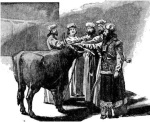
Leaning hands on a bull in an ordination offering

“… you shall offer your offerings (korbanim) from the animals from the herd or the flock.  If someone offers an olah from the [cattle] herd, he shall offer an unblemished male at the entrance of the Tent of Meeting.  He shall offer it out of his own desire in front of God.  And he shall lean his hand on the head of the olah, and it will be accepted for him, to atone for him.  And he shall slaughter the young bull in front of God.  Then the descendants of Aaron, the priests, shall offer the blood and splash the blood against the altar all around … (Leviticus/Vayikra 1:2-5)

olah (עֹלָה) = rising-offering.  (From the root verb alah (עלה) = go up.)  In an olah the entire slaughtered animal is burned up, so olah is often translated as “burnt offering” or even “holocaust offering”.

The same procedure applies to every animal offered at the altar: the donor leans his hand on the animal’s head, then slices its throat.  A priest splashes its blood on the altar, then butchers it.  For an olah, the entire animal is burned up on the altar; for other types of animal offerings, the priest waves around various pieces of the animal, then burns the fatty parts on the altar to make smoke rise up to God.  The breast and right thigh are for the priest and his family to eat.  The remaining meat is eaten by the donor and his guests.

This is difficult reading for someone who stopped eating mammals and birds 24 years ago because they are too much like human beings.3

The Torah’s instructions emphasize the affinity between livestock animals and humans be requiring the donor to lean or lay a hand on the animal’s head just before slaughtering it.  This act transfers the donor’s identity to the animal, so that killing and offering it is the equivalent of sacrificing one’s own life to God.4

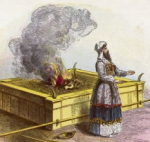
Smoke from the altar, “Treasures of the Bible”, Northrup 1894

Live, healthy cows, sheep, and goats were valuable items among the ancient Israelites, suitable as bribes, gifts, or payments to chieftains and prophets.  Dead animals were only good for hospitality, as part of a festive  meal.

What use would God have for a dead animal?

In the book of Leviticus, the fatty parts of the animal offerings are burned up into smoke, which ascends to the heavens, and the scent of that smoke pleases God.  The Torah does not specify whether an anthropomorphic God loves the smell of burning fat, or loves the smell that means humans are sacrificing valuable assets as gifts.

I can understand the desire to present God with a gift—out of sheer gratitude for our lives in the world, or out of a desire to return to harmony with the divine after we have strayed.  But I am grateful that Jews have moved beyond killing animals at an altar.

So what we can give to God instead?  The usual answer is that prayer has replaced animal offerings, and the passion of sincere prayer replaces the fire on the altar.

The first two Torah portions of Leviticus describe six types of fire-offerings.  In Part 2 of this post I will suggest alternatives for each type.  But first, let us look at fire-offerings in general.

Fire-offering

One thing that all six types of offerings have in common is that part of the offering is placed on the altar fire, and it goes up in smoke.  Even the minchah offering, which consists only of grain products, requires oil and frankincense on each item put on the altar.

When this week’s Torah portion, Vayikra, describes the first type of offering, the olah or rising-offering, it establishes that fire-offerings make God relax.

…and the priest shall bring all of it and make it go up in smoke on the altar; it is an olah, an isheh of restful fragrance for God. (Leviticus/Vayikra 1:13)

isheh (אִשֵּׁה) = fire-offering; offering burned on the altar. (From the word eish (אֵשׁ) = fire.)

Yet fire often evokes the emotion of anger the Torah; Biblical Hebrew, like English, uses words meaning “burning” and “inflamed” to indicate rage, especially God’s rage.  When the anthropomorphic God-character in the Torah gets a “hot nose”, a plague or another disaster kills thousands of Israelites, the innocent with the guilty.5

It is not the fire that that God finds restful, but the fragrance of the smoke.6

Today, some people claim that it is good to feel outrage at politicians, at authority figures who oppress the poor, and even at people who vote the “wrong” way, because outrage motivates people to take action.  Yet political action is more effective, as well as more ethical, when it comes from compassion tempered by reason.  Anger is an overwhelming emotion that carries us away, leading us to do things that our better selves regret later.

Anger is also a selfish emotion.  When we say or think “How dare they!” the underlying assumption is that “they” are threatening our power.  Both the child abuser and the rioter use what power they have to express an anger that does not respect other human beings.

Can we turn the fire of our natural selfish anger into smoke that rises up to the level of the divine?

Pillar of Fire, by Paul Hardy, 1896

To soothe an angry impulse we might make an isheh, a fire-offering, by praying, chanting, or meditating on our anger.  (I find that walking while I do this helps to release the physical energy of anger.)  If we are easily inflamed by controversies, or by the behaviors of other people, we might imagine offering our passionate anger on the altar to burn itself down.  We might visualize the smoke rising into a clear, calm sky.  After a while we might reach a state in which our original outrage is tempered both by rational considerations and by empathy for people who at first appeared to be enemies.

If we are anxious or afraid of the anger expressed by another person or group, we might sing prayers while imagining the majesty of God’s pillar of fire leading the way through the wilderness.  Eventually we, too, can move forward into the unknown with courage and calm strength.

*

Next week I will look at the six types of fire-offerings described in the Torah portions Vayikra and Tzav, and how we might address the impulse behind each one today—without slaughtering animals.

(I published an earlier version of this essay in March 2014.)

  1. From the hifil form of the verb karav (קָרַב) = come near.
  2. Exodus 29:42-45.  See my post Terumah & Psalm 74: Second Home.
  3. When I posted my first version of this essay in 2014, it was 18 years.
  4. Samakh (סָמַךְ) = he leaned (or lay) a hand (or hands) on.  When Moses lays his hands on Joshua, he transfers some of his authority and spirit to his successor as the leader of the Israelites (Numbers 27:18-23, Deuteronomy 34:9).  When the Levites are ordained, the Israelites lay hands on them to make them the people’s substitutes for service in the sanctuary (Numbers 8:10).  The word samakh is also used for the ritual before an animal sacrifice.  The word smikha (סְמִיכָה), from the root samakh, refers to the ordination of rabbis and other Jewish religious functionaries to this day.  See my post Tzav: Oil and Blood.
  5. For example, Exodus 32:10, Numbers 11:1-35, and Numbers 17:7-10.
  6. See my post Pinchas: Aromatherapy.

Pekudei & 1 Kings: A Throne for the Divine

Canaanite temples were built according to a basic three-part plan: a courtyard in front, a main hall behind it, and a small temple 2sacred chamber at the back containing a statue of the temple’s god. There were often additional rooms at the sides of the main hall for practical use by the temple’s priests and functionaries, but religious rituals happened in the courtyard, main hall, and back chamber.

The Hebrew Bible describes the construction of three sanctuaries: the portable tent-sanctuary in the book of Exodus, the first Israelite temple in Jerusalem in the first book of Kings, and the second temple in the books of Ezra and Nehemiah.

The portable Tent of Meeting that Moses assembles at the end of the book of Exodus travels with the people from Mount Sinai all the way across the Jordan River. It is erected in several locations while the Israelites are gradually conquering Canaan: Gilgal, Shiloh, Nob, Givon, and then Jerusalem. King Solomon builds the first temple in Jerusalem in the first book of Kings, and the construction of the second temple in Jerusalem begins in the book of Ezra.

All three of these sanctuaries follow the basic three-part Canaanite plan. But since the Israelites are forbidden to make an image of God, the innermost chamber at the back cannot contain a statue of their deity. So what is inside the “holy of holies”?

This week’s Torah portion, Pekudei (“Inventories”), says what Moses put into the holy of holies in the Tent of Meeting.

He took and placed the eidut in the aron, and he put the poles on the aron, and he placed the cover on top of the aron. Then he brought the aron into the dwelling-place, and he placed the curtain of screening-off, and screened off the aron of the eidut, as God had commanded Moses.  (Exodus/Shemot 40:20-21)

eidut (עֵדֻת) = testimony—of a witness or of God. (The Torah often uses this word to refer to the second pair of stone tablets Moses brings down from Mount Sinai.)

aron (אֲרוֹן)  = chest, coffer, coffin; ark of the covenant

What does the aron look like? In the book of Exodus, it is a gold-plated wooden box about four feet long, with carrying-poles attached to the bottom. Last week’s Torah portion, Vayakheil, describes how the master artist Betzaleil makes the lid of the aron:

Then he made a cover of pure gold, two and a half cubits long and a cubit and a half wide. And he made two keruvim of gold; he made them hammered out from the two ends of the cover. One keruv from this end and one keruv from that end; from the cover he made the keruvim, from its two ends. And the keruvim were spreading wings upward, screening off with their wings over the kaporet; and their faces were toward each other, toward the cover were the faces of the keruvim. (Exodus 37:6-9)

keruv (כֱרוּב), (plural keruvim)  = a hybrid beast with wings and a face. (See my earlier post: Terumah: Cherubs Are Not for Valentine’s Day.)

What are the wings of the keruvim on the cover screening off? The space above the golden lid is empty—or, at least, nothing is visible there. But the Torah treats the aron as a throne for an invisible, although not inaudible, god.

Moses came into the Tent of Meeting to speak with [God]. Then he heard the voice speaking to him from above the cover that was on the aron of the eidut, from between the two keruvim; thus [God] spoke to him. (Numbers/Bemidbar 7:89)

The keruvim and the lid of the aron are a single piece of gold in the Tent of Meeting. But in the first temple, they are separate items. While the aron stays in the tent where King David put it, King Solomon’s craftsmen make two keruvim out of olive-wood overlaid with gold. Each keruv is ten cubits (about 15 feet) tall, with a ten-cubit span from wingtip to wingtip.

Then he placed the keruvim inside the House, in the innermost [chamber]. And the wings of the keruvim spread out so the wing of one keruv touched the wall, and the wing of the second keruv was touching the second wall, and in the middle of the chamber their wings touched. (1 Kings 6:27)

The haftarah reading corresponding to the Torah portion Pekudei is from the first book of Kings. It describes the ceremony after the first temple in Jerusalem is completed, starting with a procession as King Solomon and elders from all over Israel accompany the aron on its short journey from the tent in the old city to the new House of God.

The priests brought in the aron of the covenant of God to its place, to the back room of the House, to the holy of holies, to underneath the wings of the keruvim. For the keruvim were spreading wings toward the place of the aron, so the keruvim screened off the aron and its poles from above. (1 Kings 8:6-7)

In both the Tent of Meeting and the first temple, there is an empty space between the lid of the aron below and the wings of the keruvim above. God’s voice or presence is never located inside the aron, only in the space above it.

Yet inside the aron is the eidut, God’s testimony. Commentary on the Tent of Meeting agrees that the eidut means the second, unbroken, pair of stone tablets inscribed by God on Mount Sinai (also called Choreiv). Commentators disagree on whether the aron also contained the shattered tablets, and/or a scroll that Moses wrote.

The first book of Kings clarifies the contents of the aron in the time of the first temple:

There was nothing in the aron but the two tablets of stone that Moses placed there at Choreiv, when God cut a covenant with the children of Israel after they left the land of Egypt. (1 Kings 8:9)

The first temple was sacked several times, and when the Babylonian army captured Jerusalem in 586 B.C.E. they razed it altogether. The keruvim and the aron were never recovered. So in the second temple, which was begun in 538 B.C.E., the holy of holies was an empty room. But priests still treated it as the locus of God’s presence.

After the Romans destroyed the second temple in 70 C.E., Jews had to find God’s presence in other places. Today, many of us search for God by going inside ourselves: pondering what we have learned, questioning our feelings, meditating, sinking into ritual, praying with intention, and so on. This inner journey in search of God also has stages.

If the first stage of your search is like the courtyard of the Tent or temple, does your courtyard have an altar for animal sacrifices and a basin for washing? If you push on into the main hall, does it have any of the furnishings of the Israelite sanctuaries: a lampstand for light, or a table for bread, or an altar for incense? And if you keep searching even deeper, what do you find in your holy of holies?

Do you enshrine fundamental written principles in a gold coffer? Or do you encounter fantastical creatures? If you find both in your holy of holies, are the fantastical creatures bigger or smaller than the coffer? Or is your holy of holies an empty room?

Is God present there?

Vayakheil and Ki Tissa: How to Be a Holy Artist

What does it take to create something that will help people feel the presence of God?

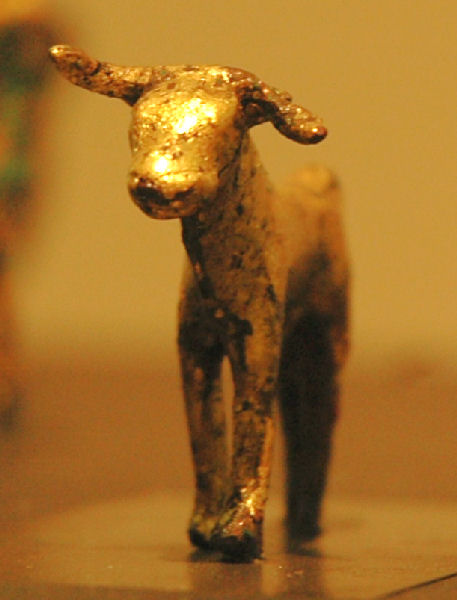
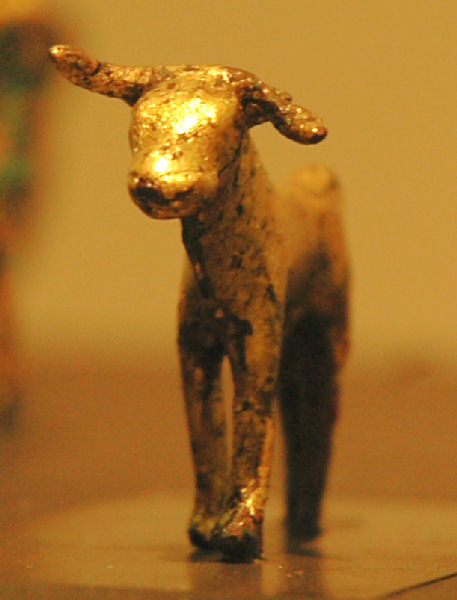
Golden Calf: figurine from the Temple of Baalat in Byblos

Aaron tries to do this when he makes the Golden Calf in last week’s Torah portion, Ki Tissa. At first, the people are ecstatic over the idol, bowing down to it and singing and dancing. But this simple and undisciplined religious outlet does not last. When Moses returns and grinds the calf into gold dust, nobody protests. Moses stirs the gold dust into water, and they all meekly swallow it. Aaron’s creation turns out to be a failure.

In this week’s Torah portion, Vayakheil (“And he assembled”), the master craftsman Betzaleil begins making the holy objects for the new sanctuary. The completed creation is so successful that it sustains the religion of the Israelites for several centuries, until King Solomon replaces it with the temple in Jerusalem.

The key difference between Aaron and Betzaleil as creators of religious objects appears in the Torah twice, repeated word for word. In the portion Ki Tissa, God says it to Moses. In this week’s portion, Moses says it to the Israelites:

See? God has called by name Betzaleil, son of Uri, son of Chur, of the tribe of Yehudah. And [God] has filled him with ruach of God, with chokhmah, with tevunah, and with da-at, and with every craft. (Exodus/Shemot 35:30-31)

ruach (רוּחַ) = wind; spirit, motivation, overwhelming state of mind.

(Usually when the ruach of God comes over someone in the Hebrew Bible, that person speaks as a prophet or leads people into battle. Exceptions are Samson, who is gripped by a murderous rage and supernatural strength; and Betzaleil the artist, who is filled with a divine motivation to create.)

chokhmah (חָכְמָה) = wisdom; inspiration.

tevunah (תְבוּנָה) = insight, rational understanding, analytic ability.

da-at (דַעַת) = knowledge.

In later Kabbalistic writings, chokhmah and binah (another form of the word tevunah) are two of the sefirot or divine powers.  Chokhmah is the sefirah associated with the left side of the head, i.e. the left brain that popular science now associates with non-rational, intuitive, holistic consciousness. Binah (tevunah) is the sefirah associated with the right side of the head, i.e. the right brain that we now associate with rational, logical, analytic thinking. In the Kabbalist system, da-at is the product of chokhmah combined with binah.

Aaron, although he will serve as the high priest, lacks the four qualities with which God fills Betzaleil. When the Israelites are waiting at the foot of Mount Sinai in Ki Tissa, Aaron feels no ruach of God, no divine urge to create a holy object. The people decide Moses will never return and order Aaron: Get up, make for us gods that will go before us! (Exodus 32:1). Then Aaron acts, but only to satisfy the crowd.

He has no chokhmah, no inspiration nor wisdom about what to make; he merely calls for gold earrings to melt down, since the finest idols are made of gold.

He took it from their hands and he shaped it with the engraving tool, and he made it into an image of a calf. (Exodus 32:4)

Afterward, when Aaron explains to Moses what happened, he says: I said to them, “Who has gold? Pull it off yourselves.” And they gave it to me and I threw it into the fire and out came this calf.” (Exodus 32:24)

Aaron admits that he acted without any of the insight or discrimination of tevunah, and also without any da-at, any knowledge of what would emerge from the fire.

Betzaleil, on the other hand, is born betzalmeinu—in God’s shadow or image—when it comes to creativity. (See my post Vayakheil: Shadow Power.) He creates under the protection of God’s shadow. God “fills” him with the qualities he already has the potential and experience to develop.

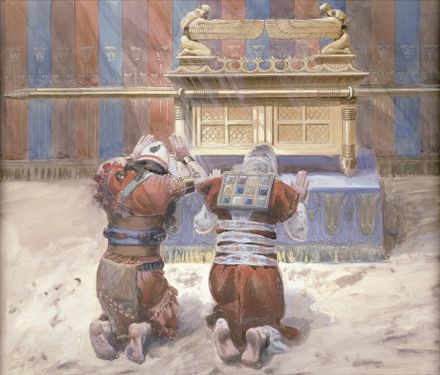
Bowing Before the Ark, by James Tissot, ca. 1900

Even as Moses comes down with God’s basic design for a portable sanctuary, Betzaleil is filled with a divine desire to create it. He has the chokhmah to visualize the whole thing, and to imagine beautiful and inspiring objects—from the gold keruvim (hybrid winged beasts) on top of the ark to the design embroidered in brilliant colors on the curtain at the entrance to the Tent of Meeting. He has the tevunah to analyze and understand how each part can be made well and assembled into the whole. And he has da-at, knowledge, of every craft: metal-working, jewelry, wood-working, weaving, and embroidery.

Betzaleil is so filled with chokhmah, tevunah, and da-at that he and his assistant can teach other craftsmen and craftswomen among the people.

And [God] put teaching into his heart, him and Ahaliyav son of Achisamakh of the tribe of Dan. (Exodus 35:34)

And Betzaleil and Ahaliyav and everyone wise of heart to whom God gave chokhmah and tevunah for da-at and for doing all the work for the service of the Holy, they shall do everything that God commanded. (Exodus 36:1)

The sanctuary that is completed in next week’s Torah portion, Pekudei, is the product of the grand design Moses heard from God; the divine spirit, inspiration, understanding, and know-how of the master artist, Betaleil; and the enthusiasm and wisdom of the contributors in the community. No wonder it becomes a place where people feel God’s presence.

I think that the qualities God gives Betzaleil are necessary for anyone to produce truly moving art, whether its explicit goal is religious or not. I know that when I do “creative writing”, especially of Torah monologues and fiction, both my motivation (ruach) and my inspiration (chokhmah) seem to come from a mysterious place outside myself, or perhaps from some inner place so deep my conscious mind can never penetrate it. I might as well say they come from God, the great mystery.

But the most burning motivation and inspiration leads nowhere without the application of rational insight and analysis (tevunah). My own ability in this area is a talent I was born with, a gift of God, that I have developed over many years of practice. And as in Kabbalah, I have found that the combination of left-brained inspiration (chokhmah) and right-brained analysis (binah or tevunah) does indeed result in knowledge (da-at).

The final requirement for creating art is to actually do all the labor. I am grateful that the ruach that blows through me from the unknown source I call God is strong enough to motivate me to keep on working, with enthusiasm—like the Israelites in this week’s Torah portion.

May the divine spirit be strong in all artists.

Ki Tisa: Fighting or Singing?

After God’s revelation to the Israelites at Mount Sinai, the people repeatedly promise to do everything God says. Then Moses and Aaron lead the elders halfway up the mountain, where they have a vision of God’s feet. (See my earlier post, Mishpatim: After the Vision, Eat Something.)

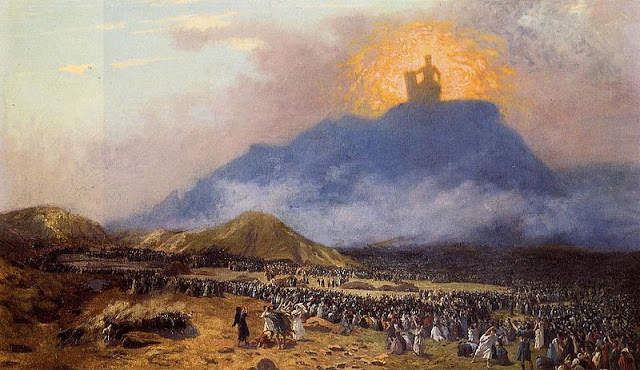
Moses on Mt. Sinai,
by Jean-Leon Gerome, 19th century

This is their high point. After this, Aaron and the Israelite leaders go downhill, both literally and figuratively. Joshua, Moses’ attendant and war-leader, stays partway up the mountain. And Moses climbs to the summit again. There he disappears into God’s cloud—or fire, from the point of view of the Israelites below. (See my earlier post, Mishpatim: Seeing the Cloud.)

Inside the cloud, Moses listens to God’s instructions for 40 days . Meanwhile, the Israelites below conclude that their prophet has died in the fire on the mountaintop and will never return. And without Moses, how can their god lead them to their promised land?

Gold calf from Temple of Baalat, Byblos

They fall back on an old and familiar solution in this week’s portion, Ki Tissa (“When you bring up”): a physical image or idol for the god to inhabit. They give Aaron their gold earrings, and get him to mold an image in the shape of a calf. On his own initiative, Aaron builds an altar and declares a festival for God the next day.

The same day that the Israelites bring animal offerings to the new altar, God hands Moses the two stone tablets written by the finger of God (Exodus/Shemot 31:18), tells him to go down the mountain, and then tells him what the Israelites have done.

Quickly they deserted the path that I commanded them! They made for themselves a cast image of a calf, and they bowed down to it and they slaughtered offerings to it, and they said: These are your gods, Israel, that brought you from the land of Egypt. (Exodus 32:8)

God offers to consume the Israelites and make Moses into a great nation instead. But Moses refuses the offer and tramps down the slope, still holding the two stone tablets on which God wrote, among other things, the commandment against making idols.

Joshua joins his mentor partway down. He has spent 40 days waiting on the mountainside, unaware of what was happening either to Moses at the top or to the Israelites at the bottom.

Then Joshua heard the sound of the people as they shouted, and he said to Moses: The sound of battle is in the camp! (Exodus 32:17)

Moses does not reply. Joshua listens carefully as they continue to descend.

And he said: Not the sound of anot of prevailing, and not the sound of anot of defeat. A sound of annot I am hearing. (Exodus 32:18)

anot (עֲנוֹת) = responding, answering; humiliating, abusing; call-and-response singing (such as kirtan or antiphony).

annot (עַנּוֹת) = (This form of the verb anot is used most often for humiliation, but it is also used in at least one other place, Isaiah 27:2, for singing.)

If there were indeed a battle in camp, Joshua would hear the winners raising their voices in war-cries, abuse, or battle-songs. He would also hear the losers raising their voices in pain, fear, or grief. Because he does not hear these sounds, he concludes that there is no battle. The camp has not been attacked by strangers. Nor has it divided into two sides fighting each other. Whatever the people are doing, nobody in the camp is objecting to it.

What sound does Joshua decide he is hearing? Here are two possible translations:

“A sound of humiliation I am hearing.” In other words, he is hearing the sound of people who have abandoned reason and conscience. Maybe sexual excess has turned into rape. Or maybe the people’s wild party is humiliating for Joshua and Moses, the only two Israelites left to stand against the worship of the Golden Calf.

“A sound of call-and-response singing I am hearing.” In other words, he is hearing a joyful celebration. Elsewhere in the Bible, people use call-and-response singing, along with dancing, to rejoice over God’s success (as Miriam does after they cross the Reed Sea), and to rejoice over David’s victories in battle.

I can imagine Joshua realizing that something happened in the camp, while Moses was gone, and now the Israelites are either holding an orgy, or singing and dancing to rejoice over—what?

The Torah returns to Moses’ point of view.

Moses Breaking the Tablets, by Rembrandt

And it happened as he drew near to the camp, he saw the calf and dancing. Then Moses’ anger flared up, and he threw down from his hand the tablets, and he shattered them under the mountain. (Exodus 32:19)

Moses already knows about the Calf, so why does his anger flare up now? One frequent answer by commentators is that now he sees the people dancing. If the Israelites were worshiping the Calf in a state of doubt and anxiety, they might reject their idol as soon as they saw Moses. Instead, they are rejoicing over the Golden Calf, as if they like the old-time religion better than following Moses’ lead.

It takes the shock of the shattering tablets to yank them back into their former state of mind, when they promised to obey the god of Moses.

Joshua already knows the Israelites are singing. He can assume they are also dancing; elsewhere in the Bible call-and-response singing is usually accompanied by dancing. Now Joshua sees the Golden Calf and the smoking altar in front of it, so he knows the reason for the people’s ecstasy. He also hears the sound of stone shattering. The singing stops.

Moses grinds the Calf into gold dust, adds it to water, and makes the people drink it. He questions Aaron briefly, then stands at the gateway of the camp and shouts: Whoever is for God, to me! (Exodus 32:26)

All the men from the tribe of Levi go over to the side of Moses and Joshua. Moses orders the Levite men, in the name of God, to take their swords and go through the camp from gate to gate.  The Levites kill 3,000 Israelite men. The Torah reports no casualties on the Levite side; apparently the Calf worshippers were too cowed or ashamed to fight back.

So Joshua finally does hear the battle cries of the winners, and the screams of pain and humiliation of the losers. There is no more singing of any kind in the Torah until the book of Numbers/Bemidbar.

I have always wondered if killing 3,000 Calf-worshippers was overkill. After all, everyone was shocked when Moses shattered the tablets God gave him. Everyone drank the gold dust from the Calf. What if Moses’ next move had been to start up a song, instead of a massacre?

What if he had changed the words of the call-and-response song the people were singing for the Calf? Their song is not recorded, but here are two other call-and-response songs in the Torah:

Sing to God because He is the highest;

Horse and its rider He threw into the sea! (Exodus 15:21)

Saul struck down his platoons;

And David struck down his armies! (I Samuel 21:12)

Some people need the outlet of ecstatic song and dance. Maybe another call-and-response song would have turned the hearts of the apostate ecstatics toward the God of Moses. Here is my proposal for the people who rejoiced in the Golden Calf:

“Sing to God because He is the highest;

Higher than idols and higher than gold.”

Just set it to a catchy melody, and let Miriam lead the dancing.

Terumah & 1 Kings: Tent versus Temple

A 2,000-year-old tradition pairs every weekly Torah portion with a haftarah, a reading from the Prophets/Neviim. In this week’s Torah reading, Terumah (“Donations”), God gives Moses instructions for building a sanctuary. This week’s haftarah is a passage from the first book of Kings about how King Solomon begins building the temple in Jerusalem.

The sanctuary and the temple both contain the ark, menorah, bread table, and incense altar. Both are places where priests perform the rituals prescribed in the Torah. But there are dramatic differences between the two structures.

For one thing, the building materials dictate whether each holy structure is portable or stationary. The Torah portion Terumah specifies that the walls of the mishkan will be made out of woven pieces of cloth hung on a framework of gilded acacia planks and beams.

The Tabernacle that the Israelites
Built, Charles Foster Bible, 1897

And you shall make the mishkan of ten panels of fabric, made of fine twisted linen, and sky-blue dye and red-violet dye and scarlet dye …(Exodus/Shemot 26:1)

mishkan (מִשְׁכָּן) = sanctuary, dwelling-place for God. (The word is used for the portable tent-like sanctuary created in the book of Exodus and used until the second book of Samuel.)

Next God tells Moses to make the roof out of woven goat-hair, and cover it with tanned hides. The mishkan would look like a huge tent of vividly-colored cloth, its framework resting directly on the earth. After it has been built, the Torah often calls this sanctuary the “Tent of Appointed Meeting”.

The courtyard in front of it, containing the altar for burning animal offerings, is to be enclosed by another wall of linen cloth, this one roofless. I can imagine the cloth walls of both the courtyard and the tent glowing in the sunlight, and the gold, silver, and bronze fittings gleaming. The structure would be beautiful, but also obviously portable, easy to disassemble and move to the next location.

While the mishkan is temporary, Solomon’s temple is built to last.

The king commanded, and they quarried huge stones, valuable stones, to lay the foundation of the house with hewn stones. (1 Kings 5:31)

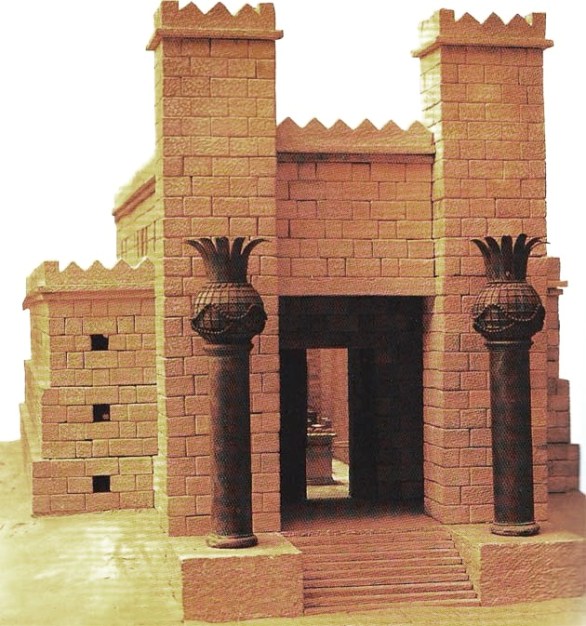
First Temple reconstruction,
Bible Museum, Amsterdam

On this foundation, the “house” is built out of more large squared stones, then paneled inside with cedar wood, and roofed with cedar planks. Additional rooms are built against the outside walls, all the way around. The temple is three stories high, with stairs and narrow latticed windows. This sanctuary could never be disassembled and moved. It is supposed to be permanent. According to the Hebrew bible, it lasted for four centuries, until the Babylonian invaders destroyed it. During that time, the central place of worship for the southern kingdom remained fixed in its capital, Jerusalem.

Another important difference between the tent and the temple is how the materials and labor to build them were obtained. The materials for the tenttextiles, hides, wood, and metals—are all gifts volunteered by the Israelites. This week’s Torah portion opens with God asking for only voluntary donations.

God spoke to Moses, saying: Speak to the children of Israel, and they shall take for me a donation from every man whose heart urges him; [from him] you shall take My donation. And this is the donation that you shall take from them: gold or silver or bronze, or sky-blue or red-violet or scarlet dyes, or linen or goat hair, or hides… (Exodus/Shemot 25:1-5)

But the stone and cedar for Solomon’s temple are purchased from a foreign king, Chiram of Lebanon. This week’s haftarah opens:

God had given wisdom to Solomon, as [God] promised him; and there was peace between Chiram and Solomon, and the two of them cut a treaty. (1 Kings/Malchim 5:26)

Just before this verse, the first book of Kings describes the deal between Chiram and Solomon: Hiram will provide timber and stone for Jerusalem, and in exchange Solomon will pay Hiram in annual shipments of wheat and olive oil—shipments that would require a heavy tax on Israel’s farmers.

In the book of Exodus, both women and men enthusiastically volunteer to do the weaving, carpentry, and metal-working for the tent sanctuary. In the first book of Kings, Solomon imposes forced labor on the Israelite men to do the logging and quarrying.

And King Solomon raised a mas from all of Israel, and the mas was 30,000 men. He sent them to Lebanon, 10,000 a month in turns; they were in Lebanon for a month, two months at home. And Solomon loaned 70,000 burden-carriers and 80,000 stone-cutters on the mountain. (1 Kings 5:28-29)

mas (מַס) = compulsory labor, corvée labor, levy

Compulsory labor, mas, is what the pharaoh imposed on the Israelites in Egypt—the slavery that God and Moses freed them from. King Solomon gets away with his temporary mas, but later in Kings, his son Rechavam imposes an even heavier “yoke” on his people, and they revolt against him.

So while the mishkan is constructed with voluntary gifts and voluntary labor, the temple is built through agricultural taxes and forced labor.

In the Torah portion, Moses gets instructions for making a sanctuary from God Itself. In the haftarah, Solomon remembers his father David’s desire to build a temple, and after he has built a palace for himself, he starts the temple on his own initiative.

In both cases, God makes a conditional promise to dwell among the Israelites. In the Torah portion, God will stay with them if they make a place for God:

And they shall make for me a holy place, and I will dwell in their midst. (Exodus 25:8)

But in the haftarah, God will stay with the Israelites if King Solomon follows the rules:

And the word of God came to Solomon, saying: This house that you are building—if you follow my decrees and you do my laws and you observe all my commandments, to go by them, then I will establish my word with you that I spoke to David, your father: then I will dwell in the midst of the children of Israel, and I will not desert my people Israel. (1 Kings 6:12-13)

The differences between the mishkan and the temple imply two different approaches to religion. The sanctuary God describes to Moses belongs to the people; they make it voluntarily, they move it with them wherever they go, and God dwells among them because they make a holy place for God.

The temple of Solomon belongs to the king; he oppresses his own people in order to procure the materials and labor, he fixes it permanently in Jerusalem, and God dwells among his people because King Solomon obeys God’s rules.

I believe the tent-sanctuary described in the Torah portion represents the ideal approach to communal religion, in which everyone in the community contributes enthusiasm, support, or creativity; in which textual interpretations and rituals are flexible enough to move and change along with the people; and in which everyone makes a holy place for God.

Yet this ideal cannot always be realized. There are times everyone, including me, is too exhausted or too stuck to manage creative communal worship. Sometimes we just need a place to go where the rituals will be fixed and familiar, and where a trusted authority figure is taking care of everything and telling us what to do.

We need both tents and temples.