Va-eira & Shemot: Patchwork

Sometimes a narrative section in the Torah flows as smoothly as a tale told by a master storyteller. Other times the narrative is a patchwork of different versions of the story, with obvious seams.

Those who believe that God dictated every word in the first five books of the bible to Moshe (“Moses” in English) either ignore the seams, or do some mental acrobatics to explain them away. I like to imagine that God’s dictation is interrupted when God gets distracted by other things happening in the world. But I daresay the single-author stalwarts would never accept a God who has trouble multi-tasking.

I prefer to explain the patchwork parts of Torah by applying a key hypothesis of modern source criticism: that several versions of the same story were circulating in ancient Israel when a redactor1 combined them to produce what became the authoritative version, the version recorded from then on in Torah scrolls. Sometimes the resulting narrative reads seamlessly. But some seams are definitely showing in the stitching together of last week’s Torah portion, Shemot (Exodus/Shemot 1:1-6:1) with this week’s Torah portion, Va-eira (Exodus/Shemot 6:2-9:35)—particularly regarding the question of who is qualified to speak for God.

Who speaks?
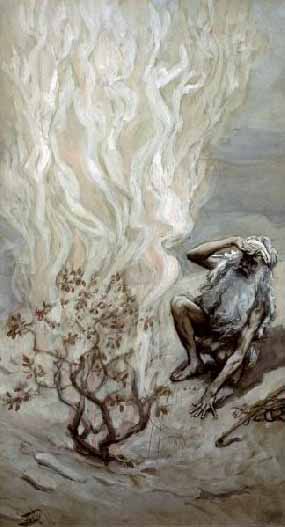
Moses Adores God in the Burning Bush, by James Tissot, ca. 1900

The first time Moshe goes to Mount Sinai, in the portion Shemot, he is a shepherd. He walks over to look at a bush that burns but is not consumed, and finds himself having a conversation with God—the God of his Israelite birth parents in Egypt. He learns that God plans to bring the oppressed Israelites out of Egypt and to the land of Canaan, and that he will be God’s agent.

Moshe tries five times to get out of this assignment. His penultimate attempt is to protest that he is a very poor speaker.

Then God said to him: “Who placed a mouth in the human being? … Is it not I, God? And now go! I myself will be with your mouth, and I will teach you what you will speak.” But he said: “Excuse me please, my lord. Please send by the hand of [someone] you should send!” (Exodus 4:11-12-13)

But God is not about to send someone else to liberate the Israelites. So God compromises, saying:

“Is not your brother Aharon the Levite? I know that he can certainly speak. And also, hey! He is going out to meet you, and he will see you and rejoice in his heart. And you will speak to him, and you will put the words in his mouth. And I myself will be with your mouth and with his mouth, and I will teach you both what you must do. And he will speak for you to the people. And he himself will be like a mouth for you, and you yourself will be like a god for him. And this staff, you will take it in your hand, because you will do the signs.” (Exodus 4:14-17)

In other words, Moshe will be God’s spokesperson, and Aharon will be Moshe’s spokesperson. Moshe will use his staff to initiate the miracles God has planned to impress first the Israelites, then the pharaoh.

Who holds the staff?

Moshe heads toward Egypt, and meets his brother at Mount Sinai. He tells Aharon everything he knows so far. Then both men go to Egypt and gather the Israelite elders.

And Aharon spoke all the words that God had spoken to Moshe, and he did the signs before the eyes of the people. And the people believed, and they paid attention … (Exodus 4:30-31)

Things seem to be going according to God’s plan. Next Moshe and Aharon go to the pharaoh and request that the Israelites get three days off work to go into the wilderness and sacrifice to their God. The pharaoh doubles their work instead, requiring them to find their own straw while still making their daily quota of bricks. The Israelite foremen blame Moshe and Aharon, and Moshe asks God:

“My lord, why did you do harm to this people? Why did you send me? Since I came to Paroh to speak in your name, he has done evil to this people; and you have certainly not rescued your people!” (Exodus 5:22-23)

Paroh (פַּּרְעֺה) =the title of the king of Egypt, “Pharaoh” in English. The portion Shemot ends with God saying the equivalent of “Just wait and see”.

Who memorizes the divine words?

The portion Va-eira then begins with God repeating what Moshe already learned on Mount Sinai. Then God says:

“Therefore, say to the Israelites: I am Y-H-V-H. I will bring you out from under the forced labor of Egypt, and I will rescue you from serving them, and I will redeem you with an outstretched arm and with great judgments. And I will take you for myself as a people, and I will be for you as a God, and you will know that I am GOD, your God, who brings you out from under the forced labor of Egypt. And I will bring you to the land where I raised my hand [in an oath] to give to Avraham, Yitzchak, and Yaakov, and I will give it to you as a possession. I am Y-H-V-H.” (Exodus 6:6-8)

This is quite a speech to memorize and deliver, for a man who knows he is a poor speaker. But the next verse says:

Then Moshe spoke thus to the Israelites. But they did not listen to Moshe, due to shortness of spirit and due to hard servitude. (Exodus 6:9)

In the portion Shemot, Moshe refused to speak to the Israelites without Aharon as an interpreter. But here in Va-eira, Moshe simply tells the people what God said—with no speech defect, no difficulty with Hebrew, no hesitation over the words. Aharon is not mentioned.

Classic commentary does not try to explain this sudden change. But the change makes sense if a redactor has suddenly switched to a different version of the story. Modern source scholarship identifies the story of Moshe’s recruitment on the mountain in the portion Shemot with a non-P (non-priestly) tradition.2 The version from the P tradition begins with Exodus 6:2, which is also the first verse of the portion Va-eira.

Clumsy lips

Right after the overworked Israelites ignore Moshe’s message, God orders Moshe to speak to the pharaoh. Moshe objects:

“Hey, the Israelites do not listen to me. Then how will Paroh listen to me? And I have foreskinned lips!” Then GOD spoke to Moshe and to Aharon, and commanded them regarding the Israelites and Paroh, king of Egypt—to bring out the Israelites from the land of Egypt.” (Exodus 6:12-13)

According to Richard Elliott Friedman, these two verses were added by a redactor.3 But why? Moshe and Aharon have already received God’s instructions. “Foreskinned lips” might indicate that Moshe’s problem as an orator is a speech defect, and the Israelites who were overworked and short of breath did not invest the energy to understand him. But there is no need to insert Moshe’s objection here, since he describes his lips that way again after an intermission giving Moshe and Aharon’s genealogy.

And GOD spoke to Moshe, saying: “I am GOD. Speak to Paroh, king of Egypt, everything that I speak to you.” And Moshe said before GOD: “Hey, I have foreskinned lips! So how will Paroh listen to me?” (Exodus 6:29-30)

Who speaks to the pharaoh?

In the P version of the story in the portion Va-eira, it appears that the whole conversation on Mount Sinai recorded in the portion Shemot never happened, because next God reacts to Moshe’s protest as if it were news, and tells Moshe the same solution God gave on Mount Sinai:

“See, I place you as a god to Paroh, and your brother Aharon will be your prophet. You yourself will speak everything that I command you, and your brother Aharon will speak to Paroh, and he will send out the Israelites from his land.” (Exodus 7:1-2)

Does this mean that from now on, God will speak to Moshe, Moshe will speak to Aharon, Aharon will speak to the pharaoh, and Moshe will initiate miracles with his staff—the same arrangement God decided on in the Mount Sinai version?

No.

First Moshe learns that God will harden the pharaoh’s heart after each miracle, so he will not let the Israelites go until God is ready to bring them out of Egypt. Then God gives instructions for a preliminary miracle:

“When Paroh speaks to you, saying: Give us a miracle for yourselves!—then you must say to Aharon: Take your staff and throw it down before Paroh; it will become a reptile.” (Exodus 7: 9)

Already Aharon is the brother wielding the staff.

The first miracle that affects the whole country is turning the water of the Nile River into blood. At God’s command, Moshe warns the pharaoh at length. Then Aharon strikes the surface of the river, and God turns the water into blood (Exodus 7:14-20).
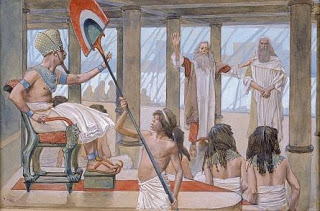
Moses Speaks to Pharaoh, by James Tissot, ca. 1900

The next miracle, frogs, goes the same way, with Moshe speaking to Pharaoh, and Aharon wielding his staff (Exodus 7:26-8:2). Pharaoh summons both of them and promises to release the Israelites if they plead with their God to remove the frogs. With no prompting from God, Moshe asks Pharaoh to name the day of the frog removal, and adds that the death of the frogs on that exact day will prove God’s unique power (Exodus 8:5-7). For someone who claimed in the portion Shemot that he was “not a man of words”,4 he is thinking on his feet and speaking eloquently and confidently.

Moshe continues to be the one who speaks to Pharaoh throughout the rest of the portion Va-eira. Aharon stretches out his staff to initiate the miraculous plague of gnats or lice (Exodus 8:12-13), but Moshe holds out his staff to initiate the plague of hail (Exodus 9:22-23). Regardless of who wields his staff, Moshe does all the talking—and continues through the last three miracles—locusts, darkness, and death of the firstborn—in the following Torah portion, Bo.

Throughout the narrative of the ten miracles or plagues, non-P sources alternate with P sources, according to modern source scholars. But the redactor of this section of narrative stitches together the two versions of the story seamlessly, maintaining Moshe as the prophet who speaks directly to the pharaoh, and showing his increasing confidence and authority.5


But in the narrative section from Moshe’s call to prophecy on Mount Sinai (in the portion Shemot) to the miracle of turning water into blood (in the portion Va-eira), the redactor hops between sources without harmonizing them.

I wish the redactor had used more care. It is not that hard to redact; every week I write a lot about the weekly Torah portion or haftarah reading, then go back and select which paragraphs I will actually use for my blog post, often rearranging them in the process. If something I have written does not fit the theme, I remove it and save it for another post. If one paragraph seems to contradict the section before it, I add an explanation. And if I actually do contradict myself, I think about it and start over!

However, I am only redacting my own writing. What if I had the job of combining two earlier stories that I viewed as equally sacred? Perhaps the redactor of this part of the book of Exodus could not bear to eliminate either the narrative that views Moshe as unable or unwilling to speak, or the narrative in which Moshe speaks eloquently to the pharaoh.

What would I do, faced with that dilemma? I would include both—but rearrange the passages slightly, and write a little extra material, to show that Moshe is gradually learning how to speak and gaining confidence.


  1. Although the current usage of “redact” usually focuses on making deletions from a piece of writing, biblical scholarship uses “redact” to mean selecting and arranging various pieces of writing to make a single document.
  2. Julius Wellhausen (1844–1918), formulated a “documentary hypothesis” identifying different passages in the Pentateuch (Genesis through Deuteronomy) as coming from one of four sources: J, E, P, and D. Source scholarship today abounds with disagreements about non-P sources, as well as different theories for dating P and other sources. But the consensus is that the P (priestly) source is different from all other sources and is clearly identifiable.
  3. Richard Elliott Friedman, the Bible with Sources Revealed, HarperCollins, New York, 2003, p. 128.
  4. Exodus 4:10. See my post Shemot: Not a Man of Words.
  5. See my post Shemot to Bo: Moses Finds his Voice.
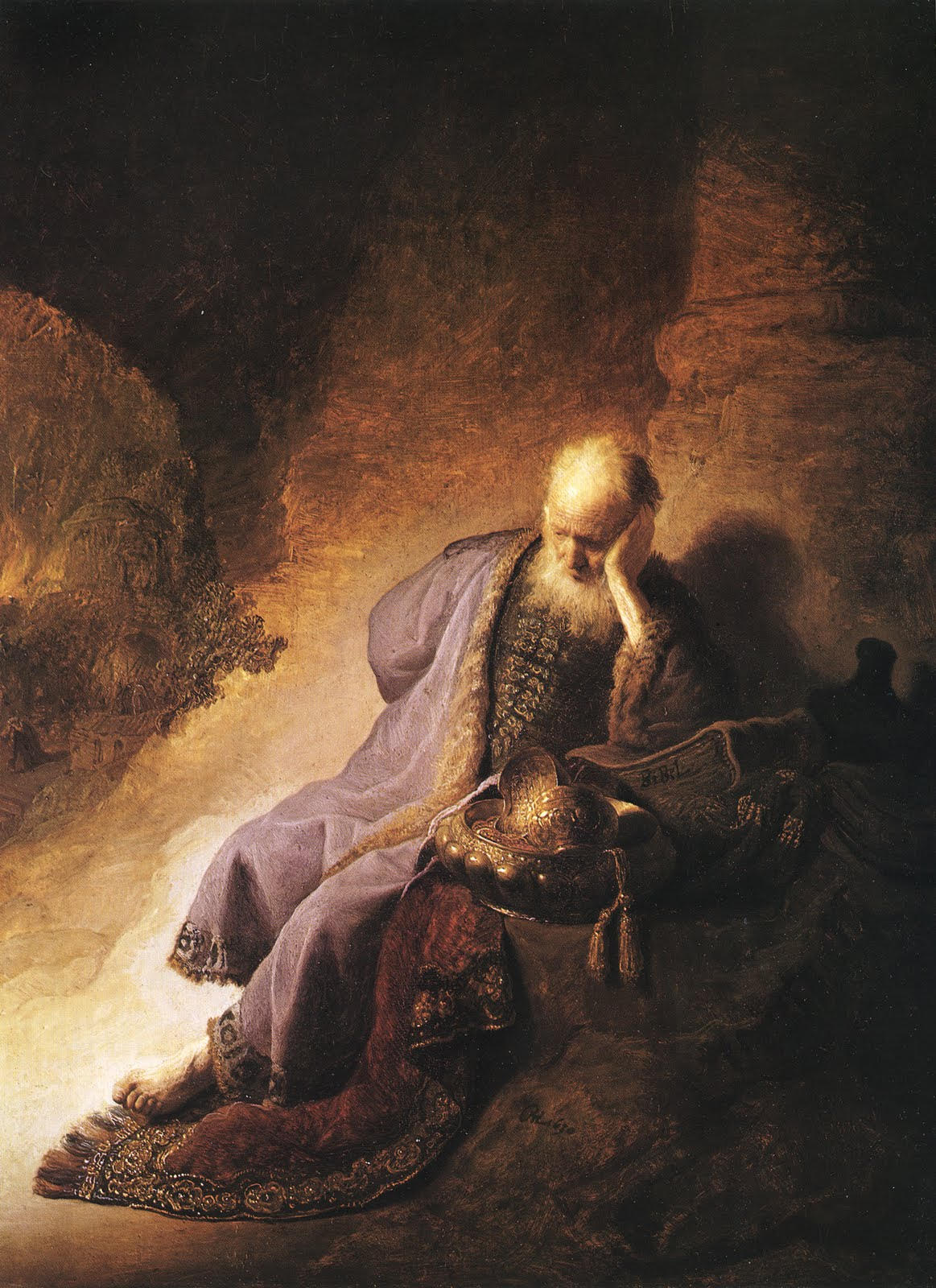
Haftarat Shemot or Matot—Jeremiah: A Congenital Prophet

(In this post I refer to people by their Hebrew names first, but to books and places by their English names.)

The English word “prophet” means “1. one who utters divinely inspired revelations. … 2. one gifted with more than ordinary spiritual and moral insight. … 3. one who foretells future events: predictor.”1

The Biblical Hebrew word navi (נָבִיא), routinely translated as “prophet”, means: 1. one who goes into a temporary altered state and experiences God.2 2. one who receives messages from God and communicates at least some of them to other people.3

Even the second kind of navi does not predict the future, but rather warns people about what God will do to them if they do not change their ways.4 Everyone in the Hebrew Bible who hears or reads one of these prophecies has a choice: to continue their behavior and eventually suffer the prescribed doom from God, or to stop doing the wrong things and avoid the doom.

Ironically, although the recipients of prophecies have free will (the ability to choose their own actions), the prophets themselves may not.

Jeremiah Lamenting the Destruction of Jerusalem, by Rembrandt, ca. 1630

A time for prophecy

Yirmeyahu (“Jeremiah” in English) seems to have no choice but to prophesy, whether he wants to or not. His dilemma is introduced in the haftarah reading Jeremiah 1:1-2:3, which goes with this week’s Torah portion, Shemot, according to the Sefardi tradition.5 The book of Jeremiah opens:

The words of Yirmeyahu, son of Chilkiyahu, one of the priests who were at Anatot in the territory of Benjamin. (Jeremiah 1:1)

Already we know that the father of Yirmeyahu (Jeremiah) is a priest, perhaps even the high priest named Chilkiyahu during the reign of King Yoshiyahu (“Josiah” in English).6 Priesthood is hereditary in Ancient Israel, so Yermiyahu (Jeremiah) is born a priest. He is also born in the territory of Benjamin, close to Jerusalem, the capital city of the kingdom of Judah.

Before he reaches adulthood, he finds out that he is also a prophet.

The word of God happened to him in the days of Yoshiyahu son of Amon, king of Judah, in the thirtieth year of his reign. (Jeremiah 1:2)

King Yoshiyahu (“Josiah” in English) ruled the kingdom of Judah from 640 to 608 B.C.E.—after the Assyrian Empire to the north had become weak and ceded some of northern kingdom of Israel to Judah, and before the new Babylonian empire had grown strong. According to 2 Kings 22 and 23, King Yoshiyahu crusaded to get rid of all the shrines and priests serving other gods.7

There is not much work for Yirmeyahu (Jeremiah) until after King Yoshiyahu dies, since the main roles of a prophet during the time of the Israelite kingdoms are to challenge government policies and to shame or frighten rich citizens into reforming. But then Babylon’s power grows, and the kings of Judah make no changes in policy to address the threat. The word of God happens to Yirmeyahu (Jeremiah) more often, and many of his prophesies warn that unless people return to the exclusive worship of God, and embrace God’s ethical rules, the Babylonians will conquer Judah and Jerusalem.

And it happened through the days of Yehoyakim son of Yoshiyahu, king of Judah, until the end of the eleventh year of Tzidekiyahu son of Yoshiyahu, until Jerusalem went into exile in the fifth month. (Jeremiah 1:3)

The reign of King Tzidekiyahu (“Zedekiah” in English) ended in 586 B.C.E. when the Babylonian army completed its conquest of Judah by destroying Jerusalem and exiling almost all of its remaining citizens to Babylon.

A congenital prophet

The narrative in this week’s haftarah then switches to the first person, and Yirmeyahu (Jeremiah) speaks.

And the word of God happened to me, saying: “Before I formed you in the belly, I knew you; and before you went out of the womb, I set you apart as holy. A prophet to the nations I appointed you.” (Jeremiah 1:4-5)

What is God communicating here?

“Before I formed you in the belly, I knew you.” Psalm 139 is the only other biblical passage that says God gives human fetuses their physical form and some aspect of their personality:

For you yourself provided my conscience;

            You wove me together in my mother’s womb. (Psalm 139:13)

Furthermore, in Psalm 139 God knows all human thoughts:

God, you have examined me and you know me.

You know [when] I sit down and stand up,

            You discern my intention from afar. (Psalm 139:1-2)

The new claim in the book of Jeremiah is that God knows Yirmeyahu even before weaving him together in the womb. This might mean that God knows what certain individuals will be like in the future. Or it might mean that God creates someone’s personality even before creating that person’s body.

“And before you went out of the womb, I set you apart as holy.” This statement could mean merely that Yirmeyahu (Jeremiah) was born into the priesthood, since priests are holy in the sense of being set apart for temple service and restricted regarding marriage and mourning.8 But it might also mean that God made him, in utero, even holier than a priest, even more set apart from normal life.

“A prophet to the nations I appointed you.” In the rest of the book of Jeremiah, the prophet addresses most of his prophecies to the citizens of Judah, although he does utter some prophecies about other nations.9 But the point in this verse is that before Yirmeyahu (Jeremiah) was born, God determined how he would spend his entire adult life.

A right of refusal?

That raises the question of whether it is even possible for Yirmeyahu (Jeremiah) to refuse to speak as a prophet. (Presumably he cannot help hearing, or otherwise experiencing, God.) Some modern commentators assert that he does have the power to refuse. For example, Plaut wrote:

“The call to Jeremiah may thus be seen to express both predetermination and freedom: the child was born with particular gifts and a high degree of religious sensitivity. But giving his life to a pursuit of the divine call—with all its rewards, difficulties and dangers—was a decision that Jeremiah had to make for himself.”10

After God’s opening salvo, Yirmeyahu (Jeremiah) protests that he does not have the eloquence to be a prophet.

“Ah-ah, my lord God! Hey, I do not know how to speak, since I am a na-ar.” (Jeremiah 1:6)

na-ar(נַעַר) = boy or young man.

He says this, according to Malbim, because he lacks confidence, because he does not know how to speak well in front of a congregation, and because he is afraid people will kill him on account of his prophecies.11

And God said to me: “Don’t you say ‘I am a na-ar’. For you will go wherever I send you, and you will speak whatever I command you.” (Jeremiah 1:7)

Midrash Tanchuma explains, ominously: That is, against your will you will go, and against your will you will speak.”12

Indeed, later in the book Yirmeyahu (Jeremiah) complains:

“… the word of God happens to me, for scorn and derision all day. So I thought: I will not mention him, and I will not speak any more in his name. But it [God’s word] happened in my mind like a burning fire shut up in my bones, and it exhausted me to hold it in, and I could not endure.” (Jeremiah 20:8-9)

By the prophet’s own testimony, he has no freedom of choice when it comes to prophecy.

A promise of rescue

After God tells Yirmeyahu (Jeremiah) that he must go and speak at God’s command, God attempts to reassure him by saying:

“Don’t be afraid in front of them! For I am with you to rescue you.” (Jeremiah 1:8)

“To rescue you” could mean merely to rescue him if his speech stumbles. But God makes the real meaning clear before the interview is over:

“And hey, I appoint you this day as a fortified city, and as an iron pillar, and as bronze walls, against the whole land—against the kings of Judah, against its officers, against its priests, and against the people of the land. And they will battle against you, but they will not prevail over you, because I am with you,” declares God, “to rescue you!” (Jeremiah 1:18)

Later in the book, the prophecies of Yermiyahy (Jeremiah) are so unpopular that he needs to be rescued from various death threats.13 The worst is when he tries to leave Jerusalem on a business trip, and a guard at the gate accuses him of defecting to the Babylonians. City officials beat him, imprison him, and eventually convince King Tzediyahu to put him to death. Yirmeyahu (Jeremiah) is lowered into a pit with no water, only mud. But before he dies of thirst and hunger, the king changes his mind and has him pulled up and returned to the regular prison. He remains there until the Babylonians capture Jerusalem.14 Then, while the city is burned down and its nobles are killed, the Babylonians remove him, give him food, and set him free.15


The characters in the Hebrew Bible have fewer choices than we do in today’s world, but almost all of them have free will, the ability to choose to do something different. We know this because the prophets who utter prophecies issue warnings about how people will suffer if they do not change their ways.

But do the prophets themselves have free will? It is hard to know, since even reluctant prophets like Moses come to accept their role in the world—except for Yirmeyahu (Jeremiah), who hates being a prophet so much that he wishes he had never been born. He declares:

“Accursed is the day that I was born! … Why did I ever go out from the womb to see trouble and grief, and to use up my days in shame!” (Jeremiah 20:14-20)

Today we have more choices than anyone in ancient Jerusalem, yet our range of choices is still limited by our starting point. A person is born into a family; events can change one’s upbringing as time goes on, but one’s first environment makes its mark. A person is born with predetermined genes; they can be turned on or off by events, but not replaced by different genes.16 Some infants have congenital defects. Some, for all we know, might be congenital prophets.

Do we have more control over our own lives than Yirmeyahu? Or are we just less aware that someone or something is pulling the strings?


  1. www.merriam-webster.com, 2025.
  2. E.g. 1 Samuel 10:5-6 and 10-13.
  3. E.g. Deutereonomy 34:10, 1 Samuel 3:20, etc. There are also false prophets, as in Deuteronomy 13:1-4.
  4. Deuteronomy 18:22 is an exception to this rule; the book of Jonah is a prime example.
  5. The haftarah reading Jeremiah 1:1-2:3 goes with the portion Matot in Numbers according to the Ashkenazi tradition.
  6. 2 Kings 22:4ff.
  7. 2 Kings 22:1-23:25.
  8. Leviticus 21:1-15.
  9. Jeremiah 9:25, 25:9–29, 27:3–11, and chapters 46–51.
  10. W. Gunther Plaut, The Haftarah Commentary, UAHC Press, New York, 1996, p. 413.
  11. Malbim is the acronym of Meir Leibush ben Yehiel Michel Weisser (1809–1879).
  12. Midrash Tanchuma, c.500–c.800 C.E., translation in www.sefaria.org.
  13. Jeremiah 11:21-23, 26:8-11, 26:24, 36:26.
  14. Jeremiah chapters 37-38.
  15. Jeremiah 40:1-4.
  16. At least not yet; gene splicing is still in its infancy.

Vayechi & 1 Kings: Last Will and Testament

The patriarch Yaakov (“Jacob” in English), also called Yisrael (“Israel”), dies in this week’s Torah portion, Vayechi (Genesis 47:28-50:26). King David dies in this week’s haftarah (reading from the Prophets), which is 1 Kings 2:1-12. Both dying men tell their heirs what to do after they have expired. But their instructions are about different kinds of unfinished business.

Choosing an executor

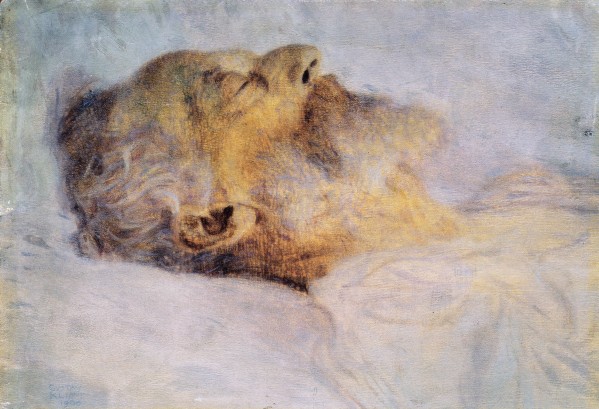
Old Man on his Deathbed, by Gustav Klimt, 1900

And the time drew near for Yisrael to die. And he called for his son Yoseif, and said to him— (Genesis 47:29)

Yoseif (“Joseph”) is Yaakov’s beloved eleventh son. Although normally a man’s oldest son inherits more of his estate, and responsibility for his family, Yoseif is the viceroy of Egypt and already takes care of his whole extended family, including his father. So Yaakov calls for Yoseif when he is approaching death.

And the time drew near for David to die. And he commanded his son Shlomoh, saying— (1 Kings 2:1)

Shlomoh (“Solomon” in English) is King David’s tenth son. While David is lying feebly in bed, his fourth son, Adoniyahu, gets himself anointed and proclaimed king without his father’s knowledge. (David’s oldest son, Amon, is already dead.) Batsheva (“Bathsheba”), David’s favored wife, and Natan, David’s prophet, rush into action. They get David to protest that his heir is Batsheva’s son Shlomoh, then get Shlomoh anointed and proclaimed king that same day. Adoniyahu’s supporters abandon him, and Shlomoh becomes king. (1 Kings 1:5-53) So David calls for Shlomoh when he is close to death.

Both Yaakov and David are practical in their choice of executor of their last wishes, choosing the son whom they trust and who has the most power to act.

Directions for burial

Yaakov’s first instruction to his son Yoseif is about his burial.

“If, please, I have found favor in your eyes, please place your hand under my thigh. And do with me loyal-kindness and faithfulness: do not, please, bury me in Egypt! [When] I lie down with my fathers, then carry me out of Egypt and bury me in their burial site!” (Genesis 47:29-30)

Yaakov’s deference to Yoseif shows that he knows he no longer has authority. Rabbi Chayim ibn Attar added: “Had he not said ‘please,’ it might have sounded as if he had not been grateful for the sustenance Joseph had provided thus far.”1

The request that Yoseif put a hand under his thigh (the most sacred way to swear an oath in the book of Genesis)2 shows Yaakov’s determination to be buried in Canaan.

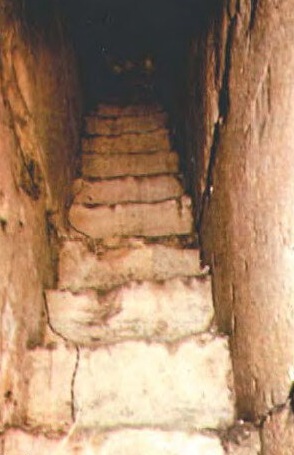
Stairs inside the caves of Makhpelah

Lying down with one’s fathers and being gathered to one’s fathers are idioms for dying; in ancient Israel, family members were buried in the same cave for generations. Yaakov wants to be buried in “their burial site”—the cave of Makhpelah near Hebron.

Then he [Yoseif] said: “I myself will do according to your words”. But he [Yaakov] said: “Swear to me!” And he swore to him. Then Yisrael bowed, at the head of the bed. (Genesis 47:30-31) 

The oath does turn out to be useful. When Yoseif asks Pharaoh permission for himself and his brothers to take Yaakov’s body to Canaan, he says: “My father made me swear …” and Pharaoh answers: “Go up and bury your father, as he had you swear.” (Genesis 50:5-6)

Why does Yaakov care about where he is buried? Rashi summarized a Talmudic-era midrash:

“Because its [Egypt’s] soil will ultimately become lice which would swarm beneath my body. Further, those who die outside the Land of Israel will not live again at the Resurrection except after the pain caused by the body rolling through underground-passages until it reaches the Holy Land. And another reason is that the Egyptians should not make me (my corpse or my tomb) the object of idolatrous worship.”3

S.R. Hirsch added a psychological reason: that after seventeen years in Egypt, Yaakov noticed that his whole family had come to think of Egypt as home. “It was sufficient reason for him to say to them: ‘You may hope and wish to live in Egypt, but I do not even want to be buried there.’”4

And Karen Armstrong pointed out that Yaakov wanted to continue the precedent set by his grandfather Avraham, who bought the burial cave—the first bit of land in Canaan owned by the family. Avraham and Sarah are buried there, along with Yaakov’s father Yitzchak (“Isaac”) and mother Rivkah (“Rebecca”), and his own first wife, Leah.

“Finally, Jacob gave instructions that he be buried not beside the beloved Rachel in Bethlehem but beside Leah in the family tomb at Hebron.  For once, he did not allow himself to give in to his own inclinations but fulfilled his official patriarchal duty.”5

King David, however, gives his son Shlomoh no instructions regarding his burial—perhaps because he assumes his son will bury him in Jerusalem, where they both live. And King Shlomoh does.

Yaakov’s instructions for his estate

Yaakov’s health declines further, and Yoseif brings his two sons to receive a final blessing from their grandfather.

Then Yisrael gathered his strength and he sat up in the bed. (Genesis 48:2)

He tells Yoseif that back in Canaan, God appeared to him and told him:

“Here I am, making you fruitful and numerous, and I will appoint you as a congregation of peoples, and I will give this land to your descendants after you, as a possession forever!”(Genesis 48:4)

Yaakov now considers the promise of Canaan his estate, and he wants a say in how his descendants will divide up the land. So he tells Yoseif:

“And now your two sons, the ones born to you in the land of Egypt before I came to you in Egypt, they are mine; Efrayim and Menasheh, they will be mine like Reuven and Shimon!” (Genesis 48:5)

Reuven and Shimon (“Simeon” in English) are Yaakov’s first and second-born sons. In effect, adopting Efrayim and Menasheh gives Yoseif the double inheritance of the firstborn.  Instead of getting one share, as Yoseif, he will get two shares, in the name of his two sons.

Yaakov starts talking about the death of Yoseif’s mother, Rachel, then notices the two people standing next to Yoseif. At this point, he is nearly blind.

And Yisrael saw Yosef’s sons, and he said: “Who are these?” And Yoseif said to his father: “They are my sons, whom God has given me here.” Then he said: “Please bring them to me, and I will bless them.” (Genesis 48:9)

Yaakov kisses and embraces his grandsons, overcome with emotion.

Then Yoseif took them away from his knees, and they bowed down, their noses to the ground. (Genesis 48:11)

In the Hebrew Bible, placing a newborn infant on one’s knees signifies an adoption.6 Although Yoseif’s sons are young men now, having been born before their grandfather came to Egypt seventeen years before, the symbolism may be the same.

The scribe who wrote down this part of the Torah portion had another reason for reassigning Yoseif’s portion of Canaan to Efrayim and Menasheh. From circa 900 to 720 B.C.E., the two kingdoms of Israel consisted of the territories of twelve tribes: ten tribes in the northern kingdom of Israel (Efrayim, Menasheh, Reuven, Shimon, Gad, Dan, Yissachar, Zevulun, Asher, and Naftali) and two tribes in the southern kingdom of Judah (Yehudah and Binyamin). Some scribes connected these twelve tribes with the twelve sons of Yaakov/Yisrael. To make the numbers work out, they assigned two tribes (Efrayim and Menasheh) to Yaakov’s eleventh son, Yoseif, and excluded the tribe of Yaakov’s third son, Levi, from the count, since the Levites were scattered throughout the two kingdoms and did not have a territory of their own.

As the book of Genesis draws to a close, Yaakov wants his family to return to Canaan, though he does not issue an explicit order about when they should go. According to the book of Exodus, Yaakov’s descendants stay in Egypt for 430 years before they finally head north.7

David’s instructions for execution

Dividing up territory is not a problem in the story of King David’s death, since David’s estate is the whole kingdom of Israel, before it separated into two kingdoms. David’s chosen son, Shlomoh, has already been anointed as king, so he gets the entire estate. But David has more to say to his son the king.

And the time drew near for David to die. And he commanded his son Shlomoh, saying: “I am going the way of all the earth. And you must be strong, and be a man!”  (1 Kings 2:1-2)

When Yaakov gives his deathbed instructions to his son Yoseif, Yoseif is 57 years old and has been the viceroy of Egypt for 27 years. When David gives his deathbed instructions to his son Shlomoh, Shlomoh is about 20 years old and has barely begun his reign.

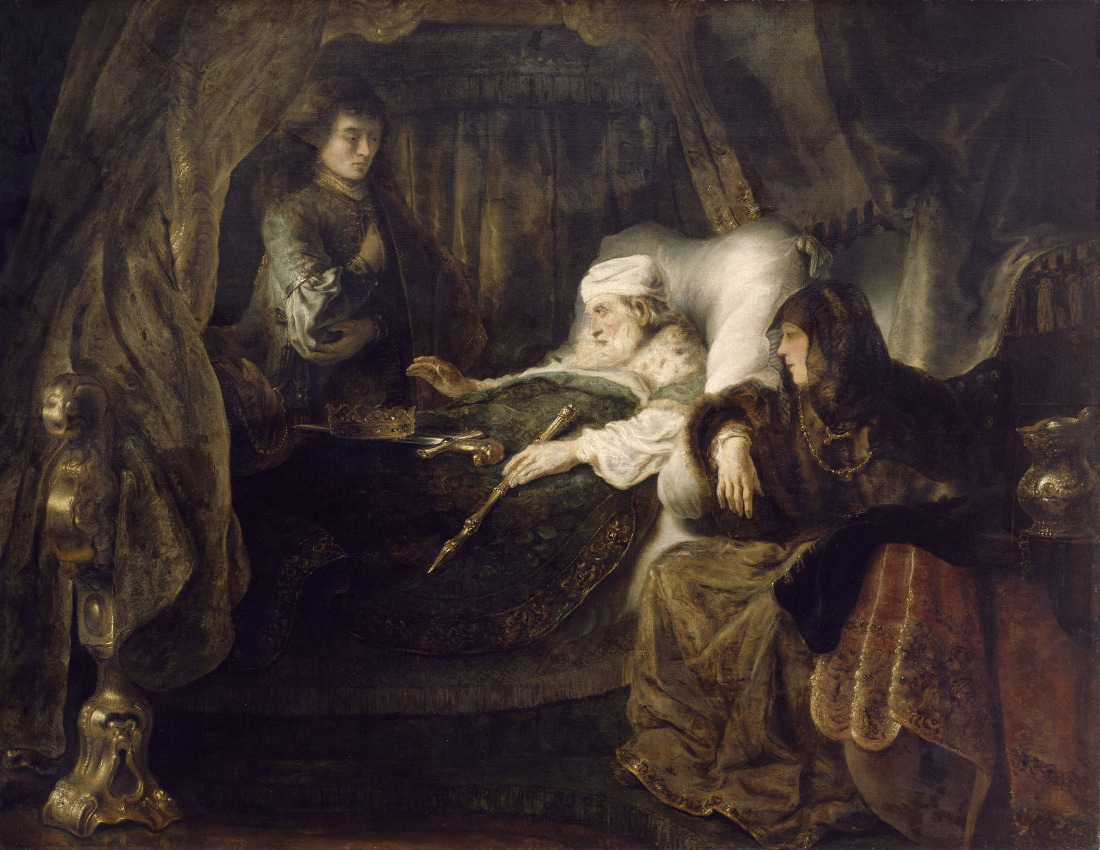
David’s Dying Charge to Solomon, by Ferdinand Bol, ca. 1700

After reminding his son that he must follow God with all his mind and soul, David moves on to his primary concern: some unfinished business from his own reign.

First he orders Shlomoh to punish Yoav (“Joab” in English), David’s nephew and the general of his army. Yoav stealthily murdered the general of northern Israel, Avneir (“Abner”), right after David and Avneir had concluded a peace treaty in which the northern territories would join David’s kingdom. (See my post 2 Samuel: David the King.) Yoav’s motivation was revenge for his brother’s death at Avneir’s hands on the battlefield. The usual punishment for revenge killing was execution. But King David neither executed nor demoted Yoav—perhaps because of family feeling, or perhaps because he feared that Yoav was becoming too powerful to oppose.

Later, King David’s third son, Avshalom (“Absalom”), usurped the throne. David took refuge in Machanayim and sent out troops, but he asked Yoav and his other two commanders not to kill Avshalom. However, when Avshalom was snagged by a tree, and Yoav killed him.8 That was the last straw for King David, who then gave Amasa Yoav’s post as a commander.9 The next time Yoav and Amasa met, Yoav grabbed Amasa’s beard with one hand, and with the other hand stabbed him in the belly.10 Again King David did not punish his dangerous nephew; he even let Yoav become his general.

Now David wants Shlomoh to deliver the punishment that he could not manage during his own lifetime.

“… you yourself know what Yoav son of Tzeruyah did to me … to Avneir son of Neir, and to Amasa son of Yeter: he murdered them! … And you must act according to your chokhmah, and you must not let his gray head go down in peace to Sheol!” (1 Kings 2:5-6)

chokhmah (חׇכְמָה) = wisdom, technical skill, aptitude, experience, good sense.

Sheol (שְׁאוֹל) = the silent underworld where every person goes at death.

Next he tells Shlomoh to keep rewarding the sons of Barzilai, who fed David’s men during the war with Avshalom.11 Finally, he brings up Shimi son of Gera, who cursed and threw rocks at King David when he was fleeing Jerusalem after Avshalom’s coup. When David returned, he promised Shimi that he would not execute him.12 Now he regrets that promise.

“And now you must not exempt him from punishment! …  you yourself know what you must do to him, and bring down his gray head in blood to Sheol!” Then David lay with his fathers, and he was buried in the City of David. (1 Kings 2:9-10)

David wants the execution of two men whom he had pardoned when he was king, and King Shlomoh does arrange their deaths—because he, too, does not trust Yoav, and because Shimi violated Shlomoh’s condition that he could live in peace as long as he did not leave Jerusalem.13


Today we still need to name an executor of our last will and testament. Like both Yaakov and David, many of us appoint one of our children, the one who has the most ability to carry out our wishes.

Few people today are in a position to leave a whole country as a bequest. But whatever we do leave is important to us: wealth to improve the lives of our heirs, heirlooms that have personal meaning to us, and sometimes instructions for more than our own burial.

We may believe that we can make sure everything happens the way we want it to after our deaths. But that is unrealistic. Our heirs will do as they think best, not as we think best.

At least Yaakov and David die knowing that their surviving children are doing well in life, and that the beloved children who will be their executors are successful and respected. So may it be for us today.


  1. Chayim ibn Attar, Or HaChayim, 18th century, translation in www.sefaria.org.
  2. See my post Vayechi, Chayei Sarah, & Vayishlach: A Touching Oath.
  3. Rashi (the acronym for 11th-century Rabbi Shlomoh Yitzchaki), summarizing Bereishit Rabbah 76:3, translation in www.sefaria.org.
  4. 19th-century rabbi Samson Raphael Hirsch, reprinted in The Hirsch Chumash: Sefer Bereshis, English translation by Daniel Haberman, Feldheim Publishers, Jerusalem, 2002, p. 846.
  5. Karen Armstrong, In the Beginning, Ballantine Books, New York, 1997, pp. 115-16.
  6. Genesis 30:3-6, Ruth 4:16-17.
  7. Exodus 12:40.
  8. 2 Samuel 18:14.
  9. 2 Samuel 19:4.
  10. 2 Samuel 20:9-10.
  11. Barzilai appears in 2 Samuel 17:27-29 and 19:32-41.
  12. Shimi appears in 2 Samuel 16:5-10 and 19:20-25.
  13. See 1 Kings 2:28-35 on Yoav, and 1 Kings 2:36-46 on Shimi.

Vayigash & Veyechi: Yoseif’s Theology, Part 2

Before we look at the new concept of God that Yoseif (“Joseph” in English) shares with his brothers in this week’s Torah portion, Vayigash (Genesis/Bereishit 44:18-47:27), let’s look at what the characters in the book of Genesis already believe about God’s ongoing involvement in the universe.1

  1. God controls the weather, including winds, floods, and storms of hail and sulfur, and wreaks destruction thereby (Genesis 6:13, 7:11, 8:1, 18:21, 19:24-15).
  2. God blesses some individuals with success and curses some with failure (Genesis 4:14, 4:17, 12:2-324:35, 24:56, 26:28-29).
  3. God punishes people for certain ethical violations, including: unwarranted murder (Genesis 4:23-24), gratuitous violence (Genesis 6:13), human bloodshed (Genesis 9:6), and raping guests (Genesis 19:4-15).
  4. God can inflict and heal disease (Genesis 12:17-18, 20:17-18).
  5. God shares the aversion in the Ancient Near East to a man committing adultery with a married woman (Genesis 12:18-19, 20:1-7). Yoseif assumes that adultery would be “a great wrong before God” in Genesis 39:7-9. (See my post Mikeitz & Vasyeishev: Yoseif’s Theology, Part 1.)
  6. God gives people significant dreams (Genesis 15:13-16, 20:3, 22:1-3, 26:24, 28:11-16, 31:24, 31:29, 31:42, 32:25-31). Yoseif goes further and claims that dream interpretations also come from God.2
  7. Only God can “open wombs”, giving childless women children (Genesis 17:16-21, 18:10-15, 21:1-2, 25:21, 29:31. 30:2. 30:22-23).
  8. Perhaps God can influence the course of history; God makes promises to Avraham, Yitzchak, and Yaakov that their descendants will someday own the land of Canaan (Genesis 12:7, 132:14-17, 15:7, 15:18-21, 17:8, 26:2-3, 28:13, 35:12), but Avraham doubts it will happen (Genesis 15:8 ), and the other two patriarchs are silent on the subject.
  9. Perhaps God can influence more immediate events; three characters pray to God for specific outcomes (Avraham’s steward in Genesis 23:12-19; Yitzchak (“Isaac”) in Genesis 25:21, 27:28-33, and 28:3-4; and Yaakov (“Jacob”) in Genesis 32:10-13).

Yoseif’s relationship with God

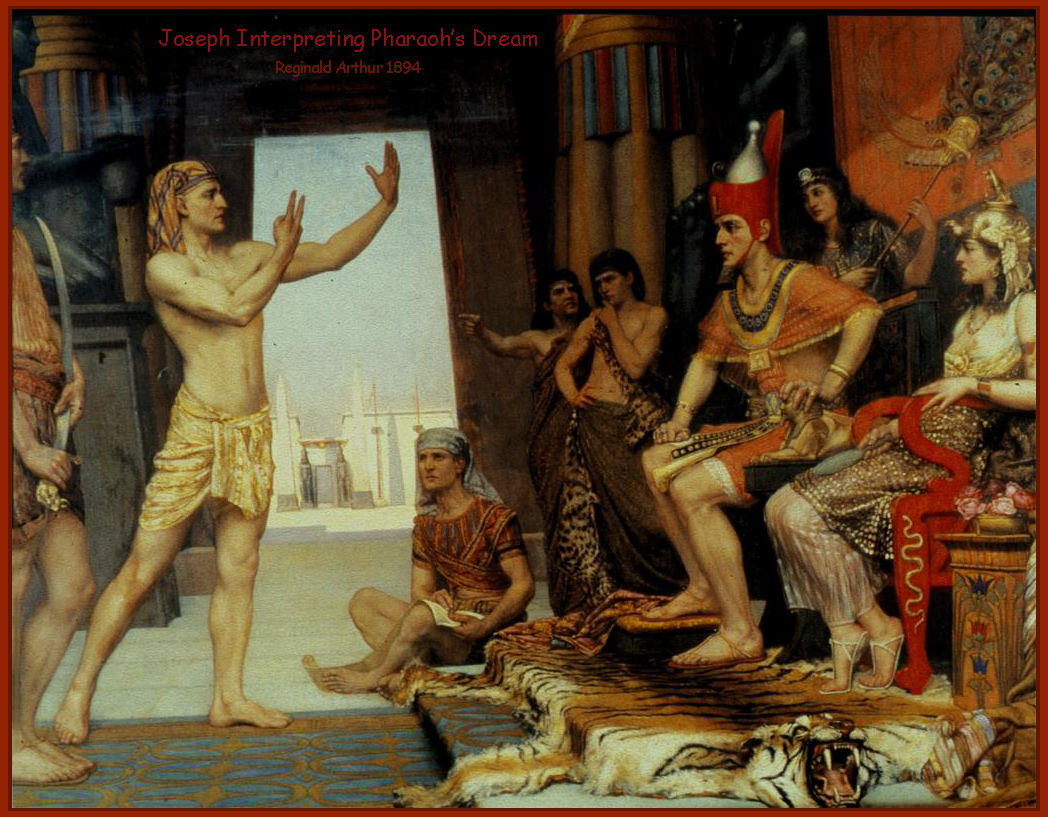
Joseph Interprets Pharaoh’s Dreams,
by Reginald Arthur, 1894

Although God addresses Yoseif in speech, he credits God with giving him the correct interpretations of four dreams: two dreams by imprisoned officials of Pharaoh and two dreams by Pharaoh himself.3 When Yoseif hears these dreams, the interpretation just occurs to him at once. (See my post Mikeitz & Vasyeishev: Yoseif’s Theology, Part 1.)

When he encounters a problem, such as the seven years of plenty followed by seven years of famine that Pharaoh’s dreams foretell, the solution also occurs to him at once—but he does not attribute his solutions to God. He tells Pharoah his solution for getting Egypt through the seven years of famine: appointing “a discerning and wise man” to stockpile grain nationwide during the seven years of plenty. Pharaoh announces:

“Could we find [another] like this man, who has the spirit of an elohim in him?” (Genesis 41:38)

Elohim (אֱלֹהִים) = gods, a god, God.

Although Yoseif has been quick to say that God, not he, interprets dreams, he is silent when Pharaoh says the spirit of God is in him. Pharaoh appoints Yoseif as the administrative head of all Egypt.

In the first year of famine, Yoseif’s ten older brothers come to Egypt to buy grain. They have not seen him since he was 17, when they threw him in a pit, considered killing him, then sold him as a slave to a caravan bound for Egypt.4 The brothers do not recognize the 38-year-old Egyptian nobleman in front of them, and Yoseif converses with them through an interpreter, pretending he does not know Hebrew.

On the spot, he invents an elaborate scheme for testing whether his older brothers have reformed, and for getting his innocent younger brother, Binyamin (“Benjamin” in English), to Egypt. (See my post Mikeitz: A Fair Test, Part 1.) Yoseif sees nothing unethical in lying to and manipulating his brothers. He cares about being unethical “before God”, and so far, God has not said anything about lying.

A theory about God

Joseph’s Brothers Bow Down, by Owen Jones, 1865

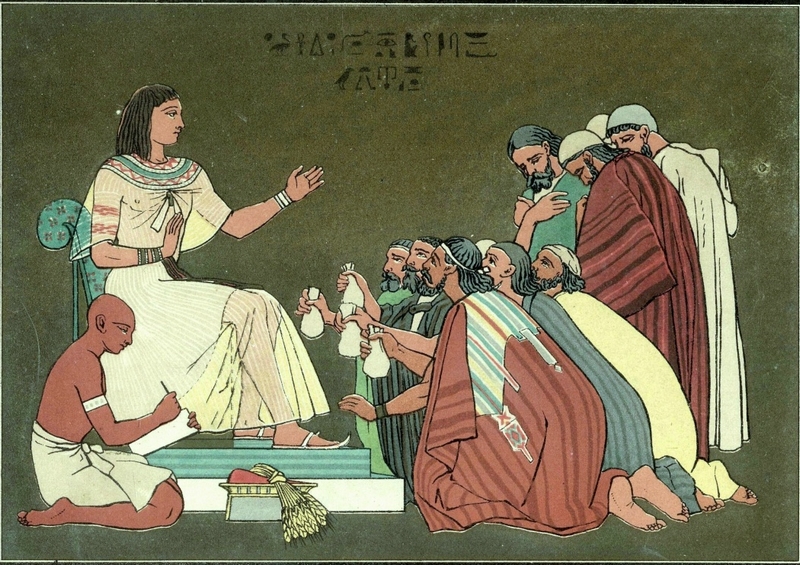
In the second year of famine, Yoseif’s brothers return, with Binyamin, in order to buy more grain. And Yoseif continues to test his older brothers. (See my post Mikeitz & Vayigash: A Fair Test, Part 2.) The testing finally ends in this week’s Torah portion, when Yehudah (“Judah” in English) begs Yoseif to enslave him instead of Binyamin.5 Then Yoseif reveals his identity.

And Yoseif said to his brothers: “Come close to me, please!” And they came close. And he said: “I am Yoseif your brother, whom you sold into Egypt. And now, do not be pained, and do not let anger kindle in your eyes that you sold me here. Because to preserve life, Elohim sent me before you.” (Genesis 45:4-5)

After this startling claim, Yoseif explains his view of God’s plan.

“For this is two years the famine has been in the midst of the land, and there are still five years more in which there will be no plowing or harvest. So Elohim sent me ahead of you, to make you she-eirit and for keeping you alive, as a great deliverance. So now, you did not send me here, but Elohim! And [Elohim] has established me as av to Pharaoh and as lord of all his house and as ruler over all the land of Egypt.” (Genesis 45:6-9)

she-eirit (שְׁאֵרִית) = a remnant, remainder, residue. (In this verse, she-airit refers to a group of survivors.)

av (אָב) = father, forefather, male ancestor; chief advisor to a ruler.

Some commentators have written that Yoseif has been figuring this out for a while.6 But I think that Yoseif’s insight is the latest in a long string of sudden inspirations.

Yoseif would not be in a position to rescue his whole family from starvation if it were not for both his brothers’ evil deed, and his own sharp insights. His speech to his brothers might mean that he is now giving God credit for both their assorted levels of wickedness,7 and his own cleverness—in other words, for their respective personalities. In this interpretation, humans have free will to make their own decisions. But God determines who tends to be consumed by jealousy, and who is quick-witted.

According to 21st-century commentator Robert Alter, “Joseph’s … recognition of a providential plan may well be admirable from the viewpoint of monotheistic faith, but there is no reason to assume that Joseph has lost the sense of his own brilliant initiative in all that he has accomplished, and so when he says “God” (‘elohim, which could also suggest something more general like ‘providence’ or ‘fate’), he also means Joseph.”8

On the other hand, Yoseif’s own adolescent dreams about his brothers bowing down to him came true, even though many accidents of fate could have intervened. And his interpretations of the dreams of Pharaoh’s imprisoned officials came true, even though Pharaoh might have changed his mind about whom to pardon and whom to execute. Yoseif might be crediting God not with forming a human’s character, but with manipulating events at key moments by nudging people toward certain decisions and away from others.

According to 21st-century rabbi Jonathan Sacks, God is always nudging people: “One of the core messages of this narrative is just that—to remember that God plays a role in our lives on a daily basis even if we don’t realise it at the time. … One of the main and overarching messages is that God is behind the scenes making sure that events occur and destinations are reached according to His plan.”9

Perhaps the way you interpret Yoseif’s speech depends on your own beliefs about how much power God exercises over human beings—or how much interest God has in making things happen.

Yoseif then tells his brothers:

“Hurry and go up to my father and say to him: ‘Thus says your son Yoseif: Elohim has placed me as lord of all Egypt; come down to me, don’t remain!” (Genesis 45:9)

If God has arranged the past 22 years in order to rescue the whole extended family of his father Yaakov (“Jacob” in English), then it is time to get the patriarch down to Egypt, along with all of the wives and children of Yoseif’s eleven brothers.

Yoseif promises to provide for them all, and to settle them and their flocks and herds in Goshen, near the capital. Then he embraces Binyamin.

And he kissed all his brothers, a wept upon them. After that his brothers spoke with him. (Genesis 45:15) Why are they silent while Yoseif is explaining his theory that God arranged everything for the long-term good of the family? Maybe they are in shock at the knowledge that Yoseif’s annoying dreams came true: he rules, and they have bowed down to him. Maybe they do not believe his theory about God, but they do not dare annoy him by arguing.

Believing the theory

The famine ends in five years, but the whole family stays in Egypt. After all, Yoseif is still second only to Pharaoh, and his brothers now own land there and have lucrative administrative jobs supervising Pharoah’s flocks.10

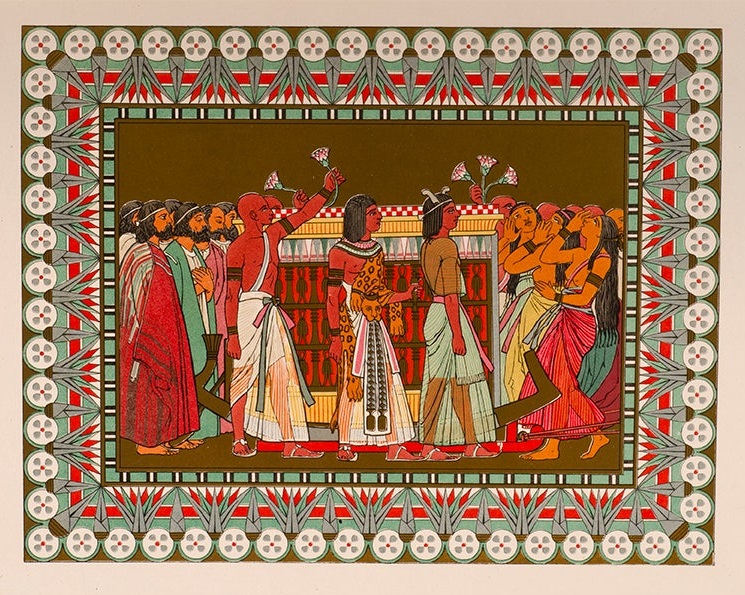
Jacob Is Buried, by Owen Jones, 1865

The patriarch Yaakov dies after seventeen years in Egypt, and all twelve of his sons accompany his body to Canaan for burial. After they return to Egypt, Yoseif’s older brothers say to one another:

“What if Yoseif holds a grudge, and actually repays us for all the evil that we dealt out to him?” (Genesis 50:15)

They send a message, purportedly from their father, ordering Yoseif to forgive them.

Then his brothers also went, and they prostrated themselves, and said to him: “Here we are, slaves to you!” But Yoseif said to them: “Do not be afraid! For am I in place of Elohim?” (Genesis 50:18-19)

Earlier in Genesis, in the Torah portion Vayeitzei, Yaakov said the same thing to his childless wife, Rachel, several years before she finally became pregnant.

Rachel … said to Yaakov: “Give me children! If not, I will die!” Then Yaakov heated up against Rachel, and he said: “Am I in place of Elohim, who has withheld from you fruit of the belly?” (Genesis 30:1-2)

Yaakov meant that only God could “open her womb”. Now their son Yoseif is asking the same rhetorical question, saying that only God can punish his older brothers.

According to Rashi, Yoseif means: “Even if I wished to do you harm, would I at all be able to do so? For did you not all design evil against me, and you did not succeed because the Holy One, blessed be He, designed it for good. How, then, can I alone, without God’s consent, do evil to you?”10

But Hirsch wrote that even if the decision were up to Yoseif, he would not punish them: “God can judge the thoughts, the intentions. I, as a human being, see only the result, and in that respect I owe you deep gratitude.”11

Yoseif concludes by stating that his brothers’ intentions years ago really were evil; but what matters is that the result was good.

“And you, you planned evil against me; Elohim planned it for good, in order to do as it is this day—to keep many people alive.” (Genesis 50:20)

This time, Yoseif’s older brothers are comforted. They are now certain that Yoseif would never oppose God by punishing them for their long-ago crime.

Is Yoseif’s view of how God operates original? Not quite; there are intimations in earlier Genesis stories that God sometimes answers prayers by making things happen (see #9 above) and that God can promise to eventually give the descendants of the patriarchs the land of Canaan (see #8 above).

But Yoseif changes a vague feeling that God influences events into a definite statement that God controls people enough to determine either their personalities, and/or their actual deeds; and God does this to achieve concrete objectives in history.


How much power does God exercise in human affairs? To what extent do human beings have free will? These are questions that theologians and philosophers have chewed over for centuries.

Many people today believe that a powerful God (preferably omnipotent and omniscient) runs the show, but also that humans are free to make their own decisions and act on them. So, like Yoseif, they resolve the inherent contradiction by positing a God who arranges human destiny behind the scenes—loading the dice to make sure that God’s own goals are met, while granting humans a limited sphere of free will.

Are they right? If so, does God do it by determining our personalities (so we will naturally make the decisions God needs for the long-term plan), or by directing our impulses at the moment of decision?

And if not, what do you believe instead about God and about free will? 


  1. The authors of Genesis also reveal assumptions about God in the narrative, but I do not assume that the characters share these beliefs unless one of them hears or says something to that effect.
  2. Genesis 40:8, 41:16.
  3. The title “Pharaoh” in English is Paroh (פַּרֺה) in Hebrew.
  4. When Yoseif was their teenage nemesis, all ten of his older brothers cooperated in seizing and stripping him. When Reuvein objected against bloodshed, they threw him into a pit. Then Judah talked the others into selling him instead of leaving him to die there. (Genesis 37:19-27)
  5. Genesis 44:18-34. See my post Vayigash: Compassion.
  6. E.g. 19th-century rabbi Shimshon Rafael Hirsch, The Hirsch Chumash: Sefer Bereshis, translated by Danield Haberman, Feldheim Publishers, Jerusalem, 2002, pp. 814-815.
  7. See footnote 4.
  8. Robert Alter, The Five Books of Moses, W.W. Norton & Co., New York, 2004, p. 261.
  9. Rabbi Lord Jonathan Sacks, Covenant & Conversation, “The Angel Who Did Not Know He Was an Angel: Vayeshev 5780”, December 2019.
  10. Genesis 47:6, 11.
  11. Rashi (11th-century rabbi Shlomoh Yitzchaki), translation in www.sefaria.org.
  12. Hirsch, p. 897.

Mikeitz & Vayeishev: Yoseif’s Theology, Part 1

At age 17, Yoseif (“Joseph” in English) is a spoiled brat. He tattles on his ten older brothers, and he tells them two dreams that predict they will all bow down to him someday. His brothers hate him so much that they want to kill him. As soon as they are all far from home, they grab Yoseif, strip off the fancy tunic their father gave him, and throw him into a pit. Then they sell him as a slave to a caravan bound for Egypt.

Vayeishev: Success

No doubt this is a sobering experience for Yoseif; in Egypt he is far more diplomatic. As last week’s Torah portion, Vayeishev (Genesis 37:1-40:23), continues, we learn that Yoseif is also intelligent, and has what a modern person might call good luck. The Torah puts it another way:

And Y-H-V-H was with Yoseif, and he became a successful man … and everything that he did, God made successful in his hand. (Genesis/Bereishit 39:2-3)

Potifar, the Egyptian official who buys him, notices Yoseif ‘s achievements, and makes Yoseif his steward and personal attendant. What Potifar’s wife notices about the young Hebrew man is his exceptional good looks.

Joseph Flees Potiphar’s Wife, by Julius Schnorr von Carlsfeld, 19th century

And she said: “Lie down with me!” But he refused, and he said to his master’s wife: “Hey, my master … has not withheld anything from me except for you, his wife. Wouldn’t this be a great evil? And I would be doing wrong before Elohim!” /(Genesis 39:7-9) 

Elohim (אֱלֹהִים) = gods, a god, God.

This is the first time in the Torah that Yoseif mentions God. He uses a term that could apply to any god, although he would know the name Y-H-V-H, the personal name of the God of his father, Yaakov (“Joseph”). Perhaps Yoseif does not want to reveal that name to a foreigner. Or perhaps he uses a generic term so that Potifar’s wife will know what he is talking about.

Despite Yoseif’s refusal, Potifar’s wife keeps importuning him, and as soon as they happen to be alone in the house, she grabs him. Yoseif flees, leaving his garment in her hands. Spitefully, she accuses him of attacking her, and he is sent to jail.

In the dungeon, God blesses Yoseif with success again, and the prison overseer puts him in charge of all his tasks.

The overseer of the roundhouse did not need to look after anything at all in his hands, because Y-H-V-H was with him [Yoseif], and whatever he did, Y-H-V-H made successful. (Genesis 39:23)

One morning Yoseif asks two of the prisoners, Pharaoh’s chief cup-bearer and Pharaoh’s chief baker, why they are looking especially glum.

And they said: “A dream we have dreamed, and there is no interpreter for it!” And Yoseif said to them: “Aren’t interpretations from Elohim? Recount it, please, to me.”  (Genesis 40:8) 

All dreams in the Hebrew Bible are considered messages from God. Some dream symbols have obvious interpretations; Yoseif’s brothers had no doubt that his dream of eleven wheat sheaves bowing down to him meant that his eleven brothers would someday bow to him as if he were a king. But more difficult dreams require professional interpreters. Being in jail, Pharaoh’s two officials have no access to professionals.

According to Ramban, Joseph is not claiming either that he is a professional interpreter or that God answers his questions; he is merely saying “If it is obscure to you, tell it to me; perhaps He will be pleased to reveal His secret to me.’”1

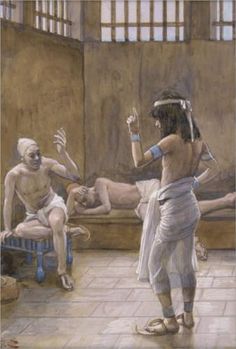
Joseph in Prison, by James Tissot, circa 1900

The two prisoners tell Yoseif their dreams, which seem like two variations of the same dream.

At this point, we might expect God to speak to Yoseif and tell him what their dreams mean. After all, hearing God speak runs in his family. God spoke to his father, Yaakov, and to his grandfather Lavan, in their dreams.2 And God spoke in the middle of the day to Yoseif’s other grandfather, Yitzchak (“Isaac”), and to his great-grandparents Avraham and Sarah.3

But God never speaks to Yoseif. Instead, dream interpretations occur to him on the spot. He assigns the two dreams of the prisoners different meanings, saying that in three days Pharaoh will pardon the chief cupbearer, but execute the chief baker. That is exactly what happens.

Mikeitz: Pharaoh

In this week’s Torah portion, Mikeitz (Genesis 41:1-44:17), Pharaoh4 has two dreams. When none of his magicians can interpret the dreams, Pharaoh’s chief cup-bearer speaks up and tells him about the young Hebrew dream interpreter in the prison. At once Pharaoh sends for Yoseif.

And Pharaoh said to Yoseif: “… I have heard about you, saying you [need only] hear a dream to interpret it.” And Yoseif answered Pharaoh, saying: “It is not in me! Elohim will answer, for Pharaoh’s welfare.” (Genesis 41:15-16)

Yoseif is still claiming that only God can interpret a difficult dream. Now he assumes that God will reveal the interpretations of two more dreams to him. He also assumes that the interpretations he gets from God will lead to Pharaoh’s welfare.

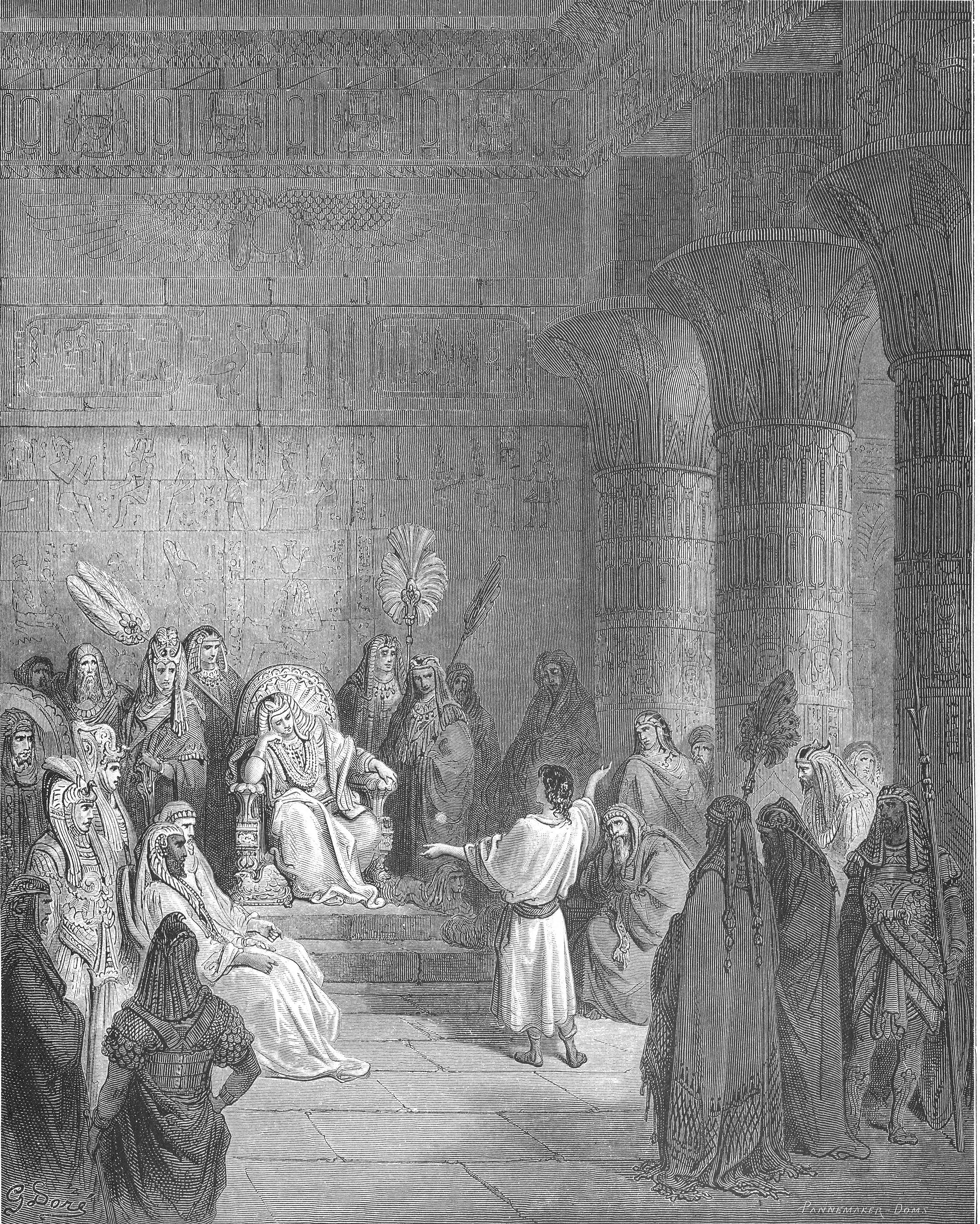
Joseph Interprets Pharaoh’s Dreams, by Gustave Dore, 19th century

Pharaoh tells Yoseif the two dreams. Again the interpretation of Pharaoh’s dreams occurs to Yoseif immediately. He announces:

“What the Elohim will do, he has told Pharaoh.” (Genesis 41:25)

Both dreams, Yoseif explains, are warning Pharaoh that there will be seven years of plenty followed by seven years of “very heavy” famine.

“And about the repetition of the dream to Pharaoh two times: [it means] that the matter is established by the Elohim, and the Elohim is hastening to do it.” (Genesis 41:32)

Although God does not control everything—the prophecies that God dictates to prophets in the Hebrew Bible only predict what will happen to people if they do not change their course of action—God does control the weather.

Next Yoseif unselfconsciously gives Pharaoh some advice.

“And now, may Pharaoh be shown a discerning and wise man, and may he set him over the land of Egypt.” (Genesis 41: 33)

Yoseif goes on to explain how this man must appoint overseers to stockpile grain during the seven good years, and guard the stockpiles as a reserve for the seven years of famine. Since he does not mention God when he tells Pharaoh the wisest course of action, we can assume Yoseif figures it out himself.

And Pharaoh said to his servants: “Could we find [another one] like this man, who has the spirit of an elohim in him?” (Genesis 41:38)

Pharaoh is not saying that Yoseif is possessed, but rather that he receives divine inspiration.

And Pharaoh said to Yoseif: “After an elohim has made you know all this, there is no one who is as discerning and wise as you. You yourself will be over my house! … See, I place you over all the land of Egypt!” (Genesis 41:39-41)

And he gives Yoseif his signet ring. Pharaoh remains the monarch, but Yoseif, at age 30, is now the ruler of Egypt.

Eight years later, after the famine has struck “the whole surface of the earth”,9 Yaakov sends his ten older sons from Canaan to Egypt to buy grain.

And Yoseif’s brothers came, and they bowed down to him, nostrils to the earth. (Genesis 42:6)

They do not recognize Yoseif, who is now shaved and dressed like an Egyptian, and converses with them through an interpreter without revealing that he knows Hebrew. But Yoseif recognizes them. He falsely accuses them of being spies, probably so that they will talk about their family. When Yoseif finds out that Yaakov kept his twelfth and youngest son, Binyamin (“Benjamin”), at home, he instantly hatches a plan to get his little brother down to Egypt. Yoseif and Binyamin are the only sons of Yaakov’s favorite wife, Rachel, and Yoseif may be afraid that his older brothers want to get rid of Binyamin, just as they got rid of him 21 years before.

He imprisons all ten of his older brothers for three days, then tells them that he will keep one of them as a hostage until they return with their youngest brother. At that point he hears their private conversation in Hebrew, in which they agree this must be a punishment (presumably from God) for ignoring Yoseif’s pleas from the pit long ago.5  (See my post Mikeitz: A Fair Test, Part 1.)

A year later, Yaakov finally lets Binyamin go to Egypt with his brothers, because the whole extended family is Canaan is starving. When Yoseif sees the grown man who was a child when Yoseif was sold as a slave, he says:

“Is this your littlest brother, of whom you spoke to me?” And he said: “May Elohim be gracious to you, my son!” (Genesis 43:29)

Yoseif himself plans to be gracious to Binyamin. But he also values God’s blessings.


So far, Yoseif is consistently using the generic term elohim to refer to God. He believes that God controls the weather, and also affects the lives of at least some individuals, including himself. He hopes that God will also improve Binyamin’s life. Yoseif recoils from the thought of committing an offense against God. He believes that dreams come from God, and seems to believe that when he interprets dreams correctly, God is inspiring him. Yoseif’s thoughts about God seem simple, and unlikely to upset anyone.

But in next week’s Torah portion, Vayigash, Yoseif goes out on a theological limb.


  1. Ramban (13th century Rabbi Moses ben Nachman), translation in www.sefaria.org.
  2. God speaks in dreams to Yaakov in Genesis 28:12-15 and to Lavan in Genesis 31:24.
  3. God speaks during the day, directly, to Yitzchak in Genesis 26:2-5 (and at night in 26:24), to Sarah in Genesis 18:15, and to Avraham in Genesis 12:1-3, 12:7, 13:14-17, 15:1-9, 17:1-21, 18:20-33, 21:12-13, and 22:16-18 (and in dreams in Genesis 15:12-29 and 22:1-2).
  4. The title “Pharaoh” in English is Paroh (פַּרֺה) in Hebrew. The bible uses it for every pharaoh, without an article.
  5. Genesis 42:21-22.

Vayeishev: Envy

A note on names: This blog has never been consistent about how biblical names are spelled. For years I used the standard English spelling (which borrows from early German biblical translations) for the most familiar characters and place-names, and transliterations of the Hebrew for all other names. In my last two posts, however, I transliterated every proper name (following it with the English version in parentheses the first time).

TThis week I realized that sometimes the English version of a name is close enough, especially if the only difference is a vowel sound, or if one of its letters is pronounced differently in Mizrahi Hebrew than in Ashkenazi Hebrew. However, I am not going back to using the English version of all the familiar names in the Hebrew Bible. When the English version sounds markedly different from the Hebrew—as in “Jacob” instead of “Yaakov”—I am going to use the Hebrew version (with the English version after the first reference, so everyone can keep track). Here goes!


One person has absolute power over a country or company. Another person has more wealth and status than you do, but is not the ruler. Which one do you fear or admire? Which one do you envy?


This week’s Torah portion, Vayeishev (Genesis 37:1-40:23), begins:

Joseph the Shepherd, by Marc Chagall

And Yaakov settled in the land of his father’s sojournings, the land of Canaan. These are the histories of Yaakov: Yoseif, at age 17, was tending the flock with his brothers, and he was a naar with the sons of Bilhah and the sons of Zilpah, his father’s women …  (Genesis 37:1-2a)

(Yaakov (יַעֲקֺב) is “Jacob” in English; his alternate name is Yisraeil (יִשְׂרָאֵל), “Israel” in English.  Yoseif (יוֹסֵף) is “Joseph”, Yaakov’s eleventh son.)

naar (נַעַר) = boy, young unmarried man, male servant, male slave.

We get a clue right at the beginning of the portion: the histories of Yaakov are all about Yoseif.

Job status

In the culture portrayed in the Torah, a man’s firstborn son gets an extra inheritance and extra responsibilities. Wives have more status than concubines, and the first wife has more status than the second. Reuben is the firstborn son of Yaakov and his first wife, Leah, so he should be at the top of the pecking order among the twelve brothers. Yoseif is merely Yaakov’s eleventh son, born to his second wife, Rachel.

Rachel, the woman Yaakov loved the most, died giving birth to Binyamin (“Benjamin”), her second son and Yaakov’s twelfth.1 Now Yaakov dotes on Rachel’s older son, Yoseif.

Yaakov also has two concubines, Bilhah and Zilpah. Once Yoseif is old enough to become a shepherd, like his brothers, he goes out with the four sons of the concubines, rather than with the six sons of Leah. According to Rashbam, “he spent most of his time in the company of those four children who were far closer to him in age.”2

Perhaps Yoseif is called a naar because he is an informal servant to his slightly older brothers. But the midrash3 says that he primps like a boy, even curling his hair and using kohl eyeliner. Other commentators explain that he is a tattletale because he is immature and does not know any better.

… And Yoseif brought dibatam to their father. (Genesis 37:2b)

dibatam (דִּבָּתָם) = slander about them, their slander, their bad reputation.

One way to rise in status is to denigrate your rivals, pushing them down the ladder. It only works if the boss at the top of the ladder believes you, but this is not a problem for Yoseif. Yaakov trusts everything he says, and later dispatches him to a distant pastureland to check on how his brothers are doing and report back.4

On the other hand, Yoseif may not be deliberately pushing his older brothers down the ladder. Maybe he denigrates them when he chats with his father simply because he does not understand them, and he has not yet learned the value of tact and discretion.

Conspicuous consumption

Jacob Blesses Joseph and Gives Him the Coat by Owen Jones, 1865

And Yisraeil loved Yoseif most out of all his sons, because he was a son of his old age, and he made him a ketonet passim. (Genesis 37:3)

ketonet (כְּתֺנֶת) = a long tunic/shirt/loose dress worn by both men and women. It was belted with a sash.5

passim (פַּסִּים) = ?  Translations include “multicolored” (as in the King James “coat of many colors”), “ornamented”, and “long-sleeved”.

The only other appearance of ketonet passim in the Hebrew Bible is in 2 Samuel 13:18-19, which notes that every unmarried daughter of King David wore one. Yoseif is only an assistant shepherd, but Yaakov gives him a royal garment.

He can afford it. Although Yaakov is a nomad, he has more wealth than many Canaanite kings. He returned to Canaan with servants, huge herds of cattle and flocks of goats and sheep, and the Rolls-Royces of the Ancient Near East: camels, so many that he could give his estranged brother 30 female camels with their colts and still have enough left as mounts for his two wives, two concubines, and twelve children.6

Yaakov is as rich as a king, but he has a ketonet passim made only for his favorite child. And Yoseif’s ten older brothers envy him—not just for his clothing, but for their father’s love.

They do not envy their father, who owns everything and issues all the orders. That is the unquestioned role of the oldest male in the family. Sometimes in the Hebrew Bible a younger son usurps the place of the firstborn son, but no one challenges the authority of the patriarch. So like Cain, who reacts to God’s unfair favoritism by attacking his brother Hevel (“Abel”) rather than God, the ten older brothers react to their father’s unfair favoritism by attacking Yoseif rather than their father. (See my post Vayeishev: Favoritism.)

At first their attacks are only verbal. 

And his brothers saw that their father loved him more than any of his brothers. And they hated him, and they could not speak to him peacefully. (Genesis 37:4)

Prophetic dreams

Then their little brother tells them two exciting dreams he has had. In the first dream, his brothers are binding sheaves, and all of their sheaves bow down to his sheaf.

Joseph’s Dream of Sheaves, by Owen Jones, 1865

And his brothers said to him: “Will you actually be king over us? Or will you actually rule over us?” And they hated him even more, because of his dreams and because of his words. (Genesis 37:8)

They do not mind their father ruling over them, but Yoseif is supposed to be their equal, or slightly less.

All dreams in the Hebrew Bible are divine communications about the future, never psychological symbols from one’s own unconscious, so Yoseif’s older brothers probably do not blame him for having a grandiose dream. But since they believe that a dream foretells an event that is likely to come true, they envy and resent him even more.

In Yoseif’s next dream the sun, the moon, and eleven stars are bowing down to him.

And he recounted it to his father and his brothers, and his father rebuked him, and said to him: “What is this dream that you dreamed? Will we actually come, I and your mother and your brothers, to bow down to the ground to you?” (Genesis 37:10)

Yaakov assigns the obvious meaning to the symbolism of the dream, even though Yoseif’s mother, symbolized by the moon, is no longer alive.

Vayekanu, his brothers, of him. And his father kept the matter in mind. (Genesis 37:11)

vayekanu (וַיְקַנְאוּ) = and they were jealous, and they were envious, and they were zealous.

One 18th-century commentary, Or HaChayim, explained: “When the brothers had heard this second dream they backtracked from accusing Joseph of wanting to be a ruler over all of them; they agreed that Joseph could not have aspired to rule over his own father. The very fact that he had such a dream, however, indicated that he had received a message from heaven. They were jealous of Joseph having received that communication.”7

Yaakov knows that his older sons resent Yoseif, but it does not occur to him that they hate their little brother so much that they would consider murdering him. According to Sforno, Yaakov “remembered it because he thought that the dream reflected what would in fact occur. In fact, his father was looking forward to the fulfillment of Joseph’s dream.”8

But Yoseif’s older brothers do not want a callow tattletale who does not even know how to handle sheep to rule over them like a king. At first, the only way they can think of to prevent Yoseif’s dream from coming true is to kill him. So when he travels all the way to Datan to check up on them, they seize him and throw him into an empty cistern. While they are eating lunch, ignoring Yoseif’s cries from the pit, they see a caravan bound for Egypt. Then they change their minds, and decide to get rid of him by selling him to the traders as a slave.

Twenty years later, the ten brothers travel to Egypt to buy grain. They do not recognize that Pharaoh’s viceroy is Yoseif.9 He is not a king, but he has power, and they bow down to him.


The ten older sons of Yaakov are all shepherds, and good at their business. Their father spent his whole life as a shepherd and livestock dealer. Naturally when Yoseif becomes an apprentice shepherd, the ten brothers expect him to be the kind of man they are (even if their father does fawn over him too much).

But Yoseif is different from his brothers. They excel at practical, hands-on work. He is an abstract thinker, good at planning and analysis. Today someone with Yoseif’s style of thinking would get a graduate degree and a high-status office job, becoming a member of what we now call the “elites”.

The brothers would not want his job even if they could get it. They like working outdoors, walking through fields under the open sky. But they resent his status, since he is neither their father nor their king. They are all sons of the same man. So why should Yoseif look down on them, wear a fancy suit, and get a high-status job? They envy and resent him so much that they want to destroy him.

“Elites” of the United States, beware!


  1. Genesis 35:16-26.
  2. Rabbi Shmuel ben Meir, a.k.a. Rashbam, 12th century, translation in www.sefaria.org.
  3. Midrash is a type of commentary that adds backstories and/or mystical meanings to the original text.
  4. Genesis 37:13-14.
  5. Isaiah 22:21.
  6. Genesis 30:43, 31:17-18, 32:14-15. At that point, Yaakov has 11 sons and one daughter, Dinah.
  7. Rabbi Chayim ben Moshe ibn Attar (1696-1743), translation in www.sefaria.org.
  8. Rabbi Ovadiah Sforno, 16th century, translation in www.sefaria.org.
  9. Because of his ability to plan ahead and organize, Yoseif becomes Potifar’s steward in Genesis 39:1-5, the prison supervisor in Genesis 39:22-23, and Pharaoh’s vizier in Genesis 41:25-44.

Vayishlach: He Kissed Him

All ten times when a kiss occurs in the book of Genesis/Bereishit, a man is kissing one of his family members (but not his wife). The person kissed may embrace the kisser, and sometimes they both weep, but the Torah does not say that he or she kisses him back.

It is not unusual in the Hebrew Bible for someone to kiss a family member at a significant reunion (such as when Aharon kisses his brother Moshe after a long separation in Exodus 4:27), or at a formal final separation (such as when Naomi kisses her two daughters-in-law goodbye before she leaves Moab in Ruth 1:9).

The Meeting of Jacob and Esau, by James Tissot, circa 1900

In this week’s Torah portion, Vayishlach (Genesis 32:4-36:43), twin brothers Yaakov (“Jacob” in English) and Eisav (“Esau” in English) meet again after 20 years apart. Eisav kisses Yaakov, and both brothers weep.

Then Eisav ran to meet him, and he embraced him, and he fell on his neck, vayishakeihu, and they wept. (Genesis 33:4)

vayishakeihu (וַיִּשָּׁקֵהוּ) = and he kissed him; or “and he was putting on armor”. (A form of nashak (נָשַׁק), the root of two different verbs that are homonyms. The root meaning “kiss” is the one that makes sense in context, since Eisav has just embraced his brother and fallen on his neck. Someone falls on someone else’s neck three times in Genesis, always at a tearful reunion between two male relatives.1 I imagine an embrace so close that the heads of the two men are pressed together and their cheeks touch.)

Yet even though it is a reunion between brothers, Yaakov does not expect the kiss.

Yaakov fled from Canaan 20 years earlier because Eisav, enraged because Yaakov had cheated him out of both an inheritance and a blessing,2 was planning to murder him as soon as their father died. During the years since then, Eisav left Canaan and founded his own kingdom, Edom, southeast of Canaan. And Yaakov acquired significant wealth in livestock while he lived in Charan, northeast of Canaan. Now that both men have been blessed with wealth, they no longer need an inheritance from their father.

Maybe Eisav no longer wants to kill his brother. But Yaakov is not so sure of that when he finally leaves Charan and heads back toward Canaan.

When he reaches the Yabok River with his large family, servants, herds, and flocks, Yaakov sends a message to Edom. His messenger returns with the news that Eisav is coming north to meet him, with 400 men—the standard size for a troop of soldiers. So Yaakov sends several generous gifts of livestock ahead to Eisav on the road, along with appeasing messages. (See my posts Vayishlach: A Partial Reconciliation and Vayishlach: Message Failure.) Finally Eisav and his men reach the Yabok River.

Yaakov raised his eyes and he saw—hey!—Eisav coming, and 400 men with him! (Genesis 33:1)

He organizes his wives and children so that his favorites are in the rear, where they will be the most likely to escape if Eisav’s men attack.

And he himself crossed over in front of them, and he bowed down to the earth seven times, until he came close to his brother. Then Eisav ran to meet him, and he embraced him, and he fell on his neck, vayishakeihu, and they wept. (Genesis 33:3-4)

What does Eisav’s kiss mean?

Extra dots

In Torah scrolls (which preserve every detail of how the words of Genesis through Deuteronomy have been written in scrolls since 500 C.E. or earlier) the word vayishakeihu looks like this:

By the 10th century C.E., the Masoretic system of “pointing” (nikudot)—putting various dots and short lines above, below, and inside Hebrew letters—had been universally adopted. These “points” add vowels, modify pronunciation, and indicate a few other distinctions that the letters alone do not reveal.3 Nikudot are still used for the complete Hebrew Bible when it is printed in book form, as well as some other Hebrew texts (but rarely in Modern Hebrew works).

In the Masoretic text, the word vayishakeihu in Genesis 33:4 appears with all the usual nikudot as well as the more ancient dots, sometimes called “extraordinary pointing”, above every letter:

This is the only place in the Hebrew Bible where any form of the verb nashak is written withdots that are not vowel points above the letters.

In fact, only fifteen verses in the whole Hebrew Bible contain a word with an extra dot above one or more letters.4 This “extraordinary pointing” was originally added by scribes who pre-dated the Masoretes, going back at least as far as the writers of the Dead Sea Scrolls (115-408 C.E.). The most common theory is that scribes used these dots indicate a problem with a word.

When I examined the verses with extraordinary pointing, I found three possible quibbles about grammar, two cases in which a repeated word might seem superfluous, and one weirdly spelled hapax legomenon. Seven other verses with extra dots use ordinary words with correct spelling and grammar, and no alternative meanings. Medieval midrash writers really stretched to come up with fanciful explanations for extraordinary pointing in these verses.5

That leaves two words with extra dots that may have a problem regarding the meaning of the word: lulei (לוּלֵא) in Psalm 27:13, and vayishakeihu (וַיִּשָּׁקֵהוּ) in Genesis 33:4.

I will save Psalm 27:13 for a future post. Now let’s look again at Eisav’s kiss.

Is Eisav’s kiss a problem?

Then Eisav ran to meet him, and he embraced him, and he fell on his neck, vayishakeihu, and they wept. (Genesis 33:4)

Perhaps some ancient scribes doubted that Eisav would kiss Yaakov, so they put extra dots over vayishakeihu to indicate that maybe the word should be erased from the verse altogether.

 Alternatively, they might have put in the extra dots to indicate that vayishakeihu (וַיִּשָּׁקֵהוּ) is a misspelling, and the word should be vayishacheihu (וַיִּשָּׁכֵהוּ) = and he bit him; or “and he borrowed at interest”. (From nashakh (נָשַׁך), the root of two other verbs that are homonyms. It is at least possible for Eisav to bite his brother while they are embracing. No commentator would suggest that in between embracing Yaakov and bursting into tears, Eisav took time out to borrow money.)

Jewish commentary is divided among three opinions about Eisav’s kiss: that it is an expression of love or compassion; that it happens, but it is cold and grudging; and that it is really a bite.

Bereishit Rabbah, an early collection of midrash, includes two of these opinions:

“Rabbi Shimon ben Elazar said: … it teaches that at that moment he was overcome with mercy and he kissed him with all his heart. Rabbi Yannai said to him: If so, why is it dotted over it? Rather, it teaches that he did not come to kiss him, but rather to bite him, and Jacob’s neck was transformed into marble and the teeth of that wicked one were blunted. Why does the verse state: ‘And they wept’? It is, rather, that this one wept over his neck, and that one wept over his teeth.”6

Bachya ben Asher was one of the classic commentators who wrote that Eisav did kiss Yaakov, but it was not a loving kiss. “Here the reason they placed these dots was to let us know that this kiss was not whole-hearted. It was a kiss which originated in anger.”7

Eisav’s character

I think that the scribes who originally placed the extra dots over vayishkeihu accepted the symbolism that became widespread among rabbinic commentators around the 5th century C.E.: that Yaakov represents the Jews, and Eisav represents Rome and the Christians.8 These opposing symbols led to commentary painting Yaakov as all good, and Eisav as all evil.

The Torah itself uses wordplay to make Eisav a symbol for a long-standing enemy of the Israelites: the kingdom of Edom.9 Yet the stories about Eisav and Yaakov in Genesis are more nuanced. Before this week’s Torah portion, Yaakov has the admirable traits of intelligence, self-control, and adaptability; but he cheats his brother twice, first out of a selfish desire for more of the inheritance, then to please his domineering mother. Eisav is impulsive, over-emotional, and easily duped; but he goes to some trouble to cook treats for his blind father, and he does not make threats regarding his brother until after the second time Yaakov cheats him.

Twenty years after Yaakov fled to Charan, he is no longer concerned about inheriting from his father or pleasing his mother. He wants nothing from his brother except safe passage to Canaan for himself and his own people.

And Eisav? The way the Torah portrays him, I doubt he could maintain his rage over the stolen blessing for more than a week. He throws his energies into founding a new kingdom instead. I bet he is thrilled by the idea that he will be at the head of 400 men when he meets his sneaky, uppity brother again.

Of course he wants to be ready if Yaakov tries to pull any tricks on him. But when his brother showers him with gifts and compliments instead, Eisav is flattered. And when he sees Yaakov bowing down to him the way a subject bows to a king, his heart melts completely. Suddenly he loves Yaakov the way he probably did when they were children—when Yaakov, who was born only a minute after his twin, seemed  much younger because he was smaller, less physically mature,10 and handicapped by the lower status of the second-born son.

Then Eisav ran to meet him, and he embraced him, and he fell on his neck, and he kissed him, and they wept. (Genesis 33:4)


  1. Genesis 33:4, 45:14, and 46:29.
  2. Genesis 25:29-34; Genesis 27:1-33. See my post Toledot: To Bless Someone.
  3. Many printed texts of the Hebrew Bible also include the trope marks invented by 10th-century Tiberian Masoretes to indicate how the words should be chanted. Here I exclude the trope for clarity.
  4. Genesis 16:5, 18:9, 19:33, 33:4, and 37:12; Numbers 3:39, 9:10, 21:30, and 29:15; Deuteronomy 29:28; 2 Samuel 19:20; Isaiah 44:9; Ezekiel 41:20 and 46:22; and Psalm 27:13.
  5. Midrash is a type of commentary that adds backstories and/or mystical meanings to the original text.
  6. Bereishit Rabbah 78:9, circa 300-500 C.E., translation in www.sefaria.org.
  7. Rabbeinu Bachya ben Asher, 1255–1340 C.E., www.sefaria.org.
  8. See Malka Z. Simkovitch, “Esau the Ancestor of Rome”, https://www.thetorah.com/article/esau-the-ancestor-of-rome.
  9. Genesis 25:26 (in which Eisav is born red—admoni, reminiscent of Edom, and hairy—sei-ar, like Mount Sei-ir in Edom); and Genesis 36:8 (which says “Eisav, he is Edom”).
  10. Eisav is born hairy (Genesis 25:26). When the twins are at least 40 years old, Yaakov reminds his mother: “My brother Eisav is a hairy man, and I am a smooth man.” (Genesis 27:11)

Vayeitzei: Two Stones

And Yaakov walked away from Beirsheva and went toward Charan. (Genesis/Bereishit 28:10)

So begins this week’s Torah portion, Vayeitzei (“And he went out”, Genesis 28:10-32:3). Yaakov (“Jacob” in English) has to leave home because his twin brother Eisav (“Esau” in English) has been threatening to kill him as soon as their ailing father dies.1

The family is dysfunctional. Eisav resents Yaakov for cheating him twice.2 Their parents, Yitzchak (“Isaac” in English) and Rivkah (“Rebecca” in English), play favorites, as last week’s Torah portion, Toledot, reports:

When the boys grew up, Eisav became a man who knew how to hunt, a man of the outdoors; and Yaakov was a quiet man staying indoors. And Yitzchak loved Eisav, because of [the taste of] game in his mouth; but Rivkah loved Yaakov. (Genesis 25:27-28)

Furthermore, Rivkah and Yitzchak are not frank with one another. Yitzchak does not tell his wife what he plans to do in terms of deathbed blessings for his sons. Rivkah manipulates Yaakov into deceiving his blind father and steal the blessing he plans to give Eisav. (See my post Toledot: Rebecca Gets It Wrong.) Everyone in the family assumes that Yitzchak has the power to pass on the blessing he received from God.

After Eisav threatens to kill Yaakov, Rivkah urges her favorite son to flee to Charan, where her brother lives, until Eisav’s anger has faded. Then she announces to her husband that she could not bear it if Yaakov, like Eisav, took a Canaanite wife. She does not need to say more; Yitzchak himself has never left Canaan, but he knows of one place outside the land: Charan, where his father Avraham and his wife Rivkah came from. So he orders Yitzchak to go there. 

“… and take yourself a wife from there, from the daughters of Lavan, your mother’s brother” (Genesis 28:2).

Yaakov departs at once. He is over 40 years old, and this is the first time in his life he leaves his immediate family, and the land of Canaan.

Erecting a stone

On the way to Charan he encounters God in a transformative dream. (See my post Vayeitzei: The Place.)

And Yaakov woke up from his sleep, and he said: “Truly there is God in this place, and I, I did not know!” And he was awestruck, and he said: “How awesome is this place! This is none other than a house of God, and this is the gate of the heavens!” And Yaakov got up early in the morning, and he took the stone that he had set by his head, and he set it up as a matzeivah, and he poured oil on top of it. (Genesis 28:16-18)

matzeivah(מַצֵּבָה) = a tall upright stone used for a religious purpose, as a grave marker, or as a memorial to an important event.

Erecting a tall stone and anointing it with olive oil was an accepted way of acknowledging a god in the Ancient Near East. Although Yaakov is smaller than his huge twin Eisav, he is strong enough to manhandle a long slab of stone.

Then Yaakov vows that if God takes care of him until he returns,

“… then Y-H-V-H will be my god. And this stone, which I have set up as a matzeivah, will become a house of God, and from everything that you give to me, I will tithe a tenth for you.” (Genesis 28:21-22).

The matzeivah remains at the spot as a witness to Yaakov’s experience and a marker for fulfilling his vow when he returns.

Rolling a stone

And Yaakov picked up his feet and went to the land of the Easterners. And he looked around, and hey! A well was in the field. And hey! There were three flocks of sheep lying down near it, because from that well they watered the flocks. And there was a large stone on the mouth of the well. For when all the flocks were gathered there, then they rolled the stone off from the mouth of the well, and watered the sheep, and brought the stone back to its place over the mouth of the well. (Genesis 28:1-3)

The shepherds could have chosen a lighter covering for their well, something made with wood that anyone could lift. But instead they use a stone that is so heavy, they have to cooperate to roll it off the well. This would prevent strangers or natives from drawing water unless a large group of men is there to enforce fair distribution of a limited resource.3 (Perhaps it takes all day for groundwater to seep in and refill the well.)    

Yaakov greets the shepherds of the three flocks that have arrived so far, finds out they are from Charan, and asks about Lavan, whom they report is doing well. They add:

“And hey! His daughter Racheil is coming with the flock!” (Genesis 29:6) 

As Racheil (“Rachel” in English) leads her flock over, Yaakov tells the men:

“Hey, the day is still long, it’s not time to gather in the livestock [for the night]. Water the sheep and go pasture them!” (Genesis 29:7)

Yaakov was in charge of the sheep in his father’s household, so he knows what should be done. But to me it seems bossy to tell men whom one has just met that they are wasting time. Perhaps Yaakov wants them to water their sheep and leave, so that he will have a moment alone with Racheil while she is watering her flock.

The shepherds tell Yaakov that they always wait until everyone is there to roll the stone off the mouth of the well.

He was still speaking with them when Racheil came with the sheep that were her father’s, for she was a shepherdess. And when Yaakov saw Racheil, a daughter of his mother’s brother Lavan, and the flock of his mother’s brother Lavan, then Yaakob stepped forward and rolled the stone off from the mouth of the well, and he watered the flock of his mother’s brother Lavan. (Genesis 29:10)

How does he have the strength to roll a stone so heavy that normally it can only be budged by many men working together? Tur HaArokh answered: “The new hope he had been given through his dream about the ladder had left its mark also on his body.”4

Another answer appears in Or HaChayim: “This teaches us that unless Jacob had had divine assistance he could not have moved that stone.”5

He might also have inherited strength and stamina from his mother. About 60 years earlier, when Rivkah was a teenager in Charan, she was at the well when a stranger arrived with a train of camels. She offered him a drink of water. Then she ran back and forth pouring heavy pitchers of water into the watering-trough until all ten of the stranger’s camels had drunk their fill. The stranger ( whom Avraham had sent to find a bride for his son Yitzchak) was awed by her athletic feat. (See my post Chayei Sarah: Seizing the Moment, Part 1.)

by Ephraim Moshe Lilien (1874-1925)

Rivkah’s son Yaakov also performs an athletic feat at the well, then waters Racheil’s sheep.

Then Yaakov kissed Racheil, and he lifted up his voice and wept. And he told Racheil that he was her father’s kinsman, and that he was Rivkah’s son. And she ran and told her father. And when Lavan heard tidings of Yaakov, his sister’s son, then he ran to meet him, and he embraced him and kissed him, and brought him into his house. (Genesis 29:11-13)

So far, so good. Yaakov, who never considered marriage while he was in Canaan, is smitten with Racheil. Now marrying into Lavan’s family is no longer just his parents’ idea. But although Lavan probably expects as large a bride-price as Avraham’s steward brought for Rivkah, Yaakov has unaccountably neglected to put any gold, silver, or jewelry in his pack. (See my post Vayeitzei: Guilty Conscience for one explanation.) So Yaakov offers to work for his uncle for seven years as the bride-price for marrying Racheil.

And Yaakov served seven years for Racheil, but they were like a few days in his eyes, because of his love for her. (Genesis 29:20)

Blocked by a stone

Traditional Jewish commentary often takes symbolism to extremes. Many classic commentaries identify the well near Charan with the temple in Jerusalem, and the three flocks of sheep with the three pilgrimage festivals there—even though Jerusalem and its festivals have nothing to do with Yaakov’s story. Others propose that the well represents knowledge of the Torah, and the stone is the evil inclination that blocks people from drinking it in. Compared to these far-fetched analogies, Robert Alter’s comment is refreshing:

“If, as seems entirely likely, the well in the foreign land is associated with fertility and the otherness of the female body to the bridegroom, it is especially fitting that this well should be blocked by a stone, as Rachel’s womb will be ‘shut up’ over long years of marriage.”6

But I am intrigued by a Chassidic commentary that identifies the well and the stone in terms that could be applied to Yaakov’s feelings by the end of the month during which he leaves home, encounters God, and falls in love—all for the first time.

Kedushat Levi compares the well to the human heart, which longs to connect with God, but is blocked as if by a stone. “The large stone is the evil urge … preventing the flow of God’s blessing. … He rolled the stone off the mouth of the well means that he removed the stumbling-block from the heart that flows with prophecy.”7

Arthur Green added: “… our evil urge, that which causes the human ego to assert its own will, blocks us from that vision. Our strongest force in defeating it is that of joy.  When we open our hearts and rejoice … we overcome that need for self-assertion. Then divine blessing can flow upon us, even opening our hearts to the prophetic witness that is our true natural state of being.”8

While Yaakov is in Canaan, his “evil urge” is his jealousy of Eisav. Eisav is slated to get the larger inheritance of the firstborn son because he was born one minute before his twin brother. Furthermore, Eisav’s knack for hunting and cooking game wins their father’s love. So Yaakov cheats Eisav twice. He cannot let go of his jealousy until he is forced to leave Canaan, the inheritance, and Yitzchak. As soon as he is on the road, the heavy stone of Yaakov’s jealousy rolls away, and his heart opens. He has a vision and hears God in a dream, and the stone that lay by his head becomes his matzeivah for God. He falls in love with Racheil, and he rolls the stone off the well. Instead of continuing to dedicate his life to jealousy, Yaakov chooses a life of joy.


I always questioned the popular saying “Wherever you go, there you are”—with all the same problems you had before. It is true that we cannot erase the old experiences that shaped our personalities. Yet a big change in our lives can lead to psychological growth. Some of our old complexes can become healed scars instead of bleeding wounds, and we can move on.

In the portion Vayeitzei, Yaakov begins this process with the liberation of leaving home—leaving behind his manipulative mother, his detached father, and the unfair law of inheritance. Immediately he has stunning new experiences: encountering God, and falling in love. He changes. During the rest of his story in Genesis, he remains weighed down by mistrust and selfishness. But at least his jealousy and rivalry have rolled away, making a good life possible.

I, too, had a manipulative mother and a detached father, and I suffered from other types of unfairness when I was growing up. My liberation began when I escaped to college, and over many years the heavy stone rolled off my well. I still carry scars, but now love and a good life are not only possible for me, but a reality.


  1. Genesis 27:41.
  2. Genesis 27:34-36, referring to Genesis 25:29-34 and Genesis 27:5-27.
  3. According to 19th-century Rabbi Samson Raphael Hirsch, the heavy covering means that the people who live there do not trust one another.
  4. Rabbi Jacob ben Asher (c. 1269 – c. 1343), Tur HaArokh, translated in www.sefaria.org.
  5. Rabbi Chayim ben Moshe ibn Attar, Or HaChayim, 18th century, translated in www.sefaria.org.
  6. Robert Alter, The Hebrew Bible, Vol. 1, W.W. Norton & Co., New York, 2019, p. 103.
  7. Levi Yitshak of Berdyczow (1740-1809), Kedushat Levi, translated by Arthur Green,in Speaking Torah, Vol. 1, edited by Arthur Green, Jewish Lights Publishing, Woodstock, VT, 2013, pp. 126-127.
  8. Arthur Green, Speaking Torah, Vol. 1, p. 127.

Vayeira: Return to Silence

Below is the fourth and final post in my series on the relationship between Avraham (“Abraham” in English) with God. If you want to read one of my posts on this week’s Torah portion, you might try Toledot: Rebecca Gets It Wrong.


The book of Genesis/Bereishit portrays both Avraham and God as complex characters, and their relationship evolves slowly. It begins when God tells Avraham to leave his home and go to the land of Canaan, making the first of many promises that Avraham will have a whole nation of descendants who own that land.1 Avraham simply obeys. After that he makes his own decisions about where to live and what to do, while God repeats the promises about his descendants,2 and makes sure that his wife, Sarah, is returned to him after Avraham scams two kings.3

At the third repetition of the promise of descendants, Avraham begins asking God for guarantees. (See my post Lekh-Lekha: Conversation.) The God character responds first with a treaty ceremony,4 then with a two-way covenant in which God gives Canaan to Avraham and his descendants, and Avraham and his male descendants will be circumcised.5 (See my post Bereishit, Lekh-Lekha, and Vayeira: Talking Back.)

Later, God takes their relationship a step further by telling Avraham ahead of time about the plan to wipe out the valley of Sodom.6 Avraham responds by making a strong ethical argument for pardoning Sodom for the sake of the innocent people living there, and God agrees to do it if there are even ten. (See my post Vayeira: Persuasion).

The Sacrifice of Isaac, by Caravaggio, 1603

Many years after that, God tells Avraham to slaughter and burn his own son as an offering. And Avraham silently obeys. It seems as if both characters are seized by sudden madness. Why do they act this way?

Your only one, whom you love

The story, which Jews call the Akeidah (עַקֵידָה = “Binding”), begins:

And it was after these events, and God nisah Avraham, and said to him: “Avraham!” And he said: “Here I am.” (Genesis 22:1)

nisah (נִסָּה) = tested, evaluated, assayed.

From the beginning, we know the Akeidah is a test, but we do not know what result God is hoping for.

And [God] said: “Take, please, your son. Your only one, whom you love. Yitzchak. …” (Genesis 22:2)

Avraham has two sons. Hagar, his slave or concubine, bore him the elder one, Yishmael (“Ishmael “in English), and Sarah, Avraham’s wife, bore him the younger one, Yitzchak (“Isaac” in English). “Your only one” is a reminder that only Yitzchak is still part of Avraham’s household, and only Yitzchak is destined to have the descendants who inherit Canaan.  

Perhaps God also needs to remind Avraham that he loves Yitzchak. Earlier in the Torah Avraham goes to some trouble for his nephew Lot,7 and feels love and concern for his older son, Yishmael.8 But it does not mention Avraham showing any feelings or making efforts for Yitzchak.

Perhaps Avraham demonstrates no special attachment to Yitzchak because there is no occasion to rescue him or worry about him—until God orders him:

“Take your son … And go for yourself to the land of the Moriyah, and offer him up there as a burnt-offering on one of the hills, which I will say to you.” (Genesis 22:2)

Moriyah (מֺרִיָּה) = mori (מֺרִי) = my showing, my teacher + yah (יָה) = God; therefore Moriyah = God is showing me, God is my teacher.

The name of the land implies that God will be not only testing Avraham, but teaching him something.

Offer him up

Slaughtering one’s own child as an offering to a god was not unknown in the Ancient Near East, but it was a rare and desperate move. Within the Hebrew Bible, the king of Moav sacrifices his oldest son so that his god will help him defeat the Israelites.9 But Genesis 22:2 is the only time that the God of Israel asks for a human burnt offering.

Avraham does not question this shocking order from God. Although he used an ethical argument to persuade God to refrain from destroying Sodom, now he says nothing at all, even though Yitzchak is innocent of any crime.

Avraham’s silence also ignores the fact that Yitzchak is still unmarried and childless, and God promised him many descendants through Sarah’s son.

And Avraham got up early in the morning, and he saddled his donkey, and he took two of his servants with him and his son Yitzchak, and he split wood for the burnt-offering, and he stood up, and he went to the place that God said. On the third day, Avraham raised his eyes and saw the place from a distance. (Genesis 22:3-4)

He does not tell either his servants or his son about God’s command during those three days. When they arrive, Avraham orders the servants to wait at the foot of the hill until “we will return to you.” (Genesis 22:5) As father and son are walking to the top, Yitzchak asks him where the lamb is for the offering, and Avraham says God will see to it. Perhaps he is lying, or perhaps he believes that at the last minute God will indeed provide a lamb to replace Yitzchak, and they will come back down together.

Once the wood is on the altar, Avraham can no longer conceal God’s command. And apparently Yitzchak accepts it, since at that time he is either 26 or 37 years old,10 and his father is 126 or 137 years old. Clearly the younger man is offering no resistance.

And Avraham reached out his hand, and he took the knife to slaughter his son. Then a messenger of God called to him from the heavens, and said: “Avraham! Avraham!” And he said: “Here I am.” (Genesis 22:10-11)

In the Hebrew Bible, a messenger of God (sometimes called an “angel” in English translations) may or may not be visible, but it always has a voice through which God speaks. The last words Avraham ever says to God in the Torah are his answer to the messenger: “Here I am”.

And [the messenger] said: “Don’t you reach out your hand toward the young man. Don’t you do anything to him! Because now I know that you are yarei God; you have not withheld your son, your only one, from me.” (Genesis 22:12) 

yarei (יָרֵא) = in fear of, in awe of, reverent of.

Perhaps God’s test is to find out how much Avraham is in awe of God.

Only then does Avraham see a ram caught in a thicket behind him. He uses it as the burnt offering in place of Yitzchak.

Then the messenger of God called to Avraham a second time from the heavens, and said: “By myself I swear, word of God, that since you did this thing, and did not withhold your son, your only one, from me, I will bless you and definitely multiply your descendants like the stars of the heavens and like the sand that is on the shore of the sea, and your descendants will possess the gates of their enemies. And they will bless themselves through your descendants, all the nations of the earth, as a consequence of your heeding my voice!” (Genesis 22:15-18)

This second speech repeats the promises God has been making ever since the call to leave home and go to Canaan, but now they are framed as a reward for Avraham’s obedience to God’s outrageous command.

Then Avraham returned to his servants, and they got up and went together to Beirsheva, and Avraham stayed in Beirsheva. (Genesis 22:19)

The text does not say that Yitzchak returned with Avraham. In the next Torah portion, Chayei Sarah, Avraham sends his steward to bring a bride to Yitzchak, who is living on his own at Beir-lachai-roi. He evidently knows it is useless to try to summon his son to his own encampment. Father and son are not in the same place again until Avraham dies at age 175, and Yitzchak and Yishmael come and bury him.11

Neither God, nor Yitzchak, nor Yishmael ever speaks to Avraham again. To me this indicates that even if Avraham passes God’s test, he does not earn flying colors.

The test

Jewish commentary is rich with theories about what God’s test is, and whether Avraham really passes it or not.

Does God want to know whether Avraham values obedience to God over love, reason, or ethics? (And if so, what does God want him to put first?)

Does God want to know if Avraham has enough compassion for Yitzchak to draw the line?13

Does God want to know whether Avraham believes that God would never expect him to do something evil?14 (And if so, does passing the test mean refusing to obey, or proceeding and assuming God will stop him at the last minute?) Or does God want to know whether Avraham can live with a clear contradiction—between God’s promises of many descendants through Yitzchak, and God’s command to slaughter Yitzchak while he is still childless?15 (And if so, does living with the contradiction count as passing the test or failing it?)

The silence

Why does Avraham revert to silent obedience when God orders him to slaughter Yitzchak as an offering?

He would never have argued with God about Sodom unless he believed in justice for the innocent. Yet he prepares to slaughter Yitzchak despite his ethical principles.

Is his compassion too limited? Does he feel more responsible for Lot than for Yitzchak? Is his heart too small to love more than one son?

Does he intuit that God’s contradictory command is a test, and decide to test God in return by silent obedience? If the divine messenger had not stopped him, would he have actually plunged in the knife?

Or is Avraham simply too old to figure out how to handle a radically new situation? The God character is able to try something new, but perhaps Avraham is no longer able to respond with anything but his usual obedience.

It would have been kinder if the God character had appreciated what Avraham had already achieved as the father of a new nation, and saved the ultimate test for one of his descendants.


  1. Genesis 12:1-3.
  2. The promises occur in Genesis 12:7, 13:14-17, 15:1-5, 15:7, 15:18,17:1-8, and 22:17-18.
  3. Genesis 12:17-19 and 20:3-7. See my posts Lekh-Lekha, Vayeira, & Toledot: The Wife-Sister Trick, Part 1 and Part 2.)
  4. Genesis 15:7-21.
  5. Genesis 17:1-27.
  6. Genesis 18:17-21.
  7. Genesis 12:5, 13:8-12, 14:12-16.
  8. Genesis 21:11. See my post Vayeira: Failure of Empathy.
  9. 2 Kings 3:26-67. Also see Jeremiah 19:5.
  10. Yitzchak is old enough to carry a load of firewood for his aging father, and is called a naar (נַעַר), a boy or unmarried young man. He is younger than 40, because at that age he is living away from his father and marries Rivkah (Rebecca). The two most common opinions in the commentary are that Yitzchak is either 26 or 37.
  11. Genesis 25:7-9.
  12. See Marsha Mirkin, “Reinterpreting the Binding of Isaac”, Tikkun, Vol. 18, No. 5, 2003.
  13. See David Kasher, ParshaNut: Parshat Vayera: “It’s Complicated”, 2104; and Elimelekh of Lizhensk, Noam Elimelekh, 1786. Also see Martin Buber, Eclipse of God: Studies in the Relation Between Religion and Philosophy, 1957; and .
  14. See Jonathan Sacks, Covenant & Conversation, “Negative Capability: Vayera 5780”, 2019; and Soren Kierkegaard, Fear and Trembling, 1843.

Vayeira: Persuasion

(Below is the third post in my series on how Abraham speaks to God. If you want to read one of my posts on this week’s Torah portion, you might try Chayei Sarah: Arranged Marriage.)


Avraham is the first human being to argue with God in the Hebrew Bible. Near the beginning of the Torah portion Vayeira (Genesis/Bereishit 18:1-22:21), after God tells Avraham that Sodom and Gomorrah will be completely wiped out, and Avraham boldly tells God what the “judge of all the earth” ought to do instead.

But near the end of that Torah portion, God orders Avraham to slaughter his own son and heir as a burnt offering, and Avraham does not protest. He reverts to silent obedience, his approach when we first meet him in the book of Genesis. (See my post Lekh-Lekha: Conversation.) Worse, he obeys the divine order regardless of the cost, like Noach (“Noah” in English). (See my post Noach: Silent Obedience.)

The Torah says that God is testing Abraham both times.

Teaching proposal

The portion Vayeira begins with three “men”, who turn out to be divine messengers. After Avraham has offered them hospitality, he walks with them to a lookout point to see them off. Below they see the lowland near the Dead Sea, including Sodom and its satellite towns.

And God thought: “Shall I hide from Avraham what I am about to do? Avraham must certainly become a great and numerous nation, and all the nations of the earth must be blessed through him. For I have become acquainted with him so that he will command his sons and his household after him, and they will keep the way of God: to do tzedakah and mishpat …” (Genesis 18:17, 19)

tzedakah (צְדָקָה) = right behavior, ethical behavior.

mishpat (מִשְׁפָּט) = justice; law.

Whatever the divine plan is for Sodom, the God character anticipates a teaching moment. But what principle of ethics and justice does God hope to teach Avraham?

Then God said: “The outcry in Sodom and Gomorrah is great, because their abundant guilt is very heavy. Indeed I will go down, and I will see: Are they doing like the outcry coming to me? [If so,] annihilation! And if not, I will know.” (Genesis 18:20-21)

Two of the divine messengers go down to Sodom to find out, while God (perhaps still manifesting as a man) stays with Avraham at the lookout.

Avraham teaches

Abraham Intercedes for Sodom, artist unknown

Avraham came forward and said: “Would you sweep away the tzadik with the wicked? What if there are fifty tzadikim inside the city? Would you sweep away and not pardon the place for the sake of the fifty tzadikim who are in it? Far be it from you to do this thing, to bring death to the tzadik with the wicked! Then the tzadik would be like the wicked. Far be it from you! The judge of all the earth should do justice!” (Genesis 18:23-25)

tzadik (צַדִּיק) = righteous, innocent. tzadikim (צַדִּיקִם) = people who are righteous or innocent. (Both words have the same root as tzedakah.)

This is a new thing in the world of the book of Genesis: a human being arguing with God and telling God the right thing to do.

Clearly God is “the judge of all the earth”; in the time of Noach, God judged the whole earth and drowned all the land animals, including humans, that were not on the ark. Avraham argues that since God is the ultimate judge, God should do justice. And justice requires discriminating between the innocent and the guilty, and not sentencing innocent people to death.

However, Avraham does not argue that God should pick and choose which individuals will live and which will die, instead of annihilating an entire population. Perhaps he recalls that it took a lot of advance preparation to arrange for Noach’s ark before God flooded the earth. Or perhaps Avraham has noticed that what we now call “acts of nature”, but the ancient Israelites considered acts of God, never distinguish between the innocent and the guilty.

So how can God save the innocent? Only by not annihilating a population at all! Avraham urges God to pardon everyone in the Sodom area, and refrain from annihilating the city and its towns, if there are a critical number of innocent people living there.

How many innocent people does it take?

Avraham starts with the number 50. According to Rashi,1 he is thinking of ten tzadikim for each town. (Although the portion Vayeira does not specify any settlements except Sodom and Gomorrah, in last week’s Torah portion, Lekha-Lekha, Sodom and Gomorrah are two of five towns that lose a battle at the Dead Sea.)2

And God said: “If I find in Sodom fifty tzadikim within the city, then I will pardon the whole place for their sake.” (Numbers 18:26)

The God character does not question or argue with Avraham. Either God finds Avraham’s argument enlightening, or God was testing Avraham and is pleased that his human protégé is standing up for justice.

Avraham dares to speak up again, although this time he makes a parenthetical statement of humility, saying that he is dust and ashes. He asks if God would destroy the whole city if there are 45 tzadikim, or 40, or 30, or 20. Each time God says “I will not destroy” or “I will not do it”.

Then he said: “Please don’t be angry, my lord, but I would speak one more time. Perhaps [only] ten will be found there!” And [God] said: “I will not destroy, for the sake of the ten.” And God went, as soon as [God] had finished speaking to Avraham, and Avraham returned to his place. (Genesis 18:32-33)

It is not clear whether Avraham stops at ten, or God cuts off the conversation after ten. Two reasons why Avraham might have stopped at ten tzadikim are summarized by Bachya ben Asher:

“Eight people had entered the Ark. Had there been another pair of deserving human beings at that time the deluge might have been delayed or might not have occurred at all. Furthermore, Avraham had reason to believe that there were ten righteous people in Sodom. He counted Lot and his wife, his four daughters and their respective husbands (or fiancés) as making up that quorum. [But] Seeing there were fewer than ten good people whose presence could protect their town against impending doom, God departed as soon as He had heard Avraham speak about ten good people.”3

Motivations

Avraham might be standing up for justice and ethical behavior. Or perhaps his speech is a cover for an attempt to save his nephew Lot; after all, after the battle in Lekh-Lekha, Avraham staged an armed raid to rescue Lot, along with other captives from the Sodom area.4 And later, when God does not find even ten innocent people in Sodom, God knows how to do Avraham a favor:

And it happened, when God destroyed the cities of the valley, then God kept Avraham in mind and sent out Lot from the midst of the overturning … (Genesis 19:29)

Regardless of Avraham’s motivation, he might be teaching the God character how to turn over a new leaf. According to Aggadat Bereishit:

“God said to him, ‘No, no, may it never be that they should say, “This is God’s way, to subject His creatures to cruelty.” In the generation of the Flood, and in the generation of the Dispersion [after the Tower of Babel was built], I did not restrain My wrath, but with you, may it never be. … And if you think that I have acted unfairly, teach me and I will act fairly from now on.”5

Nevertheless, God might feel that pardoning the whole population for fewer than ten innocent people is simply going too far. However, the two divine messengers whom God sent down to the city do rescue Lot and his wife and two unmarried daughters, just before God annihilates the plain of Sodom.6

On the other hand, if God is teaching Avraham, God might feel satisfied that Avraham has passed the test and stood up for the concept that it is more important to save the innocent than to punish the guilty. Perhaps God leaves after the conversation reaches ten tzadikim because Avraham has already proved himself.

Given how passionately Avraham argues for God to pardon Sodom if even ten innocent people live there, many Torah readers are surprised at Avraham’s silence about two decades later, when God tells him to slaughter his own innocent son and heir. I will discuss that development in the relationship between Avraham and God in next week’s post: Vayeira: Return to Silence.


  1. Rashi is the acronym for 11th-century Rabbi Shlomoh Yitzchaki.
  2. Genesis 14:1-12.
  3. Bachya ben Asher ibn Halavah,1255–1340, translated in www.sefaria.org. The Torah does not actually say how many daughters Lot has, though at least two of them must be married, since Genesis 19:14 refers to sons-in-law. Bachya assumes the two unmarried daughters living at home are engaged. We do learn that Lot’s sons-in-law are not innocent (Genesis 19:4).
  4. Genesis 14:12-16.
  5. Aggadat Bereishit 22:2, 9th-10th century midrash, translated in www.sefaria.org.
  6. Genesis 19:15-26.