Sukkot & Ecclesiastes: Rejoicing Without Justice

Life on earth is the only life that humans get, according the Hebrew Bible (except the second-century B.C.E. book of Daniel1).  The souls of all dead humans, good and bad, go to Sheol, an underground place of oblivion.  There is no reward or punishment for human deeds after death.

The reward for virtue in most of the Hebrew Bible is a long and healthy life with male descendants and a good reputation.  The punishment for wicked deeds is an early death, the early death of one’s children, or being forgotten.

Psalm 37

Do not get inflamed over evildoers;

            Do not envy those who do wrong.

For quickly they will dry up like grass;

            Like green plants they will wither.  (Psalm 37:1-2)

In a little while the wicked one will be no more;

            When you look at his place, he will not be there.

But the humble will take possession of the earth

            And delight in abundant well-being.  (Psalm 37:10-11)

For the wicked will be shattered,

            But God supports the virtuous.  (Psalm 37:17)

In the Psalms, God is omnipotent and just.  If bad things happen to good people, they are temporary setbacks, and only those who have done something wrong suffer sickness and beg God for mercy.

Yom Kippur and Sukkot

At Yom Kippur services, Jews pray to a God who tempers justice with mercy.  Besides begging God to forgive us for our misdeeds, we chant God’s self-description to Moses in the “thirteen attributes”, including “a compassionate and gracious god, slow to anger and abounding in kindness and dependability.”2

Four days after the sun sets on Yom Kippur we begin the week of Sukkot, when the Torah commands us to “rejoice before God, your God, seven days”.3  Rejoicing seems appropriate after the work of atonement is done, the last crops have been harvested, and the grapes have been pressed for new wine.  Life is good.

But the Torah reading for Sukkot also says:

In sukkot you must dwell for seven days.  All the citizens of Israel must dwell in sukkot, so that your (future) generations will know that I made the Israelites dwell in sukkot when I brought them out from the land of Egypt. (Leviticus 23:42-43)

Modern American sukkah

sukkot (סֻכֺּת) = temporary shelters; huts made of branches and mats to provide shade for harvesters in fields and vineyards, for travelers, or for cattle.  (The roofs of ritual sukkot must provide more shade than sun, but still let in any rain.)

So we rejoice even though our shelters are temporary, our harvest is temporary, and our lives are temporary. 

Ecclesiastes

During Sukkot we read the book of Ecclesiastes/Kohelet, which begins:

Haveil of havalim, said Kohelet.

          Haveil of havalim! Everything is havel.  (Ecclesiastes/Kohelet 1:2)

haveil (הֲבֵל), havel (הָבֶל), or hevel (הֶבֶל) = puff of air, vapor; ephemeral, futile, fleeting.  (“Vanity” in the King James Bible.  Plural: havalim (הֲבָלִים).)

All human achievements and human lives are as temporary as puff of air.  Meanwhile the seasons go around forever, like the cycles of the sun, the winds, and the water.

And there is nothing new under the sun.  (Ecclesiastes 1:9)

Furthermore Kohelet observes that wisdom and foolishness, virtue and wickedness, make no difference in the fate of human beings.  Kohelet does not question God’s omnipotence, and refers to God as judging humans according to their virtue, but concludes that humans cannot change the quality or length of their lives through good deeds or religious observances.  God has predetermined everything.

And I said to myself: The virtuous and the wicked God will judge …  God sifts them out only to show them they are beasts.  Because the fate of the sons of humankind and the fate of beasts are one fate, since this one dies and that one dies.  The spirit of the human has no advantage over the beast, since everything is hevel.  They all go to one place, they all come from the dust and they all return to the dust.  (Ecclesiasters 3:17-20)

Humans die like beasts.  But does God grant virtuous humans any of the biblical rewards during their lifetimes—

—by  giving them longer lives?

I have seen everything in my days of hevelThere is a virtuous one perishing in his virtue, and there is a wicked one living long in his evil.  (Ecclesiastes 7:15)

—by giving them descendants to inherit what they built?

And I hated everything I earned from my toil that I was toiling under the sun, that I would leave it to the human who will come after me.  And who knows whether he will be wise or foolish?  But he will control everything I earned from my toil that I toiled, and that I gained by wisdom under the sun.  This, too, is havel.  (Ecclesiastes 2:18-19)

—or by giving them renown in the memories of those who follow?

There is no remembrance of the wise or of the fool.  For it is already certain that in the days to come everything will be forgotten.  (Ecclesiastes 2:16)

After examining what actually happens on earth, “under the sun”, Kohelet concludes that dispensing justice is simply not something that God does.

Then is there any point in avoiding evil?

Kohelet considers any pleasure in life an unpredictable gift from God.4  But he recommends against either drowning in despair or drowning in sensuality.  The wisest course of action is to enjoy simple physical pleasures, friendship, and love.

Go, eat your bread with joy and drink your wine with a good heart, because long ago God was favorable …  At all times let your clothes be clean and let your head be oiled.  (Ecclesiastes 9:7-8)

Friendship is also valuable.

Better are a pair than one alone, for they get good recompense for their toil.  For if they fall, one can raise his friend, but if one falls alone there is no second one to raise him.  Also if a pair lie down together they are warm, but for one alone there is no warmth.  And if one is attacked, the pair can stand against [the attacker].  (Ecclesiastes 4:9-12)

Succumbing to a woman who is a sexual predator leads to bitterness, not enjoyment.5  But if one happens to have a good spouse, that is another reason to rejoice.

Enjoy life with a woman whom you love all the hevel days of your life that have been given to you under the sun.  (Ecclesiastes 9:9)


According to Kohelet, the only good that humans can do is to appreciate the good things in their ephemeral lives.  But later Jewish tradition adds that in situations even when God is not righting wrongs, humans should do what they can to improve the world.  Kohelet notes the violent oppression that humans commit, but does not advocate taking any action to reduce it.6  Nevertheless, Kohelet says:

All that you find your hand has the power to do, do it, because there is no doing or learning or wisdom in Sheol where you are going.  (Ecclesiastes 9:10)

I believe that the best life, however fleeting, is one in which we not only enjoy the physical pleasure, friendship, and love that come our way, but also do everything within our own power to improve life for other humans, and for all living things under the sun.


  1. Daniel 12:1-3 describes the resurrection of at least some of the dead, perhaps in messianic times. (See my post Vayeilekh: The End of Days.)  Another work written in the second century B.C.E., the non-canonical Book of Enoch, describes the separation of virtuous souls from wicked souls in preparation for the resurrection of the virtuous and the torture of sinners.  Only after the first century C.E. did the writers of the Christian New Testament and the rabbis of the Talmud imagine an afterlife in which good souls are rewarded in a heaven and bad souls suffer in a hell.
  2. Exodus 34:6.
  3. Leviticus 23:40. The Torah reading for the first day of Sukkot is Leviticus/Vayikra 22:26-23:44.
  4. Ecclesiastes 3:12-14.
  5. Ecclesiastes 7:26.
  6. Ecclesiastes 4:1-3.

Psalm 130 & Yom Kippur: Waiting for Forgiveness

When we are guilty of harming another person, we can often acknowledge what we did, apologize to the person we wronged, offer to make amends, and promise not to do it again.  Then our human victim may (or may not) forgive us.

But what if we have wronged God, or the divine spirit within us?  Is forgiveness even possible?

Psalm 130

One answer is found in Psalm 130, traditionally read between Rosh Hashanah and Yom Kippur.

Levites singing on the temple steps, by James J.J. Tissot

(A song of ascending steps.)

From the depths I called to you, God:

            “My lord, hear my voice!

May your ears be attentive to the voice of my plea.”

If you kept a watch over avonot, my lord Yah,

            Who could stand?

However, forgiveness is yours

            So that tivarei.

I hoped for God,

            My soul hoped,

                        And I waited for God’s word.

My soul [watches] for my lord

            More than watchmen for the morning,

                        Watching for the morning.  (Psalm 130:1-6)

avonot (עֲוֺנֺת) = wrongdoing, immoral activity, intentional sins.  (Singular avon, עָוֹן.)

tivarei (תִּוָּרֵא) = you will be feared, you will inspire awe.  (From the root yarei, יָרֵא  = was afraid of, was in awe of, was reverent of.)

The speaker (whom I will call “they”, since the first person pronoun is ungendered in Hebrew, as in English) cries out to God from the depths of mental suffering due to guilt.  How can they forgive themselves for deliberately doing something morally wrong?  Their only hope is that God will forgive them.  But at first they cannot quite believe God would grant forgiveness out of compassion.  So the speaker hypothesizes two other motivations:

1) If God held every human being accountable for every avon, nobody would be left standing, left alive.  Perhaps the speaker recalls that God swore not to destroy the world again after the Flood, even though “the inventions of the human mind are evil from youth”.4  Therefore God must sometimes exercise mercy.

2) Forgiveness is one of the ways God inspires awe.  Being forgiven by God seems incredible to the speaker, so amazing they would be dumbstruck and trembling.  And this is just what God wants; throughout the bible God asks to be regarded with fear and awe.  Instead of rewarding awe with forgiveness, maybe God forgives in order to earn the awe.

The last two verses of Psalm 130 switch from a guilty individual to the Israelites as a whole.  Being human, they have all transgressed in one way or another.  But when the speaker steps back from their own need for forgiveness and embraces a larger perspective, they realize that God forgives out of kindness.

Israel will wait for God

            Because with God is steadfast kindness

                        And abundant redemption.

And [God] will ransom Israel

            From all its avonot.    (Psalm 130:7-8)

Despite all the times the Israelites disobeyed God by worshiping idols, ignoring the poor, and committing injustice, God does redeem the Israelites from their captivity in Babylonia in the books of Ezra and Nehemiah.  The speaker in Psalm 130 hopes that this means it is God’s nature to forgive.  They wait and watch for the morning of a new day, a new life, that God will grant them.

Yom Kippur

If we have not already made atonement with human beings whom we wronged or who wronged us during the past year, Jews try to do it before Yom Kippur starts.  We do not always succeed.  I have found myself apologizing to people who don’t take me seriously, and to people who don’t remember the incident that I feel guilty about.  Often the only people who ask me for forgiveness are the ones who have always been kind and respectful, while those who actually hurt me never apologize.  But I do the best I can to make amends, clearing the way to seeking atonement with God on Yom Kippur.

How do we wrong God?

drawing by Dugald Stewart Walker (1883-1937)

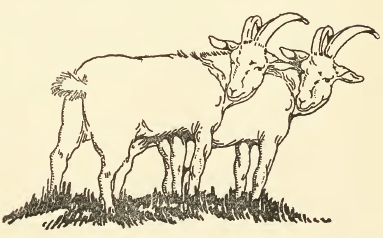
In the book of Leviticus /Vayikra, the high priest atones for the whole community in the Torah portion Acharei Mot (which is chanted at Yom Kippur services) through a ritual involving two goats.  (See my post Acharey Mot: Azazel.)

And Aaron shall both his hands on the head of the live goat and confess upon it all the avonot of the Israelites and all their insubordinations, for all their chatot, and put them on the head of the goat.  And it shall be sent by the hand of a designated man into the wilderness.  (Leviticus/Vayikra 16:21)

chatot (חטֺּאת) = wrongdoing, misdeeds, lapses, unintentional offenses.  (Singular chatat, חַטָּאת or cheit, חֵטְא.  The root of the noun is the verb chata (חָטָא) = missed the mark, offended, was at fault, was guilty.)

In Leviticus, rules for purity and rituals, as well as ethical principles, are labeled as avonot and chatot.  These words for intentional and unintentional offenses are applied to everything from touching an animal that died of natural causes to hating one’s neighbor.1

But in the liturgy for Yom Kippur, we wrong God only when we succumb to evil thoughts and unethical behavior.

Jews Praying in the Synagogue on Yom Kippur, by Maurycy Gottlieb

On Yom Kippur, Jews chant two confessional prayers again and again: the Ashamnu and the Al Cheit, both extant in the 9th century C.E.2   The Ashamnu (אָשַׁמְנוּ = We have become guilty), is a list of 23 immoral actions that begins with betrayal, robbery, and slander, and ends with leading others astray.  After confessing that we, as a group, have been wicked in all these ways, the prayer asks God to “make atonement for us for all our chatot, forgive us for all our avonot, and pardon us for all our insubordinations”.

The Al Cheit (עַל חֵטא = For the wrong) is a list of both immoral actions and bad attitudes (such as arrogance and recklessness) that lead to wrongdoing.  Each line begins with:

Al cheit shechatanu lefanekha (עַל חֵטא שֶׁחָטָאנוּ לְפָנֶיךָ) = For the wrong that we have done wrong in your presence.

“Your presence” means the presence of God.  Some people think of God as the ruler of the universe; for others, God is the “still, small voice” inside.3  Either way, God notices the bad deeds and wicked thoughts we are guilty of, even when no humans do.  And our souls or psyches are affected.

After each group of six or more bad deeds or attitudes in the Al Cheit, we sing this refrain:

Ve-a’ kulam, Eloha selichot, selach lanu, machal lanu, kaper lanu! (וְעַל כֻּלָּם אֱלוֹהַּ סְלִיחוֹת סְלַח לָנוּ מְחַל לָנוּ כַּפֶּר לָנוּ) = And for all of them, God of forgiveness, forgive us, pardon us, reconcile with us!

We confess that we are guilty as a group, and we wait, like Israel in Psalm 130, for God’s forgiveness.

Yet it is impossible not to think of our individual moral failings when we spend all day praying for forgiveness.


How do we wrong God?

If humans are made in God’s image,5  then we wrong God both when we wrong other humans, and when we damage our own souls.  I believe we degrade our souls when we treat other people as objects, when we selfishly or carelessly hurt or neglect or endanger any of our fellow human beings.

If we are lucky, we realize what we did wrong—maybe the same year, maybe many years later.  Then we feel guilty.  We can make any amends that are possible, and we can sincerely change our ways.  Then we only need to wait until we hear the still, small voice of God releasing us from guilt.

May we all find our way to forgiveness.


  1. See Leviticus 4:2-3, 4:13, 5:1-6, 7:18, and 24:15 on transgressing ritual laws, and Leviticus 18:6-25, 19:17, and 19:20-22 on transgressing ethical laws.
  2. In the Siddur Rav Amram, compiled by Amram ben Sheshna, the Gaon of Sura.
  3. 1 Kings 19:12. When God crosses in front of the cave where the prophet Elijah is hiding, there is a windstorm, an earthquake, and a fire, but God is not in any of these things.  After the fire Elijah hears “a thin, murmuring sound” or “a soft murmuring voice”, and knows God is there.
  4. Genesis 8:21.
  5. According to Genesis 1:27 and 5:1.

Psalm 27: Not Forsaken

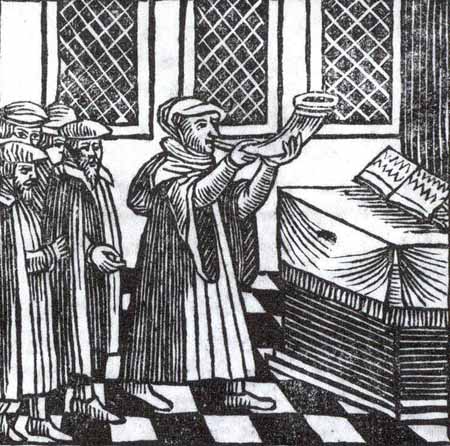
Shofar in “Minhagim”, Amsterdam 1707

The Hebrew month of Elul began Sunday evening.  This is the month for Jews to listen to the wake-up call of the shofar (ram’s horn), add Psalm 27 to our prayers, and identify where we went wrong during the past year.  We begin apologizing to the people we wronged, and repenting of our deeds that wronged God.

By the end of Yom Kippur (“Day of Atonement”) next month,1 we hope to have made amends with both human beings and the divine spirit within us.

Psalm 27:1-9, promise and plea

The custom of reading Psalm 27 every day during the month of Elul began in the mid-18th century.2  How does that psalm help us in our work of self-review and repentance?

One answer is that we are begging God for forgiveness, and Psalm 27 includes both a promise and a plea about God’s response in times of trouble.  It begins with the promise, a statement of faith that God will continue to help the poet:

God is my light and my salvation; whom would I fear?

          God is the stronghold of my life; whom should I dread?  (Psalm 27:1)

Later in the psalm, the speaker is less certain of God’s benign attention, and begs:

Listen to my voice, God, when I call!

           And by gracious to me, and answer me!  (Psalm 27:7)

Do not conceal your face from me, do not turn away from your servant in anger!

           My helper you have been.

           Don’t you cast me off, and don’t ta-azveini, God of my salvation!  (Psalm 27:9)

ta-azveini (תַּעַזְבֵנִי) = you leave me, forsake me, abandon me, give up on me, set me free.  (A form of the verb azav, עָזַב.)

Psalm 27:10, abandonment

Another answer is that Psalm 27 contains this couplet guaranteeing that God will accept anyone who sincerely repents:3

Although my father and my mother azavuni,

            God ya-asefeini.  (Psalm 27:10)

azavuni (עֲזָבוּנִי) = they have left me, forsaken me, deserted me, neglected me, set me free.  (Another form of the verb azav.)

ya-asefeini (יַאַסְפֵנִי) = will gather me in, will take me in.  (A form of the verb asaf, אָסַף.)

In other words, even if my parents kick me out, God will take me in.

The standard interpretation of this couplet is that all parents are attached to their children at first, but let them go at some point.  God, on the other hand, is always ready to bring us in and take care of us, no matter how old we are.

For 16th-century rabbi Obadiah Sforno, parents set their children free when they reach adulthood, and after that only God helps them.  For some later commentators, parents love their children indefinitely, unless the children commit unforgivable acts; but even then, God is willing to forgive them.4  19th-century rabbi S.R. Hirsch rephrases Psalm 27:10 this way:  “For even if I were so depraved that my own father and mother would abandon me and leave me to my own devices, God would still take me up and believe in my ability to mend my ways.”5

This interpretation of Psalm 27:10 follows the usual psychology of an abused or neglected child.  Parents have absolute power over their children, so it would be devastating to believe that these god-like creatures were unjust, inflicting punishment for no reason.  Therefore most abused or neglected children assume that they are the “bad” ones, that they deserve what they get, and that if only they can manage to do the right things, their parents will reciprocate with protection and affection.

Of course this strategy does not work, since the parents are defective because of their own psychological problems.  So then it helps to believe that “Although my father and my mother have forsaken me, God will take me in.”  Adult children who still feel as though anything that goes wrong must be their own fault can take comfort in this view of God as the supreme parent.

I can imagine people who grew up with loving, attentive, and empathetic parents either skipping over Psalm 27:10, or interpreting it as “Even when my father and my mother have [died and] left me, God will gather me in [like a good parent].”  Perhaps they picture confessing a mistake to God, and God enfolding them in a forgiving embrace.

What about people whose parents were neither terrible nor excellent, but merely inadequate?  What about those of us with parents who provided us with meals and clothing, some signs of affection, and punishments only for actual disobedience; but who made us feel like failures?  Can we find encouragement in Psalm 27:10?

I know some people brought up by inadequate parents who think of God as an improved parent, an invisible presence who substitutes for what they missed.  I take a different approach.  I gradually learned to recognize my parents’ flaws and stop blaming myself, and I worked hard to be a better parent to my own child.  Now I think of God not as a substitute parent, but as the inner inspiration that sets me free to choose my path.

As for Psalm 27:10, I take it as a goal for ethical behavior.  If one of my fellow human beings is forsaken and deserted by others, I would like to welcome that person and offer my attention and kindness.  I cannot be a substitute for a forgiving God; after all, I am not omnipotent, so I need to avoid outcasts who would put me in danger.  But a harmless outcast might only need someone to talk to.

I regret the times this past year when I have ignored people.  I hope to become someone who listens.

  1. Yom Kippur is the 10th of Tishrei, the month after Elul in the Hebrew calendar.
  2. The recitation of Psalm 27 continues until Hoshanah Rabbah, the 21st of Tishrei. This custom was first recorded by Rabbi Ya’aokov Emden in Siddur Bet Yaakov, 1745.
  3. Rabbi Nosson Scherman, The Complete ArtScroll Machzor: Yom Kippur, Mesorah Publications, Ltd., 1987, p. xiv.
  4. Including Scherman (ibid); and Robert Alter, The Book of Psalms, W. Norton & Co., New York, 2007, p. 93.
  5. Samson Raphael Hirsch, The Hirsch Tehillim, translated from German by Gertrude Hirschler, Feldheim Publishers, 2014, p. 237.

Lamentations, Va-etchannan, & Vayeishev: The Pit

Dig a deep hole in the ground and you have a pit, a bor in Hebrew.  In the bible you can use it as a dungeon, or line it with cement and use it as a cistern to store water. A bor is also part of the underworld where the souls of the dead go.

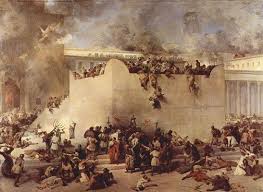
Roman Destruction of the Temple in Jerusalem, by Francesco Hayez, 19th century

This Sunday is Tisha B’Av, the annual Jewish day of fasting that commemorates the destruction of Jerusalem and its temple—both the first temple, razed by the Babylonians in 586 B.C.E., and the second temple, razed by the Romans in 70 C.E.  On Tisha B’Av it is customary to read the book of Lamentations/Eykhah, a series of five poems which mourn the fall of Jerusalem to the Babylonian army.

The first poem opens with the word Eykhah (“How can it be?”)1 and expresses the desolation of the ruins of Jerusalem.  The second poem, which also begins Eykhah, calls the destruction “the day of God’s wrath” over the misdeeds of Jerusalem’s people.  The fourth and fifth poems combine the two themes, with emphasis on starvation and being at the mercy of the enemy.

The third poem, however, reads like one of the personal psalms in which the ancient poets feel as if they are near death, and plead with God to bring them back to life and take vengeance against their enemies.2  Only in verse 40 does the third poem of Lamentations switch from “I” to “we”, urging all the people of Jerusalem to plead with God for forgiveness and rescue.

     Let us check on our ways and cross-examine [ourselves], and turn back to God!  (Lamentations 3:40)3

The first person singular returns with:

     Streams of water go down from my eyes over the shattering of my people.  (Lamentations 3:48)

Shortly after that, the narrator, identifying with Jerusalem, claims that the Babylonians did not actually need the city.

     My enemies actually hunted me like a bird, for no reason.

     They silenced my life in the bor, and in their hand was a stone against me.

     The waters rose over my head.  I thought: “I am ended!”

     I called your name, God, from the bottom of the bor.

     May you hear my voice!  Do not shut your ear to my spirit, to my cry for help!  (Lamentations 3:52-56)

bor (בּוֹר) = a pit; a cistern, a dungeon, a synonym for Sheol.

Here the bor is not a physical cistern or dungeon, but a poetic image for Sheol, the underworld of the souls of the dead.  Bor is used at least 21 times in the Hebrew Bible to indicate either Sheol or the lowest region of Sheol, but this is the only such reference that includes water.  Souls never drown after they are dead in ancient Hebrew mythology.  Thus the narrator of this poem is not dead, but despairing of life.  The poet uses the images of both stone and water, comparing the bor of Sheol to a cistern filling up with water.

The narrator, like all the citizens of defeated Jerusalem, is trapped—unable to float to the surface and escape.

A full cistern

Next week Jews read from Va-etchanan (“And I implored”), the second Torah portion of the book of Deuteronomy/Devarim.  In this portion cisterns are listed as assets that the Israelites will enjoy once they conquer the land of Canaan:

… cities big and good that you did not build, and houses filled with everything good that you did not fill, excavated borot that you did not excavate, vineyards and olive groves that you did not plant.  And you will eat and you will be satisfied.  [Then] take heed, lest you forget God who brought you out from the land of Egypt, from the house of slavery.  (Deuteronomy 6:10-12)

borot (בֺּרוֹת) = plural of bor.

How lovely to move into a land already dotted with cisterns that collect and store water for the dry season!  Moses reminds his people not to take the cisterns for granted, since they did not excavate them.  Canaanites dug them, and the Israelites will conquer Canaan only with God’s help.4

The books of Exodus through Joshua treat the conquest of Canaan as an unmitigated good, since it results in fertile land for the Israelites, not to mention pre-existing amenities such as cities, houses, and cisterns.  The bible does not consider the Canaanite point of view.

But I can imagine poets from the various conquered peoples of Canaan writing laments after the Israelites besiege and loot their cities, destroy their temples, and kill many of their people.  The conquest of Canaan by the Israelites under Joshua is the same story as the conquest of Judah by the Babylonians under Nebuchadnezzar; only the names and dates change.

An empty cistern

Cisterns holding water are mentioned twelve times in the Hebrew Bible.  Dry cisterns and dry pits are mentioned at least 31 times.  They serve as hiding places,5 a warrior throws bodies of the slain into them,6 and large animals fall in.7  Psalm 7:16 refers to a man falling into a pit he dug himself, a fine image of being caught in your own trap.8

Since the walls of an empty cistern are covered with cement, they do not provide handholds for a human to climb out.  The only escape is for someone at the top to throw you a rope.

At least thirteen times the bible mentions a dry bor, it was  excavated to serve as a dungeon.  Five times in Genesis, in the portion Vayeishev (“And he settled”), the bor is an empty cistern that Joseph’s older brothers use as an ad-hoc prison.

They see Joseph coming up the road to check on them, and they know he will give a negative report to their father, as usual.

Joseph pulled up from the pit, by James J.J. Tissot

And they said, each man to his brother: “Hey!  Here comes the master of dreams!  And now let’s go murder him, and let’s throw him into one of the borot, and we can say a wicked beast ate him.  Then we’ll see what happens to his dreams!”    And Reuben said to them: “Don’t shed blood!  Throw him into this bor that is in the wilderness, but don’t lay a hand on him!”—in order to rescue him from their hand and return him to his father.  And it happened when Joseph came up to his brothers.  They stripped his tunic off Joseph, the fancy tunic that he had on, and they took him and threw him into the bor.  And there was no water; the bor was empty. (Genesis 37:20-24)

It would take about two weeks for a healthy adolescent like Joseph to die of dehydration at the bottom of the pit, less if there were no shade.  Before Reuben can return with a rope to rescue him, Judah sells Joseph to a caravan.  The traders pull him up out of the bor and take him to Egypt as a slave.


A deep hole in the ground is beneficial when it becomes a cistern full of water, or the basement of a building.9  But when it is used as a dungeon, the captive will die unless given food and water.  A prisoner in a dungeon can hope for a reprieve or a rescue, but if the bor is Sheol you can only be saved if God heeds your prayer as you go down.  There is no life after death in that bor; at best the disembodied souls lie in eternal sleep.10

Today, when we are depressed we feel “down”, trapped in a mysterious place without life or meaning.  In English we call it “a pit of despair”.

May everyone who sinks into a pit find a way to cry out for help and be rescued, whether the rescuer is a fellow human being or the voice of God within.


  1. See my post Devarim, Isaiah, & Lamentations: Desperation.
  2. g. Psalms 28, 30 and 88, all of which mention bor as a synonym for Sheol.
  3. Since the poem is an acrostic, verse 40 must begin with the letter nun, נ. When the prefix nun is attached to verbs in the perfect tense, it indicates the second person plural.  However, the prefix nun can also be used to indicate the simple passive (nifal) verb stem, and there are many other words that begin with a nun, so switching to the second person plural for a word beginning with nun is a deliberate choice on the part of the poet.
  4. See my post Eikev, Va-etchannan, & Noach: Who Built It?
  5. 1 Samuel 13:6, 1 Chronicles 11:17-18, and Proverbs 28:17.
  6. Jeremiah 41:7-9 and 1 Chronicles 11:17-18.
  7. Exodus 21:33-34, 2 Samuel 23:20, and 1 Chronicles 11:22.
  8. Psalm 7:16.
  9. The word bor is not used for a basement in the bible; the substructure of a building is called a yesod (יְסוֹד) = foundation, base.
  10. Unless they are disturbed by a diviner such as the witch of Endor, who summons the ghost of Samuel to speak briefly with King Saul in 1 Samuel 28:7-20.

Shavuot, Vayeira & Ruth: Whatever You Say

Barley sheaf

At first Shavuot (שָׁבֻעֹת = weeks) marked the end of the seven-week barley harvest and the beginning of the wheat harvest.1 Then it became one of the three annual pilgrimage-festivals in Jerusalem, the day to bring gifts of first fruits to the temple, and it came on fiftieth day after Passover/Pesach.2 After the fall of the second temple, the rabbis decided that day was the anniversary of God’s revelation and transmission of the Torah at Mount Sinai.

This year Shavuot begins at sunset on Sunday, May 16. Some Jews will stay up all night studying Torah—including the book of Ruth,3 which touches on both the barley harvest and the acceptance of the Torah. 

Ruth

The celebration at the end of the barley harvest is the night when Ruth risks everything.4 She also embraces the religion transmitted at Mount Sinai; she leaves her own land, Moab, to follow her mother-in-law Naomi, saying:

from The Story of Ruth, Thomas Matthews Rooke, 1876

“Where you go, I will go; where you stay, I will stay; your people will be my people; and your god will be my god.” (Ruth 1:16)

Although Naomi discourages her, and the Israelites do not welcome her at first, Ruth’s embrace of her new life is as wholehearted as her attachment to Naomi.

During the barley harvest, she feeds herself and her mother-in-law by gleaning in the field of kind landowner named Boaz.  Naomi identifies Boaz as a potential “redeemer”, a male relative who can fulfill two duties for a widow: buying back her deceased husband’s land, and giving her a son in her deceased husband’s name, thereby giving her a place in his family.5

But although Boaz is generous toward Ruth in the barley field, it does not occur to him that he could do more for her and his kinswoman Naomi. He may be holding back because he expects Ruth to marry one of the younger men in the town; later in the story, he praises her for not going after them.6

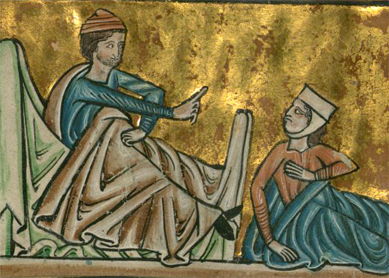
Ruth at Boaz’s Feet (a polite version), William deBrailes, ca. 1250

So when the barley harvest ends, Naomi comes up with an audacious scheme. She tells Ruth to hide near the threshing floor and wait until Boaz has feasted, drunk, and dozed off.

“Then go over and uncover his ‘feet’ and lie down. And he himself will tell you what to do.” And [Ruth] said to her: “Kol that you say to me I will do.” (Ruth 3:4-5)

kol (כֹּל) = all, everything, whatever, anything.

Ruth is risking her whole future on Naomi’s desperate plan. Boaz could treat her as a prostitute rather than an honorable woman. Or he might cry out in surprise when he wakes up and finds her, and then the other men sleeping on the threshing floor would awaken and discover her in a compromising position.

But Ruth has attached herself to Naomi so completely that she does exactly what her mother-in-law says—and more. When Boaz wakes at midnight, startled, he asks (presumably in a whisper) “Who are you?”

And she said: “I am Ruth, your servant. Spread your wing over your servant, because you are a redeemer.” (Ruth 3:10)

Now she is telling Boaz what to do. He is rich and powerful in his community; she is an impoverished foreigner, dependent on his good will. But she does everything she can to carry out Naomi’s plan successfully.

Ruth courageously follows all of Naomi’s instructions and more because she has committed herself completely to her mother-in-law.

Abraham

Back in the book of Genesis, Abraham is not nearly as committed to his wife, Sarah.  When she tells him to have a child with her slave-woman, Hagar, he goes along with her request, but disregards the reason she gives.

And Sarah said to Abraham: “Hey, please, God has kept me from bearing a child. Please come into my slave-woman; perhaps I will be built up through her.” And Abraham heeded Sarah’s voice. (Genesis 16:2)

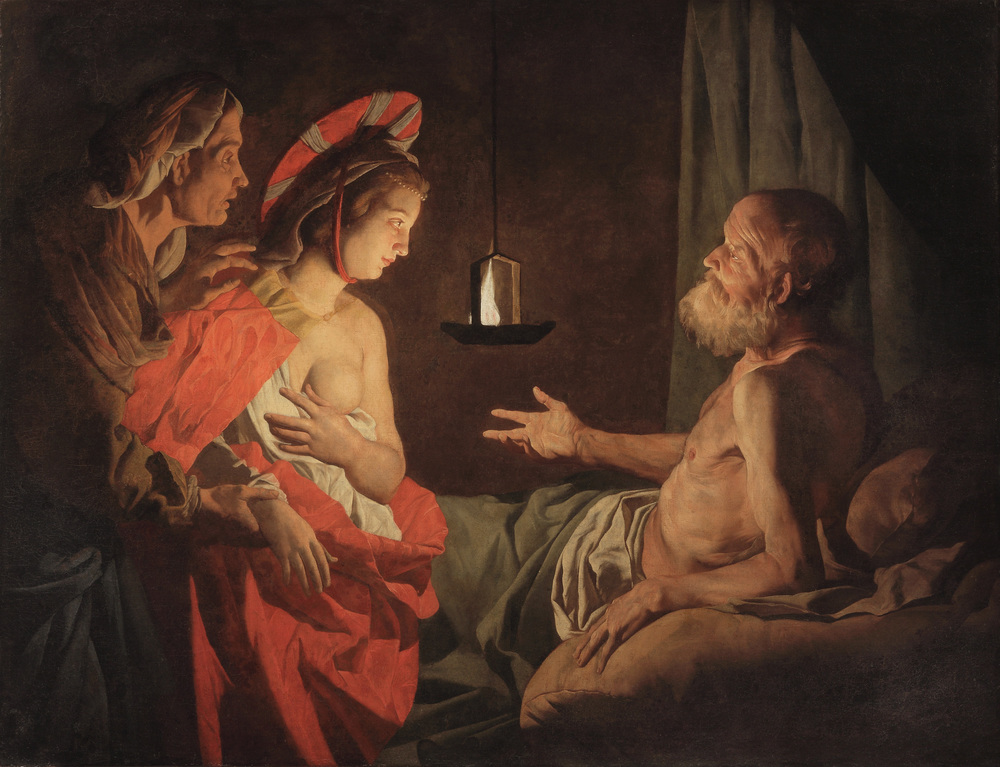
Sarah Presenting Hagar to Abraham, by Matthias Stomer, 17th century

Sarah politely informs him that she wants a child, even if she must adopt the child of her husband and her slave, Hagar. Abraham heeds her request long enough to get Hagar pregnant, but by the time Sarah complains that Hagar is belittling her, he has lost interest. Instead of intervening to put Sarah’s adoption plan back on track, he merely says:

“Hey, your slave-woman is in your hand. Do to her what is good in your eyes.” (Genesis 16:6)

Sarah abuses Hagar, and Hagar runs away and has a conversation with God. Although she returns to Abraham’s camp, her newborn baby is not placed in Sarah’s lap to signify adoption.7 The boy is named Ishmael—not by Sarah, but by God and then Abraham.

Abraham loves his son.8 But when Ishmael is an adolescent Sarah gives birth to her own son, Isaac. She tells her husband to cast out Ishmael, along with Hagar.

The thing was very bad in Abraham’s eyes, on account of his son. And God said to Abraham: “Don’t let it be bad in your eyes concerning the young man or concerning your slave-woman.  Kol that Sarah says to you, heed her voice, because through Yitzchak descendants will be called by your [name]. And also the son of the slave-woman I will make a nation [out of him], since he is your seed.” (Genesis 21:11-13)

Only when God tells him to do whatever Sarah says does Abraham send away Ishmael and his mother.

And Abraham got up early in the morning, and he took bread and a skin of water and he gave them to Hagar, placed them on her shoulder and the boy[’s], and he sent her away … (Genesis 21:14)

Abraham is a rich man; he could easily afford to give Hagar and Ishmael a donkey or two loaded with provisions and trade goods. And for all he knows, Sarah would not object; she says she does not want Ishmael to inherit Abraham’s estate, but she does not say anything about parting gifts.

Yet Abraham sends off his older son and his concubine with only bread and a single skin of water. They get lost in the desert, the water runs out, and Ishmael is about to die of dehydration when God sends an angel to intervene.9

Abraham can safely assume Ishmael will live long enough to have at least one son, since God promises to “make a nation” out of him. But even if he is not risking Ishmael’s life, Abraham is still responsible for making Ishmael and his mother suffer from thirst and agony in the desert. His neglect is unnecessary and unethical.

Why is he so mean? Abraham is not wholehearted about either Ishmael or Sarah. He obeys God by doing what Sarah says, but he does it grudgingly and badly. Perhaps he closes his heart in order to obey Sarah, and then his heart remains closed. He no longer wants to love Ishmael.


Ruth, on the other hand, is so wholehearted in her attachment to Naomi that her heart is open to Boaz as well.

Naomi introduced her threshing floor scheme by saying:

“My daughter, should I not seek for you a tranquil place where it will be good for you?” (Ruth 3:1)

She wants Ruth to have a better life. But Ruth knows that Boaz is kind-hearted enough so that if he redeems her and gives her a tranquil place in his home, he will not leave Naomi out in the cold. For Naomi’s sake, Ruth makes what amounts to an offer of marriage to Boaz.

When she reminds him that he is a potential redeemer, Boaz says:

“And now, my daughter, don’t be afraid. Kol that you say to me I will do for you.” (Ruth 3:11)

Like Ruth, Boaz does exactly what he is told, and more. He helps her sneak away from the threshing floor before dawn, and sends her back to Naomi with a gift of threshed barley. In the morning, in order to make sure nobody can question his acting as the redeemer, Boaz sits with the other elders in the city gate and hails the only relative of Naomi’s who is closer to her on the family tree. The other elders serve as witnesses that the other man refuses to be the redeemer, and that Boaz is now acquiring the land and Ruth.

Boaz opens his heart to Ruth and Naomi, and takes extra steps to make sure his marriage to Ruth is legal and recognized by the whole community, even though she is a Moabite. The book ends with Boaz and Ruth’s newborn son sitting on Naomi’s lap. Naomi has become his adoptive mother, the role Sarah wanted but never got.

In the book of Genesis, Abraham’s half-hearted compliance with Sarah’s requests signals his shrinking love for both Sarah and Ishmael, and foreshadows his willingness to sacrifice Isaac without a protest.10 In the book of Ruth, Ruth does everything Naomi says and more, while Boaz does everything Ruth says and more. The result is a tranquil household in which all three adults are loving and generous.

May we all learn to be as open-hearted as Naomi, Ruth, and Boaz became.


  1. For seven weeks after Passover we count the omer (עֺמֶר), a measure of barley. Click here to see my post: Omer: Counting 49.
  2. Numbers 28:26-31 (the maftir reading for both days of Shavuot) and Deuteronomy 16:9-12, 16:16-17 (part of the Torah reading for the second day of Shavuot).
  3. The rabbis of the first millennium C.E. assigned a biblical book to reach on each of the pilgrimage-festivals: The Song of Songs on Passover, Ruth on Shavuot, and Ecclesiastes on Sukkot.
  4. Ruth 3:1-18.
  5. For more on the role of a redeemer, see Deuteronomy 25:5-6 and Genesis 38:6-26, or my post Yitro & Vayeishev: Fathers-in-Law.
  6. Ruth 3:10.
  7. The adoptive parent holds the infant on his or her knees as part of the adoption ritual in Genesis 30:3-13 and Genesis 48:5 and 48:12.
  8. Genesis 17:18-21.
  9. Genesis 21:14-17.
  10. Genesis 22:1-13.

Vayikra & Vayechi: Kidneys and Faces

After a delay while I wrote a dialogue for a Passover seder and addressed some family issues, I am back at work on my book on Genesis. This week I am considering the moral ramifications of Joseph’s version of pardoning his ten older brothers.

Joseph’s brothers make two attempts to get Joseph to forgive them for their shameful misdeed when he was seventeen and they sold him as a slave bound for Egypt.  The second attempt happens in the last Torah portion of the book of Genesis, Vayechi.

Since their first attempt failed (see my recent post Testifying to Divine Providence )1 they try a ploy that they hope will be more persuasive; they pretend that before their father, Jacob, died, he left the following message for Joseph:

“Please sa, please, the rebellion of your brothers and their guilt because of the evil they rendered to you.  And now sa, please, the rebellion of the servants of the god of your father.”  (Genesis/Bereishit 50:17)

sa (שָׂא) = lift up! pardon! forgive!  (From the root verb nasa, נָשָׂא= lifted, raised, pardoned.)

Are they asking Joseph, who is now Pharaoh’s viceroy, to pardon them, or to forgive them?  In English, pardoning means excusing someone who committed an error or offense from some of the usual practical consequences.  A United States president can pardon someone who was convicted of a crime, commuting that person’s sentence, without having to list any extenuating circumstances.  And the president’s feelings about the offender are irrelevant.

Forgiving, on the other hand, means letting go of one’s resentment against the person who committed an error or offense.

Biblical Hebrew, however, makes no distinction between pardoning and forgiving; it only distinguishes who is doing it.  Soleach (סֺלֵחַ) means “forgiving” or “pardoning”, but it is only used in the Hebrew Bible when God is forgiving or pardoning one or more human beings.

Nosei (נֺשֵׂא) has several meanings, including pardoning, and it is something either God or a human can do.  When God or a human is pardoning someone in the Hebrew Bible, the text says either nosei their head, nosei their face, or just nosei.  The reader has to figure out from context whether it is a reference to forgiving/pardoning, or to one of the other meanings of nosei (such as taking a census for nosei their head, bestowing favor for nosei their face, or lifting and carrying an object for nosei by itself).

After Jacob dies, Joseph’s older brothers worry that Joseph might decide to take revenge on them after all.  They are still carrying guilt in their kidneys.


This week’s Torah portion, Vayikra, discusses burning the kidneys of an animal slaughtered on the altar.  Elsewhere in the Hebrew Bible, human kidneys are the seat of the conscience or moral sense.  (See my post on the subject by clicking here: Vayikra & Jeremiah: Kidneys.)  For example, Psalm 16 recognizes the kidneys as the source of a guilty conscience.

          I bless God, who has advised me;

                        Even  the nights my kidneys chastised me.  (Psalm 16:7)

When your kidneys chastise you for wronging another human being, you long for your victim to lift your face in forgiveness.


  1. Genesis 45:4-8.

Tetzaveh & Vayigash: Testifying to Divine Providence

What can you give God, when God has given abundantly to you?

Illustration from Northrop, Treasures of the Bible, 1894

Burning something is the standard method for expressing gratitude to God in the Torah.  God loves the smell of smoke, whether it comes from animal fat burning on the courtyard altar, or incense burning on the golden altar just inside the Tent of Meeting.

In this week’s Torah portion, Tetzavveh, God tells Moses the ritual for consecrating both the courtyard altar and the new priests, a ritual that includes a lot of fat burning.1  After burning the fat parts of a bull and all of one ram, the priests to be ordained must hold up the fat parts of the “ram of ordination”, along with its right thigh and three kinds of grain products.

Then you shall take them from their hands and you shall turn them into smoke on the altar, on top of the rising offering, for a soothing fragrance before God; it is a fire-offering for God.  (Exodus 29:25)

The end of the Torah portion describes the construction of the incense altar and decrees that the high priest must burn incense on it twice a day.2  Apparently God needs a lot of soothing.

Only a few psalms and the writings of a few prophets indicate that one can also worship God through words.  See my post: Tetzavveh & Psalms 141, 51, and 40: Smoke and Prayer.

Serving God through words also has a precedent in the Joseph story in the book of Genesis.  In the chapter in my book on the portion Vayigash, Joseph reveals himself to his brothers and explains that they are not to blame for throwing him into a pit and selling him as a slave all those years ago, because it was all part of God’s plan to bring the whole family down to Egypt during the seven-year famine.3

He intends to reassure his older brothers, but they are not thrilled to hear that they have no free will.  Joseph kisses them and sobs on their necks, but they merely become able to speak to him.4

The author of Psalm 40, like Joseph, expresses his religious attitude by giving verbal testimony about divine providence.5  Unlike Joseph, he later becomes insecure and reminds God:

I did not conceal your righteousness in the middle of my heart;

          I spoke of your reliability and your deliverance.

          I did not conceal from a great assembly your loyal kindness and your fidelity.

You, God, you will not hold back your compassion from me;

          Your loyal kindness and your fidelity will always guard me.  (Psalm 40:11-12)

Faith in divine providence is easy in hindsight, as it was for Joseph.  But when troubles are still threatening you, you need to keep reminding yourself of your belief, like the author of Psalm 40.  And when someone else tells you not to worry about your past crime because it all worked out for the best, you may feel cheated of a chance to make amends, like Joseph’s brothers.

  1. Exodus 29:12-25.
  2. Exodus 30:1-9.
  3. Genesis 45:4-8.
  4. Genesis 45:15.
  5. We can assume the speaker is a man because he is allowed to speak to a “great assembly”, something no woman could do at that place and time.

Devarim, Isaiah, & Lamentations: Desperation

Eykhah (אֵיכָה) = Oh, how?  Oh, where?  Oh, how can it be?  (Ten of the nineteen occurrences of eykhah in the Hebrew Bible are in rhetorical questions that express despair or desperation.1)

The first appearance of the word eykhah in the  bible is in this week’s Torah portion, Devarim.2  Eykhah also appears in the accompanying haftarah reading from first Isaiah, and in the book of Lamentations, which we read next week during the fast of Tisha B’Av.  (In 2020 we read the Torah portion Devarim during the week ending this Saturday, July 25, and observe Tisha B’Av beginning Wednesday evening, July 29.)

Deuteronomy

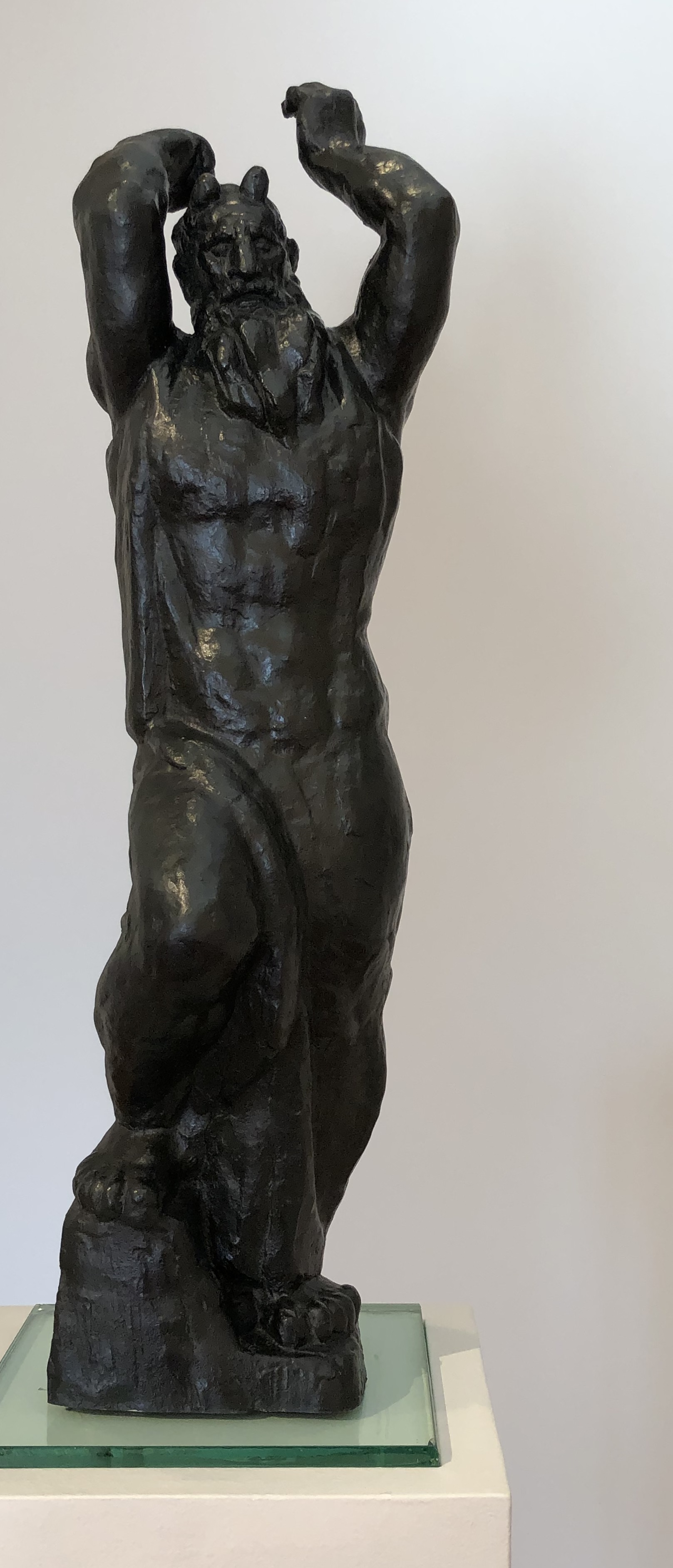
Moses, by Ivan Mestrovic,1934, bronze

The book of Deuteronomy (also called Devarim in Hebrew) is a long series of speeches that Moses delivers on the bank of the Jordan before he dies and the other Israelites cross over to conquer Canaan.  Some of his speeches outline God’s laws and others relate what Moses remembers happening on the 40-year journey from Egypt.1

Moses’ first recollection begins with God telling the Israelites to leave Mount Horeb (elsewhere called Mount Sinai) and go to Canaan to take possession of the land.  Moses says:

Then I spoke to you at that time, saying: “I am not able to carry you by myself!  God, your God, has multiplied you, and here you are today like the stars of the heavens in multitude …  Eykhah can I handle by myself alone your load and your burden and your disputing?  Bring men of wisdom and discernment and knowledge from among yourselves to your tribes, and I will appoint them as your heads.  (Deuteronomy/Devarim 1:9-10, 12-13)

Here the word eykhah begins a cry of desperation expressing Moses’ memory of how overwhelmed he was.

Isaiah

This week’s haftarah reading from first Isaiah4 rails against the immorality of the people of Jerusalem in the 8th century B.C.E.  The prophet cries out:

Isaiah, by Gustave Dore, 1866

     Eykhah she has become a prostitute,

     The [once] faithful city

     Filled with justice?

     The righteous used to linger in her,

     But now—murderers.  (Isaiah 1:21)

When Isaiah asks “Eykhah (How can it be?) she has become a prostitute, the [once] faithful city?”, it is a prophet’s cry of desperation, both exclaiming over how far the city of Jerusalem has fallen and sounding the alarm that its residents must change or else.  Isaiah can imagine a reversal of the immoral behavior of the Israelites, but he is afraid they will not cooperate until God smites the evil-doers.

Lamentations

The word eykhah appears four times in the book of Lamentations, which we read next week.5  In fact, Lamentations is called Eykhah in Hebrew because that is the first word in the book.  Tisha B’Av, the day next week dedicated to remembering the destruction of the first and second temples in Jerusalem, includes fasting and reading the book of Lamentations/Eykhah.

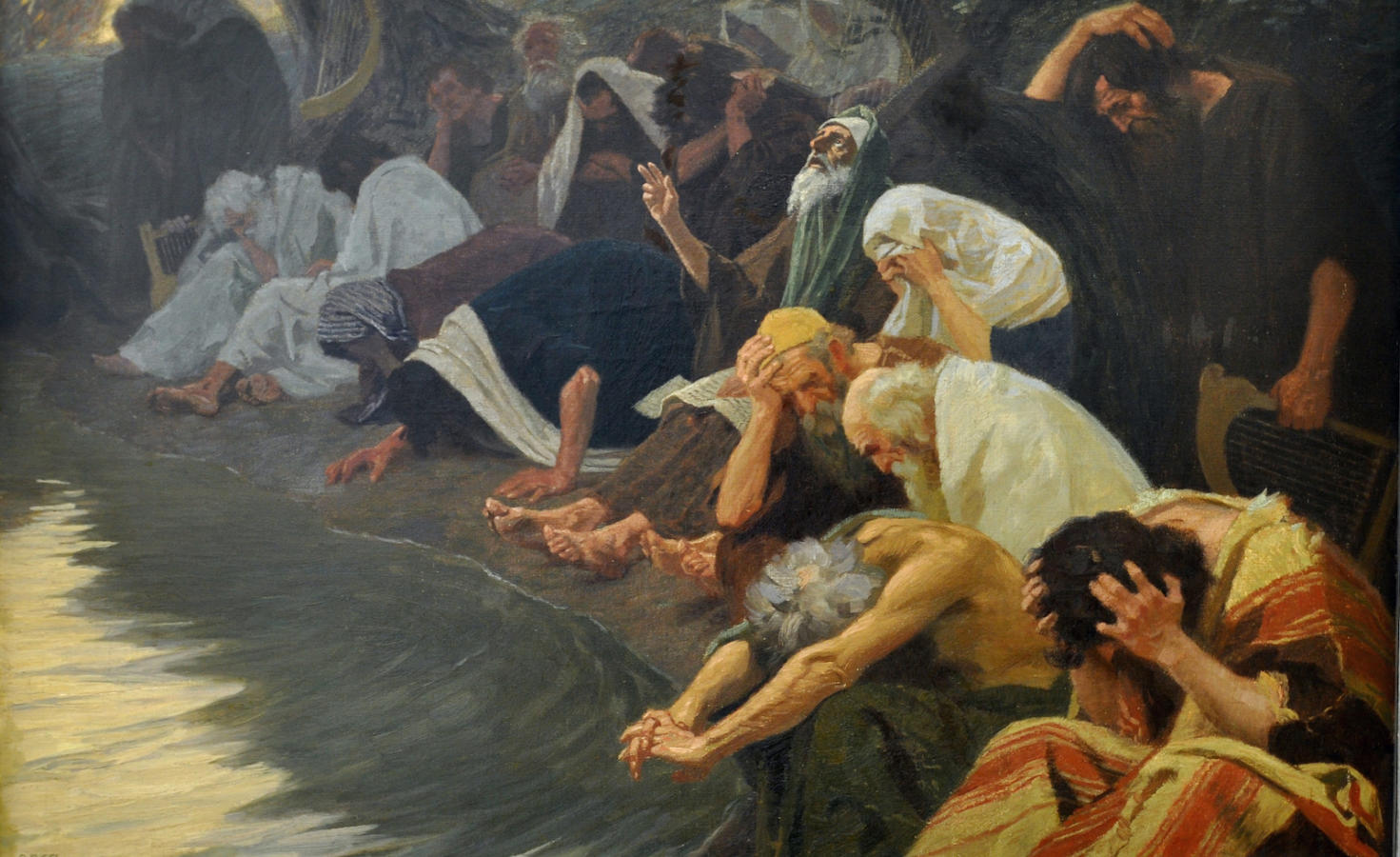
By the Rivers of Babylon, by Gebhard Fugel, ca. 1920

This book is set in a time shortly after the Babylonian army destroyed Jerusalem and its first Jewish temple in 587 B.C.E.  It opens with this rhetorical question:

      Eykhah the city sits alone,

     Once teeming with people?

     She has become like a widow,

     Once great among the nations.

     A princess among the provinces,

     She has become a slave. (Lamentations 1:1)

Here the poet6 utters a cry of despair over how the city of Jerusalem has changed from an important metropolis to a hillside of ruins.  Eykhah, how can it be?

The second chapter also begins with a rhetorical question:

Eykhah God, in his wrath, concealed in a cloud

The daughter of Zion?

Cast down from heaven to earth,

The splendor of Israel?

Did not remember his footstool

On his day of wrath?  (Lamentations 2:1)

This time the word eykhah expresses the poet’s despair over the nature of God, who exalted Jerusalem with splendor and chose the city as God’s footstool or resting place—and then in a fit of anger cast it down and made it disappear.  How could God do such a thing?


“Oh how can it be that the city sits alone?” we read in Lamentations on the fast of Tisha B’Av.  “Oh how can God forget God’s footstool on a day of wrath?”  Now all the people of the world might ask: “Oh how can God abandon us to this pandemic, letting the innocent die along with the guilty?”

What if we ask ourselves: “How can I grow out of my belief in a god who is a parent, either loving or abusive?  How can I stop blaming God and accept what is beyond my control?  And how can I take responsibility for what is within my reach?”

Oh how can the once faithful city have become a prostitute?” Isaiah asks in this week’s haftarah reading.  Now Americans might ask: “Oh how can our once responsible national government have become devoted to stroking the ego of a megalomaniac?”

What if we ask ourselves: “How can we restore a government devoted to saving lives and helping all of its citizens?”

“Oh how can I handle by myself alone your load and your burden and your disputing?” Moses asks in this week’s Torah portion.  Now, in the Covid-19 pandemic, we might ask: “Oh how can I handle by myself taking care of the kids without a single break, without a summer program or a class or a play group?  How can I handle the dangers of going to work, or the dangers of a simple trip to the grocery store?”  The burden can indeed be too much for one person, alone.

What if those of us who are not as overwhelmed ask ourselves: “How can I help my neighbor or my friend and safely lighten their burden?”


  1. Other Hebrew words that can be translated as “how” include eykh (אֵיךְ), which begins a rhetorical question in two of its three appearances in the bible; eikhakha (אֵכָכָה), used rhetorically in all three of its appearances; ey (אֵי), which usually means “where” but is used once as a rhetorical “how”; and mah (מַה), which usually means “what” but is used twice as a rhetorical “how”. But none of these words are used as an “Oh, how could it happen?” beginning a lament.
  2. The word God calls out in Genesis 3:9 when Adam and Eve are hiding in the garden is ayekha (אַיֶּכָּה). Although this word is spelled with the same letters as eykhah, the vowel pointing indicates that the word is actually ayeh (אַיֵּה) = where, with the suffix cha (כָּה) = you. Thus ayekha means “Where are you?”
  3. Moses’ memory is not always accurate, and sometimes the way he tells the story is self-serving. See my post Devarim: In God We Trust? Deuteronomy 1:9-13 is a different version of the delegation of administrative and legal jobs than either the one in Exodus/Shemot 18:13-26 where Moses’ father-in-law Yitro advises him to delegate 70 elders, or the one in Numbers/Bemidbar 11:16 and 11:24-25 where God tells him to delegate 70 elders.  In this week’s Torah portion, Moses claims that he asked for help on his own initiative, and that he asked the people to choose their own leaders to assist him with giving orders and judging legal disputes.
  4. See my post Haftarat Devarim—Isaiah: False Worship.
  5. Lamentations 1:1, 2:1, 4:1, and 4:2.
  6. The author of Lamentations is not named in the book, but rabbinic tradition ascribes it to the prophet Jeremiah.

Chukkat & Ecclesiastes: Accounting for Cheshbon

Moses asks two foreign kings to let the Israelites cross through their land in this week’s Torah portion, Chukkat (“decree of”).  Both refuse, even though Moses promises they will stay on the road, leave fields and vineyards untouched, and pay for any water they and their livestock drink.

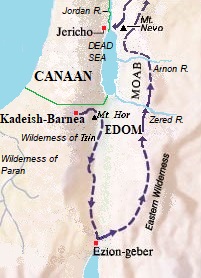
Route of Israelites

The king of Edom says no and sends an army to the border to bar the way.1  Apparently he does not trust the Israelites, but he prefers not to attack them.  So the Israelites circle around Edom and continue north through the unpopulated wilderness east of Moab until they reach the Arnon River.  Then Moses sends the same message to King Sichon of Cheshbon.  Sichon also refuses to let the Israelites pass through, but he attacks them at his border.  The Israelites win and conquer Sichon’s land.

And Israel took all these towns, and Israel settled in all the towns of the Amorites, in Cheshbon and in all its daughter-villages.  For Cheshbon was the town of Sichon; a king of the Amorites he was, and he had battled against the first king of Moab, and he had taken all his land from his hand as far as the Arnon.  (Numbers 21:25-26)

Cheshbon (חֶשְׁבּוֹן) =

  1. a town about 14 miles (23 km) east of where the Jordan River enters the Dead Sea.
  2. accounting, reckoning. (From the root verb chashav, חָשַׁב = evaluate, consider, calculate, think out.)

After explaining that Sichon’s land used to be northern Moab, the Torah portion Chukkat quotes part of an Amorite poem celebrating Sichon’s earlier victory, translating it into Hebrew.

Route of Israelites

Therefore the epic poem says:

            “Come to Cheshbon!  It was built

            and firmly established, the town of Sichon.

            Because fire went out from Cheshbon;

            Flame from the city of Sichon.

            It consumed Ar of Moab,

            The local gods of the high places of Arnon …  (Numbers 21:27-28)

Ironically, this week’s Torah portion shows that Cheshbon is not firmly established as the town of Sichon, since the Israelites conquer it on their way to the Jordan River.

The image of fire going out of a town is often used in the Hebrew Bible for an army going out to battle, consuming enemy soldiers.  Since the Amorites spoke a Semitic language closely related to ancient Hebrew, it is not surprising that the two peoples employed the same metaphor.

Perhaps King Sichon decides to attack the Israelite travelers because his victory against Moab has convinced him that his people are stronger than anyone else.  Look at the fortified town they built!

Cheshbon contested

If Sichon cannot hang on to Cheshbon, however firmly built, can the Israelites do any better?

They go on to conquer the Amorite kingdom north of Cheshbon, then camp on the east side of the Jordan River while Moses delivers the book of Deuteronomy/Devarim.  After Joshua leads the conquest Canaan west of the Jordan, he assigns the land east of the river, now called Gilead, to the tribes of Reuven, Gad, and Menashe.  Gad gets the Cheshbon area.2

Gilead changes hands twice in the book of Judges, and is attacked a third time.  In one story, King Eglon of Moab captures the territory and holds it for 18 years until the Israelite hero Ehud brings him tribute, then assassinates him and escapes to lead the charge against the army of Moab.3

In another story, the king of Ammon (or possibly Moab) 4 makes war on Gilead for 18 years.5  The territory’s new hero, Yiftach (Jepthah in English), sends the king a message explaining that the Israelites took Gilead from Amorite kings, not from Ammon (or Moab).  He adds that even if the enemy did have a claim to the land,

When Israel dwelled in Cheshbon and her daughter-villages, and in Aroer and her daughter-villages, and in all the towns that are along the Arnon, for 300 years, then why did you not recover them during this time?  (Judges 11:26)

The king sends no reply.  Yiftach captures twenty towns and villages, and Gilead remains in the hands of Israelites.6

Gilead becomes part of David’s kingdom in the second book of Samuel.  His son Solomon assigns a governor to administer “the land of Gilead: the land of Sichon, king of the Amorites, and Og, king of the Bashan.”  (1 Kings 4:19)

But after King Solomon’s death, Cheshbon and the rest of Gilead secede from Judah along with the territories of the other northern tribes.  They found the northern kingdom of Israel (also called Samaria), with Jereboam as its first king.7

When Tiglath-Pileser III (745–727 BC), king of the Neo-Assyrian Empire, decided to conquer Israel, he started by capturing Gilead and deporting people in the tribes of Reuven, Gad, and Menasheh.8  The conquest of the northern kingdom continued under the next two Assyrian kings, with Sargon II capturing the capital city of Samaria in 722 BCE.

Israelites never ruled over Cheshbon again.

Taking account

The book of Ecclesiastes/Kohelet opens with the declaration that everything is futile, because nothing a human does can make a permanent change.  The same things happen over and over again, so there is nothing new under the sun.

by Auguste Rodin, 1886

Kohelet, the narrator, explores this idea at length, analyzing the activities of humankind.

Myself, I turned [it] around in my mind to know and to scout out and seek wisdom and cheshbon.  … See, this I found, said Kohelet, one by one finding a cheshbon.  I sought further in my soul … (Ecclesiastes 7:25, 7:27)

Only see this: I found that God made humankind upright, but they themselves sought many chishbonot.  (Ecclesiastes 7:27, 7:29)

chishvonot (חִשְּׁבֺנוֹת) = plans, inventions.  (Also from the root verb chashav.)

Here Kohelet states that humans are naturally good but they invent too much.  I suspect Kohelet means inventing reasons for doing what we want.  A true cheshbon, an inner accounting and reckoning, is the means to gaining self-knowledge and wisdom, which are good for their own sake.

Everything that you find you are able to go and do, do it!  Because there is no doing nor cheshbon nor knowledge nor wisdom in Sheol, where you are going.  (Ecclesiastes/Kohelet 9:10)

Sheol is where the spirits of the dead go.   Ecclesiastes affirms that after death no action or thought is possible; there is no afterlife in heaven or Gehenna.  You can only acquire wisdom by conducting a personal accounting while you are alive.


Today the place called Cheshbon is the site of an archaeological dig in Jordan.  But many Jews follow the mussar9 practice of Cheshbon Hanefesh (“Accounting of the Soul”), keeping a daily record of good and bad deeds in order to improve one’s behavior.

Cheshbon as a practice of self-examination is lasting longer than Cheshbon as a town fortified for war.


  1. Numbers 20:14-21.
  2. Joshua 22:36-37.
  3. Judges 3:12-30.
  4. Most modern scholars argue that the negotiations between Yiftach and the attacking king in Judges 11:12-28 came from another source. This explains why the two leaders discuss what happened after King Sichon took the land from Moab, and Yiftach refers to Kemosh, the god of Moab rather than Ammon.  The compiler of Judges inserted Ammon to make the story fit the battle between the Israelites of Gilead and the Ammonite army.  (Robert Alter, The Hebrew Bible, Vol. 2, W. Norton & Co., New York, 2019)
  5. Judges 10:5.
  6. Judges 11:29-33. Also see my post Haftarat Chukkat—Judges: A Peculiar Vow.
  7. 1 Kings 12:1-24.
  8. 2 Kings 15:29.
  9. Mussar (מוּסַר), “moral instruction”, is a system of self-improvement developed in the 19th century CE from classic ethical texts dating back to the 11th century CE.

Song of Songs & 2 Isaiah: Love Sacred and Profane

A single word can mean attraction, desire, passion, affection, or devotion.

In English, that word is “love”.  In Biblical Hebrew, it is ahavah (אַהֲבָה).

Song of Songs, Rothschild machzor, 15th century CE

The noun ahavah and its related verb, ahav (אָהַב), appear eighteen times in The Song of Songs/Shir Hashirim, the short biblical book that Jews traditionally read during the week of Passover/Pesach.  The first line in this series of interlocking poems sets the tone:

            Let him kiss me with kisses of his mouth …  (The Song of Songs 1:2)

Soon the female speaker cries:

            Revive me with raisin cakes,

            Refresh me with quinces,

            Because I am faint with ahavah!  (Song of Songs 2:5)

The book frequently expresses erotic attraction by using metaphors from nature.  The woman’s breasts are compared to twin gazelle fawns, date clusters, grape clusters, and towers.1  In another example, the man says:

            A locked garden is my sister, my bride;

            A locked well, a sealed spring.

            Your limbs are an orchard of pomegranates

            And choice fruit …  (Song of Songs 4:12-13)

And the woman responds:

            Let my beloved come into his garden,

            And let him eat its choice fruit.  (Songs of Songs 4:16)

What is a book like this doing in the bible?  God is never mentioned in The Song of Songs.  Yet subsequent commentators, including Rashi,2 have argued that the whole book is an allegory for the love between the Israelites and God.

There is a precedent for this analogy.  In the 8th century BCE, Hosea portrayed the northern kingdom of Israel as the unfaithful wife of God.3  After him, several other biblical prophets portrayed the southern kingdom of Judah as God’s unfaithful wife, and the covenant between God and the people as a marriage contract.4  So the idea of using a human marriage as an analogy for the relationship between a people and God was well-known by the third or second century BCE, when The Song of Songs was written.  But the poetry in this book focuses on sexual love, not on the covenant of marriage.

Nevertheless, Rabbi Akiva argued for the inclusion of The Song of Songs in the biblical canon, declaring, “All eternity is not as worthwhile as the day the Song of Songs was given to Israel, for all biblical books are holy, but the Song of Songs is the holy of holies.”5

Song of Songs, artist unknown

Perhaps some human beings have loved God with an ahavah similar to the sensual yearning of the lovers in The Song of Songs.  Maimonides wrote: “What is the proper form of the love of God?  It is that one should love God with a great, overpowering, fierce love as if he were love-sick for a woman and dwells on this constantly … for the whole of Song [of Songs] is a parable on this theme.”6

But it is hard to imagine God loving human beings that way.  Although the Torah presents us with an anthropomorphic God who feels rage, jealousy, and compassion, the God of Israel is different from other ancient Near Eastern gods in that God does not partner with a goddess, and never engages in sex.

Then how does God love humans?  In the Hebrew Bible divine love is not individual, but collective.  God loves the people of Israel, or Judah, or Jerusalem.  God loves those who follow God’s rules.  The reader is encouraged to be like God and love concepts such as justice and compassion.

The love of God sometimes seems like immature favoritism to a modern reader.  Out of love, God destroys the rivals or enemies of the Israelites.7  When the Israelites are “unfaithful” and worship other gods, God lashes out in jealousy and destroys them, either by afflicting them with plagues or making their enemies victorious.  Neither the people nor God seem mature enough for marriage.

In other biblical passages, God’s love is more like a good parent’s devotion.

            For Israel was a boy and ohaveihu

            And from Egypt I called to my son …  (Hosea 11:1)

ohaveihu (אֺהֲבֵהוּ) = I loved him.

Similarly, the second book of Isaiah recalls a time when God was kind to the people of Judah, the southern kingdom of Israelites.

            And [God] said: “Surely they are my people,

            Children who do not betray.”

            And [God] became their rescuer.  (Isaiah 63:8)

            … In ahavah and compassion, [God] redeemed them,

            Plucked them up and carried them all the days of old.

            But they, they rebelled

            And pained [God’s] holy spirit.

            And [God] turned against them as an enemy;

            [God] made war against them.  (Isaiah 63:9-10)

Then the people of Judah yearn to come home again to an affectionate “father” who is devoted to their welfare. They recall that:

            “… You, God, are our father,

            Our redeemer of old …  (Isaiah 63:16)


Why do we read The Song of Songs during Passover?  The Passover seder retells the story of God taking the Israelite slaves out of Egypt.  We repeat God’s promise:

I will take you as my people, and I will be your God.  (Exodus 6:7)

This could mean taking the Israelites as a metaphorical wife; the bible sometimes uses the word “take” (lakach, לָקַה) to mean have intercourse with or marry.  But it could also mean God adopts the Israelite slaves and their fellow-travelers out of compassion, as if they are children who need special care.  Then God treats them with affection and devotion, the ahavah of a parent—at least until they reject God and worship other gods.

Is there anything in The Song of Songs to connect human sensual desire with God’s ahavah?  I found one hint.  Three times in The Song of Songs, the erotic poetry is interrupted by this verse:

            I make you swear, daughters of Jerusalem,

            By deer or by gazelles of the field:

            Do not rouse or lay bare ahavah until it pleases!  (The Song of Songs 2:7, 3:5, and 8:4)

The female speaker is warning her friends not to rush into consummating a sexual attraction; wait until the ahavah is ripe.  She does not say what a ripe love is.  A more overpowering attraction?  Or a fuller relationship with the beloved that includes tenderness, friendship, affection, and devotion, as well as carnal desire?  For human beings, physical ahavah and spiritual ahavah are often inseparable.

May each of us find ahavah in our lives, whether it is passionate desire or affectionate devotion.  And may each of us learn how to turn toward the world with an open heart and ahavah.


  1. The Song of Songs 4:5, 7:4, 7:8, 7:9, 8:10.
  2. 11th-century rabbi Shlomoh Yitzchaki.
  3. Hosea 2:18-22.
  4. See Jeremiah 2:2, Ezekiel 16:3-14, and Second Isaiah 54:4-10 and 62:5.
  5. Rabbi Akiva ben Yosef (50-135 CE), quoted in Mishnah Yadayim 3:5.
  6. Maimonides, a.k.a. Moses ben Maimon or Rambam (12th century CE), Mishnah Torah, I: The Book of Knowledge, 10:3, Laws Concerning Repentance.
  7. For example, see Malachi 1:2.