Lamentations: Starvation

The Burning of Jerusalem by Nebuchadnezzar’s Army, studio of Juan de la Corte, 17th century

Jews observe a day of mourning every year on Tisha Be-Av, the ninth day of the month of Av. Starting at sunset this Saturday evening, we will once again mourn the destruction of Jerusalem in 587 B.C.E and its temple in 586 B.C.E. by the Babylonian army.

After the Romans destroyed the second temple in 70 C.E., Tisha Be-Av became the day to mourn both events. Over the millennia, the mourning on this day has expanded to include other wholesale catastrophes inflicted on Jews, such as the Crusades, the Spanish Inquisition and Expulsion, and the Nazi Holocaust.

Besides fasting and praying on Tisha Be-Av, the Jewish tradition calls for chanting the book of Lamentations: four poems mourning the Babylonian destruction of Jerusalem, and a poem of personal lamentation in the middle.

What I noticed when I reread Lamentation this year is the theme of death by starvation—the result of the 30-month siege before Jerusalem surrendered to the Babylonians in 587 B.C.E.

Chapter 1: Neglected city

The book of Lamentations is called Eykhah in Hebrew because it opens with that word:

Eykhah she sits in isolation?
The city [once] teeming with people?
She has become like a widow. (Lamentations 1:1)
Eykhah (אֵכָה) = How, where, alas; how can it be?1

After describing the desolation of the razed city, the deportation of some of its survivors, and the lack of allies to help the remaining survivors, the poem says:

All her people are moaning,
searching for bread.
They have given away their treasures for food
to restore their lives.
See, God! And notice
how I have become worthless. (Lamentations 1:11)

The last couplet in this verse switches to first person, from the viewpoint of Jerusalem herself. The city is worthless now. The victims of the siege would also feel worthless, not even worthy of being fed.

I called out to my lovers;
they had deceived me.
My priests and my elders perished in the city
as they searched for food for themselves
to restore their lives.
See, God, that I am in narrow straits!
Mei-ay are in turmoil.
My heart is turning over inside me,
for I have surely rebelled.
Outside, the sword bereaves;
in the house, it is like death. (Lamentations 1:19-20)

mei-ay (מֵעַי) = my bowels, my innards; my inner feelings.

“My lovers” refers to the kingdom of Judah’s erstwhile allies, who abandoned it when the Babylonian army began its conquest. “My priests and my elders” are the religious leaders and judges who were formerly sustained by public funding. “Bowels in a turmoil” could be a literal description of a symptom of malnutrition, or a reference to extreme anxiety.

“I have surely rebelled” is one of many lines in Lamentations which reflect the biblical assumption that the victims must have done something wrong, or God would not have let the devastation happen. (See my post: Isaiah & Lamentations: Any Hope?) In this first poem the city has surrendered and the siege is over, but the deaths continue. The last two lines refer to Jerusalemites being slain by enemy soldiers in the streets, while people inside their houses are still dying of the diseases caused by slow starvation.

Chapter 2: Starving children

The second poem in Lamentations points out the fate of children in Jerusalem.

My eyes are consumed with tears,
mei-ay are in turmoil.
Keveidi pours out on the ground,
over the shattering of my people.
Small child and nursing baby are fainting
in the plazas of the city. (Lamentations 2:11)

keveidi (כְּבֵדִי) = my liver (the heaviest organ in the body). From the same root as the adjective kaveid (כָּבֵד) =heavy, weighty, oppressive, impressive; and theverb kaveid (כָּבֵד) = was heavy, was honored.

The speaker’s liver is not literally pouring out on the ground. The person full of tears and inner turmoil either finds the situation either unbearably heavy and oppressive, or has lost any hope of being honorable.

The poem continues:

They say to their mothers:
“Where is grain and wine?”
While they faint like the fatally wounded
in the plazas of the city,
As their life pours out in their mothers’ bosoms. (Lamentations 2:12)

After a digression criticizing the enemies of the almost-conquered kingdom of Judah, the poet cries out to Jerusalem:

Get up! Sing out in the night
at the beginnings of the watches,
Pour out your heart like water
in front of our Lord!
Raise your palms to God
over the life of your small children,
Who faint with hunger
at every street corner! (Lamentations 2:19)

The poet even raises the threat that people might commit what the Hebrew Bible considers the most horrible kind of cannibalism: a mother eating her own child.

See, God, and notice
to whom you are ruthless!
If women eat their own fruit,
children [they once] fondled?
If priest and prophet are killed
in the holy place of God? (Lamentations 2:20)

But in the book of Lamentations, God never responds.

Chapter 4: Slow death

After the third poem in Lamentations, a first-person lament that does not mention Jerusalem, the fourth poem returns to stirring sympathy for the innocent children caught in the siege.

The tongue of the nursing baby sticks
to its palate in thirst.
Small children beg for bread;
there is no one to break it for them. (Lamentations 4:4)

Breaking bread is an idiom; we can assume at this point there are no loaves of bread available to break in the besieged city! The poet then describes how the survivors of the long siege have changed.

Her consecrated ones were cleaner than snow,
whiter than milk.
Their limbs were ruddier than coral,
gleaming like sapphire.
[Now] they appear darker than black;
they are not recognized in the streets.
Their skin is shriveled on their bones;
it has become dry as wood. (Lamentations 4:7-8)

Starvation and malnutrition turn people who were once gleaming with good health into black stick-figures. Their shriveled and discolored faces are no longer recognizable. Metaphorically, they are so sick and depleted that they have lost their individuality.

Better those slain by the sword
than slain by famine,
Since those pierced through gush blood
more than the crop of the field. (Lamentations 4:9)

In other words, it is better to die suddenly when one is in good health, losing blood in a rush, than to die gradually by drying up. The Talmud explained: “This one, who dies of famine, suffers greatly before departing from this world, but that one, who dies by the sword, does not suffer.”2

The metaphor of bleeding crops is obscure. Robert Alter suggested: “Run through by the sword, their bodies ooze blood more abundantly than the crop of the field runs with sap (alternately, more than the crop of the field flourishes).”3

The poet then turns to the horror already broached in the second poem:

The hands of compassionate women
cooked their own children!
They were for eating, for them,
during the shattering of my people. (Lamentations 4:10)

Neither reference to cannibalism in Lamentations accuses the mothers of killing their children. After all, children die of starvation much sooner than adults.4 The Talmud viewed a mother’s cannibalism as the most severe punishment from God for whatever sin the Jerusalemites might have committed.5

Chapter 5: Burning

The fifth and final poem in Lamentations sums up what happened, including the lack of food during and after the siege.

At the risk of our lives we gathered our bread
in the face of the sword of the wilderness.
Our skin was hot like a furnace
in the face of burning hunger. (Lamentations 5:9-10)

Rabbi Steinsaltz suggested two possible meanings: “In order to obtain food, we must put our lives at risk by traveling through the desert, which is frequented by robbers. Alternatively: In order to survive during the war we must bring food from faraway places, even from the wilderness.”6

And Robert Alter speculated that the verse about gathering bread referred to Jerusalemites who were fleeing into the desert after Jerusalem surrendered, and faced armed bandits.7 Regardless of the poet’s exact meaning, the two couplets refer to the same alternatives as in the fourth poem: death by the sword, or death by starvation. And the opportunistic diseases that accompany starvation give people high fevers.


War has not ended. There is always somewhere in the world where people are suffering due to destruction, death, and exile inflicted upon them by enemies. In 587 B.C.E., Jerusalem was one of those places. And since the city had been under siege for two and a half years, many of the deaths were due to starvation.

The book of Lamentations begs God for compassion. No one expected the Babylonians to exercise compassion. But whoever deprives innocent people, especially infants and children, of food tortures them to death, and deprives them of their humanity.

Today the Gaza strip has been under siege for almost two years. Hamas started the war, but the government of Israel has continued bombing the enclave. Residents are warned about each new offensive so they can move to another area of the Gaza strip while their homes are ruined. But the distribution of food, clean water, and medical supplies has been hampered rather than encouraged. More and more survivors of the bombs (today’s equivalent of swords) are dying of starvation. What was once true for Jews in Jerusalem is now true for Palestinians in Gaza:

All her people are moaning, searching for bread. (Lamentations 1:11)

Small child and nursing baby are fainting in the plazas of the city … their life pours out in their mothers’ bosoms. (Lamentations 2:11-12)

Eykhah! How can it be?


  1. For more on Eykhah and the incomprehension at how things could have reached this point, see my post: Devarim, Isaiah, & Lamentations: Desperation.
  2. Talmud Bavli, Bava Batra 8b.
  3. Robert Alter, The Hebrew Bible, Volume 3: A Translation with Commentary, W.W. Norton & Co., New York, 2019, p. 665 footnote 9.
  4. Growing children have higher nutritional needs than adults, and their immune systems are more susceptible to disease and infection. Infants die quickly in a famine because mothers who have not eaten cannot breastfeed them.
  5. Talmud Bavli, Sanhedrin 104b, translation in www.sefaria.org.
  6. Rabbi Adin Even-Israel Steinsaltz, Introductions to Tanakh: Lamentations, quoted in www.sefaria.org.
  7. Alter, p. 668 footnote 9.

Isaiah & Lamentations: Any Hope?

The annual fast day of Tisha Be-Av (the ninth of the summer month of Av) is the day of mourning for the Babylonian destruction of Solomon’s temple in Jerusalem in 587 B.C.E.—and the Roman destruction of the second temple in 70 C.E..

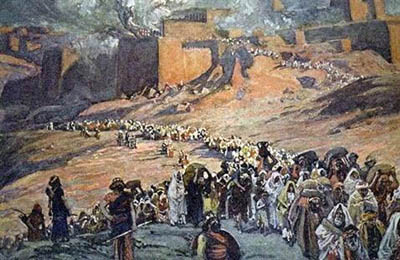
The Flight of the Prisoners (as Jerusalem burns),
by James Tissot, 1896

Tisha Be-Av falls during the week after Jews read the first Torah portion in Deuteronomy and the third “haftarah of admonition”, Isaiah 1:1-27. And the day has its own reading: the book of Lamentations, which describes the ruin of Jerusalem and its people after the Babylonian conquest.

Both the haftarah and Lamentations personify Jerusalem as a woman whom God has destroyed for her misdeeds. Yet both readings offer the hope that God might revive the city, if her people reform.

Isaiah

The haftarah from Isaiah, like Lamentations, uses the word eykhah to express a stunned realization of how degenerate Jerusalem has become.

Eykhah she has become a prostitute,
The [once] faithful city,
Filled with justice.
The righteous used to linger in her,
But now—murderers! (Isaiah 1:21)

eykhah (אֵיכָה) = Oh, how?  Oh, where?  Oh, how can it be?  (See my post: Devarim, Isaiah, & Lamentations: Desperation.)

Isaiah asked “Oh, how can it be she has become a prostitute?” in the 8th century B.C.E., when the Assyrian army had burned the towns around Jerusalem and was attempting to take the city. The prophet Isaiah asked why God was letting it happen, and answered that although the people of Judah were observing the forms of worship in the temple, they were ignoring God’s commands regarding justice.

Your sarim are rebels 
And companions of thieves,
All of them loving a bribe
And chasing after gifts.
They do not judge an orphan
And the case of a widow does not come to them. (Isaiah 1:23)

sarim (שָׂרִ’ם) = officials, leaders.

All the men in charge of justice are corrupt, selling themselves like prostitutes; they also refuse to hear cases that would benefit the poor. This makes them rebels against God, who had commanded:

You must not pervert justice for your impoverished in their legal cases. … You must not take a bribe, because the bribe blinds the clear-sighted and overturns the words of those who are in the right. (Exodus 23:6-8)

Naturally God is enraged. But now God is punishing the sarim of Jerusalem by punishing the whole city and its kingdom, Judah.

Therefore, thus says the lord, God of Armies, the mighty one of Israel:
“Ah! I will console myself about my adversaries,
And I will take vengeance on my enemies.” (Isaiah 1:24)

Rabbi Steinsaltz explained: “Once I have punished them I will be able to relax, as it were. These sinners are considered God’s adversaries and enemies.”1

Can anything be done so that God will send the Assyrian army away?

“Cease to do evil!
Learn to do good!
Advance the oppressed!
Judge the orphan!
Plead for the widow!
Go, please, and let us reason together,” said God.
“If your misdeeds are like crimson,
They can become white like snow.
If they are red like scarlet dye,
They can become like fleece.” (Isaiah 1:16-18)

If the officials in Jerusalem change their ways, God will rescue the whole kingdom. But if they do not, “The sword will devour you.” (Isaiah 1:20)

Speaking through the prophet Isaiah, God adds that the punishment is part of the long-term plan for improvement.

“And I will turn my hand against you [Jerusalem]
And smelt your dross away as if with lye,
And remove all your slag.
And I will restore judges to you like those at her beginning,
And counsellors to you like those she had first.
After that you will be called the town of the righteous,
The city of the faithful.
Zion will be redeemed through lawful judgements,
And those who return to her, through righteousness.” (Isaiah 1:24-1:27)

Isaiah does not say how God will achieve this metaphorical smelting, but his prophecy does promise that the king’s judges and counsellors will be replaced by virtuous men who are faithful to God’s laws for human justice.

Lamentations

If there were any reforms in Jerusalem when the Assyrians ended the siege and retreated, they did not last. When Babylonian army besieged Jerusalem in 589-587 B.C.E., the prophet Jeremiah claimed that God was letting the enemy win because the people of Judah practiced injustice and worshiped other gods. (See last week’s post on the second haftarah of admonition: Haftarat Masey—Jeremiah: Israel’s Divorce.)

The belief that disaster is caused by disobedience to God is also the foundation of the book of Lamentations (called Eykhah in Hebrew), five long acrostic poems of mourning. The first poem (or chapter) mourns the starvation and degradation caused by the Babylonian siege and destruction of Jerusalem. It begins:

Eykhah the city sits alone?
Once teeming with people,
She has become like a widow.
Once great among the nations,
A princess among the provinces,
She has become a slave. (Lamentations 1:1)

The poet explains that Jerusalem is deserted now, most of her people dead or in exile, and the remainder dying of starvation or disease.

Her adversaries are on top,
Her enemies are at ease,
Because God has afflicted her
On account of her many transgressions. (Lamentations 1:5)

The poet alludes to the biblical assumption that when bad things happen to the Israelites, it means God is punishing them for doing something wrong. The assumption pops up again a few verses later:

Jerusalem is certainly guilty,
	  Therefore she has become like filth. (Lamentations 1:8)

And Jerusalem herself says:

"God is in the right,
For I have disobeyed him." (Lamentations 1:18)

But the first poem never says how Jerusalem transgressed. The second poem blames Judah’s false prophets for God’s punishment, without saying what the people did wrong.

[What] your prophets foresaw for you
Was false and foolish.
They did not expose your iniquity
In order to turn back your backsliding. (Lamentations 2:14)

The third chapter of Lamentations says that God only afflicts people who have sinned, and hints that the sin is injustice.

To pervert justice for the strong man,
In front of the face of the Most High,
To subvert a human being in his legal case,
My lord [God] would not consider. (Lamentations 3:34-36)

The poet urges us to recognize our unjust deeds, repent, and reform.

Why does a living human being, a strong man,
Complain about [the punishment for] his own guilt?
Let us investigate our ways, and search,
And return to God. (Lamentations 3:39-40)

Earlier in this chapter the poet said that an individual man who has stopped his wrongdoing should wait humbly and patiently for God to rescue him from his suffering.

Let him put his mouth in the dust;
Perhaps there is hope.
Let him offer his cheek to be struck;
Let him be surfeited with scorn.
For my lord [God]
Does not reject forever,
For though he causes grief, then he has compassion,
According to the abundance of his steadfast kindness. (Lamentations 3:29-32)

But what if the people of a whole city, a whole country, keep on suffering because of the wrongs done by their leaders? The patient endurance of one person will not help.

The fifth poem of Lamentations suggests that God needs a reminder to end the collective punishment, and the people need a reminder that God is waiting for them to reform. The book concludes with a prayer to God that is repeated weekly in Jewish liturgy:

Why have you continued to forget us,
Have you forsaken us for the length of [our] days?
Return us to you, God,
And we will return!
Renew our days as of old! (Lamentations 5:20-21)

How can human beings return to a God who has abandoned them? The poet begs God to take the initiative.


If God is omnipotent and just, why do innocent people suffer so much? The prophet Isaiah offers a partial answer to that question: a whole people must suffer for the crimes of their leaders because justice can only be collective, not personal. All the people of Judah suffer because of the crimes of Jerusalem’s officials and judges. The book of Lamentations also blames human injustice for the suffering God afflicts through enemies, but does not distinguish between individuals and whole populations.

Both the haftarah from Isaiah and the book of Lamentations record the despair of the survivors, who see no evidence that God will ever rescue them. Isaiah responds that God will rectify the situation by making sure good leaders are installed. The book of Lamentations insists that if the survivors wait patiently, God may be compassionate—and then prays that God will remind the people that they can return and reform.

Today countless innocent people still suffer and die because of the crimes of a small minority: those who are powerful, politically or economically, but not ethical. Would it help us to wait and pray for God to install new leaders, or to remind us of what we ought to do?

Is there another way we can turn our countries and our world around?


  1. Rabbi Adin Even-Israel Steinsaltz, The Steinsaltz Tanakh, Koren Publishers, Jerusalem, 2019.

Esther: Playing Vashti

Jews will celebrate the holiday of Purim this Saturday evening. The evening revolves around the megillah, the book of Esther, and we have a wild time with it. We come in costume, often cross-dressing for the night, and drinking is encouraged. When someone reads the megillah out loud, we make loud noises to drown out the name of Haman, the villain, whenever it comes up. Then the Ashkenazic tradition is to perform a purim spiel, a play based on the story in Esther, full of jokes and innuendos and often comic songs. Purim is the merriest holiday in the Jewish calendar.

Purim, 17th-century woodcut

The book of Esther itself is a fantasy tale revolving around four characters: Esther, a Jew who becomes the queen of Persia through a beauty contest; Achashveirosh, the foolish king of Persia; Haman, his villainous chief advisor who tries to exterminate all the Jews; and Mordecai, Esther’s wise uncle who replaces Haman as the king’s advisor at the end, after Esther gets the king to save the Jews.

Before the king can hold the beauty contest to choose his new queen, his old queen must be disposed of. So the first episode in the book of Esther, and every purim spiel, is the banishment or death of another character: Queen Vashti.

And there is more than one way to play Vashti.

The kings of Persia

And it happened in the days of Achashveirosh—he was the king from India to Ethiopia—127 provinces. In those days, as King Achashveirosh sat on his royal throne that was in the citadel of Shushan, in the third year of his reign, he made a drinking-feast for all his officials and powerful courtiers of Persia and Medea … (Esther 1:1-2)

The opening of the book sets a fictional tale in a historical reality. The empire of the Persians and Medes (the Achaemenid Empire) really did stretch from the border of Ethiopian in Africa to the border of India in the east at its height, during the reign of King Darius (522-485 B.C.E.). Cyrus (the founder of the empire), Darius, and his son Artaxerxes (Artachshasteh in Hebrew) all embraced a policy of religious tolerance, according to both history and parts of the books of Ezra and Nehemiah.1

Nehemiah’s King Artaxerxes I, or Artachshasteh, is decisive, thoughtful, and thorough—the opposite of King Achashveirosh in the book of Esther.

The king who gets drunk

Achashveirosh is probably an alternate name for Artaxerxes/Artachshasteh—although unlike Artaxerxes, Achashveirosh is impulsive, vacillating, and stupid. (See my post Esther: Stupid Decisions.)

The book of Esther says that the king’s drinking-feast for the nobles and top officials of the empire lasts for 180 days, while he impresses them with the gorgeous and expensive splendors of his palace. Then King Achashveirosh invites all the men in the city of Shushan to a drinking-feast that lasts for 7 days, in the palace’s impressively bedecked and furnished courtyard. These commoners drink from golden goblets, as much wine as they like.

Purim playing card

And the drinking was according to the rule: There is no constraint! Because this was what the king laid down over every steward of his household: to do according to the desire of each man. Also Vashti, the queen, made a drinking-feast for the women in the royal house of King Achashveirosh. On the seventh day, when the king’s heart was tov with wine, he said to … the seven eunuchs who waited on King Achashveirosh, to bring Queen Vashti before the king, in the royal crown, to let the people and the officials see her beauty—for she was tovah of appearance. (Esther 1:8-11)

tov (טוֹב), masculine, and tovah (טוֹבָה), feminine = good; joyful, desirable, usable, lovely, kind, virtuous.

King Achashveirosh’s mind is “joyful” with wine; Queen Vashti is lovely in appearance. The drunk king wants to show off his queen’s beauty.

After all, he has spent 187 days showing off the beautiful treasures of his palace. Perhaps, in his mentally hampered condition, it strikes him that the queen is the most beautiful treasure he owns.

But Esther Rabbah, written in the 12-13th centuries, invents a backstory in which the men at the king’s drinking feast argued about which country had the most beautiful women. One man said that Median women were the prettiest, another that Persian women were. King Achashveirosh declared that his own wife, a Chaldean (i.e. Babylonian) was the most beautiful, and added:

“‘Do you wish to see it?’ They said to him: ‘Yes, provided that she be naked.’ He said to them: ‘Yes, and naked.’” (Esther Rabbah 3)2

Why would the king agree that his own wife should display herself naked? One 21st-century analysis of Esther Rabbah explains: “In this view, Ahasuerus wishes to publicly establish his dominance over Vashti, by forcing the glaring contrast of “queen wearing a crown” and “subservient strumpet.” Such an aggressive act can be understood as stemming from the king’s insecurity, since she is royalty and he is not, for if it was only her beauty that he wished to show off, why was the royal crown necessary? … In other words, Ahasuerus wishes to express with this outlandish demand that Vashti may be royalty but her value to him is only in her beauty.”3

The queen who says no

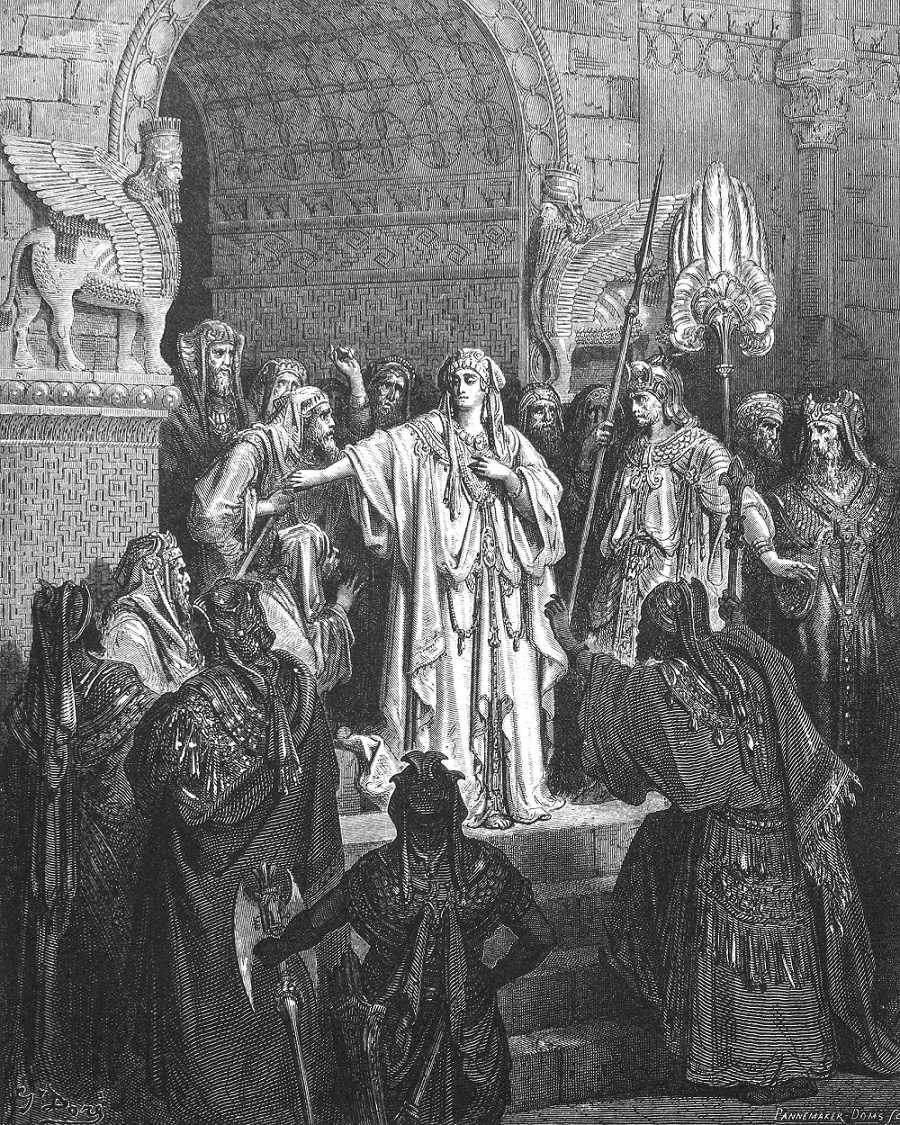
Queen Vashti Refused,
by Gustave Dore, 1866
(The eunuchs have beards!)

But Queen Vashti refused to come at the word of the king delivered by the eunuchs. And the king became very angry, and rage was burning within him. (Esther 1:12)

The book of Esther does not say why Vashti refused. But commentators—and purim spielers—have been speculating for centuries.

Rabbis in the Talmud tractate Megillah, written circa 500 C.E., proposed that God suddenly disfigured her, with either a skin disease or a tail, so she was too embarrassed to show herself to men in public.3

In the 11th century, Rashi added that Vashti deserved the skin disease, citing another classic fiction: “Because she would force Jewish girls to disrobe and make them do work on Shabbos, it was decreed upon her to be stripped naked on Shabbos.”4

A century or two later, three rabbis are quoted in Esther Rabbah as suggesting that Vashti was willing to display herself to the men, but only if she were incognito, so she refused to wear her crown. “She sought to enter with only a sash, like a prostitute. But they would not let her.” (Esther Rabbah 3)

Another invention in Esther Rabbah is that Vashti tried to argue with the king before flat-out refusing to appear.

“She sent and said to him things that upset him. She said to him: ‘If they consider me beautiful, they will set their sights on taking advantage of me, and will kill you. If they consider me ugly, you will be demeaned because of me.’” (Esther Rabbah 3)

Vashti’s argument might influence a man who had the wits to think it over, but is useless on a man who is drunk. Then Esther Rabbah reports a second argument:

“She sent and said to him: ‘Weren’t you the stable-master of my father’s house, and you were accustomed to bringing naked prostitutes before you, and now that you have ascended to the throne, you have not abandoned your corruption.’” (Esther Rabbah 3)

It is hardly surprising that in this insult (also invented by the Talmud and Esther Rabbah) does not make King Achashveirosh change his mind, either.

In the 21st century, Rabbi Adin Steinsaltz did not take a position on whether the king wanted his queen to appear clothed or naked. But he pointed out: “Her refusal to obey the command of the king, whose authority was absolutely unlimited, is indicative of her high status. She was unwilling to humiliate herself by parading her body before an audience.”5

In modern purim spiels, when Vashti says no, she often adds a remark about stupid men who treat women like objects and possessions.

Vashti’s fate

In the book of Esther itself, Vashti merely refuses to come, and no explanation is given. Achashveirosh is enraged—maybe because he did not get his way, but more likely to avoid recognizing that he was in the wrong. He asks his seven top advisors:

“According to law, what is to be done with the queen, Vashti, considering that she did not do the command of the king, Achashveirosh, delivered by the eunuchs?” (Esther 1:15)

In the real Persian Empire, the king’s advisors would gently point out these facts:

“Queens do not drink with their male subjects, and thus, in refusing, Vashti is preserving expected power dynamics and behaving as a queen should. And yet, when she insists on her right not to appear before commoners to titillate them, she loses her position.” (Gaines)6

And [his advisor] Memuchan said in front of the king and the officials: “Not against the king alone did Queen Vashti act, but against all the officials and all the peoples in all the provinces of  King Achashveirosh. Because the news that goes out about the queen will make all wives treat their husbands with contempt, as they say: King Achashveirosh said to bring Queen Vashti to him, but she would not come.”  (Esther 1:16-17)

Memukhan suggests a punishment that would make the women of the empire hesitate before disobeying their husbands.

“If it seems good to the king, let him issue a royal edict, and let it be written into the laws of Persia and Media, so it cannot be passed over, that Vashti must never come before the King Achashveirosh again. And let the king give her royal rank to someone who is hatovah than she.” (Esther 1:19)

hatovah (הַטּוֹבָ֥ה) = (noun) the good; (adjective) better. (A form of tov.)

Apparently there is no Persian law about punishing a queen who disobeys the king, no matter how outrageous the king’s request is. So Memukhan thinks of a reason why Vashti should be punished, and then makes up a punishment for her: losing her rank as queen, and losing her access to the king.

In the 11th century, Rashi interpreted this punishment as requiring Vashti’s execution, so she would be incapable of coming before the king. A century or two later, Esther Rabbah concluded that Memukhan’s proposal in the book of Esther proves the Persian legal system was capricious and inferior to the Jewish legal system. Then it invented three personalreasons why Memukhan had a grudge against Vashti.

But in the book of Esther, we never find out what happens to Vashti. The other six advisors of the king agree with Memuchan, and Achashveirosh, true to form, issues the edict without giving it any thought. Esther Rabbah, elaborating on Rashi’s opinion, adds: “He issued the decree and brought in her head on a platter.”

A 21st-century commentary follows the book of Esther more literally: “Presumably, the text means to communicate that she lived on in the harem—a king’s consort is never afterward free to marry another—but was never allowed to see the king.”7

To make Memukhan’s ad hoc law universal,

He sent scrolls to all the provinces of the king, to each province in its own script and to each people in its own language, that every man should rule his household, speaking the language of his own people. (Esther 1:22)

Rashi explained: “He can compel his wife to learn his language if her native tongue is different.”4

And the Talmud noted that the pettiness of this law turned out to be a good thing: “Since these first letters were the subject of ridicule, people didn’t take the king seriously and did not immediately act upon the directive of the later letters, calling for the Jewish people’s destruction.”3

Esther Rabbah commented on this verse without resorting to fantasy: “Rav Huna said: Aḥashverosh had a warped sensibility. The way of the world is that if a man wishes to eat lentils and his wife wishes to eat peas, can he compel her? No, she will do whatever she wants.”

A replacement queen

After these events, as the rage of King Achashveirosh subsided, he remembered Vashti and what she had done and what had been decreed against her. And the king’s young servants who waited on him said: “They can seek out for the king young virgins of tovot appearance.” (Esther 2:1-2)

tovot (טוֹב֥וֹת) = good, lovely. (Feminine plural of tov.)

In other words, the foolish king remembers his beautiful queen, whom he will never see again, and he feels sad. But his servants remember Memukhan’s advice that Achashveirosh should find another, better queen.

The beauty contest begins. And so does Esther’s story, as she is taken to be a contestant, has her trial night with the king, and wins the queenship.


I want to write a purim spiel in which Esther, waiting in the king’s harem until she is called, meets Vashti, the imprisoned former queen. Vashti would tell Esther all about her last night as queen. Then the two women would suggest increasingly outrageous methods for dealing with a clueless sexist pig. If only I could find the right comic song to go with the dialogue …


  1. Ezra 1:1-11, 5:5-6:12, and 7:11-26 (but not 4:6-24); Nehemiah 2:1-9 and 5:14.
  2. Translations of Esther Rabbah are based on The Sefaria Midrash Rabbah, 2022, www.sefaria.org.
  3. Talmud Bavli, Megillah 12b.
  4. Rashi (Rabbi Shlomoh Yitzchaki), translation in www.sefaria.org.
  5. Rabbi Adin Steinsaltz, Introductions to Tanakh: Esther, reprinted in www.sefaria.org.
  6. Dr. Jason M.H. Gaines, “But Vashti Refused: Consent and Agency in the Book of Esther”, www.thetorah.com/article/but-queen-vashti-refused-consent-and-agency-in-the-book-of-esther.
  7. Dr. Malka Z. Simkovitch, Dr. Rabbi Zev Farber, Rabbi David D. Steinberg, “Ahasuerus and Vashti: The Story Megillat Esther Does Not Tell You”, https://www.thetorah.com/article/ahasuerus-and-vashti-the-story-megillat-esther-does-not-tell-you

Vayeilekh: Long-Term Prophecy

(I am flying cross-country to see my sister for the first time since 2019, so I will not be able to write new blog posts for the next three weeks. You can read some of my favorite earlier posts for this time of year at the following links: Ha-Azinu: Raining Wisdom; Rosh Hashanah & Yom Kippur: Our Father, Our King; Haftarot for Rosh Hashanah & Shabbat Shuvah—1 Samuel & Hosea: From Smoke to Words; Yom Kippur & Isaiah: Ending Slavery; and Jonah: Turning Around. You can also look under “Categories” on my home page to find all my previous posts.)


Most prophecies in the Hebrew Bible are short-term; they predict events during the lifetime of the prophet’s audience. They are also conditional; the prophet announces what will happen if the people, or their rulers, do not change their course of action. If they do change, like the Assyrians of Nineveh in the book of Jonah, God changes the decree.

But a prophecy containing the idiom be-acharit hayamim is about events in the distant future, not a warning to anyone alive at the time of the prophecy. Moses makes one of these long-term prophecies near the end of this week’s double Torah portion, Nitzavim and Vayeilekh (Deuteronomy 29:9-31:22), after God has told him what will happen many generations later, after the Israelites have conquered Canaan.

And God said to Moses: “Hey, you will be lying with your fathers, and this people will rise up and go whoring after the foreign gods of the land where they are coming into their midst. And they will abandon me and violate my covenant that I cut with them. And on that day my nose will heat up against them, and I will abandon them! And I will hide my face from them. And they will be [ripe] for devouring, and many bad things and troubles will find them. And on that day they will say: Isn’t it because our God is not in our midst that these evils found us?” (Deuteronomy 31:16-17)

Not only God, but also the writer of these verses knows that the Israelites will backslide again and be punished. According to some 21st-century biblical scholarship, much of the book of Deuteronomy was written in the 7th century, but it was rewritten and expanded in the 6th century during the Babylonian exile.1 The rewriter made two major changes: the book was recast as a series of speeches by Moses; and “predictions” were added that Judah and its capital would be destroyed someday because the Israelites would disobey God’s primary command: do not worship any other gods.

The Babylonian army razed Jerusalem in 586 BCE, and the rewriter of Deuteronomy lived through it. According to biblical reasoning, Judah could only be conquered if God stopped protecting it; and God would only stop protecting Judah if its people persistently disobeyed God. Therefore the conquest and destruction of Judah was the people’s own fault.

Moses duly transmits God’s message to the people, saying:

For I know that after my death, you will indeed act ruinously, and you will swerve away from the path that I commanded to you, and bad things will happen to you, be-acharit hayamim. For you will do what is bad in the eyes of God, offending [God] through your handiwork. (Deuteronomy 31:29)

be-acharit (בְּאַחֲרִית) = in an end, when afterward, as an aftermath, in the future. Be (בְּ) = in, at, when, through. Acharit (אַחֲרִית) = an end, outcome, future. (From achar (אַחַר)= behind, after, afterward, following.)

hayamim (הַיָּמִים) = (literally) the days; (as an idiom) a long period of time.

be-acharit hayamim (בְּאַחֲרִית הַיָּמִים) = (literally) “at the end of days”; (as an idiom) a long time afterward, in the distant future, as a long-term outcome.

A long time from now

The phrase be-acharit hayamim appears 15 times in the Hebrew Bible, and even though it could be translated as “at the end of days”, none of these verses refer to the end of the world as we know it. They usually predict the future of the people of Israel, and describe events that had actually happened by the time the second temple was built in Jerusalem in the 5th century BCE. (Prophecies about two neighboring kingdoms foretell events in the same time period.2)

The first appearance of be-acharit hayamim is in Jacob’s deathbed prophecies, supposedly about his twelve sons, but actually about what happens to the twelve tribes of Israel after the land of Canaan is settled.3

The second appearance is in Bilam’s introduction to the fourth prophecy he delivers to King Balak of Moab about the Israelites camped on the king’s border:

Bilam Prophesies, by James Tissot, ca. 1900

And now, here I am going [back] to my people. I will advise you what this people will do to your people be-acharit hayamim. (Numbers 24:16)

Bilam says Israel will conquer Moab and Edom; 2 Samuel 8:11-12 reports King David’s conquest of those two kingdoms. Bilam says Amalek will perish forever; 1 Samuel 7-33 reports that King Saul killed all the Amalekites (although a few of them show up later in the bible).4 Bilam says the Kenites (allies of the Israelites who are nomads in their territory) will be captured by Asshur (the Neo-Assyrian Empire); the Assyrians did take over the northern kingdom of Israel in the 8th century BCE, a conquest reported in 2 Kings 17:5-6, and they attacked Judah, the southern kingdom, so they may well have captured the Kenites. Bilam’s final prediction is that enemies on ships will destroy Asshur forever; the Medes and the Babylonians did conquer the Assyrians in 614-612 BCE, but the Tigris River was too shallow for ships to reach the capital.

Some modern scholars attribute this prophetic poem to a refugee from the Assyrian conquest of the northern kingdom of Israel.5 The only event in the prophecy that had not happened by the time the refugee recorded it was the conquest of the Assyrian Empire.

The phrase be-acharit hayamim occurs twice in the book of Deuteronomy. In this week’s portion Vayeilekh, Moses tells the Israelites:

… bad things will happen to you, be-acharit hayamim. For you will do what is bad in the eyes of God, offending [God] through your handiwork. (Deuteronomy 31:29)

Sure enough, although the Israelites toe the line in the book of Joshua, they repeatedly worship foreign gods in the book of Judges and the first and second books of Kings, as well as in most of the books of the prophets. Meanwhile, the Assyrians wipe out the northern kingdom of Israel in the 8th century BCE, and the Babylonians destroy Jerusalem in the 6th century BCE. Thus when Deuteronomy was revised and Moses’ prophecy was recorded, it had already come true.

Earlier in Deuteronomy, Moses predicts that after the Israelites have been living in Canaan for generations, they will make and worship idols, and God will get angry and drive them out of their land into other nations. In fact, the Assyrians deported many leading citizens of Israel, and the Babylonians deported many leading citizens of Judah. Moses continues:

But if you seek there, then you will find God, your God, if you inquire with all your heart and with all your soul. When you are in distress and all these things have found you, be-acharit hayamim, then you will return to God, your god, and you will listen to [God’s] voice. (Deuteronomy 4:29-30)

It may be no accident that here Moses sounds like second Isaiah, who wrote after the Persians conquered Babylon. Second Isaiah repeatedly urges the exiles in Babylon to seek God and return to their religion and to Jerusalem.

The phrase be-acharit hayamim also appears in first Isaiah, Hosea, Micah, and Jeremiah, in predictions that are so vague, they merely express optimism that someday the Israelites will return to their God. Ezekiel uses be-acharit hayamim in two expressions of pessimism over the long-term future of the Israelites, when he invents a foreign king called Gog who will overrun the land. Although none of these predictions from the Prophets refer to specific events in the future, they do all refer to a distant future in historical time, in this world.6

Not the end of the world

The phrase be-acharit hayamim appears twice in the book of Daniel, but neither time does it refer to the End of Days.  First Daniel uses the Aramaic version be-acharit hayamim when he interprets King Nebuchadnezzar’s dream about a statue made of different materials, from a gold head down to feet of iron and clay.7  It is not an apocalyptic image, but merely foretells a succession of kingdoms ruling Mesopotamia. The second time the phrase appears in Daniel, an angel proceeds to tell him the future of the Persian Empire.8 In both cases, a better translation of be-acharit hayamim would be “in the distant future”.

The verse that does mean “the End of Days” comes at the end of the book of Daniel, when an angel tells him:

“But you go to the keitz. And you will rest [in the grave]; then you will stand up for your destiny at keitz hayamim.” (Daniel 12:13)

keitz (קֵץ) = end (of someone’s existence), limit, boundary, extremity.

keitz hayamim (קֵץ הַיָּמִים) = the end of days; the limit of time.

Acharit means an outcome sometime in the future, after which history will continue. But keitz is an absolute end. The verse at the end of Daniel is is the only occurrence in the Hebrew bible of the phrase keitz hayamim—and the book of Daniel is the only book that seriously proposes the resurrection of the dead at the end of the world as we know it. Although the Daniel story begins during the 6th-century CE Babylonian Exile, the book was written in the 2nd century CE, well after all the other books of the Hebrew Bible. The starting point for Jewish and Christian eschatology9 is the final chapter of Daniel, which includes not only the phrase “the end of days”, but also the concept of resurrection of the dead—the righteous to “everlasting life” and others to “everlasting shame”.


Some people hope for a life after death; others believe this world is the only one we get, and humans only live once. Some people believe the ethical level of humanity will continue to improve, rapidly enough so we will save ourselves and our polluted earth; others believe we will not get our act together in time.

Will we win the human race, or self-destruct? Will humankind learn how to manage without war? How bad will the damage be from our degradation of the planet, and when will it stabilize? And what about my own nation, my own religion, my own people? Will we ever get it right?

We might want to know the short-term future for selfish reasons: so that we can make choices that will improve our own lot, or our family’s. But we want to know long-term future because we care about the fate of human beings who come after us, even those we will never meet.

I pray that enough people find enlightenment, dedicate their lives to doing no harm, and repair what they are able to repair. I am not interested in an End of Days, but I pray for a better future for this world, be-acharit hayamim.


  1. See Eckart Otto, www.thetorah.com/article/deuteronomy-rewritten-to-reflect-on-the-exile-and-future-redemption.
  2. Jeremiah 48:47 and 49:39.
  3. See my post Vayechi & 1 Kings: Deathbed Prophecies.
  4. Amalekites appear in 1 Samuel 30:1-2 and 2 Samuel 1:5-10.
  5. The “E” or Elohist source.
  6. Isaiah 2:2; Jeremiah 23:20, 30:24, 48:47, 49:39; Hosea 3:5; Micah 4:1; Ezekiel 38:8, 38:16.
  7. Daniel 2:28.
  8. Daniel 10:14.
  9. The orthodox Christian tradition is that the “The End of Days” or “The End Times” will be a world-wide apocalypse, as described in the Book of Revelation, followed by the Second Coming of Jesus and the Last Judgment, when life on earth will become obsolete. Jewish eschatology is moderate by comparison. The orthodox Jewish tradition, established as a subject for argument in the Talmud before 500 CE, is that in some distant future there will be a happy olam haba (world-to-come) here on earth. There will be a new king (moshiach, מַשִׁיַח = “anointed one”) who is a descendant of King David; the Jews in the diaspora will return to the land that was once David’s kingdom; and righteous people who have died over the centuries will be resurrected bodily.

Jeremiah & Psalm 139: Mind Versus Conscience

Jeremiah offers an insight on human psychology in the haftarah reading that accompanies the Torah portion Bechukotai in Leviticus this week. The haftarah (Jeremiah 16:19-17:14) warms up with one of Jeremiah’s predictions that the kingdom of Judah will be lost because its people lack trust in God and persist in worshiping idols. (Jeremiah lived through the Babylonian conquest of Judah and their siege and destruction of Jerusalem.)

Jeremiah adds that the people of Judah should not expect their own military power to save them.

            Cursed is the man who trusts in humankind,

                        And makes human flesh his strength. (Jeremiah 17:5)

In other words, you cannot win a war with armies alone. Jeremiah goes on to say that only those who trust in God will flourish. (See my post Haftarat Bechukotai–Jeremiah: Trust Me.) Then he touches on another problem about trusting human beings. His two-verse gem on human psychology is rich in words that can be translated as either physical objects or psychological states. So I made three translations. The first one leaves the metaphors in the original Hebrew:

The leiv (לֵב) is more akov (עָקֺב) than anything,

                        And it is pathological; who can understand it?

I am God, who investigates a leiv,

                        Testing the kelayot (כְּלָיוֹת),

And allotting to a man according to his drachim (דְּרָכִים),

                        According to the peri (פְּרִי) of his deeds. (Jeremiah 17:9-10)

Next I translate the ambiguous words literally:

The heart is more a heel than anything.

                        And it is pathological; who can understand it?

I am God, who investigates a heart,

                        Testing the kidneys,

And allotting to a man according to his roads,

                        According to the fruit of his deeds. (Jeremiah 17:9-10)

Finally, here is a version with all the ambiguous words translated metaphorically:

The mind is more devious than anything.

                        And it is pathological; who can understand it?

I am God, who investigates a mind,

                        Examining the conscience,

And allotting to a man according to his conduct,

                        According to the result of his deeds. (Jeremiah 17:9-10)

Heart and Kidneys

In English, the heart is the metaphorical location of feelings, while the brain is the location of thoughts. In the Hebrew Bible, the heart is the seat of both feeling and thinking. The word for “heart” (leiv or levav) is used for the whole conscious mind—except for one mental function: our conscience. The awareness of what we ought to do is assigned to the kidneys in the bible. (See my post: Vayikra & Jeremiah: Kidneys.) Kidneys are often paired with hearts because, according to one commentary:

“The kidneys advise the heart, and the heart decides.”1

If we are accustomed to following our “kidneys” (conscience), our decision-making is straightforward; we reject thoughts of gratifying our immoral impulses, choose the course of action God would approve of, and do it. But if we do not listen for the voice of our conscience, its advice is drowned out by conflicting desires, our “hearts” (minds) make less virtuous decisions, and we reflexively invent devious rationalizations for them.

“Who can understand it?” indicates that people cannot fully understand even their own minds, nor the minds of their fellow human beings. Only God can investigate a human’s psychology and understand everything inside, heart and kidneys.

Jeremiah: Examine me and my enemies

Biblical characters who believe they are virtuous, and their enemies are not, welcome God’s investigation of human minds. In two other poetic passages in the book of Jeremiah, the prophet urges God to examine and punish his enemies. Before this week’s haftarah, Jeremiah reports that God told him idolaters from his hometown, Anatot, were scheming to kill him in order to stop his prophesies.

            Then God let me know, and I knew.

                        That was when you let me see their deeds.

            And I was like a docile lamb who was brought to slaughter,

                        And I did not know that they had plotted plots against me …

            So God of Hosts, righteous judge,

                        Who examines kidneys (conscience) and heart (mind),

            Let me see your vengeance upon them!

                        For I bring my case to you. (Jeremiah 11:18-20)

In a passage after this week’s haftarah, Jeremiah is released from prison in Jerusalem but cannot stop speaking God’s prophecies, even though the city is full of informers. He uses similar language about these Jerusalemites:

            So God of Hosts, righteous examiner,

                        Who sees kidneys (conscience) and heart (mind),

            Let me see your vengeance upon them!

                        For I bring my case to you. (Jeremiah 20:12) 

Psalm 139: Improve my thoughts

Psalm 139 begins:

            God, you investigate me and you know me.

                        You know when I sit down or get up.

                        You see my thoughts from afar. (Psalm 139:1-2)

The psalmist marvels at everything God knows about a person, concluding:

            Knowledge is too extraordinary for me;

                        It is too high; I am not capable of it. (Psalm 139:6)

The next verse is:

            Where could I go from your spirit?

                        And where could I disappear from your presence? (Psalm 139: 7)      

The 19th-century commentator S.R. Hirsch elaborated on these two questions, filling in the context: “Where could I go to escape Your ‘spirit’ so that it might not move me, stir me, fill my heart and summon my conscience before Your judgment seat? And whither could I flee from Your ‘countenance’ where You would not see me, where Your rule would not touch me?”2

In other words, God is not an abstract omniscient deity to the psalmist; they feel God’s spirit move through their mind, move their own spirit, and summon their own conscience—which then reminds the mind of God’s judgment.

The next five verses expand on how there is no place to hide from God. The psalmist then explains:

            Because you yourself produced my kidneys (conscience);

                        You wove me together in my mother’s belly.  (Psalm 139:13)

After realizing the intimate relationship between the inner conscience and the judgement of God, the psalmist concludes by asking for God’s evaluation:

            Search me, God, and know my heart (mind);

                        Examine me and know my thoughts,

            And see if a distressing road (line of conduct) is in me;

                        Then lead me on an everlasting road (line of conduct)! (Psalm 139:23-24)

The conscience has won.


The human mind is devious, Jeremiah says in this week’s haftarah. When we become accustomed to avoiding the advice of our conscience, our excuses and self-deception become pathological. Only God can investigate a human’s psychology, see through the deception, and deal justice to evildoers.

The writer of Psalm 139 finds God’s attention to the human mind uncomfortably invasive at first, but then welcomes God’s correction through one’s innate conscience. It is better to give up transitory secret pleasures, the psalmist concludes, in order to lead a life dedicated to doing the right things.

Some people succumb to immoral impulses frequently, and deceive themselves as well as others about their motivations. As Jeremiah says, the human mind is naturally devious. But as Psalm 139 says, humans are born with a conscience.3 It is up to us to decide how much to listen to it, and how much to reject it and rationalize our decisions.


  1. Midrash Tehillim (a collection of commentary on the Psalms completed by the 11th century C.E.), Psalm 14:1 on Jeremiah 17:10.
  2. Rabbi Samson Raphael Hirsch, The Hirsch Tehillim, translated by Gertrude Hirschler, Feldheim Publishers, Nanuet, NY, 2014 (original German edition 1882), p. 1107.
  3. Except, perhaps, for the small percentage of humans who are sociopathic or psychopathic. It is still a matter of debate whether someone with a weak or nonexistent conscience is born that way, or becomes that way through certain kinds of early childhood trauma.

Emor & Job: A Sacred Name

A man who blasphemes the name of God is executed in this week’s Torah portion, Emor, in the book of Leviticus.

In English, “blasphemy” means insulting or showing contempt for a god, or for something sacred. In Biblical Hebrew, there is no word that exactly corresponds to “blasphemy”. Humans do not have the power to profane God, and our curses are only effective if God chooses to carry them out. We can, however, misuse sacred objects, making them chalal חָלַל = profaned, degraded by being used for an ordinary purpose. And we can insult or belittle God’s name, which is a type of blasphemy.1 In  Biblical Hebrew, one’s name also means one’s reputation.

Yet the idea of reviling God or God’s name was so abominable to the ancient Israelites that the bible usually indicates blasphemy through euphemisms or near-synonyms.

Blasphemy with a euphemism in 1 Kings and Job

Naboth’s Stoning in Front of the Vineyard, Anon., Prague, 14th century

The verb barakh (בָּרַךְ), meaning to bless or utter a blessing, appears frequently in the Hebrew Bible. But twice in the first book of Kings and four times in the book of Job, this verb serves as a euphemism for blaspheming or cursing God.

In 1 Kings, Nabot owns a vineyard adjacent to palace of King Ahab. Ahab offers to buy the land, but Nabot refuses. The king is so upset that his wife, Jezebel, schemes to kill Nabot so she can seize the vineyard for her husband. She writes orders in the king’s name telling the judges of the town to summon Nabot.

“And seat two worthless men opposite him, and they must testify, saying: ‘Beirakhta God and king!’ Then take him out and stone him so he dies.” (1 Kings 21:10)

beirakhta (בֵּרַכְתָּ) = you “blessed”.

The judges follow orders. The two worthless men use exactly those words, and everyone knows they really mean that Nabot reviled God and the king. Nabot is executed by stoning.


At the beginning of the book of Job, Job is so devout he makes extra burnt offerings for his adult children, saying to himself:

“Perhaps my children are guilty, uveirakhu God in their hearts.” (Job 1:15)

uveirakhu (וּבֵרַכוּ) = and they “blessed”.

Job not only worries that his children might have some negative thoughts about God, but even uses a euphemism for blasphemy when he talks to himself.

The action of the story switches to the heavenly court of the “children of God”—perhaps lesser gods or angels. The God character mentions how upright and God-fearing Job is. The satan (שָׂטָן = adversary, accuser) in the court points out that God has blessed Job with wealth and children, so of course the man responds with grateful service. He adds:

“However, just stretch out your hand and afflict everything that is his. Surely yevarakhekha to your face!” (Job 1:11)

yevarakhekha (יְוָרַכֶךָּ) = he will “bless” you.

Thus the satan in the heavenly court also uses blessing as a euphemism for cursing God. The God character gives the satan permission to run the experiment, and in four simultaneous disasters Job loses his livestock, his servants, and all his children. Job responds:

“Y-H-V-H gave and Y-H-V-H took away. May the name of Y-H-V-H be a mevorakh.” Through all that, Job did not sin and did not accuse God of worthlessness. (Joab 1:21)

mevorakh (מְבֺרָךְ) = blessing.

Here Job actually does bless God’s four-letter personal name. He does not use the word for “bless” to revile or curse God.

The God character points out to the satan that Job’s devotion to God has not wavered. The satan replies:

“But a man will give up all that he has [to save] his life. However, just stretch out your hand and afflict his bones and his flesh. Surely yevarakhekha to your face!” (Job 2:5)

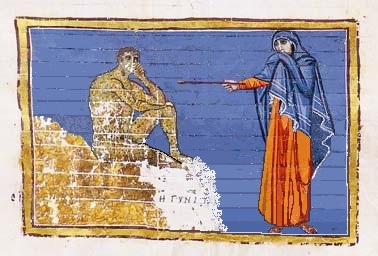
Job and his Wife, Venice Codex, 905 C.E.

Again the satan uses blessing as a euphemism for blasphemy, and again the God character authorizes the experiment, asking only that the satan spare Job’s life. Job comes down with a painful inflammation from head to toe, and he sits in an ash-heap scratching himself.

Then Job’s wife utters her famous cry of despair, “Curse God and die!” But in the original Hebrew she expresses it this way:

“You still cling to your uprightness? Bareikh God and die!” (Job 2:9)

bareikh (בָּרֵךְ) = “bless!”

The reader or listener is expected to understand that “bless!” means the opposite, and should have the equivalent of air-quotes around it. Either Job’s wife does not want to go so far as to say “curse God” herself, or the author of the book does not.

Near-synonyms for blasphemy in Emor

People in the Hebrew Bible also commit blasphemy by using near-synonyms for “blaspheme”: verbs that mean curse, belittle, or revile, but count as blasphemy when they are applied to God or the name of God. The near-synonyms in this week’s Torah portion, Emor, are:

  • nakav (נָקַב) = pierce, put a hole in, designate, curse,
  • kalal (ַקַלַל) in the piel stem = belittle, insult, revile, curse.

One of God’s commands in the book of Exodus is:

Lo tekaleil God! (Exodus 22:27)

lo tekaleil (לֺא תְקַלֵּל) = you must not belittle, revile, curse. (lo, לֺא = not + tekaleil, תְקַלֵּל = you must belittle, insult, revile, curse; from the piel stem of the root verb kalal.)

Even though a human cannot actually inflict a curse on God, it is possible to belittle or revile God’s reputation. The word for “God” in this command is not God’s four-letter personal name, but Elohim (אֳלֺהִים) = God, a god, gods. The God of Israel does not want to be belittled or reviled by any name.

The command in Exodus is violated in this week’s Torah portion, Emor.

A son of an Israelite woman and an Egyptian man went out among the Israelites. And the Israelite woman’s son and an Israelite man scuffled in the camp. Vayikov the name, the Israelite woman’s son, vayekaleil, and he was brought to Moses. The name of his mother was Shelomit, daughter of Divri, from the tribe of Dan. (Leviticus 24:10-11)

vayikov (וַיִּקּב) = and he pierced, put a hole through, designated, cursed. (A form of the verb nakav.)

vayekaleil (וַיְקַלֵּל) = and he belittled, insulted, reviled, cursed. (A form of the root verb kalal in the piel stem.)

Does he curse God’s name? Or does he curse the Israelite man he is scuffling with, using God’s name in a curse formula?2 We do not know; this week’s Torah portion adds vayekaleil (and he belittled, reviled) without a direct object. But whatever Shelomit’s son says, we know he is misusing God’s name.

And they put him into custody [to wait] for exact information for themselves from the mouth of God. Then God spoke to Moses, saying: “Take hamekaleil outside the camp, and all who heard must lay their hands on his head. Then the whole community must stone him.” (Leviticus 24:12-14)

hamekaleil (הַמְקַלֵּל) = the belittler, the insulter, the reviler, the curser. (Also in the piel stem of the verb kalal.)

Moses and some of the other judges in the community have already determined, on the testimony of multiple witnesses, that Shelomit’s son is guilty. They wait only for God to tell Moses what the sentence should be, and God obliges.

Next God provides a general rule about blasphemy:

“And you must speak to the Israelites, saying: Anyone yekaleil his eloha will bear the burden of his guilt. Venokeiv the Name of God, he must definitely be put to death; the whole community must definitely stone him. Resident alien and native alike, benakvo the Name he must be put to death.” (Leviticus 24:15-16)

yekaleil (יְחַלֵּל) = who belittles, insults, reviles, curses. (Also in the piel stem of the verb kalal.)

eloha (אֱלֺהָ) = god. (Singular of Elohim.)

venokeiv (וְנֺקֵב) = and one who curses. (Another form of the verb nakav.)

benakvo (בְּנָקְבוֹ) = when he curses. (Also from nakav.)

One way to interpret this command is that anyonewho reviles his own god is guilty and will be punished in some undetermined way; but anyone who reviles the personal name of the God of Israel must be executed.

The Talmud (6th century C.E.) agrees that “For cursing the ineffable name of God, one is liable to be executed with a court-imposed death penalty.” But it interprets “anyone yekaleil his eloha” as anyone who reviles or curses one of the less sacred names of God, such as Elohim.3

Rashbam 4 wrote in the 12th century C.E. that God would deliver the punishment to someone who cursed a lesser name of God, so human judges did not need to take action. 

The God character in the portion Emor immediately adds:

“And a man who strikes down the life of any human being, he must definitely be put to death.” (Leviticus 24:17)

There are other death penalties in the Torah, but this juxtaposition makes a point. Reviling God’s personal name is as bad as destroying a human being, who is made “in the image of God” (Genesis 1:27).


Shelomit’s son in this week’s Torah portion might have had a good reason for cursing God’s name. According to Sifra, a 4th-century C.E. commentary,

He had come to Moses asking him to render a judgment in his favor so that he could pitch his tent in the camp of Dan, his mother’s tribe.  Moses ruled against him because of the regulation (Numbers 2:2) that the order of the encampment was to be strictly governed by the father’s ancestry.  His resentment against the unfavorable ruling by Moses led him to blaspheme.5

In this addition to the biblical story, he curses when he is scuffling with an Israelite from the tribe of Dan who insults or excludes him.

I can sympathize with Shelomit’s son, and I think he should have been reprimanded, not executed, for expressing his anger with a curse.

Does it really matter if we give God a bad reputation? Ancient Israelite society depended on respect for God and therefore obedience to God’s laws, so reviling God could be an incitement to insurrection. Modern multicultural societies depend on obedience to civil laws and respect for those who follow different religions from your own. Today, I believe, it matters if we give a religion a bad reputation.

May we all bless, not curse, one another. And may we refrain from belittling or reviling any human being, for the sake of the divine image in every one of us.


  1. “God in principle cannot be hurt by any human act, but His name, available for manipulation and debasement in human linguistic practice, can suffer injury, and for this injury the death penalty is exacted, as here in the case of murder.” (Robert Alter, The Five Books of Moses, W.W. Norton & Co., New York, 2004, p. 652.)
  2. One example of a curse formula appears in Psalm 109:20: “May this be God’s repayment to my enemies …”
  3. Talmud Bavli, Shevuot 36a, translation by The William Davidson Talmud, www.sefaria.org.
  4. Rashbam is the acronym of 12th-century Rabbi Shmuel ben Meir.
  5. Translation by www.sefaria.org.

Ecclesiastes & Sukkot: Nothing New

Do you celebrate this year’s harvest, and pray for the right weather to do it again next year—or  does the endless cycle of seasons make you tired? Do you rejoice over the good things in life, even though they do not last—or do you despair because nothing lasts?

Both of these approaches, the practical and the existential, are part of the week of Sukkot, called zeman simchateynu, the “time of our rejoicing”. This year, Sukkot will end at sunset on Sunday, October 16.

Sukkot was originally a celebration of the harvest of autumn fruits (grapes, figs, pomegranates, and olives), then became one of the three annual pilgrimage-festivals at the temple in Jerusalem. After the fall of the second temple in 70 C.E., the festival moved into people’s yards or streets, where they built fragile temporary shelters called sukkot (סוּכּוֹת) = huts, booths, temporary shelters (singular: sukkah). Traditionally, Jews spend part of each day of Sukkot inside their sukkot, conducting rituals to pray for enough rain for the coming year, and eating festive meals (unless it is already raining).1

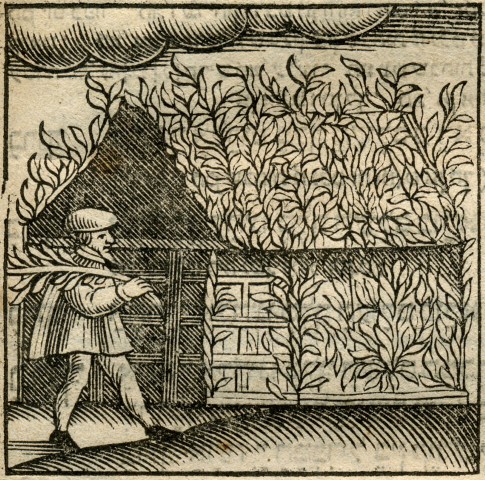
“Sukkot Customs”, English woodcut, 1662

Life is temporary

The biblical reading for Sukkot is the book of Ecclesiastes/Kohelet. This book views all life as fragile and temporary, like a sukkah. But instead of celebrating that we are alive to see another season, Ecclesiastes questions whether our brief lives have any meaning.

In the well-known King James translation, Ecclesiastes begins: “Vanity of vanities, saith the Preacher, vanity of vanities; all is vanity.”

The word “vanity” in this 17th-century translation refers to doing something in vain, i.e. with no resulting change. In the original Hebrew, the word is haveil.

The words of Kohelet2, a son of David, king in Jerusalem:

Haveil havalim, said Kohelet.

Haveil havalim! Everything is havel. (Kohelet 1:1-2)

haveil (הֲבֵל), havel (הָבֶל), or hevel (הֶבֶל) =  (noun) puff of air, vapor; (adjective) impermanent, fleeting, futile, absurd.

havalim (הֲבָלִים) =plural of haveil. (In biblical Hebrew a singular noun followed by the same noun in the plural can be translated as “~ of ~s” (as in “holy of holies”, “king of kings”). This construction means “most ~”, “highest ~”, or “utterly ~”. Thus haveil havalim = utterly transitory, utterly futile, utterly absurd.)

Kohelet considers both gaining wisdom and gaining wealth. Both of these efforts yield temporary satisfaction. But he dismisses them as hevel because they cannot last.

Wisdom

Kohelet values wisdom as a tool in the search for the purpose of life. Yet he considers wisdom hevel because disappears over time.

And I said to myself: “The fate of the fool is also mine; then why have I been wise?” That was when I spoke in my heart and concluded that this too was havel. Because the wise man along with the fool is not remembered forever; as the days continue to pass, all of them are forgotten. Alas, the wise man dies along with the fool! (Ecclesiastes 2:15-16)

The wise man dies and his wisdom is forgotten. Presumably, after enough millennia have passed, the wisdom book of Ecclesiastes will also be lost!

Wealth

Since many people value wealth, Kohelet builds a large estate with gardens, slaves, treasures, and singers.

Garden of Eram, Shiraz

And I did not neglect anything that my eyes asked for, I did not restrain my heart in any enjoyment. Rather, my heart rejoiced in all the fruits of my labor—and that was the only thing I got out of all my labor. (Ecclesiastes 2:10)

The pleasure of creating and maintaining a luxurious estate is not enough to give life meaning. Kohelet adds that passing on your wealth to your heirs is useless, since sooner or later the inheritance will be controlled by a fool who does not care about what you achieved.3 Furthermore, no matter how much luxury you accumulate, you can’t take it with you.

As one goes out from his mother’s womb naked, he will return … He cannot carry the fruits of his labor in his hand. (Ecclesiastes 5:14)

Innovation

Wisdom and wealth are not the only things that people believe are worthwhile. Some people today say life is about doing good and giving to others; but Kohelet barely touches on that subject. Others find meaning in scientific discovery, invention, artistic creation, promoting new social structures, or increasing knowledge; but Kohelet is not impressed.

What profit is there for the human

            In all his labor

            That he labors under the sun? (Ecclesiastes 1:3)

He describes how the cycles of nature never change, then claims that human endeavors are also repetitious.

What will happen

Has happened before

And what is done

Has been done before.

And there is nothing new under the sun. (Ecclesiastes 1:9)

There may be something of which it is said: “Look, this one is new!” But it occurred long ago, it happened before our time. There is no memory of the first ones, and also, like them, the later ones will not be remembered … (Ecclesiastes 1:10-11)

Thus Kohelet presents two reasons why human inventions are hevel. Even a human invention, discovery, or work of art only repeats what someone else created earlier; there is nothing new under the sun. And eventually people forget the so-called innovation—until someone else rediscovers it.

I have observed all the deeds done under the sun, and hey!—everything is hevel and herding the wind! (Ecclesiastes 1:14)

So much for devoting one’s life to discovering, inventing, or creating. So much for trying to improve the world through new science or new ways of government.


In a few billion years our whole solar system will die. But in the meantime, our earth has radically changed during the last two millennia. Thanks to human innovations, billions of people live longer and healthier lives, enjoy luxuries Kohelet could not have dreamed of, and acquire knowledge he would have envied.

Humans innovations have also resulted in so much pollution that the climate around the world is permanently disrupted, with grave results for all living things.

We can still celebrate our harvests and pray for the right amount of rain. We can still enjoy eating and drinking and spending our short lives with someone we love, as Kohelet suggests.4 But perhaps we can also recognize that there are new things under the sun—and our lives can be meaningful, not hevel, if we dedicate them to making changes for the good.


  1. A sukkah is modeled after the temporary hut the ancient Israelites erected in their fields during harvest season to provide a shaded place for laborers to take a drink or a meal break, as in the book of Ruth. The roof of a ritual sukkah is made out of vegetation such as reeds or branches, and must have gaps wide enough for rain to come in—and for the people inside to see stars at night.
  2. The word kohelet (קֹהֶלֶת) = assembler (from the root verb kahal (קהל) = assembly). Jewish tradition attributes the book to King Solomon, who succeeds King David in the first chapter of 1 Kings, but there is no corroborating evidence.
  3. Ecclesiastes 2:18-21.
  4. Ecclesiastes 3:22, 5:17, 9:9.

Haftarat Va-ethchanan—Isaiah: How to Comfort Yourself

How can people find consolation after a national disaster?

Flight of the Prisoners (from Jerusalem in 586 BCE) by James J.J. Tissot, 1896

“There are none menacheim me!” wails Jerusalem, imagined as a widow, in Lamentations 1:21.

menacheim (מְנַחֵם= comforting, consoling; one who comforts or consoles. (A piel form of the verb nacham,  נָחַם, which in the nifil form means a change of heart: either regret or consolation.)

Jerusalem is crying because the Babylonian army besieged and destroyed the city and its temple in 586 B.C.E. (See last week’s post: Lamentations: Seeking Comfort.) The leading families of the kingdom of Judah and its capital were exiled to Babylon, and the rest of the Israelites of Judah became serfs to the Babylonian conquerors.

Jews customarily read the book of Lamentations on the annual fast day of Tisha Be-Av. On the following Shabbat, called Shabbat Nachamu, we read the Torah portion Va-Etchanan in the book of Deuteronomy, and its accompanying haftarah reading from second Isaiah1, which begins:

Nachamu, nachamu my people!”

            Said your God.  (Isaiah 40:1)

nachamu (נַחֲמוּ) = Comfort! Console! (A plural imperative of the verb nacham in its piel form.)

Here God is the speaker, telling someone to comfort God’s people. These people (referred to later in the haftarah as “Jerusalem” or “Zion”) include both the exiles in Babylon and those who remained in Judah.

But who should do the comforting?

Decree by Cyrus (British Museum, photo by Ferrell Jenkins)

One candidate could be King Cyrus, whose Persian Empire swallowed the Babylonian Empire in 538 B.C.E.. Cyrus did, in fact, comfort the exiles from Judah living in Babylon, since he decreed that exiles throughout his empire could return to their own lands and enjoy modified independence.

Yet in the rest of the haftarah God never mentions Cyrus or the good news that the next generation among the exiles could go home after the Persians take over.

Instead God recommends four possible attitudes the Judahites  could adopt to console themselves:

  1. that they deserved their punishment, and it is ending;
  2. that their lives and their troubles are ephemeral, impermanent; and
  3. that God moves in mysterious ways.

An unnamed prophetess is called to deliver God’s messages of possible consolation.2

1. Just deserts

The first message begins by telling the people of Judah that have been punished enough.

Speak to the heart of Jerusalem

            And call out to her

That she has completed her term of service,

            That her crime has been expiated … (Isaiah 40:2)

Throughout the Hebrew Bible, God is considered responsible for the outcome of any war. When God wants the Israelites to win, they do. When God wants to punish the Israelites for worshiping other gods or behaving unethically, then their enemy wins.

Lamentations, Jeremiah, and second Isaiah all assume that God let the Babylonians capture the kingdom of Judah and destroy Jerusalem in order to punish the Israelites.

The Judahites would certainly be reassured if they believed that their sentence of punishment was now over. Many people also find comfort in the belief that there is a reason for their suffering. If God is punishing them for their own misdeeds, they have a reason that does not shake their faith in an omnipotent, omniscient, and omni-benevolent God.

However, verse 40:2 continues with a potentially faith-shaking statement.

            … That her crime has been expiated,

Since she took from the hand of God

            A double [punishment] for all her misdeeds. (Isaiah 40:2)

Why tell the people that they have endured twice as much punishment as they deserved?

Rashi3 pointed out that Isaiah 40:2 echoes Jeremiah 16:18: “I shall fully repay double for their crime and their misdeeds, because they profaned my land …”

Contemporary commentator Benjamin Sommer reasoned that if people believed that Jeremiah’s prophecy had come true, they were more likely to believe that second Isaiah’s would also come true.4

But the reference to a double punishment could also reflect a feeling among the exiles in Babylon or the serfs in the former land of Judah that they had not really sinned enough to warrant what happened to them.

Job, by Ivan Mestrovic, 1943 (photo by M.C.)

In the book of Job, the title character suddenly loses his wealth, his health, and all his children. Three of his friends come to the ash-heap where he sits scratching his boils.

And they agreed to meet together to come to condole with him ulenachamo. (Job 2:11)

ulenachamo (וּלְנַחֲמוֹ) = and to comfort him, and to console him. (From the same root as menacheim and nachamu.)

They take turns telling Job that all his suffering is a punishment from God, and if he would only recognize what sin he had committed and apologize to God, God might heal him. These would-be comforters utterly fail to comfort their friend, because Job knows he did nothing wrong.

Unlike Job, the Judahites in this week’s haftarah know that the people as a whole have committed some misdeeds—but they believe they are being punished twice as much as they deserve. People in this position would not be comfortable with the argument that they deserved their suffering and now it is ending. Their faith that God is just would be shaken.

Perhaps that is why God tells the prophetess:

Say unto the cities of Judah:

            Behold your God! (Isaiah 40:9)5

A description of God’s power to punish and reward follows. Then God is described as a gentle, caring shepherd.6 Anyone who believes they belong to this shepherd’s flock might be comforted.

Nevertheless, the people of Judah might be hesitant to trust God to care for them tenderly so soon after God delivered them into the hands of the Babylonians.

2. Impermanence

For a second approach at consolation, God says:

“All flesh is grass

            And all its loyalty is like the flowers of the field.

Grass dries up, and flowers wither and fall

            When the breath of God has blown on them.” (Isaiah 40:6-7)

The prophetess replies:

“Truly, the people are grass!

            Grass dries up, and flowers wither and fall.

            But the word of our God stands forever.” (Isaiah 40:7-8)

The impermanence of human life is also compared to grass or wildflowers in Psalm 90:5-6, Psalm 103:15, and Job 14:1-2. Pondering the ephemeral nature of human life might be depressing to people who are eager to have more deeds and experiences. But people who are helplessly suffering might be consoled by the reflection that their suffering is ephemeral and will soon disappear.

Later in the haftarah the metaphor of grass returns, along with a veiled reference to government dignitaries.7 This iteration points out that the Babylonian Empire is ephemeral too, not a permanent evil.

3. Mysterious ways

William Cowper wrote the Christian hymn that begins “God moves in a mysterious way” in 1773. His line became an adage, “God moves in mysterious ways”, reflecting the idea that even when we cannot explain events, God knows that God is doing. For all we know, Cowper had been studying the book of Job, where God finally answers by pointing out that God knows things Job could not even imagine.8

Or he was studying Isaiah 40, which says:

Who measured the waters in the hollow of his palm,

            And plumbed the skies with a handspan? (Isaiah 40:12)

No human being, obviously, but only God. Then the haftarah mocks humans who think they could understand God:

Who has plumbed the spirit of God?

            And [what] man informs [God] of his plan?

With whom did [God] consult, and who discerned 

            And taught [God] the measure of justice,

And taught [God] knowledge

            And informed [God] about the path of discernment? (Isaiah 40:13-14)

Obviously, according to this approach, God’s wisdom and justice are so far beyond human comprehension that for all we know, our suffering is necessary for some mysterious good result. We can console ourselves by trusting that the pain God inflicts on us is worthwhile.

*

A reader with a theological bent will have noticed that just deserts, impermanence, and trust in God’s mysterious ways are all theodicies: attempts to explain why an omnipotent, omniscient, and good God permits evil in the world. (See my post Psalm 73: When Good Things Happen.)

Some theologians excuse God from responsibility for war, on the grounds that wars are begun and conducted by human beings, and God gave humans free will because without it we could not make ethical choices at all. But the biblical assumption is that God permits war in order to punish peoples who have disobeyed or misbehaved.

Those whose worldview depends on a God who rewards and punishes desperately need to trust God to do the right thing. Then they could not only be comforted, but could also consider the evils of war acceptable, because

  1. the losers deserved their punishment, and ends when justice has been done; or
  2. both lives and their troubles are ephemeral, impermanent anyway; or
  3. God moves in mysterious ways and brings about the best possible world in the long run.

But what about people who believe that human beings, not God, are to blame for wars and other national disasters?

Perhaps we can find consolation in the thought that at least our suffering is not the will of God.

  1. Most of Isaiah 1-39 consists of the prophecies of Isaiah son of Amotz, who lived in Jerusalem when the Assyrians besieged it in 701 B.C.E. (but failed to capture the city). Isaiah 40-66, sometimes called “second Isaiah”, is a collection of writings dating from after the Babylonians succeeded in capturing Jerusalem in 586 B.C.E.. It includes prophecies that the Babylonian exile would end and the Judahites would return to Jerusalem.
  2. In Isaiah 40:9, God addresses the one who answers the call as “mevaseret of Zion”. Mevaseret (מְבַשֶּׂרֶת) = (fem.) herald, bringer of news. (The masculine form is mevaseir, מְבַשֵּׂר.)
  3. 11th-century Rabbi Shlomoh Yitzchaki.
  4. Benjamin D. Sommer, “Deutero-Isaiah Reworks Past Prophecies to Comfort Israel”, thetorah.com.
  5. I used the King James translation of this couplet from Isaiah 40:9 because it is captures the meaning of the Hebrew and it is well-known from the libretto in George Friderick Handel’s oratorio “The Messiah”.
  6. Isaiah 40:11. The King James translation contains some inaccuracies, but Charles Jennens used this verse as well in his libretto for Handel’s Messiah. For more, see my post Haftarah for Ki Tavo—Isaiah: Rise and Shine.
  7. Isaiah 40:23.
  8. Job 38:1-39:4.

Lamentations: Seeking Comfort

Sorrowing Old Man, by Vincent Van Gogh, 1890

Mourning has fallen out of style in much of America. After someone close to you dies, you are allowed to act distraught until after the funeral, but then you are supposed to pull yourself together and assume a positive attitude. Treat that emptiness in your life with a new routine, an affirmation, an anti-depressant.

Jewish culture, however, remains more mourning-friendly. There are rituals for the first week, the first month, and the first eleven months after someone’s death. There is a specific prayer to say in the presence of other Jews on the anniversary of the death,1 and memorial services for everyone on four holidays during the year.2

All of these rituals and prayers require the presence of at least ten adults who stand or sit with the person who has been bereaved. Their witnessing presence provides some comfort and consolation; at least the survivor is not alone.

But what if there are millions of mourners observing the death of whole cities, nations, civilizations?

Once a year Jews dedicate a day to this kind of mourning: the fast day of Tisha Be-Av (the ninth day of the month of Av), which begins at sunset this Saturday.

Tisha Be-Av commemorates the destruction of Jerusalem by the Babylonians in 586 B.C.E. and by the Romans in 70 C.E. But it is not a day for mourning the end of temple worship and its animal sacrifices; most Jews prefer the rabbinic religion that evolved to replace it.  Our mourning on Tisha Be-Av focuses on mass destruction, death, and exile from our homes. Over the centuries Jews have attached other vast tragedies to Tisha Be-Av, including the Spanish expulsion of Jews in the 1490’s and the Nazi genocide of Jews in the 1940’s.

Mourning Day, by Jan Voerman, 1864

On Tisha Be-Av Jews around the world gather not only to fast and pray together, but to read the book of Lamentations/ Eikhah3, five long poems mourning the fall of Jerusalem in 586 B.C.E.. The book begins:

Oh, how can she sit alone,

            The city [once] great with people?

            She has become like a widow.

Great among nations,

            A noblewoman among provinces,

            She has become an unpaid laborer. (Lamentations/Eikhah 1:1)4

What does it mean to be like a widow? In the male-dominated society of the ancient Israelites, a woman depended on a man for food and shelter. If she did not have a father, husband, or son to provide for her, she was in a vulnerable position. Another male relative might take her in, or she might glean fields, like Ruth. She might sell herself as a slave, resort to prostitution, or depend on charity. The book of Deuteronomy/Devarim urges people eight times to feed the fatherless child and the widow.5

In Lamentations, Jerusalem is like a widow because she has lost not only her people, but also her wealth. It was standard practice in the ancient Near East for successful invaders to make the surviving natives do unpaid labor.6

She weeps and weeps through the night;

            Her tears are on her cheek.

There are none menacheim her

            Out of all who loved her.

All her friends have been faithless to her;

            They have become like enemies to her. (Lamentations/Eikhah 1: 2)

menacheim (מְנַחֵם) = comforting, consoling; one who comforts or consoles. (A piel form of the verb nacham, נָחַם, which in the nifil form means a change of heart: either regret or consolation.)

Jerusalem’s lovers and friends in this verse are her erstwhile allies, particularly Egypt. The poet calls these allies faithless because they did not come to her aid when the Babylonian army attacked Judah and besieged its capital city.

Jerusalem weeps without consolation because the countries she expected to help her are absent. A real friend shows up and offers to help, but Jerusalem sits all alone.

Is God there? Yes, but this time God is allied with Jerusalem’s enemies. The book of Lamentations says repeatedly that God initiated the Babylonian conquest in order to punish Jerusalem for violating God’s laws.

There are none menacheim her” becomes a refrain in the first poem of Lamentations, repeated in verses 1:9 and 1:17.

In verses 1:12-16, Jerusalem speaks for herself in the first person. She describes her suffering on God’s “day of wrath”, and blames God for the defeat of her men at the hands of the Babylonian army. Then she says:

Over these things I am weeping;

            My eyes, my eyes flood with water.

Because distant from me is [any] menacheim

             Who might restore my spirit. (Lamentations 1:16)

At the end of the first poem in Lamentations, Jerusalem addresses God directly:

They heard that I myself sighed:

            “There are none menacheim me!”

All my enemies have heard of my evil fate.

            They rejoice because you yourself did it!

You brought on the day you called for.

            Then let them become like me!

Bring all their evil before yourself,

            And inflict on them

What you have inflicted on me

            For all my mutinies.

Because my groans are many

            And my heart is sick. (Lamentations 1:21-22)

Here Jerusalem realizes that even though God permitted the Babylonian army to raze God’s temple, the Babylonians sinned when they did it. So she begs God to punish her human enemies the same way God punished her.

Perhaps she believes this rough justice would console her.

Jeremiah Lamenting the Destruction of Jerusalem, by Rembrandt, 1630

The subject of consolation comes up once more in the book of Lamentations, in the second poem. The speaker now is the poet, who describes God’s fury and the resulting destruction, then calls Jerusalem a virgin daughter rather than a promiscuous widow.

What can I compare to you va-anachameikh,

            Virgin daughter of Zion?

For your shattering is as vast as the sea.

            Who will heal you? (Lamentations 2:13)

va-anachameikh (וַאֲנַחֲמֵךְ) = and I comfort you (with)? (Another form of the verb nacham.)

According to Rashi,7 the poet wants to console Jerusalem by telling her that something just as bad happened to another city, another people. But no sufficiently horrible example comes to mind.

The question “Who will heal you?” hangs unanswered. The Babylonians could rebuild the walls and the houses, and erect their own temple. But who will heal the people of Jerusalem?

Eikhah Rabbah, a Talmudic-era collection of commentary on Lamentations, suggests that God will. After all, God split the Reed Sea to let the Israelites pass through on dry land when they were fleeing the Egyptian army. Then God healed the breach in the water, destroying the enemy.8 Since God created miracles that helped the Israelites in the past, then someday, after God’s rage is spent, God will save them again.

In the second book of Isaiah, God declares: “I, I am the one menacheim you!” (Isaiah 51:12)

*

The book of Lamentations is only one of many biblical texts that view God as an omnipotent father with an anger management problem. Those who believe in that particular anthropomorphic version of God often blame themselves for disasters, since anything is better than accusing their father-figure God of injustice. And if they are very, very good, Daddy will forgive them and comfort them.

I believe we humans must comfort one another, if only by acknowledging one another’s losses as real.

But perhaps ultimately, comfort and consolation can only come from God—either through a fortunate change in circumstances beyond our control, or through the divine spirit that lives within us.

  1. The Mourner’s Kaddish, in Aramaic, a part of every prayer service.
  2. Yizkor services on Passover/Pesach, Shavuot, Yom Kippur, and Shemini Atzeret.
  3. Lamentations begins with the Hebrew word eikhah, which here means: “Oh, how can it be?” See my post Devarim, Isaiah, & Lamentations: Desperation.
  4. Although most of the poetry in Lamentations falls into couplets, I follow Robert Alter in dividing the first verse into triplets and retaining the order of the original Hebrew phrases. (Robert Alter, The Hebrew Bible: Volume 3, The Writings, W.W. Norton & Co., New York, 2019)
  5. Deuteronomy 14:29, 16:11, 16:14, 24:19, 24:20, 24:21, 26:12-13, 27:19.
  6. Deuteronomy 20:10-14 instructs the Israelites that if a foreign town surrenders to them immediately, they must impose forced labor on the residents. But if the town does not surrender until after the Israelites have besieged it, they must kill all the men and take the women and children as booty. The Babylonians, however, ended their siege of Jerusalem by deporting Israelite men who were skilled or educated, along with their families, to enclaves in Babylon. Their usual policy was to assign unpaid labor to any remaining residents of a conquered city.
  7. 11th-century rabbi Shlomoh Yitzchaki.
  8. Eikhah Rabbah 2:17, sefaria.org.

Psalm 73: When Good Things Happen

This week’s Torah portion is Bemidbar, the beginning of the book of Numbers/Bemidbar. But I am still pondering God’s promises of reward and punishment in the last portion in the book of Leviticus/Vayikra. This post will consider Psalm 73, a different take on divine recompense and retribution.

Next week I will write about the first two Torah portions in the book of Numbers, and catch up with the Jewish cycle of Torah readings!


Last week’s Torah portion, Bechukotai, quotes God as promising rewards to those who obey God’s rules and punishments to those who disobey them—with physical consequences here and now: food or starvation, health or sickness, peace or war, etc. (See my post Bechukotai & Jeremiah: Real Carrots and Sticks.) Yet often the good suffer and the wicked prosper, as Psalm 73 and the book of Job point out.

If God is omnipotent, omniscient, omnibenevolent, and just, then why do so many good things happen to bad people, and bad things happen to the good? Theologians have struggled with “the problem of evil” for millennia. Their solutions include:

Wilhelm Gottfried Leibniz, 18th-cent. author of Theodicy on the Goodness of God
  • Best of All Possible Worlds and Free Will: This imperfect world that God created is the best of all possible worlds; God could not improve it in one way without making it worse in another way. Furthermore, the best possible world is one in which human beings freely choose what is good. God created a world containing evil as well as good so that humans could understand the difference, and choose to increase the goodness in the world.1

This answer means that if God modified any natural disasters, there would be some unimaginable dire effect. So we should not blame God for all the natural disasters that happened before man-made global warming took effect.

It also means that if God tweaked human psychology to make our thinking less short-sighted and compartmentalized, so we made fewer inadvertent poor moral decisions, it would turn us into monsters in some other way. (And it means that if God eliminated sociopaths from our species it would create some disaster. All of this strains belief.)

  • The Reward Is in Heaven: God rewards every good person and punishes every bad person—not in this world, but in an afterlife.2

This answer requires belief in one or two mysterious other worlds that “exist” outside space and time. It also requires belief in a soul that can magically retain the identity of an individual person after death without any physical correlates.

  • The Long Run: God is unconcerned about individuals, but has a master plan in which all humans will be good and this earth will be a paradise—in the long, long run, after many millennia. Too bad so many good people have to suffer along the way.3

This answer posits a God unlike the one in the bible, who shows personal concern for at least some individuals and groups, and commands human judges to be fair to individuals.

  • “I do not understand wonders too difficult for me.” (Job 42:3): Humans are incapable of understanding divine justice, which is radically different from human justice.4

This answer is self-defeating. If we are incapable of understanding what God considers “good”, God’s injunctions in the bible do not mean what we think they do. Then how can we judge what God wants in new situations? And what should we do: what we know is right, or what we are guessing God wants?

Is the problem of evil insoluble, then? Or does God reward the good and punish the bad in some other way?

Psalm 73

Psalm 73 opens:

Surely God is good to Israel

            —to those who purify their hearts.5

As for me, my feet had almost turned aside;

            My steps had nearly slipped,

Because I envied the revelers;

            I saw the prosperity of the wicked. (Psalm 73:1-3)

The psalmist goes on to describe how fat and healthy the wicked are, despite the fact that they oppress people and speak with malice. They seem to be getting away with a selfish and cruel way of life.

They avoid the toil of other men,

            And lo yenuga-u with [the rest of] humankind. …

Hey! These are the wicked, yet they are always complacent.

            They pile up wealth.

Surely in vain have I kept my heart morally pure

            And washed my palms with innocence!

For I was nagua every day,

            And I was chastised every morning. (Psalm 73:5, 12-14)

lo yenuga-u (לֺא יְנֻגָּעוּ) = they are not afflicted, hurt. (lo = not + a form of the verb naga, נָגַע = touch, afflict, hurt, strike.)

nagua (נָגוּעַ) = touched, afflicted, hurt. (Another form of the verb naga.)

Job 1, by Ivan Mestrovic, 1943 (photo by M.C.)

We do not learn what the speaker’s affliction was, but elsewhere in the Hebrew Bible the “touch” of God often causes a disease or plague.6

While Job is sitting on the ash-heap scratching his putrid sores he says:

“Be kind! Be kind! You are my friends!

            For the hand of God nagah me.” (Job 19:21)

nagah (נָגְעָה) = touched, afflicted. (Another form of the verb naga.)

Like Job, the speaker in Psalm 73 is innocent of wrongdoing, but nevertheless afflicted. The speaker considers telling the world that the wicked are rewarded and the good are punished, but then realizes:

If I said: “I will recount [this] exactly”

            Hey, I would be backstabbing your children’s generation!

And when I evaluated and understood this,

            It was trouble in my sight.  (Psalm 73:15-16)

Unlike the wicked, the speaker cares about the welfare of the next generation, and feels responsible for promoting good behavior so that people will not harm each other.

The speaker’s second insight is that although the wicked think their path is smooth, it is actually slippery, and sooner or later they will fall.

Surely you set them [the wicked] on slippery footing,

            You cast them down into destruction.

How they become a horror in an instant!

            They reach the limit, they come to an end in terror.

Like awakening from a dream, my Lord,

            The city finds their shadow contemptible. (Psalm 73:18-20)

Suddenly their wickedness will be revealed to everyone, and people will turn against them. Then their complacency will change into terror.

The psalmist does not tell us the nature of their terror. Are the wicked afraid that now “the city” will be as cruel to them as they were to others? Or do they recognize their own guilt?

The third insight is that mental agitation and pangs of conscience come from God.

When my mind was agitated

            and my conscience was stabbed,

Then I was a dolt and I did not know;

            I was [like] the beasts with you.

Yet I was always with you;

            You held fast to my right hand. (Psalm 73:20-23)

Since God is always available, the wicked have to deliberately turn away from God and ignore their consciences in order to continue doing bad deeds. But the speaker did not pull away. The speaker’s affliction, as a “touch” from God, might even have led him or her to reflect deeply enough to feel the stab of conscience.

Through your counsel you guided me

            And in the end, you will take me in honor. (Psalm 73:24)

Martin Buber explained, “God counsels by making known that He is present”.7

Unlike the wicked, the psalmist says, someone who follows God’s counsel will be honored after death. But Psalm 73 focuses on life in this world. And in this world the wicked travel so far from God that eventually nobody listens to them anymore.

Because hey! Those far away from [God] go astray;

            Everyone who is unfaithful to [God] is silenced.

But as for me, the nearness of God is my good.

            I place my refuge in my lord God, and I recount all of your works. (Psalm 73:27-28)

Doing the right things leads to an inner satisfaction, the good experience of feeling the nearness of God. This inner reward is a refuge when outer circumstances are difficult.


The nearness of God is my good” is the best answer I know to the problem of evil. But it is incomplete. A thoughtful adult might well conclude that virtue is its own reward, and physical suffering is unimportant compared to the reward of a contented conscience. But what about the millions of innocent children who have suffered, physically and psychologically, and then died without growing up?

Must we believe that this is nevertheless the best of all possible worlds? Or that children who have been tortured will get a good “life” in a non-physical afterlife? Or that all the children destroyed by the Holocaust are unimportant compared to some ideal distant future? Or that a superior, divine point of view considers our outrage and empathy for these children foolish?

Even though doing the right thing is intrinsically rewarding, it is only a partial solution to the problem of evil in a world created by a God who is an omnipotent, omniscient, omnibenevolent, and just judge.

We might ask whether this notion of God is a naïve concept.


  1.  Wilhelm Gottfried Leibniz presented this argument in Essays of Theodicy on the Goodness of God, the Freedom of Man and the Origin of Evil, 1710, and was satirized by Voltaire in Candide, 1759, in which Dr. Pangloss chirps that this is “the best of all possible worlds” at inopportune times.
  2. This is Rabbi Yitzchak Abravanel’s answer to the problem of evil in his 15th-century commentary on Leviticus, as well as a common answer in Christian and Muslim traditions.
  3. Cf. Isaiah 46:10-13; Fyodor Dostoyevsky, The Brothers Karamozov.
  4. Cf. the book of Job.
  5. My translation is informed by 19th-century rabbi S.R. Hirsch on the psalm’s use of the word bar (ּבַּר) instead of tahor (טָהוֹר) for “pure”. “A man may be לב טהוֹר by nature and disposition. However, the designation לב בר can be applied only to him whose purity of mind is a result of his own efforts at self-improvement.” (Samson Raphael Hirsch, The Hirsch Tehillim, translated by Gertrude Hirschler, Feldheim Publishers, Nanuet, NY, 2014, p. 597)
  6. Eg. Genesis 12:17, 2 Kings 15:5, Isaiah 53:4, Job 2:5, 2 Chronicles 26:20.
  7. Martin Buber, Good and Evil, translated by Ronald Gregor Smith, Charles Scribner’s Sons, New York, 1952, p. 43.