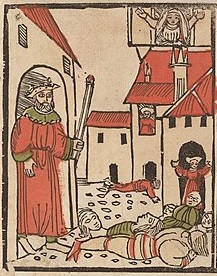
Pesach: Who Is Elijah?

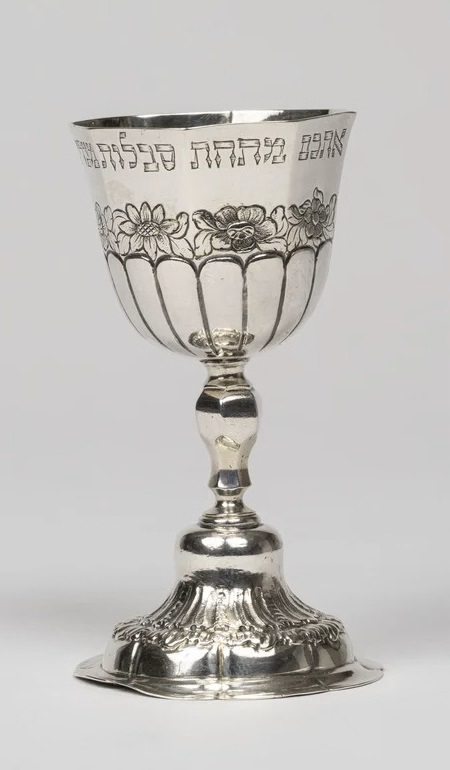
Passover cup by Johann Jakob
Runnecke, 18th century,
Jewish Museum

During this week of Passover (Pesach, פֳּסַח), Jews have been gathered around tables to celebrate liberation. Our ceremony (seder, סֵדֶר) has fourteen steps, punctuated by four cups of wine. When we pour the fourth cup of wine for each person at the table, we also pour wine into a cup that has been standing untouched the whole evening: the cup of Elijah.

Then we stand up, and someone opens the door to invite Elijah inside to join us. (This is the second time we open the door during the seder; before the meal, we open it to invite “all who are hungry” to come in and eat with us.)

While we wait for Elijah, we read a short passage. The traditional reading, from the centuries when almost every non-Jew was an enemy, consists of three biblical quotations asking for God’s wrath to destroy the enemies of Jews:

Pour out your wrath on the nations that do not recognize you, and on kingdoms that do not proclaim your name; because they ate up Jacob and made his abode a desolation. (Psalm 79:6-7) Pour out on them your curse and let your rage engulf them. (Psalm 69:25) Pursue in rage, and annihilate them from under the heavens of God. (Lamentations 3:66)

The connection between this reading and Elijah is tenuous. However, Elijah is portrayed in a few stories from the first book of Kings as a wrathful zealot bent on destroying the worshipers of other gods.

Many modern seders replace this reading with something less dire that refers to biblical stories in which Elijah orders kings around, or rescues the unfortunate, or becomes an angel instead of dying.

After that, we sing a song with these words1 before we close the door:

Eliyahu, hanavi                                   (Elijah the prophet)
Eliyahu, haTishbi (Elijah the Tishbite)
Eliyahu, Eliyahu, Eliyahu haGiladi (Elijah the Giladite)
Bimheirah veyameinu (Quickly, in our days)
Yavo eleinu (May he come to us)
Im moshiach ben David (With the anointed one, descendant of David)

Moshiach (מָשִׁיחַ) is “messiah” in English. The Christian story is that the messiah arrived over 2,000 years ago as Jesus. The Jewish story is that the messiah (or the messianic age) will not arrive until the whole world has become a place of peace, justice, kindness, and wisdom. So naturally Jews hope Moshiach will come during our lifetimes.

But why do we also call for Elijah to come to us? It depends on which characteristic of the prophet—or angel—we consider.

Elijah the wrathful zealot

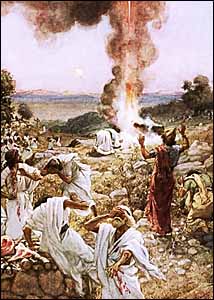
Elijah first appears in the Hebrew Bible after Ahab has become the king of the northern kingdom of Israel. Ahab marries the Phoenician princess Jezebel, and erects an altar for Baal and a pole for Asherah in his capital city, Samaria. The prophet Elijah is driven by his desire to eliminate the worship of other gods in the kingdom of Israel. First he declares a long drought, presumably so the Israelites will be realize their own God, Y-H-V-H, has the power to destroy them. After three years of drought, he stages a dramatic contest between Y-H-V-H and Baal at Mount Carmel.

Elijah’s Sacrifice on Mt. Carmel,
by William Brassey Hole

When Elijah’s God wins, the Israelites prostrate themselves and shout:

“Y-H-V-H, he is the only god! Y-H-V-H, he is the only god!” Then Elijah said to them: “Seize the prophets of Baal! Don’t let any of them escape!” And they seized them, and Elijah took them down to the Wadi Kishon and slaughtered them there. (1 Kings 19:39-40)

Then God brings rain. (See my blog post: Haftarat Ki Tissa—1 Kings: Ecstatic versus Rational Prophets.)

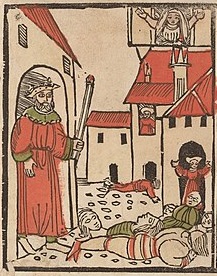
Elijah’s zeal for God shows up again in a story about King Ahab’s successor, his son Achaziyahu. The new king falls out a window, and sends messengers to ask a god in Ekron whether he will recover. Elijah intercepts the messengers and tells them King Achaziyahu will die because he sought out a foreign god instead of asking a prophet of Y-H-V-H. The king sends fifty soldiers to arrest Elijah, and their captain climbs the hill where the prophet is sitting and orders him to come down. Elijah replies:

“If I am a man of God, fire will come down from the heavens and consume you and your fifty!” (2 Kings 1:10)

Obligingly, God incinerates the soldiers with fire from heaven. The king sends another fifty men, with the same result. The third time, the captain begs Elijah to please spare him and his men. No fire appears, and Elijah follows the captain to the palace, where he tells the king that he will not rise from his bed, but will die for his disloyalty to God. Achaziyahu dies.2

Elijah the insolent

Another approach to Elijah’s part of the Passover seder is to emphasize his refusal to submit to authority.

When Elijah first shows up in the bible, he is identified by his clan (Tishbi) and region (Gilead), as in the Passover song. Then, with no transition, he speaks abruptly to King Ahab.

Then Elijah the Tishbite, an inhabitant of Gilead, said to Ahab: “As Y-H-V-H lives, the God of Israel whom I wait on—there will be no dew nor rain these years unless my mouth pronounces it!” (1 Kings 17:1)

Whenever Elijah speaks to a king, he uses none of the customary courtesies. He never refers to himself as the king’s servant, nor says please, nor uses any honorifics. He does not respect human authority. (He also appears to be arrogant in his assumption that when he says a miracle will happen, God will follow through. But God always does. And when God gives him an order, Elijah always obeys.)

After three years of drought, God tells him:

“Go, appear to Ahab, and I will give rain to the face of the earth.” (1 Kings 18:1)

When he meets King Ahab outside the city of Samaria, Elijah criticizes him for following other gods, then gives him orders:

“And now, assemble all of Israel at Mount Carmel for me, along with the 450 prophets of Baal and the 400 prophets of Asherah who eat from Jezebel’s table.” (1 Kings 18:19)

King Ahab obeys.

Elijah the compassionate

The prophet Elijah is high-handed with kings, soldiers, and the prophets of other gods. But he is thoughtful when it comes to the unfortunate. Some seders tell the story of how he saved a poor widow and her son.

After Elijah announces the long drought, God tells him where to hide from the agents of King Ahab and Queen Jezebel. His second hiding place is the house of a widow and her son in a village near Phoenicia. When Elijah arrives, the widow tells him she has only enough flour and oil to bake a couple of biscuits3 before she and her son starve to death. Elijah tells her to make a small biscuit for him first, and promises that God will make a miracle so her jar never runs out of flour and her jug never runs out of oil until it rains again.4 The widow obeys the prophet, God makes the miracle, and Elijah lives in the room on the widow’s rooftop.

Then her son gets sick. When the boy stops breathing, Elijah carries him upstairs and lays him on his own bed.

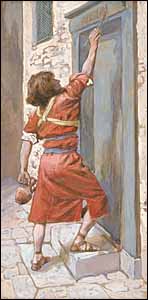
Elijah Raises the Widow’s Son, by James Tissot, circa 1900

Then he stretched himself out over the boy three times, and he called out to Y-H-V-H and said: “Y-H-V-H, my God, please bring back the life inside this boy!” (1 Kings 17:21)

The boy revives.

In a later story, Elijah is compassionate even when he is in despair, believing that he has failed in his mission to convert the whole kingdom of Israel to worshiping only Y-H-V-H. He heads south into the Negev, hoping to die there instead of at the hand of Queen Jezebel.5 On the way he thoughtfully leaves his servant in the town of Beersheba, so the man will not die in the desert with him.6

Elijah the angel

The final biblical story about Elijah describes his non-death. His disciple Elisha knows it is Elijah’s last day on earth, and sticks close to his master, even though Elijah asks him to stay behind three times. When they reach the Jordan River, Elijah rolls up his mantle (cloak) and slaps the water with it. The river divides and the two men walk across the riverbed.

Elijah Carried Away into Heaven by a Chariot of Fire,
by James Tissot, circa 1900

And they kept on walking and talking. And hey! A chariot of fire and horses of fire! And they separated the two of them. And Elijah went up in a whirlwind to the heavens. (2 Kings 2:11)

Elisha watches, then picks up Elijah’s mantle.

According to later Jewish writings, Elijah becomes an angel (i.e. a supernatural messenger or emissary of God) after God’s whirlwind carries him up to the heavens. This concept first appears in the book of Malachi. In the third chapter God, addressing the Israelites, says:

“Here I am, sending my malakh; and he will clear the way before me, and suddenly the lord that you are seeking will come to the temple. And the malakh of the covenant that you desire, hey! He is coming!” (Malachi 3:1)

malakh (מַלְאַךְ) = messenger, emissary. When God sends a malakh, it is often translated into English as “angel”.

The text postpones identifying this malakh. The next verse warns that the arrival of God’s emissary is not all good news.

“But who can endure the day he comes? And who can stand when he appears? For he is like the fire of a smelter and the lye of a fuller.” (Malachi 3:2)

The book of Malachi ends with God announcing:

“Behold, I am sending you Elijah the prophet before the great and awesome day of Y-H-V-H comes. And he will turn the hearts of fathers toward sons, and the hearts of sons toward fathers, lest I come and I strike the land with complete destruction.” (Malachi 3:23-24)

Now we know the malakh or angel is Elijah, centuries after he ascended to the heavens. The “day of Y-H-V-H” is a day of final judgment anticipated in some later books of the Hebrew Bible and in the Talmud. After that “day”, those whom God has found acceptable will live in “the world to come”, in which the Moshiach reigns.

But first, Elijah will do what he can to improve people’s hearts so they can enter the world of the Moshiach.

The tradition that Elijah is still among us as a malakh continued from the Talmud to 19th-century Chassidic tales, in which Elijah appears disguised as an ordinary human being. He either rewards a good person or makes a man realize he has behaved badly and only later does the person realize it was Elijah.

This Elijah no longer despairs of reforming people, but enlightens them one at a time.


Which Elijah do you want to invite into your house—or into the world today? The zealot who wipes out people who are irredeemable? The insolent prophet who demonstrates that authority figures have less power than they think? The compassionate man who goes out of his way to save the lives of the unfortunate? Or the divine emissary who improves the world slowly, one person at a time, until Moshiach comes?


  1. Jews also sing this song during the ritual of Havdalah marking the end of Shabbat and the start of a new week.
  2. 2 Kings 1:2-17.
  3. The Hebrew word is translate here as “biscuit” is ugah, עֻגָה = a round, flat wheat cake baked on hot stones or ashes.
  4. 1 Kings 17:13-14.
  5. Jezebel sends a messenger to tell Elijah that she is going to kill him (1 Kings 19:1-2).
  6. 1 Kings 19:3.

Pesach: Four Questions

Question: Why do Jews celebrate Passover?

Answer: To teach children the story of the exodus from Egypt.

This answer is in both the Torah and the Talmud, along with the need for adults to recall the story of liberation in an unforgettable way.

Two rituals in Exodus

Passover/Pesach begins this Wednesday at sunset. Jews around the world will gather at dinner tables and perform an elaborate ritual that is quite different from the two observances required in the book of Exodus.

In the book of Exodus, God orders the Israelites to gather in their houses for dinner on the 14th of the month of Nisan, which begins at sunset. That night, God will afflict Egypt with the last of the ten plagues: death of the firstborn. Each Israelite household must slaughter a year-old male lamb or goat; smaller households should combine and share one.

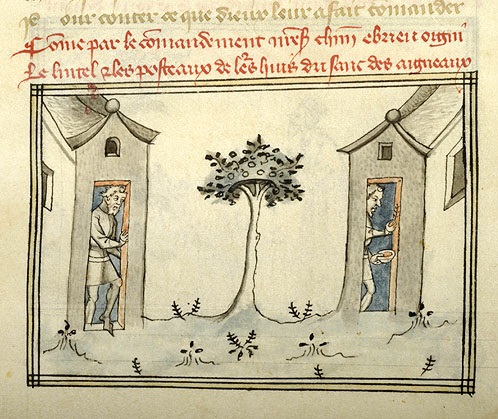
Painting the Blood, History Bible, Paris, c. 1390

And they must take some of the blood, and they must put it on the two doorposts and on the lintel of the houses where they will be. And they must eat the meat on this night, roasted in fire, and matzot on bitter herbs they must eat. You must not eat it raw, or cooked by boiling in water, but rather roasted in fire, its head on its lower legs and on its entrails. And you must not leave any for yourselves until morning; and [any] leavings from it in the morning you must burn in the fire. And thus you must eat it: your hips girded, your sandals on, and your staffs in your hand. And you must eat it in haste. It is a pesach for God. (Exodus/Shemot 12:7-11)

matzot (מַצּוֹת) = plural of matzah (מַצָּה) = unleavened bread; dry flatbread baked quickly to avoid sourdough action.

pesach (פֶּסַח) = “Passover” offering. (From the verb pasach, פָּסַח = hop (in 1 Kings 18:21); protect (in Isaiah 31:5); skip over, spare (in Exodus 12:23).)

Presumably the Israelites were enacting this ritual on the first night of Passover when Exodus was written down.  As God’s instructions continue, the ritual about daubing blood and eating a whole lamb standing up is followed by seven days of eating matzot:

Seven days you must eat matzot; indeed, on the first day you must remove the leaven that is in your houses, since any soul eating leaven must be cut off from Israel from the first day through the seventh day. (Exodus 12:14-15)

Pilgrimage festivals ceased after the destruction of the Second Temple in Jerusalem in 70 C.E. But the seven days without leaven is still a widespread Jewish observance during the week of Passover.

The Seder Table, Ukrainian print from Lubok, 19th century

However, painting your door frame with blood, eating a whole lamb including the head and entrails, and/or eating standing up with a staff in hand are rare today. Instead, on the evening of Nissan 14 (and sometimes on subsequent evenings during the week of Passover), Jews sit around the dinner table going through a Haggadah (הַגָּדָה = telling), a guide to saying blessings, singing songs, telling traditional stories, doing show-and-tell rituals, and eating ritual foods (as well as dinner). The event is called a seder (סֵדֶר= order, arrangement) because all these ritual acts are done in a prescribed order.

The reason for doing this is not only to remind ourselves of the story about God bringing us out of slavery in Egypt, but to teach it to our children.

Children in the Torah

The section of the Haggadah called “The Four Sons” or “The Four Children” paraphrases questions and answers in the Torah, imagining a different type of child corresponding to each answer.1 Three of the four biblical instructions on what to tell children are given in Exodus on the eve of the final plague and the liberation from Egypt:

When a child asks why we paint blood on our doorframes every year on Nissan 14, say:

“It is a pesach slaughter-sacrifice for God, who pasach over the houses of the Israelites in Egypt when [God] afflicted the Egyptians, but saved our households.” (Exodus 12:26)

When everyone has to eat matzot instead of leavened bread for a week, say:

“On account of what God did for me, when I went out of Egypt.” (Exodus 13:8)

When a firstborn son is ransomed in a ritual at the beginning of Passover, say:

“With a strong hand God brought us out from Egypt, from the house of slavery …” (Exodus 13:14)

The first of the Four Children in the Haggadah is based on the book of Deuteronomy, when Moses posits a son who asks about all the rules God has given. What Moses (unlike the Haggadah)2 tells you to answer begins:

“We were slaves to Pharaoh in Egypt, and God brought us out …” (Deuteronomy 6:20)

But the biblical questions and answers are not enough. Before the Four Children section, the Haggadah makes sure children are engaged with a section called “The Four Questions”.

The Four Questions in the Talmud

Most of the traditional Haggadah3 is described in the Babylonian Talmud tractate Pesachim, including the Four Questions, which appear in the older part of the tractate, the mishnah.4  The mishnah dates to the early third century C.E. and records what the Israelites in Babylonia were already practicing; therefore the Four Questions, like the Four Sons, has been an important part of the Passover ritual for about 2,000 years.

And for about 2,000 years, the purpose of the Four Questions has been to make the children at the seder pay attention.

Asking the Four Questions, German Haggadah c. 1460

All four questions are amplifications of the basic question:

Why is this night different from all other nights?

But the content of the four amplifications has changed somewhat since Talmudic times.

The original Four Questions (or amplifications) in the Talmud are:

On all other nights, we eat leavened bread or matzah, but on this night only matzah.

On all other nights, we eat other vegetables, but on this night only bitter herbs.

On all other nights, we eat meat roasted, stewed, or boiled, but on this night only roasted.

On all other nights we dip [vegetables] once, but on this night we dip twice.

The mishnah continues: And according to the son’s understanding, his father instructs him.”5 (Perhaps this remark inspired the creation of the section traditionally called “The Four Sons”.)

By the 10th century C.E., the question about how the meat is cooked had been dropped from the list, and replaced with a different question:

            On all other nights we eat sitting up or reclining, but on this night only reclining.

Reclining instead of sitting up was already a requirement by the time the mishnah of Pesachim was written.6 The Talmudic rabbis cited in the gemara (the part of a Talmud tractate written during the 3rd through 5th centuries C.E. as commentary on the mishnah) argued about the technicalities of reclining. They agreed that:

Lying on one’s back is not called reclining. Reclining to the right is not called reclining, as free men do not recline in this manner. People prefer to recline on their left and use their right hand to eat, whereas they find it more difficult to eat the other way. (Pesachim 108a)

After some argument, they also agreed that reclining was necessary not only while eating matzah, but also while drinking each of the four cups of wine, since only free and independent people got to recline while drinking—the opposite of “We were slaves” in the retelling of Exodus. But nobody had to recline while eating the bitter herbs.

When the requirement about reclining replaced the method of cooking meat in the Four Questions, the order of the questions also changed.6 During the last 1,000 years, the most common order has been:

Why is this night different from all other nights?

  1. … but on this night we dip them twice.
  2. … but on this night only matzah.
  3. … but on this night only bitter herbs.
  4. … but on this night only reclining.

Today, after we pour the second cup of wine and come to the page in the Haggadah with the Four Questions, all the questions are sung by the youngest person at the table who can manage it. Some children relish the job; others complain. But someone has to do it.

And if even his wife is not capable of asking or if he has no wife, he asks himself. And even if two Torah scholars who know the halakhot of Passover are sitting together and there is no one else present to pose the questions, they ask each other. (Pesachim 116a)

The Talmud offers additional ways to prompt children to ask about the unusual things they see in the dining room. Following Rabbi Akiva, Pesachim recommends giving the children roasted grains and nuts, “so that they will not sleep and also so they will ask the four questions at night.” (Pesachim 109a)

Another technique was to grab the matzot and wolf them down, “so that, due to the hasty consumption of the meal, they will not sleep and they will inquire into the meaning of this unusual practice.” (Pesachim 109a)

One prompt in the Talmud is to actually remove the dinner table from the room before the main meal!

Why does one remove the table? The school of Rabbi Yannai says: So that the children will notice that something is unusual and they will ask: Why is this night different from all other nights? The Gemara relates: Abaye was sitting before Rabba when he was still a child. He saw that they were removing the table from before him, and he said to those removing it: We have not yet eaten, and you are taking the table away from us? Rabba said to him: You have exempted us from reciting the questions of: Why is this night different [ma nishtana], as you have already asked what is special about the seder night. (Pesachim 115b)

Another rabbi quoted in Pesachim, Rab Shimi bar Ashi, explained:

Matza must be placed before each and every participant at the seder. Each participant in a seder would recline on a couch at his own personal table. Likewise, bitter herbs must be placed before each and every participant, and ḥaroset must be placed before each and every participant. And during the seder, before the meal, one shall remove the table only from before the one reciting the Haggadah. The other tables, which correspond to the seder plates used nowadays, are left in their place. (Pesachim 115b)


I have never been to a Passover seder in which each person reclines on a couch at a separate table, as at an ancient Greek symposium. And since we are all sitting at one big table (leaning to the left uncomfortably at the appropriate times), I have never seen the table removed.

But I have witnessed other devices to keep children—and even adults—awake and asking questions. If you were leading a seder, what would you do?


  1. See my post Pesach: Changing Four Sons.
  2. The reply to the first son (or child) in the Haggadah is to summarize only the rabbinic rulings (halakhah) about Passover, up to the ban on eating anything after the afikomen, the final piece of matzah.
  3. Modern Jews have added new ritual elements to the seder, and therefore new pages of text and songs in the Haggadah, while retaining all the important elements of the traditional Haggadah that is still used by more orthodox Jews.
  4. Pesachim 116a. (All translations from tractate Pesachim in this post are from The William Davidson Talmud on www.sefaria.org.) The mishnah in each tractate of the Talmud is the oral law collected by Yehudah HaNasi at the beginning of the third century CE.  Later rabbinic commentary on the mishnah, the gemara, was added over the next few centuries.
  5. Pesachim 116a.
  6. Pesachim 108a. The question about reclining is added to the Four Questions in the writings of both Saadiah Gaon  (10th-century rabbi Saadiah ben Yosef Gaon) and Rambam (12th-century philosopher Moshe ben Maimon, a.k.a. Maimonides).
  7. This is the order of the four questions according to Saadiah Gaon, Rambam, and the first extant printed haggadah (Soncino, 1485).

Exile in Tarshish

Was I was in Israel last week without knowing it?

The Torah says to observe Passover/Pesach for seven days, and that’s what Jews still do in Israel. Since Passover began on Friday evening, April 15, Jews in Israel read the Torah portion Acharei Mot on Saturday morning, April 22.

So did I.  And I stayed up late several nights last week writing a blog post about Acharei Mot,1 just as if I were in Israel.

But in the diaspora—the Jewish population outside what was our religion’s homeland thousands of years ago—Jews observe Passover for eight days. When I joined a Shabbat service by Zoom last Saturday, the eighth morning after Passover began, there was a Passover Torah reading and two special holiday prayer sections2. And I realized my mistake.

The diaspora includes places thick with Jews, like Brooklyn. But it also includes places where Jews are hard to find, like the small town on the Oregon coast where I live now.

At sunset on the first night of Passover, I was just getting home from a four-hour drive after a week of clearing out my mother’s house. (I succeeded in moving her to assisted living last month, but there is so much more to do!) That evening my husband and I went through the first page of the Passover ritual (with oregano3), then stumbled off to bed. We skipped the second seder because after two pandemic years, we couldn’t bear to watch it by Zoom for a third year. And for the first time in over 20 years, we forgot to start counting the omer.

Clearly my mind was not in Israel, but in Tarshish.

Tarshish is the most distant location mentioned in the Hebrew Bible. The book of Jonah begins when God tells Jonah to go prophesy in Nineveh, something he absolutely does not want to do. Nineveh is northeast of Jonah’s home, Gat-Hefer in the northern Kingdom of Israel.4 Jonah heads southeast, to the coast.

Phoenician Merchant Ship, 4th cent. BCE relief

And Jonah got up to run away toward Tarshish, away from the presence of God. He went down to Jaffa and he found a ship going to Tarshish, and he paid its fare and he went down into it to go with them to Tarshish, away from the presence of God. (Jonah 1:3)

Although we no longer know where Tarshish was, we know that Phoenicians from ports like Jaffa crossed the Mediterranean to trade with Tarshish. The bible includes Tarshish in lists of distant islands and far shores.5 Large ships suitable for long-distance travel are called ani tarshish (עָנִי תַרְשִׁשׁ) = Tarshish ships.6 Tarshish is the epitome of a faraway land.

Second Isaiah speaks of a future time when people from all nations will come to Jerusalem to worship God, even the most distant.

… Tarshish, Pul, and Lud … Tuval and Yavan: the far shores, the remote places that have not heard my name … (Isaiah 66:19)

So I was not in Israel last week; I was in Tarshish.

The Passover seder ends: “Next year in Jerusalem!” Next year (if the progression of Covid permits) I just want to be in Portland with some of my Jewish friends.

I am realizing what it means to be in exile from both of my Jewish communities in Portland. This small coastal town seemed like the perfect place to live when the pandemic began, but now it feels like Tarshish.

Tarshish may be one of the ends of the earth, but living here is not the end of the world. I am my own island of Torah study here. Every day I sing my morning prayers, and every day when I first see the ocean I say the blessing thanking God for making the “great sea”. I will pay more attention to the Jewish calendar. And someday I will sail home from Tarshish.


  1. Acharei Mot: Private Parts.
  2. Haleil and Yizkor.
  3. See my post Pesach, Metzora, & Chukat: Blood and Oregano.
  4. 2 Kings 14:25.
  5. Genesis 10:1-5; Isaiah 23:6, 66:19.
  6. 1 Kings 10:22, 22:48; Isaiah 2:16; Psalm 48:7; 2 Chronicles 20:37.

Pesach, Metzora, & Chukat: Blood and Oregano

Jews will gather around tables all over the world this Friday evening for the Passover seder, a ritual and story about God liberating the Israelites from Egypt. One highlight is when we chant the names of the ten plagues God inflicted on Egypt. After the name of each plague, we use one finger to remove a drop from the second of our four ceremonial cups of wine.1

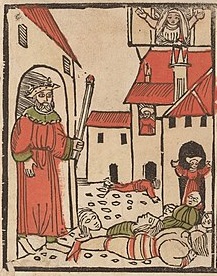
Death of the Firstborn, Spanish Haggadah c. 1490

The tenth and final plague is makat bechorot, death of the firstborn; God takes the life of every firstborn in every family in Egypt—except for the Israelites who mark their doors so that God skips, or passes over, them.

Before the final plague, God tells Moses that each Israelite family must slaughter a lamb or goat kid on the fourteenth day of the month.

“Then they shall take some of the blood and put it on the two doorposts and on the lintel, on the houses in which they will eat it. And they shall eat the meat that night, roasted in fire, and unleavened flatbread; on bitter herbs they shall eat it.” (Exodus/Shemot 12:7-8)

After describing how the Israelites should eat standing up with their loins girded, ready to leave, God says:“… It is a Pesach for God.” (Exodus 12:11)

Pesach (פֶּסַח) = the sacrifice mandated in Exodus 12; the annual spring pilgrimage festival in the Torah; the annual observance of Passover. (From the root verb pasach, פָּסַח = limp, skip.)

“And the blood will be a sign on the houses where you are, and I will see the blood ufasachti over you, and you will not be afflicted with destruction when I strike in the land of Egypt.” (Exodus 12:13)

ufasachti (וּפָסַחְתִּי) = and I will skip over you. (A form of the verb pasach.)

The animal blood both signals an escape from death and brings the recipient close to God—in these instructions and in two other rituals in the Torah in which the blood of  slaughtered animal is applied with branches of oregano.

1) Bo in Exodus (Pesach)

Moses adds oregano when he transmits God’s instructions to the Israelites.

Preparing for the Plague of the Firstborn, History Bible, Paris, c. 1390

“Then you shall take a bundle of eizov and you shall dip it into the blood that is in the basin, and touch some of the blood that is in the basin to the lintel and to the two doorposts. And you must not let anyone go out from the door of his house until morning. Upasach, God, to strike dead the Egyptians, and [God] will see the blood on the lintel and on the two doorposts, upasach, God, the door and not let the destruction enter your houses to strike dead [your firstborn].  (Exodus 12:21-23)

eizov (אֵזֺב) = Syrian oregano, an aromatic perennial herb. (Traditionally translated as “hyssop”, although true hyssop does not grow in the Middle East.) Eizov grows in stony ground to a height of 3-4 feet; its stems are the longest in the oregano branch of the mint family.

upasach (וּפָסַח) = and he will pass over, skip over. (Another form of the verb pasach.)

In the above passage, the first upasach means that God will pass over Egypt, and the second upasach means that God will skip over the houses whose doorframes are painted with blood.

An omniscient god would already know which houses to skip. Either the God-character in this story is not omniscient, or God includes the blood painting for its emotional impact.

Up to this point in the book of Exodus, the Israelite slaves find it hard to believe that God is on their side. But when they discover that God has killed every firstborn in every house except theirs, they are (temporarily) reassured that God is indeed rescuing them, and they march out of Egypt into freedom “with a high hand”.2

Why does Moses specify that the Israelites should use a bunch of eizov to paint the blood? The only herbs God mentioned to him were generic bitter herbs, to be eaten with the roast lamb or goat. Oregano is savory, but not bitter. Perhaps Moses is afraid that the Israelites will find it eerie to paint with blood, and he hopes to comfort them with the good smell of oregano.

2) Metzora in Leviticus

Last week’s Torah portion, Metzora, describes four steps of purification for someone who has recovered from the skin disease tzara-at. Although this disease does not seem to be contagious, the white and scaly patches of skin are a reminder of death. If the tzara-at clears up, ritual purification is necessary so that the healed person can return to the community and to God’s sanctuary. (See my post Metzora: Time to Learn, Part 2.)

Two Birds, by Simon Fokke, 18th century

The first step is a ritual requiring two wild birds.

And the priest shall slaughter one bird in an earthenware vessel [held] over living water. The live bird he shall take, along with the cedar wood and the crimson dye and the eizov, and he shall dip them and the live bird into the blood of the bird [that was] slaughtered over living water. Then he shall sprinkle it on the one being purified from tzara-at seven times and purify him. And he shall send the live bird out over the open field. (Leviticus 14:5-6)

The ancient Israelites identified blood with the life-force (nefesh, נֶפֶשׁ) in a person or animal.3 Here the priest kills one bird and catches its lifeblood in a bowl held over fresh water, which is called “living water” in the bible. The priest dips the other bird into the blood of life and sets it free. The healed person who is watching knows deep down that God has rescued them and given them new life.

The cedar and crimson dye (made from shield-louse eggs) have no apparent purpose except to emphasize the red color of the blood.

The eizov is used to sprinkle blood on the person being purified. A bunch of branches covered with soft leaves can be used to paint blood on something, and also be shaken to sprinkle blood on someone. And shaking a bunch of eizov branches would release the good smell of oregano, a reminder that life will be savory again.

3) Chukat in Numbers

A purification ritual in the book of Numbers/Bemidbar uses blood and eizov to make a transition for someone who has been exposed to a human death, so that the person can return to the right state for worshiping God with the community.

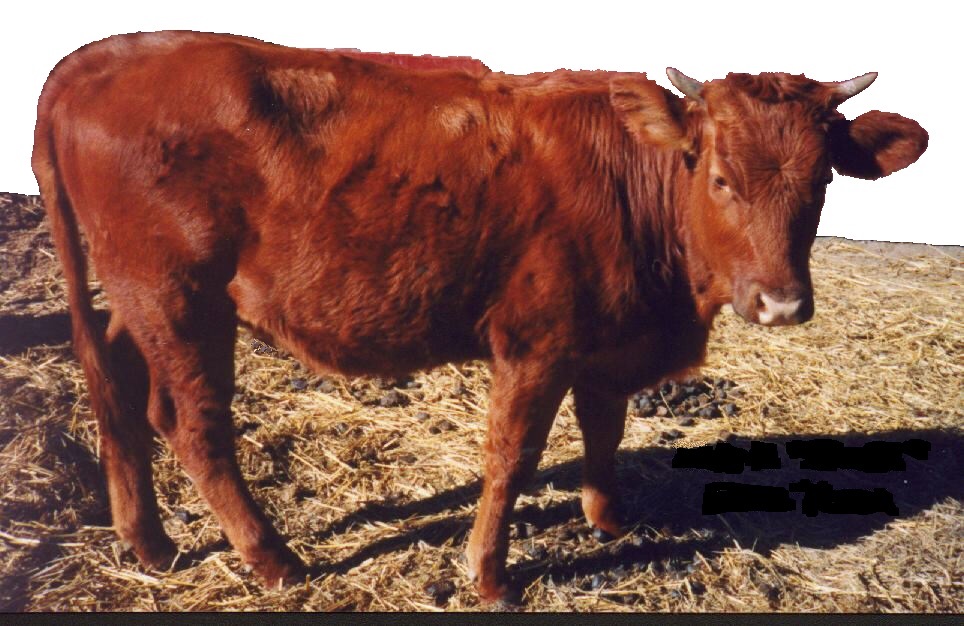
First a perfect, unblemished red cow that has never carried a yoke is slaughtered outside the camp as a chatat (חַטָּאת), an offering to compensate for an inadvertent sin or lapse. Usually someone offers a chatat after realizing they have made an error in observance that separates them from God. The chatat in this Torah portion is unique because the offering is slaughtered and burned ahead of time, so that future people who find they have become separated from the divine through exposure to human death can make a virtual chatat.

Then Elazar the high priest shall take some of her [the cow’s] blood with his finger, and he shall flick some of the blood seven times in the direction of the front of the Tent of Meeting. (Numbers/Bemidbar 19:4)

This connects the cow’s life with God’s holy place. Next, Elazar watches while someone burns the entire cow, even its blood and dung.

And the priest shall take cedar wood and eizov and crimson dye, and throw them into the middle of the burning cow. (Numbers 19:6)

The ashes of the red cow in Chukat are gathered and stored in a ritually pure place, to be used to purify the following:

1) Anyone who is inside a tent where a human dies, and anyone who enters the tent for the next seven days (Numbers 19:14).

2) Anyone who touches a human corpse (even on a battlefield), or who touches a human bone, or who touches a grave (Numbers 19:16).

Eizov (Syrian oregano)

Then some of the ashes of the burning of the chatat will be taken and mixed with living water in a vessel. Then a ritually pure man shall take eizov and dip it in the water, and he shall sprinkle it over the tent and on all the vessels and on the souls who were there; or on the one who touched the bones, or the killed person, or the person who died [of natural causes], or the grave. And the ritually pure one shall sprinkle it on the third day and on the seventh day. Vechito on the seventh day. And he shall clean his clothes and he shall wash in water, and he will be ritually pure in the evening. (Numbers 19:17-19)

vechito (וְחִטּאוֹ) = and he will become free of his lapse. (From the same root as chatat.)

Anyone exposed to death who does not go through this process is excluded or “cut off” from the community. If they were not excluded, “the holy place of God would become impure”. (Numbers 19: 20)

*

Today we have no ritual to free us from the feeling of alienation that accompanies contact with death; there has been no ash from a pure red cow for two thousand years. Neither do we have a ritual to reintegrate with the community when we recover from a disfiguring condition that isolates us as tzara-at once did.

And today very few Jews in the world observe Passover by slaughtering a lamb and painting its blood on their doorframes with bunches of giant oregano—even during the current plague of Covid. The long ritual seder developed over the past millennium and a half focuses on freedom from slavery, not on fear that God will kill us.

Nevertheless, this Passover I am going to put a sprig of oregano on my seder plate, next to the bitter herbs. Even during times when we are crushed by the bitterness of physical or psychological slavery, life has savory moments.

  1. The custom of removing drops of wine is first mentioned in a Pesach sermon written by Rabbi Eleazer of Worms (1176–1238). The idea that we do it in sympathy for the Egyptians is based on Proverbs 24:17 and first appeared in commentary by Rabbi Yirmiyahu Löw (1812-1874).
  2. Numbers 33:3.
  3. Leviticus 17:14, Deuteronomy 12:23.

Bo: Pride and Ethics

Haggadah by Judah Pinḥas, Germany, 1747

Pharaoh wants the Israelites to stay in Egypt and serve him as corvée laborers making bricks and building cities. God wants the Israelites to walk out of Egypt, take over Canaan, and serve “him”.  In an effort to terrorize Pharaoh into letting the Israelites go, God afflicts Egypt with ten “plagues” or miraculous disasters: blood, frogs, lice, mixed vermin, cattle pestilence, boils, hail, locusts, utter darkness, and death of the firtborn.

The God-character reveals another divine agenda in last week’s Torah portion, Va-eira, just before the plague of hail.

Shalach my people so they can serve me! Because this time I myself sholeiach all my scourges into your heart and against your courtiers and against your people, so that you will see that there is none like me on all the earth. Indeed, by now shalachti my hand and struck you and your people with the pestilence, and you would have been effaced from the earth. However, for the sake of this I have let you stand: so that I can show you my power and make my name known throughout the earth.” (Exodus 9:14-16)

shalach (שַׁלַּח) = Send! Send forth! Send out! Let go! Release!

sholeiach (שֺׁלֵחַ) = am sending, am sending forth, am sending out, am letting go, am releasing.

shalachti (שָׁלַחְתִּי) = I sent, I could have sent, I could have stretched out, I could have released.

(Throughout the story of the ten plagues, forms of the verb shalach are used both when God releases a plague, and when anyone talks about Pharaoh releasing the Israelites.)

Before sending the hail, the God-character reveals that “his” other goal is to prove to the whole world that “he” is the most powerful god. Being recognized as the most powerful seems more important to the God depicted in the book of Exodus than any moral considerations.1

The ethical problem with the God-character’s actions is that the plagues afflict not only Pharaoh, but also the native Egyptians. Why should ordinary Egyptians suffer? Pharaoh is the one who keeps refusing to let the Israelites go; his people have no say in the matter.

Some commentators have claimed that all the Egyptian people are on Pharaoh’s side, so they deserve to be punished. But there is nothing in the text of the Torah to indicate this. Pharaoh issues a general order for “all his people” to throw male Israelite infants into the Nile in last week’s Torah portion, Shemot.2 But the Torah never reports an Egyptian actually doing so. The only Egyptians who act against Israelites in the book of Exodus are:

  • Pharaoh, who issues commands calling for their oppression and death.
  • Egyptian taskmasters supervising the corvée labor, who oppress and beat the Israelites.3
  • Pharaoh’s armed regiment of charioteers, who pursue them after they leave Egypt.4

Yet the other native Egyptians also suffer from God’s ten plagues. Is their suffering unavoidable collateral damage in the war between Pharaoh and God? Or does God choose miracles that harm the most people on purpose, in order to make a more dramatic display of power?

*

Plague of the Firstborn, Spanish haggadah c. 1490

The tenth and final plague, described in this week’s Torah portion, Bo, is death of the firstborn.

And it was the middle of the night, and God struck down all the first-born in the land of Egypt, from the first-born of Pharaoh who sits on his throne to the first-born of the captive who was in the dungeon, to all the first-born of the livestock. (Exodus 12:29)

Only the Israelites receive God’s instructions to paint blood on their door frames and stay inside overnight to avoid the death of any of their first-born.5

Is this extreme unethical measure necessary in order to make Pharaoh submit? Or does the God-character kill every first-born in every Egyptian family merely in order to make a more dramatic display of power?

A necessary evil

The mass murder does appear to achieve the liberation of hundreds of thousands of oppressed Israelites.

And Pharaoh got up in the night, he and all his courtiers and all the Egyptians. And there was a great wailing outcry in Egypt, because there was no house without someone dead. And he summoned Moses and Aaron in the night and he said: “Arise, go out from among my people, you and also the Israelites, and go serve God, as you spoke! Take even your flocks and your herds, as you spoke, and go! And may you also bless me.” (Exodus 12:30-32)

Only after the death of the first-born does Pharaoh capitulate and tell the Israelites to go with everything Moses asked for. He even lowers himself by asking for a blessing, acknowledging that he cannot prosper again without God’s help.

Pharaoh loses his own first-born son, a blow that would shatter the hardest heart. But the wailing all over his capital city would reinforce his new despair. He may suspect that if he does not let the Israelites go now, the Egyptian people will revolt against him. The authority conferred upon him by the gods of Egypt no longer holds when the God of Israel is obviously more powerful.

A dramatic display

On the other hand, after three of the plagues (boils, locusts, and darkness) the Torah says that God hardens Pharaoh’s heart.6 What does this mean?

Pharaoh hardens his own heart after the plague of frogs, and continues to harden it four more times.7 He is in the habit of hardening his heart, and once we get into a habit, it can seem as if an outside force makes us keep doing it again and again. But in the text of Exodus, there is an outside force, and it is God. Before the plagues begin, the God-character tells Moses:

“And I myself will harden the heart of Pharaoh, and I will multiply my signs and my omens in the land of Egypt.” (Exodus 7:3)

The God-character follows up on this promise by deliberately hardening Pharaoh’s heart three times when Pharaoh is softening and might give in. The God-character does not want Pharaoh to let the Israelites go before “he” is ready. And the God-character is only ready after “he” has a chance to commit the tenth and most emotionally devastating plague: the death of the firstborn.

Apparently the God-character is so fixated on the goal of demonstrating power that the full ten-step dramatic display, from blood to death, is worth postponing the liberation of the Israelites. Demonstrating power is also far more important to this God-character than minimizing the suffering of innocent Egyptians.


Red Sea in Golden Haggadah, c. 1320, Spain

After the final plague, the Israelites march into the wilderness, but Pharaoh changes his mind about letting them go. The God-character hardens Pharaoh’s heart one last time in next week’s Torah portion, Beshallach, and Pharaoh commands his charioteers to pursue the Israelites. This gives the God-character a chance to create another memorable miracle: the splitting of the Reed Sea, and the return of the waters in time to drown the Egyptian chariot regiment.8

And Israel saw the great power that God wielded against Egypt, and the people were awed by God, and they had faith in God and in [God’s] servant Moses. (Exodus 14:31)

This miracle impresses both the Egyptians and the Israelites with God’s power. The fact that it also avoids killing any innocent bystanders is probably incidental in the book of Exodus.

Although Exodus is based on older oral traditions, modern scholars estimate that it was written down in the 6th and 5th centuries B.C.E. About a thousand years later, the rabbis of the Talmud imagined a different sort of God responding to the death of the Egyptian soldiers.

At that time the ministering angels wanted to recite a song before the Holy One, Blessed be He. The Holy One, Blessed be He, said to them: “My creatures are drowning in the sea, and you are reciting a song before me?” (Talmud Bavli, Sanhedrin 39b and Megillah 10b)

As the ethics of the Israelites advanced, so did the ethics of their God.


  1. See Jerome M. Segal’s treatment of this theme in his book Joseph’s Bones: Understanding the Struggle Between God and Mankind in the Bible, Riverhead Books, Penguin Group, New York, 2007.
  2. Exodus 1:22.
  3. Exodus 1:13-14 reports unspecified ruthless oppression by the taskmasters; Exodus 2:11 and 5:15-16 report beatings.
  4. Pharaoh and his charioteers pursue the Israelites after Pharaoh changes his mind about letting them go in Exodus 14:6-10. The disciplined Egyptian charioteers advance at the Reed Sea in order to kill some Israelites and capture the rest, but God intervenes with a miracle.
  5. Exodus 12:6-7, 12:21-23.
  6. Exodus 9:12, 10:20, 10:27.
  7. Exodus 8:11, 8:15, 8:28, 9:7, 9:34.
  8. Exodus 14:5-30.

Passover, Vayeishev & Mikeitz: Four of Jacob’s Children, Part 2

The wise child, the wicked child, the simple child, and the child who does not know how to ask; these are the four kinds of children in the Passover Seder.  Can we find them among Jacob’s progeny?

Last week I argued that out of the three of Jacob’s children with speaking roles in the book of Genesis, Reuben is an unwise wise child, and Judah is a reformed wicked child.  You can read that post here: Passover, Vayeishev & Mikeitz: Four of Jacob’s Children, Part 1.

The only other one of Jacob’s children who speaks is Joseph.  In the Passover Haggadah, the simple child says only, “What is this?”  Joseph says a great deal more.

Joseph: Complicated Simple Son

In fact, he talks too much.  By the time he is seventeen, four of his older brothers hate him because he brings bad reports of them to their father, Jacob.1  The rest hate him because he is Jacob’s favorite.  Joseph should notice their animosity, since “they could not speak to him in peace”.2

Joseph Reveals his Dream to his Brothers, by James J.J. Tissot

Yet he tells his brothers about two dreams in which they (thinly disguised as sheaves of grain, then as stars) are bowing down to him.3

Only a simple child would tell these dreams to brothers who already hate him.  Does Joseph realize how his older brothers feel?  Is he unable to imagine that they might lash out at him?

Their father, Jacob (who may also be deficient in emotional intelligence) sends Joseph off alone to check up on his brothers and their flocks.  As soon as he reaches them, they seize him, throw him into a pit, and argue about whether to kill him, let him slowly starve, or sell him as a slave.4  He pleads with them to no avail,5 and before the day is over he is a slave bound for Egypt.

The next time Joseph speaks is when his Egyptian master’s wife tries to seduce him, and he explains that he will not lie down with her because it would be wicked.6   It does not even occur to him to flatter her when he refuses her advances. She does not take his rejection well, and Joseph ends up in Pharaoh’s prison.

One morning in prison Joseph notices that two of his fellow prisoners, Pharaoh’s head butler and head baker, have “bad expressions”7—the first sign that he is noticing the feelings of others.  He asks them why, and they say there is no one to interpret their dreams.

Joseph in Prison, by James J.J. Tissot

Then Joseph said to them: “Aren’t dream interpretations for God?  Please tell me.”  (Genesis 40:8)

Is Joseph giving credit to God for his upcoming interpretations, or is he claiming that God gives him secret information?  Probably both.  Joseph’s predictions based on their dreams come true, and two years later when Pharaoh has a pair of puzzling dreams, the head butler recommends Joseph.

This time Joseph says God is revealing the future to Pharaoh through those dreams.8  The implication that God is giving Pharaoh, not Joseph, secret information indicates Joseph’s increasing sophistication.  He says the dreams are forecasting seven years of plenty followed by seven years of famine, and throws in some advice: Pharaoh should appoint an insightful man to organize stockpiling and later distribution of food.  Impressed, Pharaoh appoints Joseph.  From then on, he is the viceroy of Egypt.9

When Joseph’s ten older brothers come to the viceroy to buy grain during the first year of famine they do not recognize him.  Joseph plays a complicated game, arranging elaborate tests to see if his brothers have reformed.10  Joseph’s premise is that he can judge his older brothers according to how they treat Benjamin, Jacob’s youngest son and his new favorite.

Joseph still has grandiose impulses, and adds details to his game that are not strictly necessary.  For example, he invites them to dinner and seats them in order from oldest to youngest, although no Egyptian could guess their exact birth order.  They are astonished by his apparent magical power.11

The final test comes when Joseph plants a silver cup in Benjamin’s pack, then accuses him of stealing it and decrees that the punishment is to stay in Egypt as the viceroy’s slave.  Joseph’s ten older brothers say they are all guilty and they will all be slaves with him.  Even this is not enough for Joseph, who insists that only Benjamin will stay.12  Finally Judah breaks the deadlock by explaining that their father could not live without Benjamin.  Judah begs to be the viceroy’s slave instead of Benjamin, and Joseph finally breaks down and admits who he is.13

But there is one more complication.  Joseph is so attached to his role as the savior of Egypt, Canaan, and his own family, that he says:

“And now don’t worry and don’t be angry with yourselves because you sold me.  Because hey! God sent me ahead of you to save life.  For this was a pair of years of the famine in the midst of the land, and there will be five more years when there will be no plowing nor reaping …  So now, you did not send me here!  Rather, God did, and he placed me as a father-figure to Pharaoh and as a master to all his household and a ruler over all the land of Egypt.” (Genesis 45:5-8)

By the end of this speech Joseph is bragging about his high position.  As Pharaoh’s 39-year-old viceroy, he is older and wiser than he was at age 17.  But he is still as full of himself as a simple child.  He is also full of his theory of divine providence (at least for him and his family), and does not see that his brothers need his forgiveness.

Joseph invites the whole extended family to live in Egypt and benefit from his munificence.  Yet when their father Jacob dies, his ten older sons send a message to Joseph begging for a pardon.  They still do not feel safe with a simple child who has absolute power over them and never explicitly forgave them.

Then Joseph said to them: “Don’t be afraid!  Am I instead of God?  And you, you planned evil for me, but God planned it for good, in order to bring about this time of keeping many people alive.  And now, don’t be afraid; I, myself, will provide for you and your little ones.”  And he comforted them, and he spoke to their hearts.  (Genesis 50:19-21)

Whatever Joseph says to comfort them works, and they have a change of heart.  But I wish one of Joseph’s brothers would protest, “What is this?”

Benjamin: Speechless Son

Jacob has nine sons who are not quoted in the Torah.  He also has a daughter, Dinah, who is silent about her own rape, the subsequent proposed marriage, and the murder of her would-be bridegroom.14  I am tempted to call Dinah the fourth child in the Passover Seder, the “child who does not know how to ask”, so I could grandstand about how women in the Ancient Near East were pawns and chattels of the men, deprived even of the right to speak for themselves.15

But if Reuben, Judah, and Joseph correspond to the three children who ask questions, then the fourth child, who is amazed by the Passover rituals but cannot put together a question, must be Benjamin.

Benjamin is the youngest of Jacob’s children, and the only one who does not commit or witness any terrible deeds.  He has not even been born when Dinah is raped and Jacob’s oldest sons massacre all the men in the town of Shekhem.  He is only a toddler in Jacob’s camp when Joseph’s older brothers sell him as a slave.  The first year Jacob sends his ten older sons to Egypt to buy grain, he does not let Benjamin go.  The second year, when Benjamin does go, he is a married man with children of his own—but he is leaving his father’s home for the first time in his life!

He is silent—probably flabbergasted—when the viceroy’s steward “finds” the silver cup in his pack and accuses him of stealing it.  Benjamin remains silent when his older brothers tell the viceroy they will all stay in Egypt and suffer the punishment of slavery.  Another man might protest at this point, but Benjamin is not used to making his own ethical decisions.

After the viceroy reveals that he is Joseph, he embraces Benjamin first.

And [Joseph] fell on the neck of Benjamin, his brother, and he sobbed, and Benjamin sobbed on his neck.  And he kissed all his brothers and he sobbed on them.  And after that his brothers spoke to him.  (Genesis 45:14-15)

Benjamin is the only one of Joseph’s brothers who sobs back.  He is overwhelmed by Joseph’s affection, and unlike his older brothers, he is innocent of any wrongdoing.  He can react freely, and non-verbally.

Like the fourth child in the Passover Seder, Benjamin is the baby of the family.  It does not even occur to him to question what is going on.  We do not learn whether he ever grows up.

  1. Genesis 37:2.
  2. Genesis 37:3-4.
  3. Genesis 37:5-9.
  4. Reuben argues that they should throw Joseph in the pit without killing him outright, implying that he will eventually die of dehydration.  Reuben’s plan is to sneak back and rescue him (Genesis 37:21-22).  Judah persuades his brothers to sell Joseph to a passing caravan (Genesis 37:26-28).
  5. Genesis 42:21.
  6. Genesis 39:8-9.
  7. Genesis 40:7.
  8. Genesis 41:25.
  9. Genesis 41:39-44.
  10. Genesis 42:9-25, 43:26-44:17.
  11. Genesis 43:33.
  12. Genesis 44:16-17.
  13. Genesis 44:18-45:3.
  14. Genesis 34:1-31.
  15. Except for Rebecca, who can say “yes” or “no” to her engagement to Isaac (Genesis 24:57-58).


Passover, Vayeishev & Mikeitz: Four of Jacob’s Children, Part 1

The number four is big in the Passover/Pesach seder.  The Haggadah (the script for the ritual) is punctuated by four cups of wine.  Between the first cup and the second, the youngest person present sings the four questions, we read about four rabbis who stayed up all night, and we answer questions from four kinds of children.

The Four Seder-night Sons, American Haggadah, circa 1920

“The Four Sons” Passover tradition is first reported in the Mekhilta di Rabbi Yishmael, and might date as early as the second century C.E.1

There are four sons: a wise son, a wicked son, a simple son, and one who does not know how to ask.  (Mekhilta di Rabbi Yishmael, 13:14)2

The Torah prescribes what a father should say to a son on Pesach four times.3  Three of these instructions are preceded in the Torah by a hypothetical question from a child.  These three questions are similar in the Torah, the Mekhilta di Rabbi Yishmael, and the Haggadah:

  1. The “wise child”: “What are the terms and the decrees and the laws which God, our God, has commanded us?”
  2. The “wicked child”: “What does this service mean to you?”
  3. The “simple child”: “What is this?”
  4. The “child who does not know how to ask”.  (This child corresponds to an implied question about why everyone must eat only unleavened bread during the seven-day festival.  Moses gives the answer: “And you shall tell your child on that day, saying: This is because God did for me when I went free from Egypt.”  (Exodus 13:8))

The three questions may be similar, but the answers in the Haggadah leave out a lot of the information in the Torah, and one answer, to the so-called wicked child, is quite different.3  You can compare the Torah versions and the Haggadah versions in my 2019 post: Pesach: Changing Four Sons.

Every year as Pesach approaches, I enjoy playing with the idea of four kinds of children.  In 2012 I applied the four children model to Aaron’s four sons in this post: Shemini: Aaron’s Four SonsIn 2014 I wrote a post about the four children in terms of the four worlds of kabbalah in this post: Passover: Children of Four Worlds.

This year I am writing my book on morality in Genesis, and thinking about  Jacob’s twelve sons and one daughter.  Only three of his children get speaking roles in the Torah: Reuben, Judah, and Joseph.  Do they correspond to the three children who ask questions in the Haggadah?  What about the fourth child, the silent one?

Reuben: Unwise Son

Reuben, Jacob’s oldest son, is an unwise “wise child”.  I can imagine him asking for all the rules because he wants to do the right thing.  But then he blunders into some stupidity and messes it up.

When Joseph’s ten older brothers see him from a distance and plot to seize him, throw him into a pit, and kill him, Reuben says: “Let us not take his life!”  His brothers ignore him, so he waters down his protest.

And Reuben said to them: “Don’t shed blood!  Throw him into that pit that is in the wilderness, but don’t send a hand against him!”—in order to rescue him from their hand and restore him to his father.  (Genesis/Bereishit 37:22)

After Joseph is at the bottom of the pit, the other brothers sit down for a meal, but Reuben wanders away for some reason not recorded in the Torah.  Early commentators invented excuses for Reuben’s absence at the critical moment, but I maintain Reuben is not thinking clearly.  What could be more important than staying near the pit in case his murderous brothers suddenly decide to act?

And they do.  While Reuben is gone, Judah proposes selling Joseph as a slave to a passing caravan headed for Egypt.

And he [Reuben] returned to his brothers, and he said: “The boy is not here!  And I, where can I go?”  (Genesis 37:30)

Reuben intended to do the right thing, but he was not wise enough to carry it out properly.

Twenty-one years later, during the first year of a long famine, the viceroy of Egypt tells the ten brothers that he will not sell them grain again unless they bring their youngest brother down with them.  Back in Canaan the famine continues a second year, and the brothers try to persuade their father to let Benjamin go, even though he has become Jacob’s favorite now that Joseph is gone.  Reuben knows the whole family will starve to death unless his father lets Benjamin go, so he says:

“You may kill my two sons if I do not bring him back to you!  Put him in my hand, and I myself will return him to you.”  (Genesis 42:37)

He sounds ready to make a noble sacrifice.  But why would Jacob want to kill two of his own grandsons?  Once again, Reuben tries to be the wise child who does the right thing, but what he actually does is far from wise.

Judah: Reformed Wicked Son

The “wicked son” in the Haggadah asks, “What does this service mean to you?”  In the Torah it is an innocent question, and the parent merely answers that they are making a Passover offering to God to remember when God smote the Egyptians but passed over their households.  But in the Haggadah and the Mekhilta di Rabbi Yishmael, the parent accuses this son of separating himself from other Jews by saying “you” instead of “us”.4

Judah, Jacob’s fourth son, starts out as selfish as the Haggadah’s version of the “wicked son”. When Joseph is naked at the bottom of the pit, Judah is the one who says:

“What is the profit if we kill our brother and cover up his blood?”  (Genesis 37:26)

He persuades his brothers to sell Joseph as a slave to a passing caravan instead, and they are paid 20 silver pieces for him.  At this point, Judah is indeed wicked, separating himself from any empathy toward his younger brother Joseph.  Later, he deprives his widowed daughter-in-law Tamar of her traditional right to stay in his family by having a child with her deceased husband’s nearest male relative.  Tamar deceives Judah in order to get pregnant by him, and when Judah sentences her to death for adultery, she produces evidence that he is the father of her unborn child.  Judah’s eyes are opened, and he admits he was wrong, saying: “She is more righteous than I am!”  (Genesis 38:26)

After that wake-up call, Judah exhibits the empathy that I believe is implied by the question “What does this service mean to you?”  I think the so-called wicked child is actually interested in the feelings of other people, like Judah later in his life.

When Jacob refuses to let Benjamin go to Egypt so his sons can buy food during the second year of famine, Judah is the one who finally makes him change his mind.

Then Judah said to his father, Israel: “I will bring him.  Send the young man with me, and we will get up and go, and we will live and not die—we and you and our little ones. I myself will be the pledge for him; from my hand you may seek him.  If I do not bring him back to you and produce him before you, I will be guilty to you forever.”  (Genesis 43:8)

Judah’s word is good; when the viceroy of Egypt plants a silver cup in Benjamin’s pack and accuses him of stealing it, Judah volunteers to be the viceroy’s slave instead of his brother.  This act, along with a moving story about Jacob’s love for Benjamin, turns the tide, and the viceroy confesses that he is actually their brother Joseph.  Thanks to Judah’s empathy, the family arrives at a happy ending.

*

Does Joseph, the third of Jacob’s children who has a speaking role in the Torah, correspond in any way to the Haggadah’s “simple son”?  And who is the silent child?  You can find out next week in Passover, Vayeishev, & Mikeitz: Four of Jacob’s Children, Part 2.

  1. The Mekhilta di Rabbi Yishmael collection of commentary on the books of Exodus through Deuteronomy written during the first through fourth centuries CE and by Rabbi Yishmael ben Elisha, his students, and subsequent commentators.  The four sons in the Mekhilta are alluded to in the Jerusalem Talmud, but not in the Babylonian Talmud.
  2. This quote and all subsequent quotes from the Mekhilta use the translation in sefaria.org/Mekhilta_d’Rabbi_Yishmael.
  3. Deuteronomy 6:20-24 (wise), Exodus 12:27 (wicked), Exodus 13:15 (simple), and Exodus 13:6-8 (silent).
  4. This is outrageous, since in the Torah the wise son’s question is “What are the duties and the decrees and the laws that God, our God, commanded to you?”

Pesach & Vayikra: Holy Matzah

We interrupt this program of Torah readings from the book of Leviticus/ Vayikra to bring you a special announcement from the book of Exodus/Shemot:

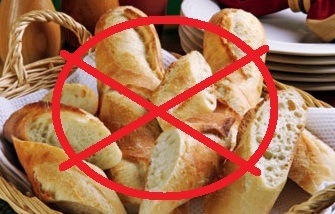
Do not eat regular bread during the week of Passover.

Why not?

First Day of Pesach

Painting doorposts with blood, History Bible, Paris, 1390

On the first day of Passover/Pesach, the Torah reading (Exodus 12:21-51) includes tenth plague in Egypt, the death of the firstborn.  Moses tells the Israelites what each household must do on that day: slaughter a sheep and paint its blood around the door, so death will pass over their house.

Night falls while the Israelites are eating their slaughtered sheep.  The firstborn child in every house without blood around the door dies.  In the middle of the night Pharaoh and the other Egyptians urge the Israelites to leave the country at once, with no conditions.  The Israelites march away in the morning, taking all their livestock; some gold and silver the Egyptians “loan” them; and some household items, including bread dough and kneading troughs.  When they camp on the first night of their journey,

They baked the dough that they had brought out from Egypt as cakes of matzot, because it was not leavened, because they were driven out of Egypt and they were unable to tarry; and also they had not made provisions for themselves.  (Exodus 12:39)

matzot (מַצּוֹת) = plural of matzah (מַצָּה) = unleavened bread; a flat “loaf” of flour and water baked before any sourdough can make it rise.

Every year we read this specious reason for eating matzah during Passover, in the haggadah (script) for the seder (ritual meal) as well as in the Torah.  And every year I sigh with impatience.

People in the ancient Near East used sourdough, not yeast, to leaven their bread.  It takes about a week to make new sourdough starter and gradually add enough flour and water to do some baking.  So for thousands of years bakers have kept sourdough starter going in their kitchens.

A family packing hurriedly to leave the country might bring dry flour and a jar of sourdough starter.  Or they might bring dough that was already rising in preparation for baking later in the day.  But who would mix some flour with water and bring the damp lump without adding any of the sourdough starter right there on the shelf?

Saying that we eat only unleavened bread during the week of Pesach because our ancestors had no time to prepare leavened bread is an explanation that some young children enjoy.  But it has never satisfied me.

Last Day of Pesach

On the last day of the week of Pesach, the Torah reading is Deuteronomy 15:19-16:17, which combines eating the slaughter offering with eating the matzah, and adds some new details to the Pesach observance.

Israelites Leave Egypt, The Golden Haggadah, 14th century Spain

Observe the month of the green grain,1 and make the Pesach offering to God, your God, because in the month of the green grain God, your God, brought you out of Egypt at night.  You shall slaughter Pesach offerings from the flock and from the herd for God, your God, in the place where God chooses to make [God’s] name dwell.  You shall not eat leaven with it.  Seven days you shall eat it with matzot, the bread of wretchedness, because in a hasty flight you went out from the land of Egypt.  On account of [eating matzot], you shall remember the day you went out from the land of Egypt all the days of your life.  (Deuteronomy/Devarim 16:1-3)

Here the purpose of eating both the animal offering and the matzot for a week is to remember the exodus from Egypt.  In Deuteronomy, we must do this at the temple, with everyone else who has come for the pilgrimage.

This passage adds that matzah is the bread of wretchedness,2 a statement repeated during the Pesach seder.3  Eating matzah reminds us of our own wretchedness and our inability to rise by our own efforts when we were in Egypt.

The hard labor imposed on the Israelites enslaved in Egypt gave them “shortness of breath” (or “shortness of spirit”; both translations are legitimate) so they could not listen to Moses talking about liberation.4  They could only cry bitterly, until God created the ten miraculous disasters that finally persuaded even the Pharaoh to let them leave Egypt.

We eat matzah during Pesach to remember that any freedom we have now is due to God’s compassion for us.

In the first century C.E. Philo of Alexandria initiated an explanation for eating matzah that we still repeat at many seders today: that leavening makes bread puff up like an arrogant person.  Eating flat matzah is a reminder of our humility before God.5

Pesach and Leviticus

This year another explanation for eating matzah occurred to me.  After reading about the matzot burned on the altar in various types of offerings to God in the first two Torah portions of Leviticus/Vayikra, I noticed that whenever the people make a grain offering6 to God, it is always unleavened.

The first Torah portion in the book of Leviticus/Vayikra describes several  acceptable types of afternoon grain offerings.  The first is:

… wheat flour; and he shall pour oil over it and place frankincense upon it.  And he shall bring it to the sons of Aaron, the priests, and one shall scoop from it … a memorial portion on the altar, a fire-offering, a fragrant aroma for God.   (Leviticus/Vayikra 2:1-2)

The Torah then describes four ways to cook the grain before offering it to God on the altar.  The mixture of flour and oil can be baked into matzot “loaves”, or into flat wafers.  It can be fried on a griddle, or cooked as soft dough in a pot.  But it must always be sprinkled with frankincense and salt before the priest breaks off a piece and lays it on the altar to burn up into smoke.  Furthermore, the grain offering must never be allowed to rise, and it must never include fruit syrup.

Any grain offering that you offer to God you shall not make leavened, for you must not make any sourdough or any syrup go up in smoke with a fire-offering for God.  You shall offer those to God as an offering of first-fruits, but they shall not be upon the altar, nor go up as a fragrant aroma.  (Leviticus 2:11-12)

Later the Torah describes the annual offering of first-fruits (and optional fruit syrups) on the holiday of Shavuot, which also prescribes an offering of two loaves of leavened bread from each pilgrim.  These offerings are presented to the priests at the sanctuary, but no part of them is burned on the altar for God.

Grain is also part of the wholeness-offering, given to express thanks or fulfill a pledge.  Besides slaughtering an animal at the altar, the donor brings:

 loaves of matzot mixed with oil, and wafers of matzot anointed with oil, and toasted flour mixed with oil.  Along with loaves of leavened bread, he shall offering his offering with his wholeness slaughter-offering.  (Leviticus 7:11-13)

Portions of the sacrificial animal and the unleavened grain offerings are burned on the altar.  But the leavened bread is all eaten by human beings: the officiating priest and the donor and his guests.  None of it is turned into smoke for God.

This means that during the week of Passover, we eat only the kind of grain that can be offered to God.  We remember that major transformations in our lives happen only by the grace of God, but we also, in effect, share bread with God.

Why?  In the Torah portion that comes after Pesach this year, Kedoshim, God declares:

You shall be holy, because I, God, your God, am holy.  (Leviticus 19:3)

Holiness is not a feeling in the Torah; the portion Kedoshim follows up that statement with a list of holy actions to take, both ethical and ritual.  But perhaps, when we eat matzah, we might remember we are eating the bread of God.  Maybe if that makes us feel more holy, we will act in a more holy way.  We will love our neighbor as ourselves (Leviticus 19:18) and share our food with the hungry (Pesach Haggadah).


  1. Aviv (אָבִיב) = green ears of grain; the first month of spring, later renamed Nissan in Hebrew.
  2. The Hebrew word is oni (עָני) = wretchedness, misery, poverty.
  3. In the Haggadah, matzah is called “ha-lachma anya”, an Aramaic phrase that means “the bread of wretchedness”.
  4. Exodus 6:9.
  5. See my post Pesach: Being Unleavened, Part 2.
  6. The afternoon grain offering is the minchah (מִנחָה)= allegiance-offering; a gift to a king as a sign of homage or respect; tribute.  See my post Vayikra & Tzav: Fire Offerings Without Slaughter, Part 2.
     

Song of Songs & 2 Isaiah: Love Sacred and Profane

A single word can mean attraction, desire, passion, affection, or devotion.

In English, that word is “love”.  In Biblical Hebrew, it is ahavah (אַהֲבָה).

Song of Songs, Rothschild machzor, 15th century CE

The noun ahavah and its related verb, ahav (אָהַב), appear eighteen times in The Song of Songs/Shir Hashirim, the short biblical book that Jews traditionally read during the week of Passover/Pesach.  The first line in this series of interlocking poems sets the tone:

            Let him kiss me with kisses of his mouth …  (The Song of Songs 1:2)

Soon the female speaker cries:

            Revive me with raisin cakes,

            Refresh me with quinces,

            Because I am faint with ahavah!  (Song of Songs 2:5)

The book frequently expresses erotic attraction by using metaphors from nature.  The woman’s breasts are compared to twin gazelle fawns, date clusters, grape clusters, and towers.1  In another example, the man says:

            A locked garden is my sister, my bride;

            A locked well, a sealed spring.

            Your limbs are an orchard of pomegranates

            And choice fruit …  (Song of Songs 4:12-13)

And the woman responds:

            Let my beloved come into his garden,

            And let him eat its choice fruit.  (Songs of Songs 4:16)

What is a book like this doing in the bible?  God is never mentioned in The Song of Songs.  Yet subsequent commentators, including Rashi,2 have argued that the whole book is an allegory for the love between the Israelites and God.

There is a precedent for this analogy.  In the 8th century BCE, Hosea portrayed the northern kingdom of Israel as the unfaithful wife of God.3  After him, several other biblical prophets portrayed the southern kingdom of Judah as God’s unfaithful wife, and the covenant between God and the people as a marriage contract.4  So the idea of using a human marriage as an analogy for the relationship between a people and God was well-known by the third or second century BCE, when The Song of Songs was written.  But the poetry in this book focuses on sexual love, not on the covenant of marriage.

Nevertheless, Rabbi Akiva argued for the inclusion of The Song of Songs in the biblical canon, declaring, “All eternity is not as worthwhile as the day the Song of Songs was given to Israel, for all biblical books are holy, but the Song of Songs is the holy of holies.”5

Song of Songs, artist unknown

Perhaps some human beings have loved God with an ahavah similar to the sensual yearning of the lovers in The Song of Songs.  Maimonides wrote: “What is the proper form of the love of God?  It is that one should love God with a great, overpowering, fierce love as if he were love-sick for a woman and dwells on this constantly … for the whole of Song [of Songs] is a parable on this theme.”6

But it is hard to imagine God loving human beings that way.  Although the Torah presents us with an anthropomorphic God who feels rage, jealousy, and compassion, the God of Israel is different from other ancient Near Eastern gods in that God does not partner with a goddess, and never engages in sex.

Then how does God love humans?  In the Hebrew Bible divine love is not individual, but collective.  God loves the people of Israel, or Judah, or Jerusalem.  God loves those who follow God’s rules.  The reader is encouraged to be like God and love concepts such as justice and compassion.

The love of God sometimes seems like immature favoritism to a modern reader.  Out of love, God destroys the rivals or enemies of the Israelites.7  When the Israelites are “unfaithful” and worship other gods, God lashes out in jealousy and destroys them, either by afflicting them with plagues or making their enemies victorious.  Neither the people nor God seem mature enough for marriage.

In other biblical passages, God’s love is more like a good parent’s devotion.

            For Israel was a boy and ohaveihu

            And from Egypt I called to my son …  (Hosea 11:1)

ohaveihu (אֺהֲבֵהוּ) = I loved him.

Similarly, the second book of Isaiah recalls a time when God was kind to the people of Judah, the southern kingdom of Israelites.

            And [God] said: “Surely they are my people,

            Children who do not betray.”

            And [God] became their rescuer.  (Isaiah 63:8)

            … In ahavah and compassion, [God] redeemed them,

            Plucked them up and carried them all the days of old.

            But they, they rebelled

            And pained [God’s] holy spirit.

            And [God] turned against them as an enemy;

            [God] made war against them.  (Isaiah 63:9-10)

Then the people of Judah yearn to come home again to an affectionate “father” who is devoted to their welfare. They recall that:

            “… You, God, are our father,

            Our redeemer of old …  (Isaiah 63:16)


Why do we read The Song of Songs during Passover?  The Passover seder retells the story of God taking the Israelite slaves out of Egypt.  We repeat God’s promise:

I will take you as my people, and I will be your God.  (Exodus 6:7)

This could mean taking the Israelites as a metaphorical wife; the bible sometimes uses the word “take” (lakach, לָקַה) to mean have intercourse with or marry.  But it could also mean God adopts the Israelite slaves and their fellow-travelers out of compassion, as if they are children who need special care.  Then God treats them with affection and devotion, the ahavah of a parent—at least until they reject God and worship other gods.

Is there anything in The Song of Songs to connect human sensual desire with God’s ahavah?  I found one hint.  Three times in The Song of Songs, the erotic poetry is interrupted by this verse:

            I make you swear, daughters of Jerusalem,

            By deer or by gazelles of the field:

            Do not rouse or lay bare ahavah until it pleases!  (The Song of Songs 2:7, 3:5, and 8:4)

The female speaker is warning her friends not to rush into consummating a sexual attraction; wait until the ahavah is ripe.  She does not say what a ripe love is.  A more overpowering attraction?  Or a fuller relationship with the beloved that includes tenderness, friendship, affection, and devotion, as well as carnal desire?  For human beings, physical ahavah and spiritual ahavah are often inseparable.

May each of us find ahavah in our lives, whether it is passionate desire or affectionate devotion.  And may each of us learn how to turn toward the world with an open heart and ahavah.


  1. The Song of Songs 4:5, 7:4, 7:8, 7:9, 8:10.
  2. 11th-century rabbi Shlomoh Yitzchaki.
  3. Hosea 2:18-22.
  4. See Jeremiah 2:2, Ezekiel 16:3-14, and Second Isaiah 54:4-10 and 62:5.
  5. Rabbi Akiva ben Yosef (50-135 CE), quoted in Mishnah Yadayim 3:5.
  6. Maimonides, a.k.a. Moses ben Maimon or Rambam (12th century CE), Mishnah Torah, I: The Book of Knowledge, 10:3, Laws Concerning Repentance.
  7. For example, see Malachi 1:2.

Pesach: Changing Four Sons

The wise one, the wicked one, the simple one, and the one who does not know how to ask.

These are the “Four Sons” in the haggadah (הַגָּדָה = The Telling), the guide to the Passover/Pesach seder.  Even haggadot that leave out many traditional sections still include the Four Sons (or in modern versions, Four Children) and label them that way.  If you go to a Pesach seder this Friday evening, you will encounter them.

pesach (פֶּסַח) =  the animal sacrifice for Passover, the festival of Passover.  Plural: pesachim (פְּסָחִים).

Neither the  four types of children, nor what we should tell them, come from the story of the exodus from Egypt in the Torah–even though telling that story is what Pesach is all about.

The Torah does prescribe what a father should say to a son on Pesach four times.  Three of these instructions are preceded by a hypothetical question from a child. But the answers in the Haggadah are different from the answers in the Torah.  By about 200 CE the Jewish community in Babylon had labeled the sons in the four passages and changed the answers to be given by their fathers.

“The Four Sons” Pesach tradition is first reported in the Mekhilta di Rabbi Yishmael.1  Who knows, maybe even Rabbi Yishmael ben Elisha was the one who invented this section in the second century CE, and it became popular after his students recorded it.  The passage begins:

Four Sons in French haggadah, 1880’s

There are four sons: a wise son, a wicked son, a simple son, and one who does not know how to ask.  (Mekhilta di Rabbi Yishmael, 13:14)2

A parental answer follows for each type of son.

Is it possible to combine the four explanations to children in the Torah with the Four Sons found in the Mekhilta and all traditional haggadot?  Here is my attempt.

The “Wise” One

The question of the first child comes from the book of Deuteronomy/Devarim:

If your son asks you in the future, saying: “What are the terms and the decrees and the regulations that God, our God, has commanded you?”  Then you shall say to your son: “We were slaves to Pharaoh in Egypt, and God brought us out from Egypt with a strong hand …  And then God commanded us to do all these decrees, to be in awe of God, our God, for our own good always, to keep us alive as on this day.”  (Deuteronomy 6:20-21, 6:24)

For about 1,800 years the haggadah has applied the child’s question to the rules of the Pesach seder:

Breaking off the afikoman

What does the wise son say?  “What are the testimonies and the statutes and the judgments that God, our God, commanded us?”  You, likewise, open to him with the Pesach rule: “Nothing should be eaten after the Pesach afikoman.”2

Later haggadot say the parent should tell the child all the rules of Pesach, including the one that nothing must be eaten after the afikoman.  Although in the Torah this child says “commanded you”, the Mekhilta rewrites his question as “commanded usin order to make the boy look better.

Answering the child’s question in the context of Deuteronomy 6:20-25 would be a bootless enterprise.  If you responded with every rule in the Torah and how it is applied, both you and the child would fall asleep long before you could finish the task.  You could limit your list to the rules of the Pesach seder, including the afikoman; but why not bring up each rule when you actually apply it during the evening?

I recommend saying: “We were slaves to Pharaoh in Egypt, and God brought us out from Egypt with a strong hand.  So if we are wise we obey God’s rules, in awe and gratitude, and for our own good.  Because here we are, alive today!”  (Deuteronomy 6:21-24)

The “Wicked” One

The question of the second child comes from the book of Exodus/Shemot:

Take for yourselves an animal from the flock for your families and slaughter the pasach.  And you shall take a bunch of hyssop and dip it in the blood that is in the basin, and daub it on the lintel and the two doorposts …  And God will pass through to strike the Egyptians, and will see the blood on the lintel and the two doorposts, and God will pasach over the entrance …  And when your children say to you: “What is this service to you?”  Then you shall say: “It is a pasach slaughter for God, who pasach the houses of the Israelites in Egypt when [God] struck the Egyptians, but preserved our households.”  (Exodus/Shemot 12:21-23, 12:26-27)

pasach (פָּסַח) = (verb) limped, skipped; (noun) an alternate spelling of pesach (פֶּסַח).

In context, the children are asking about the service of daubing blood on the outside frame of the front door, to commemorate the action in the book of Exodus.  (Although pesach animals were slaughtered annually at the temple in Jerusalem until the second temple was destroyed in 70 CE, there is no evidence to date other than this passage in Exodus that the daubing of blood around doors was ever re-enacted.)

But the Mekhilta completely changes the meaning of the children’s question:

What does the wicked son say?  “What is this service to you?”—to you, and not to him.  Because he disassociated himself from the congregation and denied the foundation, you, likewise, blunt his teeth and tell him: “Because of this [that] God did for me when I went out of Egypt.”  For me and not for you.  Had you been there, you would not have been redeemed.

The father’s reply here sounds to me as if the questioner is not “the wicked son”, but “the son whose father hates him”.

The father makes the “wicked son” look bad by correctly quoting “What is this service to you?” and leaping to the conclusion that “to you” means the boy is disassociating himself from his parents and from other Jews.

This is a prejudiced assumption.  Perhaps the child is merely expressing curiosity about a particular Pesach service and its meaning to an adult.  The service in question is what the Israelites did in Egypt the night before they were freed: slaughtering a sheep or goat and daubing its blood on the lintel and doorposts of the front door.

I recommend answering: “Thanks to that service, God “skipped over the houses of the Israelites in Egypt when [God] struck the Egyptians, but preserved our houses.  (Exodus 12:27)   And that is why we call this week Passover; the Hebrew name, Pesach, means skipped over.”


The “Simple” One

The third child’s question appears in Exodus after the instructions to sacrifice every firstborn male animal in the herd and flock to God, in commemoration of the tenth and final plague in Egypt.  A firstborn donkey is redeemed with a sheep sacrificed in its place.  The firstborn son of each human mother is also dedicated to God.

Death of the Firstborn, haggadah by Judah Pinḥas, Germany, 1747

But every firstborn human among your sons you shall redeem.  And when your son asks you in the future, saying: “What is this?”  Then you shall say to him: “By strength of hand God brought us out from Egypt, from the house of slavery.  And when Pharaoh hardened against sending us out, then God killed every firstborn in the land of Egypt, from the firstborn of humans to the firstborn of livestock.  Therefore I am slaughtering for God every male womb-opener, but every firstborn of my sons I must redeem.”  (Exodus 13:14-15)

The Mekhilta takes the question out of context and shortens the answer:

What does the simple son say?  “What is this?”  And you shall tell him: “With a mighty hand did God take us out of Egypt from the house of bondage.”

The best answer depends on what the simple child cannot find the words to describe.  If “this” is the Pesach seder, it suffices to answer: “This is the way we tell the story of how God rescued us from slavery in Egypt.”

But what if the child has qualms about God’s tenth plague in Egypt, the death of the firstborn?  I recommend reassuring your child (or your inner child) by explaining: “That was a miracle in the story.  Moses told our ancestors to commemorate it by sacrificing the firstborn of each cow, sheep, or goat at the altar, but to redeem every firstborn son by giving something different to God instead.  (Exodus 13:15)  Today we give money in honor of the firstborn.”

The Speechless One

Exodus tells the father what to say to his son about the festival of matzah without including any prompting question.

Seven days you shall eat matzah, and on the seventh day will be a festival for God.  Matzah shall be eaten for seven days, and nothing leavened shall be seen with you, and no sourdough shall be seen with you, throughout all your territory.  And you shall tell your son on that day, saying: “For the sake of what God did for me in taking me out from Egypt.”  (Exodus 13:6-8)

Modern biblical scholars suspect that there was already a festival of matzah in the spring, before the first grain harvest, and the Torah absorbed the pre-existing festival into the Pesach observance.4

Nevertheless, the Torah instructs us to explain the presence of matzah and the absence of leavened food during the week of Pesach in terms of the exodus.  And you shall tell your son on that day, saying: “For the sake of what God did for me in taking me out from Egypt.”  So does the Mekhilta:

And he who does not know how to ask, you open for him, as it is written: “And you shall tell your son on that day, etc.”

Like the answers for the “wicked” child and the “simple” child, the invented “son who does not know how to ask” gets an answer that ignores the point of the corresponding passage in the Torah—in this case instructions for the festival of matzah.

I recommend telling the speechless child: “For seven days we eat matzah, and avoid any baked goods with leavening.  Why do we do this?  For the sake of what God did for me in taking me out from Egypt.  (Exodus 13:6-8)  That’s what it says in the Torah, but what do you think it means?”  In this way you may encourage your child to ask questions and generate possible answers.

*

Pesach is when we must tell the story of the exodus from Egypt in a way that engages our children and the “children” inside us.  In order to do that, we can combine the traditions with our own creativity.  The Babylonian Talmud tractate Pesachim gives examples of spur-of-the moment alternatives to traditional sections.5  But if you would like to plan some alternatives in advance, you are welcome to use this blog post as a starting point.

  1. The Mekhilta di Rabbi Yishmael collection of commentary on the books of Exodus through Deuteronomy written during the first through fourth centuries CE and by Rabbi Yishmael ben Elisha, his students, and subsequent commentators and redactors. The rules and customs of Passover in the Mekhilta were probably written in the early third century CE, about the same time as Rabbi Yehudah Ha Nasi collected the mishnah of the Talmud.  The fours sons in the Mekhilta are alluded to in the Jerusalem Talmud, but not in the Babylonian Talmud.
  2. This quote and all subsequent quotes from the Mekhilta use the translation in sefaria.org/Mekhilta_d’Rabbi_Yishmael. They are all from 13:14.
  3. The afikomen is the final course or dessert of the Passover meal, consisting of half a piece of matzah separated and hidden early in the ritual.
  4. The only reason given in Exodus for observing the festival of matzah during Pesach is the sentence: “And they baked the dough that they had taken out of Egypt, flat rounds of matzah, because it had not leavened, because they were driven out from Egypt and they could not delay. They did not even make provisions for themselves.”  (Exodus 12:39)  But the Israelites have two week’s notice, and their only leaven is sourdough starter, which never runs out as long as a little is saved from each batch of bread.
  5. For example, Babylonian Talmud, Pesachim 115b: “Abaye was sitting before Rabba when he was still a child. He saw that they were removing the table before him, and he said to those removing it: “We have not yet eaten, and you are taking the table away from us?”  Rabba said to him: “You have exempted us from reciting the questions of ‘Why is this night different’, as you have already asked what is special about the seder night.”  (Translation from www.sefaria.or/Pesachim 115b.)