Beha-alotkha & Ki Tisa: Calf Replacement

When the Israelites arrive at Mount Sinai in the book of Exodus, they are led by God’s pillar of cloud by day and fire by night, as well as by God’s prophet Moses. When they leave in the book of Numbers, they are led by God’s cloud and fire, and Moses, and the ark.

It sounds like a net gain. But it was nearly a total loss.

Descent in Exodus

The Israelites, who spent their whole lives under Egyptian rule, are deeply insecure when they head into the wilderness. They cannot believe God will rescue them—from the Egyptian chariot army, from thirst, from hunger. After they reach Mount Sinai, God puts on an impressive revelation including fire, smoke, lightning, thunder, and shofar-blasts. The people tremble as violently as the mountain,1 and they unanimously pledge to do everything God commands.2

But all they really learn is that God is powerful, not that they can trust God to get them to Canaan and help them conquer it, as promised.

Vesuvius in Eruption, by J.M.W. Turner, 1817

When Moses climbs Mount Sinai for his first forty-day stint, the presence of God at the summit looks like a cloud to him. But it looks like a “consuming fire” to the Israelites.3 How could anyone, even a prophet of Moses’ stature, come back out of that fire alive?

The Israelites below fall into despair in the Torah portion Ki Tisa (Exodus 30:11-34:36), just as God finishes giving instructions to Moses and inscribes some words on a pair of stone tablets.

Then the people saw that Moses was delayed in coming down from the mountain, and the people assembled against Aaron and said to him: “Get up! Make us a god that will go in front of us, because this man Moses who brought us up from the land of Egypt, we do not know what has become of him!” (Exodus 32:1)

The Israelites are afraid to go any farther in the wilderness without Moses. Furthermore, God’s pillar of cloud and fire, which led the way to Mount Sinai,4 seems to have disappeared when they arrived.5 (Perhaps the divine pillar changed shape and relocated to the top of the mountain?) So, grasping at straws, they ask Aaron, Moses’ brother, to make them an idol “to go in front of us”. They would not expect a statue to walk, but they must hope that God would inhabit the idol, as the Egyptian gods inhabited statues in Egypt. Then if the idol were carried on a cart in front of them, God would, in a sense, be leading them. (See my posts Ki Tisa: Golden Calf, Stone Commandments and Ki Tisa: Making an Idol Out of Fear.)

Since the people “assembled against Aaron”, I suspect Aaron was telling them to wait a little longer for Moses to return. But now he caves in, and asks them to bring him gold earrings.
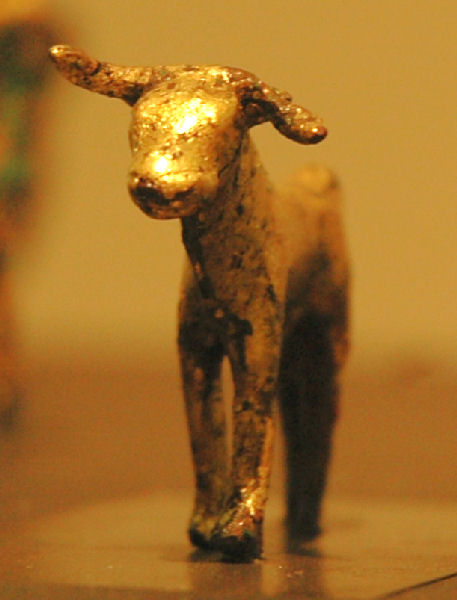
Golden calf figurine from temple of Baalat, Byblos

And he took [the gold] from their hands and he shaped it in a mold, and he made it into a statue of a calf. And they said: “This is your God, Israel, who brought you up from the land of Egypt!” And Aaron saw, and he built an altar in front of it. And Aaron called out and said: “A festival for Y-H-V-H tomorrow!”  (Exodus 32:4-5)

The Israelites worship the golden calf as if the God of Israel, whose personal name is Y-H-V-H, were inhabiting it. Nobody mentions that God has already prohibited making or worshiping any statue.

On the mountaintop above, God tells Moses what is happening, and threatens to wipe out all the Israelites and make a nation out of Moses’ descendants instead. Moses talks God out of it. Then he carries the stone tablets down to the camp below—and smashes them. The Levites kill 3,000 calf-worshipers at Moses’ command. And God kills additional people with a plague.

After that, God tells Moses that the Israelites should still go north and conquer Canaan.

“And I will send a malakh in front of you, and I will drive out the Canaanites …. But I will not go up in your midst, lest I destroy you on the way, because you are a stiff-necked people.” (Exodus 33:1,3)

malakh (מַלְאָךְ) = messenger. (In most English translations, a malakh from God is called an angel. A divine malakh can look like a man, or look like fire, or be a disembodied voice.)

And [when] the people heard this bad news, they mourned, and not one man put on his ornaments. (Exodus 33:4)

Their human leader is with them again, but the people want their divine leader as well. How will they know that God is with them, and they are going the right way, unless God’s pillar of cloud and fire is in front of them?

Moses knows a malakh would not be enough to reassure the Israelites, so he tells God:

“If your presence is not going, don’t you make us go up from this [mountain]!” (Exodus 33:15)

And God agrees to go with the Israelites for Moses’ sake. Only then does Moses pass on to the people the instructions God gave him for building a tent-sanctuary so God can dwell among them. The people eagerly donate materials and labor. They spend a year making everything, from the courtyard enclosure to the gold-plated ark inside the Holy of Holies. Then Moses assembles the sanctuary.

And Moses finished the work. And the cloud covered the Tent of Meeting, and the glory of Y-H-V-H filled the mishkan. (Exodus 40:33-34)

mishkan (מִשְׁכָּן) = Literally: dwelling-place (from the root verb shakhan, שָׁכַן = settle, stay, inhabit, dwell). In practice throughout the five books of the Torah: God’s dwelling-place, God’s sanctuary.

So God is willing to inhabit the tent-sanctuary, but not a gold statue. The book of Exodus ends:

For a cloud was over the mishkan by day, and fire was in it by night, in the sight of all the House of Israel on all their journeys. (Exodus 40:38)

Ascent in Numbers

The Israelites finally resume their journey to Canaan in this week’s Torah portion, Beha-alotkha (Numbers 8:1-12:16). Just before this Torah portion begins, the Torah indicates that unlike the golden calf, the two gold statues of keruvim (hybrid winged creatures) rising from the gold cover of the ark are not idols.

And when Moses came into the Tent of Meeting to speak with [God], then he heard the voice speaking to him from above the cover that was on the Ark of the Testimony, from between the two keruvim. (Numbers 7:89)

In other words, God speaks to Moses from the empty space between the two gold statues.

When the Israelites are finally ready to set out for Canaan, the Torah refers back to the end of Exodus.

The Tabernacle in the Camp, Collectie Nederland

And on the day the mishkan was erected, the cloud covered the mishkan for the Tent of the Testimony; and in the evening it was over the mishkan as an appearance of fire, until morning. Thus it was always: the cloud covered it, and appeared as fire at night. And according to when the cloud was lifted up from over the tent, after that the Israelites set out; and at the place where the cloud settled, there the Israelites camped. (Numbers 9:15-17)

The cloud by day and fire by night is not described as a pillar here; its shape is not mentioned at all. But it serves at least one of the purposes of the pillar of cloud and fire that led the Israelites from Egypt to Mount Sinai.

Whether for days or a month or a long time, when the cloud lingered over the mishkan, staying over it, the Israelites were camped, and they did not set out. But when it was lifted, they set out. (Numbers 9:22)

The other purpose of the pillar of cloud and fire was to indicate the direction of travel. This purpose is implied later in this week’s Torah portion:

And they set out from the mountain of God on a journey of three days, and the ark of the Covenant of God  traveled in front of them a journey of three days to seek out a resting place for them. (Numbers 10:33)

The ark, as we learned earlier in the book of Numbers, is covered by a curtain, a sheet of leather, a blue cloth, a crimson cloth, and another sheet of leather when the people travel6—both to honor it and to make sure nobody sees it. Levites from the clan of Geirshon carry it by the wood poles extending from the bottom of the ark.

The portion Beha-alokha contains two different descriptions of the location of the ark when the Israelites are traveling. First it describes the tribes of Judah, Yissachar, and Zevulun setting out, followed by Levites carrying the ark and other pieces of the mishkan.7  Then it says “the ark of the Covenant of God  traveled in front of them”. Either way, the ark goes wherever the Levites gripping the poles take it, so how can it “seek out a resting place”?

And the cloud of God was above them by day, when they set out from the camp. (Numbers 10:34)

If the divine cloud hovers over the marching Israelites all day, then it could indicate the direction of travel by veering off. The Israelites would respond with a course correction—just as they did when the pillar of cloud by day and fire by night led them from Egypt to Mount Sinai.

And the cloud can still take the shape of a pillar. When God orders Moses, Miriam, and Aaron rto report to the entrance of the mishkan,

Then God came down in a pillar of cloud and stood at the entrance of the tent, and called: “Aaron and Miriam!” And the two of them went forward. (Numbers 12:5)

Thus God addresses the anxious insecurity of the Israelites by traveling with them in person, so to speak, in the form of the cloud above them. They also have Moses, the man who arranged their liberation from Egypt and who communicates regularly with God. And they have the ark as a symbol of God’s presence among them even when the mishkan is disassembled and God is not currently speaking to Moses from above the ark.


I have friends who want to believe God is leading them. None of them see pillars of cloud by day and fire by night, as far as I know. But they often notice signs and omens (what I would call coincidences) that reassure them God is in charge and they are being led in the right direction.

I don’t blame them, any more than I blame the Israelites marching toward the unknown dangers of the land of Canaan. The wilderness of this world is frightening.


  1. Exodus 19:16-18, 20:15-16.
  2. Exodus 24:3, 24:7.
  3. Exodus 24:15-18.
  4. Exodus 13:21-22.
  5. So many commentators conclude, since throughout their stay at Mount Sinai no pillar is mentioned until they have finished building the sanctuary. Then God’s cloud by day and fire by night settles on the sanctuary tent, and lifts to signal that it is time for them to travel on (Exodus 40:33-34-38).
  6. Numbers 4:5-8. See my post: Bemidbar: Covering the Sacred.
  7. Numbers 10:13-17.

Naso: Divine Verdict

The Hebrew Bible rejects most efforts to force God to reveal inside information.1 But there are a few exceptions:

Casting Lots for Tribal Inheritance,
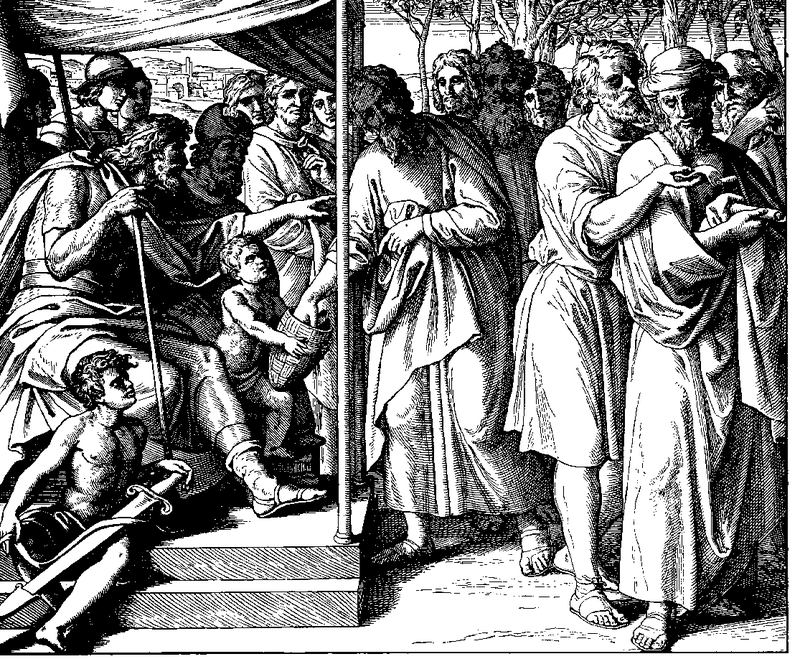
by Schnorr von Carolsfeld, Bibel in Bildern, 1860
  • When the high priest consults two items called the urim and tumim, kept in the inside pocket of his jeweled breast-piece, for yes-or-no answers to a king’s questions.2 Yet once when King Saul tried it, God refused to respond.3
  • When Joshua casts lots to find out how God wants the newly conquered lands of Canaan to be allocated among the tribes and their clans. He does not ask the high priest to check with God ahead of time, but simply orders men to travel and write descriptions of the geography, then casts lots on his own initiative as he stands next to the high priest at the entrance of God’s Tent of Meeting in Shiloh.4
  • When a priest conducts a magic ritual to reveal whether a wife has been unfaithful to her husband.

The ritual of the jealous husband is described in this week’s Torah portion, Naso (4:21-7:89). The passage begins by attributing the authorship of the ritual to God:

And God spoke to Moses, saying: “Speak to the Israelites and say to them: Any man, if his wife tisteh and breaks faith with him faithlessly— (Numbers 5:12)

tisteh (תִּשְׂטֶה) = she goes astray, she deviates from the right path. (A form of the verb satah, שָׂטָה = turn aside, go astray.5 The noun from the same root, sotah (שׂוֹטָה), refers to this passage in Numbers, to a Talmud tractate about it, and to the wife who is under suspicion.)

Breaking faith

The first condition for a priest to conduct the magic ritual is that a wife breaks faith with her husband. This does not necessarily mean she is sexually unfaithful. The Talmud tractate Sotah opens:

“With regard to one who issues a warning to his wife not to seclude herself with a particular man, so that if she does not heed his warning she will assume the status of a woman suspected by her husband of having been unfaithful [sotah]… However, if after he told her not to speak with so-and-so, she entered into a secluded place and remained with that man long enough to become defiled, i.e., sufficient time to engage in sexual intercourse, she is forbidden to her home from that moment until she undergoes the sotah rite.” (Talmud Bavli, Sotah 2a)6

According to the mores of the Ancient Israelites, if a husband gives his wife an order, she is obligated to obey. According the mores of the West today, she is under no obligation unless she explicitly agrees that she will comply with his order. (But perhaps she has a moral obligation to tell him her own views on the matter, so she is not guilty of dishonesty.)

Secrecy

—and a man lay down with her, a lying-down of seed, and it was hidden from her man’s eyes, and she kept it secret, and she made herself tamei, and there is no witness, and she was not caught— (Numbers 5:13)

 tamei = contaminated, ritually impure, unfit to enter God’s sanctuary, unfit for marriage.

This verse further defines the circumstances under which a priest should conduct the ritual for the sotah. It stipulates that the husband must suspect his wife of full intercourse including ejaculation with possible insemination (a lying-down of seed); that she has not confessed adultery to him (she kept it secret), and that nobody saw the guilty couple or caught them in the act.

Jealousy

—and a spirit of jealousy crossed over him, and he was jealous about his wife, and she has contaminated herself; or a spirit of jealousy crossed over him and he was jealous about his wife, but she has not contaminated herself—then the man shall bring his wife to the priest.” (Numbers 5:14-15)

What matters is the husband’s jealousy. The magic of the ritual will determine whether the wife is actually guilty of adultery.

The Torah portion does not offer a remedy if a woman is jealous and suspects her husband of adultery. But then, the Torah is providing laws for a patriarchal society. So married men are allowed to have sexual intercourse not only with their wives, but also with concubines, their female slaves, and prostitutes. But married women  are forbidden to have sexual intercourse with anyone but their husbands. If they are caught in the act, and the court does not rule that it was a rape, both the wife and her lover get the death penalty.7

Revealing the truth

The Torah portion Naso provides a remedy if the husband only suspects his wife of adultery, but has no proof.

The jealous husband brings his wife to a priest at the temple, along with a small offering. The priest mixes dust from the floor of the sanctuary into a bowl of water, thereby making it holy. Then he declares:

“May this water of bitterness come inside you, making your belly inflate and your yareikh fall.” And the woman must say: “Amen, amen!” (Numbers 5:22)

yareikh (יָרֵךְ) = thigh, loins, or a euphemism for genitals.

Sotah Ordeal, by Ephraim Moshe Lilien, 1908, detail

The woman’s “Amen, amen!” counts as an oath that she will accept God’s verdict as to her innocence or guilt. The priest writes it all on a scroll, then dissolves the ink from the scroll into the holy water. He makes the sotah drink this mixture. If she is guilty, she suffers the described symptoms—perhaps a miscarriage or worse. If she is innocent, she remains healthy and bears a legitimate child to her husband. (See my blog post Naso: Ordeal of Trust.)

According to the Torah, it is God who opens or closes a womb.8 God determines whether a woman conceives, and whether she miscarries or gives birth. The ritual of the sotah forces God to determine the fate of the woman’s womb according to whether she committed secret adultery.


Why does the Torah provide a magical ritual to make God reveal whether a wife committed adultery or not?

A husband who suspects his wife of adultery could, according to Torah law, simply divorce her without proving anything.9 Alternatively, he could decide that he wants to continue the marriage no matter what she did or did not do.

But the Torah portion Naso addresses the case of a jealous husband—someone who wants the marriage to continue, but cannot shrug off the thought that his wife might have cheated on him. If he believes in the solemn and impressive ritual at the temple (and if his wife does not have a miscarriage), his jealousy will disappear and he will welcome his wife with open arms.

His wife, on the other hand, will have to live with the knowledge that her husband did not trust her, either to remain sexually faithful or to tell him the truth. In ancient Israelite society, she would probably be willing to settle for the good fortune of retaining her status as a married woman, continuing to live with her own children, and enjoying her husband’s financial support.

In modern western society, she might prefer to divorce a man who did not trust her. And we have no ritual to make God indicate whether a wife, or a husband, has broken a promise to be sexually faithful. Nor do we have an easy way to prove that a spouse was honest, or that a spouse will no longer be suspicious and jealous.

How can two people be contented lifelong companions without mutual trust?


  1. Three kinds of diviners are denounced in Deuteronomy 18:10-11; see my post: Shoftim: Is Magic Abominable? Part 1.
  2. E.g. Numbers 27:21.
  3. 1 Samuel 28:6.
  4. Joshua 18:4-10, 19:51.
  5. The verb satah appears only six times in the entire Hebrew Bible: four times in this week’s Torah portion, and twice in the book of Proverbsa collection of advice from a father to a son. Proverbs 4:15 advises the son to “turn aside” from the path of the wicked. Proverbs 7:25 urges him not to “turn aside” from the right path toward the paths of prostitutes.
  6. William Davidson Talmud translation, from www.sefaria.org.
  7. Leviticus 20:10.
  8. E.g. Genesis 29:31, 30:22-23.
  9. Deuteronomy 24:1

Bemidbar: Too Close

Both army duty and sanctuary duty are dangerous in the Torah; they can result in death.

Numbering of the Israelites, by H.F.E. Philippoteaux,
19th century

The book of Numbers (Bemidbar, “In the wilderness of”) opens when the people are preparing to leave Mount Sinai and conquer Canaan. So the first Torah portion, also called Bemidbar, begins with a census of all the Israelite men age 20 and over who can serve in the army. The twelve tribes of Israel1 are assigned campsites and marching positions by tribe. In the center of the camp is God’s Tent of Meeting, and in the center of the traveling troop are the disassembled parts of that tent.

The implication is that the Israelite men are protecting the Tent of Meeting from attack by local armed bands.

But the sanctuary itself is dangerous when God is in residence, and the holiest items inside it have power even when the tent is down. So God calls for a separate census of adult Levite men, who cannot serve in the army because their duty is to transport and safeguard the Tent of Meeting.

And when the mishkan is to set out, the Levites will take it down. And when the mishkan is in camp, the Levites will erect it. And the outsider who comes close yumat. (Numbers 1:51)

mishkan (מִשׁכָּן) = dwelling place of God; sanctuary. (From the root verb shakan, שָׁכַן = dwell, reside, live in, sojourn in, stop at.)

yumat (יוּמָת) = will be put to death. (A form of the verb meit, מות = die.)

When Israelites get too close

The outsiders who must not come too close to the mishkan include all the Israelites who are not Levites. Who will execute these outsiders? The classic commentators disagree, with Rashi’s camp claiming that “heaven” will smite the trespasser, and Ibn Ezra’s camp claiming that a human law court must sentence the trespasser to death.2

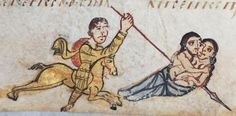
Pinchas, Sacra Paralella, Byzantine,
9th century CE

The Hebrew Bible provides only one example of this transgression, a story later in the book of Numbers. An Israelite man who is the chief’s son in the tribe of Shimon, and a Midianite woman who is the chief’s daughter in a tribe of Midian, walk right into the mishkan for a sexual ritual. A Levite named Pinchas spears them both, thereby executing the death penalty without the benefit of a trial. Then God tells Moses that if Pinchas had not acted so promptly, God’s rage would have destroyed the entire Israelite community.3

Given the danger of setting off God’s rage, the best strategy is to set a guard around the mishkan to intercept anyone who gets too close. And that is what this week’s Torah portion prescribes.

And the Levites will encamp around the mishkan of the Testimony,4 so that there will be no fury against the Israelites; and the Levites will observe the guard duty of the mishkan of the Testimony. (Numbers 1:53)

When Levites get too close

The campsites of the Levites are a buffer zone between the mishkan and the Israelites. The Levite clan of Merari camps along the north side of the Tent of Meeting, the clan of Gershon along the west side, and the clan of Kehat along the south side. The east side, which has the only entrance into the mishkan, is reserved for the tents Moses and the three priests: Aaron and his two surviving sons, Elazar and Itamar.

In front of the curtained entrance is a courtyard containing the copper altar, where animal and grain offerings are burned. Ordinary Israelites bring their offerings to this outdoor altar by entering the courtyard, so they must be allowed to come at least that close to the mishkan. But any Israelites who attempt to go past the altar and touch the curtain across the entrance must be put to death.

… and the outsider who comes close yumat. (Numbers 3:38)

Levites are allowed to touch the fabric of the tent, but only Moses and the priests can safely enter the Tent of Meeting.

Yet the Gershonite clan of Levites is responsible for taking down and setting up the entrance curtain, along with all the cloths forming the walls and roof of the mishkan. And the Merarites are responsible for disassembling and reassembling all the structural timbers and fasteners. How could they avoid stepping into the holy space inside?

Chizkuni5 explains: “They may not enter these holy precincts once the Tabernacle had been reassembled. Assembling or dissembling did not require their entering, and when the Tabernacle had been taken apart, the site it had stood on was no longer considered as a holy site.”

However, the objects inside the mishkan—the ark, the bread table, the lampstand, and the gold incense altar—are always holy. So before the tent is disassembled, the priests must cover these sacred objects, along with the tools used for their service, with multiple layers of cloth and leather, and place them on carrying poles or frames. (See my post Bemidbar: Covering the Sacred.) Only then are the Gershonites and Merarites allowed to take down the tent.

(Kehatites carrying the ark)
Bible Card,
Providence Lithograph Co.,
1907

The Kehatite clan of Levites gets the duty of transporting the holy objects after the three priests have covered them.6

And Aaron and his sons are to finish covering the holy things and all the tools of the holy things at the breaking of camp. And after that, the Kehatites will come to lift them; and they must not touch the holy, vameitu. (Numbers 4:15)

vameitu (וָמֵתוּ) = or they will die. (Another form of the verb meit.)

Nobody except the three priests can touch the holy things themselves without dying. Furthermore, the Kehatites must not see the priests wrapping them.

And they must not come in to look as the holy things are swallowed up, vameitu.  (Numbers 4:20)

The verses prohibiting the Kehatites from touching or looking at the holiest objects state that transgressors will die, not that they will be put to death. It would kill them to look at the holy objects while the priests are covering them. Does the Torah mean this literally?

Some commentators have argued that seeing the ark is deadly by citing a story in the first book of Samuel in which the two sons of the current high priest, Eli, bring the ark to the battlefield, where the Israelite soldiers raise a cheer. The sight of the ark does not kill them, but the Philistines do.7 The Philistines capture the ark and take it back to their own land, where it is moved from city to city. Each time the ark enters a new city, a plague strikes. Eventually the Philistines load the ark onto a wagon steered only by oxen, and send it back into Israelite territory. The oxen stop at the Israelite village of Beit Shemesh, and the men there look inside the ark. God strikes them dead for their lack of respect.8

Nobody dies from looking at the outside the of ark in that story.9 But in this week’s Torah portion, the Levites will die if they merely watch the priests cover up the ark and the other holy objects in the mishkan.

I wonder if their sudden terror at this unaccustomed sight would give them heart attacks. Or perhaps it is not their bodies that will die, but their souls. A soul radiant with awe is not the same as a soul divorced from all feeling.

When biblical scholars get too close

Rabbi Adin Steinsaltz compared the problem of the Levites in the Torah portion Bemidbar with the problem of recovering one’s religious awe after doing an analysis of the Torah and Talmud. He explained:

“As long as one stands at a distance from the sacred … one can see the sacred and stand in awe of it. But what happens when one has to dismantle the sacred? … It is a problem inherent in Torah study, in faith, and in Judaism: How can one question, take apart, demolish, and rebuild, and at the same time preserve the sense that one is in the realm of holiness? Only those who can bear it—the sons of Aaron, the Priests—may enter the inner Sanctuary and dismantle it. … Only one who does inner, hidden service, totally committed to serving God, may enter the Sanctuary and cover the sacred.”10


Human beings seem to need a sense that some thing or concept is sacred. Some people today feel that way about tangible things such as holy books or national flags. Some feel that way about a holy place. For others the most sacred thing is an idea—for example, an ethical imperative, a conception of God, or a belief in reason.

When someone violates or disgraces what you hold sacred, your emotional reaction is swift and negative. A patriot who considers the national flag sacred automatically labels flag-burning an abomination, and wants immediate punishment for the perpetrator. For some Jews, dropping a Torah scroll on the floor, even accidentally, causes shock and guilt; throwing one down deliberately would mean automatic de facto excommunication.

And if you hold an idea sacred, you automatically reject all arguments against it. But once in a while the unthinkable happens. A well-meaning outsider succeeds in persuading you that your sacred belief is a fallacy. Or an event in your life or in the world violates your whole conception of what is true. Then your loss is hard to bear, since a sacred thing gives life meaning.

In the Torah portion Bemidbar, for an unauthorized person to touch the mishkan when God is in residence, or to see its most sacred objects, results in the death penalty. In our lives today, the demolition of a sacred idea causes a psychological death, as the believer is swamped by a sudden loss of meaning.

May every person who has this experience be granted the strength and resilience of a Levite, or even a priest, and rebuild the sacred in a new place of wisdom.


  1. The Torah portion Bemidbar, as well as later Jewish tradition, distinguishes between three kinds of people for religious purposes: the priests (kohanim), who are an elite subset of Levites; the Levites (Levi-im), who are a tribe of Israel but not counted as part of the Israelites because they have specific religious functions; and the twelve tribes of Israelites (benei Yisrael), counting Joseph’s sons Efrayim and Menashe as two tribes and not counting the Levites.
  2. Rashi is the acronym for 11th-century Rabbi Shlomoh Yitzchaki. He explained that the fury in Numbers 1:53 refers to God executing outsiders who get too close to the tent. Ibn Ezra is the 12th-century rabbi Avraham ben Meir ibn Ezra.
  3. Numbers 25:6-15.
  4. The “testimony” (eidut, עֵדֻת) here is the pair of stone tablets inside the ark. The book of Exodus frequently refers to the ark of the testimony, while the book of Numbers refers nine times to the tent or mishkan of the testimony. (Numbers 1:50, 1:53 (twice), 9:15, 10:11, 17:19, 17:22, 17:23, and 18:2.)
  5. Rabbi Hezekiah ben Manoah compiled commentary in the book Chizkuni in 13th century.
  6. In addition, the priests cover and the Kehatites transport the copper altar where offerings are burned in the courtyard. See my post: Bemidbar & Naso: Why Cover the Altar?.
  7. 1 Samuel 4:3-11. See my post: Pekudei & 1 Kings: Is the Ark an Idol?.
  8. 1 Samuel 6:19; Talmud Bavli, Sota 35a-b.
  9. This has led some commentators to posit two arks, a mishkan ark and a battle ark—or at least two literary traditions about the ark.
  10. Adin Even-Israel Steinsaltz, Talks on the Parasha, Koren Publishers, Jerusalem, 2015, pp. 281-287.

Bechukotai, Va-eria, & Isaiah: Redeeming a Pledge

“Redeeming” can mean exchanging something less important to you for something more important. Last week’s Torah portion, Behar, prescribed redemption for Israelites who had fallen into poverty and debt. If they were forced to sell the family farm, or if they had to sell themselves as slaves, the sale was never permanent; Israelite land was “sold” as a long-term lease, and Israelite persons were “sold” as indentured servants. Both land and human beings could be redeemed if a family member paid off the remainder of the contract. (See my post: Behar: Redeeming an Identity.)

“Redeeming” can also mean making good on a pledge, through either an exchange or a rescue. When a human being pledges a donation to God, they must give the donated item to the priests at the temple—or else redeem it by exchanging the pledged item for something more valuable. But when God makes a pledge to the Israelites, God makes good on the pledge by rescuing them from a foreign power. No exchange is necessary.

Bechukotai: When an Israelite redeems a pledge to God

A pledge to God is actually a pledge to support a religion’s service to God. Today someone who wants to make an extra donation to their congregation, over and above the membership dues, might send an electronic payment. But in ancient Judah, an extra donation, over and above the mandatory tithes, offerings, and contributions of firstborn animals and first fruits, could only be made by bringing an object of value to the priests at the temple in Jerusalem. So the donor would make a verbal pledge, and redeem it later by traveling to the temple and delivering either the item pledged or its value in silver.

The item pledged could even be a human being. The Talmud tractate Arakhin explains that a person often pledged his or her own value in silver to the temple in Jerusalem. But someone could also vow to donate the value of any person belonging to him or her at the time—i.e. someone the vower owned and could legally sell.  In that era, people could sell their slaves or their own underage sons and daughters.

This week’s Torah portion, Bechukotai (Leviticus 26:3-27:34), explains the rules for redeeming a person who has been pledged as a donation to God.

When anyone explicitly vows the assessment of persons to God, the assessment will be: the assessment of the male from twenty to sixty years old will be fifty shekels of silver … (Leviticus 27:2-3)

A list follows giving the assessment in silver for male and female human beings in four age categories. (See my post: Bechukotai: Gender, Age, and Personal Value.) The persons themselves are not being given to God; they stand in as pledges until the donor pays their assessed values in silver to the temple.

But if [the donor vowed] an animal that can be brought as an offering to God, anything that he gives to God becomes consecrated. One may not replace or exchange it, either a better one for a worse one, or a worse one for a better one. And if one actually does exchange one animal for another, both it and its substitute will become consecrated. (Leviticus 27:9-10)

This means that when anyone pledges an animal that can be legally offered at the altar, it becomes temple property at that instant. The donor no longer owns it, so he has no choice but to bring it in to its rightful owner, the temple. If he tries to substitute a different animal, then both the original and the substitute must be brought and slaughtered for God. I suspect the priests knew that people who felt moved to give more to God sometimes had second thoughts later, and tried to skimp when it was time to fulfill their pledges.

If someone pledges an animal that is kosher, but unfit for the altar because of some blemish, the priest assesses its equivalent value. Then the person who pledged the animal to God must donate that amount in silver to the temple—and also leave the blemished but edible animal with the priests.

If the donor prefers to keep the unfit animal, he can redeem it by making a larger payment in silver.

But if definitely yigalenah, then he must add one-fifth to its assessment. (Leviticus 27:13)

yigalenah (יִגְאָלֶנָּה) = “he would redeem it”. (From the root verb ga-al, גָּאַל = redeem, ransom, rescue.)

The same law applies when a donor—perhaps overcome by religious ecstasy or a generous impulse—pledges his house to God, thus making it consecrated property.

And if the consecrator yigal his house, then he must add one-fifth in silver to the assessment; then it will be his. (Leviticus 27:15)

yigal (יִגְאַל) = he would redeem. (Also from the root verb ga-al.)

The donation of a field to God is more complicated, since the procedure must also meet the rules in last week’s Torah portion about land reverting to its original owner in the yoveil year. (See my post: Behar: Redeeming an Identity.) But if the current owner wants the field back before the yoveil year, he must pay silver equal to the assessment for the remaining years plus one-fifth to redeem it.

Va-eira & Second Isaiah: When God redeems a pledge to the Israelites

Israelites redeem their pledges to God by exchanging silver for whatever they pledged. But when God redeems a pledge to the Israelites, God simply rescues them by arranging their liberation from a foreign power and sending them “home” to Canaan. In the book of Exodus, God rescues the Israelites from bondage in Egypt. In the book of Isaiah, God rescues them from exile in Babylon.

In Exodus, in the Torah portion Va-eira1, God tells Moses:

“And now I myself have listened to the moaning of the Israelites because the Egyptians are enslaving them, and I have remembered my covenant. Therefore say to the Israelites: I am Y-H-V-H, and I will bring you out from under the bondage of Egypt. And I will rescue you from your servitude, vega-alti you with an outstretched arm and with great punishments. And I will take you as my people, and I will be your God. … And I will bring you to the land that I raised my hand to give to Abraham, to Isaac, and to Jacob, and I will give it to you as a possession. I am Y-H-V-H.” (Exodus 6:5-6, 6:8)

vega-alti(וְגָאַלתִּי) = and I will redeem, and I will rescue. (Also from the root ga-al.)

Leading the Israelites
with a Pillar of Fire,
by John Jacob Scheuchzer,
1731

The pledge or covenant God made in the book of Genesis to Abraham, Isaac, and Jacob by “raising a hand” was that God would give their descendants the land of Canaan. Now God affirms that God will fulfill the pledge. Just as written proclamations in the Ancient Near East ended with the king identifying himself by name, God concludes this statement with I am Y-H-V-H, confirming it as a legal pledge.

Then God makes good on the divine pledge with an elaborate rescue operation. First God stages ten miracles to liberate those descendants, the Israelites, from Egypt. Then God leads them to a new home in Canaan.

Second Isaiah2 states that God created the Israelites for a unique role, which implies a pledge to make sure they continue to exist as a people on the land God chose for them.

And now thus said God:
Who created you, Jacob?
Who formed you, Israel?
Do not fear, because ge-altikha.
I have called by name;
You are mine. (Isaiah 43:1)

ge-altikha (גְאַלְתִּיךָ) = I have redeemed you, I have rescued you. (Also from the root ga-al.)

Therefore, the prophet says, God is in the process of rescuing the Israelites from Babylon by arranging the destruction of the Babylonian Empire.

Thus said God,
Your Go-eil, the Holy One of Israel:
For your sake I send to Babylon
And I bring down the bars, all of them,
And the Babylonians sing out in lamentations. (Isaiah 43:14)

go-eil (גֺּאֵל) = redeemer, rescuer. (Also from the root ga-al.)

This is one of eleven times that second Isaiah makes go-eil part of God’s title.3

The “bars” in this verse are either the bars of the gates of the city,4 or by extension, the borders of their whole territory.5 Second Isaiah credits God with sending Cyrus, the first king of the Persian Empire, to conquer Babylon6 (a feat Cyrus I achieved quickly in 539 B.C.E.).

Next the redemption of the Israelites from Babylon is connected with their redemption from Egypt. The prophet reminds us that God parted the Red Sea to arrange the escape of the Israelites from Pharaoh’s army of chariots.

Thus said God:
Who placed a road in the sea,
And a path through powerful waters?
Who met chariots and horses,
The mighty and the strong?
Together they lay down, never to rise;
They were extinguished, quenched like a wick. (Isaiah 43:16-17)

When second Isaiah is praying to God for redemption from Babylon, he reminds the exiled Israelites again about how God redeemed the Israelites from Egypt.7

Like other biblical prophets, second Isaiah says God let the Babylonians conquer Judah and Jerusalem because its citizens were disobeying God. But now, according to the book of Isaiah, God says:

I have wiped away your rebellions like fog,
And your misdeeds like cloud.
Return to me, because ge-altikha! (Isaiah 44:22)

Once God has redeemed the Israelites from their past sins, God can rescue them from Babylon. The book of Isaiah confirms that redemption by God is a rescue, not an exchange:

For no price you were sold,
And not for silver tiga-eilu. (Isaiah 52:3)

tiga-eilu (תִּגָּאֵלוּ) = you will be redeemed.

But being rescued and liberated is not enough. The Israelites must fall in with God’s plan by taking advantage of the opportunity to leave Babylon and return to Jerusalem.

Go forth from Babylon!
Flee from Chaldea!
Declare in a loud voice,
Make this heard,
Bring it out to the ends of the earth!
Say: God ga-al [God’s] servant Jacob! (Isaiah 48:20)

The kind of exchange outlined in this week’s Torah portion, Bechukotai, is good business practice: making a pledge, posting something as security, and then redeeming the security by handing over the required monetary payment. Both the donor and the priests who receive the silver know and follow the rules.

But sometimes we humans imitate God by pledging to do something that has no monetary value. One example is the traditional marriage vow to “forsake all others”.

And sometimes we help another person voluntarily, for no reward, with no expectation of tit-for-tat—not because we have formally pledged to do so, but just out of the goodness of our hearts.

All humans make moral errors. When we do something good, above and beyond what we have promised, we redeem ourselves. So helping someone out of the goodness of our hearts is a double redemption: we rescue the other person from distress, and we also redeem ourselves.

May we all aspire to be voluntary redeemers.


  1. The portion Va-eira is Exodus 6:2-9:34.
  2. The first 39 chapters of the book of Isaiah were written in the 8th century B.C.E., and are attributed in the first verse to the prophet Yesheyahu (Isaiah) son of Amotz. Chapters 40-55 were written in the 6th century B.C.E., after the Babylonians conquered Jerusalem and deported its leading citizens to Babylon; this section is often called Second Isaiah or Deutero-Isaiah. Chapters 56-66 were written after Babylon fell to the Persian Empire in 539 B.C.E. and the exiles living there were allowed to return to their old homes. Some scholars include this last section in Second Isaiah, while others call it Third Isaiah, or Trito-Isaiah.
  3. Go-eil is part of God’s title in Isaiah 41:14, 43:14, 44:6, 44:24, 47:4, 48:17, 49:7, 49:26, 54:8, 60:16, and 63:16.
  4. Ibn Ezra (12th century), citing Lamentations 2:9: Her gates have sunk into the ground, He has shattered to bits her bars.
  5. Adin Steinsaltz, The Steinsaltz Humash: Isaiah, Koren Publishers, 2019.
  6. See Isaiah 44:1.
  7. Isaiah 51:10-11.

Behar: Redeeming an Identity

What does “redeem” mean?

A pledge is “redeemed” when a promissory note or token is exchanged for money or real property. Next week’s Torah portion, Bechukotai, explains the rules for redeeming an animal or a person that has been pledged to God by delivering its equivalent to the priests. (See my post Bechukotai: Gender, Age, and Personal Value.)

I first learned the word “redeem” when I helped my mother redeem trading stamps issued by grocery stores (a pledge to their customers) for a place setting or an electric mixer.

But the primary meaning of “to redeem” is to restore someone or something to its original or rightful state. In the Hebrew Bible, property that has been sold can be repurchased by its original owner. A human being trapped in a bad situation, such as slavery, can be ransomed or otherwise rescued and freed. Today we also say that if you damage your reputation, you can redeem yourself with good deeds.

Restoration to one’s rightful state may also be the source of a widespread Christian concept of redemption: that the death of Jesus redeemed humans, or a subset of humans, from original sin (which is not a Jewish interpretation of the Garden of Eden story) and from death in some way. Christian doctrine might be claiming that Jesus’ sacrifice redeemed humanity by making it possible for people to return to their original, pre-Edenic state.

Obviously the Christian variant of redemption as restoration is absent from the Hebrew Bible. But a recurring theme is that God redeemed Israelite (or Judahite) people from bondage in Egypt and exile in Babylon, restoring them to their rightful condition of freedom.

This week’s Torah portion, Behar (Leviticus 25:1-26:2), declares that human beings can redeem individual people and their ancestral farmlands—and are obligated to do so, in order to restore the order God decreed. The Israelite people should, by rights, serve only God, not any slave-owner. And if poverty forces someone to sell the family farm, the land should return to the family.

“The land must not be sold in perpetuity. Because the land is mine; for you are resident aliens with me. So concerning all land you hold, you must provide ge-ulah for the land.” (Leviticus 25:23-24)

ge-ulah (גְֱאֻלֱָה) = redemption. (From the root verb ga-al, גָּאַל = redeem, ransom, rescue.)

At any time, a man or his kinsman can redeem a plot of land by paying the current owner a fair price.

If your kinsman becomes poor and sells some of his holding, his nearest go-eil must come to him and ga-al what his kinsman sold. And if a man who has no go-eil, but whose hand grows great [who prospers] and he finds enough for his ge-ulah, then he calculates the years of his sale and he refunds the remainder to the man to whom he sold it, and he returns to his holding. And if he cannot find in his hand enough to refund it, then what he sold will be in the hand of the purchaser until the year of the yoveil; then it will be released in the yoveil and return to [the original owner’s] holding. (Leviticus 25:25-28)

go-eil (גֺּאֵל) = redeemer.

yoveil (יוֹבֵל) = ram; year of the ram’s horn; year of summoning home; “jubilee” in many English translations. (Every fiftieth year is a yoveil.)

In other words, farmland is leased, rather than truly sold. Eventually it returns to the family that originally received it when God was assigning lands in Canaan.1

One way or another, any plot of farmland that is sold must return to the original family. This is not the case for all real estate; if a man sells a house in a walled town, it may only be redeemed during the first year after the sale. Then it cannot be reclaimed, even in the yoveil—unless it belonged to a Levite. Levites do not own farmland, so their houses count as their holdings, and can be redeemed in any of the usual ways.2

Man with a Hoe, by Jean-Francois Millet, ca. 1860

The Torah portion Behar recognizes that sometimes the head of a household (always male) must sell some of his farmland because of poverty. If he falls deeper into debt, he must sell himself as a slave.

This week’s Torah portion permits Israelites to own the slaves they capture in war or buy from the families of resident aliens in perpetuity—that is, for the rest of the slaves’ lives. They can even bequeath these slaves, and any children the slaves have, to their heirs.

But if the example is reversed and an Israelite sells himself as a slave to a resident alien, he can be redeemed through the same methods that Israelite land can be redeemed. At any time, one of his kinsmen can redeem him, or he can redeem himself, by paying his owner the correct price.

And he will calculate with his purchaser from the year he sold himself to the year of the yoveil, and the silver from his sale will be [divided] according to the number of years. The time period [the slave] was with [the owner] will be like the time period of a hired laborer. (Leviticus 25:50)

In other words, the purchaser paid a lump sum for all the years the slave would be working for him, up to the yoveil, when he would automatically go free. The years the slave has already worked are subtracted from the purchase price, and the go-eil refunds the owner for the years when the slave will not be working after all.

Like a wage laborer [hired] year by year he must be … And if he is not ga-al in these [ways], then he will leave in the year of the yoveil, he and his children with him. Because the Israelites are servants to me, my servants whom I brought out from the land of Egypt! (Leviticus 25:53-55)

Just as God is the owner of all land and leases certain plots to certain families, who may sublet their land to others for money, God is the owner of all people and leases them their lives, which they may sublet to others for money. But if they are not redeemed sooner, all sub-leases are erased in the yoveil year.

You must make every fiftieth year holy, and you must proclaim emancipation in the land for all its residents. A yoveil it will be for you, and you must return each man to his holding, and you must return each man to his family. (Leviticus 25:10)

Every Israelite who was once a farm owner regains that identity. And every single Israelite is once again free.


This week’s Torah portion asks us to imagine nationwide redemption every 50 years. What would it be like if your father sold the family land, and then 50 years later it was suddenly given to you? What would it be like to grow old as a slave, and then suddenly go free? Would your previous identity be restored?

The idea of the family farm remains important in many countries today, including the United States. A farm that has been passed down through generations is a source of pride. In some cultures, selling the farm is a source of shame. But there are no modern laws to reverse a sale of farmland.

When a house in town changes hands, today as well as in this week’s Torah portion, the sale is viewed as merely a real estate transaction. I remember the house I lived in as a child over 50 years ago. I loved the lady-slippers under the pine trees that screened our front yard from the street. I planted my own patch of the garden, and I caught salamanders in the swampy woods in back. I have memories of every room inside the house, as personal as the bite-marks I made on the windowsills when I was teething.

The last time I went back east and drove past that house, I saw that someone had cleared all the trees in front, turned the garden into lawn, and built two additions that changed the appearance of the whole house. The woods in back was the only thing that still looked like my childhood.

What if that house were returned to my family, additions and all, in the next yoveil year? It would not really be my old house. And I would not want to move back to New England now that I have built a life in Oregon.

What about redemption as emancipation from servitude? Slavery was common not only in biblical times, but well into the 19th century C.E. Next month on June 19, the United States will celebrate the federal holiday of Juneteenth, which began in 1865 as a celebration of the emancipation of black slaves. They called that day the Jubilee, the English word for yoveil.

Today outright slavery is rare. But modern Western nations do have a yoveil year for freedom from meaningless labor; it is called a “retirement age”. Some people postpone retirement, either because they earn money through work that is personally meaningful, or because the funds they paid into government and private retirement accounts are too skimpy to live on. But for the rest of us retirement age means freedom. Finally we can dedicate our time to feeding our souls, not just our bellies.

Imagine reclaiming the God-given parts of your soul that you had to neglect for so many years. Imagine releasing a spouse, a parent, or an adult child from your expectations, enabling them to redeem their own souls.

And according to this week’s Torah portion, you may not have to wait until old age.  If you have the means, the courage, and the mental resources, you can redeem yourself at any time. Or a close relative, such as a spouse, may help you to do it. There are more paths to redemption than we think.


  1. The divine assignment of land by family begins when Joshua leads the conquest of Canaan; see Joshua 11:23 and 13:8 through 17:18.
  2. Leviticus 25:29-33.

Emor: Laying Hands on a Blasphemer

Laws about holiness and ritual purity fill most of the book of Leviticus. This week’s Torah portion, Emor (Leviticus 21:1-24:23), is no exception—but it does offer one story at the end, in order to illustrate a law about blasphemy.

In the middle of the Torah portion, God tells Moses to give the Israelites this law:

“You must not profane my holy sheim, so that I will be considered holy among the Israelites. I am God who makes you holy.” (Leviticus 22:32)

sheim (שֵׁם) = name, reputation.

Something is holy (kadosh, קָדוֹשׁ) in the Hebrew Bible when it is set apart from ordinary, mundane things and dedicated to God. Objects are holy when they are reserved for use in a religious ritual. Animals are holy when they are reserved as slaughter-offerings for God. Human beings are holy when they obey all of God’s rules for achieving holiness. God is holy by definition.

But what makes a name or a reputation holy? A sheim is not called holy unless it belongs to God. Both the names of God and God’s reputation must be treated reverently, neither denigrated nor used to swear a false oath.1 To profane God’s “name” is to sully God’s reputation, making God seem ordinary. The story at the end of the portion Emor illustrates how a half-Israelite man does just that.

The blasphemy

Leviticus 24:10, medieval manuscript detail

The son of an Israelite woman and an Egyptian man went out among the Israelites. And the son of the Israelite woman quarreled with an Israelite man concerning the camp. Vayikov, the son of the Israelite woman the sheim, vayekaleil.  And they brought him to Moses. And the name of his mother was Shelomit … of the tribe of Dan. (Leviticus 24:10-11)

vayikov (וַיִּקֺּב) = pierced; cursed. (A form of the verb nakav, נָקַב = pierced, tunneled; designated; cursed.)

vayekaleil (וַיְקַלֵּל) = and he pronounced a curse, and he denigrated.  (From the root verb kalal, קַלַּל = belittled, denigrated, cursed.)

When “the name” (hasheim, הַשֵׁם) is not followed by any other identifier, it means God’s sheim. Shelomit’s son has punched a hole through God’s name, profaning God’s reputation as holy. Then he cursed or denigrated someone, presumably the man with whom he quarreled concerning the camp. (For reasons why Shelomit’s son cursed his opponent, see my post Emor: Blasphemy.)

The consequence

And they put him in custody, to get themselves a clarification from the mouth of God.  God spoke to Moses, saying: “Remove hamekaleil to outside of the camp. Everyone who heard must lean their hands on his head, and then the entire assembly must stone him.” (Leviticus 24:12-14)

hamekaleil (הַמְקַלֵּל) = the one who pronounced a curse, the one who denigrated.  

Belittling or cursing a human being does not carry the death penalty, but profaning God’s sheim does. And stoning is the most common form of execution in the Torah.

But why must everyone who heard the blasphemy lean (or lay) their hands on the blasphemer’s head first? 

Laying on hands

When people are instructed to lay their hands on the head of a person or animal elsewhere in the Torah, the action indicates a transference of identity or agency from the person resting a hand on the head to the person or animal whose head is touched. The first time this action is described is in God’s instructions for consecrating the first priests and the first altar.

“Then you must lead the bull up in front of the Tent of Meeting, and Aaron and his sons must lean their hands on the head of the bull. The slaughter the bull in front of God, at the entrance of the Tent of Meeting.” (Exodus 29:10-11)

Moses must daub some of the bull’s blood on the four horns of the altar, then burn parts of the bull as an offering to remove any guilt the new priests might carry.

Laying a hand on the head of an animal before it is slaughtered at the altar becomes standard procedure for anyone who makes an animal offering. The book of Leviticus begins with the procedure for bringing a rising-offering, which is completely burned to make smoke for God.

And he must lean his hand on the head of the offering, so it will be accepted for him, to make reconciliation for him. (Leviticus 1:4)

The animal becomes a substitute for the animal’s owner; giving it to God (by slaughtering and burning it) symbolically gives the owner to God. According to Hebrew scholar Everett Fox,2 laying a hand on the animal’s head “may symbolize ownership, a statement of the reason for the sacrifice, or perhaps identification with the animal (as a substitute for the life of the worshiper).”

Laying hands on the heads of human beings normally transfers not identity, but authority. For example,3 when God tells Moses he will die before the Israelites cross the Jordan River into Canaan, Moses asks God to appoint a successor for him, so the people will not be leaderless.

And God said to Moses: “Take for yourself Joshua, son of Nun, a man who has spirit in him, and lean your hand upon him. … And place some of your majesty on him, so that the whole community of Israelites will heed him.” (Numbers 27:18, 20)

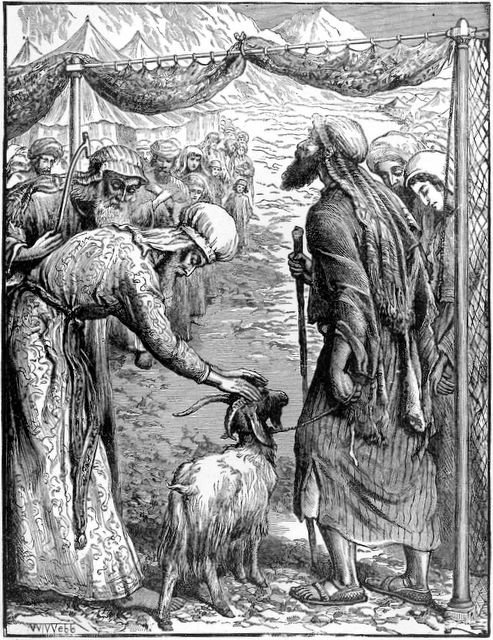
A third type of hand-leaning is prescribed for the annual ritual to make atonement with God and cleanse the entire community of sin on the day that became Yom Kippur. The high priest must place lots on two identical goats, and slaughter the one designated for God. He must sprinkle its blood on the ark inside the Holy of Holies and on the altar in order to purify them from contamination by the sins of the Israelites. Then he turns to the other goat.

Sending Out the Scapegoat, by William James Webb, 19th century

And Aaron must lean both his hands on the head of the live goat and confess over it all the sins of the Israelites, and all their transgressions, for all their misdeeds, and place them on the head of the goat; and send it away to the wilderness by the hand of a designated man. And the goat will carry upon itself all of their sins to an inaccessible land … (Leviticus 16:21-22)

In this case, the guilt of the people is transferred to the goat when the high priest lays his hands on its head.

Is the death sentence for the son of the Egyptian man and Israelite woman the only time in the Hebrew Bible when hand-leaning does not effect any transference?

Passing it on

Rashi answered yes. When the witnesses lean their hands on the blasphemer’s head, he explained, they are indicating: “Your blood is on your own head! We are not to be punished for your death, for you brought this upon yourself!”4

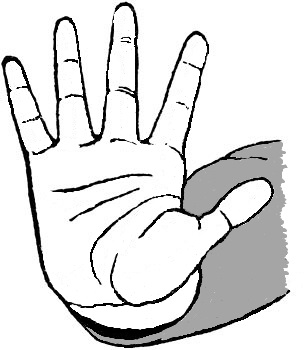
According to this approach, still used by commentators today, leaning a hand on the blasphemer’s head is more like holding up a hand, palm forward, to say: Stop! Go no farther! You shall not pass!

For Rashi, the hand is a barrier, not an agent of transference. The witnesses are rejecting any responsibility for the son of Shelomit’s crime when he profaned God’s sheim while uttering his curse.

I would agree that the hand-leaning in the story from the portion Emor does not transfer the identity of the witnesses to the blasphemer. After all, he will be executed by stoning, not burned on the altar, so he is not anyone’s substitute gift to God. Neither do the witnesses transfer their authority to him, as Moses transferred his authority to Joshua by leaning a hand on his head.

However, the witnesses might be transferring their sins to the blasphemer, as the high priest Aaron transfers the sins of the Israelites to the head of the goat on Yom Kippur.

Chizkuni,6 a 13th-century Torah commentary, identifies one inevitable sin: that of pronouncing the words of the blasphemer’s curse. At the trial, the witnesses had to quote the words the blasphemer used. Therefore, “they transferred any guilt that they had been burdened with through that to the blasphemer”.5 

But they might have been transferring other sins—or at least guilt for morally bad deeds. The Torah portion does not say so, but a close reading of the story reveals that the men with Israelite fathers have done wrong, even though they did not break the law. The quarrel between Shelomit’s son and the man with full Israelite parentage was “concerning the camp”. In the book of Numbers, campsites are allotted according to the father’s tribe.6 Since an Egyptian father is not a member of any Israelite tribe, his son would not be allowed to camp with his Israelite mother’s family in the area allotted to the tribe of Dan. Nor could he camp with any of the other tribes of Israel. He would have to live outside the camp, with the non-Israelite riff-raff and the people excluded because of skin disease.

Modern commentator David Kasher suggested that the blasphemer’s mother was probably raped by an Egyptian man who remained in Egypt. Their son could not live with his father. And none of the tribes would let him pitch his tent with them.

“… sure, by the strict letter of the law, he is guilty of a crime that merits the death penalty. Just as by the strict letter of the law, no tribe had to allow him to camp with them. But why didn’t they? How could they have turned him away? The law was on their side—but where was their compassion?”7

Kasher compared the witnesses laying hands on the blasphemer’s head to the high priest laying hands on the scapegoat’s head, and proposed that God required the witnesses to do this before the execution in order to force everyone who heard the quarrel to acknowledge their own guilt for refusing to help Shelomit’s son.

Yet the book of Leviticus generally ignores good traits like compassion, and instead focuses on laws, rules, and questions of purity versus contamination. So my guess is that the Israelites who hear Shelomit’s son curse God’s sheim in Leviticus would feel contaminated, impure. Laying their hands on the blasphemer’s head would symbolically transfer their contamination back to its source. Then when they kill him by stoning, their impurity and their sense of sin dies with him. Once they have followed the procedures for purification after contact with a corpse, the episode is over from their point of view.


Words have power. Hearing shocking words does psychologically contaminate the listener. Even today it is shocking, or at least sobering, to hear intentional blasphemy (rather than the common practice of adding the word “god” to an expletive as an intensifier).

What would it mean to deliberately denigrate God if you believed in God? And what would it mean to curse a human being if you believed your curse would be effective? How would you react if you heard a believer pronounce those words?


  1. See the second of the “Ten Commandments”, Exodus 20:7.
  2. Everett Fox, The Five Books of Moses, Schocken Books Inc., 1983, p. 511.
  3. Also see Numbers 8:10 and Deuteronomy 34:9.
  4. Rashi is the acronym of 11th-century commentator Rabbi Shlomoh Yitzchaki, who followed Torat Kohanim in this explanation. Translation by chabad.org.
  5. Chizkuni was written by Hezekiah ben Manoah and published in 1240. Translation by http://www.sefaria.org.
  6. Rabbi David Kasher, “The Curse: Parshat Emor”, ParshaNut blog post, reprinted in ParshaNut: 54 Journeys into the World of Torah Commentary, Quid Pro Books, 2020.
  7. Numbers 2:1-2.

Haftarat Acharey Mot or Kedoshim—Amos: Chosen for Collective Punishment?

Who are the “chosen people”? The Hebrew Bible assigns that designation to the ethnic group called the Israelites.  But why would the God of all humanity favor one ethnic group over all others?

Furthermore, the God of Israel in the Hebrew Bible repeatedly calls for good deeds, for behavior that meets the ethical and religious standards laid out by God’s laws. Why wouldn’t God reward righteous individuals and punish wrongdoers regardless of their ancestry?

Both of these questions are addressed in the haftarah (reading from the Prophets) of Amos 9:7-15, which accompanies either this week’s Torah portion from Leviticus, Acharey Mot, or next week’s, Kedoshim, depending on the tradition a congregation follows.

Chosen people

The portion Kedoshim contains this statement that the Israelites are God’s chosen people:

And you shall be holy to me, because I, God, am holy, and I separated you from the other peoples to be mine. (Leviticus 20:26)

But the book of Deuteronomy expresses the idea of a chosen people the most clearly:

Amos, by Karl von Blaas, Altlerchenfelder Church, 19th century

For you are a holy people to God, your God. God, your God, chose you to be God’s as a people: a personal possession treasured more than any of the [other] peoples who are on the face of the earth. Not because you are more numerous than any of the peoples did God want you and choose you—for you are the smallest of all peoples. But because of God’s love for you, and to keep the oath that he swore to your forefathers, God brought you out from Egypt with a strong hand and rescued you from the house of slavery, from the hand of Pharaoh, the king of Egypt.  (Deuteronomy 7:6-8)

A passage in the book of Amos repeats this idea of Israelites as God’s chosen people, and adds a consequence:

“Listen to this word that God has spoken about you Israelites,
About the whole family that I brought up from the land of Egypt, saying:
Only you yadati
Out of all the families of the earth.
Therefore I call you to a reckoning
For all your iniquities!” (Amos 3:1-2)

yadati (ָדַעְתֱִי) = I know, I am acquainted with, I understand, I care about, I have been intimate with. (A form of the verb yada, יָדַע.)

According to the Hebrew Bible, God arranges the punishment of all kingdoms that go too far in their wrongdoing. According to Amos, this includes the two kingdoms of Israelites, even though God has been the closest to them.

Disowned people?

Then what are we to make of the following verse, which begins this week’s haftarah reading in the book of Amos?

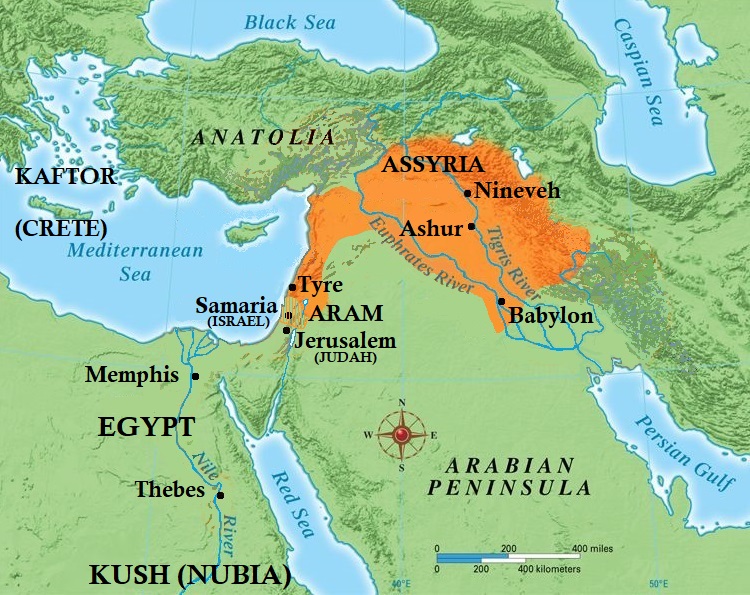
“Aren’t you like the Kushiyim [Nubians] to me, you Israelites?”
—declares God.
“Didn’t I bring up Israel from the land of Mitzrayim [Egypt],
And the Plishtiyim [Philistines] from Kaftor [Crete],
And Aram from Kir?” (Amos 9:7)

This verse reads like a rebuttal of the idea of the Israelites as God’s “chosen people”. The Israelites are no more beloved than the Kushiyim from distant Nubia (Ethiopia). Furthermore, bringing a whole people from one land to another does not mean anything special either; after all, God also arranged the migration of the Philistines from Kaftor (Crete) to the coast west of Judah, and the Aramaeans from Kir (location unknown) to the land east of Israel.

But I suspect Amos’s real point is: “Who do you think you are?  You’re not so special!”

730 BCE, during Neo-Assyrian Conquest of Israel

Collective punishment

Like most liberal Jews today, I prefer the idea that God cares equally about all ethnic groups; we have some differences, but we are equally beloved, and we humans should treat members of all ethnic groups with respect. However, that is probably not what Amos meant. Given the context of the rest of the book of Amos, God is disappointed that the Israelites are not behaving better than any other ethnic group. Therefore God plans to eliminate them.

Hey, the eye of my lord God
Is on the guilty kingdom!
“And I will wipe it off
From upon the face of the earth!” (Amos 9:8)

Collective punishment is the norm for God in the bible; if the majority of people in a kingdom act unethically according to the standards of the time, God threatens to destroy the whole kingdom. When a kingdom is conquered by an enemy, the prophets explain it as God’s punishment, inflicted because either its king or too many of its people were wrong-doers.

The book of Amos begins with prophecies that God will inflict collective punishment on other countries in the Ancient Near East for their war crimes: Aram, the city-states of the Philistines, Tyre, Edom, Ammon, and Moab.1

Then Amos does use the same poetic formula in his prophecies against Judah and Israel. However, God threatens to punish these two kingdoms not for crimes against other countries, but for crimes within their own borders. Judah will be punished for worshipping other gods, and the northern kingdom of Israel will be punished for cruelty to the poor and violation of what should be sacred.2

Amos does not mention the Assyrian Empire, which has been conquering or subjugating neighboring kingdoms. Other books of the Prophets report that God uses the Assyrians to punish other kingdoms, then uses the Babylonian Empire to punish the Assyrians. (See my post Haftarah for Bo—Jeremiah: The Ruler of All Armies.)

Rarely is there any concept of God picking and choosing among the individual citizens of a kingdom, punishing the guilty ones and saving the innocent ones. But at this point in the book of Amos, God has another thought:

“Except that I will not actually wipe out the House of Jacob,”
—declares God. (Amos 9:8)

This may be an insertion by a later editor.3 Yet in the next verse, God says that the good and wicked people of Israel will be separated in a process like shaking a sieve.

“And no pebble will fall to the ground.
By the sword they will die,
All the guilty of my people,
The ones who say:
The evil will never approach or confront us!” (Amos 9:10)

Probably the wicked Israelites are the pebbles that will remain in the sieve, where they will be killed (presumably by the Assyrians, who will soon target the Kingdom of Israel).The innocent will survive, but they will be scattered in exile. (The historical record shows that the standard practice of the Neo-Assyrian Empire, upon conquering a new land, was to deport most of its native population to distant parts of their empire, and move in people from other locations.)

The wicked Israelites believe that God will never punish them; they think God is too blind to see what they are pulling off, or too weak to do anything about it. According to Amos, God says they are wrong; when Israel is conquered, the guilty will all be killed. Only the good individuals will survive, albeit in exile.

(Historically, the so-called “Lost Tribes of Israel” were deported by the Assyrians from 734 to 715 B.C.E.. The deportees and their descendants remained scattered throughout the Neo-Assyrian Empire, never to return. But other survivors of the Assyrian conquest escaped and settled in the southern kingdom of Judah, where they assimilated with their fellows from the same ethnic group.)

Collective reward

The remainder of the haftarah promises that someday God will restore one large, unified kingdom of Israelites, as in the time of King David, and the land will produce great agricultural plenty for its people.

The final verse of both the haftarah and the book of Amos is a divine promise:

“And I will plant them on their own soil
And they will never again be uprooted
From upon their soil that I gave them,”
—says God, your God. (Amos 9:15)

When will that permanent planting happen? Amos does not say. But the happy ending of the prophecy is about collective, not individual, reward.


The religion of the ancient Israelites, with its emphasis on animal sacrifices and endorsement of war, died with the fall of the second temple in Jerusalem in 70 C.E. Over the past two millennia, the Jewish religion has shifted toward an emphasis on prayer and endorsement of the Torah passages about loving the stranger and freeing the poor from oppression.

Yet many people today, Jews and non-Jews, still believe that their own religion is the only right one, the only true religion—and therefore they and their co-religionists are God’s chosen people.

I pray that we all receive the divine inspiration that Amos (or his later editor) received, and reject the idea of a biased God who singles out one ethnic or religious group for extra benefits. God rescues lots of people and brings them to new lands. In God’s eyes, Amos reports, Israelites are the same as the Kushites.

I wish I could also pray that good individuals will have good lives, and only wicked individuals will suffer. But I am too much of a realist for that. Acts of nature (“acts of God”) affect everyone who happens to be in the vicinity. And acts of organized human groups such as nations also have a collective impact, for good or evil.

Yet as individuals, we can be good to other individuals. And we can try to be a good influence on the groups and nations we belong to.


  1. Amos 1:2-2:3.
  2. Amos 2:4-8.
  3. “The prophet has just represented God as saying He will destroy the offending kingdom from the face of the earth. Although it is possible that he wants to qualify this sweeping declaration, one suspects that the mitigation of the prophecy of destruction is an editorial addition—especially since this entire sentence does not scan as poetry.” (Robert Alter,The Hebrew Bible, Volume 2: Prophets, W.W. Norton & Company, New York, 2019, p. 1279.)

Pesach: Who Is Elijah?

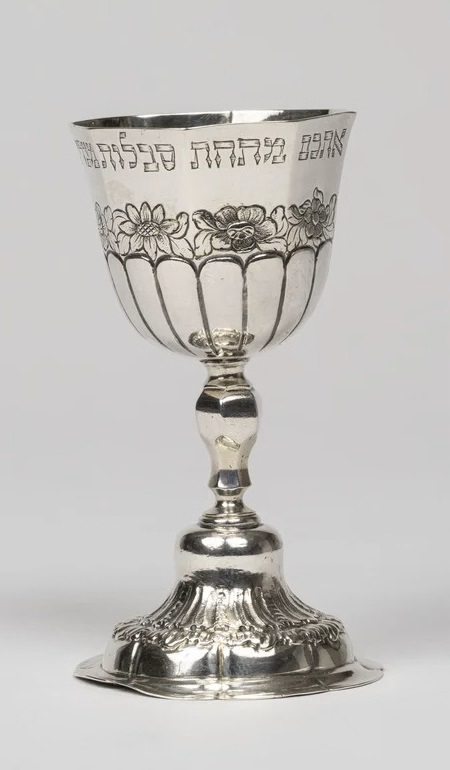
Passover cup by Johann Jakob
Runnecke, 18th century,
Jewish Museum

During this week of Passover (Pesach, פֳּסַח), Jews have been gathered around tables to celebrate liberation. Our ceremony (seder, סֵדֶר) has fourteen steps, punctuated by four cups of wine. When we pour the fourth cup of wine for each person at the table, we also pour wine into a cup that has been standing untouched the whole evening: the cup of Elijah.

Then we stand up, and someone opens the door to invite Elijah inside to join us. (This is the second time we open the door during the seder; before the meal, we open it to invite “all who are hungry” to come in and eat with us.)

While we wait for Elijah, we read a short passage. The traditional reading, from the centuries when almost every non-Jew was an enemy, consists of three biblical quotations asking for God’s wrath to destroy the enemies of Jews:

Pour out your wrath on the nations that do not recognize you, and on kingdoms that do not proclaim your name; because they ate up Jacob and made his abode a desolation. (Psalm 79:6-7) Pour out on them your curse and let your rage engulf them. (Psalm 69:25) Pursue in rage, and annihilate them from under the heavens of God. (Lamentations 3:66)

The connection between this reading and Elijah is tenuous. However, Elijah is portrayed in a few stories from the first book of Kings as a wrathful zealot bent on destroying the worshipers of other gods.

Many modern seders replace this reading with something less dire that refers to biblical stories in which Elijah orders kings around, or rescues the unfortunate, or becomes an angel instead of dying.

After that, we sing a song with these words1 before we close the door:

Eliyahu, hanavi                                   (Elijah the prophet)
Eliyahu, haTishbi (Elijah the Tishbite)
Eliyahu, Eliyahu, Eliyahu haGiladi (Elijah the Giladite)
Bimheirah veyameinu (Quickly, in our days)
Yavo eleinu (May he come to us)
Im moshiach ben David (With the anointed one, descendant of David)

Moshiach (מָשִׁיחַ) is “messiah” in English. The Christian story is that the messiah arrived over 2,000 years ago as Jesus. The Jewish story is that the messiah (or the messianic age) will not arrive until the whole world has become a place of peace, justice, kindness, and wisdom. So naturally Jews hope Moshiach will come during our lifetimes.

But why do we also call for Elijah to come to us? It depends on which characteristic of the prophet—or angel—we consider.

Elijah the wrathful zealot

Elijah first appears in the Hebrew Bible after Ahab has become the king of the northern kingdom of Israel. Ahab marries the Phoenician princess Jezebel, and erects an altar for Baal and a pole for Asherah in his capital city, Samaria. The prophet Elijah is driven by his desire to eliminate the worship of other gods in the kingdom of Israel. First he declares a long drought, presumably so the Israelites will be realize their own God, Y-H-V-H, has the power to destroy them. After three years of drought, he stages a dramatic contest between Y-H-V-H and Baal at Mount Carmel.

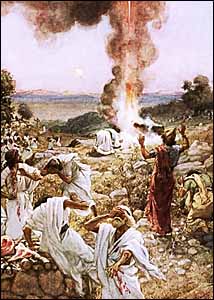
Elijah’s Sacrifice on Mt. Carmel,
by William Brassey Hole

When Elijah’s God wins, the Israelites prostrate themselves and shout:

“Y-H-V-H, he is the only god! Y-H-V-H, he is the only god!” Then Elijah said to them: “Seize the prophets of Baal! Don’t let any of them escape!” And they seized them, and Elijah took them down to the Wadi Kishon and slaughtered them there. (1 Kings 19:39-40)

Then God brings rain. (See my blog post: Haftarat Ki Tissa—1 Kings: Ecstatic versus Rational Prophets.)

Elijah’s zeal for God shows up again in a story about King Ahab’s successor, his son Achaziyahu. The new king falls out a window, and sends messengers to ask a god in Ekron whether he will recover. Elijah intercepts the messengers and tells them King Achaziyahu will die because he sought out a foreign god instead of asking a prophet of Y-H-V-H. The king sends fifty soldiers to arrest Elijah, and their captain climbs the hill where the prophet is sitting and orders him to come down. Elijah replies:

“If I am a man of God, fire will come down from the heavens and consume you and your fifty!” (2 Kings 1:10)

Obligingly, God incinerates the soldiers with fire from heaven. The king sends another fifty men, with the same result. The third time, the captain begs Elijah to please spare him and his men. No fire appears, and Elijah follows the captain to the palace, where he tells the king that he will not rise from his bed, but will die for his disloyalty to God. Achaziyahu dies.2

Elijah the insolent

Another approach to Elijah’s part of the Passover seder is to emphasize his refusal to submit to authority.

When Elijah first shows up in the bible, he is identified by his clan (Tishbi) and region (Gilead), as in the Passover song. Then, with no transition, he speaks abruptly to King Ahab.

Then Elijah the Tishbite, an inhabitant of Gilead, said to Ahab: “As Y-H-V-H lives, the God of Israel whom I wait on—there will be no dew nor rain these years unless my mouth pronounces it!” (1 Kings 17:1)

Whenever Elijah speaks to a king, he uses none of the customary courtesies. He never refers to himself as the king’s servant, nor says please, nor uses any honorifics. He does not respect human authority. (He also appears to be arrogant in his assumption that when he says a miracle will happen, God will follow through. But God always does. And when God gives him an order, Elijah always obeys.)

After three years of drought, God tells him:

“Go, appear to Ahab, and I will give rain to the face of the earth.” (1 Kings 18:1)

When he meets King Ahab outside the city of Samaria, Elijah criticizes him for following other gods, then gives him orders:

“And now, assemble all of Israel at Mount Carmel for me, along with the 450 prophets of Baal and the 400 prophets of Asherah who eat from Jezebel’s table.” (1 Kings 18:19)

King Ahab obeys.

Elijah the compassionate

The prophet Elijah is high-handed with kings, soldiers, and the prophets of other gods. But he is thoughtful when it comes to the unfortunate. Some seders tell the story of how he saved a poor widow and her son.

After Elijah announces the long drought, God tells him where to hide from the agents of King Ahab and Queen Jezebel. His second hiding place is the house of a widow and her son in a village near Phoenicia. When Elijah arrives, the widow tells him she has only enough flour and oil to bake a couple of biscuits3 before she and her son starve to death. Elijah tells her to make a small biscuit for him first, and promises that God will make a miracle so her jar never runs out of flour and her jug never runs out of oil until it rains again.4 The widow obeys the prophet, God makes the miracle, and Elijah lives in the room on the widow’s rooftop.

Then her son gets sick. When the boy stops breathing, Elijah carries him upstairs and lays him on his own bed.

Elijah Raises the Widow’s Son, by James Tissot, circa 1900

Then he stretched himself out over the boy three times, and he called out to Y-H-V-H and said: “Y-H-V-H, my God, please bring back the life inside this boy!” (1 Kings 17:21)

The boy revives.

In a later story, Elijah is compassionate even when he is in despair, believing that he has failed in his mission to convert the whole kingdom of Israel to worshiping only Y-H-V-H. He heads south into the Negev, hoping to die there instead of at the hand of Queen Jezebel.5 On the way he thoughtfully leaves his servant in the town of Beersheba, so the man will not die in the desert with him.6

Elijah the angel

The final biblical story about Elijah describes his non-death. His disciple Elisha knows it is Elijah’s last day on earth, and sticks close to his master, even though Elijah asks him to stay behind three times. When they reach the Jordan River, Elijah rolls up his mantle (cloak) and slaps the water with it. The river divides and the two men walk across the riverbed.

Elijah Carried Away into Heaven by a Chariot of Fire,
by James Tissot, circa 1900

And they kept on walking and talking. And hey! A chariot of fire and horses of fire! And they separated the two of them. And Elijah went up in a whirlwind to the heavens. (2 Kings 2:11)

Elisha watches, then picks up Elijah’s mantle.

According to later Jewish writings, Elijah becomes an angel (i.e. a supernatural messenger or emissary of God) after God’s whirlwind carries him up to the heavens. This concept first appears in the book of Malachi. In the third chapter God, addressing the Israelites, says:

“Here I am, sending my malakh; and he will clear the way before me, and suddenly the lord that you are seeking will come to the temple. And the malakh of the covenant that you desire, hey! He is coming!” (Malachi 3:1)

malakh (מַלְאַךְ) = messenger, emissary. When God sends a malakh, it is often translated into English as “angel”.

The text postpones identifying this malakh. The next verse warns that the arrival of God’s emissary is not all good news.

“But who can endure the day he comes? And who can stand when he appears? For he is like the fire of a smelter and the lye of a fuller.” (Malachi 3:2)

The book of Malachi ends with God announcing:

“Behold, I am sending you Elijah the prophet before the great and awesome day of Y-H-V-H comes. And he will turn the hearts of fathers toward sons, and the hearts of sons toward fathers, lest I come and I strike the land with complete destruction.” (Malachi 3:23-24)

Now we know the malakh or angel is Elijah, centuries after he ascended to the heavens. The “day of Y-H-V-H” is a day of final judgment anticipated in some later books of the Hebrew Bible and in the Talmud. After that “day”, those whom God has found acceptable will live in “the world to come”, in which the Moshiach reigns.

But first, Elijah will do what he can to improve people’s hearts so they can enter the world of the Moshiach.

The tradition that Elijah is still among us as a malakh continued from the Talmud to 19th-century Chassidic tales, in which Elijah appears disguised as an ordinary human being. He either rewards a good person or makes a man realize he has behaved badly and only later does the person realize it was Elijah.

This Elijah no longer despairs of reforming people, but enlightens them one at a time.


Which Elijah do you want to invite into your house—or into the world today? The zealot who wipes out people who are irredeemable? The insolent prophet who demonstrates that authority figures have less power than they think? The compassionate man who goes out of his way to save the lives of the unfortunate? Or the divine emissary who improves the world slowly, one person at a time, until Moshiach comes?


  1. Jews also sing this song during the ritual of Havdalah marking the end of Shabbat and the start of a new week.
  2. 2 Kings 1:2-17.
  3. The Hebrew word is translate here as “biscuit” is ugah, עֻגָה = a round, flat wheat cake baked on hot stones or ashes.
  4. 1 Kings 17:13-14.
  5. Jezebel sends a messenger to tell Elijah that she is going to kill him (1 Kings 19:1-2).
  6. 1 Kings 19:3.

Metzora: Erasing the Taint

The idea of being tamei (טָמֵא) is hard to understand in the 21st century. The adjective tamei has been translated into English as “unclean”, but it has nothing to do with dirt. It has been translated as “impure” or “contaminated”, but it has nothing to do with a being less than 100% one substance. It has been translated as “defiled”, but that word is appropriate only when one is tamei because of idol worship or sexual misdeeds; the Torah does not consider childbirth or married intercourse defiling, yet both activities make people temporarily tamei.

“Ritually impure” often works as a definition of tamei, because in the Hebrew Bible a tamei person is not allowed to enter even the outer courtyard of the precincts where God is worshipped (the tent sanctuary first, later the temple). But a person who is tamei because of a skin condition called tzara-at (צָרַעַת)1 is not allowed inside the camp or town at all; that person might be considered “socially impure”.

Animals and objects can also be tamei, regardless of their location. An animal that is not kosher for people to eat is called tamei.2 The carcass of a dead non-kosher animal is tamei, and any person who touches it becomes tamei.3 Cloth and leather become tamei if mold grows on them. (See last week’s post: Tazria: Mold or Mood?) Some objects are tamei merely because they touched a tamei person or animal.

Being tamei is often treated as a contagious condition, but it does not refer to any contagious diseases. Touching someone or something that is already tamei spreads an abstract contagion. Perhaps “tainted” or “icky” captures the meaning of the word—except that tamei has a religious as well as a visceral aspect.

The adjective tamei and its related verb and noun appear 269 times in the Hebrew Bible. In the book of Leviticus alone, words from the root tamei occur 136 times!4

Why is tumah (טֻמְאָה, the condition of being tamei) a major theme in Leviticus? In ancient Judah, priests diagnosed the condition, told people what to do about it, and performed purification rituals when needed.5 Modern scholars have concluded that Leviticus was written by priests over a period of several centuries, probably between the 7th and 4th centuries B.C.E., and its main purpose was to describe the responsibilities of priests.

Tamei skin conditions

This week’s Torah portion, Metzora (Leviticus 14:1-15:32), gives instructions on three of the many types of tumah: human skin diseases, moldy house walls, and genital discharges.

 The first section describes the ritual by which a priest changes a person who has recovered from one of the skin conditions called tzara-at from tamei to tahor.

This is the teaching of the metzora at the time of his taharah (Leviticus 14:2)

metzora (מְצֺרָע) = person with one of the skin conditions called tzara-at.

taharah (חָהָרָה) = state of being tahor; process of becoming tahor. (Tahor, טָהוֹר = not tamei; clean, ritually or socially pure, not tainted or icky.)

A metzora must live outside the camp or town. If the skin of the metzora appears to have returned to normal, a priest must go out and inspect it. If the priest deems that there is no more tzara-at, he assembles the items needed for the first of several rituals to confirm that the man or woman is now tahor and can return to normal life.

Two Birds, by Simon Fokke, 18th century

…he will take for the mitaheir two live tahor birds, and cedar wood, and red stuff, and [a branch of] oregano. And he will issue an order and have one of the birds slaughtered over fresh water in an earthenware vessel. He will take the live bird and the cedar wood and the red stuff and the oregano, and dip them, along with the live bird, in the blood of the bird that was slaughtered over the fresh water. Then he will sprinkle it over the mitaheir from the tzara-at seven times, and he will become tahor; and he will send free the living bird over the open field. (Leviticus 14:3-7)

mitaheir (מִטַּהֵר) = one becoming tahor (i.e. not tamei).

After the priest has used the oregano branch to sprinkle the bloody water, the person who has recovered from tzara-at must become literally clean.

Then the mitaheir will scrub his clothes and shave off all his hair and wash in water; and he will be tahor. Afterward he may enter the camp, but he must live outside his tent for seven days. (Leviticus 14:8)

At this point, the mitaheir is no longer socially unacceptable, and can live inside the camp. But further ritual is required before the mitaheir can resume all of normal life. The clothes-scrubbing, shaving, and washing must be repeated on the seventh day. On the eighth day the person comes to the entrance of the sanctuary with various offerings, and the priest conducts the final ritual, which includes daubing first lamb’s blood, and then oil, on the person’s right ear, right thumb, and right big toe.6

And the priest reconciles the mitaheir with God. (Leviticus 14:31)

Tamei walls

Green mold in plaster wall

The middle section of Metzora provides instructions on what to do if the walls of a house are tamei. If the owner of the house observes green or red stains in a wall,

…he must come and tell the priest, saying: “Something like a mark has appeared in the house.” (Leviticus 14:34-35)

The owner of the house is not allowed to make the diagnosis; that is the priest’s job. (For a literal and a metaphorical description of what the priest does, see my post: Metzora: A Diseased Family.)

When the priest considers the house mold-free and tahor, he conducts a ritual using the same materials as in the first ritual for a person who has healed from tzara-at.

Then he will take, to make amends for the house, two birds, and cedar wood, and red stuff, and [a branch of] oregano. (Leviticus 14:49)

The priest follows the same procedure, this time sprinkling the bloody water seven times on the house, instead of on a person. But no further waiting period or ritual is required. The passage concludes:

And he has made reconciliation for the house; and it is tahor. (Leviticus 14:53)

Tamei discharges

The third section of this week’s Torah portion deals with tumah because of genital discharges: gonorrhea or semen from a man, blood from a woman. The gonorrhea calls for the most extensive response.

Any bed that the discharger lies upon is tamei. And anyone who touches his bed must scrub his clothes and wash in water, and will be tamei until evening. (Leviticus 15:4-5)

The same goes for anyone whom the afflicted man spits on, who touches him, or who sits where he sat. The contaminating effect even applies to some dishes.

And any earthenware vessel that the discharger touches must be shattered, and any wooden implement must be rinsed in water. (Leviticus 15:12)

Seven days after the man has recovered, he scrubs his clothes and washes himself in fresh water. Then he is tahor, but he must bring two birds to a priest on the eighth day. The priest sacrifices both birds at the altar.

And the priest reconciles him with God for his discharge. (Leviticus 15:15)

Semen is a less serious source of tumah. The man only has to wash himself and anything the semen falls on, and he will become tahor at sunset. The same goes for a couple having intercourse.

A woman is tamei during her menstrual period for at least seven days, more if she bleeds longer than seven days. Anything she lies on or sits on is tamei, and anyone who touches these things must bathe and wash their clothes; then they become tahor at sunset.

And if a man actually lies with her, then her menstruation is upon him, and he will be tamei seven days, and any bed he lies on will be tamei. (Leviticus 15:24)

If a woman has a discharge of blood when it is not her period, then the same rules apply as for a man with gonorrhea, including the priest sacrificing two birds  to reconcile her with God once it is over and she is tahor again.

The passage in this week’s Torah portion about a woman’s discharge of blood does not mention bathing to become tahor again, even though bathing is required for a man who had a discharge and for anyone who recovered from tzara-at. But by the time the Talmud tractate Niddah was written (circa 500 C.E.) the rabbis had already established that a woman must immerse herself completely in the water of a mikveh after her period. They argued about the number of days the woman had to allow after she stopped bleeding, and other details. Traditional observant Jewish women today still submerge in a mikveh after their periods.


The Torah portion Metzora concludes as God tells Moses:

And you will separate the Israelites from their tumah, so they will not die from their tumah by their making tamei my sanctuary that is in their midst. (Leviticus 15:31)

All the rules about not touching anything tamei, and taking the ritual steps to undo the tumah, prevent God’s sanctuary itself from becoming tamei. A contaminated sanctuary would be a disaster, according to ancient Israelite thinking.

Perhaps it is because the idea of tumah in the sanctuary is so awful that a person who has become tahor again after the most serious cases of tumah must be reconciled with God. The Hebrew word I translate here as “reconciled” is kiper (כִּפֶּר), which is often translated as “atoned” when the purpose of the ritual is to make amends for a sin against God. Being tamei is not a sin, yet a tamei person is unfit to stand before God.

And the worship of God must be free of anything remotely icky. Our thoughts and feelings matter.


  1. Tzara-at was formerly translated as “leprosy”, but it is unrelated to the disease once called leprosy and now called Hansen’s disease. The instructions for diagnosing tzara-at in Leviticus 13:1-44 (in last week’s portion, Tazria) describe several separate skin conditions that cause changes in skin color and texture and the appearance of the hairs growing in the affected skin.
  2. Leviticus 11:1-23.
  3. Leviticus 11:24-40.
  4. The biblical book with the second highest frequency of words from the root tamei is Numbers, with 48. Third is Ezekiel, with 34, and fourth is Deuteronomy, with 10.
  5. The book of Ezekiel probably has frequent references to being tamei because the prophet Ezekiel belonged to a family of priests (kohanim), and would have served as a priest before he was exiled to Babylonia.
  6. More of this ritual is described in my post: Metzora: Time to Learn, Part 2.

Tazria: Mold or Mood?

Green mold on fabric

A woman is ritually impure (tamei)1 after giving birth, and must stay away from anything holy for 40 days (for a boy) or 90 days (for a girl). Anyone with a certain skin condition is ritually impure, and must live outside the camp or town. If mold appears in cloth or leather and cannot be washed out, it is ritually impure, and must be burned.

This week’s Torah portion, Tazria (Leviticus 12:1-13:59) devotes 67 verses to these three situations—and next week’s portion continues the instructions. But do rules about ritual purity from about 2,500 years ago have any relevance in today’s world?

The biblical laws about keeping kosher, which appear in last week’s Torah portion, Shemini, are still observed by many Jews. And a few other ritual purity laws are followed by observant orthodox Jews—for example, the rule that a married woman must submerse in the water of a mikveh after her menstrual period ends. Other purity laws have been impossible to observe since the fall of the second temple in Jerusalem in 70 C.E., when the descendants of priests were left with a few special honors, but no longer conducted sacrificial services or ritual purifications.

Nevertheless, the Torah’s instructions about how priests should diagnose ritually impure conditions and conduct purification rituals can still be interpreted in ways that might speak to us today.

In my post Tazria: Time to Learn, Part 1, I talk about the value of a delay in returning to social life after childbirth. In Tazria & 2 Kings: A Sign of Arrogance, I discuss the connection between skin disease and excessive pride.

And what about the third topic in the portion Tazria, moldy cloth and leather? This passage can also have an alternate meaning, depending on how we translate the Biblical Hebrew words in it that refer to both physical objects and psychological meatphors.

Infected garmentsor depressed traitors

The instructions begin with this verse:

If the beged has a mark of tzara-at in it—in a beged of wool or in a beged of linen— (Leviticus 13:47)

beged (בֶּגֶד) = cloth garment—or betrayal. (Identical spelling. The noun beged meaning betrayal comes from the root verb bagad, בָּגַד = deceive, betray, break faith.)

tzara-at (צָרָעַת) = a skin condition characterized by white patches lower than the surrounding skin; patches of mold in cloth, leather, or walls. (A related word, tzira-ah, צִרְעָה = depression, discouragement. Its construct form would be tzira-at, צִרְעָת = depression of, discouragement of. The noun tzira-ah is closely related to tzara-at; a depression in one’s skin becomes a depression in one’s mood.)

What is the best translation of verse 13:47, given the alternative meanings of the words beged and tzara-at?

Most translators pick the meaning that makes sense if you read the passage as a straightforward description of an event, or as a set of instructions for carrying out laws or rituals. I usually do that myself. But sometimes the English word that expresses the most straightforward meaning does not give us any idea of the alternative, metaphorical meaning of the Hebrew word. Then something is lost in translation.

A straightforward translation of Leviticus 13:47 is:

If the garment has a mark of mold in it—in a garment of wool or in a garment of linen—

An alternative translation of Leviticus 13:47 is:

If the betrayal has the mark of depression in it—in a betrayal of wool or in a betrayal of linen—

Someone who betrays another person, God, or an ideal often feels depressed. But what is a betrayal of wool or linen?

Spotted sheep

In the Torah, wool is the fabric associated with the Israelites, who own flocks of sheep. Linen is an Egyptian import.2 So with a small stretch, the translation of Leviticus 13:47 could become:

If the betrayal has the mark of depression in it—in a betrayal of Israelite ways or in a betrayal of Egyptian ways—

Weaving and leatheror drinking, mixing, and skin

If the next verse did not continue this line of thought, I would ditch the metaphorical translation and restrict myself the plain, straightforward one. But I have nothing interesting to say about the technical details of diagnosing mold in cloth. Fortunately, the next verse is:

—or in the shti or in the eirev of the linen or of the wool; or in or, or in any melekhet of or— (Leviticus 13:48)

shti (שְׁתִי) = warp (in weaving)—or drinking. (Identical spelling.)

eirev (עֵרֶב) = woof (in weaving)—or mixing.3 (Identical spelling.)

or (עוֹר) = leather, skin (including the skin of a living human being).

melekhet (מְלֶאכֶת) = craft, business, mission.

A straightforward translation of Leviticus 13:48 is:

or in the warp or in the woof of the linen or of the wool; or in leather or in anything crafted of leather—

Here is an alternative translation of Leviticus 13:48 with the same interpretations of linen and wool I used for verse 13:47:

or in drinking, or in the mixing of Egyptian and Israelite ways; or in skin or in any business of skin—

The Torah forbids mixing linen and wool,4 and biblical prophets warn Israelites against making alliances with Egypt or moving to Egypt.5 An example of mixing Egyptian and Israelite ways could be sex with a sibling, which was a permissible kind of marriage in Egypt, but an abomination in Israel.

The Hebrew Bible talks about three kinds of betrayal: telling lies (especially in court), breaking a vow, and deliberately violating God’s orders. What it does not mention is that if you betray a human being or God, you usually betray yourself as well, by failing to live up to your own standards. One result is likely to be depression. Traitors who feel depressed about their betrayals might indeed start drinking too much. And they might violate their own culture’s mores about sex or other aspects of life because they despair of being upright citizens.

But what about a “business of skin”? The first time the word or (עוֹר) appears in the Torah is when God clothes Adam and Eve in the skins of animals before sending them out of the garden of Eden.

Mosaic of Eden,
Cathedral Monreale, Sicily

And God, God made for Adam and for his woman fancy garments6 of skin, and [God] clothed them. (Genesis 3:21)

Most commentators conclude that God does not make leather garments for them, but rather gives them bodies covered with skin, like all mammals. Subsequent references to or as skin merely mention skin as opposed to muscle or bone—one more physical body part. Biblical writers and commentators assume it is our physical bodies that give us the most in common with other animals. So “business of skin” could mean “animal concerns” such as food and sex.

Putting verses 13:47 and 13:48 together could yield this slightly imaginative alternative translation:

If betrayal has the mark of depression in it—in betrayal of Israelite ways or in betrayal of Egyptian ways—or in drinking, or in the mixing of Egyptian and Israelite ways; or in animality, or in any animal concerns— (Leviticus 13:47-48)

Expert help

If you notice yourself, or someone you know, behaving like this, what should you do?

The next verse in the portion Tazria gives the first instruction: the mark of tzara-at must be shown to a priest.

And the priest will look at the mark, and isolate the mark seven days. (Leviticus 13:50)

It is easy enough to isolate a cloth garment, or something made of leather. It is harder to isolate a person, but this week’s Torah portion has already described how a priest isolates people who have the skin condition called tzara-at by requiring them to live outside the camp or town. They are considered unfit for society.

On the seventh day, the priest looks at the mark again. According to the plain, straightforward translation:

If the mark has spread in the garment, or in the warp or woof of the cloth, or in the leather or in anything that is made of leather, the mark is a harmful mold; it is ritually impure. (Leviticus 13:51)

According to a metaphorical translation:

If the mark has spread, the betrayal or the drinking or the mixing or the animal behavior, it is a hurtful depression; therefore it is “ritually impure”: a condition that requires strong action.

The action the priest must carry out is to burn up the article that has tzara-at in a fire. Moldy cloth or leather can certainly be burned. But how can one burn depression due to betrayal, and all the hurtful behavior it can cause?

If a modern expert in the role of the ancient priest, perhaps a psychologist, decides the betrayer’s depression is  seriously hurtful, the expert might prescribe anti-depressants—but that is not enough to stop the damage. The depressed person also needs to “burn up” their old ways. With ongoing guidance, a traitor could make recompense to the one betrayed, a drinker could quit, a person operating only by animal instinct could become dedicated to rules of reasonable behavior.


The author of this part of the book of Leviticus was probably a Levite who simply wanted a written record of how priests and the general public should interact in specific undesirable situations, such as mold in cloth and leather.

Yet two major 12th-century commentators who usually approached Torah from very different perspectives, Rambam (Rabbi Moses Maimonides) and Ramban (Rabbi Moses Nachmanides) agreed that tzara-at was actually a supernatural warning from God that a person was doing something evil.  The problem had to be addressed with repentance and reform.

I suspect these traditional commentators were influenced by the alternative meanings of the words in this passage in Tzaria.  Without the dual meanings, the psychology underneath the arcane ritual might get lost in translation.


  1. Tamei (טָמֵא) = “ritually impure”, i.e. requiring correction through a purification ritual before the person, animal, or object can return to normal life or use.
  2. Other fabrics available in the Ancient Near East circa 500 B.C.E. include those woven of camel hair or goat hair. Silk from China and cotton from India were not introduced until around 100 B.C.E.
  3. The noun eirev, which often means “mixed race”, comes from the root verb arav, עָרַב = mix, mingle.
  4. Leviticus 19:19 (banning any mixture of thread sources), Deuteronomy 22:11 (specifically banning cloth that combines wool and linen).
  5. For example, Jeremiah 42:7-22 tells the Judahites to stay in their land even under Babylonian rule instead of fleeing to Egypt. Ezekiel 29:6-9 denounces an alliance between Egypt and Israel that failed.
  6. Genesis 3:21 uses the word is katnot (כָּתְנוֹת) = long decorated garments, possibly tunics; not beged = any garment.