Haftarat Metzora—2 Kings: A Response to Rejection

Every week of the year has its own Torah portion (a reading from the first five books of the Bible) and its own haftarah (an accompanying reading from the books of the prophets). This week the Torah portion is Metzora (Leviticus 14:1-15:33) and the haftarah is 2 Kings 7:3-20.

Even when people belong to the same religious, ethnic, or national group, they can become marginalized or ostracized in their society. The book of Leviticus/Vayikra insists that anyone who develops a skin disease called tzara-at must be excluded from public worship and live apart from other people. Last week’s Torah portion (Tazria) declares:

All the days that the affliction is in him, he shall be ritually impure. Ritually impure, he shall dwell alone; his dwelling shall be outside the camp. (Leviticus/Vayikra 13:46)

This skin disease is not always a permanent disfigurement; in fact, in last week’s haftarah, the Aramaean general Na-aman is cured of tzara-at. (See my post 2 Kings: A Religious Conversion.) This week’s Torah portion (Metzora) opens with the ritual for readmitting someone whose tzara-at has healed. But in this week’s haftarah, four men with tzara-at seem to be permanently shut out of their own city, with no way to make a living other than to beg at the city gate.

Ruins of the City of Samaria

An army from Aram is besieging Samaria (Shomron in Hebrew), the capital of the northern kingdom of Israel. (Na-aman, the Aramaean general in last week’s haftarah, is not mentioned; perhaps he is deployed elsewhere.) Inside the walls of the city, people are dying of starvation. Outside the city gate are four Israelites with tzara-at. Their skin disease is obvious, and the soldiers of Aram also ignore them, since they are only wretched beggars—with no one left to beg from.

And there were four men, metzora-im, at the entrance of the gate. And they said, each man to his rei-a: Why are we sitting here until we die? (2 Kings 7:3)

metzora-im (מְצֹרָעִים) = people with tzara-at (צָרַעַת), a non-communicable disease characterized by patches of white skin.

rei-a (רֵעַּ) = comrade, companion, friend.

Although shunned by the Israelites inside the walls of the town, the four outcasts are companions and friends with each other. They consider their situation:

If we say “Let us enter the city” and starvation is in the city, we shall die there; but if we stay here, we shall die. So now let us go to the camp of Aram and defect. If they let us live, we shall live, and if they put us to death, then we shall die. (2 Kings 7:4)

An extreme patriot might criticize the four men for deciding to defect (literally, “throw themselves down”) to their country’s enemy. Yet Israel has not taken care of them, and their best hope of staying alive is to take a chance on begging for food from the Aramaean army.

An Empty Camp

So they got up at twilight to come to the camp of Aram, and they came up to the edge of the camp of Aram, and hey!—nobody was there! God had made the camp of Aram hear the sound of chariots, the sound of horses, the sound of a great army; and each man had said to his brother: Hey! The king of Israel has hired against us the kings of the Hittites and the kings of Egypt to come against us! And they had got up and fled at twilight, and they had abandoned their tents and their horses and donkeys, [leaving them] in the camp just as it was. And they had fled for their lives. (2 Kings 7:5-7)

At twilight, while the four metzora-im were getting up to sneak away from the city, the soldiers of Aram were getting up to run away from their camp, terrified by divine auditory hallucinations.
Metzora-im at an enemy tent
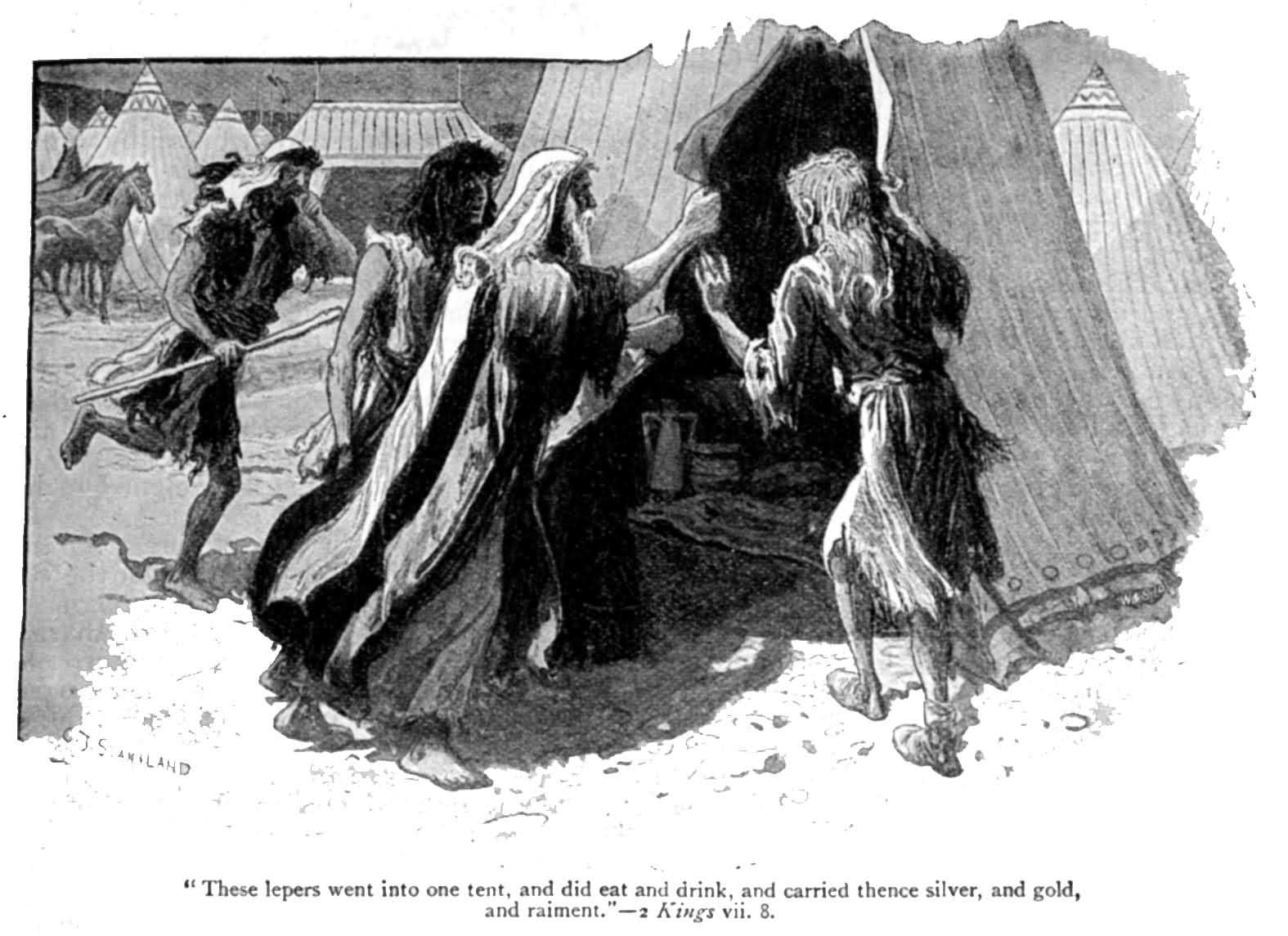
Metzora-im enter an enemy tent

And those metzora-im came up to the edge of the camp, and they entered one tent and they ate and they drank, and they carried off from there silver and gold and clothing and hid them. Then they came back and entered another tent, and they carried off [things] from there and hid them. And then they came back. (2 Kings 7:8)

At first the metzora-im think their problems are over. So what if their own country ostracizes them? In the deserted camp of the Aramaeans they have plenty of food and drink, as well as valuables they can sell later to make a living.

Then they said, each man to his rei-a: We are not doing right. This day is a day of good news, and we are keeping silent, delaying until the light of morning. And we will be found guilty for our offense. So let us go now, and come and tell the household of the king. (2 Kings 7:9)

Their offense is withholding the news from the Israelites shut up in the capital. Even delaying overnight would result in punishment. If they delayed for days, more of their fellow Israelites would starve to death, oblivious of God’s miracle.

Why tell the king?

Commentators differ on whether the four outcasts are motivated by ethics, by utility, or by fear. According to Rashi (11th-century Rabbi Shlomo Yitzchaki), we will be found guilty means “We will be held guilty by the throne”. They assume the king of Israel will eventually catch them, and they are afraid of the ensuing punishment.

Other commentary claims the decision of the four metzora-im is practical. Only if the city of Samaria functions again can they resume begging from travelers going in and out of the city gate. If they tell the good news at once to the king’s officials, they can count on the continued support of Israelite travelers. If they withhold the information and Samaria finds out later that the Aramaean army is gone, the Israelites will have a grudge against them. And if they load up Aramaean donkeys with Aramaean goods and try to make a new life elsewhere, they will still be discriminated against because of their skin disease (and perhaps also because of their country of origin). Telling the king of Samaria at once and returning to their old lives as beggars at the gate is their most practical option. (And who knows, maybe later they will have a chance to trade the silver and gold they hid.)

Another viewpoint is that the metzora-im make an ethical decision. It would be wrong to let their fellow Israelites starve, when they now have the means to feed them. So what if their own people ostracized them, and will continue to do so? They can still do the right thing.

These four men are such good friends, so good at talking things through with each other, that I think they considered fear, utility, and ethics when they made their decision. I admire their realism in accepting that as long as their skin disease lasts, they will be ostracized, so the best life they can hope for is as beggars at the gate. (I also wish they would take a chance like Na-aman in last week’s haftarah, and dare to ask the prophet Elisha for a cure.)

I also admire them for catching themselves in the midst of looting the abandoned Aramaean camp, and considering the plight of the people inside the city. What I admire most is that they do not enjoy the fact that now they are full and the people who kicked them out are starving. Instead they decide to share the wealth with the very people who refused to share with them—the clear-skinned city dwellers who followed the Levitical law of exclusion with no remediating measures.

None of us lead charmed lives; we are all ostracized or discriminated against at some point. But every person who resists a chance to discriminate against a former or potential enemy makes the world better.

May we all be blessed with the practicality and the ethical determination of the four metzora-im!




Haftarat Tazria—2 Kings: A Religious Conversion

Every week of the year has its own Torah portion (a reading from the first five books of the Bible) and its own haftarah (an accompanying reading from the books of the prophets). This week the Torah portion is Tazria (Leviticus 12:1-13:59) and the haftarah is 2 Kings 4:42-5:19.

What inspires someone to convert to a religion?

For Na-aman, an Aramaean general from Damascus who converts to the religion of Israel in this week’s haftarah, the quick answer is that he decides to convert after an Israelite prophet heals him. But the full story runs deeper.

soldier 2

Na-aman, the commander of the army of the king of Aram, was a great man [who stood] before his lord with a high rank, because God had given victory to Aram, and the man was a powerful warrior—[and] a man with skin disease. (2 Kings 5:1)

His skin disease is tzara-at , which is a serious ritual impurity in this week’s Torah portion, Tazria; someone who has it must live outside the camp, wear torn clothes, and cover his upper lip—even though the disease is not contagious. The rules in Aram may have been more lenient, but we can assume the disfiguring disease carried some social stigma.

And a raiding party of Aram had gone out and captured from the land of Israel a young na-arah, and she [stood] before the wife of Na-aman. And she said to her lady: If only my lord [stood] before the prophet who is in Samaria! Then he would remove his skin disease. (2 Kings 5:2-3)

na-arah (נַעֲרָה) = slave-woman; any girl or young woman during the stage after puberty but before her first pregnancy.

The slave-girl is the one who knows what Na-aman needs to do to get rid of his disfiguring skin disease. She tells her mistress, who tells her husband, who then tells his master, the king of Aram.

And he came and told his lord, saying: This and this she said, the na-arah who is from the land of Israel. (2 Kings 5:4)

The king of Aram writes a letter for Na-aman to take to the king of Israel, perhaps to guarantee his safe passage through a foreign country. Eventually Na-aman and his servants arrive at the house of the prophet Elisha.

Jordan River
Jordan River

So Na-aman came with his horses and his chariots, and he stood at the door of the house of Elisha. Then Elisha sent a messenger out to him, to say to him: You must bathe seven times in the Jordan, and it will make your flesh restored and ritually-pure. But Na-aman became angry, and he walked away, and he said: Hey, I said to myself that he would surely go out and stand and invoke the name of God, his god, and wave his hand toward the place, and that would exterminate the skin disease.  Aren’t the Amnah and the Parpar, the rivers of Damascus, better than all the waters of Israel? Wouldn’t I become pure if I bathed in them? Then he turned around and walked away hotly. (2 Kings 5:9-12)

Na-aman can respect a miracle-working prophet. But he expects the prophet to grant him the dignity of a personal cure, not a message by proxy. He also disdains the message because he believes his own country of Aram is superior to Israel. (See my post Tazria & 2 Kings; A Sign of Arrogance.)

On the other hand, he is willing to listen to advice from servants, including the Israelite girl who told him about Elisha in the first place. This time the grown men traveling with Na-aman as servants advise him.

The Cleansing of Naaman, woodcut from Biblia Sacra Germanaica
The Cleansing of Naaman,
woodcut from Biblia Sacra Germanaica

But his servants came near and spoke to him, and they said: My father, if the prophet spoke to you about doing a great deed, isn’t it true that you would do it? Then how much more so when he said to you: Bathe and be pure. So he went down and he dipped in the Jordan seven times, as the man of God had spoken. And his flesh was restored, like the flesh of a na-ar, and he was ritually-pure. Then he returned to the man of God, he and all his troop, and he came and stood before him. He said: Here, please, I know that there are no gods on all the earth except in Israel. (2 Kings 5:13-15)

na-ar (נַעַר) = male slave; any boy or unmarried young man. (The male equivalent of na-arah.)

The Talmud considers Na-aman’s statement a declaration of religious conversion. Before Na-aman makes this declaration, he is compared to a boy or a slave, put on the same footing as his Israelite na-arah. Only from that position can he actually meet the prophet and “stand before” him, as earlier in the story subordinates stood before their masters. And only now does Na-aman know that the god of Israel is the only god on earth.

What gives him this knowledge or belief? I think it is not just the miraculous healing he experiences, but the fact that he receives healing only by setting aside his identity as an important Aramaean general and becoming an obedient “boy”.

And Na-aman said: Will it not be given, please, to your servant, enough soil to burden a pair of mules?—because your servant will never again make a rising-offering or an animal sacrifice to other gods, only to God. (2 Kings 5:17)

The only way Na-aman knows how to worship a god is to make offerings in the land of that god. Since he must return to Damascus to serve his king, he asks permission to take some of the dirt of Israel back with him. Elisha says Go in peace.


My own conversion to Judaism 30 years ago was mostly—but not entirely—different from Na-aman’s conversion. I was brought up as an atheist, but during my twenties I felt restless and dissatisfied. As a philosophy major in college, I had reasoned my way to the conclusion that the standard definition of God was contradictory and therefore described an impossibility. Yet every once in a while I was surprised by a flash of intuition that the universe was one and alive.  It was a sudden gut feeling, not a rational idea.  I felt an increasing need for something like religion, for some other connection with the ineffable. Thus my longing for a religion came not from my head, but from my guts.

In western religions and culture, the body is often considered inferior to the mind. We assume that the mind makes a decision and the body carries it out, like a servant or a beast of labor.

But sometimes the body speaks first. The great general Na-aman’s own body develops a skin disease. Then the least of his servants, the captive Israelite girl, tells him who to go to for a cure. And he follows her advice.

When he arrives in the foreign land of Israel, he is instructed first by the prophet’s servant, then by his own servants. If he had not obeyed them and bathed in the Jordan, Na-aman would have gone home unhealed and unconverted.

If I had not listened to my gut feelings, even though I viewed them as inferior to my rational mind, I would have remained a dissatisfied atheist with a dry life. Instead I began reading about various religions and their attitudes toward life in this world. And I fell in love with Judaism, which seemed to share my irrational, gut conviction that nothing is more important than doing the right thing, regardless of any possible future reward.

It was a good match. I converted 30 years ago, and I am still a passionate Jew.

Part of my conversion was to immerse myself underwater in a mikveh—rather like Na-aman’s seven immersions in the Jordan River. Then I affirmed my inner knowledge that all divinity is one by reading the Shema out loud before three witnesses. This was not so different from Na-aman telling Elisha: Here, please, I know that there are no gods on all the earth except in Israel.

I was not brought up to slaughter and burn animals for God, thank God. But perhaps whenever I pray with other Jews, I am symbolically worshiping God on the soil of our religion. And even as my mind occupies itself with translating the Hebrew prayers into meanings I can accept, my body-servant, my heart and gut, rise in exaltation.


Haftarat Shemini—2 Samuel: A Dangerous Spirit

Every week of the year has its own Torah portion (a reading from the first five books of the Bible) and its own haftarah (an accompanying reading from the books of the prophets). This week the Torah portion is Shemini (Leviticus 9:1-11:47) and the haftarah is 2 Samuel 6:1-7:17.

Being touched by God is a dangerous thing.

Uzza, in this week’s haftarah, walks next to the cart carrying the ark of the covenant during King David’s first attempt to move it to Jerusalem.

"The Chastisement of Uzzah" by James Tissot
“The Chastisement of Uzzah”
by James Tissot, ca. 1900

When the oxen pulling the cart stumble, Uzza instinctively reaches out and grabs at the ark—and God strikes Uzza dead.  (See my post Shemini & 2 Samuel: Segregating the Holy.)

And David was angry that God had broken through, [making] a breach in Uzza. (2 Samuel 6:8)

The bible does not say whether David is angry at Uzza or at God, but he is certainly upset that he has to abort his carefully-planned procession to bring the ark to his new capital, Jerusalem. For one thing, David is still consolidating his position as Israel’s second king.

He began his career as King Saul’s loyal lieutenant, a charismatic hero in Saul’s war against the Philistines. After Saul turned against David and repeatedly tried to kill him, David fled and found refuge in Philistine territory. After Saul died, David returned and was acclaimed king of Judah, the southern part of Saul’s former kingdom, but one of Saul’s sons became king of the northern territory. Gradually David conquered that land as well, then captured the foreign stronghold of Jerusalem and made it his new capital. But not all the people of Israel supported King David. Some still viewed him as the charismatic war hero who used to lead Saul’s troops; others resented him for opposing King Saul’s son.

So King David decides to bring the ark of the covenant, the people’s most important religious object, into Jerusalem. That way his new administrative center will also be his subjects’ primary center of worship. But after God breaks through and kills Uzza, David asks: How can it come to me, the ark of God? (2 Samuel 6:9)

David's first attempt with ark, illuminated manuscript
David’s first attempt with ark, illuminated manuscript

David is also angry and afraid because he deliberately set up the transportation of the ark as an occasion of religious rejoicing.

And David and the whole house of Israel were laughing and playing before God, with every woodwind of cypress, and with lyres and harps and tambourines and castanets and cymbals. (2 Samuel 6:5)

At that time, there were companies of “prophets” among the Israelites who entered altered states in order to experience God. Their usual method, according to the two books of Samuel, included playing music and encouraging ecstatic dancing and speaking in tongues.

For example, after the prophet Samuel anoints Saul as the first king of Israel, he tells him:

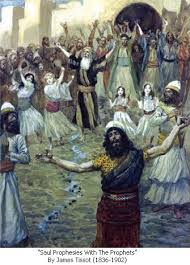
"Saul Prophesies with the Prophets", by James Tissot
“Saul Prophesies with the Prophets”, by James Tissot, ca. 1900

… as you are coming into the town you shall encounter a company of neviyim coming down from the high shrine, preceded by lute and tambourine and flute and lyre, and they shall be mitnabim. (1 Samuel 10:5)

neviyim (נְבִיאִִים) = prophets. (From the root verb niba (נבּא) = raved; conveyed the word of God. The Hebrew Bible uses the word neviyim (singular navi (נָבִיא) for both those who go into an altered state in order to experience God, and those who hear God and serve as God’s interpreters. (See my post Haftarah for Ki Tissa—1 Kings: Ecstatic versus Rational Prophets.)

mitnabim (מִתְנַבְּאִים) = speaking in an altered state (including glossolalia), often with ecstatic movement. (Also from the root niba.)

Samuel continued:

Then the ruach of God will overpower you, vehitnabita with them, and you shall be transformed into another man. (1 Samuel 10:6)

ruach (רוּחַ) = wind, spirit, overpowering mood.

vehitnabita (וְהִתְנַבִּיתָ) = and you shall babble in an altered state, move in ecstasy.

A ruach of God does overpower Saul, but it does not transform him into a better man. It merely makes a breach without killing him, so a ruach can overpower him again and again. Most often Saul is seized with angry jealousy and tries to kill David.

Maybe Saul’s original personality simply could not be transformed so that his altered states were joyful, like those of the neviyim.

David, however, enters the narrative as a charismatic, brave, and clever young man who sizes things up and plans ahead. When things go wrong, he optimistically bounces back with a new scheme.

Although David is a musician, he does not act like the neviyim until it fits his plan to bring the ark to his new capital. And after his first attempt fails because of the death of Uzza, David waits three months and then tries again.

Then David went and he brought up the ark of God from the house of Oveid-Edom to the City of David with rejoicing. …And David was whirling with all his might before God; and David had belted on a linen tunic. (2 Samuel 6:12, 6:14) 

King David’s tunic is an eifod (אֵפוֹד), two rectangles of material fastened together at the shoulders and belted at the waist. Elsewhere in the Bible an eifod is a ritual garment worn by the high priest over his robe and underpants. David is planning to take the role of high priest as well as king. But on this occasion, he does not wear anything under his tunic.

The ark arrives in Jerusalem (David not shown)
The ark arrives in Jerusalem (David, scantily dressed, is not shown)

David and all the household of Israel were bringing up the ark of God with shouts and with the sound of the ram’s horn. And the ark of God entered the City of David. And Mikhal, daughter of Saul, looked down from the window, and she saw the king, David, leaping and whirling before God, and she scorned him in her heart. (2 Samuel 6:16)

Mikhal is not only Saul’s daughter, but also one of David’s wives—arguably his most important wife at the time, since David’s marriage to her helps to legitimize his claim to Saul’s kingdom. She notices that while David is ecstatic leaping and whirling, the front piece of his tunic flaps around below the belt—revealing his lack of underpants.

Once the ark is ensconced in a tent in Jerusalem, King David makes animal offerings and blesses the people in the name of God, like a high priest. Then he hands out bread and cakes to everyone before going to his palace to bless his own household. Mikhal intercepts him at the door.

And Mikhal, daughter of Saul, went out to meet David and she said: How he was honored today, the king of Israel—who exposed himself today to the eyes of the slave-women of his servants as one of the worthless exposes himself! (2 Samuel 6:20)

And David said to Mikhal: Before God—who chose me instead of your father and instead of any of his household, to appoint me sovereign over the people of God, over Israel—before God I will laugh and play; and I will be dishonored even more than this, and I will be debased in my own eyes! But with the slave-women of whom you speak, with them I will be honored. (2 Samuel 6:21)

King David is claiming that he knows proper behavior according to members of the ruling class—and that nevertheless, he will behave in the way that wins the love of the common people. There are times when a king is better off dancing with a flapping tunic—as long as the dancing proves the king has been touched by God.

Religious ecstasy did not help Israel’s first king. King Saul lived in the moment, and if the spirit of God touched him, he acted, for good or for bad.

King David, on the other hand, always planned ahead. He whirled ecstatically in front of the ark because a joyful and over-the-top religious procession was part of his plan for uniting his people.

Sometimes it is good to get emotional over God. I have led Shabbat services with a sequence of songs designed to inspire and elevate people into joy, and even dancing.

But there must be a safe container for ecstasy. Samuel did not realize that Saul was not a safe container for the spirit of God.  And Mikhal did not realize that David had created a procession that would be a safe container for religious ecstasy.

May we all be blessed with intuitive knowledge of when it is good to let go, and when it is better to restrain oneself.

Haftarot for Vayikra & Tzav—Isaiah & Jeremiah: Useless Gods

Every week of the year has its own Torah portion (a reading from the first five books of the Bible) and its own haftarah (an accompanying reading from the books of the prophets). Last week the Torah portion was Vayikra (Leviticus 1.1-5:26) and the haftarah was Isaiah 43:21-44:23. This week the Torah portion is Tzav (Leviticus 6:1-8:36) and the haftarah is Jeremiah 7:21-8:3 and 9:22-23.

The first two Torah portions in the book of Leviticus/Vayikra consist entirely of instructions for making offerings on the altar: what each type of offering is for, what kind of animal or grain should be brought, and how the priests should process them. In Leviticus, this is the primary way to worship God, so the instruction manual is important.

The two accompanying haftarah readings both declare that offerings on God’s altar are meaningless when people are also making and worshiping idols.

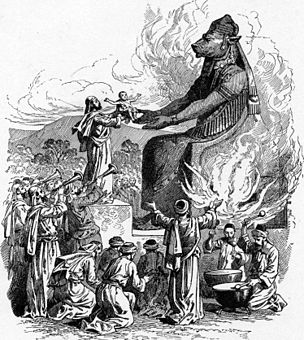
The children of Judah have done what is bad in My eyes, declares God. They have set their abominable idols in the House with My name on it, defiling it. And they have built shrines of the Tofet in the valley of Ben-Hinnom, for burning their sons and their daughters in the fire, which I did not command and which did not arise in my mind. (Jeremiah 7:30-31)

Tofet in "Bible Pictures", 1897
Tofet in “Bible Pictures”, 1897

Jeremiah decries the placement of statues of other gods right in God’s temple (“house”) in Jerusalem, as well as the practice of Tofet-worship in the valley below.  The haftarah from Isaiah points out that a craftsman might burn part of a log to burn for heat and cooking, and carve another part of the log into a statue to which he bows down and prays.

Yotzeir of an idol—

All of them are emptiness;

And what they crave

Cannot be useful.  (Isaiah 44:9)

yotzeir (יֹצֵר) = shaping, forming, fashioning.

Other gods and the statues that represent them are empty, useless. God is the yotzeir of real humans; but a human is a yotzeir of false gods.

Jeremiah agrees that worshiping other gods is useless. In a prophecy that follows this week’s haftarah, Jeremiah says:

And the towns of Judah and inhabitants of Jerusalem will go to the gods for whom they sent up offerings in smoke, and call for help. But they [these gods] will certainly not rescue them at the time of their adversity. (Jeremiah 11:12)

The haftarah in Isaiah goes a step further, and declares other gods simply do not exist.

Thus said God, king of Israel

And its redeemer, God of Armies:

I am first and I am last

And except for Me there are no gods. (Isaiah 44:6)

The haftarot in Jeremiah and Isaiah agree that God punished the people of Judah for making and worshipping other so-called gods by sending in the Babylonian army to conquer the land and destroy Jerusalem and its temple. (See my post Haftarah for Bo—Jeremiah: The Ruler of All Armies.)

Does that leave any hope for the future? Jeremiah, who witnessed the siege of Jerusalem in 589-587 B.C.E., predicts only more disaster.

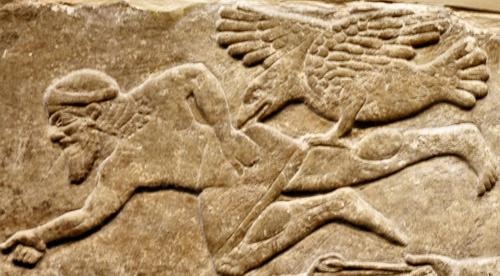
Vulture on Assyrian relief carving in Kalhu

And the carcasses of these people will be food for the birds of the sky and for beasts of the earth, and there will be no tomorrow. (Jeremiah 7:33)

And death will be preferable over life for all the remainder of those remaining from this wicked family, in all the places where I will push them… (Jeremiah 8:3)

But chapters 40-66 of the book of Isaiah were written at least 50 years later, after the Babylonian empire had been replaced by the Persians. Although the Jews did not get an independent kingdom again, the new Persian emperors granted them religious freedom and let those who wished go back to Jerusalem and build a second temple for their god.

The haftarah from Isaiah interprets this Persian policy as God’s intervention. After criticizing the Israelites for their idolatry, the haftarah says:

I have wiped away like a mist your rebellion

And like a cloud your transgressions.

Return to Me, for I have reclaimed You. (Isaiah 44:22)

How can they return? What should they do that is more important than making offerings at a rebuilt altar?

This week’s haftarah from Jeremiah says they should follow God’s directions for the right way to behave in the world.

Heed My voice, and I will be your god and you will be My people; but you must walk on the entire path that I command you, so that it will go well for you. (Jeremiah 7:23)

Last week’s haftarah from Isaiah says they should praise God to the rest of the world.

This people yatzarti for Myself:

My praise they should report! (Isaiah 43:21)

yatzarti (יָזַרְתִּי) = I formed, I shaped, I fashioned. (From the same verb as yotzeir above.)

Instead of forming statues of empty, useless gods, the people should report what the real God is.

But the Israelites of Judah turned deaf (according to Jeremiah) and mute (according to Isaiah) where God was concerned.

*

We still make idols for ourselves, 2,600 years later, and we still worship “gods” that are ultimately useless. Some people pursue power as if it were the source of life—until their careers or families crash and they discover they live in a spiritual exile. Others dedicate themselves to accumulating or spending money—until a disaster reveals how they devoted so much time and energy to something so transient. We do not need an anthropomorphic god to send an army against us; serving the false gods we create carries its own intrinsic punishment, preventing us from leading full and meaningful lives.

A Jeremiah can point out that the wrong path leads to a bitter death. Sometimes this is the slap in the face we need to wake up.

But an Isaiah can give us hope for a second chance, however late in life. If we return to God—if we return of a life of appreciating reality (one form of praising God), appreciating one another, remembering we are only human, and rejoicing when we come home to our better selves—then the divine spirit will wipe away our former false worship like a mist, like a cloud. We can change, and true meaning can return to our lives.

Haftarat Pekudei—1 Kings: More, Bigger, Better

Every week of the year has its own Torah portion (a reading from the first five books of the Bible) and its own haftarah (an accompanying reading from the books of the prophets). This week the Torah portion is Pekudei (Exodus 35:1-40:38). The haftarah in the Sefardi tradition is 1 Kings 7:40-50; the haftarah in the Ashkenazi tradition is 1 Kings 7:51-8:21.

More, bigger, better.

The tent-sanctuary and its courtyard, which Moses assembles at the end of the book of Exodus in this week’s Torah portion, Pekudei, are small and easily disassembled and reassembled. This is a necessity, since the Israelites must continue their journey to Canaan, erecting the sanctuary again every time they pitch camp.

Reconstruction of First Temple,
Bible Museum, Amsterdam

But the first Israelite temple1 in Jerusalem and its courtyards, which King Solomon completes in this week’s haftarah, is a permanent structure. And it must be considerably larger, with more appurtenances, to accommodate not only a larger crowd of worshipers, but a larger number of priests and assisting Levites.

Sanctuary

People from Noah to Moses build altars to burn sacrifices for the God of Israel. But at the end of the book of Exodus, Moses assembles the first sanctuary or shrine: a structure with a roof, walls, and an entrance. This sanctuary is a small tent: 10 by 30 cubits (about 15 by 45 feet or 4½ by 13½ meters).2

The tent sanctuary needs to be small because it has to be disassembled and reassembled every time the Israelites travel to a new campsite . But there is enough room inside for the only people who are allowed to enter: Moses, the high priest Aaron, and Aaron’s sons.

The temple King Solomon builds in Jerusalem, described in both options for this week’s haftarah, is a tall building of stone and cedar, its footprint is 20 by 60 cubits (about 30 by 90 feet or 9 by 27 meters).3 Solomon’s temple is four times as big as Moses’ tent sanctuary—and it needs to be. As the main temple in the capital of a nation-state, it must accommodate many priests and their Levite assistants.

Holy of Holies

Both Moses’ sanctuary and Solomon’s temple are divided into two rooms: a main hall and a smaller chamber in back for the holy of holies. King Solomon adds a front porch with two gigantic bronze columns.

The “Holy of Holies” the innermost chamber in both the tent and the temple, contains only the ark of the covenant and two golden cherubs/keruvim, hybrid beasts with wings. (See my post Terumah: Cherubs are Not for Valentine’s Day.)

Ark with Keruvim, one possibility
Ark with Keruvim

In the Tent of Meeting, the keruvim are part of the lid of the ark, one hammered out of the solid gold at each end. Their wings tilt toward each other, enclosing an empty space above the lid, a space from which God sometimes speaks. (See my post Pekudei & 1 Kings: A Throne for the Divine.)

Since the ark is only about four feet long, a keruv wing cannot be more than two feet long. But in Solomon’s temple, each keruv is about fifteen feet tall and has a fifteen-foot wingspan.4 An earlier passage in the first book of Kings describes how they are carved out of olive wood and overlaid with gold, then set up in the back chamber so that each one touches a wall with one wingtip and the tip of the other keruv’s wing with the other. Since the ark is smaller than these statues, it fits underneath them.

The priests brought in the ark of the covenant of God to its place, to the inner chamber of the bayit, to the holy of holies, to underneath the wings of the keruvim. (1 Kings 8:6)

It is not clear whether the inner chamber of the temple now contains four keruvim—the small pair on the ark and the large pair standing on the floor—or just the two large ones. But either way, the principle of “more, bigger, better” applies.

Main room of sanctuary

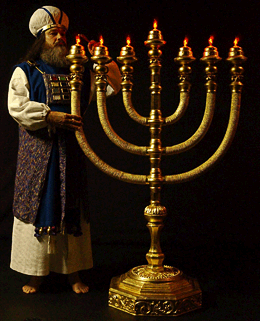
The main room of Moses’ sanctuary contains only three sacred ritual objects: a gold incense altar, a gold-plated table for display bread, and a solid gold lampstand with seven oil lamps.

The main hall of Solomon’s temple has the same three items, also gold—but the lampstands and perhaps the tables have multiplied.

Menorah
Menorah

When Moses assembles everything in this week’s Torah portion,

…he put the lampstand in the Ohel Mo-eid opposite the table, on the south side of the sanctuary. And he lit up the lamps before God, as God had commanded Moses. (Exodus 40:24-25)

Instead of placing one lampstand on the right side of the main hall, King Solomon’s crew positions five lampstands on each side.

And Solomon made all the vessels that were in the House of God, the gold altar and the gold table on which was the display bread and the pure gold lampstands, five on the right side and five on the left side in front of the inner chamber, and the gold blossom [decorations] and lamps and wick cutters … (1 Kings 7:48-49)

In the first book of Kings, Solomon’s temple contains only one bread table.

And Solomon made all the equipment that was in the bayit of God: the gold altar and the gold table that had the display bread upon it… (1 Kings 7:48)

But by the fourth century B.C.E., when the two books of Chronicles were written, the bread table had multiplied.

And he made ten tables and he set them in the main hall, five on the right side and five on the left side; and he made a hundred gold sprinkling-basins. (2 Chronicles 4:8)

After all, if one table is good, ten tables must be better.

Wash basins in courtyard

Like most religions in the ancient Near East, the religion outlined in the Hebrew Bible makes a distinction between public worship and the rituals conducted by priests. The public place of worship is the open courtyard in front of the sanctuary, where animals and grain products are offered at the altar. Only priests are allowed to go inside the tent or temple.

When priests move from serving at the altar to serving inside the tent or building, they stop to wash their hands and feet. So when Moses is setting up the portable sanctuary for the first time,

… he put the basin between the Ohel Mo-eid and the altar, and he place there water for washing. And from it Moses and Aaron and his sons washed their hands and their feet. When they came into the Ohel Mo-eid and when they approached the altar they washed, as God had commanded Moses. (Exodus 40:30-32)

Ohel Mo-eid (אֹהֶל מוֹעֵד) = Tent of Meeting.  (From ohel (אֹהֶל) = tent and mo-eid (מוֹעֵד) = meeting, meeting place, appointed time or place.)

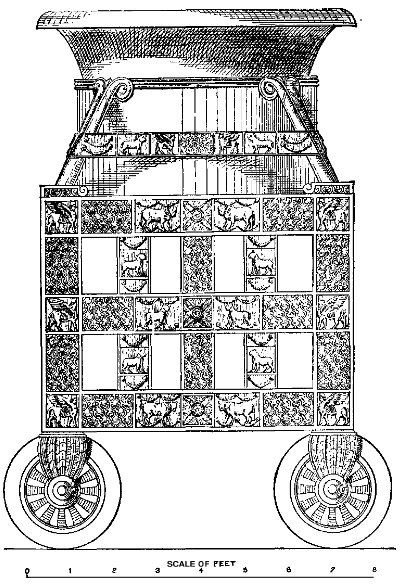
Basin on wheeled stand, Solomon's Temple
One of ten basins
in Solomon’s Temple

The courtyard in front of Solomon’s much bigger temple has a huge bronze “sea” resting on twelve bronze oxen. (See last week’s post, Haftarah for Vayakheil: Symbolic Impressions.) In addition to this much more impressive basin, Solomon’s master artisan makes ten smaller bronze basins on elaborate wheeled stands covered with engraved spirals, cherubim/keruvim, lions, and palm trees.

And he placed five stands at the entrance of the bayit on right and five at the entrance of the bayit on the left… (1 Kings 7:39)

bayit (בָּיִת) = house, important building, household.

Why settle for one small basin when you could have a giant “sea” along with ten basins?

When the temple is complete with all its furnishings, King Solomon proudly declares:

I certainly built an exalted bayit for You, an abode for you to rest in forever! (1 Kings 8:13)

When it comes to religious ritual objects, is more or bigger really better?

Anything made of precious metals would have provided a locus for worship that met the expectations of the Israelites Moses led through the wilderness. In Exodus, thanks to the tent sanctuary and its ritual objects, they no longer feel the need for a golden calf. And if the ritual objects were too large or too many, they would be too hard to transport through the wilderness.

The capital of a new nation-state, however, needs not only a large and permanent temple, but also a large and glittering display to impress both foreign visitors and the nation’s citizens with the power of its religion. So in front of King Solomon’s temple are gigantic bronze columns, the oversized bronze “sea” on twelve bronze oxen, ten bronze lavers on elaborate stands, and a host of priests walking in and out of the building.  Inside, there are enough lampstands and tables to accommodate those priests as they perform the rituals, which would help reconcile them to a centralized religion.


In my own life, I have responded to religious cues on both scales, small and large. I know the calm, centering effect of lighting two candles for Shabbat, and the hushed tenderness of reading from a Torah scroll in an otherwise unremarkable room.  I also know the awe I feel when I stand at the ocean, in a forest of tall trees, or in a medieval cathedral (even though as a Jew, I am a foreign visitor there).

I do not want to lose either the personal connection of rituals with small sacred things, or the impersonal awe of encounters with vastness.  Both a tent and a temple are exalted places where God might rest.


  1. The Jebusites who occupied Jerusalem before King David conquered part of it probably had their own shrine. Genesis 14:17-20 mentions a Jebusite priest-king named Malki-tzedek who blesses Abraham.
  2. Exodus 26:1-6.
  3. 1 Kings 6:2.
  4. 1 Kings 6:23-26.

Haftarat Vayekheil—1 Kings: Symbolic Impressions

Every week of the year has its own Torah portion (a reading from the first five books of the Bible) and its own haftarah (an accompanying reading from the books of the prophets). This week the Torah portion is Vayakheil (Exodus 35:1-40:38). The haftarah in the Sefardi tradition is 1 Kings 7:13-26. (The haftarah in the Ashkenazi tradition is 1 Kings 7:40-50.)

Both Moses’ tent sanctuary and Solomon’s temple have a place for priests to wash their hands and feet before they enter the holy building. In this week’s Torah portion, Vayakheil, the master craftsman Betzaleil makes a simple but symbolic wash-basin. (See my blog post Pekudei: Basin of Mirrors.)

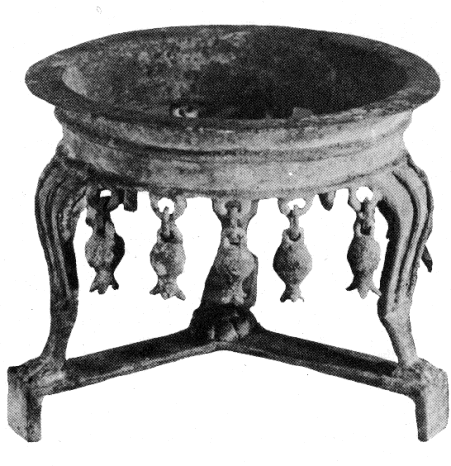
Kiyor on stand, stone, Megiddo
Kiyor on stone stand, Megiddo

And he made the kiyor of bronze and its stand of bronze from the mirrors of the army of women who mobilized at the entrance of the Tent of Meeting. (Exodus 38:8)

kiyor (כִּיִוֹר) = basin, laver.

Solomon’s temple has ten such basins, cast out of regular molten bronze rather than mirrors, perched on elaborate wheeled stands. But King Solomon also has his master bronze artisan cast a water container so huge it is called a sea.

Then he made the yam of cast metal, ten cubits from its [lower] rim up to its circular rim, five cubits high, and a measuring-line of thirty cubits around its circumference. (1 Kings 7:23)

yam (יָם) = sea; in Canaanite religion, the name of the god of the sea.

This tub of water would be more than 14 feet (4 meters) across and more than 7 feet (2 meters) high. Since it would be impossible to climb into for bathing, commentators have concluded it had an outlet like a spigot at the bottom, to pour water into a shallower container for washing.

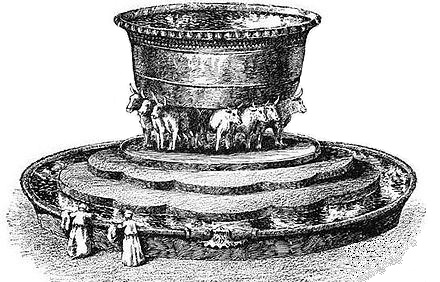
Bronze "Sea", artist's rendering from Encyclopedia Judaica
Bronze “Sea”, artist’s rendering from Encyclopedia Judaica

And gourd ornaments were below its rim all around the circle, ten per cubit, encompassing the yam all around; two rows of the gourd ornaments, cast in one piece with it. It was standing on twelve oxen: three facing north and three facing west and three facing south and three facing east. And the yam was on top of them, and all of their hind parts were inward. (I Kings 7:24-25)

The most striking difference between the yam in front of Solomon’s temple and the kiyor in front of Moses’ tent sanctuary is that the yam rests on twelve bronze cows—probably life-size—instead of on an ordinary framework.

Moses discourages the molding of any real animals (as opposed to the keruvim, the composite fantasy animals whose wings are spread over the ark). He smashes and grinds up the golden calf that Aaron makes in the book of Exodus. In a passage after this week’s hafatarah, the first book of Kings criticizes King Jereboam of Israel for putting golden calves in temples at Dan and Bethel.

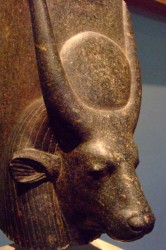
Hathor
Hathor

This may have been a reaction to cow-worship in other religions. The religion of the Hittites to the north included a pair of bulls who carried the weather god Teshub on their backs. To the south, Egyptians worshipped the bull as Apis, the avatar of the gods Ptah and Osiris, and the cow as the goddess Hathor.

Yet throughout the bible, the twelve bronze oxen supporting the yam in front of Solomon’s temple are treated as perfectly acceptable.

Is the huge tub of water in front of Solomon’s temple called the yam simply because it is so large, or does it evoke the Canaanite god named Yam? Are the twelve oxen simply decorative, or do they inspire awareness of bull and cow worship?

Throughout history, people have viewed symbols of the divine in two ways.  Some people consider a symbolic object or building as a way to evoke the ineffable. Its beauty and impressiveness are like an arrow pointing to the divine, and its specific details (such as fruit, water, architecture that reaches toward the sky) allude to ideas about the divine.

Other people see symbolic things in a more concrete way.  A god visits a building or enters a statue. Carrying out rituals in sacred buildings with sacred objects is essential for pleasing the god.

Either way, symbols are important—and often enduring. Even today, Mormons conduct baptisms and sealings in copies of the yam perched on twelve oxen.

One question remains, for King Solomon and for us today:  Which symbols from other cultures and from the history of our own culture or religion can enhance our lives, and which symbols should be discarded?

Anyone want a bronze ox?

Haftarat Ki Tissa—1 Kings: Ecstatic versus Rational Prophets

Every week of the year has its own Torah portion (a reading from the first five books of the Bible) and its own haftarah (an accompanying reading from the books of the prophets). This week the Torah portion is Ki Tissa (Exodus 30:11-34:31), and the haftarah is 1 Kings 18:1-39.

And Elijah said to the people: “I am the only navi left for God, and the neviyim of the Baal are 450 men.” (1 Kings 18:22)

navi (נָבִיא) = prophet. (From the root verb niba (נבּא) = raved; conveyed the word of God.)

neviyim (נְבִיאִִים) = plural of navi.

The Hebrew Bible uses the word navi for two kinds of people: those who go into an altered state in order to experience God, and those who hear God whether they want to or not.

Prophetic ecstasy

The first book of Samuel introduces bands of Israelite prophets who go into an altered state and speak in ecstasy, but do not hear or convey God’s commands. Saul joins one of these bands right after the prophet Samuel has anointed him as the future king of the Israelites.1 After Saul has been king for a few years, Samuel anoints David as king behind Saul’s back. Eventually Saul suspects David will supplant him. David flees to where Samuel lives, and Saul sends men to seize David there.

And they saw a group of the neviyim nibim, and Samuel standing stationed over them. And the spirit of God came over the messengers of Saul, vayitnabu, even they. And they told Saul, and he sent other messengers, vayitnabu, they also. Then Saul sent a third group of messengers, vayitnabu, they also. (1 Samuel 19:20-21)

nibim (נִבְּאִים) = speaking in ecstasy; raving.

vayitnabu (וַיִּתְנַבְּאוּ) = and they spoke in prophetic ecstasy; and they raved as if insane.

Next Saul goes himself in search of David.

And he walked there, to Nayot in Ramah, and the spirit of God came over him, even him, and he continued walking, vayitnabei until he entered Nayot in Ramah. Then he stripped off his clothes, even he, vayitnabei, even he, in front of Samuel, and he fell naked… (1 Samuel 19:23-24)

vayitnabei (וַיִּתְנַבֵּא) = and he spoke in prophetic ecstasy; and he raved.

Rational prophets

Moses by Ivan Kramskoy, 1861
Moses, by Ivan Kramskoy,
1861

In the book of Exodus/Shemot, Moses is the prophet who hears God directly, whenever God wants to speak to him. When God first speaks to him at the burning bush, Moses tries to turn down God’s mission, but later he gets used to passing on God’s words to Pharaoh and the Israelites. God also uses Moses to signal miracles, both by words and by raising his staff or his hand.  He is a full-service prophet, but he never goes into a prophetic ecstasy.

The book of Numbers/Bemidbar gives us an example of a non-Israelite prophet who does not rave in ecstasy, but hears and must obey God’s commands. First Bilam hears God’s words in dreams, but by the end of his story God is channeling poetic prophecies to him directly. (See my post Balak: Three Places to Be Blessed.)

The two kinds of neviyim could be easily distinguished; one kind is overcome by God’s spirit and speaks and acts like a madman, while the other kind quietly listens to God’s words and then speaks and acts like a rational person.

One rational prophet versus 450 ecstatic prophets

In this week’s haftarah Elijah is a navi in the tradition of Moses: he hears God while he is in his normal consciousness, he tells God’s words to other people, and he serves as a conduit for God’s miracles. He also thinks up a plan to achieve God’s goal of eliminating the worship of other gods.

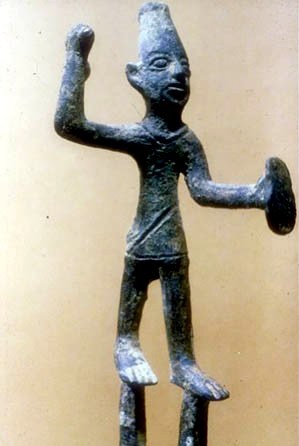
Bronze figure of Baal holding thunder and lightning

 At this time, the northern kingdom of Israel is ruled by King Ahab, who welcomes the worship of the Phoenician gods Baal (a god of weather, especially lightning and rain) and Asherah (a mother goddess). Ahab’s wife Jezebel, daughter of a Phoenician king, supports hundreds of prophets who serve these two gods. She wants to exterminate all the prophets of the God of Israel.

Since Baal is the god in charge of weather, Elijah warns Ahab that it will not rain again until he, the servant of the God of Israel, says so. Then Elijah flees and hides east of the Jordan while Israel suffers three years of drought.

This week’s haftarah begins:

And it was much later, and the word of God happened to Elijah in the third year, saying: Go, appear to Ahab; then I will send rain over the face of the earth. (1 Kings 18:1)

When Elijah confronts King Ahab again, he requests a contest.

Now send, gather all Israel to me at Mount Carmel, and the 450 neviyim of the Baal and the 400 neviyim of the Asherah who eat at the table of Jezebel. (1 Kings 18:19)

Instead of killing Elijah on the spot, the king arranges a contest between God and Baal. (The neviyim of the goddess Asherah drop out of the story at this point.) Ahab probably expects Elijah and the God of Israel to lose. After all, God will have only one prophet, Elijah; Baal will have 450. On Mount Carmel, God’s altar is in ruins; Baal’s altar is in good repair. The winning side will be the one whose god who answers with fire; lightning is one of Baal’s specialties.

The 450 prophets of Baal, on the other hand, are neviyim who induce an altered state of prophetic ecstasy in themselves.

Once everyone has gathered at Mount Carmel, Elijah addresses the people:

How long will you keep hopping back and forth between two crutches? If God is the god, follow Him; but if it is the Baal, follow him!”  And the people did not answer a word. (1 Kings 18:21)

fire

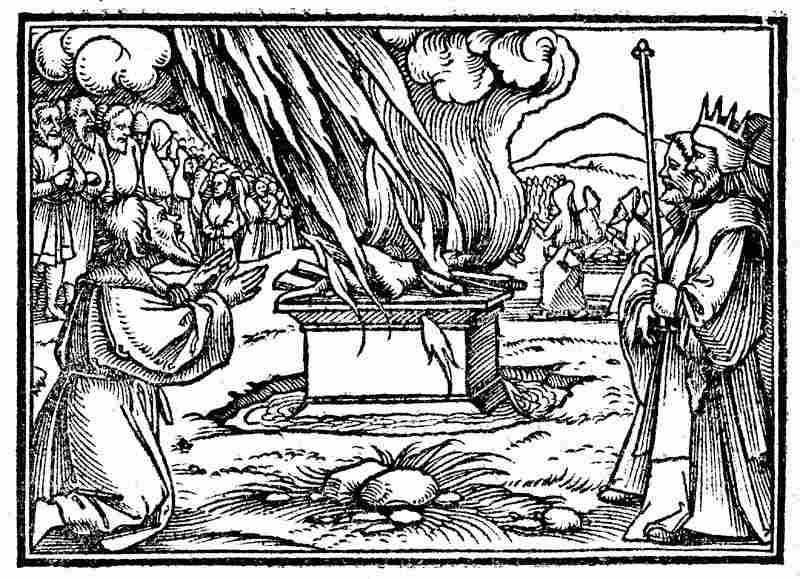
So the contest begins.  Each side gets its altar, a bull to butcher, and a stack of wood. When each sacrifice is prepared, the prophets will call on their gods.  The Israelites agree that the god who answers by setting the wood on fire will be their god henceforth.

Elijah lets the neviyim of Baal go first.

…and they called in the name of the Baal, saying: “Answer us!” But there was no voice and there was no answer. Then they hopped around on the altar that was prepared. And at noon Elijah mocked them, and said: “Call in a louder voice! After all, he is a god. Maybe he is chatting, or maybe he is preoccupied, or maybe he is on the road. Maybe he is sleeping, and he will wake up.

And they called in a louder voice, and they cut themselves with daggers and with lances, as is their custom, and blood poured out over them. And noon passed, vayitnabu, until the time of the afternoon offering, but no one answered and no one paid attention. (1 Kings 18:26-29)

The neviyim of Baal did everything they could to work themselves into a prophetic ecstasy, but their speech sounded like insane raving—especially in light of Elijah’s mockery and the lack of response from Baal.

Then Elijah repaired the altar for the God of Israel, laid out his bull offering on the wood, and had twelve jugs of water poured over it, so everyone would see that no ordinary fire could burn there. Then he said:

Elijah and Ahab at Mt. Carmel, Zurich Bible
Elijah and Ahab at Mt. Carmel,
Zurich Bible

God, god of Abraham, Isaac, and Israel, today may it be known that You are elohim in Israel and I am Your servant, and at Your word I did all these things. Answer me, God, answer me, and this people will know that You, God, are the god…” And the fire of God fell, and it ate up the rising-offering and the wood and the stones and the dirt, and it licked up the water in the trench. And all the people saw, and they fell on their faces and said: “God, He is the elohim! God, He is the elohim!” (1 Kings 18:36-39)

Later that day, it finally rains.

And the winner is … not only the God of Israel, but also his rational navi.


Does this mean the bible prefers non-ecstatic prophets?  Not quite. The bands of raving Israelite neviyim are not criticized in either the book of Numbers or the first book of Samuel. There is nothing wrong with entering an altered state in order to experience God’s presence.

But experiencing God’s presence is different from hearing God’s words. A navi like Moses or Elijah hears God whether he wants to or not, and must keep his head in order to act on God’s words, whether he is passing on divine information, signaling a miracle, or, in this week’s haftarah, elaborating on a hint from God (“Go, appear to Ahab; then I will send rain over the face of the earth“) in order to make the right things happen.

May all of us who engage in religion remember that experiencing God in an altered state, or even in an especially good worship service, is not the same as serving God. To truly serve God, we must listen for the divine word or inspiration during our everyday lives, and then think carefully before we act.


  1. 1 Samuel 16:1-13.

Haftarat Tetzaveh—Ezekiel: The Meaning of Humiliation

Every week of the year has its own Torah portion (a reading from the first five books of the Bible) and its own haftarah (an accompanying reading from the books of the prophets). This week the Torah portion is Tetzaveh (Exodus 27:20-30:10), and the haftarah is Ezekiel 43:10-27.

This week’s haftarah begins when God tells the prophet Ezekiel:

You, son of humankind, describe the House to the household of Israel, veyikalmu because of their sins, and they will measure off its plan. And if nikhlemu because of everything that they have done, make known to them the design of the House and its plan …(Ezekiel 43:10-11)

veyikalmu (וְיִכָּלְמוּ) = and they will be humiliated, embarrassed, publicly disgraced. (From the root k-l-m, כּלם, sometimes translated as “ashamed” but actually referring to public humiliation regardless of actual guilt or innocence.)

nikhlemu (נִכְלְמוּ) = they are humiliated, etc. (Also from the root k-l-m.)

“The House” refers to a building for the God of Israel: Ezekiel’s vision of a new temple to replace the one that King Solomon erected and King Nebuchadnezzar of Babylon razed when he destroyed Jerusalem in 587 B.C.E.

Temple sizes
Temple sizes

The two clauses about being humiliated are difficult to interpret, since in the first one God predicts the Israelites will be humiliated, and in the second one God says “if they are humiliated”. According to the standards of the sixth century B.C.E., there is no question that the Israelites of Judah have been publicly humiliated by the time of this prophecy, dated to the fourteenth year after the fall of Jerusalem.

The kingdom of Judah had been a vassal state of the Neo-Babylonian Empire, paying annual tribute to King Nebuchadnezzar but managing its internal affairs as an independent country. Then King Yehoyachim of Judah rebelled, and the Babylonian army besieged his capital, Jerusalem. His son Yehoyachin (a.k.a. Jeconiah) surrendered in 597 B.C.E. and saved the city. Nebuchadnezzar deported him and about 3,000 of Jerusalem’s leading citizens—including Ezekiel—to Babylon. Nebuchadnezzar installed Yehoyachin’s uncle Zedekiah as Judah’s king, and Judah resumed its status as a Babylonian vassal state.

The Flight of the Prisoners, by James J.J. Tissot, 1886 (capture of Jerusalem in 587)

The Israelites remaining in Judah still had their own king, and a temple for their own god. But eight years later Zedekiah rebelled (after making a secret treaty with Egypt), and the Babylonian army surrounded Jerusalem again. This time the siege ended in the capture of Jerusalem, the execution of Judah’s last king, and the destruction of the capital and its temple—in other words, the complete humiliation of Judah.

What caused this humiliation? One might blame Nebuchadnezzar for his determination to expand his empire, or King Zedekiah for foolishly rebelling, or even Egypt for marching toward Judah at Zedekiah’s instigation, then succumbing to the Babylonian army before they reached Jerusalem.

But in the passage above, God says twice that the humiliation of the Israelites happened because of their own sins—and God is not referring to their kings’ rebellions against Babylon.

This week’s haftarah comes in the middle of Ezekiel’s fifth and final vision. This vision begins when a divine guide wafts Ezekiel to Jerusalem and shows him around a new and larger temple, measuring everything as he goes. Then the glory of God appears, and God tells Ezekiel:

Son of humankind, [this is] the place of My throne and the place of the soles of My feet, where I will dwell in the midst of the children of Israel forever. But the house of Israel must not again defile My holy name, neither they nor their kings, by their prostitution [with other gods] and with their kings’ lifeless idols in their shrines. (Ezekiel 43:7)

The sin of the Israelites is building shrines for idols and other gods—and in the worst possible place.

When they placed their thresholds next to My threshold and their doorposts beside My doorposts, [with only] the wall between Me and them, and they defiled My holy name with their taboo actions, then I consumed them in My anger. (Ezekiel 43:8)

God decided to destroy Jerusalem and its temple because of the people’s apostasy, and used the Babylonian army to do it.

Jeremiah, who was still prophesying in Jerusalem when Ezekiel prophesied in Babylon, also said that God arranged the destruction of Jerusalem, using Nebuchadnezzar as a tool. According to both prophets, God decides which army wins in every battle involving Israelites. (See my post Jeremiah: The Ruler of All Armies.) Nebuchadnezzar, naturally, did not know that the God of Israel was using him to punish the Israelites.

Today this prophetic point of view seems parochial and narrow-minded. Even if God did micro-manage every battle and siege, why should all of God’s plans be about rewarding or punishing the Israelites? What about all the other peoples in the world?

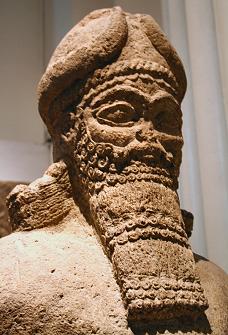
Nabu, from temple at Kalah

Other peoples had their own, albeit inferior, gods. For example, the chief gods of the Neo-Babylonian Empire were Nabu and Marduk. The Bible maintains that the God of Israel was more powerful than all other gods, and that God chose the Israelites to be “His” people and commanded them not to worship any other gods. The Torah often compares this exclusive relationship between the God of Israel and the Israelites to a marriage in which the Israelites let down God by failing to be monogamous.

Monotheism, the idea that there is only one god in the universe, only creeps into the Bible in a few of the many books written during the Babylonian exile in the sixth century B.C.E. The book of Ezekiel, however, sticks to the older point of view that the God of Israel is the most powerful god, not the only god.  Therefore the book of Ezekiel is Judeo-centric; God interferes in the world primarily to reward or (more often) punish the Israelites.

And if nikhlemu because of everything that they have done, make known to them the design of the House and its plan——its exits and its entrances, and its entire plan, and all its decrees and all its plans and all its teachings; And write it down before their eyes so they will observe its entire plan and all its decrees, and do them. (Ezekiel 43:11)

*

For those of us who have a more monotheistic or universal idea of God, I propose a radical rereading of Ezekiel 43:11:

And if nikhlamta because of everything that you have done, discover for yourself the design of the House and its plan—

If you feel your life is unsatisfactory, even humiliating, and suspect it is because you have done something wrong, then think of your life as a temple for God’s presence.

—its exits and its entrances, and its entire plan,

Where in your life do you exit from the presence of God? Where do you enter it? What is your overall plan for living with God?

and all its decrees and all its plans and all its teachings;

What principles do you follow as if they are divine decrees? What teachings help you to approach God?

And write it down before your own eyes so you will observe its entire plan and all its decrees, and do them. (Ezekiel 43:11)

And undertake a practice, such as prayer or study, that will keep reminding you of your plan for living in God’s presence and the principles you are following. Then make it your life.

Haftarat Terumah—1 Kings: Solomon versus Shalom

Every week of the year has its own Torah portion (a reading from the first five books of the Bible) and its own haftarah (an accompanying reading from the books of the prophets). This week the Torah portion is Terumah (Exodus 25:1-27:19), and the haftarah is 1 Kings 5:26-6:13.

To rule as a king, one needs administrators, a standing army, and a capital city. And in the Ancient Near East, the capital had to have a temple for the chief god of the kingdom.

When David conquers Jerusalem (in the first book of Samuel) to be the capital of his new kingdom, he brings in the two objects that are the most sacred to the Israelites: the Tent of Meeting and the Ark of the Covenant. But he leaves building the temple to his son and heir, Solomon.

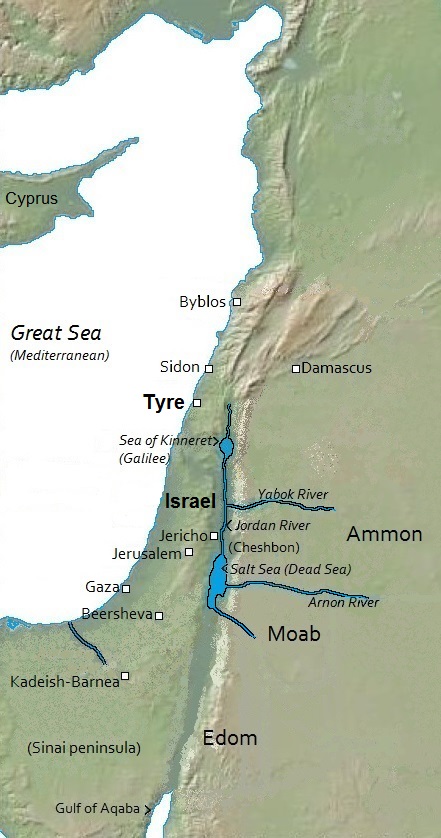
map 950 BCE

King Solomon has stone quarries and can command his citizens to do forced labor. But Israel has neither tall timber nor craftsmen skilled with wood. So he makes a pact with Chiram, king of the Phoenician city-state of Tyre.

And it happened: Chiram gave to Shlomoh cedar and cypress wood, all he wanted. And Shlomoh gave to Chiram 20,000 kor of wheat for his household and 20 kor of beaten oil. This Shlomoh gave to Chiram year after year. And God had given wisdom to Shlomoh, as [God] had spoken to him. [There was] shalom between Chiram and Shlomoh, and the two of them cut a covenant. (1 Kings 5:24-26)

Shlomoh (שְׁלֹֹמֹה) = Solomon in English, Suleyman in Arabic. (From the root verb shilam (שִׁלָם) = complete; make amends, repay, fulfill; restore to wholeness.)

Shalom (שָׁלֹם) = peace, wholeness, intactness, well-being. (Also from the root shilam.)

In the tenth century B.C.E., the time of Shlomoh and Chiram, there were two kinds of treaties between kingdoms in the Near East. In one model, the weaker kingdom was a vassal of the stronger one, and paid tribute to it (see my post Jeremiah: The Ruler of All Armies). In the other, two equal kingdoms made a treaty or covenant for trade and mutual defense.

The treaty between King Shlomoh of Israel and King Chiram of Tyre specified that Tyre would provide wood for all of Shlomoh’s building projects in Jerusalem, and Israel would provide annual large shipments of wheat and olive oil to Tyre. Although the Bible does not mention a clause about mutual defense, it does state that there was shalom between the two kings, which implies that they had at least agreed to mutual non-aggression.

And the king, Shlomoh, imposed a mas upon all of Israel, and the mas was 30,000 men. And he sent 10,000 a month to Lebanon; following a month in Lebanon they were two months at home, in turns … And Shlomoh had 70,000 burden-carriers and 80,000 quarriers in the hills … The king commanded, and they pulled out great stones, valuable stones, to lay the foundation-wall of the House: hewn stones. (1 Kings 5:27-31)

mas (מַס) = conscription for forced labor.

The first mas described in the Bible is the forced labor of the Israelites in Egypt. Although it was an accepted practice for a king to impose a temporary mas on his own citizens, in this case Shlomoh made 180,000 Israelites neglect their own land to do heavy labor for a full year. Then after two years at home, they had to go back to cut and haul materials for the temple, for King Shlomoh’s palace, and for several other large new buildings in Jerusalem.

Limestone quarry under Jerusalem: four stones partly cut out

The text also emphasizes that the stones for the foundation wall of the temple are hewn: huge blocks of stone cut out and smoothed.

And when the House was built, it was built of shleimah stone, quarry stone; but hammers or the axe, any tool of iron, was not heard in the House when it was built. (1 Kings 6:7)

shleimah (שְׁלֵמָה) = complete, whole, uninjured, undivided, peaceable. (Plural: shleimot.)

The king wants to avoid the sound of an iron tool on the site of the new temple because of an old law about altars:

If you make an altar of stones for Me, you must not build it of hewn stones; if you have wielded your sword upon it, you have profaned it. (Exodus 20:22)

And you shall build there an altar for God, your god, an altar of stones; you must not wield iron upon them. You must build the altar for God, your god, of shleimot stones. (Deuteronomy 27:5-6)

King Shlomoh’s laborers are building the foundation-wall of the temple, not an altar. However, the temple will enclose a space even more sacred than the altar. So the king orders the stones to be cut at the quarry, and merely set in place at the temple site. Shlomoh’s attempt to follow the law may actually subvert it, since the stones are hewn.

Similarly, Shlomoh’s treaty with Chiram of Tyre has two purposes: to promote shalom, peace, between the two kingdoms, and also to build a temple that will unite the Israelites under a single god at a single holy place so they will be shaleim, intact, one people.

Instead the annual wheat and oil shipments to Tyre become a burden on the farming population.  And the mas imposed on so many Israelite men results in complaints and rebellion. Shortly after King Shlomoh’s death, northern Israel secedes from southern Judah. (See my post Terumah & 1 Kings: Tent versus Temple.)

Are the stones of the temple wall really shleimot, whole and undivided, when they are cut out of the quarry with hammers and shaped with axes?

Does Shlomoh’s kingdom really live in shalom, peace and wholeness, when building a temple in Jerusalem leads to oppression, revolt, and secession?

Haftarat Mishpatim—Jeremiah: False Freedom

Every week of the year has its own Torah portion (a reading from the first five books of the Bible) and its own haftarah (an accompanying reading from the books of the prophets). This week the Torah portion is Mishpatim (Exodus 21:1-24:18), and the haftarah is Jeremiah 34:8-22.

Town by town, city by city, the armies of King Nebuchadnezzar took over the land of Judah. The country could have remained a semi-independent vassal of Babylon, keeping its own temple and running its own internal affairs. But the last three kings of the Israelites had rebelled against their overlord. And each time Nebuchadnezzar’s retaliation had been more severe.

King Nebuchadnezzar
King Nebuchadnezzar

The prophet Jeremiah kept warning the kings of Judah to keep paying tribute to Babylon, but they never listened to him. Instead they flirted with Egypt. Only Jeremiah realized what was obvious to the Babylonians: that when Pharaoh Nekho lost the big battle with Nebuchadnezzar at Carchemish in 605 B.C.E., and lost all his vassal states to the new Babylonian Empire, Egypt was finished as a world power.

When King Yehoyakhim of Judah stopped paying tribute to Babylon in 597 B.C.E., Nebuchadnezzar besieged Jerusalem until it surrendered. When King Zedekiah stopped paying tribute eight years later, after secret negotiations with Egypt, the Babylonian army surrounded Jerusalem again.

This time Nebuchadnezzar also conquered the rest of Judah, town by town and city by city.

Trapped in Jerusalem, unable the send their slaves out to the fields to plant and harvest, the leaders of Judah were getting desperate. Soon their city would fall, and they would all be killed or, at best, deported to Babylon. Only a miracle could save them.

The god of Israel had made miracles for the Israelites before. The priests were still serving God in the temple. What more was needed? How could they win God’s favor again?

In this week’s hafatarah, it occurs to King Zedekiah that the people of Judah have been ignoring one of God’s commands:

If your brother or sister Hebrew sells himself to you, then he shall serve six years, and in the seventh year you shall let him go chafshi from you. And when you let him go chafshi from you, you shall not let him go empty-handed… (Deuteronomy/Devarim 15:12-13)

chafshi (חָפְשִׁי) = emancipated, freed. (Plural: chafshim.)

In ancient kingdoms of Israel and Judah, men who could not pay their taxes or other debts sold themselves or their children as temporary slaves. After six years of service, their owners were required to set them free, and give the men a food supply and the means to make a living.

But the slave-owners of Judah had let the years pass without emancipation.

… the king, Zedekiah, cut a covenant with all the people who were in Jerusalem, to proclaim for them a dror: for each man to let go of his male slave and his female slave, the Hebrew male and the Hebrew female, chafshim, so that no one would be enslaved by his fellow Yehudi. And they heeded [the proclamation], all the officers and all the people who had entered in the covenant … they heeded and they let them go. (Jeremiah 34:8-10)

dror (דְּרוֹר) = emancipation of slaves every seventh year and every  fiftieth year.

Yehudi (יְהוּדִי) = citizen of Judah; Jew. (From Yehudah (יְהוּדָה) = the kingdom of Judah, the tribe of Judah, or the individual Judah in the book of Genesis.)

The slave-owners in Jerusalem had more than one reason to free their slaves. Besides wooing God’s favor, the general emancipation also meant that the owners no longer had to feed their slaves. And since no one could work in the fields anyway, the government could recruit the emancipated men as soldiers to help defend the city.

The siege lifted briefly when an Egyptian army marched north, perhaps intending to honor its new alliance with the king of Judah.  Most of the Babylonian army departed to take care of the Egyptian annoyance, and for a few months life in Jerusalem could return to normal.

Unfortunately, it did.

And later they turned back, and they took back the male slaves and the female slaves whom they had let go chafshim, and they subjected them to slavery [again]. Then the word of God happened to Jeremiah… (Jeremiah 34:11-12)

Jeremiah the Prophet and King Zedekiah, 1897 illustration
Jeremiah the Prophet and King Zedekiah,
1897 illustration

Through his prophet, God reminds the people in Jerusalem that Hebrews enslaved because of debt must be freed in the seventh year. God continues:

“One day you yourselves turned around and became upright in My eyes, proclaiming a dror for each man from his fellow, and you cut a covenant before Me in the house that is called by My name. But now you have profaned My name; each of you has brought back his male slave and his female slave that he had let go chafshim to follow their desire, and subordinated them to be male slaves and female slaves for you [again].

“Therefore, thus says God: [Since] you did not listen to Me proclaiming a dror, each one for his brother and each one for his fellow, here I am, proclaiming to you a dror—declares God—to the sword, to disease, and to starvation! (Jeremiah 34:15-17)

Jeremiah’s prophecy points out the hypocrisy of the ruling class. They free their slaves only when feeding them is a burden—and when they hope to wangle an extra favor out of God. But the newly-emancipated slaves have no means to feed themselves. What kind of liberty is that?

Then as soon as it looks as though the ex-slaves can once more engage in agriculture, their former owners re-enslave them, making them responsible for feeding everyone.

So God threatens to emancipate the Yehudi the same way they emancipated their slaves—by abandoning them to death. After all, no human beings can live exclusively by their own power, without the world God provides.

Nebuchadnezzar takes Jerusalem James_Tissot_Flight_of_The_PrisonersIn fact, the Babylonians returned before the slaves of Jerusalem could bring in a harvest. In 586 B.C.E. the wall around the city was breached. Nebuchadnezzar blinded King Zedekiah, killed his sons, razed the capital, and burned down the temple. Judah became merely a district of Babylonia. The remaining ruling families were deported, and Jeremiah lingered in the ruins of Jerusalem.

(See my post Haftarah for Bo—Jeremiah: The Ruler of All Armies.)

In some parts of the world today, impoverished people are still kidnapped to become slaves (often for sex or war). Those of us who read blogs on the Internet, distant from the villages of Syria or Nigeria, might congratulate ourselves on never owning a slave or oppressing a debtor. But is that true?

Do we vote for political candidates who claim that everyone can succeed by their own efforts, even those who are not given the tools?  Do we find it acceptable that one accident, disease, or misinformed purchase can doom a person to poverty for life, with no second chance—not even after six years of suffering?

Do we treat our own children as slaves? Do we send them off, after the right number of years, with all the tools they need to make it on their own? Do we try to recapture and control them later?

Do we take advantage of someone over and over again, neglecting them when we do not need them?