Behar: Choosing a God

Feeling a sense of the numinous from time to time is human nature. So is the impulse to acknowledge and reach out to the ineffable. For thousands of years, many human beings have channeled this impulse into worship of one or more gods.

The Hebrew Bible does not have a separate word corresponding to the English word “worship”. But it does have words for prayer (tefillah); bowing down or prostrating oneself (hishtachavot); service (avodah—often meaning the tasks of priests); and bringing offerings to a god (hakriv korban). Prayer and prostration usually happen on the impulse of the moment in the Torah.  Priestly service and bringing offerings, on the other hand, are rituals for which the book of Leviticus/Vayikra gives detailed rules.

What matters most is which god one is addressing. The Torah repeatedly warms its readers to restrict themselves to only one god out of the many available in the ancient Middle East. This week’s Torah portion, Behar (“on the mountain”) ends with these instructions:

You must not make for yourselves eliylim, or a pesel; and a matzeivah you must not erect for yourselves; and a maskit stone you must not place in your land for prostrations upon it; because I, God, am your elohim. (Leviticus/Vayikra 26:1)

eliylim (אֱלִילִם) = pseudo-gods (often used to refer to gods in other religions)

pesel (פֶּסֶל) = carved image; idol of cut stone or wood (from the verb pasal = carve)

matzeivah (מַצֵּבָה) = standing-stone

maskit (מַשׂכּית) = paving-stone with a design on it, set into the floor of a shrine

elohim (אֱלֹהִים) = gods (plural of eloha = god); God

What strikes me about this warning is that after the general reference to pseudo-gods, we get three examples of idols associated with stone. In contrast, the God of the four-letter name (approximated in English by Y-H-V-H) is associated with a day of rest and a holy place in the next verse:

Shabbetotai you must guard, and mikdashi you must hold in awe; I am God. (Leviticus 26:2)

shabbetotai (שַׁבְּתֹתַי) = my sabbaths

mikdashi (מִקְדָּשִׁי) = my holy place

Shabbat, the sabbath, is a holy time: one day a week when the people must refrain from labor and honor God. A mikdash is a holy place. A shrine with a pesel, matzeivah, or maskit stone might be a mikdash for another god. But this week’s Torah portion quotes the god of Israel as saying mikdashi, MY mikdash. Throughout the book of Leviticus, God’s mikdash is the portable sanctuary Moses assembles in the book of Exodus; God becomes present above the ark in the sanctuary’s innermost chamber. Later in the Bible, the holy place where God becomes present is the temple in Jerusalem. Since the fall of the second temple, some Jews have continued to view Jerusalem as God’s holy place, while others have said the holy place is any spot where God becomes present to a human being—as long as it is the correct god.

Both the pseudo-gods and the God of Israel require human actions before they can be worshipped. Humans carve the pseudo-gods out of stones. Humans set aside times and places as holy to the God of the four-letter name.

Like many religious seekers today, I like the more abstract idea of how to approach God. Thinking about time and space dazzles me; looking at a stone sculpture only stimulates my aesthetic sense. But in Biblical times, the sanctuary or the temple was full of tangible objects and decorations made of metals, wood, and thread. Gold flashed, rich colors glowed. And the second temple was built of stone.

A visit to the temple meant not only a feast for the eyes, but an overwhelming experience for the other senses. The Levites chanted psalms and played musical instruments. Priests burned aromatic incense. When you brought any animal offering, you laid your hands on the beast’s hairy head. When you brought a wholeness-offering, a priest burned selected portions into smoke for God, and ate his own portion, but the donor and his guests ate the rest of the meat and bread.

When we make God too abstract, we approach the divine with only one part of ourselves, the rational function of our minds. But our minds are much bigger than that. Reading a prayer silently makes me think about the meaning of words; singing a prayer lifts my spirit. Thinking about time and space dazzles my intellect; looking at a blossoming tree or a smiling face moves my heart with a feeling of the divine.

So I have to reinterpret the phrase:  I, God (the four-letter Y-H-V-H name), am your elohim. Most translations use “the LORD”, a variation of “Y-H-V-H”, or Hashem (“the Name”) for the first god-word, and “God” (always capitalized) for elohim. Yet elohim is a plural, and the Torah occasionally uses the word to refer to multiple gods worshipped by other peoples.

When I come to that phrase, in prayers or in this passage from the portion Behar, I think: I, God, am all gods to you.

In other words, do not get stranded in abstract theories, however dazzling to the intellect. And do not get stuck at the level of a stone carving. Let the stone, or the singing of psalms, or the taste of bread move your heart. Use your head to recognize that the divine is also more than an exalted feeling. And then acknowledge that these things are all part of the holy One.

Pekudei & 1 Kings: A Throne for the Divine

Canaanite temples were built according to a basic three-part plan: a courtyard in front, a main hall behind it, and a small temple 2sacred chamber at the back containing a statue of the temple’s god. There were often additional rooms at the sides of the main hall for practical use by the temple’s priests and functionaries, but religious rituals happened in the courtyard, main hall, and back chamber.

The Hebrew Bible describes the construction of three sanctuaries: the portable tent-sanctuary in the book of Exodus, the first Israelite temple in Jerusalem in the first book of Kings, and the second temple in the books of Ezra and Nehemiah.

The portable Tent of Meeting that Moses assembles at the end of the book of Exodus travels with the people from Mount Sinai all the way across the Jordan River. It is erected in several locations while the Israelites are gradually conquering Canaan: Gilgal, Shiloh, Nob, Givon, and then Jerusalem. King Solomon builds the first temple in Jerusalem in the first book of Kings, and the construction of the second temple in Jerusalem begins in the book of Ezra.

All three of these sanctuaries follow the basic three-part Canaanite plan. But since the Israelites are forbidden to make an image of God, the innermost chamber at the back cannot contain a statue of their deity. So what is inside the “holy of holies”?

This week’s Torah portion, Pekudei (“Inventories”), says what Moses put into the holy of holies in the Tent of Meeting.

He took and placed the eidut in the aron, and he put the poles on the aron, and he placed the cover on top of the aron. Then he brought the aron into the dwelling-place, and he placed the curtain of screening-off, and screened off the aron of the eidut, as God had commanded Moses.  (Exodus/Shemot 40:20-21)

eidut (עֵדֻת) = testimony—of a witness or of God. (The Torah often uses this word to refer to the second pair of stone tablets Moses brings down from Mount Sinai.)

aron (אֲרוֹן)  = chest, coffer, coffin; ark of the covenant

What does the aron look like? In the book of Exodus, it is a gold-plated wooden box about four feet long, with carrying-poles attached to the bottom. Last week’s Torah portion, Vayakheil, describes how the master artist Betzaleil makes the lid of the aron:

Then he made a cover of pure gold, two and a half cubits long and a cubit and a half wide. And he made two keruvim of gold; he made them hammered out from the two ends of the cover. One keruv from this end and one keruv from that end; from the cover he made the keruvim, from its two ends. And the keruvim were spreading wings upward, screening off with their wings over the kaporet; and their faces were toward each other, toward the cover were the faces of the keruvim. (Exodus 37:6-9)

keruv (כֱרוּב), (plural keruvim)  = a hybrid beast with wings and a face. (See my earlier post: Terumah: Cherubs Are Not for Valentine’s Day.)

What are the wings of the keruvim on the cover screening off? The space above the golden lid is empty—or, at least, nothing is visible there. But the Torah treats the aron as a throne for an invisible, although not inaudible, god.

Moses came into the Tent of Meeting to speak with [God]. Then he heard the voice speaking to him from above the cover that was on the aron of the eidut, from between the two keruvim; thus [God] spoke to him. (Numbers/Bemidbar 7:89)

The keruvim and the lid of the aron are a single piece of gold in the Tent of Meeting. But in the first temple, they are separate items. While the aron stays in the tent where King David put it, King Solomon’s craftsmen make two keruvim out of olive-wood overlaid with gold. Each keruv is ten cubits (about 15 feet) tall, with a ten-cubit span from wingtip to wingtip.

Then he placed the keruvim inside the House, in the innermost [chamber]. And the wings of the keruvim spread out so the wing of one keruv touched the wall, and the wing of the second keruv was touching the second wall, and in the middle of the chamber their wings touched. (1 Kings 6:27)

The haftarah reading corresponding to the Torah portion Pekudei is from the first book of Kings. It describes the ceremony after the first temple in Jerusalem is completed, starting with a procession as King Solomon and elders from all over Israel accompany the aron on its short journey from the tent in the old city to the new House of God.

The priests brought in the aron of the covenant of God to its place, to the back room of the House, to the holy of holies, to underneath the wings of the keruvim. For the keruvim were spreading wings toward the place of the aron, so the keruvim screened off the aron and its poles from above. (1 Kings 8:6-7)

In both the Tent of Meeting and the first temple, there is an empty space between the lid of the aron below and the wings of the keruvim above. God’s voice or presence is never located inside the aron, only in the space above it.

Yet inside the aron is the eidut, God’s testimony. Commentary on the Tent of Meeting agrees that the eidut means the second, unbroken, pair of stone tablets inscribed by God on Mount Sinai (also called Choreiv). Commentators disagree on whether the aron also contained the shattered tablets, and/or a scroll that Moses wrote.

The first book of Kings clarifies the contents of the aron in the time of the first temple:

There was nothing in the aron but the two tablets of stone that Moses placed there at Choreiv, when God cut a covenant with the children of Israel after they left the land of Egypt. (1 Kings 8:9)

The first temple was sacked several times, and when the Babylonian army captured Jerusalem in 586 B.C.E. they razed it altogether. The keruvim and the aron were never recovered. So in the second temple, which was begun in 538 B.C.E., the holy of holies was an empty room. But priests still treated it as the locus of God’s presence.

After the Romans destroyed the second temple in 70 C.E., Jews had to find God’s presence in other places. Today, many of us search for God by going inside ourselves: pondering what we have learned, questioning our feelings, meditating, sinking into ritual, praying with intention, and so on. This inner journey in search of God also has stages.

If the first stage of your search is like the courtyard of the Tent or temple, does your courtyard have an altar for animal sacrifices and a basin for washing? If you push on into the main hall, does it have any of the furnishings of the Israelite sanctuaries: a lampstand for light, or a table for bread, or an altar for incense? And if you keep searching even deeper, what do you find in your holy of holies?

Do you enshrine fundamental written principles in a gold coffer? Or do you encounter fantastical creatures? If you find both in your holy of holies, are the fantastical creatures bigger or smaller than the coffer? Or is your holy of holies an empty room?

Is God present there?

Vayakheil and Ki Tissa: How to Be a Holy Artist

What does it take to create something that will help people feel the presence of God?

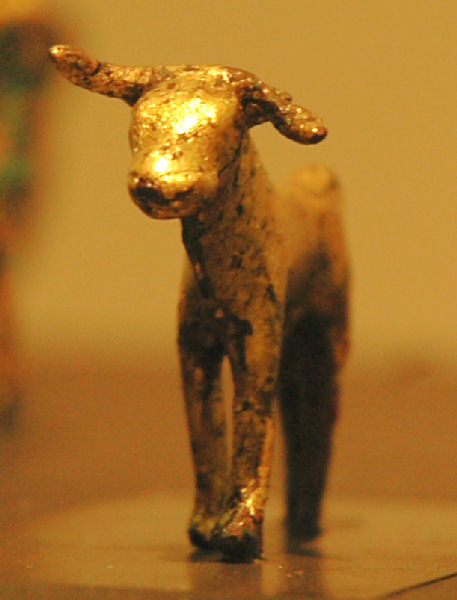
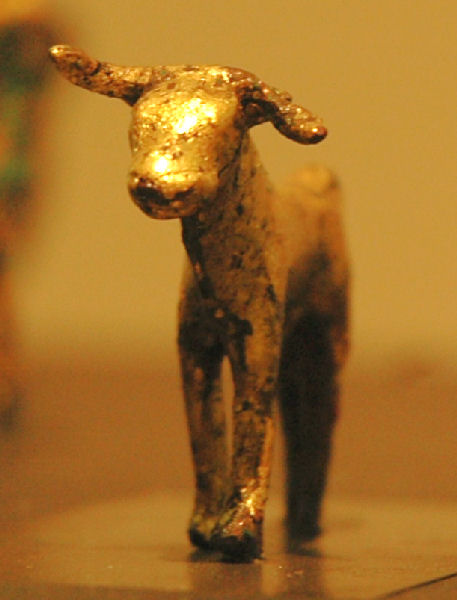
Golden Calf: figurine from the Temple of Baalat in Byblos

Aaron tries to do this when he makes the Golden Calf in last week’s Torah portion, Ki Tissa. At first, the people are ecstatic over the idol, bowing down to it and singing and dancing. But this simple and undisciplined religious outlet does not last. When Moses returns and grinds the calf into gold dust, nobody protests. Moses stirs the gold dust into water, and they all meekly swallow it. Aaron’s creation turns out to be a failure.

In this week’s Torah portion, Vayakheil (“And he assembled”), the master craftsman Betzaleil begins making the holy objects for the new sanctuary. The completed creation is so successful that it sustains the religion of the Israelites for several centuries, until King Solomon replaces it with the temple in Jerusalem.

The key difference between Aaron and Betzaleil as creators of religious objects appears in the Torah twice, repeated word for word. In the portion Ki Tissa, God says it to Moses. In this week’s portion, Moses says it to the Israelites:

See? God has called by name Betzaleil, son of Uri, son of Chur, of the tribe of Yehudah. And [God] has filled him with ruach of God, with chokhmah, with tevunah, and with da-at, and with every craft. (Exodus/Shemot 35:30-31)

ruach (רוּחַ) = wind; spirit, motivation, overwhelming state of mind.

(Usually when the ruach of God comes over someone in the Hebrew Bible, that person speaks as a prophet or leads people into battle. Exceptions are Samson, who is gripped by a murderous rage and supernatural strength; and Betzaleil the artist, who is filled with a divine motivation to create.)

chokhmah (חָכְמָה) = wisdom; inspiration.

tevunah (תְבוּנָה) = insight, rational understanding, analytic ability.

da-at (דַעַת) = knowledge.

In later Kabbalistic writings, chokhmah and binah (another form of the word tevunah) are two of the sefirot or divine powers.  Chokhmah is the sefirah associated with the left side of the head, i.e. the left brain that popular science now associates with non-rational, intuitive, holistic consciousness. Binah (tevunah) is the sefirah associated with the right side of the head, i.e. the right brain that we now associate with rational, logical, analytic thinking. In the Kabbalist system, da-at is the product of chokhmah combined with binah.

Aaron, although he will serve as the high priest, lacks the four qualities with which God fills Betzaleil. When the Israelites are waiting at the foot of Mount Sinai in Ki Tissa, Aaron feels no ruach of God, no divine urge to create a holy object. The people decide Moses will never return and order Aaron: Get up, make for us gods that will go before us! (Exodus 32:1). Then Aaron acts, but only to satisfy the crowd.

He has no chokhmah, no inspiration nor wisdom about what to make; he merely calls for gold earrings to melt down, since the finest idols are made of gold.

He took it from their hands and he shaped it with the engraving tool, and he made it into an image of a calf. (Exodus 32:4)

Afterward, when Aaron explains to Moses what happened, he says: I said to them, “Who has gold? Pull it off yourselves.” And they gave it to me and I threw it into the fire and out came this calf.” (Exodus 32:24)

Aaron admits that he acted without any of the insight or discrimination of tevunah, and also without any da-at, any knowledge of what would emerge from the fire.

Betzaleil, on the other hand, is born betzalmeinu—in God’s shadow or image—when it comes to creativity. (See my post Vayakheil: Shadow Power.) He creates under the protection of God’s shadow. God “fills” him with the qualities he already has the potential and experience to develop.

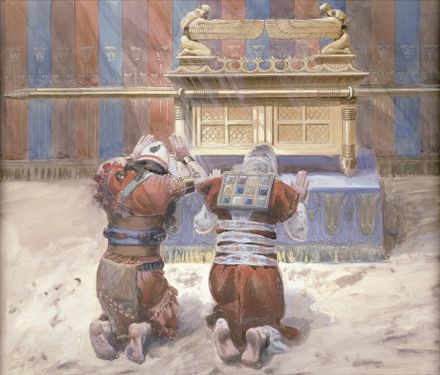
Bowing Before the Ark, by James Tissot, ca. 1900

Even as Moses comes down with God’s basic design for a portable sanctuary, Betzaleil is filled with a divine desire to create it. He has the chokhmah to visualize the whole thing, and to imagine beautiful and inspiring objects—from the gold keruvim (hybrid winged beasts) on top of the ark to the design embroidered in brilliant colors on the curtain at the entrance to the Tent of Meeting. He has the tevunah to analyze and understand how each part can be made well and assembled into the whole. And he has da-at, knowledge, of every craft: metal-working, jewelry, wood-working, weaving, and embroidery.

Betzaleil is so filled with chokhmah, tevunah, and da-at that he and his assistant can teach other craftsmen and craftswomen among the people.

And [God] put teaching into his heart, him and Ahaliyav son of Achisamakh of the tribe of Dan. (Exodus 35:34)

And Betzaleil and Ahaliyav and everyone wise of heart to whom God gave chokhmah and tevunah for da-at and for doing all the work for the service of the Holy, they shall do everything that God commanded. (Exodus 36:1)

The sanctuary that is completed in next week’s Torah portion, Pekudei, is the product of the grand design Moses heard from God; the divine spirit, inspiration, understanding, and know-how of the master artist, Betaleil; and the enthusiasm and wisdom of the contributors in the community. No wonder it becomes a place where people feel God’s presence.

I think that the qualities God gives Betzaleil are necessary for anyone to produce truly moving art, whether its explicit goal is religious or not. I know that when I do “creative writing”, especially of Torah monologues and fiction, both my motivation (ruach) and my inspiration (chokhmah) seem to come from a mysterious place outside myself, or perhaps from some inner place so deep my conscious mind can never penetrate it. I might as well say they come from God, the great mystery.

But the most burning motivation and inspiration leads nowhere without the application of rational insight and analysis (tevunah). My own ability in this area is a talent I was born with, a gift of God, that I have developed over many years of practice. And as in Kabbalah, I have found that the combination of left-brained inspiration (chokhmah) and right-brained analysis (binah or tevunah) does indeed result in knowledge (da-at).

The final requirement for creating art is to actually do all the labor. I am grateful that the ruach that blows through me from the unknown source I call God is strong enough to motivate me to keep on working, with enthusiasm—like the Israelites in this week’s Torah portion.

May the divine spirit be strong in all artists.

Ki Tisa: Fighting or Singing?

After God’s revelation to the Israelites at Mount Sinai, the people repeatedly promise to do everything God says. Then Moses and Aaron lead the elders halfway up the mountain, where they have a vision of God’s feet. (See my earlier post, Mishpatim: After the Vision, Eat Something.)

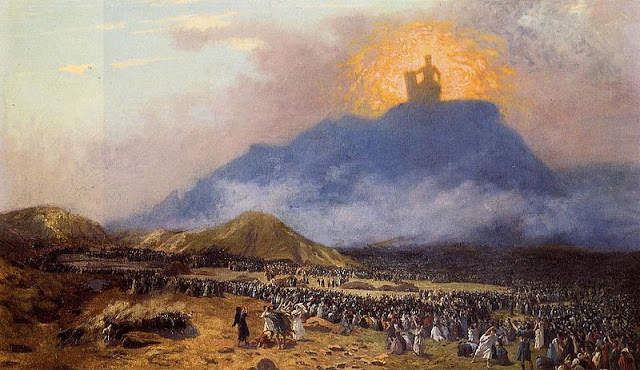
Moses on Mt. Sinai,
by Jean-Leon Gerome, 19th century

This is their high point. After this, Aaron and the Israelite leaders go downhill, both literally and figuratively. Joshua, Moses’ attendant and war-leader, stays partway up the mountain. And Moses climbs to the summit again. There he disappears into God’s cloud—or fire, from the point of view of the Israelites below. (See my earlier post, Mishpatim: Seeing the Cloud.)

Inside the cloud, Moses listens to God’s instructions for 40 days . Meanwhile, the Israelites below conclude that their prophet has died in the fire on the mountaintop and will never return. And without Moses, how can their god lead them to their promised land?

Gold calf from Temple of Baalat, Byblos

They fall back on an old and familiar solution in this week’s portion, Ki Tissa (“When you bring up”): a physical image or idol for the god to inhabit. They give Aaron their gold earrings, and get him to mold an image in the shape of a calf. On his own initiative, Aaron builds an altar and declares a festival for God the next day.

The same day that the Israelites bring animal offerings to the new altar, God hands Moses the two stone tablets written by the finger of God (Exodus/Shemot 31:18), tells him to go down the mountain, and then tells him what the Israelites have done.

Quickly they deserted the path that I commanded them! They made for themselves a cast image of a calf, and they bowed down to it and they slaughtered offerings to it, and they said: These are your gods, Israel, that brought you from the land of Egypt. (Exodus 32:8)

God offers to consume the Israelites and make Moses into a great nation instead. But Moses refuses the offer and tramps down the slope, still holding the two stone tablets on which God wrote, among other things, the commandment against making idols.

Joshua joins his mentor partway down. He has spent 40 days waiting on the mountainside, unaware of what was happening either to Moses at the top or to the Israelites at the bottom.

Then Joshua heard the sound of the people as they shouted, and he said to Moses: The sound of battle is in the camp! (Exodus 32:17)

Moses does not reply. Joshua listens carefully as they continue to descend.

And he said: Not the sound of anot of prevailing, and not the sound of anot of defeat. A sound of annot I am hearing. (Exodus 32:18)

anot (עֲנוֹת) = responding, answering; humiliating, abusing; call-and-response singing (such as kirtan or antiphony).

annot (עַנּוֹת) = (This form of the verb anot is used most often for humiliation, but it is also used in at least one other place, Isaiah 27:2, for singing.)

If there were indeed a battle in camp, Joshua would hear the winners raising their voices in war-cries, abuse, or battle-songs. He would also hear the losers raising their voices in pain, fear, or grief. Because he does not hear these sounds, he concludes that there is no battle. The camp has not been attacked by strangers. Nor has it divided into two sides fighting each other. Whatever the people are doing, nobody in the camp is objecting to it.

What sound does Joshua decide he is hearing? Here are two possible translations:

“A sound of humiliation I am hearing.” In other words, he is hearing the sound of people who have abandoned reason and conscience. Maybe sexual excess has turned into rape. Or maybe the people’s wild party is humiliating for Joshua and Moses, the only two Israelites left to stand against the worship of the Golden Calf.

“A sound of call-and-response singing I am hearing.” In other words, he is hearing a joyful celebration. Elsewhere in the Bible, people use call-and-response singing, along with dancing, to rejoice over God’s success (as Miriam does after they cross the Reed Sea), and to rejoice over David’s victories in battle.

I can imagine Joshua realizing that something happened in the camp, while Moses was gone, and now the Israelites are either holding an orgy, or singing and dancing to rejoice over—what?

The Torah returns to Moses’ point of view.

Moses Breaking the Tablets, by Rembrandt

And it happened as he drew near to the camp, he saw the calf and dancing. Then Moses’ anger flared up, and he threw down from his hand the tablets, and he shattered them under the mountain. (Exodus 32:19)

Moses already knows about the Calf, so why does his anger flare up now? One frequent answer by commentators is that now he sees the people dancing. If the Israelites were worshiping the Calf in a state of doubt and anxiety, they might reject their idol as soon as they saw Moses. Instead, they are rejoicing over the Golden Calf, as if they like the old-time religion better than following Moses’ lead.

It takes the shock of the shattering tablets to yank them back into their former state of mind, when they promised to obey the god of Moses.

Joshua already knows the Israelites are singing. He can assume they are also dancing; elsewhere in the Bible call-and-response singing is usually accompanied by dancing. Now Joshua sees the Golden Calf and the smoking altar in front of it, so he knows the reason for the people’s ecstasy. He also hears the sound of stone shattering. The singing stops.

Moses grinds the Calf into gold dust, adds it to water, and makes the people drink it. He questions Aaron briefly, then stands at the gateway of the camp and shouts: Whoever is for God, to me! (Exodus 32:26)

All the men from the tribe of Levi go over to the side of Moses and Joshua. Moses orders the Levite men, in the name of God, to take their swords and go through the camp from gate to gate.  The Levites kill 3,000 Israelite men. The Torah reports no casualties on the Levite side; apparently the Calf worshippers were too cowed or ashamed to fight back.

So Joshua finally does hear the battle cries of the winners, and the screams of pain and humiliation of the losers. There is no more singing of any kind in the Torah until the book of Numbers/Bemidbar.

I have always wondered if killing 3,000 Calf-worshippers was overkill. After all, everyone was shocked when Moses shattered the tablets God gave him. Everyone drank the gold dust from the Calf. What if Moses’ next move had been to start up a song, instead of a massacre?

What if he had changed the words of the call-and-response song the people were singing for the Calf? Their song is not recorded, but here are two other call-and-response songs in the Torah:

Sing to God because He is the highest;

Horse and its rider He threw into the sea! (Exodus 15:21)

Saul struck down his platoons;

And David struck down his armies! (I Samuel 21:12)

Some people need the outlet of ecstatic song and dance. Maybe another call-and-response song would have turned the hearts of the apostate ecstatics toward the God of Moses. Here is my proposal for the people who rejoiced in the Golden Calf:

“Sing to God because He is the highest;

Higher than idols and higher than gold.”

Just set it to a catchy melody, and let Miriam lead the dancing.

Mishpatim: Seeing the Cloud

When God manifests in this world, what does God look like? In the book of Exodus/Shemot, God looks like either cloud or fire.

Moses first encounters God as a voice in a burning bush. As soon as the Israelites leave Egypt, God sends a guide to lead the way: a pillar of cloud by day and fire by night. When God comes down on Mount Sinai to speak to all the people,

there was thunder and lightning and a heavy cloud on the mountain … and all of Mount Sinai smoked with the presence of God that came down upon it in fire… (Exodus/Shemot 19:16, 19:18)

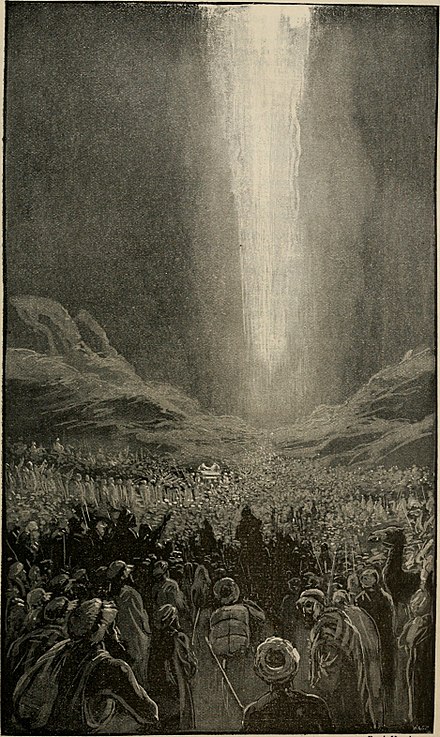
Pillar of Fire, by Paul Hardy, 1896

At the end of this week’s Torah portion, Mishpatim (“Laws”), God summons Moses back up the mountain to receive the stone tablets, the torah (“teaching”) and the mitzvah (“commandment”). As Moses climbs, the Torah describes more cloud and fire. But this time the Israelites below see Moses walking into fire, while Moses sees himself walking into cloud.

Then Moses went up the mountain, and the cloud covered the mountain. And the kavod of God rested on Mount Sinai; and the cloud covered it/him for six days. Then [God] called to Moses on the seventh day, from the midst of the cloud. But in the eyes of the children of Israel, the mareih of the kavod of God was like a consuming fire on the top of the mountain. (Exodus 24:15-17)

kavod (כָּבוֹד) = weight, impressiveness, magnificence, glory. (The kavod of God = a visible manifestation of God’s splendor.)

mareih (מַרְאֵה) = appearance, vision, apparition, mirror.

Moses is accustomed by now to living in close communication with a highly dangerous and powerful god. God has spoken to him at least 41 times already, and Moses often asks God questions and makes suggestions.

Yet he has not seen God directly. When God manifests in our world, Moses still sees only fire or  cloud. The nature of God is always hidden.

This time, Moses sees the cloud. But the people at the foot of the mountain do not see God’s kavod in cloud form. They see only a mareih of God’s kavod, an apparition or mirror image of it—God’s presence as reflected in their own minds. Having lived through the ten miraculous plagues in Egypt, not to mention the parting of the Reed Sea, no wonder they view God as so powerful, dangerous, and threatening that they are afraid God’s glory will eat them up. Their own feelings make the cloud look like a “consuming fire”.

They watch their leader Moses walk right into the fire, a fire nobody could survive. And they despair.

No wonder, after they have waited for 40 long days, they demand a safer manifestation of God—in the form of a golden calf rather than a fire.

Meanwhile, Moses waits inside the cloud on the mountain for six days. He can see nothing in the fog; he does not know what God is, what reality is, or what will happen. But at least he does not see fire; he is not afraid. He waits patiently for what God will give him. And on the seventh day, God calls to him.

And Moses entered into the middle of the cloud and went up the mountain. And Moses was on the mountain forty days and forty nights. (Exodus 24:18)

The Torah has already said that Moses was in the cloud, on top of the mountain. Is this verse a repetition of that information? I think not; I think it means that after Moses hears God call him, he goes even farther into the fog of unknowing, and climbs even higher and farther away from the ordinary world.


Could you leave your “real” life so far behind, for so long? Could you face an unknown and unknowable god of terrible power and remain calm, waiting for instructions?

I doubt I could. I have always been amazed by people who seek out ecstatic mystical experiences, through drugs or through other means. I never know whether to view such people as foolhardy idiots, or advanced wisdom masters.

My own mystical experiences, all mild and momentary, have all come by accident without any mountain-climbing or cloud-entering on my part. And a mild and momentary experience is enough for me. Perhaps where others see fog, I see fire. I do not want to enter the fire, because I am afraid of getting burned. I am content to watch from a distance when seriously religious people walk into the kavod of fire—or cloud.

But unlike the people at the foot of Mount Sinai, I refuse to demand an easier god to worship. In the modern Western world, the most common versions of an easier god to worship are: a) a loving parental god who looks after you personally, or b) a theological paradox (omnipotent, omniscient, omnibenevolent, personal, and yet responsible for evil in the world).  Version A is easy to worship because it is safe and feels good—rather like the golden calf to the Israelites at Sinai. Version B is easy to worship because it is an abstraction which does not require emotional engagement.

But what if we know God only as cloud or fire?

I think if the word “God” has any meaning, it must have something to do with that nagging blur at the edge of our vision, that cloud—or fire—we encounter when we move away from the outside world and deep into ourselves.

Beshalach: Hands Up

What does it mean to raise one or both hands when they are empty?

Today, the gesture for “Stop!” is holding one arm straight out from the shoulder, with the hand bent back, palm forward.

If you raise one arm straight up into the air, you are “raising your hand” for permission to speak.

When an authority figure says “Hands up!” you raise both arms, palms forward, to show you are not holding a weapon.

What if you raise both arms at an angle somewhere between straight up and straight out? Whether your hands are turned up or down, it looks as though you are making a religious gesture.

In many Jewish Renewal congregations, when we stretch out both hands with our palms down, we want to transmit a blessing to someone.  (This gesture is derived from the Torah’s description of leaning one’s hands on the head of a man or boy in order to transfer holiness, as Jacob does to bless his grandsons in Genesis 48, and as Moses does to commission Joshua as his successor in Numbers 27.)

When we stretch out both hands with our palms up, it means we are prepared to receive a blessing. This is also one traditional posture of supplication to God; we reach forward and up toward “heaven” with empty hands, hoping God will fill them.

In this week’s Torah portion, Beshallach (“When he sent out”), God tells Moses to split the Reed Sea by holding the staff that summoned the ten plagues in Egypt, and stretching out his hand over the water. After the Israelites have crossed the Reed Sea and seen the Egyptian army drown,

…the people were in awe of God, vaya-amiynu in God and in Moses, his servant. (Exodus 14:31)

vaya-amiynu (וַיַּאֲמִינוּ) = and they trusted, and they had faith, and they believed, and they relied upon.

Because they have seen Moses signal the miracle by raising his arm, they believe that the god who split the Reed Sea is their god, the god of their leader Moses. So at that moment, they trust God.

The Israelites trek across the Sinai Peninsula unmolested, while God provides manna and quail for them to eat. Yet in less than three months, when they are camped only one day’s journey from Mount Sinai, the people complain to Moses that they have no water.

God instructs Moses to strike a rock with his staff, and water comes out.  But Moses notes that the people did not trust God to provide for them.

And he called the name of the place Trial-and-Disputing because of the dispute of the children of Israel and because of their testing God, saying: Hayeish, God, bekirbeinu, or ayin? (Exodus/Shemot 17:7)

Hayeish (הֲיֵשׁ) = Is it there? Does it exist?

bekirbeinu (בְּקִרְבֵּנוּ) = in our midst, inside us.

ayin (אָיִן) = not there, nothing.

A traditional translation of the people’s question is: “Is God in our midst, or not?” But another valid translation would be: “Does God exist inside us, or nothing?”

Immediately after the Israelites doubt God’s presence, the people of Amalek attack them.

Then Amalek came and fought against Israel at Refidim. And Moses said to Joshua: Choose for us men and go out, fight against Amalek. Tomorrow I will station myself on the top of the hill and the staff of God will be in my hand. So Joshua did as Moses had said to him, to fight against Amalek; and Moses, Aaron, and Chur went up to the top of the hill. (Exodus 17:8-10)

At this point, Moses probably assumes that he and God will do their usual routine, in which Moses raises the staff and God sends a miracle. But God does not speak to him. And when the battle begins, Moses does not seem to be holding the staff.

And it happened, when Moses elevated his hand, then Israel prevailed; but when he rested his hand, then Amalek prevailed. And the hands of Moses were getting heavy, so they took a stone and they placed it under him, and he sat upon it. And Aaron and Chur held his hands, one on either side, and his hands were emunah until the sun set. (Exodus 17:11-12)

emunah (אֱמוּנָה)  = steadiness, dependability, faithfulness. (From the same root as vaya-amiynu above, 14:31)

Why do the Israelites prevail when Moses’ hands are raised? Is it because God is responding to Moses’ gesture and making it happen? Or is it because their faith in God’s presence is renewed and they fight better?

Talmud tractate Rosh Hashanah 29a says: “Did the hands of Moses wage war or crush the enemy? No; the text only teaches that as long as Israel turned their thoughts above and submitted their hearts to their father in heaven, they prevailed; but otherwise they failed.” In other words, there is no magic in Moses’ hands, and God performs no miracles. When Joshua’s men prevail against Amalek, it is only because the sight of Moses’ upraised hands encourages them.

Modern commentator Avivah Gottlieb Zornberg wrote in Particulars of Rapture, p. 245: “The role of Moses’ hands is to model for the people the attraction upward that is faith.”  Moses demonstrates prayer and attachment to God by raising his hands toward heaven.

Maybe that is why we raise our hands for blessing in many Jewish Renewal congregations. Words are not enough. When we see upraised hands we remember in our bodies, not just our intellects, that we want to connect with the divine.

Raising our own hands, palms up and empty, completes the ritual link. Then we can—sometimes—feel that God is bekirbeinu, inside us. Then it is easier to prevail over our own internal enemies, our own psychological Amaleks that attack us when we complain too much.

Is it the feeling of God inside us that lets us prevail? Or is it God Itself?

Regardless of the answer, I am grateful for the inner strength that comes when I become aware of a deeper meaning in the universe and inside myself. I pray—with uplifted hands—for that strength, so I can prevail over my own internal enemies. And I am grateful when my friends help to support me as I reach upward.

Lekh-Lekha and Bereishit: Giving Directions

For me, every story in the book of Genesis/Bereishit is another fruit from the Tree of Knowledge of Good and Evil. And the God who speaks to individual people, from Adam to Jacob, is like a human teacher trying to prod people into making conscious choices and moral judgments.

Like other animals, we humans make most of our decisions automatically, out of instinct and habit. Sometimes we stop to solve a practical problem or an intellectual puzzle. But only rarely do we stop to solve a moral problem. When we do become aware of a moral issue, and of our ability to choose between good and evil actions, I think we are tasting another fruit from the Tree of Knowledge.

The anthropomorphic God in Genesis often talks to Himself, debating what to do next. He also talks to human characters, asking them questions, telling them His plans, blessing and cursing them, making covenants with them, and giving them directions.

“God” tries out several methods for giving directions. In the second creation story, “God” makes a single human out of dirt and breathes life into it. After placing the human (ha-adam) in the garden of Eden, the God character gives it an instruction.

figGod tzivah the human, saying: From every tree of the garden, certainly tokheil. But from the tree of the knowledge of good and bad, not tokhal; for on the day you eat from it, you will certainly die. (Genesis 2:16-17)

tzivah = commanded, ordered, directed.

tokheil, tokhal = you will eat, you shall eat, you should eat, you could eat, you may eat, you can eat, you are going to eat, you must eat.

It is impossible to translate this passage literally, because biblical Hebrew has only one verb form for action that has not yet happened. Is “God” telling the human “you must not eat” from the tree of knowledge, and if you do, you will be punished with death? Or is “God” saying “you could not eat” from it without becoming mortal?  Either translation is correct.

The God character’s motivation in giving this order is also open to interpretation. Classical commentary assumes “God” wants the human to stay in the garden, in a state of moral ignorance, and therefore after the female and male humans eat the fruit, they are punished for disobeying orders. I think “God” points out the Tree of Knowledge in order to show the adam, the solo and sexless human, that it can act of its own free will, and gain knowledge. But the adam passively follows orders, and nothing changes. I can imagine the God character wondering what it will take to get the humans to make a choice and acquire a sense of good and evil, so He can remove them from Eden and place them in the real world! “God” solves the problem by splitting the human it into male and female persons, and inventing the snake to make the female human think.

The next person in the Torah to get moral training is Cain, who gets upset when God shows a preference for Abel’s offering over his. Perhaps because reverse psychology did not work well with Adam, “God” avoids anything that sounds like an order when He first addresses Cain.

Cain, by Henri Vidal, detail


And God said to Cain: Why are you making yourself angry, and why has your face fallen? Is it not so: if you do good, [there is] uplifting; but if you do not do good, wrongdoing waits at the door, and its desire is for you. Yet you can rule over it. (Genesis 4:6-7)

Cain does not get the hint, and in a fit of rage kills his brother Abel.

In the story of Noah, the God character tries a different approach.

God said to Noah: The end of all flesh is coming before Me, because the earth is filled with violence on account of them, and here I am, the one Who destroys the earth.  Make for yourself a floating-container of gofer wood; you shall make the floating-container compartmented, and you shall cover it inside and outside with caulking. (Genesis 6:13-14)

If what “God” wants is for Noah to obey orders, His new style works. Noah simply follows orders, and makes no independent decisions until after the flood. But commentators have wondered for millennia whether Noah’s mechanical obedience is actually what “God” wants. (See my post last week, Noach: Righteous Choices.) What if “God” is hoping that Noah will propose an alternative, the way Abraham does later when “God” announces He will destroy Sodom and Gommorah?

abraham-looks-at-starsThis week’s Torah portion, Lekh-lekha, begins with the God character’s first direction to Abraham.

God said to Abraham: Lekh-lekha, away from your land, and away from your home, and away from the house of your father, to the land that I will show you. And I will make you into a great people, and I will bless you, and I will make your name great, so it will become a blessing. (Genesis 12:1-2)

Lekh = Go!

-lekha = yourself, for yourself, to yourself.

Here the God character’s order specifies what Abraham should leave behind, but gives no details about the future he is walking into. What “God” does communicate is that this move is important for Abraham, not just for God. Rashi (11th-century Rabbi Shlomo Yitzchaki) interpreted Lekh-lekha as “Go for yourself”, i.e. for your own sake. The Zohar (a 13th-century kabbalistic text) interpreted it as “Go to yourself”, i.e. recreate yourself as a new individual, separate from your past.

All the promises of blessing, while non-specific, also serve to let Abraham know that going to the new land will be for his own benefit. This is the first time in the Torah that “God” promises a reward for obeying His directions.

Abraham responds to the divine direction by leaving home for good, as instructed. But he takes some initiative and prepares for his own future by bringing along his wife, nephew, servants, and livestock.

Since the voice of God does not even tell him which way to head when he leaves his father’s house in Charan, Abraham chooses to travel west into Canaan. Only after he has reached Shechem, well inside Canaan, does “God” appear to him and say: To your offspring I will give this land. (Genesis 12:7)

The God character’s method of giving partial directions, promising an eventual reward, and leaving the rest up to the human being seems to be the most successful approach so far. Abraham responds by leaving his old familiar habits behind, and making new choices.

Today, few people hear God giving them direct instructions in Biblical Hebrew. But I can imagine the God character in these stories as an inner voice from the human subconscious, struggling to be heard properly.

There are many ways for a human being to get stuck and wait passively for change, instead of looking for a good action and bravely doing it. At times in my life I have been like the adam, obeying orders without raising questions, avoiding any potential conflict. I had to reach a certain level of misery before an inner voice from God’s snake reminded me that it would not kill me to pick the fruit and liberate myself, to choose my own course and act.

At times in my life I have been like Cain, feeling as though I am at the mercy of a bad desire. Yet eventually I hear the divine hint that I can master the desire, and choose to do good.

Other times, I feel overwhelmed, drowned, by the demands of other people and by the way the world works. I want to make my own little floating container and hide in it. But my conscience nags at me, reminding me that I cannot hide in an ark without bringing my family and hordes of hungry animals with me. God wants engagement with the world.

And yes, periodically I have heard an inner call to leave my familiar but not-so-good life, and set out for an unknown destination and destiny, like Abraham. So far, responding to that voice has led to blessings.

May we all be blessed to listen to our inner “God” voice, and never lose the taste of the fruit from the Tree of Knowledge of Good and Evil.

Noach: Righteous Choices

This is the story of Noah: Noah was a man of tzadik; he was blameless in his generations; Noah walked with God. (Genesis/Bereishit 6:9)

tzadik (צַדִּיק) = right conduct, lawfulness, innocence; a righteous person.

In the Talmud, a man is called a tzadik if he devotes his life to Torah study and prayer. For the Chassidim in Eastern Europe, a tzadik was a holy man so esteemed by God that he could work miracles. Some commentary reads these meanings of the word tzadik back into Noah’s story, but the Torah never shows Noah studying, praying, or acting like a holy miracle-worker. So I think Noah is merely innocent and lawful, avoiding violence even though everyone around him is doing it.

At the end of last week’s Torah portion, God regrets creating humankind, because of

the abundant badness of the human on earth, that the shape of every idea of his heart was only bad all the time. (Genesis 6:5)

(See my post last week, Bereishit: Inner Voices.) Since Noah is the best human being available, God speaks to him at the beginning of this week’s Torah portion, Noach (Noah” or “resting”).

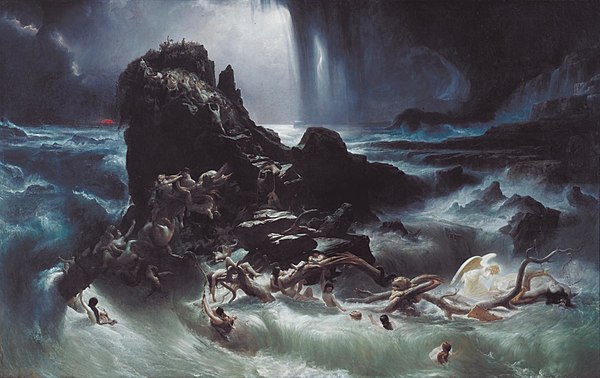
The Deluge, by Francis Danby, 1840

And God said to Noah: “The end of all flesh is coming before me, because violence has filled the earth on account of them, and here I am, their destroyer of the earth. Make for yourself an ark …” (Genesis 6:13-14)

God gives Noah explicit instructions on how to build the ark, and explains that the problem of human violence will be solved when God wipes out everything else on earth with a vast flood. Then God tells Noah to collect what will go inside the ark: a pair of every kind of animal; Noah and his wife, sons, and daughters-in-law; and food for everybody.

And Noah did so; everything that God commanded him, thus he did. Then God said to Noah: Enter, you and all your household, into the tevah, because in you I have seen tzadik before Me in this generation. (Genesis 6:22-7:1)

It sounds as if God approves of Noah’s passive obedience. Yet commentators through the ages have wondered why Noah does not try to talk God out of the Flood, the way Abraham tries to talk God out of destroying Sodom and Gomorrah by saying perhaps there are some innocent people among the wicked.

Most of the commentary I have read falls into two camps. One camp considers Noah either a failed prophet (because he did not warn anyone to repent) or a failed tzadik in the Chassidic sense (because he did not ask God to decree a different fate for the world). The other camp argues that God must have asked Noah to prophesy in an unrecorded conversation, and Noah must have done his best, while building the ark, to warn people about the flood and urge them to repent before it was too late.

But the commentary that alarms me the most comes from the 19th-century Rabbi Samson Raphael Hirsch. Hirsch wrote that performing God’s will is what matters; acting on the basis of your own judgment is of secondary and uncertain importance. So although Noah could have done other things, he was correct in doing exactly what God commanded, and no more.

I would say that if God only wants humans to do as they are told, God had no reason to plant the Tree of Knowledge in the Garden of Eden in the first place. Yet God not only places the Tree, but points it out to Adam by warning him not to eat from it. Then when Adam obediently avoids it, God creates Eve and the talking snake, so the humans finally eat. The taste of knowledge of good and bad gives humans have the ability to form opinions, and choose between them. Though we usually act out of habit and instinct, we have the ability to make new and creative choices.

Some rabbis have argued that the most desirable outcome is when a human deliberately chooses to do exactly what God wants. But sometimes there is a difference in the Torah between what God says and what God wants. On several occasions God “tests” (nasah) people to see what they will choose to do. For example, God tests Abraham by telling him to sacrifice his son Isaac as a burnt offering—but when Abraham binds his son on an altar and raises his knife, God intervenes to save Isaac’s life. It was only a test, and in a real test you do not tell the subject everything you want.

So when God tells Noah to build and supply the ark before the flood wipes out the earth, is that really all God wants Noah to do? Or is God testing him, to see whether Noah will warn people to repent, or even propose a different solution to God?

Suppose Hirsch is right, and God only wants us to choose to follow explicit directions. That not only makes the relationship between humans and God uninteresting, it also leaves us stranded when we have to make independent decisions that are not explicitly covered by the 613 rules in the Torah. The tradition of Jewish oral law tries to fill the gap, but it still cannot cover everything. Human beings often find themselves in situations where they need to figure out the best course of action for themselves.

Thank God!  I believe we humans shine when we discover, or invent, good ideas that nobody considered before. Choosing to follow God’s orders is a virtue of sorts. But we are blessed with the ability to rise above Noah’s level of virtue, and improve the world in ways the Torah never envisioned. Depending on how you define “God”, this might be what God really wants.

In my own lifetime, I have seen great progress in granting status, rights, and respect to people in groups that were subjugated for millennia, including women, people outside the traditional heterosexual model, and outsiders from different ethnic groups and countries. We still have farther to go, and some parts of the world lag far behind, but we have created a good path. The Torah merely assumes these groups will always be inferior, and offers a few paltry laws to protect the members of some groups within their inferior status. Thanks to our God-given abilities, humans are now working on a better vision.

The Torah also promotes war, while alluding to a distant future when war will disappear because everyone will worship the same god. But we can do better than that, thanks to our taste for knowing good from bad, our ability to transcend our habits and instincts and make choices, our creative minds, and our power to rise above ourselves to speak as prophets or tzaddikim. Someday humans may achieve an era of peace better than the one imagined in the Bible!

May it be God’s will … but most of all, may it become our will.