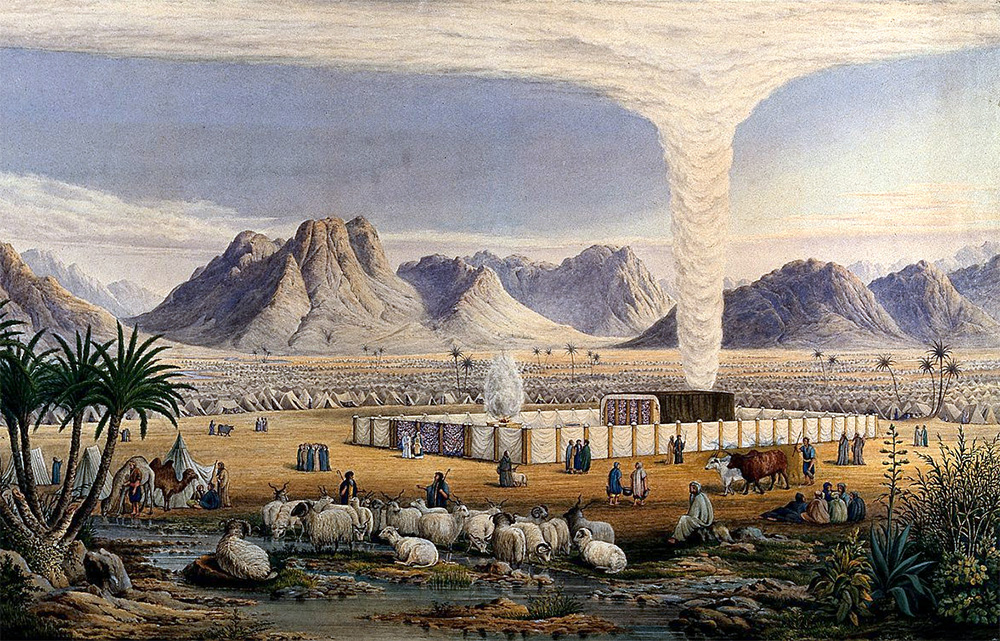
Tabernacle in the Wilderness, by J.J. Derghi, 1866
The Israelites wait for the signal from God before they leave Mount Sinai and head north toward Canaan. At last God’s cloud, which has been hovering over the portable tent-sanctuary, ascends and glides off in the direction where God wants the Israelites to travel next.1
The Israelites spend the whole book of Leviticus/Vayikra at Mount Sinai, initiating the priests and the sanctuary and performing various religious rituals for the first time. During the first two Torah portions of the book of Numbers/Bemidbar, they learn how to disassemble the Tent of Meeting and its courtyard, carry the pieces safely, and march in formation by tribe. But they do not set off until this week’s Torah portion, Beha-alotkha (“When you bring up”):
On the twentieth of the second month of the second year, the cloud rose up from over the Mishkan of the Testimony. The Israelites journeyed on their journey-stages from the Wilderness of Sinai. Vayishkon, the cloud, in the Wilderness of Paran. (Numbers 10:11-12)
mishkan (מִשְׁכָּן) = dwelling-place. (From the root verb shakhan, שָׁכַן = dwell, inhabit, settle in, stay.) The portable tent-sanctuary or “tabernacle” is made as a place for God to dwell, at least part-time, among the Israelites.2
vayishkon (וַיִּשְׁכֺּן) = and it settled, and it came to rest and dwelled. (Also from the root verb shakhan.)
The first stage of the journey north toward Canaan lasts three days; then the cloud descends, and they camp for a month at an uninhabited spot in Paran.3 The Torah gives it two place-names: first Taveirah, then Kivrot Hata-avah.
The complaints begin after the cloud has come to a stop and the camp is set up. The Torah does not say what the Israelites complained about; the important thing is that once they have left Mount Sinai they start whining again.
And the people were becoming complainers, and it was evil in the ears of God. God listened, and [God’s] anger heated up and burned against them, and a fire of God ate up the edge of the camp. Then they wailed to Moses for help, and Moses prayed to God, and the fire sank down. And the name of that place was called Taveirah, because the fire of Hashem barah. (Numbers 11:1-3)
Taveirah (תַּבְעֵררָה) = it burns. (From the verb barah, בָּרעֲרָה = burned.)
But the people do not stop complaining. They find a pretext: they do not like the food.
Then the riffraff who were among them felt a craving and they wept again, and the Israelites also wept, and said: “Who will feed us meat?” (Numbers 11:4)
There is no lack of meat at the camp in Paran; the people brought all their livestock with them from Egypt, herds of cows and flocks of sheep and goats.4 At Mount Sinai they learned how to make wholeness-offerings, in which portions of the slaughtered animals were eaten along with some of the bread by the priests and by the donors and their guests.5
If some of the “riffraff” among the people6 got left off the invitation lists, it might explain their complaint. But then why do all the Israelites join in asking “Who will feed us meat?”
Perhaps their problem is not that a shortage of meat, but that they want to be fed, like children—or slaves. Yet even though the people eat their own meat and bread, God is still providing them with the miracle of manna every morning.
We remember the fish that we ate in Egypt at no charge, the cucumbers and the melons and the leeks and the onions and the garlic. And now our throats are dry. There is nothing but the manna before our eyes! (Numbers 11:5-6)
In other words, they miss Egypt. They miss the food they ate in Egypt, and despise the food God gives them in the wilderness. Egypt was where the Israelites were slaves to a government that wanted their eventual extermination. Yet it was also their home. The Wilderness of Paran does not feel like home, even though God is feeding them and taking care of them, even though everyone can see the cloud by day and fire by night over the mishkan, so they know their God is in residence.
The rules Moses has transmitted to them are clear; they know how to serve God instead of Pharaoh, they know what to do in terms of both cult ritual and communal life. The divine cloud leads them on every journey, and tells them when to pitch camp and when to pull up stakes. Life should be easy.
Common quail
But the Israelites whine so much that God gets angry and teaches them a lesson by sending flocks of quail that stack up two cubits deep on the ground. The people gather more dead quail than they can eat.
The meat was still between their teeth, not yet chewed, when God’s anger heated up against the people and God struck a great blow against them. And the name of that place was called Kivrot Hatavah, because there the people kavru those who were mitavim. (Numbers 11:33-34)
Kivrot (קִבְרוֹת) = burial grounds of. (From the same root verb as kavru, קָבְרוּ = they buried.)
Hata-avah (הַתַּאֲוָה) = the desire, appetite, craving. (From the same root verb as mitavim, מִתְאַוִּים = feeling a craving, a longing.)
Thus the first camp in the Wilderness of Paran is named both Taveirah, after both God’s burning anger when the people began complaining again, and Kivrot Hatavah, after the burial of people who were too attached to their cravings for the former home in Egypt, the place of slavery, extermination, and comfort food.
*
Why did God’s cloud stop and settle for a while in the Wilderness of Paran, before the Israelites reached the border of Canaan? Was it a test to find out if the people would revert to their old complaining ways, even after they had built the mishkan for God to dwell in?
In every human heart there is both a longing for a new life and a longing to return to the familiar and well-known. There is courage to journey to a new land, and there is also entrenched discouragement. Although the proportion of resilience to despair is different inside each individual, every person does get opportunities to lean one way or the other.
Are you leaning toward God or Pharaoh today?
—
And when the cloud rose up from above the mishkan, the Israelites would pull out on each of their journeys. But if the cloud did not rise up, they would not pull out until the day it did rise. Because the cloud of God was over the mishkan by day, and fire was in it by night, in the sight of all the Israelites on all their journeys. (Exodus/Shemot 40:36-38)
The Hebrew word sometimes translated as “riffraff” is asafsuf(אֲסַפְסֻף), based on the verb asaf (אָסַף) = gather in, gather against, take in, take away.
May God shine the light of panav toward you and be compassionate to you!
May God yissapanav to you and grant you peace! (Numbers/Bemidbar 6:24-26)
yissa (יִשָֹּא) = he will lift, raise; may he lift, raise. (Imperfect form of the verb nasa = lift, raise.)
panav (פָּנָיו) = his face, his presence.
yissa panav = may he lift his face. When God is the subject, this is an idiom meaning “May [God] be benevolent.”
This “Priestly Blessing” or “Threefold Blessing” is chanted at peak moments in Jewish services to this day. (The first sentence has three words in Hebrew, the second has five words, and the third has seven words. Chanting these lines out loud, with a pause or melodic phrase after each sentence, produces the effect of increasing blessing.)
The Threefold Blessing comes directly from this week’s Torah portion, Naso (“Lift up”). The portion opens with God’s instructions to Moses for taking a census of the men between 30 and 50 in the Gershonite clan of the tribe of Levi and assigning them their duties.
Numbering of the Israelites, by Henri Felix Emmanuel Philippoteaux, 19th century
And God spoke to Moses, saying: “Naso et rosh of the sons of Gershon also, by their ancestral houses and by their clans, from the age of 30 years up to the age of 50 years you will count them… (Numbers 6:21-23)
naso (נָשֹא) = Lift! Raise up! (Imperative form of the verb nasa.)
rosh (רֺאשׁ) = head.
naso et rosh = Lift the head! (An idiom meaning either “take a census” or “pardon”.)
You lift someone else’s head when you are taking a head count, or when you are pardoning that person. You lift your own head, raising your face, when you acknowledge someone’s presence. God lifts God’s face in order to face people with benevolence—like humans raising their heads to smile at someone.1
The idiom of lifting someone else’s head, which is used merely for counting at the start of the portion Naso, is later transformed into the idiom of lifting one’s own face, which God does to bless people with benign attention.
Initiating a blessing
The climax of this week’s Torah portion, in my opinion, is when God instructs Moses on the way the priests should bless the Israelites as a whole.
And God spoke to Moses, saying: “Speak to Aaron and to his sons, saying, ‘Thus you shall bless the Children of Israel. Say to them: May God bless you and protect you! May God shine the light of panav toward you and be compassionate to you! May God yissapanav to you and grant you peace!’” (Numbers 6:23-26)
After giving the three sentences of blessing, God concludes with this instruction:
Place my name upon the Children of Israel, and I myself will bless them. (Numbers 6:27)
In other words, the priests must recite the correct three-line formula in front of the people. Then God, not the priests, will bless them. God’s blessing is triggered not by the wishes of the priests, but by the words that the people hear, the three sentences that include the personal name of God.
If we imagine an external being called God, who bestows gifts like a good king or a loving parent, then the Threefold Blessing expresses what we want God to give us in the world. We want the universe, personified, to bless us with success; to protect us from harm; to shine with kindness toward us; to treat us with compassion; to give us benign attention; and to arrange for us to live in peace.
Traditional Jewish blessings, like the Threefold Blessing, follow the form “May God bless you with—”, perhaps because we know that even a parent blessing a child cannot actually make any of these good things happen. Only God can do that—if God is a semi-anthropomorphic being who runs the universe.
Hearing a blessing
There is plenty of evidence that blessing in our universe does not work that way. Many people are hapless, damaged, confused, starved, or punished too harshly. That makes the Threefold Blessing either a fantasy, or a prayer that the whole universe will change.
But maybe there is a deeper truth in the instructions in this week’s Torah portion about how the priests can initiate God’s blessings. Maybe something happens when the people who need blessing hear God’s name in the blessing formula.
The prophet Elijah learns that God is not in the wind, not in the earthquake, not in the fire, but in a soft murmur—a “still, small voice” in the King James translation.2 If we want to be blessed with a life in which God seems to be smiling at us and easing our way, then we must learn to hear the small voice of God inside us.
“May God bless you with—” is also a way to say “Listen for God and the blessing of—”.
May we all find a way to listen.
*
Last week, when other Jews were celebrating Shavuot and the giving of the Torah at Mount Sinai, I could only imitate the mountain, shaking uncontrollably. This week, fortunately, I have a smaller set of (non-Covid) symptoms, less frightening than an earthquake, less painful than fire. I continue to get medical tests and to hope for a fuller diagnosis and further improvement. But I also notice that every time I lie down (which is often) I feel grateful for my life, for the bed underneath me, for my own thoughts, and for the soft murmur deep inside me that sometimes releases a word in a still, small voice. God is blessing me.
—
In a similar idiom, people’s faces “fall” (nafal, נָפַל) when they lower their heads in anger at whomever they are facing. When God does not welcome Cain’s offering, Cain became very hot with anger, and his face fell. (Genesis 4:5) This idiom can also apply to God’s face. God tells the prophet Jeremiah to say: Continue turning back [to me], declares God; I will not make my face fall at you, because I am kind, declares God. (Jeremiah 3:12)
Israel Enters the Land of Promise, Bible Card by the Providence Lithograph Company, 1907
At Mount Sinai the Israelites experience God, lose hope and make the Golden Calf, reform and make the portable sanctuary for God, and learn how to practice their religion. After a year and a month, they are ready when the book of Numbers/Bemidbar begins, to dismantle the sanctuary and journey north to Canaan.
On the way, how will they safely carry the sacred items in the sanctuary’s Tent of Meeting from one campsite to the next?
This week’s Torah portion, also called Bemidbar (“In the wilderness of”), is not concerned about the safety of the safety of the ark, the table, the menorah, or the incense altar on the road. It is concerned about the safety of the Levites who will carry the holy items.
Aaron shall enter, and his sons, when the camp is going to pull out, and they shall take down the dividing curtain and kisu the ark of testimony. (Numbers/Bemidbar 4:5)
kisu (כִּסּוּ) = they shall cover. (A form of the verb kasah, כָּסָה = covered, covered over, clothed, concealed.)
The Torah describes how many layers of what materials the priests will use to cover the gold ark, bread table, menorah, and incense altar that normally stand inside the Tent of Meeting, which only priests may enter. (See my post Bemidbar: Covering the Sacred.) The word for “cover” in this passage is always the verb kasah.
And Aaron and his sons shall finish lekhasot the Holy and all the implements of the Holy when the camp is going to pull out, and after that the Kohatites shall come in to carry [them], but they shall not touch the Holy or they will die. (Numbers 4:15)
lekhasot (לְכַסֺּת) = to cover, covering. (Another form of the verb kasah.)
One reason to wrap up the holy items is so that the Levites cannot touch them; unauthorized contact results in death.1 The Levites from the Kohat tribe are only authorized to touch the carrying poles for each furnishing.
They are also endangered if they see any part of the Holy as it is being wrapped. The Torah uses a different term for wrapping or covering to describe this unauthorized view.
And God spoke to Moses and to Aaron, saying: “Do not cause the tribe of the families of the Kohatites to be cut down from among the Levites! Do this for them, and they will live and not die: when they approach the Holy of Holies, Aaron and his sons shall come in and assign each individual man his service and his burden. And they shall not come in to look as the Holy [are] bala, or they will die.” (Numbers 4:17-20)
Where did that menacing image come from? Do the holy items suddenly look as if they are being devoured by their own wrappings?
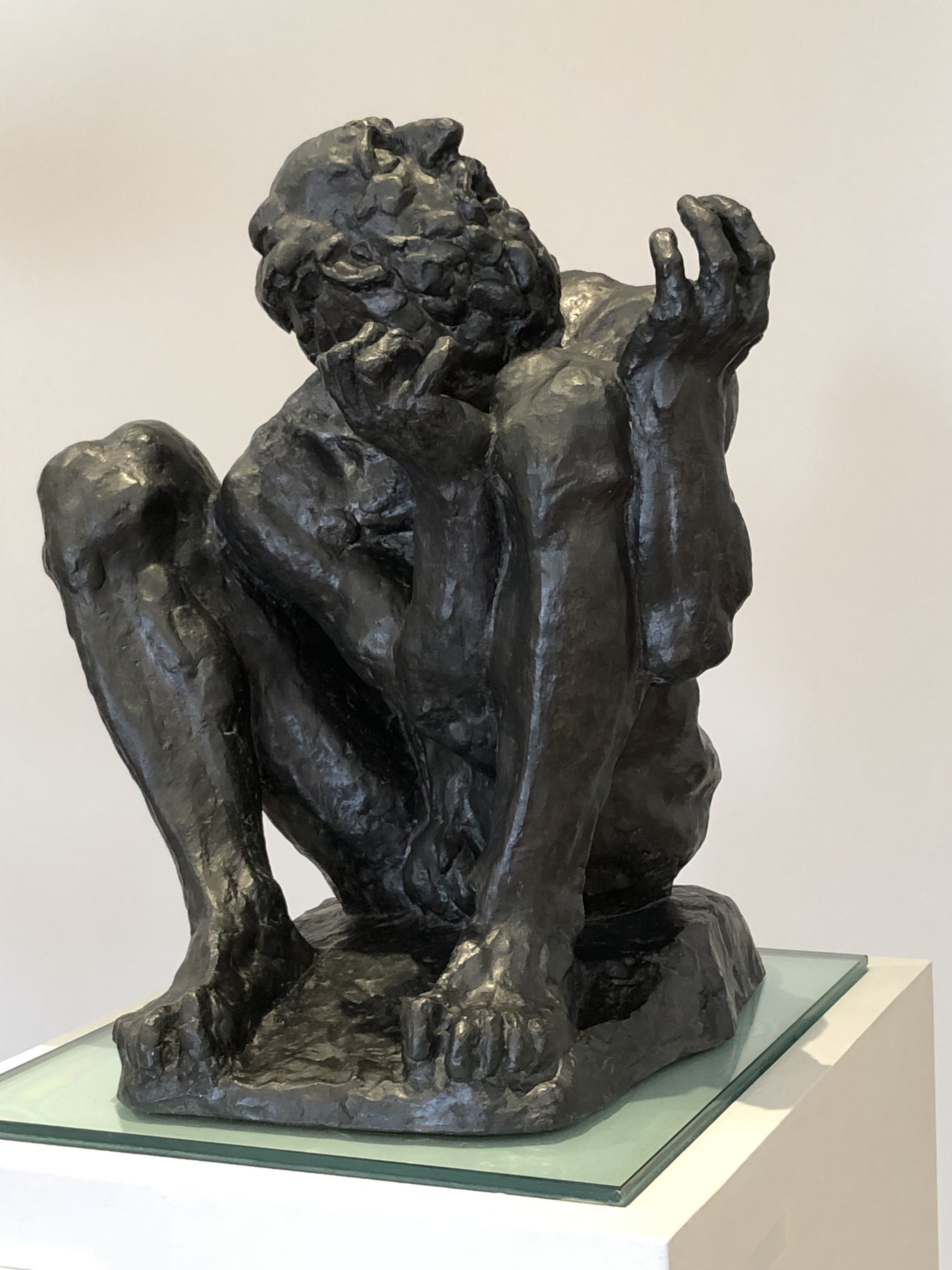
Job, by Ivan Mestrovic, 1943 (photo by M.C.)
Usually when the verb bala appears in the Torah it means either “destroyed” in general, or specifically “swallowed”. One exception is when Job complains that God is persecuting him.
“Will you not look away from me, leave me alone, until I bala my own spit?” (Job 7:19)
Here Job uses a form of bala to mean “swallow” in an idiom for a moment or instant—the brief time it takes to swallow spit.
Taking off from this idiom, some translators conclude that bala in our Torah portion at the beginning of the book of Numbers does not mean “swallowed”, but rather “the time it takes to swallow”. Here is a version by Everett Fox2:
But they are not to enter and see (even) for-a-moment (the dismantling of) the Holy-Shrine, lest they die. (Numbers 4:20)
Perhaps the Levites must not see the holy items for even as long as it takes to swallow. Or perhaps the Levites must not see the holy items as small objects being swallowed or engulfed by their coverings.
Why not?
Pride. A tantalizing glimpse of something normally out-of-bounds could lead a Levite porter to steal another chance to look at part of holy item. He might feel powerful, familiar with the most holy, almost like a priest. Yet peeking under the wrapping, for example, would result automatically in the Levite’s death.
Disenchantment. On the other hand, seeing one of the holy items being wrapped as if it were any other physical object might lead a Levite to treat it with less reverence, which is also a bad idea. The Levite might even start thinking of God as a mere physical object.
These same arguments might apply to the priests wrapping the holy items. When the Tent of Meeting is set up and in operation, all of the priests get to see the bread table, menorah, and incense altar. But the ark stands behind a dividing curtain in the Holy of Holies, where only the high priest may go, once a year.
Yet this week’s Torah portion implies that lesser priests are allowed to see the ark every time they dismantle and reassemble the sanctuary. Perhaps the priests cover the ark with the specified layers of cloths without actually looking at it (or touching it directly). I think the Torah assumes they have the willpower to do this.
But the Kohatites waiting to receive the covered-up ark might not be able to resist peeking—unless the priests assigned them tasks that would keep them busy from the time the curtains came down until the ark was covered. After all, when you are faced with a deadly temptation, it is easier to redirect your mind if you stay busy.
Maybe if Adam and Eve had been given the job of weeding around the Tree of Knowledge in the garden of Eden, they could have resisted the temptation to taste its fruit.
What tempts you? Hot fudge? The body of a person who is off-limits for you? Personal power?
What is it like to be tempted by divine power? To crave something beyond awe in the face of the mystery? To want to touch something beyond reason, something so alien to normal human thinking that contact with it could destroy you?
Reward and punishment sound simple at the end of the book of Leviticus/ Vayikra. If you obey all my rules, God says in the last Torah portion, Bechukkotai (“by my decrees”), then I will give you ample food, peace, and descendants. If you reject any of my rules, then I will reject you, and punish you for several pages.
Pomegranates, photo by M.C.
If you go by my decrees and you observe my commands and perform them, then I will give the rains in their season, and I will give the land her produce, and the tree of the field will give its fruit. (Leviticus/Vayikra 26:3-4)
The list of rewards concludes:
And I will put my dwelling-place among you, and my nefesh will not reject you. I will walk around in your midst, and I will be your god, and you will be my people. (Leviticus/ Vayikra 26:11-12)
nefesh (נֶפֶשׁ) = appetite, throat; animating soul (what makes humans and animals alive).
The promise of God living among the people and being their god is the culmination of the rewards that result from keeping the covenant with God.
The list of results from not going by God’s decrees begins:
But if you do not listen to me, and you do not do all these commands, and if your nefesh loathes my laws, preventing you from doing any of my commands, making you break out of my covenant—[then] I will even do this to you: I will appoint panic over you, consumption, and fever, using up the eyes and wearing out the nefesh. And you will sow your seeds in vain, and your enemies will eat them. (Leviticus 26:14-16)
The list of punishments concludes:
You will be lost in the nations, and the land of your enemies will consume you. And those who remain will rot away in their depravity in the lands of their enemies, and even in the depravity of their forefathers remaining in them. Then they will confess their depravity and the depravity of their fathers, that they walked against me with hostility. When I have been hostile to them and have brought them into the land of their enemies, that is when their uncircumcised heart will humble itself, and that is when they will gain appeasement for their depravity. (Leviticus 26:38-41)
Only then, after they have fully recognized and admitted their horrible deeds, baring their hearts, will God renew the covenant with the remaining Israelites and bring them back to their former land.
Nefesh as throat
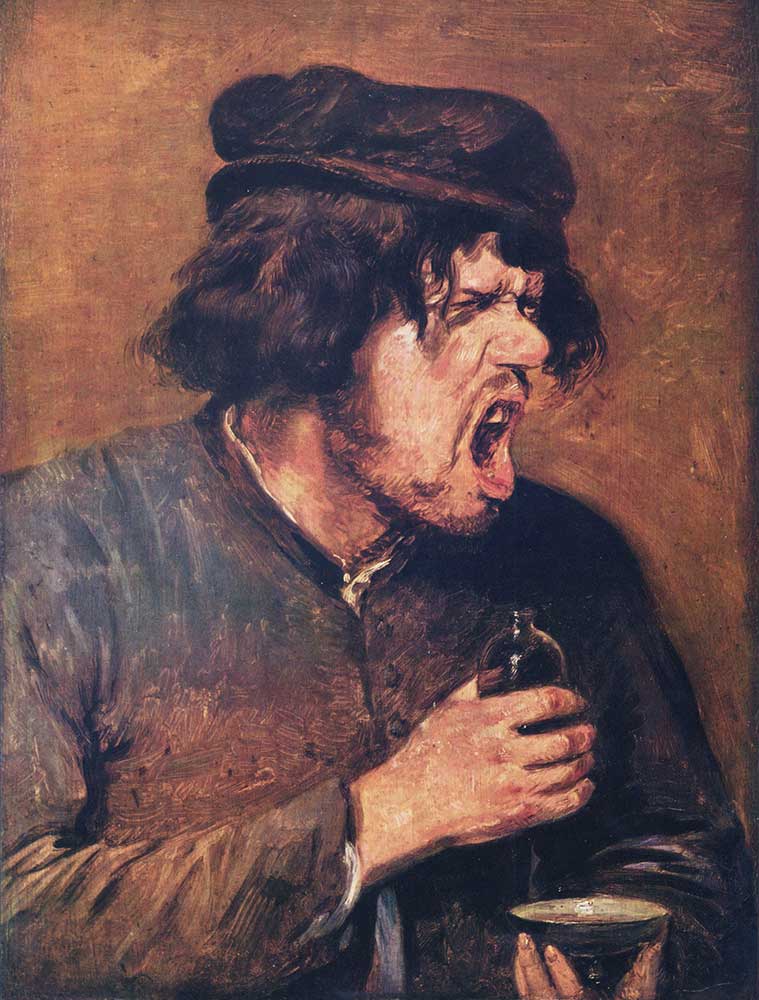
Bitter Drink by Adriaen Brouwer, 17th century
Suppose we translate nefesh as the throat, the location of the appetite for physical food. Robert Alter took this tack when he translated “my nefesh will not reject you” as “I shall not loathe you”, and explained that a literal translation would be “my throat will not expel you”, i.e. I will not retch in disgust over you.1 Similarly, “if your nefesh rejects my laws” means “if you retch in disgust over my laws”.
Continuing to translate nefesh as “throat”, “the fever of using up the eyes and wearing out the nefesh” becomes “inflamed eyes and sore throat”. These could be either disease symptoms, or a description of a person who has been crying for a long time.
The advantage of viewing nefesh as “throat” is the emotional impact of imagining God retching with disgust, and imagining ourselves sobbing in anguish. How can we remain hostile to a God who is so emotionally involved that God finds our bad behavior nauseating? How can we live with the suffering of our own nefesh?
Nefesh as animating soul
On the other hand, suppose we translate nefesh as the animating soul that gives the body life and desires. Then “my nefesh will not reject you” assigns a different anthropomorphic metaphor to God. It means that if we follow God’s decrees, God will desire to make a home with us and walk around in our midst—to be close to us. (See my translation of Leviticus 26:11-12 above.)
Then God will continue to be alive to us.
If humans suffer from “the fever of using up the eyes and wearing away the nefesh“ their alienation from God is making them feel more and more dead inside.
The bottom line in this covenant between God and the Israelites is that if you want to be alive to God and desire God, you must also be aware of and desire all of God’s decrees, laws, and commandments. If you reject the divine rules that you don’t like, you lose your connection with God.
*
This tells me I’d be a lousy Israelite. There are many rules in the Torah that stick in my throat, rules that I have no appetite for, that my soul is dead to. For example, the technology of animal sacrifice obviously worked for most ancient Israelites, at least until the time of the prophet Isaiah. But all the rules about animal sacrifices disgust me. Jewish authorities point out that without a Jewish temple in Jerusalem, Jews have no place to make animal sacrifices, so we don’t have to follow the rules about them. But this rational explanation does not comfort me. My most visceral soul, my nefesh, still feels outrage at the very thought of killing animals in order to draw closer to God.
Does this mean I can never walk with God? I hope not. After all, the rabbis of 2,000 years ago, as quoted in the Talmud, “interpreted” many of the rules in the Torah until they came out quite different. Also, rabbis since Talmudic times have made their judgments by using the same general standards, but applying them differently according the particulars of each case.
Today, we cannot help but pick and choose which specific rules to follow. But we can still apply the same general moral standards to each particular situation.
Suppose you are fair with other people—except when you cannot resist cheating them. Or kind to others—except when you does not feel like it. Then your inner vision fails, and your nefesh becomes flimsy. As it says in Leviticus, the spirit of God will no longer walk or find a home with such a person.
May we all be blessed with the strength and wisdom we need to keep working on ethical behavior. May each of us develop an appetite (nefesh) for goodness, and sow seeds of kindness everywhere. Then we will be rewarded with a harvest of aliveness (nefesh), and holiness will dwell with us wherever we walk.
(For the past week I have suffered from nausea, lightheadedness, and other odd physical symptoms. I do not believe the cause is hostility toward God, and I hope to get a medical diagnosis soon. Meanwhile, my ability to write has slowed down, so please bear with me this month.)
—
Robert Alter, The Five Books of Moses, W. W. Norton & Company, 2004, p. 661.
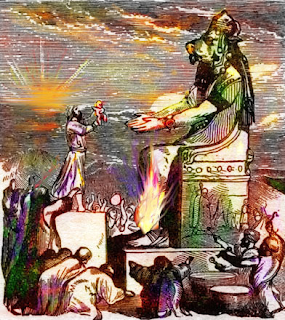
Offering to Molech, Bible Pictures, by Charles Foster, 1897
And you must not give any of your offspring to pass through for the molekh, and you must not profane the name of your God; I am Y-H-V-H. (Leviticus/Vayikra 18:21)
molekh (מֹלֶךְ) = a forbidden god. (Melekh(מֶלֶךְ) = king, spelled with the vowel marks of boshet(בֺּשֶׁת) = shame.)
This command in Acharey Mot (“After the death”), one of this week’s two Torah portions, contains the first occurrence of the word molekh in the Torah—if you are reading the standard Masoretic text. If you read a Torah scroll, which has no vowel marks, it looks the same as a command not to give your offspring to “the king” (melekh).1
The prohibition above raises two questions:
How does giving your offspring (children, grandchildren, or great-grandchildren) to the molekh profane the name of the God of Israel?
What does “to pass through” mean?
Profaning the name
The usual biblical way to profane God’s name appears in this week’s second Torah portion, Kedoshim (“Holy ones”):
And you must not swear by my name for a falsehood, and profane the name of your God; I am Y-H-V-H. (Leviticus 19:12)
Using God’s personal four-letter name to give false testimony demeans that name by treating it as merely a trick word for pulling off a wicked deed.
Perhaps giving a child to the molekh demeans a different name of God. Psalm 47:7-8 considers God “our king” and “king of all the earth”. Giving children to another god called “king” (מלך), one who demands an unholy deed, demeans God’s name and reputation.
Later in Kedoshim God pronounces two penalties for this serious offense:
Any man of the Israelites, or from the foreign sojourners sojourning in Israel, who gives any of his offspring to themolekh must certainly be put to death; the people of the land must pelt him with stones. And I, I shall give my attention to that man and cut him off from among his people, because he gave one of his offspring to the molekh, intentionally making my holy ones impure and profaning my holy name. (Leviticus 20:2-3)
Even if the people do not stone the molekh-worshipper, God will still “cut him off”2 along with
… all the whores after him from among the people who whore after the molekh. You must make yourselves holy and you must be holy, because I, Y-H-V-H, am your God.” (Leviticus 20:5)
Throughout the Torah the God of Israel demands both exclusive worship (being faithful to God instead of “whoring” after other gods) and adherence to God’s rules for holy behavior.
Passing through fire
King Josiah of Judah begins his campaign for exclusive worship of one God by clearing the effects of other gods out of the temple in Jerusalem: an Asherah idol, utensils for worshiping Baal and Asherah, and enclosures woven for Asherah. Next Josiah demolishes the shrines in Judah where unauthorized worship is going on, and then:
He desecrated the burning-place which is in the Valley of Ben-Hinnom, to prevent passing a son or a daughter through fire for the molekh. (2 Kings 23:10)
The second book of Chronicles describes the same practice during the time of Josiah’s grandfather, King Menashe, 3 confirms that there was an established tradition of passing children through a fire in the valley of Ben-Hinnom below Jerusalem.4
Model of Jerusalem: Valley of Ben Hinnom below Herod’s city wall, Valley of Kidron right. Israel Museum (photo by M.C.)
King Josiah discourages this practice by desecrating the place where it happens. Jeremiah, who prophesies from Josiah’s reign until after the Babylonian army destroys Jerusalem in 586 B.C.E., discourages the practice by reporting that God never wanted people to do it in the first place.
And they built shrines for the burning-place in the Valley of Ben Hinnom, to burn their sons and their daughters in the fire—which I did not command, and which was definitely not on my mind. (Jeremiah 7:31)
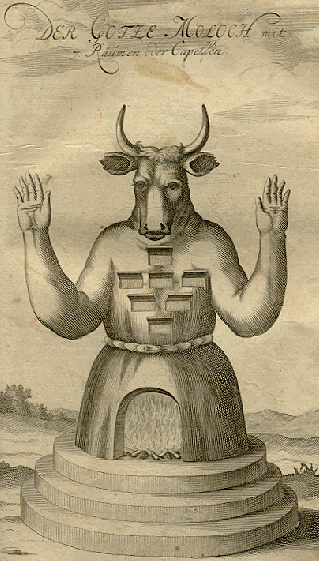
Molekh, Die Alten Judischen Heiligthumer by Johann Lund, 1711 (7 ovens from Yalkut Shimoni; bull head from unknown source)
And they built shrines for the Baal in the Valley of Ben-Hinnom, for passing their sons and their daughters to the molekh, which I did not command them, and it was not on my mind to do this abomination … (Jeremiah 32:35)
Jeremiah makes it clear that the “king” worshipped in the Valley of Ben-Hinnom is not the God of Israel.
According to modern commentator Jacob Milgrom, some Israelites might have believed that God wanted people to pass their offspring through the fire in a ritual that may or may not have burned them to death. Alternatively, Milgrom wrote, people might have believed in two gods, the king of the heavens (God the melekh, worshiped in the temple on top of a hill in Jerusalem) and the king of the underworld (the molekh, worshiped in the valley below).5 Jeremiah 32:35 denounces both beliefs, insisting that there is only one God and God never wanted people to burn their children.
The Hebrew Bible does not say whether a child who was passed through, between, or over the fire in the Valley of Ben Hinnom survived the experience. One Talmudic opinion is that the child was led along a latticework of bricks between two fires; another is that the child leaped over a small bonfire.6
On the other hand, the Talmud shortens Valley of Ben Hinnom (Gey Ben Hinnom in Hebrew) to Gehinnom elsewhere in the Talmud. The rabbis imagine Gehinnom, where the fire for the molekh burned, as the opening to a vast underground fire where the souls of the wicked go after death.7 (The righteous go straight to the Garden of Eden.) Burning in Gehinnom purifies the souls of the wicked, which are eventually redeemed.
I think the myth of Gehinnom is actually a return to the belief, denounced by Jeremiah, that God desired the burning of children in Ben Hinnom. Several Talmud tractates claim that God created Gehinnom and the Garden of Eden before creating the world.8 Therefore the melekh of heaven who created all the earth, and the molekh of the underworld who burns souls and commands passing children through fire, are actually one and the same god.
So why did the Masoretes replace the word melekh with molekh in passages about passing children through fire? It strikes me as one of many attempts to dodge the theodicy or “problem of evil”: How can God be both all-good and the source of everything that exists, including evil?
I say forget the molekh, and wrestle directly with the problem.
For centuries the Hebrew Bible was written with consonants but no vowels. When the Masoretes added vowel marks in the 6th–10th centuries C.E. they also assigned the vowels in the word boshet to seven appearances of the word for “king”, turning מֶלֶך (melekh) into מֺלֶךְ (molekh).
In the Torah being “cut off”, karet, means either dying prematurely, dying without children, or dying in spiritual isolation. In the Talmud it can also mean being excluded from the World to Come (as in Talmud Bavli, Sanhedrin 64b).
Menashe, who ruled the kingdom of Judah circa 697-643 B.C.E., is described in 2 Chronicles 33:6 as worshiping false gods and passing his own sons through the fire in the Valley of Ben Hinnom. His grandson Josiah ruled circa 640–609 B.C.E.
Talmud Bavli, Sanhedrin 64a, assumes that parents also handed over their children to priests of the molekh.
Jacob Milgrom, Leviticus (A Continental Commentary), Fortress Press, Minneapolis, 2004, p. 199.
Talmud Bavli, Sanhedrin 64b.
See Talmud Bavli, Eiruvin 19a. Jews did not adopt the idea that souls survive death until the second century B.C.E. The idea of souls burning in an underground fire came from Greek and Persian sources, which Jews developed into the myth of Gehinnom (later called Gehenna) and Christians developed into the myths of Hell and Purgatory. The Talmud was written during the third through fifth centuries C.E.
Childbirth, menstruation, and death called for apotropaic magic in most Ancient Near East cultures. The Torah addresses these disturbing events with social distancing and ritual purification.
Four men with tzara-at in 2 Kings 7:8
This week Jews read a double Torah portion: Tazria (“she makes seed”) and Metzora (someone with the skin disease tzara-at). Both portions are about physical conditions that make people ritually impure and the procedures for purifying them. The most space is devoted to a skin disease that makes people so ritually impure that they are excluded from their camp or town, and must pitch their tents outside its boundaries until a priest pronounces them cured. (See my post last year, Tazria & Psalms 38 & 88: Isolation of the Sick.) But this week’s two portions also consider the ritual impurity of childbirth and menstruation, during which a woman can remain in her home, in a room set aside for her.
Tazria begins:
If a woman makes seed [conceives] and gives birth to a male, then she is temeiah for seven days: in the same way as in the days of her menstrual indisposition titema. (Leviticus/Vayikra 12:2)
And if a woman is discharging blood … seven days she shall be in her menstrual separation, and whoever touches her yitema until evening. And whatever she lies on during her menstrual separation yitema, and whatever she sits on yitema. (Leviticus 15:19-20)
yitema (יִטְמָה) = he/it becomes tamei.
Ruins of mikveh for immersion in priest’s home, Wohl Museum, Jerusalem (photo by M.C.)
Any person or object that touches a menstruating woman must be immersed in water that day, and then becomes ritually pure again in the evening.1 The same rule applies to a man with an unhealthy genital discharge, and a woman with a discharge other than her monthly period.2
A human being who is tamei/temeiah is also forbidden to “touch the holy” by entering the precincts of the sanctuary or by eating any of the meat and bread from a wholeness-offering.3 A tamei/temeiah person in a priest’s household may not eat any of the food given to the priest.4
Seven days tamei and 33 days after = 40
The Torah portion Tazria assumes that if a woman gives birth to a son, her post-partum bleeding lasts for seven days. During that week she is temeiah, and anyone or anything that touches her becomes tamei until immersion and sunset.
And on the eighth day, the flesh of his [her son’s] foreskin shall be circumcised. Then for 33 days she shall stay in the bloodshed of taharah; she shall not touch anything holy, and she shall not come into the holy place, until the days of her taharah are completed. (Leviticus/Vayikra 12:3-4)
taharah (טָהֳרָה) = ritual purification process; ready for ritual purification.
During the 33-day interim period of “purification bloodshed”, the mother of the son may still have some vaginal discharge, but she is considered tehorah only to the extent that a person or object that touches her does not become tamei. This would make it easier for her to receive visitors, and she could move around the house freely. The only things she cannot do during those 33 days are to approach the holy sanctuary or eat holy food.
What is the purpose of the 33-day interim period? A simple answer is that although the Torah is strict about abnormal vaginal discharges, it mercifully lessens the requirements for a woman who is experiencing the last traces of post-partum seepage.
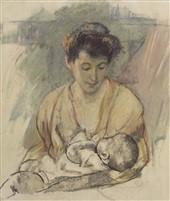
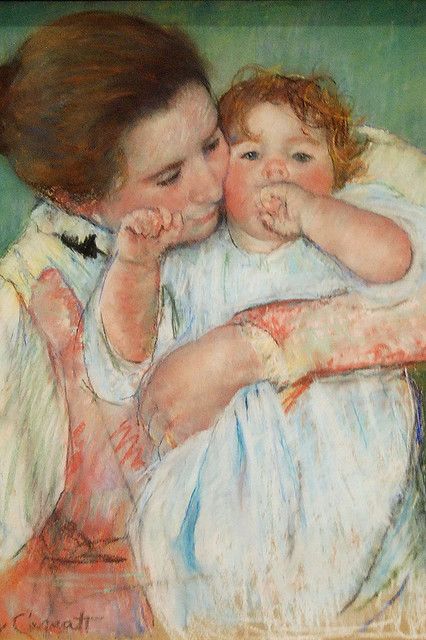
by Mary Cassat
Modern commentators give a psychological reason for the 33-day interim period. Expanding on a hint by 16th-century Rabbi Obadiah ben Jacob Sforno, 20th-century Rabbi Raphael Pelcovitz wrote: “Although she is physically ready and ritually clean, mentally she is not yet geared to concentrate on the holy. Since the sacred demands kavanah, intent, she must wait until her thoughts are sufficiently predisposed to focus on the non-physical, namely, the spiritual and the holy.”5
I can remember my own single-minded absorption in my son when he was a newborn.
I believe that Israelite women would also have needed time to recover from fear of death. Without modern medicine, the mother or the infant often died shortly after childbirth. If both mother and son were healthy 40 days after the birth, it would be easier for the relieved mother to focus on other things.
Fourteen days tamei and 66 days after = 80
The post-partum time periods in Leviticus are longer when the woman has a daughter.
And if she gives birth to a female, then she shall be temeiah for a pair of weeks, in the same way as in her menstruation. And she shall stay 66 days over the bloodshed of taharah. (Leviticus 12:5)
The Talmud’s explanation of why the woman is temeiah twice as long for the birth of a daughter as for a son assumes that most women in labor swear they will never have sex again.6 It takes seven days for a woman who bore a son to repent of her oath, but fourteen days for a woman who bore a daughter to repent. Why? One theory in the Talmud is that her labor pains are twice as bad for a daughter, because:
Just as a male engages in intercourse facing downward, so too, it is born while facing down. And that one, a female fetus, emerges in the manner in which it engages in intercourse, i.e., facing upward. (Niddah 31a)7
This assumes that a couple uses the “missionary position”, and that only and all female infants are born face up. Obviously the rabbis did not ask any mothers or midwives about it. I can, however, attest that the final stage of delivery is especially long and painful when the baby emerges face up—like my son.
The Talmud gives a second theory, based on the assumption that everyone wants a boy more than a girl:
Rabbi Shimon ben Yoḥai answered them: When a woman gives birth to a male, over which everyone is happy, she regrets her oath that she will never again engage in intercourse with her husband, already seven days after giving birth. By contrast, after giving birth to a female, over which everyone is unhappy, she regrets her oath only fourteen days after giving birth. (Niddah 31b)
Neither the Torah nor the Talmud says why the interim period of taharah is 33 days for a son but 66 days for a daughter.
by Mary Cassat
In the 19th century Rabbi Samson Raphael Hirsch explained it in terms of which parent would be the infant’s role model. The circumcision of a boy, he wrote, marks the beginning of the father’s duty to prepare his son to be an observant Jewish man. The mother no longer has full responsibility for her son, so her interim period is just 33 days, enough time to recover. For a daughter, the mother’s interim period is twice as long to “impress upon the mother the full solemnity and magnitude of her task—to be an example and role model for the Jewish woman of the future. … With sons, the crucial part of their education comes from the father, as the sons see in him a model for their own future male role. With daughters, however, the mother is both a role model and a molder of character.”8
Gender roles in the 19th century were strictly defined, just as they were when the Torah and Talmud were written.
Rigid gender roles still exist in some cultures today, but much of the world has adopted a more fluid approach. Modern liberal Jews recognize this when we hold a naming ceremony for a female baby on her eighth day, corresponding to a male infant’s circumcision; or a bat mitzvah for a pubescent girl because she is able, today, to take on the same adult religious responsibilities as a boy.
Now some congregations are also recognizing people whose gender is not simply male or female. The Talmud rules that a woman who gives birth to an infant of indeterminate gender follows the same count as a woman who gives birth to twins who are a girl and a boy: her initial period of being temeiah lasts 14 days, as in the birth of a daughter, but her interim period of taharah lasts 33 days, as in the birth of a son.9
Many countries now require employers to offer parental leave when a child is born or adopted. I think we should also offer parental leave from social expectations. After all, during a baby’s first few months the parents are usually exhausted from getting up during the night for feedings and diaper changes. They should not be expected to give their full attention to anything else.
Whether the primary care-giver of a fragile new human being should get a total of 40 or 80 days away from normal religious and social responsibilities depends on factors other than the gender of the infant!
Intercourse with a menstruating woman is forbidden in Leviticus 18:19, and the penalty assigned in Leviticus 20:18 is that both partners are “cut off”, exiled from their community. Since the fall of the second temple in Jerusalem, strictly observant women have been sleeping separately from their husbands and abstaining from sexual intercourse during their periods and for seven to ten days afterward, then ending the period of abstinence with immersion in a ritual bath, a mikveh.
Leviticus 15:2-11, 15:25-27.
See my post Vayikra & Tzav: Fire Offerings Without Slaughter, Part 2 on how a shelamim or wholeness-offering was divided.
Rashi (11th-century Rabbi Shlomoh Yitzchaki), following the Talmud, Yevamot 75a.
Obadiah Sforno: Commentary on the Torah, trans. and footnotes by Raphael Pelcovitz, ArtScroll Mesorah Publications, 1993, footnote by Pelcovitz p. 539 on 12:8.
The Two Priests Are Destroyed, by James Tissot, ca.1900
Aaron and his four sons have just finished their eight days of ordination in this week’s Torah portion, Shemini (“Eighth”). Then the two older sons, Nadav and Avihu, bring unauthorized incense into the Tent of Meeting, and the fire of God consumes them. (See my post Shemini: Fire Meets Fire.) After their bodies are dragged out,
Then God spoke to Aaron, saying: “Do not drink wine or strong drink, neither you nor your sons with you, when coming into the Tent of Meeting, and you shall not die. [This is] a decree forever for your generations: to havdil between the holy and the ordinary, and between the ritually-impure and the ritually-pure; and to instruct the children of Israel on all the decrees that God spoke to them through Moses.” (Leviticus/Vayikra 10:10-11)
havdil (הַבְדֹּיל) = make a distinction, separate, segregate, distinguish.
The new priests already know they must officiate at the altar; tend the menorah, bread table, and incense altar inside the Tent of Meeting; and guard the ark in the curtained-off Holy of Holies in back. Now God says they must distinguish between the holy and the ordinary and keep them separate; and teach God’s decrees to the Israelites. (Since a priest would need a clear head to perform both duties, many commentators connect these duties with God’s injunction against drinking on the job.)
Although Nadav and Avihu did not disobey a specific decree, they made a serious error when they brought unauthorized incense into the holy Tent of Meeting, perhaps into the Holy of Holies. A priest must not violate a holy space.
What does it mean to distinguish and segregate the holy from the ordinary?
In the Hebrew Bible, holiness is not a feeling. The holy (hakodesh, הַקֹּדֶשׁ) means whatever is dedicated to God. Objects, places, and days are all holy if they are reserved for serving God.
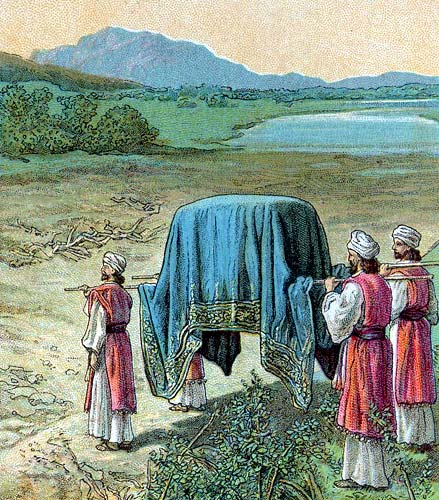
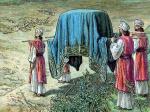
Levites carry the ark properly, Bible card by Providence Lithograph Co., 1907
The holiest object is the ark, which holds two stone tablets that God gave Moses on top of Mount Sinai. When the ark is inside the innermost chamber of the sanctuary, the Holy of Holies, God’s presence manifests in the empty space right above its lid. No one but Moses and the high priest may see the ark inside the Holy of Holies. When the tent-sanctuary is dismantled and Levites transport the ark to the Israelites’ next camp, priests drape three layers of coverings over it to protect people from seeing it. No one may touch it except for the Levites carrying its poles.1
The haftarah reading accompanying this week’s Torah portion is a selection from the second book of Samuel which describes how King David transports the ark from a private house near the border of Philistia to his new capital in Jerusalem.2 In this story, as in Shemini, someone serving as a priest fails to differentiate between the holy and the ordinary.
The ark resides in a private house near the border because 20 years earlier, in the first book of Samuel, two priests who had a reputation for being derelict in their duties took the ark out of the sanctuary in Shiloh and into battle, where the Philistines captured it.3 After the enemy brought it home, their idol of Dagon fell over and broke, and the Philistines were plagued by mice and hemorrhoids. They sent the ark back across the border into Israelite territory, where the people of Beit-Shemesh rejoiced and make animals offerings on the spot. But then 70 men looked into the ark and died.4 Frightened, the remaining men of Beit-Shemesh sent the ark to the house of Avinadav in Kiryat-Yarim, where it remained for 20 years.5
In the haftarah reading from the second book of Samuel, King David decides to transport the ark to Jerusalem.
They mounted the ark of God on a new cart, and they carried it away from the house of Avinadav, which was on the hill. Uzza and Achio, descendants of Avinadav, were guiding the new cart. (2 Samuel 6:3)
Elazar, Avinidav’s “consecrated son”, had served as the first priest to guard the ark.6 But after 20 years there is a new generation of guardians. Achio walks in front of the ox-cart, and Uzza has the honor of walking beside the ark. The procession includes King David and thousands of Israelites dancing to the sound of musical instruments. Then the oxen pulling the cart stumble.
The Chastisement of Uzza, by James Tissot, ca. 1900
They came as far as the threshing-place of Nakhon; then Uzza reached out to the ark of God and grabbed at it, because the cattle had let [the cart] go off by itself. And God’s anger flared up against Uzza, and [God] struck him down there, over the heedless error. And he died there beside the ark of God. (2 Samuel 6:6-7)
While Uzza is accompanying the ark, he is serving as a priest, who must “havdil the holy and the ordinary”. His impulsive action, however well-meant, fails to distinguish between the perilously holy ark and an ordinary ox-cart load.
King David sends the ark to a nearby house, and tries again three months later. This time the ark reaches the tent the king has prepared. As the procession crosses the City of David in Jerusalem,
David was whirling around with all his might before God; and David had belted on a linen efod. (2 Samuel 6:14)
efod(אֵפוֹד) = a tunic or cuirass with the front and back tied together, worn by the high priest as part of his ritual costume.
David is dancing in front of the ark, but the ark is so holy that the Torah says he is dancing before God. His “whirling around with all his might” reminds me of the prophets who speak in ecstasy in Exodus and the two books of Samuel. Although David is wearing a priest’s efod, he acts more like a prophet filled with the spirit of God—until the ark has been placed inside the tent in Jerusalem.
Then King David soberly plays the role of high priest, performing all the rituals without a hitch.
They brought the ark of God and set it up in its place inside the tent that David had pitched for it, and David brought up rising-offerings before God, and the wholeness-offerings. And when David finished bringing up the rising-offerings and the wholeness offerings, then he blessed the people in the name of the God of Armies. (2 Samuel 6:17-18)
David treats the ark as holy in two ways: first as a prophet filled with the spirit of God, second as a high priest conducting ritual. Both responses to holiness are acceptable in the bible, at the appropriate time and place.
The ark was lost with the fall of the first temple in Jerusalem in 586 B.C.E. The innermost chamber of the second temple was empty, but it was still called the Holy of Holies, and treated with awe and reverence. The high priest still entered it only once a year, on Yom Kippur.
Since the fall of the second temple in 70 C.E., Jews have made do with objects and places of lesser holiness. Instead of an ark, we have Torah scrolls, which are unrolled for everyone to see. Instead of a sanctuary with a Holy of Holies, we have the foundation wall of the place where the temple once stood in Jerusalem.
But Jews still have the holy days set out in the Torah: our annual feast and fast days, and Shabbat every week. On Friday night we light candles and say blessings to distinguish the new seventh day, and on Saturday night we make a havdallah, a separation, between the holy day of Shabbat that has ended and the ordinary days of the week to come. The havdallah blessing concludes with words from God’s instructions to Aaron:
Blessed are you, God, [who] hamavdil between the holy and the ordinary.
I find treating a day as holy is harder than treating an object or a place as holy. The sun sets and rises on Shabbat the way it does on any other day; the only difference is in what we do that day. And even if we try to dedicate every moment to serving God on a Shabbat or on an annual holy day, and avoid any activity that counts as labor, we still have to spend some of our time getting dressed, eating, and so forth, just as on an ordinary day.
And Jews who fail to observe Shabbat properly are not struck dead.
Segregating the holy from the ordinary is critically important in the bible, where God is present as the threat of magical annihilation. Today, treating Torah scrolls and other religious objects with reverence, and setting aside certain days for special prayers and actions, serve the purpose of helping humans to approach the whole idea of God with awe and love.
Is that enough? Perhaps today we can serve God more by bringing the holy into the ordinary, by bringing awe and love into more places and more times.
Numbers 4:4-5, 4:15, 4:20.
The haftarah begins with 2 Samuel 6:1. It ends somewhere between 2 Samuel 6:19 and 7:17, depending on whether the community follows the Ashkenazi, Sefardi, Misrachi, or Italian tradition.
1 Samuel 2:12-17, 4:3-11.
And [God’s] hand was on the people of Beit Shemesh, because they looked into the ark of God, and [God’s] hand [struck down] 70 men of Beit Shemesh, 50,000 men. And the people mourned because God had struck a great blow against the people. (1 Samuel 6:19). Rashi (11th-century Rabbi Shlomoh Yitzchaki) wrote that this passage means each of the 70 men that God smote was the equal of 50,000.
We interrupt this program of Torah readings from the book of Leviticus/ Vayikra to bring you a special announcement from the book of Exodus/Shemot:
Do not eat regular bread during the week of Passover.
Why not?
First Day of Pesach
Painting doorposts with blood, History Bible, Paris, 1390
On the first day of Passover/Pesach, the Torah reading (Exodus 12:21-51) includes tenth plague in Egypt, the death of the firstborn. Moses tells the Israelites what each household must do on that day: slaughter a sheep and paint its blood around the door, so death will pass over their house.
Night falls while the Israelites are eating their slaughtered sheep. The firstborn child in every house without blood around the door dies. In the middle of the night Pharaoh and the other Egyptians urge the Israelites to leave the country at once, with no conditions. The Israelites march away in the morning, taking all their livestock; some gold and silver the Egyptians “loan” them; and some household items, including bread dough and kneading troughs. When they camp on the first night of their journey,
They baked the dough that they had brought out from Egypt as cakes of matzot, because it was not leavened, because they were driven out of Egypt and they were unable to tarry; and also they had not made provisions for themselves. (Exodus 12:39)
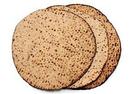
matzot (מַצּוֹת) = plural of matzah(מַצָּה) = unleavened bread; a flat “loaf” of flour and water baked before any sourdough can make it rise.
Every year we read this specious reason for eating matzah during Passover, in the haggadah (script) for the seder (ritual meal) as well as in the Torah. And every year I sigh with impatience.
People in the ancient Near East used sourdough, not yeast, to leaven their bread. It takes about a week to make new sourdough starter and gradually add enough flour and water to do some baking. So for thousands of years bakers have kept sourdough starter going in their kitchens.
A family packing hurriedly to leave the country might bring dry flour and a jar of sourdough starter. Or they might bring dough that was already rising in preparation for baking later in the day. But who would mix some flour with water and bring the damp lump without adding any of the sourdough starter right there on the shelf?
Saying that we eat only unleavened bread during the week of Pesach because our ancestors had no time to prepare leavened bread is an explanation that some young children enjoy. But it has never satisfied me.
Last Day of Pesach
On the last day of the week of Pesach, the Torah reading is Deuteronomy 15:19-16:17, which combines eating the slaughter offering with eating the matzah, and adds some new details to the Pesach observance.
Israelites Leave Egypt, The Golden Haggadah, 14th century Spain
Observe the month of the green grain,1 and make the Pesach offering to God, your God, because in the month of the green grain God, your God, brought you out of Egypt at night. You shall slaughter Pesach offerings from the flock and from the herd for God, your God, in the place where God chooses to make [God’s] name dwell. You shall not eat leaven with it. Seven days you shall eat it with matzot, the bread of wretchedness, because in a hasty flight you went out from the land of Egypt. On account of [eating matzot], you shall remember the day you went out from the land of Egypt all the days of your life. (Deuteronomy/Devarim 16:1-3)
Here the purpose of eating both the animal offering and the matzot for a week is to remember the exodus from Egypt. In Deuteronomy, we must do this at the temple, with everyone else who has come for the pilgrimage.
This passage adds that matzah is the bread of wretchedness,2 a statement repeated during the Pesach seder.3 Eating matzah reminds us of our own wretchedness and our inability to rise by our own efforts when we were in Egypt.
The hard labor imposed on the Israelites enslaved in Egypt gave them “shortness of breath” (or “shortness of spirit”; both translations are legitimate) so they could not listen to Moses talking about liberation.4 They could only cry bitterly, until God created the ten miraculous disasters that finally persuaded even the Pharaoh to let them leave Egypt.
We eat matzah during Pesach to remember that any freedom we have now is due to God’s compassion for us.
In the first century C.E. Philo of Alexandria initiated an explanation for eating matzah that we still repeat at many seders today: that leavening makes bread puff up like an arrogant person. Eating flat matzah is a reminder of our humility before God.5
Pesach and Leviticus
This year another explanation for eating matzah occurred to me. After reading about the matzot burned on the altar in various types of offerings to God in the first two Torah portions of Leviticus/Vayikra, I noticed that whenever the people make a grain offering6 to God, it is always unleavened.
The first Torah portion in the book of Leviticus/Vayikra describes several acceptable types of afternoon grain offerings. The first is:
… wheat flour; and he shall pour oil over it and place frankincense upon it. And he shall bring it to the sons of Aaron, the priests, and one shall scoop from it … a memorial portion on the altar, a fire-offering, a fragrant aroma for God. (Leviticus/Vayikra 2:1-2)
The Torah then describes four ways to cook the grain before offering it to God on the altar. The mixture of flour and oil can be baked into matzot “loaves”, or into flat wafers. It can be fried on a griddle, or cooked as soft dough in a pot. But it must always be sprinkled with frankincense and salt before the priest breaks off a piece and lays it on the altar to burn up into smoke. Furthermore, the grain offering must never be allowed to rise, and it must never include fruit syrup.
Any grain offering that you offer to God you shall not make leavened, for you must not make any sourdough or any syrup go up in smoke with a fire-offering for God. You shall offer those to God as an offering of first-fruits, but they shall not be upon the altar, nor go up as a fragrant aroma. (Leviticus 2:11-12)
Later the Torah describes the annual offering of first-fruits (and optional fruit syrups) on the holiday of Shavuot, which also prescribes an offering of two loaves of leavened bread from each pilgrim. These offerings are presented to the priests at the sanctuary, but no part of them is burned on the altar for God.
Grain is also part of the wholeness-offering, given to express thanks or fulfill a pledge. Besides slaughtering an animal at the altar, the donor brings:
… loaves of matzot mixed with oil, and wafers of matzot anointed with oil, and toasted flour mixed with oil. Along with loaves of leavened bread, he shall offering his offering with his wholeness slaughter-offering. (Leviticus 7:11-13)
Portions of the sacrificial animal and the unleavened grain offerings are burned on the altar. But the leavened bread is all eaten by human beings: the officiating priest and the donor and his guests. None of it is turned into smoke for God.
This means that during the week of Passover, we eat only the kind of grain that can be offered to God. We remember that major transformations in our lives happen only by the grace of God, but we also, in effect, share bread with God.
Why? In the Torah portion that comes after Pesach this year, Kedoshim, God declares:
You shall be holy, because I, God, your God, am holy. (Leviticus 19:3)
Holiness is not a feeling in the Torah; the portion Kedoshim follows up that statement with a list of holy actions to take, both ethical and ritual. But perhaps, when we eat matzah, we might remember we are eating the bread of God. Maybe if that makes us feel more holy, we will act in a more holy way. We will love our neighbor as ourselves (Leviticus 19:18) and share our food with the hungry (Pesach Haggadah).
Aviv (אָבִיב) = green ears of grain; the first month of spring, later renamed Nissan in Hebrew.
The Hebrew word is oni(עָני) = wretchedness, misery, poverty.
In the Haggadah, matzah is called “ha-lachma anya”, an Aramaic phrase that means “the bread of wretchedness”.
The first two Torah portions in the book of Leviticus/ Vayikra mention repeatedly that God enjoys the smell of smoke, especially the smell of burning animal fat.1
Six types of offerings at the altar appear in the portions Vayikra (“and [God] called”) and Tzav (“Command”). For five out of six, the donor must bring an animal, lean a hand on its head, and slaughter it. Then the donor watches a priest butcher the animal, splash its blood around the altar, and burn all or part of it to generate smoke. (The other offering is made out of grain, and is sprinkled with oil and frankincense before it goes on the fire, so the smoke will smell good to God.)
Killing and burning animals was the usual technology for worship in the Ancient Near East, and the ancient Israelites probably found fire-offerings spiritually moving. Today some people view the slaughter of animals as an unfortunate necessity, and others find it unethical to kill animals for human food. Can we apply the Torah’s six categories of offerings to a more ethically refined set of procedures?
Last week I suggested a new way of interpreting fire-offerings in general. This week I propose six kinds of practices to replace the six kinds of fire offerings.
*
In the order of their appearance in the Torah portions Vayikra and Tzav, the six types of fire-offerings are:
1) olah (עֹלָה) = rising-offering.
(From the root verb alah(עלה) = go up.)
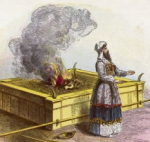
Altar, “Treasures of the Bible”, Northrup 1894
Then
This is the instruction of the olah: It is the olah which burns on the altar all night until the morning … (Leviticus/Vayikra 6:2)
In an olah the entire slaughtered animal is burned up, so olah is often translated as “burnt offering” or even “holocaust offering”. The olah is the only offering which stays on the altar fire all night, until it is completely burned up into smoke. An olah is required twice a day as a matter of routine, perhaps to keep a sustaining level of smoke rising to the heavens.
And the fire on the altar shall burn on it; it shall not go out. The priest shall kindle wood on it every morning and arrange the olah upon it … A continual fire shall burn on the altar; it must not go out. (Leviticus 6:5-6)
A holy day calls for an extra olah. This type of offering is also prescribed for individuals who have been isolated and need to return to a normal relationship with God and their community.2 Perhaps a normal relationship includes continuous, unflagging dedication to serving God, day and night.
Now
For a physical, animal body, fat serves as a reserve source of energy in lean times. But accumulating too much fat is physically unhealthy, just as accumulating too much wealth is spiritually unhealthy. How can we burn up the excess fat in our lives? How can we avoid selfish hoarding? How can we keep our souls directed toward making our own best contributions in a world full of other individuals?
The Jewish practice of mussar calls for a daily review of our actions before bedtime. We record every time we succumbed to an undesirable character trait (such as hoarding) and every time we practiced a good trait we want to acquire (such as generosity). It takes continual self-examination to change a habit.
During our isolation due to the coronavirus pandemic, we could start a journal noting when we acted selfishly, and when we acted generously. We can think about what we will do differently next time. Then when we come out of social isolation, may we offer the olah of a pledge to pay extra attention to our own behavior to make sure we do not lapse back into selfishness.
2) minchah (מִנחָה)= allegiance-offering; a gift to a king as a sign of homage or respect; tribute.
Frankincense (Boswellia sacra tree resin)
Then
The Torah prescribes an offering of grain, loose or baked, as a minchah to God.
A person who offers a minchah to God, he shall offer fine flour, and he shall pour oil over it and place frankincense upon it … and the priest shall make a memorial portion go up in smoke on the altar, a fire-offering of soothing fragrance for God. (Leviticus 2:1-2)
Now
When I burn my toast, it only sets off the smoke alarm. But before I eat my toast, or any other food, I say a blessing to give thanks for it. My blessing is my gift of allegiance to the source of all life.
During the pandemic, may we express gratitude and allegiance not only to God, but to all human beings who are keeping the world fed.
3) shelamim (שְׁלָמִים)= wholeness-offering.
(From the same root as shaleim (שָׁלֵם) = complete, safe and sound, at peace; and shalom (שָׁלוֹם) = peace.)
Then
And if his offering is a shelamim, if he offers it from the herd, whether male or female, he shall offer it unblemished in front of God. And he shall lean his hand on the head of the offering … (Leviticus 3:1-2)
The Torah gives three reasons for offering a shelamim:
(Electronic handshakes only during the pandemic please.)
todah (תוֹדָה) = thanks,
neder (נֶדֶר) = fulfilling a pledge to make that offering if all goes well, or
nedavah (נְדָבָה) = donating out of generosity.
And this is the instruction for the shelamim offering that he shall offer to God. If he brings an offering of todah, then he shall offer, along with the todah slaughter-offering, unleavened loaves mixed with oil and unleavened crackers anointed with oil and fine flour loaves mixed with oil. Along with loaves of leavened bread, he shall offering his offering along with his shelamim slaughter-offering. (Leviticus 7:11-13)
The same assortment of grain products accompany neder and nedavah animal offerings. The slaughtered animal and the unleavened loaves are divided into three portions: one to be turned into smoke for God, one for the officiating priest to eat, and one for the donor and his guests to eat in God’s presence (i.e. in the courtyard in front of the altar). None of the leavened bread is burned for God; it is all eaten by the priest and the donor’s party.
The difference between a shelamim for a todah and and a shelamim for a neder or nedavah is the time limit for eating the meat and bread. The donor and his family and guests have one day to eat the meat and bread from a todah. They have two days to eat the meat and bread from a neder or nedavah.3 One theory is that these time limits ensure that the donor invites more guests to share the feast. This increases his generosity.
Now
Today we can say blessings to thank God for our lives and for everything else in the world. (Even though the world includes things we consider bad, I am grateful that there is a world with people in it, and so much beauty and wonder.)
But it is also important to show our appreciation to the human groups and individuals that improve life on earth. We can give individuals thank-you gifts, and give groups our pledges and donations. The more often we do so, the more we add to the world’s supply of generosity—and that brings more wholeness (shaleim), and holiness into the world.
During the pandemic, consider leaving a gift on someone’s doorstep. Pledge or donate to a good cause to help our battered world recover.
4) chattat (חַטָּאת)= lapse-offering.
(From the root verb chata(חָטָא) = miss the mark, commit an offense against God; make amends for doing wrong.)
Then
If one soul from among the people of the land should chata unintentionally, by doing one of the [negative] commandments of God, [doing something] that should not be done, and he incurs guilt— If the offense that he committed becomes known to him, then he shall bring his offering: an unblemished female goat for his chatat that he chata … (Leviticus 4:27-28)
A different animal must be offered according to the person or group who unintentionally violated one of God’s rules: priests, leaders, the whole community, and individuals. All the animals are offered in the usual way for fire-offerings, from leaning a hand on the living animal’s head to burning up the fatty parts on the altar to give soothing smoke to God.
And the priest shall make atonement for him and he shall be forgiven. (Leviticus 4:31)
Now
What can we do today when we realize after the fact that we violated a moral or religious rule we want to live by?
If I bite into what I thought was a vegetarian omelet and taste bacon in my mouth, I push the plate aside and say a short prayer for discernment in the future. Both actions help me to accept that I made a mistake, and forgive myself.
But if I realize I did something that hurt another person, I need to find reconciliation not only with my conscience, but also with the person I wronged. I find what I hope is a calm time to talk with the person, then say what I think I did wrong and apologize. (Finding the right time may call for extra sensitivity during a period of social isolation during a pandemic.)
Next I give the other person a chance to say how the offense looked to them. If I need to explain anything, I try to do it humbly, without defending my ego. Then I ask what I can do to make up for the wrong I did. If there is something concrete and reasonable, I do it. Only then can I be forgiven by both the other person and myself.
5)asham (אָשָׁם)= guilt-offering.
(From the root asham(אָשַׁם) = incur guilt.)
Then
If a soul who does wrong commits treachery against God and lies to his fellow about a pledge, or a loan, or a theft, or fraud; or he finds a lost item and lies about it, and he swears falsely … he shall return the stolen item that he stole or the fraud that he committed or the pledge that was left with him or the lost item he found … and he shall pay back the principal and add a fifth … And he shall bring his asham to God: an unblemished ram … And the priest shall make reconciliation for him before God, and he shall be forgiven for everything that he did to become guilty. (Leviticus 5:21-26)
Pinocchio, by Enrico Mazzanti, 1883
In a case of theft or fraud, the Torah requires both reparations to the person who was wronged, and an offering to God for atonement. Someone who has stolen or cheated and then lied about it bears extra guilt, so that person must give the victim extra compensation and offer an asham to God.
Now
When we have made reparations for our original misdeed, but we still feel guilty about the way we did it, what can we do to clear ourselves? For some people, the answer is to give a large donation to charity, in money or labor. For others, the answer might be a period of saying prayers from the Yom Kippur repentance liturgy. Words make a difference, even when we speak them only to ourselves and our God.
6) milu-im(מִלֻּאִים) = ordination-offering.
(From the root mala (מָלַא) = fill, fulfill. Filling someone’s hands is the Biblical Hebrew idiom for ordaining that person as a priest.)4
Then
And God spoke to Moses, saying: Take Aaron and his sons with him, and the garments, and the anointing oil, and the chataat bull, and the two rams, and the basket of unleavened bread, and assemble the whole community at the entrance of the Tent of Meeting. (Leviticus 8:1-3)
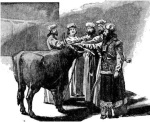
Leaning hands on a bull in an ordination ritual
Moses washes the five men who are being ordained as priests, dresses them in their official vestments, and anoints them and the sanctuary and its altar. Then come the fire-offerings: first a chataat with a bull, to atone for anything the new priests might have done wrong inadvertently; then an olah with a ram.
Then [Moses] offered the second ram, the ram of milu-im, and Aaron and his sons leaned their hands on the head of the ram. And Moses slaughtered it, and took some of its blood and placed it on the edge of Aaron’s right ear and on the thumb of his right hand and on the big toe of his right foot. (Leviticus 8:22-23)
The ritual continues with both the altar and the five new priests being anointed with blood as well as oil, the fatty parts of the ram burned into smoke to please God, and the meat of the ram roasted for Aaron and his sons to eat in the holy place at the entrance of the Tent of Meeting.
Now
If our goal is to become “a kingdom of priests and a holy nation” (Exodus 19:6), then we need to give milu-im, ordination-offerings, whenever our hands are filled—i.e. whenever we receive authority to act in the public sphere.
What can we give today in return for the grant of authority? Humble service, regular prayers or meditations on becoming worthy, and the sacrifice of stepping down again at the right time.
When we have opportunities to elect people to positions of authority, may we choose leaders who will serve with humility, act for the good of everyone, and give a higher priority to the well-being of their people than to re-election.
*
Ancient Israelites who wanted to give God fire-offerings, offerings of the heart, could come to the altar and follow the established rituals. They knew what to do; and the death, blood, and smoke made the rituals more impressive.
Today we have to think harder about our practices. Yet we can still give six kinds of offerings to the divine, with the fire of our hearts. We can practice rising above selfishness (olah), give allegiance (minchah), cultivate wholeness through thanks and generosity (shelamim), repair mistakes (chataat), undo guilt (asham), and turn our positions of authority into holy ordinations (milu-im).
Let’s keep on giving our own offerings! And may the whole world someday become a holy nation.
An individual must bring an olah at the end of a period of social isolation because of seclusion following childbirth (Leviticus 12:1-8), because of the skin disease tza-arat (Leviticus 14:1-11 and 9-20), because of genital discharges that require staying away from the sanctuary (Leviticus 15:13-15 and 28-30), and because of a nazirite vow (Numbers 6:9-14). A new priest brings an olah for his ordination (Leviticus 8:18-21).
And [God] called to Moses, and God spoke to him from the Tent of Meeting. (Leviticus/Vayikra 1:1)
The opening of the book of Leviticus/Vayikra leads us to expect an important announcement. Instead, God explains how to make six kinds of offerings at the altar of the brand-new Tent of Meeting. The only technology on offer for pleasing or appeasing God involves slaughtering animals at the altar, splashing their blood around, butchering them, and burning them.
My 2014 posts on the first two Torah portions in the book, Vayikra and Tzav, reinterpret the six types of animal sacrifices from a vegetarian viewpoint. You can read a revised version of the first one here: Vayikra & Tzav: Fire-Offerings Without Slaughter, Part 1. (I will rewrite Part 2 for next week.)
This year I feel sadness and disgust once again at the gratuitous slaughter of innocent animals. I feel gratitude once again that Jews now serve God with prayer and good deeds instead. I stand by my earlier interpretations of fire-offerings as ways of dealing with anger, and of rising-offerings as ways of continuously directing our desires toward doing good.
But the let-down of learning that God’s first words from the new tent-sanctuary are instructions for animal offerings hit me harder this year. It reminds of the let-down I went through when I reached the climax of our journey, Jerusalem itself.
Men’s side of the western wall (kotel) on March 13, 2020, after most tourists left
My first disappointment was that although I prayed at the Western Wall (Herod’s retaining wall for the Temple Mount) three times, and stuck my own heartfelt written prayer into a crevice, I was unable to feel holiness emanating from the stones. I was sad, but not surprised. I have always been a practical person, capable of flights of imagination but untouched by the world that mystics sense so vividly.
My second disappointment was the abrupt end of my time in Israel. I wanted to attend a third teaching by Avivah Zornberg, one of my favorite biblical commentators. I wanted to go to several more archaeological sites and museums. I wanted to see some places outside Jerusalem that I had read about in the Torah and in later Jewish writings—the Dead Sea, the Negev, the Galilee, the kabbalistic town of Sfaat, the northern cities on the Mediterranean.
But like the United States, Israel shut down all public places in order to fight the spread of the coronavirus. Museums closed, tours ceased. There was no point sitting in our apartment day after day, watching teachings online that we could watch from anywhere in the world. And what if we could not return to the U.S., where we have health insurance, when we need medical care for our pre-existing conditions?
We canceled our flight to Athens, the next stop on our itinterary, and booked an earlier flight to the United States. Now we are repatriated in our home state of Oregon, looking for a new place to live. I remind myself that while the whole world is shut down, I will have time to work on both of the books I was writing when we left last September: my book on the ethics of free will in Genesis, and my fantasy novel. Staying home to write will not be so bad.
But I was expecting something bigger when I reached Jerusalem. I suppose I wanted a divine voice to call to me from a holy place and tell me something important. All I got was instructions on making sacrifices.
Now I will have to make my own meaning out of life during the pandemic.













 Questioning Torah