Yitro: The Heaviness of Honoring Parents

by Melissa Carpenter, maggidah

“Heavy, man!”

When we said that back in the 1970’s, we meant that something was impressive, difficult, or profound, not to be taken lightly. The Hebrew word for “heavy”, kaveid, has similar shades of meaning.

Moses at the Burning Bush by Rembrandt van Rijn
Moses at the Burning Bush
by Rembrandt van Rijn

When God tells Moses his mission at the burning bush, Moses objects that he cannot speak to either the Pharaoh or the Israelites in Egypt because his tongue is kaveid.

But Moses said to God: Excuse me, my lord, I am not a man of words…because I am khevad mouth and khevad  tongue. (Exodus/Shemot 4:10)

khevad (כְבַד) = heavy of. (Another formation from the root verb kaveid, כָּבֵד.)

What does Moses mean by saying his mouth and tongue are heavy? Rashi (11th-century Rabbi Shlomo Yitzhaki) wrote that Moses stammered or had a speech impediment.  His grandson Rashbam (12th-century Rabbi Shmuel ben Meir) wrote that Moses was no longer proficient in Egyptian. Either way, Moses’ speech is kaveid because it is slow and difficult for him.

Later in the Torah, Moses speaks at length.  Then his speech might be kaveid because it is impressive to the listener, difficult to grasp, and profound.

When Moses and Aaron first ask Pharaoh to give the Israelites a three-day vacation to worship their god, Pharoah increases his laborers’ workload instead, saying:

Tikhebad, the work, upon the men, and they must do it, and they must not deal in lying words. (Exodus/Shemot 5:9)

tikhebad (תִּכְבַּד) = it will weigh heavily, let it be heavy, it must be a burden. (A form of the root verb kaveid, כָּבֵד.)

Pharoah’s heart (the seat of his thoughts and feelings, in Biblical Hebrew) also becomes heavy. After each divine miracle except the final one (the death of the firstborn), Pharaoh is tempted to let his slaves go on that three-day vacation. But then he reverts and refuses to change his economic and political system. Pharaoh’s heart is hardened six times, and made heavy (hakhebeid, הַכְבֵּד) five times. He is too stiff and too heavy to move.

Brick making Tomb of King Rekhmire in Thebes
Brick Making, Tomb of King Rekhmire in Thebes

Furthermore, the Torah describes four of the miraculous plagues (swarming insects, cattle disease, hail, and locusts) as kaveid, heavy, because they are so oppressive.

When Pharaoh finally lets the Israelites and their fellow-travelers leave, we read:

And the Children of Israel journeyed from Ramses to Sukkot, about 600,000 strong men on foot, besides non-marchers. And also a mixed throng went up with them, and flocks and herds, very kaveid property. (Exodus/Shemot 12:37-38)

kaveid (כָּבֵד) = heavy, weighty, oppressive, impressive, magnificent.

For newly-freed slaves, they leave with a lot of property: their own livestock, and all the gold and silver objects the Egyptians gave them on their way out. As they march away, the abundance of their possessions is impressive.

God also wants to be impressive.  When the emigrants have entered the wilderness, God tells Moses that Pharoah’s army will pursue them, so that God can stage one last miracle at the Reed Sea.

…then ikavedah through Pharaoh and through all his army; … and the Egyptians will know that I am God. (Exodus 14:4, 14:17-18)

ikavedah (עִכָּבְדָה) = I will be recognized as important, I will be honored, I will be respected, I will appear magnificent. (A form of the root verb kaveid.)

The people reach Mount Sinai in this week’s Torah portion, Yitro (“his surplus”, the name of Moses’ father-in-law).  This is where God pronounces the Ten Commandments. The fifth commandment begins with the word kaveid.

Kabeid your father and your mother, so that your days will lengthen upon the soil that God, your god, is giving to you. (Exodus 20:12)

Kabeid (כַּבֵּד) = Honor! Respect! Treat as weighty, important!  (This imperative verb comes from the same root as the adjective kaveid.)

Honoring your parents sounds like a nice idea, but why is it one of God’s top ten rules?

In traditional commentary from the third century C.E. to the present, honoring your parents is a necessary step to honoring God, and neglecting your parents is an insult to God. One reason given is that your biological parents—and God—created you. However, the Talmud (Ketubot 103a) states that this commandment applies not only to biological parents, but also to step-parents and older brothers—and therefore, presumably, to adoptive parents.

The other traditional reason why honoring parents means honoring God is that parents must teach their children Jewish history and Torah. (Apparently reading books, including the Bible, is not enough; religious knowledge must be transmitted orally.) Children honor their parents by learning their religion and passing it on to the next generation.  Without this transmission, God would cease to be honored.

Underage children are supposed to honor their parents by learning Torah from them, and by obeying them (as long as the parental request does not contradict God’s will).

Adult children must honor their parents in other ways. The Talmud (Kiddushin 31b) explained that you honor your parents by making sure they have food, drink, clothing, and coverings, and by “leading them in and out”. (It was assumed that the responsible son continued living in his parents’ house, and so could always arrange to escort them.)

Rambam (12th-century Rabbi Moses Maimonides) added in his Mishneh Torah, book 14, that if a man’s parents are poor and their son is able to take care of them, he must do so. He must also treat his parents with the respect of a student for a teacher, performing personal services and rising before them. However, Rambam wrote, if a parent is mentally ill and the son can no longer bear the stress, he may move out and hire someone else to care for his parents.

All this deference and personal care, the commentary insists, is required regardless of whether your parents were kind to you as you grew up. Nowhere in the Torah are parents required to honor or love their children; they are only required to circumcise their sons, to teach their children God’s commandments, and to refrain from incest and child-sacrifice.

If your parents were kind to you, it is a natural human inclination to honor them. But even if your parents did not earn your gratitude or love, the commentary on the fifth of the Ten Commandments says you must still honor them—in order to honor God.

Maybe the fifth commandment adds “so that your days will lengthen” in order to encourage people to honor even difficult parents. A longer life would be an especially good reward if it gives you more years to enjoy life after your difficult parent has died.

Yet we can all observe that some of the most dutiful children die younger than some of the most neglectful.  A famous story in the Talmud (Chullin 142a) tells of a father who ordered his son to climb to the top of a building and bring down some chicks. The son “honored” his father by climbing up, and followed another Biblical rule that promises prolonged life by chasing away the mother bird before collecting her young.  On the way down the ladder, the son fell and died. The rabbis in the Talmud conclude that “there is no reward for precepts in this world”, and declare that the story is an argument in favor of the doctrine of the resurrection of the dead.

Since the commandment says: so that your days will lengthen upon the soil that God, your god, is giving to you, Hirsch and other commentators explained that honoring parents would prolong the period of time when the Israelites got to live in the “Promised Land” of Canaan.

But the commandment in this week’s Torah portion uses the singular “you” throughout.  I think the only way your days might be lengthened because you honor your parents is if each day feels longer to you.  We can only hope that the day seems longer because it is fuller and richer, not because you can hardly wait for it to be over!

What kind of “honor” do we owe our parents today?

I think we should kabeid  (honor) our own parents according to the way they have been kaveid (heavy) in their relations with us.  Has a parent been oppressive, or impressive?

If parents caused childhood trauma, and remain crushing impediments, I think we are entitled to “move away”, as Rambam suggested. We do not need to personally delegate a caregiver, when we pay taxes for social services that will maintain them.

If parents were magnificently kind and encouraging, we should pay them every feasible honor, and continue to learn from them.

And in between? How shall we honor parents who are burdensome, but not bad—heavy, but not heavies?
Beshalach: Singing

by Melissa Carpenter, maggidah

The first time the Torah refers to singing, it is something that does not happen.  In the book of Genesis/Bereishit, Jacob works as an indentured servant for his uncle and father-in-law, Lavan, for twenty years.  Then while Lavan is out of town, Jacob flees with his own wives, children, servants, herds, and flocks.  Lavan catches up with Jacob on the road and says:

Why did you hide and run away? And you robbed me and you did not tell me—and I would have sent you off with gladness, and with shirim, with tambourine, and with lyre. (Genesis 31:27)

shirim (שִׁרִים) = songs.  (Singular: shirah, שִׁירָה)

Although I think Lavan is lying, this first reference to song does tell us that musical celebrations of departure were customary in ancient Aram.

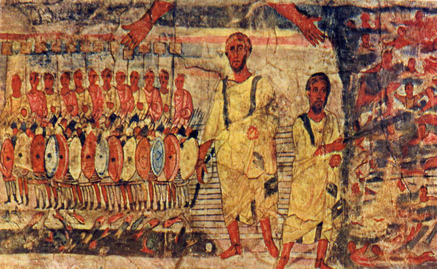
"Moses Crossing the Red Sea", Dura Europas Synagogue, 245 C.E.
“Moses Crossing the Red Sea”, Dura Europas Synagogue, 245 C.E.

The first singing that does happen in the Torah is in this week’s portion, Beshalach (“When he sent out”).  God splits the Reed Sea, the Israelites cross over on the damp sea-bottom, the Egyptian army pursues them, and the wheels of their chariots get stuck in the mud.  As soon as all the Israelites and their fellow-travelers are safe on the other side, God makes the waters return and drown all the Egyptians.  The Israelites see the dead bodies of the soldiers on the shore, and start to sing.

This is when Moses yashir, along with the children of Israel, this shirah to Y-H-V-H; and they said, saying:

Ashirah to Y-H-V-H, for He rises up in triumph;

    horse and its rider He threw into the sea!  (Exodus/Shemot 15:1)

yashir (יָשִׁיר) = he sings.

ashirah (אָשִׁירָה) = I sing, I will sing, let me sing.

(I am using “He” to translate the pronoun prefixes and suffixes in the “Song of the Sea’, since later lines in this hymn picture God as a “man of war”, i.e., warrior.  For the name of God indicated by Y-H-V-H, see my blog post: Va-eira: The Right Name.)

The hymn continues:

My strength is the melody of Yah, it is my salvation;

     this is my god, and I extol Him;

    the god of my father, and I exalt Him. (Exodus 15:2)

God is man of war; Y-H-V-H is His name. (Exodus 15:3)

Yah (יָהּ) = a name for God, possibly an abbreviation of Y-H-V-H.

Since God has single-handedly defeated and killed the enemy, the Israelites sing a hymn celebrating God as the ultimate warrior.

(The Song of the Sea continues for 16 more verses, using a more archaic Hebrew than the text surrounding it. Modern scholars agree that whoever compiled and wrote down the first version of the book of Exodus, some time after 900 B.C.E., inserted a much older hymn here and attributed it to Moses.)

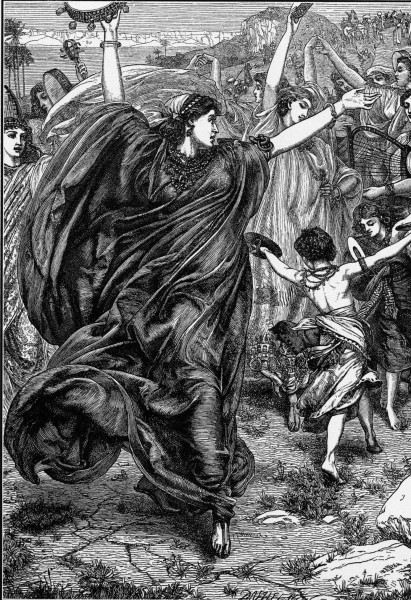
Miriams-Song 1909

At the end of the “Song of the Sea”, the women sing and dance. 

And Miriam the prophetess, the sister of Aaron, took the tambourine in her hand, and all the women went out after her, with tambourines and with circle-dances. And Miriam ta-an to them:

Shiru to Y-H-V-H, for He rises up in triumph;

    horse and its rider He threw into the sea!  (Exodus 15:20-21)

ta-an (תַּעַן) = she sang call-and-response; she answered, she responded (from the root anah, ענה).

Shiru (שִׁירוּ) = Sing!

Miriam appears to be leading singing, dancing, and percussion at the same time!

The next time the Torah reports singing is in the book of Numbers/Bemidbar, when it inserts a short archaic song in honor of a well of water into a list of places the Israelites traveled through.

This is when Israel yashir this shirah:

Rise up, well! Enu for it!

The well that captains dug,

That donors of the people excavated,

With a scepter, with their walking stick. (Numbers 21:17-18)

Enu (עֱנוּ) = let us sing call-and-response (also from the root anah, ענה).

The only other reference to singing in the first five books of the Hebrew Bible precedes a long hymn inserted into the book of Deuteronomy/Devarim. To introduce this song, God tells Moses:

And now, write for yourselves this shirah, and teach it to the children of Israel; put it in their mouths, so that this shirah will be a witness for me against the children of Israel. (Deuteronomy 31:19)

Although the hymn inserted at this point does praise God, it also criticizes the people for backsliding, and warns them about God’s vengeance.  The overall message is that the Israelites do not appreciate everything God has done for them, and they had better behave, or else. The purpose of the song, according to the Torah, is to make this message easy to remember.

King David is the first professional musician named in the Bible. In the second book of Samuel, he composes and sings not only another hymn praising God, but also the first two dirges in the Bible, one for Saul and Jonathan, and one for Avner. Both dirges are introduced by a new verb, va-yekonein (וַיְקֹנֵן) = and he sung a lamentation.

Besides songs of celebration and lamentation, the Bible contains many references to hymns addressed to God; and all 150 psalms are the lyrics of hymns.  There are psalms of praise and of thanksgiving.  The majority of the psalms plead with God: to reward those who worship God and do good, and punish the wicked; to rescue God’s followers from poverty or enemies; to grant us long life and to kill our enemies; to teach us how to do good; and—a plea that moves me today—to stop being silent and remote, to answer and prove that our God exists.

"The Concert Singer", by Thomas Eakins, 1892
“The Concert Singer”, by Thomas Eakins, 1892

I remember that when I was I small child, I sang spontaneously whenever  happiness came over me, making up melodies and nonsense words as I went along.  When I was in elementary school, I learned a variety of songs, and sang both to entertain myself, and to have fun with other people.  I was singing when it was the custom, and when I wanted to celebrate—like the singers in the first part of the Hebrew Bible.

I admit that as a young teenager, I sang “Ding, dong, the witch is dead” when I was consumed with frustration over someone who seemed to be my enemy.  I did not know that many psalms also begged God to kill the singer’s enemies.

After that, I learned that when I was feeling down, singing sad songs lifted my spirits.  I had discovered the equivalent of the Biblical dirge.  When I needed to vent my romantic frustrations and thwarted physical desires, singing certain popular songs gave my feelings an outlet.

When I was over 30, and searching for God, none of the popular songs I once loved met my needs.  Then I stumbled upon a Jewish Renewal congregation, P’nai Or of Portland, that supplied me with all the songs I wanted.  Finally, I could sing to express the yearning of my soul for both a good direction in life and a connection with the divine.  And many of those songs and chants come from the book of psalms.

Recently, I was singing a chant by Rabbi Shefa Gold using two lines that appear in the Song of the Sea in today’s Torah portion, and are so evocative the Torah repeats them in Isaiah and Psalms:

Ozi ve-zimrat Yah, vayehi li liyshuah (עָזִּי וְזִמְרָת יָהּ וַיְהִי לִי לִישׁוּעָה). Or in English:

My strength and the melody of Yah, it is my salvation. (Exodus 15:2, Isaiah 12:3, Psalm 118:14)

At this stage of my life, what saves my spirit is my own strength (which is a divine gift), combined with the ability to sing my own songs (both literally and figuratively) in praise of Yah, of the divine as I know it.

May we all be blessed with such music in our lives.

Bo: Impenetrable Darkness

by Melissa Carpenter, maggidah

Blood.  Frogs.  Lice.  Insect swarms (“wild beasts” in earlier translations).  Pestilence.  Boils.  Hail.  Locusts.  Darkness.  Death of the Firstborn.

These are the ten “plagues”—miraculous calamities—that God inflicts on Egypt before the Pharaoh lets the Israelites go.  Jews recite the ten plagues every spring during Passover/Pesach, the holiday commemorating the exodus from Egypt. We also read about the last three plagues in this week’s portion, Bo (“Come”).

Most of the plagues inflict pain on humans, kill livestock, and destroy crops. The last plague kills humans. But the ninth plague, darkness, seems harmless at first glance.

Seder Haggadah shel Pesach: Plague of Darkness

God said to Moses:  Stretch out your hand against the skies, and it will become choshekh over the land of Egypt, and the choshekh will be felt.  And Moses stretched out his hand against the skies, and it became choshekh of afeilah throughout all the land of Egypt, for three days.  No one could see his brother, and no one could get up from under it, for three days.  But for all the Children of Israel, there was light in their dwellings. (Exodus/Shemot 10:21-23)

choshekh (חֹשֶׁךְ) = dark, darkness.

afeilah (אֲפֵלָה) = cut off from any light, complete darkness, impenetrable darkness.

The three days of total darkness terrorize the Egyptians so much that Pharaoh makes his best offer yet to Moses: the Israelites could go with their women and children, leaving merely their livestock behind. (Moses rejects this offer, so that God can produce the final plague and Pharaoh’s complete capitulation.)

What is so terrible about this darkness?  If it were merely three days of blindness, the Egyptians might be able to wait it out.  They would have to feel their way around, but they could still talk with each other. They could cooperate to make sure everyone got food and water.  They could comfort each other.

But the plague of darkness is not physical blindness; it is psychological darkness.

This darkness can be felt.  The Midrash Rabbah (a collection of commentary from Talmudic times) explains that the darkness has “substance”.1  Maybe when the Egyptians grope around to find things they cannot see, all they feel is “darkness”. 19th-century rabbi Samson Raphael Hirsch wrote that groping means uncertainty, and in the impenetrable darkness of afeilah, everything seems uncertain and doubtful.2

In this condition, stray thoughts that a person would normally dismiss in an instant become obsessions.  What if there is no god?  Does that person wish I were dead?  What if I don’t really love them?  Is my whole life meaningless? What if I am insane? A person living in spiritual darkness keeps groping for true answers, but feels only darkness.

The Torah adds: “No one could see his brother”.  This is the darkness of extreme egotism, exemplified by the Pharaoh.  As the plagues roll through Egypt, Pharaoh’s advisors and the Egyptian people protest that it would be better to give Moses and his god what they want than to put the land through more plagues.  Pharaoh ignores them because he cares only about himself and his own pride; he does not recognize anyone as a “brother” human being.

Thus he is cut off not only from affection, but also from any possibility of enlightenment; he is incapable of learning from others.  Similarly, the afeilah cuts off the Egyptians from any possibility of light.

At first, Pharaoh hardens his own heart.  Over time, it becomes a habit from which only a divine intervention could shake him loose. But God keeps his heart hardened, so Pharaoh does not change. In the plague of darkness, all the Egyptians experience Pharaoh’s immobility.  The Torah says “and no one could get up from under” the darkness.  The Midrash Rabbah explains that anyone who was sitting could not stand, anyone standing could not sit, and anyone lying down could not rise up.3  Like the Pharaoh, the Egyptians cannot change their positions—or their beliefs.

Imagine experiencing a “dark night of the soul” or spiritual crisis so impenetrable that you cannot distract yourself by looking at anything; you cannot trust anything you feel; you cannot care about anyone else, or believe anyone cares about you; and you cannot get a new idea, or see life from a different perspective.

The plague of darkness terrifies the Egyptians because for three days, they experience what it is like to be the Pharaoh.  Maybe it terrifies the Pharaoh himself because at the end of the three days, when the darkness lifts, he sees a glimmer of what his own soul is like.  But it is only a glimmer; his habit of hardening his heart is too strong for actual enlightenment.

As I write this, my eyes are filling with tears for some people I know who appear to be living in a psychological darkness, unconsciously isolating themselves from others because they can neither trust nor respect them, and immobilizing themselves because they cannot change their perspective.

stars in blackAnd I know that any of us can fall into a temporary state of darkness.  I pray that whenever healthy uncertainty turns into doubting everything, we find the power to stop our obsessive groping.  I pray that whenever we fall into the trap of justifying our own behavior instead of noticing and appreciating what others are doing, we realize that we are isolating ourselves, and make an effort to see our brothers and sisters.  And I pray that whenever we are so depressed that change seems impossible, we follow any glimmer of light that gives us a view from a different perspective.

May every human being escape from the plague of darkness.

  1. Shemot Rabbah 14:1, Soncino translation.
  2. Samson Raphael Hirsch, p. 144-145.
  3. Shemot Rabbah 14:3, Soncino translation.

Va-eira: The Right Name

by Melissa Carpenter, maggidah

Go to the king of Egypt, and tell him to declare a three-day holiday for his labor force, so they can go out into the wilderness and worship a god the king has never heard of.

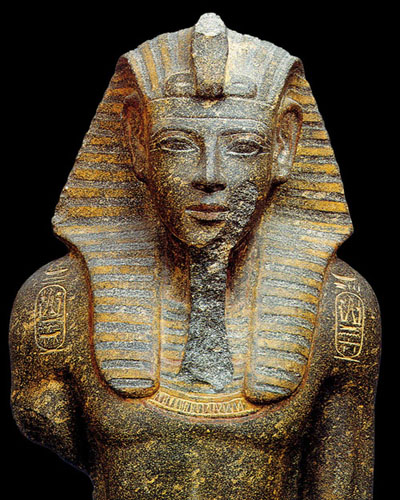
Pharaoh Merneptah, son of Rameses II

This is the mission God gives Moses in the first Torah portion of Exodus/Shemot. Moses tries to get out of it, but God insists, and Moses gives in.

And afterward Moses and Aaron came and said to Pharaoh: Thus says YHWH, god of Israel: Send out My people and they will celebrate-a-festival for Me in the wilderness. And Pharaoh said: Who is YHWH that I should listen to His voice and send out the Israelites? I do not know YHWH… (Exodus/Shemot 5:2)

YHWH = probably a form of the verb hayah (היה) = be, exist, become, occur. A variant spelling of this verb is havah or hawah (הוה). If the initial Y (י) indicates a third-person singular imperfect form, YHWH = he/it becomes, he/it exists, he/it will be.  If the four-letter word is a unique verb form, YHWH = us-was-will be; being-becoming.

(YHWH is considered the most sacred name of God, God’s four-letter personal name. I do not include the Hebrew spelling here because according to Jewish tradition, any text containing the personal name of God must be treated with respect and disposed of by special means. Furthermore, the name YHWH is not supposed to be pronounced except once a year inside the Holy of Holies—which has not existed since the fall of the second temple in Jerusalem in 70 C.E., almost 2,000 years ago.)

Since Pharaoh does not know YHWH, he refuses to give the Israelites three days off.  Instead he doubles the work of the Israelites forced to build his cities. The Israelite foremen complain to Moses, and Moses complains to God:

Since I came to Pharaoh to speak in Your name, he has done evil to this people, and You certainly did not rescue Your people! (Exodus 5:23)

Moses’ complaint implies that using the name of God was ineffective. But for God, everything is going according to plan.  As God tells Moses repeatedly in this week’s portion, Va-eira (“And I appeared”), God’s purpose in performing miracles in Egypt is: 1) so that the Israelites will know their own God as YHWH, and 2) so that the Egyptians will know the power of the god YHWH.

From God’s point of view, the ten miraculous “plagues” God plans to create will be all the more effective coming from a previously unknown god. God assures Moses that although it will be a long process, at its conclusion God will indeed rescue the Israelites from Egypt and bring them to Canaan.

But first God insists on being known by the right name.

And Elohim spoke to Moses, and said to him:  I am YHWH. And I appeared to Abraham, to Isaac, and to Jacob as Eil Shaddai, but [by] my name YHWH I was not known to them. (Exodus 6:2-3)

elohim (אֱלֹהִים) = gods (when used with a plural verb suffix); God (when used with a singular verb suffix).

eil (אֵל) = god

shaddai (שַׁדָּי) = of breasts (if it comes from shad = breast), of devastation (if it comes from shadad = devastate), of the mountain (if it comes from the Akkadian word shadu).

In the book of Genesis Abraham, Isaac, and Jacob certainly know that YHWH is one of God’s names; all three of them sometimes use that name to refer to God. So why does God claim, in this week’s Torah portion, “my name YHWH I did not make known to them”?

Most commentators explain that the three patriarchs knew God in terms of the attribute or power associated with the name Eil Shaddai, but not in terms of the power associated with the name YHWH.

In fact, the name Shaddai only appears six times in the book of Genesis, four times followed by blessings for being fruitful and multiplying (17:1, 28:3, 35:11, and 48:3). Jacob also uses that name of God to pray for rachamim (רַחֲמִים) = mercy (literally, “wombs”—43:14) and to bless Joseph with “blessings of breasts and womb” (49:25).

Although Eil Shaddai took on other meanings in later books of the Hebrew Bible, it seems safe to say that as far as the three patriarchs are concerned, Eil Shaddai is the name of the god of fertility. Abraham, Isaac, and Jacob are all concerned with the question of fertility, and want to be founders of a people or nation.

But in the book of Exodus, the Israelites in Egypt are already fertile. (The first pharaoh worries about the rapid birth rate of the Israelites; his son, the pharoah Moses speaks to in God’s name, agrees that there are far too many Israelites.) So a different aspect of God is needed to impress both Israelites and Egyptians. And God Itself seems eager to promote a new identity.

One can deduce the divine power associated with Eil Shaddai from context, but this cannot be done with the name YHWH.  The four-letter name appears 162 times in the book of Genesis alone, in a wide variety of actions and statements by God.

Commentary on which divine aspect is represented by the name YHWH ranges from the god of miracles (12th-century rabbi Abraham Ibn Ezra); to the god expressed by all ten sefirot, i.e. divine emanations (Sefer Yetzirah, a book of kabbalah possibly written in the 4th century); to the preserver of existence (16th-century rabbi Ovadiah Sforno).

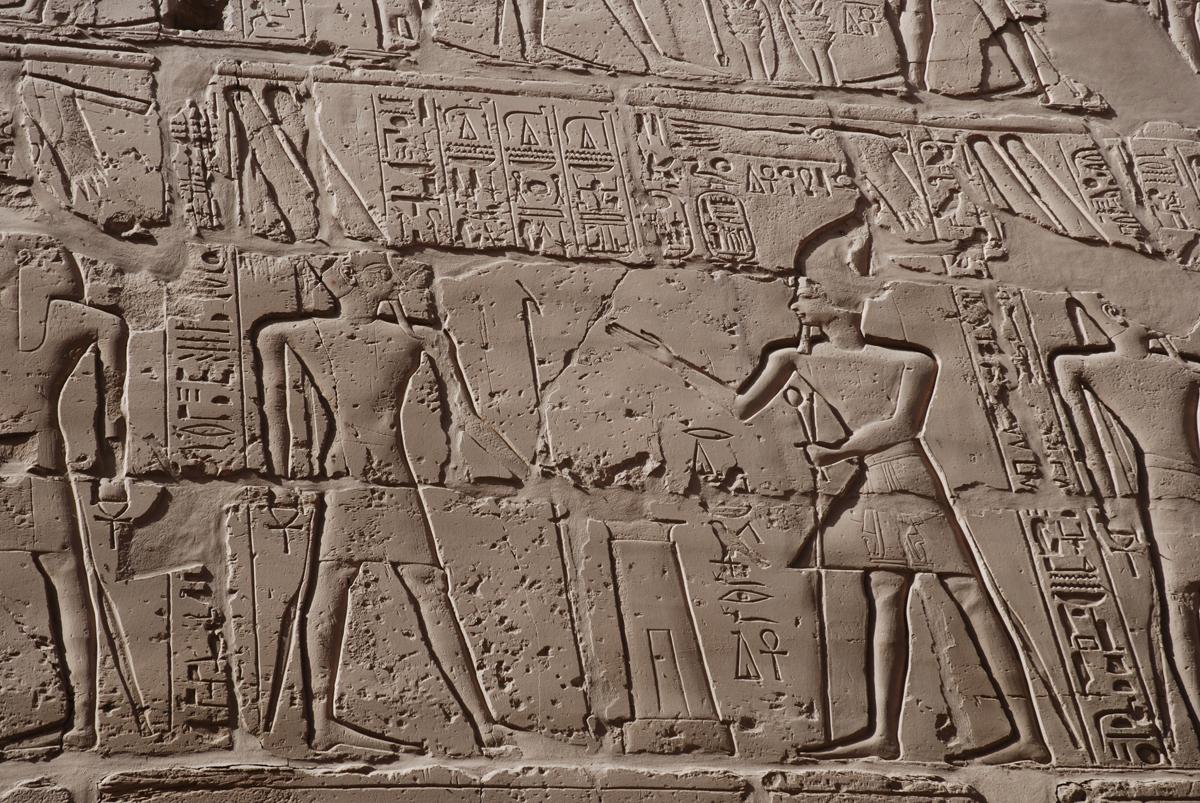
Rameses II (right) dedicating a temple to his god, Amun-Ra

All three of these interpretations boil down to the idea that God is the supreme deity; if any other gods can be said to exist, they are only emanations of YHWH, the god whose name means existence itself.

In the Exodus story, God wants Egypt to know that the god of the Israelites is the most powerful god in world, far more powerful than any of Egypt’s gods. And God wants the Israelites to know that the god who is making a covenant with them is not merely a fertility god, but a god with power over everything. Once everyone knows that God is YHWH, nobody can question God’s existence or decisions.

Or so God thinks, in the first two portions of the book of Exodus.

As the story continues, we read that after each time Pharaoh admitted the superior power of the god of the Israelites, he changed his mind and behaved as if he could win the contest with YHWH.  Even after the tenth and final plague, when Pharaoh finally lets the Israelites leave Egypt, he changes his mind again and sends his army to pursue them.  He only gives up after God splits the Reed Sea for the Israelites, then drowns the Egyptian army.

The Israelites themselves keep forgetting their god’s awesome power over life and death. As they travel through the wilderness of Sinai they worry whenever they run out of water or food, when Moses does not return from the top of Mount Sinai for 40 days, and when they face enemy forces. They cannot seem to trust the god who has taken them as Its people, even when the name of that god is YHWH.

Why doesn’t the name work?

I think that the idea of God as “being” or “becoming” is intellectually appealing. And sometimes I feel grateful that this universe exists, or that everything is in the process of becoming.

But psychologically, human beings cannot have a relationship with “existence” or “becoming”; the concepts are too abstract. To be followed, or loved, or feared, or trusted, God must be named after a more human attribute.

Eil Shaddai, the god of fertility, is not a useful divine name for most people today. When we lack children, we take practical steps; otherwise, we enjoy being fruitful in our own creative endeavors. Elohim, the God who combines the powers of all gods, is an irrelevant name at a time when nearly everyone is either an atheist or a monotheist. And YHWH, the concept of being and becoming, is too abstract for a relationship.

Then what name can inspire us to strive to “know” God? I welcome your suggestions.


Shemot: Choosing Life

by Melissa Carpenter, maggidah

At the end of his life, Moses says:

…life and death I place before you, blessing and curse; and you must choose life, so that you will live, you and your offspring: le-ahavah God, your god; lishmoa [God’s] voice; and ledavkah [God] … (Deuteronomy/Devarim 30:19-20)

le-ahavah (לְאַהַוָה) = to love, by loving.

lishmoa (לִשְׁמֹעַ) = to listen, by listening.

ledavkah (לְדָוְחָה) = to be attached to, to stick with, to be faithful to; by sticking with, etc.

At the beginning of his life, in the first Torah portion of the book of Exodus/Shemot, Moses survives only because the women in the story choose life—by loving, listening, and being attached.

The character who wants to restrict life is Pharaoh, a xenophobe. He is frightened by the large number of Israelites living in Egypt (called “Hebrews” or ivrit in this Torah portion, from the Egyptian word habiru). This unnamed king of Egypt says:

…it may be if a war happens, then they will even be added to our enemies and wage war against us, and go up from the land. (Exodus/Shemot 1:10)

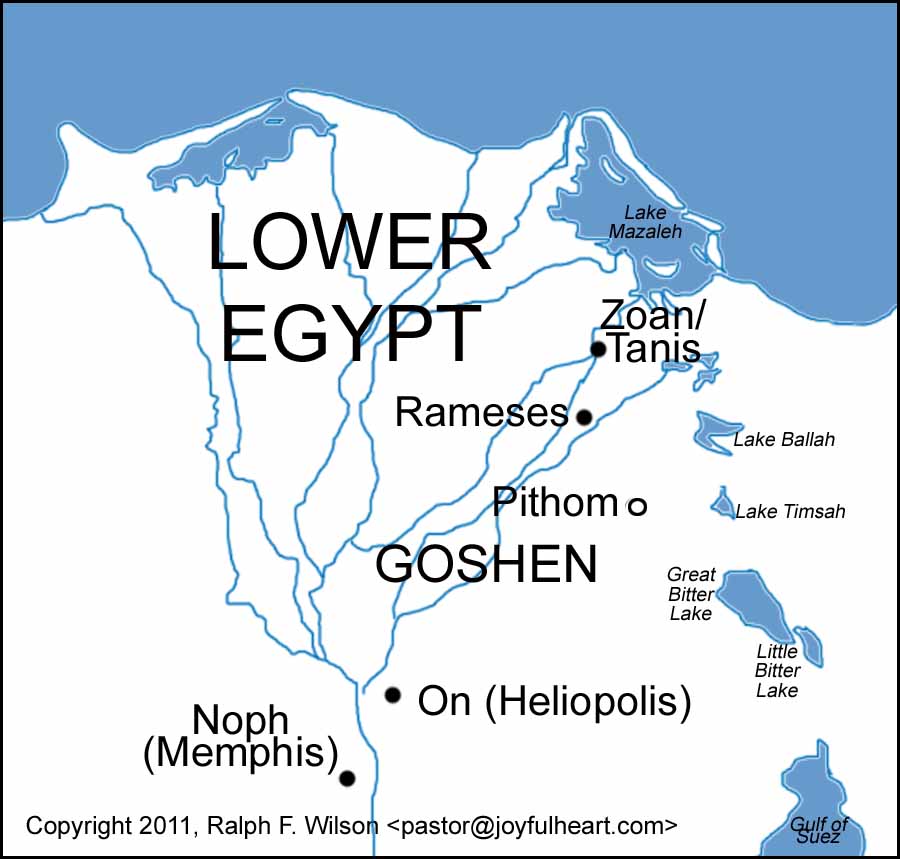
Goshen and the new cities of Ramses and Pitom
Nile delta circa 1250 B.C.E., with the capital, Tanis, and the new cities of Ramses and Pitom

Pharaoh fears that the Hebrews will either stay in Egypt and fight against the Egyptians, or leave Egypt and deprive the land of workers. His solution to this double anxiety is to reduce the population of Hebrews gradually. First he drafts large numbers of them into forced labor building the new cities of Pitom and Ramses (which were actually built in the Nile delta, in the Goshen region, during the reign of Rameses II). But so many Hebrew men survive and have relations with their wives, the population of Hebrews continues to increase.

Pharaoh’s next ploy is to order the midwives of the Hebrews to kill all the boys as they are born, but let the girls live. At that time, more than 3,000 years ago, only men would go to battle, and only men would lead their families to another country. Women would do whatever their masters or husbands ordered them to do. Pharaoh is thinking ahead, assuming that a future surplus of Hebrew women is no threat, since they would all become slaves or wives of native Egyptians. All he wants to do is reduce or even eliminate the future population of Hebrew men.

But the midwives feared God, and they did not do as the king of Egypt spoke to them, and they kept the boys alive. Then the midwives said to Pharaoh: “Because the Hebrews are not like Egyptian women, for [they are] lively animals; hey!—before the midwife comes to them, they have given birth.” (Exodus 1:17-18)

In biblical Hebrew, to “fear God” is an idiom meaning to act righteously or ethically. The Hebrew midwives save lives, instead of following orders, because it us the right thing to do. They are listening—not to Pharaoh, but to the God of good deeds.

Then Pharaoh commanded his entire people, saying: “Every son that is born, you shall throw him into the Nile. But every daughter you shall keep alive.” (Exodus 1:22)

The Torah does not say how many baby boys are drowned, but we can tell that this command is also ineffective at reducing the number of Hebrew men; many years later, after that Pharaoh (probably Rameses II) has died and been replaced by a new Pharaoh (probably his son Merneptah), the new Pharaoh says: Hey, the people are numerous now in the land! (Exodus 5:5)

During the period when the previous Pharaoh was encouraging Egyptians to drown Hebrew male infants, a man and woman from the tribe of Levi have a son. (Later in the Torah, their names are given as Amram and Yokheved.)

And the woman conceived, and she gave birth to a son. And she saw him, ki tov hu, and she hid him for three months. (Exodus 2:2)

ki tov hu (כִּי־טוֹב הוּא) = that he was good.

Commentators have puzzled over whether the mother saw that her baby was exceptionally healthy, or beautiful, or placid and quiet, or good in some other sense. Both the Talmud (in Sotah 12a) and the Midrash Rabbah (in Shemot Rabbah 1:20) report the opinion of the Sages (i.e. authoritative rabbinic commentators from about 200 B.C.E. to 500 C.E.) that when Moses was born, the whole house was flooded with light. Their proof text is in the first chapter of Genesis/Bereishit, where God creates light.

And God said: Light will be! And light was. And God saw the light, ki tov. (Genesis/Bereishit 1:3-4)

Since both texts use the phrase ki tov, they must be talking about the same thing: light.

I find this interpretation a stretch. But I can imagine that when the mother sees her new baby, her heart is flooded with (metaphorical) light. Just as God creates light, and sees that it is good, a human experiences creation as good.  When I “create” a story, it feels as if I only shaping a story that comes to me from some unknown place, and when I have finished writing it down, I feel elated, knowing that something good has happened. Similarly, when I was pregnant, I felt as if I were a container for a mysterious process, and when my son was born, I felt elated, knowing that something good had happened.

Moses’ mother hides him to preserve his life because she sees the goodness of creation; in other words, she appreciates God the Creator. She loves her son, and she loves God. As a mother, she attaches herself to her son until she can no longer protect him.

Then she was not able to hide him anymore, so she took for him an ark of papyrus, and asphalted it with asphalt and pitch, and she place the child in it, and she placed it in the reeds at the bank of the Nile. And his sister stationed herself meirachok, to know what would be done to him. (Exodus 2:3-4)

meirachok (מֵרָחֹק) = at a distance, long ago, mysteriously.

In context, Moses’ older sister Miriam obviously stands at a distance from the riverbank. But the Torah’s choice of words hints that Miriam has a connection with mysteries.  When we see her as an adult, the Torah calls her a prophet.

Miriam stands by, ready to intervene and make whatever happens to her baby brother the best possible outcome. This is a different kind of attachment than a mother’s attachment to her baby. Miriam the prophet is faithful to a vision of the future that she wants to help realize.

Meritamun, one of Rameses II's daughters
Meritamun, one of Rameses II’s daughters

Then the daughter of Pharaoh went down to wash in the river, and her serving-women walked on the riverbank; and she saw the ark among the reeds, and she sent her slave-woman, and she took it. And she opened it, and she saw the child, and hey!—the boy was sobbing. And she felt compassion over him, and she said: This is one of the children of the Hebrews! (Exodus 2:5-6)

Pharaoh’s daughter decides to disobey her father’s command and save the life of the baby because she listens to him sobbing, and her heart is moved by compassion. This is another kind of love, the instinctive and generous love for a living being who needs help. It leads to another attachment, as she decides to protect the child by adopting him as her own.

Miriam emerges and offers to find a woman to nurse the infant. If Pharaoh’s daughter can see that the baby in the ark is a Hebrew, she can certainly see that Miriam is also a Hebrew, and she may suspect that the girl is offering to fetch the baby’s own birth mother. A jealous woman would not agree to this, but Pharaoh’s daughter has so much compassion that it includes the baby’s family. When Miriam returns with her mother, Pharaoh’s daughter says:

Carry away this child and nurse him for me, and I myself will give [you] your wages.” (Exodus 2:9)

Pharaoh’s daughter not only gives the baby to his natural mother until he is weaned, but even pays her, so the whole family will thrive. Then Moses’ mother proves to be as righteous as the midwives at the beginning of the story, because when her son is old enough, she duly returns him to his adoptive mother.

Thus Moses grows up as a prince of Egypt, and launches on a long life that results in the liberation of thousands of slaves. They leave Egypt (as Pharaoh feared) and walk into a new life.

All the women in this story—the midwives, Moses’ first mother, his sister, and Pharaoh’s daughter—choose life by disobeying the fearful Pharaoh, and keeping a child alive. They are motivated by all three ways of choosing life that Moses describes near the end of his own life, 120 years later: loving, listening, and faithful attachment.

May we all be blessed with open hearts so that we can do the same.

Beha-alotkha & Beshalach: Stomach versus Soul

When we doubt the meaning of our lives, mere food cannot address the problem. Yet many people divert anxiety about their futures into craving for food—both today and in the Torah.

When the Israelites and their fellow-travelers leave Egypt, they take all their herds and flocks with them. They are never forbidden to use their livestock for milk or meat, so they are in no danger of starving. Yet a month and a half after they leave Egypt, they complain about food.

The entire assembly of the Children of Israel grumbled against Moses and against Aaron in the wilderness.  The Children of Israel said to them: “If only we had died by God’s hand in the land of Egypt, when we sat beside a pot of meat, when we ate bread until [we were] sated; for you brought us out to this wilderness to put to death this whole congregation by famine!” (Exodus/Shemot 16:2-3, in the Torah portion Beshalach)

How could dying in Egypt with a full stomach be better than journeying with God’s protection? These are the people who chose to follow Moses and his god out of Egypt, who sang and danced after God rescued them from the Egyptian army at the Reed Sea. How could they feel so discouraged in the second month of their trek across the wilderness?

God diagnoses the problem, and solves it—temporarily—with manna.

Then God said to Moses: Here I am, raining down food from the heavens… (Exodus 16:4)

Manna satisfies the people for a while—not because they need additional food, I think, but because it reminds them daily that God loves them like a parent. They are already following the divine pillar of cloud and fire across the wilderness. Now they know that they are not wandering aimlessly; serving God gives them a purpose in life.

The Israelites forget their purpose and fail to serve God whenever they are idle or afraid during their sojourn at Mount Sinai. But they are in good spirits when they march away from the mountain in this week’s Torah portion, Beha-alotkha (“When you raise up”) in the book of Numbers/Bemidbar. They head toward their promised land supplied not only with the manna God provides, and the livestock they brought up from Egypt, but also with a splendid portable sanctuary and its numinous objects, as well as a set of God-given rules and principles to live by.

Alas, after only three days of marching they lapse into complaining again. The Torah does not tell us the content of their complaint at Taverah. It merely says God hears and reacts with anger, consuming the edge of the camp with fire. Then the people switch from complaining to sobbing.

And the riff-raff that was in its midst felt strong cravings, and they sobbed, and the Children of Israel also [sobbed], and they said: Who will feed us meat? We remember the fish that we ate in Egypt for free, and the cucumbers and watermelons and leeks and onions and garlic. And now our nefesh is dried up; there is nothing except the manna for our eyes. (Numbers/Bemidbar 11:4-6)

nefesh (נֶפֶשׁ) = appetite, throat, animating soul, life

Why, when they are on the verge of getting their own land, do the people yearn for the food in Egypt again? Psalm 78 answers:

They tested God in their hearts by asking for food for their nefesh. (Psalm 78:18)

To me, this shows that the people are not complaining about dry throats, but about dry lives. They have not lost their appetite for food, but they have lost their appetite for being God’s people.

For the survivors of the Golden calf incident, life at Mount Sinai was both pleasant and meaningful. They had the pleasure of serving God by making donations, but their donations were the treasures they took from their Egyptian neighbors, rather than anything personal. They also had the pleasure of serving God by skilled creative work, as they made the sanctuary and its holy objects.

Now, as they march north, the people are approaching the border of Canaan. They know their next service to God will be taking over a land inhabited by other people. As we learn in next week’s Torah portion, Shelach, very few Israelites believe that God will single-handedly drive out the inhabitants and leave them empty cities and farms. Instead they are anticipating war, which means many hardships and deaths.

Now the thought of serving God fills them with anxiety instead of purpose. So, as the psalm says, they sob for Egyptian food to (unconsciously) test whether God will nourish their souls.

God correctly interprets the sobbing as indicating a lack of faith, rather than a desire for tasty food. But instead of reassuring the people that their lives will be filled with meaning, God takes a punitive approach, and tells Moses:

To the people you shall say: Consecrate yourselves for tomorrow; then you will eat meat … Not for one day will you eat, nor for a couple of days, nor for five days, nor for ten days, nor for twenty days. Until a month of days, until it comes out of your nostrils and you are nauseated because of it! For you rejected God, who is in your midst … saying: Why did we leave Egypt for this? (Numbers 11:18-20)

I confess I am like the Israelites in this week’s Torah portion. My life is full of meaning and purpose right now, while my material needs are met and I spend my days drawing insights and inspirations from the Torah, and sharing my life with people I love. Yet there are empty times in my day, when I need to rest or alleviate chronic pain. At those times, anxiety about the future haunts me. What if my sense of purpose is not strong enough to carry my through old age, when I must face hardships and the deaths of people I love?

My first impulse, as these times, is to comfort myself by eating something tasty. Yet I know that if I eat too much, I will make myself sick in the long run. I would rather keep faith that God is with me, and my life will continue to be worthwhile no matter what happens.  But how can I do that?

The only solution I know is to refocus and cultivate gratitude for the good life I have now. Do you have another solution to the anxiety of the Israelite? Please comment!

Pekudei & 1 Kings: A Throne for the Divine

Canaanite temples were built according to a basic three-part plan: a courtyard in front, a main hall behind it, and a small temple 2sacred chamber at the back containing a statue of the temple’s god. There were often additional rooms at the sides of the main hall for practical use by the temple’s priests and functionaries, but religious rituals happened in the courtyard, main hall, and back chamber.

The Hebrew Bible describes the construction of three sanctuaries: the portable tent-sanctuary in the book of Exodus, the first Israelite temple in Jerusalem in the first book of Kings, and the second temple in the books of Ezra and Nehemiah.

The portable Tent of Meeting that Moses assembles at the end of the book of Exodus travels with the people from Mount Sinai all the way across the Jordan River. It is erected in several locations while the Israelites are gradually conquering Canaan: Gilgal, Shiloh, Nob, Givon, and then Jerusalem. King Solomon builds the first temple in Jerusalem in the first book of Kings, and the construction of the second temple in Jerusalem begins in the book of Ezra.

All three of these sanctuaries follow the basic three-part Canaanite plan. But since the Israelites are forbidden to make an image of God, the innermost chamber at the back cannot contain a statue of their deity. So what is inside the “holy of holies”?

This week’s Torah portion, Pekudei (“Inventories”), says what Moses put into the holy of holies in the Tent of Meeting.

He took and placed the eidut in the aron, and he put the poles on the aron, and he placed the cover on top of the aron. Then he brought the aron into the dwelling-place, and he placed the curtain of screening-off, and screened off the aron of the eidut, as God had commanded Moses.  (Exodus/Shemot 40:20-21)

eidut (עֵדֻת) = testimony—of a witness or of God. (The Torah often uses this word to refer to the second pair of stone tablets Moses brings down from Mount Sinai.)

aron (אֲרוֹן)  = chest, coffer, coffin; ark of the covenant

What does the aron look like? In the book of Exodus, it is a gold-plated wooden box about four feet long, with carrying-poles attached to the bottom. Last week’s Torah portion, Vayakheil, describes how the master artist Betzaleil makes the lid of the aron:

Then he made a cover of pure gold, two and a half cubits long and a cubit and a half wide. And he made two keruvim of gold; he made them hammered out from the two ends of the cover. One keruv from this end and one keruv from that end; from the cover he made the keruvim, from its two ends. And the keruvim were spreading wings upward, screening off with their wings over the kaporet; and their faces were toward each other, toward the cover were the faces of the keruvim. (Exodus 37:6-9)

keruv (כֱרוּב), (plural keruvim)  = a hybrid beast with wings and a face. (See my earlier post: Terumah: Cherubs Are Not for Valentine’s Day.)

What are the wings of the keruvim on the cover screening off? The space above the golden lid is empty—or, at least, nothing is visible there. But the Torah treats the aron as a throne for an invisible, although not inaudible, god.

Moses came into the Tent of Meeting to speak with [God]. Then he heard the voice speaking to him from above the cover that was on the aron of the eidut, from between the two keruvim; thus [God] spoke to him. (Numbers/Bemidbar 7:89)

The keruvim and the lid of the aron are a single piece of gold in the Tent of Meeting. But in the first temple, they are separate items. While the aron stays in the tent where King David put it, King Solomon’s craftsmen make two keruvim out of olive-wood overlaid with gold. Each keruv is ten cubits (about 15 feet) tall, with a ten-cubit span from wingtip to wingtip.

Then he placed the keruvim inside the House, in the innermost [chamber]. And the wings of the keruvim spread out so the wing of one keruv touched the wall, and the wing of the second keruv was touching the second wall, and in the middle of the chamber their wings touched. (1 Kings 6:27)

The haftarah reading corresponding to the Torah portion Pekudei is from the first book of Kings. It describes the ceremony after the first temple in Jerusalem is completed, starting with a procession as King Solomon and elders from all over Israel accompany the aron on its short journey from the tent in the old city to the new House of God.

The priests brought in the aron of the covenant of God to its place, to the back room of the House, to the holy of holies, to underneath the wings of the keruvim. For the keruvim were spreading wings toward the place of the aron, so the keruvim screened off the aron and its poles from above. (1 Kings 8:6-7)

In both the Tent of Meeting and the first temple, there is an empty space between the lid of the aron below and the wings of the keruvim above. God’s voice or presence is never located inside the aron, only in the space above it.

Yet inside the aron is the eidut, God’s testimony. Commentary on the Tent of Meeting agrees that the eidut means the second, unbroken, pair of stone tablets inscribed by God on Mount Sinai (also called Choreiv). Commentators disagree on whether the aron also contained the shattered tablets, and/or a scroll that Moses wrote.

The first book of Kings clarifies the contents of the aron in the time of the first temple:

There was nothing in the aron but the two tablets of stone that Moses placed there at Choreiv, when God cut a covenant with the children of Israel after they left the land of Egypt. (1 Kings 8:9)

The first temple was sacked several times, and when the Babylonian army captured Jerusalem in 586 B.C.E. they razed it altogether. The keruvim and the aron were never recovered. So in the second temple, which was begun in 538 B.C.E., the holy of holies was an empty room. But priests still treated it as the locus of God’s presence.

After the Romans destroyed the second temple in 70 C.E., Jews had to find God’s presence in other places. Today, many of us search for God by going inside ourselves: pondering what we have learned, questioning our feelings, meditating, sinking into ritual, praying with intention, and so on. This inner journey in search of God also has stages.

If the first stage of your search is like the courtyard of the Tent or temple, does your courtyard have an altar for animal sacrifices and a basin for washing? If you push on into the main hall, does it have any of the furnishings of the Israelite sanctuaries: a lampstand for light, or a table for bread, or an altar for incense? And if you keep searching even deeper, what do you find in your holy of holies?

Do you enshrine fundamental written principles in a gold coffer? Or do you encounter fantastical creatures? If you find both in your holy of holies, are the fantastical creatures bigger or smaller than the coffer? Or is your holy of holies an empty room?

Is God present there?

Vayakheil and Ki Tissa: How to Be a Holy Artist

What does it take to create something that will help people feel the presence of God?

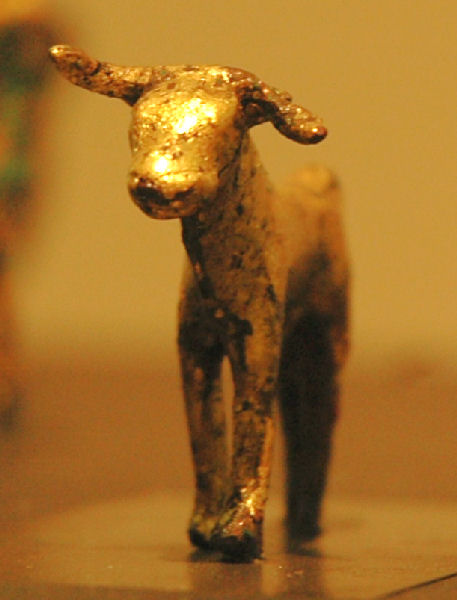
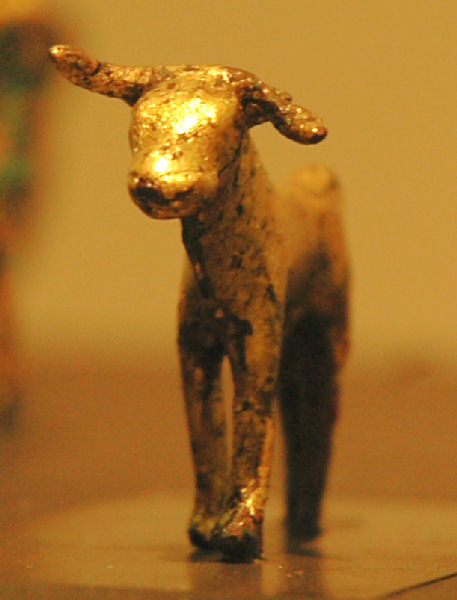
Golden Calf: figurine from the Temple of Baalat in Byblos

Aaron tries to do this when he makes the Golden Calf in last week’s Torah portion, Ki Tissa. At first, the people are ecstatic over the idol, bowing down to it and singing and dancing. But this simple and undisciplined religious outlet does not last. When Moses returns and grinds the calf into gold dust, nobody protests. Moses stirs the gold dust into water, and they all meekly swallow it. Aaron’s creation turns out to be a failure.

In this week’s Torah portion, Vayakheil (“And he assembled”), the master craftsman Betzaleil begins making the holy objects for the new sanctuary. The completed creation is so successful that it sustains the religion of the Israelites for several centuries, until King Solomon replaces it with the temple in Jerusalem.

The key difference between Aaron and Betzaleil as creators of religious objects appears in the Torah twice, repeated word for word. In the portion Ki Tissa, God says it to Moses. In this week’s portion, Moses says it to the Israelites:

See? God has called by name Betzaleil, son of Uri, son of Chur, of the tribe of Yehudah. And [God] has filled him with ruach of God, with chokhmah, with tevunah, and with da-at, and with every craft. (Exodus/Shemot 35:30-31)

ruach (רוּחַ) = wind; spirit, motivation, overwhelming state of mind.

(Usually when the ruach of God comes over someone in the Hebrew Bible, that person speaks as a prophet or leads people into battle. Exceptions are Samson, who is gripped by a murderous rage and supernatural strength; and Betzaleil the artist, who is filled with a divine motivation to create.)

chokhmah (חָכְמָה) = wisdom; inspiration.

tevunah (תְבוּנָה) = insight, rational understanding, analytic ability.

da-at (דַעַת) = knowledge.

In later Kabbalistic writings, chokhmah and binah (another form of the word tevunah) are two of the sefirot or divine powers.  Chokhmah is the sefirah associated with the left side of the head, i.e. the left brain that popular science now associates with non-rational, intuitive, holistic consciousness. Binah (tevunah) is the sefirah associated with the right side of the head, i.e. the right brain that we now associate with rational, logical, analytic thinking. In the Kabbalist system, da-at is the product of chokhmah combined with binah.

Aaron, although he will serve as the high priest, lacks the four qualities with which God fills Betzaleil. When the Israelites are waiting at the foot of Mount Sinai in Ki Tissa, Aaron feels no ruach of God, no divine urge to create a holy object. The people decide Moses will never return and order Aaron: Get up, make for us gods that will go before us! (Exodus 32:1). Then Aaron acts, but only to satisfy the crowd.

He has no chokhmah, no inspiration nor wisdom about what to make; he merely calls for gold earrings to melt down, since the finest idols are made of gold.

He took it from their hands and he shaped it with the engraving tool, and he made it into an image of a calf. (Exodus 32:4)

Afterward, when Aaron explains to Moses what happened, he says: I said to them, “Who has gold? Pull it off yourselves.” And they gave it to me and I threw it into the fire and out came this calf.” (Exodus 32:24)

Aaron admits that he acted without any of the insight or discrimination of tevunah, and also without any da-at, any knowledge of what would emerge from the fire.

Betzaleil, on the other hand, is born betzalmeinu—in God’s shadow or image—when it comes to creativity. (See my post Vayakheil: Shadow Power.) He creates under the protection of God’s shadow. God “fills” him with the qualities he already has the potential and experience to develop.

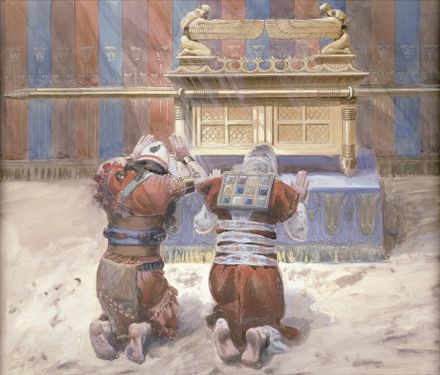
Bowing Before the Ark, by James Tissot, ca. 1900

Even as Moses comes down with God’s basic design for a portable sanctuary, Betzaleil is filled with a divine desire to create it. He has the chokhmah to visualize the whole thing, and to imagine beautiful and inspiring objects—from the gold keruvim (hybrid winged beasts) on top of the ark to the design embroidered in brilliant colors on the curtain at the entrance to the Tent of Meeting. He has the tevunah to analyze and understand how each part can be made well and assembled into the whole. And he has da-at, knowledge, of every craft: metal-working, jewelry, wood-working, weaving, and embroidery.

Betzaleil is so filled with chokhmah, tevunah, and da-at that he and his assistant can teach other craftsmen and craftswomen among the people.

And [God] put teaching into his heart, him and Ahaliyav son of Achisamakh of the tribe of Dan. (Exodus 35:34)

And Betzaleil and Ahaliyav and everyone wise of heart to whom God gave chokhmah and tevunah for da-at and for doing all the work for the service of the Holy, they shall do everything that God commanded. (Exodus 36:1)

The sanctuary that is completed in next week’s Torah portion, Pekudei, is the product of the grand design Moses heard from God; the divine spirit, inspiration, understanding, and know-how of the master artist, Betaleil; and the enthusiasm and wisdom of the contributors in the community. No wonder it becomes a place where people feel God’s presence.

I think that the qualities God gives Betzaleil are necessary for anyone to produce truly moving art, whether its explicit goal is religious or not. I know that when I do “creative writing”, especially of Torah monologues and fiction, both my motivation (ruach) and my inspiration (chokhmah) seem to come from a mysterious place outside myself, or perhaps from some inner place so deep my conscious mind can never penetrate it. I might as well say they come from God, the great mystery.

But the most burning motivation and inspiration leads nowhere without the application of rational insight and analysis (tevunah). My own ability in this area is a talent I was born with, a gift of God, that I have developed over many years of practice. And as in Kabbalah, I have found that the combination of left-brained inspiration (chokhmah) and right-brained analysis (binah or tevunah) does indeed result in knowledge (da-at).

The final requirement for creating art is to actually do all the labor. I am grateful that the ruach that blows through me from the unknown source I call God is strong enough to motivate me to keep on working, with enthusiasm—like the Israelites in this week’s Torah portion.

May the divine spirit be strong in all artists.

Ki Tisa: Fighting or Singing?

After God’s revelation to the Israelites at Mount Sinai, the people repeatedly promise to do everything God says. Then Moses and Aaron lead the elders halfway up the mountain, where they have a vision of God’s feet. (See my earlier post, Mishpatim: After the Vision, Eat Something.)

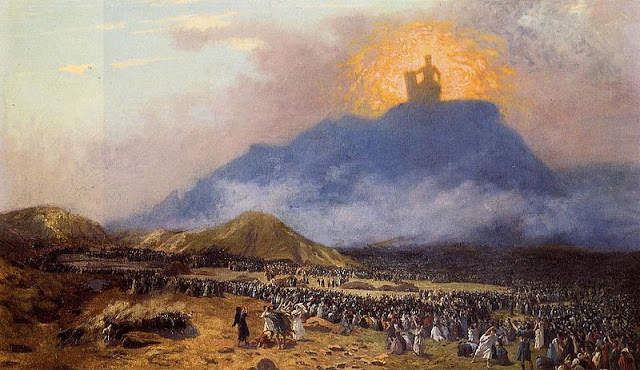
Moses on Mt. Sinai,
by Jean-Leon Gerome, 19th century

This is their high point. After this, Aaron and the Israelite leaders go downhill, both literally and figuratively. Joshua, Moses’ attendant and war-leader, stays partway up the mountain. And Moses climbs to the summit again. There he disappears into God’s cloud—or fire, from the point of view of the Israelites below. (See my earlier post, Mishpatim: Seeing the Cloud.)

Inside the cloud, Moses listens to God’s instructions for 40 days . Meanwhile, the Israelites below conclude that their prophet has died in the fire on the mountaintop and will never return. And without Moses, how can their god lead them to their promised land?

Gold calf from Temple of Baalat, Byblos

They fall back on an old and familiar solution in this week’s portion, Ki Tissa (“When you bring up”): a physical image or idol for the god to inhabit. They give Aaron their gold earrings, and get him to mold an image in the shape of a calf. On his own initiative, Aaron builds an altar and declares a festival for God the next day.

The same day that the Israelites bring animal offerings to the new altar, God hands Moses the two stone tablets written by the finger of God (Exodus/Shemot 31:18), tells him to go down the mountain, and then tells him what the Israelites have done.

Quickly they deserted the path that I commanded them! They made for themselves a cast image of a calf, and they bowed down to it and they slaughtered offerings to it, and they said: These are your gods, Israel, that brought you from the land of Egypt. (Exodus 32:8)

God offers to consume the Israelites and make Moses into a great nation instead. But Moses refuses the offer and tramps down the slope, still holding the two stone tablets on which God wrote, among other things, the commandment against making idols.

Joshua joins his mentor partway down. He has spent 40 days waiting on the mountainside, unaware of what was happening either to Moses at the top or to the Israelites at the bottom.

Then Joshua heard the sound of the people as they shouted, and he said to Moses: The sound of battle is in the camp! (Exodus 32:17)

Moses does not reply. Joshua listens carefully as they continue to descend.

And he said: Not the sound of anot of prevailing, and not the sound of anot of defeat. A sound of annot I am hearing. (Exodus 32:18)

anot (עֲנוֹת) = responding, answering; humiliating, abusing; call-and-response singing (such as kirtan or antiphony).

annot (עַנּוֹת) = (This form of the verb anot is used most often for humiliation, but it is also used in at least one other place, Isaiah 27:2, for singing.)

If there were indeed a battle in camp, Joshua would hear the winners raising their voices in war-cries, abuse, or battle-songs. He would also hear the losers raising their voices in pain, fear, or grief. Because he does not hear these sounds, he concludes that there is no battle. The camp has not been attacked by strangers. Nor has it divided into two sides fighting each other. Whatever the people are doing, nobody in the camp is objecting to it.

What sound does Joshua decide he is hearing? Here are two possible translations:

“A sound of humiliation I am hearing.” In other words, he is hearing the sound of people who have abandoned reason and conscience. Maybe sexual excess has turned into rape. Or maybe the people’s wild party is humiliating for Joshua and Moses, the only two Israelites left to stand against the worship of the Golden Calf.

“A sound of call-and-response singing I am hearing.” In other words, he is hearing a joyful celebration. Elsewhere in the Bible, people use call-and-response singing, along with dancing, to rejoice over God’s success (as Miriam does after they cross the Reed Sea), and to rejoice over David’s victories in battle.

I can imagine Joshua realizing that something happened in the camp, while Moses was gone, and now the Israelites are either holding an orgy, or singing and dancing to rejoice over—what?

The Torah returns to Moses’ point of view.

Moses Breaking the Tablets, by Rembrandt

And it happened as he drew near to the camp, he saw the calf and dancing. Then Moses’ anger flared up, and he threw down from his hand the tablets, and he shattered them under the mountain. (Exodus 32:19)

Moses already knows about the Calf, so why does his anger flare up now? One frequent answer by commentators is that now he sees the people dancing. If the Israelites were worshiping the Calf in a state of doubt and anxiety, they might reject their idol as soon as they saw Moses. Instead, they are rejoicing over the Golden Calf, as if they like the old-time religion better than following Moses’ lead.

It takes the shock of the shattering tablets to yank them back into their former state of mind, when they promised to obey the god of Moses.

Joshua already knows the Israelites are singing. He can assume they are also dancing; elsewhere in the Bible call-and-response singing is usually accompanied by dancing. Now Joshua sees the Golden Calf and the smoking altar in front of it, so he knows the reason for the people’s ecstasy. He also hears the sound of stone shattering. The singing stops.

Moses grinds the Calf into gold dust, adds it to water, and makes the people drink it. He questions Aaron briefly, then stands at the gateway of the camp and shouts: Whoever is for God, to me! (Exodus 32:26)

All the men from the tribe of Levi go over to the side of Moses and Joshua. Moses orders the Levite men, in the name of God, to take their swords and go through the camp from gate to gate.  The Levites kill 3,000 Israelite men. The Torah reports no casualties on the Levite side; apparently the Calf worshippers were too cowed or ashamed to fight back.

So Joshua finally does hear the battle cries of the winners, and the screams of pain and humiliation of the losers. There is no more singing of any kind in the Torah until the book of Numbers/Bemidbar.

I have always wondered if killing 3,000 Calf-worshippers was overkill. After all, everyone was shocked when Moses shattered the tablets God gave him. Everyone drank the gold dust from the Calf. What if Moses’ next move had been to start up a song, instead of a massacre?

What if he had changed the words of the call-and-response song the people were singing for the Calf? Their song is not recorded, but here are two other call-and-response songs in the Torah:

Sing to God because He is the highest;

Horse and its rider He threw into the sea! (Exodus 15:21)

Saul struck down his platoons;

And David struck down his armies! (I Samuel 21:12)

Some people need the outlet of ecstatic song and dance. Maybe another call-and-response song would have turned the hearts of the apostate ecstatics toward the God of Moses. Here is my proposal for the people who rejoiced in the Golden Calf:

“Sing to God because He is the highest;

Higher than idols and higher than gold.”

Just set it to a catchy melody, and let Miriam lead the dancing.

Terumah & 1 Kings: Tent versus Temple

A 2,000-year-old tradition pairs every weekly Torah portion with a haftarah, a reading from the Prophets/Neviim. In this week’s Torah reading, Terumah (“Donations”), God gives Moses instructions for building a sanctuary. This week’s haftarah is a passage from the first book of Kings about how King Solomon begins building the temple in Jerusalem.

The sanctuary and the temple both contain the ark, menorah, bread table, and incense altar. Both are places where priests perform the rituals prescribed in the Torah. But there are dramatic differences between the two structures.

For one thing, the building materials dictate whether each holy structure is portable or stationary. The Torah portion Terumah specifies that the walls of the mishkan will be made out of woven pieces of cloth hung on a framework of gilded acacia planks and beams.

The Tabernacle that the Israelites
Built, Charles Foster Bible, 1897

And you shall make the mishkan of ten panels of fabric, made of fine twisted linen, and sky-blue dye and red-violet dye and scarlet dye …(Exodus/Shemot 26:1)

mishkan (מִשְׁכָּן) = sanctuary, dwelling-place for God. (The word is used for the portable tent-like sanctuary created in the book of Exodus and used until the second book of Samuel.)

Next God tells Moses to make the roof out of woven goat-hair, and cover it with tanned hides. The mishkan would look like a huge tent of vividly-colored cloth, its framework resting directly on the earth. After it has been built, the Torah often calls this sanctuary the “Tent of Appointed Meeting”.

The courtyard in front of it, containing the altar for burning animal offerings, is to be enclosed by another wall of linen cloth, this one roofless. I can imagine the cloth walls of both the courtyard and the tent glowing in the sunlight, and the gold, silver, and bronze fittings gleaming. The structure would be beautiful, but also obviously portable, easy to disassemble and move to the next location.

While the mishkan is temporary, Solomon’s temple is built to last.

The king commanded, and they quarried huge stones, valuable stones, to lay the foundation of the house with hewn stones. (1 Kings 5:31)

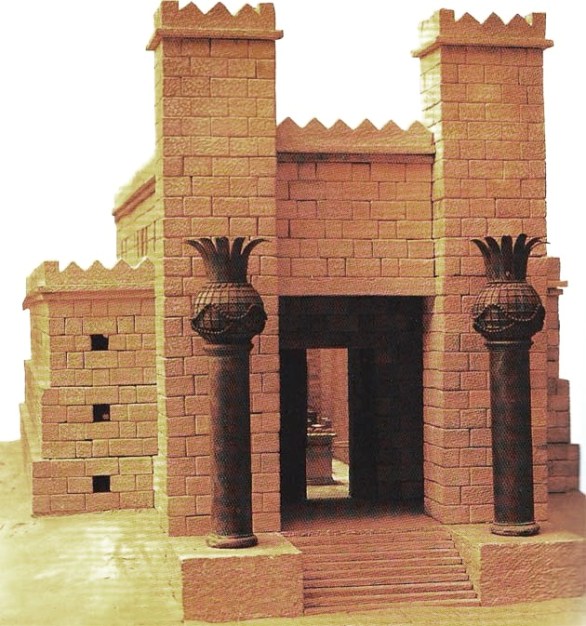
First Temple reconstruction,
Bible Museum, Amsterdam

On this foundation, the “house” is built out of more large squared stones, then paneled inside with cedar wood, and roofed with cedar planks. Additional rooms are built against the outside walls, all the way around. The temple is three stories high, with stairs and narrow latticed windows. This sanctuary could never be disassembled and moved. It is supposed to be permanent. According to the Hebrew bible, it lasted for four centuries, until the Babylonian invaders destroyed it. During that time, the central place of worship for the southern kingdom remained fixed in its capital, Jerusalem.

Another important difference between the tent and the temple is how the materials and labor to build them were obtained. The materials for the tenttextiles, hides, wood, and metals—are all gifts volunteered by the Israelites. This week’s Torah portion opens with God asking for only voluntary donations.

God spoke to Moses, saying: Speak to the children of Israel, and they shall take for me a donation from every man whose heart urges him; [from him] you shall take My donation. And this is the donation that you shall take from them: gold or silver or bronze, or sky-blue or red-violet or scarlet dyes, or linen or goat hair, or hides… (Exodus/Shemot 25:1-5)

But the stone and cedar for Solomon’s temple are purchased from a foreign king, Chiram of Lebanon. This week’s haftarah opens:

God had given wisdom to Solomon, as [God] promised him; and there was peace between Chiram and Solomon, and the two of them cut a treaty. (1 Kings/Malchim 5:26)

Just before this verse, the first book of Kings describes the deal between Chiram and Solomon: Hiram will provide timber and stone for Jerusalem, and in exchange Solomon will pay Hiram in annual shipments of wheat and olive oil—shipments that would require a heavy tax on Israel’s farmers.

In the book of Exodus, both women and men enthusiastically volunteer to do the weaving, carpentry, and metal-working for the tent sanctuary. In the first book of Kings, Solomon imposes forced labor on the Israelite men to do the logging and quarrying.

And King Solomon raised a mas from all of Israel, and the mas was 30,000 men. He sent them to Lebanon, 10,000 a month in turns; they were in Lebanon for a month, two months at home. And Solomon loaned 70,000 burden-carriers and 80,000 stone-cutters on the mountain. (1 Kings 5:28-29)

mas (מַס) = compulsory labor, corvée labor, levy

Compulsory labor, mas, is what the pharaoh imposed on the Israelites in Egypt—the slavery that God and Moses freed them from. King Solomon gets away with his temporary mas, but later in Kings, his son Rechavam imposes an even heavier “yoke” on his people, and they revolt against him.

So while the mishkan is constructed with voluntary gifts and voluntary labor, the temple is built through agricultural taxes and forced labor.

In the Torah portion, Moses gets instructions for making a sanctuary from God Itself. In the haftarah, Solomon remembers his father David’s desire to build a temple, and after he has built a palace for himself, he starts the temple on his own initiative.

In both cases, God makes a conditional promise to dwell among the Israelites. In the Torah portion, God will stay with them if they make a place for God:

And they shall make for me a holy place, and I will dwell in their midst. (Exodus 25:8)

But in the haftarah, God will stay with the Israelites if King Solomon follows the rules:

And the word of God came to Solomon, saying: This house that you are building—if you follow my decrees and you do my laws and you observe all my commandments, to go by them, then I will establish my word with you that I spoke to David, your father: then I will dwell in the midst of the children of Israel, and I will not desert my people Israel. (1 Kings 6:12-13)

The differences between the mishkan and the temple imply two different approaches to religion. The sanctuary God describes to Moses belongs to the people; they make it voluntarily, they move it with them wherever they go, and God dwells among them because they make a holy place for God.

The temple of Solomon belongs to the king; he oppresses his own people in order to procure the materials and labor, he fixes it permanently in Jerusalem, and God dwells among his people because King Solomon obeys God’s rules.

I believe the tent-sanctuary described in the Torah portion represents the ideal approach to communal religion, in which everyone in the community contributes enthusiasm, support, or creativity; in which textual interpretations and rituals are flexible enough to move and change along with the people; and in which everyone makes a holy place for God.

Yet this ideal cannot always be realized. There are times everyone, including me, is too exhausted or too stuck to manage creative communal worship. Sometimes we just need a place to go where the rituals will be fixed and familiar, and where a trusted authority figure is taking care of everything and telling us what to do.

We need both tents and temples.