Haftarat Yitro—Isaiah: Burning Angels

Every week of the year has its own Torah portion (a reading from the first five books of the Bible) and its own haftarah (an accompanying reading from the books of the prophets). This week the Torah portion is Yitro (Exodus 18:1-20:23), and the haftarah is Isaiah 6:1-7:6 & 9:5-6.

You cannot see My face, because humankind may not see Me and live. (Exodus/Shemot 33:20)

Although God cannot be seen directly, people in the Bible do experience visions of God. The Israelites see a manifestation of God in this week’s Torah portion, and Isaiah sees a manifestation of God in this week’s haftarah.

Vision at Mount Sinai
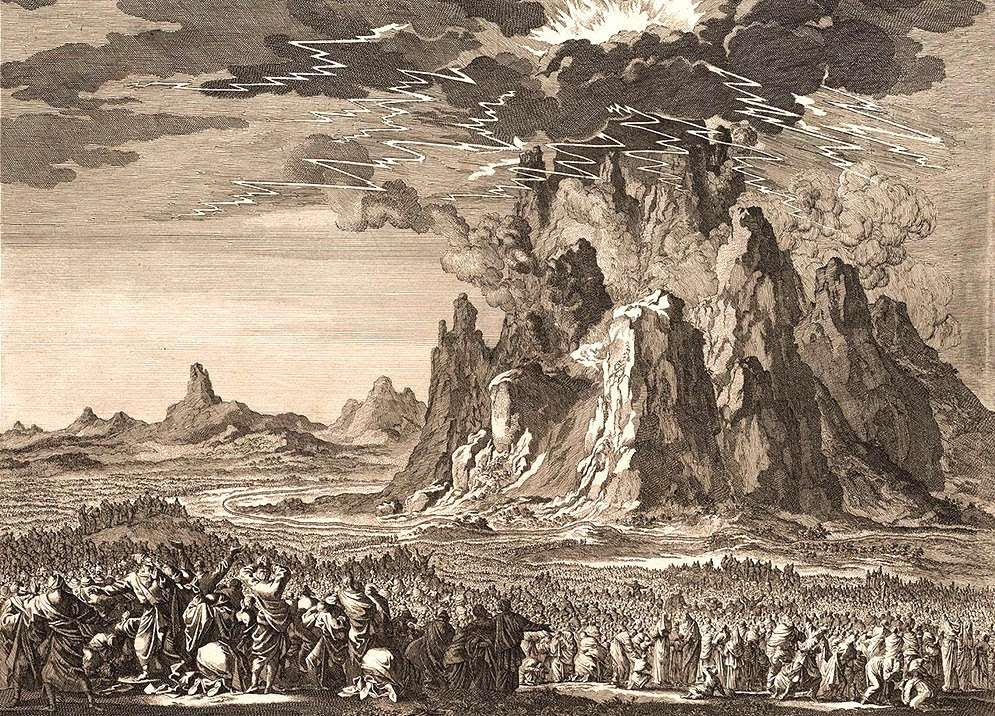
The Law on Mount Sinai, by Jan Luyken, 1708

In the vision shared by everyone at Mount Sinai, God appears only as fire.

And Moses brought out the people from the camp to meet God, and they stationed themselves at the bottom of the mountain. And all of Mount Sinai smoked, because God went down upon it in fire, and its smoke went up like the smoke of the furnace, and all the mountain shuddered very much. (Exodus 19:17-18)

A shuddering, smoking mountain could be a volcano—except that in this vision, God’s fire comes down from the sky, not up from a crater. God also manifests in the book of Exodus as the fire Moses sees in the burning bush on Sinai, as the pillar of cloud and fire that leads the Israelites to Mount Sinai, and as fire and cloud on the mountain when Moses ascends to receive each pair of stone tablets.

No angels or other semi-divine creatures appear in the revelation at Mount Sinai; only fire, smoke, and various sounds.

Other parts of Exodus speak of God’s hand, arm, or finger (when God takes action in the world), and God’s feet (in a separate vision; see my post Mishpatim: After the Vision, Eat Something). But these references may not indicate an anthropomorphic god; the Hebrew Bible often uses these body parts in idioms.

Vision at the temple

Isaiah’s moment of revelation also includes fire, but God does not appear as fire.

In the year King Uzziyahu died, I saw my Master sitting elevated on a lofty throne, and His skirts filling the heykhal. (Isaiah 6:1)

heykhal (הֵיכָל) = palace, temple; main room of the temple in Jerusalem; heavenly palace.

Isaiah beholds God wearing a robe and sitting on a throne, like a king—except that the skirts of the robe mysteriously flow out to fill the room. As the vision continues God speaks, but does not move. Angelic attendants surrounding God do move; and they burn with fire.
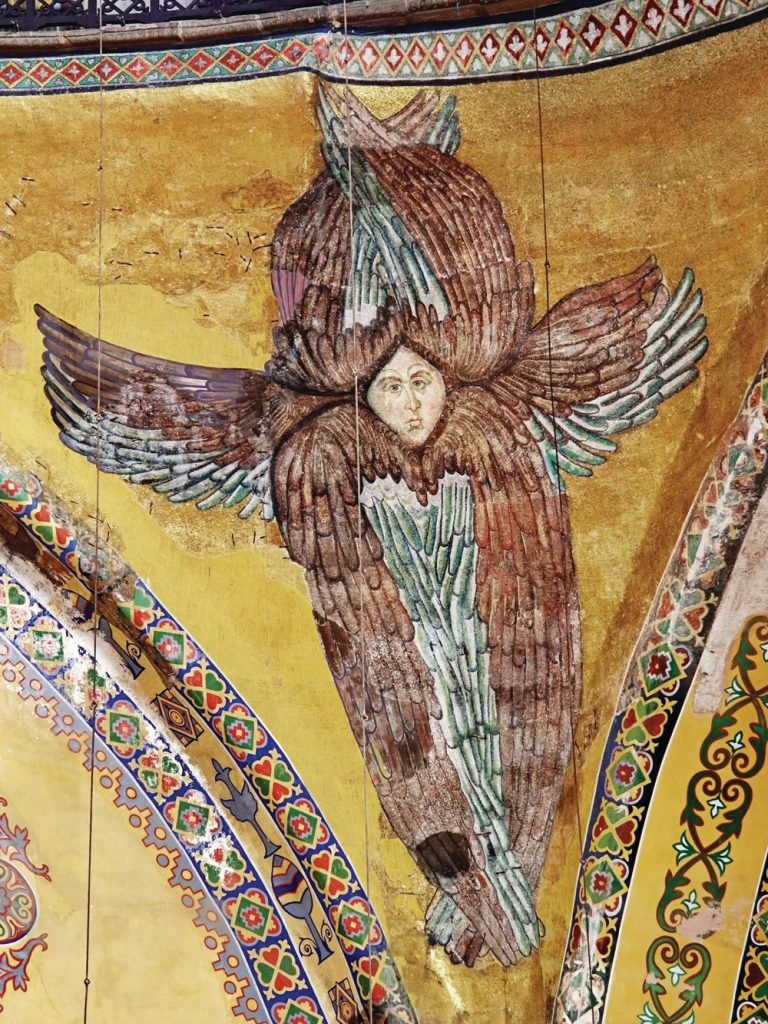
Seraf, Haggia Sophia mosaic

Serafim are stationed above Him, each with six wings; with one pair he covers his face, and with a pair he covers his raglayim, and with a pair he flies. And one calls to another, and he says: Holy, holy holy! God of Tzevaot, Who fills all the earth with His glory! And the supports of the threshold shiver from the sound of the calling, and the house fills with smoke. (Isaiah 6:1-4)

serafim (שְׂרָפִים) = burners, burning creatures. (From the verb saraf, שָׂרַף = burn. Used in Numbers and Deuteronomy for “burning serpents”—probably poisonous snakes.)

tzevaot  (צְבָאוֹת) = armies (on earth); the stars (in the heavens).

raglayim (רַגְלָיִם) = (pair of) feet, legs; a euphemism for the penis. Singular: regel (רֶגֶל) = foot, leg; walking pace; time set for a pilgrimage-festival.

The serafim must both cover and uncover their faces and their raglayim; if these body parts were permanently covered, they would not need wings for that purpose. When and why do they conceal these parts of their anatomy?

In Leviticus Rabbah, a collection of commentary from 400-600 C.E., Rabbi Jacob ben Zadbi says the serafim cover their faces to avoid looking at God’s presence, and cover their feet so God would not have to look at such unsightly appendages. (The writer assumed that the feet of the serafim were like the feet of Ezekiel’s angelic keruvim, which resembled calves’ feet.)

Twelfth-century C.E. rabbi Moses Maimonides wrote in The Guide for the Perplexed that the description of serafim covering their body parts is symbolic. The faces of the serafim are covered to indicate that “the cause of their existence is hidden and concealed”, while their feet are covered to indicate that their actions in the universe are also hidden. The wings for flying, Maimonides adds, merely represent the speed with which the serafim move when they act.

I propose a simpler explanation. Maybe the serafim cover their faces whenever they turn toward Isaiah, so he is not exposed to the blinding light radiating from these burning creatures. If seeing God’s face means death, seeing the faces of the serafim might be almost as bad.

As for covering their raglayim, I doubt the serafim are concealing their feet.  After all, humans must have bare feet when they are in God’s presence; Moses must remove his sandals in front of the burning bush, and the priests must go barefoot inside the sanctuary. Since Isaiah’s vision is set inside a heykhal, the serafim in God’s presence probably expose their bare feet.

Although the word raglayim most often refers to feet or legs, sometimes it implies the pubic area between the legs, and there are three places in the Bible where raglayim is definitely a euphemism for the male genital organs. In Judges 3:24 and 1 Samuel 24:4 the word raglayim is combined with a verb to indicate a man urinating.  And in the part of chapter 7 of Isaiah that is left out of this week’s haftarah, the prophet says that God will use the king of Assyria as a razor to shave off the head of hair and the hair of the raglayim (JPS: public hair) and also snatch away the beard. (Isaiah 7:20)

A man’s hair, especially his beard and pubic hair, stood for virility in ancient Israelite culture. Isaiah employs a shaving metaphor to prophesy that God will use Assyria to symbolically castrate Israel’s other enemies.

Why would the serafim in Isaiah’s vision use their extra wings to cover their genitals?

The penis is a symbol of rule, dominance, and control throughout the Bible, from the oath Abraham’s servant swears on his master’s yareich (which can also mean genitals; see my post Chayyei Sarah: A Peculiar Oath) to the Persian king who approves Esther’s interruption by lifting his sharvit (scepter). But God is the ultimate ruler. It would be subversive for a male to uncover his genitals in God’s presence.

That is why this week’s Torah portion specifies that all altars for God must be built without stairs or steps.

You must not ascend on stairs to My altar; that way you would expose your nakedness upon it. (Exodus 20:23)

The Torah also requires that priests must wear linen undergarments, so their genitals will be concealed in all areas of God’s sanctuary.

So each seraf uses one pair of wings to conceal his fiery face from Isaiah, for his own protection; and one pair of wings to conceal his genitals, so Isaiah will know that God rules, not the serafim.

Nevertheless, these angels are endowed with the potential to generate independent decisions and actions. One example occurs after Isaiah expresses his anxiety about having a vision of God.

The Prophet Isaiah, by Marc Chagall

And I said: Woe to me! I am as good as dead, because I am a man of impure lips, and I am living in the midst of a people of impure lips, yet my eyes behold the King, God of Tzevaot! Then one of the serafim flew toward me, and in his hand was a live coal he had taken from the altar with a pair of tongs. And he touched it to my mouth and he said: Hey! Now that this has touched your lips, your bad deeds have gone away, and your offense is atoned for. Then I heard the voice of my Master saying: Whom shall I send, and who will go for us? And I said: Here I am, send me! (Isaiah 6:5-8)

We have come a long way from the vision at Mount Sinai of God as undifferentiated fire, unaccompanied by any furniture or subsidiary creatures.

Isaiah sees God in terms of a throne and skirts, not in terms of fire. The fire exists in God’s serafim, “burning ones”, who occupy a station somewhere between humankind and God. They praise God (Holy, holy holy!) and they are privy to some of God’s plans (and who will go for us?) They protect Isaiah from the blinding brightness of their faces, and they cover their genitals to indicate that although they have some power, God is the ultimate ruler. And one seraf, hearing Isaiah’s anxiety about his unworthiness, takes action to remove his guilt. In his relief, Isaiah volunteers to be God’s prophet. Thus the seraf both furthers God’s plan and helps Isaiah rise to his calling.


The image of God as a king with a throne and a long robe has continued to be popular, from some of the writings after the fall of the first temple to some of the explanations given to children today. For me, God as fire is a better metaphor. An individual human cannot become a god.

But maybe we can aspire to be brighter, more aware of God’s presence, and more able to listen to people and address their concerns.

May all of us humans learn to act as thoughtfully as the serafim in Isaiah’s vision.

Haftarat Beshalach—Judges: Overlooking the Underdog

Every week of the year has its own Torah portion (a reading from the first five books of the Bible) and its own haftarah (an accompanying reading from the books of the prophets). This week the Torah portion is Beshallach (Exodus 13:17-17:16), and the haftarah is Judges 4:4-5:31.

The underdog triumphs in many biblical stories. Jacob, the beardless weakling, outsmarts his strong, hairy brother Esau. Joseph rules over the older brothers who once enslaved him. The boy David kills the giant Goliath.

In this week’s Torah portion, Beshalach (“when he sent out”), the Israelite slaves leave Egypt as free people while Pharaoh’s army drowns behind them. In the haftarah from the book of Judges, two Israelite women triumph over the Canaanite general Sisera and his army.

How do you defeat an enemy stronger than you?  In the Hebrew Bible, two effective ways are by receiving and using inside information from God, like Moses; and by taking action on your own initiative with intelligence, courage, and guile, like Jacob and Joseph.

The haftarah from Judges tells the story of two women, the ultimate underdogs in the patriarchal society of the ancient Israelites, triumphing over Israel’s enemies through both methods. Devorah the prophet gets her people to act on God’s promise to help them defeat the army of their Canaanite overlord, and Jael/Yael the Kenite acts on her own initiative and kills the enemy’s general.

War chariots, ivory plaque from Megiddo

When this week’s haftarah begins, the Israelites are scattered tribes who have been ruled by the chief king of Canaan, Yavin, for twenty years. They are oppressed by King Yavin’s general, Sisera, who commands a force that includes 900 chariots, the most fearsome war technology of the time.

Still, instead of relying on the Canaanite king’s dubious justice, the Israelites go to their own judges, including one outstanding judge.

Devorah was a woman, a prophet, a woman of lapidot; she was a shoftah of Israel at that time. (Judges/Shoftim 4:4)

Devorah (דְבוֹרָה) = “Deborah” in English; honey bee. (From the same root as doveir  = speaker, and divrah  = legal case.)

lapidot (לַפִּידוֹת) = a feminine plural form of the masculine noun lapid = torchlight, torch, flash of light. (Some translations consider lapidot a place-name or the name of Devorah’s husband.)

shoftah (שֹׁפְטָה) = the feminine form of shofet = judge; a man who decides legal cases and resolves disputes.

The bible emphasizes that Devorah is a woman; all the other judges in the bible were men. Moreover, she is a prophet, a woman of flashes of light. Even her name is significant: she is a speaker, both for justice and for God.

Date palm tree
Date palm tree

And she was the one who sat under the Date-Palm of Devorah, between Ramah and Bethel in the hills of Efrayim. And the children of Israel went up to her for the law. (Judges 4:5)

Unlike the judges of villages, Devorah serves as the authority for a wider area, and holds her own law court in a sacred place. In ancient Israel, many holy places were indicated by trees or groves with names, such as the Oak of Weeping (Genesis 35:8), the Grove of Teaching (Genesis 12:6), or the Grove of Mamre (Genesis 13:18). Devorah’s own presence is what makes this particular palm tree the marker of a holy site.

And she sent and summoned Barak, son of Avinoam, from Kedesh in Naftali. And she said to him: Did not God, the god of Israel, command: “Go!—and draw up your position on Mount Tabor, and you shall take with you ten thousand men from Naftali and Zevulun. Then I will draw up to you, to the wadi of Kishon, the commander of the army of Yavin, Sisera, and his charioteers, and his infantry; and I will give them into your hand.” (Judges 4:6-7)

If Barak musters troops from the two Israelite tribes of Naftali and Zevulun and marches them up Mount Tabor, God will arrange for the defeat of the enemy’s army. But Barak is afraid.

And Barak said to her: If you go with me, then I will go; but if you will not go with me, I will not go. (Judges 4:8)

Devorah agrees to go with him, but prophesies that Barak will get no glory from the battle, because

into the hand  of a woman God will deliver Sisera. (Judges 4:9)

Deborah, by Gustave Dore

Devorah walks with Barak both to Kedesh to inspire the men to volunteer for the ad hoc army, and to the top of Mount Tabor to announce when the men should charge down. God panics Sisera’s army (through a flash flood in the wadi, according to the accompanying poem) and the Israelite foot soldiers kill every enemy soldier except General Sisera.

Devorah is supremely successful as the instigator of the battle because she is God’s prophet. Receiving divine communication and cooperating with God both inspires people to trust her and results in a successful campaign—even though she is a woman, who would normally be powerless.

Sisera gets down from his chariot in the middle of the battle and flees on foot. Where can he find refuge? He heads for the nearby camp of Chever the Kenite, a vassal of King Yavin.

Sisera fled on foot to the tent of Yael, wife of Chever the Kenite … (Judges 4:17)

Study of Jael, by Carlo Maratta

Yael (יָעֵל) = a variant of ya-al (יָעַל) = he will ascend, he will climb, he will mount for mating.

Normally, a fugitive would go to the tent of the man who heads the household or encampment, the only person who can take the role of host and decide to shelter the unexpected guest.  In that culture, a woman’s tent was her private domain that no man outside her immediate family would dare to enter. Why does Sisera enter Yael’s tent instead of heading straight for her husband’s tent?

One line of commentary claims that Sisera’s motivation was to rape Yael, and then claim Chever’s household as his own. By taking ownership of a chieftain’s women, a man signaled that he was the new chieftain. Later in the Bible, King David’s son Absalom shows Israel that he is the new king by having sexual intercourse with the concubines King David leaves behind in Jerusalem. Sisera might plausibly decide he would rather be the head of a camp of Kenites than a disgraced ex-general.

But I think Sisera is on his way to Chever’s tent when Yael appears and suggests a different plan.

And Yael went out to meet Sisera, and she said to him: Surah, my lord, surah eilai, do not fear. Vayasar to her, to her tent, and she concealed him with the curtain. (Judges 4:18)

surah (סוּרָה) = turn aside, go away, desert, avoid.

eilai (אֵלַי) = to me.

vayasar (וַיָּסַר) = and he turned aside, went away, deserted, avoided.

Normally a woman would warn an intruder who slipped past the sentries around her husband’s camp to get away from her. But since Yael says surah eilai, she must be saying either “turn aside to me” or “desert to me” (knowing that Sisera has already deserted his own army).

Yael is a quick thinker with a cool head. She may view Sisera as an enemy; the Kenites are usually allies with the Israelites in the Bible, and Chever might have sworn vassalage to King Yavin because he had no alternative. But now Yavin’s army no longer exists, and the time is ripe for change.  Sizing up the situation, Yael steps out of her tent and tempts Sisera with an ambiguous sentence.

And he falls for it. Suddenly he imagines he can take Chever’s wife, and then take over his whole household. He steps inside her tent, and she lets the curtain fall behind him. He asks for water, and she brings him a yogurt drink and puts covers over him. He orders her to stand at the entrance of the tent and tell anyone who comes that there is no one inside. Then, secure in his belief that she is his and they will eventually seal the deal with sex, Sisera falls asleep.

Jael and Sisera, by Jan de Bray

Then Yael, wife of Chever, took a tent peg and took the hammer in her hand, and she came to him quietly, and she drove the peg into his temple, and she hammered it into the ground. And he was fast asleep, exhausted, and he died. (Judges 4:21)

Deborah’s prophesy is fulfilled; Sisera dies by the hand of a woman.

Yael acts on her own initiative, taking advantage of the situation and employing her sharp wits and her ability to deceive without actually lying. The text does not say whether Sisera carries a weapon on his body, but he is a career soldier, and under ordinary circumstances could overpower (and rape) any woman in his path.  Yael courageously uses guile, the weapon of the underdog, to overpower and “rape” him with her tent peg.


Never assume you can take advantage of an underdog who has always held a rank beneath your own. People who have been slaves for hundreds of years might turn out to have God on their side, and defeat you, as in this week’s Torah portion from Exodus. And women who have been ordered around by men for hundreds of years might turn out to be prophets and judges, like Devorah, or extraordinary executioners, like Yael.

Never overlook the underdog.

Haftarat Bo—Jeremiah: The Ruler of All Armies

Every week of the year has its own Torah portion (a reading from the first five books of the Bible) and its own haftarah (an accompanying reading from the books of the prophets). This week the Torah portion is Bo (Exodus 10:1-13:16), and the haftarah is Jeremiah 46:13-28.

In the book of Exodus, God inflicts ten miraculous plagues on Egypt to punish the pharaoh for refusing to let the Israelite slaves go. Pharaoh finally sets the Israelites free in this week’s Torah portion, Bo—but only after the final miracle: the death of the firstborn.

In this week’s haftarah, Jeremiah predicts that God will once again punish the pharaoh of Egypt for mistreating the Israelites.  This time God will not create miracles, but instead will use another empire’s army to achieve the goal.

The political history

There were three kinds of nations in the Near East during the era of 800-500 B.C.E.: superpowers that ran empires (the Egyptian, Neo-Assyrian, and Neo-Babylonian empires); countries that were directly controlled by a superpower; and semi-independent vassal states that paid tribute to a superpower in exchange for protection against outside attacks. Being a vassal state was the best hope for a small country like Judah, the only remaining Israelite kingdom after the northern kingdom of Israel was swallowed by the Neo-Assyrian Empire in 732 B.C.E.

Judah sent tribute to Assyria for about a century, except for a brief and doomed rebellion in 705-701 B.C.E. The Neo-Assyrian Empire expanded southwest to include northern Egypt, and southeast to the Persian Gulf.

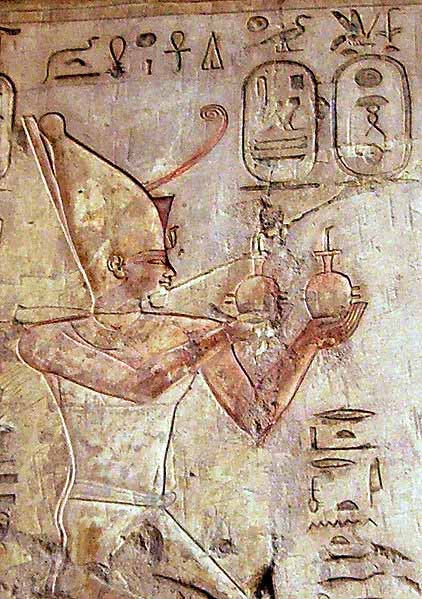
Pharaoh Psamtik I
Pharaoh Psamtik I unites Egypt

But no empire lasts forever. Psamtik, the son of one of Assyria’s puppet governors in northern Egypt, hired Greek mercenaries to drive out the Assyrian occupiers. By 654 B.C.E. he was pharaoh over a united Egypt. He went on to conquer the western half of the Neo-Assyrian Empire, and by 630 B.C.E. King Josiah of Judah had become a vassal of Pharaoh Psamtik.

Next Assyria was assailed from the southeast. In 626 B.C.E. Babylon revolted under its new king, Narbopolassar. A shrunken Assyria allied itself with Egypt, and Psamtik’s son, Pharaoh Nekho II, sent his armies north to fight Narbopolassar’s son, Nebuchadnezzar II.

It was a slow march, interrupted by rebellions of vassal states along the way. King Josiah of Judah took his own army to Megiddo to challenge the Egyptians in 609 B.C.E., but the Egyptians trounced the Israelites, and Pharaoh Nekho killed Josiah.

The armies of Egypt and Babylon met in 605 B.C.E. at Carchemish, about 2,000 miles north of Jerusalem (on the present border between Turkey and Syria). The Egyptian army was crushed, and its surviving soldiers fled south.

According to Jeremiah, Egypt did not lose the battle because of any deficiency of its own; Egypt lost because the God of Israel made it happen.

Why have your strong ones been cut down?
They did not stand
Because God shoved them down. (Jeremiah 46:15)
map Neo-Babylonian Empire B

After the battle at Carchemish, all of Egypt’s vassal states became vassals of Babylonia, and Assyria disappeared. The prophet Jeremiah repeatedly warned the new king of Judah, Yehoyakhim, to stay out of trouble and keep sending tribute to the Babylonian king, Nebuchadnezzar.

But Yehoyakhim revolted against Babylonia in 599 B.C.E. and sent Judah’s tribute to Pharaoh Nekho II (the same pharaoh who had killed his father, Josiah).

Nebuchadnezzar retaliated by besieging Jerusalem. After a year and a half the city fell and Judah came under direct control of the Neo-Babylonian Empire. Both Jeremiah and Ezekiel criticized Egypt for failing to send troops to defend its new vassal Judah.

Judah’s king, the prophet Ezekiel, and other leading citizens were deported to Babylon. Jeremiah stayed behind in the ruins of Jerusalem until some of his fellow countrymen took him into exile in Egypt.

The prophecy

Both Jeremiah and Ezekiel prophesied that because Egypt had failed keep its promise to help Judah, God would send an army from the north to destroy Egypt.  Both prophets said it would be King Nebuchadnezzar’s army, but in actual history, Nebuchadnezzar failed in his 568 B.C.E. attempt to conquer Egypt. The country remained independent until the Persians took it—from the north—in 526 B.C.E.

The Chaldees [Babylonians] Destroy Jerusalem,
by James Tissot, circa 1900

In Ezekiel’s prophecy, God would arrange for Nebuchadnezzar to devastate Egypt not just to punish it, but so that the pharaoh would know who God is. (See last week’s post, Va-eira—Ezekiel: How to Know God.)

Jeremiah’s prophecy also includes more than punishment. He uses a name for God that never appears in Ezekiel:

As I live, declares the kingY-H-V-H of Tzevaot is his name
As Tabor is among the mountains,
And Carmel is by the sea,
It will come!
Prepare for yourself the gear of exile ...
For Nof will become a horror,
A desolation without inhabitants.
Egypt is a heifer with a beautiful mouth,
But a stinging fly from the north is coming, coming! (Jeremiah 46:18-20)

Y-H-V-H = the four-letter personal name of God, possibly related to the Hebrew verb “to be”.

Tzevaot (צְבָאוֹת) = armies; companies of soldiers. (Singular tzava, צָבָא. The Bible also uses the word metaphorically for armies of stars.  See my post Bemidbar: Two Kinds of Troops.)

The first biblical book that calls the God of Israel HVH of Tzevaot is Samuel I, which modern scholars date to 630–540 BCE—the same period as the book of Jeremiah. Jeremiah uses this term 70 times!

Why does Jeremiah emphasize that YHWH, the god of existence itself, is the god of armies?

Jeremiah lived through at least 60 years of wars and reversals of fortune in the Near East, 60 years in which Judah was always a pawn, unable to take charge of its own destiny.

The common belief in the ancient Near East was that each country had its own god. When that god was happy with the people of his country, he made their army succeed. When the god was unhappy with them, their army failed.

The Bible also attributes many failures of Israelite armies to Israelite rejections of God. But why were God’s people suffering so many defeats, if their god was the most powerful?

Jeremiah was inspired to preach that the God of Israel is unlike the gods of other nations. Israel’s god, the supreme God of all existence, controls all the armies in the world. God decides which armies will win and which will lose, even when Israelites are not involved in the battle.

For Jeremiah, the prophetic insight that God rules all armies made the wars of his own lifetime meaningful. God had a master plan. Egypt would be humbled. Eventually the Babylonians would also be defeated. And in the long run, the Israelites would outlast all other peoples.

You must not fear, my servant Jacob,
—declares Y-H-V-H—
For I am with you.
For I will make an end of all the nations
Among which I have banished you.
But with you, I will not make an end. (Jeremiah 46:28)

Personally, I shrink inside when I sing a prayer that includes the term Y-H-V-H Tzevaot. If God is the ruler of all armies, then God is responsible for the carnage and suffering of all wars—which are apparently necessary for God’s master plan.

Yet if God were the Master Planner, controlling all the actions of mutable human beings, surely God could come up with a better plan than war after war. And if human beings hold ultimate responsibility for wars, then God is not the Master Planner, and not the God of Armies.

Sorry, Jeremiah.

Hafarat Va-eira—Ezekiel: How to Know God

Every week of the year has its own Torah portion (a reading from the first five books of the Bible) and its own haftarah (an accompanying reading from the books of the prophets). This week the Torah portion is Va-eira (Exodus 6:2-9:35), and the haftarah is Ezekiel 28:25-29:21.

Apparently God really wants Egypt to know who God is. The god of Israel asks the prophet Moses to tell Pharaoh “and you will know that I am God” three times in this week’s Torah portion, Va-eira. And God tells the prophet Ezekiel how God will bring down the Egyptians “and they will know that I am God” four times in this week’s haftarah.

Plague of Blood, as depicted in 14th century CE

Before God inflicts the first of ten terrible miracles on Egypt, God instructs Moses to meet Pharaoh on the shore of the Nile and warn him that the water will turn into blood.

And you shall say to him: YHVH, the god of the Hebrews, sent me to you to say, ‘Let My people go and they shall serve Me in the wilderness’, but hey—you did not listen before now. Thus says YHVH: ‘By this teida that ani YHVH’. (Exodus 7:16-17)

YHVH = the Tetragrammaton or four-letter personal name of God that Jews consider most sacred. The name appears to be a form of havah  or hayah (הוה or היה) the root of the verb “to be”, “to happen”, or “to become”, but it is a form that does not fit any Hebrew verb conjugations.

teida (תֵּדַע) = you will know, experience, be acquainted with, recognize, realize, have intercourse with.

ani (אֲנִי) = I [am].

Pharaoh hardens his heart during the seven days of bloody water, claiming it is not a divine miracle, so he does not experience or recognize the god of Israel.

God’s goal of being known by Pharaoh reappears when Moses talks about the second miracle, the plague of frogs:

… so that teida that there is none like YHVH our god. (Exodus 8:6)

—and again when God tells Moses the fourth plague will be more miraculous, because the swarm will be excluded from the place where the Israelites live,

…so that teida that ani YHVH in the midst of the land. (Exodus 8:18)

It takes ten miracles or plagues before Pharaoh finally knows YHVH, and can no longer harden his heart in denial. The knowledge comes from experiencing what God can do in the world.

The haftarah for this week’s Torah portion is a passage from the book of Ezekiel, set many centuries later during the Babylonian exile after King Nebuchadnezzar conquered the Israelite nation of Judah in 597 BCE. Judah had asked Egypt to help it fight the Babylonians, and Egypt had not come to the rescue. So Ezekiel prophesies that God will restore the land to the Israelites and punish Egypt, and both peoples will “know” God.

build houses and plant vineyards…then they will dwell on their soil that I gave to My servant, to Jacob. And they will dwell on it in safety, and they will build houses and plant vineyards, and they will dwell on it in safety when I have passed judgments on all those who despise them from all around; veyad-u that ani YHVH their god. (Ezekiel 28:25-26)

veyad-u (וְיָדְעוּ) = and they will know, realize, experience, etc. (A form of the same verb as teida.)

The Israelites will once again know YHVH is their god when they have first-hand experience of this amazing reversal in fortune.

The hafatarah continues with a poem describing the future downfall of Egypt. Then Ezekiel says:

Thus said my master, YHVH: Here I am over you, Pharaoh, king of Egypt …To the beasts of the earth and to the birds of the sky I have given you for food. Veyade-u, all the inhabitants of Egypt, that ani YHVH; because you were a walking-stick of reed to the House of Israel; when their hand grasped you, you would break…(Ezekiel 29:3-6)

The implication is that because Egypt failed to support the Israelites, God will make sure all Egyptians know from experience who YHVH is.

And the land of Egypt will become a deserted place and a ruin; veyade-u that ani YHVH, because he [Pharaoh] said: The Nile is mine and I made it. (Ezekiel 29:9)

Egyptians must also realize that although their pharaoh claimed he created the Nile, really YHVH created everything. In order to accomplish this, God will reduce Egypt to the lowest of nations.

And never again will they inspire trust in the House of Israel … veyade-u that ani the lord YHVH. (Ezekiel 29:16)

Therefore, thus says my master YHVH: Here I am, giving the land of Egypt to Nebuchadnezzar, king of Babylon. And he will carry off her wealth and loot her loot and plunder her plunder, and she will be a reward for his army. …On that day… veyade-u that ani YHVH. (Ezekiel 29:19, 29:21)

In all of these cases in Exodus and Ezekiel, people are expected to realize who God is after they have experienced an unexpected disaster or triumph, a miraculous change in fortune. The experience is supposed to be so powerful that both Israelites and Egyptians will realize that only the most powerful god in the world could create such a miracle, and that this supreme god is the god of Israel.

Furthermore, both peoples will know God by the name YHVH, the four-letter name based on the verb “to be”.  Is this detail repeatedly included simply because it is the name the Israelites use for their god? Or does it carry another meaning?

In last year’s post on this Torah portion (Va-eira: The Right Name) I suggested that the idea of God as “being” or “becoming” is intellectually appealing, but too abstract for an emotional relationship with God. Now I notice that the phrase “know that I am YHVH” always occurs in the Torah and haftarah portions in the context of knowing God’s power to change fate and to create. What is most important is for the Egyptians and for the defeated and deported Israelites to realize that the god of Israel is the god of existence itself. Nothing can have power over YHVH.

I have experienced no inexplicable miracles or reversals of fortune in my own life. I do not know God in that way. I acknowledge the reality of being, that there is something rather than nothing, and I could call that God, even if it is irrelevant to the anthropomorphic god of the Bible.

But I will not. My unmiraculous life is full of meaning and my soul is full of awe, so “I know”—yadati (יָדַעְתִּי)—that there is something I might as well call God that goes beyond the fact of existence.

Teida that ani YHVH = You will know that I am Being.

Then what, or who, is the “I”?

Beha-alotkha and Shemot: Moses as Wet Nurse

by Melissa Carpenter, maggidah

Moses never wanted the job.

When God spoke out of the burning bush and assigned him to lead the Israelites out of Egypt, Moses tried to get out of it.  He objected:

Moses at the Burning Bush by Rembrandt van Rijn
Moses at the Burning Bush
by Rembrandt van Rijn

Hey! Lo ya-aminu me, and they will not listen to my voice, for they will say: Your god, God, did not appear. (Exodus 4:1)

Lo ya-aminu = They will not believe, they will not trust.  Lo (לֹא) = not.  Ya-aminu (יַאֲמִינוּ) = They will believe, be convinced by, put trust in, have faith in.  (From the root aman, אמן, which is also the root of amen (אָמֵן) = a solemn statement of confirmation or acceptance.  See last week’s post, Naso: Ordeal of Trust for the first use of “Amen” in the Torah.)

God gave Moses three miraculous signs to convince the Israelites that he really did speak for God.  But Moses still tried to turn down the job. Finally God compromised by giving Moses a partner: his older brother Aaron, who had stayed in Egypt when Moses fled to Midian many decades before.

The arrangement was that God would speak to Moses, Moses would speak to Aaron, and Aaron would deal directly with the people.  Moses accepted this arrangement—maybe because he had run out of excuses.

Moses and Aaron are still together in this week’s Torah portion, Beha-alotkha (“when you bring up”), in the book of Numbers/Bemidbar.  But their roles have changed.  The big change came while the Israelites were camped at Mount Sinai, halfway between Egypt and the “promised land’ of Canaan.  When they first arrived at Mount Sinai, the people trusted God.  Sure, they had panicked a few times when there was a shortage of water or food, but each time Moses talked to God and God fixed the problem. So when they reached Mount Sinai, the people said:

Everything that God speaks we will do!  And God said to Moses: Hey! I myself will come to you in the thickness of the cloud, in order that the people will listen when I speak with you, and also ya-aminu in you forever. (Exodus 19:9)

Alas, while Moses is secluded inside God’s cloud on top of Mount Sinai for 40 days, the people feel abandoned and lose faith that Moses will return to them.  They ask Aaron to make a god to lead them, now that Moses has disappeared.

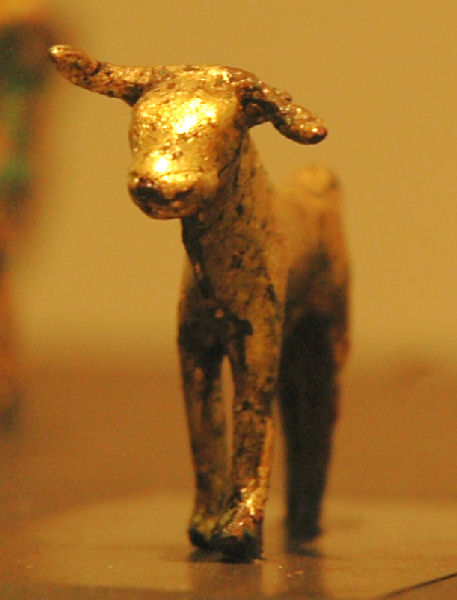
Gold calf, Temple of Baalat in Byblos

If Aaron were trustworthy as Moses’ co-leader, he would have reminded them that God explicitly forbade them to make gold or silver idols.  He might have redirected them toward making an acceptable offering to God.  Instead, Aaron made the Golden Calf, and the Israelites had a wild party.

When Moses returned and questioned him about it, Aaron lied about his own role—

So I said to them: Who has gold? They took it off themselves and they gave it to me, and I threw it away into the fire, and out came this calf (Exodus 32:24)

—and slandered the Israelites—

You yourself know the people, that they are bad. (Exodus 32:22)

The Midrash Rabbah on the Song of Songs, a collection of commentary from the 8th century C.E., said that the two breasts of the woman in the song symbolize Moses and Aaron, who were full of the milk of Torah. But Aaron fails as a wet-nurse when he fails to set appropriate limits for the “children” of Israel, and instead gives them their golden calf—and then denies his own responsibility for their downfall.

God and Moses between them kill thousands of the guilty, but they let Aaron live. Later they make him the high priest: the chief technician in charge of conducting rituals, looking impressive, handling holy objects, and diagnosing skin diseases.  But Moses is left as the people’s sole boss and spiritual leader.

He does his best to keep them encouraged and in line, but in this week’s Torah portion Moses finally cracks.

The people appear to be in good shape at the beginning of the book of Numbers.  They are marching from Mount Sinai to the border of Canaan in battle formation, with their portable sanctuary and all its holy objects in the middle, so they know God is with them. They have water to drink and manna to eat.

Then suddenly they are overcome with craving.

They weep and say:

Who will feed us basar? We remember the fish that we ate in Egypt for free, the cucumbers and the melons and the leeks and the onions and the garlic. But now nafsheinu are drying up; there is nothing except the manna before our eyes. (Numbers/Bemidbar 11:4-6)

basar (בָּשָׂר) = human flesh (skin and/or muscle); animal meat.

nafsheinu (נַפְשֵׁנוּ) = our souls, our lives, our throats, our appetites.

They are not actually hungry.  They are disgusted with God’s manna and, according to many commentators who point out the double meaning of basar, with God’s laws restricting sex partners. Perhaps they are fed up with the whole religion.  Or perhaps they have had their fill of spiritual experiences, long lists of rules, and the goal of taking over Canaan.  They get cranky. They want a break for immediate physical pleasure.

Moses heard the people weeping in their family groups, each one at the entrance of its tent, and God’s anger flared very hot; and in the eyes of Moses it was bad. And Moses said to God: Why do You do bad to your servant, and why have I not found favor in your eyes, that you put the burden of all this people on me?  Did I myself become pregnant with all this people, or did I myself give birth to them, that you say to me: Carry them in your bosom, like the omein carries the one who suckles, to the land that You swore to their forefathers? (Numbers 11:10-12)

omein (אֹמֵן) = guardian, substitute parent. (Literally, the reliable one, the dependable one; from the same root as ya-aminu and amen.)

Elsewhere in the Bible, an omein is a man in charge of bringing up a child; each of King Ahab’s underage children has an omein in the second book of Kings, and Mordecai is Esther’s omein in the book of Esther. The female form of this word, omenet, means wet-nurse or nanny.  Moses imagines himself not just as a parent to the Israelites, but as their wet-nurse, too.

Moses continues:

I am not able to carry all this people by myself alone, because they are too heavy for me! If thus You must do to me, please kill me altogether, if I have found favor in Your eyes, and don’t let me see my badness! (Numbers 11:14-15)

Moses has a hard enough time serving as the people’s sole spiritual leader and teaching them God’s directives. Being a nanny for thousands of ex-slaves is too much for him. If only they acted like mature adults, restraining their impulses and deferring immediate pleasure for the sake of higher goals!  Instead, the people are like small children—as immature as if they are still nursing. (Children in ancient Israel nursed until they were about four years old.)

Moses cannot bear to be a single mother.  He tells God he would rather die than continue to be their omein.

God tries to solve the problem by giving 70 elders some of Moses’ spirit of prophecy, so they can all help him. But in the rest of the book of Numbers, the elders prove insufficient to control the childish impulses of the Israelites. Either the elders are not mentioned, or in the case of Korach’s rebellion, they are part of the group that revolts and complains to Moses.


Child in a Tantrum, by Rembrandt van Rijn

Have you ever been responsible for a small child who loses control and throws a tantrum?  Rational explanations go right over their heads; all they can think about is the physical gratification they want right now, the comfort that their parent or babysitting is denying them. Back when that child was my son, I had to fight hard to stay calm until I could calm him down.

Small children are totally dependent on their caregivers.  If they are to grow up into independent adults, rather than slaves, their omein or omenet must be totally dependable—emunah.

Yet all humans are imperfect, unable to rise successfully to every single challenge. I was not a perfect mother, but I did not give up, and now I am proud of my adult son.

Moses does not give up either, even though he did not give birth to the Israelites, nor ask for the job of being their nanny. When God lashes out at the people, Moses talks God out of God’s temper tantrum, and keeps everyone on the road to the future.

May everyone who is given responsibility for others find the fortitude to carry on.  May we all be more like Moses than Aaron.


In next week’s Torah portion, the Israelite spies return from Canaan and ten out of twelve report that the land is full of fearsome giants. Look for my next blog post about how the people weep and refuse to go—because this time they do not ya-aminu God.

Pesach:  Being Unleavened, Part 2

by Melissa Carpenter, maggidah

In the Hebrew Bible, Passover appears to be a conflation of three holidays:

* chag ha-aviv (“festival of the new ears of grain”), a one-day celebration of spring on the 15th of the month that was called Aviv until the Babylonian exile in the sixth century B.C.E, then renamed Nissan. (See Leviticus 2:14.)

lamb 2

* chag ha-matzot (“festival of the unleavened bread”), a seven-day period of refraining from eating, or owning, any leavened food.  This period fell at the beginning of the barley harvest in the spring. (See Exodus 23:15, 34:18.)

* pesach (“skipping over”), a one-day observance in Aviv, in which a lamb or goat kid was sacrificed, and the meat was roasted and eaten in one night.

Some modern scholars speculate that the Torah combines an ancient festival of matzot (when farmers cleared out their old grain products in preparation for the new grain) with an ancient festival of pesach (when shepherds celebrated the spring lambing by sacrificing a lamb and performing a skipping dance)—and then incorporates both spring holidays in the story of the exodus from Egypt.

Thus the special Torah reading for the first day of Passover, Exodus 12:21-51 (in the Torah portion Bo), begins with Moses’ instructions to the Israelites for the night of the tenth and final plague in Egypt: the death of the firstborn.  Each family must slaughter a lamb as a pesach offering, paint the blood on the lintel and doorposts of its home, and stay indoors all night, eating the roasted meat, while God “skips over” the marked houses and kills only the firstborn children of the Egyptians. The Torah adds that the Israelites shall continue to re-enact this ritual every spring.

Then, after describing the final plague and Pharaoh’s command that the Israelites leave at once, the Torah says:

The people picked up their dough before it could become chameitz, their kneading-troughs wrapped up in their cloaks upon their shoulders. …And the Children of Israel journeyed from Ramses to Sukkot… And they baked the dough that they had taken from Mitzrayim in rounds of matzot, because it was not chameitz, because they were banished from Mitzrayim and they could not delay, and they had not even prepared provisions for themselves. (Exodus 12:34, 37, 39)

chameitz (חָמֵץ) = leavened bread, leavened food.

Mitzrayim (מִצְרַיִם) = Egypt.  The dual form —ayim (ַיִם) probably refers to the combined kingdoms of Upper and Lower Egypt. The first three letters, מצר, might be related to the word meitzar (מֵצַר) = narrow strait, constriction, confinement, bondage.

Egyptian kneading trough

I have always found the above explanation of the festival of matzot unconvincing.  If the Israelites normally made leavened bread in Egypt, then they would always have a jar of sourdough starter bubbling in the house.  Why not bring that jar along with a kneading-trough and flour?  The story in the book of Exodus smacks of a post-hoc, invented rationale.

Nevertheless, one of the special Torah readings for intermediate days of the week of Passover, Exodus 13:1-16 (also in the Torah portion Bo), makes the festival of matzot an essential part of the observance of Passover:

Moses said to the people: Remember this day on which you went out from Egypt, from the house of slavery.  For with a strong hand God brought you out from this, and you shall not eat chameitz.  Today you are leaving, in the month of Aviv… and it will happen when God brings you into the land…then you shall serve this service in this month.  Seven days you shall eat matzot, and on the seventh day [will be] a festival for God. Matzot shall be eaten these seven days, and chameitz must not be seen with you, and se-or must not be seen with you in all your borders. And you shall tell your child on that day, saying:  Because of this, God acted for me when I went out from Egypt. (Exodus 13:3-8)

se-or (שְׂאֹר) = sourdough starter; any leavening agent.

Throughout history, religions have connected their new holidays to pre-existing holidays.  Sometimes the only real connection between the new and old holiday seems to be the time of year.  Spring is certainly a good time of year to celebrate both the promise of new grain and the concept of liberation.

But the connection between the festival of matzot and the story of liberation from Egypt may be deeper than that.

In last week’s post, Tzav & Pesach: Being Unleavened, Part 1, I wrote about the symbolic meanings of matzot and chameitz proposed by Philo of Alexandria in the first century C.E. and by Rabbi Raphael Samson Hirsch in the 19th century.

Philo considered how leaven makes bread rise and puff up, like an arrogant person.  He wrote that eating matzot is a reminder of our humility before God.

Hirsch wrote that chameitz is the bread of independence, and matzot the bread of dependence.  Among other arguments, he cited a verse from the special Torah reading for the eighth day of Passover, Deuteronomy 15:19-16:17 (in the Torah portion Re-eih):

Seven days you shall eat matzot, the bread of oni, because in hurried flight you went out from the land of Egypt—so that you shall remember the day of your exodus from the land of Egypt all the days of your life. (Deuteronomy/Devarim 16:3)

oni (עֹנִי) = misery, wretchedness; a state of dependence due to poverty.

By eating matzot in remembrance of our deliverance from slavery, Hirsch argued, we acknowledge that we did not escape from poverty and oppression by our own actions, but only because of God’s actions: the ten plagues or miracles, and the warnings God communicated through Moses.  We rose to the independence represented by chameitz only because God lifted us out of Egypt.

That is as far as Hirsch went.  But I wonder:  Does leaven itself represent one aspect the divine?  What if God is the fermentation in our souls, and in the world, which leads to liberation and expansion?

During Passover we might acknowledge that without the divine spark, we would be as flat as matzah.  We could not escape from Egypt, Mitzrayim, or the constrictions in our own souls. We would be slaves to our genetic predispositions and to all the psychological complexes we have acquired during our lives.

But if the divine spark in our souls bubbles up like the se-or that bubbles up and makes bread rise, and we are inspired with an insight, then we can make different decisions. With a holy insight, we can push open some of the narrow places in our psyches, and expand into a new life of more freedom and independence.

But we cannot change from matzot into chameitz through sheer willpower. It takes a touch of leavening, and that is a gift from God.

matzah001

The festival called Chag ha-Matzot, Pesach, or in English, Passover, lasts for seven days in Israel.  By Jewish tradition, Passover lasts for eight days outside of Israel (to make sure that those who live far away will be observing Passover during all of Israel’s seven days). This year in the diaspora, Passover begins on a Friday evening and ends on a Saturday evening the following week.  That means we will study the special Torah portions for Passover—including the ones in this blog post—for two weeks.

So it will be two weeks before I return to the annual cycle of Torah portions, and post my new thoughts on Shemini, the next Torah portion in the book of Leviticus.

May all my Jewish readers have a happy Passover! And may some divine insight bubble up in everyone during this change of seasons.

Vayakheil: Holy Time

by Melissa Carpenter, maggidah

Holy time is more important than holy space. Jewish commentary through the millennia has drawn this conclusion from several key passages in the Torah, including the opening of this week’s Torah portion, Vayakheil (“And he assembled”):

matchAnd Moses assembled the whole community of the Children of Israel, and he said to them: Six days you shall do melakhah, and the seventh day there shall be holiness for you: a shabbat shabbaton for God. Anyone who does melakhah on it shall be put to death. You shall not kindle a fire in any of your settlements on the day of the shabbat. (Exodus/Shemot 35:1-3)

melakhah (מְלָאכָה) = tasks, labors; crafts; creative work, productive work; a project, an enterprise.

Shabbat (שַׁבָּת) = day of rest, day of stopping. (From the root verb shavat, שָׁבַת = stop, cease, desist.)

shabbat shabbaton (שַׁבַּת שַׁבָּתוֹן) = day of absolute stopping.

Immediately after this, Moses hands down God’s directions for making the portable sanctuary—the most holy type of melakhah humans can do. According to most of commentary, Moses first makes it clear that the work of making the sanctuary must be confined to six days a week, then tells the people what to make.  The holy day of Shabbat trumps the holy sanctuary.

As confirming evidence, the commentary points to the first mention of any form of the root shavat in the Torah—after God spends six “days” creating the heavens and the earth and everything in them.

God finished on the seventh day Its melakhah that It had done, vayishbot on the seventh day from all Its work that It had done. God blessed the seventh day and made it holy… (Genesis/Bereishit 2:2-3)

vayishbot (וַיִּשְׁבֹּת) = and he/it stopped, ceased, desisted.

God made the seventh day holy long before making the sanctuary (or any other place) holy.

In between the beginning of Genesis and the ending of Exodus, the Torah gives us more information about Shabbat and melakhah in the fourth of the Ten Commandments.

Remember the day of the Shabbat to make it holy. Six days you shall serve and you shall do all your melakhah. And the seventh day is Shabbat for God, your god; you shall not do any melakhah—you or your son or your daughter, your male slave or your female slave or your livestock or your resident alien who is within your gates.  Because [for] six days God made the heavens and the earth, the sea and everything that is in them, vayanach on the seventh day; therefore God blessed the seventh day and made it holy. (Exodus 20:8-11)

vayanach  (וַיָּנָח) = and he/it rested.

Here the Torah introduces the idea of stopping as resting. People, animals, and even God must periodically stop and rest. We know that our physical bodies need rest to rebuild energy. Do our souls also need rest to re-energize? During Moses’ first 40 days on Mount Sinai, God says:

The Children of Israel shall guard the Shabbat, to make the Shabbat for their generations, a covenant forever. Between Me and the Children of Israel it is a sign forever, because for six days God made the heavens and the earth, and on the seventh day shavat, vayinafash. (Exodus 31:16-17)

shavat (שָׁבַת) = he/it stopped, ceased, desisted.

vayinafash (וַיִּנָּפַשׁ) = and refreshed his/its soul, and recovered himself/itself, and re-animated himself/itself. (From the same root as nefesh = soul, the soul that animates the body, inclination, appetite.)

Since the divine life of the universe pauses periodically for refreshment and redirection, so must our own souls. (See my earlier post, Shabbat in Yitro, Mishpatim and Ki Tissa: Soul Recovery.)

One divine inspiration can trigger human beings to engage in a lifetime of holy work; but if we do not stop regularly to rest and listen with our souls, our work will never be animated by new inspirations.

When Shabbat comes up again in this week’s Torah portion, the Torah adds a new detail:

You shall not kindle a fire in any of your settlements on the day of the shabbat. (Exodus 35:3)

Kindling a fire is the archetype of a human activity that is creative and useful, and enables further creative and useful work. Many ancient cultures considered kindling fire the beginning of civilization.

fireI would add that God manifests in the Torah as a sound, a cloud, or a fire. So fire can stand for our own holy work, as well as for God’s presence. And fire represents change and activity; flames are always moving, never stopping, until the fire has burned down to an ember.

I learned a hard lesson from preparing this blog post: as I suspected, I have been cheating myself.

It is a pleasure to refrain from doing drudgery on Shabbat. And during the years I worked at a job that was not my calling, I was always glad to take Saturday off.

But now I love my melakhah, my creative work of learning, pondering, and teaching Torah through my adult education classes, my Torah monologues, the services I lead, and this weekly blog. I love the work so much that it is hard to make myself take a vacation. I know I should rest on Shabbat, but after all, studying Torah is an approved Shabbat activity.  So what if I put sticky tags next to passages I want to copy onto my computer the next day? So what if I take notes on Shabbat afternoon, even though the Talmud (in Shabbat 73a) includes writing in its list of melakhah forbidden on Shabbat?  I decided long ago that I never wanted to be so strict in my observance that Shabbat became a punishment.  Why not write down any ideas about the Torah that come to me?  After all, studying Torah is holy work.

So was making the items for the sanctuary.

Rereading the portion Vayakheil this year, I can understand the value of stopping even holy work, once a week. My work makes me feel happy, but also driven. Every day that I have the blessing of time to work on Torah, I quickly kindle my inner fire. So far I have not run out of insights and observations—perhaps because I have 60 years of life to reflect upon. But I do run out of energy. I am starting to worry that my fuel supply is dwindling, and if I go on this way, I will burn out.

I need to rest more. I need to re-animate my soul. I need a regular day of shabbat shabbaton, absolute stopping. The Torah is right.

So I am going to start obeying the fourth commandment. I will still lead a Shabbat service now and then, having prepared the week before. But I will rest every Shabbat, and refrain from working on my next holy project. It will not be easy for me.


Ki Tisa: Heard But Not Seen

by Melissa Carpenter, maggidah  (first posted 2015, revised 2020)

For 40 days at the top of Mount Sinai, Moses listens to God’s instructions on making a sanctuary and preparing priests for the new religion.  After all that time, the Israelites at the foot of Mount Sinai give up and decide Moses is never coming back in this week’s Torah portion, Ki Tisa (“When you bring up”).

And the people saw that Moses took too long to come down from the mountain, and the people gathered against Aaron, and they said to him: “Get up!  Make for us elohim that will go in front of us, because this man Moses who brought us up from the land of Egypt, we don’t know what happened to him!”  (Exodus/Shemot 32:1)

elohim (אֱלוֹהִים) = gods (the plural of eloha, אֱלוֹהַּ.); a god; God.

Moses is gone, and God’s pillar of cloud and fire, which led them from Egypt to Mount Sinai, has disappeared.  Who or what can lead them through the wilderness now?  When the Israelites ask Aaron to make them elohim, they are asking for an idol, an image of a god that carries some divine power or magic.

Gold calf, Temple of Baalat in Byblos
Gold calf from Temple of Baalat, Byblos

Aaron said to them: “Pull off the gold rings that are in the ears of your wives, your sons, and your daughters, and bring them to me.” And all the people pulled off the gold rings in their ears, and they brought them to Aaron.  He took [the gold] from their hand, and he shaped it in the mold, and he made it a calf of cast metal …  (Exodus 32:2-4)

Maybe Aaron forgot that in the Ten Commandments God had ordered: “You shall not make yourself a sculpted image or any likeness of what is in the heavens above or on the earth below or in the water beneath the earth.  You shall not bow down to them nor serve them …  (Exodus 20:4-5)

The people at the foot of Mount Sinai immediately identify the gold calf Aaron makes with the god who made miracles in Egypt and led them out of slavery with a pillar of cloud and fire.

… and they said: “This is your elohim, Israel, who brought you up from the land of Egypt!”  And Aaron saw, and he built an altar in front of it; and Aaron called out, and said: “A festival for God tomorrow!”  (Exodus 32:4-5)

Aaron uses God’s four-letter proper name, so at least he is not encouraging the people to worship any other god.  But he continues to behave as if God does not mind being worshiped through an idol.  The next day people bring offerings to burn in front of the golden calf and eat the remainder of the meat in a celebratory feast—the standard way to serve a god at that time.

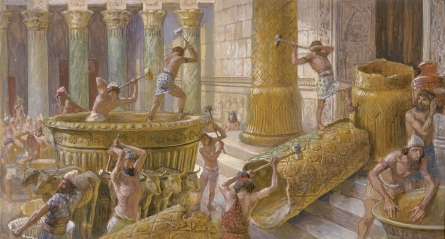
By the end of this week’s Torah portion, the golden calf has been destroyed and its worshipers killed (though Aaron is excused).  But later in the Bible, King Jereboam calls for two gold calves.

The united kingdom of David and Solomon falls apart in the first book of Kings/Melachim when Solomon’s son Reheboam overworks and overtaxes the people.  Jereboam leads the revolt and secession of the north, and becomes the first ruler of the northern kingdom of Israel.  Jerusalem remains the capital of the southern part of the land, the kingdom of Judah.

King Jereboam consolidates his reign by means of two golden calves.

And the king took counsel and he made two gold calves, and he said to them: “Going up to Jerusalem is too much for you.  Here are your gods, Israel, that brought you up from the land of Egypt.”  And he placed one in Beit El and the other he gave to Dan.  (1 Kings 12:28-29)

The temples at Beit El (a central location) and Dan (far to the north) become the new centers of worship for the northern kingdom.  Although the ten northern tribes worship the God of Israel, the Bible denounces King Jereboam’s action.

And this thing was wrong.  But the people went into the presence of even the one in Dan.  (1 Kings 12:30)

Moses and Joshua Bowing before the Ark, by James Tissot, c. 1900

Yet this does not mean all sculptures are bad.  The temple in Jerusalem has its own sculpted images: the two gold-plated keruvim, hybrid winged creatures erected on either side of the ark by King Solomon, in imitation of the two keruvim that God tells Moses to hammer out of the gold lid of the ark in Exodus 25:18-20.1

Why would God find the keruvim acceptable, but not the golden calves?


A location, not a throne

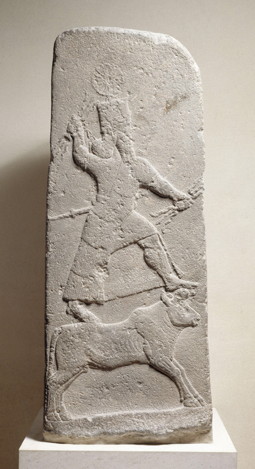
Baal Hadad on bull throne, stele from Arslan Tash

Modern commentator Robert Alter wrote that the Golden Calf was not intended to be inhabited by a deity, but rather to serve as the throne for a god—just  as Canaanite deities were often shown sitting or standing on a bull or calf.2

The ark with its keruvim is not a throne.  Later in the Bible, God acquires the title “Who Sits Above the Keruvim”.3  But the book of Exodus makes it clear that God manifests as a voice coming from the empty space between the keruvim.When God is enthroned above keruvim in the book of Ezekiel, the glory of God is hovering above the four-faced creatures next to the wheels with eyes in the prophet’s vision—quite different from the two keruvim framing the lid of the ark.

Imaginary, not actual

A sculpture of a calf falls into the category of “a sculpted image or any likeness of what is in the heavens above or on the earth below” which God forbids in the Ten Commandments.  But the keruvim do not represent any known animal on earth. Are they acceptable because they are mythical?  Or did the people in the Ancient Near East consider this hybrid guardian figures representations of angels in the heavens?

Commanded, not volunteered

In his book Kuzari, 12th-century commentator Judah Halevi argued that images were psychologically necessary for people in that era.  Until they reached Mount Sinai, the Israelites followed a visible pillar of cloud and fire.  After the pillar disappeared, they waited for Moses to come down from Mount Sinai with some other visible item.  Only after they concluded Moses would never return did they make an unauthorized image.5

The difference between the keruvim and the Golden Calf, according to Halevi and subsequent commentary by Ibn Ezra and Abarbanel, is that God ordered the keruvim.  God does not want people to use any items for worship that God has not authorized.

Heard, not seen

I think the underlying reason why golden calves are idols but keruvim are acceptable is while a number of people hear God’s voice in the Torah, nobody sees God’s form.  God’s glory (kavod, כָּבוֹד) appears as cloud or fire, not a physical creature.6  Even the pillar of cloud and fire that leads the people through the wilderness is called God’s messenger.  In this week’s Torah portion, Ki Tissa, God tells Moses:

You will not be able to see My face, because humankind may not see Me and live. (Exodus 33:20)

Only God’s creations can be seen, not God.  But God’s voice is heard by all the people in the revelation at Mount Sinai.  And throughout the Bible, God speaks to individual human beings.

The people in the Torah portion Ki Tissa err in expecting God to manifest as a visible shape, sitting astride the golden calf or standing on its back.  They want the reassurance of something they can see.  But God only manifests as a voice; God wants people to listen for divine direction.

In the Torah, God does not manifest on the solid and visible Golden Calf; God speaks from an invisible empty space between and above the keruvim.

Maybe God still speaks to us from out of nowhere—if we make empty spaces in our lives, and listen.


  1. See my post Terumah:  Cherubs Are Not for Valentine’s Day.
  2. Robert Alter, The Five Books of Moses, W. W. Norton & Company, 2008, p. 494.
  3. Isaiah 37:16.
  4. Exodus 25:22.
  5. Elie Munk, The Call of the Torah: Shemos, Mesorah Publications Ltd., 1994, p. 443-444.
  6. The only exception is when 74 selected people see God’s “feet” on a sapphire pavement after they have hiked halfway up Mount Sinai.  (Exodus 24:9-11)

Tetzaveh: The Clothes Make the Man

by Melissa Carpenter, maggidah

You shall make garments of kodesh for Aaron, your brother, for kavod and for tifaret. And you, you shall speak to all the wise of heart whom I have filled with the spirit of wisdom, and they shall make the garments of Aaron lekadsho, to perform as a priest for Me. (Exodus/Shemot 28:2-3)Kohein Gadol 1

kodesh (קֹדֶשׁ) = holiness; a holy thing, person, place, or day.

lekadsho (לְקַדְּשׁוֹ) = to make him holy, to consecrate him.

kavod (כָּבוֹד) = honor, magnificence.

tifaret (תִּפְאָרֶת) = beauty, magnificence.

In this week’s Torah portion, Tetzaveh (“you shall command”), God tells Moses how to set up the institution of priesthood for the Israelites’ new religion. Before giving instructions on how to ordain Aaron and his sons, God describes their costumes.

These are not merely fine clothes, but holy garments.  In the Torah, something is holy when it is set apart for the worship of God. Priests must wear their vestments whenever they are on duty, and only when they are on duty.

The passage translated above says that Aaron’s holy garments will make him holy, too. Even if his heart were completely dedicated, he would not be holy without the garments.

Aaron, as high priest, must also wear these garments for kavod and tifaret.  I can understand why special clothing confers honor; it indicates the wearer’s authority.  In our society, doctors wear white lab coats, police officers wear uniforms and badges, and rabbis wear caps (kippot or yarmulkes) and prayer shawls (tallitot)—at least when they are on duty.

But the high priest of the Israelites must also wear special clothing for tifaret, for beauty or magnificence.

This is the first appearance in the Torah of the word tifaret in any of its forms. (Alternate spellings pronounced tiferet and tifarah occur later in the Bible.) Sometimes the word means “beauty” or even “beautification”, as when God threatens to strip all the jewelry and other ornamentations off the vain women of Zion (Isaiah 3:18). Sometimes it means “magnificence” or “distinction”, as when the general Barak says he will only go to war against Sisera if the prophetess Devorah comes with him, and Devorah replies:

Is that so?  I will go with you.  However, the way you are going, it will not be for your own tifaret; because God will hand over Sisera to the hand of a woman. (Judges 4:9)

Both meanings of tifaret apply to the vestments of the high priest; they are beautiful to behold, and they make the priest look so magnificent that the beholder assumes he is a superior being.kohein gadol 2

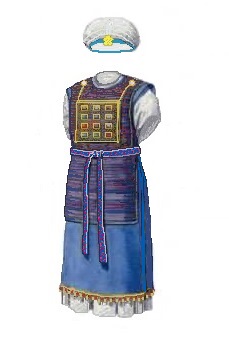
The high priest and his assistant priests wear the same first two layers of clothing:  undyed linen breeches (underpants), and long linen tunics over the breeches. The high priest wears a sky-blue robe over his tunic.

All the priests wear the same sash to hold their tunics (and for the high priest, his robe) together at the waist: a strip of linen embroidered with sky-blue, purple, and crimson wool, just like the curtains hanging at the doorways into the outer courtyard and the sanctuary of the mikdash (“holy place”).  (See my post Terumah: Under Cover.)  And all the priests wear turbans wound around their heads, though the high priest’s turban is a different shape.

The high priest gets additional costume items. The hem of his robe has alternating gold bells and embroidered pomegranates. (See my post Tetzaveh: The Sound of Ringing.)  Over his robe he wears an eifod (an over-tunic of two squares of material fastened by straps at the shoulders and waist) with a gem on each shoulder strap. Over the front of the eifod hangs a choshen (a square pocket) with gold embroidery and twelve gems on the front. And tied to the high priest’s forehead, in front of his turban, is a tzitz (an engraved flower-shaped gold plate).  (See my post Tetzaveh: Holy Flower.)

Modern commentator Avivah Gottlieb Zornberg wrote in The Particulars of Rapture that the appearance of the high priest is all-important; the man merely animates the glorious costume as it carries out the rituals in the courtyard and the sanctuary. She also pointed out the double meaning of the Hebrew word for “garments”.

You shall make begadim of kodesh for Aaron, your brother, for kavod and for tifaret. (Exodus 28:2)

begadim (בְּגָדִים) = garments, clothing. (The singular form, beged (בֶּגֶד), means “garment”, but is spelled the same way as beged (בֶּגֶד) = faithlessness, fraud, deception.)

Like “a wolf in sheep’s clothing”, a person can deceive others by wearing clothes that do not match his true identity or his inner self. A high priest wearing a dazzling holy costume might have an unworthy personality.

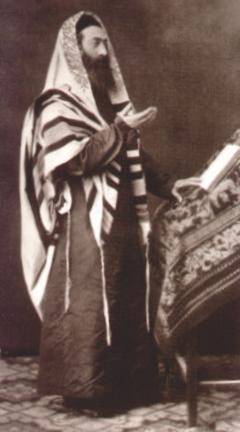
Prayer leader in tallit

Today, people often project their expectations on the person in uniform or the person with the title or degree. Doctors in their white lab coats, with their MD degrees, may or may not be the perfect diagnosticians that patients assume they are.  The person who wears a kippa (cap or yarmulke) and a tallit (prayer shawl) as he or she leads services, and has received ordination as a rabbi, may or may not be as saintly as congregants assume.

For the high priest of the Israelites, the clothes did make the man.  All people needed to do was watch the gorgeously bedecked priest carrying out the ritual of the moment, and the sheer beauty of it inspired them to religious worship.

For a congregational rabbi today, the longest and most gorgeous tallit is not enough. The rabbi must also inspire congregants with his or her d’var Torah (“word of Torah”, or sermon).  And a rabbi today is expected to set an example of ethical behavior, and to provide pastoral counseling.  A rabbi’s soul really does matter more than the rabbi’s clothing.

This makes a rabbi more like Moses, who wears ordinary clothing as he speaks with God and leads the Israelites.  At least his clothing is never mentioned in the Torah, except for the shoes he removes at the burning bush, and the veil he wears after his face acquires an unearthly radiance. The materials or colors of Moses’ shoes and veil are not specified.

In the Torah, the religion of the Israelites is established with both Aaron and Moses, and continues with both a high priest to conduct religious rituals and a king and/or prophet to provide guidance.

Maybe we need both an Aaron and a Moses today, as well. My own congregation has a number of people who are skilled at leading services. (And we wear the right garments when we do so!)  Yet a large number of our congregants want some of our services to be led by an official, ordained rabbi.  The title “rabbi” is as reassuring to them as the MD after my doctor’s name is to me.

And sometimes an Aaron is not enough; we need inspiration from a Moses, from a person with deep soul, whether or not that person has a title or a uniform.  But finding the person with the deep soul is harder.  You can’t just look for a man in a blue robe with a gold plate on his forehead.


Terumah: Under Cover

by Melissa Carpenter, maggidah

How do you make a holy sanctuary, a place where God can manifest and be heard? God gives Moses instructions in this week’s Torah portion, Terumah (“Donations”). The instructions require the creation of both ritual objects (the ark, the bread-table, the lampstand, the outer altar) and the creation of ritual spaces through curtains.

The Torah uses five different words for curtains in Terumah. The name of each curtain depends on its position in a sanctuary designed so that the holier and more exclusive the space is, the more it is covered and screened off.

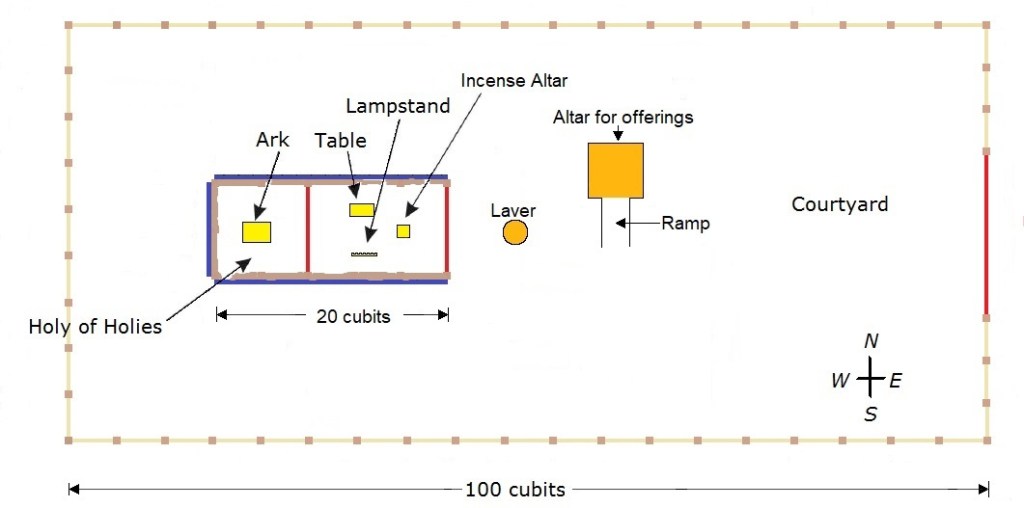
The outer courtyard of the sanctuary is accessible to all the people, walled off by curtains but open to the sky. It measures 50 by 100 cubits (roughly 75 by 150 feet, slightly smaller than an Olympic swimming pool). Inside the courtyard is the altar, where offerings for God are burned, and the mishkan.

mishkan (מִשְׁכָּן) = dwelling-place (usually God’s dwelling-place within the Israelite camp, called the “tabernacle” in English, from the Latin word for “tent”).

Only priests may enter the front chamber of the mishkan. The back chamber is the Holy of Holies, which only Moses and the high priest may enter, since that is where God manifests as a voice above the gold-plated ark.

You shall make a courtyard for the mishkan; for the south side, kela-im for the courtyard of twisted linen, 100 cubits long for one side. …And thus for the north side, kela-im a hundred long…(Exodus 27:9, 11)

kela-im (קְלָעִים) = curtains, hangings. (From a root verb (קלע) meaning either “slung”, as from a slingshot, or “carved”.)

The word kela-im occurs 16 times in the Bible, 15 times to indicate the linen hangings around the outer courtyard of the portable sanctuary, and once to indicate the carved double door into the great hall of the first temple in Jerusalem.

The kela-im in this week’s Torah portion are made of a single material, twisted linen threads, undyed and therefore an off-white. The kela-im separate the outer courtyard, where all the people can gather around the altar, from the rest of the world. They are the boundary between holy space and mundane space.

There is one entrance into the courtyard, a 20-foot gateway in the east wall covered by a hanging curtain.

And for a gate of the courtyard, a masakh of 20 cubits of sky-blue wool and purple wool and crimson wool and twisted linen, the work of an embroiderer, with four posts and four sockets. (Exodus 27:16)

masakh (מָסָךְ) = hanging curtain across a doorway, portiere. (From the root word sakhakh (סכך)= block off.)

A masakh also hangs in the doorway of the mishkan, the tent inside the courtyard.

You shall make a masakh for the entrance of the tent, of sky-blue wood and purple wool and crimson wool and twisted linen, the work of an embroiderer. (Exodus 26:36)

There is only one doorway into the tent, an opening in the east wall. The curtain screening this doorway between the outer courtyard and the inner priest’s chamber has a different name.

Both of these curtains separate a less holy space from a more holy space, and both hang loose so they can be pushed aside when someone enters or exits. They are both woven from linen, like the walls of the courtyard, but a design is embroidered on them in three vivid colors of wool.

The word masakh appears 25 times in the Bible, all but three times referring to the hangings in the courtyard gate or the mishkan doorway. In the three exceptions, the word masakh is used for the cloth cover over a cistern (2 Samuel 17:19), for the metaphorical gateway to the kingdom of Judah (Isaiah 22:8), and for the cloud God spread over the Israelites when they left Egypt (Psalm 105:39).

The walls of the mishkan are made of another type of curtain.

And the Dwelling-Place you shall make of ten yeriyot of twisted linen and sky-blue wool and purple wool and crimson wool, with keruvim of weaving-work you shall make them. The length of each yeriyah is 28 cubits, and the width four cubits, one measure for all the yeriyot. (Exodus/Shemot 26:1-2)

yeriyah (יְרִיעָה), plural yeriyot (יְרִיעֹת) = cloth sheet, hanging.

Ivory from Samaria, Israel, 9th-8th century BCE
Ivory carved with a keruv, from Samaria, Israel, 9th-8th century BCE

keruvim (כְּרֻוִים) = sphinx-like creatures with lion bodies, eagle wings, and human faces.

Each yeriyah is four cubits (about six feet) wide—which was the standard width of an Egyptian loom. The linen and three colors of wool are all woven together into a tapestry with a design of mythical semi-divine creatures.

A few verses later, God tells Moses:

You shall make yeriyot of goat-hair for a tent-roof over the mishkan; eleven yeriyot you shall make. (Exodus 26:7)

Moses fastens together these goat-hair cloth panels and drapes the resulting huge cloth over the outside of the tent-sanctuary.

The word yeriyah appears 48 times in the Hebrew Bible, and all but three of those occurrences refer to the yeriyot of the mishkan or of the first temple in Jerusalem. The three exceptions are all poetic.  Jeremiah 49:29 and Habakkuk 3:7 use yeriyot as a poetic synonym for tents. Psalm 104  describes God as “wrapping light like a robe, spreading out the heavens like a yeriyah”. (Psalm 104:2)

The roof part of the goat-hair yeriyot must be covered with two more layers of roofing. Each layer is a curtain of hides sewn together.

You shall make a mikhseh for the tent of skins of rams dyed red, and a mikhseh of skins of tachashim over above. (Exodus 26:14)

mikhseh (מִכְסֶה) = curtain, covering. (From the root word kasah (כּסה) = cover, conceal.)

tachashim (תְּחָשִׁים) = (Nobody knows what this word means; speculations range from badgers to giraffes to dolphins.)

The word mikhseh occurs in the Bible thirteen times, twelve times as the outer layer of the roof over the tent-sanctuary, and once as the roof over Noah’s ark. It serves as a sort of waterproof tarpaulin, covering and protecting the tent-cloth ceiling underneath.

Model of Mishkan
Model of the mishkan without the roof

The fifth kind of curtain in the sanctuary is the partition that screens off the Holy of Holies from the priests’ chamber inside the mishkan.

You shall make a parokhet of sky-blue wool and purple wool and crimson wool and twisted linen, the making of a weaver; it will be made with keruvim. (Exodus 26:31)

And you shall place the parokhet beneath the hooks; and you shall bring in there, into the house for the parokhet, the Ark of the Testimony; and the parokhet will make a separation for you between the Holy [space] and the Holy of Holies. (Exodus 26:33)

parokhet (פָּרֹכֶת) = curtain, woven partition. (The word is related to the Assyrian parraku = a chamber or shrine that is shut off.)

The word parokhet occurs 25 times in the Bible, always in reference to the partition screening off the Holy of Holies.

The parokhet is woven of the same materials, with the same motif, as the walls of the mishkan. But it hangs so that Moses, Aaron, or the high priest after Aaron, can push it aside to enter the Holy of Holies and speak with God.

By using five different words for curtains, the Torah portion Terumah emphasizes the importance of the different levels of holiness of each space that is partitioned, blocked from view, or protected.


I think people also have zones of intimacy, each protected by its own barrier. To the outer world of strangers, we present a face like the blank white kela-im of the outer courtyard, without any designs or colors showing—except in the gateway, where our bland, socially acceptable surface is embroidered with a colored design indicating what our personalities might be like inside.

When we make friends, we admit them through the gate into our outer courtyard, where they can see the sanctuary protecting our true selves. Our friends get a glimpse of our own vivid colors, and the mythological animals that indicate our particular life stories.  But our inner self is still hidden and protected by yeriyot panels and by a mikhseh, a roof covering we hope is disaster-proof.

Some people have never been inside the tent of their inner selves; they live only according to social roles and expectations, and find self-examination difficult. Others discover they have an inner priest who can enter the inner self and see what is inside. There, besides working with their own lamps and bread tables, they see the parokhet that screens off the Holy of Holies, where God might speak to them.

These self-explorers might invite one or two people into the priestly level of intimacy. But only the individual can walk through the parokhet and see their own ark, and the keruvim that inspired all their woven and embroidered designs.  Only an individual can see the empty space where the voice of God might manifest.

Some individuals would prefer never to enter their own Holy of Holies, never to risk hearing a voice that comes from a deep place beyond the knowable self.

How intimate do you want to become with yourself?  With God?  Which curtains will you pass through, and which will block your passage?