Yitro & Psalms 29, 82, & 97: Greater Than Other Gods

(One of a series of posts comparing ideas in the book of Exodus/Shemot with related ideas in the book of Psalms.)

The “Song of the Sea”, a psalm in last week’s Torah portion, Beshallach, includes the verse:
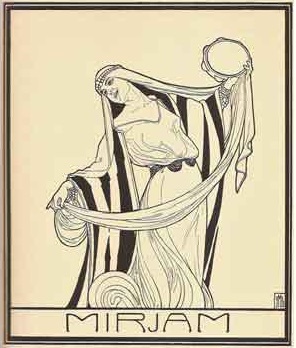
Miriam singing, by Ephraim Moshe Lilien, 1908

Who is like You among the eilim, Y-h-w-h?

Who is like You, glorious in holiness,

Awesome, praiseworthy, doing wonders! (Exodus 15:11)

Y-h-w-h (י־ה־ו־ה) = God’s personal four-letter name.  (Many English translations substitute “LORD” for this name, even though it is spelled using letters from several forms of the Hebrew verb “to be”, rather than from the Hebrew noun for “lord”.)1

eilim (אֵלִם) = plural of eil (אֵל) = a god. (In some Canaanite religions, Eil was the founding god of the pantheon.  In the Torah, Eil is another name for Y-h-w-h, but eilim always means multiple other gods.)

The Song of the Sea assumes that other gods exist, and rejoices that the God of Israel, Y-h-w-h, is more powerful than any of them.  This verse is included in the daily Jewish liturgy, morning and evening.  When Jews sing “Mi chamokha” (“Who is like You?”) we do not always remember that we are comparing our God with other gods.

Yitro and the First Commandment

In this week’s Torah portion, Yitro, the Midianite priest Yitro travels to Mount Sinai to meet his son-in-law Moses shortly after God and Moses have brought the Israelites out of Egypt.

And Yitro said: “Blessed be Y-h-w-h, Who rescued you from the hand of the Egyptians and from the hand of Pharaoh…  Now I know that Y-h-w-h is greater than all the elohim…” (Exodus/Shemot 18:11)

elohim (אֱלֺהִים) = gods, a god, God.  (Grammatically elohim is the plural of eloha, a rarely used word for a god.  The Torah uses the word elohim to refer to both multiple gods, as with eilim, and to a single god.  Sometimes elohim refers to a single foreign god2, but more often the word refers to the God of Israel, Y-h-w-h.)

Does Yitro believe in the existence of multiple gods only because he is a Midianite?  No; many passages in the Bible that were originally written before the destruction of the first temple in 587 B.C.E. share this belief.  Even the first of the “Ten Commandments” in this week’s Torah portion does not require monotheism, but only a henotheistic religion in which Y-h-w-h is the best god and the only one the people are allowed to worship:

I am Y-h-w-h, your elohim, Who brought you out from the land of Egypt, from the house of servitude.  You shall have no other elohim over and above My presence. (Exodus/Shemot 20:2-3)

(For other translations of this commandment, see my post Yitro: Not in My Face.)

The god Y-h-w-h does not say that there are no other gods, but only that the Israelites must not serve them.

A number of psalms3 are similarly henotheistic in the original Hebrew (though some translators strain to make them sound as monotheistic as later Biblical writings.)  These psalms treat other gods as real, but emphasize that they are weak and worthless compared with Y-h-w-h, the God of Israel.  Here are three examples:

Psalm 29

Psalm 29 is probably the oldest of the henotheistic psalms.  Its opening addresses the “children” or dependents of other gods:

           Assign to Y-h-w-h, children of eilim,

                        Assign to Y-h-w-h magnificence and might!

            Assign to Y-h-w-h the magnificence of [God’s] name,

                      Bow down to Y-h-w-h of holy beauty!

           The voice of Y-h-w-h is over the waters;

                      The eil of magnificence is thundering.  (Psalm 29:1-3)

“Children of eilim” might mean those dependent on other gods, i.e. their human worshipers.  Or, according to Ibn Ezra4 in his commentary on Exodus 15:11 (above), “children of eilim” refers to the stars, which were considered divine.
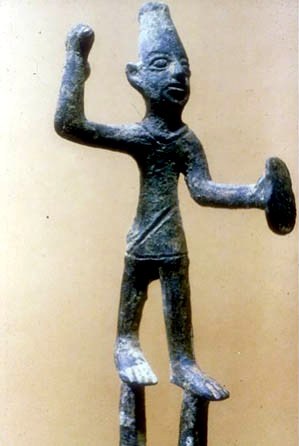
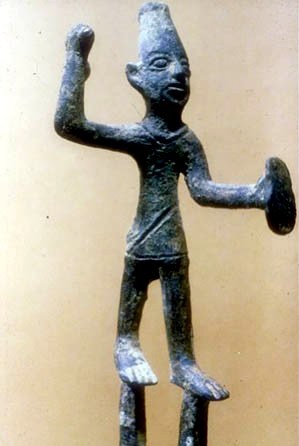
Baal preparing lightning, bronze
Baal preparing lightning

Psalm 29 goes on to describe the voice of Y-h-w-h as shattering cedars, making the mountains of Lebanon dance, kindling fire, shaking the wilderness, and startling deer into giving birth—all images related to thunderstorms and earthquakes.  Canaanite poems describe the god Baal as the weather god who speaks in thunder and makes lightning and earthquakes, but this Israelite poem says that God does all that.

In Canaanite literature the god Baal conquers the waters of chaos, builds a palace on a mountaintop, and becomes king over all the other gods except his father, Eil.

Psalm 29 gives God a palace and a throne:

          And in [God’s] palace everyone says: Magnificent!

                    Y-h-w-h sat enthroned for the flood,

          And Y-h-w-h sits enthroned as king forever.  (Exodus 29:10)

The purpose of Psalm 29 may have been to replace Baal-worship among the Israelites with the worship of Y-h-w-h, and to persuade them that all the other eilim are less powerful than Y-h-w-h.  These inferior gods acclaim and bow down to Y-h-w-h in God’s palace.

Psalm 82

In Canaanite writings from Ugarit, the father god Eil periodically convenes an assembly of the gods, each of whom has its own sphere of power.  After receiving advice from the other gods, Eil makes the major decisions about the world.5

Psalm 82 takes the idea a divine assembly in a different direction.

Elohim takes a stand in the assembly of Eil,

           Among elohim he pronounces judgment. (Psalm 82:1)

The Council of Gods, sketch by Peter Paul Rubens
The Council of Gods, sketch by Peter Paul Rubens

In the first line, “Elohim” refers to Y-h-w-h; in the second line “elohim” refers to all the assembled gods.  “Eil” in the first line might be either Y-h-w-h or the Canaanite father god.

Y-h-w-h then accuses the other gods of unjust rulings that favor the wicked and fail to rescue the poor.  But the other gods don’t get it.

            They neither know nor understand,

            They walk around in darkness;

            Causing all the foundations of the earth to totter.  (Psalm 82:5)

Without true divine justice, the whole human world is threatened.  So Y-h-w-h gets rid of the ignorant lesser gods, commenting:

           I used to say to myself: You are elohim,

                      And children of the Most High, all of you.

           Nevertheless, you will die like humans,

                      And you will fall like one of the princes.  (Psalm 82:6-7)

Psalm 82 might be an explanation of why the wicked are not always punished: inferior gods have been acting as their judges.

On the other hand, this psalm might be a story exhorting the Israelites to abandon other gods because those gods are wicked, stupid, and no longer immortal.  Only Y-h-w-h is worth worshiping, because only Y-h-w-h administers true justice and lives forever.

Psalm 97
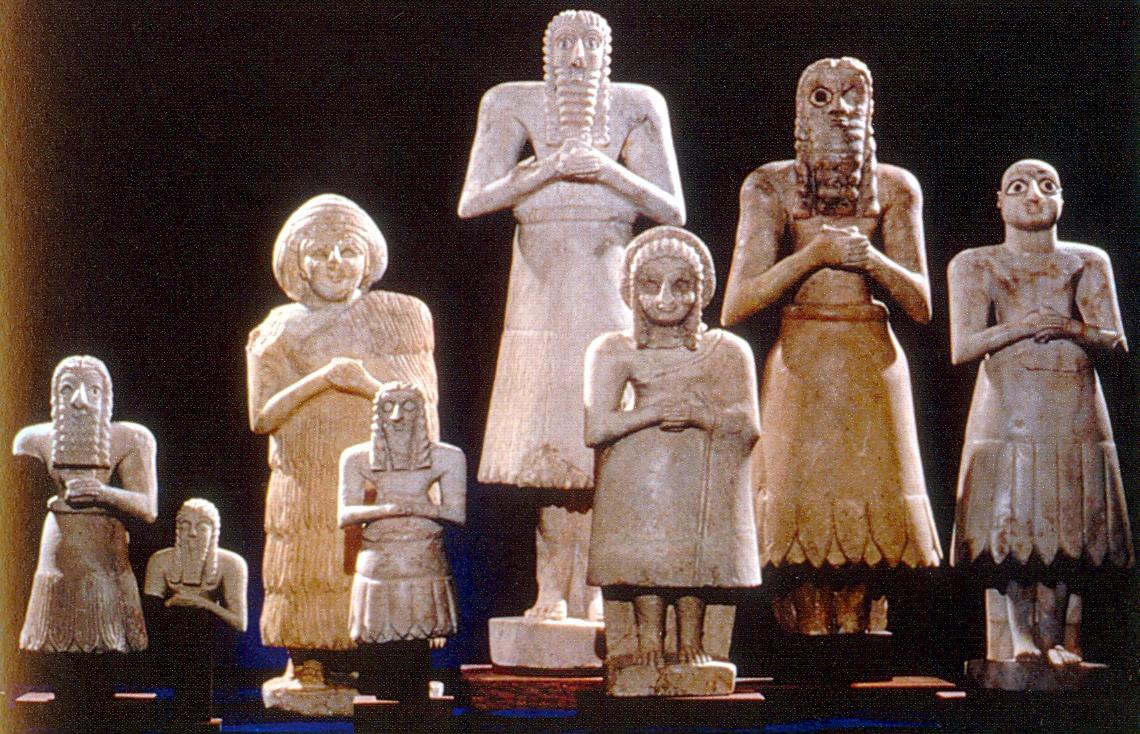
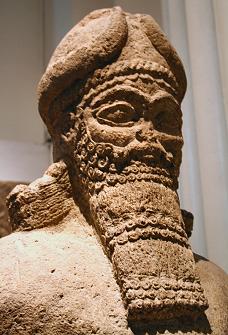
Sumerian annunaki (gods from the sky)
Sumerian annunaki (gods from the sky)

The heavens told of [God’s] true justice;

All the peoples saw [God’s] magnificence.

Every worshiper of a carved idol is shamed,

Those who boast of the elilim.

All elohim bowed down to [God]! (Psalm 97:6-7)

elilim (אֱלִילִים) = worthless gods, nonentities, not-gods, insignificant gods.

“The heavens” in verse 6 probably refers not to the sky, but to the gods (including stars) who dwell in the heavens.  Since even the other gods bow down to Y-h-w-h and acknowledge God’s justice, anyone silly enough to worship these insignificant gods should be ashamed.


It took many centuries for the Israelites to stop worshiping the old gods. People would declare their allegiance to Y-h-w-h, and then slide back into worshiping some other god, a god that “everyone” knew was especially effective at dealing with their current problem.  The Bible repeatedly shows Moses and other prophets scolding the Israelites for straying after other gods, but the scoldings must have been ineffective, since the people kept on backsliding.

It was hard for the Israelites to stick to henotheism, in which their God was supreme and the others were not worth worshiping.  How could they manage the radical idea of monotheism, which the Torah first introduced in Deuteronomy 4:35?  How long did it take, after the second Isaiah preached monotheism during the Babylonian exile, before most Israelites believed there was only one god in the universe?


1  I usually translate the four-letter name as “God”, but in this post it is important to distinguish Y-h-w-h from elohim. I insert hyphens because according to Jewish tradition, God’s personal name must not be spelled correctly in writings that are neither biblical nor liturgical. For many Jews this applies even to spelling the name with Roman letters. (The Hebrew for “lord” or “master” is adon (אָדוֹן). When Jews read out loud in religious services, we often substitute adonai  (“my lords”) for the four-letter name of God.)

2 The Bible uses “elohim” as a singular noun for the gods Baal, Baal-berit, Baal-zebub, Dagon, Kemosh, Milkom, and Nisrach; the goddesses Astarte and Ashtoret; and the golden calf.

3  Psalms 29, 82, 86, 89, 95, 96, 97, 135, and 136 all assume the existence of other gods.

4  Ibn Ezra was the 12th-century Spanish theologian Abraham ben Meir Ibn Ezra.

5  A divine assembly also appears in the book of Job and in Psalms 82 and 89.

Beshalach & Psalm 136: Miracle at Sea

(One of a series of posts comparing ideas in the book of Exodus/Shemot with related ideas in the book of Psalms.)

After the tenth plague, the pharaoh finally lets the Israelites go. Then he has another change of heart, and sends a brigade of charioteers after them. At nightfall the Egyptians catch up with the Israelites at the shore of the sea—the Red Sea in English, the Sea of Reeds (yam sufיַם סוּף) in the Hebrew Bible. Both parties camp for the night, with the Israelites trapped between the enemy and the water.

What happens next? The most familiar version of the story appears in this week’s Torah portion, Beshalach (“When he sent out”).

The Passage of the Red Sea, by William Hole,
The Passage of the Red Sea,
by William B. Hole (1846-1917)

The Prose Account

Moses stretched out his hand over the sea, and God made the sea move with a strong east wind all night. Vayasem the sea dry land, and the waters split. And the Israelites entered the middle of the sea on dry ground, and the waters were for them a wall on their right and on their left. (Exodus/Shemot 14:21-22)

vayasem (וַיָּשֶׂם) = and he/it placed, set, set up, put, put in.

Until I translated these verses, I had the impression that God simply splits the water down to the seabed, which becomes dry and firm enough for the Israelites to walk on. But the Torah says vayasem, as if there were no real bottom to the sea, so God has to install a strip of dry land.  (Many English translations say God “made” or “turned” the sea into dry ground—which has the same implication.)

In the cosmology of the ancient Israelites, beneath the land lies a subterranean ocean of water called the tehom (תְּהוֹם —singular) or tehomot (תְּהֺמֺת —plural). This deep water bubbles up through the earth in the form of springs. Under the ocean, it’s water all the way down, with no ocean floor.1

Pharoah Tutankhamen on a chariot, pursuing Nubians
Pharaoh Tutankhamen on a chariot, pursuing Nubians

And the Egyptians pursued, and all the horses of Pharoah, his chariots, and his horsemen entered after them into the middle of the sea. …And [God] made the wheels of their chariots swerve, and made them proceed laboriously. (Exodus 14:23, 25)

And Moses stretched out his hand over the sea, and the sea settled before morning into its normal flow. And the Egyptians were fleeing from it, and God na-ar the Egyptians into the middle of the sea. And the waters turned back, and they covered the chariots and the horsemen of all the army of Pharaoh, the one coming after them into the sea; not one remained. (Exodus 14:27-28)

na-ar (נָעַר) = shook out, shook off. (The form of this verb used in verse 14:27 is vayena-eir (וַיְנָעֵר). This verb appears only 12 times in the entire Hebrew Bible.)

Safe on the other side of the sea, the Israelites are awed by God’s miracle, and moved to sing along with Moses and Miriam.

The Song of the Sea

That was when Moses sang, along with the children of Israel, this song to God… (Exodus/Shemot 15:1)

The whole “Song of the Sea” that follows is a psalm written in archaic Hebrew, one of the two oldest texts in the Hebrew Bible.2 (The other is the Song of Deborah, Judge 5:1-31.) The scribe who redacted this week’s Torah portion inserted the well-known hymn without changing its archaic syntax and spellings.

The Song of the Sea does not mention God splitting the sea or the Israelites walking on dry land. Nevertheless, one early verse matches the prose account: 

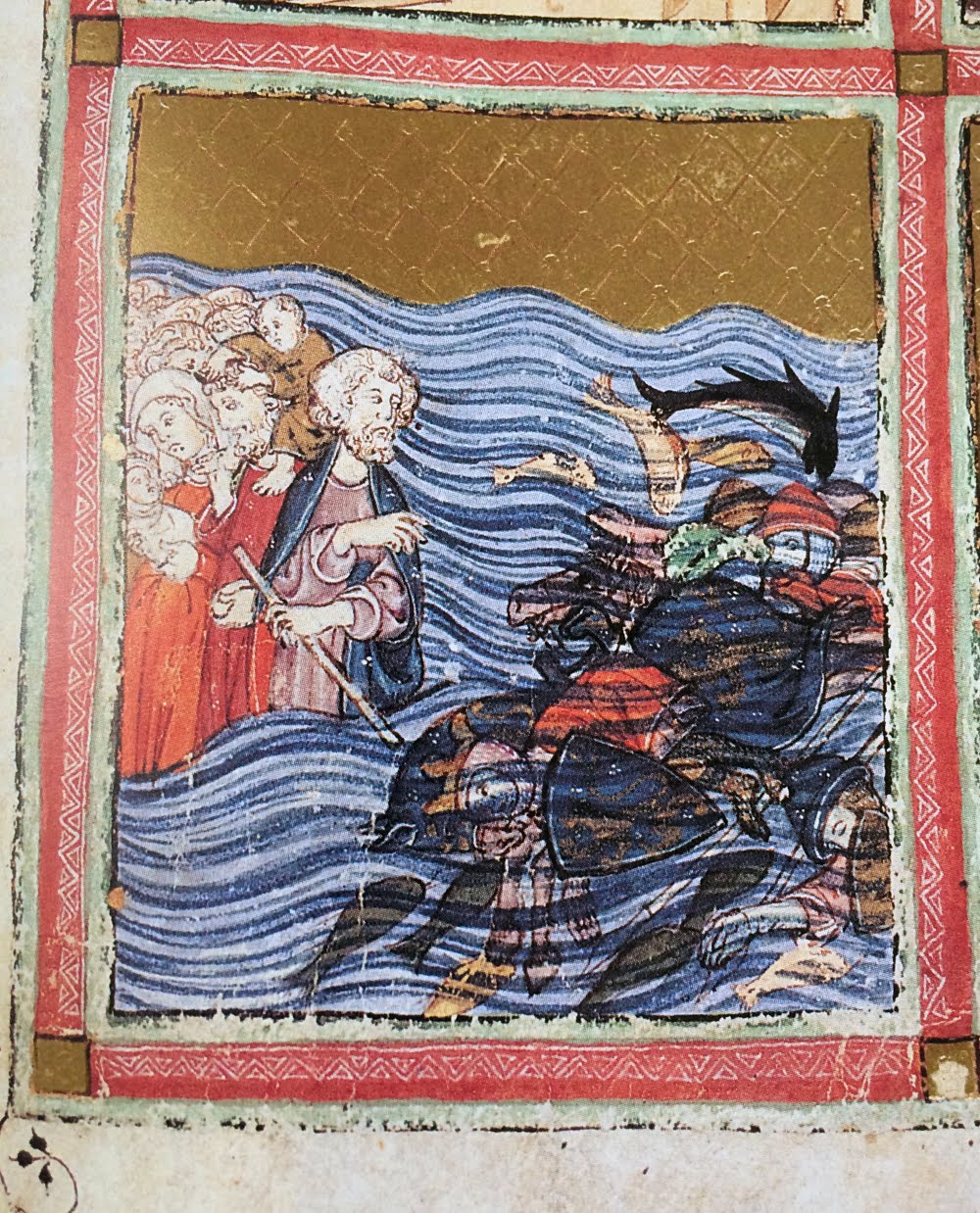
from the Golden Haggadah, c. 1320 Spain
from the Golden Haggadah,
c. 1320 Spain

         Chariots of Pharaoh and his army

                        [God] pitched into the sea,

            And the best of his captains

                        sank in the Sea of Reeds. (Exodus 15:4)

Twice the Song of the Sea says the Egyptians sank all the way down into the tehomot.

           Tehomot covered them;

           They went down into the depths like a stone. (Exodus 15:5)

           In the wind of Your nostrils the waters were dammed up.

                        They stood up like a dike [made of] waves,

                        Congealed tehomot in the heart of the sea. (Exodus 15:8)   

Ice canyon, Antarctica, 2011 photo by NASA
Ice canyon, Antarctica,
2011 photo by NASA

         You blew Your wind; the sea covered them.

                        They sank like lead in the mighty waters. (Exodus 15:10)

This description led 16th-century rabbi Obadiah Sforno to explain that the water at the bottom of the sea became solid, and the Israelites walked across the congealed or frozen water.

Psalm 136

The Bible includes several briefer descriptions of the crossing of the Sea of Reeds, all used as examples of God’s miracles on behalf of the Israelites. But the descriptions in Second Isaiah (51:9-10) and Psalms 77, 106, and 136 do not explain how the Israelites got across the water.

Psalm 136 does, however, refer to God as the one who split the sea, and like the prose account in Exodus it uses the rare word na-ar.

reed-sea-2

           Who cut the Reed Sea into parts,

                        Because forever is [God’s] loyal kindness.

            And let Israel pass through the middle,

                        Because forever is [God’s] loyal kindness.

            Veni-eir Pharaoh and his army into the Sea of Reeds,

                        Because forever is [God’s] loyal kindness. (Psalm 136:13-15)

veni-eir (וְנִעֵר) = And [God] shook off, shook out. (Another form of the verb na-ar נָעַר.)

We do not know which text first used the poetic image of God shaking off the Egyptians into the sea: Psalm 136, or one of the stories woven into the prose account in this week’s Torah portion. 3

If we follow the prose account, the sea divides and a miraculous strip of earth appears over the tehomot. I can picture the earth getting soggy after the Israelites have crossed, so the chariot wheels of the Egyptians get stuck in mud. Then the bridge of earth buckles and shakes off the Egyptians, chariots, and horses into the water, before God’s second wind blows the walls of water down over them.

On the other hand, if we take the Song of the Sea as the oldest, most authoritative account, and follow Sforno’s explanation that the water congeals into a frozen roadway between dikes of ice, then I can imagine the chariot wheels skidding out of control on the slippery surface. This provides an alternate explanation of the detail in the prose account that God “made the wheels of their chariots swerve, and made them proceed laboriously”. (Exodus 14:25)  Then the ice-dikes break and the sea rushes over the Egyptians.

Either of these two pictures of the crossing of the Sea of Reeds is more vivid than most readers—and illustrators—of the Bible imagine.

Unless you are an eye witness, it takes vivid imagery to feel the impact of a miracle. The various Biblical accounts of crossing the Sea of Reeds are designed to make the descendants of the Israelites experience the feeling of a last-minute rescue, and to give them confidence that God has always been on their side. So for centuries the Israelites rejoiced over the miracle at the sea.

Yet after the second temple in Jerusalem fell in 70 C.E., some Jews questioned this attitude. In the Talmud, Rabbi Yochanan says God does not “rejoice in the downfall of the wicked”. He gives the crossing of the Sea of Reeds as an example, saying: “The ministering angels wanted to chant their hymns, but the Holy One, blessed be He, said: The work of my hands is being drowned in the sea, and shall you chant hymns?” (Babylonian Talmud, Soncino translation, Megilah 10b)

I, too, feel sympathy for the Egyptian soldiers. They have no more choice about following the Pharaoh’s orders than the Israelite slaves did before Pharaoh let them go. And their orders were to round up the Israelites (shooting arrows if necessary) and bring them back for re-enslavement.

Suddenly the Egyptians find themselves in the middle of a situation they never imagined was possible.  They are chasing the Israelites across a dirt bridge over the sea, or maybe down an ice canyon. They see the ex-slaves reach the far side, but their chariot wheels are either mired in mud or skidding on ice. Then the Egyptians are shaken off the path like crumbs.  And the sea crashes down on them.

Today people still experience events they never imagined were possible. Sometimes what seems like a good miracle to one group of people is worse than a nightmare to another group.

May we all learn the humanity to refrain from singing out with joy when our opponents are dying. And may God save us all when we find ourselves trapped in a situation we never imagined was possible.

___

1 This detail supports Richard Elliott Friedman’s argument in his Commentary on the Torah (HarperCollins 2001) that although the body of water in question is called the Sea of Reeds, it is no shallow lake, but the Gulf of Suez–the western arm of the Red Sea.

2 The exodus from Egypt is set during Egypt’s 19th Dynasty, which ruled during the 13th century B.C.E. The Song of the Sea mentions the Plashet (Philistines), who did not emigrate to Canaan until about 1175 B.C.E. Thus Moses could not have known or composed the Song of the Sea, but the writer of the Song of Sea might have known the story of the exodus. According to modern scholars, the prose version of the story in Exodus is a compilation of three different stories written in Biblical Hebrew sometime after 700 B.C.E. The redactor also inserted the ancient Song of the Sea.

3 Psalm 136 cannot be reliably dated. The language is consistent with the Hebrew in the book of Exodus (excluding the archaic Song of the Sea). But it could have been written much earlier, and rewritten centuries later with updated language. Or it could even have been written during the time of the second temple, 530 B.C.E.-70 C.E.

Va-eira & Bo; Psalm 78 & Psalm 105: Responding to Miracles

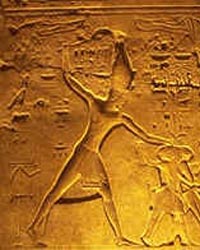
Pharaoh Merneptah subjugating Semites

(One of a series of posts comparing ideas in the book of Exodus/Shemot with related ideas in the book of Psalms.)

It takes two Torah portions (Va-eira this week and Bo next week) to describe the miraculous “plagues” that force the Pharaoh to let the enslaved Israelites walk out of Egypt. Two psalms, Psalm 78 and Psalm 105, offer briefer versions of the story. And the festival of Passover/Pesach tells the story of how God rescued the Israelites from Egypt in such detail that the seder (“order”;  ritual retelling of the story) can last half the night.

In the Torah portion Va-eira, God lays out the plan to Moses:

Therefore say to the children of Israel: “I am God, and I will bring you out from under the burden of Egypt, and I will rescue you from enslavement, and I will redeem you with an outstretched arm and with great acts of judgement. And I will take you to be My people, and I will be your god. And you will yada that I am God, your god, who is taking you out from under the burden of Egypt. (Exodus/Shemot 6:6-7)

yada (יָדַע) = know, realize, recognize, become acquainted, come to understand through direct experience. (Yada is the root verb. The Hebrew here uses the form viyda-etem (וִידַעְתֶּם) = and you will yada.)

Why does God inflict “great acts of judgement” on Egypt? The first reason given in this week’s Torah portion is so that the Israelites will yada God.

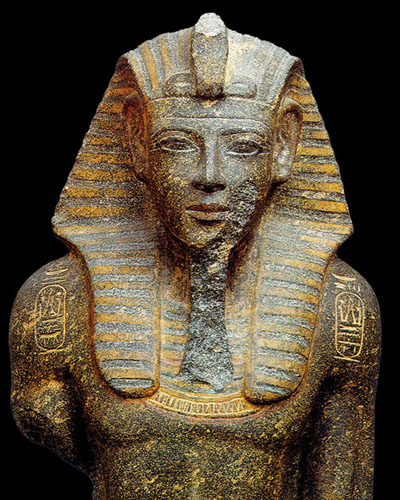
Pharaoh Mernptah, son of Ramses II
Pharaoh Merneptah, son of Ramses II

The second reason is so that the Pharaoh and the Egyptians will yada God, or at least recognize God’s existence and power:

And Egypt, they will yada that I am God when I stretch out my hand against Egypt and I bring out the children of Israel from their midst. (Exodus 7:5)

(The Hebrew in this verse uses form veyade-u (וְיָדְעוּ) = and they will yada.)

How many plagues does it take before both the Israelites and the Egyptians yada God?  Anyone who has participated in a Passover seder, spilling a drop of wine for each plague, knows the answer is ten. And in the book of Exodus/Shemot God does indeed inflict ten miracles on Egypt—the first seven in Va-eira (And I appeared), and the last three in Bo (Come).

However, the ten plagues are described in two different voices. Any close reader of  Va-eira and Bo, even in translation, notices points where the narrative suddenly stops and restarts, rephrasing a bit of the story that has already been told. Scholars examining the language itself have discovered that two stories of the plagues are woven together (but not seamlessly).

Both strands have something to say about the plagues of blood, frogs, and death of the firstborn. The other seven plagues are described by one strand or the other, not both. Maybe each of the two original stories had fewer than ten plagues. Or maybe the redactor(s) who combined the two stories decided to give both descriptions of three plagues, but chose only their favorite descriptions for the other seven.

Psalms 78 and 105 report fewer than ten plagues, and the order is different than in Exodus.

plagues-table

What accounts for these differences? We cannot identify any of these accounts as the original story. At least one strand in the composite story in Exodus was probably written in the 8th century B.C.E. Psalm 78 may have been written as early as the 10th century B.C.E., soon after the first Israelite temple was built in Jerusalem. Psalm 105 could have been written any time after that, maybe before the book of Exodus, maybe as late as the period of the second temple. Probably the story of God’s miracles in Egypt was familiar to all the authors before they began to write down their own versions.

The two psalms and the composite in Exodus borrow language from each other, not only using the same words for the plagues, but sharing pieces of description. For example, Exodus describes the plague of blood this way:

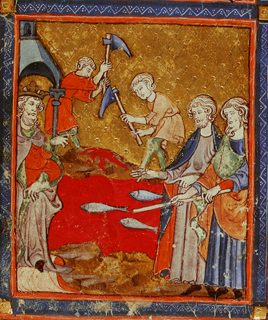
Plague of Blood, Golden Haggadah, c. 1320 Spain

…and he raised the staff and he struck the water that was in the Nile before the eyes of Pharaoh and his courtiers, and all the waters of the Nile turned into blood. And the fish that were in the Nile died. And the Nile stank and the Egyptians were not able to drink water from the Nile, and there was blood throughout the land of Egypt. (Exodus 7:20-21)

Psalm 78 focuses on the lack of drinking water:

And [God] turned into blood the Nile and its streams;

            They could not drink. (Psalm 78:34)

Psalm 105 focuses on the loss of an important food:

           [God] turned their waters into blood

                        And it made their fish die. (Psalm 105:39)

Whether the story is expanded in the book of Exodus, or contracted in a psalm, it is always offered as a decisive example of God’s miracles on behalf of the Israelites.

In the book of Exodus, the purpose of the plagues is to get both the Israelites and the Egyptians to yada God. But the Torah portion Bo also gives instructions several times for the earliest Passover rituals, which were conducted about 3,000 years ago. The purpose of these rituals is to remember the story of the exodus.

This day shall be for you for remembrance, and you shall celebrate it as a festival for God, through [all] your generations. It is a decree forever: you shall celebrate it. (Exodus 12:14)

While Exodus only calls for remembering the story of God’s miracles in Egypt, Psalms 78 and 105 tell the story in order to motivate the Israelites of Judah to action.

Psalms 78 hopes that if the Israelites remember the miracles God did for them, then they will stop backsliding, trust God, and obey God’s rules.

           What we have listened to, and we yada,

                      and our ancestors recounted to us,

           should not be concealed from their descendants,

                      to the last generation recounting

           praises of God and Its strength

                      and Its wonders that It did. (Psalm 78:3-4)

(The Hebrew in verse 3 uses form vaneida-eim (וַנֵּדָעֵם) = and we will yada.)

Why must God’s miracles be recounted to every generation?

           Then they will place their kesel in God,

                      and they will not forget the deeds of God,

                      and they will comply with Its commandments. (Psalm 78:7)

kesel (כֶּסֶל) = conviction, certitude, unwavering belief regardless of other evidence or arguments; folly, stupidity.

The section of Psalm 78 that tells about the miracles God inflicted on Egypt (78:42-51) is not designed to mention every single plague, but rather to bring the story to life in ten short verses. Psalm 78 leaves out the kinim, the shechin, and the darkness, but it adds a few details that are not in Exodus:

Plague of Hail, Haggadah by Judah Pinchas, 1747 Germany

—that the action happened at Tzoan, a specific place in the Nile Delta. (78:43)

—that the arov, the mixed hordes of vermin, ate the flesh of the Egyptians. (78:45)

—that when God sent hail, Egyptian flocks were hit by lightning. (78:48)

—that the hail killed grapevines and fig trees (important crops in Canaan, but not in Egypt). (78:47)

These additional details would make the story more vivid in the listener’s imagination.

Psalm 105 is less concerned than Psalm 78 about lack of faith and commitment among the people of Judah. I believe its purpose is to whip up enthusiasm for God and the religion among the worshipers at the temple.

           Thank God, call out Its name,

                      hodiyu among the peoples Its deeds!

           Sing to [God], make music to It,

                      consider all Its wonders!

           Revel in the name of Its holiness!

                      Let the heart of those who seek God rejoice! (Psalm 105:1-3)

hodiyu (הוֹדִיעוּ) = make known, inform, announce. (A different form of the root verb yada.)

Rylands Haggadah, 14th century Spain. Left: livestock pestilence. Right: Shechin.

Psalm 105 then tells the story of the people who became Jews, starting with God’s covenant with Abraham and ending with the Israelites’ conquest of part of Canaan. When it describes the plagues, it omits both livestock pestilence and shechin, perhaps because the thought of rashes and boils would depress the congregation.  Or, according to 19th-century rabbi Samson Raphael Hirsch, because diseases do not seem supernatural enough to count as miracles. But Psalm 105 uses some of same vivid details as Psalm 78.

*

Do the stories of God’s miracles in Egypt achieve their purpose?

Direct experience of miracles works in Exodus; both the Israelites and the Egyptians yada—know, realize, and recognize—a powerful god acting on behalf of the Israelites. The instruction to perform a ritual to remember what happened also worked; we have been celebrating Passover for about 3,000 years.

Does the account in Psalm 78 work, leading people to kesel, an unshakeable belief in God, and to a determination to obey God’s rules? I think it would depend on the listener. Some people believe any account that is vivid (like Psalm 78’s selection of details) and comes from an accepted source (such as the temple priests, or a particular news station, or a friend’s e-mail). Other people are skeptics by nature; they examine a story to see if it is logical and how it fits with personal experience and other information. This type of person would probably need direct experience, yada, to achieve kesel and commit themselves to obeying all the rules of the religion.

What about Psalm 105? I believe that an account of past miracles can inspire both kinds of people, especially when it is poetry set to uplifting music. Even natural skeptics can get caught up in singing joyful praise, and leave the temple (or synagogue) with a better attitude toward their God and their religion. And natural believers might be moved to proselytize, following the instruction hodiyu—make known, announce!

The singing of the psalms continued as part of both Jewish and Christian prayer after the fall of the second temple in Jerusalem in 70 C.E. It continues today. But Jewish liturgy concentrates on other psalms. It quotes only one verse from Psalm 78 and fifteen from Psalm 105, none of which are verses addressing the plagues in Egypt.

However, serious-minded Jews study the story of the plagues in the Torah portions Va-eira and Bo every winter, when we reach this time in the cycle of Torah readings. And in the spring many more Jews celebrate Passover, a festival of dramatic rituals, prayers, songs, and stories about how God freed the Israelites from slavery in Egypt.

The haggadah (“the telling”), the book that provides the texts and ritual instructions, includes many quotes from our two Torah portions in Exodus. Psalms 78 and 105 are not traditionally included. In a modern American haggadah, the song “Go Down Moses” usually is.

from an Iraqi haggadah, printed in Vienna 1930

Out of all the stories of God’s miracles in Egypt, I would say Passover is by far the most effective at getting Jews to remember the claim that God created miracles to rescue our people from Egypt. The ritual itself has changed and grown over the millennia, so it can speak to new generations. Even Jews who grew up in families that managed to conduct a boring seder  every year cannot help but remember the symbolic foods, the song that the youngest child must sing, the exodus story, spilling a drop of wine for each of the ten plagues, and hunting for the hidden piece of matzah.

Thus Passover still serves the purpose given in the book of Exodus: remembering the story. Whether we can go further and yada God (as in Exodus), or commit ourselves to kesel (as in Psalm 78), or be moved to joy and a desire to recommend the religion (as in Psalm 105) depends on the individual.

Personally, I have a skeptical nature, and I actively try to avoid kesel—while remaining committed to studying Torah and being a Jew in a liberal sense. But I remember the exodus story every winter when I study it in the Torah, as well as every spring when I participate in Passover. I do not yada the God of the ancient Israelites, but I do yada something I cannot describe that I call God. And when I sing psalms that have uplifting words and melodies, I am indeed moved to joy. I would recommend that to anyone!

Shemot and Psalm 137:  Cry Like a Baby

This week begins the reading of the book of Exodus/Shemot in the Jewish tradition. This year my posts on Exodus will relate each Torah portion to one of the psalms.

Weeping in Egypt

Too many foreigners live in Egypt, from the Pharaoh’s point of view in this week’s Torah portion. Unlike those who fear immigrants in our own time, the Pharaoh is not afraid that the Israelites will take jobs from native Egyptians. He is afraid that if another country makes war on Egypt, these foreign Hebrews will join Egypt’s enemies.

Pharaoh's decree, by Michiel van der Borch, 1332
Pharaoh’s decree, by Michiel van der Borch, 1332

Instead of integrating the Israelites into Egyptian society to win their loyalty, the Pharoah enslaves them, requiring that the men do forced labor. He also tries to reduce the population.

Then Pharaoh commanded his entire people, saying: “Every son that is born, you shall throw him into the Nile. But every daughter you shall keep alive”. (Exodus/Shemot 1:22)

And a man from the house of Levi went out and married a daughter of Levi. And the woman conceived and she bore a son, and she saw that he was good, and she hid him for three months. (Exodus 2:1-2)

Commentators have suggested many reasons why the baby (later named Moses) is “good”. But since his mother (later identified as Yokheved) is able to hide the baby for three months, the simple answer is that he is placid and quiet. As long as his mother is there whenever he wakes up, Moses does not cry.

Why could Yokheved no longer hide him after three months? The commentary offers different theories. I suspect that Moses happens to be three months old when Egyptian bullies start searching the houses of Israelites for baby boys to drown.

It occurs to Yokheved that the best hiding place for an Israelite baby boy is the Nile itself. She tars a floating box made of papyrus stems, and places Moses inside. Then she carries it to the pool where a woman of the royal family goes to bathe, and wedges it among the reeds so the current will not carry it away. The care with which Yokheved picks the spot shows that she hopes her baby will be discovered and adopted.

detail, Golden Haggadah, c.1420 Spain

And the daughter of Pharaoh went down to bathe in the Nile, and her maidens were walking next to the Nile. And she saw the floating box among the reeds, and she sent her slave-girl to fetch it. (Exodus 2:5)

The princess sees the box; she does not hear any crying. Moses, rocking gently inside, is probably asleep.

And she opened it and she saw the child, and hey! It was a boy, bokheh! And she felt pity for him, and she said: “This is one of the children of the Ivrim”. (Exodus 2:6)

bokheh (בֺּכֶה) = weeping, crying, sobbing, wailing. (From the root bakhah, ּבָּכָה = wept.)

Ivrim (עִבְרִים) = Hebrews; immigrants. (From the root avar, עָבַר = passed over, crossed through, emigrated.) Egyptians in the book of Exodus sometimes call the Israelites the Ivrim.

The story continues like a fairy tale, as the Pharaoh’s daughter ends up paying Moses’s own mother to nurse him, then adopts him after he is weaned. But why does Moses begin to cry when the princess opens the lid of the box? Probably the sudden sunlight wakes him—and then, instead of seeing the familiar face of his mother, he sees a stranger.

All infants cry when they are suddenly deprived of their primary caregivers, just as adults cry when someone they are deeply attached to dies. The world is strange and frightening without that familiar presence.

People may also cry when they are forced to leave their homes and live in a strange place. Yet when the Israelites and their fellow travelers follow the adult Moses out of Egypt, they “leave with a high hand” (Exodus 14:8). They rejoice rather than weep because they are choosing to leave a life of slavery and seek a new land to make their home.

Weeping in Babylon

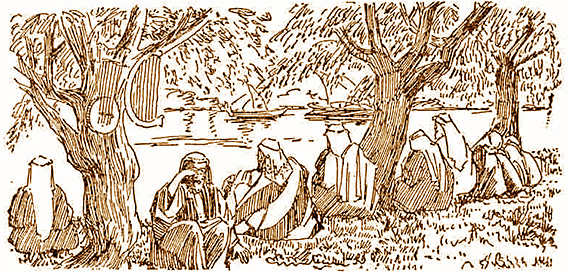
On the other hand, in Psalm 137 the Israelites weep when the Babylonian army deports them from Jerusalem many centuries later, circa 586 B.C.E. They have no choice; they are forced to leave their homeland and live as foreigners in a strange place.

psalm-137-1

           By the rivers of Babylon

           There we sat down, bakhinu,

           when we remembered Tziyon. (Psalm 137:1)

bakhinu (בָּכִינוּ) = we wept, cried, sobbed, wailed. (From the same root, bakhah, as in Exodus 2:6.)

Tziyon (צִיוֹן) = Zion; a hill overlooking Jerusalem; Jerusalem itself as a religious center.

The deportees weep when they see the place where they must now live. It even looks different from their motherland.         

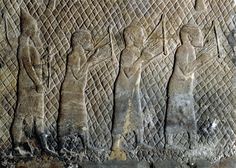
Prisoners playing lyres from Sennacherib's palace, Nineveh, circa 700 B.C.E.
Prisoners carrying lyres, palace of Sennacherib, Nineveh, c. 700 B.C.E.

           Upon the poplars in her [Babylon’s] midst,

            Our lyres will remain hung. (137:2)

            Because there our captors asked us for words of song,

            Our oppressors for rejoicing:

            “Sing to us some song of Tziyon!” (Psalm 137:3)

The Babylonian officers ask the deportees to entertain them by singing one of their quaint, provincial songs from Tziyon. If the officers merely wanted a folk song, they might have asked for a song from Jerusalem or Judah. By using the word Tziyon, the Babylonians are referring to Jerusalem as a religious center. Thus they remind the Israelites how helpless they are, even in matters of religion, now that the Babylonian army has razed the temple and deported them.

            How can we sing a song of God

           On the soil of a foreign land? (Psalm 137:4)

The Israelites, and the Jews descended from them, do eventually sing sacred songs in foreign lands—including the psalms once sung in the temple. But in Psalm 137, they recoil from the idea of singing a hymn to God in order to let the Babylonians mock and humiliate them.

            If I forget you, Jerusalem,

            May my right hand forget.

            May my tongue cling to my palate,

            If I do not remember you,

            If I do not exalt you, Jerusalem,

           Above my highest joy.

            Remember, God, the Edomites

           On the day of Jerusalem, who said:

            “Strip it! Strip it down to the foundations!” (Psalm 137:5-7)

According to the book of Obadiah, probably also written in the 6th century B.C.E., the men of the nearby land of Edom joined the Babylonians in sacking the city of Jerusalem (Obadiah 1:11-13).

            Babylon the despoiler,

            Fortunate are those who will retaliate for your retaliation against us! (137:8)

            Fortunate are those who will seize and smash

           Your little children on the rock! (Psalm 137:9)

I picture the Israelites reacting like children, full of desperation at the loss of their mother land and religion, suddenly under the thumb of cruel and all-powerful foreigners. Toddlers in that situation might well scream with outrage and hatred at the mean strangers who have kidnapped them. It takes time to cool down, grow up, and consider the ramifications of one’s initial reaction. For a whole society, it can take centuries.


When the infant Moses cries at the sight of a stranger, it is because the stranger is not his mother, and he fears he has lost his mother forever. When the Israelite deportees cry at the sight of the rivers of Babylon, it is because Babylon is not their home, and they fear they will lose everything that means home to them: their identity, their way of life, and their religion.

They promise themselves they will never forget Jerusalem. Perhaps they recall the stories about Moses as an adult, who breaks with his royal Egyptian family to rescue the Israelite slaves.  He never forgets his mother and his own people.

May every one of us remember those we have loved and lost. May we remember our true homes—whether they are the homes we were born into (like the Israelites in Psalm 137), or the homes we adopt (like the Israelites that Moses leads out of Egypt in the book of Exodus).

Haftarat Pekudei—1 Kings: More, Bigger, Better

Every week of the year has its own Torah portion (a reading from the first five books of the Bible) and its own haftarah (an accompanying reading from the books of the prophets). This week the Torah portion is Pekudei (Exodus 35:1-40:38). The haftarah in the Sefardi tradition is 1 Kings 7:40-50; the haftarah in the Ashkenazi tradition is 1 Kings 7:51-8:21.

More, bigger, better.

The tent-sanctuary and its courtyard, which Moses assembles at the end of the book of Exodus in this week’s Torah portion, Pekudei, are small and easily disassembled and reassembled. This is a necessity, since the Israelites must continue their journey to Canaan, erecting the sanctuary again every time they pitch camp.

Reconstruction of First Temple,
Bible Museum, Amsterdam

But the first Israelite temple1 in Jerusalem and its courtyards, which King Solomon completes in this week’s haftarah, is a permanent structure. And it must be considerably larger, with more appurtenances, to accommodate not only a larger crowd of worshipers, but a larger number of priests and assisting Levites.

Sanctuary

People from Noah to Moses build altars to burn sacrifices for the God of Israel. But at the end of the book of Exodus, Moses assembles the first sanctuary or shrine: a structure with a roof, walls, and an entrance. This sanctuary is a small tent: 10 by 30 cubits (about 15 by 45 feet or 4½ by 13½ meters).2

The tent sanctuary needs to be small because it has to be disassembled and reassembled every time the Israelites travel to a new campsite . But there is enough room inside for the only people who are allowed to enter: Moses, the high priest Aaron, and Aaron’s sons.

The temple King Solomon builds in Jerusalem, described in both options for this week’s haftarah, is a tall building of stone and cedar, its footprint is 20 by 60 cubits (about 30 by 90 feet or 9 by 27 meters).3 Solomon’s temple is four times as big as Moses’ tent sanctuary—and it needs to be. As the main temple in the capital of a nation-state, it must accommodate many priests and their Levite assistants.

Holy of Holies

Both Moses’ sanctuary and Solomon’s temple are divided into two rooms: a main hall and a smaller chamber in back for the holy of holies. King Solomon adds a front porch with two gigantic bronze columns.

The “Holy of Holies” the innermost chamber in both the tent and the temple, contains only the ark of the covenant and two golden cherubs/keruvim, hybrid beasts with wings. (See my post Terumah: Cherubs are Not for Valentine’s Day.)

Ark with Keruvim, one possibility
Ark with Keruvim

In the Tent of Meeting, the keruvim are part of the lid of the ark, one hammered out of the solid gold at each end. Their wings tilt toward each other, enclosing an empty space above the lid, a space from which God sometimes speaks. (See my post Pekudei & 1 Kings: A Throne for the Divine.)

Since the ark is only about four feet long, a keruv wing cannot be more than two feet long. But in Solomon’s temple, each keruv is about fifteen feet tall and has a fifteen-foot wingspan.4 An earlier passage in the first book of Kings describes how they are carved out of olive wood and overlaid with gold, then set up in the back chamber so that each one touches a wall with one wingtip and the tip of the other keruv’s wing with the other. Since the ark is smaller than these statues, it fits underneath them.

The priests brought in the ark of the covenant of God to its place, to the inner chamber of the bayit, to the holy of holies, to underneath the wings of the keruvim. (1 Kings 8:6)

It is not clear whether the inner chamber of the temple now contains four keruvim—the small pair on the ark and the large pair standing on the floor—or just the two large ones. But either way, the principle of “more, bigger, better” applies.

Main room of sanctuary

The main room of Moses’ sanctuary contains only three sacred ritual objects: a gold incense altar, a gold-plated table for display bread, and a solid gold lampstand with seven oil lamps.

The main hall of Solomon’s temple has the same three items, also gold—but the lampstands and perhaps the tables have multiplied.

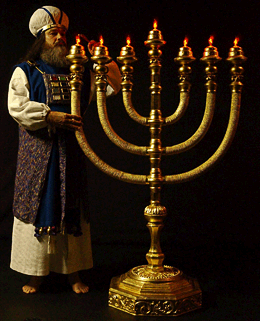
Menorah
Menorah

When Moses assembles everything in this week’s Torah portion,

…he put the lampstand in the Ohel Mo-eid opposite the table, on the south side of the sanctuary. And he lit up the lamps before God, as God had commanded Moses. (Exodus 40:24-25)

Instead of placing one lampstand on the right side of the main hall, King Solomon’s crew positions five lampstands on each side.

And Solomon made all the vessels that were in the House of God, the gold altar and the gold table on which was the display bread and the pure gold lampstands, five on the right side and five on the left side in front of the inner chamber, and the gold blossom [decorations] and lamps and wick cutters … (1 Kings 7:48-49)

In the first book of Kings, Solomon’s temple contains only one bread table.

And Solomon made all the equipment that was in the bayit of God: the gold altar and the gold table that had the display bread upon it… (1 Kings 7:48)

But by the fourth century B.C.E., when the two books of Chronicles were written, the bread table had multiplied.

And he made ten tables and he set them in the main hall, five on the right side and five on the left side; and he made a hundred gold sprinkling-basins. (2 Chronicles 4:8)

After all, if one table is good, ten tables must be better.

Wash basins in courtyard

Like most religions in the ancient Near East, the religion outlined in the Hebrew Bible makes a distinction between public worship and the rituals conducted by priests. The public place of worship is the open courtyard in front of the sanctuary, where animals and grain products are offered at the altar. Only priests are allowed to go inside the tent or temple.

When priests move from serving at the altar to serving inside the tent or building, they stop to wash their hands and feet. So when Moses is setting up the portable sanctuary for the first time,

… he put the basin between the Ohel Mo-eid and the altar, and he place there water for washing. And from it Moses and Aaron and his sons washed their hands and their feet. When they came into the Ohel Mo-eid and when they approached the altar they washed, as God had commanded Moses. (Exodus 40:30-32)

Ohel Mo-eid (אֹהֶל מוֹעֵד) = Tent of Meeting.  (From ohel (אֹהֶל) = tent and mo-eid (מוֹעֵד) = meeting, meeting place, appointed time or place.)

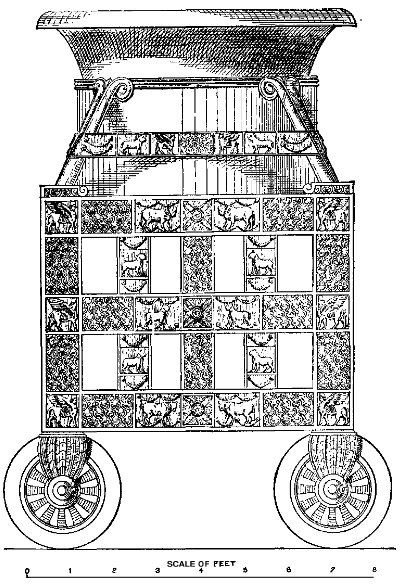
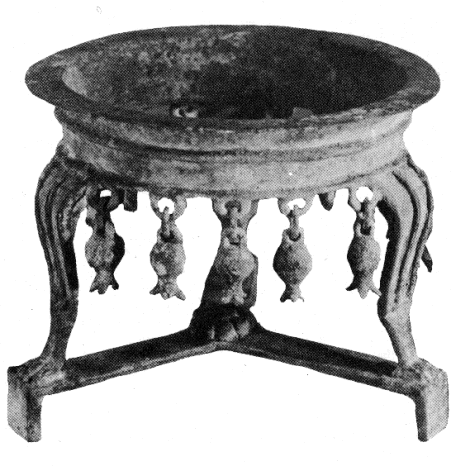
Basin on wheeled stand, Solomon's Temple
One of ten basins
in Solomon’s Temple

The courtyard in front of Solomon’s much bigger temple has a huge bronze “sea” resting on twelve bronze oxen. (See last week’s post, Haftarah for Vayakheil: Symbolic Impressions.) In addition to this much more impressive basin, Solomon’s master artisan makes ten smaller bronze basins on elaborate wheeled stands covered with engraved spirals, cherubim/keruvim, lions, and palm trees.

And he placed five stands at the entrance of the bayit on right and five at the entrance of the bayit on the left… (1 Kings 7:39)

bayit (בָּיִת) = house, important building, household.

Why settle for one small basin when you could have a giant “sea” along with ten basins?

When the temple is complete with all its furnishings, King Solomon proudly declares:

I certainly built an exalted bayit for You, an abode for you to rest in forever! (1 Kings 8:13)

When it comes to religious ritual objects, is more or bigger really better?

Anything made of precious metals would have provided a locus for worship that met the expectations of the Israelites Moses led through the wilderness. In Exodus, thanks to the tent sanctuary and its ritual objects, they no longer feel the need for a golden calf. And if the ritual objects were too large or too many, they would be too hard to transport through the wilderness.

The capital of a new nation-state, however, needs not only a large and permanent temple, but also a large and glittering display to impress both foreign visitors and the nation’s citizens with the power of its religion. So in front of King Solomon’s temple are gigantic bronze columns, the oversized bronze “sea” on twelve bronze oxen, ten bronze lavers on elaborate stands, and a host of priests walking in and out of the building.  Inside, there are enough lampstands and tables to accommodate those priests as they perform the rituals, which would help reconcile them to a centralized religion.


In my own life, I have responded to religious cues on both scales, small and large. I know the calm, centering effect of lighting two candles for Shabbat, and the hushed tenderness of reading from a Torah scroll in an otherwise unremarkable room.  I also know the awe I feel when I stand at the ocean, in a forest of tall trees, or in a medieval cathedral (even though as a Jew, I am a foreign visitor there).

I do not want to lose either the personal connection of rituals with small sacred things, or the impersonal awe of encounters with vastness.  Both a tent and a temple are exalted places where God might rest.


  1. The Jebusites who occupied Jerusalem before King David conquered part of it probably had their own shrine. Genesis 14:17-20 mentions a Jebusite priest-king named Malki-tzedek who blesses Abraham.
  2. Exodus 26:1-6.
  3. 1 Kings 6:2.
  4. 1 Kings 6:23-26.

Haftarat Vayekheil—1 Kings: Symbolic Impressions

Every week of the year has its own Torah portion (a reading from the first five books of the Bible) and its own haftarah (an accompanying reading from the books of the prophets). This week the Torah portion is Vayakheil (Exodus 35:1-40:38). The haftarah in the Sefardi tradition is 1 Kings 7:13-26. (The haftarah in the Ashkenazi tradition is 1 Kings 7:40-50.)

Both Moses’ tent sanctuary and Solomon’s temple have a place for priests to wash their hands and feet before they enter the holy building. In this week’s Torah portion, Vayakheil, the master craftsman Betzaleil makes a simple but symbolic wash-basin. (See my blog post Pekudei: Basin of Mirrors.)

Kiyor on stand, stone, Megiddo
Kiyor on stone stand, Megiddo

And he made the kiyor of bronze and its stand of bronze from the mirrors of the army of women who mobilized at the entrance of the Tent of Meeting. (Exodus 38:8)

kiyor (כִּיִוֹר) = basin, laver.

Solomon’s temple has ten such basins, cast out of regular molten bronze rather than mirrors, perched on elaborate wheeled stands. But King Solomon also has his master bronze artisan cast a water container so huge it is called a sea.

Then he made the yam of cast metal, ten cubits from its [lower] rim up to its circular rim, five cubits high, and a measuring-line of thirty cubits around its circumference. (1 Kings 7:23)

yam (יָם) = sea; in Canaanite religion, the name of the god of the sea.

This tub of water would be more than 14 feet (4 meters) across and more than 7 feet (2 meters) high. Since it would be impossible to climb into for bathing, commentators have concluded it had an outlet like a spigot at the bottom, to pour water into a shallower container for washing.

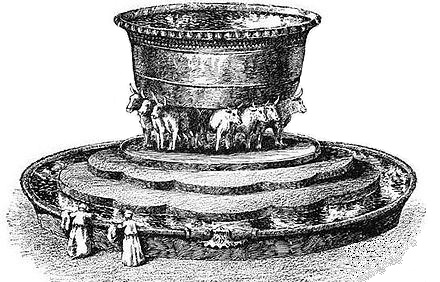
Bronze "Sea", artist's rendering from Encyclopedia Judaica
Bronze “Sea”, artist’s rendering from Encyclopedia Judaica

And gourd ornaments were below its rim all around the circle, ten per cubit, encompassing the yam all around; two rows of the gourd ornaments, cast in one piece with it. It was standing on twelve oxen: three facing north and three facing west and three facing south and three facing east. And the yam was on top of them, and all of their hind parts were inward. (I Kings 7:24-25)

The most striking difference between the yam in front of Solomon’s temple and the kiyor in front of Moses’ tent sanctuary is that the yam rests on twelve bronze cows—probably life-size—instead of on an ordinary framework.

Moses discourages the molding of any real animals (as opposed to the keruvim, the composite fantasy animals whose wings are spread over the ark). He smashes and grinds up the golden calf that Aaron makes in the book of Exodus. In a passage after this week’s hafatarah, the first book of Kings criticizes King Jereboam of Israel for putting golden calves in temples at Dan and Bethel.

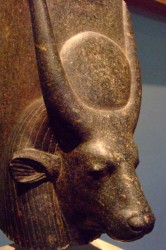
Hathor
Hathor

This may have been a reaction to cow-worship in other religions. The religion of the Hittites to the north included a pair of bulls who carried the weather god Teshub on their backs. To the south, Egyptians worshipped the bull as Apis, the avatar of the gods Ptah and Osiris, and the cow as the goddess Hathor.

Yet throughout the bible, the twelve bronze oxen supporting the yam in front of Solomon’s temple are treated as perfectly acceptable.

Is the huge tub of water in front of Solomon’s temple called the yam simply because it is so large, or does it evoke the Canaanite god named Yam? Are the twelve oxen simply decorative, or do they inspire awareness of bull and cow worship?

Throughout history, people have viewed symbols of the divine in two ways.  Some people consider a symbolic object or building as a way to evoke the ineffable. Its beauty and impressiveness are like an arrow pointing to the divine, and its specific details (such as fruit, water, architecture that reaches toward the sky) allude to ideas about the divine.

Other people see symbolic things in a more concrete way.  A god visits a building or enters a statue. Carrying out rituals in sacred buildings with sacred objects is essential for pleasing the god.

Either way, symbols are important—and often enduring. Even today, Mormons conduct baptisms and sealings in copies of the yam perched on twelve oxen.

One question remains, for King Solomon and for us today:  Which symbols from other cultures and from the history of our own culture or religion can enhance our lives, and which symbols should be discarded?

Anyone want a bronze ox?

Haftarat Ki Tissa—1 Kings: Ecstatic versus Rational Prophets

Every week of the year has its own Torah portion (a reading from the first five books of the Bible) and its own haftarah (an accompanying reading from the books of the prophets). This week the Torah portion is Ki Tissa (Exodus 30:11-34:31), and the haftarah is 1 Kings 18:1-39.

And Elijah said to the people: “I am the only navi left for God, and the neviyim of the Baal are 450 men.” (1 Kings 18:22)

navi (נָבִיא) = prophet. (From the root verb niba (נבּא) = raved; conveyed the word of God.)

neviyim (נְבִיאִִים) = plural of navi.

The Hebrew Bible uses the word navi for two kinds of people: those who go into an altered state in order to experience God, and those who hear God whether they want to or not.

Prophetic ecstasy

The first book of Samuel introduces bands of Israelite prophets who go into an altered state and speak in ecstasy, but do not hear or convey God’s commands. Saul joins one of these bands right after the prophet Samuel has anointed him as the future king of the Israelites.1 After Saul has been king for a few years, Samuel anoints David as king behind Saul’s back. Eventually Saul suspects David will supplant him. David flees to where Samuel lives, and Saul sends men to seize David there.

And they saw a group of the neviyim nibim, and Samuel standing stationed over them. And the spirit of God came over the messengers of Saul, vayitnabu, even they. And they told Saul, and he sent other messengers, vayitnabu, they also. Then Saul sent a third group of messengers, vayitnabu, they also. (1 Samuel 19:20-21)

nibim (נִבְּאִים) = speaking in ecstasy; raving.

vayitnabu (וַיִּתְנַבְּאוּ) = and they spoke in prophetic ecstasy; and they raved as if insane.

Next Saul goes himself in search of David.

And he walked there, to Nayot in Ramah, and the spirit of God came over him, even him, and he continued walking, vayitnabei until he entered Nayot in Ramah. Then he stripped off his clothes, even he, vayitnabei, even he, in front of Samuel, and he fell naked… (1 Samuel 19:23-24)

vayitnabei (וַיִּתְנַבֵּא) = and he spoke in prophetic ecstasy; and he raved.

Rational prophets

Moses by Ivan Kramskoy, 1861
Moses, by Ivan Kramskoy,
1861

In the book of Exodus/Shemot, Moses is the prophet who hears God directly, whenever God wants to speak to him. When God first speaks to him at the burning bush, Moses tries to turn down God’s mission, but later he gets used to passing on God’s words to Pharaoh and the Israelites. God also uses Moses to signal miracles, both by words and by raising his staff or his hand.  He is a full-service prophet, but he never goes into a prophetic ecstasy.

The book of Numbers/Bemidbar gives us an example of a non-Israelite prophet who does not rave in ecstasy, but hears and must obey God’s commands. First Bilam hears God’s words in dreams, but by the end of his story God is channeling poetic prophecies to him directly. (See my post Balak: Three Places to Be Blessed.)

The two kinds of neviyim could be easily distinguished; one kind is overcome by God’s spirit and speaks and acts like a madman, while the other kind quietly listens to God’s words and then speaks and acts like a rational person.

One rational prophet versus 450 ecstatic prophets

In this week’s haftarah Elijah is a navi in the tradition of Moses: he hears God while he is in his normal consciousness, he tells God’s words to other people, and he serves as a conduit for God’s miracles. He also thinks up a plan to achieve God’s goal of eliminating the worship of other gods.

Bronze figure of Baal holding thunder and lightning

 At this time, the northern kingdom of Israel is ruled by King Ahab, who welcomes the worship of the Phoenician gods Baal (a god of weather, especially lightning and rain) and Asherah (a mother goddess). Ahab’s wife Jezebel, daughter of a Phoenician king, supports hundreds of prophets who serve these two gods. She wants to exterminate all the prophets of the God of Israel.

Since Baal is the god in charge of weather, Elijah warns Ahab that it will not rain again until he, the servant of the God of Israel, says so. Then Elijah flees and hides east of the Jordan while Israel suffers three years of drought.

This week’s haftarah begins:

And it was much later, and the word of God happened to Elijah in the third year, saying: Go, appear to Ahab; then I will send rain over the face of the earth. (1 Kings 18:1)

When Elijah confronts King Ahab again, he requests a contest.

Now send, gather all Israel to me at Mount Carmel, and the 450 neviyim of the Baal and the 400 neviyim of the Asherah who eat at the table of Jezebel. (1 Kings 18:19)

Instead of killing Elijah on the spot, the king arranges a contest between God and Baal. (The neviyim of the goddess Asherah drop out of the story at this point.) Ahab probably expects Elijah and the God of Israel to lose. After all, God will have only one prophet, Elijah; Baal will have 450. On Mount Carmel, God’s altar is in ruins; Baal’s altar is in good repair. The winning side will be the one whose god who answers with fire; lightning is one of Baal’s specialties.

The 450 prophets of Baal, on the other hand, are neviyim who induce an altered state of prophetic ecstasy in themselves.

Once everyone has gathered at Mount Carmel, Elijah addresses the people:

How long will you keep hopping back and forth between two crutches? If God is the god, follow Him; but if it is the Baal, follow him!”  And the people did not answer a word. (1 Kings 18:21)

fire

So the contest begins.  Each side gets its altar, a bull to butcher, and a stack of wood. When each sacrifice is prepared, the prophets will call on their gods.  The Israelites agree that the god who answers by setting the wood on fire will be their god henceforth.

Elijah lets the neviyim of Baal go first.

…and they called in the name of the Baal, saying: “Answer us!” But there was no voice and there was no answer. Then they hopped around on the altar that was prepared. And at noon Elijah mocked them, and said: “Call in a louder voice! After all, he is a god. Maybe he is chatting, or maybe he is preoccupied, or maybe he is on the road. Maybe he is sleeping, and he will wake up.

And they called in a louder voice, and they cut themselves with daggers and with lances, as is their custom, and blood poured out over them. And noon passed, vayitnabu, until the time of the afternoon offering, but no one answered and no one paid attention. (1 Kings 18:26-29)

The neviyim of Baal did everything they could to work themselves into a prophetic ecstasy, but their speech sounded like insane raving—especially in light of Elijah’s mockery and the lack of response from Baal.

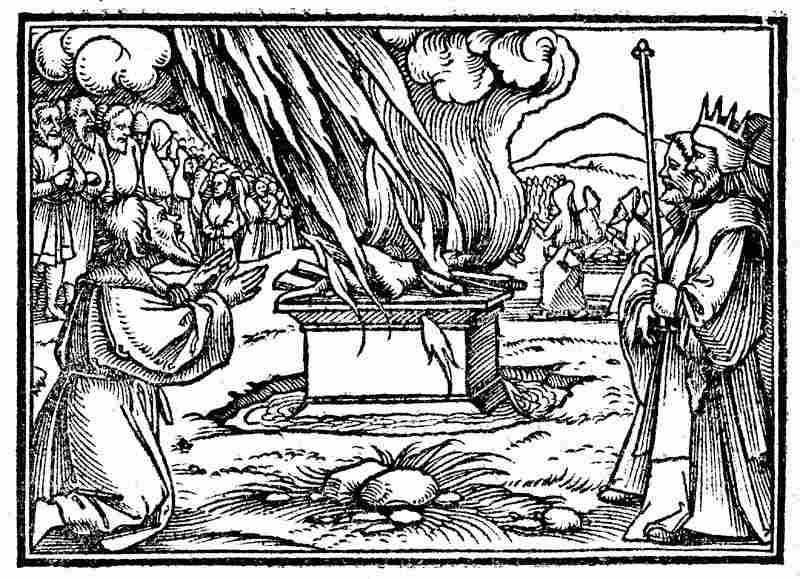
Then Elijah repaired the altar for the God of Israel, laid out his bull offering on the wood, and had twelve jugs of water poured over it, so everyone would see that no ordinary fire could burn there. Then he said:

Elijah and Ahab at Mt. Carmel, Zurich Bible
Elijah and Ahab at Mt. Carmel,
Zurich Bible

God, god of Abraham, Isaac, and Israel, today may it be known that You are elohim in Israel and I am Your servant, and at Your word I did all these things. Answer me, God, answer me, and this people will know that You, God, are the god…” And the fire of God fell, and it ate up the rising-offering and the wood and the stones and the dirt, and it licked up the water in the trench. And all the people saw, and they fell on their faces and said: “God, He is the elohim! God, He is the elohim!” (1 Kings 18:36-39)

Later that day, it finally rains.

And the winner is … not only the God of Israel, but also his rational navi.


Does this mean the bible prefers non-ecstatic prophets?  Not quite. The bands of raving Israelite neviyim are not criticized in either the book of Numbers or the first book of Samuel. There is nothing wrong with entering an altered state in order to experience God’s presence.

But experiencing God’s presence is different from hearing God’s words. A navi like Moses or Elijah hears God whether he wants to or not, and must keep his head in order to act on God’s words, whether he is passing on divine information, signaling a miracle, or, in this week’s haftarah, elaborating on a hint from God (“Go, appear to Ahab; then I will send rain over the face of the earth“) in order to make the right things happen.

May all of us who engage in religion remember that experiencing God in an altered state, or even in an especially good worship service, is not the same as serving God. To truly serve God, we must listen for the divine word or inspiration during our everyday lives, and then think carefully before we act.


  1. 1 Samuel 16:1-13.

Haftarat Tetzaveh—Ezekiel: The Meaning of Humiliation

Every week of the year has its own Torah portion (a reading from the first five books of the Bible) and its own haftarah (an accompanying reading from the books of the prophets). This week the Torah portion is Tetzaveh (Exodus 27:20-30:10), and the haftarah is Ezekiel 43:10-27.

This week’s haftarah begins when God tells the prophet Ezekiel:

You, son of humankind, describe the House to the household of Israel, veyikalmu because of their sins, and they will measure off its plan. And if nikhlemu because of everything that they have done, make known to them the design of the House and its plan …(Ezekiel 43:10-11)

veyikalmu (וְיִכָּלְמוּ) = and they will be humiliated, embarrassed, publicly disgraced. (From the root k-l-m, כּלם, sometimes translated as “ashamed” but actually referring to public humiliation regardless of actual guilt or innocence.)

nikhlemu (נִכְלְמוּ) = they are humiliated, etc. (Also from the root k-l-m.)

“The House” refers to a building for the God of Israel: Ezekiel’s vision of a new temple to replace the one that King Solomon erected and King Nebuchadnezzar of Babylon razed when he destroyed Jerusalem in 587 B.C.E.

Temple sizes
Temple sizes

The two clauses about being humiliated are difficult to interpret, since in the first one God predicts the Israelites will be humiliated, and in the second one God says “if they are humiliated”. According to the standards of the sixth century B.C.E., there is no question that the Israelites of Judah have been publicly humiliated by the time of this prophecy, dated to the fourteenth year after the fall of Jerusalem.

The kingdom of Judah had been a vassal state of the Neo-Babylonian Empire, paying annual tribute to King Nebuchadnezzar but managing its internal affairs as an independent country. Then King Yehoyachim of Judah rebelled, and the Babylonian army besieged his capital, Jerusalem. His son Yehoyachin (a.k.a. Jeconiah) surrendered in 597 B.C.E. and saved the city. Nebuchadnezzar deported him and about 3,000 of Jerusalem’s leading citizens—including Ezekiel—to Babylon. Nebuchadnezzar installed Yehoyachin’s uncle Zedekiah as Judah’s king, and Judah resumed its status as a Babylonian vassal state.

The Flight of the Prisoners, by James J.J. Tissot, 1886 (capture of Jerusalem in 587)

The Israelites remaining in Judah still had their own king, and a temple for their own god. But eight years later Zedekiah rebelled (after making a secret treaty with Egypt), and the Babylonian army surrounded Jerusalem again. This time the siege ended in the capture of Jerusalem, the execution of Judah’s last king, and the destruction of the capital and its temple—in other words, the complete humiliation of Judah.

What caused this humiliation? One might blame Nebuchadnezzar for his determination to expand his empire, or King Zedekiah for foolishly rebelling, or even Egypt for marching toward Judah at Zedekiah’s instigation, then succumbing to the Babylonian army before they reached Jerusalem.

But in the passage above, God says twice that the humiliation of the Israelites happened because of their own sins—and God is not referring to their kings’ rebellions against Babylon.

This week’s haftarah comes in the middle of Ezekiel’s fifth and final vision. This vision begins when a divine guide wafts Ezekiel to Jerusalem and shows him around a new and larger temple, measuring everything as he goes. Then the glory of God appears, and God tells Ezekiel:

Son of humankind, [this is] the place of My throne and the place of the soles of My feet, where I will dwell in the midst of the children of Israel forever. But the house of Israel must not again defile My holy name, neither they nor their kings, by their prostitution [with other gods] and with their kings’ lifeless idols in their shrines. (Ezekiel 43:7)

The sin of the Israelites is building shrines for idols and other gods—and in the worst possible place.

When they placed their thresholds next to My threshold and their doorposts beside My doorposts, [with only] the wall between Me and them, and they defiled My holy name with their taboo actions, then I consumed them in My anger. (Ezekiel 43:8)

God decided to destroy Jerusalem and its temple because of the people’s apostasy, and used the Babylonian army to do it.

Jeremiah, who was still prophesying in Jerusalem when Ezekiel prophesied in Babylon, also said that God arranged the destruction of Jerusalem, using Nebuchadnezzar as a tool. According to both prophets, God decides which army wins in every battle involving Israelites. (See my post Jeremiah: The Ruler of All Armies.) Nebuchadnezzar, naturally, did not know that the God of Israel was using him to punish the Israelites.

Today this prophetic point of view seems parochial and narrow-minded. Even if God did micro-manage every battle and siege, why should all of God’s plans be about rewarding or punishing the Israelites? What about all the other peoples in the world?

Nabu, from temple at Kalah

Other peoples had their own, albeit inferior, gods. For example, the chief gods of the Neo-Babylonian Empire were Nabu and Marduk. The Bible maintains that the God of Israel was more powerful than all other gods, and that God chose the Israelites to be “His” people and commanded them not to worship any other gods. The Torah often compares this exclusive relationship between the God of Israel and the Israelites to a marriage in which the Israelites let down God by failing to be monogamous.

Monotheism, the idea that there is only one god in the universe, only creeps into the Bible in a few of the many books written during the Babylonian exile in the sixth century B.C.E. The book of Ezekiel, however, sticks to the older point of view that the God of Israel is the most powerful god, not the only god.  Therefore the book of Ezekiel is Judeo-centric; God interferes in the world primarily to reward or (more often) punish the Israelites.

And if nikhlemu because of everything that they have done, make known to them the design of the House and its plan——its exits and its entrances, and its entire plan, and all its decrees and all its plans and all its teachings; And write it down before their eyes so they will observe its entire plan and all its decrees, and do them. (Ezekiel 43:11)

*

For those of us who have a more monotheistic or universal idea of God, I propose a radical rereading of Ezekiel 43:11:

And if nikhlamta because of everything that you have done, discover for yourself the design of the House and its plan—

If you feel your life is unsatisfactory, even humiliating, and suspect it is because you have done something wrong, then think of your life as a temple for God’s presence.

—its exits and its entrances, and its entire plan,

Where in your life do you exit from the presence of God? Where do you enter it? What is your overall plan for living with God?

and all its decrees and all its plans and all its teachings;

What principles do you follow as if they are divine decrees? What teachings help you to approach God?

And write it down before your own eyes so you will observe its entire plan and all its decrees, and do them. (Ezekiel 43:11)

And undertake a practice, such as prayer or study, that will keep reminding you of your plan for living in God’s presence and the principles you are following. Then make it your life.

Haftarat Terumah—1 Kings: Solomon versus Shalom

Every week of the year has its own Torah portion (a reading from the first five books of the Bible) and its own haftarah (an accompanying reading from the books of the prophets). This week the Torah portion is Terumah (Exodus 25:1-27:19), and the haftarah is 1 Kings 5:26-6:13.

To rule as a king, one needs administrators, a standing army, and a capital city. And in the Ancient Near East, the capital had to have a temple for the chief god of the kingdom.

When David conquers Jerusalem (in the first book of Samuel) to be the capital of his new kingdom, he brings in the two objects that are the most sacred to the Israelites: the Tent of Meeting and the Ark of the Covenant. But he leaves building the temple to his son and heir, Solomon.

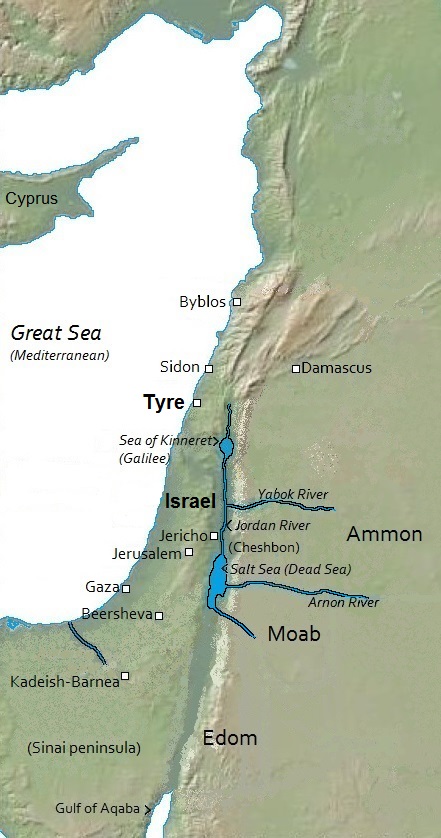
map 950 BCE

King Solomon has stone quarries and can command his citizens to do forced labor. But Israel has neither tall timber nor craftsmen skilled with wood. So he makes a pact with Chiram, king of the Phoenician city-state of Tyre.

And it happened: Chiram gave to Shlomoh cedar and cypress wood, all he wanted. And Shlomoh gave to Chiram 20,000 kor of wheat for his household and 20 kor of beaten oil. This Shlomoh gave to Chiram year after year. And God had given wisdom to Shlomoh, as [God] had spoken to him. [There was] shalom between Chiram and Shlomoh, and the two of them cut a covenant. (1 Kings 5:24-26)

Shlomoh (שְׁלֹֹמֹה) = Solomon in English, Suleyman in Arabic. (From the root verb shilam (שִׁלָם) = complete; make amends, repay, fulfill; restore to wholeness.)

Shalom (שָׁלֹם) = peace, wholeness, intactness, well-being. (Also from the root shilam.)

In the tenth century B.C.E., the time of Shlomoh and Chiram, there were two kinds of treaties between kingdoms in the Near East. In one model, the weaker kingdom was a vassal of the stronger one, and paid tribute to it (see my post Jeremiah: The Ruler of All Armies). In the other, two equal kingdoms made a treaty or covenant for trade and mutual defense.

The treaty between King Shlomoh of Israel and King Chiram of Tyre specified that Tyre would provide wood for all of Shlomoh’s building projects in Jerusalem, and Israel would provide annual large shipments of wheat and olive oil to Tyre. Although the Bible does not mention a clause about mutual defense, it does state that there was shalom between the two kings, which implies that they had at least agreed to mutual non-aggression.

And the king, Shlomoh, imposed a mas upon all of Israel, and the mas was 30,000 men. And he sent 10,000 a month to Lebanon; following a month in Lebanon they were two months at home, in turns … And Shlomoh had 70,000 burden-carriers and 80,000 quarriers in the hills … The king commanded, and they pulled out great stones, valuable stones, to lay the foundation-wall of the House: hewn stones. (1 Kings 5:27-31)

mas (מַס) = conscription for forced labor.

The first mas described in the Bible is the forced labor of the Israelites in Egypt. Although it was an accepted practice for a king to impose a temporary mas on his own citizens, in this case Shlomoh made 180,000 Israelites neglect their own land to do heavy labor for a full year. Then after two years at home, they had to go back to cut and haul materials for the temple, for King Shlomoh’s palace, and for several other large new buildings in Jerusalem.

Limestone quarry under Jerusalem: four stones partly cut out

The text also emphasizes that the stones for the foundation wall of the temple are hewn: huge blocks of stone cut out and smoothed.

And when the House was built, it was built of shleimah stone, quarry stone; but hammers or the axe, any tool of iron, was not heard in the House when it was built. (1 Kings 6:7)

shleimah (שְׁלֵמָה) = complete, whole, uninjured, undivided, peaceable. (Plural: shleimot.)

The king wants to avoid the sound of an iron tool on the site of the new temple because of an old law about altars:

If you make an altar of stones for Me, you must not build it of hewn stones; if you have wielded your sword upon it, you have profaned it. (Exodus 20:22)

And you shall build there an altar for God, your god, an altar of stones; you must not wield iron upon them. You must build the altar for God, your god, of shleimot stones. (Deuteronomy 27:5-6)

King Shlomoh’s laborers are building the foundation-wall of the temple, not an altar. However, the temple will enclose a space even more sacred than the altar. So the king orders the stones to be cut at the quarry, and merely set in place at the temple site. Shlomoh’s attempt to follow the law may actually subvert it, since the stones are hewn.

Similarly, Shlomoh’s treaty with Chiram of Tyre has two purposes: to promote shalom, peace, between the two kingdoms, and also to build a temple that will unite the Israelites under a single god at a single holy place so they will be shaleim, intact, one people.

Instead the annual wheat and oil shipments to Tyre become a burden on the farming population.  And the mas imposed on so many Israelite men results in complaints and rebellion. Shortly after King Shlomoh’s death, northern Israel secedes from southern Judah. (See my post Terumah & 1 Kings: Tent versus Temple.)

Are the stones of the temple wall really shleimot, whole and undivided, when they are cut out of the quarry with hammers and shaped with axes?

Does Shlomoh’s kingdom really live in shalom, peace and wholeness, when building a temple in Jerusalem leads to oppression, revolt, and secession?

Haftarat Mishpatim—Jeremiah: False Freedom

Every week of the year has its own Torah portion (a reading from the first five books of the Bible) and its own haftarah (an accompanying reading from the books of the prophets). This week the Torah portion is Mishpatim (Exodus 21:1-24:18), and the haftarah is Jeremiah 34:8-22.

Town by town, city by city, the armies of King Nebuchadnezzar took over the land of Judah. The country could have remained a semi-independent vassal of Babylon, keeping its own temple and running its own internal affairs. But the last three kings of the Israelites had rebelled against their overlord. And each time Nebuchadnezzar’s retaliation had been more severe.

King Nebuchadnezzar
King Nebuchadnezzar

The prophet Jeremiah kept warning the kings of Judah to keep paying tribute to Babylon, but they never listened to him. Instead they flirted with Egypt. Only Jeremiah realized what was obvious to the Babylonians: that when Pharaoh Nekho lost the big battle with Nebuchadnezzar at Carchemish in 605 B.C.E., and lost all his vassal states to the new Babylonian Empire, Egypt was finished as a world power.

When King Yehoyakhim of Judah stopped paying tribute to Babylon in 597 B.C.E., Nebuchadnezzar besieged Jerusalem until it surrendered. When King Zedekiah stopped paying tribute eight years later, after secret negotiations with Egypt, the Babylonian army surrounded Jerusalem again.

This time Nebuchadnezzar also conquered the rest of Judah, town by town and city by city.

Trapped in Jerusalem, unable the send their slaves out to the fields to plant and harvest, the leaders of Judah were getting desperate. Soon their city would fall, and they would all be killed or, at best, deported to Babylon. Only a miracle could save them.

The god of Israel had made miracles for the Israelites before. The priests were still serving God in the temple. What more was needed? How could they win God’s favor again?

In this week’s hafatarah, it occurs to King Zedekiah that the people of Judah have been ignoring one of God’s commands:

If your brother or sister Hebrew sells himself to you, then he shall serve six years, and in the seventh year you shall let him go chafshi from you. And when you let him go chafshi from you, you shall not let him go empty-handed… (Deuteronomy/Devarim 15:12-13)

chafshi (חָפְשִׁי) = emancipated, freed. (Plural: chafshim.)

In ancient kingdoms of Israel and Judah, men who could not pay their taxes or other debts sold themselves or their children as temporary slaves. After six years of service, their owners were required to set them free, and give the men a food supply and the means to make a living.

But the slave-owners of Judah had let the years pass without emancipation.

… the king, Zedekiah, cut a covenant with all the people who were in Jerusalem, to proclaim for them a dror: for each man to let go of his male slave and his female slave, the Hebrew male and the Hebrew female, chafshim, so that no one would be enslaved by his fellow Yehudi. And they heeded [the proclamation], all the officers and all the people who had entered in the covenant … they heeded and they let them go. (Jeremiah 34:8-10)

dror (דְּרוֹר) = emancipation of slaves every seventh year and every  fiftieth year.

Yehudi (יְהוּדִי) = citizen of Judah; Jew. (From Yehudah (יְהוּדָה) = the kingdom of Judah, the tribe of Judah, or the individual Judah in the book of Genesis.)

The slave-owners in Jerusalem had more than one reason to free their slaves. Besides wooing God’s favor, the general emancipation also meant that the owners no longer had to feed their slaves. And since no one could work in the fields anyway, the government could recruit the emancipated men as soldiers to help defend the city.

The siege lifted briefly when an Egyptian army marched north, perhaps intending to honor its new alliance with the king of Judah.  Most of the Babylonian army departed to take care of the Egyptian annoyance, and for a few months life in Jerusalem could return to normal.

Unfortunately, it did.

And later they turned back, and they took back the male slaves and the female slaves whom they had let go chafshim, and they subjected them to slavery [again]. Then the word of God happened to Jeremiah… (Jeremiah 34:11-12)

Jeremiah the Prophet and King Zedekiah, 1897 illustration
Jeremiah the Prophet and King Zedekiah,
1897 illustration

Through his prophet, God reminds the people in Jerusalem that Hebrews enslaved because of debt must be freed in the seventh year. God continues:

“One day you yourselves turned around and became upright in My eyes, proclaiming a dror for each man from his fellow, and you cut a covenant before Me in the house that is called by My name. But now you have profaned My name; each of you has brought back his male slave and his female slave that he had let go chafshim to follow their desire, and subordinated them to be male slaves and female slaves for you [again].

“Therefore, thus says God: [Since] you did not listen to Me proclaiming a dror, each one for his brother and each one for his fellow, here I am, proclaiming to you a dror—declares God—to the sword, to disease, and to starvation! (Jeremiah 34:15-17)

Jeremiah’s prophecy points out the hypocrisy of the ruling class. They free their slaves only when feeding them is a burden—and when they hope to wangle an extra favor out of God. But the newly-emancipated slaves have no means to feed themselves. What kind of liberty is that?

Then as soon as it looks as though the ex-slaves can once more engage in agriculture, their former owners re-enslave them, making them responsible for feeding everyone.

So God threatens to emancipate the Yehudi the same way they emancipated their slaves—by abandoning them to death. After all, no human beings can live exclusively by their own power, without the world God provides.

Nebuchadnezzar takes Jerusalem James_Tissot_Flight_of_The_PrisonersIn fact, the Babylonians returned before the slaves of Jerusalem could bring in a harvest. In 586 B.C.E. the wall around the city was breached. Nebuchadnezzar blinded King Zedekiah, killed his sons, razed the capital, and burned down the temple. Judah became merely a district of Babylonia. The remaining ruling families were deported, and Jeremiah lingered in the ruins of Jerusalem.

(See my post Haftarah for Bo—Jeremiah: The Ruler of All Armies.)

In some parts of the world today, impoverished people are still kidnapped to become slaves (often for sex or war). Those of us who read blogs on the Internet, distant from the villages of Syria or Nigeria, might congratulate ourselves on never owning a slave or oppressing a debtor. But is that true?

Do we vote for political candidates who claim that everyone can succeed by their own efforts, even those who are not given the tools?  Do we find it acceptable that one accident, disease, or misinformed purchase can doom a person to poverty for life, with no second chance—not even after six years of suffering?

Do we treat our own children as slaves? Do we send them off, after the right number of years, with all the tools they need to make it on their own? Do we try to recapture and control them later?

Do we take advantage of someone over and over again, neglecting them when we do not need them?