Balak: Prophet and Donkey

Bilam appears to be a sorcerer who can bless and curse people, but he is actually a prophet who transmits God’s blessings and curses. Bilam’s donkey1 appears to be an ordinary domestic animal, but she actually knows more than Bilam.

At the beginning of this week’s Torah portion, Balak, King Balak of Moab is alarmed by the large Israelite camp on his border. He sends messengers to Bilam, whom he thinks is a professional sorcerer, with this request:

“Now come, please, curse for me this people, because they are too mighty for me. Then perhaps I will be able to strike them and drive them out from the land; for I know whoever you bless is blessed, and whoever you curse is cursed.” (Numbers/Bemidbar 22:6)

God has used Bilam as a prophet so often that Bilam believes he can count on God to speak to him during the night (presumably in a dream). So he tells Balak’s messengers:

“Remain here overnight, and I will bring back to you whatever God speaks to me.”  (Numbers 22:8)

That night, God tells Bilam:

“You shall not go with them.  You shall not curse the people, because it is blessed.” And Bilam got up in the morning and said to the officials of Balak: “Go back to your own country, because God refused to permit me to go with you.” (Numbers 22:12-13)

Bilam fails to mention that God has already blessed the Israelites. When the messengers report to their king, they fail to mention God at all; they simply say:

“Bilam refused to go with us.” (Numbers 22:14)

King Balak assumes Bilam refused only because he did not expect to get paid enough, so he sends a larger and higher-ranking group of officials. His second message promises Bilam:

I will honor you very impressively, and anything that you say to me I will do; just come, please, curse for me this people. (Numbers 22:17)

This time Bilam suggests the payment he would like: the king’s house full of silver and gold. In other words, he wants as much wealth and/or as much honor as a king. But he is at least honest enough to add that he cannot do anything that contradicts God’s command. Then he asks the messengers to stay overnight while he checks with God.

And God came to Bilam at night, and said to him: “If the men came to invite you, get up, go with them. But only the word that I speak to you, shall you do.” And Bilam got up in the morning and saddled his she-donkey and went with the officials of Moab. (Numbers 22:20-21)

Bilam’s silence in the morning is dishonest, since it gives Balak’s messengers the impression that the cursing will take place as requested.

And God vayichar af because he [Bilam] was going, and a messenger of God manifested itself on the road as an accuser for him. (Numbers 22:22)

vayichar (וַיִּחַר) = and he/it became glowing hot.

af (אַף) = nose, nostril.

vayichar af (וַיִּחַר אַף) = and his nose burned: an idiom meaning “and he became angry”.

God gives Bilam permission to go to Moab, but God is angry when he goes. Perhaps God disapproves of Bilam’s lying by omission, or of his greed for a payment he is unlikely to receive.2

Three times a messenger of God (i.e. an angel), manifests on the road to Moab. Who sees the divine apparition? Not Bilam, the prophet and would-be sorcerer; but his donkey. Bilam has only heard God’s voice at night, but his donkey sees God’s angel in broad daylight.
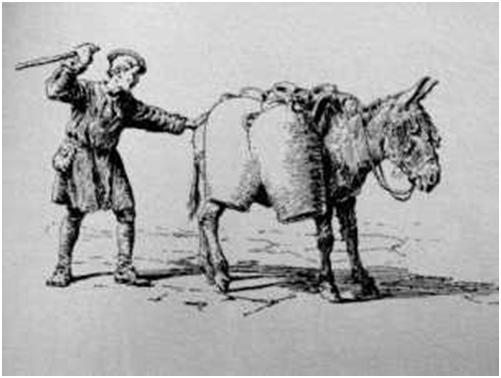
Each time Bilam’s donkey sees an angel with a drawn sword in the middle of the road, she refuses to go forward. The first time she runs off into a field, the second time the road lies between walls and she presses Bilam’s foot against the stones, and the third time the way is so narrow she lies down in the middle of the road. Each time Bilam beats his donkey, unable to see the reason for her behavior. The third time, the Torah describes the beating:

…and she lay down underneath Bilam, and Bilam vayichar af and he beat the she-donkey with the stick. (Numbers 22:27)

Then God opened the mouth of the she-donkey, and she said to Bilam: “What have I done to you that you beat me these three times?” And Bilam said to his she-donkey: “Because you made a fool of me!  If only there were a sword in my hand, I would kill you now!” (Numbers 20:28-29)

Bilam has been beating his donkey out of pride. With his servants and possibly King Balak’s officials watching him, he wants to look as if he is in control of his animal. In fact, his donkey is in control of where Bilam goes, and the donkey sees God’s messenger—with a sword in its hand, ready to kill Bilam!

by Rembrandt, 1626

And the she-donkey said to Bilam: “Am I not your she-donkey, upon whom you have ridden all your life until this day?  Have I really been in the habit of doing thus to you?” And he said: “No.” (Numbers 22:30)

The donkey says “all your life”, not “all my life”, even though the average life-span of a working donkey is 15 years in developing countries (a category that applies to all countries in biblical times). While Bilam’s age is not given in the story, he is a man who has developed a reputation, so he is too old to have been riding the same donkey his whole life.  The donkey’s words are a clue that the donkey is not just a talking animal; she also represents a part of Bilam.

Though he enjoys hearing God speak in the dark, Bilam is only a human being, and he cannot do anything without his animal: his body. Perhaps it is no coincidence that Bilam rides a she-donkey; in Biblical Hebrew, the word nefesh, which means both an individual body and the soul that animates the body, is feminine.

When Bilam answers his donkey with the word “No”, he both recognizes the truth and humbles himself before the animal he rides.

Then God uncovered the eyes of Bilam, and he saw the messenger of God standing in the road, and its drawn sword was in its hand.  Then he knelt down, and he bowed down le-apav.  (Numbers 22:31)

le-apav (לְאַפָּיו) = to his nostrils, to his nose. (A form of af.)

Bowing down to his nose is an idiom for making a full prostration, indicating his humility and submission before God’s messenger. But it also implies Bilam is surrendering his own “hot nose”, his own anger.

Then God speaks through the divine messenger and explains that the donkey saved Bilam’s life three times. If the donkey had not shied away from the angel, God would have killed Bilam—but spared the donkey.

After that humbling experience, Bilam becomes a better prophet. He is more direct and honest; as soon as he meets King Balak, he warns his employer that he can speak only the word God puts into his mouth. And now God speaks to Bilam in the daylight, and even gives him prophetic visions.

Of course all three times Bilam attempts to curse the Israelites, God makes praise and blessings come out of his mouth. And his employer, King Balak, is enraged.

Balak, vayichar af at Bilam …and Balak said to Bilam: “To curse my enemies I called you, and hey! You kept on blessing them, these three times!  So now run away to your own place! I said I would honor you impressively, but hey! God held you back from honor.”

King Balak dismisses Bilam rudely and without payment. But Bilam no longer seeks honor from other people. Now he knows that seeking wealth or fame blinds him to God’s message, and he is a prophet.  He responds to Balak only by pronouncing another prophecy—one that includes Israel defeating Moab. Then, unrewarded by either wealth or status,

Bilam got up and went and returned to his own place. (Numbers 24:25)


Personally, I resent being humbled by my donkey.  All too often I set off on what looks to me like a rewarding path, assuming I can do what I want—only to find that my body refuses to carry me. My chronic pain increases and my energy flags. If I try to whip my body into doing my will by drinking too much coffee, for example, my body starts lying down underneath me.

These days I find myself getting a “hot nose” less and less often, thank God. I am trying to pay attention to my own donkey. I am slowly giving up my desire for recognition and honor, knowing that I am still blessed with the ability to do my calling, as long as I listen to both my God and my donkey.

Who knows, if I learn enough humility, maybe someday my eyes will be uncovered and I’ll see a messenger of God in the road! But I’m not planning on it.  It’s enough to learn how to get along with this faithful donkey whom I’ve been riding all my life.


1  “Donkey” and “ass” are two words for the same species of equine animal. In Hebrew, a she-donkey, or jenny, is an aton (אָתוֹן).

2  According to Ramban (3th-century Rabbi Moses ben Nachman or Nachmanides), God was angry at Bilam for leaving without telling Balak’s messengers everything God had said, and for hoping that he might be able to curse Israel after all.

(An earlier version of this essay was published in June 2010.)

Haftarat Pesach—Ezekiel: Dry Bones

During the week of Passover/Pesach, we pause in the annual cycle of Torah readings to commemorate the story of the liberation from slavery in Egypt. The first evening of Passover (or the first and second evenings, in some traditions) is devoted to the seder, a 14-step ritual with a meal and a story that goes from the beginning of Exodus through the crossing of the Reed Sea. One of the many songs in the ritual can be translated as “We were slaves; now we are free!”

After the excitement of the seder or seders, Jews are supposed to spend the rest of the week of Passover eating matzah and eschewing all other grain products. On the Shabbat that falls during this week we get two special readings. The Torah reading comes from later in the book of Exodus, when God proclaims Its “thirteen attributes” to Moses on top of Mount Sinai.1 The haftarah reading is a vision from the book of Ezekiel.

The hand of God came over me, and it brought me out by the ruach of God and set me in the middle of the broad valley [which] was full of bones. And it swept me over them, around and around, and hey!—there were very many on the surface of the broad valley, and hey!—they were very dry.  And [God] said to me: “Son of humankind, will these bones become alive?   And I said: “My lord God, [only] You know.”  (Ezekiel 37:1-3)

ruach (רוּחַ) = wind, spirit, breath. (Plural ruchot, רוּחוֹת.)

Ezekiel uses the phrase “the hand of God came over me” to mean that God overpowered him and compelled him to enter his vision.2 After asking Ezekiel if the dry human bones can come to life, God tells his prophet what to say to the bones.

Valley of the Dry Bones
by Gustave Dore, 1866

And I prophesied as I had been commanded. And a sound happened, as I was prophesying, and hey!—a clatter!—and the bones drew close [to each other], a bone to its bone. Then I looked, and hey!—they had sinews and flesh on them, and skin spread over them. But there was no ruach in them.  (Ezekiel 37:7-8)

Next God instructs Ezekiel to bring breath—or spirit—into the bodies by saying:

Thus said my lord God: Ruach, come from the four ruchot, and blow into these slain, and they will become alive. And I prophesied as [God] commanded me. And the ruach came into them, and they became alive, and they stood up on their feet—a very, very great force.  (Ezekiel 37:9-10)

What does this vision mean? Some early commentators viewed it as a literal statement that some dead Israelites were, or would be, resurrected.3 But in the book of Ezekiel, God explains the vision as a metaphor or parable.

And [God] said to me: “Son of humankind, these bones are the whole house of Israel.  Hey! They are saying: ‘Our bones are dried up, and our hope has perished, and we are cut off’. Therefore prophesy, and you shall say to them: ‘Thus says my lord God: Hey! I, Myself, am opening your graves, and I will lift you out of your graves, My people, and I will bring you back to the soil of Israel. … And I will put My ruach inside you, and you will become alive [again], and I will put you back on your soil.  (Ezekiel 37:12, 14)

The book of Ezekiel was written in the 6th century B.C.E. during the Babylonian Exile. When the Babylonians conquered Judah, the southern kingdom of the Israelites, they deported its leading families to Babylon, including Ezekiel’s family of priests.  Ezekiel prophesied to his fellow exiles, who were inclined to despair of either returning to their old land, or building new lives among the Babylonians, who treated them as paroled prisoners.

After showing Ezekiel the vision of the dry bones coming to life, God tells Ezekiel to give new hope to “the whole house of Israel”: both the Israelites from the kingdom of Judah who have given up on their lives in Babylon, and the Israelites whom the Assyrians had deported from the northern kingdom of Israel about 150 years earlier.

It is never too late to come to life again.

*

At the beginning of Passover, we tell the story of God’s ten miracles and how God, with the prophet Moses, leads a few thousand subjugated people out of Egypt to a new land that will become their own.4 On the Shabbat during Passover, we read about God’s demonstration to Ezekiel that miracles are still possible, and God can liberate the subjugated people in Babylon and give them a new life ruling their old homeland.

May everyone today who slides toward despair receive the ruach to hold onto hope instead. May we all create new lives for ourselves, and build good countries wherever we may be.  It is not too late.

1  Exodus/Shemot 33:12-34:2.

2  Rashi (1th-century rabbi Shlomo Yitzchaki), commentary on Ezekiel 37:1. In Hebrew, the phrase is hayetah (הָיְתָה) = it happened; alai (עָלַי) = over me; yad (יַד) = hand, power; of God. See also Ezekiel 1:3, 3:22, and 8:1.

3  In the Babylonian Talmud, Sanhedrin 92b, the rabbis argue about whether Ezekiel’s vision is a parable, or whether he actually resurrected some long-dead skeletons. Rabbi Yehudah bar Batyra claims to be a descendent of one of the resurrected men!

4  Unfortunately, the “promised land” in the Torah is already occupied by Canaanites. In the book of Joshua the ex-slaves from Egypt have to fight and defeat the indigenous peoples in order to take over their land. History often clashes with morality. It is a challenge today to provide liberty and justice for all the people residing in a country.

Haftarat Pinchas—1 Kings: The Sound of God

When people in the Hebrew Bible see a manifestation of God, they nearly always see either fire (from the flames in the burning bush to the sparks of fire in the pillar or cloud), or something human (from Abraham’s guest to the feet on the sapphire pavement).

When they hear a manifestation of God, they usually hear words. I have found only two exceptions in the Hebrew Bible. One is in the book of Exodus, when God descends upon Mount Sinai, and all the Israelites hear (and see, perhaps through synesthesia) thunder and the sound of a shofar (a loud wind instrument made from an animal’s horn). The cracks of thunder and the increasing volume of the shofar blasts would make the sound of God unbearably loud.

Ram's Horn Shofar
Ram’s Horn Shofar

The other exception is in this week’s haftarah, when the prophet Elijah hears God as what the King James translation calls “a still, small voice”.

A haftarah is the reading from the prophets that accompanies the week’s Torah portion. This week’s haftarah, from the first book of Kings, opens with the prophet Elijah running before the chariot of King Ahab.

In the scene just before, Elijah had staged a dramatic contest on Mount Carmel, where there were altars to both Baal and the God of Israel. King Ahab (who was away from his wife Jezebel at the time) summoned all the people to the mountaintop as witnesses. Elijah invited 450 prophets of Baal and 400 prophets of Asherah to call on their gods, while he alone would call on the God of Israel. (The prophets of Asherah did not show up, but the contest proceeded anyway.) A bull was killed and laid over wood at each altar, but nobody was allowed to bring fire to burn the offerings. Elijah said:

You will call your gods by name, and I, I will call God by name. And it will be the god that answers with fire, that one is the god.” And all the people answered, and they said: “It is good!” (1 Kings 18:14)

Elijah increased the drama by giving the prophets of Baal all day to work themselves into an ecstatic frenzy, and by pouring water all over the God of Israel’s altar. No fire ever appeared on Baal’s altar. In the evening, when water was dripping into the trench around God’s altar, Elijah called on God by name.

And the fire of God fell, and it consumed the rising-offering and the wood and the stones and the dirt, and it licked up the water that was in the trench. And all the people saw, and they fell on their faces, and they said: “That god is the god! That god is the god!” (1 Kings 18:38-39)

The Israelites helped Elijah kill all 450 prophets of Baal. A three-year drought ended. And Elijah ran as an honor guard before King Ahab’s chariot as they returned to the king’s nearest palace, in the fortress of Jezreel.

Haftarat Pinchas begins with this triumphal run. Then Ahab’s wife Jezebel, the real ruler of the kingdom, nixes the mass conversion and threatens to kill Elijah.

The prophet flees, lies down in the wilderness to die, then gets up again at the request of an angel and walks all the way to Mount Chorev (another name for Mount Sinai). There God speaks to him—first in words, as usual.

Then the word of God came to him, and it said to him: “Why are you here, Elijah?” And he said: “I was very zealous for God, the God of Armies, because the Children of Israel had abandoned your covenant, and pulled down your altars, and killed your prophets by the sword. And only I was left, and they tried to take my life.” (1 Kings 19:9-10)

Elijah is in despair because Queen Jezebel won. He forgets that the Israelites fell on their faces, shouted that the God of Israel is the only god, and killed Baal’s prophets. He either does not believe, or does not care, that the people’s feelings about God have changed. All that matters to him is that he lost the contest with Queen Jezebel for political power. Her gods, and the rest of her prophets, will remain in the kingdom of Israel whether the people support them or not.

God tells Elijah to stand up, and then gives him a wordless demonstration.

And hey! God was passing by, and a big and strong wind was tearing off mountains of rocks in front of God; but God was not in the wind. And after the wind, an earthquake; but God was not in the earthquake. And after the earthquake, fire; but God was not in the fire. And after the fire, kol demamah dakkah. And when Elijah heard, he wrapped his face with his robe, and he went out and stood at the entrance of the cave; and hey!—a  voice [came] to him, and it said: “Why are you here, Elijah?” (1 Kings 19:11-13)

kol (קוֹל) = voice; sound.

demamah (דְּמָמָה) = quiet (without much movement or sound); stillness; silence.

dakkah (דַקָּה) = very thin; finely ground, powdery.

kol demamah dakkah = “a still, small voice” (King James translation); “a soft murmuring sound” (Jewish Publication Society translation); a “sound of thin silence” (Avivah Gottlieb Zornberg translation); a faint sound of quietness (my translation).

Elijah hears the sound of quietness, steps out to the mouth of the cave, and covers his face. That means he knows God is in the quietness, since God told Moses no one may see God from the front.

Then God asks him the same question: Why are you here, Elijah? And Elijah gives the same reply, word for word—as if he had learned nothing. So God tells him he must anoint a young man named Elisha to be a prophet in his place.

I agree with the many commentators who concluded that Elijah is too impatient in his zeal; he wants the spectacle of fire (or, presumably, windstorm or earthquake) to turn Israel back to God all at once. He is not interested in a quiet, gradual approach. And that is why God decides to retire Elijah and try a new prophet.

But I also wonder about the three ways of hearing God: as ear-splitting blasts and booms, as spoken words, and as a faint sound of quietness.

We are only human. When we want to plan, or communicate, or understand something complicated, we turn to language. Even musicians and visual artists who are working alone must think in words when they address other aspects of their lives. Our brains automatically translate much of our experience into words and language.

Maybe one difference between a prophet and an ordinary person is that a prophet can easily translate experiences of God into words. So for them, God manifests as spoken words.

For the rest of us, our occasional numinous experiences are hard to understand, hard to put into words. A shaft of sunlight or a haunting bird call might trigger an awareness of something greater—but we struggle just to describe it. Our brains do not translate these evanescent and ineffable experiences into direct speech from God.

In the book of Exodus, God manifests to all the non-prophets at Mount Sinai as unbearably loud noise. The people are terrified, and beg for God to speak only to Moses; their prophet can then translate what God says into words spoken at a reasonable decibel level.

But in the book of Elijah, when the prophet hears God ask him a question in words—Why are you here, Elijah?—he answers defensively, stuck in a repetitive loop of his own words, his own story about himself. Any further insight from God cannot get through. So God resorts to non-verbal communication.

Elijah hears the windstorm, the earthquake, and the fire. Then he hears God in the “still, small voice,” the faint sound of quietness. But he does not understand.

Does God manifest to us, sometimes, as quietness?

Can we understand?