Beshalach: Hands Up

What does it mean to raise one or both hands when they are empty?

Today, the gesture for “Stop!” is holding one arm straight out from the shoulder, with the hand bent back, palm forward.

If you raise one arm straight up into the air, you are “raising your hand” for permission to speak.

When an authority figure says “Hands up!” you raise both arms, palms forward, to show you are not holding a weapon.

What if you raise both arms at an angle somewhere between straight up and straight out? Whether your hands are turned up or down, it looks as though you are making a religious gesture.

In many Jewish Renewal congregations, when we stretch out both hands with our palms down, we want to transmit a blessing to someone.  (This gesture is derived from the Torah’s description of leaning one’s hands on the head of a man or boy in order to transfer holiness, as Jacob does to bless his grandsons in Genesis 48, and as Moses does to commission Joshua as his successor in Numbers 27.)

When we stretch out both hands with our palms up, it means we are prepared to receive a blessing. This is also one traditional posture of supplication to God; we reach forward and up toward “heaven” with empty hands, hoping God will fill them.

In this week’s Torah portion, Beshallach (“When he sent out”), God tells Moses to split the Reed Sea by holding the staff that summoned the ten plagues in Egypt, and stretching out his hand over the water. After the Israelites have crossed the Reed Sea and seen the Egyptian army drown,

…the people were in awe of God, vaya-amiynu in God and in Moses, his servant. (Exodus 14:31)

vaya-amiynu (וַיַּאֲמִינוּ) = and they trusted, and they had faith, and they believed, and they relied upon.

Because they have seen Moses signal the miracle by raising his arm, they believe that the god who split the Reed Sea is their god, the god of their leader Moses. So at that moment, they trust God.

The Israelites trek across the Sinai Peninsula unmolested, while God provides manna and quail for them to eat. Yet in less than three months, when they are camped only one day’s journey from Mount Sinai, the people complain to Moses that they have no water.

God instructs Moses to strike a rock with his staff, and water comes out.  But Moses notes that the people did not trust God to provide for them.

And he called the name of the place Trial-and-Disputing because of the dispute of the children of Israel and because of their testing God, saying: Hayeish, God, bekirbeinu, or ayin? (Exodus/Shemot 17:7)

Hayeish (הֲיֵשׁ) = Is it there? Does it exist?

bekirbeinu (בְּקִרְבֵּנוּ) = in our midst, inside us.

ayin (אָיִן) = not there, nothing.

A traditional translation of the people’s question is: “Is God in our midst, or not?” But another valid translation would be: “Does God exist inside us, or nothing?”

Immediately after the Israelites doubt God’s presence, the people of Amalek attack them.

Then Amalek came and fought against Israel at Refidim. And Moses said to Joshua: Choose for us men and go out, fight against Amalek. Tomorrow I will station myself on the top of the hill and the staff of God will be in my hand. So Joshua did as Moses had said to him, to fight against Amalek; and Moses, Aaron, and Chur went up to the top of the hill. (Exodus 17:8-10)

At this point, Moses probably assumes that he and God will do their usual routine, in which Moses raises the staff and God sends a miracle. But God does not speak to him. And when the battle begins, Moses does not seem to be holding the staff.

And it happened, when Moses elevated his hand, then Israel prevailed; but when he rested his hand, then Amalek prevailed. And the hands of Moses were getting heavy, so they took a stone and they placed it under him, and he sat upon it. And Aaron and Chur held his hands, one on either side, and his hands were emunah until the sun set. (Exodus 17:11-12)

emunah (אֱמוּנָה)  = steadiness, dependability, faithfulness. (From the same root as vaya-amiynu above, 14:31)

Why do the Israelites prevail when Moses’ hands are raised? Is it because God is responding to Moses’ gesture and making it happen? Or is it because their faith in God’s presence is renewed and they fight better?

Talmud tractate Rosh Hashanah 29a says: “Did the hands of Moses wage war or crush the enemy? No; the text only teaches that as long as Israel turned their thoughts above and submitted their hearts to their father in heaven, they prevailed; but otherwise they failed.” In other words, there is no magic in Moses’ hands, and God performs no miracles. When Joshua’s men prevail against Amalek, it is only because the sight of Moses’ upraised hands encourages them.

Modern commentator Avivah Gottlieb Zornberg wrote in Particulars of Rapture, p. 245: “The role of Moses’ hands is to model for the people the attraction upward that is faith.”  Moses demonstrates prayer and attachment to God by raising his hands toward heaven.

Maybe that is why we raise our hands for blessing in many Jewish Renewal congregations. Words are not enough. When we see upraised hands we remember in our bodies, not just our intellects, that we want to connect with the divine.

Raising our own hands, palms up and empty, completes the ritual link. Then we can—sometimes—feel that God is bekirbeinu, inside us. Then it is easier to prevail over our own internal enemies, our own psychological Amaleks that attack us when we complain too much.

Is it the feeling of God inside us that lets us prevail? Or is it God Itself?

Regardless of the answer, I am grateful for the inner strength that comes when I become aware of a deeper meaning in the universe and inside myself. I pray—with uplifted hands—for that strength, so I can prevail over my own internal enemies. And I am grateful when my friends help to support me as I reach upward.
Va-eira & Shemot: Request for Wilderness

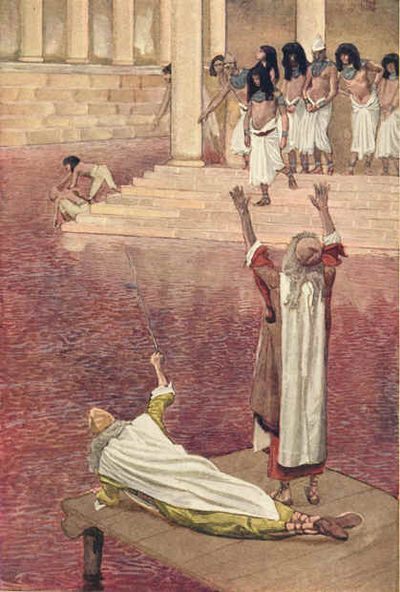
Water is Changed into Blood, by James J.J. Tissot

The preliminaries end and the ten “plagues”1 begin in in this week’s Torah portion, Va-eira (“and I appeared”).  God asks Moses to meet Pharaoh at the river and tell him the reason for the first plague, when water will turn into blood.

And you shall say to him: “Y-H-V-H, the god of the Hebrews, sent me to you, saying: Send out my people, and they will serve me in the midbar!  And hey, you have not paid attention before now.”  (Exodus/Shemot 6:16)2

midbar (מִּדְבָּר) = wilderness, uninhabited land, uncultivated land (pasturage or desert).

Moses had asked for a leave of absence for the Israelites when he first came before the pharaoh, just as God had ordered him at the burning bush on Mount Sinai:

“And you shall say to him: God, the god of the Hebrews, appeared to us; and now, let us go, please, a journey of three days into the midbar, and we will bring animal-offerings for Y-H-V-H, our god.”  (Exodus/Shemot 3:18)

It seems like a small request.  The pharaoh has been forcing the Israelite men to do corvée labor building brick storehouses.  He could afford to grant them all one week off—three days to travel into the wilderness, perhaps one day for ritual offerings, and three days to come back.  Then as soon as they returned he could put them back to work.

Why does God order Moses to make this small request, when the long-term plan is to take the  Israelites out of Egypt altogether and relocate them in Canaan?  Why should Moses ask for a short leave of absence, instead of for permanent emancipation?

A trick?

I used to wonder if Moses’ repeated request for a leave of absence to serve God in the wilderness is a ploy to give the Israelites a head start on their journey to Canaan before the Egyptians realize they were not coming back, and decide to pursue them. After all, when they do finally leave Egypt, it takes them only three days to get to the Reed Sea, part of the boundary of Egypt proper.3

However, God already knows that the pharaoh will repeatedly refuse to grant the Israelites a leave of absence.4  God is already planning to harden the Pharaoh’s heart and inflict the miraculous plagues on Egypt.

Therefore Moses’ request is both an excuse for Pharaoh to say no, and an expression of two things the Israelites ought to desire, according to God: serving their own god, and going into the wilderness to do it.

When Moses and his brother Aaron first come before the pharaoh they phrase the request this way:

“Thus says Y-H-V-H, the god of Israel: Send out my people and let them make a festival-offering for me in the midbar.”  (Exodus 5:1)

The pharaoh refuses, giving two reasons:

“Who is Y-H-V-H that I should listen to his voice to send out Israel?  I do not know Y-H-W-H, and neither will I send out Israel.”  (Exodus 5:2)

Why, Moses and Aaron, would you disturb the people from their work?  Go to your [own] burdens!”  (Exodus 5:4)

The pharaoh then gives the Israelites additional hours of work; they must gather the straw stubble for brickmaking while still meeting their quota for making bricks (and presumably for building the brick storehouses).  His move is effective; the Israelites tell Moses and Aaron that this additional hardship is all their fault.5  But the two brothers continue to cooperate with God’s plan for eventually liberating the Israelites from Egypt.

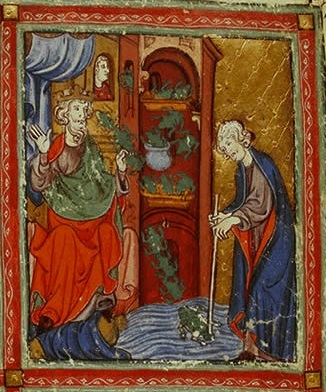
Plague of Frogs, Golden Haggadah, Barcelona, 14th century

The pharaoh ignores the first plague in this week’s Torah portion, Va-eira, in which all the water in Egypt turns into blood.  The second plague, an infestation of frogs, bothers the pharaoh enough so he summons Moses and Aaron.

…and he said: “Plead for me to God, so He will clear away the frogs from me and from my people; then I will send out the people, and they may slaughter an offering to Y-H-V-H.” (Exodus 8:4)

At this point the pharaoh mentions only the offering to God, not the request to make it in the wilderness. And Moses does not bring it up.

After Egypt is relieved of frogs, the pharaoh hardens his own heart and refuses to carry out his side of the bargain anyway; he still stands firm in his two original objections to Moses’ request: that he does not recognize the god of the Israelites, and that he will not give them any time off work.

Going into the wilderness

Only after the fourth plague (arov = mixed vermin) does the pharaoh make a more genuine offer—perhaps because this time God inflicts the plague only on native Egyptian houses, leaving the houses of the Israelites vermin-free.

And Pharaoh summoned Moses and Aaron, and he said: “Go!  Slaughter offerings to your god, in the land.”  (Exodus 8:21)

Moses refuses.  He says they will only make offerings to God in the wilderness, not in the populated part of Egypt.  His excuse is that the animal offerings God wants from the Israelites are taboo to native Egyptians.

“Sure, we slaughter the taboo of Egyptians in front of their eyes, and they do not stone us?  Let us go for a journey of three days into the midbar, and we will slaughter animals for Y-H-V-H, our god, as [God] says to us.”  (Exodus 8:22-23)

Then Pharaoh said: “I, I will send you, and you may slaughter offerings for Y-H-V-H, your god, in the midbar—only you definitely must not go far away.  Plead for me!”  (Exodus 8:24)

After Moses has pleaded with God to remove the plague of arov, the pharaoh hardens his heart again, and refuses to give the Israelites any leave of absence.

During the rest of the plagues, God, Moses, and the pharaoh speak only of sending out the people; the wilderness is now assumed to be their destination.

What is the deeper reason why the Israelites must serve their god in the wilderness, not in the settled land of Egypt?

Routine sacrifices to God are conducted at altars in long-term campsites in the books of Genesis through Joshua, and at temples in towns populated by Israelites in the rest of the Torah.  But in situations that make it harder to reach God, the wilderness is often where the connection happens.

In Genesis, God speaks to Hagar twice, both times when she has walked far into the midbar south of Beersheva.6  Abraham must travel away from Beersheva to a remote hilltop in order to commit the difficult sacrifice of his son Isaac.7  Jacob wrestles with a divine being in an uninhabited area on the Yabbok River.8  Moses does not encounter God until he is 80, when he sees the burning bush on Mount Sinai, so deep in the wilderness that last week’s Torah portion says:

And he led the flock behind the midbar, and he came to the mountain… (Exodus 3:1)

*

In my own experience, there are two kinds of divine connection.  I find that when I am praying with my friends and fellow travelers on the Jewish path, the connection among all of us brings in the divine, and we rise toward the universal divine together—rather like the Israelites in the Torah who gather at at their communal altars.  I miss prayer services when I go too long without them.

Yet if I want a deeper connection with the divine spirit inside myself, I can only reach it in a wilderness: a place where there are no other people to distract me, not even praying people or inspiring speakers; and no buildings or vehicles in sight to remind me of what else I might be doing.  If I see only what we call nature, and hear only wind or water or bird songs as well as my own breathing, then I can do a different and deeper kind of prayer.

In a midbar, I am separated from my usual labors.  I am neither a pharaoh who demands achievement, nor an Israelite who works harder than she really can in order to achieve.  You might say that “serving God” in this way gives me freedom.  And a little freedom returns with me when I return to the world of people.

May we all find a wilderness when we need it.

  1. What we call the ten “plagues” are ten miracles that cause widespread devastation in Egypt.
  2. Although I usually translate the four-letter personal name of God as simply “God”, in this essay I spell it out in Roman letters because Pharaoh does not know there is a god by that name, and one of the reasons God sends Moses to Egypt and inflicts the plagues is so that all Egypt will know the name Y-H-W-H.  God brings this up at least ten times.  For more on the tetragrammaton, the four-letter name, see my post Beshallach & Shemot: Knowing the Name.
  3. The Reed Sea is the third place where the Israelites encamp for the night after they leave the capitol city of Ramses.  The first is Sukkot, the second is Eitam (Exodus 13:20), and the third is Pi Hachirot by the Reed Sea (Exodus 14:2 and 14:9).  (See also Numbers 33:3-8.)  God chooses not to part the sea until after the Egyptian army arrives and is available to be drowned.
  4. And God said to Moses: “When you come and return to Egypt, see all the wonders that I have put in your hand and do them before Pharoah.  But I, I will strengthen his heart and he will not send out the people.”  (Exodus 4:21.)
  5. Exodus 5:6-21.
  6. Genesis 16:7-13, 21:14-19.
  7. Genesis 22:2.
  8. Genesis 32:23-29.

Shemot: Hebrews vs. Children of Israel

Both the book of Exodus and its first Torah portion are called Shemot (“Names”) after a key word in the first sentence.  But that sentence also includes the two names of Jacob and all his descendants:

Jacob and his Family Go to Egypt, by Jean Bondol, 14th century CE

And these are the names of the Children of Yisra-eil who came to Egypt with Ya-akov, each man and his household. (Exodus/Shemot 1:1)

shemot (שְׁמוֹת) = names.

Yisra-eil (יִשְׂרָאֵל) = Israel (in English).  Yisra (ישׂר) is derived from either yisar (יִּשַׂר) = he strives, contends, struggles; or yasor (יָשֹׂר) = he rules, directs.  Eil (אֵל) = god, God.

(Jacob earned the name Yisra-eil after wrestling with a mysterious being.1  The possible meanings of Yisra-eil have spurred a lot of commentary.  Likely translations are “He struggles with God”, “God strives”, or “God rules”. Calling Jacob’s descendants the children of Israel, instead of the children of Jacob, focuses on their active and sometimes insecure relationship with their god.)

Ya-akov (יַעֲקֹב) = Jacob (in English); he grabs the heel (from the verb akav, (עָקַב) = came from behind, grabbed by the heel, supplanted, circumvented, held back).

(Jacob’s father, Isaac son of Abraham, named him Ya-akov when he was born, because he emerged holding the heel of his twin brother Esau.2)

The second sentence in Exodus lists the names of eleven of Jacob’s twelve sons.  Joseph is already a viceroy of Egypt when his extended family moves down.  He invited them to resettle in the Goshen area so he could guarantee they would have food during the seven-year famine.

Over the next few centuries or generations the descendants of Jacob multiply, and a new dynasty takes over Egypt.3

And a new king rose over Egypt who did not know [about] Joseph.  And he said to his people: “Hey! The people of the children of Yisra-eil are more numerous and more mighty than we are!  … What if a war happens, and they even join our enemies and wage war against us, or they go up out of the land?” (Exodus/Shemot 1:8-10)

Here the pharaoh is superficially respectful, referring to the children of Israel by their own name for themselves.  Perhaps at this point most Egyptians had nothing against their Israelite neighbors.

Having identified a potential problem, Pharaoh assigns the Israelites to corvée labor (forced and unpaid labor on a state project).  They must build storage cities in the eastern delta of the Nile, near the Goshen region where they live.  This move establishes their lower-class status, and puts them under close supervision so they cannot defend themselves against any future injustice.

Pharaoh and Midwives, The Golden Haggadah, 14th century CE

The pharaoh’s next move is to order the midwives to kill all the Israelites’ newborn sons.  At this point, Pharaoh calls the Israelite women “Hebrews”.

And he said: When you deliver the ivriyot, and you look at the pair of stones [the birthing seat], if it is a son, then you shall kill him.  But if it is a daughter, then she shall live. (Exodus 2:16)

ivriyot (עִבְרִיּוֹת) = Hebrew women; the feminine plural of ivri (עִבְרִי) = a Hebrew person.  (From the root verb avar, עבר = passed through, passed by, crossed over.  Ivri is an imperative form of this verb.)

The word ivri is etymologically related to the Egyptian word ‘apiru and the Mesopotamian word habiru (as well as the English word “Hebrew”).  Several thousand years ago, the countries surrounding Canaan used the term to mean any Semitic immigrants on the fringes of society.  Surviving ancient texts refer to Hebrews as nomadic herders, temporary laborers, mercenaries, or outlaws.  They are not permanent residents.

Yet when the book of Exodus opens, the children of Israel have been living in Egypt for somewhere between two generations and 350 years.Although they belong to a distinct ethnic group, they have a long-established place in Egyptian society.

Nevertheless, the pharaoh switches from calling them “children of Israel” to calling them “Hebrews”.  This change in language signals that they are aliens who do not really belong in Egypt.  Given the usual meaning of the Egyptian word ‘apiru, the pharaoh also implies that the Israelites are low-class migrant workers and potential outlaws.  His racial slur probably makes the idea of killing the newborn males more palatable to ordinary Egyptians.

Yet the midwives do not carry out the pharaoh’s hate crime; they come up with an excuse for letting the baby boys live.  Although the pharaoh does not punish them, he remains determined to eliminate the “Hebrews” by attrition, letting the old ones work until they die without a new generation to replace them.  His next move is to incite the whole native Egyptian population to commit a form of genocide.

Pharaoh gave orders to all his people, saying: “Every son that is born, you shall throw away into the Great River; but every daughter, you shall let live.” (Exodus/Shemot 1:22)

Why does the pharaoh want to kill only the newborn boys, and not the girls?  In the ancient world of the Torah, men carry the identity of a tribe or nation; women become members of their husbands’ tribes when they marry.  If the only young Israelites were female, they would merely become wives, prostitutes, or servants to native Egyptians.

I would add that adolescent boys and young men are always seen as the most dangerous members of an out-group.

The children of Israel are already subject to corvée labor with no fixed endpoint—in practice, a kind of slavery.  Now they are also helpless against any Egyptians who decide to drown their male children.

Moses from the River, detail from Dura Europos, 244 CE

Only a hero and some miracles can reverse the situation.  The miracles will come from God; the hero is born among the Israelites in Egypt.  His mother hides him for three months before putting him inside a waterproof papyrus box and floating it among the reeds on the bank of the Nile.  When the pharaoh’s daughter finds the  box and sees a baby boy inside, she says:

This is one of the children of the ivrim!”  (Exodus 2:6)

ivrim (עִבְרִים) = Hebrews; the male or all-purpose plural of ivri.

Thus the infant whom she adopts and names Moses begins life identified as an ivri, a nomad, immigrant, outsider.  Eighty years later, Moses leads the ivrim out of Egypt and toward Canaan, the land where ivrim originally came from, the land where they can live as children of Yisra-eil.

Once the Israelites leave Egypt, the Torah rarely calls them ivrim.  References to “Hebrew” people appear only in rules regarding Israelites who have sold themselves as slaves, and in conversations with non-Israelites.

The Israelite occupation of Canaan was not permanent.  The Babylonians conquered Jerusalem in 586 B.C.E., and it took 2,534 years before the land became an independent nation of Israel again, rather than a province of a larger country.  During much of that time Jews in Palestine and in the diaspora were treated like ivrim, unsavory migrants.

*

No group of people is permanent.  Identifying some residents of a country as natives, and others as migrants, outsiders, ivrim, is only a way for demagogues to stir up enough fear and hatred to get what they want.

None of us are natives, if you look back far enough in history.  None of us have an exclusive claim to a patch of land.  All of us are temporary residents—in our countries, and on this earth.  We are all ivrim.

Our challenge is to recognize that everything is temporary, and dedicate our short lives to becoming true children of yisra-el by wrestling with God and changing the fate of the earth.

  1. Genesis 32:25-29.
  2. Genesis 25:26.
  3. Neither the Torah nor the classic commentary are consistent about how much time passed between the immigration to Egypt of Jacob and family, and the imposition of corvée labor by the first pharaoh alarmed by the strength and numbers of his descendants.  According to Exodus 12:14, the Israelites were in Egypt a total of 430 years, making the time between their arrival and their initial enslavement no more than 340 years.  In Genesis 15:13-14 God says the Israelites will be in Egypt for 400 years, bringing that time down to no more than 310 years, which  Genesis 15:16 considers four generations.  Yet according to Exodus 6:16-20, Moses’ grandfather Kehat came down with Jacob, so there were only two generations.

Vayeishev: Stripped Naked

What does it mean to be stripped naked and exposed in public? Joseph finds out—twice—in this week’s Torah portion, Vayeishev (“And he stayed”).

When Joseph is growing up, his father, Jacob, treats him as superior to all ten of his older brothers. Naturally his brothers are jealous. They also hate Joseph because he tells them his two dreams, both of which predict his brothers will bow down to him.

Jacob makes things worse by giving a special garment only to his favorite son, Joseph.

Jacob Blesses Joseph and Gives Him the Coat, by Owen Jones, 1865

…and he made for him a ketonet passim. And his brothers saw that it was he their father loved most out of all his brothers, so they hated him, and they were not able to speak to him with peace. (Genesis/Bereishit 37:3-4)

ketonet  = a long tunic

passim = ? (Newer translations include “ornamented” and “long-sleeved”. Pas = palm of hand (or sole of foot). A garment with sleeves below the wrist would be impractical for physical labor, and therefore a sign of high rank.  The only other biblical reference to passim is in 2 Samuel 13:18-19, which explains that King David dresses his unmarried daughters in katenot passim.)

The King James Bible translated ketonet passim, inaccurately, as a “coat of many colors”. I wonder if the translators chose the word “coat” in order to imply that Jacob is fully dressed underneath the garment his brothers strip off. But a coat or cloak would be a simlah or me-iyl in biblical Hebrew, not a ketonet. And as far as we know, nothing was worn under a ketonet.

Jacob sends Joseph to check up on his brothers, who are pasturing the family flocks far away in Dotan. Although Joseph knows his brothers could not speak to him in peace” (Genesis 37:4), he does not imagine that while they watch him approach they are debating whether to kill him.

And so it was, when Joseph came to his brothers, then they stripped off Joseph his ketonet, the ketonet of the passim, which was on him. And they took him and threw him down into the pit; and the pit was empty, there was no water in it. (Genesis 37:23-24)

The brothers decide to sell Joseph as a slave instead of killing him. They have no trouble selling him to a passing merchant caravan; a naked adolescent boy at the bottom of an empty cistern is unlikely to be anyone of importance. When the merchants reach Egypt, they resell Joseph to the Pharaoh’s chief butcher, Potifar.

What if you found yourself in a foreign country with no clothes, no money, and no identification, being handed over to your new owner? Would you scream that it was a mistake, and keep trying to explain who you are?

At age 17, Joseph accepts his new situation with remarkable equanimity. He sees that without his father’s ketonet and his father’s authority, he has no identity. Naked, he has only the blessings God gave him at birth: brains and beauty. So he applies his intelligence to his new situation and makes the best of it.

God was with him and he became a successful man, and it happened in the house of his master, the Egyptian. (Genesis 39:2)

Joseph’s master, Potifar, promotes him from field slave to steward of his entire household. Egyptian field slaves worked naked, but a steward would wear a linen kilt called a shenti or shendyt.

Once Joseph is nicely dressed, his beauty attracts Potiphar’s wife. She propositions him day after day, but Joseph refuses her on the grounds that it would be unfair to his master and an offense against God.

A less mature young man would assume his elevation to steward was entirely due to his own cleverness and hard work. But Joseph’s reply to Potifar’s wife shows that he knows he would still be working in the field naked without the goodwill of his human and divine masters.

Then it happened one day, he came into the house to do his work, and none of the men of the house were there inside the house. And she seized him by his beged, saying: Lie with me! But he left his beged in her hand, and he fled and he went outside. (Genesis 39:11-12)

beged = garment (of any kind), clothing, cloth covering; treachery.

Joseph Flees Potiphar’s Wife, by Julius Schnorr von Carlsfeld, 19th century

Joseph’s wrap-around linen kilt would be tied in front, and if the knot came loose—or were pulled loose by a lustful woman—the garment would fall off onto the floor.

What does an Egyptian wear under his kilt? In the time of the Middle Kingdom, an Egyptian nobleman wore a sheer linen shendyt and a short under-skirt. But Joseph, as a high-ranking slave, would wear a coarse linen shendyt and nothing underneath. When he flees and goes outside, he is naked.

Potifar’s wife is afraid that other servants will see Joseph naked, and find Joseph’s garment in her room. To avoid being accused of adultery, she screams, and then accuses Joseph of imposing himself on her. As a result, Joseph finds himself back in a pit: Potifar sends him to prison.

Once again, Joseph has been stripped of his clothing and his position due to the treachery of someone whom he never suspected would go that far.

Joseph continues to use his brains in prison, and God continues to bless him with success. He becomes the chief jailer’s steward. After two years, Joseph is given an opportunity to interpret the Pharaoh’s dreams, and he succeeds at this, too. Pharaoh elevates him to viceroy of Egypt, and Joseph wears a gold ring and the finest sheer linen. This time he keeps his public identity, along with his clothes.


Clothing still gives people visible status and identity today. We treat a man wearing a suit and tie differently from one wearing a torn sweatshirt. And even today, we might lose our social identities at any time, no matter how wonderful our innate qualities are.

But we increase the odds of keeping our public identities when we treat other people not as clothes hangers, but as human beings with their own feelings and desires. We do better if we are grateful to the Potifars in our lives, and extremely cautious with the jealous brothers and philandering wives.

We are all naked under our clothes. May we all become humble enough, like Joseph, to learn from the times we are exposed, and reinvent our lives for the better.

Vayeitzei: Satisfaction

You can’t always get what you want.

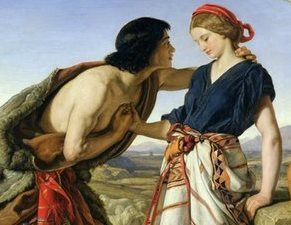
The Meeting of Jacob and Rachel, by William Dyce, 1853, detail

From the moment Jacob meets his beautiful cousin Rachel in this week’s Torah portion, Vayeitzei (“And he went”), he wants to marry her. He and his uncle Lavan agree on a bride-price: seven years of free labor. But on the wedding night seven years later, Lavan switches brides, and Jacob wakes up to find himself married to Rachel’s older sister, Leah. A week later Lavan gives him Rachel as his second wife—after he promises to work another seven years.

Jacob only wanted Rachel, but he accepts Leah and double the number of years of servitude. It is only realistic, when he is far from home and Lavan rules the household.

The two sisters are not happy with their joint marriage. Rachel knows Jacob is in love with her, but she longs for children. Leah bears Jacob’s children, but she longs for his love. Each woman envies the other.

When Leah names her first three sons, she explains each name in terms of her yearning for Jacob’s affection.1 She finally gives up hoping for her husband’s love when she has her fourth son.

And she conceived again, and she bore a son, and she said: “This time odeh God.” Therefore she called his name Yehudah. Then she stopped giving birth. (Genesis/Bereishit 29:35)

odeh (אוֹדֶה) = I will thank, I will praise.

Yehudah = (Judah in English) Yah = an alternate form of the four-letter personal name of God + odeh.

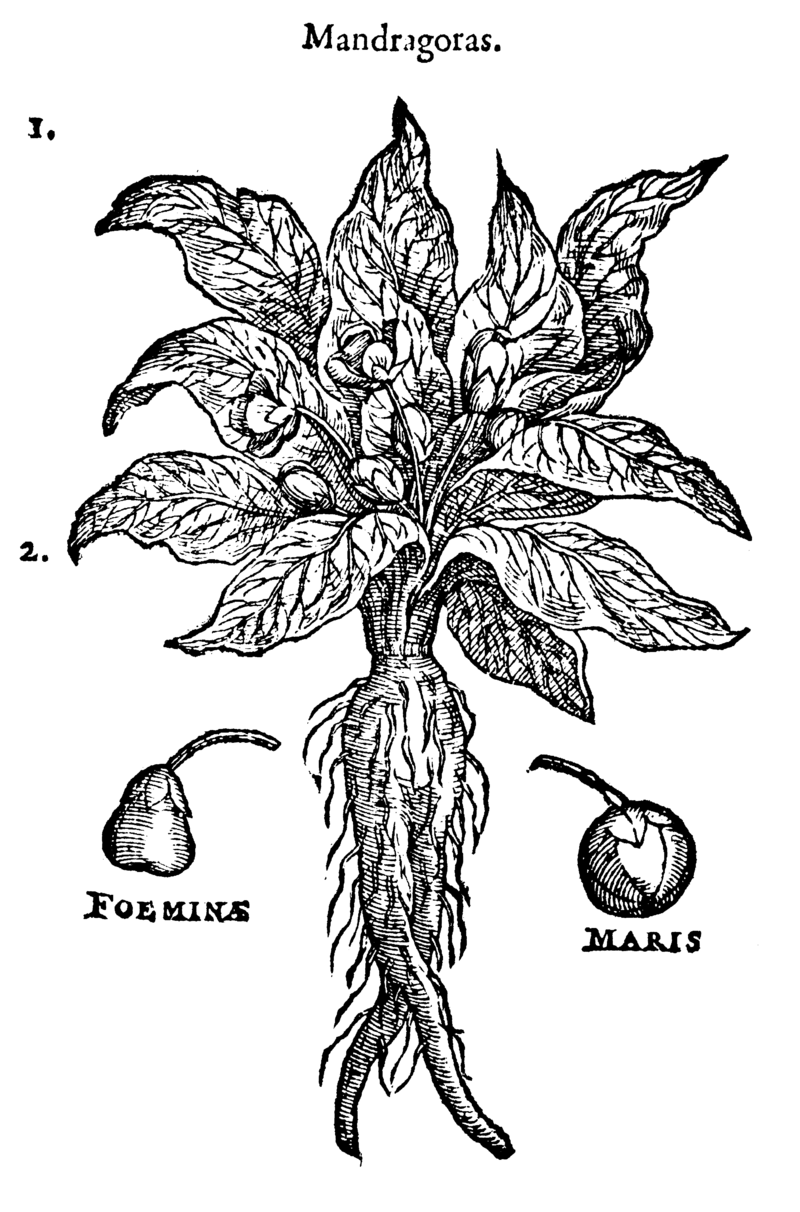
Duda (mandrake), by Rembert Dodoens, 1583

Her gratitude does not last, however.  Jacob stops coming to her bed because Rachel starts insisting on exclusive conjugal rights. The Torah confirms this when Leah’s oldest son brings her fertility herbs (probably mandrakes, with their suggestive and hallucinogenic roots).  Rachel asks for some, and Leah protests:

“Is it such a trifle to take away my husband? And now to take also my son’s duda-im!” (Genesis/Bereishit 30:15)

duda-im (דּוּדָאִים) = an unknown plant believed to increase fertility. The word sounds like dodim (דּוֹדִים) = lovers.

After Leah complains, Rachel decides to compromise.

Then Rachel said: “All right, he will lie down with you tonight in exchange for your son’s duda-im.” (Genesis 30:14-15)

Rachel now accepts that she cannot get everything she wants. She decides that bearing a child is more important than denying her sister sex. So she trades a night with Jacob for the duda-im. And Jacob does what he is told.

Leah has no illusions that her husband will fall in love with her. She knows she cannot get everything she wants.  But she settles for sex and children, which are both rewarding for her.

Rachel eventually does become pregnant, and gives birth to Joseph. But she is greedy; when she names Joseph, she says she wants another pregnancy.2 She gets it in next week’s Torah portion, and she dies in childbirth. Jacob, who only wanted Rachel in the first place, mourns her and complains about her death for the rest of his life.

The only one of these three characters who achieves a long life of contentment is Leah, who learns how to be grateful for what she has.

In our modern western society, we still can’t get everything we want.  We still have to make choices, and think of realistic alternatives.

Yet I believe we can all get at least part of what we want, like Jacob, Leah, and Rachel. May we all be grateful when we get one thing we want, and keep looking for new paths to a satisfying life.

  1. Leah names her first son Reuben (Re-uvein, רְאוּבֵן) “because God saw (ra-ah, רָאָה) my wretchedness (ani, עָנִי), so that now my husband will love me” (Genesis 29:32). She names her second son Simeon (Shimon, שִׁמעוֹן) “because God heard (shama, שָׁמַע) that I was hated” (Genesis 29:33). She names her third son Levi (Levi, לֵוִי), saying “this time my husband will become attached (yilaveh, יִלָּוֶה) to me” (Genesis 29:34).
  2. So she called his name Joseph (Yoseif, יוֹסֵף), saying: “May God add (yoseif, יוֹסֵף) another son for me.”  (Genesis 30:24).

Toldedot: To Bless Someone

For most of my life, the closest I came to giving or receiving a blessing was “Good luck!” When I converted to Judaism, I learned how to bless God as a way to express my appreciation for food and other good things in life. But the idea blessing another person never occurred to me.

Yes, I had read about Isaac blessing his sons in this week’s Torah portion, Toledot (“Lineages”). I gathered that giving a blessing means both stating the good outcomes you want for another person, and calling on (or praying to) God to make your words come true. But I did not believe that the actual words mattered, or that a formal blessing would be any more effective than “Good luck!” I felt sorry for Isaac and his family for taking the blessing business so seriously. I was 48 before I discovered Jewish Renewal and the potential power of blessing.

What makes a blessing a living force instead of a formality?

The blessings in the book of Genesis/Bereishit use formal poetic language. Even when they are personal blessings, they focus material prosperity, fertility, and/or victory over enemies, and use customary phrases. For example, Rebecca’s mother and brother bless her as she leaves home to get married, saying: Our sister, may you become a thousand multitudes, and may your descendants take possession of their enemies’ gate.” (Genesis/Bereishit 25:60)

Another kind of blessing in Genesis is “the blessing of Abraham”, a phrase the Torah uses to refer both to God’s promise that Abraham’s descendants will possess the land of Canaan, and to the first blessing God gives Abraham:

I will make you a great nation, and I will bless you and I will make your name great, and you will become a blessing. And I will bless those who bless you, and those who curse you I will curse. And all the clans of the earth will find blessing through you. (Genesis 12:2-3)

In this week’s Torah portion, Isaac decides to give a blessing to Esau, the firstborn of his twin sons. The Torah does not say whether Isaac is planning to give Esau his personal blessing, or the blessing of Abraham, but it does say what part of himself Isaac hopes will deliver the blessing.

Isaac Sends Esau to Hunt, by James Tissot, ca. 1900

He said: I have grown old, and I do not know the day of my death. So now, please pick up your gear, your quiver and your bow, and go out to the field and hunt game for me. Then make me tasty tidbits, the kind that I love, and bring them to me, and I will eat, so that my nefesh may bless you before I die.” (Genesis/Bereishit 27:2-4)

nefesh (נֶפֶשׁ) = animating soul; seat of appetite, desire, yearning, instinct; person

Isaac wants the blessing to come from his nefesh, his instinctual self, without any interference from his conscious mind. Isaac loves Esau and could invent a formula of blessing. But he wants his blessing to express the will of God as it moves through him, not his own conscious will.

When Isaac’s wife, Rebecca, overhears him, she assumes he intends to give Esau the blessing of Abraham. She panics, not only because she loves Jacob more, but also because she knows that Jacob is the one who will carry on the worship of the God of Abraham.

Apparently Rebecca and Isaac are having communication problems, because she does not march into Isaac’s tent and straighten him out. Instead, she says to Jacob:

Hey, I heard your father speaking to your brother Esau, saying: Bring game to me and make me tasty tidbits, and I will eat them, and I will bless you lifnei God, before my death.” (Genesis 27:6-7)

lifnei (לִפְנֵי) = in the presence of, before

Rebecca interprets Isaac’s reference to blessing with his nefesh as blessing “in the presence of God”, and she associates this with God’s blessing of Abraham.

She quickly cooks some tasty tidbits from goat meat, and orders Jacob to bring them to his father. Jacob protests that he is not a hairy man, like his brother, so his blind father will know he is not Esau as soon as he touches him. So Rebecca disguises Jacob by dressing him in Esau’s spare clothes and fastening the skins of goat kids around his hands and neck.

Of course as soon as Jacob comes in and says, My father, Isaac recognizes Jacob’s voice, and asks:

Who are you, my son?” Then Jacob said to his father: “I am Esau, your firstborn. I have done as you spoke to me. Get up, please, sit, and eat some of my game, so that your nefesh may bless me.” (Genesis 27:18)

Jacob thinks like his father. He hears Rebecca’s “in the presence of God”, and interprets it in terms of Isaac’s nefesh!

Isaac tests his son several times, unable to believe that this man with Jacob’s voice is really Esau, no matter how hairy his hands feel. Then he decides to bless the son in front of him anyway. Now it is even more important that the blessing come from God, so he repeats:

I will eat some of the game of my son, so that my nefesh may bless you.” (Genesis 27:25)

After Isaac has eaten and received a kiss from his son, he delivers the blessing:

May God give to you from the dew of the heavens, and from the fat of the land, and abundant grain and wine. May peoples serve you, and may nations bow down to you. Be a leader to your kinsmen, and may the descendants of your mother bow down to you. Cursed be those who curse you, and may those who bless you be blessed.” (Genesis 27:28-29)

The blessing begins with the standard themes of material abundance and victory over other nations. Then Isaac adds part of God’s blessing of Abraham:  Cursed be those who curse you, and blessed be those who bless you. He does not say the other part of the blessing of Abraham—that he will have many descendants, and they will possess the whole land of Canaan—until later in the Torah portion, when he gives a blessing to Jacob as Jacob.

I think that Isaac gives Jacob-in-disguise part of the blessing of Abraham because he is indeed speaking from his instinctual self, channeling divine inspiration without thinking it through. His words naturally mirror the words of the blessing of Abraham.

When his other son shows up a moment later with his own tasty tidbits, Isaac recognizes Esau’s voice, and comes out of his trance and back to earth. He trembles, partly because he knows he cannot repeat the same blessing to Esau, and partly because he realizes that the blessing he just gave Jacob is indeed an expression of God’s will.

Then Isaac trembled, full of fear, and said: “Who is it, then, who hunted game and brought it to me and I ate everything before you came and I blessed him? He must be truly blessed!” (Genesis 27:33)


Is it possible to channel a blessing from God, as Isaac apparently channels his first blessing? I do not know. But when I was 48 and I wandered into a Jewish Renewal service, I saw the rabbi of P’nai Or of Portland, Aryeh Hirschfield zt”l, blessing people. I could tell he was connecting with some inner source of energy, and the people he blessed were taking in that energy.

Is that kind of blessing from the instinctual self, the nefesh, confirmed by God and therefore bound to come true? Again, I do not know. What I do know is that a blessing given with what seems to be divine energy makes a big impression on both giver and receiver. No doubt the words of the blessing are absorbed deep into the subconscious mind of the one blessed, where they affect one’s outlook and behavior for years to come. That alone might make a blessing come true.

May everyone who needs a blessing be truly blessed. And may everyone who sees the need for a blessing be inspired to give a true blessing.

Chayei Sarah & Lekh-Lekha: A Holy Place

What makes a place holy?

The word for “holy”, kadosh, means separated from mundane use, dedicated to God, or simply inspiring religious awe.  Kadosh appears only once in the book of Genesis/Bereishit, in verb form, when God blesses the seventh day of creation and makes it holy.  The word does not show up again until the book of Exodus/Shemot, when Moses stops to look at the burning bush, and God tells him to take off his shoes, because the place where you are standing is holy ground (Exodus 3:5).  Later in Exodus, Mount Sinai becomes holy ground for a whole people.  Eventually the Bible names Jerusalem as a holy city.

Even though there are no places called kadosh, “holy”, in the book of Genesis, there many sites where God makes first contact with a human being.  At two of the locations where God speaks to a human, the human dedicates the spot, and later someone returns to the same place to connect with God.  These places, Be-eir Lachai Ro-i and Beit-El, must surely count as holy!

Isaac and his bride Rebecca meet in a field next to Be-eir Lachai Ro-i (“Well for the Living One Who Sees Me”) in this week’s Torah portion, Chayei Sarah (“the life of Sarah”).  But it is Hagar, an Egyptian, who first encounters God there.

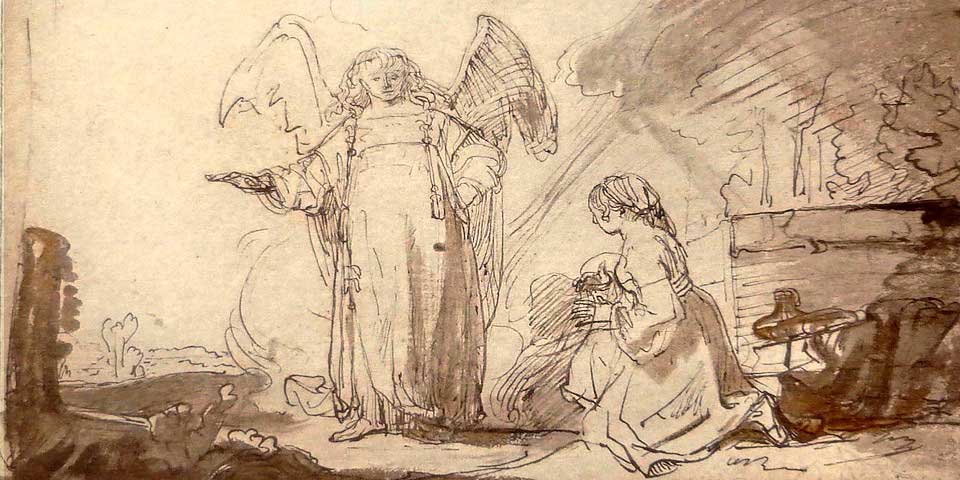
Hagar and the Angel, by Rembrandt

When Abraham and his wife Sarah leave Egypt in the Torah portion Lekh-Lekha (“Go for Yourself”), Hagar goes with them as Sarah’s servant.  Sarah gives Hagar to her husband for the purpose of producing a child Sarah can adopt.  But once Hagar is pregnant, Sarah abuses her, and Hagar runs away across the Negev Desert, back toward Egypt.  A messenger of God  finds her at a spring, a watering-place by the road.  God speaks to Hagar through the messenger and convinces her to return to Abraham and Sarah.

And she called the name of God, the one speaking to her: You are the God of Ro-i; for she said: Even as far as here, I saw after ro-i! Therefore the be-eir is called Be-eir Lachai Ro-i. (Genesis 16:13-14)

ro-i = seeing me, one who sees me.

be-eir = well, watering-place.

lachai = for the living one.

For Hagar, accustomed to being a pawn in Sarah’s schemes, the most amazing thing is that God actually notices her—and she survives.  Hagar does return, and gives birth to Ishmael.  Sarah adopts Ishmael, but later bears her own son, Isaac, and sends Hagar and Ishmael into exile.

Isaac is 40 years old before the Torah once again mentions Be-eir Lachai Ro-i, the Well of the Living One Who Sees Me.  At this point, Isaac is estranged from his father.  In last week’s Torah portion, Vayeira (“And He Saw”), Abraham bound Isaac as a sacrificial offering, and raised the knife to his son’s throat before a voice from God called him off.  After that, Isaac did not go home with his father.  In this week’s Torah portion, Abraham buries Sarah, Isaac’s mother, without Isaac’s presence.  Then he arranges for Isaac to marry an Aramean without even informing his son.  Apparently they are not on speaking terms.

Abraham lives in Beersheba (Be-eir Sheva), and Isaac lives farther south, in the Negev Desert.

And Isaac, he came from coming to Be-eir Lachai Ro-i, and he himself lived in the land of the Negev.  And Isaac went out lasuach in the field, in the face of the sunset; and he raised his eyes and he saw—hey!  Camels were coming. (Genesis 24:62-63)

lasuach = to ?? (This is the only occurrence of the word in the Bible, and though it is in the form of an infinitive verb, scholars do not agree on its meaning.  Lasuach has been translated as to stroll, to pray, to supplicate, and to meditate.  It might be a variant spelling of the verb siyach = meditate, go over a matter, contemplate something.)

I like the literal translation he came from coming to; it emphasizes that a holy well is a place you come to.  Isaac is avoiding his father, but he comes to the well where God noticed and spoke to Hagar.  Since he has no intention of traveling to Egypt on the road that runs past the well, he must come there because he knows about Hagar’s experience.

Like Hagar, Isaac is used to being overlooked as a person, accustomed to being a pawn in his father’s schemes.  Maybe he hopes that God will notice him at Hagar’s well, or maybe he hopes he will be able to see himself.

Coming from the Well of the Living One Who Sees Me, Isaac heads out into the field at sunset to lasuach.  Maybe Isaac senses the holy presence of God at the well, and he walks back through the field slowly to absorb the experience.

Lost in thought, he raises his eyes and is surprised to see camels approaching.  He is not far from the road between Beersheba and Egypt, but these camels have left the road and are heading across the field toward him.  The first rider to dismount is Rebecca, the bride that Abraham’s servant is bringing to Isaac.  They meet in the field, he loves her, and he begins his new life.

Near the end of the Torah portion, Isaac and his half-brother, Hagar’s son Ishmael, bury Abraham in the family cave to the north.  Then Isaac returns to Hagar’s well.

And it was after the death of Abraham when God blessed Isaac, his son; and he settled next to Be-eir Lachai Ro-i. (Genesis 25:11)

The only other place in the book of Genesis that remains holy years later, under the same name, is Beit-El (sometimes called Bethel in English).  In the upcoming Torah portion Vayeitzei (“And he went”), Jacob stops for the night on his way to Charan and dreams of a stairway between heaven and earth. God speaks to him for the first time.  When Jacob wakes, he says:

Truly God yesh in this place and I, I did not know! And he was awestricken, and he said: How awesome is this place! This is nowhere but Beit El, and this is the gate of the heavens! (Genesis 28:16-17)

yesh = it exists, it is present, there is.

Beit El = the house of God.

For Jacob, the most amazing thing is not that God notices him, but that God exists at all in this world.

Jacob dedicates the spot by setting up a stone pillar and pouring oil over it, and naming it Beit-El.  More than 20 years later, God tells him to return to Beit-El.  Jacob first buries all the idols belonging to his household.  Then he leads them to the spot and builds an altar. God blesses him again, and Jacob pours a libation as well as oil on the stone pillar before moving on.  By returning to the place where God first spoke to him, Jacob rededicates himself to God.

*

Few of us today hear God speaking to us in Biblical Hebrew.  But once in a while, we notice God, or God notices us, and we are amazed.  Suddenly our usual mundane perspective changes, and the world is suffused with new meaning.

Sometimes this happens because a place strikes us as holy, awe-inspiring, connected with God.  It might be a liminal place in nature—the edge of the ocean, deep in a forest, a remote spot with a brilliant night sky.  I have also felt that mysterious awe inside medieval cathedrals, though as a Jew I do not go looking for God there.

Sometimes we go back later, and find God again.  Sometimes we go back and discover that the place seems ordinary now; the holiness was in our own heart.  Either way, it is a blessing to be able to stand on holy ground.

Vayeira & Noach: Drunk and Disorderly

As I read the book of Genesis/Bereishit again this year, I feel sorry for the characters who try to rise to the challenge of walking with God, but are just too limited to keep up. Two of those who fall by the wayside are Noah and Lot, who both attempt to do the right thing, then collapse into drink and incest after they see their worlds destroyed.

Noah begins by following all of God’s directions; he sees God destroy all life on land with the over-the-mountaintop flood. Abraham’s nephew Lot begins by offering hospitality to strangers in this week’s Torah portion, Vayeira (“And he saw”). He sees the strangers, who are actually messengers from God, destroy the city of Sodom and the land around it.

After their respective catastrophes are over, and it is time to build a new life, both men think only about getting drunk.

Noah

Drunkenness of Noah, mosaic, Basilica di San Marco, Venice, 1215

And Noah began to be a man of the soil, and he planted a vineyard. And he drank some of the wine, and he became drunk, and vayitgal in the middle of his tent. And Cham, the father of Canaan, saw the erat of his father and he told his two brothers outside. (Genesis/Bereishit 9:20-22)

vayitgal = he uncovered himself, exposed himself

erat = nakedness

Noah plans his drunkenness with the foresight of an alcoholic who hides stashes of liquor in strategic places. He has to wait a long time, through planting and harvesting and fermentation, before he gets his first drink after the flood. Although the Torah does not report Noah’s feelings, I imagine he is haunted by the deaths of everyone he knew outside his own immediate family of eight. Perhaps he dreams of children drowning. Perhaps he wishes he had said something to change God’s mind, or found some way to rescue more people.

I suspect that Noah cannot find a way to live with this knowledge and move forward. So he opts to escape into an altered state of consciousness, or unconsciousness.

After becoming drunk, Noah uncovers his nakedness in the middle of his tent. A modern reader might wonder what is so bad about lying down naked in the privacy of your tent—even if one of your sons barges in and accidentally sees you.

But in the Torah, to “uncover the nakedness” of someone is a euphemism for a sexual act. The book of Leviticus/Vayikra devotes thirteen verses to listing close relatives whose nakedness you must not uncover, using the same words for “uncovering” and “nakedness” as the passage above.

The implication is that Noah and his son Cham (whose name means “heat”) are guilty of some illicit sexual act. Furthermore, Noah begins it, by “uncovering himself”. Yet Noah shifts all the blame to his son.

And Noah woke up from his wine, and he knew what his youngest son had done to him. (Genesis 9:24)

Noah expresses his anger at Cham by cursing Cham’s son Canaan. Alas, it is a common human reaction to reject your own guilt by lashing out at someone else.

Lot

In this week’s Torah portion, Lot and his daughters act out a different version of the drunken incest theme.

Lot, like Noah, means well. His story begins with a good deed; when two messengers from God, disguised as ordinary men, come to the city of Sodom, Lot goes out of his way to give them hospitality and treat them with respect and kindness—just as his uncle Abraham did in the previous scene in this week’s Torah portion. After Lot has brought the strangers home and fed them, the men of Sodom converge on Lot’s house and demand that he bring out his guests, so that they can “know” them.

Just as it never occurs to Noah to question God’s plan to wipe out the earth, it never occurs to Lot that there might be an alternative to sacrificing two people to the mob. Since his two guests are out of the question, Lot steps outside and offers the would-be rapists his two virgin daughters instead.

Maybe Lot is so terrified of his neighbors that he cannot think straight. But we can still question his impulse to sacrifice his daughters—and perhaps after the crisis is over, Lot is tormented by remembering his own behavior.

The mob outside ignores Lot’s proposed substitution of rape objects, and crowd forward to break down the door. The messengers from God save the day (or night) by pulling Lot inside and blinding the men outside. Then they tell Lot that God has sent them to destroy the whole city, and they order Lot to flee with his family.

Lot panics, and at dawn he is still dithering in his house. The messengers grab him, his wife, and their two daughters by the hand and lead them outside the city. They tell Lot to save himself by escaping to the mountain, without stopping or looking back.

When God rains sulfur and fire down from the heavens, Lot’s wife looks back and turns into a pillar of salt, but Lot hurries on. He settles into a cave on the mountain with his two daughters.

And the elder said to the younger: Our father is old, and there is no man on the earth to marry us as the way of all the earth. Come, we will give our father a drink of wine, and we will lie down with him, and we will keep alive seed from our father. So they gave their father wine to drink that night, and the elder came, and she lay down with her father, and he did not know when she was lying down or when she was getting up. (Genesis 19:31-33)

They repeat the procedure the next night, with the younger daughter as the seed collector. And once again the Torah claims Lot did not know when she was lying down or when she was getting up. Both women become pregnant, as they planned.

Many commentators have pointed out that preserving a man’s lineage is a high value in the Torah, and concluded that Lot’s daughters were doing the right thing. But if incest were truly the right behavior in their situation, they would simply ask their father to cooperate, without resorting to wine. Lot may not have read the Torah’s prohibition against “uncovering the nakedness of your father”, but he obviously knows that incest, like mistreating a stranger, is wrong.

The Torah appears to view Lot as innocent of incest by reason of unconsciousness. Yet it is Lot’s decision to keep drinking the wine until he passes out; even two strong young women could not force it down his throat.

And where did the wine come from? The Midrash Rabbah, a collection of commentary from Talmudic times, speculates that either the Sodomites stored wine in distant mountain caves, or the wine appeared miraculously. However, I agree with modern commentator Jonathan Kirsch that Lot probably grabs some wine when they pass through the village of Zoar on the way to the mountain. Like Noah, Lot would anticipate a need for escape from sanity after the catastrophe. And as in Noah’s story, the Torah blames Lot’s subsequent sexual misdeed on his children.

It is easy for me to judge both Noah and Lot harshly. But if God gave me orders, would I have the imagination or the courage to talk back? If I were faced with a mob of evil men, would I have the imagination or the courage to divert them safely? I have lots of imagination—except when it comes to my own problems. I’m learning courage, but I still prefer avoidance.

If all my friends, most of my family, and every familiar thing in my life were suddenly wiped out, would I have the imagination and courage to build a new life from nothing? I think I would, but how do I know?

When life becomes unbearable, do I stick with reality and avoid any drugs of escape? Cookies don’t count, do they?

When something bad happens between two people, do I duck responsibility by blaming it on the other guy? Never—except for when I am fixated on escaping the situation.

As I read the book of Genesis again this year, I feel sorry for the characters who try to rise to the challenge of walking with God, but are just too limited to keep up. I might be one of them.

Lekh-Lekha and Bereishit: Giving Directions

For me, every story in the book of Genesis/Bereishit is another fruit from the Tree of Knowledge of Good and Evil. And the God who speaks to individual people, from Adam to Jacob, is like a human teacher trying to prod people into making conscious choices and moral judgments.

Like other animals, we humans make most of our decisions automatically, out of instinct and habit. Sometimes we stop to solve a practical problem or an intellectual puzzle. But only rarely do we stop to solve a moral problem. When we do become aware of a moral issue, and of our ability to choose between good and evil actions, I think we are tasting another fruit from the Tree of Knowledge.

The anthropomorphic God in Genesis often talks to Himself, debating what to do next. He also talks to human characters, asking them questions, telling them His plans, blessing and cursing them, making covenants with them, and giving them directions.

“God” tries out several methods for giving directions. In the second creation story, “God” makes a single human out of dirt and breathes life into it. After placing the human (ha-adam) in the garden of Eden, the God character gives it an instruction.

figGod tzivah the human, saying: From every tree of the garden, certainly tokheil. But from the tree of the knowledge of good and bad, not tokhal; for on the day you eat from it, you will certainly die. (Genesis 2:16-17)

tzivah = commanded, ordered, directed.

tokheil, tokhal = you will eat, you shall eat, you should eat, you could eat, you may eat, you can eat, you are going to eat, you must eat.

It is impossible to translate this passage literally, because biblical Hebrew has only one verb form for action that has not yet happened. Is “God” telling the human “you must not eat” from the tree of knowledge, and if you do, you will be punished with death? Or is “God” saying “you could not eat” from it without becoming mortal?  Either translation is correct.

The God character’s motivation in giving this order is also open to interpretation. Classical commentary assumes “God” wants the human to stay in the garden, in a state of moral ignorance, and therefore after the female and male humans eat the fruit, they are punished for disobeying orders. I think “God” points out the Tree of Knowledge in order to show the adam, the solo and sexless human, that it can act of its own free will, and gain knowledge. But the adam passively follows orders, and nothing changes. I can imagine the God character wondering what it will take to get the humans to make a choice and acquire a sense of good and evil, so He can remove them from Eden and place them in the real world! “God” solves the problem by splitting the human it into male and female persons, and inventing the snake to make the female human think.

The next person in the Torah to get moral training is Cain, who gets upset when God shows a preference for Abel’s offering over his. Perhaps because reverse psychology did not work well with Adam, “God” avoids anything that sounds like an order when He first addresses Cain.

Cain, by Henri Vidal, detail


And God said to Cain: Why are you making yourself angry, and why has your face fallen? Is it not so: if you do good, [there is] uplifting; but if you do not do good, wrongdoing waits at the door, and its desire is for you. Yet you can rule over it. (Genesis 4:6-7)

Cain does not get the hint, and in a fit of rage kills his brother Abel.

In the story of Noah, the God character tries a different approach.

God said to Noah: The end of all flesh is coming before Me, because the earth is filled with violence on account of them, and here I am, the one Who destroys the earth.  Make for yourself a floating-container of gofer wood; you shall make the floating-container compartmented, and you shall cover it inside and outside with caulking. (Genesis 6:13-14)

If what “God” wants is for Noah to obey orders, His new style works. Noah simply follows orders, and makes no independent decisions until after the flood. But commentators have wondered for millennia whether Noah’s mechanical obedience is actually what “God” wants. (See my post last week, Noach: Righteous Choices.) What if “God” is hoping that Noah will propose an alternative, the way Abraham does later when “God” announces He will destroy Sodom and Gommorah?

abraham-looks-at-starsThis week’s Torah portion, Lekh-lekha, begins with the God character’s first direction to Abraham.

God said to Abraham: Lekh-lekha, away from your land, and away from your home, and away from the house of your father, to the land that I will show you. And I will make you into a great people, and I will bless you, and I will make your name great, so it will become a blessing. (Genesis 12:1-2)

Lekh = Go!

-lekha = yourself, for yourself, to yourself.

Here the God character’s order specifies what Abraham should leave behind, but gives no details about the future he is walking into. What “God” does communicate is that this move is important for Abraham, not just for God. Rashi (11th-century Rabbi Shlomo Yitzchaki) interpreted Lekh-lekha as “Go for yourself”, i.e. for your own sake. The Zohar (a 13th-century kabbalistic text) interpreted it as “Go to yourself”, i.e. recreate yourself as a new individual, separate from your past.

All the promises of blessing, while non-specific, also serve to let Abraham know that going to the new land will be for his own benefit. This is the first time in the Torah that “God” promises a reward for obeying His directions.

Abraham responds to the divine direction by leaving home for good, as instructed. But he takes some initiative and prepares for his own future by bringing along his wife, nephew, servants, and livestock.

Since the voice of God does not even tell him which way to head when he leaves his father’s house in Charan, Abraham chooses to travel west into Canaan. Only after he has reached Shechem, well inside Canaan, does “God” appear to him and say: To your offspring I will give this land. (Genesis 12:7)

The God character’s method of giving partial directions, promising an eventual reward, and leaving the rest up to the human being seems to be the most successful approach so far. Abraham responds by leaving his old familiar habits behind, and making new choices.

Today, few people hear God giving them direct instructions in Biblical Hebrew. But I can imagine the God character in these stories as an inner voice from the human subconscious, struggling to be heard properly.

There are many ways for a human being to get stuck and wait passively for change, instead of looking for a good action and bravely doing it. At times in my life I have been like the adam, obeying orders without raising questions, avoiding any potential conflict. I had to reach a certain level of misery before an inner voice from God’s snake reminded me that it would not kill me to pick the fruit and liberate myself, to choose my own course and act.

At times in my life I have been like Cain, feeling as though I am at the mercy of a bad desire. Yet eventually I hear the divine hint that I can master the desire, and choose to do good.

Other times, I feel overwhelmed, drowned, by the demands of other people and by the way the world works. I want to make my own little floating container and hide in it. But my conscience nags at me, reminding me that I cannot hide in an ark without bringing my family and hordes of hungry animals with me. God wants engagement with the world.

And yes, periodically I have heard an inner call to leave my familiar but not-so-good life, and set out for an unknown destination and destiny, like Abraham. So far, responding to that voice has led to blessings.

May we all be blessed to listen to our inner “God” voice, and never lose the taste of the fruit from the Tree of Knowledge of Good and Evil.

Noach: Righteous Choices

This is the story of Noah: Noah was a man of tzadik; he was blameless in his generations; Noah walked with God. (Genesis/Bereishit 6:9)

tzadik (צַדִּיק) = right conduct, lawfulness, innocence; a righteous person.

In the Talmud, a man is called a tzadik if he devotes his life to Torah study and prayer. For the Chassidim in Eastern Europe, a tzadik was a holy man so esteemed by God that he could work miracles. Some commentary reads these meanings of the word tzadik back into Noah’s story, but the Torah never shows Noah studying, praying, or acting like a holy miracle-worker. So I think Noah is merely innocent and lawful, avoiding violence even though everyone around him is doing it.

At the end of last week’s Torah portion, God regrets creating humankind, because of

the abundant badness of the human on earth, that the shape of every idea of his heart was only bad all the time. (Genesis 6:5)

(See my post last week, Bereishit: Inner Voices.) Since Noah is the best human being available, God speaks to him at the beginning of this week’s Torah portion, Noach (Noah” or “resting”).

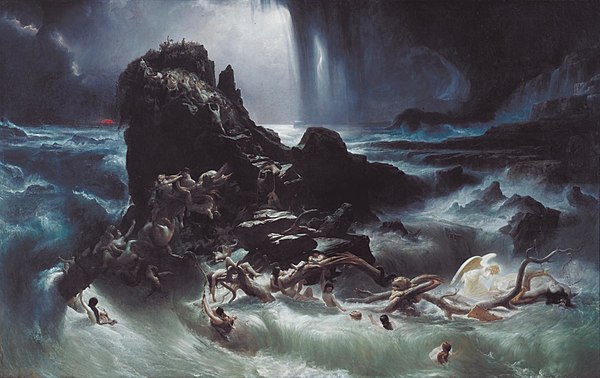
The Deluge, by Francis Danby, 1840

And God said to Noah: “The end of all flesh is coming before me, because violence has filled the earth on account of them, and here I am, their destroyer of the earth. Make for yourself an ark …” (Genesis 6:13-14)

God gives Noah explicit instructions on how to build the ark, and explains that the problem of human violence will be solved when God wipes out everything else on earth with a vast flood. Then God tells Noah to collect what will go inside the ark: a pair of every kind of animal; Noah and his wife, sons, and daughters-in-law; and food for everybody.

And Noah did so; everything that God commanded him, thus he did. Then God said to Noah: Enter, you and all your household, into the tevah, because in you I have seen tzadik before Me in this generation. (Genesis 6:22-7:1)

It sounds as if God approves of Noah’s passive obedience. Yet commentators through the ages have wondered why Noah does not try to talk God out of the Flood, the way Abraham tries to talk God out of destroying Sodom and Gomorrah by saying perhaps there are some innocent people among the wicked.

Most of the commentary I have read falls into two camps. One camp considers Noah either a failed prophet (because he did not warn anyone to repent) or a failed tzadik in the Chassidic sense (because he did not ask God to decree a different fate for the world). The other camp argues that God must have asked Noah to prophesy in an unrecorded conversation, and Noah must have done his best, while building the ark, to warn people about the flood and urge them to repent before it was too late.

But the commentary that alarms me the most comes from the 19th-century Rabbi Samson Raphael Hirsch. Hirsch wrote that performing God’s will is what matters; acting on the basis of your own judgment is of secondary and uncertain importance. So although Noah could have done other things, he was correct in doing exactly what God commanded, and no more.

I would say that if God only wants humans to do as they are told, God had no reason to plant the Tree of Knowledge in the Garden of Eden in the first place. Yet God not only places the Tree, but points it out to Adam by warning him not to eat from it. Then when Adam obediently avoids it, God creates Eve and the talking snake, so the humans finally eat. The taste of knowledge of good and bad gives humans have the ability to form opinions, and choose between them. Though we usually act out of habit and instinct, we have the ability to make new and creative choices.

Some rabbis have argued that the most desirable outcome is when a human deliberately chooses to do exactly what God wants. But sometimes there is a difference in the Torah between what God says and what God wants. On several occasions God “tests” (nasah) people to see what they will choose to do. For example, God tests Abraham by telling him to sacrifice his son Isaac as a burnt offering—but when Abraham binds his son on an altar and raises his knife, God intervenes to save Isaac’s life. It was only a test, and in a real test you do not tell the subject everything you want.

So when God tells Noah to build and supply the ark before the flood wipes out the earth, is that really all God wants Noah to do? Or is God testing him, to see whether Noah will warn people to repent, or even propose a different solution to God?

Suppose Hirsch is right, and God only wants us to choose to follow explicit directions. That not only makes the relationship between humans and God uninteresting, it also leaves us stranded when we have to make independent decisions that are not explicitly covered by the 613 rules in the Torah. The tradition of Jewish oral law tries to fill the gap, but it still cannot cover everything. Human beings often find themselves in situations where they need to figure out the best course of action for themselves.

Thank God!  I believe we humans shine when we discover, or invent, good ideas that nobody considered before. Choosing to follow God’s orders is a virtue of sorts. But we are blessed with the ability to rise above Noah’s level of virtue, and improve the world in ways the Torah never envisioned. Depending on how you define “God”, this might be what God really wants.

In my own lifetime, I have seen great progress in granting status, rights, and respect to people in groups that were subjugated for millennia, including women, people outside the traditional heterosexual model, and outsiders from different ethnic groups and countries. We still have farther to go, and some parts of the world lag far behind, but we have created a good path. The Torah merely assumes these groups will always be inferior, and offers a few paltry laws to protect the members of some groups within their inferior status. Thanks to our God-given abilities, humans are now working on a better vision.

The Torah also promotes war, while alluding to a distant future when war will disappear because everyone will worship the same god. But we can do better than that, thanks to our taste for knowing good from bad, our ability to transcend our habits and instincts and make choices, our creative minds, and our power to rise above ourselves to speak as prophets or tzaddikim. Someday humans may achieve an era of peace better than the one imagined in the Bible!

May it be God’s will … but most of all, may it become our will.