Bereishit: Divine Inner Voices

The first Torah portion in the first book of the Torah (both called Bereishit, “In a beginning”) opens with God’s creation of the world. It closes with God’s decision to destroy the world and start over again.

Just before God makes this decision, the Torah gives us a curious story fragment:

And beney ha-elohim saw the daughters of the human, how tov they were, and they took themselves wives from whomever they chose. (Genesis 6:2)

The Nefilim were on the earth in those days, and also afterward, for beney ha-elohim came into the daughters of the human, and they bore children to them. They were the mighty ones from long ago, men of renown. (Genesis 6:4)

beney ha-elohim = the sons of God.

tov = good, attractive.

What does “the sons of God” mean? Some traditional commentary claims the phrase refers to superior human men, who make the mistake of marrying an inferior class of women. Other commentators say the “sons of God” are angels, angels of a lower grade than the malachim (“messengers”) that appear in the Torah in human form in order to speak as mouthpieces for God.

What strikes me is that the phrase beney ha-elohim appears only four times in the whole Hebrew Bible: twice in the passage above, and twice in the book of Job. The book of Job begins by describing how upright, good, and God-fearing Job is. Then the scene shifts to the court of God:

One day beney ha-elohim came to present themselves in front of God, and ha-satan came too, in the middle of them. And God said to ha-satan: Where do you come from? And ha-satan answered God, and said: From roving about on the earth and from going back and forth on it. (Job 1:6-7)

ha-satan = the adversary, the obstacle

God pays attention to ha-satan, and does not question any of the other “sons of God”. The Adversary doubts whether Job is genuinely good and God-fearing, and persuades God to test Job’s faithfulness. God assigns the Adversary to strike all Job’s possessions. Ha-satan eliminates Job’s wealth and all his children—for no good reason—but Job still blesses God.

Then one day beney ha-elohim came to present themselves in front of God, and ha-satan came too, in the middle of them, to present itself in front of God. And God said to ha-satan: Where do you come from this? And ha-satan answered God, and said: From roving about on the earth and from going back and forth on it. (Job 2:1-2)

Once again God only converses with ha-satan. The Adversary persuades God to test Job again, this time by afflicting his body, and God authorizes another injustice in order to find out what Job will do.

The book of Job is a theological conversation in the guise of a story about a man who lived long ago and far away. In order to set up the question of whether God is just, the story uses an allegory of God in His court, receiving His sons, the lesser gods (a scene obviously borrowed from one of the pantheistic religions in the region).

But on another level, I see both stories about beney ha-elohim as allegories for the human mind.

In the book of Job, I think God’s court represents the human mind. The decision-making ego is visited by various sub-personalities, including one that takes an adversarial role and obstructs the ego by planting doubt, then tempting the ego to abandon morality in order to find out for sure.

In the book of Genesis, the interaction between “the sons of God” and the “daughters of the human” can also represent the human mind. Like ha-satan in Job, beney ha-elohim in Genesis  visit the earth. The purpose of the visit in Job is to observe the human beings from a different perspective than God’s, and bring that perspective into the heavenly court that I think represents the human mind.

The purpose of the visit in Genesis is to marry and “come into” human women. When the book of Genesis says “for beney ha-elohim came into the daughters of the human, and they bore children to them”, we can read it as simply a description of the sons of God having sex with their wives, who then give birth to mighty and famous men. But we can also read it as a representation of subconscious aspects of the mind coming into the consciousness of human women, and inspiring them to give birth to new ideas and notions.

In the Bible divine inspiration, ruach elohim, can be good or bad; good when a prophet is moved to speak out and warn people they are doing wrong, but bad when King Saul is seized by divinely-induced madness. What if divine inspiration comes from different aspects of God, different “sons”? One aspect might give us an impulse to speak out against injustice. Another aspect (such as ha-satan in Job) might give us an impulse to commit any injustice in order to prove a point.

The “sons of God” in Genesis are apparently bad impulses, leading to bad thoughts and actions.

And God saw the abundant badness of the human on the earth, that the shape of every idea of his heart was only bad all the time. And God nicham that It had made the human on the earth, and It was heartbroken. (Genesis/Bereishit 6:5-6)

nicham = had a change of heart, reconsidered. (This verb covers at least two kinds of change of heart: regret, and consolation.)

Before the beney ha-elohim show up, the humans on earth seem like a mixed lot, more good than bad. Cain is a murderer, and his great-great-great grandson Lemekh boasts to his wives about vengeance, but the other people the Torah mentions seem innocent enough. When Enosh is born, people start invoking the four-letter name of God. One of Enosh’s descendants, Enoch (Chanokh), “walked with God”.

Only after the beney ha-elohim influence the human race does God consider the ideas of the human heart “only bad all the time”. Perhaps these “sons of God” are like ha-satan in Job. The Adversary in Job corrupts the ruling god with feelings of doubt. The sons of God in Genesis apparently introduce urges that corrupt the conscious mind of the human “daughter”, and become obstacles to good behavior.

And God said: I will wipe away the human that I created from the face of the earth, from human to beast to creeper to flyer in the sky, because I have nicham that I made them. But Noah found grace in the eyes of God. (Genesis/Bereishit 6:7-8)

In next week’s Torah portion, God decides to start the world over again with Noah and his family (as well as pairs of all the animals). This is like deciding to eliminate all those awkward feelings of beney ha-elohim, and reduce the mind to a single virtuous ego. Yet when the flood ends, God reaches the more mature conclusion that the human mind is always subject to evil, and decides to put up with it.

Today, we all hear the mental voices of divine inspiration inside our own minds. Sometimes they are Adversaries, trying to push us off the right path and make us act out of doubt or resentment or another negative urge. Sometimes they enter with enlightenment, and impregnate us with ideas that lead to good actions.

May we all learn to put up with the many shapes of our ideas, as the god in Genesis did. And may we all become more discriminating about our inner promptings than the god in Job.
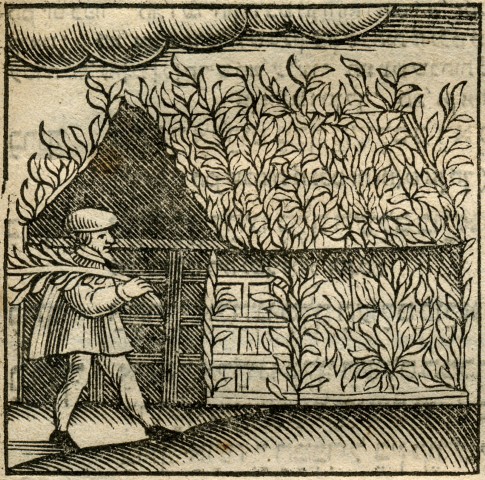
Sukkot: Temporary and Permeable

Everything in life is temporary, including life itself.

The annual festival of Sukkot was once a pilgrimage to the temple to celebrate the harvest.  Since the second temple in Jerusalem was destroyed in 70 C.E., Sukkot has centered around this instruction in the Torah:

“Sukkot Customs”, 1662

In the sukkot you shall live seven days; all the citizens of Israel shall live in the sukkot, so that your generations will know that I made the children of Israel live in the sukkot when I brought them out from the land of Egypt.  (Leviticus/Vayikra 23:42-43)

sukkot  (סֻּכֹּֽת) = huts, temporary shelters constructed in fields during harvest (often translated as “booths”).  Singular: sukkah (סֻּכַּה).

The Sukkah

This week many Jews are eating meals and spending time in their sukkot.  A ritual sukkah must be a temporary structure.  While it can be attached to a wall of one’s house, it must also have temporary walls and a temporary roof.  The roof must also be permeable, made of plant materials such as branches or reeds—materials that leave gaps big enough to let in both rain and starlight.  One cannot seal oneself off from the world in a sukkah; the outside world is always coming in.

The Mishkan

The sukkah reminds me of another temporary dwelling-place in the Torah:

And let them make for me a holy place, and I will dwell in their midst.  Like everything that I am showing you, the pattern of the mishkan and the pattern of its furnishings, thus you shall make it.  (Exodus/Shemot 25:8-9)

mishkan (מִּשְׁכָּן) = dwelling-place, home.  (From the root verb shakan = stay, dwell, inhabit.)

Every time the Israelites camp in the Torah, the priests and Levites assemble all the pieces of the mishkan to rebuild the sanctuary.  Then when the Israelites move on, the Levites disassemble all the pieces and carry them on the journey through the wilderness.  The mishkan, the holy place where the presence of God dwells, is both temporary and portable.

Divine cloud rising from mishkan (artist unknown)

It is also permeable, but in the opposite direction from a sukkah.  Rain and light from outside a sukkah penetrate its roof and come inside. The mishkan has cloud by day and fire by night inside it, from the divine presence in its inner chamber. The cloud and fire inside penetrate the roof and appear outside, above the mishkan where people outside the sanctuary can see the divine manifestation.

Inside and Out

When we assemble a sukkah, it’s not only a dwelling-place for us, but also a mishkan for God.  In kabbalah, the aspect of God that dwells here in this world is the Shechinah, a feminine form of the noun for “dweller, inhabitant” (from the same root as mishkan).  As we sit in the sukkah, we invite God in, along with the rain and starlight.  And God dwells “in our midst”, inside us.  It is a mitzvah, a good deed, to invite other people to join you in your sukkah.  I can imagine this fellowship in a fragile structure radiating goodwill out to the world.

Like the mishkan, a sukkah is temporary.  Sitting in a temporary shelter can remind us that we are temporary visitors in our world.  Humans get attached to things; we crave permanence.  Yet in the Torah, the Israelites escape the slavery of Egypt and live in the wilderness for 40 years in tents, moving on whenever God’s pillar of cloud and fire lifts from the mishkan.

A sukkah is a reminder that we have the power to become free from attachments to material things, even from attachments to our homes and our familiar lives.  We can find shelter wherever we go.  Sometimes it’s hard to step out from under our solid roofs, but we can do it.

Sukkot is also called “The Season of our Rejoicing”.  May we all rejoice, knowing that everything in our lives is temporary and permeable—and knowing that accepting this fact of life brings us inner freedom.

Ha-azinu & Vezot Habrakhah: Upright, Devious, and Struggling

Would you like to belong to a group called the God-Strugglers? What about the Heel-Grabbers? Or the Upright-Ones?

Yisra-el (“Israel” in English) is the most common name in the Hebrew Bible for the people that God and Moses lead out of Egypt, instruct on God’s laws, and bring to the land of Canaan. Occasionally the bible also refers to the people as Ya-akov (“Jacob” in English), and a few times as Yeshurun (“Jeshurun” in English).

Yisra-el (יִשְׂרָאֵל) = He struggles with God. (Yisar, יִשַׂר = he struggles, he contends + eil, אֵל = god.)

Ya-akov (יַעַקֺב) = He grabs a heel; he supplants; he takes advantage. (From the root verb akav, עָקַב = grasp by the heel; cheat)

Yeshurun (יְשֻׁרוּן) = Upright ones; those on the level, straight, honest, law-abiding. (From the root verb yashar, יָשַׁר= be upright, be straight, be level.)

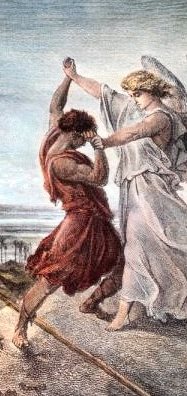
Jacob Wrestling with an Angel, by James Tissot, ca. 1900

Yisrael and Ya-akov are the two names of the patriarch in the book of Genesis who fathers the twelve sons whose names become the names of the twelve tribes. His first name, Ya-akov, refers to his devious efforts to pull down his brother Esau and replace him as the “firstborn” who will inherit not only twice as much wealth, but also God’s blessing and covenant. Ya-akov wins a second name, Yisrael, after wrestling all night with an angel of God, refusing to let go until the angel blesses him.

I find it significant that the Hebrew Bible does not call the twelve tribes after Abraham, or Isaac, but after the patriarch who began his career as a deceitful heel, and had to struggle with God to become the legitimate conduit for the divine covenant. At the end of the book of Genesis, Jacob-Israel is more straightforward and law-abiding than at the beginning of his story, but still far from perfect.

The name Yeshurun appears in the Torah for the first time in the long poem of Ha-azinu (“Use your ears”), the portion we read this Saturday, between Rosh Hashanah and Yom Kippur. Purportedly a prophecy written by Moses, the poem describes how after Moses has died and the Israelites have conquered and settled Canaan, God made them prosperous, but then they forgot the source of their wealth.

…[God] suckled them with honey from a rock,

And oil from a flinty boulder,

Sour cream from cattle and cream from sheep,

With the fat of lambs, and rams from Bashan, and he-goats,

With the fat of kernels of wheat,

And the blood of the grape you drink fermented.

And Yeshurun fattened, and it kicked;

You fattened, you became thick, you became gorged,

And abandoned the god who made him,

Dismissed as foolish the Rock who rescued him. (Deuteronomy/Devarim 32:13-15)

The ingrates in this poem are anything but upright.  16th-century rabbi Obadiah Sforno explained that the Israelites kicked like an animal that kicks the person feeding it. Their love of material pleasures, indicated by the rich foods, made them too “thick” to understand subtle truths.

19th-century rabbi Samson Raphael Hirsch added that God made the Israelites prosperous in order to show the world that it is possible to enjoy material pleasures and still lead a spiritual and moral life. When you are well-fed, Hirsch wrote, the correct behavior is to be more active and accomplish more. But the people who were supposed to be the Upright-Ones got lazy and fat instead.

In the last Torah portion of Deuteronomy, Vezot Habrakhah (“This is the blessing”), Moses calls the Israelites Yeshurun two more times, just before and just after his poetic prophecies for individual tribes. Here Moses uses the name Yeshurun without irony.

First he recalls the Israelites’ peak moment, when all the tribes gathered at Mount Sinai and pledged themselves to God.

He became king among Yeshurun,

When the heads of the people gathered themselves,

All together, the tribes of Yisra-el. (Deuteronomy 33:4)

Commentators disagree on who “he” is in this verse, Moses or God. According to Rambam (12th-century rabbi Moses Maimonides), the Israelites honored Moses like a king. This would make Moses the head of the Upright Ones. But according to the Talmud, the Israelites accepted God as their king. This would make them the Upright Ones who unite to obey God’s laws (even though it is a struggle, yisra, to serve the divine king).

After giving prophecies for individual tribes, Moses makes another positive statement about the Israelites as a whole.

There is none like the god of Yeshurun,

Riding through heavens as your rescuer,

…And Yisra-el will dwell in safety,

The well of Ya-akov left alone. (Deuteronomy 33:26, 33:28)

Ultimately, God will help the people, even though sometimes they are upright, sometimes struggling for God’s blessing, and sometimes they are devious supplanters.

After these three uses of Yeshurun at the end of Deuteronomy, the name occurs only once again in the whole Hebrew Bible:

Thus says God, your maker and your shaper,

Who helps you from the womb on:

Do not fear, My servant Ya-akov,

And Yeshurun whom I have chosen. (Isaiah 44:2)

I think Isaiah means that the descendants of Ya-akov, who grabbed his brother’s heel and used devious means to supplant him, need not fear as long as they serve God. If Ya-akov had pursued only the firstborn’s double portion of wealth, God would not have helped him. But since Ya-akov also pursued the firstborn’s blessing of the covenant with God, God gave him more chances to make good.

And Yeshurun, the upright ones, need not fear as long as they live up to the role God chose for them: to be the model of a nation that obeys God’s laws.


Do you identify with the God-Struggler (Yisra-el), the Heel-Grabber (Ya-akov), or the Upright One (Yeshurun)? Or perhaps a fourth name?

Personally, my default is to be law-abiding, probably because I grew up feeling the safest when I went unnoticed. That kind of uprightness is hardly a great model. Fortunately I also have a stubborn moral sense, so when I discover I have accidentally done something that might be devious, I rush to make amends. I do not want to be a heel-grabber, even when that seems to be the only means to a good end.

I think my highest self is a god-struggler, wrestling with the question of what God is, and how I can have at least a relationship, if not a covenant, with this mystery called God.

And I pray that all humans may find the names that they need to grow into.

Haftarah for Ki Tavo–Isaiah: Rise and Shine

I was an alto before I was a Jew. I first sang Handel’s “Messiah” in my high school choir. Now, 27 years after my conversion, I still enjoy Handel’s music, and I still do not take the words seriously. But when you sing words, you remember them.

This week I read the Torah portion, Ki Tavo, and then turned to the haftarah, the passage from the Prophets/Neviyim that is traditionally chanted after the Torah portion at the morning Shabbat service. I glanced at the first line in Hebrew, and I immediately sang:

handel-1

Arise, shine, for thy light has come! (Isaiah 60:1)

This King James Bible translation accurately captures one possible meaning of the Hebrew. But the “Messiah” uses the line for an entirely different purpose than the book of Isaiah. Handel’s friend Charles Jennens, who provided the libretto for the oratorio, was a devout Anglican who wanted to tell a story of Jesus’ life in terms of direct divine intervention in human affairs. So he cut and pasted verses from all over the King James Bible and the Common Book of Prayer to make his point.

Jennens took many lines out of context from the book of Isaiah. At the beginning of the “Messiah”, after setting the scene, he put in a line from the King James version of Isaiah: Behold, a virgin shall conceive and bear a son, and shall call His name Emmanuel: God with us.

This line is now notorious as a bad Hebrew translation. A more accurate translation would be: Behold (or Hey!), the young woman is pregnant and is giving birth to a son; may she call his name Immanu-El (with us God). (Isaiah 7:14)

There is no virgin birth in the original Hebrew, and the young woman is already pregnant. There is no indication here or in the rest of Isaiah that this line has anything to do with the birth of someone called Jesus about 700 years later.

But by using this quote from the King James Bible, Jennens established that the “Messiah” was going to be about Jesus. He proceeded with another out-of-context quote from Isaiah: O thou that tellest good tidings to Zion …say unto the cities of Judah, behold your god! (Isaiah 40:9)

Then Jennens goes directly to the verse at the beginning of this week’s haftarah. The King James translation is: Arise, shine, for thy light is come, and the glory of the Lord is risen upon thee.

Here is my own translation:

Arise! Shine! For your light ba,

And the kavod of God dawns over you. (Isaiah 60:1)

ba = come, has come, is coming

kavod = glory, honor, dazzling splendor, awesome presence

In the “Messiah”, Jennens uncharacteristically chose to follow up Isaiah 60:1 with the next two verses, Isaiah 60:2-3. A solo bass sings the King James version: For behold, darkness shall cover the earth, and gross darkness the people; but the Lord shall arise upon thee, and His glory shall be seen upon thee. And the Gentiles shall come to thy light, and kings to the brightness of thy rising.

Here is my translation from the Hebrew:

For hey! the darkness will cover the earth

And the gloom the peoples;

But God will dawn upon you

And Its kavod will appear over you.

And the nations will walk to your light

And kings to a gleam of your dawn. (Isaiah 60:2-3)

What is the light that either came or is coming? And who is “you”?

These three verses connect “light” with God’s glory. In the previous two chapters of Isaiah, the Israelites who live in exile in Babylonia have been groping in the darkness of ignorance, wondering how to find their god. So “light” may mean both enlightenment and God’s close approach.

The “you” (and all the verbs) in the verses above are in the feminine singular, but no female human is mentioned. “The people” and “God” (and “Jesus”!) would all take the masculine form. However, most place-names in the Torah are feminine. The subject whose light will attract the tribute of many nations is finally named in 60:14: And they will call you City of God, Zion of the Holy One of Israel.

Zion (pronounced Tziyon in Hebrew) is a synonym for Jerusalem. Scholars date the second half of the book of Isaiah (chapters 40-66) to about 550-515 B.C.E., around the time when the Persian king Cyrus  gave the Jews in exile permission to return to Jerusalem and rebuild their temple. The poet in Isaiah chapter 60 apparently rejoiced that Zion’s people and religion were rising again, and hoped that the religion would spread as more and more nations “saw the light”.

So in the 6th century B.C.E., the book of Isaiah saw the rebuilding of Jerusalem as the dawn of an era in which belief in the god of Israel would become universal. In the 18th century C.E., the librettist of Handel’s “Messiah” connected the dawning of God’s light with the birth of Jesus, heralding the new religion of Christianity. Meanwhile, for the last 2,000 years or so, Isaiah 60:1-22 has been the “sixth haftarah of consolation” of Jews; we read it during the sixth week after Tisha B’Av, the day of mourning for the fall of the first and second temples in Jerusalem.

Can this haftarah from Isaiah, which is so hopeful about the rebuilding of the temple, still console us for the fall of both temples in Jerusalem? Personally, I am glad that for the last 2,000 years we have been seeking God through prayer instead of through animal offerings at a temple.  But I am still waiting for enlightenment to dawn over Zion.

Meanwhile, I can use a message of hope during this introspective month of Elul, when Jews are asked to prepare for Yom Kippur by reviewing the past year and acknowledging their misdeeds. As Rabbi Shoshana Dworsky pointed out, it is easy for a woman to take the first few verses of this haftarah personally, since all the language is in the feminine singular! What if the poem is addressing me, as I wonder how I will ever outgrow the shortcomings in my character that I am pondering this month?

Maybe my light is coming, and soon I will arise and shine.

Ki Teitzei: Captive Soul

detail of Rachel weeping in Massacre of the Innocents, by Francois-Joseph Navez, 1824

When you go out to battle against your enemies, and God, your god, gives [one of them] into your hand, and you capture captives from him; and you see among the captives a woman who is yefat to-ar, and you desire her, then you may take her for a wife. (Deuteronomy 21:10-11)

yefat to-ar = beautiful of form, shapely, attractive.

yefat (יְפַת) = beautiful of.

to-ar (תֺּא) = form, shape.

This week’s Torah portion, Ki Teitzei (“When you go out”), opens with a standard situation in war: the men on the winning side of a battle take all the losers’ possessions, including their women.  In other Torah portions, the enemy’s women are merely listed as part of the booty; their fate is not addressed until the portion Ki Teitzei.

The implication in the passage above is that the Israelite soldiers will restrain themselves from raping most captive women, but a woman who has a beautiful shape is a special case.

The Hebrew bible describes three people besides the captive woman as yefat to-ar (feminine) or yefeh to-ar (masculine): Rachel, Jacob, and Esther.  Rachel’s beauty in the book of Genesis/Bereishit makes Jacob fall in love at first sight and labor for 14 years in order to marry her.  When her son Joseph is serving as Potifar’s steward in Egypt, his beauty makes his master’s wife lust after him so much that she grabs his clothing to pull him down.  Esther’s beauty in the book of Esther makes the king of Persia fall for her and crown her as his queen.

Clearly if you are yefat to-ar, your body is bound to inspire someone with extreme desire. Perhaps that is why this week’s Torah portion does not ask Israelite soldiers to refrain altogether from sex with the enemy’s women. But it does raise the bar for a man who desires a shapely captive. Instead of (or according to some commentators, in addition to) raping her in the field, he must bring her home.

You shall bring her into the midst of your household, and she shall shave her head, and she shall do her nails. And she shall remove the cloak of her captivity from herself, and she shall sit in your house, and she shall weep for her father and her mother for a month of days. After this, you may come into her and become her husband, and she will be your wife. But it happens that you do not want her [any more], then you shall send her out as her own nefesh. You shall certainly not sell her for silver, nor shall you take advantage of her, inasmuch as you violated her. (Deuteronomy 21:12-14)

nefesh = soul, person, individual; appetite. (In post-Biblical Jewish writings, the nefesh is the level of soul that animates the body.)

By bringing the captive woman into his household, and exchanging her captive’s cloak for ordinary clothes, the man publicly changes her status from war booty to prospective wife.  Next, she gets a full month to mourn for her old home and family, by shaving her head (a common mourning practice in the Hebrew bible), trimming her nails, and weeping.  During this month, the man is forbidden to molest her.  The month of mourning grants the woman a measure of human dignity.

At the end of the month, the man chooses whether to espouse her or to send her away free.  Being a woman, the former captive does not have the right to negotiate her own marriage.  Nevertheless, she now has as much status as an Israelite woman with no father; she is either married or free, not a slave.

On a literal level, the law of the captive woman teaches men to restrain their sexual desires and reserve sex for responsible and committed relationships.  It also teaches men to choose their partners after a period of consideration, rather than in the first heat of physical passion.

But the Chassidic rabbis of the 17th-19th centuries found other levels of meaning in the passage about the captive woman. The one that speaks to me this year comes from 18th-century Rabbi Schnuer Zalman of Liadi (with some interpretation by Rabbi Zalman Schacter-Sholomi).  Schnuer Zalman saw the Israelite soldier as the conscious ego, and the captive woman as the nefesh, the level of soul that animates our bodies.  He called this the “animal soul” because it is the seat of physical desires.

The nefesh is held captive not by the body itself, but by the limited perspective of our physical desires and aversions, and by the compulsions of our bad habits.  The nefesh is a “woman of beautiful form” because, despite its captivity, it expresses some of the beauty of the neshamah, the divine level of soul that transcends the physical world.

When your conscious self longs to connect with the beauty of the divine, you have to free your nefesh from its captivity, so it can become a clear vessel for your divine neshamah.  According to Schnuer Zalman, the way to do this is to shave its head and cut its nails—that is, to renounce physical desires for the sake of spiritual desires.

This year, my rational mind knows my body would benefit from a weight-loss diet.  Another part of me craves comfort food. Now I wonder if my craving for comfort food is a bad habit that grew because of the limited perspective of my “animal soul”.  My nefesh is short-sighted enough to prefer feeling better right now over restraining myself for the sake of a distant future benefit.  Now the bad habit holds my nefesh captive.  According to Rabbi Schneur Zalman, I should renounce my physical desires in order to elevate my nefesh.

But I do not want to renounce ALL of my physical desires.  After all, some of them are good for my body, nefesh, and neshamah.  For example, sometimes I feel the urge to stretch, take a walk, kiss my husband, or eat green beans and mint from my garden.  These are good desires, since acting on them results in joy and gratitude for the gifts of the universe.

Can I renounce only one physical desire: the craving for comfort food?

I have never been able to stick to a diet I undertake for the sake of my body.  But what if I dieted for the sake of my soul?

My heartfelt impulse is to give the captive woman in this week’s Torah portion a safe home and a position of dignity, respect, and freedom.  Maybe I can see my own nefesh as a captive who is being enslaved by my bad habit.  If I intervene, will God give me the strength to rescue my soul and give it a good home?

Re-eih: The Right Place

The first four books of the Torah describe two kinds of encounters with God. One is having a conversation with God, or God’s “angel”. The other is going through a ritual to rededicate yourself to God. The ritual of choice was the animal sacrifice.

In the book of Genesis/Bereishit, Abraham, Isaac, and Jacob built altars for animal sacrifices in several places: Shekhem, Mount Moriyah (said to be the site of Jerusalem), Beersheva, Hebron/Chevron, Beit-El, and a spot between Beit-El and Aiy (probably the site later named Shiloh). Modern scholars have established that these places were also sites for Canaanite religious ritual. Perhaps they struck people as particularly good spots for numinous experiences.

In the book of Exodus/Shemot, Moses built an altar at the site of the Israelites’ first battle, in which they defeated Amalek; and his father-in-law carried out an animal sacrifice at the foot of Mount Sinai. But when Moses spent his first 40 days at the top of  Mount Sinai, God gave him lengthy instructions for building a portable sanctuary as a dwelling place (mishkan) for God, with the ark in the innermost chamber, and the altar for animal and grain offerings in the outer enclosure. This sanctuary could be dismantled, moved, and re-erected, so once the Israelites had made all the parts, they did their ritual offerings only at its altar, no matter where they were camping in the wilderness. The priests—at this point, Aaron and his sons—became necessary for all rituals.

But what would happen after the Israelites entered Canaan and settled down in scattered villages and towns? Would the head of every household build his own altar and lead his own rituals again?

The book of Deuteronomy/Devarim says no in this week’s Torah portion, Re-eih (“See!”). The first step is to banish any possibility of worshiping the God of Israel at any Canaanite religious sites.

You must utterly obliterate every makom where the nations that you are dispossessing serve their gods: upon the mountains, the high places, and upon the hills, and under every luxuriant tree. You must break up their altars and shatter their standing-stones and burn their tree-goddesses in fire and chop down the statues of their gods; and you must obliterate their sheim from that makom. (Deuteronomy/Devarim 12:2-3)

makom (מָקוֹם) = place; sacred place; religious site.

sheim (שְׁמָם) = name, reputation, standing.

Moses has told the Israelites many times to destroy all the religious items of the natives when they conquer Canaan. Now he also tells them to obliterate the places themselves. No longer can a Canaanite site be used to make offerings to the God of Israel.

You must not do thus for God, your god. Rather, you must seek out and come to the makom which God, your god, chooses out of all your tribes [tribal territories] to set Its sheim there, for it to dwell in. (Deuteronomy 12:4-5)

It will be the makom that God, your god, will choose for the dwelling of Its sheim. There you shall bring everything that I command you: your elevation-offerings and your slaughter-offerings and your tithes and the donation of your hands and all your choice vow-offerings that you vow to God. And you shall rejoice before God, your god, you and your sons and your daughters and your manservants and your maidservants … (Deuteronomy 12:11-12)

God Itself will not dwell in the single chosen place, only God’s name. This abstraction distinguishes the Israelite religion from the Canaanite belief that gods can inhabit wood and stone images.

Deuteronomy never says which place God will choose. Judging by the rest of the Hebrew Bible,  the Children of Israel alternated between short periods when there was no single makom and people constructed other altars at will; and long periods when all offerings were brought to a central sanctuary where priests conducted the rituals.

For the first 14 years after the Israelites cross the Jordan in the book of Joshua, the portable sanctuary with its altar and ark stayed in Gilgal, and the Israelites were free to set up their own altars to God elsewhere. Then Joshua assembled everyone to erect the portable sanctuary at Shiloh (possibly on the site of one of Abraham’s altars), in the territory of the northern tribe of Efrayim. Over time the sanctuary acquired stone walls and wooden doors, though its roof remained a tent woven out of goat-hair.

For 369 years Shiloh was one and only place to bring offerings. Its last high priest was Eli, who died when the city fell to the Philistines in the first book of Samuel. The Philistine army captured the ark, then returned it to Israelite territory seven months later. While the ark was kept in a private house in the Israelite town of Kiryat-Ye-arim, there were national altars in Nov and Giveon, but for 57 years individuals are allowed to build their own altars as well. Individual altars were prohibited again only after King Solomon built the temple in Jerusalem and put the official altar and the ark in the same enclosure once more.

This week’s Torah portion describes the three pilgrimage festivals, Pesach, Shavuot, and Sukkot, when everyone must travel to the central place of worship to make offerings, pay tithes, feast, and celebrate. Since the Israelites are settled all over the former land of Canaan, the journey to Shiloh or Jerusalem takes from one to several days for most people.

Re-eih gives no instructions for what a man should do in between festivals if he wants to ritually rededicate himself to God because he has done something wrong, or because he is full of gratitude and generosity, or because he just wants to be closer to God. Should he travel all the way to the temple? Or is there another way?

The modern biblical scholar James Kugel argues that Deuteronomy promotes serving God by obeying all the laws passed down by Moses, instead of by making offerings at an altar. Being conscientious about obeying all of God’s laws will naturally lead people to be loyal to God and cling to God with love.

After the fall of the second temple in Jerusalem in 70 CE, Rabbinic Judaism substituted prayer for offerings at an altar. But they continued to emphasize the importance of following both the rules in the Torah and the additional rules determined by the rabbis in the Talmud.

Today, many Jews (including myself) pick and choose which of the rules are really important and worth following. When we want to rededicate ourselves to God, we either go through a ritual with our own congregation, or we pray passionately, hoping to make a connection. Unless we are in Jerusalem, the idea of traveling to a single holy place for all our religious rituals can seem irrelevant and outdated.

Yet the 19th-century Chassidic rabbi Yehudah Leib Alter of Ger wrote in Sefat Emet that “darash  and come to the makom” means we should seek out the places, times, and souls in which holiness is revealed. They are where we can find God, and rededicate ourselves to holiness.

I believe an important caveat to this approach is that we must not unthinkingly adopt the holy places of others. Each individual must inquire whether a place, a community, a ritual, or even a time, is truly holy enough to succeed in reconnecting them with God, rededicating themselves to God. If something is lacking, the individual must keep on seeking for the makom where God’s name dwells.

This means there are multiple holy places—but I believe individual “altars” are not enough; a human being who yearns for the divine also needs a central place of worship. A numinous spot out in the woods can be a makom for silent connection between an individual and the divine. Yet in order to sustain our dedication to God and to the path of becoming holy, we need to find a makom in a community, with set times for prayer and ritual.

It may take a long journey to get there.

Eikev: 40 Days and 40 Nights

Moses spends most of the book of Deuteronomy/Devarim reminding the Israelites that for 40 years they have been rebelling against God and provoking God to anger. For 40 years Moses has been urging the people to change their ways and urging God not to wipe them out. After Moses dies and the people enter the Promised Land, he warns, he can no longer intercede for them.

In the middle of another harangue in this week’s Torah portion, Eikev (“on the heels of”), Moses is seized by a visceral memory from 40 years before.

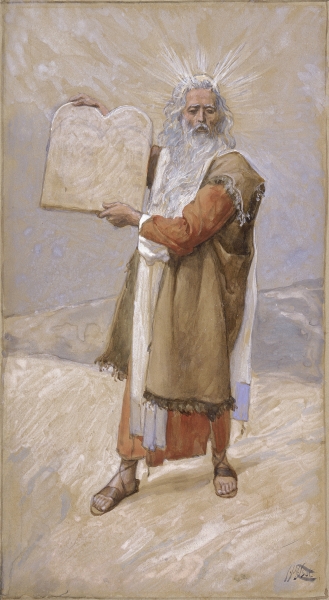
Moses and the Ten Commandments, by James J.J. Tissot, 1896

In Choreiv you provoked God, and God became furious enough to exterminate you. When I went up to the mountain to take the stone tablets of the covenant that God had cut with you, and I stayed on the mountain 40 days and 40 nights—bread  I did not eat and water I did not drink. Then God gave me the two stone tablets written by the finger of God, and on them were all the words that God had spoken with you on the mountain from the midst of the fire on the day of the assembly. And it happened at the end of 40 days and 40 nights, God gave me the two stone tablets, the tablets of the covenant. (Deuteronomy/Devarim 9:8-11)

Choreiv = dryness, drought; an alternate name for Sinai.

Moses does not mention the reams of information God gave him during those 40 days, according to the book of Exodus/Shemot: hundreds of laws, and instructions for making a portable sanctuary. What sticks in his memory—so much that he says it twice—is receiving the stone tablets after spending 40 days and 40 nights on the mountaintop with God.

The Torah often uses “40 days” or “40 years” to mean “a long time”. But the phrase “40 days and 40 nights” appears in only four stories: Noah and the flood in Genesis; Moses’ two long stints on Mount Sinai in Exodus; Moses’ recollection of that time in this week’s Torah portion in Deuteronomy; and the prophet Elijah’s stay in a cave on Mount Choreiv in Kings I.

In all of these passages, if something happens for 40 days and 40 nights, it is removed from the ordinary world.

On the last night of Moses’ first 40 days and nights on the mountaintop, God gives him the tablets. Then God tells him to hurry back down, because the Israelites have made themselves a cast-metal idol, a golden calf. In both the book of Exodus and Moses’ recollection 40 years later, God offers to wipe out those no-good Israelites and choose Moses’ descendants instead.

And God said to me: “I have seen this people, and look, it is a stiff-necked people. Leave me alone, and I will exterminate them and wipe out their name from under the heavens and make you into a greater and mightier nation than they.” (Deuteronomy 9:13-14)

In the Exodus account, Moses picks up on God’s hint and does not leave God alone. Instead, he argues that it would give God a bad reputation if God now killed the people God had personally brought out of Egypt. Only after God relents does Moses go down the mountain.

But 40 years later, Moses does not remember arguing with God. He merely says:

And I turned and came down from the mountain, and the mountain was burning with fire, and the two tablets of the covenant were in my two hands. (Deuteronomy 9:15)

His sensory impressions—the fire on the mountain, the stone tablets in his hands—come back to Moses so vividly that he misses an opportunity to remind the Israelites that he intervened for them again. He only remembers and patches it into his story later.

As Moses tells the story in this week’s Torah portion, he saw the people carousing in front of the golden calf, smashed the stone tablets, then went back up the mountain for another 40-day fast in order to appease God.

I grasped the two tablets and threw them from my two hands and shattered them before your eyes. Then I fell down before God, like the first time, 40 days and 40 nights—bread  I did not eat and water I did not drink—because of all your offense that you committed, doing what was bad in God’s eyes, angering God. (Deuteronomy 9:17-18)

Moses backtracks briefly, remembering that he ground the calf into gold dust. But he does not mention all the other things he did according to Exodus before climbing the mountain again, including ordering the Levites to kill about 3,000 men who worshiped the golden calf, and asking God to either bear with the offending Israelites or erase Moses from God’s book.

What matters to Moses is that he spent another 40 days and 40 nights with God on the mountaintop.

According to Exodus, during that that time Moses saw God’s back, hear God describe Itself, bargained some more, and received more laws. Then God told him to write the words of the Ten Commandments on the stone tablets, which Moses did.

In Deuteronomy, Moses does not mention any of this, not even seeing God’s back! But he repeats three times that he stayed before God on the mountain a second time for 40 days and 40 nights. And in Moses’ memory, he made an ark for the tablets, but God carved the words into the stone.

And God wrote on the tablets, like the first inscription, the Ten Commandments that God spoke to you on the mountain from the midst of the fire on the day of the assembly, and God gave them to me. Then I turned and came down from the mountain, and I put the tablets in the ark that I had made, and they were there, as God had commanded me. (Deuteronomy 10:4-5)

Moses brings up the 40 days and 40 nights one more time before he returns to preaching.

And I, I stood on the mountain, as on the first days, 40 days and 40 nights, and God listened to me this time as well, and God did not want to exterminate you. God said to me: Get up, go on the journey in front of the people… (Deuteronomy 10:10-11)

Moses’ overriding memories of “40 days and 40 nights” and “two stone tablets could be considered a distraction from his point that the Israelites rebelled against God even at Mount Sinai/Choreiv, and Moses kept on interceding for them. Maybe now that he is 120 years old, Moses’ mind is wandering.

Or maybe these are the two most important things in the story after all:

1) The basic rules for human behavior are written in stone. Even if you shatter them, they will return.

2) When you spend 40 days and 40 nights above the world, like Noah in his ark or Moses on the mountain, you may be so high you forget to eat and drink. But God will bring you back down to deal with life on the ground, life with other people.

Haftarat Devarim—Isaiah: Ignoring the Divine

Every weekly Torah portion is paired with a haftarah (“what emerges”), a passage from Prophets/Neviim. For nearly 2,000 years, in traditional Saturday Torah services, the chanting of the haftarah follows the chanting of the Torah portion. This week, Jews read the first Torah portion in the book of Deuteronomy/Devarim, which is also called Devarim (“Words”). The haftarah this week is Isaiah 1:1-27. Both the Torah portion and the haftarah contain the word eykhah, which means “how” as in “Oh, how could this happen?” This is also the opening word of the book of Lamentations, which we read on Tisha Be-Av, the fast day shortly after this Shabbat. (See my post: Devarim, Isaiah, & Lamentations: Desperation.)

All three readings accuse the Israelites of rebellion against God. But Isaiah offers the most hope for change. The Shabbat before Tisha Be-Av is called Shabbat Chazon (Sabbath of Vision) because the book of Isaiah begins with the word chazon (vision or revelation).

The vision of Yeshayahu, son of Amotz, who had vision concerning Judah and Jerusalem … (Isaiah 1:1)

The Hebrew for Isaiah is Yeshayahu, which means “Rescue of God”. Again and again, even as Isaiah points out how despicably the children of Israel are behaving, he promises that eventually God will rescue them.

After the opening sentence, which also dates Isaiah’s prophecies by listing the names of the kings of Judah during his time, Isaiah’s first poem begins:

Listen, heavens, and use [your] ears, earth;

Because God has spoken:

I brought up children, and I made them high,

And they? They rebel against me.

An ox knows his koneh,

And a donkey the feeding-trough of his ba-al.

Israel does not know;

My people do not hitbonan. (Isaiah 1:2-4)

koneh = owner, buyer; creator.

ba-al = master, ruler; local god.

hitbonan = consider. (From the same root as binah = understanding, analysis.)

In these verses, the ox is the most knowledgeable because it recognizes its owner. Next comes the donkey, which recognizes the place where its owner provides nourishment. Last come the Israelites, who do not even recognize that someone is giving them nourishment.

The reverse order applies to the role of God. God, who creates all creatures, is only the creator (an earlier meaning of koneh) as far as the ox is concerned. God is the ba-al, the local god, of the donkey. But when it comes to the children of Israel, God is also like a parent, bringing them up, making them high (superior), and considering them “My people”.

Does this mean that the more God does for someone, the less that creature recognizes God? Not necessarily. The tragedy in these opening verses is that God elevates human beings in general by endowing us with both the intelligence to consider, analyze, and understand, and the desire to distinguish between good and bad. The Israelites, like any people, have the God-given ability to figure out that God is their creator, sustainer, and parent. They also have the ability to feel gratitude, and to choose good behavior. Yet they do not take the trouble to stop and consider any of this.

Isaiah views this willful ignorance not as laziness, but as deliberate denial: They rebel against me. Furthermore, in Isaiah’s view, those who turn their backs on God also turn their backs on ethical behavior. He calls them People heavy with crooked deeds. (Isaiah 1:4)

Willful ignorance is not bliss. Isaiah mourns how much the Israelites have suffered at the hands of the Assyrians, whose attack on the two Israelite kingdoms began around 740 B.C.E. The Assyrians conquered the northern kingdom, and besieged but did not capture Jerusalem, the capital of the southern kingdom of Judah. Isaiah, like most of the prophets, assumes that if the Israelites had been upright and ethical, God would not have permitted their enemies to defeat and burn their cities. Isaiah calls God the God of Armies, including Assyrian armies. He uses God’s complete destruction of Sodom and Gomorrah to remind his audience that God destroys immoral peoples.

If the God of Armies had not left us a few survivors,

We would be like Sodom,

We would resemble Gomorrah. (Isaiah 1:9)

Nevertheless, the surviving Israelites are not doomed. They still have the ability to change, and God still wants them to turn back from evil. Isaiah reports God saying:

Give up doing evil!

Learn to do good!

Seek out the rule of law.

Step on the oppressor.

Get justice for the orphan.

Defend the case of the widow. (Isaiah 1:16-17)

God assures the people that they can, indeed, be redeemed from their immorality, if they pay attention and obey God. Then Isaiah mourns over how far the people of Jerusalem have fallen, beginning with the line: Eykha (Oh, how) has it become a prostitute, [this] faithful city? (Isaiah 1:21)

Nevertheless, at the end of the haftarah, Isaiah says that if the surviving Israelites in Judah (also called Zion) learn to do good, then God will save them.

Zion will be redeemed through lawful justice,

And those who turn back, through righteousness. (Isaiah 1:27)


Isaiah’s poetry calls for the repentance of the people of Judah. But does it address any people today?

Certainly human beings are still endowed with the intelligence to figure out that we did not create ourselves, nor the world that supports us. We might also notice that our elaborate intelligence and our ethical intuitions are extraordinary gifts. Yet like the Israelites of the 8th century B.C.E., we often do not take the trouble to stop and consider.

Someone who does stop and consider today might conclude that human abilities are merely an accidental result of evolution, and have nothing to do with anything that might be called God. For atheists, Isaiah’s claim that turning away from God means turning away from moral behavior makes no sense. When I was an atheist myself, I still felt gratitude for the world and humanity, and I believed that the human condition came with its own ethical imperatives.

Someone with a traditional Jewish or Christian background who stopped to consider might conclude that God is sufficiently anthropomorphic to prefer some types of human behavior over others. Such a person might analyze the Bible as well as the world, and conclude that God prescribes moral behavior such as honoring parents and protecting orphans, and proscribes immoral behavior such as cheating, adultery, and murder. Someone who believes in a somewhat anthropomorphic God, but takes the Bible with a grain of salt, might conclude that God desires whatever human behavior promotes harmony, cooperation, and mutual respect.

What if someone who is neither an atheist nor a believer in a semi-anthropomorphic God stops to consider? My intellectual analysis deduces that God is the condition of “becoming” implied by the four-letter name of God (sometimes written in Roman letters as YHVH) based on the Hebrew verb for “to be” or “to become”. Another part of my mind concludes that the word “God” covers various mysterious forces in the world. I believe God is evolving along with the universe, and our human attitudes and actions affect God’s evolution. If we become more ethical, the forces of God become more ethical.

Does this mean that eventually God will not let the army of one country devastate another country? Maybe so—if God works through the human psyche.

The lesson I draw from the Isaiah’s opening poem is that if we learn to do good as individuals, the whole world will improve. And the first step toward learning to do good is to stop and consider that our existence depends on forces outside our control; and therefore we owe gratitude to other human beings, to the whole universe, and—yes—to God.

Masey & Pinchas: Daughters and Loyalty

As the book of Numbers/Bemidbar comes to an end, the Israelites are camped on the east bank of the Jordan, ready to begin their conquest of Canaan. Moses knows he will die before they cross the river, so he is handing down rules that will only apply after the people settle the new land and switch to a different economy. Instead of being nomads, most of the Israelites will become farmers or ranchers in Canaan. Wealth will be measured in land rather than herds.

Last week I wrote about God’s directions in the Torah portion Pinchas on how to divide up Canaan into hereditary properties—after the Canaanites have been driven off their land. (See Pinchas: Fairness). First Moses takes a census of men aged 20 and older. Every man counted in that census will get a tract of land in Canaan for his household. His land will be in the district of his clan, and his clan’s district will be in the territory allocated to his tribe.

Women, of course, do not count. Ancient Israelite society was patriarchal, and women were dependents. Apart from their personal effects, women’s possessions were nominal. In a marriage contract, any property that a woman’s father assigned to her was passed directly to her husband. If her husband died or divorced her, “her” possessions became the property of her sons. Women did not inherit, and if they were given land, they did not control it. They belonged to the clan and tribe of whichever man supported them, and only men could be leaders in a clan.

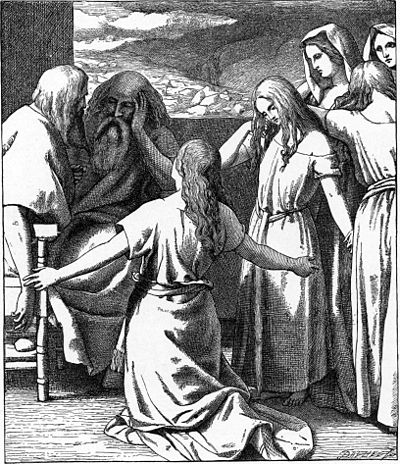
Daughters of Tzelofchad, print after Frederick R. Pickersgill, by Dalziel Brothers, Charles Foster Bible 1897

Yet in the Torah portion Pinchas, five women take a bold and independent action. The daughters of Tzelofchad come to Moses and the assembly of all-male leaders at the entrance of the Tent of Meeting. They ask for the property that would have gone to their father, if he had lived long enough to be counted in Moses’ census.

Why should the name of our father be removed from his family because he had no son? Give us property amidst the brothers of our father.” (Numbers/Bemidbar 27:4)

The women are careful to ask for property not for their own sake, but in order to perpetuate their father’s name. Moses checks with God, who replies:

“Rightly the daughters of Tzelofchad speak; you shall certainly give them possession of a hereditary property amidst the brothers of their father, and you shall make the property of their father pass over to them. And you shall speak to the children of Israel, saying: If a man dies and has no son, then you shall make his property pass over to his daughters.” (Numbers 27:7-8)

God’s answer promotes women from chattels to second-class citizens who can inherit land—but only if their father dies without sons. This solution rescues women who would otherwise be dependent on the goodwill of distant male relatives. The Torah never praises independence, but it does praise compassion for the unfortunate, and a woman without a father, husband, brother, or son to support her is considered unfortunate. A side-effect of the new law was that a daughter who inherited and remained unmarried would have a financial independence no other women possessed. But the Torah assumes all women marry and try to have sons.

This assumption raises an issue about the daughters of Tzelofchad in this week’s double Torah portion, at the end of Masey (“Journeys”). The heads of other clans in the Gilad branch of the tribe of Menasheh come to Moses and say:

“God commanded my lord to give the land, by lot, as hereditary property for the children of Israel; and my lord was commanded by God to give the property of Tzelofchad, our brother, to his daughters. But if they become wives to any of the sons of the [other] tribes of the children of Israel, then their property will be removed from the property of our fathers, and it will be added onto the property of the tribe that they will belong to; so it will be removed from our allotted property.” (Numbers 36:2-3)

In other words, if a daughter who inherited land married a man from another tribe, then she and her land would automatically become her husband’s property—and therefore the property of her husband’s tribe. These men identify strongly with their own tribe, Menasheh, and with the Gilad branch of the tribe. Any reduction in the amount of land under the control of the Gilad clans of Menasheh seems like a personal loss to them.

Moses approves of their sentiment. He does not stop to check with God this time, but he answers the men in God’s name.

“This is the word that God commanded for the daughters of Tzelofchad, saying: They may become wives to whoever is good in their eyes; yet only within the clan of the tribe of their father they shall become wives. And landed property shall not go around for the children of Israel from tribe to tribe, for each man shall daveik to the landed property of the tribe of his fathers. And every daughter coming into possession of landed property from the tribes of the children of Israel, she shall become a wife to someone from the clan of the tribe of her father, so that each of the children of Israel shall possess the landed property of his fathers.” (Numbers 36:6-7)

daveik  = cling to, stick to, be attached to; catch up with

The idea of clinging to your ancestral land is so important that Moses repeats it.

“The property will not go around from one tribe to another tribe, because each man shall daveik to his hereditary property in the tribes of the children of Israel.” (Numbers 36:9)

The Hebrew Bible uses the verb daveik when physical things stick to each other, and when one person pursues and overtakes another. But daveik is also used when one person is devoted to another, and when it sets out the ideal that the Israelites should cling to God with loyal devotion. The only time the Bible uses a form of daveik to indicate a person’s attachment to land is in Numbers 36:7 and 36:9, translated above. But land here is not just real estate; it is the expression of family lineage and tribal loyalty.

Conquering Canaan could, theoretically, be an opportunity for the tribes of Israel to unite and become truly one people (as the thirteen colonies became the United States of America). However, the Torah tells men to cling to the property they inherit from their fathers, and to the territory of their tribe. Why?

My theory is that instead of viewing tribal loyalty as a threat to national loyalty, the way many nations do today, the Torah views tribal loyalty as good practice for for national loyalty. The more you cling to one thing, the more you become able to cling to something else.

Most of all, Moses repeats that everyone must love God. But does practicing  passionate attachment to another person, to a tribe, or to a country, make it easier to love God?

I grew up in an atheist household in 20th-century America. I have always valued independence more than loyalty. I love my husband and my son, and give them my passionate allegiance. But I have never been interested in loyalty to my ancestry, or hometown, or school, or state, or country. I grew fond of several of the houses and yards where I have lived, but I still moved and sold the property to strangers. Maybe I have not practiced attachment enough, and that is why I find it hard to become attached to God.

In the Torah, many of the Israelites wandering in the wilderness also find it hard to cling devoutly to God. The first generation of the exodus from Egypt frequently complains about the food and expresses a desire to abandon God and return to Egypt. When Moabites invite the second generation to worship Baal-Peor, most of the men quickly abandon any loyalty to their own god. (See my earlier post, Balak: Carnal Appetites.)  No wonder Moses encourages them to practice passionate loyalty, if only to their families and tribes!

If you have not practiced a lot of clinging, is there any other way to develop a love for God? In Chassidic Judaism of the last two centuries, a key aspiration is deveikut, attachment or clinging to God. The Chassidic masters recommended developing deveikut through personal prayer, meditation, and intention (though it also helps to learn from a wise rabbi).

But first a modern, independent person without a religious upbringing must decide whether deveikut is even desirable. And that includes figuring out what it is that we are calling “God”.

I wonder if my life would be easier if I had inherited my religion and my god. On the other hand, a good life is not necessarily easy.

Pinchas: Fairness

Children passionately want life to be fair. For the sake of fairness, they can even be persuaded to share their possessions. But if a young child is the victim of unfairness, prepare for a tantrum.

Adults know that life is not fair. People in power are biased, and bad luck happens. Nevertheless, most of us feel bitter when we do all the right things, and still get the short end of the stick.

When is the distribution of benefits “fair”?  Merriam-Webster’s dictionary gives two possible answers: when the distributor is impartial, i.e. free from self-interest, prejudice, or favoritism; or when everyone is given their due according to established rules.

Unfairness to Canaanites

This week’s Torah portion, Pinchas, looks ahead to how the land of Canaan will be distributed after the Israelites have conquered it by killing or subjugating the Canaanites. The question of fairness to the indigenous Canaanites never comes up in the Torah. Over and over again, from the book of Genesis/Bereishit through the conquest of the land in the book of Joshua, we read that God is giving the land of Canaan to the children of Israel. And what God wants trumps any human notion of fairness. Although later Jewish writings paint the Canaanites as evil perverts, the only objection to Canaanites in the Torah itself is that they worship different gods.

Fairness among Israelites

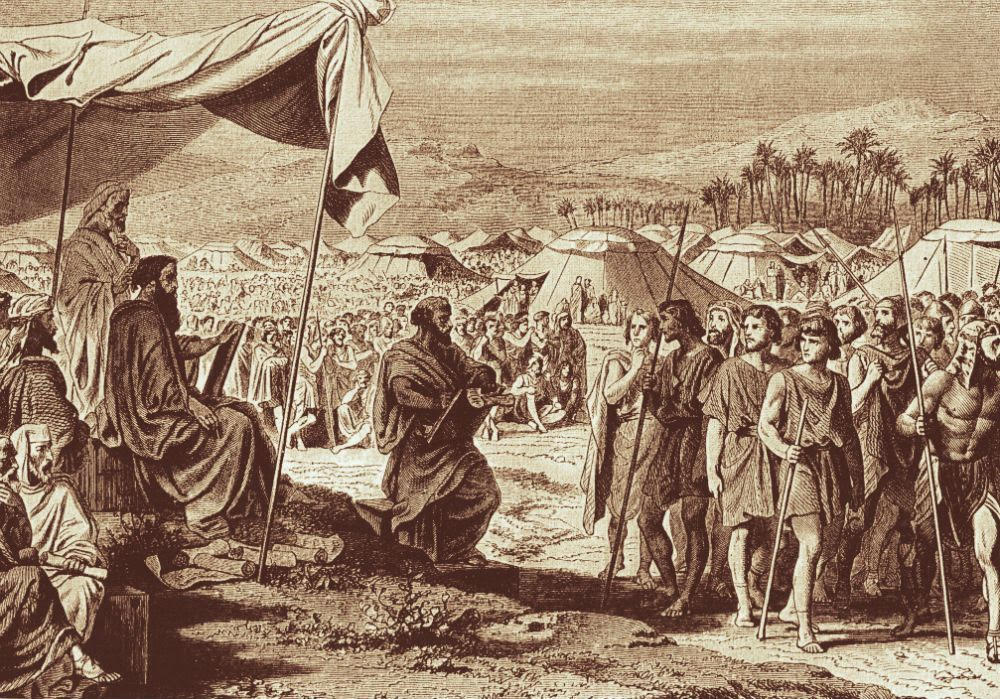
Numbering of the Israelites, by H.F.E. Philippoteaux,
19th century

In this week’s Torah portion, God prescribes how the land the Israelites are about to conquer should be divided among themselves. The first step is to take a census of men aged 20 and older. The census serves both as a mustering of eligible fighters for the upcoming conquest, and as a count of the households that will own plots of land once Canaan has been conquered.

The census of adult men raises two questions: What about women? And why should the land be divided according to the current population on the banks of the Jordan, rather than the previous generation, or the next generation? The Torah addresses these issues in the story of the daughters of Tzelofchad, which begins in the portion Pinchas and resumes in the portion Masey. I plan to examine that two-part story in next week’s blog post.

Right or wrong, the census clearly defines the in-group for the distribution of land: male heads of households. The next step is to divide the land fairly among the tribes of the in-group.

This is the census of the sons of  Israel: 601,730. Then God spoke to Moses, saying: “For these the land shall be divided as a nachal, by the account of names. The abundant [tribe] will have an abundant nachal, and the scanty [tribe] will have a scanty nachal; each one shall be given its nachal according to the bidding of the census. Yet the land shall be divided according to the bidding of a lottery; nachal [will be assigned] to the names of the tribes of their fathers.  According to the bidding of the lottery you shall divide [land] among the abundant [tribes] and the scanty [tribes], giving each its nachal.” (Numbers/Bemidbar 25:51-55)

nachal (נָחַל)=a permanent possession to pass on as an inheritance; a hereditary land-holding.

In other words, each tribe will get a territory proportionate to the number of adult men in the tribe, and tribes will be matched with territories through a lottery. This procedure goes out of its way to achieve fairness. The land will be distributed according to population, and an impartial lottery will match each tribe with its territory. (After that, the leaders of each tribe are to use a similar process to allocate land to individual clans and households.)

According to the Talmud Bavli, tractate Bava Batra 121b-122a, every man in the census will end up with his own plot of land, and all the plots will be equal—not in size, but in value. Where the land is more fertile, the plots will be smaller. This seems fair because each male Israelite head of household, i.e. each member of the in-group, will get his due.

The purpose of the lottery is to make sure this distribution is carried out without favoritism. Later in the Hebrew Bible, lotteries express the will of God, but here a lottery might be merely a randomizing mechanism, as it is today. The choice is left up to blind chance rather than a human decision. A lottery seems to meet the dictionary definition of fairness as impartial distribution, free from self-interest, prejudice, or favoritism.

But there is a catch. Each tribe must get a territory whose total value matches its total count of adult males. And the tribes are different sizes. The tribe with the largest head-count is Yehudah (Judah in English), with a total of 76,500 men. The smallest is Shimon (Simeon in English) with a total of 22,200. In a truly random lottery, the high priest might draw the name Yehudah the same time as the description of a territory that could only support Shimon. Thus the leaders cannot conduct a random lottery and still give each tribe land according to its head-count. Either the land will not be not distributed equally, or the lottery will be rigged.

Fairness versus foreknowledge

The Talmud explained that when the lottery took place, the high priest Elazar already knew which tribe would be matched with which territory, because he was supported by the ruach hakodesh, the holy spirit of God. First he would predict the tribe and its territory. Then he would shake the urn of tribe names and pick one, and shake the urn of land boundaries and pick one. Every time, the two lots matched his prediction (Talmud Bavli, Bava Batra 122a). In other words, the whole lottery was predetermined by God.

Thus God’s orders for land distribution are fair only for the group counted in the census, and only if God is impartial and does not play favorites. The obvious question is: Is God fair?

God wears a human face in the Torah; “He” is an anthropomorphic character who feels emotions such as regret (for creating this world) and rage (every time the Israelites disobey him). Nevertheless, God is the creator of the universe, far greater than any other gods, if they even exist. Sometimes this God character is benevolent. When God tells Moses “His” 13 attributes in Exodus/Shemot 34:6, the list begins with compassion, grace, patience, abundant kindness, and truth. Fairness is not mentioned.

And it is hard to attribute fairness to the god who saves Noah’s family but drowns the rest of the world, including innocent children; or to the god who routinely wipes out thousands of Israelites with plagues that make no distinction between the innocent and the guilty.


Some people still assume that the God character in the Torah is the same being as the theologian’s omnipotent all-benevolent God, and that both are the same as God the Unknowable. After all, the three versions of God all have the same name. It is hard for these people to believe that life is unfair. If God is human enough to care about fairness, and God runs everything in the universe, then why does bad luck strike some people and not others? Surely the unlucky must deserve a worse deal than their luckier neighbors. Otherwise, God would be unfair.

This confusion about God led some Jews to believe that they must have deserved the Holocaust; if only they had been more observant, God would have intervened to prevent it. During the current long recession, some Americans who lose their houses and jobs blame themselves for not working hard enough, or for making the wrong decisions.  It is easier for them to believe they are undeserving than to believe that either God or the American system is unfair.

Other people embrace the reality that life is not fair, and campaign to change the system to make it more fair. Still others view the desire for fairness as childish, and focus on moral values they find less simplistic.

Life is not fair.  What do you want to do about it?