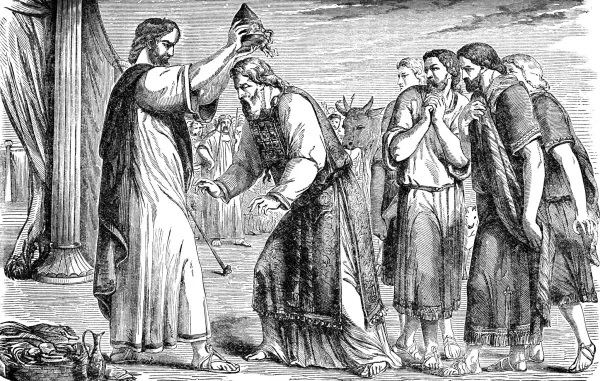
Balak, Pinchas, & Matot: Midianites Revisited

Ten years ago I wrote a post called Balak, Pinchas, & Matot: How Moabites Became Midianites. I received some positive comments, but also some hate mail. I am leaving that post up to remind myself that my writing is not always interpreted the way I intended it.

This week Matot (Numbers 30:2-32:42) arrives again in the annual cycle of Jewish Torah portions, and I want to add another interpretation of the Israelites’ massacre of Midianite women. I also want to re-examine my conclusion in 2015, in which I compared my own unreflective discrimination against Republicans to Moses’ discrimination against Midianites.

Midianites in Moab

Moses first encounters Midianites in the area where archaeologists have confirmed that they actually lived: east of the Gulf of Aqaba (in present-day Saudi Arabia), and north up to and including Timna. In the book of Exodus, Moses is fleeing from a murder charge in Egypt, and a priest of Midian invites Moses to live with him and marry one of his daughters.1

Years later in the book of Numbers, Moses leads the Israelites all the way to the east bank of the Jordan River. When King Sichon will not let them pass through Cheshbon, they conquer his whole kingdom, and the kingdom of Bashan to the north. Then they go back and camp in the acacias on the “Plains of Moab”, so-called because the land of Cheshbon was once part of kingdom of Moab.

In the Torah portion Balak, King Balak of Moab is afraid of the horde of Israelites camped just north of his border.

And Moab said to the elders of Midian: “Now this assembly will lick up everything around us like the ox licks up the green plants of the field!” (Numbers 22:4, in the portion Balak)

Apparently there is no king of Midian, so King Balak sends his message to the elders of each town. And apparently the Midianites respond to his call for an ally, because when Balak sends a delegation to Bilam, a Mesopotamian “sorcerer”, the Torah says:

The elders of Moab and the elders of Midian went, and tools of divination were in their hand, and they came to Bilam and they spoke Balak’s words to him. (Numbers 22:7).

Balak’s message asks Bilam to come to Moab and curse the Israelites. Eventually the two men meet on a ridge at Moab’s northern border, overlooking the Israelite camp. But King Balak’s plan fails, because Bilam is actually a prophet, and God will not let him curse the Israelites.2

Then Bilam got up and went, and he returned to his place. And also Balak went on his way. And Israel stayed in the acacias, and the people began to whore with the women of Moab. They [the women] called the people for animal sacrifices of their gods, and the people ate, and they bowed down to their gods. And Israel yoked itself to the Ba-al of Peor, so God’s nose heated up against Israel. (Numbers 24:25-25:3)

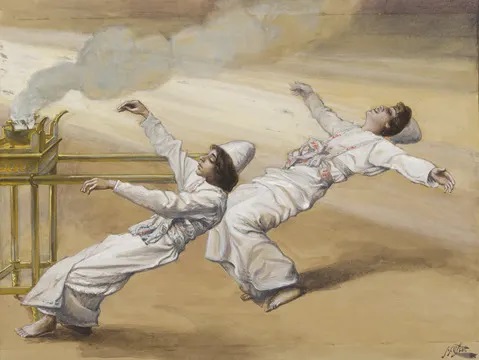
As usual, the God character responds to “whoring” after other gods with a plague. Next, an Israelite man brings a foreign woman into the Tent of Meeting itself for sex. Aaron’s grandson Pinchas quickly thrusts a spear through both of them, and the plague halts.

One would expect the impaled woman to be a Moabite, since the Israelite men were seduced into worshiping Ba-al Peor by Moabite women. But the next Torah portion, Pinchas, identifies the foreign woman as the daughter of a Midianite elder.

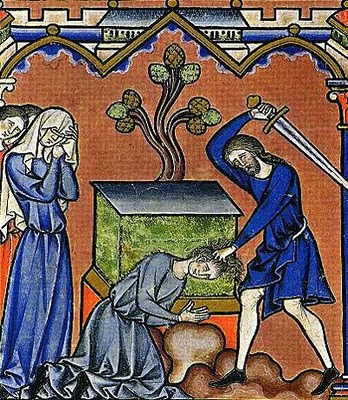
Pinchas impales them, in Sacra Parallela, 9th century Byzantine manuscript

And the name of the Midianite woman who was struck down was Kozbi, daughter of Tzur, the head of the people of a paternal household from Midian. And God spoke to Moses, saying: “Be hostile toward the Midianites, and strike them down. Because they were hostile to you through their deceit, when they deceived you about the matter of Peor …” (Numbers 25:15-18)

Suddenly Moabite women have become Midianite women.

In this week’s Torah portion, Matot, God reminds Moses to attack the Midianites.

And God spoke to Moses, saying: “Take vengeance, the vengeance of the Israelites, from the Midianites; afterward you will be gathered to your people.” (Numbers 31:1-2)

Moses obediently musters an army.

And they arrayed against Midian, as God had commanded Moses, and they killed every male. And the kings of Midian they killed … five kings of Midian, and Bilam son of Beor, they killed by the sword. But the children of Israel took captive the women of Midian and their little ones… (Numbers 31:7-9)

In this passage, the Midianites are not ruled merely by elders, but by five kings. And Bilam, who goes home at the end of the portion Balak, mysteriously appears among the kings of Midian.
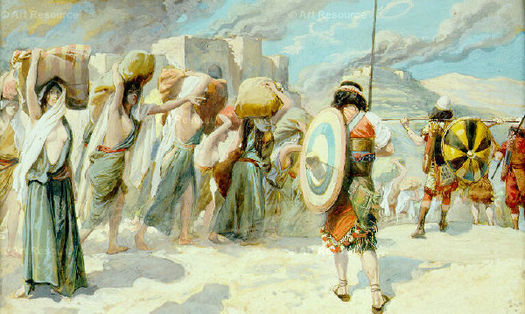
The Women of Midian Led Captive by the Hebrews, by James Tissot, ca. 1900

The story ends with the slaughter of the captive Midianite women. (See my post Matot: Killing the Innocent.)

And Moses said to them: “You left every female alive! Hey, they were the ones who, by the word of Bilam, led the Israelites to treachery against God in the matter of Peor, so there was a plague in God’s assembly. So now, kill every male among the little ones; and every woman who has known a man by lying with a male, kill!” (Numbers 31:15-17)

Has Moses forgotten that the Israelite men were seduced into worshiping Ba-al Peor by Moabite women? Or does he assume that God must be right, so the women whom he thought were Moabites must secretly be Midianites?

Another Explanation for Midianites in Moab

In my 2015 post, I review three kinds of attempts by commentators to reconcile the apparent conflation of Moabites and Midianites in this storyline: the “apologists”, who invented bizarre explanations for the inconsistencies; the “scientists”, modern scholars who assigned the scenes to two different sources and noted that the redactor left both Moab (the enemy in the J/E source) and Midian (the enemy in the P source) in the story; and the “psychologists”, who imagined that Moses, whose own wife is a Midianite, is flummoxed when God tells him that the Midianite women are all guilty.

Now I would add a fourth explanation. Angela Roskop Erisman3 dates the storyline about Midianites in Moab to the reign of Hezekiah, the king of Judah from circa 716 to 687 B.C.E. Before King Hezekiah rebelled against being a vassal of the Assyrian Empire, he lined up support from Egypt, but Egypt (ruled by Kushites at the time) was not much help. So, according to Erisman, he probably arranged an alliance with Midian instead. These two political alliances are reflected in the Torah, where Moses has a Midianite wife in the book of Exodus, but a Kushite wife in Numbers 12:1.

Jerusalem survived the Assyrian siege in 701 B.C.E. not because of any allies, but because King Hezekiah had built a new city wall and dug a tunnel between the city and the nearest water source, the Siloam Pool. No assistance from Midianites was recorded either in the Hebrew Bible or on the Assyrian stelae that have been excavated.

If the Midianites failed to come to the aid of Jerusalem, that would be reason enough to vilify them in one of the stories about Moses.

Floored by comments

Ten years ago, I wrote this conclusion to my post on Midianites in Moab:

“Just as Moses judges all Midianites in the five northern tribes as evil because of the actions of a few of their members, human beings throughout history have made judgements about undifferentiated groups.  It is so much easier than discriminating among individuals. From Biblical times to the present day, some people have judged all Jews as bad.

“Today, I catch myself ranting against Republicans, as if every person who voted Republican in the last election were responsible for the particular propaganda efforts and political actions that I deplore. A psychological look at the story of Moses and the Midianites near Moab reminds me that I need to be careful not to slander the innocent with the guilty.”

My intention was to sound a warning against treating all members of a group as if they were the same. It is obvious that “All Midianites are bad” is a false statement in the context of the whole Torah, since Moses’ father-in-law and wife are Midianites and do nothing but good deeds.

My next example was my own bad tendency to talk about “Republicans” as if all Republicans were bad. I thought I was being clear that there were people who voted for Republican candidates in the 2014 election for reasons that had nothing to do with the claims and policies that I, personally, objected to.

But I got a lot of comments that were vicious put-downs. I deleted them, since I did not want hate language in this blog. Now I wish I had saved them, so I would have examples of knee-jerk emotional reactions.

This year I received a milder negative comment on my 2015 post:

“You had me until you started the Republican rant…. Too bad TDS once again ruins scripture talk unnecessarily.”

I had to look up TDS. I found it that it stands for “Trump Derangement Syndrome”, and is a term that some supporters of Donald Trump use to criticize people whom they perceive as having knee-jerk emotional reactions against Trump that make them incapable of perceiving reality.

Who is making a rational analysis, and who is having a knee-jerk emotional reaction? It turns out to be a complicated question.

Should I have avoided any mention of politics in my 2015 blog post, and found a different example of my own tendency to discriminate against whole groups (instead of being discriminating about the differences among individual members of those groups)?

Maybe. But I find American politics more frightening now than I did ten years ago. When I wrote my 2015 post, I thought it was obvious that “All Jews are bad” is a false statement, like “All Midianites are bad”. But now anti-Semitism is increasing in the United States, and it comes from both ends of the political spectrum. I suspect that the increase on the right is part of today’s greater tolerance for hate speech, while the increase on the left is due to a false assumption that all Jews support the current government of Israel’s war on Gaza.

Will human beings ever overcome the black-and-white thinking that leads us to slander whole groups of people?


  1. Exodus 2:15-22.
  2. See my post Balak: Prophet and Donkey.
  3. Angela Roskop Erisman, “Moses is Modeled on Horus and Sargon, but His Story Is About King Hezekiah” and “Miriam Complains of Moses’ Cushite Wife: Hezekiah Married the Wrong Empire!” in www.thetorah.com, 2025.
Haftarat Pinchas—1 Kings: Despair

The prophet Elijah scores a stunning victory in his competition with Queen Jezebel for the religious allegiance of the Israelites. And then he falls into a deep depression in this week’s haftarah reading, 1 Kings 18:46-19:21.

The contest

Elijah and Queen Jezebel are both zealots for their gods.1 When Jezebel of Sidon marries Ahab, king of the northern kingdom of Israel, she brings 450 prophets of Ba-al and 400 prophets of Asherah with her to her new home. Ahab builds a temple for Ba-al and a post for Asherah in his capital, Samaria.

Then Ahab continued to act to provoke Y-H-V-H, the God of Israel, more than all the kings of Israel who were before him. (1 Kings 16:13)

Elijah declares a drought in the northern kingdom of Israel, and God cooperates by withholding rain.2 After three years of drought and famine, Elijah appears before Ahab and orders the king to set up a contest.

He tells King Ahab to assemble “all Israel” and the 450 prophets of Ba-al on top of Mount Carmel3, where there are two altars: one for Ba-al, and a ruined altar for Y-H-V-H. The king obeys, because he knows only Elijah can end the drought.

When everyone has assembled on top of Mount Carmel, Elijah calls out:

“How long will you hop between two opinions? If Y-H-V-H is God, follow him! And if it’s Ba-al, follow him!” (1 Kings 18:21)

Nobody answers. So Elijah announces the terms of the contest. Each altar will be stacked with firewood, and a bull will be cut up and laid out on top. Then the prophets will ask their gods to send fire to ignite the offering—450 prophets of Ba-al at one altar, and Elijah alone at the other.

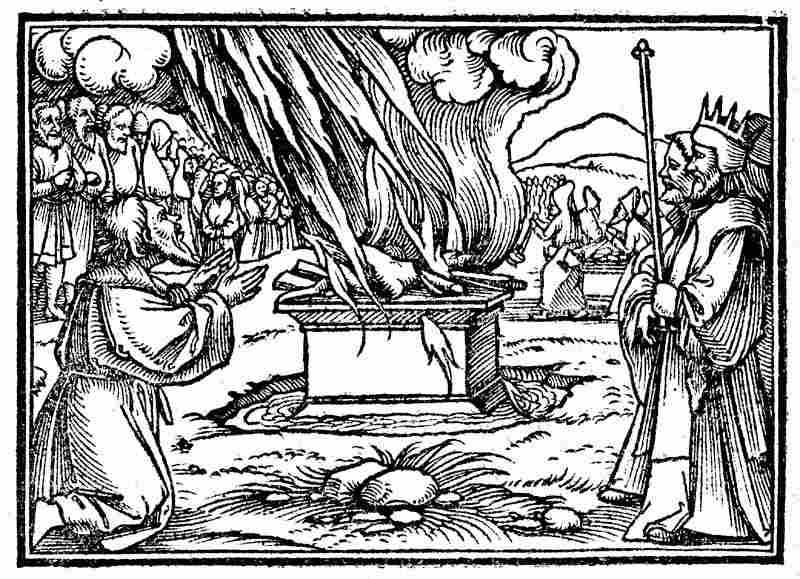
Elijah and Ahab at Mount Carmel, Zurich Bible, 1531

The Israelites agree that whichever god sends down fire will be their god. So Jezebel’s 450 prophets spend all morning and most of the afternoon calling on Ba-al, dancing, and gashing themselves, but nothing happens. Then Elijah mends the ruined altar of Y-H-V-H, stacks the firewood and the slaughtered bull, and has water poured over the whole thing. He calls to God once, and fire falls down from the sky. The fire devours the cut-up bull, the wood, the stones, the dirt, and the water.

All the people prostrate themselves, and shout:

“Y-H-V-H is God! Y-H-V-H is God!” (1 Kings 18:39)

Victory? Not enough for Elijah. He tells the Israelites:

“You must seize the prophets of the Ba-al! Not one must escape you!” (1 Kings 18:40)

They do. Elijah takes all 450 of them down to the nearest gully and slaughters them like sacrificial animals. Then he announces to King Ahab that it is about to rain at last.

The flight

This week’s haftarah opens with Elijah’s triumphal run through the rain in front of the king’s chariot, all the way from Mount Carmel to the king’s house in the Yizreil Valley, about 18 miles (29 km). There King Ahab tells Queen Jezebel what happened at Mount Carmel. She sends Elijah a message saying that she will have him killed the next day.

And he saw, and he rose, and he went for [the sake of] his nefesh. And he came to Beersheba that belongs to Judah, and he left his young man there. (1 Kings 19:3)

nefesh (נֶפֶשׁ) = soul that animates the body, life force; throat, appetite, desire.

In another time and place, a man in Elijah’s position might start a revolution against the king and queen instead of fleeing. But popular revolutions were rare in the Ancient Near East. The only one recorded in the Hebrew Bible is led by Jereboam against King Reheboam, Solomon’s son and heir. When the northern Israelites secede from Reheboam’s kingdom, they proclaim Jereboam king of their new nation.4

But biblical prophets only try to motivate people, from kings to commoners, to stop worshiping other gods, to follow God’s rules (especially the ethical ones), to refrain from certain wars, and (after the Babylonian Exile) to return to Jerusalem.

Elijah succeeds in inducing the Israelites to choose God over Ba-al. But King Ahab does whatever his wife says, and Jezebel is furious at the death of the prophets she supported. Neither converts to worshiping Y-H-V-H. So Elijah concludes that he has failed.

He travels about 200 miles (320 km) south, to the southern edge of the kingdom of Judah. He does not stop at Jerusalem to ask for asylum from King Jehosephat, who worships Y-H-V-H. Maybe he is afraid of extradition, or of a paid assassin sneaking into Jehosephat’s palace.

Or maybe he imagines spending the rest of his life as a useless courtier, instead of as a powerful prophet fighting for Y-H-V-H, and he decides a life like that is not worthwhile.

He stops at the last town before the Negev Desert, where he thoughtfully leaves his only servant. He does not want the young man to die in the desert.

Elijah, however, is ready to die. At least he will die on his own terms, not Jezebel’s.

And he walked into the wilderness, a day’s journey, and he came and sat down under a lone broom bush, and he asked for his nefesh to die. And he said: “Too much! Now, Y-H-V-H, take my nefesh, since I am no better than my forefathers!” [1 Kings 19:4]

What does he mean by the reference to his forefathers? One interpretation is that “up until this point, he has harbored an ambition that with his unique methodology, he could surpass his ancestors … Where his ancestors failed, Eliyahu HaNavi [“the prophet”] thought his innovative and more aggressive approach would succeed.” (Jachter)5

He asks for death when he concludes that he, too, has failed to turn the Israelites away from worshiping other gods.

Answer to a prayer

Two other prophets in the Hebrew Bible, Moses and Jonah, beg God for death.

Moses is fed up when he has brought the Israelites within a day’s march of the border of Canaan, and they sit and wail that they miss the food in Egypt. He never wanted the job of leading them in the first place. He tells God:

“Where am I to get meat to give to all this people, when they cry on me saying: ‘Give us meat, so we may eat it!’ I am not able to carry all this people alone by myself, because they are too heavy for me! If this is what you do to me, definitely kill me, please!” (Numbers 11:13-15)

To me this seems like a cry of desperation, not an actual desire for death. And God does not kill Moses, but rather sends so many quail that many Israelites die when “the meat was still between their teeth” (Numbers 11:33).

Jonah, like Moses, does not want the job God assigns him. He is supposed to go to Nineveh, the capital of Israel’s enemy, and proclaim that in 40 days the city will be overthrown. But he is afraid that the Ninevites might actually repent, and then God will have mercy on them. Jonah tries to run away from God, to no avail. After he finally does his job, all the Ninevites do repent, even the king. And Jonah feels frustrated, because he wants the Ninevites to die.

And to Jonah this was very bad, and he burned with anger. And he prayed to Y-H-V-H, and said: “… And now, Y-H-V-H. please take my nefesh from me, because it would be better if I die than if I live!” (Jonah 4:1–3)

To me this seems more like an ill-considered expression of anger than an actual death-wish. And God does not kill Jonah, but instead gives him an object lesson on compassion.

Is Elijah cracking under stress, like Moses? Or angry, like Jonah? Perhaps, but I think he is also seriously depressed and really does want to die. He does not merely ask God to kill him, but walks into the desert all day, then sits down in a place with shade, but no water. He has made sure that if God does not take his life immediately, he will die of dehydration.

And God does not kill Elijah, either.

And he lay down and slept under a lone broom bush. And hey, this malakh was poking him! And it said to him: “Get up! Eat!”  

malakh (מַלְאָךְ) = messenger, human or divine. A messenger from God might appear human, but is not; in that case it is often translated as “angel”.

And he looked, and by his head was a cake baked on hot stones, and a jug of water. And he ate and he drank, and he went back and he lay down. (1 Kings 19:6)

Elijah merely obeys the angel, without pausing to think about what the divine rescue might mean. He does not want to do anything, ever again.

And the malakh of Y-H-V-H returned a second time and poked him, and it said: “Get up! Eat! Or the journey will be too much for you.” (1 Kings 19:7)

Since God will not leave him alone to die, Elijah eats and drinks again, then continues walking south, all the way to Mount Sinai. There God tells him he will go on living, but he must anoint Elisha, who will replace him as the kingdom of Israel’s chief prophet.6


I can empathize with Moses when he bursts out “If this is what you do to me, definitely kill me, please!” because I, too, feel frustrated when something I didn’t really want to do in the first place is not going well due to the behavior of the other people involved. But what I really want is to get out of that particular responsibility and enjoy life.

I also feel mildly depressed now and then, but I am grateful that I have never felt so depressed I wanted to die. Poor Elijah could not imagine life without his mission: to convert the whole kingdom of Israel to the worship of Y-H-V-H. My own mission is smaller: I just want to write about Torah.


  1. See my post Pesach: Who Is Elijah?
  2. 1 Kings 17:1.
  3. Mount Carmel is one of the hills just east of present-day Haifa.
  4. 1 Kings 12:1-20.
  5. Chaim Jachter, From David to Destruction, 2019, reprinted in www.sefaria.org.
  6. See my posts Haftarat Pinchas—1 Kings: The Sound of God and Haftarat Pinchas—1 Kings: Passing On the Mantle.

Balak: High Anxiety

Poor King Balak of Moab. His name, Balak (בָּלָק), means “he devastated”. But he never devastates any person or any land in the Torah; instead, Balak himself feels devastated.

The situation

Balak already rules a diminished country. During the reign of the previous king, the Amorites conquered the northern half of Moab.

… Sichon, king of the Amorites, himself had waged war against the former [king] of Moab, and had taken all his land from his hand, as far as the Arnon. (Numbers 21:26)

Next, a horde of Israelites march through the wilderness east of Moab at the end of last week’s Torah portion, Chukat, avoiding settled lands until they have crossed the Arnon River. Then they turn west, heading for the land of Canaan. Since they must pass through King Sichon’s city-state of Cheshbon to reach the Jordan River, they ask Sichon for permission to travel on the king’s highway, promising they will not use any well water or go off the road into fields or vineyards. But the king refuses and attacks the Israelites east of his border. They conquer his entire country. (See my post Chukat: Respect versus Belligerence.)

Encouraged by their victory, the Israelites begin conquering more Amorite land to the north, until the army of King Og of Bashan confronts them at Edre-ii.

(Route of the Israelites in red)

And they [the Israelites] struck him and his sons and all his people, until there was no survivor left to him, and they took possession of his land. Then the Israelites journeyed on, and camped on the Plains of Moab, across the Jordan from Jericho. (Numbers 21:35-22:1)

The Torah still calls the area where they camp, near Mount Nebo, “the Plains of Moab”, even though Moab has not owned the land since King Sichon captured it.

When this week’s Torah portion (Balak, Numbers 22:2-25:9) begins, the conquering Israelites have come south again, and are camping right across the Arnon River from the remaining kingdom of Moab. King Balak does not know that the Israelites’ next target for conquest is the land of Canaan. It would be just as easy for them to continue south and ford the Arnon River as it would be for them to turn east and cross the Jordan.

This week’s portion begins:

Balak son of Tzipor saw everything that Israel had done to the Amorites. And Moab1 felt very intimidated on account of the people, because there were so many; and Moab felt dread on account of the Israelites. (Numbers 22:2-3)

I think that King Balak, who never does devastate any person or place, feels devasted at the sight of the Israelites across the Arnon. (If their campsite is within view of Jericho, it would actually be almost 60 miles, or 100 km, from the Arnon, but the Torah is more interested in a good story than in geographic precision.)

A confident and thoughtful king might feel relieved that the Israelites had skirted his own country and conquered his enemy to the north instead.  He might make inquiries, and learn that the Israelites had asked permission to cross through the land of Cheshbon peacefully, since their real destination was Canaan.  He might realize that the Israelites are, in fact, no threat to the present kingdom of Moab.

But Balak is consumed by anxiety.  The Israelites are so numerous, and so successful in battle, how could they not be a threat?  Balak knows his own army could never defeat them unaided.

The search for help

A king of Moab looking for allies might consider the kingdom of Ammon to the northeast, or the kingdom of Edom on Moab’s southern border. Instead Balak calls on Midianites, who live mostly south of Edom, near the Gulf of Aqaba and the Sinai Peninsula. I will discuss this oddity in my post two weeks from now, about the Torah portion Matot.

And Moab said to the elders of Midian: “Now the assembly [of Israelites] will lick up everything around us, like an ox licks up the green plants of the field!” (Numbers 22:4)

Balak then decides that help from the Midianites will not be enough; what he really needs is magic.

“Israel’s mere presence and the wondrous victories they had already achieved had worked such a spell on his people that they had lost all confidence in the ordinary powers of nations … the spell had to be broken. It had to be countered with an equally mysterious power, one that acts secretly in the dark, before Balak could dare to lead his people into battle against Israel, or before he could even hope to succeed in doing so.” (Hirsch)2

So Balak sends dignitaries to Bilam (often spelled Balaam in English), a famous sorcerer who lives even farther away than the Midianites: by the Euphrates in Mesopotamia.  The dignitaries deliver their king’s message:

“Hey! A people went out from Egypt; hey! It covers the sight of the land!  And it is dwelling in front of me! And now go, please, and curse this people for me, because it is too numerous for me! Perhaps we will be able to strike them and drive them from the land. Because I know that whomever you bless is blessed, and whomever you curse is cursed.” (Numbers 22:5-6)

I think that Balak feels so powerless, he cannot believe that his army could drive back the Israelites even if Bilam blessed every Moabite. What he needs is a curse that will cripple the Israelites so they cannot fight in the first place.

The king’s dignitaries spend the night at Bilam’s house, while Bilam waits for God to speak to him. In the morning Bilam says:

“Go back to your land, because Y-H-V-H refuses to let me go with you.” (Numbers 22:13)

Bilam knows that he is a prophet, not a sorcerer, and his blessings and curses come true only because God puts the words in his mouth. His use of the same personal name for God as the Israelites indicates to readers that he is a real prophet.

When the dignitaries return to King Balak, they say:

“Bilam refused to go with us.” (Numbers 22:14)

“They suspected him of being a liar, accusing him of desiring more honor than what Balak had shown him thus far.” (Or HaChayim)3

Balak refuses to take no for an answer; he cannot bear to give up the idea of being rescued by magic.  So he sends a larger and more impressive delegation, with a pleading message that offers Bilam great honor—i.e., ample remuneration:

“Please don’t hold back from going to me! Because I really will honor you very much. And anything that you say to me, I will do. So please go and curse this people for me!” (Numbers 22:16-17)

The failure of magic

Bilam goes, hoping against hope that God will let him curse the Israelites and collect the reward. When he arrives in Moab, the king’s first words to him are not royal commands, but subservient whining:

“Didn’t I actually send for you, to invite you?  Why didn’t you go to me? Am I actually not able to honor you?” (Numbers 22:37)

Balak’s insecurity is showing.  Meanwhile, Bilam has had a harrowing experience involving an angel and a talking donkey (see my post Balak: Prophet and Donkey).  He answers with the truth:

“Hey! I’ve come to you now. Am I actually able to speak anything? I must speak the word that God puts in my mouth.”  (Numbers 22:38)

Bilam Prepares for Prophecy, by James Tissot, circa 1900

King Balak takes Bilam to three different spots overlooking the Israelite camp, and at each place, he builds altars and sacrifices animals according to Bilam’s instructions.  At each place, Bilam goes off by himself, then returns to King Balak and recites a poem extolling the Israelites. Bilam’s second poem includes the lines:  

“For there is no magic in Jacob,

and no divination in Israel.” (Numbers 23:23)

Unlike Balak, the people of Israel do not need magic, because they know God is blessing them.

After the third time Balak and Bilam go through their routine, the king of Moab finally gives up on magic.

Then Balak’s nose burned in anger toward Bilam, and he slapped his hands together. Balak said to Bilam: “I invited you to pronounce a curse on my enemies, and hey! You repeatedly blessed them these three times!  So now, run away back to your own place.  I said I would certainly honor you, but hey! God held you back from honor!” (Numbers 24:10-11)


Poor King Balak. Since he is ruled by fear, he never does find out that the Israelites have no intention of attacking Moab.

It is easy for us to see that Balak should have sent his dignitaries to the Israelites first, and learned their intentions. But things look different when anxiety unhinges you.

How can we face threats, real or apparent, with equanimity? How can we avoid being devastated? The clue in the Torah is that there is no magic in Israel; people who know they have God’s blessing do not seek magic. Our task is to focus on our blessings instead of our fears.

Balak could have thought about how the conquering Israelites had already passed up opportunities to attack his kingdom, and investigated why. I could think about all the ways my life is good right now, while preparing as best I can for a future in a world that seems more uncertain than ever. I know that magic is of no avail, but it helps to remember that I have led a worthwhile life.


  1. Elsewhere in the Hebrew Bible the name of a kingdom is also used as the name of its king; for example, in Numbers 20:18, the king of Edom is called “Edom”.
  2. Samson Raphael Hirsch, The Hirsch Chumash: Sefer Bemidbar, English translation by Daniel Haberman, Feldheim Publishers, Jerusalem, 2007.
  3. Chayim ibn Attar, Or Hachayim, 18th century, translation in www.sefaria.org.

Haftarat Chukat–Judges: Outlaws

The leader of a band of outlaws becomes a ruler by popular acclaim twice in the Hebrew Bible. It happens to Yiftach (“Jepthah” in English) in the book of Judges, and to David in the first book of Samuel. But the story of Yiftach’s ascent is a tragedy, while David rises to kingship with confidence and unlimited success. The biggest difference between them is their relationship with God.

Yiftach the outlaw

This week’s haftarah reading from the Prophets (Judges 11:1-33) begins:

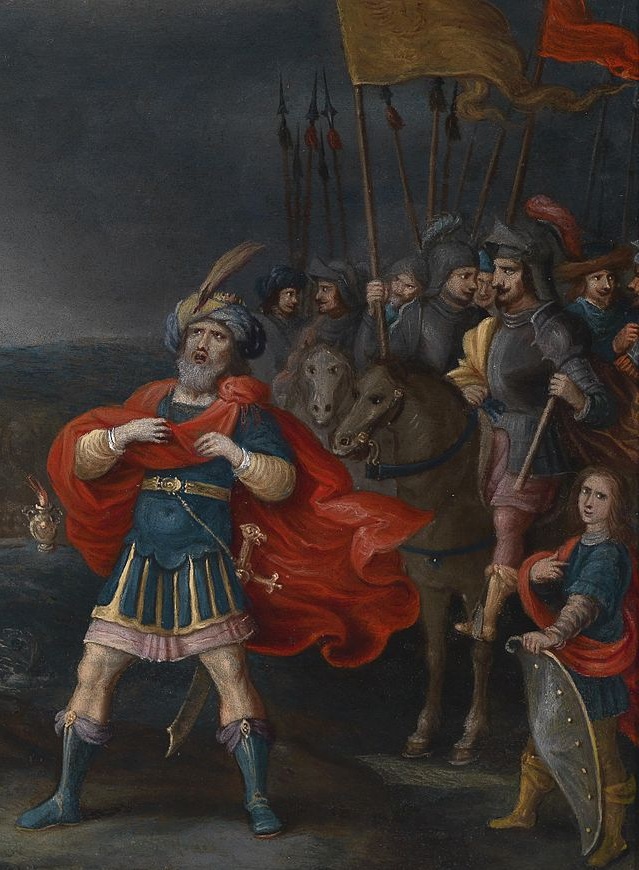
Yiftach, by Hieronymus Francken, 17th century, cropped

Yiftach the Giladite was a mighty man of ability, and he was the son of a prostitute woman. And Gilad begot Yiftach. (Judges 11:1)

Gilad (often spelled “Gilead” in English) is both the name of Yiftach’s father, and the name of the Israelite territory east of the Jordan River.1 The name of Yiftach’s father implies that he is the most important man in Gilad. No one would believe a prostitute who identified someone important as the father of her child—unless she had given up her trade to live in that man’s house.

“The plain meaning of this statement is that Yiftah’s mother was a licentious woman who became Gilad’s concubine.” (Steinsaltz)2

And Gilad’s wife bore sons to him. But when the wife’s sons had grown up, they cast out Yiftach, and said to him: “You will not inherit in our father’s household, because you are the son of the other woman!” (Judges 11:2)

This is an illegal move in Israelite tradition. If Yiftach grew up in his father’s house, that means his father acknowledged him as a son. All of a man’s acknowledged sons split his property when he died, and the firstborn son inherited a double portion.3 The order in which the story reports the births of Gilad’s sons implies that Yiftach is the firstborn. His half-brothers may want larger shares of the inheritance, and they may also be jealous of Yiftach’s strength and prowess. So they kick him out of the house.

Vayivrach, Yiftach, from the presence of his brothers, and he settled in the land of Tov. And worthless men collected around Yiftach, and they went out with him. (Judges 11:3)

vayivrach (וַיִּבְרַח) = and he fled, went quickly.

They went out with him” means that Yiftach and his followers went out raiding farms and villages. For a man who had no property and no trade, the only alternatives to raiding (or stealing) were to find employment as a seasonal agricultural worker, or to sell oneself as a slave.

Worthless men—men without land or jobs—are attracted to Yiftach because he is a “mighty man of ability”, a natural leader for activities involving aggression. The text does not say who the men raid, but if Tov was close to the northern border of Gilad, as some scholars argue, then outlaws living in Tov could raid Aramean villages just over the border without making enemies in Gilad.

The Ammonite threat

The first three verses about Yiftach fill in the background for a situation that the bible describes immediately before this week’s haftarah reading:

The Ammonites mustered and camped inside Gilad. And the Israelites gathered and camped at Mitzpah.4 And the people, the leaders of Gilad, said, each to his fellow: “Who is the man who will begin to do battle against the Ammonites? He will be the head of all the inhabitants of Gilad!”  (Judges 10:17-18)

“They scarcely permit themselves to imagine victory but are prepared to proclaim as chief whoever will dare to fight the Ammonites.” (Alter)5

At this point, Yiftach and his band of outlaws have been raiding for some time from their base in Tov. Stories of daring raids have probably spread across Gilad. So the elders of Gilad travel to Tov.

And they said to Yiftach: “Go, and become a commander for us, and we will wage war against the Ammonites!” And Yiftach said to the elders of Gilad: “Aren’t you the ones who hate me, and drove me away from my father’s house? Then why have you come to me, now that you are in a tight place?” (Judges 11:6-7)

The answer is obvious: Yiftach is the only man they know who is capable of conducting a military campaign. But he cannot resist pointing out that the elders should have thought of that before they kicked him out.

Then the elders of Gilad said to Yiftach: “Just so. Now we have returned to you [so that] you will go with us and wage war against the Ammonites. And you will become our head, out of all the inhabitants of Gilad.” (Judges 11:8)

They need the man whom they cast out so much, they even offer to make him the governor of the region as well as their war general.

And Yiftach said to the elders of Gilad: “If you yourselves bring me back to wage war against the Ammonites, and God gives them to me, I myself will be your head.” (Judges 11:9)

Exum6 pointed out that Yiftach’s counter-offer specifies that he will be the head of the Giladites even after the military action is over. It also brings God into the picture.

The elders agree, and Yiftach goes with them to Mitzpah, where he repeats the agreement so everyone there can hear it, too. Then he exchanges messages with the Ammonite commander, who pays no attention to Yiftach’s explanation of why Gilad belongs to the Israelites.7 His explanation concludes:

“May God, the judge, judge today between the Israelites and the Ammonites!” (Judges 11:27)

Up to this point, God has been silent.

Then a spirit of God came over Yiftach, and he crossed over Gilead … to the Ammonites. (Judges 11:29)

In most biblical stories about ad-hoc war leaders, God’s spirit inspires them to volunteer. But Yiftach is recruited by human beings, and the spirit of God does not come over him until he has already negotiated the terms of his service with the elders, and attempted negotiation with the enemy. (See my post Haftarat Chukat—Judges: A Peculiar Vow.)

Yiftach has been talking as if he knows God is on his side, but he is actually unsure and insecure. Even feeling a divine spirit come over him and move him to lead the battle does not reassure him. Yiftach desperately wants to become the “head” or governor of the whole region, and he knows it will only happen if God grants him victory, no matter how good his strategy and leadership are. And if he loses the battle with the Ammonites, they will kill him.

So he utters a vow that could be considered a prayer—or a bribe.

Yiftach’s vow

Then Yiftach vowed a vow to God, and said: “If you definitely give the Ammonites into my hand, then it will be the one going out—whoever goes out the doors of my house to meet me when I return safely from the Ammonites—will be God’s; and I will offer up [that one] as a burnt offering.” (Judges 11:30-31)

Yiftach’s Sacrifice, Maciejowski Bible, ca. 1250

The battle is a rout, with total victory for the Israelites. When Yiftach returns, his daughter, who is his only child, comes dancing out of the house playing a drum in celebration. Yiftach is shocked, even though it is customary for women to greet returning warriors with dancing, singing, and drumming. (See my post Judges, Jeremiah, and 1 Samuel: More Dancing.) But he carries out his vow. (See my post Haftarat Balak—Micah: Bribing the Divine.)

Why would Yiftach utter a vow that leaves so much room for disaster? One theory is that Yiftach expected his daughter to emerge, and his vow to sacrifice her reflected extreme trust in God; he was waiting for God to stop him the way God stopped Abraham from sacrificing Isaac.8 But since God disapproves of Yiftach’s vow, God lets the sacrifice go forward.9

Another theory is that Yiftach suppressed the knowledge that his daughter was likely to come out the door.

“A psychological study of Jephthah might suggest that punishing himself was, if only unconsciously, the purpose of the vow.  The man who was considered to be unworthy because of his birth, and maybe in his heart of hearts accepted this, made sure, through the vow, that there would be no continuity beyond his own lifetime. To put it another way, the stain of his illegitimate birth would end with his death. Perhaps that is why he does not take a second wife and try again.” (Magonet)10

Since Yiftach’s own brothers cast him out, he believes God will eventually cast him out. And the God-character in this story silently collaborates with Yiftach to blight his success.

David the outlaw

The name of the other biblical leader of an outlaw band is David (דָּוִד), which comes from the noun dod (דּוֹד), meaning “beloved”. He is the beloved of God, as well as of King Saul’s son Jonathan.

I will explore King David’s relationship with God in greater detail in a series of blog posts in August. Here, I will point out that David’s history before he becomes the leader of an outlaw band is different from Yiftach’s.

David is an adolescent, the youngest of eight sons of Jesse, when God commands the prophet Samuel to secretly anoint him as the next king of Israel, after Saul.

And Samuel took the horn of oil and anointed him in the midst of his brothers. And the spirit of God made David prosper from that day on. (1 Samuel 16:13)

Samuel Anoints David, Dura Europos Synagogue, 3rd century CE

David’s brothers seem happy with his anointment. While Yiftach flees from his brothers, David flees from King Saul, who is insanely jealous of David’s military successes and keeps threatening to kill him. After a quick stop for provisions,

Then David stood up, vayivrach that day from the presence of Saul … (1 Samuel 21:11)

When David finds a hiding place in the cave of Adulam,

… his brothers and his father’s whole household heard, and they went down to him there. And they gathered themselves to him, every man in distress, and every man who had a creditor, and every man with bitter feelings. And he became a commander over them. And there were with him about 400 men. (1 Samuel 22:2)

David’s band of outlaws includes “worthless men”, like Yiftach’s. But it also includes all of David’s brothers and their families and servants.

The book of 1 Samuel provides two clues about how David and his outlaws support themselves. Instead of raiding villages like Yiftach’s band, they rescue the town of Keilah from Philistine raiders, with God’s approval—after leading away the Philistine’s livestock. Later, David appears to be running a protection racket. He and his men stand around in the field by Carmel where Naval’s 3,000 sheep are being sheared. Afterward, David sends ten of his young men to Naval to wish him peace, mention the shearing, and give him this message:

“Now, the shepherds that belong to you were with us. We did not humiliate them, and nothing was missed by them the whole time they were in Carmel. Ask your lads, and they will tell you … Please give whatever you can find in your hand to your servants [David’s men] and to your ‘son’ David!” (1 Samuel 25:7-8)

When Naval refuses to give anything to David for guarding his sheep, David and his men head toward Naval’s house armed with swords, intending to kill every male there. They refrain only because Naval’s wife intercepts them with a troop of donkeys loaded with provisions.

King Saul keeps hunting them down, so finally David offers his outlaws (600 now) as mercenaries to the Philistine king of Gath. He brings his employer booty from the villages they raid, claiming they are Israelite villages, when really they are places affiliated with neither Israelites nor Philistines.11

Finally, when all the Philistine kings unite to make war on the Israelites, David sends booty to the elders in more than two dozen towns in the territory of Judah. He is absent from the battle, but when he learns that King Saul was killed, he and his outlaws move to Judah.

And the men of Judah came, and they anointed David as king there over the House of Judah … (2 Samuel 2:4)

David has become the “head” or chief of Judah without making a single vow to God. He does not need to, because unlike Yiftach, he grew up confident about his family, and he has known that God is on his side ever since Samuel anointed him when he was a teenager.


  1. Numbers 32:33-42. This region is currently the northwestern corner of Jordan.
  2. Rabbi Adin Even-Israel Steinsaltz, Introductions to Tanakh: Judges, reprinted in www.sefaria.org.
  3. Genesis 25:31-34, Deuteronomy 21:17.
  4. The Hebrew Bible refers to at least two towns named Mitzpah (מִצְפָּה), one in Gilad and one in the territory of Benjamin, where Samuel assembles the Israelites to cast lots for a king in 1 Samuel 10:22.
  5. Robert Alter, Ancient Israel: The Former Prophets, W.W. Norton & Co., New York, 2013,p. 164.
  6. J. Cheryl Exum, Tragedy and Biblical Narrative, Cambridge University Press, Cambridge, 1992, p. 55.
  7. Judges 11:21, 23.
  8. Rabbi Yosef ibn Kaspi, Gevia Kesef, 14th century, citing Genesis 22:9-13.
  9. Jonathan Kirsch, The Harlot by the Side of the Road: Forbidden Tales of the Bible, Penguin Random House, 1998, p. 207.
  10. Jonathan Magonet, “Did Jephthah Actually Kill his Daughter?”, footnote 11, www.thetorah.com, 6/25/2015.
  11. 1 Samuel 27:1-12.

Haftarat Korach—1 Samuel: No Kings?

“You said to me: ‘No, for a king must be king over us!’ But Y-H-V-H, your God, is your king!” (1 Samuel 12:12)

A king makes the rules and wields absolute power over his people, the prophet Samuel warns in this week’s haftarah1 reading (1 Samuel 11:14-12:22). Like other biblical prophets, Samuel insists that this role belongs only to God. Yet the Israelites demand a human king.

The government of the Israelites is decentralized and minimal until Saul becomes king in the first book of Samuel. Prophets communicate God’s laws and decrees to the people. In each town and village, respected elders meet to judge cases and interpret the laws. The general community enforces its elders’ rulings. And when an enemy threatens more than one town, the elders of the region call for a war leader to command their fighting men until the threat is over.

Occasionally a notable Israelite holds two of these positions, but never three. Moses and Samuel serve as both the prophet and the appeals judge for the Israelites,2 but neither is a war leader. Joshua is a judge and war leader, but not a prophet.3 In the book of Judges, Gideon and Yiftach are war leaders who become local judges.4

But after the Israelites ask Samuel to appoint a king, everything changes.

Samuel’s first warning

The initial reason for their request is that Samuel is preparing for retirement as the circuit judge. He appoints his two sons as judges in Beer-sheva, a town about 59 miles (95 km) south of his own home base in Ramah.

But his sons did not walk in his ways, and they were bent on following profit, and they took bribes and bent justice. So all the elders of Israel gathered together and came to Samuel at Ramah. And they said to him: “Hey! You have grown old, and your sons have not walked in your ways. Now appoint a king for us, leshaftanu, like all the nations!”  (1 Samuel 8:3-5)

leshaftanu (לְשָׁפְטַנוּ) = to judge us, to govern us. (From the verb shafat, שָׁפַת.)

In other words, the elders of all the Israelite towns and villages demand a king to replace Samuel and his sons as the court of appeals. They overlook the facts that kings are also succeeded by their sons, and that kings govern through more than judging cases.

Rabbi Steinsaltz explained: “… the rule of judges is unstable and national leadership has begun in Israel … The elders did not wish to dismiss Samuel from his position, but they wanted to regularize and facilitate the continuation of a central authority. They turned to the prophet because he had the power to decide on behalf of all Israel.”5

And the matter was bad in Samuel’s eyes … and Samuel prayed to God. And God said: ‘Listen to the voice of the people … However, you must definitely warn them; and you must tell them the procedures of the king who will be king over them.” (1 Samuel 8:6-9)

The kings of other countries in the Ancient Near East, especially Egypt and Assyria, issued new laws as well as administrative decrees. They served as appeals judges, and they also enforced their own rulings. They conducted all foreign policy, including war. They funded their personal and administrative costs through taxes, and imposed corvée labor6 and military service on their people.

So Samuel tells the Israelites:

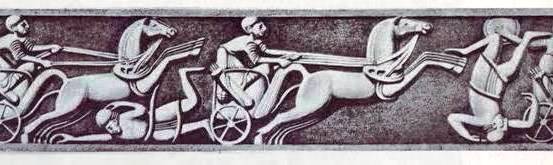
Chariots in ivory plaque from Megiddo

“This will be the procedure of the king who will be king over you: he will take your sons for himself, and put them in his chariots and on his horses … and to plow his plowing and to harvest his harvest, and to make his battle weapons and his chariot weapons. And he will take away your daughters for ointment-makers, and cooks, and bakers. And he will take away your fields and your vineyards and your olive groves, the best ones, and give them to his courtiers.” (1 Samuel 8:11-14)

Samuel adds that a king will also take slaves owned by the Israelites for himself, and tithe everyone’s produce and livestock.

But the people refused to pay attention to Samuel’s voice, and they said: “No! Rather, let a king be over us, and we, we too, will be like all the nations! Ushefatanu, our king, and he will go out in front of us and fight our battles!” (1 Samuel 8:19-20)

ushefatanu (וּשְׁפָטָנוּ) = and he will judge us, and he will govern us. (Also from the verb shafat.)

The people are so swept up in the idea of having their own king, one man to serve as both judge and war leader for all the tribes, that Samuel’s warning makes no impression on them. They probably cannot imagine their own king commandeering their sons and daughters, farms, slaves, and livestock. They would only have experienced these losses when a foreign king conquered part of their territory. So Samuel resigns himself to finding a king for the Israelites.

Samuel makes Saul the first king

In another town on Samuel’s circuit as an appeals judge, God identifies the future king of Israel: Saul, a tall, handsome young man who has never done anything. And Samuel anoints him.7

Samuel gathers the Israelites at Mitzpah, and casts lots, knowing that God will make the lot indicate Saul. But when it does, Saul “has hidden himself among the baggage” (1 Samuel 10:22), and the elders have to haul him out to be presented.

Not everyone is enthusiastic about the new king. But when the king of Ammon threatens a town in Gilead, God inspires Saul to unite the tribes and defeat the Ammonite army. In this week’s haftarah reading, after the victory, Samuel assembles the Israelites at Gilgal for a ceremony confirming Saul’s kingship. Now all the Israelites are enthusiastic about King Saul—except for Samuel.

In this week’s haftarah, Samuel first asks the crowd whether he has ever abused his position as a circuit judge.

And they said: “You have not defrauded us, and you have not oppressed us, and you have not taken anything from anyone’s hand!” (1 Samuel 12:4)

The implication is that they do not need a king as a judge.

Next Samuel argues that the Israelites do not need a permanent war leader. In the past, he says, when Israelites needed to be rescued from enemies, God inspired someone to step forward as a temporary war leader.

“And he rescued you from your enemies all around, and you lived in security. But you saw that Nachash, king of the Ammonites, was coming against you. And you said to me: ‘No! For a king must be king over us!’ Yet God is your king. But now here is the king whom you have chosen, whom you have requested. And here, God has set a king over you!” (1 Samuel 12:11-13)

The kings of the Israelites

Later, Samuel replaces King Saul with King David, who is succeeded by his son Solomon. After King Solomon dies, the Kingdom of Israel splits into two kingdoms because Solomon’s son and successor, Rehoboam, imposes harsher corvée labor than his father.8

Yet according to the Hebrew Bible, none of the kings of the northern kingdom of Israel and the southern kingdom of Judah make the Israelites quite “like all the nations”. Although Israelite kings do issue decrees, judge cases, conduct wars and other foreign affairs, and impose taxes and obligatory labor, they do not wield absolute power. Unlike neighboring kings, they are not considered divine, and they are forbidden to interfere with the priests—or to ignore the laws in the Torah.9


The “No Kings” protests on June 14, 2025, made me wonder what Samuel would think of President Donald Trump.

(The inspiration for the “No Kings” protests included Trump’s own comment “Long live the king!” on a social media platform in February, and his deluge of executive orders that exceeded previous restraints on presidential power. The date for “No Kings” coincided with a military parade Trump had arranged. The slogan “No Kings” was also reminder of the American Revolution and the Constitutional Convention, both dedicated to the ideal of democratic self-governance.)

On laws and decrees. Samuel believed that God was the people’s true king, and that any government could not transgress God’s laws recorded in the Torah. In the United States, the constitution fills a similar function—although unlike the Torah, it can be amended. (Samuel would probably disapprove of the freedom of religion clause in the first amendment to the U.S. constitution. But he never questions freedom of speech, or the right of people to assemble and petition him.)

No one had real power to make new rules until there were kings, who issued unilateral decrees. Samuel warned that kings ruling by decree could seize family members and personal property.

The American constitution established an elected legislative branch to write new laws as needed, and an elected president to administer those laws. But in the 20th century, as Congress became increasingly impotent, presidents issued executive orders that did not just administer programs, but also initiated or effectively eliminated programs. This “imperial presidency” has reached its peak (so far) in the first part of Trump’s second term as president. I suspect Samuel would disapprove of any head of state ruling by unilateral decree, even if courtiers or lawyers justified the decrees by referring to laws written for other purposes.

On judges. In ancient Israelite territory, judges interpreted the written laws and determined whether they have been transgressed. Local judges, i.e. a court of elders in a village or town, referred difficult cases to appeals judges like Samuel. Samuel would have approved of the separate judicial branch in the U.S. constitution—especially the right of the Supreme Court to overthrow laws it deemed unconstitutional.

On enforcement. Samuel preferred the self-policing communities of the Israelites before they had a king. He did not specifically address the question of who would enforce a king’s decrees, but he denounced the seizures of human beings and personal property that he said were the typical results of those decrees.

In the United States today, municipalities, counties, and states provide police to enforce the law, but technically there is no federal police. The national guard of each state serves as a militia in the event of an emergency, and Trump recently mobilized California’s national guard over the governor’s protests. He has also expanded the policing authority of ICE, the U.S. Immigration and Customs Authority. Samuel would have denounced both moves as the unethical actions of a king.

On war and foreign policy. Samuel advocated for the old Israelite custom that in the event of a war, the elders of collaborating towns would call for a volunteer general, and the communities would muster their own soldiers. Samuel warned against setting up a permanent war leader, and he accused kings of drafting soldiers. He would have denounced the clause in Article 2 of the U.S. constitution, which makes the president the commander in chief of all the armed forces.

He would have had a more favorable opinion of the clauses in Article 1 of the constitution that assign Congress the right to declare war and to regulate commerce with foreign nations.

But the delay in declaring war became unwieldy in the mid-20th century, and presidents began issuing executive orders to engage in military actions—wars in all but name. This year, President Trump has executed a military action against Iran, as well as ordering tariffs on goods from foreign nations. Samuel would consider these the actions of a king.

The only kings today are constitutional monarchs with ceremonial roles, so “king” has become a friendlier word. People who have the powers of Ancient Near Eastern kings are called autocrats instead. Some autocrats begin their careers with an election. But then they take the law into their own hands, like the ancient kings, and deprive people of their customary rights and freedoms. Voters do not always know who will turn out to be an autocrat.

At this point, Samuel would probably consider President Trump a king.


  1. The haftarah is the weekly reading from the Prophets that accompanies the Torah portion. This week’s Torah portion is Korach in the book of Numbers.
  2. Samuel is a circuit-court judge who travels from town to town judging cases that the elders cannot resolve (1 Samuel 7:15-17). However, Deuteronomy 17:8-9 decrees that in the future, when a town’s elders cannot reach a verdict, they must take the case to the priests or appointed judge at the yet-to-be-built temple. This temple is built by King Solomon in 1 Kings.
  3. The high priest uses lots and magical devices to interpret God’s desires in the book of Joshua.  
  4. Judges 6-8, 11.
  5. Rabbi Adin Even-Israel Steinsaltz, Introductions to Tanakh, I Samuel, reprinted in www.sefaria.org.
  6. Corvée labor is unpaid, forced labor imposed by the government on some of its residents for a fixed period of time. The pharaohs in the book of Exodus imposed a corvée on the Israelites then extended the time period indefinitely.
  7. 1 Samuel 9:1-21.
  8. 1 Kings 12:1-20.
  9. Deuteronomy 17:19-20.

Haftarat Shelakh-Lekha—Joshua: Loyalty, Kindness, or Exchange?

English makes a clear distinction between “loyalty” and “kindness”. Loyalty means a long-term, committed allegiance; a loyal person consistently supports a person or a social group no matter what happens. Kindness means acting with generosity, thoughtfulness, or consideration; you can do a kindness for a stranger you will never see again.

But in Biblical Hebrew, the word chessed (חֶסֶד) covers both loyalty and kindness. The translation depends on the context—but it also colors the interpretation.

For example, Abraham uses the word chessed when he is explaining to the king of Gerar why both he and Sarah said they were brother and sister, when in fact they are husband and wife. He claims that if strangers knew they were married, they would kill him to get her; but if a man who wants her (such as the king) believes Abraham is only Sarah’s brother, the man would pay him to take her as a concubine, and Abraham would live.1

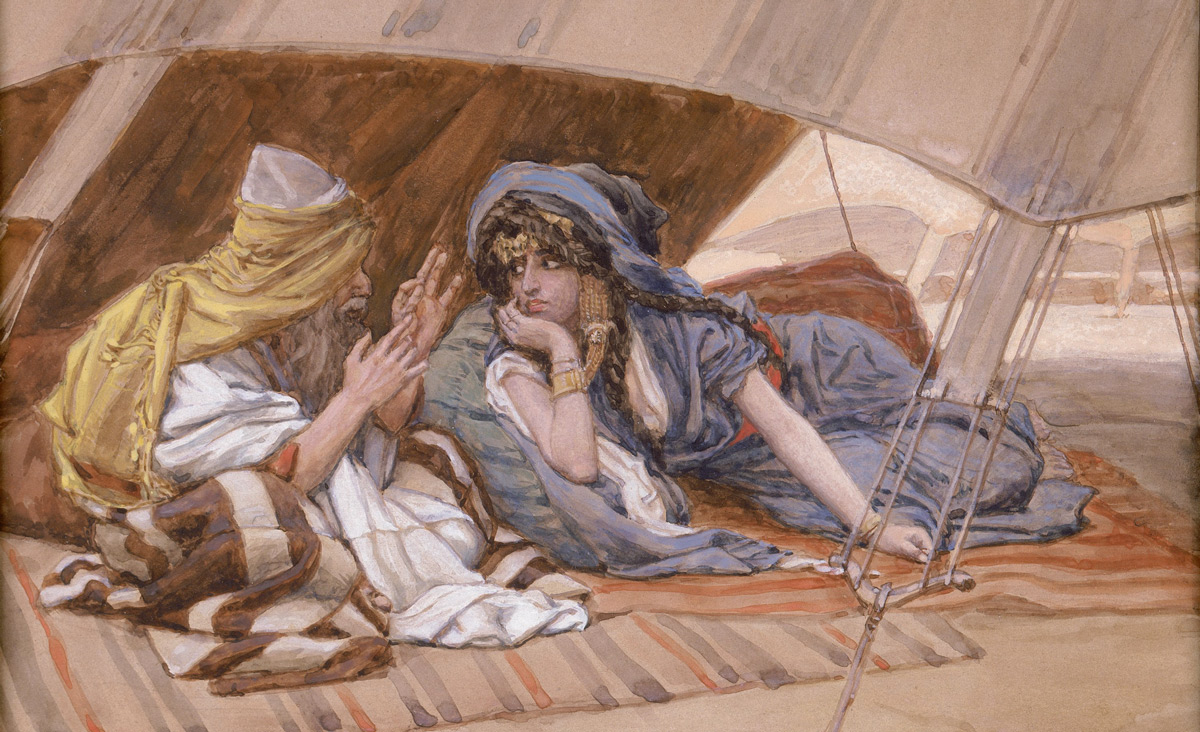
Abraham’s Counsel to Sarah, by James Tissot, ca. 1900, detail

“When God made me wander from my father’s house, I said to her: ‘This is your chessed that you will do for me: At every place where we arrive, say of me: He is my brother.’” (Genesis 20:13)

If chessed is translated as “kindness” here, the implication is that Sarah lies about her marital status out of the goodness of her heart, as a favor to her husband. If chessed is translated as “loyalty”, the implication is that Sarah has an obligation to her husband: as a loyal wife, she must either obey him, or (if she believes Abraham’s claim about strangers) save his life by telling the lie.


The word chessed appears four times in this week’s haftarah reading, Joshua 2:1-24. (A haftarah is the passage from the Prophets that accompanies the weekly Torah portion. In this week’s Torah portion, Moses sends spies into Canaan almost 40 years before Joshua does it in the haftarah. See my post Shelakh-Lekha: Sticking Point.)

Disloyalty to king and country

In this week’s haftarah, the Israelites are camped on the east bank of the Jordan River, across from the city-state of Jericho. Moses has died, and the people are poised to begin the conquest of Canaan under their new leader, Joshua. Before he leads his troops around Jericho and the walls come tumbling down, Joshua sends two spies across the river. They slip through the city gates as evening approaches, and go to a prostitute’s house.

Someone in town sees the two strangers, assumes they must be spies from the horde of Israelites camped right across the river, and tells the king of Jericho. The king immediately sends a message to the prostitute, Rachav, saying:

Rahab Receiveth and Concealeth the Spies, by H.R. Pickersgill, 1897

“Bring out the men who came to you, who came into your house, because they have come to search out the whole land!” (Joshua 2:3)

Naturally the king of Jericho wants to interrogate the two spies, and then make sure they never report back to the Israelite camp.

Thinking fast, Rachav tells the king’s messengers:

“True, the men came to me, but I do not know where they were from. And it was, the gate was closing at dark, and the men went out. I do not know where the men went. Quick, chase after them, for you might overtake them!” (Joshua 2:4-5)

As a loyal subject and citizen, Rachav should have handed over the two Israelites—not only because her king ordered it, but also because they are enemies of her own city-state. But she has secretly decided to defect to the other side, so she lies to the king’s men. They believe her, and run off to look for the two spies at the fords along the Jordan River.

Allegiance to a deity

Rachav hides the two Israelites on her roof, under the stalks of flax she had spread out to dry.2

And before they lay down, she herself came up to them on the roof. And she said to the men: “I know that Y-H-V-H has given you the land, and that dread of you has fallen over us, and that all the land’s inhabitants are quivering before you. Because we heard that God dried up the waters of the Reed Sea before you when you went out of Egypt, and what you did to the two Amorite kings who were across the Jordan … 3 And we heard, and our hearts melted [in fear], and no spirit of life rose again in a man before you, because Y-H-V-H is your god. He is God in the heavens above and on the earth below!” (Joshua 2:8-11)

Once she has declared her faith in the God of Israel (a necessary step for defecting and joining the Israelites), and provided some valuable information about the morale of the people of Jericho, Rachav asks the two spies to repay her for saving them from the king of Jericho’s men.

Loyalty to family

“And now, please swear to me by Y-H-V-H, since I have done chessed for you, then you will also do chessed for my father’s household, and you will give me a sign of emet; and you will preserve the lives of my father and my mother and my brothers and my sisters, and all those who belong to them, and you will rescue our souls from death!” (Joshua 2:12-13)

emet (אֱמֶת) = reliability, faithfulness; truth.

Rachav asks the spies to save her whole family as well as herself. Yet in the Hebrew Bible, a prostitute supports herself by taking customers because she is not supported by her father, brother, or husband. Rachav’s father and brothers are still alive. Either they refused to let her live with them, or she is an unusually independent woman who chose to set up her own house and business, even though it would shame the whole family.

Despite this earlier rift, Rachav is now loyally doing chessed for her family by requesting that the spies save their lives as well.

Exchange of favors

But although Rachav is loyal to her family, she has not yet had an opportunity to join the Israelites and pledge her loyalty to them. So when she points out that she has done chessed for the two spies, she means she has done them a kindness or a favor.

When she asks the spies to swear that they will do chessed for her and her family, she is not asking for an act of kindness or an act of loyalty. She is asking for reciprocity, an exchange of favors.

Later in the story of the conquest of Canaan, the word chessed is employed that way when some Israelite scouts see a man leaving the town of Beit-El. They stop him and propose an exchange of favors:

“Please show us the way to enter the town, and we will do chessed for you.” And he showed them the way to enter the town, and they struck the town with the edge of the sword, but they sent free the man and his whole clan. (Judges 1:24-25)

Rachav’s proposal is more formal, calling for an oath and a reliable sign from the two men.

And the men said to her: “Our souls to die instead of yours—as long as you do not tell about this business of ours! And it will be, at Y-H-V-H’s giving the land to us, that we will do with you chessed and emet.” (Joshua 2:14)

The combination chessed and emet can be translated as “reliable loyalty” or “true kindness”, depending on the circumstances. Here, the men are not pledging to be kind, but to be loyal—loyal to the reciprocal arrangement that Rachav requested.

Thorough kindness

After dark, Rachav completes her initial act of kindness by helping the two spies leave the town unnoticed.

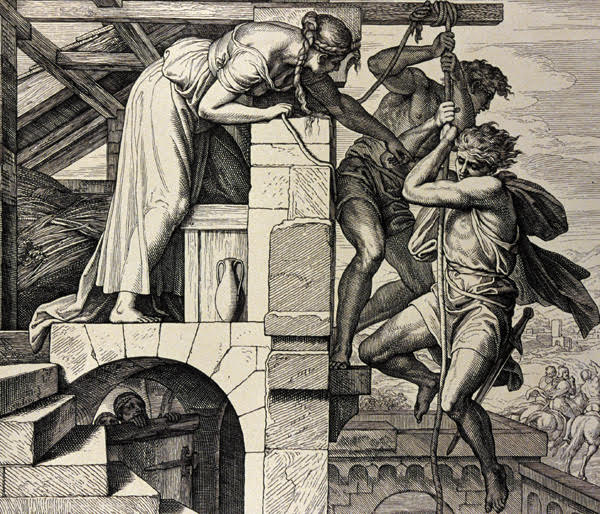
Escape from Rahab’s House, by Julius Schnorr von Carolsfeld, 1860

Then she let them down by a rope through the window—since her house was in a recess of the wall, and in the [city] wall she lived. (Joshua 2:15)

Fortified cities in the Ancient Near East were encircled by double (casemate) walls, with rooms between the two walls. At strategic points, these rooms were occupied by soldiers, but other stretches of wall were available to those who could not afford larger quarters.

And she said to them: “Go to the hills, lest the pursuers encounter you, and stay hidden there for three days, until the pursuers return. After that you may go on your way.” (Joshua 4:16)

Rachav tells the spies to hide in the hills to the west of the Jordan valley, the opposite direction from the river where the “pursuers”—the king’s men—will be guarding the fords.

Before they leave, the two spies designate the sign of emet that Rachav asked for.

“Hey, we will be coming into the land. Then you tie this cord of red string in the window through which you let us down; and you gather your father and mother and brothers and your father’s whole household to yourself in the house. And it will be: anyone who goes outside the doors of your house, his blood will be on his own head and we will be innocent. But anyone who is with you in the house, his blood will be on our head, if a hand is against him. But if you tell about this business of ours, then we will exempt from this oath of yours you had us swear.”  (Joshua 4:18-20)

The spies make sure the terms of the arrangement are spelled out so they can avoid any mistakes or misunderstandings.

And she said: “As you have spoken, so be it!” And she sent them off, and they went. And she tied the red cord through the window. (Joshua 2:21)

The two spies follow Rachav’s directions, and after hiding in the hills for three days, they arrive safely back at the Israelite camp. When the Israelite troops come to Jericho, Joshua orders them to kill all the people in the city, except Rachav and everyone with her in her house.4 While the city wall is collapsing and the rest of the troops are running through killing people, the two spies fulfill their oath by bringing Rachav and her family out to safety.

And Rachav the prostitute, and her father’s household, and everyone who was hers, Joshua let live. And she settled in the midst of Israel, to this day, because she had hidden the messengers whom Joshua had sent to spy out Jericho. (Joshua 6:25)


Some people remain loyal to a person or a country no matter what. Others are loyal only as long as the person or government meets their ethical standards. And some people act loyal only when it is in their self-interest.

Rachav acts in her own self-interest when she becomes disloyal to her king, her city-state, and the god of Jericho. But her request that the Israelites save her family is an act of loyalty to her relatives. She hides the two Israelite spies as an act of kindness. When she realizes that this is her opportunity to defect to the Israelite side, she frames her kindness as a favor, and asks the men to return the favor. After they do, Rachav becomes a loyal citizen of Israel. For her, chessed encompasses impulsive kindness, the practical exchange of favors, and loyalty—both to the family she was born into, and to the people she chose.


  1. See my post Lekh-Lekha, Vayeira, & Toledot: The Wife-Sister Trick, Part 1.
  2. Joshua 2:6.
  3. The two Amorite kings are Sichon and Og; Israelite soldiers conquer their kingdoms, Chesbon and Bashan, in Numbers 21:21-35, once their families have camped above the Jordan River across from Jericho.
  4. Joshua 6:17.

Beha-alotkha: Cold Feet, Dry Throat

The Israelites followed Moses out of Egypt in an adrenaline rush. After years of being treated as sub-human disposable labor by the pharaoh and most Egyptians, they were free! Their Egyptian neighbors gave them gold, silver, jewels, clothes, swords—anything to make them leave so the plagues would end.1 Moses told his followers that God would give them the whole land of Canaan as their own country.2 They did not wonder what would happen to Canaan’s current inhabitants. All they had to do was follow God and God’s prophet, Moses, to happiness and glory.

An adrenaline rush does not last. Anxiety plagued the people along the way, because everything depended on God’s help. They panicked when God delayed in rescuing them from the Egyptian chariots at the Reed Sea,3 and they panicked whenever they were uncertain about food or water.4 When Moses disappeared into the fire on top of Mount Sinai for 40 days, they panicked so much that they made a golden calf for God to inhabit.5 Then God gave them an alternative, and they spent a contented year making a portable tent-sanctuary for God to dwell in.

But once the new Tent of Meeting was completed and its new priests were ordained, it was time to leave Mount Sinai and head north toward Canaan.

Military service

When the book of Numbers opens, God tells Moses to take a census of men aged 20 and over—

“—everyone in Israel going out to war; you will muster them for their troops, you and Aaron.” (Numbers 1:2)

Illustration of Numbers 2, by Jan Luyken, 1673

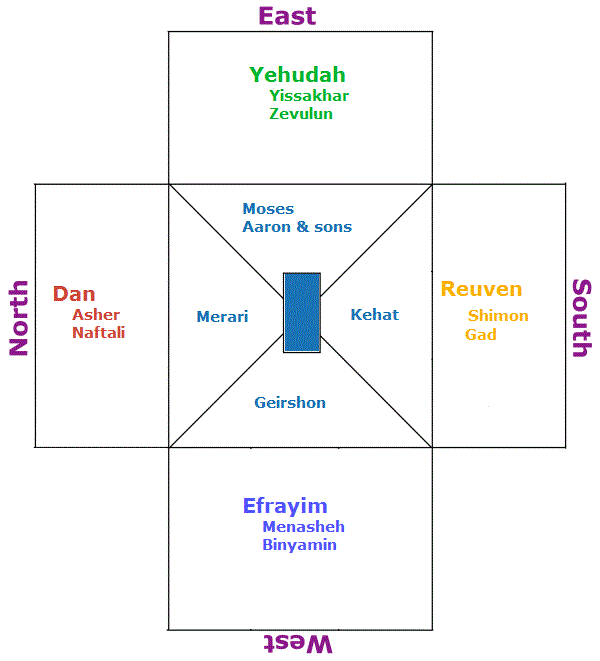
There is a separate census of the Levites, whose war duty is to guard the Tent of Meeting while the Israelites are encamped. Each Levite clan is assigned a campsite next to one side of the Tent, and the other twelve tribes must camp in a larger square around them. (There are twelve tribes not counting the tribe of Levi, because at this point the descendants of Joseph count as two tribes, Efrayim and Menashe.)

And God spoke to Moses and to Aaron, saying: “Each in its contingent, under the banner of their fathers’ house, the Israelites will camp, at a distance surrounding the Tent of Meeting they will camp. Those camping eastward, toward sunrise: the contingent of the camp of Judah, by their troops … (Numbers 2:1-3)

When they pull up stakes, they will travel in military formation, from Judah at the front to Naftali at the rear. (The Torah does not tell us where the women and children are in this army; we are left to assume they are walking with the men of their tribes.) And God will give the marching orders. This week’s Torah portion, Beha-alotkha, reminds us:

At God’s order the cloud would rise up from above the tent, and after that the Israelites would break camp; and in the place where the cloud would settle down, there the Israelites would camp. (Numbers 9:17)

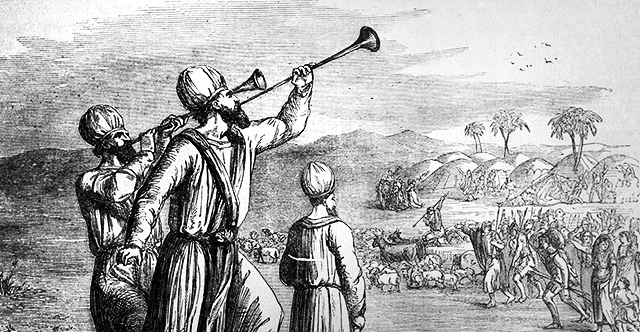
Silver trumpets in Numbers 10, 19th-century illustration

But then we learn that the signal of the divine cloud is not enough; God also calls for two silver trumpets. When a priest blows a single short blast, the leaders of the Israelites must assemble at the Tent of Meeting for instructions. A longer, trilling blast means that that the people must march.

And when you enter into battle in your land with an attacker who attacks you, then the trumpets should cry out, and you will be remembered before God, your God, and you will be delivered from your enemies. (Numbers 10:9)

Thus when the Israelites finally leave Mount Sinai, they leave as an army expecting to fight for the land of Canaan.

Rebellion

They march north for three days, then camp in the Wilderness of Paran.

And the people became like bad complainers in the ears of God. God heard, and [God’s] nose heated up [with anger]. And a fire of God burned against them, and it ate up the outer edge of the camp.  Then they wailed to Moses for help, and Moses prayed to God, and the fire sank down. (Numbers 11:1-3)

The book of Numbers does not tell us what the people are complaining about this time. According to Rashi, they felt sorry for themselves because they had walked for three days without stopping to camp, and they were weary.6 But according to Da-at Zekinim,

“The people were already mourning the potential casualties they would incur when going into battle against the Canaanites in order to conquer their land. They were lacking in faith and dreading warfare.”7

After the fire, people start complaining again.

Still Life with a Plate of Onions, by Van Gogh, 1889

Then the asafsuf who were among them felt a lusting lust. And moreover, the Israelites turned away and wept, and they said: “Who will feed us meat? We remember the fish that we ate in Egypt at no charge, the cucumbers and the melons and the leeks and the onions and the garlic! And now our nefesh is dry. There is nothing except for the manna before our eyes!” (Numbers 11:4-6)

asafsuf (אֲסְפְּסֻף) = rabble, riffraff; the non-Israelites who joined the exodus from Egypt. (They are called the eirev rav (עֵרֶב רַב)—the“mixed multitude”—in Exodus 12:38.)

nefesh (נֶפֶשׁ) =throat, appetite, life (in the sense of the animating force that makes one’s body alive).

First the asafsuf feel a lusting lust. Some commentators have written that they crave forbidden sexual relations; others that they lust for meat, and the Israelites pick up on their complaint. The manna that God provides every morning magically meets everyone’s nutritional needs, but not their emotional needs.

Their fond memories of some of the foods they ate in Egypt reveal that sometimes they wish they were still Pharaoh’s servants, instead of God’s. “… we are confronted by yearnings and nostalgia for a humdrum, small-time existence, a life of serfdom subject to their habits, passions and desires.” (Leibowitz)8

Life as God’s people seems too hard. In Egypt, they did not need to exercise any self-discipline, or follow so many rules. As long as they did whatever their foremen told them to, for as many hours as they were forced to work, they were fed “at no charge” and they could indulge in whatever pleasures they liked during their miniscule amounts of free time.

“The terrible price they had to pay for this give-away diet—slavery, suffering, persecution, murder of their children—is conveniently forgotten.” (Abravanel)9

Yet they lived at Mount Sinai for a year without complaining, the year when they were engaged in making the Tent of Meeting for God—a cooperative project calling for skilled craftsmanship. What has changed now, a three-day journey north of the mountain?

I would argue that now they are facing war, against unknown enemies. None of the Israelites were soldiers in Egypt. They engaged in only a single battle on their journey to Mount Sinai, when Amalek attacked them.10 The only other time anyone used the swords they took from Egypt was right after the golden calf worship, when Moses ordered the Levite men to go through the camp and kill the worst offenders.11

Yes, God rescued them many times on the way to Mount Sinai. But how could God make it easy to fight a long war against the Canaanites and seize all their land? They are not soldiers. How can they face all those battles? If God will no longer let them live quietly in the wilderness, they would rather be slaves in Egypt. Just thinking about the war ahead fills them with fear and dread. And they are close to the southern border of Canaan now. Desperate for a distraction and a respite from anxiety, the people long for comfort food.


We all live with anxiety about what will happen next. We might be afraid of an attack, or we might worry about our health, our work, our family, our country, our world. And most of us know about “good” strategies for managing anxiety and carrying on. I used to take long walks while singing prayers. These days, I find respite by studying and writing about Torah, and I fortify myself with naps, physical therapy, and nutritious food such as fish and leeks.

But when too many appointments and obligations use up my self-discipline, and I feel overwhelmed, I sit down with a pint of gelato. I crave sensual distraction. So I slowly savor every spoonful of gelato. Sometimes it takes a whole pint before I calm down.

I feel sorry for the people in this week’s Torah portion, who only have manna and memories.


  1. Exodus 11:1-3, 12:33-36 and 13:18.
  2. Exodus 6:2-8, 12:25, 13:5, 13:11
  3. Exodus 14:1-31.
  4. Exodus 15:22-25, 16:2-3, 17:1-7.
  5. Exodus 24:17-18, 32:1-6. See my post: Vayakheil & Ki Tisa: Second Chance.
  6. Rashi is the acronym of 11th-century rabbi Shlomoh ben Yitzchak.
  7. Da-at Zekinim, a 12th-13th century collection of commentary by tosafists, translation in www.sefaria.org.
  8. Nehama Leibowitz, Studies in Bamidbar (Numbers), translated by Aryeh Newman, The World Zionist Organization, Jerusalem, 1980, pp. 95.
  9. Yitzchak Abravanel, 15th century, quoted and translated in Leibowitz, p. 99.
  10. Exodus 17:8-13.
  11. Exodus 32:26-28.

Naso, Bemidabar, & Vayakheil: Reconstructing

(It is a pleasure to type effortlessly and comfortably again! I am glad return to my favorite work: writing about Torah.)

Model of Tent of Meeting in Timna Valley Park, Israel

The Tent of Meeting that the Israelites make as a dwelling for God in the book of Exodus is 10 cubits wide, 10 cubits high, and 30 cubits long. (Ten cubits equals about 15½ feet, or 4¾ meters.) This boxy tent stands in the back half of an open courtyard, slightly smaller than an Olympic-sized swimming pool, with a linen wall stretched between acacia wood posts around its periphery.

Neither the tent nor the courtyard is a permanent structure.

In the first two Torah portions of the book of Numbers, we learn how everything is dismantled, transported, and reassembled at the next campsite on the Israelites’ long journey north from Mount Sinai—and who is responsible for the wood, the fabric, and the holy furnishings.

Exodus: Vayakheil

Neither the inside cloth nor the outside cloth of the Tent of Meeting is sewn into a continuous shell.

And all the wise of mind among the makers of the work, the mishkan, made ten cloths of fine twisted linen threads and blue, purple, and red [dyes]; they were made with a design of keruvim.  (Exodus 36:8)

mishkan (מִשְׁכָּן) = (literally) dwelling place. (In the books of Exodus through Numbers, mishkan always refers to the portable tent-sanctuary where God dwells, at least part-time, in the tent’s back chamber, the Holy of Holies. After its first assembly, in Exodus 40:17-33, it is also called the Tent of Meeting and the Tent of Testimony. One common English translation for mishkan is “tabernacle”.)

Keruv, ivory from Samaria, 9th-8th century BCE

keruvim (כְּרֻבִים or כְּרוּבִים) = hybrid creatures with wings. Singular keruv. (Two gold keruvim rise from either end of the gold lid of the ark in the Holy of Holies, the back chamber of the mishkan, and keruvim are woven or embroidered into some of the fabrics of the mishkan as well.)1

Each of these ten tapestries is 4 cubits wide (about 2 yards or meters) by 28 cubits long (about 14 yards or meters), long enough to drape across the ceiling frame and hang down on both sides just short of the ground. Fifty loops of blue wool are sewn down both side edges of each cloth, and the loops are connected with gold clasps.

And fifty gold clasps were made, and the cloths were joined, each one to the other, with the clasps. And the mishkan became one [piece]. (Exodus 36:13)

Someone has to fasten a row of 50 clasps nine times, every time the Tent of Meeting is assembled; and unfasten them all when the tent is dismantled again. (The open end of the mishkan is covered with a free-hanging curtain, so it serves at the entrance. A hanging curtain also separates the Holy of Holies from the main chamber inside the tent.)

The outside of the framework is covered with similar cloths woven from goat-hair, joined together by bronze clasps. Two layers of leather lie on top of the goat-hair cloth over the roof.

The frame of the tent roof is made from acacia wood bars, but the three walls are solid acacia wood: wide upright planks stabilized with cross-bars. Two tenons at the bottom of each plank fit into silver sockets in wood bases. And even though these wooden elements are hidden by linen inside and goat-hair fabric outside, they are covered with gold!2 Each of the 48 upright planks is over 15 feet tall and 3 feet wide, so erecting and dismantling the underlying wooden structure means a lot of heavy labor.

Numbers: Bemidbar

The book of Numbers opens after the Israelites have made the Tent of Meeting and all its furnishings (in Exodus), and ordained new priests for the revised religion (in Leviticus). Before the people leave Mount Sinai and head north, God organizes them for the coming conquest of Canaan.

The first Torah portion, Bemidbar, opens with God calling for a census of soldiers for future combat: the men age 20 and older in every tribe except Levi. The Levites are exempt from battle because they are assigned their own “army” duty: transporting and guarding the Tent of Meeting.

And they will be in charge of all the gear of the Tent of Meeting, and the Israelites’ charge to serve the service of the mishkan. (Numbers 3:8)

Campsites of 12 tribes and 3 clans of Levites

When God signals that the people must pull up stakes, the Levites dismantle the Tent of Meeting. They carry the furnishings, the fabric, and the wood on every journey. When the Israelites pitch camp again, the Levites erect God’s tent in the middle and the courtyard wall around it. They pitch their own tents immediately around the courtyard, and serve as guards to prevent any unauthorized persons from encroaching on the sacred space.

There are three clans of Levites, named after the three sons of Levi listed in Genesis 46:11: Gershon, Kohat (or Kehat), and Merari. Sons in a biblical genealogy are list by birth order, so Gershon was born first, then Kohat, then Merari last.

And the charge of the Gershonites at the Tent of Meeting was the mishkan and the tent: its coverings, and the curtain of the entrance to the Tent of Meeting, and the cloths of the courtyard, and the curtain of the entrance of the gate of the coutyard, which is near the mishkan and near the altar—all around; and their cords, and all its service. (Numbers 3:25-26)

The descendants of Levi’s middle son, Kohat, are responsible for transporting the holy items inside the mishkan, and the bronze altar in the courtyard.

Their charge was the ark, the table, and lampstand, and the altars, and the holy utensils for ministering to them, and the curtain, and all their service. (Numbers 3:31)

The only curtain that this clan is responsible for is the one inside the tent that divides the main chamber from the Holy of Holies.

But why are the descendants of Levi’s middle son responsible for the holiest items of the mishkan? In the book of Genesis, the firstborn son of each extended family becomes responsible for making burnt offerings to God. If the people followed this precedent, the descendants of Levi’s oldest son, Gershon, would be in charge of the holiest things.

However, in Exodus and Numbers, the job of burning offerings for God is transferred to the priests, with assistance from Levites. All priests are descended from the first high priest, Moses’ brother Aaron. Moses and Aaron’s father, Amram, is a descendant of Kohat, the middle son of Levi.3 That means the rest of the Kohatites are Moses’ and Aaron’s closest relatives. No wonder they become responsible for transporting the holiest items in the mishkan.

As for the descendants of Levi’s youngest son:

The Merarites are appointed for the charge of the beams of the mishkan and its bars, and its uprights, and its sockets, and all its gear, and all its service; and the uprights of the courtyard, all around, and their sockets, and their tent-pegs, and their cords. (Numbers 3:36-37)

While the men in the other tribes of Israel are mustered into the army at age 20, the work of disassembling, carrying, reassembling , and guarding the Tent of Meeting is restricted to Levite men between the ages of 30 and 50. (See my post Bemidbar: Two Kinds of Troops.)

When God’s cloud lifts from above the mishkan, indicating that it is time for the Israelites to journey on, the priests enter the tent first. Aaron and his sons Elazar and Itamar wrap up the ark, bread table, lampstand, and gold incense altar inside, and the bronze altar in the courtyard. (See my post Bemidbar: Covering the Sacred.) The embroidered curtain that divides the Holy of Holies from the main chamber of the mishkan becomes the first of three layers covering the ark.

Only after these holy objects are completely covered, so they cannot be seen or touched, may the other Kohatite men pick them up by their carrying poles. And only after the Tent of Meeting is empty may the Gershonites and Merarites begin dismantling it.

Numbers: Naso

This week’s Torah portion, Naso, opens with God’s instructions regarding the Gershonites and Merarites between the ages of 30 and 50—

—everyone who enters to do military service of the military, to serve the service at the Tent of Meeting. (Numbers 4:23 for Gershonites, Numbers 4:30 for Merarites)

They are non-combatants in any future battle because they must be continuously responsible for all the elements of the tent itself, as well as its unroofed courtyard.

Once the sacred objects have been removed, the Gershonites take down all the lengths of fabric and leather, carefully undoing 950 clasps. They handle the lightest objects, so their work requires the least physical strength. But it requires the most patience and delicacy.

The Merarites do heavy physical labor. Furthermore, disassembling and reassembly the wooden structure with its upright plants, cross-bars, and bases, is a team effort requiring coordination between the men so that nothing collapses.

Once the wooden structure is stable, the fabric layers have all been fastened to make continuous walls and roofs, and the holy objects are all in place, only the priests may enter the mishkan. But the Levites remain on duty, assisting in the courtyard, and guarding the sacred space they have rebuilt.


Some people excel at fine detail work, like the Gershonites. Others are good at team projects on a grand scale, like the Merarites, whether they help organize the team or do the heavy lifting. We need both kinds of people to build a community.

And although everyone who has contributed tries to guard their community and keep it going, no congregation, association, institute, or enterprise continues forever unchanged. At some point, it will fall apart—unless the Gershonites and Merarites in the group pitch in to carefully dismantle the old structure, help everyone move to a place that meets the people’s new needs, and then use the elements of the old structure to build a new one. And we need people like the Kohatites to carry the most sacred goals and values of the community into the next stage.

Never underestimate a Levite.


  1. For more on keruvim, see my post Terumah: Cherubs are Not for Valentine’s Day.
  2. Exodus 36:34.
  3. Exodus 6:20.
  4. Numbers 4:5-6. See my post Bemidbar: Covering the Sacred.

2 Kings & Tazria: Skin

This is my last blog post before a surgery that will prevent me from writing for a month. My next post will probably be the first week of June. In the meantime, here are some earlier posts for the rest of Leviticus and the first portion in Numbers:


Naaman. by Pieter Fransz de Grebber, 17th century, detail

Na-aman, head of the army of the king of Aram, was an important man to his master, and high in his favor, because through him God had saved Aram. And the man was a mighty warrior, a metzora. (2 Kings 5:1)

metzora (מְצֺרָע) = one stricken with tzara-at (צָרַעַת) = a disease characterized by patches of unnaturally white skin (possibly vitiligo), or scaly white skin (possibly a form of psoriasis). (Tzara-at was formerly mistranslated as “leprosy”.)

What would it mean for an important public official in Aram to have an obvious skin disease?

An Israelite metzora

The skin disease tzara-at is a major topic in this week’s Torah portion, Tazria (Leviticus 12:1-13:59), as well as in the accompanying haftarah, the story of Na-aman in 2 Kings 5:1-19.

The Torah portion includes detailed and lengthy instructions for determining whether a skin affliction counts as tzara-at. If a priest determines that it does, the metzora must live outside the camp (or later, outside the town), isolated from the rest of the community.1 If someone else gets within shouting distance,

… then he must call out “Tamei! Tamei!” All the days that the mark is on him, he will be tamei. He is tamei, dwelling alone, his dwelling outside the camp. (Leviticus 13:45-46)

tamei (טָמֵא) = ritually impure; polluted, contaminated, defiled.

The instructions in Leviticus apply to Israelites. But General Na-aman is an Aramaean.

An Aramaean metzora

The kingdom of Aram was located between the kingdom of Israel2 and the expanding Neo-Assyrian Empire. (The Assyrians conquered Damascus, the capital of Aram, in 732 B.C.E. and Samaria, the capital of the northern kingdom of Israel, in 720 B.C.E.) Although no Aramaean documents relating to skin disease have been unearthed, we do have cuneiform documents showing how Assyrians viewed skin diseases.

A recent study of these tablets concludes:

“Someone displaying skin imperfections might involuntarily unsettle his peers in everyday social interactions and the gods during religious and ritual events. Therefore, purity represented both a form of everyday cleanliness and a ritual requirement.”3

Since certain skin diseases resulted in isolation and ritual impurity in both Israel and Assyria, it is likely that they were treated that way in Aram, as well. So is not out of place for the Aramaean general in this week’s haftarah to say that if bathing in a river cured tzara-at, he could have stayed home in Damascus, which had two small rivers.

“Couldn’t I bathe in them, and become tahor?” (2 Kings 5:12)

tahor (טָהוֹר) = ritually pure. (Sometimes tahor is used metaphorically to describe something physically clean or morally pure.)

Na-aman as a metzora

Let’s look again at the opening verse of this story:

Na-aman, head of the army of the king of Aram, was an important man to his master, and high in his favor, because through him God had saved Aram. And the man was a mighty warrior, a metzora. (2 Kings 5:1)

We are not told when Na-aman’s skin develops white patches. A reasonable assumption, given the widespread custom of excluding people with skin abnormalities from regular social intercourse, is that Na-aman was important to and favored by the king of Aram before he got tzara-at, and now that he has the disease, his position is threatened. That would explain why Na-aman goes to a lot of trouble in search of a cure.

Just as people in the Neo-Assyrian Empire believed the gods punished individuals for bad deeds by afflicting them with skin diseases, medieval Jewish commentators believed that God punished people in the Hebrew Bible for bad character traits. Bamidbar Rabbah, a 12th-century commentary, cites Rabbi Yehudah HaLevi bar Rabbi Shalom, who said that eleven bad traits led to being afflicted with tzara-at: blasphemy, illicit sex, illicit bloodshed, slander, arrogance, trespassing, lying, stealing, swearing false oaths, profanity, and idol worship. Rabbi Yehudah then cited cases of individuals in the Hebrew Bible whom he claimed had tzara-at, and identified their bad character traits.

Rabbi Yehudah said: “For arrogance, this is Naaman … It is that he had an arrogance of spirit because he was a great warrior. It is due to this that he was afflicted with leprosy.” (Bamidbar Rabbah)4

Na-aman’s arrogance

General Na-aman does exhibit arrogance during the first part of the haftarah. On his quest for a cure, he travels with an escort of men, horses, and chariots, and he brings riches in gold, silver, and clothing to pay anyone who heals him. That is how things are done by men in high positions.

When he arrives at the prophet Elisha’s house in Samaria, he and his retinue halt, and he waits for the prophet to come out and greet him. But Elisha just sends out a messenger to tell the general:

“Go and bathe seven times in the Jordan, and your skin will be restored and be tahor.” (2 Kings 5:10)

Naman stalks away, saying:

“Hey! I thought he would surely go out to me, and stand and call on Y-H-V-H, his god, and wave his hand toward the spot, and cure the disease. And aren’t the Amanah and Parpar, the rivers of Damascus, better than all the waters of Israel? Couldn’t I bathe in them and become tahor?” And he turned and went off in a rage. (2 Kings 12:11-12)

He is too important to be told, second-hand, to take a bath! He wanted a magic show! Na-aman is also arrogant about his own country, assuming that the very small rivers in the capital of Aram are superior to any river in Israel.

Then his servants approached and spoke to him, and they said: “My father, [if] the prophet spoke to you of a great thing, wouldn’t you do it? Then how much more when he says to you: Wash and be pure.” (2 Kings 5:13)

Addressing a superior as “my father” was a sign of respect in the Ancient Near East, the equivalent of saying “sir”.

The Cleansing of Naaman, Biblia Sacra Germanica, 1466

Then he went down and plunged into the Jordan seven times, as the man of God had spoken. And his skin was restored, like the skin of a little boy, and he was tahor. (2 Kings 5:14)

Na-aman overcomes his arrogance because he is not too self-centered to listen to the advice of his social inferiors.

In fact, he began his quest for a cure by listening to the advice of a social inferior. His wife is waited on by a girl whom Na-aman’s men kidnapped when they were raiding in the kingdom of Israel. Out of the kindness of her heart, the Israelite slave tells her mistress:

“Oh, I wish that my master were in front of the prophet who lives in Samaria! That’s when he would be cured of his tzara-at!” (2 Kings 5:3)

A more arrogant and self-centered man might assume that a foreign slave could not possibly know anything about the subject. But Na-aman believes her.

And [Na-aman] came and told his master, saying like this, like that, the girl from the land of Israel said. (2 Kings 5:4)

Reactions of two kings and a prophet

Na-aman’s master, the king of Aram, does not listen to what his general is telling him about a prophet in Samaria. Perhaps he is distracted by the sight of Na-aman’s tzara-at, and has subconsciously stopped treating his general as an important man. At least the king writes a letter for Na-aman to take to the king of Israel. But when Na-aman delivers the letter, the king of Israel opens it and reads:

“Behold, I have sent to you my servant Na-aman! And you will cure his tzara-at!” (2 Kings 5:6)

The king of Israel tears his clothing, and cries out:

“Am I God, to deal death and life, so this person sends to me to cure a man of his tzara-at? Indeed, you see that he is looking for a quarrel with me!” (2 Kings 5:7)

The king of Israel absolutely does not want another war with Aram. He tears his clothes in despair because he is so self-centered, he assumes that the letter is a communication from one king to another, and Na-aman is just the delivery man. It never occurs to him to investigate whether the famous prophet Elisha, who lives in Samaria, could cure Na-aman.

But Elisha sends the king of Israel a message saying:

Why have you torn your clothes? Let him come to me, please, and he will learn that there is a prophet in Israel!” (2 Kings 5:8)

Elisha is polite to the king, but he also sounds boastful (though it is true that Elisha has a track record of miracles). When Na-aman does show up at the prophet’s house, Elisha does not open the door to greet him, but merely has a servant tell the general what to do. We do not learn at first whether Elisha is too arrogant to greet a visitor himself, or whether he has an ulterior motive.

A deliberate outsider

I think Elisha does not greet Na-aman when he first arrives because he wants to test Na-aman’s character. Social considerations do not matter to him because he works directly for God.

When Na-aman returns from dipping in the Jordan, Elisha apparently does open the door, because the text says Na-aman “stood in front of him” (2 Kings 12:15). Na-aman says politely:

“Here, please! I know [now] there is no god on all the earth except in Israel. And now please take a gift from your servant.” (2 Kings 12:15)

Elisha Refusing the Gifts of Naaman, by Pieter Fransz de Grebber, 17th century

After all, he brought all that gold, silver, and clothing from Aram in the first place to pay for his cure. But Elisha replies:

“Y-H-V-H lives, whom I wait on, if I take—!” (2 Kings 5:16)

This is a literal translation of a statement containing two biblical idioms. “Y-H-V-H lives” means “As God lives,” or “By the life of God,” and serves as an introduction to swearing an oath.5 Elisha’s oath here is “If I take—” with the rest of the sentence omitted. When someone in the Hebrew bible starts a sentence with “If I” and does not finish the sentence, it is because the implied ending is “may I be cursed”, and nobody wants to curse themselves. So allowing for the two idioms, Elisha is swearing that he will not take anything from Na-aman.

Na-aman presses him to accept the gift, but he still refuses. Elisha might be refusing in order to get Na-aman to think of a way to express his gratitude to God instead of to the prophet who is God’s agent. But declining riches is not a hardship for Elisha, who is indeed a “man of God”; from the time he becomes Elijah’s disciple until he dies,6 he does not ask for anything but food, a place to sleep, and respect for himself and for God. Although he lives in a place where the trappings of social status matter,7 Elisha is a deliberate outsider.

Then Na-aman says:

“If not, then let your servant be given a load of dirt, [enough] for a pair of mules; because your servant will never raise up a burnt offering or a slaughter offering to other gods, but only to Y-H-V-H. [But] for this thing may Y-H-V-H forgive your servant: when my master enters the temple of Rimmon to bow down there, and he is leaning on my arm so I must bow down in the temple of Rimmon—when I bow down in the temple of Rimmon, may Y-H-V-H pardon your servant in this thing.” (2 Kings 5:18) 6

Elisha says: “Go in peace.” (2 Kings 5:19) In the Hebrew Bible, this is a polite way for a superior to give a subordinate permission to leave on a mission.8

Now that Na-aman no longer has tzara-at, he can return to being the king of Aram’s right-hand man, the one the king leans on, literally as well as figuratively. He can resume his old place in society. But he decides to be an outsider in one regard: he will worship the god of Israel, the erstwhile enemy of Aram. The experience of being a metzora has changed him.


Today some people are like the authors of this week’s Torah portion in Leviticus, considering diseases and other misfortunes punishments from God, so it is right to exclude the metzora. Others are like the king of Aram in the haftarah, too distracted by the appearance of people who do not look normal by their standards to pay attention to what they say. Some are like the king of Israel, too wrapped up in themselves and their own issues to spare a thought for anyone else.

But some people are like the Israelite girl and Na-aman’s attendants, trying to help even those who have power over them. And some are like Na-aman, paying attention, thinking, and growing.


  1. Leviticus 13:1-44.
  2. According to the Hebrew Bible, there was a single kingdom of Israel which split up in 931 B.C.E. into the northern kingdom of Israel and the southern kingdom of Judah.
  3. “Ancient Mesopotamian views on human skin and body: a cultural–historical analysis of dermatological data from cuneiform sources”, by Dr. Francesca Minen (published March 6, 2019), in Notes and Records: The Royal Society Journal of the History of Science, https://royalsocietypublishing.org/doi/10.1098/rsnr.2018.0056#FN6R.
  4. Bamidbar Rabbah 7:5, translation in www.sefaria.org.
  5. “Y-H-V-H lives” appears as an introduction to an oath 46 times in the Hebrew Bible, and only 3 times as an exclamation. (In addition, Job swears once that he will be honest using the word “Eil” instead of “Y-H-V-H” and God swears an oath using the phrase “I live” 17 times.) In 2 Kings, the prophet Elisha swears an oath starting with the phrase “Y-H-V-H lives” five times (2 Kings 2:2,4,6; 3:14; and 5:16).
  6. 1 Kings 19:19-21, 2 Kings 13:29.
  7. See the addendum to the story, 2 Kings 5:20-27, in which Elisha’s own servant tricks Na-aman in order to get enough wealth to buy“olive groves and vineyards and flocks and herds and male and female slaves”. (2 Kings 5:26)
  8. The text informs us that two methods of worship, for Aramaeans as well as for their Israelite neighbors, were slaughtering and burning animals, and bowing down to an idol. Until now, Na-aman has been worshiping Rimmon, the god of Aram. He assumes that there are no universal gods, only gods of particular lands; and therefore that he can only worship Y-H-V-H by making his animal sacrifices on top of some dirt from Israel.
  9. E.g. Exodus 4:18, where Moses asks his father-in-law Yitro, the head of the household, permission to return to Egypt, and Yitro says “Go in peace” (leikh leshalom, לֵךְ לְשָׁלוֹם, literally “go to peace”).

Shemini: Follow the Rules

The first animal offerings on the new altar are devoured by God’s fire—and so are two of the new high priest’s sons.

The Consecration of Aaron and his Sons, Holman Bible, 1890

The new portable tent-sanctuary, also called the Tent of Meeting, is complete. The first five priests of the revised religion are dressed in their new vestments. Moses has sacrificed a “ram of ordination”; daubed its blood on Aaron, the new high priest, and his four sons; and splashed the rest of the blood on the new altar in front of the tent. After that, Aaron and his sons have spent seven days sitting in the entrance of the tent-sanctuary.

This week’s Torah portion, Shemini (Leviticus 9:1-11:47), opens on the eighth (“shemini”) day, when the high priest slaughters the animal offerings for the first time. Aaron applies the blood to the horns, base, and sides of the altar, and lays out the prescribed animal parts over the wood fuel inside.

Then Aaron lifted his hands toward the people and he blessed them. And he came down from doing the guilt-offering, the rising-offering, and the wholeness-offering. Then Moses and Aaron entered the Tent of Meeting. And they went out, and they blessed the people. (Leviticus 9:22-23)

The text does not say why Moses and Aaron pop into the Tent of Meeting and back out. One common answer in the commentary, as explained in the 17th-century commentary Siftei HaChamim, is:

“Since the incense is a service performed inside [the Tent of Meeting], Moshe could not teach Aharon during the seven days of installation, and he needed to teach him on the eighth day of the installation.”1

But it seems odd to interrupt the dramatic inauguration of the priests and the altar for a lesson on how to burn incense on the incense altar inside the tent—a job the high priest would not perform until sunset anyway.2

Another line of commentary theorizes that Moses and Aaron are waiting for God to make the next move. When nothing happens, they go inside God’s tent to pray. Perhaps they even say a prayer the back chamber, the Holy of Holies, where God promised to dwell in the empty space above the ark. According to Sifra, circa 300 C.E.:

“When Aaron saw that all the offerings had been sacrificed and all the services had been performed and the shekhinah had not descended upon Israel, he stood and grieved: “I know that the Lord is wroth with me [because of the Golden Calf].” … Whereupon Moses entered [the tent] with him, they implored mercy, and the shekhinah descended upon Israel.”3

The term shekhinah (שְׁכִינָה), meaning God’s presence dwelling in the world, was not invented until after the fall of the second temple in 70 C.E. The book of Leviticus says that after Moses and Aaron come out and bless the people, everyone sees God’s kavod emerge from the tent.

And the kavod of God appeared to all the people. And fire went out from in front of God, and it consumed the burnt offering and the fat parts on the altar. And all the people saw, and they shouted in joy and they threw themselves on their faces. (Leviticus 9:23-24)

kavod (כָּבוֹד) = glory, weight, magnificence, authority; (later) shekhinah.

If the divine fire starts “in front of God”, it apparently goes through the curtain screening off the Holy of Holies, through the main chamber of the tent, and out through the entrance curtain, without burning anything. Then God’s fire lands on the altar in front of the tent-sanctuary, and instantly creates a blaze that consumes the animal parts laid out there.

The people’s year of labor fabricating the Tent of Meeting has been crowned with success! No wonder they shout joyfully and prostrate themselves.

Meanwhile, Aaron’s two younger sons, Elazar and Itamar, are apparently just standing outside, waiting for instructions. But his two older sons, Nadav and Avihu, do something on their own initiative.

And Aaron’s sons Nadav and Avihu took, each one, his fire-pan. And he put embers in it, and he placed incense on it, and he brought it close before God—zarah fire, which [God] had not commanded them. (Leviticus 10:1)

zarah (זָרָה) = strange, foreign, unauthorized.

Aaron the High Priest (at the incense altar), by Ephraim Moshe Lilien, 1914, detail

The commentary assumes that since Nadav and Avihu “brought it close before God”, they went inside the Tent of Meeting—as Moses and Aaron had done shortly before. Yet God’s instructions in Exodus are that incense for God is to be burned only on the gold incense altar in the main chamber of the sanctuary tent, and only by the high priest. Aaron must burn incense on the incense altar at sunset and sunrise, when he tends the lamps of the menorah. And he must burn the incense on embers brought in from the big altar outside. God adds:

“You may not bring up any zarah incense on it!”  (Exodus 30: 9)

Nadav and Avihu, being only assistant priests, are not authorized to burn incense on the gold altar at all.

Moses and Aaron are allowed to go in and out of the Tent of Meeting, and to pray to God there, so they did not break any rules when they popped inside between blessings. But Nadav and Avihu violated God’s rules about incense: they used their own embers and their own fire-pans, and they usurped one of the high priest’s jobs. None of this was authorized, so their incense was zarah in three ways. Furthermore, they did not consult with their father or their uncle Moses first, to see if they had forgotten any rules that Moses had passed down from God.

The Two Priests are Destroyed, by James Tissot, circa 1900

And fire went out from in front of God, and it consumed them; and they died in front of God. (Leviticus 10:2)

Why did they do it?

My favorite theory about why Nadav and Avihu risk death to bring unauthorized incense to God is that they are impulsive mystics. They are reckless because they are eager for the ecstasy of another close encounter with God, like their encounter partway up Mount Sinai when they and the 70 elders saw God’s feet on a sapphire pavement. (See my post: Shemini: Fire Meets Fire.)

But Jewish commentary offers other theories. This year, I am struck by the theory that God’s fire rushes out from the Holy of Holies only once, killing Nadav and Avihu on the way to igniting the animal parts on the altar.

One piece of evidence is that the two descriptions of God’s fire start with identical language in Hebrew. Here are direct English translations:

And fire went out from in front of God, and it consumed the burnt offering and the fat parts on the altar. (Leviticus 9:24)

And fire went out from in front of God, and it consumed them; and they died in front of God. (Leviticus 10:2)

Rashbam, a 12th-century commentator, explained the timing: “Fire came forth from before God—from the Holy of Holies … The fire found Aaron’s two sons there, near the golden [incense] altar, and it burned them to death. Then the fire went out of the Tabernacle to the copper altar where it consumed the burnt offering and the fats on the altar.”4

In this reading, Moses and Aaron have emerged from the Tent of Meeting and are outside blessing the people while Nadav and Avihu slip behind them and bring their own incense into the tent. God’s fire does not rush out of the tent until after the two assistant priests are inside.

Zornberg explained in her recent book, The Hidden Order of Intimacy: “Nadav and Avihu are on fire to bring God’s presence into their midst. Only in this way will the shadow of the Golden Calf be removed. This passion is pragmatic in its thrust: to resolve the suspense of waiting for the sacrifices to be consumed. It is, starkly, a passion to consummate the sacrificial rituals. The Netziv5 imagines the situation—the crowds of Israelites waiting for the revelation of the consuming fire: an element of social pressure plays its part.”6

Although God never promises to inaugurate the altar with divine fire, the crowd of Israelites is no doubt expecting to see something spectacular. It would be a disappointing anticlimax if the new priests had to light the first fire on the altar—the fire that is supposed to be so holy that it can never be allowed to go out.7 Naturally all the people are delighted when God’s miraculous fire rushes right through the entrance curtain of the tent-sanctuary and pounces on the altar.

All the people except Nadav and Avihu, who are dead because they disobeyed God’s rules at a critical time.


The book of Leviticus is primarily a priests’ handbook, listing rule after rule about how to correctly run a religion that no longer exists. The Israelite way of worship based on animal sacrifices died out quickly after the Romans destroyed the second temple in Jerusalem in 70 C.E. Since then, Jews have worshipped God through prayer, study, and good deeds. Few of the laws in Leviticus apply any more; the major exceptions are the rules for keeping kosher in Leviticus 11:1-23, and the ethical injunctions in the “Holiness Code”, Leviticus 19:1-35, which includes “Love your fellow as yourself” and “You must not place a stumbling-block in front of the blind”.8

Yet even when specific rules for worship no longer have any application, the concept of following the rules remains crucial. On a political level, the rule of law is necessary for civil society, and if the leader of a nation overrides it, everyone’s liberty is imperiled. On a religious level, each group has its own norms of behavior, and anyone who violates them too extravagantly will disrupt and perhaps even destroy a congregation. And on a personal level, we can function well in families and other social groups only when everyone observes basic rules of courtesy.

I believe it is good to question rules that may be outdated, and to suggest new rules to meet new needs. But human beings need rules. Without them, the best of us do unintended harm to others, and the worst of us get away with murder.


  1. Siftei HaChamim, 17th century, translation in www.sefaria.org.
  2. Exodus 30:7-8.
  3. Sifra, circa 300 C.E., translation in www.sefaria.org.
  4. Rashbam (12th-century Rabbi Shmuel ben Meir), translation in www.sefaria.org.
  5. The Netziv is the nickname of Naphtali Tzvi Yehudah Berlin, a 19th-century rabbi who wrote Ha-Amek Davar.
  6. Avivah Gottlieb Zornberg, The Hidden Order of Intimacy: Reflections on the Book of Leviticus, Schocken Books, New York, 2022, p. 98.
  7. Leviticus 6:12-13.
  8. See my posts: Kedoshim: Ethical Holiness, Kedoshim: Love Them Anyway, and Kedoshim: Vilification and Hindrance.