Vayigash & Terumah: Silver and Slavery

Egyptian silver bowl, Metropolitan Museum of Art

Silver stands for both magic and money in the Torah.

Shining silver glimmers with beauty and mystery (as long as someone polishes it). In the book of Genesis, the viceroy of Egypt’s cup made of silver, and Joseph claims to use it for divining as well as drinking.1 In the book of Exodus, the Israelites make parts of the portable sanctuary for God out of silver.2

Silver was also used as money in Egypt, Canaan, and the rest of the Ancient Near East. The first example in the Torah is when Abraham purchases the cave of Makhpeilah for 400 shekels of silver.3 At that time, a shekel was a unit of weight, not a coin.4

The first time Joseph’s brothers come down to Egypt to purchase grain during the seven-year famine, each man brings a bag of silver pieces, probably molded into convenient ingots.  They use their silver to pay for the grain they bring back to Canaan, but the mysterious viceroy (actually Joseph) has their silver secretly returned to their packs, on top of the grain.5 At their first camp on the way north, one of them opens his pack.

And he said to his brothers: “Kaspi!  It’s been returned!  Hey, it’s actually in my pack!”  And their hearts left them and they trembled.  Each man said to his brother: “What is this God has done to us?”  (Genesis 42:28)

kaspi (כַּסְפִּי) = my silver.  (A form of the noun kesef, כֶּסֶף = silver.)

Spooked, the brothers are psychologically primed for further mysteries.  They return to Egypt for more grain the following year, this time bringing their youngest brother, Benjamin, as the viceroy requested. They are afraid they will be accused of stealing back their own payment, so they carefully explain what happened to the viceroy’s steward, who says their God must have done it.6

That night, Joseph has his steward repeat the trick—and this time he also has his own silver cup hidden in the mouth of Benjamin’s bag. He uses the apparent theft of the silver cup as a pretext to arrest all eleven brothers.7 Then he decrees that the rest can go home, but Benjamin must stay in Egypt as his slave.8 At this Judah, the ringleader who talked his brothers into selling Joseph as a slave 22 years before, steps forward and begs the viceroy to let him stay as the slave instead of Benjamin. Joseph now has proof that Judah and his brothers have changed, so he reveals his identity and unites the family.

Joseph brings his own family down to Egypt and promises to support them, but he continues to charge everyone else for the grain he stockpiled before the famine began.

And Joseph collected all the kesef to be found in the land of Egypt and in the land of Canaan through the sale of grain, while they were buying grain.  And Joseph brought the kesef to the house of Pharaoh.  Then the kesef from the land of Egypt and from the land of Canaan ran out.  So the Egyptians came to Joseph, saying: “Bring us food!  Why should we die in front of you, because the kesef is gone?”  Then Joseph said: “Bring your livestock and I will give [grain] to you for your livestock, if the kesef is gone.” (Genesis 47:14-15)

Now Pharaoh owns all the livestock of Egypt as well as all the silver of Egypt and Canaan. The following year, the Egyptians tell the viceroy that they have nothing left to buy grain with except themselves and their land. So he acquires them as slaves under a system of serfdom. Pharaoh now owns all the land in Egypt except for the allotments of the priests, and all the farmers must give a fifth of their produce to Pharaoh.9

*

This week, as I delve into the ethics of Joseph’s enslavement of the Egyptians for the book I am writing on Genesis, I am also reading about the call for donations of silver and other precious materials in the current Torah portion, Terumah.  Here is the blog post I wrote on the subject: Terumah: Heavy Metals.

The purpose of the donations is to supply the raw materials to build a portable sanctuary for God. But how do the Israelites, ex-slaves in the wilderness of Sinai, have gold and silver to donate?

When God strikes the Egyptians with the final plague, the death of the firstborn, the Israelite slaves pack up to leave the country.

And the Israelites had done as Moses had spoken and asked the Egyptians for objects of kesef and gold, and garments.  And God had given the people favor in the eyes of the Egyptians, and they let them have what they asked for.  So they plundered Egypt.  (Exodus 12:35-36)

All the Israelites had to do was ask, according to this story, and the Egyptians eagerly handed over their money and everything else made with precious metals.  They were desperate to see the Israelites leave the country so that the God of Israel would finally stop afflicting them with plagues.

*

Silver in the Torah, like money in the world today, does not circulate evenly.  It becomes concentrated in the hands of whoever has the most power.  When Joseph is the viceroy of Egypt he has power over all the stockpiles of grain, so the all the silver in Canaan and Egypt goes into Pharaoh’s coffers, and all the farmers of Egypt are enslaved.  About 400 years later, according to the Torah, the Israelites are enslaved and the Egyptians have silver.  After the Egyptians discover that the God of Israel has the most power, they hand over their wealth so God will leave them alone.  Now the Israelite ex-slaves have gold and silver.

In a moment of panicked insecurity, the Israelites donate some of the jewelry they extorted from the Egyptians to make a golden calf, hoping that then their god will inhabit something they can see.10 Meanwhile, God tells Moses in this week’s Torah portion to have the people make a portable sanctuary for God to inhabit.11 After Moses comes down from Mount Sinai and the Israelites have been punished and redirected, they eagerly donate their plundered silver and gold to make the sanctuary.12

The silver in the sanctuary is taken out of circulation as money. The people donate their silver and other precious materials because they need to believe God is right there with them, inside the beautiful sanctuary they are building.  After all, they need to eat, just like the Egyptians and Canaanites in the book of Genesis who handed over their silver to Pharaoh’s viceroy, who controlled the grain supply. By the portion Terumah in the book of Exodus, the Israelites know that God has the power to give them manna to eat, or withhold it.  They hand over their silver and gold to God.

But this time the precious metals are not just money stored away in some strongman’s coffers.  The people can see the silver hooks holding up the cloth courtyard walls and the silver bands on its posts; the gold hooks holding up the richly colored cloths of the tent-sanctuary walls, the silver sockets securing the cross-pieces in the frame of the tent, and its gold-plated doorposts.13 These touches of shining metal add to the beauty and mystery of the enclosure, elevating the spirits of the Israelites as they worship God.

  1. Genesis 44:2-12.
  2. The walls of the sanctuary proper are cloth hung in wood frames whose sockets are silver (Exodus 26:19-25). The cloth walls of the open courtyard in front of the sanctuary hang from silver hooks, and the posts holding up the framework are banded with silver (Exodus 27:17).
  3. Genesis 23:15-16.
  4. One shekel was 8.4 grams. The oldest coins unearthed in the Israelite and Philistine region date to the late 6th century B.C.E., when the Babylonian Empire fell to the Persians.
  5. Genesis 42:25-28.
  6. Genesis 43:18-23.
  7. Genesis 44:1-9.
  8. Genesis 44:17.
  9. Genesis 47:18-24.
  10. Exodus 32:1-4.
  11. Exodus 25:8.
  12. Exodus 35:21-24.
  13. Exodus 27:17, 26:19-25, 26:36-37.

A Feast and a Famine

Sometimes I cannot find any connection between the week’s Torah portion and the story I am analyzing for my book on ethics in Genesis.  Coincidence and synchronicity are lovely, but unreliable.

So here is a link to the first blog post I wrote on this week’s Torah portion in the book of Exodus: Mishpatim: After the Vision, Eat Something.  I have long been fascinated by the brief account of how Moses, Aaron, Nadav, Avihu, and 70 elders climb halfway up Mount Sinai and see God’s feet on a sapphire pavement–and then sit down and eat.

Meanwhile, I am writing about Pharaoh’s two dreams that predict seven years of plenty followed by seven years of famine, and Joseph’s advice on how to keep the Egyptians alive until the famine is over.  Pharaoh not only takes his advice, but makes Joseph the viceroy of Egypt so he can direct the operations.  This scene (Genesis 41:14-46) is unusual in the book of Genesis because both protagonists behave ethically toward one another and for the good of the people of Egypt.

Naturally Joseph is happy to get promoted from prison trusty to ruler of Egypt, but he does not engage in deception or any other unsavory act to make it happen.  He gives God credit for his dream interpretations, comes up with a sound plan through his own quick intelligence, and presents it in a respectful way.  Pharaoh bypasses the existing hierarchy of courtiers and makes the outsider Joseph the viceroy at age 30, giving him the status symbols he will need to be successful in the job.

You never know what human beings will turn out to be capable of doing.

Yitro & Vayeishev: Fathers-in-Law

Honor your father and your mother, so that your days will be long on the earth that God, your God, is giving you.  (Exodus/Shemot 20:12)

This is the fifth of the Ten Commandments in this week’s Torah portion, Yitro.  You can read my blog post about it here: Yitro: The Heaviness of Honoring Parents.

Jethro (Yitro) and Moses, by James J.J. Tissot, ca. 1900

The portion Yitro also gives us a portrait of a father-in-law well worth honoring.  Yitro visits his son-in-law Moses in the wilderness around Mount Sinai, where Moses he has led the Israelites and their fellow-travelers.  The two men exchange greetings, with Moses bowing to the ground to honor his father-in-law.1  Yitro, a Midianite priest, rejoices over the good things that Moses’ God has done for Moses’ people, without showing a hint of jealousy.2  Then he makes an animal offering to God, and all the elders of the Israelites join him in the ritual meal.3  Finally, Yitro observes Moses wearing himself out by serving as the only judge for all his people’s disputes, asks him the reason, and then suggests a system for delegating authority.4  He leaves his son-in-law in a better position than when he arrived.

*

As I continue to write my book on morality in Genesis, I am now wrestling with the story of a less admirable father-in-law.  Judah, who once arranged to sell his brother Joseph as a slave,5 has three sons.  He chooses Tamar as a wife for his oldest son, Eir.6  But Eir dies after the wedding.

According to the law of yibum (also called levirate marriage), a woman who is childless when her husband dies must be given a place in the household of the deceased through an arrangement in which the dead husband’s brother or nearest male relative impregnates her, and when she has a son her boy inherits her dead husband’s portion of the family wealth.  Without yibum, the widow has no rights.

Judah dutifully sends his second son in to Tamar’s bed, but he refuses to perform, and shortly dies.  Now Judah has only one son left, young Shelah, and he is afraid that Shelah will also die if he gets near Tamar.

Then Judah said to Tamar, his daughter-in-law: “Return as a widow to your father’s house until my son Shelah grows up.”  (Genesis/Bereishit 38:11)

Tamar (veiled), by Marc Chagall

Tamar waits a long time in limbo, and then finally takes the yibum into her own hands.  When Judah goes to the annual sheep-shearing, he spots someone at a crossroad whom he assumes is a prostitute waiting for a customer.  It is Tamar, dressed like a prostitute and veiled so he does not recognize her.  She asks him to give her his seal, cord, and staff as a pledge until he can pay her.  When Judah sends his friend with the payment, no prostitute can be found.  A few months later, when it becomes obvious that Tamar is pregnant, Judah condemns her to death for prostitution.  After all, she was supposed to remain chaste until he arranged yibum for her again.

At the last minute, Tamar sends Judah his own seal and staff with the message:

“To the man whose these are his I am pregnant.”  And she said: “Recognize, please: whose seal and cord and staff are these?”  (Genesis 38:25)

At that moment Judah changes.  He is the first person in the Torah to admit he was wrong.

And Judah recognized, and he said: “She is more righteous than I.”  (Genesis 38:26)

He becomes an honorable father-in-law, returning Tamar to his household, where she has twin sons.  Judah also becomes an honorable man, who eventually offers himself as a slave to protect his innocent brother Benjamin.7

*

Not all parents-in-law, or all parents, are worthy of being honored.  But we can still treat them with respect, for being fellow humans and for who they might become.  The example of Judah reminds us that human beings can change.

  1. Exodus 18:7.
  2. Exodus 18:9-10.
  3. Exodus 18:12.
  4. Exodus 18:13-26.
  5. Genesis 37:26-27.
  6. Genesis 38:6.
  7. Genesis 44:32-33.

Beshalach & Vayeishev: By Hand

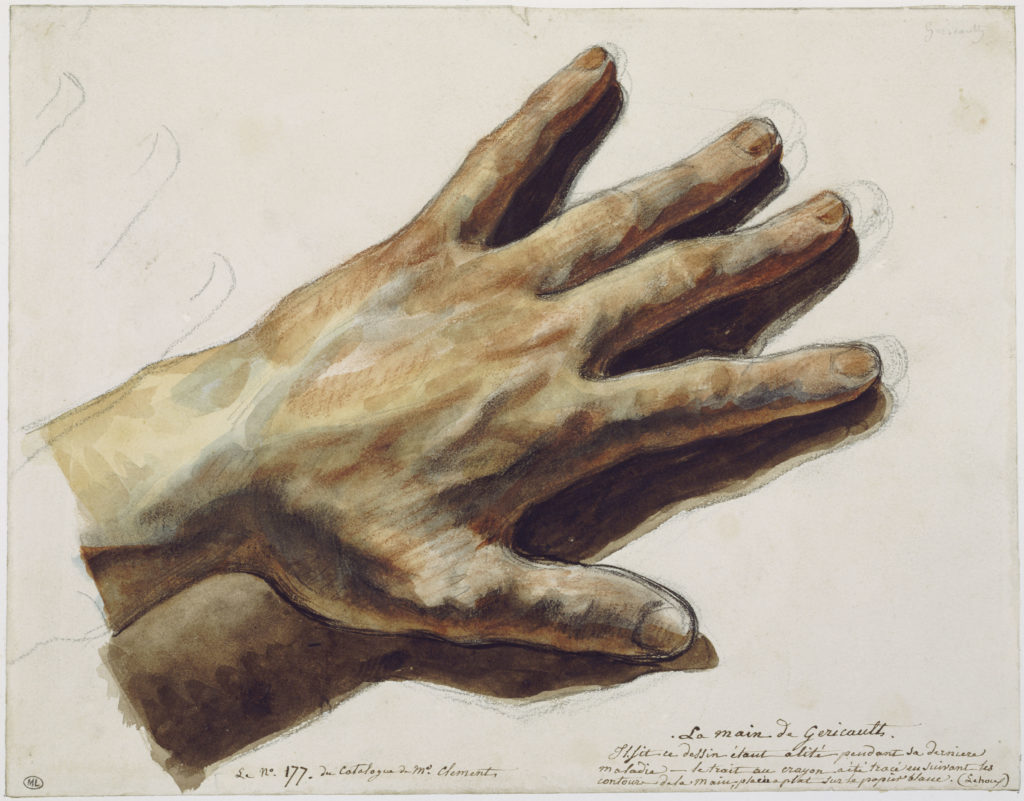
by Theodore Gericault, 1824

Hands are powerful.  Hands are personal.

Both modern English and biblical Hebrew use the word for “hand” (yad, יָד) in many idioms.  And sometimes an idiom in an English translation of the Hebrew bible was adopted into English just because the “Old Testament” had so many English-speaking readers.

Beshalach: a high hand

The Israelites leave Egypt “with a high hand” in this week’s Torah portion, Beshalach.  Here is the King James translation:

And the Lord hardened the heart of Pharaoh king of Egypt, and he pursued after the children of Israel: and the children of Israel went out with an high hand. (Exodus 14:8)

In English we say people are “high-handed” when they act as if they have the authority to accomplish something by themselves, without consulting anyone or considering anyone else’s concerns.  When the Israelites march out of Egypt, they feel arrogant for a change.  The pharaoh who oppressed them has begged them to go, they are taking everything Pharaoh wanted them to leave behind, and they have just commandeered  gold and other valuables from their Egyptian neighbors.  They act as if they are invincible–until the Egyptian army catches up with them. (See my 2013 post: Beshalach: High Handed.)

In English we say “He was caught red-handed,” because a man at a murder scene with blood on his hands is probably the murderer.  The idiom applies to anyone caught committing a violation in front of witnesses or with obvious, incontrovertible evidence.

But if you arrange for someone to die while you are elsewhere and there is no evidence that “your hand was in it”, you might never be implicated.  Biblical Hebrew would phrase that idiom as “your hand was with” the obvious perpetrator.  For example, King David asks a woman with an imaginary story about two sons “Is the hand of Joab with you in all this?” to find out if Joab’s hand is in her ploy to make him change his mind about his son Absalom (2 Samuel 14:19).

Vayeishev: don’t lay a hand on

This week I am writing the part of my book on Genesis about when Joseph’s brothers sell him as a slave to caravan bound for Egypt in the Torah portion Vayeishev.  Initially, most of Joseph’s ten older brothers want to kill him, then throw his body into one of the dry cisterns in the vicinity.  Reuben, the oldest brother, persuades them not to get blood on their own hands.

And Reuben said to them: “Don’t shed blood!  Throw them into this pit that is in the wilderness, but don’t extend a hand (yad) on him,” in order to rescue him from their hand (yad) and return him to his father.  (Genesis 33:22)

In colloquial English Reuben is saying: “Don’t lay a hand on him.”   All the brothers cooperate by seizing Joseph, stripping off his fancy tunic, and throwing him into the cistern alive.  Then Reuben wanders off while the rest of Joseph’s brothers sit down for a meal and Joseph pleads for his life from the bottom of the cistern.  An Ishmaelite caravan headed for Egypt approaches, and one of the brothers, Judah, says:

What profit if we murder our brother and cover up his blood?  Let’s go and sell him to the Ishmaelites, and our hand (yad) won’t be on him; for he is our brother, our flesh.”  (Genesis 33:26-27)

What Judah does not say is that a slave sold in Egypt would probably have a short life-span.

Thus the Torah provides an example of how humans excuse their own behavior when they put someone in harm’s way or incite someone to commit a crime.  If I didn’t do it with my own hands, they think, I’m not really guilty.

In Genesis, Joseph’s brothers realize that they are guilty after all, and that guilt haunts them the rest of their lives.

Vayishlach: Dark Night

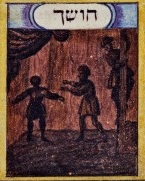
Plague of Darkness,
Haggadah by Judah
Pinchas, 1747

The penultimate plague in Egypt, just before the Death of the Firstborn results in the liberation of the Israelite slaves, is darkness.

For three days there is complete, impenetrable darkness, darkness so thick that it can be felt.  “No one could see his brother, and no one could get up from under it, for three days.”  (Exodus 10:23)

This is not only a physical darkness, but a psychological one.  Click here to read my blog post on the subject: Bo: Impenetrable Darkness.

The Egyptians in this week’s Torah portion, Bo, are immobilized by darkness–by their inability to recognize other human beings as their brothers.

Today I have been writing about Jacob’s wrestling match in the dark night before he sees his brother Esau face to face for the first time in 20 years.  Jacob wronged Esau by making him swap his firstborn rights for a bowl of lentil stew, and by tricking their father into giving him Esau’s blessing.  Like other characters in the book of Genesis/Bereishit, Jacob gave the wrong answer to Cain’s question, “Am I my brother’s protector?”

Guilt drives Jacob’s behavior for 20 years.  Now he is about to return home to Canaan, and he wants to make amends.  But how can he face Esau?

What will it take for Jacob to forgive himself?  Will he ever emerge from his inner darkness?

By the time I finish writing my book on moral psychology in Genesis, I will have some answers.

Vayeitzei: Idol Thief

I am still writing my book, Tasting the Fruit: Moral Psychology in Genesis. Today I wrote about how Rachel steals her father’s household idols as she leaves home, sneaking off toward Canaan with her husband (Jacob), her son (Joseph), and her three fellow wives and their children (Genesis 31:1-21 in the portion Vayeitzei).

Why would Rachel steal the idols?  Because they can be used for divination, and she does not want her father to know where she and her family are.

Idols (physical images of gods) are forbidden in the book of Exodus.  One of the Ten Commandments declares: “You may not make for yourself a statue or any likeness of what is in the heavens above or what is on the earth below or what is in the waters from under the earth.  You may not bow down to them or serve them.”  (Exodus 20:4-5)

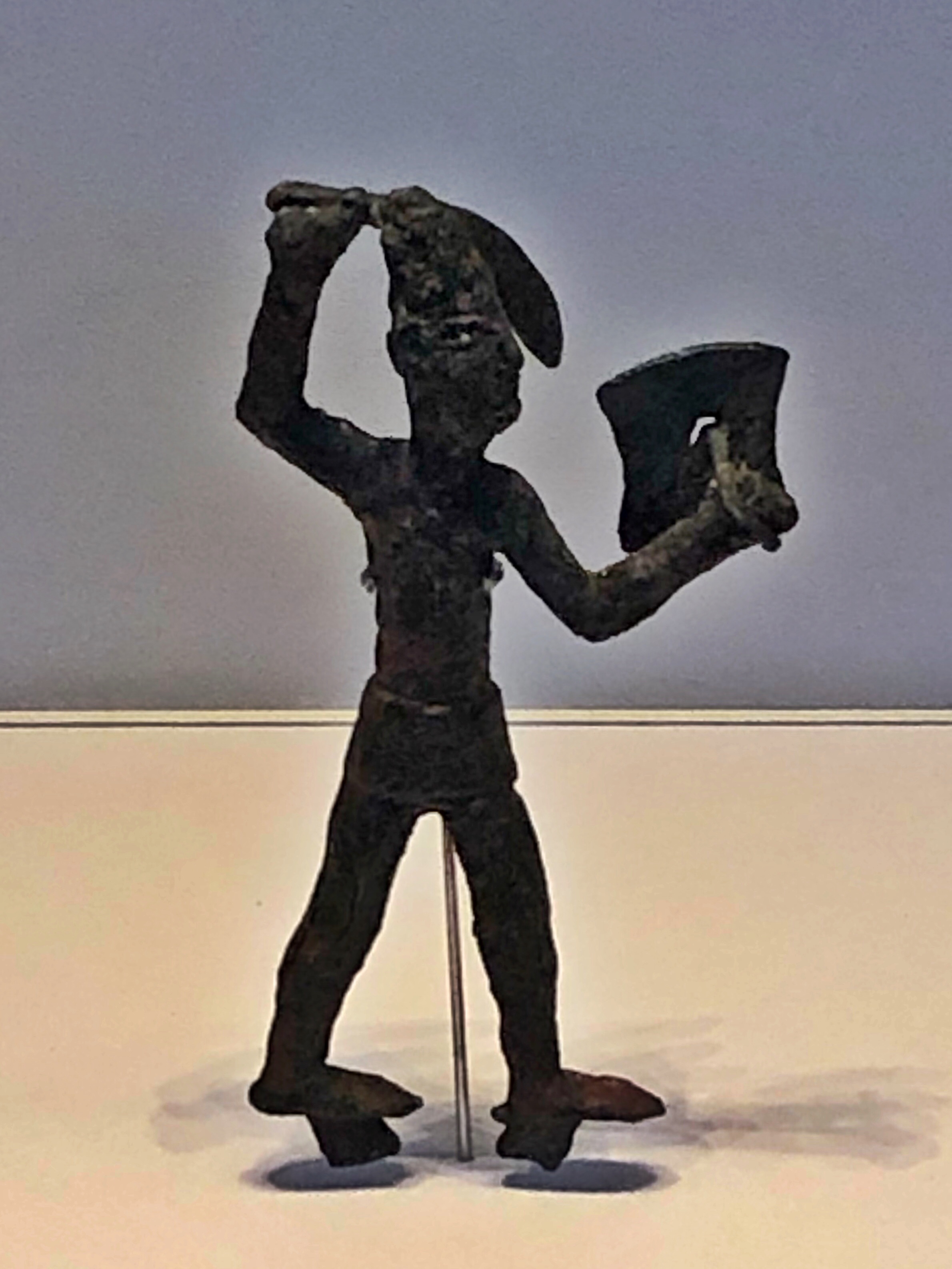
15th-13th century BCE storm god from Megiddo, Israel Museum

The books of Isaiah and Psalms make fun of idols, asking why anyone would treat a piece of inert wood, stone, or metal as if it could hear and speak.  But the book of Genesis is a different story.  The patriarchs Abraham, Isaac, and Jacob do not use idols, but Jacob’s father-in-law Lavan does, and his daughter Rachel believes they can speak to him.

The idols Rachel steals are small enough to fit into a camel pack.  They may look like the figurines of gods I saw last year in the Israel Museum in Jerusalem, all smaller than my hand.

Idols were standard religious equipment in Egypt during the 19th dynasty (1292–1190 B.C.E.), where Moses was born in this week’s Torah portion, Shemot.  He would have learned about all the gods of Egypt and their representations in painting and sculpture after he was adopted by Pharaoh’s daughter.  When he left Egypt as a young man, he went to live with a priest of Midian, and learned about the gods of the Midianites–probably including the god on Mount Sinai that later became the God of Israel.

Moses first encounters that god, God with a capital “G”, when he sees the  bush on Mount Sinai that burns but is not consumed.  God speaks out of the fire, not from an idol.  Click here to read about it in my post Shemot: Holy Ground.

Today most of us do not hear strange voices in our heads, only the familiar subvocalizations of our own psyches.  Yet many people engage in magical thinking.  I can imagine staring a long time at a bronze figurine, and hearing it speak inside your head.  And if the figurine said something that you did not consciously know, but that turned out to be true, you would stare at it again when you needed insight.

Unless it was gone when you got home, because someone had stolen it.

Deathbed Blessings

I finally finished writing about Isaac’s “deathbed” blessings for my book on Genesis.  Isaac does not actually die for many more years, but the blessings are so vital to him, Rebecca, and their sons Jacob and Esau that all four characters engage in morally dubious behavior to get what they want.  It took four essays and a Torah monologue to cover their moral psychology.

Isaac and Jacob, by Jose de Ribera, 1637

Isaac is the first person in the Torah to give what he believes is a deathbed blessing.  The next is his son Jacob, who gives blessings to all twelve of his sons and two of his grandsons just before he expires in this week’s Torah portion, Vayechi.  Here’s a link to my blog post about those blessings: Vayechi: Three Tribes Repudiated.

Both Isaac’s blessings in Toledot and Jacob’s blessings in Vayechi are like prophecies predicting what will happen the the descendants of the sons who are “blessed”—and the predictions are not all good.  All the characters in Genesis take them seriously, because if God chooses to carry out a blessing, it comes true.

The only deathbed blessing I received from my father was his smile when I told him I loved him, and that was fine with me.  If my mother gave me a Torah-style blessing when her life is about to end, I would find it creepy, even though I cannot believe there is a direct channel between her and God.

Will I want to give a deathbed blessing to my son?  He and his wife do not plan to have any children, so no prophecies about their descendants are necessary.  I would simply like to wish them good fortune and long lives.

Deception and Compassion

I have not finished writing the part of my book about Isaac’s blessings of his two sons, deceitful Jacob and straightforward Esau.  I realized that deception occurs throughout the book of Genesis, and deserves special treatment.  So I rewrote the questions I am addressing in my book on moral psychology in Genesis, and now deception gets its own heading.  So does controlling others, an important though less frequent theme.

In another day or two I expect to finish rewriting essays in earlier chapters of my book to reflect my new focus.  Then I can dive back into discussing both deception and control in the Torah portion Toledot, where I left old, blind Isaac struggling to give the right blessings.

Meanwhile, this week’s Torah reading is the portion Vayigash, which opens with Judah stepping forward to offer himself as a slave to the viceroy of Egypt in place of his little brother Benjamin.  The viceroy is actually their brother Joseph, who has been deceiving them…  You can read about it here: Vayigash: Compassion.

It’s one of my earliest blog posts, and in it I point out that although compassion is neither necessary nor sufficient for ethical behavior, the feeling of compassion does sometimes move people to step outside their usual habits and act with more kindness or generosity.

I pray that in the year 2021 all of us will be open to compassion.

1 Kings & Toledot: Bad Parents

Solomon reading from the Torah, North French 13th c.

King Solomon orders a living baby cut in half in the haftarah that accompanies this week’s Torah reading, Mikeitz.  It is his first act as a judge after God has granted him discernment between good and bad.

Two prostitutes who live in the same house come to him for judgment because they gave birth at about the same time, but one baby died in the night, and they do not agree on which of them is the mother of the living baby.  (See my post Haftarat Mikeitz–1 Kings: No Half Measures.)

Since there are no witnesses, King Solomon declares the baby will be cut in half and each claimant will get half a baby.  Then one woman begs him to save the baby’s life and give it to her adversary, while the other woman says dividing the baby is fair.  Solomon then awards the living baby (unharmed) to the woman who wants to save the baby’s life, and says she is the mother.

Whether she was the birth mother or not, she is the one who deserves to be a parent–because she who would rather save a child’s life than insist on her own legal rights .

This week, as I continue to compose my book on moral psychology in Genesis, I am writing about the blatant favoritism of the parents in the Torah portion Toledot.  In one scene, Rebecca disguises and instructs her favorite son, Jacob, so he can steal the blessing that Isaac wants to give his favorite son, Esau (Genesis 27:1-29).

The masquerade leads to one problem after another, and Jacob ends up fleeing to another country because Esau wants to kill him.  Neither Rebecca nor Isaac is as callous as the second prostitute in King Solomon’s case.  Rebecca never suggests anything that would physically harm Esau, and she chooses to lose her favorite son, Jacob, for an indefinite period of time in order to save his life.  Isaac, after blessing the “wrong” son, pronounces two more blessings, a blessing for Esau and a parting blessing for Isaac.

But both parents fail to ameliorate the psychological damage they did long ago by neglecting one son and lavishing attention on the other.  As the rest of Jacob’s life unfolds in the book of Genesis, he continues to feel unentitled, and to believe (like his mother) that he can only get what he wants through manipulation and deceit.

I think this is what the Torah means when it says God “visits the sins of the parents upon the children” (Exodus 34:7).  The punishment is built in; we are all handicapped to some extent because of our parents’ shortcomings.

Yet I believe that if we can examine our own histories, and work on discerning between good and bad like King Solomon, we can think of alternative choices for the future, and make life better for ourselves and our children and everyone around us.  May we all make it happen.

What Do You Seek?

And [Joseph] came to Shekhem.  And a man found him, and hey!  He was going astray in the field.  And the man asked him: “What do you seek?” (Genesis/Bereishit 37:14-15)

That is the opening of the first post I ever wrote on this week’s Torah portion, Vayeishev.  I dusted if off and polished it up today, and you can find it at this link: Vayeishev: The Question.

I plan to expand on  two of the points in that post when I write Chapter 9 of my book on moral psychology in Genesis.  This week I’ve been writing Chapter 5, on the Torah portion Chayyei Sarah, which includes the story of how Abraham and his steward acquire a wife for Abraham’s son Isaac.  “What do you seek?” is a good question for that story as well.

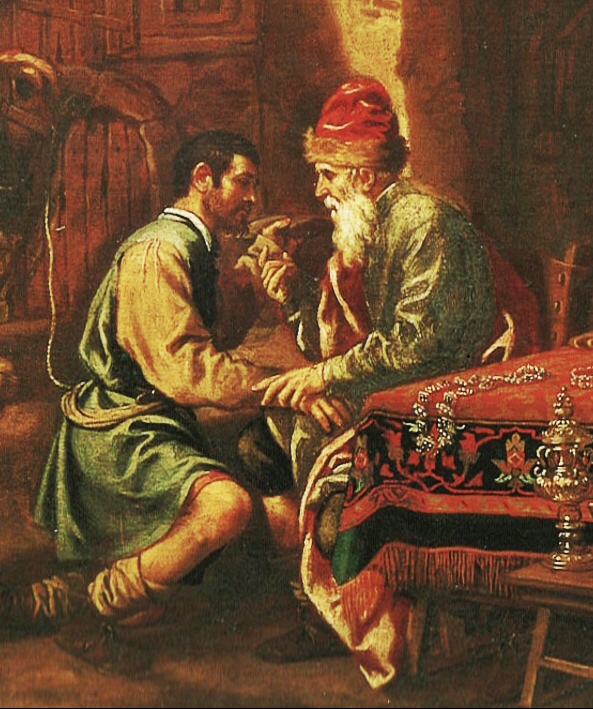
Abraham’s Solemn Charge, by Pedro Orrente, 17th cent., detail

When Abraham gives instructions to his steward for picking out the bride, he is seeking a woman who will keep Isaac on the path to provide descendants who will someday rule Canaan under God’s law.  Since Abraham believes his son is  weak and easily influenced, he wants Isaac to have a wife who is not a Canaanite but who will move to Canaan for the marriage.

Abraham’s steward has another agenda besides fulfilling his oath to his master.  He seeks a bride who is generous and strong–perhaps because Isaac is withdrawn and passive, and the steward hopes a wife like that will draw him out.

Isaac himself seeks solace after his mother’s death, but it does not occur to him to look for it in a wife.  He is surprised when his father’s steward arrives with a bride for him.

And the bride herself?  Rebecca, Isaac’s first cousin once removed, is the one all three men have been seeking.  But what does she seek, and does she find it in her marriage to Isaac?  The Torah is silent on that subject, so I am making it the theme of my Torah monologue for Chapter 5.

*

I like the word “seeking” because it means actively searching, not passively hoping that what you want will happen.  I have been seeking a life of writing books for most of my 66 years, but real life is complicated, and I have only achieved my goal a few times, during years that were never long enough.  This time, even though I am retired, I still have to keep saying no to all kinds of things in order to guard my writing time.  That’s the hard part.  The easy, delightful part is spending so many hours a day writing, and going to bed every night looking forward to writing again in the morning.

I have found what I was seeking.  What do you seek?