And it happened after these events, and God tested Abraham … And he said: “Take, please, your son, your only one, whom you love, Isaac. And get going to the land of the Moriyah, and bring him up there as a burnt offering on one of the hills …” (Genesis 22:1-2)
Abraham almost does it. Isaac is tied up on top of the stacked wood, and Abraham takes the knife in his hand before he hears the divine voice telling him to desist.
I spent four days writing about four possible tests God might have in mind, and whether Abraham passes or fails each version. Whatever God wants to find out about Abraham, there is no doubt that slaughtering Isaac would be morally wrong.
Today I am writing one more essay for this chapter on the story of the Akedah, the Binding of Isaac, in the Torah portion Vayeira. How can Abraham and Isaac reconcile after the near-sacrifice? The Torah says twice that they walk up the hill yachdav(יַחְדָּו), together. But Abraham walks down alone. (Genesis 22:6, 22:8, and 22:19)
I love writing this book on moral psychology is Genesis, but I have fallen several Torah portions behind the Jewish cycle of Torah readings. This week we are reading Vayishlach, in which Jacob and Esau meet again, 20 years after Jacob cheated his brother Esau on his blessing and Esau vowed to kill him. After 20 years apart, the twin brothers do reconcile–mostly. You can read about it in the blog post I wrote in 2015: Vayishlach: A Partial Reconciliation.
The reconciliation between the two brothers is only partial because after they have embraced one another and shed tears, Esau suggests that they travel together. (Genesis 33:12) Jacob gives him an excuse, and heads in a different direction.
When someone has wronged you, togetherness can be even harder than forgiveness.
This week of Thanksgiving in the United States happens to be the week of the Torah portion Vayeitzei, in which Jacob marries two sisters, Leah and Rachel, and all three of them eventually settle for less than they wanted. Only Leah thanks God for what she already has. See my 2015 post, Vayeitzei: Satisfaction.
As for me, I am grateful that I am still working every day on my book about moral psychology in Genesis. Right now I am rewriting a Torah monologue, or dialogue, between Sarah and Hagar, the rival mothers of Abraham’s sons. In the Torah portion Vayeira, Sarah makes Abraham drive Hagar and her son out of the camp.
Two generations later, Leah and Rachel, rival mothers of Jacob’s sons, both travel to Canaan with him, and they achieve a grudging peace. The Torah illustrates that improvement is possible over time. And a dash of gratitude can only help.
Today we are right to work against racism in the United States; and we can also be grateful that civil rights increased during the 1960’s. We are right to work against the air pollution that is already changing the world’s climate; and we can also be grateful that so many heads of state, including America’s incoming president, finally recognize the problem. We are right to accept further isolation to reduce the spread of Covid-19; and we can also be grateful for the scientists who recommend best practices and develop new vaccines.
We would all rather just get what we want. But in the meantime, let’s give thanks for what we have.
This week’s Torah portion, Toledot (“Histories”), begins with Rebecca’s difficult pregnancy and the birth of her twins, Esau and Jacob. Here is the first blog post I ever published, written eleven years ago in 2009: Toledot: Opposing Twins.
Esau and Jacob are the sons of Isaac and Rebecca, who are first cousins once removed. (Isaac’s father, Abraham, is the brother of Rebecca’s grandfather, Nachor.) Further inbreeding takes place in that family when Jacob marries both daughters of Rebecca’s brother Lavan–in other words, his first cousins.
But this is a far cry from the incest I am writing about today in the third chapter of my book on moral psychology in Genesis.
Father-daughter incest is usually perpetrated by the father on an underage daughter who cannot defend herself. But after the destruction of Sodom and Gomorrah, it is Lot’s two unmarried adult daughters who get him drunk so they can use him to get pregnant.
I feel sorry for Lot, whom the Torah portrays as foolish but not bad at heart. As he flees Sodom he knows that his city and his home are going up in flames behind him, along with his married daughters and probably grandchildren. Then Lot’s wife turns into a pillar of salt. Lot and his two remaining daughters keep going and find shelter in a cave in the hills. Then Lot wakes up and discovers he is a victim of incest. Oy, vey!
Yet Lot’s daughters are also traumatized, and the evening before the destruction of Sodom their father offered to throw them to the mob at his door in order to protect the strangers he was sheltering. And there are other complications …
It is easy to make general rules for ethical behavior. It is harder to apply them to specific cases.
Abraham arranges a wife for his estranged son Isaac without Isaac’s knowledge in this week’s Torah portion is Chayyei Sarah. Here is a link to my 2015 blog post: Chayyei Sarah: Loss of Trust.
The book of Genesis is full of dysfunctional families committing acts of dubious ethical value. This past week I wrote the chapter of my Genesis book on Noah, and found more examples. Fortunately I had already written a Torah monologue from the viewpoint of Noah’s wife, whom I picture as out of place in the pre-flood world of brutality. Do Noah and his family bring the seeds of more brutality with them on the ark?
This past week I eviscerated eight essays that seemed fine when they were blog posts and installed all new plumbing so they would speak to one of the moral themes in the first chapter of my Genesis book:
How do we know whether something is good or evil?
When should we obey God?
How do we act ethically toward family members? Toward the earth?
What subverts our ability to choose the good?
These themes continue to be questions in the rest of Genesis, along with a few more questions about ethics.
Now I just need to revise my Torah monologue from the viewpoint of Cain, and I’ll be ready to tackle my chapter on the Torah portion Noach. I don’t expect this next chapter to call for as many essays as the two creation stories and the narrative of Cain and Abel. But the story of Noah and the story of the tower of Babel certainly do address questions of moral psychology.
Meanwhile, the Jewish cycle of Torah readings covers the Torah portion Vayeira this week. Here’s a post I wrote in 2012 about how Abraham and Lot deal with men who turned out to be messengers from God, also known as angels: Vayeira: Seeing Angels.
The Torah portion this week is Lekh-lekha, which means “Go to yourself!” or “Go for yourself!” or “Get yourself going!” To read one of my favorite earlier posts on this portion, click on this link: Lekh-lekha: Please.
This past week I got going again on the book I’m writing about moral psychology in Genesis. (My current working title is “Genesis: Good and Evil Fruit”.) The most important chapter in a book is the first one, because if it doesn’t sparkle, nobody wants to read the rest. So I spent the week writing many, many drafts of a new Torah monologue from the viewpoint of the snake in the Garden of Eden. In my version, the snake is not a bad character at all.
I want to finish writing my book on moral psychology in Genesis. And I want to continue writing my weekly blog posts. But I have discovered I cannot do both at once.
So this fall, while the Jewish cycle of Torah readings is going through the book of Genesis, I will work on my own book. I have already rewritten my essays and Torah monologues to date that deal with how Genesis presents moral conundrums to its characters. Now I need to write new work to complete the jigsaw puzzle.
During the next eleven weeks, I will send you an update on my progress, and a link to one of my earlier blog posts on the Torah portion of the week–one that will not appear in the book.
Also at anytime, you can click on “Categories” in the sidebar to the right of any of my posts, scroll down, click on the name of a Torah portion, and click on any of my earlier posts that you would like to read.
I plan to be back with a new blog post in January, when we begin studying the book of Exodus again. By then I hope my book is finished!
May the next eleven weeks be creative and fulfilling for all of us.
*
Here is a link to one of my essays on the first two Torah portions of Genesis, Bereishit and Noach: Noach: Winds of Change.
Avinu malkeinu, we have missed the mark before you.
Avinu malkeinu, we have no king other than you.
avinu (אָבִינוּ) = our father.
malkeinu (מַלְכֵּנוּ) = our king.
These are the first two verses of a prayer sung from Rosh Hashanah through Yom Kippur to ask God to forgive our misdeeds of the past year. (The new year, 5781, began on Friday evening, and Yom Kippur will end the evening of September 28, 2020 in the secular calendar.)
The Avinu Malkeinu prayer can be traced to the Talmud, which records a story about Rabbi Akiva’s prayer during a drought.1 Akiva’s teacher, Rabbi Eliezer, prayed for rain.
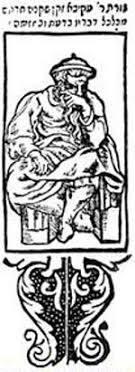
Rabbi Akiva, Mantua Haggadah, 1568
And he recited twenty-four blessings, but he was not answered. Rabbi Akiva descended before the ark after him and said: “Our Father, our King, we have no king other than You. Our Father, our King, for Your sake, have mercy on us.” And rain immediately fell. The Sages were whispering among themselves that Rabbi Akiva was answered while his teacher, Rabbi Eliezer, was not. A Divine Voice emerged and said: “It is not because this Sage, Rabbi Akiva, is greater than that one, Rabbi Eliezer, but that this one is forgiving, and that one is not forgiving. God responded to Rabbi Akiva’s forgiving nature in kind by sending rain.”2
Over the centuries more verses were added to Rabbi Akiva’s original two verses, all beginning with the words Avinu malkeinu.3
The first book of Isaiah, dated to the 8th century B.C.E., warns King Ahaz of Judah about dangers from other nations and urges him not to become a vassal of Assyria. The prophet calls God, not King Ahaz, malkeinu:
For God is our judge
Who issues decrees;
God is malkeinu;
[God] rescues us. (Isaiah 33:22)
A king here is not only a judge and a legislator, but also the one who rescues his subjects from foreign threats.
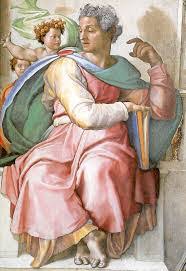
Prophet Isaiah, by Michelangelo, Sistine Chapel
The second book of Isaiah, dated to 540 B.C.E. or later, predicts that God will return the exiles in Babylonia to their homeland of Judah. The prophet reminds God that the Israelites are like children waiting for their parent to rescue them:
For you are avinu.
Even if Abraham did not know us
And Israel did not recognize us
You, God, are avinu.
Our redeemer from long ago is your name. (Isaiah 63:16)
A father knows his children, and if they become slaves he redeems them.
If God is like our father and our king, then each of us is like a child or a servant to God. In fact, the Musaf service on Rosh Hashanah includes a special three-part section with the following words after each set of shofar blasts:
Today the world is born. [God] makes all creations of all worlds stand in judgment, whether as children or as servants. If as children, have compassion toward us like the compassion of a father for children! And if as servants, our eyes hang on you until you pardon us and you release our verdict like a light, fear-inspiring Holy One!
What does it mean to be like a child to God?
Although children may be born with some instincts about fairness and kindness, they have a lot to learn. When they miss the mark, or even commit serious violations, children should be guided to realize that what they did was wrong and taught to repent, apologize, and make amends. A good human parent or mentor can do this with unflagging love for the child.
A child without help from an adult either misses out, or learns slowly through trial and error and close observation. The bible offers some rules about morality and about how to right the wrongs we do, but these hints are easy to overlook in the flood of narrative and ancient case law.
And although God may continue to love us when, like children, we miss the mark out of ignorance or naivety in a new situation, God does not provide the kind of instruction and guidance that humans can. Only after we have developed a mature sense of right and wrong, and a process for righting the wrongs we do, is it possible to hear the voice of God inside our own consciences. We need good humans in our lives before we can grow up and become good humans ourselves.
What does it mean to be like a servant to God?
In an absolute monarchy, the ruler’s subjects are like servants. Some are obedient minions of the monarchs themselves. Others are public servants who help, advise, and make requests of the monarch as they work for the good of the kingdom.
Do we serve God by obeying as many of God’s original orders to the Israelites as we can, even if God issued them several millennia ago? Do we take the biblical command to exterminate Canaanites as an order to exterminate Palestinians? Do we stone women who are not virgins on their wedding day? Do we obey other ancient rules that seem unethical by modern standards?
Or do we serve God by working for the good of God’s kingdom? In the book of Genesis God creates the world and then lets human beings rule over it.4 Now human beings are becoming absolute rulers of the world, and we are doing it badly; pollution has led to global climate catastrophe, and intolerance has prevented us from working together for mutual aid. We need to improve as human beings so we can rescue God’s world.
What does it mean for God to rescue us?
Here is the final verse of the prayer Avinu Malkeinu:
Avinu malkeinu,be gracious to us and answer us.
Even if we have no [good] deeds
Treat us with charity and kindness, and rescue us.
We pray for God, our father, our king, to forgive us for our failings the previous year and rescue us from the consequences. But as adults, we have to rescue ourselves—by doing the appropriate good deeds.
Now that I am no longer a child, I pray to the still small voice of God within for inspiration on how to recognize my misdeeds, how to make amends graciously, and how to change my approach to life so I can gradually learn to do better.
And when I think of God as a parent or a monarch, I imagine God silently praying for us wayward servants to pull ourselves together, turn around, and collectively rescue the world by doing what only human beings can do: teaching our children, restoring our planet, and treating everyone with charity and kindness.
Akiva ben Yoseif, called “Rabbi Akiva” in the Talmud, lived in Judea 30-135 C.E.
Talmud Bavli, Taanit 25b, The William Davidson Talmud, www.sefaria.org.)
The total number of verses used for the Days of Awe (Rosh Hashanah and Yom Kippur) ranges from 27 in the Yemenite tradition to 53 in the tradition of the Jews of Salonika.
For you must listen to the voice of God, your God, to keep [God’s] commands and decrees, those written in the book of this Torah; because you must return to God, your God, with all your levav and with all your nefesh. (Deuteronomy/Devarim 30:10)
In this week’s Torah portion, Nitzavim (“Taking a stand”), Moses tells the Israelites who are about to cross the Jordan that they must pay attention to and obey all of God’s orders recorded in “this book of Torah”–probably a reference to the book of Deuteronomy. The reason for observing all these rules is “because you must return to God, your God, with your levav and with all your nefesh.”
Therefore some classic commentators, including Ramban, Albo, and Sforno,1 wrote that the underlying command is to do teshuvah, i.e. repentance and turning back to God.
Moses continues:
For this command that I command you today is not too difficult for you, and it is not too far away. It is not in the heavens, to say: “Who can go up for us to the heavens and take it for us and announce it to us, so we can do it?” And it is not from across the sea, to say: “Who can cross over for us to the other side of the sea today and take it for us and announce it, so we can do it?” Rather, the thing is very close to you, in your mouth and in your levav, to do it.” (Deuteronomy 30:11-14)
Sforno explained: “You also have no need for the wise men of the generation, who are far away, to expound it for you in such a manner that it will be possible for you (to do it) in exile.”2
The command to turn back to God is always possible to obey, even for those of us who are not “wise men”, because God helps us do it. Earlier in the Torah portion Nitzavim, Moses predicts that the Israelites will stray after other gods, and God will punish them by uprooting them from their land and sending them into exile in other lands. Then he says:
It will happen, when all these things have come upon you, the blessing and the curse that I placed before you, then you will turn back to your levav among all the nations where God, your God, has banished you. Then [if] you return to God, your God, and you listen for [God’s] voice … you and your children, with all your levav and with all your nefesh … then God, your God, will return to restore you and have compassion on you…” (Deuteronomy 30:1-3)
Furthermore,
Then God, your God, will circumcise your levav and the levav of your descendants to love God, your God, with all your levav and with all your nefesh, in order that you will live.” (Deuteronomy 30:6)
In other words, if you want to return to God with all your mind and all your desire, and you listen for God, then God will meet you halfway and open your heart so that you love God. Loving God makes completing teshuvah (return) a lot easier. (See my blog post Nitzavim & Yom Kippur: Centripetal Force.)
What does the Torah portion mean by: “Rather, the thing is very close to you, in your mouth and in your levav, to do it”?
According to Albo, “The text is certainly alluding to teshuvah.A pointer to this are the words: ‘in thy mouth and in thy heart to do it’. Teshuvah involves confession of the lips and remorse of the heart.”3
Then why does your mouth (or the statement that issues from your mouth) come before your levav? Don’t you have to feel remorse in your heart before you can confess wrongdoing? Don’t you have to feel like turning back to God before you can do it?
No, at least not in my own experience. In a way, making teshuvah with God is like doing the right thing with people I don’t really like. I know I should be compassionate and fair with them, so I make an effort to acknowledge them, say something friendly, listen to them, treat them with respect. After I have done this for a while, I usually find myself caring about them. Good speech leads to good feelings.
Similarly, I often feel distant from God. It is harder for me to relate to God than to human beings, especially since I only have a vague concept of what the word “God” might legitimately mean. I used to take the easy path of atheism, ignoring my undefinable feelings of transcendence so I could deny God and avoid the problem.
On the Eve of Yom Kippur, by Jakub Weinles
But now I take the first step of teshuvah by turning toward God and listening for God’s voice. When I pray or ponder a piece of Torah, the words are in my mouth first. They echo in my consciousness, and sometimes an insight arises, as if from nowhere, as if from God. And I feel moved, as if my heart is opening. The thing that was in my mouth enters my heart.
Teshuvah is on the minds of many Jews at this time of year, as we approach Yom Kippur (“Day of Atonement”). May each of us find a way to let the spoken liturgy enter our hearts, so that as we turn toward God, God returns to us.
Rashi is the acronym for the 11th-century French rabbi Shlomoh Yitzchaki. Abraham ben Meir Ibn Ezra was a 12th-century Spanish rabbi. Ramban is the acronym for the 13th-century Spanish rabbi Moshe ben Nachman, also known as Nachmnaides. Yosef Albo was the 15th-century Spanish rabbi who wrote Sefer Ha-Ikkurim. Ovadiah ben Yaakov Sforno was a 16th-century Italian rabbi.
Ovdiah Sforno, Commentary on the Torah, translated by Rabbi Raphael Pelcovitz, Artscroll, 1997, p. 981.
From Yosef Albo, Sefer Ha-Ikkurim, translated by Aryeh Newman in Nehama Leibowitz, Studies in Devarim, The World Zionist Organization, Jerusalem, 1980, p. 323.
Moses describes three rituals the Israelites must perform after they have crossed the Jordan and taken the land of Canaan in this week’s Torah portion, Ki Tavo (“When you come”). For all three, Moses reminds the people that they will be living in “a land flowing with milk and honey”.
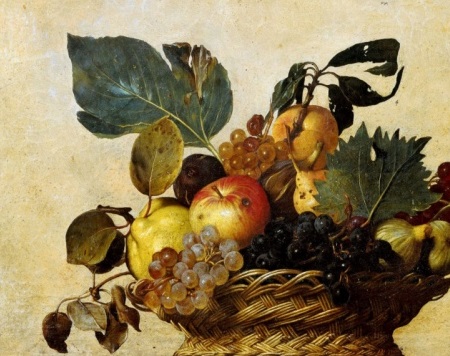
Still Life, Caravaggio ca. 1595, detail
First he prescribes Shavuot, the annual pilgrimage to bring the first fruits of the year to the priests at the temple. Each farmer must bring a basket of fruits, give the basket to a priest, and recite a short history of the Israelites from the arrival in Egypt to the arrival in Canaan. (See my post Ki Tavo: A Perishing Aramean.) The recitation ends:
“And [God] brought us to this place and gave to us this land, a land zavat chalav udevash. And now behold! I bring the first fruits of the soil that you have given to me, God.” (Deuteronomy/Devarim 26:9-10)
zavat (זָבַת) = flowing, oozing.
chalav (חָלָב) = milk, drinkable yogurt.
udevash (וּדְבָשׁ) = and honey, fruit syrup.
Through this formula, each donor expresses appreciation to God for the bountiful land.
Payment of the Tithes, by Pieter Brueghel the Younger, 1617
The second ritual takes place every three years, when all farmers must set aside a tenth of their harvest and give it to the people in their towns who have no farms to feed them. When they have done so, they must recite this declaration to God:
I have rooted out from the house what is to be consecrated, and also I have given it to the Levite and to the resident alien, to the orphan and to the widow, as in all the commands that you commanded me. I did not transgress your commands and I did not forget. … Look down from your holy home, from the heavens, and bless Your people Israel and the soil that you have given to us as you swore to our forefathers, a land of zavat chalavudevash. (Deuteronomy 26:13-15)
The second recitation alludes to the reason why God “gave” the Israelites in a land of milk and honey: because they obeyed God’s commands. (God’s gift consists of helping the Israelites attack the inhabitants of Canaan, win a series of battles, and kill or subjugate the people. See my post Re-eih: Ownership.)
Altar on Mt. Eyval, photo by Raymond A. Hawkins
The third ritual that Moses prescribes takes place neither at the temple nor in the towns, but at twin hills near the town of Shekhem. As soon as they have crossed the Jordan, the Israelites must erect large stones on Mount Eyval and coat them with limewash, which hardens into a smooth white surface. (See my post Ki Tavo: Carved in Stone.) Then they must build an altar, make an offering, and write on the standing stones.
And you shall write on them all the words of this teaching when you cross over in order to come into the land the God, your God, is giving you, a land zavat chalav udevash, as God, God of your forefathers, spoke to you. (Deuteronomy 27:3)
Because God “gives” them such a bountiful land, the Israelites must record God’s teaching (torah) on the hilltop.
Next Moses describes the ritual. Half of the tribes must stand for the blessing on nearby Mount Gezerim, and the other half must stand for the curse on Mount Eyval. Then the Levites shout out the prescribed curses for disobeying God, and after each one all the people must say “Amen”. (See my post Ki Tavo: Cursing Yourself.)
What does it mean to say that a land is flowing with milk and honey? And why does Moses keep bringing it up?
What does it mean?
Oozing fig
The most literal explanation of zavat chalav udevash was offered in the Talmud, Ketubot 111b, where several rabbis describe seeing nanny goats dripping milk as they grazed under fig trees oozing syrup. Later commentary explained the idiom as referring to a land that is good for both raising livestock (which produce milk) and growing fruits (which produce syrup). An alternative explanation was that valleys are farmed everywhere, but in Canaan even the uncultivated hills provide food, because their vegetation produces herbage for wild goats (making milk) and flowers for wild bees (making honey).1
At least in years with enough rain. Earlier in the book of Deuteronomy, Moses (speaking for God) tells the Israelites:
And observe all the commands that I command you today, so that you will be strong and enter and possess the land that you are crossing into to possess. And so that your days will be long on the soil that God swore to your forefathers to give to them and to their descendants, a land zavat chalav udevash. For the land that you are entering to possess is not like the land of Egypt that you left, where you sowed seeds and your watered them by foot, like a vegetable garden. But the land that you are crossing into to possess is a land of hills and valleys, [a land that] drinks water from rain of the heavens. … And it will be, if you really listen to my commands that I command you today, to love God, your God, and to serve [God] with all your heart and with all your soul, then I will give rain to your land … (Deuteronomy 11:8-11, 11:13-14)
Canaan will be a land “flowing with milk and honey” as long as its new occupants, the Israelites, love and serve God, so that God provides rain to make the vegetation grow and bloom.
It occurred to me that milk also indicates fertility, and honey or syrup is a luxury, one of the choice products of Canaan that Jacob sends as a gift to Egypt.2 The basket of first fruits that a person bring to the priests may also contain the delicacy of fruit syrups.
Why does Moses keep bringing it up?
The phrase zavat chalav udevash, “flowing with milk and honey”, appears fifteen times in Exodus through Deuteronomy. The first occurrence is when Moses stands at the burning bush on Mount Sinai. God tells him:
“And I have come down to rescue [my people] from the hand of the Egyptians and to bring them up from that land to a good and spacious land, to a land zavat chalav udevash, to the place of the Canaanites and the Hittites and the Amorites and the Perizzites and the Chivites and the Jebusites.” (Exodus/Shemot 3:8)
The good news is that the land flows with good things to eat. The bad news is that the land is already inhabited by six other peoples. The next two references in Exodus mention the current inhabitants first, then sweeten the picture by calling the land “zavat chalav udevash”.3
This promise does not keep the Israelites from complaining about the uncertain food and water supply on the journey from Egypt to the border of Canaan, and suggesting that they give up and return to Egypt.4 Since the carrot is not enough, Moses adds a stick, handing down warnings that the Israelites must obey God if they want God to help them move into the land zavat chalav udevash.5
Eventually the next generation of Israelites does cross the Jordan, and conquers much of Canaan under the leadership of Joshua and, presumably, with the help of God. Thus the rituals Moses lays out in this week’s Torah portion include gratitude for possession of a land zavat chalav udevash.
Today we, too, must obey the rules in order to have land that is “flowing with milk and honey”. We have imperiled our whole planet through air pollution, and the global climate change that has already begun threatens to scorch areas that we used until now to produce food for our immense world population. We must obey the rules inherent in nature, starting now.
Already in our lifetimes the flow of milk and honey will diminish. The milk of fertility will dry up, and the honey of luxury will become scarce. We will have to develop new lands to recover at least part of the abundance that came to us as a gift—for we have not loved nor served our earth.
Nogah Hareuveni, Ecology in the Bible, Neot Kedumim, 1974, p. 11, cited in The Torah: A Modern Commentary, ed. W. Gunther Plaut, Union of American Hebrew Congregations, New York, 1981.
Genesis 43:11.
Exodus 3:17, 13:5.
The Israelites complain about the journey at least five times in Exodus 14:11-12, 15:22-24, 16:2-3, 17:1-4, and 32:1. Each time they are afraid they will die without reaching the land God promised, so they would have been better off staying in Egypt. They complain about the food and water on journey to Canaan at least six times in Numbers 11:1, 11:4-6, 13:31-14:4, 16:12-14, 20:1-5, and 21:4-5.
Numbers 13:27-14:10 and 14:22-35; Deuteronomy 6:3 and 11:8-9.





 Questioning Torah