Tazria & Psalms 38 & 88: Isolation of the Sick

Tazria

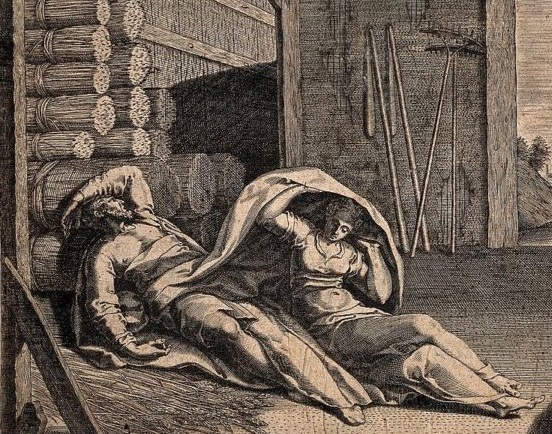
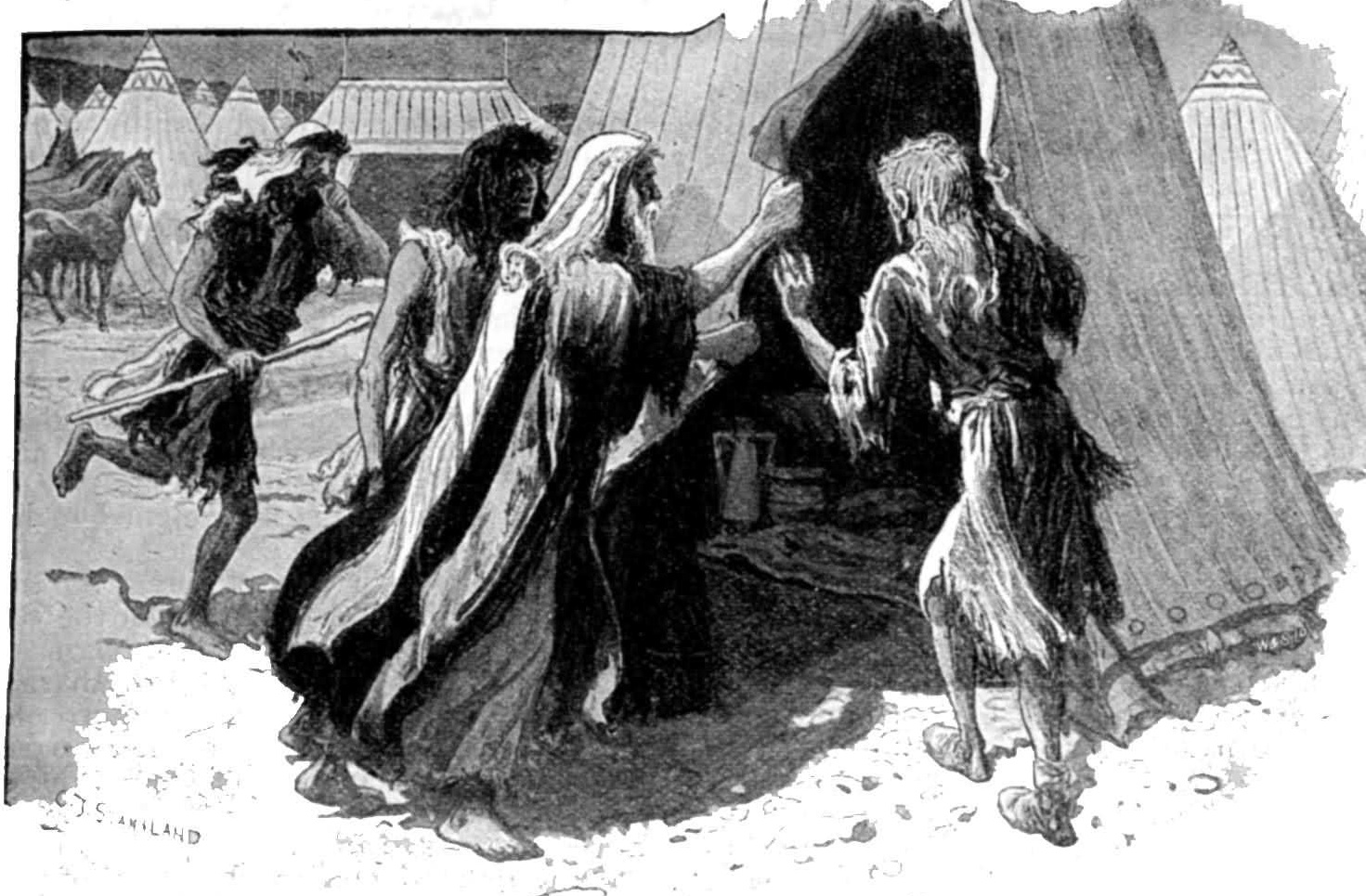
Four men with tzara-at plunder an empty tent in 2 Kings 7:8

Instructions for diagnosing the biblical skin disease of tzara-at (צָרַעַת) fill most of this week’s Torah portion, Tazria (“She makes seed”).  The end of the portion finally says what happens to people who have tzara-at.

And the person marked with tzara-at, his clothes shall be torn and his head [of hair] shall be disheveled, and he shall cover his lips, and he shall call out: “Tamei!”  All the days that the mark is on him he shall be continually tamei.  Alone he shall dwell; outside the camp is his dwelling-place.  (Leviticus/Vayikra 13:45-46)

tamei (טָמֵא) = contaminated, ritually impure, unfit for worshiping God.

Jewish mourners still tear clothing

Torn clothes, wild hair, and covered lips are all signs of mourning in the Hebrew Bible.1  People afflicted with tzara-at are not dead.  But like those who mourn a family member’s death, they mourn their separation from those they love. They can no longer live together, or even come within touching distance.  Calling out “Tamei” keeps people away, since the condition of being tamei (though not the skin disease itself) is contagious.  Being tamei also prevents people with tzara-at from approaching God in the sanctuary courtyard.

Once a priest diagnoses tzara-at, the person with the disease is isolated from the camp, the community, and the service of God.  The isolation may not be permanent; next week’s Torah portion, Metzora, includes the rituals for removing the tamei status of those who have recovered from tza-arat and reintegrating them back into the community.  Later in the bible are examples of two people healed by divine intervention,2 four men who do not expect they will ever recover,3 and a king who has tzara-at until he dies.4

The Psalms never mention tzara-at, but two psalms consider the anguish of someone with a serious disease—not because of pain, but because of isolation.

Psalm 38

The bible generally assumes that disease is a punishment God inflicts when one has done the wrong thing.  The speaker in Psalm 38 declares:

          There is no sound spot in my flesh thanks to your curse,

                        There is no peace in my bones thanks to my error.

            For my crimes pass through my head

                        Like a heavy burden, too heavy for me.         

            My wounds are making a stench

                        Through my own folly.  (Psalm 38:4-6)

After complaining about a twisted body, burning guts, numbness, a violent heartbeat, and weakness, the speaker brings up another problem:

           My loving ones and my friends stand apart from my affliction;

                       Those who are close to me stand meirachok.  (Psalm 38:12)
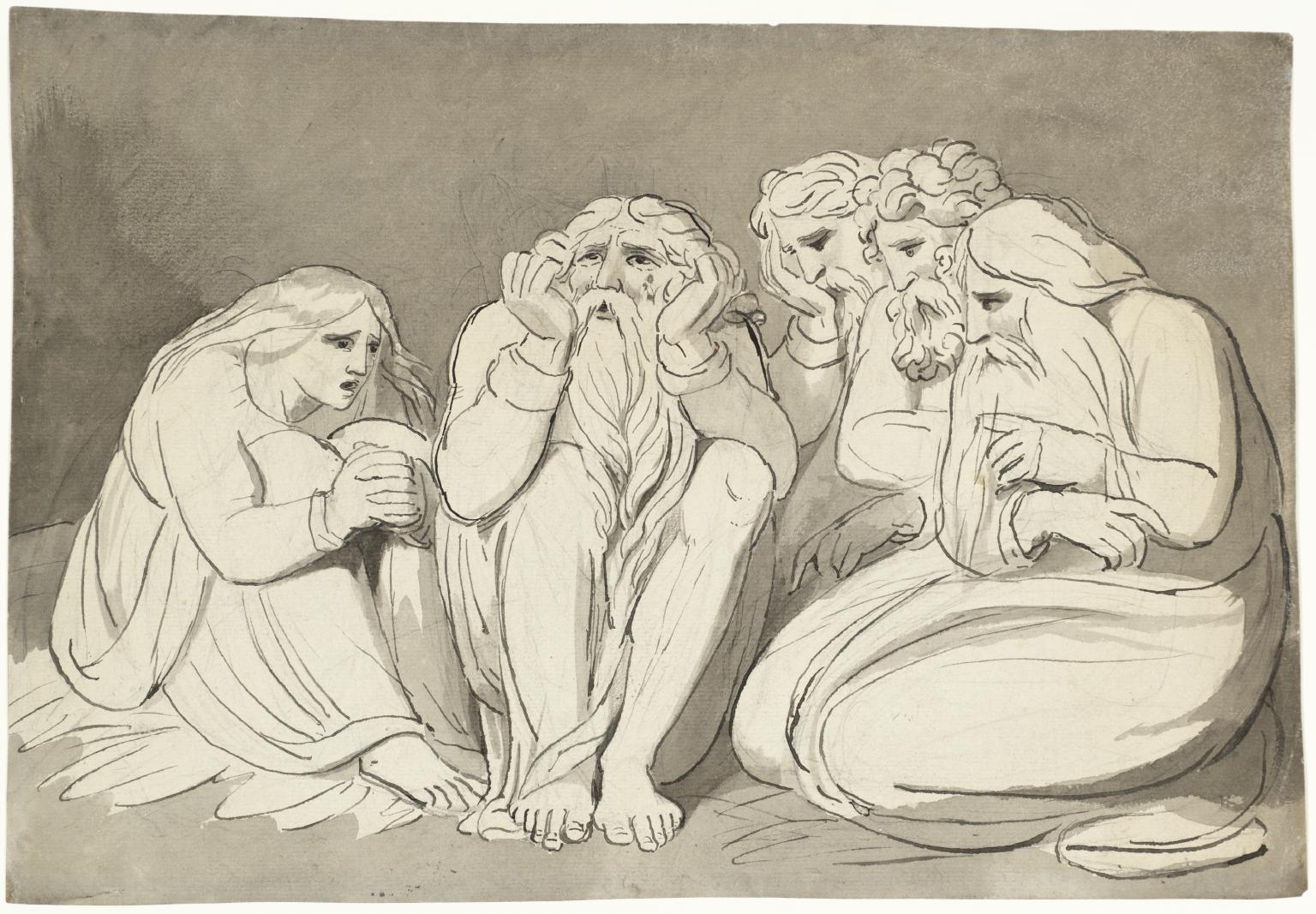
Job, his Wife and his Friends. by William Blake, ca. 1785

meirachok (מֵרָחֺק) = at a distance, from away, staying far away.  (A form of the verb rachak, רָחַק = was distant, drifted away from, kept far away.)

In the book of Job, the afflicted person’s “comforters” cluster around to tell him his sickness is his own fault, since God only sends disease to those who have sinned.  In Psalm 38, the speaker believes the sickness is a well-deserved punishment, but the speaker’s friends stay away.

Meanwhile, the speaker’s enemies plot to take advantage of his illness, and the speaker is unable to hear or rebuke them.  The only one left to listen to an appeal is God.

           Because for you, God, I have hoped.

                        You will answer me, my master, my God.

            Because I thought: “Lest they rejoice over me

                        When my foot staggers, magnify themselves over me!”

            For I am certainly stumbling,

                        And my anguish is in front of me always.  (Psalm 38:16-17)

The psalm ends:

           Do not give up on me, God!

                        My God, do not tirechak from me!

            Hasten to my aid,

                        My master, my rescuer.  (Psalm 38:22-23)

tirechak (תִּרְחַק) = you stay distant, you keep away.  (Another form of the verb rachak.)

The speaker is isolated from friends and family, who therefore cannot provide comfort; isolated from enemies, who scheme outside the speaker’s hearing range; and isolated from God, who does not seem to be present.

Psalm 88

Psalm 88 opens with a sick person’s plea to God.    

            May my prayer come before you,

                        Stretch out your ears to my cry!

            Because my living body is sated with bad things;

                        And my life has reached the brink of death.

            I am counted among those who go into the pit.

                        I have become a strongman without strength.  (Psalm 88:3-5)

This speaker blames God—who made him sick—for isolation from friends.

           Hirechakta from me those who know me;

                       You make me abhorrent to them;

                        Imprisoned, I cannot go out.  (Psalm 88:9)

hirechakta (הִרְחַקְתָּ) = you removed to a distance, you kept (something) far away.  (Another form of the verb rachak.)

Then the sick person offers God a motivation for healing, pointing out that only the living can praise God.

           Do you do wonders for the dead?

                        Do ghosts rise and praise you?  (Psalm 88:10)

Yet the speaker remains isolated from God as well.

           Why, God, do you reject me,

                        Do you hide your face from me?  (Psalm 88:15)

The psalm ends with the pain of isolation.

          Hirechakta my loving ones and my friends from me,

                        Those who know me—[into] darkness.  (Psalm 88:19)

The worst thing about death is that it cuts off any possibility of communication, with humans or with God.5

*

Some people today have visible diseases, irregularities, or deformities, like the people with tzara-at in the bible.  Although we no longer have a law isolating them, it is human nature to stare—or to carefully avoid looking at them.  Meeting their eyes, smiling, and starting a normal conversation is harder, especially when the defect is on the face.  Doing so anyway is the only ethical approach; yet because humans are weak and easily spooked, these people still suffer isolation.

Others today have invisible diseases; I am one.  Reading Psalms 38 and 88 brings tears to my eyes.  I can pass for healthy, and engage in society and communal worship like a healthy person (except that I cannot make a living because I’d need too many sick days, and I have to pace my activities to prevent exhaustion).  I am grateful that I am not isolated from human company, and I have dear family and friends.

But with my whole heart I can speak or chant those words begging God: “Do not give up on me!  Hasten to my aid!  Why do you hide your face from me?”

I do not believe God afflicts us with physical problems as a punishment for disobedience or wrongdoing.  Sometimes, in our misery, we expand our own set of physical problems with unwise behaviors.  On the other hand, we may benefit from new scientific knowledge that repairs some of the things that go wrong in our bodies.

Nevertheless, I know that often bad things happen to good people, and good things happen to bad people.  There is no divine justice for individuals.                        

Then why do we beg God to heal us?  Why do we fix our hope on God?                                

Who else is there?      

  1. Mourners customarily tear their clothes in Leviticus 10:6-7 and 21:10-11, leave their hair loose and disheveled in in Leviticus 10:6-7 and 21:10-11 and Ezekiel 24:17, and cover their lips in Ezekiel 24:17.
  2. The bible only records healing from tzara-at when there is divine intervention. In Numbers 12:10-15 God afflicts Miriam with tzara-at and then heals her.  In 2 Kings 5:1-11, the prophet and miracle-worker Elisha heals General Na-aman of tzara-at.
  3. 2 Kings 7:3-16. The four men with tzara-at must stay outside the city walls even when the enemy is approaching to attack the city.
  4. 2 Kings 15:5. King Azaryah lives in an isolated house while his son Yotam does the king’s business in the palace and on the battlefield.
  5. Walter Brueggemann points out in The Message of the Psalms, Augburg Publishing, Minneapolis, 1984, p. 79: “This is the voice of a dying one crying out to the only source of life. ‘The Pit’ [see Psalm 88:5] is not final judgment or a fiery place of punishment. It is only beyond the range of communion. For this speaker, communion with God is clearly everything.” I would amend this statement to say communion, with both human beings and God, is everything.

(P.S. I am transferring my domain name today.  Future posts will be e-mailed to everyone following my blog, as before.  Thank you, subscribers!)
Shemini, Jeremiah, Ezekiel, & Psalm 131: Silenced

Something shocking happens after the first priests, Aaron and his four sons, consecrate the new altar in this week’s Torah portion, Shemini (“Eighth”).1

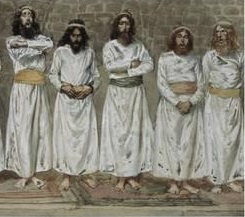
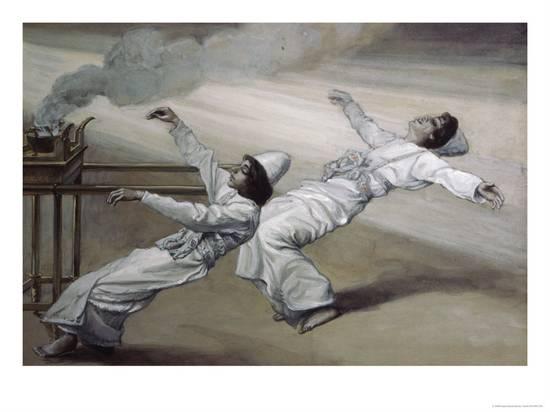
The Two Priests Are Destroyed, by James Tissot, ca. 1900

Nadav and Avihu, sons of Aaron, each took his fire-pan and he put embers on it and he placed incense on it.  And they brought alien fire in front of God, which [God] had not commanded them [to do].  And fire went out from before God, and it devoured them, and they died in front of God.  Then Moses said to Aaron: “It is what God spoke, saying:  Through those close to me, I will be proven holy; and in the presence of all the people I will be glorified.” And Aaron, vayidom. (Leviticus/Vayikra 10:1-3)

vayidom (וַיִּדֺּם) = he was silent, he became quiet; he was motionless.  (A form of the verb damam, דָּמַם = was silent, quiet, still, motionless.2)

Why do Aaron’s two older sons bring unauthorized incense into the new tent-sanctuary?  Why did Moses tell Aaron, who has just watched his sons die, that God said, “Through those close to me, I will be proven holy”?  Why is Aaron is silent and still?

I have offered some speculations in previous blog posts.  (See Shemini: Fire Meets Fire and Shemini: Mourning in Silence.)  This year I wondered why Aaron’s silence continues beyond the initial shock of the catastrophe.  Does guilt tie his tongue?  Is he too exhausted or frightened to make a move, except to obey an order?  Or is it possible that he has a moment of enlightenment?

  • After the first shock, Aaron might be unable to move or make a noise because he is overwhelmed by guilt.  Maybe he set a bad example when he made an alien idol, the golden calf.  Maybe he should have stopped Nadav and Avihu the instant when they filled their fire-pans.  Maybe God is punishing him for doing the wrong thing.
  • After the first shock, he might remain silent at some signal from his brother Moses.  As soon as Moses has arranged for Aaron’s cousins to remove the bodies, he orders Aaron and his two surviving sons to refrain from mourning.3  Aaron obediently remains silent until a question comes up about an animal offering; then he has recovered enough to take initiative again.4
  • After the first shock, Aaron might realize that no one is safe, not even Moses’ family.  He did not survive the episode of the golden calf because he was Moses’ brother, but merely because God had another plan.  God chose all four of his sons to serve as priests, then killed two of them on their first day of service.  This is life, and anything can happen.  In a moment of non-attachment, Aaron waits quietly for whatever happens next.

All three of these attitudes can be expressed with silence, as we see in Jeremiah, Ezekiel, and Psalm 131.

Jeremiah and Guilt

In the book of Jeremiah, God declares through the prophet that all the people of Jerusalem will die because they are guilty of persistent wrongdoing.  At one point, Jeremiah interrupts:

Fortress on a Hill, by Augustin Hirschvogel, 1546

Why are we sitting here?

Let us gather and enter fortified towns, venidmah there.

For God, our God, hadimanu,

And has made us drink venom,

Because we offended God. (Jeremiah 8:14)

venidmah (וְנִדְּמָה) = and we will be still and wait.  (Another form of the verb damam.)

hadimanu (הֲדִמָּנוּ) = has silenced us.  (Also a form of damam.)

Jeremiah repeatedly declares that the Babylonian conquest of Jerusalem will succeed because God is punishing the people for their sins.  They are guilty, so they must be silent.

Ezekiel and Obedience

Moses tells Aaron and his surviving sons that priests may not bare their heads or tear their clothing even if a close family member dies.  All the other Israelites can wail and mourn, but not the holy priests.

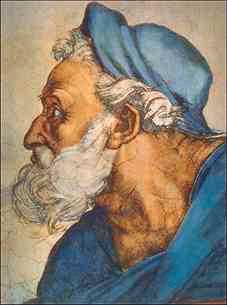
Mourning is also silenced in the book of Ezekiel, a prophet from a family of priests (who would be priest himself if the Babylonians had not deported him from Jerusalem).  Ezekiel reports that God told him:

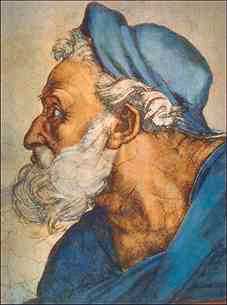
Ezekiel (with head-dress), by Michelangelo

Human, I am here taking away from you by pestilence what is precious in your eyes.  And you may not beat the breast, nor wail, nor shed a tear.  Groan in dom.  You may not do mourning rites for the dead.  You shall tie on your head-dress and put your sandals on your feet, and you may not cover your lips, and you may not eat the bread of other men.  (Ezekiel 24:16-17)

dom (דֺּם) = silence.  (From the verb damam.)

Ezekiel’s wife dies that night, and he obeys God’s orders.  When the Jews in his community in Babylon ask him why he is not mourning, Ezekiel replies that this is how they should act when the temple in Jerusalem falls and the sons and daughters they left behind die by the sword.  Like priests, they must not exhibit mourning even when God lets their beloved city and their children perish.

However, they must also remember their guilt.

… you shall not beat the breast and you shall not wail.  But you shall rot in your crimes, and you shall moan, each man to his brother.  (Ezekiel 24:23)5

Psalm 131 and Acceptance

After Nadav and Avihu die, Aaron is silent and motionless, a powerless man with nothing to do but wait.

Quiet acceptance is the theme of Psalm 131, a short poem translated here in full:

A song of ascents for David.

            God, my heart is not haughty

            And my eyes are not arrogant.

            I have not gone after greatness

            Or wonders too difficult for me.

            I have found equilibrium vedomamti my soul.

            Like a weaned child on its mother,

            Like a weaned child is my soul.

            Wait, Israel, for God

            From now until forever.  (Psalm 131:1-3)

vedomamti (וְדוֹמַמְתִּי) = and I have made quiet.  (Also a form of the verb damam.)

The speaker is humble, not striving to achieve.  He or she is weaned from attachment and dependence, and has found equilibrium6 and an inner state of peace and quiet.  Such a person can wait patiently for God to manifest.

Does Aaron become a quiet and humble man after God devours his two older sons?  Does he reach a state of peaceful non-attachment?  Perhaps; when God says Aaron must die without entering the “promised land”, Aaron, unlike Moses, does not make a fuss.7

What would it take for your soul to become quiet and peaceful after a disaster?


  1. See my post Shemini: Prayer and Glory.
  2. Some translators distinguish between damam I, which refers to silence and stillness, damam II, which refers to quiet sobbing or murmuring, and damam III, which refers to being destroyed or perishing. I believe this distinction is unnecessary.  A word indicating silence and stillness can also indicate a noise that is barely audible, like the “still, small voice” (demamah, דְּמָנָה) of God in 1 Kings 19:12.  And every time a word with the root damam has been translated as being devastated or perishing, it appears in a poetic passage that easily accommodates a translation in terms of silencing or stopping all motion. (See Psalm 31:18 and Jeremiah 25:37, 48:2, 49:26 and 50:30, and 51:6.)
  3. Leviticus 10:5-6.
  4. Leviticus 10:16-20.
  5. The translation of וּנְמַקֺּתֶם בַּעֲוֹנֺתֵיכֶם as “and you shall rot in your crimes” comes from Robert Alter, The Hebrew Bible, Vol. 2: Prophets, W. Norton & Co., New York, 2019.
  6. Shiviti (שִׁוִּתִי) = I have leveled, I have made even, I have equated. Therefore my translation here is “I found equilibrium”.
  7. Both men are doomed to die outside the “promised land” of Canaan in Numbers 20:12, although Moses is the one who shouts the words God finds offensive. Aaron quietly dies on Mt. Hor in Numbers 20:23-28.  Moses complains about God’s decree in Deuteronomy 3:23-6.

Esther: Stupid Decisions

Purim, a Jewish holiday on the 14th of Adar (March 20-21 this year), revolves around the book of Esther, an imaginative farce set in Shushan, one of the capitals of the Achaemenid Empire of Persia (553-333 BCE).

The real kings of this empire were smarter than the average dictator.  The founder, Cyrus I, encouraged the fealty of the many ethnic groups in his lands by granting them local autonomy and helping them rebuild their old temples.  Darius I recruited administrators and soldiers from many ethnic groups.  His son Xerxes I and grandson Artaxerxes I (who reigned 465–424 B.C.E.) continued these astute policies of cultural and religious tolerance, making it easier to rule the world’s biggest empire to date.

Persian Empire ca. 500 BCE

King Xerxes built gigantic palaces in two of his five capital cities, Persepolis and Susa/Shushan. His son Artaxerxes seems to have been a competent political leader with a taste for the standard royal luxuries, like his father.

In the book of Esther, the Persian emperor is King Achashveirosh, which is probably a corruption of the Hebrew name for Artaxerxes: Artachshasteh. And in the book of Esther, Achashveirosh is, above all, stupid.  His stupid decisions drive a plot of near-catastrophes and amazing reversals.

On the evening of Purim we read and perform the book of Esther, enjoying every comic moment.  Late the next afternoon there is a traditional seudah shlishit, a “third meal” which is supposed to be second in importance only to the seder meal on Passover.  Unlike the Passover seder, the Purim seudah has no ritual text.  But maybe this year it could be a time to discuss some of the stupid rulings the fictionalized king makes—and how easy it is to make similar errors today.

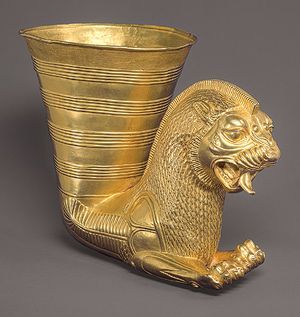
Persian gold drinking horn, 5th century BCE

The book of Esther opens with King Achashveirosh spending lavishly on a 180-day drinking feast for his administrators and noblemen, followed by a seven-day drinking feast for the entire male population of Shushan.

And the drinking was according to the dat: There is no constraint!  (Esther 1:8)

dat (דָּת) = (plural datim, דָּתִים) rule, law, regulation, edict, decree.  (From the Persian word data.)

The word dat is used only in biblical passages written after the Persian Empire took over the Neo-Babylonian Empire and its formerly Israelite territory circa 539 BCE.  Dat appears 20 times in the book of Esther.  During the course of the story, King Achashveirosh (who likes to drink) issues six new datim on impulse, without constraints such as getting information or thinking things over.

Dat 1

Persian Queen Atossa, crowned 522 BCE

On the seventh day, as the king was feeling good with wine, he said … to bring Vashti, the queen, before the king in her royal crown, to display her beauty to the peoples and the officials, since she was good-looking.  (Esther 1:11)

Vashti refuses.1  Achashveirosh is furious.

But the king spoke to the wise men … because this was the king’s practice, [to come] before all experts on dat and judgement.  (Esther 1:13)

Consulting legal advisors on what to do about this perceived insult from the queen seems like a wise and sensible move—as long as one has competent advisors.  King Achashveirosh has seven, but only one speaks: Memukhan, who declares that in order to prevent noblewomen throughout the empire from getting uppity, Vashti must be severely punished.  Memukhan proposes a new dat declaring that Vashti is dethroned, divorced, deprived of her land, and banned from the king’s presence.  Achashveirosh agrees with no further thought.

*

Today, when do we (or our rulers) act on impulse, following the lead of the first person to speak, without pausing to solicit other opinions?  Do we fail to express our own viewpoints when we are given the opportunity to speak?

Dat 2

After a while Achashveirosh misses Vashti.  The real Achaemenid kings chose all their queens from seven noble Persian families, but in the book of Esther the king’s servants suggest holding a beauty contest to pick the next queen.  Each of the many finalists would spend a night with the king.  Achashveirosh jumps on this idea without consulting his legal advisors, and issues a new dat declaring the contest and its procedures.   Eventually he chooses Esther, the adopted daughter of her uncle Mordecai, a Jew who “sits in the gate” of Shushan as a judge.

*

Today, when do we pick our romantic partners, business associates, or even presidents based on their looks and charm, without considering any possible consequences?

Dat 3

For no apparent reason, the king picks a self-centered man named Haman as his new viceroy, and orders everyone in the king’s gate to kneel and bow down with their faces touching the ground when Haman passes through.  In the Torah this is the position of humility before God—which might explain why Mordecai refuses to do it.

When the king’s other servants tell Haman that Mordecai is ignoring the dat about bowing because he is a Jew, Haman decides to wipe out all the Jews in the Persian Empire.

Then Haman said to King Achashveirosh: “There is a certain people, scattered and separate from the peoples in all the provinces of your kingdom, and their datim are different from all [other] peoples’, and the datim of the king they do not follow.  So it is not suitable for the king to leave them in peace.”  (Esther 3:8)

Achashveirosh does not ask which group Haman is talking about.  He does not ask which of the king’s datim its members are violating, or why.  And as usual, he does not talk to anyone else to get another side of the story.  For someone unaccustomed to thinking, it is enough that these people are different.  Unlike the real kings of the Persian Empire, the Achashveirosh character is easily frightened by diversity.

*

When do we react with fear (or fear disguised as resentment) because certain people look  different, or speak a different first language, or adhere to a different religion?

Dat 4

Given the king’s usual blank state of mind, Haman’s simple scare tactic might be enough.  But the viceroy adds a bribe, promising to pay 10,000 silver disks into the royal treasury if the king commands the extermination of this unnamed people.  Without asking a single question, without thinking about justice or remembering his family’s tradition of religious tolerance, King Achashveirosh hands over his signet ring to Haman.

And scrolls were sent out by the hand of the runners to every single province of the king [with the order] to destroy, to slay, and to exterminate all the Jews … on the thirteenth day of the twelfth month, which is the month of Adar, and to plunder them.  A copy of the writing was to be given as a dat in every single province and shown to all the peoples, to be prepared for this day. (Esther 3:13-14)

*

When do we abandon our identities, giving the equivalent of our signet rings to others, for financial reasons?  For other reasons that would not hold up to scrutiny?  Do we ever wonder if we are violating our own principles?

Dat 5

Mordecai begs Esther to intercede with the king.  Much drama ensues, with two intertwining plot lines.  Haman has just erected a stake for impaling Mordecai when he is forced to publicly honor the Jew for saving the king’s life.  Meanwhile Esther uses courage and cleverness to get Achashveirosh and Haman where she wants them.2

At her second private drinking feast for the king and his viceroy, Esther asks King Achashveirosh for her life and the lives of her people.

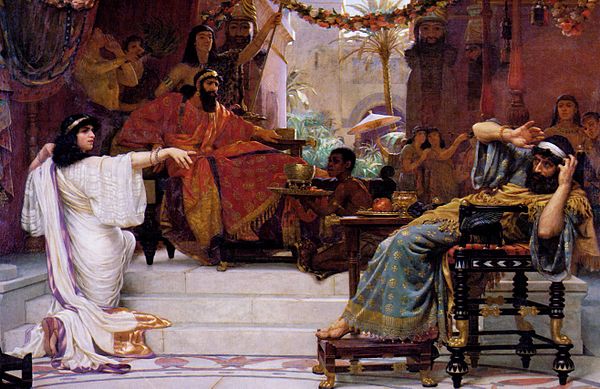
Esther Denouncing Haman, by Ernest Normand

“Because we have been sold, I and my people, to be destroyed, to be slain, to be exterminated!”  (Esther 7:4)

Still oblivious, the king asks her who ordered such a thing.

And Esther said: “The man, the oppressor and enemy, is this evil Haman!”  (Esther 7:6)

Achashveirosh believes her at once and, as usual, asks no follow-up questions.  He has Haman impaled on his own stake.  It is sheer good fortune that Esther is correct and Haman is indeed the malefactor.

When Esther asks the king to revoke the dat about killing Jews on the 13th of Adar, we learn about another standing rule:

… a writing that was written in the name of the king and sealed with the signet ring of the king, there is no way to reverse.  (Esther 8:8)

This dat would be ridiculous in a real government.  But it does express the truth that some actions have irrevocable consequences.  We insult someone, and the person never forgets it.  We make a mistake or pass a law that results in someone’s death, and nothing can bring the person back to life.

King Achashveirosh gives Mordecai his signet ring and invites him and Esther to write any new dat they like to compensate for the dat about exterminating Jews on the 13th of Adar.  A dat goes out giving Jews permission to kill anyone who tries to attack them on that day.

And in every province and in every city where the word and the dat of the king reached, there was gladness and joy for the Jews, a drinking feast and a holiday.  And many of the peoples of the land pretended to be Jews, because terror of the Jews had fallen upon them.  (Esther 8:17)

Jews all over the empire attack and kill their enemies on the 13th of Adar.  There is no due process, no trials to establish guilt or innocence, no follow-up on anyone the Jews accuse who manages to escape.  Mob violence rules the day.  The king’s fifth new dat is an arguably stupid way to prevent a one-day genocide.

*

When do we, like Achashveirosh, make excuses for violence perpetrated by people who have suffered from discrimination and persecution?  When do we, like Esther and Mordecai, use positions of power to improve the welfare of our own people without seeking justice for all people?

Dat 6

Achashveirosh tells Esther that the Jews of Shushan alone have killed 500 men in addition to Haman’s ten sons, and asks her if she has any other requests.

And Esther said: “If it please the king, may it be granted to the Jews in Shushan to do tomorrow as well the same as the dat of today, and may the ten sons of Haman be impaled on the stake.”  And the king said to have it done thus, and the dat was given out in Shushan …  (Esther 9:13-14)

The Jews of Shushan take this opportunity to kill another 300 men.

*

Today, when do we agree to do something merely to please a person who dazzles us, without considering whether it is ethical?

The six new datim King Achashveirosh issues in the book of Esther illustrate that stupid decisions come from:

  • acting on impulse in moments of anger or fear,
  • taking one person’s word for something without checking,
  • not collecting enough information, and
  • failing to consider our own ethical principles.

Someday may we all learn to be smarter than King Achashveirosh.

  1. Midrash Rabbah Esther (commentary from the 6th to 11th centuries CE) said that Vashti’s refusal was justified because the king was ordering her to display herself wearing her crown and nothing else.
  2. Before Esther can speak to Achashveirosh, she must risk her life; there is already a dat that anyone who enters the king’s inner court without being summoned is put to death unless the king extends his golden scepter. Never mind if there is an imperial emergency; Achashveirosh does not want to be bothered by inconvenient news.  When do we disable ourselves by going into denial?  When do we make life more difficult by trusting someone who ignores facts to be in charge?

Vayikra & Tzav vs. Isaiah & Psalm 40: Smoke vs. Words & Deeds

The book of Leviticus/Vayikra gets right down to business.  The first Torah portion opens with God calling to Moses, then telling him more instructions for the Israelites—this time about conducting the rituals at the altar.

from Treasures of the Bible, Northrop, 1894

Speak to the Israelites, and you shall say to them:  Any human among you who offers an offering to God, from the livestock—from the herd or from the flock—you shall offer your offering.  If it is an olah he will offer from his herd…  (Leviticus/Vayikra 1:2)

olah (עֹלָה) = rising-offering; an offering that is completely burned into smoke.  (Plural: olot (עֺלוֹת).)

A person who offers an offering of minchah to God, fine flour will be his offering …  (Leviticus 2:1)

minchah (מִנחָה) = gift of allegiance or homage; a grain-offering.

And if he offers a zevach as a thankgiving-offering …  (Leviticus 3:1)

zevach (זֶבַח) = animal slaughter as an offering on the altar.  (Plural: zivechim (זִבְחִעם).)

The text continues through this week’s Torah portion (Vayikra) and next week’s (Tzav) with instructions for a total of six kinds of offerings.  (See my post Vayikra & Tzav: Fire Offerings Without Slaughter, Part 2.)  The last four all involve slaughtering animals, burning parts of them so God can enjoy the smell of the smoke, and eating the remaining edible parts after they have been roasted on the altar.

The primary method of serving God throughout the Hebrew Bible is turning animals into smoke, “… a fire-offering of a soothing smell for God” (Leviticus 3:5).  In the first twelve books of the bible (Genesis through 2 Kings) this method goes unquestioned.

Where does this idea come from?  The Torah does not say, but I believe the ancient Israelites assumed God wanted animal sacrifices because the other gods in the Ancient Near East were worshiped that way.1

Only when foreign empires began swallowing up the kingdoms of Israel did prophets and psalmists begin to question this approach.  The first prophet in the book of Isaiah reports:

“Why your many zivechim for me?” God says.

“I am sated with olot of rams.

And suet from fattened animals

And blood of bulls and lambs and he-goats

I do not want!”  (Isaiah 1:11)

“… And when you spread your palms

I am averting my eyes from you.

Even though you multiply [your] prayers

I am not listening.

Your hands are full of blood!

Wash, become pure;

Remove your evil acts from in front of my eyes;

Cease doing evil!

Learn to do good!

Seek justice,

Make the oppressed happy,

Defend the orphan,

Argue the widow’s case!”  (Isaiah 1:15-17)

Here God does not totally reject animal sacrifices, but God does consider good deeds and justice a higher form of service.

Psalm 40 declares:

[God] gave my mouth a new song,

A song of praise for our God.

May the many see, and may they be awed

And may they trust in God.    (Psalm 40:4)

Zevach and minchah you do not want.

You dug open a pair of ears for me!

Olah and guilt-offering you do not request.  (Psalm 40:7)

That is when I said:

Hey, I will bring a scroll of the book written for me.

I want to do what you want, my God,

And your teaching is inside my guts.

I delivered the news of right behavior to a large assembly.

Hey! I will not eat my lips.  (Psalm 40:7-10)

The speaker in Psalm 40 maintains that God does not want smoke, only words of praise. Nothing can make this poet recant; he will not “eat his lips”.  (See my post Tetzavveh: Smoke and Pray.)

*

What does God want?  Most, but not all, of the Hebrew Bible assumes God wants offerings on the altar.  Today we assume God wants words of prayer and blessing, as well as deeds of kindness and justice.

But why should we give God what we think God wants?

Suppose you want to thank a person for saving your life.  You might speak to them, send them a card, send them flowers or a bigger gift.

Suppose you want to manipulate or appease a person who has power over you.  You might speak to them, send them a card, send them flowers or a bigger gift.

The same human impulses apply to thanking or manipulating a semi-anthropomorphic God.  In the bible, the Israelites slaughter their animals in order to give them to God, either in gratitude or in an attempt at appeasement.2

Today, do we pray and do good deeds to express gratitude?  Or to appease God?  Or to manipulate God into giving us what we want?

  1. For example, the odor of Utnapishtim’s burnt sacrifice gives the gods of Mesopotamia pleasure in Gilgamesh tablet 11, part 4. In the book of Numbers, Moabite women invited Israelites to worship Baal Pe-or with them through zivechey their god” (Numbers 25:2).  (Zivechey (זִבְחֵי) = slaughter offerings of.)  In the book of Ezekiel, God complains that Israelites are flocking to foreign altars and burning sacrifices to give idols soothing smells (Ezekiel 6:13, 16:19, and 20:28).
  2. Offerings of wholeness or thanksgiving (shelamim, שְׁלָמִים) are described in the portion Vayikra in Leviticus 3:1-16 and in the portion Tzav in Leviticus 7:11-21. Offerings to appease God after violating one of God’s rules (chataat, חַטָּאת, and asham, אָשָׁם) are described in Vayikra in Leviticus 4:1-5:22.

Vayakheil & Psalm 13: Waiting in Contentment

detail of “Moses on Mt. Sinai” by Jean-Leon Gerome, ca. 1900

The Israelites are overcome with anxiety the first time Moses spends 40 days on Mount Sinai.  In last week’s Torah portion, Ki Tisa:

The people saw that Moses was long delayed in coming down from the mountain, and they assembled against Aaron, and they said to him: “Get up, make for us a god who will go in front of us, since this Moses, the man who brought us up from the land of Egypt, we don’t know what has happened to him!”  (Exodus/Shemot 32:1)

Aaron asks them to donate their gold earrings to melt down.  They do, but Aaron does the work of making the golden calf.  Even though he says the new idol represents the God of Israel, not another god, it turns out to be a bad solution to the people’s anxiety.  Between them, Moses and God destroy thousands of Israelites and chasten the survivors.  After a while God forgives them.  (See last week’s post, Ki Tisa: Stiff-Necked People.)

Then Moses tells the Israelites what God does want them to make: a portable tent-sanctuary, where God will speak from the empty space above the ark inside the inner chamber.  In in this week’s Torah portion, Vayakheil (“And he assembled”), they gladly pitch in.

Every man and woman whose heart prompted them to bring anything for the work that God had commanded to do through Moses, the Israelites brought as a nedavah for God.  (Exodus 35:29)

nedavah (נְדָבָה) = spontaneous voluntary offering.

Betzaleil and Oholiav, Anton Koberger, Nuremberg Bible, 1483

Then Moses called on Betzaleil and on Ohaliav and on everyone with a skilled mind, to whom God had given a skilled mind; everyone whose heart lifted at approaching the work to do it.  (Exodus 36:2)

Moses appoints the most skilled craftsman, Betzaleil, to make the most holy objects.  But everyone with skill in weaving, sewing, metal-smithing, and woodworking gets to make some part of the new Tent of Meeting and its courtyard enclosure.  And the people with materials keep on donating them, until Moses has to tell them to stop because the artisans have more than enough.1

For the rest of the book of Exodus (five chapters), nobody complains and nobody worries.  The people are content, fulfilled by using their gifts to make something important, secure in their knowledge that God will be with them.

Yet in the book of Numbers, three days after they set out from Mount Sinai, the Israelites start complaining again—this time about the food.2  Even though both the ark and a divine cloud are leading them, even though the Levites are carrying all the pieces of the portable sanctuary, the people are discontented.  Perhaps the problem is that they no longer have anything to do but march to the border of Canaan.

The Israelite ex-slaves in the books of Exodus through Deuteronomy are like children, who enjoy doing things on their own but depend on an adult to straighten out anything that goes wrong.  When they are hungry or afraid, they complain and wait for God to relieve their suffering.

The book of Psalms includes pleas by suffering individuals as well as pleas for all the Israelites.  Psalm 44 is the first of a series of psalms complaining that God is neglecting and hiding from the Israelites as a whole, letting them be defeated in battle and subjugated by enemies.  Individuals feel abandoned and ask how long God will make them wait for rescue from diseases or personal enemies in Psalms 6, 10, 13, 22, and 35.  Only Psalm 13 hints at a solution to God’s abandonment.

Psalm 13

by John Constable

How long, God, will you endlessly forget me?

How long will you hide your face from me?

How long must I make schemes inside myself,

My heart in torment all day?

How long will my enemy loom over me?

Look!  Answer me, God, my God!

Light up my eyes, lest I sleep death!

Lest my enemy say he has prevailed over me,

My adversaries rejoice when I am made to stumble.  (Psalm 13:2-5)

The speaker has two problems:

1) God is hiding God’s face; i.e. the speaker is no longer aware of God’s presence, and so feels abandoned.

2) The enemy seems to be winning, despite the schemes the speaker devises.  In this life-and-death struggle, only God’s intervention can turn the tables.  But the speaker has already been waiting an unbearably long time for God to manifest and act.  Where is the responsible adult in charge?3

Unlike the Israelites who wait 40 days for Moses to return, only to give up and demand an idol, the speaker in Psalm 13 finds a better response.

by James Tissot

Yet I will trust in your loyal-kindness.

My heart will rejoice in your rescue.

I will sing to God,

Because [God] gamal me.  (Psalm 13:6)

gamal (גָמַל) = ripened, weaned, rewarded, made mature.

Even if God seems to have abandoned the speaker, the speaker decides not to abandon God.  A more mature approach is to sing to God while waiting for God to act.


In this week’s Torah portion, Vayakheil, God makes a request, and the Israelites create beautiful items for God’s sanctuary.  As long as they are doing that work, they are content to wait for God to rejoin them.

In Psalm 13, God neither makes a request nor acts to rescue the speaker.  After waiting a long time, the speaker takes initiative and creates a song for God.  They are still waiting for God to rescue them, but at least they are mature enough to sing, which leads to a hopeful frame of mind.

I think there is a third possibility, not mentioned in the Hebrew Bible.  If you are miserable and God does not tell you what to do, then act on your own initiative.  Even when you cannot figure out a scheme for improving your situation, you can make something beautiful for God.  Sing, write, paint.  Smile and speak humbly to a fellow human being.  Whenever you do something beautiful, God is inside you.


  1. Exodus 36:4-7.
  2. Numbers 10:33, 11:1-6.
  3. Breuggemann’s interpretation goes farther: “The speaker does not for a moment entertain the thought that the trouble comes from guilt or failure. It is because of Yahweh’s irresponsible absence, which is regarded as not only unfortunate, but unfaithful to covenant.” (Walter Breuggemann, The Message of the Psalms, Augsburg Publishing House, 1984, p. 59)

Ezekiel & Psalm 46: Desist!

Desist!  And know that I am Elohim.  (Psalm 46:11)

Elohim (אֱלוֹהִים) = God; gods in general.

The phrase “know that I am God” appears nine times in the book of Exodus, but it always uses God’s personal name (whose four letters approximate Y-H-V-H) instead of Elohim.  God wants Egyptians and Israelites to know the identity of the god who creates the miracles they witness.  (See my post Beshallach & Shemot: Knowing the Name.)

Ezekiel, by Michelangelo

In the book of Ezekiel, the phrase “know that I am God” appears more than 50 times using God’s personal name.  The book opens in the settlement near Babylon where the prophet Ezekiel was deported during King Nebuchadnezzar’s conquest of the southern Israelite kingdom of Judah in the 6th century BCE.   Jerusalem, the only remaining Israelite city, is still under siege.1  Its people are suffering—and it is their own fault, according to Ezekiel.  They enraged God by worshiping idols, so God sent famine, pestilence, and the Babylonian army to destroy them.  The losing side in a war, according to Ezekiel, is the side that made God angry.

Then you shall know that I am Y-H-V-H, whose decrees you did not follow, and whose laws you did not do; you did according to the laws of the nations that surrounded you.  (Ezekiel 11:12)

At least 25 times Ezekiel prophesies that the surviving Israelites will realize their guilt and “know that I am Y-H-V-H”.2

Ezekiel also declares that God will send Babylonians to conquer Ammon, Moab, Philistia, Tyre, Egypt, and Edom because none of these nations tried to help the Israelites.  Then their people, too, “shall know that I am Y-H-V-H”.3

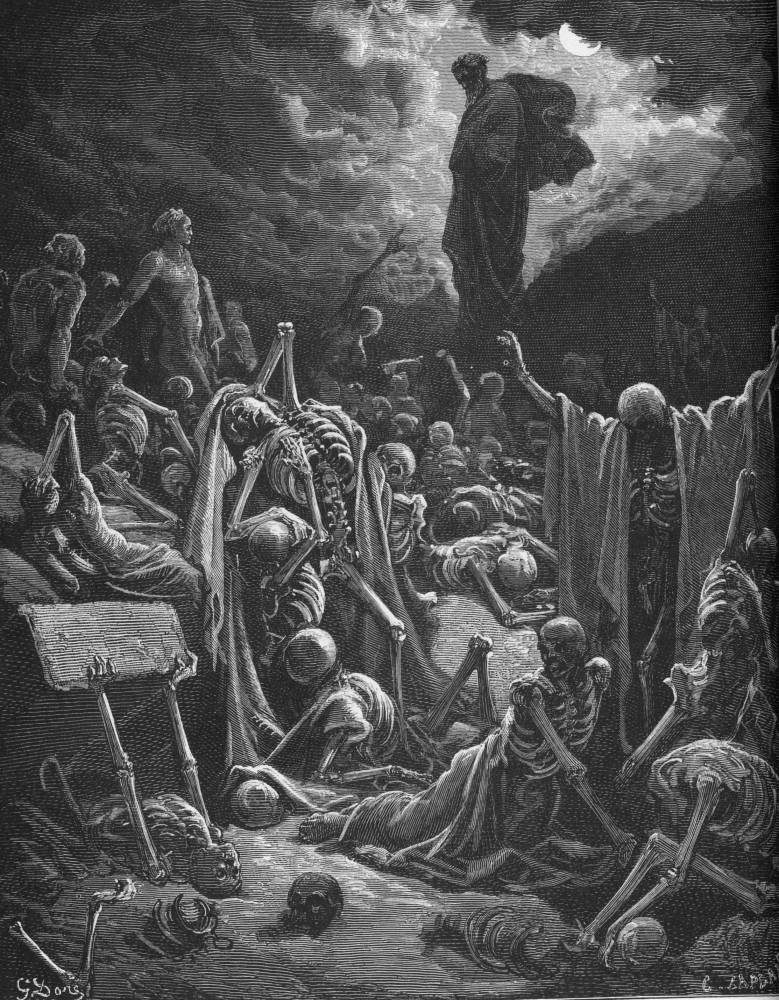
Valley of the Dry Bones, by Gustave Dore, 1866

But eventually God will forgive the deportees from Judah, reestablish the covenant with them, and return them to Jerusalem.  Ezekiel prophesies seven times that when God stops punishing the people and repopulates Jerusalem, the Israelites “shall know that I am Y-H-V-H”.4

In the distant future, the prophet says, the vast armies of Gog from Magog and his allies will invade the hills of Israel, and God will defeat them both by creating natural disasters (earthquake, pestilence, hail) and by making Gog and his allies turn on each other.5

“Thus I shall manifest my greatness and my holiness, and make myself known in the eyes of many nations.  And they shall know that I am Y-H-V-H”.  (Ezekiel 38:3)

In Ezekiel, people recognize Y-H-V-H only after a human army is wiped out.

*

In Psalm 46 people recognize God when God puts an end to war.  The song begins:

View of Fortress on a Hill, detail, by Augustin Hirschvogel, 1546

Elohim is for us a refuge and a stronghold,

            A help in dire straits, very accessible.

Therefore we are not afraid when the earth is transformed,

            When mountains collapse into the heart of the seas,

Its waters roar and foam,

            The mountains quake in its surge.  Selah.  (Psalm 46:2-4)

Some commentators have claimed that the upheavals of earth and sea are a metaphor for the violence of warring nations expected at the end of history, i.e. the war of Gog prophesied by Ezekiel.6  Others take this first section of the song so literally that they date the psalm according to an earthquake that occurred two centuries before the time of Ezekiel.7   A third interpretation is that God is responsible for all natural disasters, from floods to earthquakes, and that God will protect devout Israelites even while God is inflicting these “acts of God” on others.8

The first part of the psalm ends with the ancient Hebrew word Selah, a musical instruction whose meaning is unknown.  The second part presents an image of joy and stability in the “city of Elohim where God dwells on earth, in contrast with the chaos around it.9  This section ends with another Selah.  Then the psalmist says:

Go perceive the marvelous acts of Y-H-V-H;

            Who puts frightful devastations on the earth,

Stopping wars to the edge of the earth,

            breaking a bow and cutting up a spear,

            flaming [war] wagons with fire.

“Desist!  And know that I am Elohim.

            “I am higher than the nations,

            “I am higher than the earth.”  (Psalm 46:9-11)

This last part of Psalm 46 may be a prediction that someday God, who initiates natural disasters, will cause humans to desist from war over the entire earth.  In other words, when all humans know that Elohim is still active in nature, we will stop fighting and have world peace.

Biblical commentators usually follow Ezekiel in assuming that world peace will happen only after the defeat of Gog from Magog and the end of history, when messianic time begins.

But I believe we cannot wait for the legendary armies of Gog.  Groups of humans from families to nations have been fighting each other not only with wars, but also by exercising their own power without pity for any other creatures, human or not.  Now we are beginning to suffer from world-wide natural disasters, otherwise known as global climate change.

Can we stop fighting and making heartless power plays?  Can we change our own human natures, and rescue whoever and whatever can be rescued all over the earth?

I pray that God will inspire even the most intransigent hearts to “Desist!  And know that I am Elohim”, the divinity in all of nature, including ourselves.

  1. The people known collectively as Israelites in the Hebrew Bible had two kingdoms, the northern kingdom of Israel with its capitol in Samaria, and the southern kingdom of Judah with its capitol in Jerusalem, until the Assyrian Empire conquered the northern kingdom circa 720 BCE. The Babylonian Empire took over the Assyrian Empire circa 605 BCE, conquered most the kingdom of Judah, and besieged Jerusalem on and off from 605 BCE until it fell in 586 BCE.  Leading Israelites from Jerusalem and Judah were deported from 597 BCE to as late as 581 BCE.
  2. Ezekiel 6:7, 6:10, 6:13, 6:14, 7:4, 7:27, 11:10, 11:12, 12:15, 12:16, 12:20, 13:9, 13:14, 13:21, 13:23, 14:8, 15:7, 20:38, 20:26, 20:44, 22:16, 23:49, 24:4, 24:27, 33:29.
  3. Ezekiel 25:5, 25:7 regarding Ammon; 25:11 regarding Moab; 5:17 regarding Philistines; 26:6 regarding Tyre; 29:6, 29:9, 29:16, 29:21, 30:8, 30:19, 30:25, 30:26, and 32:15 regarding Egypt; 35:4, 35:9, and 35:15 regarding Edom (Mt. Seir); and 36:23 regarding “the nations” in general.
  4. In Ezekiel 16:62, 20:20, 20:42, 34:27, and 36:38, God will accept the repentance of the surviving Jerusalemites who were deported to Babylon, renew the old covenant, and return them to their land. In Ezekiel 37:6 and 37:13, God will (at least metaphorically) bring the dry bones of the slain back to life.
  5. Ezekiel 38:19-22. Ezekiel adds that the Israelites will “know that I am Y-H-V-H” in 39:22 and 39:28.
  6. g. Radak (12th-13th century Rabbi David Kimchi): “At the time when the mountains quake and collapse and the waters of the sea are stirred up, that is to say—when there will be great distress and war between the kingdoms of the nations, Israel will not be afraid but instead will rejoice.  This is what is said in a metaphorical fashion…”  (Sefaria translation, www.sefaria.org/Radak_on_Psalms.46. )
  7. The earthquake mentioned in Amos 1:1 occurred circa 750 BCE. See Robert Alter, The Book of Psalms, W. Norton & Co., New York, 2007, p. 162; and Arie Folger, “Understanding Psalm 46”, Jewish Bible Quarterly, http://jbq.jewishbible.org/assets/Uploads/411/jbq411psalm46folger.pdf.  Rashi (11th-century rabbi Shlomoh Yitzchaki) cites Numbers 16:31-32, where the earth swallows people, but the descriptions there sounds more like a sudden sinkhole than an earthquake.
  8. Folger, ibid.
  9. Psalm 46:5-7.

Note: Any ads below provide revenue to WordPress, not to me.

Beha-alotkha & Ezra: Retirement Age

This is what regards the Levites:  From the age of 25 years and above, each will enter the battalion of service for the Tent of Meeting.  And from the age of 50 years, yashuv from the battalion of service, and he shall not serve any more.  He shall attend to his brother in the Tent of Meeting, keeping his watch, but he shall not do service.  Thus you shall do for the Levites regarding their duties.  (Numbers/Bemidbar 8:24-26)

yashuv (יָשׁוּב) = he shall return, turn back, turn away, withdraw.

It sounds like a mandatory retirement age.  And retirement at 50 would be a golden dream to all the people today who must continue to toil at jobs that sap their energy instead of nourishing them.  Do the Levites really get this blessing?

*

This week’s Torah portion, Beha-alotkha, includes the consecration of the Levites as servants of God’s sanctuary, the Tent of Meeting.1  (The first priests, Aaron and his sons, are consecrated in the book of Leviticus/Vayikra.2 ) Leviticus also provides lengthy job descriptions for priests, who perform all the rituals of offerings at the altar, tend the most sacred holy objects, and judge various issues about ritual purity.

While the priests perform the highest-ranking work in the religious life of the ancient Israelites, many other duties are necessary to maintain either a traveling sanctuary (in Exodus through Joshua) or a permanent temple (from 1 Kings on).  The first two Torah portions in Numbers begin assigning these duties to the three clans of Levites.  (See last week’s post, Bemidbar & Naso: Four Directions of Service.)

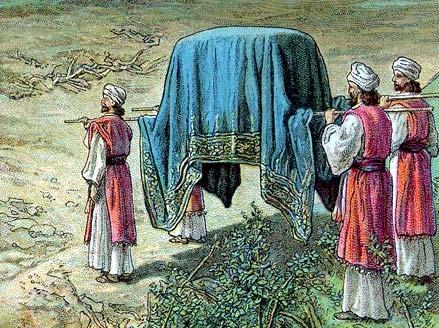
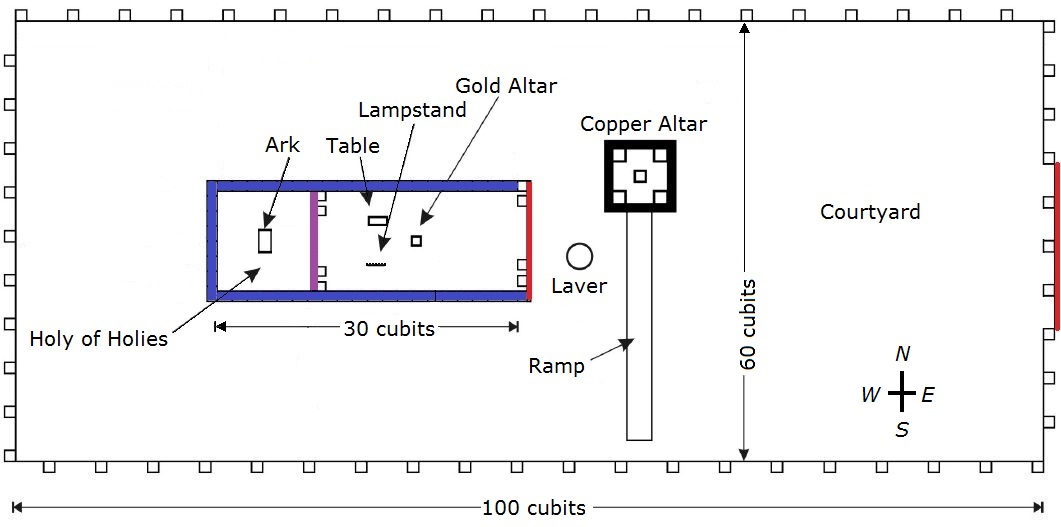
For each leg of the Israelites’ journey from Mount Sinai to the Jordan River, the Tent of Meeting must be disassembled, carried to the next campsite, and reassembled.  Only the priests can prepare the holiest items for travel; they wrap the ark, the lampstand, the bread table, the incense altar, and the altar for offerings in multiple coverings before turning them over to the Levites of the Kehat clan for porterage.

Tent of Meeting and its courtyard

The other two clans of Levites, Geirshon and Merari, disassemble, carry, and reassemble the tent roof, the cloth walls of both tent and courtyard, and the frameworks they are stretched over.  All of these jobs are critical, and an error may result in death.  (See my post Shemini & 2 Samuel: Separating Holiness.)  They are also jobs that require physical strength and skill.

I believe the tasks of dismantling, carrying, and erecting the pieces of the santucary are restricted to Levites old enough to be mindful, but young enough to do the labor without faltering.  Levites must retire from these duties before old age compromises their physical abilities.  So the men who do this work must be between the ages of 25 and 50—at least in the portion Beha-alotkha.

The first two portions of the book of Numbers give a different starting age for the Levites.  God requests a census of each of the three clans of Levites,

From the age of 30 years and above, up to the age of 50 years, all those who come into the battalion to do labor in the Tent of Meeting.  (Numbers 4:3, 4:23, 4:30)

According to Rashi, the strength to carry heavy objects is not fully developed until age 30.  After age 50, a man’s strength begins to diminish again.  The Talmud3 explains the different starting ages by claiming the Levites began learning these duties at age 25, and began actually performing them at 30.  I suspect the discrepancy is due to different opinions about the age at which young men can be trusted to carry out a long process with unflagging mindfulness of the sanctity of every movement.

*

The Levites age 50 and above still perform some duties, those that all Levites do while the Israelites are encamped and the sanctuary is in place.  What are these jobs?

The only ones mentioned in the first five books of the Torah are guarding the sanctuary to prevent any unauthorized persons from entering;4 and helping to collect tithes from the rest of the community, tithes used to support the priests, the Levites, and the poor.5

Other Levitical duties are not mentioned until books of Ezra and Nehemiah, which describe the building of the second temple in Jerusalem.

Supervising the building of a temple can apparently be done well by a wider range of Levites.  The book of Ezra says that when the exiled Israelites returned to Jerusalem from Babylon, their leaders appointed the Levites from age 20 years and above to supervise the labor of [building] the House of God.  (Ezra 3:8)

Both books list the job titles, ancestry, and numbers of men who serve at the new temple.  Priests are listed first, then Levites, then singers, then gatekeepers, then temple servants.6  Although the singers and gatekeepers are listed separately from “Levites”, the traditional interpretation is that these two groups were subdivisions of Levites.

One piece of evidence is the celebration over the completion the foundation of the second temple in the book of Ezra.

(woodcut, 1860)

…and the priests were stationed in their vestments with their trumpets, and the Levites, descendants of Asaf, with cymbals to praise God … And they [the Levites] answered with haleil and with thanks to God: “because [God]is good, because [God’s] kindness is everlasting(Ezra 3:10-11).

haleil (הַלֵּל) = songs of praise.

The same words “because [God] is good, because [God’s] kindness is everlasting” appear in Psalms 106, 118 and 136.  As far as we know, all the Psalms were sung at temple rituals, accompanied by instruments—and the musicians were Levites.

For us, as for the Levites, retirement is not ceasing to work; it is withdrawing from a job that has become difficult, and turning to work that benefits body and soul.  Yes, many retirees spend more and more time taking care of their aging and cranky bodies.  But we can also take some time to help others from a place of wisdom, and to do the work that nourishes our souls.

No doubt some of the Levites serving in the second temple got bored with locking and unlocking gates, or dreaded singing under a certain conductor, and wished they could retire at 50 like the Levites in the book of Numbers.  Lighter work is not always soul-nourishing work.

Levite singers, by James Tissot

Nevertheless, the duties of the Levites can inform our own retirements, when we finally shuv—withdraw, turn away, return from—the jobs we had to do to make a living.  In the workforce (equivalent to the “battalion” in this week’s Torah portion), we have to keep disassembling and reassembling our knowledge base, our skills, our resumes, as we meet the demands imposed by our employers or the larger society with live in.

Retired, we can exercise more of our own judgement about what to let in through our personal gates, and what to keep out.  And we can lift our own spirits toward the spirit of the divine by singing to God.

  1. Numbers 8:8-22.
  2. Leviticus 8:1-9:24.
  3. Talmud Bavli, Chullin.
  4. Numbers 18:2-6.
  5. Numbers 18:20-24; Nehemiah 12:44.
  6. Ezra 2:40-41 and 2:70; Nehemiah 7:43-45, 10:29, and 11:15-22.

Ruth: The Use of Power

After seven weeks of counting measures of barley, as prescribed in the Torah, Jews get to celebrated the holy day of Shavuot (“Weeks”).  (See my post Omer: Counting 49.)  The special reading for this weekend is the book of Ruth, a story that includes two Shavuot themes: the barley harvest, and embracing a covenant with the God of Israel.

Ruth Gleaning, by R.F. Babcock, 19th century

Ruth is a native of Moab, a young widow who chooses to leave her land and follow her widowed and impoverished mother-in-law Naomi to a potentially bleak future in the Israelite town of Beit Lechem.  Ruth commits herself to Naomi, her god, and her people.  After they arrive, she gleans barley in fields belonging to Boaz, a wealthy and devout Israelite.

Both Ruth and Boaz are admirable for their kindness.  Ruth goes beyond her duty by committing herself to Naomi and doing whatever it takes to support her mother-in-law.

from Ruth and Boaz, by E.C.F. Holbein, 1830

When Boaz first sees Ruth gleaning in one of his fields, he praises her, asks God to bless her, gives her lunch, orders his men not to touch her, and tells them to leave extra stalks of barley in the rows for her.  Eventually Boaz goes beyond his duty by marrying Ruth and taking both women into his household.

The book praises Boaz and Ruth not only for their kindness and loyalty to family members whom they have no legal obligation to help, but also for the ways they use power.

And Naomi had a kinsman through her husband, an ish gibor chayil from the family of Elimelekh, and his name was Boaz.  (Ruth 2:1)

ish (אִישׁ) = man.

gibor (גִּבּוֹר) = champion, hero in battle, respected man in a community.  (From the root verb gavar,גָּבַר = excelled, accomplished, prevailed.)

chayil (חַיִל) = power.  By itself, the noun chayil = army or wealth—the two main kinds of power in the Ancient Near East.  When the word is immediately preceded by a noun indicating a human individual (such as ish or gibor), chayil serves as an adjective meaning powerful, leading in battle, influential due to wealth or social standing, or highly capable.

Boaz is introduced as an ish gibor chayil, a respected and powerful man.  As the story unfolds we learn that his power comes from his wealth and his standing in the town of Beit Lechem.  He is one of the elders who sits at the town gate to judge cases.  His opinions are respected, and in the legal case the book of Ruth describes, the other elders follow Boaz’s lead.1

Not all wealthy men use their power to do good.  The prophets Isaiah and Amos rail against the wealthy who supply themselves with luxuries while oppressing the poor.2  But Boaz uses his power to ensure justice in his town, good behavior among his workers, and provisions for two impoverished widows, Ruth and Naomi.

Although Boaz goes out of his way to be kind to them during the harvest, it does not occur to him to make any arrangement for them after the harvest is over.  So Naomi tells Ruth when Boaz will hold a harvest celebration for his men on the threshing-floor, and instructs her to bathe, anoint herself, dress up, and hide nearby until all the men have eaten, drunk, and dozed off.  Then she must uncover Boaz’s “feet” and lie down next to him.3  Naomi concludes:

“And he will tell you what you should do.”  (Ruth 3:4)

Both women understand the risk; Boaz might use his position to marry her, or he might take advantage of his position to use her and cast her aside.  Ruth answers:

Everything that you say to me, I will do.”  (Ruth 3:5)

On the threshing floor, artist unknown

She follows Naomi’s instructions, and then goes beyond them when Boaz wakes up.

In the middle of the night, the man gave a start, and felt around.  And hey!  A woman was lying at his feet!  He said: “Who are you?”  And she said: “I am Ruth, your maidservant.  And you shall spread the wing [of your robe] over your maidservant, because you are a redeeming kinsman.”  (Ruth 3:8-9)

Ruth practically orders Boaz to spread his wing over her, and tells him he should be her redeemer.  Technically the redeemer of a childless widow is her late husband’s brother.  He is required to redeem the widow from poverty by marrying her, giving her a son, and taking care of her late husband’s land until her son is old enough to inherit it.4  But both of Naomi’s sons are dead, as well as the rest of the men in their immediate family.  Boaz is only a distant relative, not even the closest one on the family tree.

Nevertheless, he feels honored that Ruth is telling him to marry her.

And he said: “Blessed are you to God, my daughter!  Your latest chesed is better than the first—[your] not going after the young men, whether poor or rich.  And now, my daughter, you must not be afraid.  Everything that you say to me, I will do it, because all [the elders] at the gate of my people know that you are an eishet chayil.”  (Ruth 3:10-11).

chesed (חֶסֶד) = loyalty to family obligations; kindness.

eishet (אֵשֶׁת) = woman of.  (From the noun ishah,  אִֺשָּה= woman, wife.)

Boaz is an ish chayil, powerful because of his social standing in Beit Lechem.  Now he declares that the elders of the town consider Ruth, an impoverished foreigner, an eishet chayil.  Clearly her power does not come from either wealth or military prowess.  But she is a highly capable worker, and she has earned a sterling reputation because of her steadfast chesed to Naomi.  Boaz respects her so much that he promises “Everything that you say to me, I will do.”

That is exactly what Ruth said to Naomi.  The sentence also echoes the words of the Israelites at Mount Sinai, when Moses reads the scroll of the covenant out loud to the people, and they reply: “Everything that God has spoken, we will do.”5  All three replies commit the speakers to complete trust and devotion.  Ruth is devoted to Naomi, Boaz becomes devoted to Ruth, and the Israelites declare their devotion to God.

The phrase eishet chayil appears only three times in the Hebrew Bible.  The other two occurrences are in the book of Proverbs.

An eishet-chayil is a crown for her husband,

            But one who acts shamefully is like rottenness in his bones.  (Proverbs 12:4)

The book of Proverbs ends with a long encomium to the eishet-chayil, beginning with:

An eishet-chayil who can find?

            Far beyond rubies is her value.

Her husband trusts her in his heart,

            And lacks no profit.  (Proverbs 31:10-11)

The poem then describes how an eishet-chayil works long hours spinning and weaving, collecting food and feeding her whole household, acquiring land and planting vineyards.  Her arms are strong.

Her palm she spreads out to the poor,

            And her hand she extends to the needy.  (Proverbs 31:20)

Like Boaz, an eishet chayil uses the wealth she increases through her own work to give to the poor.

Her mouth opens with wisdom,

          And teachings of chesed are on her tongue.  (Proverb 31:26)

By calling Ruth an eishet-chayil, Boaz explains why he will do everything she says.  Like the eishet-chayil in Proverbs, Ruth uses the power of her example and influence to counsel wisdom and kindness.

The poem about the eishet-chayil concludes:

Extol her for the fruit of her hand,

            And her deeds will praise her at the gates.  (Proverbs 31:31)

The ideal eishet-chayil, like Ruth, is praised for her deeds by the elders at the gate.

*

Both Boaz and Ruth are instinctively kind and loyal, full of chesed.  Both have personal power, chayil; Boaz because of his wealth and social standing, Ruth because of her good example.  Even Naomi has moments when she uses the power of her influence to do good.  She provides for one daughter-in-law by persuading her to return to her parents in Moab, and provides for Ruth by arranging a marriage from behind the scenes, following her hunch about Boaz despite the risks.

The book of Ruth begins with the deaths of three men whose widows lose everything, but it has  an extraordinarily happy ending: the women of Beit Lechem visit Boaz’s house, where he is happily supporting his pleasant old relative Naomi; his young, capable, kind, and loyal wife Ruth; and their newborn son, who will carry their dreams into the future.6

Sometimes people who have power to influence our lives are not so virtuous.  Sometimes, despite our good intentions, we fail to help those around us.  But the book of Ruth demonstrates that power can be dedicated to good deeds and kindness.

May each of us notice acts of kindness with gratitude, and practice using our own power to be kind to others.

  1. Ruth 4:1-13.
  2. g. Isaiah 1:16-17, 1:23-24, 10:1-3, 58:5-7; Amos 8:4-6.
  3. In the Torah, regalayim (רַגְלַיִם = pair of feet) is sometimes a euphemism for male genitals (e.g. 2 Kings 18:27, Isaiah 7:20), and legalot ervah (לְגאלּוֹת עֶרוָה = to uncover nakedness) is a euphemism for sexual intercourse (e.g. Leviticus 18:6-18).
  4. See Genesis 38:8-11 and Deuteronomy 25:5-10 for the laws of levirate marriage/yibum.
  5. Exodus 24:7.
  6. Oveid, the son of Ruth and Boaz, is the grandfather of King David. (Ruth 4:21)

Behar, Psalm 100, and Psalm 123: Master and Slave

Who owns you?

This week’s Torah portion, Behar (“On a mountain”), sets limits on ownership of both humans and land.  God owns all the farmland.  The people are tenants with long-term leases, but God mandates that they must let the land rest every seventh year,1 and every fiftieth year (the jubilee/yoveil) any land that was purchased returns to the family that originally owned it.2  (See my post Behar: Owning Land.)

The same goes for human beings.  God owns all the Israelites.  If some of them become so impoverished they have nothing left to sell but themselves or their children, they can join another household as servants.  But they will not be permanent, inheritable slaves, like the foreign slaves Israelites own.3  Their extended families can buy them back from their Israelite masters at any time, and if they are still serving their masters when the jubilee year comes, they and their children are freed from service anyway—and can return to the land they once sold.4  (See my post Behar: Slave Owners.)  God explains:

Because they are my avadim, who I brought out from the land of Egypt, they may not be sold as an aved.  (Leviticus/Vayikra 25:42)

avadim (עֲבָדִים) = slaves, servants, subordinates.  (Singular:  eved, עֶבֶד or aved, עָבֱד.)

In this context, the Israelites are slaves of God, and can only become temporary servants or subordinates of human beings.  Even Israelites who sell themselves to resident aliens can be redeemed by their kinsmen, and must go free along with their children in a jubilee year.5

The master-slave relationship between God and the Israelites is a mutual obligation.  The Israelites are supposed to serve God by obeying all of God’s rules and commandments, which number in the hundreds.  God has absolute power over “their” lives, as well as over “their” land.  But just as the human owner of slaves is supposed to provide them with food, clothing, lodging, and all their other needs, God is supposed to take care of the Israelites.6

How did God acquire the Israelites as slaves?  In this week’s Torah portion, God says:

“Because the children of Israel are [already] avadim; they are my avadim that I brought out from the land of Egypt.  I am God, your God!”  (Leviticus 25:55)

In the book of Exodus, after God has rescued the Israelites from slavery in Egypt and led them as far as Mount Sinai, God tells Moses to tell the people:

“And now, if you really listen to my voice and you observe my covenant, then you will be my treasured possession out of all the peoples.  For all the earth is mine, but you shall be my kingdom of priests and a holy nation.”  (Exodus/Shemot 19:5-6)

After Moses has passed this on,

They answered, all the people as one, and they said: “Everything that God says, we will do!”  (Exodus 19:8)

Thus they wholeheartedly accept their new master.7

*

The relationship between God and God’s slaves is not always peaceful.  The book of Numbers/Bemidbar in particular, which we begin next week in the annual cycle of Torah reading, reports many incidents in which thousands of Israelites refuse to do what God asks, and God kills them.

The psalms offer contrasting opinions of what it is like to be God’s slave.  (Since the two psalms below compare God to a human master, my translations use the pronoun “he” and “his”.)

Psalm 100

A chant for thanksgiving:

            Call out homage to God, all the earth!

                        Ivdu God with joy!

                        Come before him with a shout of joy!

            Know that God is God;

                        He made us and we are his,

                        His people and the flock he is tending.

            Enter his gates with thanks,

                        His courtyards with praise.

                        Thank him!  Bless his name!

            For God is good.

                        His loving-kindness is forever,

                        And his faithfulness goes on from generation to generation.

ivdu (עִבְדוּ) = Serve!  (An imperative verb from the same root as avadim.)

Psalm 123

A song for ascending [stairs].

            To you I lift my eyes,

                        Dweller in the heavens.

            Hey, as the eyes of avadim are on the hand of their masters,

                        As the eyes of a female-slave are on the hand of her mistress,

            So our eyes are on God, our God,

                        Until he favors us.

            Be gracious to us, God!

                        For we have had too much contempt.

            Our soul has had too much ridicule from the complacent;

                        It is moaning over contempt from the arrogant.           

When life is going well, we rejoice in serving a God that is kind and faithful to us.  When life is going badly, we look for God anxiously and beg for succor.

Both of these psalms imply an external god who owns us.  But on another level, they can speak to an inner psychological truth: we do not fully own ourselves.

In today’s world, some people are still slaves to other human beings.  And even those of us who are relatively independent have only limited freedom to make our own decisions.  Most of our behavior is determined by our history, habits, complexes, and abilities.  Usually our conscious minds merely notice what we have already done—and instantly generate reasons for our unconscious decisions, to keep up the illusion that we are our own masters.  Only occasionally does a new bit of information stop us in our tracks, so that we take the time to think out a new response to life.  Only occasionally are we truly free.

Is God the mysterious force that determines the physical and mental operating systems for all creatures, like a master commanding his slaves?  If so, we can praise God when things happen that we consider good, and wait with trembling for the next move in God’s plan when things happen that we consider bad.  And we can consciously develop a habit of noticing and praising the good that comes our way—the food our master gives us, the beauty of a view, the companions assigned to us, the times when our required behavior is pleasant.

Or is God what we encounter in our moments of freedom?  If so, we can cultivate a habit of watching for other moments when we might seize the chance to do something new, and of welcoming the sudden uncertainty when we pause, trembling, and open ourselves to inspiration.

  1. Leviticus 25:5.
  2. Leviticus 25:13-17, 25:23-24.
  3. Leviticus 25:35, 25:39, 25:44-46.
  4. Leviticus 25:40-41.
  5. Leviticus 25:47-54.
  6. “…just as they belong to Him in that He can confiscate and apportion their land, so, too, do they belong to Him in the sense that He is responsible for looking after their wellbeing and welfare for all time.” (Rabbi Adin Even-Israel Steinsaltz, Talks on the Parasha, Maggid Books, Koren Publishers, Jerusalem, 2015, p. 267)
  7. Ibid., p. 268.

Pesach & Psalm 118: Still Singing

After drinking, eating, talking, and singing our way through the Haggadah, we still have six more days of Passover/Pesach.  What do we do besides continuing our matzah diet, unleavened by any bread?

One of the 14 steps in the seder follows us all week: the Halleil (הַלֵּל = praise), consisting of Psalms 113-118.  The Levites sang these psalms in the second temple1 during the three pilgrimage festivals to Jerusalem:  Pesach, Shavuot, and Sukkot. 2  All three festivals originated as harvest celebrations: Pesach for the first barley harvest, Shavuot for the first wheat and first fruits, and Sukkot at the end of the growing season, for all the other crops.  A harvest is a good reason to celebrate and praise God.

In my years of organizing Pesach seders and Shavuot and Sukkot services, I have been grateful that the Halleil includes Psalm 118.  Why?  Because the good lines in that psalm have inspired song and chant writers to come up with melodies.  Now, for the rest of the week of Pesach, I have the perfect excuse to keep on singing them!

Singing a verse again and again makes me ponder its meaning—which may be one reason we sing the psalms.  Here are my thoughts about some of the verses in Psalm 118:

118:1-4

Hodu l’Adonai ki tov,                         Thank God, because it is good,

          Ki le-olam chasdo!                             Because its kindness is everlasting!

Yomar na Yisrael,                               Let Israel please say:

          Ki le-olam chasdo!                             Because its kindness is everlasting!

Yomru na beit Aharon,                       Let the house of Aaron please say:

          Ki le-olam chasdo!                             Because its kindness is everlasting!

Yomru na yirey Adonai,                      Let yirey God please say:

          Ki le-olam chasdo!                             Because its kindness is everlasting!

yirey (יִרְאֵי) = those who are afraid of, those who are in awe of.

(Note:  In Hebrew, nouns and verbs have grammatical gender; in English they do not.  Therefore a masculine noun suffix or verb affix in Hebrew can be either masculine or neuter in English.  In this essay, I am translating references to God using “it” or “its”.)

Levites, from James Tissot, The Choristers

The first verses of Psalm 118 are scripted for call and response singing.  The choir, or choir leader, of the Levites invites three groups to respond. The first group, Israel, covers everyone present who is not a Levites or a priest.  The second group is the priests, whose hereditary office is traced back to Aaron in the Torah.  The third group is yirey God.3

It is tempting to consider the “yirey God” as the “God-fearers” of the Hellenistic period (the first through third century C.E.).  This was the name for people who had converted to worshipping the God of Israel, but did not go so far as to follow all the rules (such as circumcision).  One argument for this interpretation is that 118:4 calls for a class of people who are not “Israel”.  An argument against this interpretation is that Psalm 118 was probably written well before the first century C.E.

I can identify with the “yirey God”, despite my conversion to Judaism over 30 years ago, because I am not an ethnic Jew.  When the psalms were written, there were few apostates and few full converts; most of the people called “Israel” belonged by both birth and religion.  Today, when many people with Jewish ancestry live with no ties to the Jewish religion, and many converts are passionately engaged in that religion, I would appreciate a separate call for Jews by religion.4  We, too, can use a reminder that God’s “kindness is everlasting”.

118:14

Ozi vezimrat Yah,                               My strength vezimrat God,

          vayehi li liyshuah.                               and it became my rescue.

vezimrat (וְזִמְרָת) = and/or/but the zimrah of (a construct form of the noun zimrah).  Zimrah (זִמְרָה) = praising-song, melody, music.5

This line also appears in Exodus 15:2 in a song attributed to Moses, and is quoted in Isaiah 12:3.

English inserts the word “the” and forms of “to be” in places where Biblical Hebrew has no such connecting words.  Thus it is not always obvious, when translating from Hebrew to English, where to throw in the extra “the”, “is”, or “are”.  These grammatical differences mean there are at least two equally valid translations of Psalm 118:14:

“My own strength and song are of God!  And it [God] became my rescue!”  (Both the speaker’s strength and his song are attributed to God.  God rescues him by giving him superhuman strength and a song.)

“My own strength, and the song of God!  And it [the song of God] became my rescue!”  (The speaker has his own strength, but it is not enough to save him.  It is the song about God that rescues him—by calling in divine strength.)

When I sing verse 118:14, I imagine that singing in praise of God is giving me enough extra psychological strength to rescue me from my troubles.

118:19-20

Pitchu li shaarey tzedek                     Open to me the gates of righteousness

          Avo vam odeh Yah!                                         I will enter and praise God!

Zeh hashaar l’Adonai;                                    This is the gateway to God;

          Tzadikim yavo-u vo.                                    The righteous enter through it.

tzedek (צֶדֶק) = righteousness, what is right, what is just.

tzadikim (צַדִּיקִים) = (plural) the righteous, those who are innocent and in the right, those who act according to morality and justice.

When the Levites sang Psalm 118 in Jerusalem, the “gates of righteousness” probably referred to gates in the second temple complex.6  The pilgrimage festival may have included a ritual in which the double doors of a gate opened and the Levite choir sang while Judeans filed through.

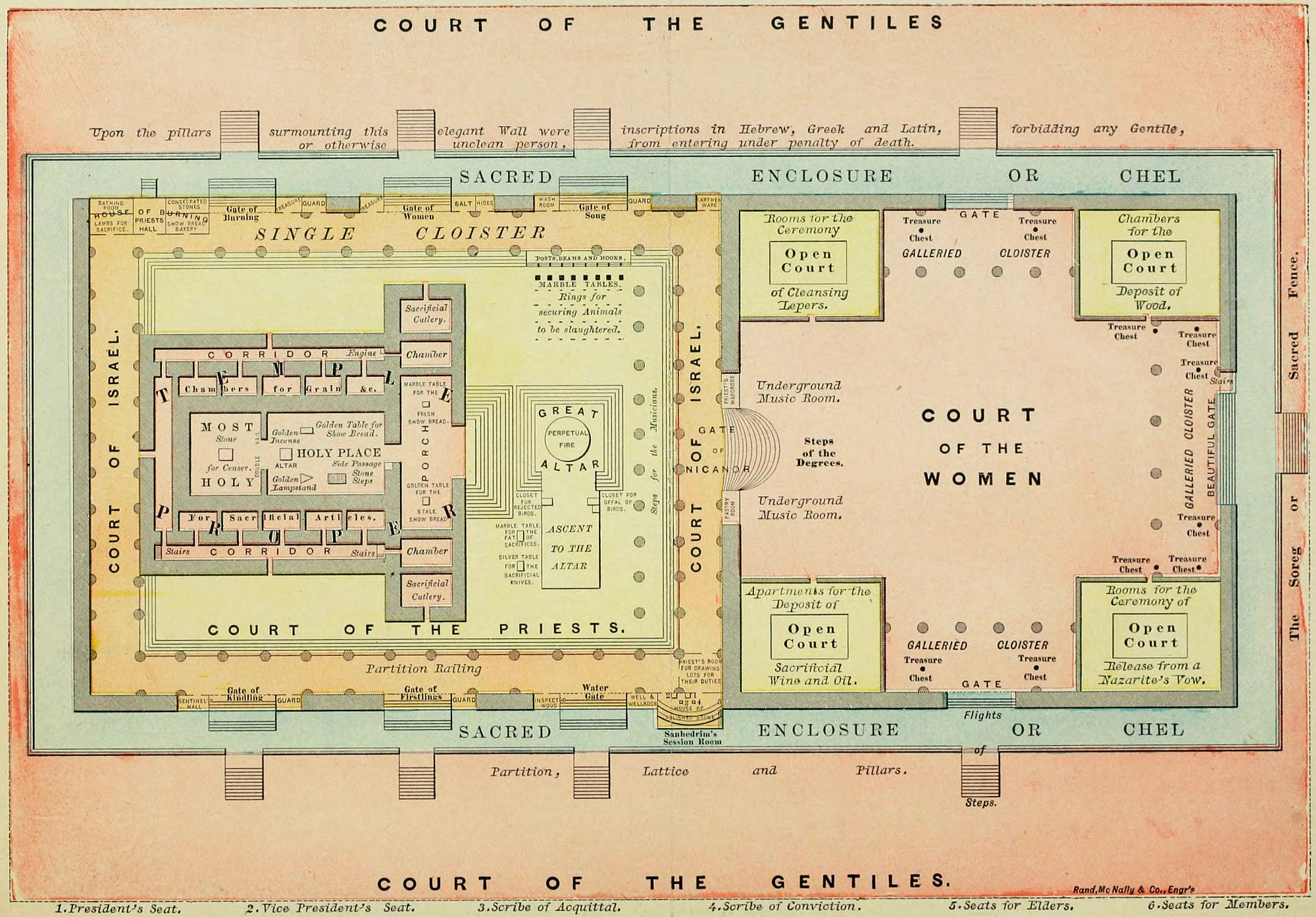
The second temple had gates from the city into the outer courtyard (the “Court of Gentiles”); three gates from the outer courtyard into the eastern inner courtyard (the “Court of Women”) which only women and men of Israelite descent or full converts could enter; one gate from that court into the “Court of Israel” (for men only) with its view of the altar; and a curtained gate into the vestibule of the temple proper, which only priests were allowed to enter.

Was coming to the temple and worshiping the God of Israel enough to make someone righteous?  Or did stepping through the designated gate express a desire and commitment to become righteous?

The first time I sang this part of Psalm 118, I felt as if I were pretending I was already righteous and commanding the gates to open for me.  Then I realized that the request in 118:19 could also be a plea.  Now when I sing, I beg for the gates of righteous to open to me, so that I can receive whatever I need to become righteous.

Rashi7 wrote that the “gates of righteousness” were the entrances to synagogues and study halls.  I would agree that these are places where one can become more enlightened about righteousness—through an emotional channel in a synagogue service, and through an intellectual channel in a study hall.  But personal gates of righteousness may also open to us, if we ask.

*

As I sing Psalm 118, using different melodies for different sections, I think of God in terms of infinite kindness; I feel the strength of a divine source entering me as I sing to God; and I humble myself to pray for the ability to become righteous.

And all that comes before Psalm 118 reminds me to look again when I reject or feel rejected, since:

The stone the builders rejected

          Has become the cornerstone!  (118:22)

  1. Scholarly consensus is that Psalm 118 was written during the time of the “second temple” in Jerusalem. The Babylonians razed the first temple dedicated to the God of Israel in 586 B.C.E.  After the Persians conquered the Babylonians, King Cyrus decreed that exiles could return to their original lands and rebuild sites of worship.  Under Ezra and Nehemiah, returning exiles from Judah laid the foundations of a second temple on the site of the old one in Jerusalem.  The temple was completed in 516 B.C.E.
  2. The Talmud determined that only the “Half Halleil”, which abbreviates Psalms 116 and 117, should be recited during the last six days of Pesach (Arachin 10a-b).
  3. Psalm 115, earlier in the Halleil, appeals to the same three groups: Israel, the house of Aaron, and “yirey God”. In this case, the leader asks each group to trust in God, and the group responds: “Their help and their shield is he!”
  4. Converts are currently called “Jews by choice”, but I do not want to exclude people of Jewish ancestry who also choose to practice Judaism.
  5. In this verse only, zimrat is often translated as “the might of” or “the strength of” . Yet the root verb zamar, זָמַר, means “pruned” in the kal form, and “sang praises” or “made music” in the pi’el   There is only one verse in the Hebrew Bible in which zimrah or zimrat is not translated in terms of music: Genesis 43:11.  There Jacob lists six products he considers zimrat the land: four kinds of aromatic resin, fruit syrup, and almonds.  All these luxuries come from trees, and therefore could be considered “prunings”.
  6. Samson Raphael Hirsch (19th century), The Hirsch Tehillim, Feldheim Publishers, Nanuet, NY, 2014, p. 968; Robert Alter, The Book of Psalms, W. Norton & Co., New York, 2007, p. 417; The Koren Siddur (Nusach Sepharad), commentary by Rabbi Jonathan Sacks, Koren Publishers, Jerusalem, 2012, p. 771.
  7. 11th-century rabbi Shlomoh Yitzchaki.