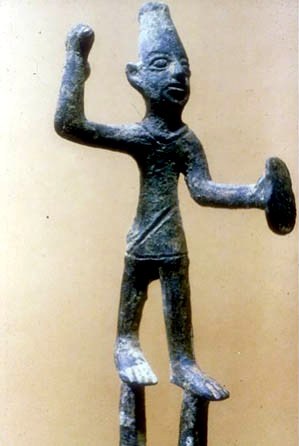
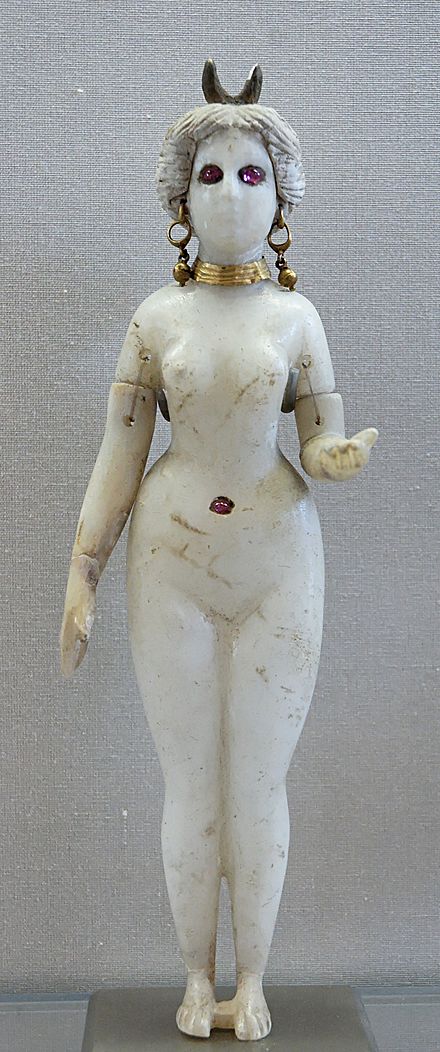
Balak, Pinchas, & Matot: Midianites Revisited

Ten years ago I wrote a post called Balak, Pinchas, & Matot: How Moabites Became Midianites. I received some positive comments, but also some hate mail. I am leaving that post up to remind myself that my writing is not always interpreted the way I intended it.

This week Matot (Numbers 30:2-32:42) arrives again in the annual cycle of Jewish Torah portions, and I want to add another interpretation of the Israelites’ massacre of Midianite women. I also want to re-examine my conclusion in 2015, in which I compared my own unreflective discrimination against Republicans to Moses’ discrimination against Midianites.

Midianites in Moab

Moses first encounters Midianites in the area where archaeologists have confirmed that they actually lived: east of the Gulf of Aqaba (in present-day Saudi Arabia), and north up to and including Timna. In the book of Exodus, Moses is fleeing from a murder charge in Egypt, and a priest of Midian invites Moses to live with him and marry one of his daughters.1

Years later in the book of Numbers, Moses leads the Israelites all the way to the east bank of the Jordan River. When King Sichon will not let them pass through Cheshbon, they conquer his whole kingdom, and the kingdom of Bashan to the north. Then they go back and camp in the acacias on the “Plains of Moab”, so-called because the land of Cheshbon was once part of kingdom of Moab.

In the Torah portion Balak, King Balak of Moab is afraid of the horde of Israelites camped just north of his border.

And Moab said to the elders of Midian: “Now this assembly will lick up everything around us like the ox licks up the green plants of the field!” (Numbers 22:4, in the portion Balak)

Apparently there is no king of Midian, so King Balak sends his message to the elders of each town. And apparently the Midianites respond to his call for an ally, because when Balak sends a delegation to Bilam, a Mesopotamian “sorcerer”, the Torah says:

The elders of Moab and the elders of Midian went, and tools of divination were in their hand, and they came to Bilam and they spoke Balak’s words to him. (Numbers 22:7).

Balak’s message asks Bilam to come to Moab and curse the Israelites. Eventually the two men meet on a ridge at Moab’s northern border, overlooking the Israelite camp. But King Balak’s plan fails, because Bilam is actually a prophet, and God will not let him curse the Israelites.2

Then Bilam got up and went, and he returned to his place. And also Balak went on his way. And Israel stayed in the acacias, and the people began to whore with the women of Moab. They [the women] called the people for animal sacrifices of their gods, and the people ate, and they bowed down to their gods. And Israel yoked itself to the Ba-al of Peor, so God’s nose heated up against Israel. (Numbers 24:25-25:3)

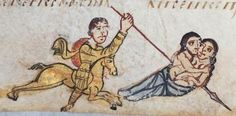
As usual, the God character responds to “whoring” after other gods with a plague. Next, an Israelite man brings a foreign woman into the Tent of Meeting itself for sex. Aaron’s grandson Pinchas quickly thrusts a spear through both of them, and the plague halts.

One would expect the impaled woman to be a Moabite, since the Israelite men were seduced into worshiping Ba-al Peor by Moabite women. But the next Torah portion, Pinchas, identifies the foreign woman as the daughter of a Midianite elder.

Pinchas impales them, in Sacra Parallela, 9th century Byzantine manuscript

And the name of the Midianite woman who was struck down was Kozbi, daughter of Tzur, the head of the people of a paternal household from Midian. And God spoke to Moses, saying: “Be hostile toward the Midianites, and strike them down. Because they were hostile to you through their deceit, when they deceived you about the matter of Peor …” (Numbers 25:15-18)

Suddenly Moabite women have become Midianite women.

In this week’s Torah portion, Matot, God reminds Moses to attack the Midianites.

And God spoke to Moses, saying: “Take vengeance, the vengeance of the Israelites, from the Midianites; afterward you will be gathered to your people.” (Numbers 31:1-2)

Moses obediently musters an army.

And they arrayed against Midian, as God had commanded Moses, and they killed every male. And the kings of Midian they killed … five kings of Midian, and Bilam son of Beor, they killed by the sword. But the children of Israel took captive the women of Midian and their little ones… (Numbers 31:7-9)

In this passage, the Midianites are not ruled merely by elders, but by five kings. And Bilam, who goes home at the end of the portion Balak, mysteriously appears among the kings of Midian.
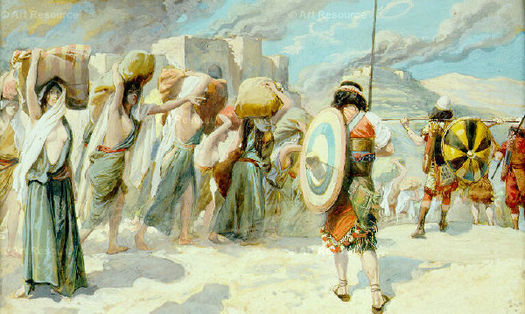
The Women of Midian Led Captive by the Hebrews, by James Tissot, ca. 1900

The story ends with the slaughter of the captive Midianite women. (See my post Matot: Killing the Innocent.)

And Moses said to them: “You left every female alive! Hey, they were the ones who, by the word of Bilam, led the Israelites to treachery against God in the matter of Peor, so there was a plague in God’s assembly. So now, kill every male among the little ones; and every woman who has known a man by lying with a male, kill!” (Numbers 31:15-17)

Has Moses forgotten that the Israelite men were seduced into worshiping Ba-al Peor by Moabite women? Or does he assume that God must be right, so the women whom he thought were Moabites must secretly be Midianites?

Another Explanation for Midianites in Moab

In my 2015 post, I review three kinds of attempts by commentators to reconcile the apparent conflation of Moabites and Midianites in this storyline: the “apologists”, who invented bizarre explanations for the inconsistencies; the “scientists”, modern scholars who assigned the scenes to two different sources and noted that the redactor left both Moab (the enemy in the J/E source) and Midian (the enemy in the P source) in the story; and the “psychologists”, who imagined that Moses, whose own wife is a Midianite, is flummoxed when God tells him that the Midianite women are all guilty.

Now I would add a fourth explanation. Angela Roskop Erisman3 dates the storyline about Midianites in Moab to the reign of Hezekiah, the king of Judah from circa 716 to 687 B.C.E. Before King Hezekiah rebelled against being a vassal of the Assyrian Empire, he lined up support from Egypt, but Egypt (ruled by Kushites at the time) was not much help. So, according to Erisman, he probably arranged an alliance with Midian instead. These two political alliances are reflected in the Torah, where Moses has a Midianite wife in the book of Exodus, but a Kushite wife in Numbers 12:1.

Jerusalem survived the Assyrian siege in 701 B.C.E. not because of any allies, but because King Hezekiah had built a new city wall and dug a tunnel between the city and the nearest water source, the Siloam Pool. No assistance from Midianites was recorded either in the Hebrew Bible or on the Assyrian stelae that have been excavated.

If the Midianites failed to come to the aid of Jerusalem, that would be reason enough to vilify them in one of the stories about Moses.

Floored by comments

Ten years ago, I wrote this conclusion to my post on Midianites in Moab:

“Just as Moses judges all Midianites in the five northern tribes as evil because of the actions of a few of their members, human beings throughout history have made judgements about undifferentiated groups.  It is so much easier than discriminating among individuals. From Biblical times to the present day, some people have judged all Jews as bad.

“Today, I catch myself ranting against Republicans, as if every person who voted Republican in the last election were responsible for the particular propaganda efforts and political actions that I deplore. A psychological look at the story of Moses and the Midianites near Moab reminds me that I need to be careful not to slander the innocent with the guilty.”

My intention was to sound a warning against treating all members of a group as if they were the same. It is obvious that “All Midianites are bad” is a false statement in the context of the whole Torah, since Moses’ father-in-law and wife are Midianites and do nothing but good deeds.

My next example was my own bad tendency to talk about “Republicans” as if all Republicans were bad. I thought I was being clear that there were people who voted for Republican candidates in the 2014 election for reasons that had nothing to do with the claims and policies that I, personally, objected to.

But I got a lot of comments that were vicious put-downs. I deleted them, since I did not want hate language in this blog. Now I wish I had saved them, so I would have examples of knee-jerk emotional reactions.

This year I received a milder negative comment on my 2015 post:

“You had me until you started the Republican rant…. Too bad TDS once again ruins scripture talk unnecessarily.”

I had to look up TDS. I found it that it stands for “Trump Derangement Syndrome”, and is a term that some supporters of Donald Trump use to criticize people whom they perceive as having knee-jerk emotional reactions against Trump that make them incapable of perceiving reality.

Who is making a rational analysis, and who is having a knee-jerk emotional reaction? It turns out to be a complicated question.

Should I have avoided any mention of politics in my 2015 blog post, and found a different example of my own tendency to discriminate against whole groups (instead of being discriminating about the differences among individual members of those groups)?

Maybe. But I find American politics more frightening now than I did ten years ago. When I wrote my 2015 post, I thought it was obvious that “All Jews are bad” is a false statement, like “All Midianites are bad”. But now anti-Semitism is increasing in the United States, and it comes from both ends of the political spectrum. I suspect that the increase on the right is part of today’s greater tolerance for hate speech, while the increase on the left is due to a false assumption that all Jews support the current government of Israel’s war on Gaza.

Will human beings ever overcome the black-and-white thinking that leads us to slander whole groups of people?


  1. Exodus 2:15-22.
  2. See my post Balak: Prophet and Donkey.
  3. Angela Roskop Erisman, “Moses is Modeled on Horus and Sargon, but His Story Is About King Hezekiah” and “Miriam Complains of Moses’ Cushite Wife: Hezekiah Married the Wrong Empire!” in www.thetorah.com, 2025.

Pinchas & Balak: Calming Zeal

One of God’s primary rules is that the Israelites must shun all other gods.  In the “Ten Commandments” God declares:

You must not have other gods … For I, Y-H-V-H, your God, am a kanna god.” (Exodus 20:3-5)

kanna (קַנָּא) = jealous; zealous. (Adjective from the root kana.)

“That is, the gods of other peoples generally have no problem with sharing their people’s devotions with other deities—polytheism is the ‘default setting’ of the ancient Near East. But that is not the case with Me, God says—I am unusually touchy in this matter, I am a jealous God.” (James Kugel)1

A jealous God

The anthropomorphic God character in the Torah not only demands exclusive worship, but becomes enraged when Israelites even nod at another god in passing. At the end of last week’s portion, Balak, many Israelite men do more than that.

And Israel strayed at the acacias, and the people began to be unfaithful [to God] with the women of Moab. They invited the people to the sacrificial slaughters of their god, and the people ate and bowed down to their god. And Israel attached itself to Baal Peor, and Y-H-V-H’s nose burned against Israel. (Numbers 25:1-3)

A hot nose is an idiom for anger in the Torah. Whenever God’s nose burns hot enough, people are afflicted with a contagious plague.

This time, the God character’s jealous rage causes a plague even God cannot stop without human intervention. Only a human act of appeasement will halt God’s zeal for destruction and restore “him” to self-control. (See my post: Balak & Pinchas: How to Stop a Plague, Part 1.) At least God retains enough sanity to recognize this, and therefore tells Moses:

Impalements, Assyrian relief,
Tiglath Pileser II

“Take all the chiefs of the people and impale them for Y-H-V-H in full sunlight. Then the heat of Y-H-V-H’s nose will turn away from Israel.” (Numbers 25:4)

The God character in the Torah prefers collective punishment. But Moses prefers selective punishment restricted to the actual perpetrators.2 So he orders every judge to execute the men under his supervision who worshipped Baal Peor.3

Before the sentence can be carried out, an even more flagrant act of forbidden worship occurs. The son of an Israelite chieftain brings a Moabite woman (in fact the daughter of a Midianite chieftain) into the courtyard of God’s sacred sanctuary and right up to the entrance of the Tent of Meeting, in front of Moses and Israelites who have gathered there to weep over the plague. The couple enter an enclosed chamber—either in an enclosure inside the Tent of Meeting itself, or in a small tent at its entrance—and engage in sexual intercourse. Since they choose this sacred space for their deed, it is not merely a  physical coupling, but a religious ritual—in the religion of the Midianite woman. (See my post: Balak: Wide Open.)

A zealous Levite

The high priest’s grandson catches them in the act.

The Zeal of Pinchas, Alba Bible, 1430

And Pinchas, son of Elazar, son of Aaron the High Priest, saw; and he rose from among the gathering and he took a spear in his hand. And he came after the Israelite man into the enclosure and he pierced both of them, the Israelite man and the woman in her enclosure. Then the plague against the Israelites halted. And the dead from the plague were twenty-four thousand. (Numbers 25:7-9)

As a Levite, it is Pinchas’s job to prevent any unauthorized persons from approaching, touching, or entering God’s Tent of Meeting.4 None of the other Levites seem to be doing their job, so Pinchas jumps up. As a devout servant of God, Pinchas is determined to eliminate anyone who blatantly insults God or flouts God’s law. Being a zealot, he stops at nothing, and finds a double murder perfectly justified under the circumstances.

Peace for a zealot

This week’s Torah portion, Pinchas (Numbers/Bemidbar 25:10-30:1), begins right after the plague stops.

And Y-H-V-H spoke to Moses, saying: “Pinchas, son of Elazar, son of Aaron the High Priest, made my rage over the Israelites abate through kano for kinati in their midst. Then I did not exterminate them in kinati. (Numbers 25:10-11)

kano (קַנְאוֹ) = his zeal, his jealousy. (From the root verb kana, קָנָא = be zealous, be jealous.)

kinati (קִנַּתִי) = my zeal, my jealousy. (Also from the root kana. )

This remark tells us that God was inflamed with jealousy, and started wiping out Israelites with zeal. When Pinchas acted out of his own zeal, God calmed down and did not kill all the Israelites.

Next God tells Moses:

“Therefore say: Here I am, giving him my covenant of peace.” (Numbers 25:12)

A “covenant of peace” sounds like a peace treaty, but God and Pinchas were not enemies. Some commentators have interpreted this phrase as God’s guarantee to protect Pinchas from vengeance by the dead man’s relatives. Rashi wrote that God acted “just like a man who shows gratitude and friendliness to one who has done him a kindness.”5

But in the next verse, God equates the “covenant of peace” with a “covenant of everlasting priesthood”.

“And it will be for him, and for his descendants after him, a covenant of everlasting priesthood, inasmuch as kinei for his God and he atoned for the Israelites.” (Numbers 25:13)

kinei (קִנֵּא) = he is/was zealous, he is/was jealous. (Perfect tense of the verb kana.)

Many Jewish commentators have explained that since a priest is not permitted contact with a corpse, Pinchas could not have killed the fornicating couple if he were already a priest. Now God grants him priesthood—and now he must be a man of peace, never killing again.

But Chayim ben Moshe ibn Attar6 wrote that “and he atoned for the Israelites” means Pinchas’s action made peace between them and God. And Sforno wrote: “Seeing that he did what he did in full view of his peers so that they would obtain expiation … he proved himself fit to become a priest, whose primary function it is to secure expiation for the sins of their Jewish brethren. As a priest he could continue in the role he had first adopted on this occasion.”7

Clearly God approves of Pinchas’s quick killing of the copulating couple. But now that God is in control again and the plague has been halted, God no longer needs Pinchas to be the kind of zealot who kills people for God’s sake. So God makes him a priest.


Zeal is an extreme enthusaism that not only feels good, but provides the energy to get a hard job done. Sometimes zeal is necessary to make change happen. But unchecked zeal can cause collateral damage.

In the Torah portions Balak and Pinchas, God’s plague seems necessary to get the Israelite men to stop worshiping an alien god. But then God is like a zealot who has gone out of control and cannot stop. Only Pinchas’s quick double killing halts the divine plague.

Pinchas’s zeal is different from God’s. He feels no personal jealousy, or even anger. Nevertheless, if Pinchas continued a career as a zealot, he would present a new danger to the Israelites. So God quashes his excess zeal by making him a priest.

When two zealots are on the same side of an issue, they can egg each another on until they have both gone too far. But it is also possible that one zealot will be more rational and restrain the other. While God is out of control in this week’s Torah portion, Pinchas is merely sitting at his post, guarding the Tent of Meeting from intruders. When the Israelite man and Midianite woman invade God’s sacred spot with a sexual ritual, Pinchas’s decisive action makes the God character blink and regain rational control.

Pinchas’s zeal makes him a violent killer for a moment, but if he had not acted zealously, God’s plague would have killed thousands more. Sometimes zeal is beneficial; other times it does more harm than good.

May we all find zeal when we need it, and may we notice if our righteous anger has burned too long. And may we find ways to help our zealous friends pause for time to find perspective.


  1. James Kugel, The God of Old, The Free Press, New York, 2003, p. 73.
  2. See Numbers 16:20-22.
  3. Numbers 25:5.
  4. Numbers 1:51-53, 3:38.
  5. Rashi is the acronym for 11th-century Rabbi Shlomoh Yitzchaki. Translation in www.sefaria.org.
  6. The 18th-century rabbi who wrote the commentary Or HaChayim.
  7. 16th-century Rabbi Ovadiah Sforno, translation in www.sefaria.org.

Pinchas: Tribal Loyalty, Part 1

The Israelites live in tents for 40 years, from the day they leave Egypt in the book of Exodus until they conquer Canaan in the book of Joshua. Only once, during the final year of their 40 years in the wilderness, do they own the land they are camping on: the east bank of the Jordan River.

King Sichon refused to let them pass through Cheshbon in last week’s Torah portion, Chukat, and the Israelites defeated his soldiers in battle, so now they own his land.1 The conquest of Canaan, across the river, is yet to come. But this new generation of Israelites is confident about killing or subjugating enough Canaanites to take their land, following God’s instructions.

Most of these nomads will become farmers in Canaan, with their own plots of land. This week’s Torah portion, Pinchas (Numbers 25:10-30:1), includes instructions on how to divide up Canaan. First God tells Moses and Elazar (Aaron’s son, the new high priest):

“Lift heads [take a census] of the whole Israelite community who is twenty years old and above, by the household of their fathers: everyone who goes to war for Israel.” (Numbers 26:2)

Moses and Elazar take a census, of all the men aged 20 and older except for the Levites, who do not go to war and will not be landowners. Following God’s instruction, they list the lineage of each man. Then God explains:

“To these you will allocate the land as a nachalah, according to the count of names. For the numerous [tribes and clans], you will multiply their nachalot, and for the few, you will reduce their nachalot; each will be given its nachalot according to its number.” (Numbers 26:53-54)

nachalah (נַחֲלָה) = hereditary possession, usually land. (Plural nachalot, נַחֲלֺת. From the verb nachal, נָחַל = take possession of land, inherit. From the same root as nachal, נַחַל = wadi, seasonal stream, stream bed, tunnel. According to S.R. Hirsch, nachalah means “property that ‘flows down’ like a stream from ancestors to descendants”.2)

In other words, after the Israelites conquer Canaan, the land will be allocated by tribe, and within each tribe by clan, and within some clans by branch, and within each clan or branch of a clan by the male head of household—adjusted according to population, so every household gets a parcel with the same value. The initial allocations will be made by a lottery. But from that point on, each parcel of land would be passed down through the same family.

In most countries today, land can be bequeathed to anyone the owner chooses. But in the Israelite kingdoms, land was automatically inherited according to a legal formula. If the landowner (usually male) had one son, all his land went to his son. If he had more than one son, the land was divided among them, with the firstborn son getting a double portion. Any daughters he had did not inherit land, and were dependent on their husbands, brothers, or sons. A wife of a deceased landowner became dependent on her sons; and if she had no sons, she was entitled to a levirate marriage with one of her husband’s brothers for the purpose of producing a son, who would then inherit the deceased man’s land.3 Otherwise, the land would revert to her deceased husband’s closest male relative.

The book of Proverbs indicates that a woman could earn income with her own business and buy land of her own.4 But she could not choose who inherited her land after she died. And every fifty years, all purchased land reverted to the families of the original owners.5

A new request from five daughters

There seemed to be no way a woman could inherit land. Yet in the Torah portion Pinchas, right after the census of fighting men, five unmarried women boldly ask for their own nachalah in Canaan.

They came forward, the daughters of Tzelofechad, son of Cheifer son of Gilad son of Makhir son of Menasheh, of the clans of Menashe son of Joseph. And these were names of his [Tzelofechad’s] daughters: Machlah, Noah, and Chaglah, and Milkhah, and Tirtzah. (Numbers 27:1)

The lineage of their father matters, since the land that the Israelites expect to conquer will be divided by tribe, then clan, then branch, then household. Tzelofechad was a son of Cheifer in the Gilad branch of the clan of Makhir, which belonged to the tribe of Menasheh.

And they stationed themselves in front of Moses, and in front of Elazar the Priest, and in front of the chieftains and the whole community at the entrance of the Tent of Meeting, saying: “Our father died in the wilderness, and he was not in the assembly that assembled against God in the assembly of Korach, for he died of his own guilt; and he did not have any sons.” (Numbers 27:2-3)

The five women are courageous, to come up to the Tent of Meeting and stand in front of all the men in Israel to make their claim. First they establish that their father’s heir (if he has one) has the right to an allotment of land:

  1. “He died in the wilderness.” Tzelofechad was one of the old generation who had to die while the Israelites waited 40 years in the wilderness for a second chance to invade Canaan. (See last week’s post, Chukat: Sapped.) The new census taken on the east bank of the Jordan lists all the men who are still alive—counted “by the household of their fathers” (Numbers 26:1). Here the five women point out that the land in Canaan will be distributed to the heirs of the men who left Egypt in the book of Exodus—and one of those men is their father.6
  2. “And he was not in … the assembly of Korach.”  Two divine miracles killed all 250 men who rebelled against Moses and Aaron under the leadership of Korach, Datan, and Aviram. (See my post Korach: Quelling Rebellion, Part 1.) Tzelofechad’s daughters assert that their father was not in that faction—either because they think the descendants of those men do not qualify to inherit land in Canaan,7 or because they think Moses might be prejudiced against the men in that rebellion.8
  3. “He died of his own guilt.” This statement establishes that Tzelofechad never participated in any other group rebellion against God or God’s chosen leaders. He is only guilty of going along with all the Israelite men (except Caleb, Joshua, Moses, and Aaron) in refusing to cross the southern border of Canaan when they first arrive there from Mount Sinai.9

Therefore if Tzelofechad had had a son who was under 20 when the Israelites left Egypt, that son would be counted in the census now, and in the lottery for land after the conquest.

Next the five women make an argument they know will appeal to men:

“Why should the name of our father be subtracted from his family because he had no son?” (Numbers 27:4a)

Starting with Abraham in the book of Genesis, what men want the most is to have descendants who will remember their names.10

Only then do the daughters of Tzelofechad request a share of the land that will be allocated to the descendants of their grandfather Cheifer:

“Give us an achuzah among our father’s kinsmen!” (Numbers 27:4b)

achuzah (אֲחַ־ֻזָֽה) = holding, landed property. (From the root verb achaz, אַחַז = seize, hold fast.)

The five sisters do not challenge the rule of male inheritance. They ask only for the inheritable land that would have gone to their brother, if they had one. They are also careful to ask for land not for their own sake, but only in order to perpetuate their father’s name.

Their motivation

What motivates the five sisters to make their novel request to inherit land? Here are some possibilities proposed in commentary from the 3rd century C.E. to the 19th century:

  1. They love the land of Canaan like their ancestor Joseph, whose deathbed wish was to be reburied there (Rashi, 11th century).11 I believe that although these women might love the idea of the “promised land”, they cannot love the actual land; unlike Joseph, they have never been there. At most, they can see the other bank of the Jordan, which looks no different from the side where they are camped.
  2. They love their father and actually do want his name to be remembered, in the lineage of inherited land as well as in the lineage of any sons they might have someday. If they did not get Tzelafechad’s nachalah, their future sons would be listed by the names of their fathers, rather than by the name of their maternal grandfather (Hirsch, 19th century).12 
  3. They do not want to be adopted into their uncles’ households; they want to continue to run their own household, even though none of them has a son to be the titular head of their family. Although earlier commentary does not mention this possibility, it does point out that the five women are united, speaking as one (Sifrei Bemidbar, 3rd century CE).13
  4. They are proto-feminists who believe that God, unlike human men, wants to distribute good things equally (Sifrei Bemidbar, 3rd century CE).14

The divine answer

After the daughters of Tzelofechad make their argument, Moses checks with God, who replies:

“Rightly the daughters of Tzelofechad speak; you shall certainly give them an achuzah of a nachalah amidst the brothers of their father, and you shall make the nachalah of their father pass over to them. And you shall speak to the children of Israel, saying: “If a man dies and has no son, then you shall make his nachalah pass over to his daughters.” (Numbers 27:7-8)

This ruling promotes women from chattels to second-class citizens who can inherit land—but only if their father dies without sons. In the Torah, God never praises independence, but does praise compassion for the unfortunate. A woman without a father, husband, brother, or son to support her is considered unfortunate.

A side-effect of the new law is that a daughter who inherits and remains unmarried would have financial independence that no other women possess.

But the male relatives of the daughters of Tzelofechad assume that all women want to marry and have sons. In next week’s double Torah portion, they come back to Moses to protest against God’s new inheritance law. (See next week’s post: Masey: Tribal Loyalty, Part 2.)


The daughters of Tzelafechad succeed because they are united, delivering a single clear request without distractions; because they give a reason that appeals to the men’s customary way of thinking; and because they limit their request so it will not disenfranchise any sons of landowners. Their first success is in persuading Moses that it is worth checking with God. Their second success is that God’s answer grants their request—and generalizes it to all cases in which a man dies without a son.

The only men’s issue that the women do not address is tribal loyalty. In next week’s Torah portion Masey, their male cousins complain because they do not want any of the land assigned to their tribe to be inherited by a different tribe—which would happen under current law if any of the daughters of Tzelafechad married a man from another tribe. (Under the current law, a son is counted as a member of his father’s tribe and clan, not his mother’s. So if any of Tzelafechad’s daughters had a son with a man from another tribe, her land would become a nachalah of her son’s tribe, not of the tribe of Menasheh.)

The women act out of loyalty, too. But their loyalty is to their immediate family: to each other, and perhaps to their father’s memory.

When we write wills today, we determine our inheritors—who will then dispose of our property according to their own wishes after we die. There is no nachalah except for the royals and nobles in some countries.

Yet I remember growing up next door to the Pratts, who had four daughters and kept “trying” until they had a son. Their youngest daughter, who was in grade school with me, told me that her parents wanted a son “to carry on the family name”. Even when land was not an issue, the men of our parents’ generation and our own felt sad when they had no son to perpetuate their last name, and all the family history that went with it.

I wonder about the next generation.


  1. Numbers 21:21-32.
  2. 19th-century Rabbi Samson Raphael Hirsch, The Hirsch Chumash: Sefer Bemidbar, translated by Daniel Haberman, Feldheim Publishers, Jerusalem, 2007, p. 554.
  3. See Deuteronomy 25:5-10; Ruth 1:11-13, 3:9-13, 4:1-12; and my post on Genesis 38:6-26: Vayeishev & Mikeitz: Identity Crisis
  4. Proverbs 31:16 says a superlative wife not only runs a successful business out of her home, but “she sets her mind on a field and she takes it”.
  5. The yoveil or “Jubilee” year described in Leviticus 25:8-28.
  6. A point considered at length by 18th-century Rabbi Chayim ibn Attar in Or Hachayim.
  7. Talmud Bavli, Bava Batra 118b.
  8. Ramban (13th-century Rabbi Moses ben Nachman).
  9. Numbers 13:25-14:35.
  10. Genesis 15:1-6.
  11. “Just as Joseph held the Promised Land dear, as it is said, (Genesis 50:25) ‘And ye shall bring my bones up (to Palestine) from hence’, so, too, his daughters held the Land dear, as it is said, (v. 4) ‘Give us an inheritance’.” Rashi (Rabbi Shlomoh Yitzchaki) on Numbers 27:1, translation by www.sefaria.org.
  12. “As for Tzelafchad, however, the family name will come to an end already in the second generation, and the extraordinary opportunity for its perpetuation presented by the apportionment of the Land according to families and houses will be lost, and his name will cease to be remembered.” Hirsch, ibid., p. 551.
  13.  “When the daughters of Tzelofchad heard that the land was to be apportioned to the tribes and not to females, they gathered together to take counsel.” Sifrei Bamidbar 133:1, translation by www.sefaria.org.
  14. “The mercies of flesh and blood are greater for males than for females. Not so the mercies of He who spoke and brought the world into being. His mercies are for males and females (equally). His mercies are for all! As it is written (Psalms 145:9) “The L-rd is good to all, and His mercies are upon all of His creations.” Sifrei Bamidbar 133:1, translation by www.sefaria.org.

Haftarat Pinchas—1 Kings: Passing On the Mantle

After the miracle, depression.

After the most spectacular miracle in his career, the prophet Elijah asks God for death in this week’s haftarah reading (1 Kings 18:46-19:21, which accompanies the Torah reading Pinchas).

Jezebel, by John Liston Byam
Shaw, 19th c.

In the first book of Kings, Ahab (Achav, אַחְסָב) king of the northern Israelite kingdom of Samaria, marries a Phoenician princess named Jezebel (Izevel, אִיזֶבֶל). As soon as she moves in she tries to change the religion of her new country. She imports prophets serving Baal and Asherah, and orders the murder of all the prophets of Y-H-V-H, the God of Israel. But 101 of God’s prophets escape: 100 acolytes who are hidden by one of King Ahab’s officials, and one elusive traveling prophet named Elijah (Eliyahu, אֵלִיָּהוּ).

Elijah prophesies that God will punish Samaria by withholding rain until he returns and gives the word. Then he leaves Ahab’s kingdom for three years of drought. When he returns, the prophet  orders the king to arrange a contest between Y-H-V-H and Baal: there will be two altars on Mount Karmel, each with a sacrificed bull, and whichever god sends fire down to roast the bull on his altar is the true god of Israel.

And the winner is …

Elijah and Ahab at Mt. Carmel, Zurich Bible, 1531

The prophets of Baal spend all morning hopping around their sacrifice and calling on their god, but they fail to make anything happen. Elijah pours water over his sacrifice, and Y-H-V-H responds to his call by sending a roaring fire that devours the slaughtered bull, the wood, the dirt, and the water in the trench around the altar.1

The Israelites who are watching enthusiastically follow Elijah’s order to seize the 450 prophets of Baal and kill them all.2

Death wish

This week’s haftarah opens as it begins to rain. When Ahab gets home and tells his Phoenician wife what happened, she sends a death threat to Elijah.

And he was afraid, and he got up and went off to save his life. And he came to Beir-sheva, which is in Judah. And he left behind his servant there. Then he himself walked a day’s journey into the wilderness, and he came and sat down under a certain broom-tree. And he asked for death. He said: “Enough! Now, God, take my life, because I am no better than my forefathers.” (1 Kings 19:3-4)

Elijah travels to Judah, the southern Israelite kingdom, in order to save his life. He would be safe in Jerusalem, the God-fearing King Yehoshafat of Judah. But instead of going there, he heads for the Negev desert. He probably leaves his servant behind in Beir-sheva because he is planning to die of dehydration in the desert and he does not want his servant to die as well.

Why is Elijah suicidal right after arranging a divine miracle, getting the Israelites to slay the prophets of Baal, and making it safely across the border into Judah? Another man might be heady with success.

One possibility is that Elijah expected the kingdom of Israel to completely return to the exclusive worship of their own God, after three years of drought and a spectacular miracle. Instead, King Ahab’s wife Jezebel retains power, and the 400 prophets of her goddess Asherah are still alive. Elijah has not achieved his goal.

Two other prophets in the Hebrew Bible beg God for death when they despair of achieving their goals. Moses asks God to kill him when the Israelites complain yet again about the food on their journey through the wilderness.3 His mission is to lead the Israelites to the land of Canaan, but they keep rebelling and whining that they want to go back to Egypt.

Jonah Preaching in Nineveh,
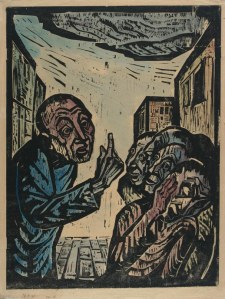
by Jakob Steinhardt, 1923

Jonah, who prophesied after Elijah, asks God to kill him when God decides not to punish the Assyrians of Nineveh, who are enemies of Israel.4 Jonah’s mission is to go to Nineveh and proclaim that the city will be overthrown, but when he finally does, the people of Nineveh take the prophecy seriously and repent. Jonah wanted them to die, not to repent and be spared.

Like Moses and Jonah, Elijah is fed up with the prophet business. Serving as God’s mouthpiece consumes all of a person’s life, but a human being lacks God’s long-term view. No wonder both Moses and Jonah try to get out of being chosen as prophets in the first place.5

Perhaps these are the men Elijah is referring to when he says he is “no better than his forefathers”.

Close encounter

In the desert an angel of God comes twice to Elijah and saves his life with cakes and jugs of water. The second time, the angel says:

“Get up, eat, or the journey will be too much for you!” (1 Kings 19:7)

Perhaps because of this hint, or perhaps because he realizes he needs a deeper consultation with God,6 the prophet gets up and walks all the way to Mount Horev (another name for Mount Sinai).

There he came into the cave, and there he spent the night. And hey! The word of God, his God! And it said to him: “What are you here for, Elijah?” And he said: “I was absolutely zealous for God, the God of Hosts, because the Israelites abandoned your covenant! Your altars they demolished, and your prophets they slayed by the sword! And I alone remain, and they seek to take my life.” (1 Kings 19:9-10)

Elijah the zealot cannot appreciate a partial victory. He cannot accept that his fellow Israelites cooperated with Queen Jezebel, demolished God’s altars, and executed some of God’s prophets. Elijah is so outraged he forgets about (or discounts) the 100 lesser prophets that King Ahab’s court official saved. And he discounts the progress he made with the contest on the Mount Karmel, even though it inspired his people to slay the 450 prophets of Baal.

And hey! God was passing by, and a big and mighty wind was tearing off mountains of rocks in front of God; but God was not in the wind. And after the wind, an earthquake; but God was not in the earthquake. And after the earthquake, fire; but God was not in the fire. And after the fire, a faint sound of quietness. (I Kings 19:11-12)

The first three phenomena are similar to the dramatic divine manifestations at Mount Sinai in the book of Exodus.7 But this time God is not present in them. We can tell that Elijah recognizes God when he hears the faint, quiet sound (or still small voice), because he covers his face. He would know that when Moses stood on that same mountain, God said: “No man can see my face and live.”8

And when Elijah heard, he wrapped his face with his adaret, and he went out and stood at the entrance of the cave. And hey!—a  voice [came] to him, and it said: “What are you here for, Elijah?” (1 Kings 19:11-13)

adaret (אַדֶרֶת) = cloak, mantle. (From the same root as eder, אֶדֶר = magnificence, splendor.)

When Gods asks the question a second time, Elijah gives the same reply, word for word. He does not pick up on God’s hint that his true service to the divine now lies in quietness. A calm spirit is not Elijah’s forte.

Tossing the mantle

So God arranges for Elijah to be replaced by a new prophet.

Then God said to him: “Go, return the way you came, [then go on] to the wilderness [near] Damascus. You must come and anoint Chazeil as king over Aram. And you must anoint Yeihu son of Nimshi as king over Israel. And you must anoint Elisha son of Shafat from Aveil Mecholah as a prophet instead of yourself.” (1 Kings 19:15-16)

Elijah is so eager to stop being a prophet that he skips anointing new kings of Aram and Israel, and goes straight to Aveil Mecholah in the Jordan valley.

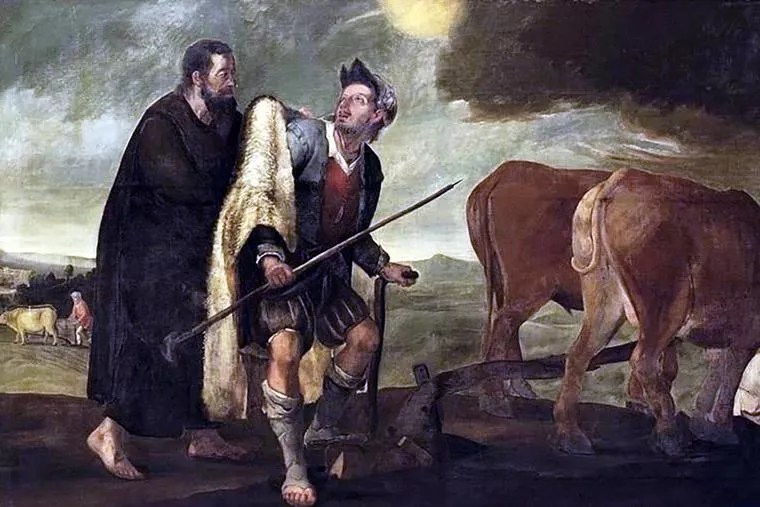
Elijah and Elisha, by Abraham Bloemaert, 1565-1651

And he went from there, and he found Elisha son of Shafat, who was plowing with twelve yokes in front of him, and he was with the twelfth. And Elijah crossed over to him and he threw his adaret to him. He [Elisha] left his oxen and he ran after Elijah … (1 Kings 19:19-20)

This is the source of the English idiom “passing on the mantle”. The word adaret is used only once in the Hebrew Bible for the garment of a king.9 Otherwise it appears as either a prophet’s outer garment or a metaphor. In this week’s haftarah Elijah’s mantle is his protection as  prophet; he uses it to hide his face when God is too close even for him.

Elijah’s improvised substitute for anointment proves to be only the beginning of the transfer of his prophetic authority. Elisha becomes Elijah’s attendant or acolyte for several years, perhaps replacing the servant whom Elijah left in Beir-sheva.

After this week’s haftarah God orders Elijah to deliver two more prophesies. He obeys, adding his own elaborations as usual. First he predicts doom (involving blood-licking dogs) for Ahab and his Phoenician wife because Jezebel arranged the murder of Nabot, who refused to sell his vineyard to the king.10

Then, three years later, Elijah tells King Achazyah, Ahab’s son and heir, that he will die of his wounds from a fall out the window.11 In this story, Elijah is described as a very hairy man with a leather belt around his waist; no adaret is evident.

The adaret reappears in the second book of Kings on the day when God is finally ready to take Elijah’s life. Elijah rolls it up and uses it to slap the Jordan River, and the waters part so he and Elisha can cross on dry land. Then the adaret falls to the ground when Elijah ascends to heaven in a whirlwind, and Elisha picks it up—this time for good.12


When is it time to pass on the mantle of authority?

When you are fed up with one of your roles in life, it is fine to keep an eye out for your successor. But you may have to humble yourself and continue serving until you can step down without doing harm. Perhaps, like Elijah, you must serve as a model for your future replacement for a while. Or perhaps, like a parent with a difficult child, you must accept your responsibility graciously until you are no longer needed.

The prophet business is not the only hard duty a person might face.


  1. 1 Kings 18:17-38.
  2. 1 Kings 18:39-40.
  3. Numbers 11:11-15.
  4. Jonah 4:1-3.
  5. Moses in Exodus 4:1-16 when he keeps trying to talk God out of it, and Jonah in Jonah 1:1-3 when he gets on a ship to Tarshish.
  6. Commentators who proposed that Elijah went to Mount Horev in order to commune with God and elevate his soul include the Malbim (19th-century rabbi Meir Leibush ben Yehiel Wisser) and Leo L. Honor, Book of Kings 1, The Jewish Commentary for Bible Readers, New York: Union of American Hebrew Congregations, 1955, p. 271.
  7. When God comes down on top of Mount Sinai in Exodus 19:16-20, the effects include an earthquake, the blare of a horn, thunder and lightning, and fire and smoke.
  8. Exodus 33:20.
  9. The king of Nineveh takes off his adaret and puts on sackcloth in Jonah 3:6.
  10. 1 Kings 21:1-24.
  11. 2 Kings 1:2-8.
  12. 2 Kings 2:8-14.

Balak, Pinchas & Matot: They Made Us Do It

(Overall, the books of Exodus through Deuteronomy present Moses as a complex character. Yet at times he obeys God without thinking. In the conversation below I address this simplistic Moses character.) 

Moses: We killed them because they made us do the wrong thing.

M. Carpenter: They made the Israelite men do it? Aren’t they adults, responsible for their own actions?

Moses: But they tricked us.

Carpenter: Or maybe you let them trick you. Here’s what the Torah says:

Torah portion Balak:

And Israel was dwelling at Shittim, and the people began liznot the Moabite women.  And they invited the people to make slaughter-offerings to their god.  So the people ate and prostrated themselves to their god.  And Israel yoked itself to Baal-Peor, and God became inflamed against Israel.  (Numbers/Bemidbar 25:1-3)

liznot (לִזְנוֹת) = to have intercourse with a religious sex worker (when zonah, זֺמָה  = cult prostitute); to have illicit intercourse (when zonah = any woman who sells herself for sex); to be unfaithful.

Any of the three meanings of liznot might apply in the passage above.  The Israelite men might have served the god of Peor from the beginning, through its sex workers. Or they might have used Moabite prostitutes, who then invited them to religious feasts.  Or the word liznot might introduce the idea that they became unfaithful to God when they bowed down to another god.

Pinchas, Sacra Parallela, Byzantine 9th century

God’s rage was expressed as a plague, which killed 24,000 Israelites before Aaron’s grandson Pinchas stopped it with a single violent act.  One of the Israelite men brought one of the Moabite women right into God’s Tent of Meeting to have sex.  Pinchas speared both of them through their private parts in one blow.1

Torah portion Pinchas: Then God made Pinchas a priest on the spot.2  When the Torah gave the names of the speared offenders, it changed the Moabite woman into a Midianite woman, an example of incomplete redaction when two versions of a story have been melded.  From that point on, the female offenders are called Midianites.

Then God spoke to Moses, saying: “Attack the Midianites and strike them down! –because they attacked you through nikheleyhem when niklu you over the matter of Peor … (Numbers 25:17-18)

nikheleyhem (נִכְלֵיהֶם) = their deceit, their trickery, their cunning.

niklu (נִכְּלוּ) =they deceived, they tricked.

Moses:  So you see, God Himself said that the Moabites, er, Midianites, tricked us.

M. Carpenter: Well, the God-character you heard in the Torah said that. I think those Israelite men should have realized that having liaisons with women attached to the god of Peor would lead to invitations to feasts, during which it would only be polite to bow down to their god like everyone else. The men could have thought it through, but they didn’t—and they could not use the excuse that they were starving.  They already had sex and food in their own camp with Israelite women.

Moses: Anyway, those Peor worshipers will never trick us again.

M. Carpenter: True. Because the next Torah portion says:

Torah portion Mattot: After a while God reminded him:

Take revenge with the vengeance of the Israelites on the Midianites! Afterward you shall be gathered to your people.” (Numbers 31:1)

So, knowing it might be his final deed before he died, Moses assembled an army.  The Israelites defeated the Midianites, burned down their towns, and killed every Midianite man.  When they returned with the booty, including the Midianite women and children, Moses ordered them to kill all the women who were not virgins.  He explained that it was Midianite women who caused the Israelites to choose Peor over God, which resulted in God’s plague.3

M. Carpenter: Exterminating the local population did eliminate that particular temptation. But it won’t stop the Israelites from straying after other Gods once they settle in Canaan, as I pointed out in an earlier post: Mattot, Va-etchannan, & Isaiah: How to Stop a Plague, Part 3.

Moses: But God wanted revenge.

M. Carpenter: In this story, the God-character wants revenge. But elsewhere in the Torah, the God-character wants justice. There’s a difference.  Let me quote something God said to you at Mount Sinai:

“A fracture for a fracture, an eye for an eye, a tooth for a tooth: as someone gives a physical injury to a human, thus it shall be given to him.  And for striking down a beast, he shall pay compensation, but for striking down a human, he shall be killed.”  (Leviticus/Vayikra 24:19-21)

Moses: So you think we should have seduced the Moabites into worshiping our God?

M. Carpenter: You could have tried. Of course, they might have had the fortitude to resist and stick to their own god. But trying to seduce them would have been more ethical than killing them.

Moses: I was afraid that if we didn’t obey God’s order to kill the Moabites, God would kill more Israelites. You know what a temper he has.

M. Carpenter: You must have noticed that God has more than one voice in the Torah. There’s the angry jealous God, the God of justice, and the God of mercy. Remember back in the book of Exodus when you talked the jealous God-character into giving up his plans for revenge against the Israelites, and extending mercy instead?3

Moses: I asked for mercy for the Israelites.  Mercy for the Moabites is different.

M. Carpenter: Is it?


  1. Numbers 25:6-9.
  2. Numbers 25:10-13.
  3. Numbers 31:16.
  4. Exodus 32:7-14.


Pinchas: The Right Spirit for Leading

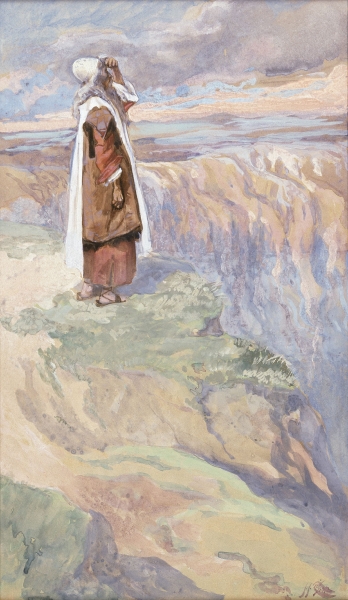
Moses Sees the promised Land from Afar, by James Tissot, circa 1900

Moses knows he will die before the Israelites cross the Jordan into Canaan.  In this week’s Torah portion, Pinchas, he asks God who will replace him as their leader.

Nobody can replace Moses as a prophet; nobody else is capable of having such frequent, direct, long, and personal conversations with God.  Yet someone must replace him as the administrative and military head of the people as they take over the “promised land”.  Moses’ own two sons dropped out of the Torah early in the book of Exodus/Shemot; presumably they either returned to their Midianite grandfather’s home, or accompanied the Israelites for 40 years without doing anything worth mentioning.  Moses’ nephews Eleazar and Itamar are priests, assisted only by Eleazar’s son Pinchas, to whom God grants priesthood at the beginning of this week’s Torah portion.1

So Moses spoke to God, saying: “May God, the God of the ruchot of all flesh, appoint a man over the community who will go out before them and who will come in before them, and who will lead them out and who will bring them in, so the community will not be like a flock without a shepherd”. (Numbers/Bemidbar 27:15-17)

ruchot (רוּחֺת) = plural of ruach (רוּחַ) = spirit, wind, mood, driving impulse.

The phrase “the God of the ruchot of all flesh” is unusual; it occurs only twice in the whole Torah.  The other appearance is earlier in the book of Numbers, when Korach leads a revolt against the authority of Moses and Aaron.  At one point he gathers the whole community against them at the entrance of the Tent of Meeting.

And God spoke to Moses and to Aaron, saying: “Stand apart from this community, and I will consume them in an instant!”  But they fell on their faces and said: “God, the God of the ruchot of all flesh!  Is it that one man sins, and You become angry at the whole community? (Numbers 16:20-22)

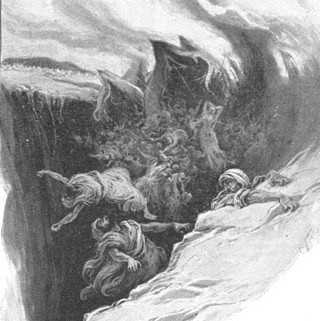
The Death of Korach, Datan, and Abiram, by Gustave Dore

Taking their point, God amends the order to standing apart from the three ringleaders of the rebellion, Korach, Datan, and Aviram.  Moses and Aaron take the extra step of warning all the other people to move away from the tents of the three rebels.  The earth swallows them, but not the people standing at a distance.  God also destroys Korach’s followers, the 250 Levites who are deliberately usurping the priestly role of offering incense.2

By using the phrase “the God of the ruchot of all flesh”, Moses and Aaron remind God that God knows the moods and desires of every individual, and therefore should distinguish between the motivation of Korach, Datan, Aviram, and the 250 Levites, who talk about justice but want personal power, and the motivation of the rest of the Israelites, who do not understand what is going on and just want to stay alive.

Moses uses the phrase “the God of the ruchot of all flesh” again in the Torah portion Pinchas, when he asks God to appoint someone to take over his position as the leader or ruler of the Israelites.  Once again, Moses might be reminding God that God knows the inner spirits of all human beings.  He wants God to choose a new leader with the right personality and motivations for the job.

Obviously Moses’ successor should not be driven by the desire for personal power, like the rebels in the portion Korach.  But what other qualities should this man3 have?

Rashi4 explained Moses’ use of “the God of the ruchot of all flesh” by writing that Moses also said: “Master of the World! The character of each individual is revealed to you, and no two are alike.  Appoint a leader who can tolerate each individual according to his character.’’

The leader of the Israelites must be able to discern each person’s ruach or inner spirit, and adjust accordingly.  He cannot succeed by simply following all the laws God gave to Moses; he must be able to interpret the laws and make new decisions that take into account the natures of different individuals in various situations.5

After Moses asks “the God of the ruchot of all flesh” to appoint the new leader, God picks the obvious choice: Joshua, who has been Moses’ attendant for 40 years in the wilderness, who led the first battle against Amalek,6 and who stood with Caleb in favor of trusting God to help the Israelites conquer Canaan instead of heading back to Egypt.7

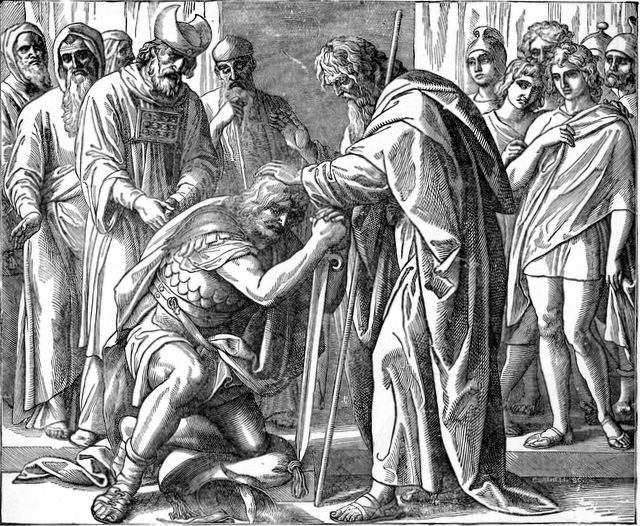
Moses Appoints Joshua, from Henry Northrop, Treasures of the Bible, 1894

Then God said to Moses: “Take for yourself Joshua, son of Nun, a man who has ruach in him, and lay your hand upon him.” (Numbers 27:18)

What does God mean by saying Joshua has ruach in him?  Elsewhere in the Torah, the ruach of a human being might be an emotional compulsion such as jealousy,8 or a “ruach Elohim” (spirit of God), an ability bestowed by God such as the wisdom of a craftsman or the gift of prophecy9.

But sometimes the Torah refers to a person’s ruach without a qualifier.   Before this week’s Torah portion, “The ruach of Jacob came alive” when he realized his son Joseph was alive and well after all.10  The Israelite slaves cannot hear Moses’ good news because they suffer “from shortness of ruach and from hard servitude.11

In these two cases, ruach appears to mean a zest for life.  So perhaps in this week’s Torah portion God says Joshua is “a man who has ruach in himbecause he has enough psychic energy to do the job of both leading an extensive military campaign and administering justice among his people.  If Joshua can also discern the ruchot of all the individuals he must lead, all the better.

Joshua is not another Moses; but his ruach, as well as his experience, make him the best candidate to lead the people after Moses dies.

*

Democracy was not invented until 508 B.C.E. in Athens, long after the time of the exodus or the time when the story of the exodus was recorded.  For the ancient Israelites, as for other cultures around the world, leaders or kings were usually replaced by their children or by a general in a coup.  Occasionally the old king would appoint a new king, in a process parallel to Moses’ laying hands on Joshua.  Everyone claimed the right to kingship came from their people’s god.

In democratic nations today we face a different challenge when it comes to replacing our leaders.  Most, though not all, candidates for highest office have a zest for power.  Do they also have a zest for life?  More importantly, do they have the ability to discern the characters of different persons, and consider their individual needs and desires?  Can they extrapolate and address the needs of citizens in a different social class from their own, people they have never met?

  1. Numbers 25:12-13.
  2. Numbers 16:35.
  3. Moses assumes that although a woman such as Miriam might lead other women, men will only follow a male leader. This is the attitude of the ancient Israelites throughout the Torah. Even the female prophet and judge Devorah, who is the actual leader during the battle against the Canaanite general Sisera, gets Barak to be her front man in Judges 4:6-10.
  4. Rashi is the acronym for Rabbi Shlomo Yitzchaki, who wrote extensive commentary in the 11th century in France.
  5. In Numbers 27:21, God tells Moses that Joshua must also ask the high priest, Eleazar, to use the umim to divine God’s decisions about when to go out to or withdraw from battles.
  6. Exodus 17:8-13.
  7. Numbers 14:1-9.
  8. I.e. Numbers 5:14, 5:30.
  9. I.e. Exodus 28:3 and 31:3 (Betzaleil), Numbers 11:17-29 (70 elders), and Numbers 24:2 (Bilaam).
  10. Genesis 45:27.
  11. Exodus 6:9.

Pinchas: New Moon

The moon waxes to a full, bright circle; then it wanes until it disappears.  In the Hebrew calendar the new moon is not the invisible one, but the first thin curved line to appear the blue daytime sky.  It sets just after the sun sets, and the first day of a month begins.

The book of Leviticus/Vayikra prescribes offerings at the altar for annual holidays, for Shabbat every week, and for morning and evening every day.  But the new moon is not singled out for its own monthly celebration until the book of Numbers/Bemidbar.

And on your days of rejoicing, and at your appointed times, and on the beginnings of chadesheykhem, you shall blow trumpets over your rising-offering and over your slaughter-sacrifices of your wholeness offerings.  (Numbers/Bemidbar 10:10)

chadesheykhem (חָדְשֵׁיכֶם) = your months.  (A form of the noun chodesh, חֺדֶשׁ = month, new moon.  From the root verb chadash, חָדַשׁ = renew.)

New moon at the altar

What offerings are prescribed for the new moon?  We find out in this week’s Torah portion, Pinchas.

And at the beginnings of chadesheykhem you shall offer a rising-offering for God: two bulls of the herd, and one ram, and seven yearling lambs, unblemished.  (Numbers 28:11)

(I refer to an olah (עֺלָה) as a “rising-offering” because the Hebrew word comes from the verb alah (עָלָה) = rose, ascended, went up.  What rises in an olah is smoke, when the animal is completely burned up for God.)1

Each animal is burned with its own measure of fine flour mixed with oil,

…a rising-offering of soothing scent, a fire-offering for God.  And their libations2 shall be wine, half a hin for a bull, and a third of a hin for the ram, and a quarter of a hin for a lamb.  This is the rising-offering of chodesh in chadesho for the chakeshey the year.  And one hairy goat for a guilt-release offering3 for God …  (Numbers 28:14)

chadesho (חַדְשׁוֹ) = its renewal.  (From the root verb chadash.)

chadeshey (חָדְשֵׁי) = months of, new moons of.  (Another form of chodesh.)

What we learn about the observance of the new moon in the book of Numbers is that there must be a rising-offering on the altar with a specific combination of animals, grain products, and wine; and that a trumpet is blown when the offering takes place.

New moon at the table

When King Saul becomes insanely jealous of his young general David, he orders David killed.  David talks with Jonathan, his best friend and Saul’s son and heir.

And David said to Jonathan: “Hey, chodesh is tomorrow and I should definitely sit with the king to eat.  But let me go, and I will hide in the countryside until the third evening.”  (1 Samuel 10:5)

Jonathan urges his beloved friend to flee, and the two young men work out the logistics.

This passage is famous for Jonathan’s declaration of love and allegiance to David.  But it also shows that at the time of King Saul (around the 11th century BCE) the observance of the new moon included an obligatory feast at the king’s table for his officers.

New moon with a prophet

The woman of Shunem makes a room on the rooftop of her house where the prophet Elisha can stay whenever he visits the town.  When her son dies suddenly, she lays him on Elisha’s bed, then goes out and asks her husband for a servant and a donkey so she can hurry to Elisha.

But he said: “Why are you going to him today?  It is not chodesh and not Shabbat.”  And she said: “Peace!”  And she saddled the donkey …  (2 Kings 4:23-24)

The woman tells no one that the boy has died, and she talks Elisha into coming back at once with her.  The prophet miraculously brings her son back to life.

This story indicates that during the reign of King Yehoram of the northern kingdom of Israel (9th century BCE), travelling prophets conducted ceremonies for their followers on the sabbath every week, and on the new moon every month.

New moon outdoors

After the Roman army destroyed the second temple in Jerusalem in 70 CE, it was never rebuilt as a Jewish temple, and animal offerings gradually ceased for Jews.4  The old method of worship was replaced by prayers and good deeds.

Only a few centuries after the fall of the second temple, Jews were going outside to look at the moon during the week when it grew from a new moon to a half moon, and reciting a blessing.  The Talmud says that blessing the new month at the proper time is like greeting the face of the divine presence (Shekhinah), so one should say the blessing while standing.  The full blessing, according to the Talmud, is:

Blessed are you God, our God, king of the universe, who by his word created the heavens, and by the breath of his mouth all their hosts.  He set for them a law and a time, that they should not deviate from their task.  And they are joyous and glad to perform the will of their owner; they are workers of truth whose work is truth.  And to the moon he said that it should renew itself as a crown of beauty for those he carried from the womb, as they are destined to be renewed like it, and to praise their Creator for the name of his glorious kingdom.  Blessed are you, God, who renews the months.  ((Talmud Bavli, Sanhedrin 42a)5

This formal prayer (in Aramaic) praises God for the creation of an orderly universe including the moon, the monthly renewal of moonlight, and an undefined renewal of human beings.  The focus is on the heavenly bodies, personified.

New moon in the synagogue

For centuries, Jewish congregations were led outside once a month to look at the moon and recite the blessing above.  This communal blessing happened right after the havadalah ceremony concluded the Shabbat that fell during those seven days.

But as more and more Jews went home after morning Shabbat services instead of staying with their rabbi all day through havdalah, a new custom arose to observe the new moon.

Now the morning Shabbat services before each new moon include an extra section of prayer and blessing in the Torah service.  First the congregation chants the following prayer (in Hebrew):

May it be your will God, our God and God of our forefathers, shetechadeish for us this chodesh for goodness and for blessing.  And may it give to us a long life, a life of peace, a life of goodness, a life of blessing, a life of right livelihood, a life of bodily health, a life full of awe of heaven and fear of wrongdoing, a life without shame or disgrace, a life of wealth and honor, a life of love of Torah and awe of heaven, a life of fulfillment by God of all desires of our heart for the good.  Amen, selah!

shetechadeish (שֶׁתְּחַדֵּשׁ) = to renew.  (A form of the verb chadash in “Prayerbook Hebrew”.)

The focus here is on blessings for humans.  In a traditional Jewish prayerbook, prayers that ask God for blessings tend to be thorough.

Next the service leader holds the Torah scroll and announces which day the new moon will appear in the coming week, saying a shorter prayer before and after the announcement.6

If the new moon is scheduled to appear at the end of Shabbat, the traditional service adds a reading of the scene between David and Jonathan mentioned above.7

New moon in women’s circles

A more recent practice is for a circle of Jewish women to gather on the evening of the new moon, the first day of each Hebrew month, to conduct their own rituals.  These have not been codified, but rosh chodesh (“beginning of a month”) groups are increasingly popular in America.

*

Celebrating the new moon follows the same trajectory as many other Jewish observances in history.  In the Torah, the new moon is an occasion for a special offering at the altar, presided over by priests.  After temple worship was replaced by communal prayers, rabbis developed different ways of celebrating the new moon, starting with a concrete act (saying a blessing outside while looking at the moon) and changing to a more abstract prayer in the synagogue.  Finally, in the last half-century, liberal Jews have been developing their own innovative celebrations.

But is it still worthwhile to devote time and energy to thanking God for each new moon?

The gravity of the moon still creates the tides in our world.  The changing moon still strikes many human beings as beautiful and awe-inspiring.  Thanking God for the moon helps us to remember that like everything else in nature, it is a gift; we did not make it.

And in Hebrew the new moon, chodesh, also signals renewal, chadash.  Something new is possible for all human beings, every month and every minute, from birth to death.  We are never as stuck as we think.

  1. See my post Vayikra & Tzav: Fire Offerings Without Slaughter, Part 1.
  2. See my post Emor: Libations.
  3. Here chataat (חַטָּאת) means an offering to remove guilt for a misdeed.
  4. Samaritans, descendants of the Israelites in the northern kingdom of Samaria, still sacrifice sheep on Mount Gezirim for Passover.
  5. sefaria.org , translation from Aramaic by William Davidson.
  6. After that, the congregation anywhere outside of Israel recites another blessing.
  7. 1 Samuel 20:18-42.

Pinchas: Aromatherapy

The God-character in the Torah often lashes out in fits of rage.  Sometimes this anthropomorphic “God” kills offensive individuals, and sometimes “He” wipes out hundreds or thousands of people, the innocent with the guilty.

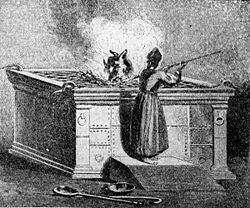
from Treasures of the Bible, Northrop, 1894

Moses succeeds in talking God down into relative calmness after the Israelites worship the golden calf in the book of Exodus/Shemot,1 and twice more in the book of Numbers/Bemidbar.2  But the smell of aromatic smoke is an even more effective way to soothe the God-character.

This week’s Torah portion, Pinchas, ends with a schedule of offerings to be burned on the altar.  God begins the list by telling Moses:

“Command the Israelites, and you shall say to them: You must pay attention to my offerings, my food—to my fire-offering of my reyach nichoach—to offer [it] to me at its appointed time.”  (Numbers 28:1-2)

reyach (רֵיחַ) = scent, odor, fragrance, aroma.  (From the same root as ruach,  רוּחַ= wind, spirit, mood.)

nichoach (נִחֺחַ) = soothing, calming.  (From the root verb nuach, נוּחַ = rest, settle down in peace and quiet.)

reyach nichoach (רֵיחַ נִחֺחַ) = soothing scent.

The phrase reyach nichoach appears ten more times in the schedule of animal and grain offerings that follows.3  Although the God-character no doubt appreciates the sacrifice of potential human food and the pouring of libations, the scent of the smoke is a key element.

The First Soothing Smoke

The smoke from burned offerings first reaches God as a reyach nichoach in Genesis/Bereishit, after the God-character has become so upset by the violence and corruption of humans (and perhaps other carnivores) that He decides to destroy all life on earth.4  God makes an exception only for the obedient Noah and the other occupants of his ark.

After the flood recedes, God tells Noah to empty out the ark.  Then Noah finally does something on his own initiative, building an altar and burning up some extra animals he brought along as an offering to God—perhaps in imitation of Abel, whose animal offering God turned toward.5  (See my post Noach: The Soother.)

And God smelled the reyach nichoach, and God said in His heart:  I will never again draw back to doom the earth on account of the human, for the impulse of the human heart is bad in its youth … (Genesis/Bereishit, 8:21)

The clouds of smoke probably remind God of Abel’s grateful sacrifice of sheep, before humankind turned bad.  Reassured, God concludes that at least some adults want to serve Him.

The phrase reyach nichoach appears again three times in the book of Exodus,6 seventeen times in Leviticus, and eighteen times in Numbers, always in descriptions of animal and grain offerings to God.

Korach

The God-character’s temper flares again in the next Torah portion, Korach, which begins with two simultaneous coups against Moses and Aaron. 

God deals with the Reuvenite leaders by making the earth swallow them and their families, and with Korach’s 250 Levites by burning them up in a conflagration.  The next day the remaining Israelites complain about all the deaths, and God tells Moses:

“Take yourselves out from the midst of this community, and I will consume them in an instant!”  (Numbers/Bemidbar 17:10)

Once again, God wants to annihilate the entire Israelite people—and presumably start over again with only Moses and Aaron and their families.  This time Moses tells Aaron to stop the plague by taking his incense pan out into the community.

Aaron took it, as Moses had spoken, and he ran into the middle of the congregation, and hey!—the pestilence had already started among the people!  He put on the incense and he made atonement over the people.  And he stood between the dead and the living, and the pestilence was stopped.  (Numbers 17:12-13)

The God-character has already killed 14,700 people when Aaron’s incense checks His rage.

At the end of the portion Korach, God instructs the Israelites to offer the firstborn of every cow, ewe, and nanny goat at the altar, “… and you shall burn-into-smoke their fat as a fire-offering for reyach nichoach for God.”  (Numbers 18:17)

Pinchas

At the end of last week’s Torah portion, Balak, the Israelites join the local Moabite Midianites in worshiping their god Baal-Peor.  When a Reuvenite man brings a Midianite princess (possibly a priestess of Baal-Peor) right into God’s tent-sanctuary to copulate, the God-character’s fury boils over.  Aaron’s grandson Pinchas dashes into the tent chamber and stabs a spear through the copulating couple.7

And the pestilence was stopped from over the Israelites.  And the deaths in the pestilence were 24,000.  (Numbers 25:8-9)

The God-character rewards Pinchas, but remains angry in this week’s Torah portion, Pinchas. God orders Moses to attack and kill all the Midianites who worship Baal-Peor—an order carried out in next week’s portion, Mattot.8  After addressing several other matters, God remembers the soothing scent of smoke in Numbers 28:1-2 (above).

Maybe the God-character finally realizes He has a quick temper and an anger management problem.  If the Israelites soothed Him with a reyach nichoach at regular intervals, He might stay calmer.

God requests two daily offerings, plus additional offerings every seventh day (Shabbat), every new moon, and on six special occasions during the year (now called PesachShavuot, Rosh Hashanah, Yom Kippur, Sukkot, and Shemini Atzeret).  The daily offerings and the additional offerings on the new moon, Pesach, Shavuot, Rosh Hashanah, Yom Kippur, and Shemini Atzeret are all labeled as either “a reyach nichoach, a fire-offering for God” or “a fire-offering of reyach nichoach for God”.

Smoke and the gods

Why does the God-character in the Torah calm down when He smells the smoke of an animal, grain, or incense offering?

The book of Ezekiel provides a clue.  Three times in Ezekiel, God complains that Israelites at home and in exile are flocking to foreign altars and giving mere idols a reyach nichoach.9

Moabite altars in “Bilam”
by James Tissot

Burning animals at altars for local gods was standard religious practice in ancient Canaan and Mesopotamia.  The epic of Gilgamesh includes a story in which Utnapishtim, the Mesopotamian equivalent of Noah, emerges from his boat after the flood and offers a sacrifice to the gods.  When he lights a fire of myrtle, cane, and cedar wood, the odor reaches the nostrils of the gods and gives them pleasure.10

Since many humans enjoy aromatic smoke from incense or from a barbecue, it is natural to assume an anthropomorphic god enjoys it, too.  Just as an angry king about to punish someone might be appeased by a delightful gift, an angry anthropomorphic god might be appeased by a gift of fragrant smoke.  Since the God of Israel and the gods of Canaanites and Mesopotamians were envisioned as living in the sky, smoke was one of the few gifts that would be sure to reach them.


Have we discarded the idea of an anthropomorphic god today?  Not entirely.  Both atheists and theists often think of God as a super-human being living in a “heaven” coexistent with our world.  Atheists prove that this super-being cannot exist, while most religious people explain that an anthropomorphic god is either one manifestation of the real God, or a helpful image in our own minds, not to be confused with the real God.

There are still some fundamentalists who believe in the angry, punishing God portrayed so often in the Hebrew Bible and inherited by Christianity and Islam.  The rest of us tend to view God as either loving (a helpful anthropomorphic image), or without emotion (because God is not really a super-human).

Yet we sometimes find ourselves disturbed by our own irrational anger, and the impulsive actions we commit as a result.  We do not want to be made in the image of the angry, temperamental God-character.  What can we do to become calmer human beings?

Smoking is not the best answer.  But making regular offerings to God could be.  Jews no longer burn animals on an altar to soothe God’s temper, thank God!  But we are asked to pray at the appointed times listed in Pinchas: daily, weekly, monthly, and on annual holy days.  I have found that when I pray thoughtfully, searching out inner meanings of some words and adding my own heartfelt longings, my prayer soothes my own spirit and lifts my soul closer to God.

May everyone who needs the blessing of calmness find a good way to receive it.


  1. Moses talks God out of annihilating the Israelites and starting over again with only Moses’ descendants in Exodus 32:9-14 and 32:25-35. See my post Ki Tissa: Fighting or Singing?  God may be testing Moses to see whether he will argue for the Israelites; but on the other hand, God does kill an untold number of them with a plague, even after the Levites have slain 3,000 guilty people.
  2. In Numbers 14:11-35 (Shelach-Lekha) God threatens to wipe out all the Israelites because they do not trust God to help them conquer Canaan and refuse to cross the border. Moses talks God down, and God makes them wait 40 years instead.  God’s next threat to annihilate all the Israelites is in Korach, reviewed above.
  3. Numbers 28:2, 6, 8, 13, 24, 27 and 29:2, 6, 8, 13, 36.
  4. Genesis 6:11-13, 6:17.
  5. Genesis 4:3-5.
  6. Exodus 29:18, 29:25, and 29:41.
  7. See my posts Balak & Pinchas: How to Stop a Plague, Part 1 and Balak: Carnal Appetites.
  8. See my post Mattot: Killing the Innocent.
  9. Ezekiel 6:13, 16:19, 20:28. In Ezekiel 20:41, God says that when all Israelites restrict themselves to serving their own God on the holy mountain of Israel, then God will accept the people themselves as a reyach nichoach.
  10. Gilgamesh tablet 11, part 4.

Balak & Pinchas: How to Stop a Plague, Part 1

And Israel strayed at the acacias, and the people began to be unfaithful [to God] with the daughters of Moab. They invited the people to the sacrificial slaughters of their god, and the people ate and bowed down to their god. And Israel attached itself to Baal Peor, and God’s nose burned against Israel. (Numbers/Bemidbar 25:1-3)

The Israelites camp for a while under the shade of acacia trees on the east bluff of the Jordan River, with a view of their “promised land” of Canaan across the water. In last week’s Torah portion, Balak, some local women invite the Israelite people—men and women—to feasts in honor of their god, Baal Peor, and the Israelites accept. (See my post Balak: False Friends.) They bow down to Baal Peor along with their hostesses, perhaps at first out of politeness. But their prostrations become sincere; they end up worshiping Baal Peor. The God of Israel is enraged at their unfaithfulness; in the Biblical Hebrew idiom, God’s nose burns.

This is the second time a large number of Israelites flout one of the Ten Commandments. The first time, at Mount Sinai, they make and worship the golden calf (as an image of the God of Israel), violating the commandment against idols in Exodus/Shemot 20:4. Even after Moses has the Levites kill about 3,000 idol-worshipers, God sends a plague that kills more of them.

The Ten Commandments also include “You shall have no other gods before Me” (Exodus 20:3). Right after forbidding other gods and idols, God says:

You shall not bow down to them and you shall not serve them; because I, God, your god, am a kana god, taking retribution for the crimes of parents upon their children, upon the third and the fourth [generations] of those who hate Me. (Exodus 20:5)

kana (קַנָּא) = jealous, zealous.

In last week’s Torah portion, Balak, many Israelites flagrantly disobey God by worshiping Baal Peor. This time God’s plague kills 24,000 Israelites.

Everyone wants to stop the epidemic—even God. Apparently pestilence is a direct expression of God’s anger (along with the idiomatic burning nose), and God (as portrayed in the book of Numbers/Bemidbar) cannot simply switch off divine anger.

So what can stop the plague? God has the first idea, and tells Moses:

Take all the chiefs of the people and hang them for God in full sunlight. Then the heat of God’s nose will turn away from Israel. (Numbers 25:4)

But Moses, who prefers justice over mass extermination, does not follow God’s suggestion. He  orders a different action to stop God’s anger:

Moses said to the judges of Israel: Each man, execute his men who are attached to Baal Peor. (Numbers 25:5)

The Torah does not say whether Moses’ order is carried out. But in the next verse, a chief from the tribe of Shimon tries another idea for halting the plague.

from Sacra Parallela, Byzantine, 9th century

And hey! An Israelite man came and brought the Midianite close to his brothers, before the eyes of Moses and the eyes of the whole community of the Israelites who were weeping at the entrance of the Tent of Meeting. And Pinchas, son of Elazar son of Aaron the Priest, saw it, and he stood up in the midst of the community and he took a spear in his hand. And he entered the kubah after the man of Israel, and he pierced the two of them, the man of Israel and the woman, to kavatah. And the pestilence was held back from the Israelites. (Numbers 25:6-8)

kubah (קֻבָּה) = alcove, small tent. (This word may be related to the Akkadian kabu, a verb for calling upon a god, and/or the Arabic kubatu, a small tent-shrine.)

kavatah (קֳבָתָהּ) = her belly. (The word is probably used here as a pun on kubah.)

The word kubah is not used in any descriptions of the God of Israel’s Tent of Meeting; in fact, it appears only once in the Hebrew Bible. So why is there suddenly a kubah near the entrance of the Tent of Meeting?

The Israelite man, we learn in this week’s Torah portion, Pinchas, is Zimri son of Salu, a chief of the tribe of Shimon. The Midianite is Kozbi daughter of Tzur, a chief of a tribe of Midian. According to commentator Tikva Fryemer-Kensky, a high-ranking Midianite woman might well be a priestess who sets up her own kubah in the hope that she can stop the plague.1 The religious ritual she uses to invoke her god apparently includes sexual intercourse with Zimri, given the pun about her kubah. Thus Zimri and Kozbi are probably transgressing three of God’s rules at once: worshiping another god, letting a foreigner enter the holy courtyard around the Tent of Meeting, and having intercourse there.2

Although some commentary justifies Pinchas’s violent deed by pointing out that the first two of these rules carry a death penalty, there is no legal trial.3  Pinchas is not an executioner, but someone who murders in the grip of emotion—like God.

Is Pinchas’s action necessary? In other parts of the Torah, God kills individuals instantly when they flout one of God’s rules or decisions.4 But in the Torah portion Balak, God seems to be overpowered by rage, unable to either calm down or attend to anything else.

In the Torah portion Pinchas, God thanks Pinchas.

And God spoke to Moses, saying: “Pinchas, son of Elazar, son of Aaron the high priest, turned back my rage from the children of Israel through his kina, kina for me in their midst, so I did not finish off the children of Israel in my kina.  Therefore say: Here I am, giving him my covenant of peace.  And it shall be for him, and for his descendants after him, a covenant of priesthood for all time, founded because kinei for his God, so he atoned for the children of Israel.” (Numbers 25:10-13)

kina (קִנְאָ)=  zeal, jealousy, fervor, passion for a cause. (From the same root as kana above.)

kinei (קִנֵּא) = he was zealous, he was jealous.

God recognizes a kindred spirit. Both God and Pinchas act out of kina when someone is unfaithful to God.

Pinchas’s double murder for God’s sake does prevent the deaths of any more Israelites from God’s plague. And murder may be justified if it is the only way to prevent other people from being killed. Does God grant Pinchas a covenant of peace and priesthood as a reward for halting the plague that God is unable to halt?

Or does the covenant modify Pinchas’s kina, giving him an ability to make peace? (See next week’s post, Mattot, Judges, & Joshua: How to Stop a Plague, Part 2.)

It takes longer for the God character in the bible to master “His” own kina over how “He” is treated by the Israelites. For example, after the Israelites are settled in Canaan, God strikes 70 Israelite villagers dead when they look into the ark, even though they are rejoicing over its return to Israelite territory and worshiping God through animal offerings.5

Eventually God calms down somewhat. When God becomes angry with the Israelites of Judah for worshiping other gods at the temple in Jerusalem, He lets the Babylonian army do the killing. God merely informs the Israelites, through the prophets Jeremiah and Ezekiel, that they deserve it.

And in Second Isaiah God finally gives up His kina over the unfaithful Israelites. God promises to take them back with love and never lash out in anger again, despite their infidelity.6

In the western world today we understand jealousy as a natural human emotion, but we caution people not to act out of jealousy, since that often leads to unfortunate or immoral results. On the other hand, we still praise zeal, passionate attachment to a cause.

Yet over the centuries millions of people have been murdered, often in battle, because of zeal for a religion. I pray that more people will question their own beliefs, and stop confusing God with the God-character in the Bible, who kills thousands in uncontrollable fits of rage and kina.

And I pray that all people who are filled with passionate attachment to a cause, even a good cause, will pause and think before taking any action that might harm someone.

May we all become humans of peace.

1  Tikva Frymer-Kensky, Reading the Women of the Bible, Schocken Books, New York, 2002, pp. 220-222.

2  The Torah prescribes the death penalty for an Israelite sacrificing to any gods other than the God of Israel (Exodus 22: 19 combined with Leviticus 27:29), and for a foreigner approaching the Tent of Meeting (Numbers 3:10). The Israelite religion also forbids semen even in the courtyard around the Tent of Meeting; anyone who has sex must bathe and wait until evening before entering the area (Leviticus 15:16-18).

3  A legal punishment can only be carried out after a trial including the testimony of two witnesses (Deuteronomy 19:15). When Moses orders the judges to execute the men who are attached to Baal Peor (Numbers 25:5), he is in effect asking for such trials. Some commentators say Pinchas assumes responsibility for impaling Zimri because God’s plague is raging and the judges of Israel are too slow to act.

4  For example, God employs fire to kill Nadav and Avihu when they bring unauthorized incense into the Tent of Meeting (Leviticus 10:1-2). God makes the earth swallow up  Korach, Datan, and Aviram when they challenge the leadership of Moses and Aaron (Numbers 16:27-33—see my post Korach: Buried Alive). And God inflicts an invisible death (perhaps a stroke or heart attack) on Uzza with when he touches the ark to prevent it from tipping over (2 Samuel 6:6-7—see my post Haftarat Shemini—2 Samuel: A Dangerous Spirit) and on King Achazeyahu after he consults with a foreign god (2 Kings 1:16-17).

5  1 Samuel 6:15, 6:19.

6  Isaiah 54:7-10. See my post Haftarat Re-eih—Isaiah: Song of the Abuser.


Pinchas & 1 Kings: Zealots

Every week of the year has its own Torah portion (a reading from the first five books of the Bible) and its own haftarah (an accompanying reading from the books of the prophets). This week the Torah portion is Pinchas (Numbers 25:10-30:1) and the haftarah is 1 Kings 18:46-19:20.

My god is better than your god.

Holding this opinion (even when your “god” is atheism) is human nature. The trouble begins when someone with religious zeal (great energy and enthusiasm) becomes a zealot (fanatical and uncompromising). When two zealots oppose one another, no compromise is possible; one of them must quit or die.

This week both the Torah portion and the haftarah include a clash between a zealot for the God of Israel and a zealot for the gods of another religion.

Pinchas

Pinchas Impales Zimri & Cozbi, by J.C. Weigel
Pinchas (Phineas),
by J.C. Weigel

The Torah portion, Pinchas, opens with God’s declaration:

Pinchas, son of Elazar son of Aaron the High Priest, turned back My hot wrath from the Israelites through his kina beside My kina in their midst so I did not finish off the Israelites through My kina. Therefore say: Here I am, giving him my covenant of peace. And it will be for him and for his seed after him a covenant of priesthood forever… (Numbers/Bemidbar 25:11-13)

kina (קְנְאָ) = zeal, fervor, passion, jealousy.

God has afflicted the Israelites with a plague because many of them started worshiping the local god, Ba-al of Pe-or. While the Israelites are weeping, an Israelite man brings a local woman into a chamber of a tent (possibly God’s Tent of Meeting). Pinchas follows them in and impales them—and God’s plague stops. The Torah uses the same word, kubah (קֻבָּה) for both the tent chamber and the woman’s inner “chamber” where Pinchas’s spear skewers them both. (See my post Balak: Wide Open.)

This week’s Torah portion names the impaled couple: Zimri, a leader in the tribe of Shimon, and Cozbi, the daughter of a Midianite chieftain of Moab.

Why would either of these people walk in front of Moses and engage in sex right in or next God’s Tent of Meeting—in the middle of a plague?  Tikva Frymer-Kensky suggests in Reading the Women of the Bible that Cozbi is a priestess, a role often given to the daughter of a king, and that Zimri brings her over to conduct a religious sexual ritual to end the plague.

Frymer-Kensky imagines Cozbi might even perform her ritual in the name of the God of Israel. But I imagine Cozbi as so zealous for Ba-al that she wants to save her new neighbors, the Israelites, from their plague-inflicting god by bringing in some positive energy from Ba-al. She does not ask for permission to practice her religion in the Israelite’s holy place; she just does it, in an act of passionate conviction.

In this clash between two zealots, Pinchas wins and Cozbi dies. God (the God character in the Torah) admits to being carried away by zeal, as well, and rewards Pinchas for stopping God from destroying the Israelites.

Elijah

The haftarah from the first book of Kings tells a different story about two zealots: the battle between the queen of Israel and Israel’s foremost prophet.

Ba-al Preparing Thunder and Lightning
Ba-al Preparing
Thunder and Lightning

King Ahab’s queen and primary wife is Jezebel (Izevel in Hebrew), daughter of the Phoenician King Etba-al of Tyre. It is a good political alliance; but both books of Kings revile Jezebel because of her zeal for her native religion. As soon as Ahab marries Jezebel, according to 1 Kings, he builds a temple to Ba-al and bows down to that god. He also erects a cultic post for the goddess Ashtart.

Phoenician Ashtart
Phoenician Ashtart

Jezebel not only persuades her husband to worship her gods, but also tries to stamp out worship of the God of Israel by “exterminating the prophets of God” (1 Kings 18:4).

Furthermore, she uses her personal wealth to maintain 450 prophets of Ba-al (god of fertility, war, and weather) and 400 prophets of Ashtart (goddess of fertility, war, and seafaring).

Meanwhile Elijah, the most powerful prophet of the God of Israel, comes to King Ahab at his capital city, Samaria, and says:

As God lives, the god of Israel on whom I stand in attendance, there will be no dew or rain these years except by the word of my mouth. (1 Kings 17:1)

After three years, the famine in Samaria is severe. Jezebel’s weather god, Ba-al, does nothing.  So King Ahab institutes a search for Elijah.

Elijah orders King Ahab to summon “all Israel”, the 450 prophets of Ba-al, and the 400 prophets of Ashtart to Mount Carmel for a contest. The first book of Kings does not mention the prophets of Ashtart again, but the prophets of Ba-al and the Israelite witnesses show up on Mount Carmel, where there are two altars: one for Ba-al and one for the God of Israel. Against impressive odds, the God of Israel wins the contest. (See my post Pinchas & 1 Kings: The Sound of God.) The people of Israel fall on their faces and declare their allegiance to God, and under Elijah’s orders they kill all the prophets of Ba-al.

Then it finally rains.

Jezebel and Ahab
Jezebel and Ahab, by Charles Horne, 1909

Jezebel is not present at Mount Carmel, but Ahab comes home and tells her about the contest and that Elijah killed all the prophets of Ba-al by the sword.

Then Jezebel sent a messenger to Elijah saying: Thus may the gods do and more if by this time tomorrow I have not made your life like the life of one of them. And he was afraid, and he got up and went to [save] his life… (1 Kings 19:2-3)

He reaches Beer-sheva in the kingdom of Judah, then walks for a day into the wilderness and lies down to die. Although he won the contest on Mount Carmel and moved the Israelites to kill 450 Ba-al worshippers, a zealot’s job is never done. His victory seems empty as long as Queen Jezebel, his zealous opponent, is still in power, still supporting the religion of Ba-al and Ashtart, and still determined to kill every one of God’s prophets.

God sends an angel to urge Elijah to eat and keep walking.  He ends up on Mount Chorev (also called Mount Sinai) where God asks him:

Why are you here, Elijah? And he said: I was very kina for God, the God of Armies, because the Israelites had abandoned Your covenant and pulled down Your altars and killed Your prophets by the sword. And only I was left, and they tried to take my life. (1 Kings 19:9-10)

He declares he is a zealot for God, and admits that he has failed to exterminate Jezebel’s religion. God responds with a demonstration.

Elijahs Cave

And hey! God was passing by, and a big and strong wind was tearing off mountains of rocks in front of God; but God was not in the wind. And after the wind, an earthquake; but God was not in the earthquake. And after the earthquake, fire; but God was not in the fire. And after the fire, a faint sound of quietness. And when Elijah heard, he wrapped his face with his robe, and he went out and stood at the entrance of the cave; and hey!—a  voice [came] to him, and it said: Why are you here, Elijah? (1 Kings 19:11-13)

And Elijah gives the same reply, word for word. He did not pick up on God’s hint that true service to the divine lies in quietness. So God, instead of rewarding him, tells him he must anoint a young man named Elisha to be a prophet in his place.


In the book of Numbers, Pinchas’s zeal, kina, leads him to kill the Ba-al worshiper Cozbi and her Israelite assistant Zimri. God declares that this murder stopped God’s own kina from killing all the Israelites in a plague, and makes Pinchas a priest. In next week’s Torah portion, Mattot, Pinchas is the priest who goes with the raiding party to kill all the inhabitants of Pe-or. One zealot wins hands-down; the other zealot dies.

In the first book of Kings, Elijah’s kina leads him to stage a contest between gods and kill 450 Ba-al worshipers on the losing side. God cooperates by sending the dramatic manifestation of fire that Elijah requests on Mount Carmel. But Elijah’s real opponent is the zealot Jezebel, who remains in power.

When two zealots oppose one another, one of them must quit or die.  God’s demonstration at Mount Chorev implies that Elijah must quit being a zealot, take a quieter approach to religion, and perhaps spend the rest of his life in hiding. But Elijah despairs because he cannot imagine living without fighting for his cause. And God appoints another prophet.

Did the good guys win? No; Jezebel is just as zealous and just as willing to murder for the sake of religion as Elijah is. But God as portrayed in the first book of Kings is now wiser and more mature than the God character in the book of Numbers. This God still wants exclusive worship, but recognizes that kina, the passion of the zealot, is not the best approach.

Our world today is full of zealots. It is easy to revile a zealot willing to kill for the sake of a religion or another cause—when that zealot is not on your side.  May we all learn to recognize uncompromising zeal in people we agree with, and even in ourselves.  May we all learn to restrain ourselves, and listen to the faint sound of quietness.