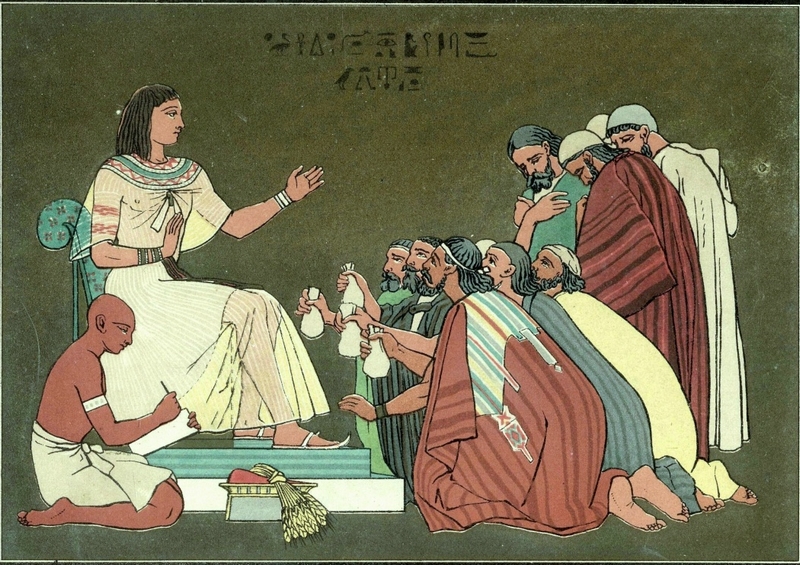
Vayigash & Vayechi: Forgiving?

Salachtikha; I forgive you.

Joseph never says that.  But then, no form of the verb salach, סָלַח (forgave) appears in the book of Genesis/Bereishit.  When the word shows up elsewhere in the Bible, it is always God, not a human being, who forgives.
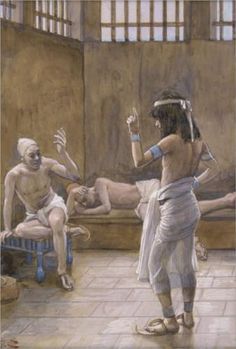
Joseph in Prison,
by James Tissot, ca. 1900

However, Joseph does know about pardoning, which men in command can do.  In the Torah portion Vayeishev he interprets the dreams of two of his fellow inmates in an Egyptian prison.  He tells one, the pharaoh’s chief cupbearer:

“In another three days the pharaoh yissa your head and he will restore you to your position and you will put the pharaoh’s cup on his palm…”  (Genesis/Bereishit 40:13)

yissa (יִשָׂא) = he will lift. To lift up someone’s head is an idiom meaning “to pardon”.  (A form of the root verb nasa, נָשָׂא = lifted, raised high, carried.)

Joseph then interprets the chief baker’s dream:

“In another three days the pharaoh yissa your head off you, and he will impale you on a pole and the birds will eat your flesh off you.”  And it was the third day, the birthday of the pharaoh, and he made a banquet for all of his servants.  Vayissa the head of the chief cupbearer and the head of the chief baker from among his servants.  And he restored the chief cupbearer to bearing cups, and he put the pharaoh’s cup on his palm.  But the chief baker he impaled…  (Genesis 40:19-22)

vayissa (וַיִּשָּׁא) = and he lifted.  (From the root verb nasa.)

The pharaoh lifts up the cupbearer’s head, pardoning him; but he lifts off the baker’s head, executing him.

Two years later, Joseph is brought up from prison to interpret two dreams of the pharaoh, and by the end of their conversation the pharaoh has made Joseph the viceroy of Egypt.1

Joseph wants to forget his family back in Canaan, especially his ten older brothers, who hated him so much they were not able to speak to him in peace2, and his father, who was responsible both for creating the discord among his sons and for sending Joseph out alone to find and report back on his brothers.  (See my post Mikeitz: Forgetting a Father.)  The brothers seized him, threw him in a pit, then sold him as a slave to a caravan bound for Egypt.

When he sees his brothers again, Joseph is 37 years old and the viceroy of Egypt.  He now has the power to execute his brothers or to pardon them.

He decides to test them first.  He overhears them express remorse over how they treated their younger brother Joseph.  Then Joseph puts the brothers through a series of tests, and concludes that they have indeed changed.  (See my post Mikeitz & Vayiggash: Testing.)  The tests are mysterious to Joseph’s brothers because they do not recognize him; they assume their younger brother died as a slave, and the viceroy is an Egyptian.

The conditions are ripe for forgiveness; Joseph’s older brothers have expressed remorse, and he can now trust them not to harm him or his younger brother Benjamin.  But does Joseph ever forgive—or at least pardon—his brothers?  Does he forgive his father for putting him in danger?

Vayiggash: Does Joseph forgive his brothers?

Joseph reveals his identity to his brothers after they refuse to leave Egypt without Benjamin, the youngest of Jacob’s sons and the only one with the same mother as Joseph.

And Joseph said to his brothers: “I am Joseph.  Is my father really still alive!”  But his brothers were not able to answer him, because they were aghast before his face.  (Genesis 45:3)

His brothers are too stunned, and perhaps terrified, to answer.  The man who has absolute power over them is the man whom they once sold into slavery.

Meanwhile, Joseph realizes that events had to unfold this way, or his whole extended family would have starved to death during the famine.  His brothers’ crime was necessary to get Joseph to Egypt, where God inspired him to interpret the pharaoh’s dreams and he became the viceroy in charge of the only food supply in the region.

“And now, don’t worry, and don’t be angry with yourselves that you sold me here, because God sent me ahead of you to preserve life.  For this pair of years the famine has been in the land, and for another five years there will be no plowing nor harvest.  So God sent me ahead of you to set up food for you in the land and to keep you alive as a large group of survivors.” (Genesis 45:5-7)

By telling his older brothers not to worry or be angry with themselves over their crime, Joseph is telling them that the concept of guilt does not apply in their case.  They are not responsible for their bad deed; God made them do it.

So now, you did not send me here, but God!  And He has set me up as a father-figure to the pharaoh, and as the master of all his household, and as the ruler of all the land of Egypt.  (Genesis/Berishit 45:8)

Now, Joseph thinks, he can be a hero and save everyone—his brothers, his father, and the whole extended family.
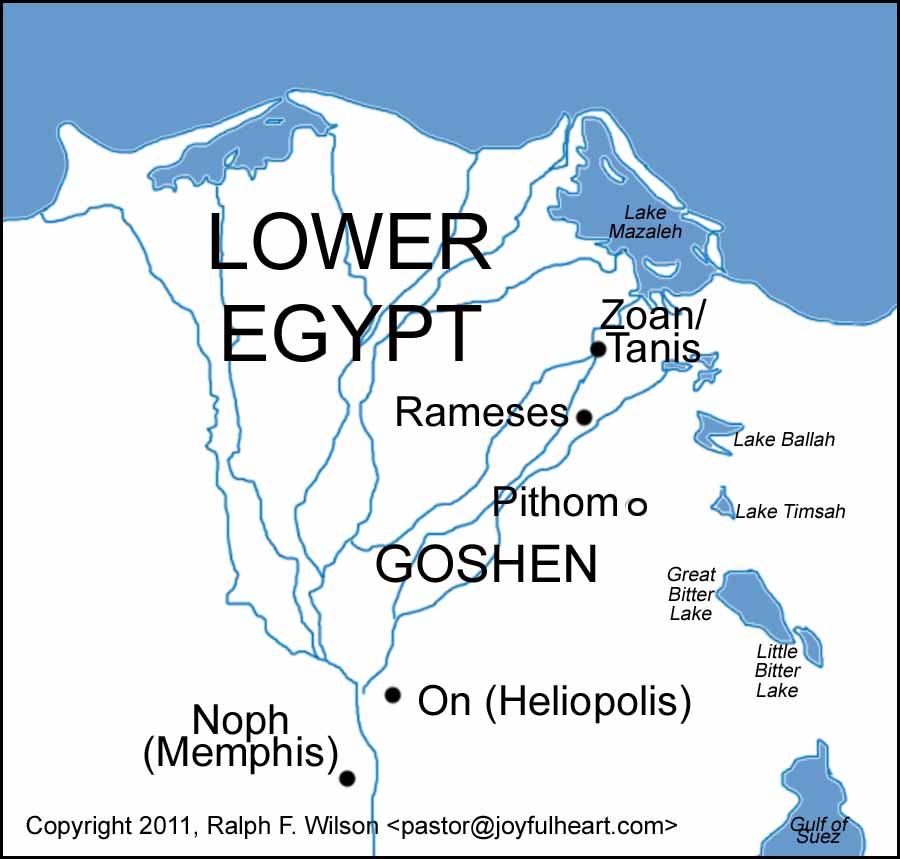
“Hurry and go up to my father and say to him: Thus said your son Joseph:  God placed me as master of all Egypt.  Come down to me, don’t stand still.  And you shall dwell in the land of Goshen, and you shall be near me, you and your children and the children of your children, and your flocks and your herds and everything that is yours.  And I will provide for you there …” (Genesis 45:9-11)

Although Joseph starts off attributing everything to God, he ends up promising that he, Joseph, will be a father-figure to his own family, as well as to the pharaoh.  He is in charge.3  And he wants his actual father, Jacob, to be impressed by his long-lost son’s power.

“And you must tell my father about all my honor in Egypt, and all that you have seen.  And you must hurry and bring my father down here.”  (Genesis 45:13)
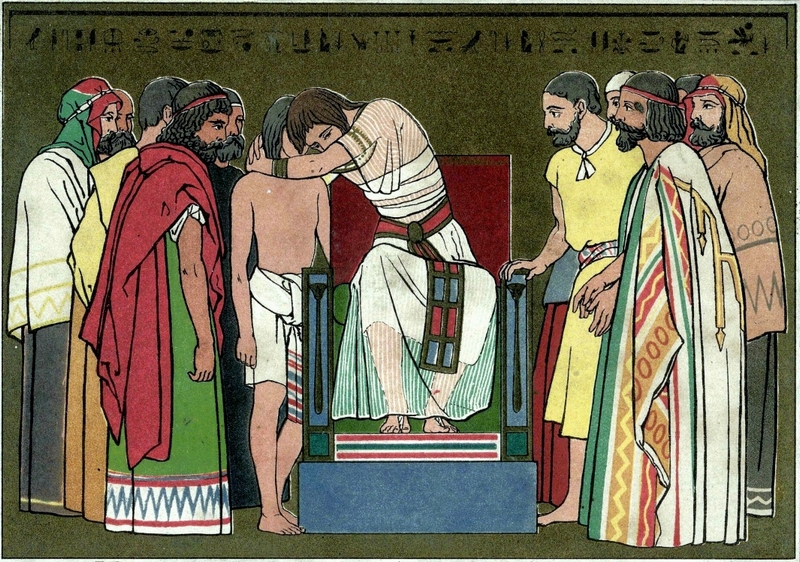
Joseph Embraces Benjamin,
by Owen Jones, 1869

Having reduced his brothers to mere dependents, Joseph embraces Benjamin and weeps.  Benjamin hugs him back, also weeping.

Then he kissed all his brothers and he wept upon them, and after that his brothers spoke to him.  (Genesis 45:15)

Maybe now his older brothers can “speak to him in peace” because they no longer hate him.  Or maybe their hatred has been replaced by fear.  Benjamin, who was six years old and at home when the older brothers sold Joseph, can embrace his long-lost brother.  But the ten older men merely speak; they neither cry, nor kiss Joseph, nor embrace him.

By denying that his brothers made a choice to sell him into slavery, Joseph shows that he does not respect them as adult human beings who are responsible for their own actions.  Personally, I would rather admit a crime and apologize for it, than be silenced because my victim insists I had no freedom of choice.

As far as Joseph is concerned, he has absolved his older brothers of guilt and reconciled with him.  But his brothers do not see it that way.  Joseph’s speech allays their fear of retribution for a while, but it does not resolve their guilt.

Vayiggash: Does Joseph forgive his father?

Joseph sends his brothers back to Canaan with gifts, and his whole extended family moves to Egypt to live under Joseph’s protection.
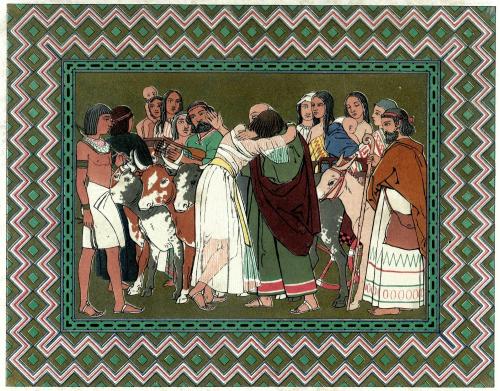
Joseph and Jacob Reunited,
by Owen Jones 1869

Joseph hitched up his chariot and went up to Goshen to meet Israel [a.k.a. Jacob], his father.  And he [Joseph] appeared to him, and he fell upon his neck, and he wept upon his neck a while.  Then Israel said to Joseph: “I can die now, after seeing your face, [knowing] that you are still alive.”  (Genesis 46:29-30)

Like many parents, Jacob does not know that he failed his son, so he does not apologize.  Joseph could bring up what his father did 22 years before, and hope for an apology.  (See my post Miketiz: Forgetting a Father.)  Instead he treats Jacob the same way he treated the innocent Benjamin.  There is no apology and no forgiveness; both father and son act as if their relationship is just fine.

This may be pragmatism on Joseph’s part.  After all, Joseph has all the authority now, and he knows Jacob is not an insightful person.  Why stir up old trouble?

Or Joseph may be thinking that if his father had not played favorites, then sent him alone into danger, he would never have been sold to the caravan headed for Egypt.  Therefore God must have arranged Jacob’s behavior, too.

Vayechi: Does Joseph forgive his brothers after Jacob’s death?

Jacob dies in this week’s Torah portion, Vayechi (“and he lived”).  Then his ten older sons become afraid that Joseph only restrained himself from executing them so as not to upset Jacob.  In desperation, they invent a deathbed command.

And the brothers of Joseph saw that their father was dead, and they said: “What if Joseph bears a grudge against us and he indeed pays us back for all the evil that we rendered to him?”  And they sent an order to Joseph saying: “Your father gave an order before he died, saying: Thus you shall say to Joseph: Please sa, please, the offense of your brothers and their guilt because of the evil they rendered to you. And now sa, please, the offense of the servants of the god of your father.”  And Joseph wept over the words to him.  (Genesis 50:15-17)

sa (שָׂא) = lift!  (A form of the verb nasa.)

This communication proves that Joseph’s brothers did not feel pardoned or forgiven when he first told them that God arranged everything, including their crime.

And they do not feel safe with Joseph.  Why should they?  According to Joseph’s philosophy, anyone might become a puppet in God’s hands, deprived of free will.  In such a universe, no one can be trusted.

On the other hand, if Joseph is wrong and humans do have a measure of free will, they still cannot trust Joseph.
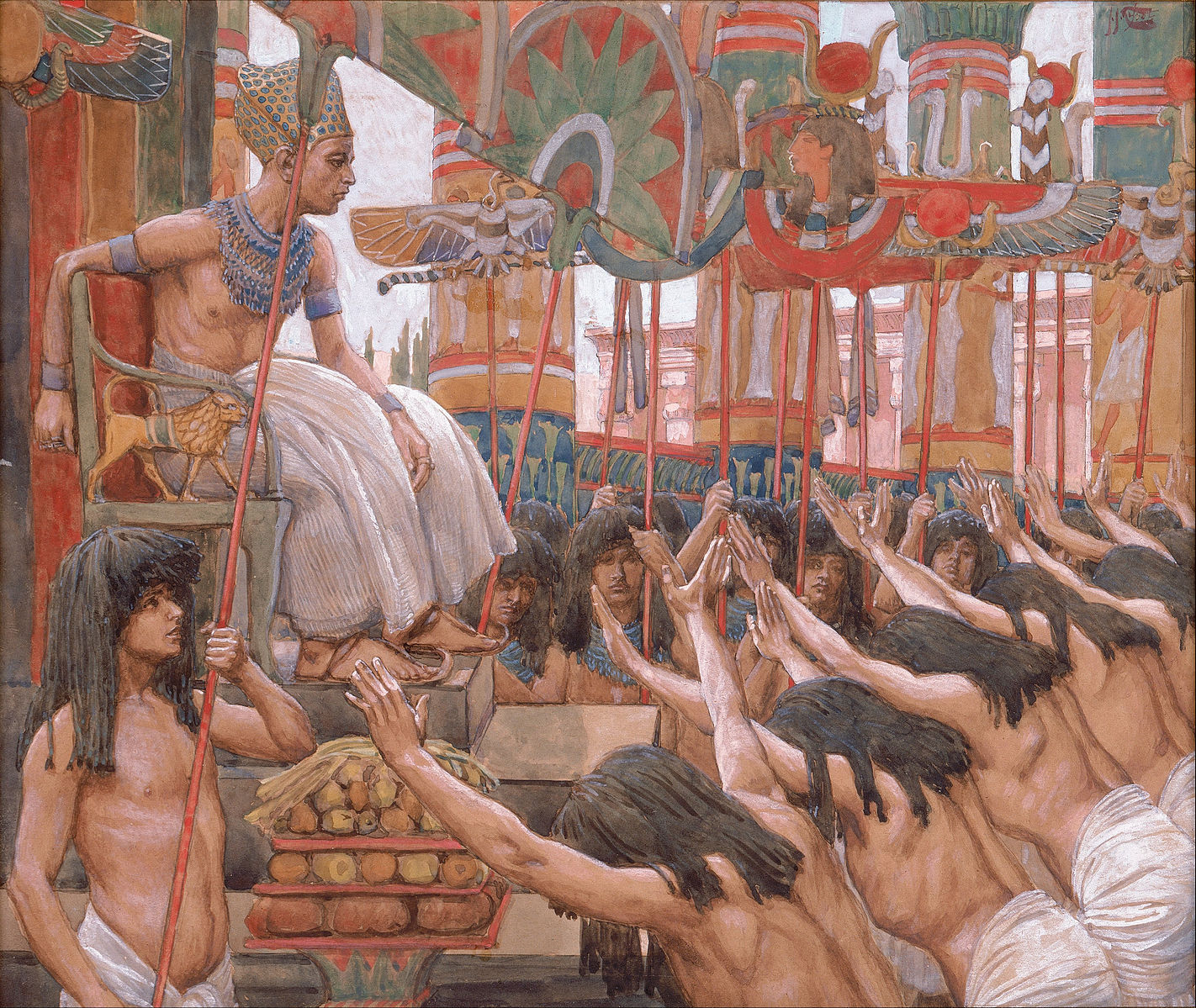
by James Tissot, ca. 1900

Then his brothers even went and threw themselves down before him, and they said: “Here we are, your slaves.”  And Joseph said to them: “Don’t be afraid!  Am I instead of God?4 And you, you planned evil for me, but God planned it for good, in order to bring about this time of keeping many people alive.”  (Genesis 50:18-20)

Joseph implies that only God can decide whether to punish the brothers.  He also continues to make God responsible for his brothers’ crime.  And although their false deathbed order explicitly begs Joseph to pardon—sa!—his brothers, he does not do so.  Instead he says:

“And now, don’t be afraid; I, myself, will provide for you and your little ones.”  And he comforted them and he spoke upon their hearts.  (Genesis 50:21)

In the Torah, to speak upon someone’s heart is an idiom for changing that person’s feelings.  (See my post Vayishlach: Change of Heart, Part 1.)  Joseph both comforts his brothers and persuades them that he will continue to be responsible for their well-being.  Even without a pardon, they finally trust Joseph.

Forgiveness or pardon is not the only road to reconciliation.


It’s a tall order, but I try to do better than Joseph.  When people offer me apologies, explicitly or implicitly, I remember Joseph, and I am careful to accept them.  Instead of saying merely, “It’s okay,” I say: “It’s okay, I forgive you.”  I do not want anyone to suffer lingering guilt or uncertainty on my account.

On the other hand, if people wrong me or those I love, and they never admit it nor apologize, I struggle to forgive them.  Sometimes I can reach a working relationship with them, but I never feel safe.  Any reconciliation is incomplete.

May we all be blessed with a greater ability to be responsible for our own actions, to apologize, to forgive, and to change.


  1. Genesis 41:1-41.
  2. Genesis 37:4.
  3. Although Joseph is indeed second only to the pharaoh in power, he is not the absolute ruler he claims to be when he is bragging to his brothers. Later he has to ask the pharaoh for authorization for his family to settle in Goshen (Genesis 46:31-34) and for permission to leave Egypt to bury his father (Genesis 50:4-6).
  4. Jacob protested “Am I instead of God?” when Rachel, his second wife, has not become pregnant and she demands that Jacob give her children (Genesis 30:2, Vayeitzei).
Haftarat Vayechi—1 Kings: Last Words

Every week of the year has its own Torah portion (a reading from the first five books of the Bible) and its own haftarah (an accompanying reading from the books of the prophets) in the Jewish tradition. This week’s Torah portion is Vayechi (Genesis 47:28-50:26), and the haftarah is 1 Kings 2:1-12.
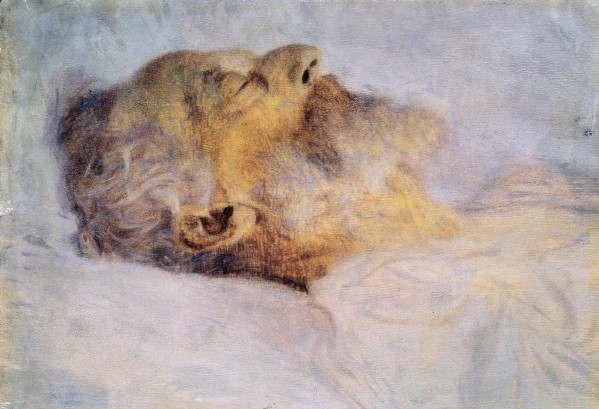
Old Man on his Deathbed, by Gustav Klimt
by Gustav Klimt

Sometimes a deathbed scene is silent; the dying person is unable to speak, or cannot even recognize the one waiting and hoping for a goodbye. But sometimes there are last words. These words might express acknowledgement, affection, even appreciation. Or the dying person might complain, give advice, or issue an order.

Giving a deathbed blessing is different from extracting a deathbed promise.

The Hebrew Bible offers two complete deathbed scenes: Jacob’s speeches to his twelve sons in this week’s Torah portion, and David’s final words to his son Solomon in this week’s haftarah.

Jacob

The Torah portion Vayechi offers three stories of the death of Jacob (also called “Israel”). In the first, Jacob gives an extremely polite order.

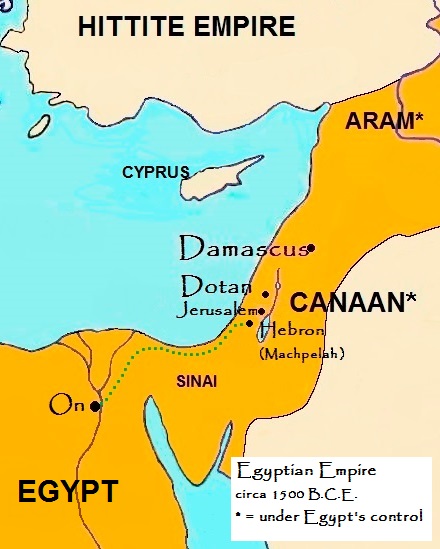
Route of Jacob's funeral cortege
Route of Jacob’s funeral cortege

And the time came close for Israel to die, and he summoned his son Joseph, and he said to him: “If, please, I have found favor in your eyes, please place your hand under my thigh and do with me chesed and fidelity: please do not bury me in Egypt. When I lie down with my fathers, then take me out of Egypt and bury me in their burial place.” And he [Joseph] said: “I myself will do as you have spoken”. And he [Jacob] said: “Swear to me!” And he swore to him. And Israel bowed down at the head of the bed. (Genesis 47:29-31)

chesed (חֶסֶד) = expected kindness; kindness out of loyalty to a family member or treaty partner.

In Egypt, Joseph is the pharaoh’s viceroy, and his father Jacob is only a guest. Although Jacob uses subservient language, he still reminds Joseph that he owes his father loyalty. Then he extracts a deathbed promise from Joseph: to bury him in Canaan, in the cave of Machpelah where Jacob’s parents and grandparents are buried.

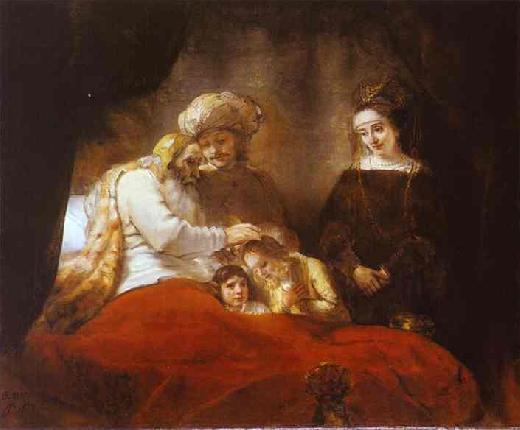
Jacob Blessing the Sons of Joseph, by Rembrandt

And it happened after these things, someone said to Joseph: “Hey! Your father is weakening.” So he took his two sons with him, Menasheh and Efrayim. And Jacob was told: “Hey! Your son Joseph has come to you.” And Israel mustered his strength and sat up on the bed. (Genesis 48:1-2)

In this second story, Jacob adopts Joseph’s two sons, giving them each a share of his estate. He kisses them, then blesses Joseph and his sons: the ultimate expression of acknowledgement and appreciation.

But Jacob has eleven other sons, and he addresses all twelve sons in a third deathbed story.

And Jacob summoned his sons, and he said: “Gather and I will tell you what will meet you in the end of days.” (Genesis 49:1)

Jacob delivers a long poem with a prophecy about the tribe that will descend from each of his sons. Only one remark is unmistakably about the son himself: a complaint about Reuben.

For when you climbed up on the lying-down place of your father

That was when you profaned it. My couch he climbed!  (Genesis 49:4)

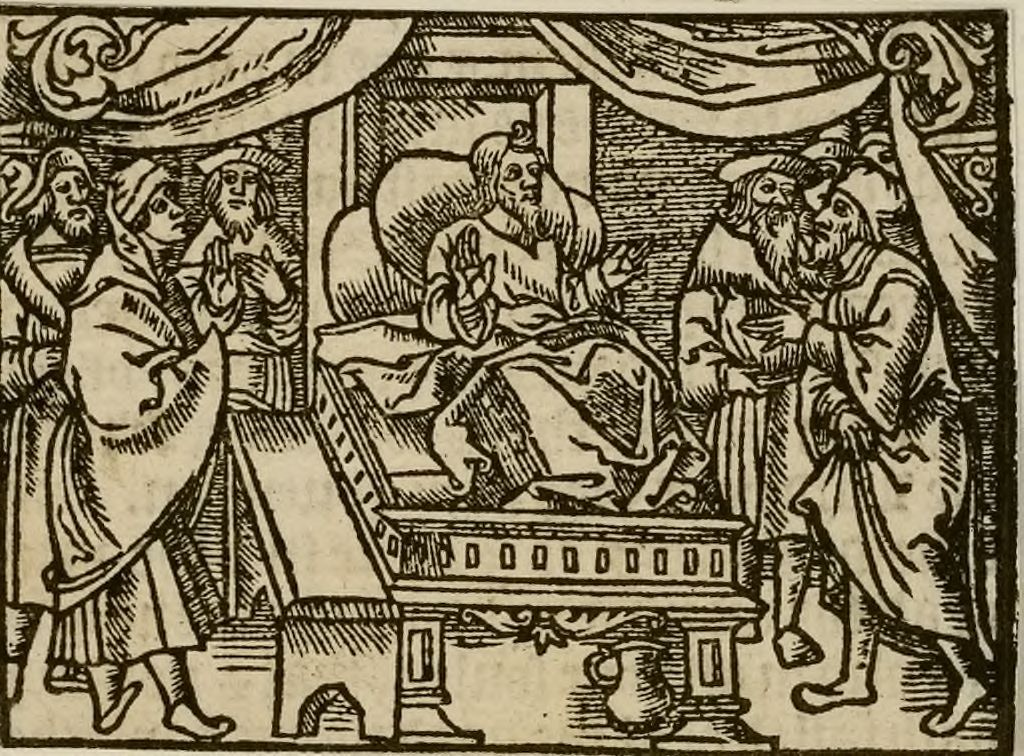
Jacob on his Deathbed, 1539 woodcut

Jacob still holds a grudge against Reuben for having intercourse with Jacob’s concubine Bilhah some 40 years earlier1. At the conclusion of the poem, a sentence that scholars attribute to a later redactor of the Hebrew Bible credits Jacob with blessing all his sons.

All these are the tribes of Israel, twelve, and this is what their father spoke to them. And he blessed them, each one according to his blessing he blessed them. (Genesis 49:28)

Finally Jacob returns to the subject most on his mind.

Vayetzav them, and he said to them: “I am being gathered to my people. Bury me with my fathers, in the cave … And Jacob finished letzavotwith his sons, and he gathered his feet into the bed, and he expired, and he was gathered to his people. (Genesis 49:29, 49:33)

Vayetzav (וַיְצַו) = And he commanded, and he ordered. (From the root verb tzivah (צִוָּה)= commanded.)

letzavot  (לְצַוֺּת) = Commanding, giving orders. (Also from the root verb tzivah.)

In his three deathbed speeches, Jacob expresses acknowledgement and appreciation of his twelve sons (and two of his grandsons) by blessing them. He complains about Reuben. He gives prophecies rather than advice. And he repeats his orders about where he must be buried, but he has no other final requests.

David

And David came close to the time of death, vayetzav his son Solomon, saying: I am going according to the way of all the earth. And you must be strong and you must be an adult. (1 Kings 2:1-2)

David’s first command or order to Solomon sounds more like advice. Now that his young son has become the king of Israel, he must behave like a strong adult.

david-on-deathbed

Next come two sentences in a different linguistic style, using synonyms in multiple phrases. Modern scholar Robert Alter has argued that these verses were added later by the editor of Deuteronomy, in order to improve David’s reputation.

And you must guard the custody of God, your god, to walk according to Its ways, to guard Its decrees, Its commandments, and Its rules, and Its admonitions, as written in the Teaching of Moses, so that you shall act with insight in everything that you do and everywhere you turn. So that God will establish Its word that It spoke concerning me, saying: if your descendants guard the way they take before Me faithfully, with all their heart and with all their soul—saying: yours will not be cut off from upon the throne of Israel. (1 Kings 2:3-4)

David reminds Solomon that as king, he must be a guardian of the religion of Israel, and base his own royal decisions on its rules. Then he gives the reason for his pious advice: so that his descendants to rule as kings of Israel forever.

The language of David’s deathbed speech reverts to a simpler style as he remembers the worst part of his life, when his beloved older son Absalom staged a coup and took over Jerusalem. Now he broods about unfinished business from those days.

He tells his son Solomon:

And furthermore, you know what Joab son of Tzeruyah did to me, what he did to two commanders of armies of Israel, to Avneir son of Neir and to Amasa son of Yeter: he killed them and he shed the blood of war beshalom(1 Kings 2:5)

beshalom  (בְּשָׁלֺם) = in peace, in peacetime.

David became the king of all Israel through a treaty with his opponent’s general, Avneir. Then David’s general, Joab, assassinated Avneir.2

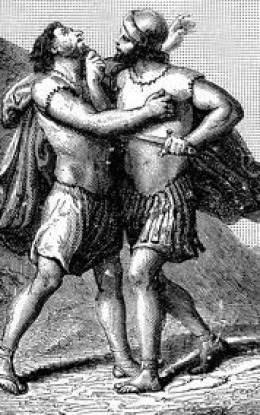
Joab kills Amasa
Joab kills Amasa

About 20 years later, Absalom usurped his father’s throne. David fled with his supporters, including Joab. When David’s army defeated Absalom’s, Joab quickly killed Absalom despite David’s order to the contrary.3 After David was reinstalled as king, he pardoned Absalom’s general, Amasa, but this did not stop Joab from murdering him under the cover of a friendly embrace.4 David did not dare punish Joab for either killing.

And so you must act in accordance with your wisdom, and you must not let his gray hair go down beshalom to Sheol. (1 Kings 2:6)

Even as David criticizes Joab for killing two generals in times of peace, he orders Solomon to kill Joab in peacetimeand make sure he does not die peacefully.

But with the sons of Barzillai of the Gilead, you shall do chesed. And they must eat at your table, because they came close to me when I fled from Absalom, your brother. (1 Kings 2:7)

While Absalom controlled Jerusalem, Barzillai had fed David and his men in exile at Machanayim. When David returned to the capital, he promised to reward Barzillai and provide for his son.5 Now David orders his son Solomon to honor that promise.

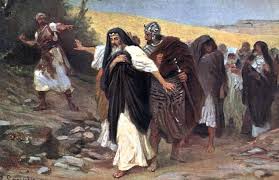
Shimi throws stones at David

Then he issues a third command. When David fled from Jerusalem, Shimi son of Geira hurled stones and insults at him on the road.6 When he returned in triumph, Shimi apologized for his wrongdoing, accompanied by a thousand Benjaminites who offered to serve King David. David had little choice but to accept the apology and swear not to execute him.7 But David still resents Shimi.

So you must not leave him unpunished, because you are a wise man, and you know what you will do to him and send down his gray hair in blood to Sheol. (1 Kings 2:9)

That is the last thing David says before he dies. Once again, he compliments his son for being wise enough to figure out how to carry out his father’s revenge, but does not trust him to make his own decision.

And David slept with his fathers, and he was buried in the City of David. (1 Kings 2:10)

His acknowledgement of Solomon’s wisdom is overshadowed by his demands that Solomon carry out his orders, including finding pretexts to execute two powerful men. Is David so self-centered that his only concern on his deathbed is making his successor promise to avenge him?  Or is David urging Solomon to get rid of Joab and Shimi before they make Solomon suffer, too?

Either way, David’s death is not peaceful. He expresses appreciation for Solomon’s wisdom only in order to assure him he can carry out his father’s commands.  He complains bitterly about Joab and Shimi. He gives Solomon advice about following his religion, but he also issues commands about killing Joab, rewarding Barzillai, and killing Shimi. His last thoughts are about murder and revenge.

Although Jacob is self-centered earlier in his life, on his deathbed he has a broader view than David.  His only command concerns his own burial. He is affectionate with one of his sons, Joseph, and two grandsons. He blesses them, and gives prophecies and blessings to his other sons, despite his complaint about Reuben. Jacob dies with dignity, passing on more blessings than obligations to the next generation.


I pray that my own last words (many years from now, God willing!) will be only blessings. And in case I am not granted a deathbed scene in which I can speak to those I am leaving, I am resolved to express acknowledgement and appreciation every day, and avoid complaining about people and giving excessive advice. May the Holy One grant me the strength!


1 Genesis 35:22.

2 After the death of King Saul, David took control of Judah and Saul’s son Ish-Boshet took over the Israelite lands to the north. For two years they fought for the kingship of all Israel, until Ish-Boshet’s general, Avneir, persuaded him to let David be the king. Avneir made a treaty with David, but afterward Joab tracked him down and assassinated him. David cursed Joab, but did not dare demote him. (2 Samuel 3:6-34)

Later, King David got Bathsheba pregnant, and used General Joab to get rid of her husband Uriah. (2 Samuel 11:1-21)  After that, the already powerful Joab was ungovernable.

3 2 Samuel 18:5-17.

4 After Joab kills Absalom, David sends a message to Absalom’s general, Amasa. “And to Amasa you shall say: Aren’t you my own bone and flesh? May God do this and more to me if you do not become my army commander for all time instead of Joab! (2 Samuel 19:14) David succeeds in recruiting Amasa as one of his own commanders, but his attempt to replace Joab fails; when they are chasing down a band of rebels, Joab tricks Amasa by reaching to kiss him with one hand and knifing him with the other (2 Samuel 20:8-13).

5  2 Samuel 19:32-39.

6  2 Samuel 16:5-8.

7  2 Samuel 19:17-24.  When David became bedridden and his older son Adoniyah made a bid for the kingship, Shimi joined Solomon’s faction (1 Kings 1:8).

Vayeitzei & Vayechi: No Substitute

by Melissa Carpenter, maggidah

Am I tachat God? (Genesis/Bereshit 50:19)

tachat (תַּחַת) = underneath, under the authority of; instead of, a substitute for, in exchange for.

Only two people in the Hebrew Bible ask this question. Jacob says it to his favorite wife, Rachel, in the Torah portion Vayeitzei (“and he went”). Almost 60 years later, their son Joseph says it to his brothers in this week’s Torah portion, Vayechi (“and he lived”).

Jacob instead of God

from "Jacob and Rachel" by William Dyce
from “Jacob and Rachel” by William Dyce

Jacob throws the question at Rachel right after she has spoken for the first time in the Torah, more than ten years after Jacob first meets her and kisses her. Their romance is not smooth. Jacob serves her father Lavan for seven years as Rachel’s bride-price, and then on his wedding day, Lavan tricks him and marries him to Rachel’s sister Leah. Jacob’s wedding with Rachel follows a week later, once he commits to working an additional seven years. Leah has four sons before Rachel speaks up.

And Rachel saw that she had not borne children to Jacob, and she was envious of her sister. And she said to Jacob: “Give me children!—and if not, I am dead.” Then Jacob was angry with Rachel, and he said: “Am I tachat God, who withheld from you fruit of the womb?” (Genesis 30:1-2)

Rachel’s demand makes Jacob angry for more than one reason. When she says that without children, she is dead, Rachel implies that Jacob’s devotion is not enough to make her life worthwhile. Naturally Jacob’s anger flashes. And it is not his fault that Rachel is infertile. So he demands: Am I tachat God?

He cannot be a substitute for God. In the Hebrew bible, only God can “open the womb” of a woman, resulting in pregnancy.

It does not occur to Jacob to pray to God, as his father Isaac prayed for his mother Rebecca to conceive. But his rebuff does lead Rachel to take her own action. She gives her slave-woman, Bilhah, to Jacob as a wife, then adopts Bilhah’s two sons as her own.

Through this human solution, Jacob actually does give Rachel children, tachat—instead of—God.

Joseph instead of God

After Rachel has two adopted sons, God finally opens her womb, and she gives birth to Joseph. The family continues to be dysfunctional; Joseph’s ten older brothers hate him and sell him as a slave bound for Egypt. When they are reunited twenty years later, Joseph tells them not to worry about their past crime, because God planned it all in order to get him to Egypt and elevate him to viceroy so he could feed everyone during the seven-year famine. The whole clan, including the patriarch Jacob, Joseph’s brothers, and their families, immigrate to Egypt under Joseph’s protection.

But after Jacob dies, we learn that Joseph’s brothers are still worried about retribution. Like Rachel, they see a problem.

And Joseph’s brothers saw that their father was dead, and they said: “If Joseph bears a grudge against us, then he will certainly pay us back for all the evil that we did to him!” (Genesis 50:15)

They assume that their father’s words would carry more weight with Joseph than their own, and they send Joseph what they claim is a deathbed request from Jacob:

Please sa, please, the crime and the offense of your brothers, when they did evil to you; now sa, please, the crime of the servants of your father’s god.” (Genesis 50:17)

sa (שָׂא) = lift up. (To lift up a man’s head was to legally pardon him.)

And Joseph sobbed when they spoke to him. (Genesis 50:17)

Unlike Jacob, Joseph is not angry before he asks “Am I tachat God?” Instead, his brothers’ clumsy and obsequious request makes him cry. Perhaps he cries because his brothers cannot speak to him directly. Or perhaps he cries in frustration, because he thought everything was settled, and now he has to deal with the issue all over again.

And his brothers also went and flung themselves down in front of him, and they said: “Here we are, your slaves.” (Genesis 50:17-18)

Joseph’s Brothers Bow Down, by Owen Jones, 1865

Nothing has changed in the seventeen years since Joseph revealed his identity to his brothers. His older brothers still feel guilty. Joseph is sobbing again.  His brothers bow down to him again, and offer to be his slaves again. (See my  post Vayiggash: A Serial Sobber.)

And Joseph said to them: “Do not be afraid. For am I tachat God? While you planned evil against me, God planned it for good, in order to accomplish what is today, keeping many people alive.” (Genesis 50:19-20)

Joseph said something similar seventeen years before:

And now, do not be worried and do not be angry at yourselves because you sold me here; because God sent me ahead of you for preservation of life.” (Genesis 45:5)

Contemporary commentator Avivah Gottlieb Zornberg made the case that the first time Joseph tells his brothers their crime is part of God’s plan, he is suddenly seeing the big picture. His enslavement was a necessary step to reach his present position as the viceroy, enabling him to save his own family and many other people from starvation. Joseph drops his own resentment against his brothers, and he hopes that sharing his vision of big picture will let his brothers drop their guilt.

But years later, when their father dies, Joseph finds out that his brothers still feel guilty. And he still does not realize that what they need is forgiveness, or at least a pardon. (See my  post Vayiggash & Vayechi: Forgiving.) Instead, he once again declares that their evil deed turned out to be part of God’s plan. Joseph continues:

And now, do not be afraid; I myself will sustain you and your little ones. And he comforted them, and he spoke to their hearts. (Genesis 50:21)

Joseph’s brothers are comforted because his promise to sustain them—to keep them alive and well—implies that he no longer hates or resents them. Even though they do not get the relief of explicit forgiveness, they know that at least they do not need to worry about future retribution from their powerful brother.

Targum Onkelos, written around 100 C.E., translated Joseph’s statement “For am I tachat God?” as: “For I am subordinate to God”. In other words, this time tachat means “under” instead of “a substitute for”. In the 16th century, Rabbi Ovadiah Sforno took this interpretation further by explaining that Joseph considered his brothers God’s agents. It was not his place to judge God’s agents, just as it was not his place to judge God’s plans.

Nevertheless, Joseph acts almost like a substitute for God. As viceroy of Egypt and distributor of food, he decides who will live and who will die.

A substitution when there is no substitute

When Jacob tells Rachel he is no substitute for God as an opener of wombs, she finds another way he can give her the children she wants.  When Joseph tells his brothers he is no substitute for God as a judge of men, they do not find another way to get the human pardon or forgiveness they want.  They still cannot speak to Joseph directly. But he offers them a substitute for forgiveness: the reassurance that he will not punish them.


Am I tachat God?” is a good question for us to ask ourselves today. Am I trying to do something no human can do? If so, is there another way to achieve a desirable outcome? Or am I acting like God when I should be acting like a human being toward someone? If so, how can I come down off my pedestal and have a true heart-to-heart conversation?