Vayechi & 1 Kings: Last Will and Testament

The patriarch Yaakov (“Jacob” in English), also called Yisrael (“Israel”), dies in this week’s Torah portion, Vayechi (Genesis 47:28-50:26). King David dies in this week’s haftarah (reading from the Prophets), which is 1 Kings 2:1-12. Both dying men tell their heirs what to do after they have expired. But their instructions are about different kinds of unfinished business.

Choosing an executor
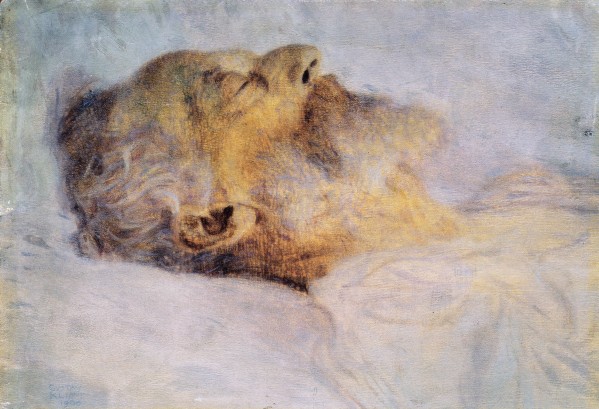
Old Man on his Deathbed, by Gustav Klimt, 1900

And the time drew near for Yisrael to die. And he called for his son Yoseif, and said to him— (Genesis 47:29)

Yoseif (“Joseph”) is Yaakov’s beloved eleventh son. Although normally a man’s oldest son inherits more of his estate, and responsibility for his family, Yoseif is the viceroy of Egypt and already takes care of his whole extended family, including his father. So Yaakov calls for Yoseif when he is approaching death.

And the time drew near for David to die. And he commanded his son Shlomoh, saying— (1 Kings 2:1)

Shlomoh (“Solomon” in English) is King David’s tenth son. While David is lying feebly in bed, his fourth son, Adoniyahu, gets himself anointed and proclaimed king without his father’s knowledge. (David’s oldest son, Amon, is already dead.) Batsheva (“Bathsheba”), David’s favored wife, and Natan, David’s prophet, rush into action. They get David to protest that his heir is Batsheva’s son Shlomoh, then get Shlomoh anointed and proclaimed king that same day. Adoniyahu’s supporters abandon him, and Shlomoh becomes king. (1 Kings 1:5-53) So David calls for Shlomoh when he is close to death.

Both Yaakov and David are practical in their choice of executor of their last wishes, choosing the son whom they trust and who has the most power to act.

Directions for burial

Yaakov’s first instruction to his son Yoseif is about his burial.

“If, please, I have found favor in your eyes, please place your hand under my thigh. And do with me loyal-kindness and faithfulness: do not, please, bury me in Egypt! [When] I lie down with my fathers, then carry me out of Egypt and bury me in their burial site!” (Genesis 47:29-30)

Yaakov’s deference to Yoseif shows that he knows he no longer has authority. Rabbi Chayim ibn Attar added: “Had he not said ‘please,’ it might have sounded as if he had not been grateful for the sustenance Joseph had provided thus far.”1

The request that Yoseif put a hand under his thigh (the most sacred way to swear an oath in the book of Genesis)2 shows Yaakov’s determination to be buried in Canaan.
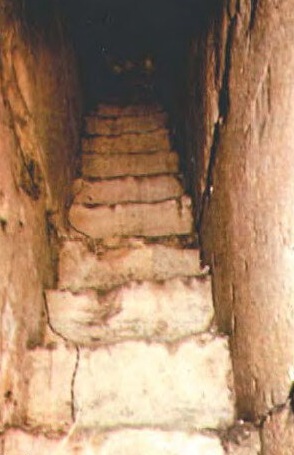
Stairs inside the caves of Makhpelah

Lying down with one’s fathers and being gathered to one’s fathers are idioms for dying; in ancient Israel, family members were buried in the same cave for generations. Yaakov wants to be buried in “their burial site”—the cave of Makhpelah near Hebron.

Then he [Yoseif] said: “I myself will do according to your words”. But he [Yaakov] said: “Swear to me!” And he swore to him. Then Yisrael bowed, at the head of the bed. (Genesis 47:30-31) 

The oath does turn out to be useful. When Yoseif asks Pharaoh permission for himself and his brothers to take Yaakov’s body to Canaan, he says: “My father made me swear …” and Pharaoh answers: “Go up and bury your father, as he had you swear.” (Genesis 50:5-6)

Why does Yaakov care about where he is buried? Rashi summarized a Talmudic-era midrash:

“Because its [Egypt’s] soil will ultimately become lice which would swarm beneath my body. Further, those who die outside the Land of Israel will not live again at the Resurrection except after the pain caused by the body rolling through underground-passages until it reaches the Holy Land. And another reason is that the Egyptians should not make me (my corpse or my tomb) the object of idolatrous worship.”3

S.R. Hirsch added a psychological reason: that after seventeen years in Egypt, Yaakov noticed that his whole family had come to think of Egypt as home. “It was sufficient reason for him to say to them: ‘You may hope and wish to live in Egypt, but I do not even want to be buried there.’”4

And Karen Armstrong pointed out that Yaakov wanted to continue the precedent set by his grandfather Avraham, who bought the burial cave—the first bit of land in Canaan owned by the family. Avraham and Sarah are buried there, along with Yaakov’s father Yitzchak (“Isaac”) and mother Rivkah (“Rebecca”), and his own first wife, Leah.

“Finally, Jacob gave instructions that he be buried not beside the beloved Rachel in Bethlehem but beside Leah in the family tomb at Hebron.  For once, he did not allow himself to give in to his own inclinations but fulfilled his official patriarchal duty.”5

King David, however, gives his son Shlomoh no instructions regarding his burial—perhaps because he assumes his son will bury him in Jerusalem, where they both live. And King Shlomoh does.

Yaakov’s instructions for his estate

Yaakov’s health declines further, and Yoseif brings his two sons to receive a final blessing from their grandfather.

Then Yisrael gathered his strength and he sat up in the bed. (Genesis 48:2)

He tells Yoseif that back in Canaan, God appeared to him and told him:

“Here I am, making you fruitful and numerous, and I will appoint you as a congregation of peoples, and I will give this land to your descendants after you, as a possession forever!”(Genesis 48:4)

Yaakov now considers the promise of Canaan his estate, and he wants a say in how his descendants will divide up the land. So he tells Yoseif:

“And now your two sons, the ones born to you in the land of Egypt before I came to you in Egypt, they are mine; Efrayim and Menasheh, they will be mine like Reuven and Shimon!” (Genesis 48:5)

Reuven and Shimon (“Simeon” in English) are Yaakov’s first and second-born sons. In effect, adopting Efrayim and Menasheh gives Yoseif the double inheritance of the firstborn.  Instead of getting one share, as Yoseif, he will get two shares, in the name of his two sons.

Yaakov starts talking about the death of Yoseif’s mother, Rachel, then notices the two people standing next to Yoseif. At this point, he is nearly blind.

And Yisrael saw Yosef’s sons, and he said: “Who are these?” And Yoseif said to his father: “They are my sons, whom God has given me here.” Then he said: “Please bring them to me, and I will bless them.” (Genesis 48:9)

Yaakov kisses and embraces his grandsons, overcome with emotion.

Then Yoseif took them away from his knees, and they bowed down, their noses to the ground. (Genesis 48:11)

In the Hebrew Bible, placing a newborn infant on one’s knees signifies an adoption.6 Although Yoseif’s sons are young men now, having been born before their grandfather came to Egypt seventeen years before, the symbolism may be the same.

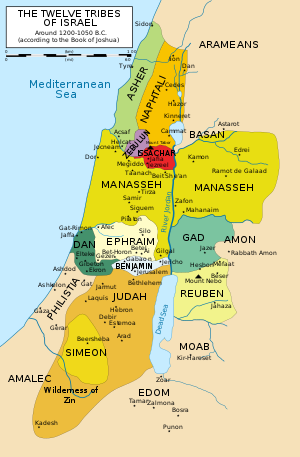
The scribe who wrote down this part of the Torah portion had another reason for reassigning Yoseif’s portion of Canaan to Efrayim and Menasheh. From circa 900 to 720 B.C.E., the two kingdoms of Israel consisted of the territories of twelve tribes: ten tribes in the northern kingdom of Israel (Efrayim, Menasheh, Reuven, Shimon, Gad, Dan, Yissachar, Zevulun, Asher, and Naftali) and two tribes in the southern kingdom of Judah (Yehudah and Binyamin). Some scribes connected these twelve tribes with the twelve sons of Yaakov/Yisrael. To make the numbers work out, they assigned two tribes (Efrayim and Menasheh) to Yaakov’s eleventh son, Yoseif, and excluded the tribe of Yaakov’s third son, Levi, from the count, since the Levites were scattered throughout the two kingdoms and did not have a territory of their own.

As the book of Genesis draws to a close, Yaakov wants his family to return to Canaan, though he does not issue an explicit order about when they should go. According to the book of Exodus, Yaakov’s descendants stay in Egypt for 430 years before they finally head north.7

David’s instructions for execution

Dividing up territory is not a problem in the story of King David’s death, since David’s estate is the whole kingdom of Israel, before it separated into two kingdoms. David’s chosen son, Shlomoh, has already been anointed as king, so he gets the entire estate. But David has more to say to his son the king.

And the time drew near for David to die. And he commanded his son Shlomoh, saying: “I am going the way of all the earth. And you must be strong, and be a man!”  (1 Kings 2:1-2)

When Yaakov gives his deathbed instructions to his son Yoseif, Yoseif is 57 years old and has been the viceroy of Egypt for 27 years. When David gives his deathbed instructions to his son Shlomoh, Shlomoh is about 20 years old and has barely begun his reign.
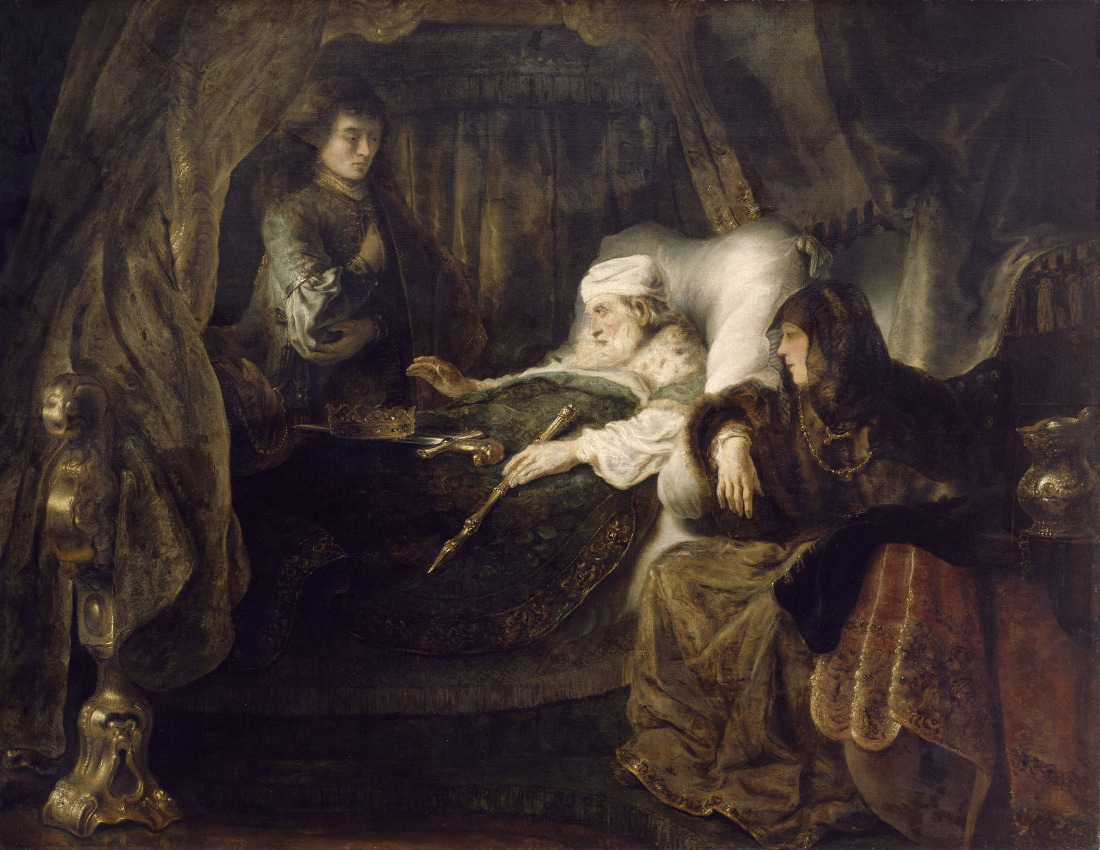
David’s Dying Charge to Solomon, by Ferdinand Bol, ca. 1700

After reminding his son that he must follow God with all his mind and soul, David moves on to his primary concern: some unfinished business from his own reign.

First he orders Shlomoh to punish Yoav (“Joab” in English), David’s nephew and the general of his army. Yoav stealthily murdered the general of northern Israel, Avneir (“Abner”), right after David and Avneir had concluded a peace treaty in which the northern territories would join David’s kingdom. (See my post 2 Samuel: David the King.) Yoav’s motivation was revenge for his brother’s death at Avneir’s hands on the battlefield. The usual punishment for revenge killing was execution. But King David neither executed nor demoted Yoav—perhaps because of family feeling, or perhaps because he feared that Yoav was becoming too powerful to oppose.

Later, King David’s third son, Avshalom (“Absalom”), usurped the throne. David took refuge in Machanayim and sent out troops, but he asked Yoav and his other two commanders not to kill Avshalom. However, when Avshalom was snagged by a tree, and Yoav killed him.8 That was the last straw for King David, who then gave Amasa Yoav’s post as a commander.9 The next time Yoav and Amasa met, Yoav grabbed Amasa’s beard with one hand, and with the other hand stabbed him in the belly.10 Again King David did not punish his dangerous nephew; he even let Yoav become his general.

Now David wants Shlomoh to deliver the punishment that he could not manage during his own lifetime.

“… you yourself know what Yoav son of Tzeruyah did to me … to Avneir son of Neir, and to Amasa son of Yeter: he murdered them! … And you must act according to your chokhmah, and you must not let his gray head go down in peace to Sheol!” (1 Kings 2:5-6)

chokhmah (חׇכְמָה) = wisdom, technical skill, aptitude, experience, good sense.

Sheol (שְׁאוֹל) = the silent underworld where every person goes at death.

Next he tells Shlomoh to keep rewarding the sons of Barzilai, who fed David’s men during the war with Avshalom.11 Finally, he brings up Shimi son of Gera, who cursed and threw rocks at King David when he was fleeing Jerusalem after Avshalom’s coup. When David returned, he promised Shimi that he would not execute him.12 Now he regrets that promise.

“And now you must not exempt him from punishment! …  you yourself know what you must do to him, and bring down his gray head in blood to Sheol!” Then David lay with his fathers, and he was buried in the City of David. (1 Kings 2:9-10)

David wants the execution of two men whom he had pardoned when he was king, and King Shlomoh does arrange their deaths—because he, too, does not trust Yoav, and because Shimi violated Shlomoh’s condition that he could live in peace as long as he did not leave Jerusalem.13


Today we still need to name an executor of our last will and testament. Like both Yaakov and David, many of us appoint one of our children, the one who has the most ability to carry out our wishes.

Few people today are in a position to leave a whole country as a bequest. But whatever we do leave is important to us: wealth to improve the lives of our heirs, heirlooms that have personal meaning to us, and sometimes instructions for more than our own burial.

We may believe that we can make sure everything happens the way we want it to after our deaths. But that is unrealistic. Our heirs will do as they think best, not as we think best.

At least Yaakov and David die knowing that their surviving children are doing well in life, and that the beloved children who will be their executors are successful and respected. So may it be for us today.


  1. Chayim ibn Attar, Or HaChayim, 18th century, translation in www.sefaria.org.
  2. See my post Vayechi, Chayei Sarah, & Vayishlach: A Touching Oath.
  3. Rashi (the acronym for 11th-century Rabbi Shlomoh Yitzchaki), summarizing Bereishit Rabbah 76:3, translation in www.sefaria.org.
  4. 19th-century rabbi Samson Raphael Hirsch, reprinted in The Hirsch Chumash: Sefer Bereshis, English translation by Daniel Haberman, Feldheim Publishers, Jerusalem, 2002, p. 846.
  5. Karen Armstrong, In the Beginning, Ballantine Books, New York, 1997, pp. 115-16.
  6. Genesis 30:3-6, Ruth 4:16-17.
  7. Exodus 12:40.
  8. 2 Samuel 18:14.
  9. 2 Samuel 19:4.
  10. 2 Samuel 20:9-10.
  11. Barzilai appears in 2 Samuel 17:27-29 and 19:32-41.
  12. Shimi appears in 2 Samuel 16:5-10 and 19:20-25.
  13. See 1 Kings 2:28-35 on Yoav, and 1 Kings 2:36-46 on Shimi.
Vayigash & Veyechi: Yoseif’s Theology, Part 2

Before we look at the new concept of God that Yoseif (“Joseph” in English) shares with his brothers in this week’s Torah portion, Vayigash (Genesis/Bereishit 44:18-47:27), let’s look at what the characters in the book of Genesis already believe about God’s ongoing involvement in the universe.1

  1. God controls the weather, including winds, floods, and storms of hail and sulfur, and wreaks destruction thereby (Genesis 6:13, 7:11, 8:1, 18:21, 19:24-15).
  2. God blesses some individuals with success and curses some with failure (Genesis 4:14, 4:17, 12:2-324:35, 24:56, 26:28-29).
  3. God punishes people for certain ethical violations, including: unwarranted murder (Genesis 4:23-24), gratuitous violence (Genesis 6:13), human bloodshed (Genesis 9:6), and raping guests (Genesis 19:4-15).
  4. God can inflict and heal disease (Genesis 12:17-18, 20:17-18).
  5. God shares the aversion in the Ancient Near East to a man committing adultery with a married woman (Genesis 12:18-19, 20:1-7). Yoseif assumes that adultery would be “a great wrong before God” in Genesis 39:7-9. (See my post Mikeitz & Vasyeishev: Yoseif’s Theology, Part 1.)
  6. God gives people significant dreams (Genesis 15:13-16, 20:3, 22:1-3, 26:24, 28:11-16, 31:24, 31:29, 31:42, 32:25-31). Yoseif goes further and claims that dream interpretations also come from God.2
  7. Only God can “open wombs”, giving childless women children (Genesis 17:16-21, 18:10-15, 21:1-2, 25:21, 29:31. 30:2. 30:22-23).
  8. Perhaps God can influence the course of history; God makes promises to Avraham, Yitzchak, and Yaakov that their descendants will someday own the land of Canaan (Genesis 12:7, 132:14-17, 15:7, 15:18-21, 17:8, 26:2-3, 28:13, 35:12), but Avraham doubts it will happen (Genesis 15:8 ), and the other two patriarchs are silent on the subject.
  9. Perhaps God can influence more immediate events; three characters pray to God for specific outcomes (Avraham’s steward in Genesis 23:12-19; Yitzchak (“Isaac”) in Genesis 25:21, 27:28-33, and 28:3-4; and Yaakov (“Jacob”) in Genesis 32:10-13).

Yoseif’s relationship with God

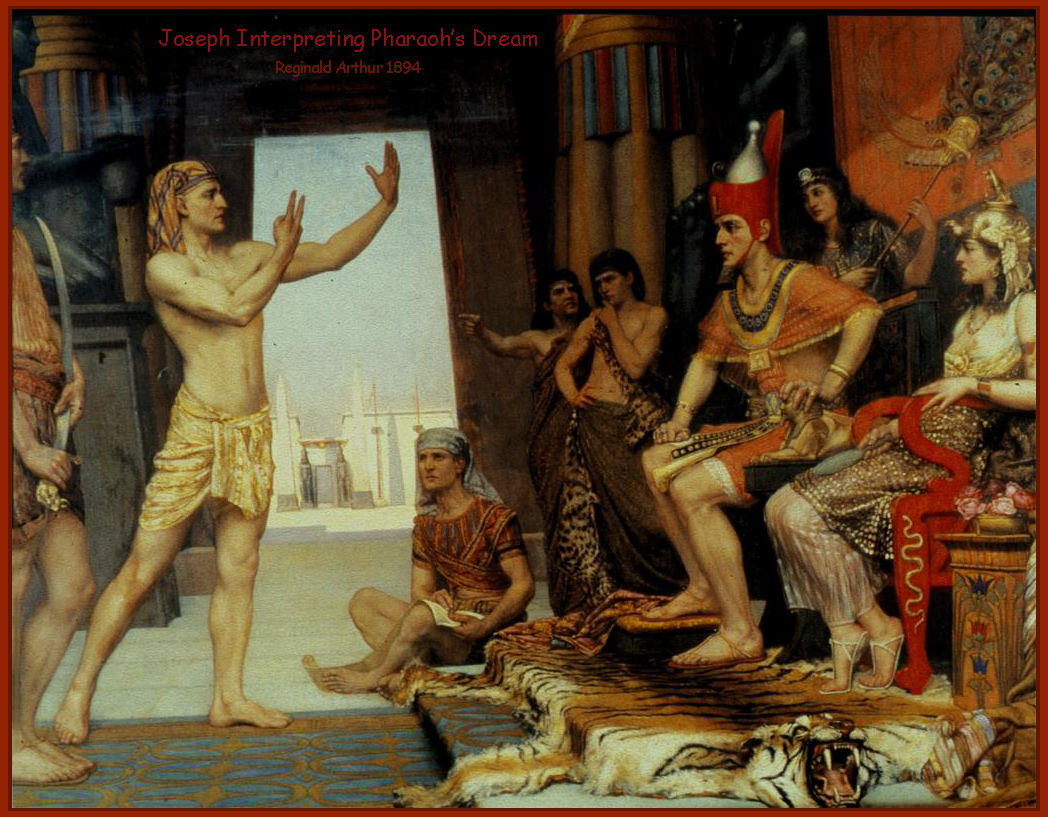
Joseph Interprets Pharaoh’s Dreams,
by Reginald Arthur, 1894

Although God addresses Yoseif in speech, he credits God with giving him the correct interpretations of four dreams: two dreams by imprisoned officials of Pharaoh and two dreams by Pharaoh himself.3 When Yoseif hears these dreams, the interpretation just occurs to him at once. (See my post Mikeitz & Vasyeishev: Yoseif’s Theology, Part 1.)

When he encounters a problem, such as the seven years of plenty followed by seven years of famine that Pharaoh’s dreams foretell, the solution also occurs to him at once—but he does not attribute his solutions to God. He tells Pharoah his solution for getting Egypt through the seven years of famine: appointing “a discerning and wise man” to stockpile grain nationwide during the seven years of plenty. Pharaoh announces:

“Could we find [another] like this man, who has the spirit of an elohim in him?” (Genesis 41:38)

Elohim (אֱלֹהִים) = gods, a god, God.

Although Yoseif has been quick to say that God, not he, interprets dreams, he is silent when Pharaoh says the spirit of God is in him. Pharaoh appoints Yoseif as the administrative head of all Egypt.

In the first year of famine, Yoseif’s ten older brothers come to Egypt to buy grain. They have not seen him since he was 17, when they threw him in a pit, considered killing him, then sold him as a slave to a caravan bound for Egypt.4 The brothers do not recognize the 38-year-old Egyptian nobleman in front of them, and Yoseif converses with them through an interpreter, pretending he does not know Hebrew.

On the spot, he invents an elaborate scheme for testing whether his older brothers have reformed, and for getting his innocent younger brother, Binyamin (“Benjamin” in English), to Egypt. (See my post Mikeitz: A Fair Test, Part 1.) Yoseif sees nothing unethical in lying to and manipulating his brothers. He cares about being unethical “before God”, and so far, God has not said anything about lying.

A theory about God

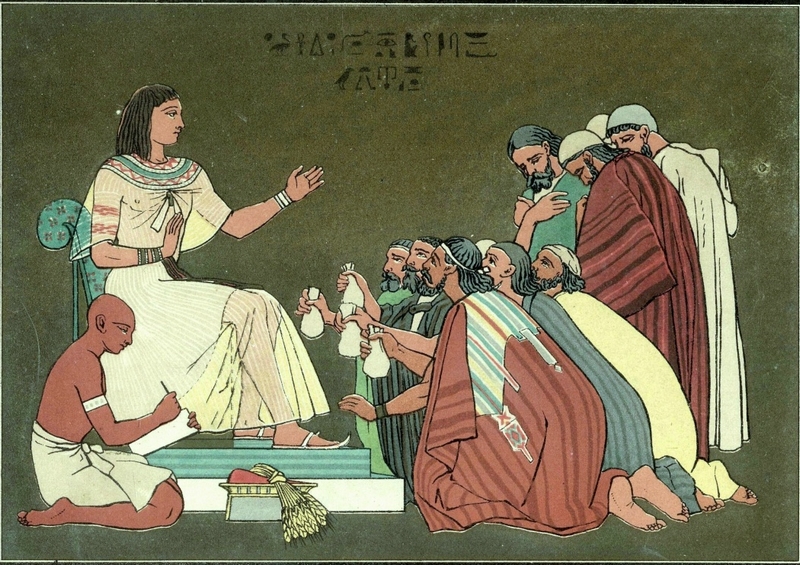
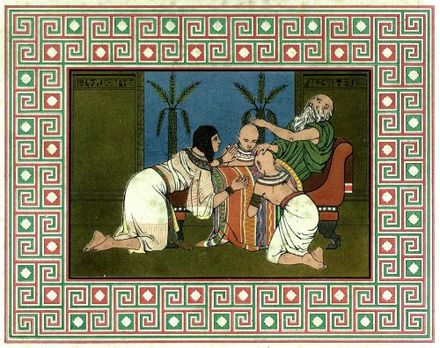
Joseph’s Brothers Bow Down, by Owen Jones, 1865

In the second year of famine, Yoseif’s brothers return, with Binyamin, in order to buy more grain. And Yoseif continues to test his older brothers. (See my post Mikeitz & Vayigash: A Fair Test, Part 2.) The testing finally ends in this week’s Torah portion, when Yehudah (“Judah” in English) begs Yoseif to enslave him instead of Binyamin.5 Then Yoseif reveals his identity.

And Yoseif said to his brothers: “Come close to me, please!” And they came close. And he said: “I am Yoseif your brother, whom you sold into Egypt. And now, do not be pained, and do not let anger kindle in your eyes that you sold me here. Because to preserve life, Elohim sent me before you.” (Genesis 45:4-5)

After this startling claim, Yoseif explains his view of God’s plan.

“For this is two years the famine has been in the midst of the land, and there are still five years more in which there will be no plowing or harvest. So Elohim sent me ahead of you, to make you she-eirit and for keeping you alive, as a great deliverance. So now, you did not send me here, but Elohim! And [Elohim] has established me as av to Pharaoh and as lord of all his house and as ruler over all the land of Egypt.” (Genesis 45:6-9)

she-eirit (שְׁאֵרִית) = a remnant, remainder, residue. (In this verse, she-airit refers to a group of survivors.)

av (אָב) = father, forefather, male ancestor; chief advisor to a ruler.

Some commentators have written that Yoseif has been figuring this out for a while.6 But I think that Yoseif’s insight is the latest in a long string of sudden inspirations.

Yoseif would not be in a position to rescue his whole family from starvation if it were not for both his brothers’ evil deed, and his own sharp insights. His speech to his brothers might mean that he is now giving God credit for both their assorted levels of wickedness,7 and his own cleverness—in other words, for their respective personalities. In this interpretation, humans have free will to make their own decisions. But God determines who tends to be consumed by jealousy, and who is quick-witted.

According to 21st-century commentator Robert Alter, “Joseph’s … recognition of a providential plan may well be admirable from the viewpoint of monotheistic faith, but there is no reason to assume that Joseph has lost the sense of his own brilliant initiative in all that he has accomplished, and so when he says “God” (‘elohim, which could also suggest something more general like ‘providence’ or ‘fate’), he also means Joseph.”8

On the other hand, Yoseif’s own adolescent dreams about his brothers bowing down to him came true, even though many accidents of fate could have intervened. And his interpretations of the dreams of Pharaoh’s imprisoned officials came true, even though Pharaoh might have changed his mind about whom to pardon and whom to execute. Yoseif might be crediting God not with forming a human’s character, but with manipulating events at key moments by nudging people toward certain decisions and away from others.

According to 21st-century rabbi Jonathan Sacks, God is always nudging people: “One of the core messages of this narrative is just that—to remember that God plays a role in our lives on a daily basis even if we don’t realise it at the time. … One of the main and overarching messages is that God is behind the scenes making sure that events occur and destinations are reached according to His plan.”9

Perhaps the way you interpret Yoseif’s speech depends on your own beliefs about how much power God exercises over human beings—or how much interest God has in making things happen.

Yoseif then tells his brothers:

“Hurry and go up to my father and say to him: ‘Thus says your son Yoseif: Elohim has placed me as lord of all Egypt; come down to me, don’t remain!” (Genesis 45:9)

If God has arranged the past 22 years in order to rescue the whole extended family of his father Yaakov (“Jacob” in English), then it is time to get the patriarch down to Egypt, along with all of the wives and children of Yoseif’s eleven brothers.

Yoseif promises to provide for them all, and to settle them and their flocks and herds in Goshen, near the capital. Then he embraces Binyamin.

And he kissed all his brothers, a wept upon them. After that his brothers spoke with him. (Genesis 45:15) Why are they silent while Yoseif is explaining his theory that God arranged everything for the long-term good of the family? Maybe they are in shock at the knowledge that Yoseif’s annoying dreams came true: he rules, and they have bowed down to him. Maybe they do not believe his theory about God, but they do not dare annoy him by arguing.

Believing the theory

The famine ends in five years, but the whole family stays in Egypt. After all, Yoseif is still second only to Pharaoh, and his brothers now own land there and have lucrative administrative jobs supervising Pharoah’s flocks.10

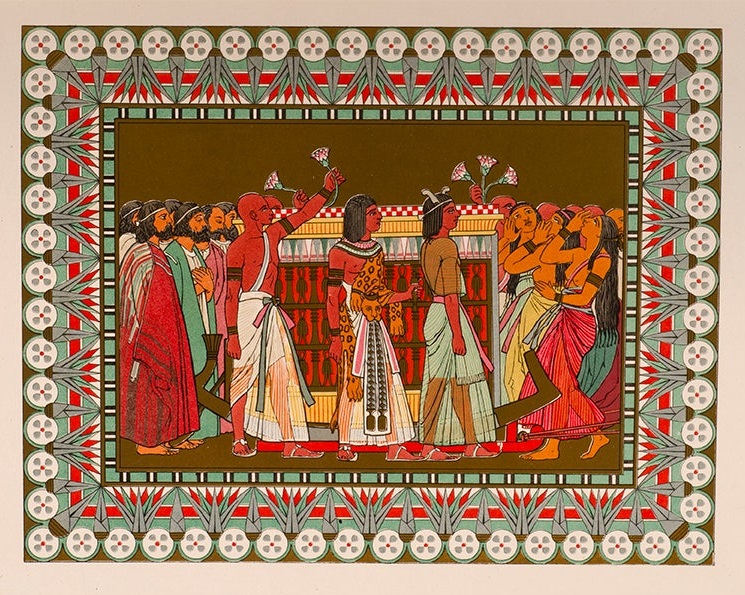
Jacob Is Buried, by Owen Jones, 1865

The patriarch Yaakov dies after seventeen years in Egypt, and all twelve of his sons accompany his body to Canaan for burial. After they return to Egypt, Yoseif’s older brothers say to one another:

“What if Yoseif holds a grudge, and actually repays us for all the evil that we dealt out to him?” (Genesis 50:15)

They send a message, purportedly from their father, ordering Yoseif to forgive them.

Then his brothers also went, and they prostrated themselves, and said to him: “Here we are, slaves to you!” But Yoseif said to them: “Do not be afraid! For am I in place of Elohim?” (Genesis 50:18-19)

Earlier in Genesis, in the Torah portion Vayeitzei, Yaakov said the same thing to his childless wife, Rachel, several years before she finally became pregnant.

Rachel … said to Yaakov: “Give me children! If not, I will die!” Then Yaakov heated up against Rachel, and he said: “Am I in place of Elohim, who has withheld from you fruit of the belly?” (Genesis 30:1-2)

Yaakov meant that only God could “open her womb”. Now their son Yoseif is asking the same rhetorical question, saying that only God can punish his older brothers.

According to Rashi, Yoseif means: “Even if I wished to do you harm, would I at all be able to do so? For did you not all design evil against me, and you did not succeed because the Holy One, blessed be He, designed it for good. How, then, can I alone, without God’s consent, do evil to you?”10

But Hirsch wrote that even if the decision were up to Yoseif, he would not punish them: “God can judge the thoughts, the intentions. I, as a human being, see only the result, and in that respect I owe you deep gratitude.”11

Yoseif concludes by stating that his brothers’ intentions years ago really were evil; but what matters is that the result was good.

“And you, you planned evil against me; Elohim planned it for good, in order to do as it is this day—to keep many people alive.” (Genesis 50:20)

This time, Yoseif’s older brothers are comforted. They are now certain that Yoseif would never oppose God by punishing them for their long-ago crime.

Is Yoseif’s view of how God operates original? Not quite; there are intimations in earlier Genesis stories that God sometimes answers prayers by making things happen (see #9 above) and that God can promise to eventually give the descendants of the patriarchs the land of Canaan (see #8 above).

But Yoseif changes a vague feeling that God influences events into a definite statement that God controls people enough to determine either their personalities, and/or their actual deeds; and God does this to achieve concrete objectives in history.


How much power does God exercise in human affairs? To what extent do human beings have free will? These are questions that theologians and philosophers have chewed over for centuries.

Many people today believe that a powerful God (preferably omnipotent and omniscient) runs the show, but also that humans are free to make their own decisions and act on them. So, like Yoseif, they resolve the inherent contradiction by positing a God who arranges human destiny behind the scenes—loading the dice to make sure that God’s own goals are met, while granting humans a limited sphere of free will.

Are they right? If so, does God do it by determining our personalities (so we will naturally make the decisions God needs for the long-term plan), or by directing our impulses at the moment of decision?

And if not, what do you believe instead about God and about free will? 


  1. The authors of Genesis also reveal assumptions about God in the narrative, but I do not assume that the characters share these beliefs unless one of them hears or says something to that effect.
  2. Genesis 40:8, 41:16.
  3. The title “Pharaoh” in English is Paroh (פַּרֺה) in Hebrew.
  4. When Yoseif was their teenage nemesis, all ten of his older brothers cooperated in seizing and stripping him. When Reuvein objected against bloodshed, they threw him into a pit. Then Judah talked the others into selling him instead of leaving him to die there. (Genesis 37:19-27)
  5. Genesis 44:18-34. See my post Vayigash: Compassion.
  6. E.g. 19th-century rabbi Shimshon Rafael Hirsch, The Hirsch Chumash: Sefer Bereshis, translated by Danield Haberman, Feldheim Publishers, Jerusalem, 2002, pp. 814-815.
  7. See footnote 4.
  8. Robert Alter, The Five Books of Moses, W.W. Norton & Co., New York, 2004, p. 261.
  9. Rabbi Lord Jonathan Sacks, Covenant & Conversation, “The Angel Who Did Not Know He Was an Angel: Vayeshev 5780”, December 2019.
  10. Genesis 47:6, 11.
  11. Rashi (11th-century rabbi Shlomoh Yitzchaki), translation in www.sefaria.org.
  12. Hirsch, p. 897.

Vayechi: Death and Inheritance

The book of Genesis/Bereishit begins with the creation of the world, then narrows in on one paternal line headed by Abraham. It ends with the death of Abraham’s great-grandson Joseph.

A name after death

The characters in the Torah do not hope for life after death.1 What men in the patriarchal society of the Ancient Near East seem to want most is male descendants to inherit their names and their land. (Names were inherited because instead of a modern last name, a man with the given name Aaron was called Aaron ben (father’s given name). If he had an illustrious grandfather, he was called Aaron ben (father’s given name) ben (grandfather’s given name).2)

Key blessings in the book of Genesis include:

“And I will make you a great nation, and I will bless you, and I will make your name great …” (Genesis 12:2, God to Abraham)

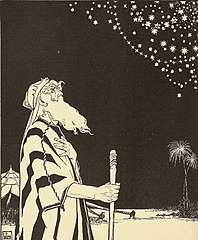
Abraham, by Ephraim Moshe Lilien, 1908

“Please look toward the heavens and count the stars, if you are able count them.” And [God] said to him: “So your zera will be!” (Genesis 15:5, God to Abraham)

zera (זֶרַע) = your seed, your offspring, your descendants.

“I will make your zera abundant as the stars of the heavens, and I will give to your zera all these lands, and all the nations of the earth will bless themselves by your zera.” (Genesis 26:4, God to Isaac)

“May God bless you and make you fruitful and numerous, and may you become an assembly of peoples.” (Genesis 28:3, Isaac to Jacob)

“Your zera will be like the dust of the earth, and you will spread out to the west and to the east and to the north and to the south.” (Genesis 28:14, God to Jacob)

In this week’s Torah portion, Vayechi (“And he lived”, Genesis 47:28-50:26, the last portion in the book of Genesis), Jacob concludes his deathbed blessing of two of his grandsons by saying:

“May [God] bless the boys, and may my name be called through them, and the name of my fathers Abraham and Isaac!”

Since descendants are so important, when the patriarchs Abraham, Isaac, and Jacob are approaching death they all leave something to their sons. But what they give their sons differs according to the personality of the father.

Abraham’s gifts

When Abraham is in his early 100’s, his behavior toward both his sons appalls me. He obeys when God tells him to disinherit and cast out his son Ishmael, along with the boy’s mother—and he sends them off into the desert with only some bread and a single skin of water. Since God has promised to make a nation out of Ishmael, he can assume his older son will survive, but why make him start a new life with so little? (See my post: Vayeira: Failure of Empathy.)

Some years later, Abraham hears God tell him to slaughter his son Isaac as a burnt offering. He neither argues with God, nor asks a single question. Isaac, a grown man, trusts his father and lets himself be bound on the altar. (Therefore Jews call this story the Akedah, the binding.) Only when Abraham’s knife is at his son’s throat does God call it off.3 But after God sends a ram as a substitute sacrifice, Isaac disappears from the story, and we never see him in the same place as his father again, not even at the funeral of Sarah, Abraham’s wife and Isaac’s mother. And although God blesses Abraham once more while the ram is burning, God does not speak to Abraham again after that.

Sarah’s Burial, by Gustave Dore, 1908

During the remainder of his life, Abraham devises his own plans for the future, including buying a burial cave for the family after his wife Sarah dies,4 and arranging a marriage for Isaac. He is over 137 when he takes a new wife and sires six more sons. He then does some careful estate planning:

And Abraham gave everything that was his to Isaac. But to the sons of the concubines that Abraham had, Abraham gave gifts, and he sent them away from his son Isaac while he was still alive, eastward, to the land of the East. (Genesis 25:5-6)

He dies at age 175.

Then he expired. And Abraham died at a good old age, old and saveia; and he was gathered to his people. (Genesis 25:8)

saveia (שָׂבֵעַ) = full, satisfied, sated, satiated. (From the root verb sava, שָׂבַע = was satisfied, was satiated, had enough.)

He has a right to be satisfied; he has done his part to further God’s plan for Isaac’s descendants to inherit the land of Canaan, and he has also provided for his other children.

Isaac’s blessing

Like his father Abraham, Isaac does not own any land except for the burial cave, but he is wealthy in livestock and other movable property. He has two sons, the twins Esau and Jacob. By default, two-thirds of his property would go to his son Esau, who is older by a few seconds, while one-third would go to his son Jacob. Isaac does not makes any other arrangement for his estate.

Isaac is more interested in God than property. He takes care of his flocks, but unlike Abraham he makes no effort to increase them. He willingly lets Abraham tie him up as a sacrificial offering to God in the Akedah. And unlike Abraham, he pleads with God to let his long-childless wife conceive.5

At age 123, Isaac is blind and cannot stand up. He believes he will die soon, and he wants to deliver a formal deathbed blessing to at least one of his sons. Perhaps he views a blessing as a prayer, since the first of the three blessings he delivers begins “May God give you”, and the third begins “May God bless you”.6 What Isaac most wants his sons to inherit is God’s blessings.

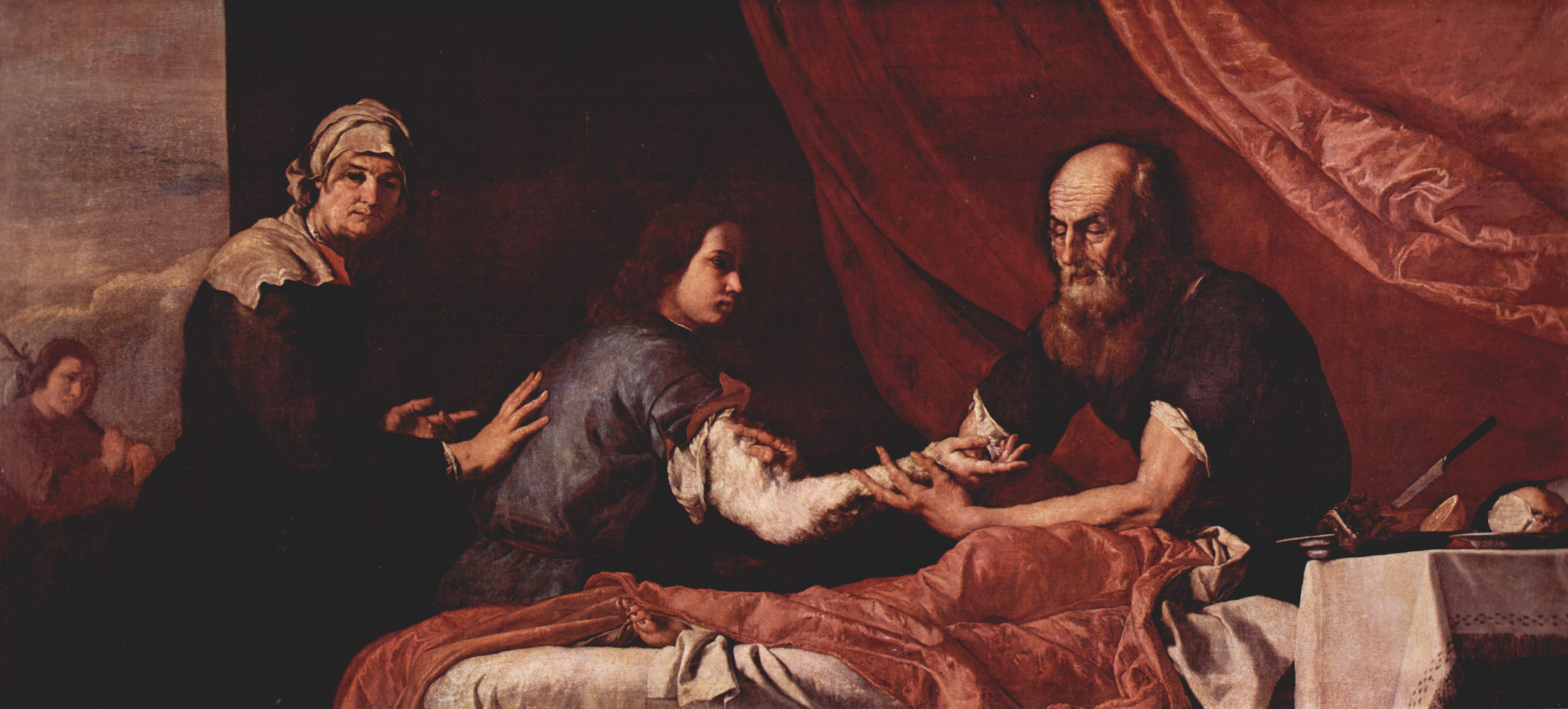
Isaac Blessing Jacob, by Jusepe de Ribera, 17th c.

Alas, his wife Rebecca does not trust him to give the right blessing to the right son, so she cooks up a deception that results in Jacob leaving home. Later Esau also leaves. But Isaac lingers on, presumably still blind and bedridden, until he finally dies at age 180.

Then Isaac expired. And he died, and he was gathered to his people, old useva in days. And his sons Esau and Jacob buried him. (Genesis 35:29)

useva (וּשְׂבַע) = and he was satisfied, and he was satiated, and he had had enough. (From the perfect form of the verb sava.) Although Isaac lives even longer than his father, the phrase “at a good old age” is not included in the description of his death. My best translation for the word useva in this verse is: “and he had had enough”. Isaac has spent more than enough time waiting for death.

Jacob’s blessings

Abraham focused on leaving his sons property. Isaac focused on leaving his sons blessings from God. Isaac’s son Jacob assigns both property and blessings at the end of his life, as well a prophecies and directions for his own burial.

He has twelve children, but he only cares about the two youngest, Joseph and Benjamin. His ten older sons sell Joseph as a slave bound for Egypt, then trick their father into believing that Joseph was killed by a wild beast. Jacob mourns for years. He is 130 years old when he finds out that Joseph is still alive and has become the viceroy of Egypt.  He exclaims:

“Enough! My son Joseph is still alive. I will go and see him before I die!” (Genesis 45:28)

In this week’s Torah portion, Vayechi, Jacob lives for another 17 years in Egypt as Joseph’s dependent. It is unclear whether he has an estate to leave; does he still have some claim over the herds and flocks his other sons are tending? And could he still claim the land he purchased long ago at Shekhem, the town that his older sons destroyed?7

Although it is not clear what Jacob’s estate consists of, he gives Joseph the equivalent of a double portion of it by formally adopting Joseph’s two sons, Menasheh and Efrayim.8

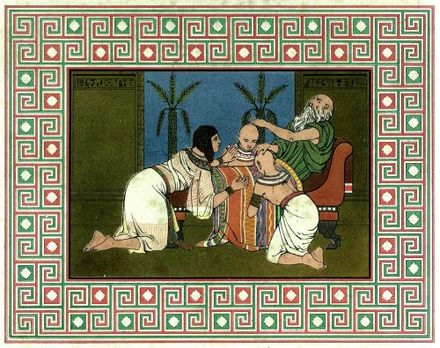
Jacob Blesses Ephraim and Manasseh, by Owen Jones, 1865

Then, perhaps in imitation of his own father, Isaac, Jacob gives Menasheh and Efrayim blessings. In the first blessing he asks God to give them lots of descendants, and in the second he predicts that their descendants will bless their own children in their names.9

In the next scene, Jacob calls all his sons to his deathbed. To each one he delivers not a blessing, but a prophecy. Some of the prophecies refer to stories in Genesis about Jacob’s sons. Others have nothing to do with the characters in Genesis, but may refer to their eponymous tribes.10

Before arranging his estate, giving blessings, and delivering prophecies, Jacob makes Joseph swear to bury him in Canaan, in the family burial cave. After he finishes his prophecies, he repeats these burial instructions to all his sons before he dies at age 147.11

Then Jacob finished directing his sons, and he gathered his feet into the mitah, and he expired, and he was gathered to his people. (Genesis 49:33)

mitah (מִטָּה) = bed of blankets. (From the same root as mateh, מַטֶּה = staff, stick, tribe.)

The text does not say that Jacob is satisfied or has had enough. But the sentence describing his death may imply that he gathered himself into the tribes he had created, before he was gathered by death. After Jacob dies, all twelve of his sons take his embalmed body up to the family burial cave in Canaan.

Although Jacob was selfish as a young man, cheating his brother out of his firstborn rights, at the end of his life he is absorbed with details concerning the future of the sons and grandsons he is leaving behind.

Joseph’s reminder

Twice Joseph tells his brothers that they should not feel guilty about selling him as a slave bound for Egypt because that was part of God’s master plan for bringing Jacob’s whole clan down to Egypt.12 (See my post: Vayigash & Vayechi: Forgiving?) On his deathbed, Jacob is still thinking about God’s master plan.

Burying the body of Joseph, the 1890 Holman Bible

And Joseph said to his kinsmen: “I am dying, but God will definitely take account of you, and bring you up from this land to the land that [God] swore to Abraham, to Isaac, and to Jacob.” And Joseph made the sons of Israel swear, saying: “God will definitely take account of you; then bring up my bones from here!” And Joseph died, 110 years old. And they embalmed him and they put him in a coffin in Egypt.  (Genesis 50:24-26)

Thus ends the book of Genesis. Joseph is not described as satisfied, or even as being gathered to his ancestors. He is focused not on his immediate family, but on the distant future of his whole clan. His only deathbed act is to make all the men in his family swear to pass on the information that someday his bones must be buried in Canaan. This promise will serve as a reminder that someday the descendants of Jacob, a.k.a. Israel, must return to the land that God promised to them.


I think Abraham believes his estate is important because he is wealthy, and he wants peace between his sons. Isaac believes his blessings are important because he wants God to help his sons. Jacob believes his estate and his blessings are important because he has a history of cheating and being cheated, and he does not want to leave anything to chance. And Joseph believes God’s master plan for the whole clan of Israel is the most important thing, so he only wants the clan to remember to bury him in Canaan.

I suspect that when I am close to death, I will believe the most important thing is to let the remaining members of my family know that I loved them. It might not make much practical difference, but I remember the reports of all those phone calls when the Twin Towers fell in New York City, and those who were about to die spent their last minutes saying “I love you”. When no inheritance is at stake, and God does not interact directly in the world, we have only our personal words of blessing to leave.


  1. The Torah says people’s souls go down to Sheol when their bodies die, but does not imagine any life for those souls, only a sort of endless cold storage.
  2. Ben (בֶּן) = son of. Bat (בַּת) = daughter of.
  3. Genesis 22:1-19. See my post: Vayeira: On Speaking Terms.
  4. Genesis 25:12-18 describes Abraham’s purchase of the cave of Machpeilah near Mamrei, where Sarah died.
  5. Genesis 25:21.
  6. Genesis 27:28 and 28:4.
  7. Genesis 33:18-19 and 33:25-30.
  8. See my post: Vayechi & 1 Kings: Deathbed Prophecies.
  9. Genesis 48:13-20. The blessing “May God make you like Efrayim and Menasheh” is still in use among Jews.
  10. See my posts: Vayechi: First Versus Favorite, and Vayechi: Three Tribes Repudiated.
  11. Genesis 47:29-31 and 49:29-30.
  12. Genesis 45:5-8 and 50:18-20.

Vayechi, Chayei Sarah, & Vayishlach: A Touching Oath

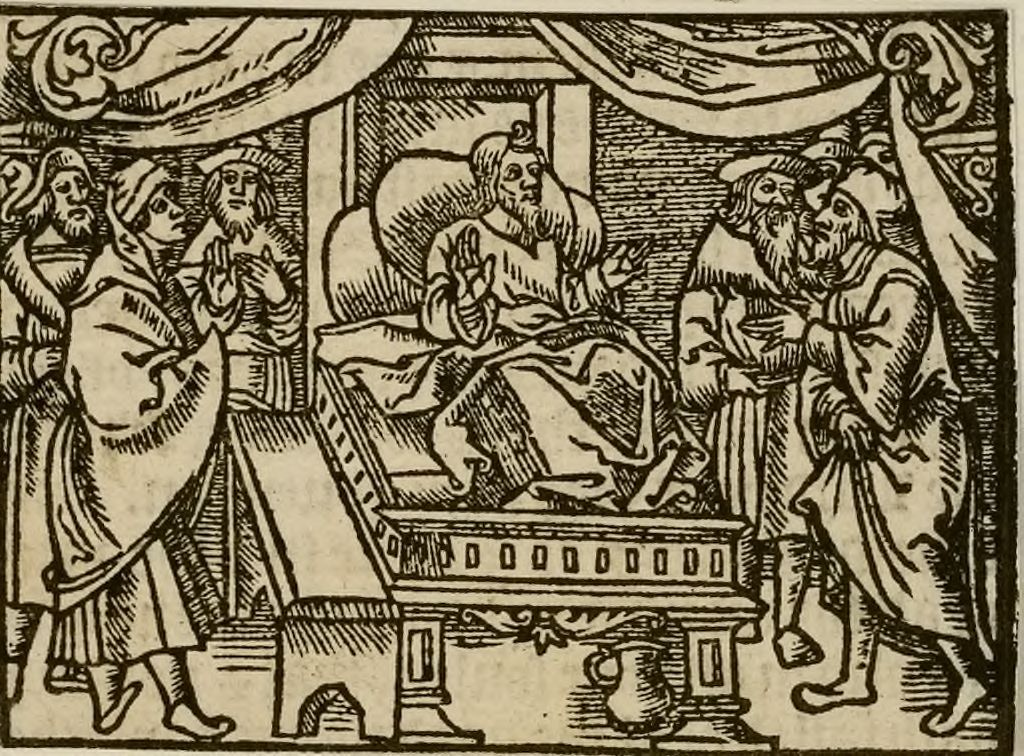
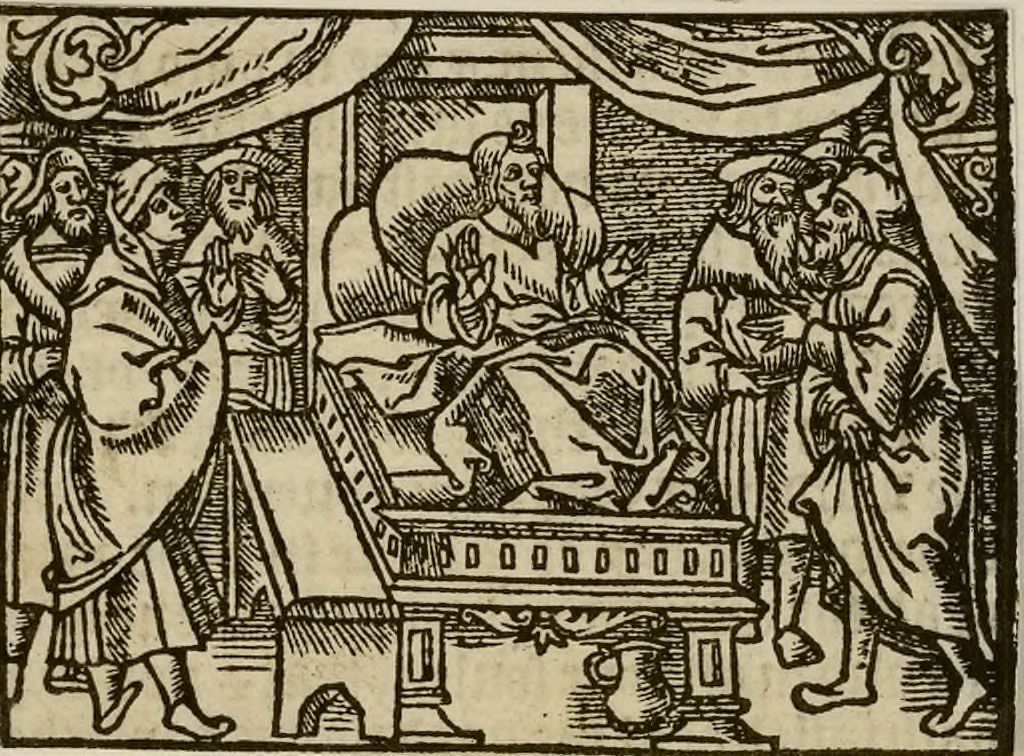
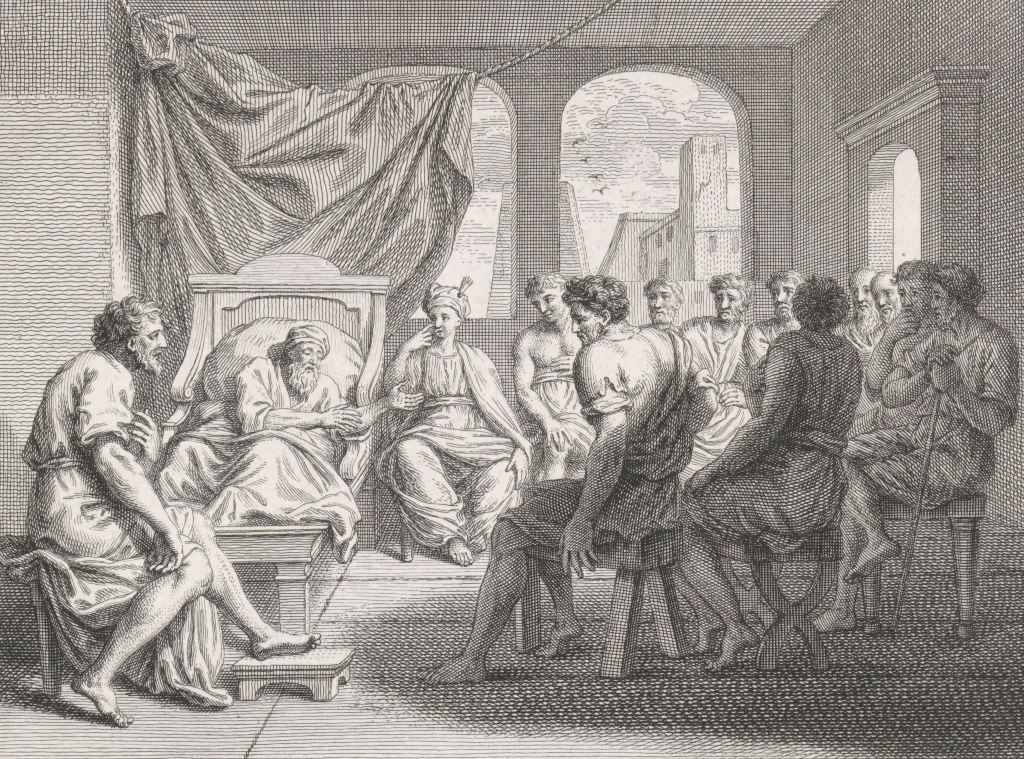
Jacob on his Deathbed, 1539 woodcut

This week’s Torah portion, Vayechi (Genesis 47:28-50:26), begins:

And Jacob lived in the land of Egypt seventeen years; and the years of Jacob, the years of his life, were 147 years. The time for Israel to die approached, and he called for his son, for Joseph …  (Genesis/Bereishit 47:28-29)

Jacob acquired a second name, Israel, in an earlier portion of the book of Genesis, Vayishlach, when he wrestled with a mysterious “man” all night before his reunion with Esau, the brother whom Jacob had cheated twenty years before.

Becoming Israel

In Vayishlach, Esau was approaching with 400 men, and Jacob was terrified that his brother would attack his camp for revenge. He prayed, he sent generous gifts ahead on the road, and he moved his whole household and all his possessions across the Yabok River. Then Jacob spent the night on the other side.

And Jacob was left alone. And a man wrestled with him until dawn rose. And he saw that he had not prevailed against [Jacob], so he touched the socket of his yareikh, and the socket of Jacob’s yareikh was dislocated when he wrestled with him. (Genesis 32:25-26)

yareikh (יָרֵךְ) = loin, i.e. hip, buttocks, upper thigh, or genitals (depending on the context).

One cannot actually touch the socket inside a human hip—unless, perhaps, one is a supernatural creature. Even with the pain of a dislocated hip, Jacob hangs onto his opponent. The mysterious wrestler is the first to speak.

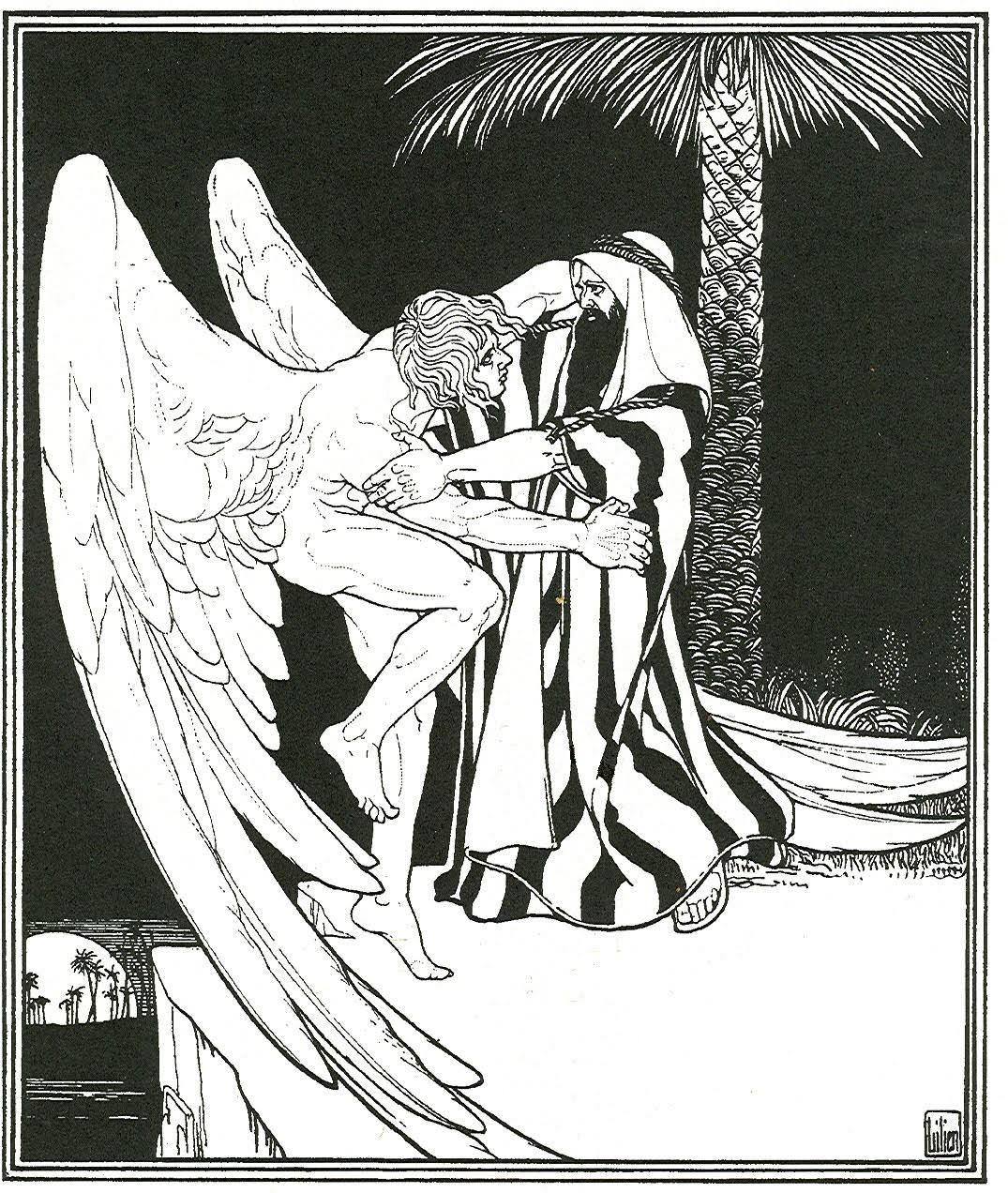
Jacob Wrestles, by Ephraim Moses LIlien, 1923

Then he said: “Let me go, because dawn is rising.”

But [Jacob] said: “I will not let you go unless you bless me!”

And he said to [Jacob]: “What is your name?”

And he said: “Jacob.”

Then he said: “It will no longer be said that Jacob is your name, but Yisrael. Because sarita with God and with men, and you have prevailed.”

And Jacob inquired and said: “Please tell your name.”

And he said: “What is this, that you ask for my name!” (Genesis 32:27-29)

Yisrael (יִשְׂרָאֵל) = “Israel” in English. Possibly he strives with God, he contends with God. (Yisar,יִשַׂר  = he strives with, he contends with + Eil, אֵל  = God, a god.) On the other hand, the subject usually follows the verb in Biblical Hebrew, so Yisrael could mean “God contends”.)

sarita (שָׂרִיתָ) = you have striven with, you have contended. (From the same root as yisar.)

Gradually the “man” who wrestles with Jacob is revealed as a divine messenger. “Jacob was left alone”—away from any other human beings. “A man wrestled with him”—messengers from God often look like men at first, and can do physical things in our world.1 “You have striven with God and with men”—striving with God’s messenger is the equivalent of striving with God. And protesting that “you ask for my name!”—God’s messengers do not reveal their names in the Torah.2

The two wrestlers in this passage also serve as a metaphor for a narrow human frame of reference wrestling with a broad divine frame of reference—both within Jacob’s psyche. The divine perspective touches an intimate spot, and Jacob emerges from the experience with a new name, and a limp to remind him of what happened.

And the sun rose for him as he passed Penueil, and he, he was limping on his yareikh. (Genesis 32:32)

After this story, the Torah continues to use the name Jacob, but sometimes switches to Jacob’s new name, Israel. Why does it switch from “Jacob” to “Israel” at the beginning of this week’s portion, Vayechi?

Requesting an oath

The time for Israel to die approached, and he called for his son, for Joseph, and he said to him: “If, please, I have found favor in your eyes, please place your hand under my thigh. And do with me loyal-kindness and faithfulness: do not, please, bury me in Egypt! [When] I lie down with my fathers, then carry me out of Egypt and bury me in their burial site!” (Genesis 47:29-30)

This is Jacob/Israel’s first deathbed speech. As the self-centered Jacob, he might want to be buried in Bethlehem beside Rachel, the wife who died in childbirth, the wife he loved and mourned for the rest of his life. Or he might even want his sons to bury him in Egypt, where his entire surviving family has emigrated. His beloved son Joseph is a viceroy, so he could buy a deluxe burial site there.

But Jacob does not mention either possibility. As Israel, he knows it will be best for his future descendants if he is buried in the cave of Machpelah, which his grandfather Abraham purchased for a family burial site. This is where Abraham and Sarah, Isaac and Rebecca, and (we learn later in this Torah portion) Jacob’s first wife, Leah, are buried. Reinforcing the importance of that site, the only land in Canaan that his family inherits through the generations, will help Israel’s descendants in Egypt remember that someday they must return to Canaan to fulfill God’s prophecies.

Israel begins his speech to Joseph with extreme formality and politeness, addressing him in his role as the viceroy. The consensus among commentators is that the pharaoh does not want his invaluable viceroy to leave Egypt for even a short visit to Canaan, his homeland.  What if Joseph did not return?  So Israel decides to give Pharaoh an extra reason to let Joseph go to Machpelah. If Joseph has sworn the most solemn oath possible, how could Pharoah make his viceroy dishonor himself by violating it?

Precedent for the oath

So Israel requests the kind of oath that Abraham made his steward swear regarding a bride for his son Isaac. Jacob/Israel knows he will be powerless over his own burial; Abraham, at age 137, was afraid he would not live long enough to make sure his son married one of his relatives from Aram instead of a Canaanite. In both cases, the aged father relies on the most serious oath possible. Abraham told his steward:

“Please place your hand under my yareikh, and I will make you swear by God, god of the heavens and god of the earth, that you do not take a wife for my son from the daughters of the Canaanites amidst whom I am dwelling. Because you must go to my [former] land and to my relatives, and [there] you must take a wife for my son, for Isaac. (Genesis 24:2-4)

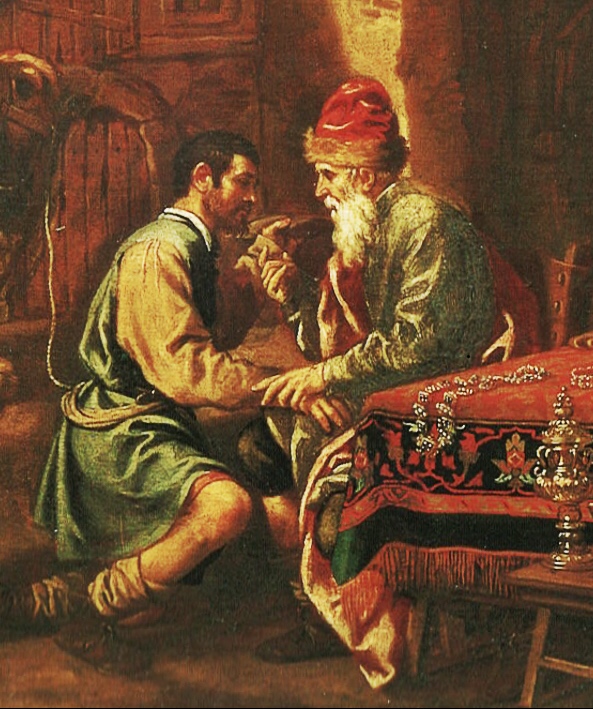
Abraham’s Solemn Charge, by Pedro Orrente, 17th century, detail

Abraham’s steward asked a clarifying question to make sure he understood his mission. Then he complied at once with his master’s request:

And the servant placed his hand under the yareikh of Abraham, his master, and he swore to him on this matter. (Genesis 24:9)

Since the word yareikh could mean any of several locations on the lower body, we can only guess where Abraham’s steward placed his hand. But commentators have noted that the Latin root “testis” appears in words whose English versions are testify, testimony, and testicles, and claim that this may reflect a Roman practice of taking an oath on the genitals. And for at least two millennia, oaths administered by a court have required the person swearing the oath to hold a sacred item in the hand. Before the holy objects were made for the sanctuary, before the Torah was written down, a circumcised penis was the only sacred object available.3

The actual oath

In the portion Vayechi, Joseph listens to his father’s request, then tells him:

“I will do as you have spoken.” (Genesis 47:30)

Instead of immediately placing his hand under his father’s yareikh, Joseph makes a simple verbal promise. Is placing his hand under his father’s whatever-it-is beneath the dignity of a viceroy of Egypt?

Or does Joseph remember Jacob’s famous limp, and feel reluctant to touch the spot that the unnamed being touched?

Jacob does not accept Joseph’s unsupported promise as a bona fide oath.

He said: “Swear to me!” And he swore to him. Vayishtachu, Israel, at the head of the bed. (Genesis 47:31)

vayishtachu (וַיִּשְׁתַּחוּ) = and he prostrated himself, and he bowed as deeply as possible. (This verb is used for bowing to a king or to God.)

It sounds as though Joseph brings himself to place his hand under the spot and swear. His father, Israel, accepts Joseph’s response as a duly sworn oath, one that even the Pharaoh could not quibble about. And he bows as deeply as possible for an invalid in bed.

When Jacob limped toward Esau the morning after the wrestling match, he prostrated himself seven times—honoring his brother’s power over his life. Now Jacob prostrates himself as best he can, at age 147, to his Joseph—honoring his son the viceroy’s power.

Pharaoh’s permission

After that Israel rearranges his inheritance by adopting Joseph’s two sons as his own4 and makes two deathbed prophecies, one short5 and one lengthy.6 Then he repeats the instructions for his burial in the cave of Machpelah, and dies.7

Joseph has his father embalmed like an Egyptian nobleman, and then informs Pharaoh:

“My father made me swear, saying: ‘Here, I am dying. In my burial side that I dug for myself in the land of Canaan there you must bury me.’ And now please let me go up, and I will bury my father, and I will return.” And Pharaoh said: “Go up and bury your father as he made you swear.” (Genesis 50:5-6)

So Israel’s plan works.

A speculation

Yet Pharaoh gives Joseph permission to go even though Joseph does not mention the hand position he used for his oath to his father. Why is the placement of Joseph’s hand so important to his father?

I wonder if Israel wants Joseph to touch the same place the divine being touched. He might recognize himself in his favorite son. The first two times Joseph’s brothers came to Egypt, Joseph disguised himself and lied to them in order to get the information he wanted. When Jacob was a young man, he disguised himself and lied to his father in order to steal his brother’s blessing.

How can Israel get Joseph to recognize the manipulative side of his personality, and wrestle with it? Maybe if Joseph touches the spot that the divine being touched, it will shock him into the awareness that he is not as grand and impartial as he thinks. Joseph is the supreme judge of Egypt’s agricultural system, but he is not divine.

Would Jacob/Israel think in those terms? He is not a psychologist, but he is a clever thinker. And humans have always used symbolic acts to make connections between the known and the unknown. There is always more going on inside us than we know. Some people tend to act intuitively, and need to practice thinking and planning. Others are like Jacob, Joseph, and myself: thinking and planning are default behavior for us. We need to step back, take a breath, and take the long view. We need a touch of the divine.


  1. For example, divine messengers wash their feet and eat in front of Abraham in Genesis 18:1-8.
  2. See my posts Toledot & Vayishlach: Wrestlers, and Haftarat Naso—Judges: Spot the Angel.
  3. Talmud Bavli, Shevuot 38b; Rashi (11th-century Rabbi Shlomoh Yitzchaki); Rabbi Elie Munk, The Call of the Torah: Bereishis, Mesorah Publications, 1994, p. 626. See my post Chayei Sarah: A Peculiar Oath.
  4. Genesis 48:3-11, 48:22.
  5. The prophecy about Efrayim and Menasheh is in Genesis 48:12-20.
  6. The prophecy about the twelve tribes of Israel is in Genesis 49:1-28.
  7. Genesis 49:29-33.

Vayechi: When Jacob Bows

The prophecy

Joseph has two prophetic dreams when is seventeen, according to the Torah portion Vayeishev (Genesis 37:1-40:23). After the second dream, he tells his brothers:

“Hey, I dreamed a dream again! And hey! The sun and the moon and eleven stars mishtachavim to me!” And he reported [it] to his father and to his brothers, and his father rebuked him and said to him: “What is this dream that you dreamed? Will we actually come, I and your mother and your brothers, lehishtachot to the ground to you?” And his brothers were jealous of him, and his father observed the matter.  (Genesis/Bereishit 37:9-11)

mishtachavim (מִשְׁתַּחֲוִים) = were bowing down, were prostrating themselves. (From the root verb shchh, שׁחה = bow down deeply in humility, do homage.)

lehishtachot (לְהִשְׁתַּחֲוֺת) = to bow down. (Also from the root sh-ch-h.)

Joseph’s Second Dream, by Owen Jones, 1865

Joseph’s father, Jacob (a.k.a. Israel), is over 100 years old at this time, and so far the Torah has not mentioned him bowing down to anyone except his brother, Esau.

The previous prostration

That happened in the Torah portion Vayishlach (Genesis 32:4-36:43), when the two brothers met again after a twenty-year estrangement. Esau had vowed to kill his brother after Jacob had cheated him out of both his birthright and the blessing he expected from their father. Jacob had fled to his uncle’s house in Charan. When he finally headed home again, after acquiring a large family and his own fortune, he learned that Esau was coming down the road with 400 men to intercept him. Jacob did everything he could think of to prevent disaster: sending his brother generous gifts ahead of time, praying to God, and finally, as Esau came into view with his troop,

He himself went across to face him, vayishtachu to the ground seven times, until he came up to his brother. (Genesis 33:3)

vayishtachu (וַיִּשְׁתַּחוּ) = and he bowed down, and he prostrated himself. (Also from the root sh-ch-h.)

In the Hebrew Bible, prostrations are a way to demonstrate humility and deference to a superior—usually to a king or to God. By bowing down to Esau seven times, Jacob is symbolically renouncing any advantage he tried to get over Esau in his youth, and demonstrating as graphically as possible that he considers Esau his superior. His prostrations are the equivalent of a puppy rolling over and exposing its throat to an older dog.

Inferior to nobody

After Jacob and his family and servants depart from Esau in peace, he does not bow to anyone for over forty years. Why should he? Jacob, jealous of his twin brother’s extra rights as the firstborn, has always been self-conscious about his position in life. After he failed to secure the rights of a firstborn son by fraud, he labored in Charan for twenty years until he had earned them. Now Jacob is a chieftain with twelve sons, many slaves and employees, and a great  wealth of livestock. The chieftain of the town of Shekhem treats Jacob as an equal, and when he makes an offer to Jacob he goes out to his camp instead of summoning him to his own residence in town.1

Jacob does not bow down to God, either. He first encounters God in the dream with angels on a stairway, and when he wakes up he treats God as someone to bargain with, vowing to give God a tithe of his wealth if God protects him and brings him safely back home.2 When Jacob worships God, he does so by pouring oil on a stone or burning animal offerings on an altar.3

Jacob and his people settle somewhere near Hebron/Chevron in Canaan.4 After Jacob’s older sons come home from the field without their younger brother and show their father Joseph’s bloody tunic, Jacob thinks his favorite son is dead. He mourns Joseph for 22 years. During that time Joseph is actually living in Egypt, where he rises from slave to viceroy. Finally Joseph sends for his father and his whole extended family in last week’s Torah portion, Vayigash (Genesis 4:18-47:27).

And Joseph harnessed his chariot and went up to Goshen to meet Israel [a.k.a. Jacob], his father. And he appeared to him, and he fell on his neck and he wept on his neck a long time. Then Israel said to Joseph: “I can die now, after seeing your face, that you are still alive.” (Genesis 46:29-30)

But the prophetic dream Joseph had when he was seventeen is not fulfilled. Jacob’s brothers have already bowed down to him many times, but his father has not.

Jacob does not bow down to Pharaoh, either, when Joseph presents him at court. He greets the king of Egypt with a blessing, and answers Pharaoh’s inquiry about how old he is by saying he is 130, and his life has been hard and short.5 Then Jacob blesses the king again, and leaves.

The prophecy fulfilled

Jacob finally bows down for the second time of his life on his deathbed, in this week’s Torah portion, Vayechi (Genesis 47:28-50:26).

Then the time approached for Israel [a.k.a. Jacob] to die, and he called for his son, for Joseph, and said to him: “If, na, I find favor in your eyes, place, na, your hand under my thigh and do a loyal and faithful deed for me: don’t, na, bury me in Egypt. When I lie down with my forefathers, then bring me up from Egypt and bury me in their burial place!” (Genesis 47:29-30)

na (נָא) = please, pray, I beg you. 

Joseph gives his word, but Jacob wants the formal hand gesture of an oath as well.6

And he [Israel/Jacob] said: “Swear to me!” And he swore to him. Vayishtachu, Israel, upon head of the bed. (Genesis 47:31)

vayishtachu (וַיֱִשְׁתַּחוּ) = and he bowed. (Also from the root sh-ch-h.)

Many classic commentators wrote that Jacob bowed toward the head of his bed, because the presence of God is at the head of the bed of a sick person (and prepositions are ambiguous). But that interpretation implies he was standing up. The Torah has already told us that Jacob is 147, and his death is approaching. I have been at the beside of four people near death, and I believe even Jacob would be too feeble to stand up during his final days.7 Perhaps he is seated on his bed, resting against a cushion, and he manages to bow at the waist.

In that case, he is not bowing toward the head of his bed; he is probably bowing to Joseph. This was the opinion of 12th-century rabbi Shmuel ben Meir, known as Rashbam, who wrote: “ ‘And Israel bowed low’: To Joseph, from the place where he was at [the top of] the bed.”8

Rabbi Bachya ben Asher (1255-1340 C.E.), known as Rabbeinu Bachya, added: “Seeing that Joseph had agreed to honour his father by undertaking to fulfill his wishes, Yaakov in turn prostrated himself before him to show that he respected the position Joseph occupied as effective ruler of the country.”8

Jacob spent the first hundred years of his life struggling to be the one on top, the one in charge. But during his final years in Egypt, he accepts that his son Joseph is his superior. He knows he is dependent on Joseph to carry out his final request, so he uses the language of an inferior, using the subservient phrase “if I find favor in your eyes” and repeating he word na. Then he uses the gesture of a humble inferior, coming as close as he can to a prostration.

This is the moment when Jacob fulfills the prophecy of the dream his son Joseph had when he was seventeen.

Jacob on his Deathbed, woodcut, 1539

After that, Jacob lives long enough to do the equivalent of rewriting his will, adopting Joseph’s two sons as his own so they will receive shares of the inheritance equal to those of Joseph’s brothers. Jacob also delivers his own prophecies to all his sons, predicting what will happen to the tribes that descend from them. Finally he orders all twelve of his sons to bury him with his deceased family members in the cave of Machpelah in Canaan.

And Jacob completed commanding his sons, and he drew back his feet in the bed, and he expired, and he was gathered to his people. (Genesis 49:33)

One prostration to Joseph before he died was enough for Jacob.


“Honor your father and your mother,” says the fifth of the Ten Commandments in the book of Exodus. In my post Yitro, Mishpatim, & Va-etchanan: Relative or Relevant? Part 1, I suggest that parents should also honor their children. But should they show humble submission to them, as Jacob did by bowing to Joseph on his deathbed?

Nobody would advise submission to a callow seventeen-year-old. But what about when the child is middle-aged, and the parent’s ability to deal with the world is declining in old age? If the adult child is competent and kind, then it would be better to humbly submit to that child’s arrangements than to insist on complete autonomy. I hope that is what I will do when I am considerably older—though I do not expect to live to age 147!


  1. Genesis 34:6-24.
  2. Genesis 28:20-22.
  3. Jacob’s journey south from Shekhem ends at the home of his father, Isaac, in Hebron/Chevron (Genesis 35:27). After that, the Torah only says Jacob lives “in the land of Canaan”, without specifying the location. His first stop on the way to Egypt is Beir-sheva, which is south of Chevron.
  4. Genesis 28:16-19, 33:19-20, 35:6, 35:13-14, 46:1.
  5. Genesis 47:7-10.
  6. Biblical Hebrew sometimes uses the word for “thigh”, yareich (יָרֵךְ) as a euphemism for the genitals. According to Pirkei DeRabbi Eliezer, midrash written between 630 and 1030 C.E., Jacob said: “O my son! Swear to me by the covenant of circumcision that thou wilt take me up to the burial-place of my fathers in the land of Canaan to the Cave of Machpelah.” (translation of Pirkei DeRabbi Eliezer 39:13 by sefaria.org)
  7. This is the first of Jacob’s three deathbed scenes. In the second, he has to summon his strength (vayitchaek, וַיִּתחַזֵּק) to sit up in bed.
  8. Both quotations are from sefaria.org.

Vayechi: First Versus Favorite

Jacob on his Deathbed, 1539

Jacob dies at age 147 in Vayechi (“and he lived”), the final Torah portion in the book of Genesis. Next week Jews begin the book of Exodus in the annual cycle of Torah readings.

As for me, I am still working on my book about moral mistakes in Genesis. Recent research on moral psychology has made me eager to add new explanations for why many of the characters in Genesis keep acting shady.

Meanwhile, here is an essay from my first draft about how Jacob challenges the rules of his society regarding the firstborn son.

Primogeniture and favoritism

In ancient Mesopotamian towns including Mari, Nuzi, and Nippur,1 a man’s firstborn son was obligated to: “Carry on the father’s name (patronym); Manage the family estate;  Provide for minors in the family; Provide a dowry for unmarried sisters; Pay for his parents’ burial and mourning ceremonies and maintain their grave afterwards.”2

In return, the firstborn would receive a double portion of the father’s inheritance, while his brothers and half-brothers received a single portion each.

Jacob blesses Ephraim and Manasseh, by Owen Jones, 1865

The Torah indicates that the firstborn had similar duties and rights among the ancient Israelites. When Jacob adopts Joseph’s two sons in Vayechi, he entreats God:

“Bless the young men!

And may they be called by my name,

And the names of my fathers, Abraham and Isaac.” (Genesis 48:16)

In the Torah a son carries his father’s name when he is called “Isaac ben Abraham” or “Jacob ben Isaac”; ben means “son of”. Here, Jacob assumes the right to carry the name of his own father, Isaac. And he gives that right to the family of Joseph, his favorite son and the oldest son of his favorite wife, not to the family of Reuben, his actual firstborn son.

The firstborn son serves as the family’s priest in the Torah (until this duty is given to the Levites in Numbers 3:5-13). And as in Mesopotamia, a man’s estate was divided into shares equal to the number of his sons plus one, and his firstborn son inherited two shares.

A law in the book of Deuteronomy decrees that a man can assign the extra duties and extra inheritance only to his firstborn son, not to his favorite son.

If a man has two wives, the one loved and the other hated, and they have [both] borne him sons, the loved one and the hated one, and the [man’s] bekhor is the son of the hated one: on the day of bequeathing what he owns to his sons … he must recognize the bekhor, the son of the hated one, giving to him two shares out of all that is found to belong to him, because he [the man’s actual firstborn] is the first of his virility. The law of the bekhorah applies to him. (Deuteronomy 21:15-17)

bekhor (בְּכוֹר) = firstborn son.

bekhorah (בְּכֺרה) = rank and rights as firstborn. (From the same root as bekhor.)

This law is intended to protect the firstborn from losing his rights.

Jacob’s early maneuvers

From birth to death, Jacob maneuvers to circumvent the rule of the bekhorah.

He and Esau are twins, but Esau is born first, while Jacob emerges holding onto his brother’s heel, as if he does not want to be left behind. Nevertheless, Esau ranks as firstborn.3 When the twins are young men, Jacob covets the role and rank of the firstborn. One day Esau comes home famished and asks Jacob for some of the stew he is cooking.

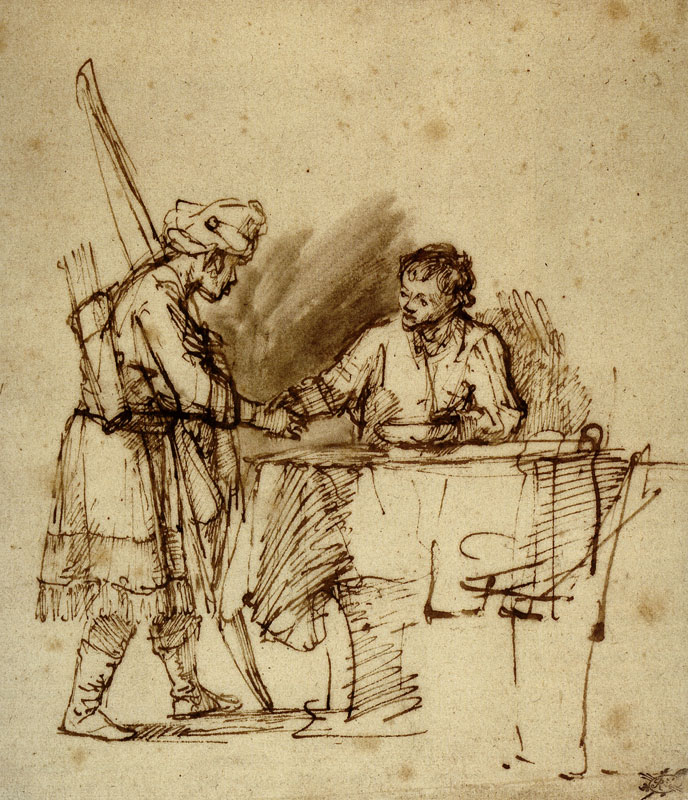
Esau Sells his Birthright, by Rembrandt

And Jacob said: “Sell today your bekhorah to me.” And Esau said: “Hey, I am going to die, so why this [bother about] my bekhorah?” And Jacob said: “Swear to me today.” And [Esau] swore to him and he sold his bekhorah to Jacob. Then Jacob give Esau bread and lentil stew … (Genesis 25:31-34)

Thus Jacob cheats his twin out of his rights. But by the time their father dies (at age 180), both brothers are already wealthy from their own efforts. Both Jacob and Esau bury Isaac.4 They have no sisters to marry off, and each brother takes care of his own children. The only firstborn right that Jacob inherits is God’s promise to give Canaan to his descendants. God made the same promise to Abraham, to his younger son Isaac, and finally to Isaac’s younger son Jacob.5

Jacob’s deathbed maneuvers

Despite his wealth and God’s promise, Jacob does not forget his resentment about the bekhorah. In fact, he challenges the rule during his two deathbed scenes in the portion Vayechi.

In the first deathbed scene, Jacob adopts Joseph’s two sons, Menasheh and Efrayim.

“And now, your two sons who were born to you in the land of Egypt before I came to you in Egypt, they shall be mine; Efrayim and Menasheh shall be mine like Reuben and Simeon.” (Genesis 48:5)

In effect, the adoption gives Joseph the double inheritance of the firstborn.  Instead of getting one share, as Joseph, he will get two shares, in the name of his two sons.

Then Israel said to Joseph: “Hey, I am dying, but God will be with you [all] and return you to the land of your fathers. And I myself give to you one shekhem over your brothers, which I took from the hand of the Emorites with my sword and my bow.” (Genesis 48:21-22)

shekhem (שְׁכֶם) = shoulders and upper back; an Amorite town about 30 miles (50 km) north of Jerusalem, where Jacob bought a plot of land in Genesis 33:18-19.

The campsite that Jacob bought near the town of Shekhem could not be of any interest to Joseph, the viceroy of all Egypt. But the author of the story knew that by 900 B.C.E. the two kingdoms of Israel would consist of the territories of twelve tribes. Three tribes (Judah, Benjamin, and Simeon) would occupy the southern Kingdom of Judah, while nine tribes (Efrayim, Menasheh, Reuben, Gad, Dan, Issachar, Zebulun, Asher, and Naphtali) would own territories in the northern Kingdom of Israel.

So what Jacob is really bequeathing to Joseph is a future double portion of the lands of the Israelite tribes in Canaan, lands they do not even begin to conquer until the book of Joshua.  When Joseph is on his own deathbed at the end of the book of Genesis, he asks to be embalmed and buried in Canaan when the Israelites return there someday.6 Joshua buries Joseph at Shekhem.7 By 900 B.C.E., Shekhem is an important city-state in the territory of Efrayim.

Jacob’s firstborn

Jacob Blesses his Twelve Sons, by Pieter Tanje, 1791

Jacob’s second deathbed scene consists of prophesies about his twelve sons and the tribes that will descend from them.  In his first prophesy he explicitly demotes his oldest son, Reuben.

“Reuben, you are my firstborn,

            My might and the first of my virility,

            Prevailing in rank

            And prevailing in strength.

Reckless like water, you will no longer prevail,

            Because you mounted your father’s couch.

            That was when you profaned my bed.

            He mounted it!”  (Genesis 49:3-4)

Here Jacob’s reason for stripping Reuben of his firstborn rights is Reuben’s incest with Bilhah, one of Jacob’s two concubines.8

The first book of Chronicles explains:

… Reuben, the firstborn of Israel—for he was the firstborn, but when he profaned his father’s couch, his firstborn-right was given to the sons of Joseph son of Israel, and he is not pedigreed as the firstborn, because Judah was more powerful as a leader than his brothers, and the firstborn-right [went] to Joseph— …  (1 Chronicles 5:1-3)

In other words, although Reuben was the first of Jacob’s sons to be born, he does not get either the duty to lead his brothers nor the right to inherit an extra share of their father’s property. Judah is the leader, and Joseph gets the double inheritance.

Sleeping with one’s father’s concubine amounted to a challenge to the father’s authority over the household.9 Yet for decades Jacob and Reuben behaved as if it had never happened. There is no indication in the Torah that Jacob ever punished Reuben or Bilhah, that Reuben ever apologized, or that Jacob ever forgave him.

For decades Reuben retains his position as the firstborn. Although his fractious brothers do not treat him as their leader, Reuben can still expect a larger inheritance when their father dies.

But at the end of Jacob’s life, all he wants is a pretext for  giving the firstborn’s extra inheritance to Joseph, his favorite son. He is not interested in either justice or mercy where Reuben is concerned.

Jacob could use Reuben’s long-ago attempt at usurpation through incest to disinherit his firstborn son altogether. But he does not.  He takes away Reuben’s birthright, but still leaves him one portion of the inheritance, like any of his other sons except Joseph.  In a way, this counts as unspoken and partial forgiveness.

Yet Jacob remains guilty of playing favorites, from the day he gives a fancy tunic only to Joseph, to the day he gives Joseph the double share. He also violates a social institution by depriving Reuben of the role and property he expected to inherit, leaving him in an embarrassing position.

On his deathbed, Jacob remains too self-absorbed to achieve a higher ethical resolution.


  1. The Mesopotamian towns of Mari, Nuzi, and Nippur were all extant during the Akkadian period, the 24th to 22nd centuries B.C.E., and continued as population centers in subsequent empires. Mari was a Semetic town later occupied by the Amorites, with whom the Israelites traded.
  2. Kristine Henrickson Garroway, “Does the Birthright Law Apply to Reuben? What about Ishmael?”, https://www.thetorah.com/article/does-the-birthright-law-apply-to-reuben-what-about-ishmael.
  3. Genesis 25:24-26.
  4. Genesis 35:28-29.
  5. Genesis 35:12.
  6. Genesis 50:24-26.
  7. Joshua 24:32.
  8. Genesis 35:22.
  9. 2 Samuel 16:20-22.


Vayikra & Vayechi: Kidneys and Faces

After a delay while I wrote a dialogue for a Passover seder and addressed some family issues, I am back at work on my book on Genesis. This week I am considering the moral ramifications of Joseph’s version of pardoning his ten older brothers.

Joseph’s brothers make two attempts to get Joseph to forgive them for their shameful misdeed when he was seventeen and they sold him as a slave bound for Egypt.  The second attempt happens in the last Torah portion of the book of Genesis, Vayechi.

Since their first attempt failed (see my recent post Testifying to Divine Providence )1 they try a ploy that they hope will be more persuasive; they pretend that before their father, Jacob, died, he left the following message for Joseph:

“Please sa, please, the rebellion of your brothers and their guilt because of the evil they rendered to you.  And now sa, please, the rebellion of the servants of the god of your father.”  (Genesis/Bereishit 50:17)

sa (שָׂא) = lift up! pardon! forgive!  (From the root verb nasa, נָשָׂא= lifted, raised, pardoned.)

Are they asking Joseph, who is now Pharaoh’s viceroy, to pardon them, or to forgive them?  In English, pardoning means excusing someone who committed an error or offense from some of the usual practical consequences.  A United States president can pardon someone who was convicted of a crime, commuting that person’s sentence, without having to list any extenuating circumstances.  And the president’s feelings about the offender are irrelevant.

Forgiving, on the other hand, means letting go of one’s resentment against the person who committed an error or offense.

Biblical Hebrew, however, makes no distinction between pardoning and forgiving; it only distinguishes who is doing it.  Soleach (סֺלֵחַ) means “forgiving” or “pardoning”, but it is only used in the Hebrew Bible when God is forgiving or pardoning one or more human beings.

Nosei (נֺשֵׂא) has several meanings, including pardoning, and it is something either God or a human can do.  When God or a human is pardoning someone in the Hebrew Bible, the text says either nosei their head, nosei their face, or just nosei.  The reader has to figure out from context whether it is a reference to forgiving/pardoning, or to one of the other meanings of nosei (such as taking a census for nosei their head, bestowing favor for nosei their face, or lifting and carrying an object for nosei by itself).

After Jacob dies, Joseph’s older brothers worry that Joseph might decide to take revenge on them after all.  They are still carrying guilt in their kidneys.


This week’s Torah portion, Vayikra, discusses burning the kidneys of an animal slaughtered on the altar.  Elsewhere in the Hebrew Bible, human kidneys are the seat of the conscience or moral sense.  (See my post on the subject by clicking here: Vayikra & Jeremiah: Kidneys.)  For example, Psalm 16 recognizes the kidneys as the source of a guilty conscience.

          I bless God, who has advised me;

                        Even  the nights my kidneys chastised me.  (Psalm 16:7)

When your kidneys chastise you for wronging another human being, you long for your victim to lift your face in forgiveness.


  1. Genesis 45:4-8.

Vayechi & 1 Kings: Deathbed Prophecies

There are two kinds of people whom the Hebrew Bible identifies with the word navi (נָבִיא) = prophet. These two types, I wrote in a post five years ago, are: “those who go into an altered state in order to experience God, and those who hear God whether they want to or not.”

You can click here to read that post: Haftarat Ki Tissa—1 Kings: Ecstatic versus Rational Prophets.

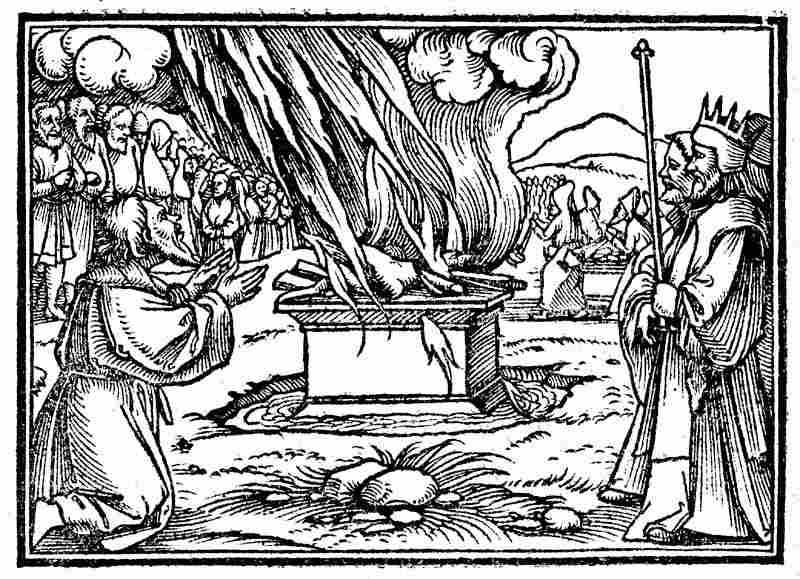
Elijah and Ahab at Mt. Carmel, Zurich Bible, 1531

The haftarah reading for this week is a story in the first book of Kings about the prophet Elijah staging a contest between himself and the prophets of Baal to find out whose god is the real one.  Elijah’s God wins by sending down fire to ignite the waterlogged sacrifice Elijah sets out on his altar.  The priests of Baal get no such miracle, even though they work themselves into an ecstatic frenzy.

Most of the bible’s rational prophets, from Moses to Elijah to Zechariah, have an initial experience of God, and then keep on hearing from God for the rest of their lives—because God keeps on wanting them to communicate to the general population.

Abraham, in the book of Genesis, also has a number of rational conversations with God, including personal blessings, directives, and one prediction: that his descendants will be enslaved in a foreign land for 400 years, then go free with great wealth.1  But unlike later prophets, Abraham does not share this prediction with anyone else.

His son Isaac and his grandson Jacob also hear God giving them personal blessings.2  Jacob also receives divine information about what will happen in the future—but not until he is on his deathbed.

I noticed this week, as I approach the end of the book I am writing on moral psychology in Genesis, that Jacob delivers prophecies in two of his three deathbed scenes.  In his first deathbed scene, Jacob makes Joseph swear to bury him in the family plot in Canaan.  In his second deathbed scene, Jacob adopts Joseph’s two sons, Menasheh and Efrayim, by:

  1. declaring that they are now his (and will therefor get shares of his inheritance),
  2. symbolically hugging them to his knees, and
  3. giving them a formal blessing, with his hands resting on their heads.
Jacob blesses Ephraim and Manasseh, by Owen Jones, 1869

His right hand is supposed to go on the head of the firstborn (Menasheh), but Jacob crosses his arms so that his right hand will be on Efrayim’s head.  This bothers Joseph.

And Joseph said to his father: “Not thus, my father, because this one is the firstborn! Put your right hand on his head.”  But his father refused to, and he said: “I know, my son, I know.  He, too, will become a people, and he, too, will be great.  However, his younger brother will be greater than he, and his descendants will be abundant enough to fill nations.”  And he blessed them that day, saying: “By you [the people of] Israel will give blessings, saying: God will make you like Efrayim and Menasheh.”  And he put Efrayim before Menasheh. (Genesis 48:18-20)

The author of Genesis knows that centuries later, the tribe of Efrayim would have more people than the tribe of Menasheh, and produce the kings of the northern kingdom of Israel.  But how does Jacob know this?  Because, later commentators explained, God gave him the gift of prophecy.

In his third deathbed scene, Jacob summons his twelve sons to his bedside.

And he said: “Gather and I ill tell you what you will encounter be-acharit hayamim.” (Genesis 49:1)

be-acharit (בְּאַחֲרִית) = in an end, when afterward, as an aftermath, in the future.

hayamim (הַיָּמִים) = (literally) the days; (as an idiom) a long period of time.

First Jacob brings up his son Reuben’s past crime of incest with his father’s concubine Bilhah, and says he will no longer take precedence as the firstborn.4  This seems to be a personal consequence for Reuben, but later in the bible the tribe of Reuben is sidelined as Efrayim becomes the dominant tribe of the northern kingdom.

Jacob then gives prophecies about what will happen in the distant future to the eponymous tribes of his remaining eleven sons. Some of Jacob’s prophetic poems include predictions that come true later in the bible; for example, the tribe of Judah does provide the kings of the southern Israelite kingdom, and the tribes of Shimon and Levi do not own territories of their own.  Other prophecies apparently refer to stories that have been lost, and still mystify commentators.

When I read about how God drives some of the prophets to do their ordained work whether they wanted to or not, I think God is kind to Jacob by giving him prophecies to utter only at the end of his life.

  1. Genesis 15:13-16.  I am not counting God’s statement that Sarah would conceive (Genesis 17:16 and 18:10), since it counts as either a personal blessing or a performative utterance (God being the opener of wombs).
  2. Isaac in Gen 26:2-4 and 26:24, Jacob in a dream in Gen 28:11-16 and directly in Gen 35:9-13.
  3. Genesis 48:14.
  4. Genesis 49:3-4.

Vayechi: Serial Sobber, Part 2

Joseph Dwells in Egypt,
by James J.J. Tissot

What kind of person is Joseph in the book of Genesis/Bereishit?  Does he forgive his ten older brothers for selling him as a slave, or does he fail to notice that they need to be pardoned?1  Does he set up his elaborate charade to test them, or to punish them?2  Why, once he has been elevated from prison slave to viceroy of Egypt, does he fail to let his father know he is alive and well?3

These questions can be interpreted many ways.  But one thing is clear: Joseph is often moved to tears.  He sobs eight times in the book of Genesis, more than any other character in the Torah.

When an adult sobs, it is often an emotional release triggered by some change in the sobber’s perception of circumstances.  Not every adult reacts with tears, but those who do can understand Joseph, who has to work to restrain himself in moments of high emotion.

I discussed the first five times Joseph breaks down and cries in my post Mikeitz & Vayiggash: Serial Sobber, Part 1.  He sobs once when he overhears his older brothers privately acknowledge their guilt for selling him, and realizes they have changed.   He sobs a second time when he first sees his little brother Benjamin after 21 years.  And he sobs three times after Judah, the leader of the ten older brothers, proves his character is completely transformed: once right after Judah speaks, once when he embraces Benjamin, and again when he embraces his older brothers.

But his tears are not exhausted.  Joseph sobs three more times in the last Torah portion of Genesis, Vayechi (“and he lived”).

Sixth sob

Joseph and Jacob Reunited,
by Owen Jones

After he has revealed his identity and wept upon the necks of all his brothers, Joseph invites them to move to Egypt along with their father, Jacob (also called Israel), and their whole extended family.  They arrive in Goshen, the area of the Nile delta that Joseph picked out for them, and Josephs rides his chariot there to greet his father.

And [Joseph] fell upon his neck, vayeivek upon his neck again and again.  And Israel said to Joseph: “This time I may die, after I have seen your face, that you are still alive.” (Genesis 46:29-30)

vayeivek (וַיֵּבְךְ) = and he sobbed, and he wept audibly.  (From the root verb bakahבָּכָּה, wept, shed tears.)

In last week’s Torah portion, when Joseph falls on Benjamin’s neck and weeps, Benjamin reciprocates.  Joseph is probably sobbing with joy over being reunited with his innocent younger brother, now that he can be himself instead of pretending to be an Egyptian.  Benjamin is probably sobbing with relief that the threatening Egyptian viceroy has turned into a long-lost brother who wishes him well.4

Joseph weeps on the necks of his other brothers because he finally accepts them as brothers rather than enemies.  They have passed his tests and proven they have become better men; and Joseph has reinterpreted their original crime as a necessary step toward a happy ending in Egypt.  His older brothers, however, do not weep along with Joseph; they are still too anxious.  But they are able to speak to him face to face.5

In this week’s portion, when Joseph weeps on the neck of his father, what change causes his emotional release?  In my post Vayeishev: What Drove Them Crazy, I argue that for years Joseph resented his father for making his ten older brothers hate him.

Jacob Blesses Joseph and Gives him the Coat, by Owen Jones

When he was an adolescent, Jacob not only showed blatant favoritism by giving Joseph alone a fancy new coat, but also regularly asked the boy to check up on his older brothers and report back.  The last time Jacob sent Joseph out to inform on his brothers, they threw him in a pit, discussed killing him, and sold him into slavery.  Joseph named his second son Menashe because he wanted to forget his whole family in Canaan, including his difficult father.6  So for 21 years he sent no message to Jacob, even after he was elevated to the position of viceroy.

Does Joseph discard his resentment now because the sight of his father reminds him of the good times in his childhood before things went south?  Or do his feelings suddenly change when he sees that his father, whom he used to obey as a dependent, is now merely the superannuated elder of a starving Canaanite family?  Joseph is the one in charge now, and he can enjoy being magnanimous to a father who is now dependent on him.  Maybe he weeps on Jacob’s neck with joy and relief that the tables have turned.

Jacob, on the other hand, stands there dry-eyed, even though he mourned over Joseph’s apparent death for 21 years.  I believe that seeing Joseph alive and well (not to mention rich and powerful) is a happy occasion for Jacob, but he is emotionally worn out.  He has no tears left.  Instead of feeling rejuvenated, Jacob declares that he can now die in peace.

At age 39, Joseph has the energy to sob with relief at the reversal in his relationship with his father.  His father, at age 130, is too exhausted to sob any more.

Seventh sob

Jacob lives for another 17 years.  Shortly before his death he includes Joseph’s first two sons in his inheritance; speaks to each of his own twelve sons; and requests burial in the cave of Machpelah in Canaan, next to his first wife (Leah), his parents, and his grandparents.

And Jacob finished giving orders to his sons, and he gathered up his feet into the bed, and he was gathered to his people.  Then Joseph fell on his father’s face, vayeivek upon him, and he kissed him.  (Genesis 49:33-50:1)

For the last seventeen years Joseph has been taking care of the old man, secure in his role as the provider rather than the vulnerable dependent.  This makes it easy for him to feel love toward Jacob and cry at his death.  He also knows that his own life will change now that he is no longer responsible for his father.

Jacob is Buried, by Owen Jones

And he may feel some lingering guilt over his earlier period of neglect.  The Torah says Joseph has his father embalmed according to the complete 40-day process.  The mourning period for Jacob lasts for 70 days—40 days during the embalming plus the traditional Israelite mourning period of 30 days.7

Next Joseph asks the pharaoh’s permission to bury Jacob in the cave of Machpelah in Canaan.  Pharaoh consents, and all twelve brothers accompany Jacob’s body to the burial place, along with an honor guard of Egyptian soldiers.

Why does Joseph arrange such a big display over Jacob’s death?  Maybe he sobbed when his father died because he suddenly realized it was too late to apologize or compensate Jacob for letting him suffer for so many years over the supposed death of his favorite son.

Final sob

All twelve brothers return to Egypt after Jacob’s burial.  Then the ten oldest ones worry that maybe Joseph refrained from taking revenge on them only because their father’s presence.  They send messengers to Joseph with instructions to tell him:

“Please pardon, please, the transgression of your brothers and their guilt, because they did evil to you.  And now pardon, please, the transgression of the servants of the God of your father.”  Vayeivek, Joseph, when they spoke to him.  (Genesis 50:17-18)

Joseph breaks into tears because he feels as if he took God’s point of view considering their crime, but now he learns that they still think of him as a potential avenger.  He probably feels hurt that they do not trust him.

And his brothers also went and fell down in front of him and said: “Here we are, your slaves.”    Then Joseph said to them, “Don’t be afraid, for am I instead of God?  And you, who designed evil against me; God redesigned it for good, in order to keep alive a large number of people to this day.”  (Genesis 50:19-20)

Then he goes a step farther than he had seventeen years before.

“So now don’t be afraid.  I will feed you and your little ones.”  And he comforted them and he spoke to their hearts.  (Genesis 50:21)

Even without explicit forgiveness, even though he insists on his role as benefactor, Joseph manages to reassure his brothers that they are safe in his hands.  But the they still do not weep.


A change that moves one person to tears may leave the other one dry-eyed.  Even when two people are both sobbing, they may have different reasons for their tears.

May we all be blessed with awareness and acceptance of the differences between ourselves and the people we are connected with.  If we cry, may we be blessed with tears of relief, and even joy.  And if tears do not come, may we find comfort when relationships change.


  1. See my posts Vayiggash & Vayechi: Forgiving? and Vayeishev & Mikeitz: A Narcissist in the Pit and Vayiggash: Near a Narcissist.
  2. See my post Mikeitz & Vayiggash: Testing.
  3. See my post Mikeitz: Forgetting a Father.
  4. See my post Mikeitz & Vayiggash: Serial Sobber, Part 1.
  5. At the beginning of the Joseph story, when Joseph is 17, the Torah says:  And his brothers saw that their father loved him more than all his brothers, and they hated him, and they were not able to speak to him in peace. (Genesis 34:4)  Now they can.
  6. Genesis 41:51.
  7. The Torah adds that the Egyptians wept with Joseph for 70 days (Genesis 50:3). Some traditional commentary claims that the Egyptians were honoring Jacob because the famine ended when he arrived in Egypt, only two years after it began instead of the seven years God had originally planned.  Yet the Torah describes Joseph impoverishing the Egyptians during the famine in three stages, each lasting at least a year.  So I think the Egyptians mourn for Jacob because Joseph, the viceroy, orders them to do it.


Vayechi: Three Tribes Repudiated

Jacob/Yaakov delivers his last words to his twelve sons in this week’s Torah portion, Vayechi (“And he lived”).

Jacob on his Deathbed,
1539 woodcut

And Jacob called his sons and he said: “Gather, and I will tell you what will happen to you in future times.”  (Genesis/Bereishit 49:1)

Jacob, also called Israel, then launches into a long poem about the fate of the twelve tribes named after his twelve sons.1  This poem resembles the poems in the books of prophets transmitting God’s warnings and plans from the divine point of view.  Jacob pauses once to cry out: “I wait for your deliverance, God!”2  This interruption only makes the rest of his poem sound more like a direct divine prophecy.

When Jacob finishes his poem, the Torah says:

All these were the twelve tribes of Israel, and this is what their father spoke to them.  Vayevarekh them, each with what was kevirkhato he blessed them.    (Genesis 49:28)

vayevarekh (וַיְבָרֶךְ) = and he blessed.  (A form of the verb beirakh, בֵּרַךְ = bless; bestow or wish on someone the achievement of something desirable.  In the Torah, the achievement is most often prosperity, success in battle, or fertility.)

kevirkhato (כְּבִרְכָתוֹ) = according to his own blessing.  (From the same root as beirakh.)

Immediately after this sentence about blessings, Jacob gives instructions for his burial, draws his feet into the bed, and dies without mentioning any of his sons’ names again.3  So the prophecies about the twelve eponymous tribes must also be the blessings.

Except for the first three sons, this is a reasonable interpretation.  Jacob blesses his fourth son (or his tribe), Judah/Yehudah, with future kingship, success in battle, and fertile vineyards.4  Zebulun, he says, will succeed in shipping, and Issachar in farming.5  He compares Dan to a snake, but at least he declares the tribe will remain part of the land of Israel.6  Gad and Benjamin/Binyamin will be successful in raiding, Asher will be wealthy, and Naftali beautiful.7  Jacob blesses Joseph/Yoseif with overall success and prosperity.8

Yet Jacob’s first three sons appear to get curses instead of blessings.

by Marc Chagall, stained glass

Reuven, my first-born are you,

my vigor and the first fruit of my potency,

Exceedingly noble,

       exceedingly fierce!

Heedless as water, you will no longer exceed,

       for you mounted your father’s bed.

That was when you desecrated it.  My couch he mounted!  (Genesis 49:3-4)

Jacob refers to a specific incident in Genesis.  After the death of Jacob’s favorite wife, Rachel, Reuven has intercourse with Bilhah, Rachel’s servant and Jacob’s concubine.9  Reuven may  hope to become the family’s leader through an ancient custom by which the new ruler assumes his office by having sex with the old ruler’s concubines.10  Reuven is the firstborn son, and therefore normally entitled to become the head of the extended family after his father’s death. But although Jacob is at least 119 years old, his own father is still alive, and does not die until he is 180.  Reuven may prefer not to wait.  (It would have been a long wait; Jacob dies in this week’s Torah portion at age 147.)

Because of that undisciplined and defiant act, Jacob declares that Reuven is unfit for leadership.

by Francisco Coelho, 1675

In the biblical tradition, leadership would then pass to the next oldest son.  But Jacob rules out both his second son, Shimon, and his third son, Levi.

Shimon and Levi are partners;

Weapons of violence are their wares.

Don’t let my soul be brought into their council!

Don’t let my honor be reckoned by their assembly!

by Marc Chagall, stained glass

For in their rage they murder a man,

and in their desire they uproot a wall.11

Accursed be their fury because it is fierce,

and their wrath because it is remorseless!

I will split them up in Jacob,

and I will scatter them in Israel.  (Genesis 49:5-7)

Since Jacob condemns Reuven on the basis of an incident during his lifetime and reported in the bible, the reader expects him to cite another such incident as his reason for criticizing Shimon and Levi.  The closest match is when the two brothers trick the rulers of Shekhem, enter the town as friends, murder the man who raped their sister Dinah, kill all the other men, destroy the town, and carry off the booty.  No doubt some walls fell.  (See my posts Vayishlach: Change of Heart, Part 1 and Part 2.)

Then Jacob said to Shimon and Levi: “You made me shunned, odious among the inhabitants of the land!”  (Genesis 34:30)

On his deathbed, Jacob attributes Shimon and Levi’s violence to the intensity of their anger.  When he says “I will split them up in Jacob” the “I” is God, the “Jacob” is an alternate name for the territory of Israel, and the need to split them up may imply that they are more dangerous when they are together and their fiery natures combine in a conflagration of rage.

Having eliminated Reuven, Shimon, and Levi with his prophetic curses, Jacob announces that the descendants of his fourth son, Judah, will be king over other Israelites.


Only some of the predictions in Jacob’s deathbed poem come true according to the history of the twelve tribes in the rest of the Hebrew Bible.  This is normal for biblical prophecies, which are often warnings of what will happen unless certain people change their ways.  In this case, the prophecy about Judah “comes true”; the second king of a united Israel is David, from the tribe of Judah, and his descendants continue to rule even after the northern kingdom secedes from the southern kingdom of Judah.

12 Tribes according to Joshua

The tribe of Reuven is part of the northern kingdom, but its members live in the land east of the Dead Sea, which is sometimes ruled by the Moabites who also live there.12  The tribe of Shimon occupies an enclave within the southern desert of the Kingdom of Judah, and is “scattered” only in the sense that all desert nomads are scattered.13  The tribe of Levi consists of hereditary priests and other religious functionaries.  In the book of Joshua, the Levites are assigned 48 towns in the territories allotted to the other tribes, including a few in the territory of Shimon.14  So the Levites are indeed scattered, but they are not entirely split apart from the Shimonites.

From the viewpoint of the stories in Genesis, however, Jacob’s deathbed prophecies  assign appropriate consequences for the behavior of Jacob’s first three sons.

Reuven’s attempts to take leadership, both when he beds Bilhah and when he acts regarding Joseph, are undisciplined and poorly thought out.  His eponymous tribe is cursed with never producing a king; but it gets the blessing of being a member tribe of the northern Kingdom of Israel, a.k.a. Samaria.

Since Shimon and Levi are the ringleaders in the disaster at Sheckhem, their tribes are cursed with being too scattered to lead their brother tribes into trouble again.  Yet their scattering is also a blessing; the nomadic tribe of Shimon is protected by Judah, and the Levites become a caste of priests and clerics with authority throughout Israel.

I think Jacob’s first prophecies are indeed blessings.  When people have been bad leaders, it is a blessing for them, as well as for their followers, to have their leadership removed—and for the former leaders to continue to be included in the larger community, like Reuven and Shimon.

by Francisco Coelho, 1675

As for Levi, it is a great blessing when people who are inflamed by intense feelings do wrong, are stripped of leadership, and then change their hearts and apply their passionate natures to positive acts for a good cause.

May we all “bless” leaders with their appropriate fates, as Jacob did.  May we work to remove leadership from those who abuse it.  May we accept all human beings as flawed but precious individuals.  And may we be able to recognize when others have truly changed.


  1. Jacob’s wives name his first eleven sons in Genesis 29:31-30:24; Jacob names his twelfth son Benjamin/Binyamin in Genesis 35:18. The first mention of “twelve tribes’ in the bible is in Genesis 49:28, at the end of Jacob’s poem.  Elsewhere in the Torah there are always twelve tribes, but they are not always identical with the names of Jacob’s twelve sons.  Whenever Shimon or Levi is omitted from the list, then Joseph is replaced by tribes named after his own two sons (adopted by Jacob), Efrayim and Menasheh.
  2. Genesis 49:18.
  3. Genesis 49:29-33.
  4. Genesis 49:8-12.
  5. Genesis 49:13-14.
  6. Genesis 49:16-17.
  7. Genesis 49:19-21, 27.
  8. Genesis 49:22-26. (Jacob’s references to God as “Shaddai” and blessings from “the heavens above” echo Isaac’s blessing of Jacob in Genesis 27:28 and 28:3.)
  9. Genesis 35:22.
  10. Absalom slept with King David’s concubines for that purpose in 2 Samuel 16:21-22.
  11. Another legitimate translation of the third couplet is some version of:

For in their rage they murder a man,

              and in their desire they cripple an ox.

How can the last two words be translated as either “uproot a wall” or “cripple an ox”?  In the Masoretic text the phrase is עִקְּרוּ שׁוֹרIkru (עִקְּרוּ) = uproot, cripple.  Shor (שׁוֹר) = bull, ox, steer.  The Masoretic text is based on earlier scrolls that did not use vowel pointing.  Although translations generally assume the Masoretes assigned the correct vowels to the words in the bible, Robert Alter makes a case that in Genesis 49:6 a better reading of the final word is shur (שׁוּר) = wall.  (Robert Alter, The Five Books of Moses, W.W. Norton & Co., New York, 2004, p. 284.)

  1. Numbers 32:1-32, Joshua 2:1-7, 1 Chronicles 5:18-22.
  2. Joshua 19:1-9.
  3. Joshua 21:4.