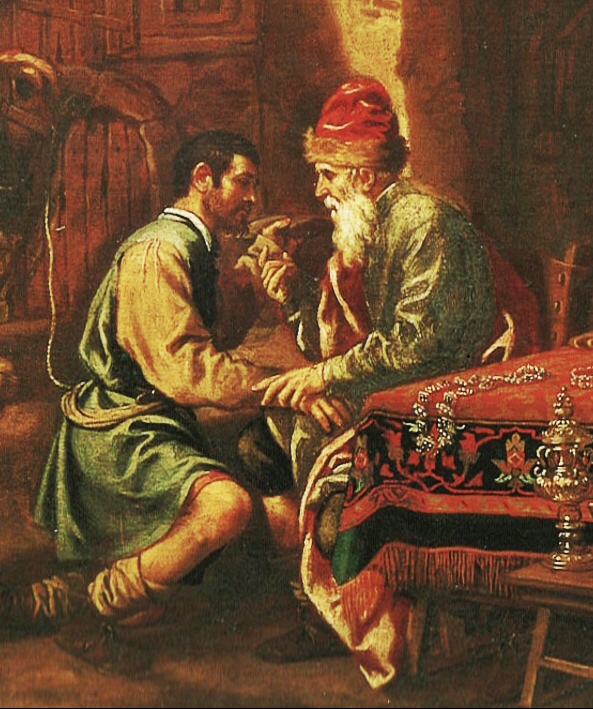
Vayechi: Death and Inheritance

The book of Genesis/Bereishit begins with the creation of the world, then narrows in on one paternal line headed by Abraham. It ends with the death of Abraham’s great-grandson Joseph.

The characters in the Torah do not hope for life after death.1 What men in the patriarchal society of the Ancient Near East seem to want most is male descendants to inherit their names and their land. (Names were inherited because instead of a modern last name, a man with the given name Aaron was called Aaron ben (father’s given name). If he had an illustrious grandfather, he was called Aaron ben (father’s given name) ben (grandfather’s given name).2)

Key blessings in the book of Genesis include:

“And I will make you a great nation, and I will bless you, and I will make your name great …” (Genesis 12:2, God to Abraham)
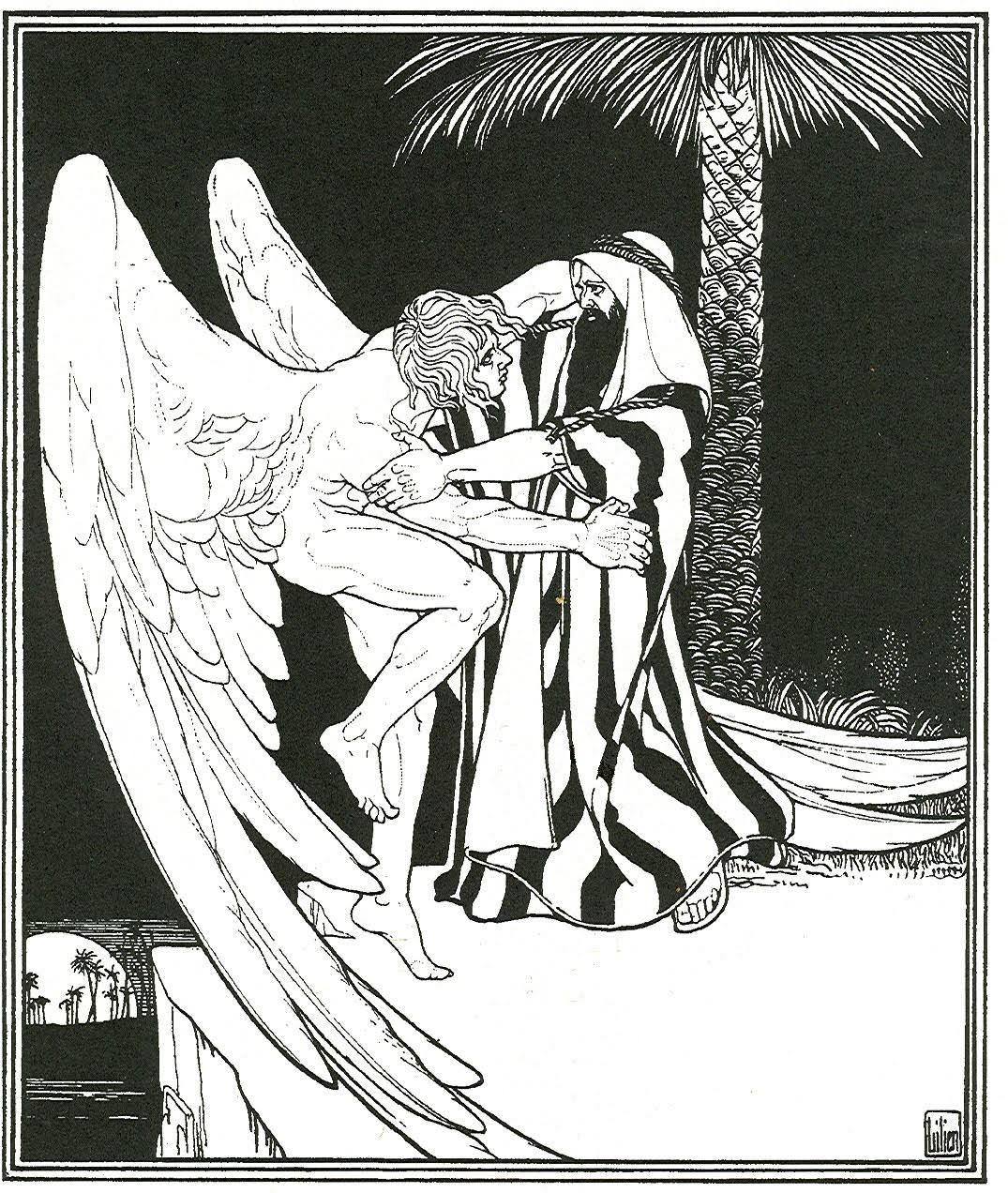
Abraham, by Ephraim Moshe Lilien, 1908

“Please look toward the heavens and count the stars, if you are able count them.” And [God] said to him: “So your zera will be!” (Genesis 15:5, God to Abraham)

zera (זֶרַע) = your seed, your offspring, your descendants.

“I will make your zera abundant as the stars of the heavens, and I will give to your zera all these lands, and all the nations of the earth will bless themselves by your zera.” (Genesis 26:4, God to Isaac)

“May God bless you and make you fruitful and numerous, and may you become an assembly of peoples.” (Genesis 28:3, Isaac to Jacob)

“Your zera will be like the dust of the earth, and you will spread out to the west and to the east and to the north and to the south.” (Genesis 28:14, God to Jacob)

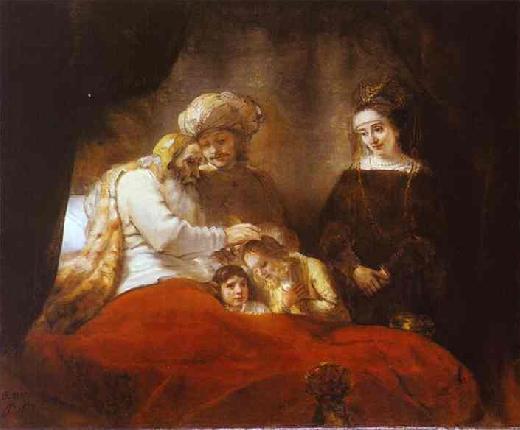
In this week’s Torah portion, Vayechi (“And he lived”, Genesis 47:28-50:26, the last portion in the book of Genesis), Jacob concludes his deathbed blessing of two of his grandsons by saying:

“May [God] bless the boys, and may my name be called through them, and the name of my fathers Abraham and Isaac!”

Since descendants are so important, when the patriarchs Abraham, Isaac, and Jacob are approaching death they all leave something to their sons. But what they give their sons differs according to the personality of the father.

Abraham

When Abraham is in his early 100’s, his behavior toward both his sons appalls me. He obeys when God tells him to disinherit and cast out his son Ishmael, along with the boy’s mother—and he sends them off into the desert with only some bread and a single skin of water. Since God has promised to make a nation out of Ishmael, he can assume his older son will survive, but why make him start a new life with so little? (See my post: Vayeira: Failure of Empathy.)

Some years later, Abraham hears God tell him to slaughter his son Isaac as a burnt offering. He neither argues with God, nor asks a single question. Isaac, a grown man, trusts his father and lets himself be bound on the altar. (Therefore Jews call this story the Akedah, the binding.) Only when Abraham’s knife is at his son’s throat does God call it off.3 But after God sends a ram as a substitute sacrifice, Isaac disappears from the story, and we never see him in the same place as his father again, not even at the funeral of Sarah, Abraham’s wife and Isaac’s mother. And although God blesses Abraham once more while the ram is burning, God does not speak to Abraham again after that.

Sarah’s Burial, by Gustave Dore, 1908

During the remainder of his life, Abraham devises his own plans for the future, including buying a burial cave for the family after his wife Sarah dies,4 and arranging a marriage for Isaac. He is over 137 when he takes a new wife and sires six more sons. He then does some careful estate planning:

And Abraham gave everything that was his to Isaac. But to the sons of the concubines that Abraham had, Abraham gave gifts, and he sent them away from his son Isaac while he was still alive, eastward, to the land of the East. (Genesis 25:5-6)

He dies at age 175.

Then he expired. And Abraham died at a good old age, old and saveia; and he was gathered to his people. (Genesis 25:8)

saveia (שָׂבֵעַ) = full, satisfied, sated, satiated. (From the root verb sava, שָׂבַע = was satisfied, was satiated, had enough.)

He has a right to be satisfied; he has done his part to further God’s plan for Isaac’s descendants to inherit the land of Canaan, and he has also provided for his other children.

Isaac

Like his father Abraham, Isaac does not own any land except for the burial cave, but he is wealthy in livestock and other movable property. He has two sons, the twins Esau and Jacob. By default, two-thirds of his property would go to his son Esau, who is older by a few seconds, while one-third would go to his son Jacob. Isaac does not makes any other arrangement for his estate.

Isaac is more interested in God than property. He takes care of his flocks, but unlike Abraham he makes no effort to increase them. He willingly lets Abraham tie him up as a sacrificial offering to God in the Akedah. And unlike Abraham, he pleads with God to let his long-childless wife conceive.5

At age 123, Isaac is blind and cannot stand up. He believes he will die soon, and he wants to deliver a formal deathbed blessing to at least one of his sons. Perhaps he views a blessing as a prayer, since the first of the three blessings he delivers begins “May God give you”, and the third begins “May God bless you”.6 What Isaac most wants his sons to inherit is God’s blessings.
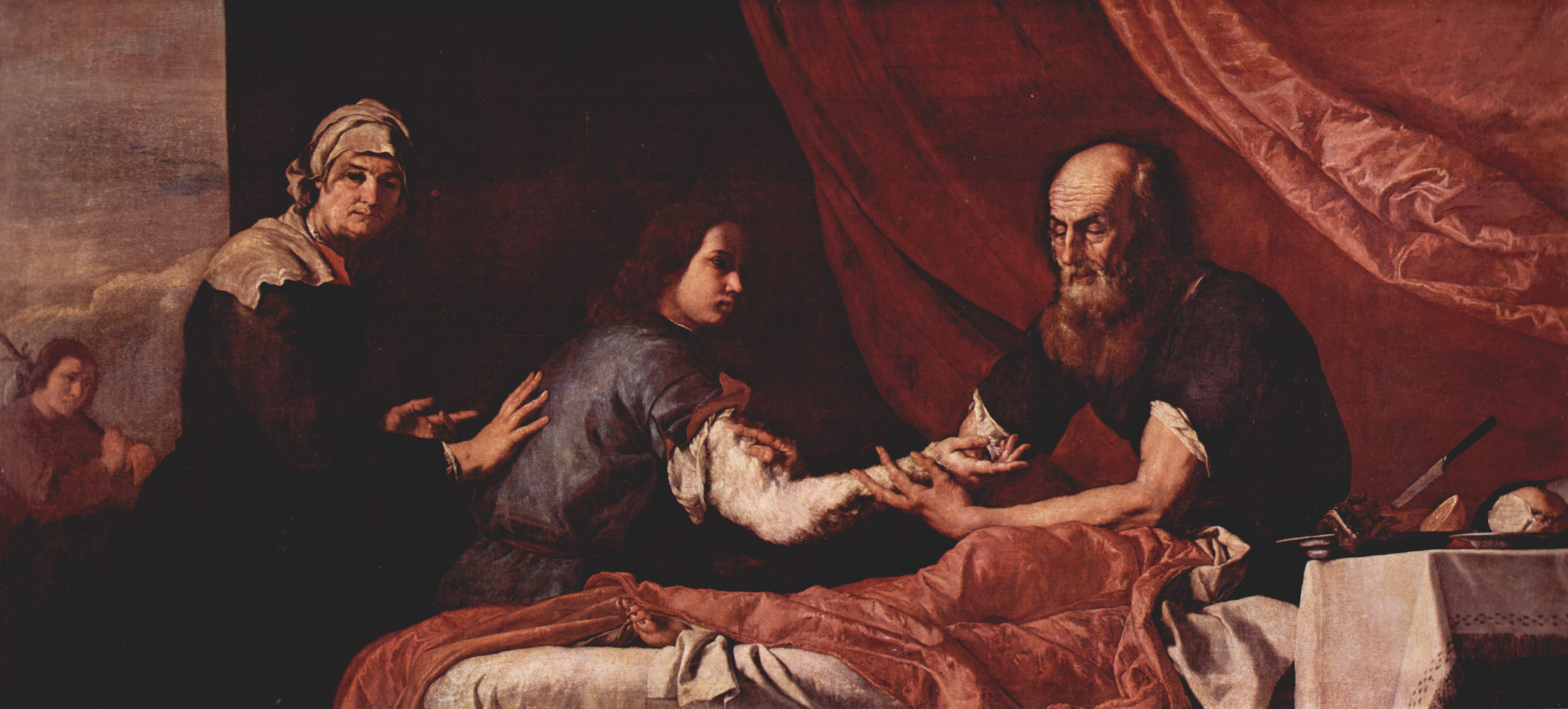
Isaac Blessing Jacob, by Jusepe de Ribera, 17th c.

Alas, his wife Rebecca does not trust him to give the right blessing to the right son, so she cooks up a deception that results in Jacob leaving home. Later Esau also leaves. But Isaac lingers on, presumably still blind and bedridden, until he finally dies at age 180.

Then Isaac expired. And he died, and he was gathered to his people, old useva in days. And his sons Esau and Jacob buried him. (Genesis 35:29)

useva (וּשְׂבַע) = and he was satisfied, and he was satiated, and he had had enough. (From the perfect form of the verb sava.) Although Isaac lives even longer than his father, the phrase “at a good old age” is not included in the description of his death. My best translation for the word useva in this verse is: “and he had had enough”. Isaac has spent more than enough time waiting for death.

Jacob

Abraham focused on leaving his sons property. Isaac focused on leaving his sons blessings from God. Isaac’s son Jacob assigns both property and blessings at the end of his life, as well a prophecies and directions for his own burial.

He has twelve children, but he only cares about the two youngest, Joseph and Benjamin. His ten older sons sell Joseph as a slave bound for Egypt, then trick their father into believing that Joseph was killed by a wild beast. Jacob mourns for years. He is 130 years old when he finds out that Joseph is still alive and has become the viceroy of Egypt.  He exclaims:

“Enough! My son Joseph is still alive. I will go and see him before I die!” (Genesis 45:28)

In this week’s Torah portion, Vayechi, Jacob lives for another 17 years in Egypt as Joseph’s dependent. It is unclear whether he has an estate to leave; does he still have some claim over the herds and flocks his other sons are tending? And could he still claim the land he purchased long ago at Shekhem, the town that his older sons destroyed?7

Although it is not clear what Jacob’s estate consists of, he gives Joseph the equivalent of a double portion of it by formally adopting Joseph’s two sons, Menasheh and Efrayim.8

Jacob Blesses Ephraim and Manasseh, by Owen Jones, 1865

Then, perhaps in imitation of his own father, Isaac, Jacob gives Menasheh and Efrayim blessings. In the first blessing he asks God to give them lots of descendants, and in the second he predicts that their descendants will bless their own children in their names.9

In the next scene, Jacob calls all his sons to his deathbed. To each one he delivers not a blessing, but a prophecy. Some of the prophecies refer to stories in Genesis about Jacob’s sons. Others have nothing to do with the characters in Genesis, but may refer to their eponymous tribes.10

Before arranging his estate, giving blessings, and delivering prophecies, Jacob makes Joseph swear to bury him in Canaan, in the family burial cave. After he finishes his prophecies, he repeats these burial instructions to all his sons before he dies at age 147.11

Then Jacob finished directing his sons, and he gathered his feet into the mitah, and he expired, and he was gathered to his people. (Genesis 49:33)

mitah (מִטָּה) = bed of blankets. (From the same root as mateh, מַטֶּה = staff, stick, tribe.)

The text does not say that Jacob is satisfied or has had enough. But the sentence describing his death may imply that he gathered himself into the tribes he had created, before he was gathered by death. After Jacob dies, all twelve of his sons take his embalmed body up to the family burial cave in Canaan.

Although Jacob was selfish as a young man, cheating his brother out of his firstborn rights, at the end of his life he is absorbed with details concerning the future of the sons and grandsons he is leaving behind.

Joseph

Twice Joseph tells his brothers that they should not feel guilty about selling him as a slave bound for Egypt because that was part of God’s master plan for bringing Jacob’s whole clan down to Egypt.12 (See my post: Vayigash & Vayechi: Forgiving?) On his deathbed, Jacob is still thinking about God’s master plan.
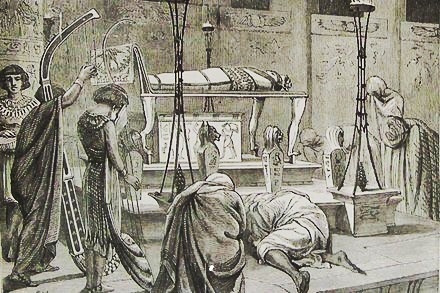
Burying the body of Joseph, the 1890 Holman Bible

And Joseph said to his kinsmen: “I am dying, but God will definitely take account of you, and bring you up from this land to the land that [God] swore to Abraham, to Isaac, and to Jacob.” And Joseph made the sons of Israel swear, saying: “God will definitely take account of you; then bring up my bones from here!” And Joseph died, 110 years old. And they embalmed him and they put him in a coffin in Egypt.  (Genesis 50:24-26)

Thus ends the book of Genesis. Joseph is not described as satisfied, or even as being gathered to his ancestors. He is focused not on his immediate family, but on the distant future of his whole clan. His only deathbed act is to make all the men in his family swear to pass on the information that someday his bones must be buried in Canaan. This promise will serve as a reminder that someday the descendants of Jacob, a.k.a. Israel, must return to the land that God promised to them.


I think Abraham believes his estate is important because he is wealthy, and he wants peace between his sons. Isaac believes his blessings are important because he wants God to help his sons. Jacob believes his estate and his blessings are important because he has a history of cheating and being cheated, and he does not want to leave anything to chance. And Joseph believes God’s master plan for the whole clan of Israel is the most important thing, so he only wants the clan to remember to bury him in Canaan.

I suspect that when I am close to death, I will believe the most important thing is to let the remaining members of my family know that I loved them. It might not make much practical difference, but I remember the reports of all those phone calls when the Twin Towers fell in New York City, and those who were about to die spent their last minutes saying “I love you”. When no inheritance is at stake, and God does not interact directly in the world, we have only our personal words of blessing to leave.


  1. The Torah says people’s souls go down to Sheol when their bodies die, but does not imagine any life for those souls, only a sort of endless cold storage.
  2. Ben (בֶּן) = son of. Bat (בַּת) = daughter of.
  3. Genesis 22:1-19. See my post: Vayeira: On Speaking Terms.
  4. Genesis 25:12-18 describes Abraham’s purchase of the cave of Machpeilah near Mamrei, where Sarah died.
  5. Genesis 25:21.
  6. Genesis 27:28 and 28:4.
  7. Genesis 33:18-19 and 33:25-30.
  8. See my post: Vayechi & 1 Kings: Deathbed Prophecies.
  9. Genesis 48:13-20. The blessing “May God make you like Efrayim and Menasheh” is still in use among Jews.
  10. See my posts: Vayechi: First Versus Favorite, and Vayechi: Three Tribes Repudiated.
  11. Genesis 47:29-31 and 49:29-30.
  12. Genesis 45:5-8 and 50:18-20.
Vayechi, Chayei Sarah, & Vayishlach: A Touching Oath

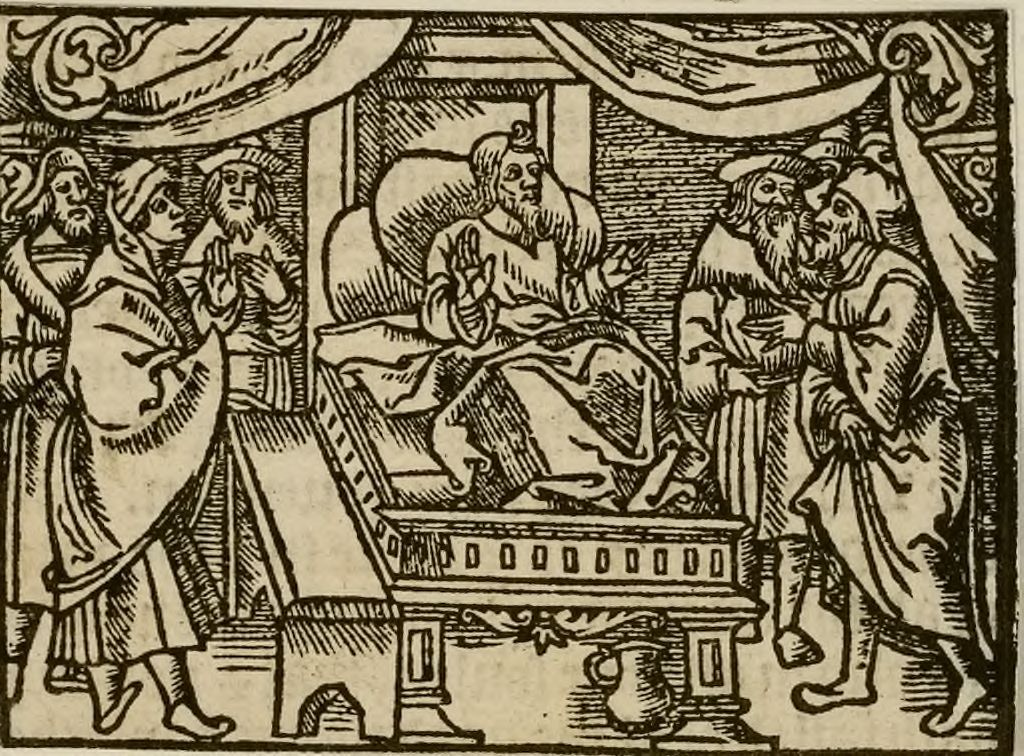
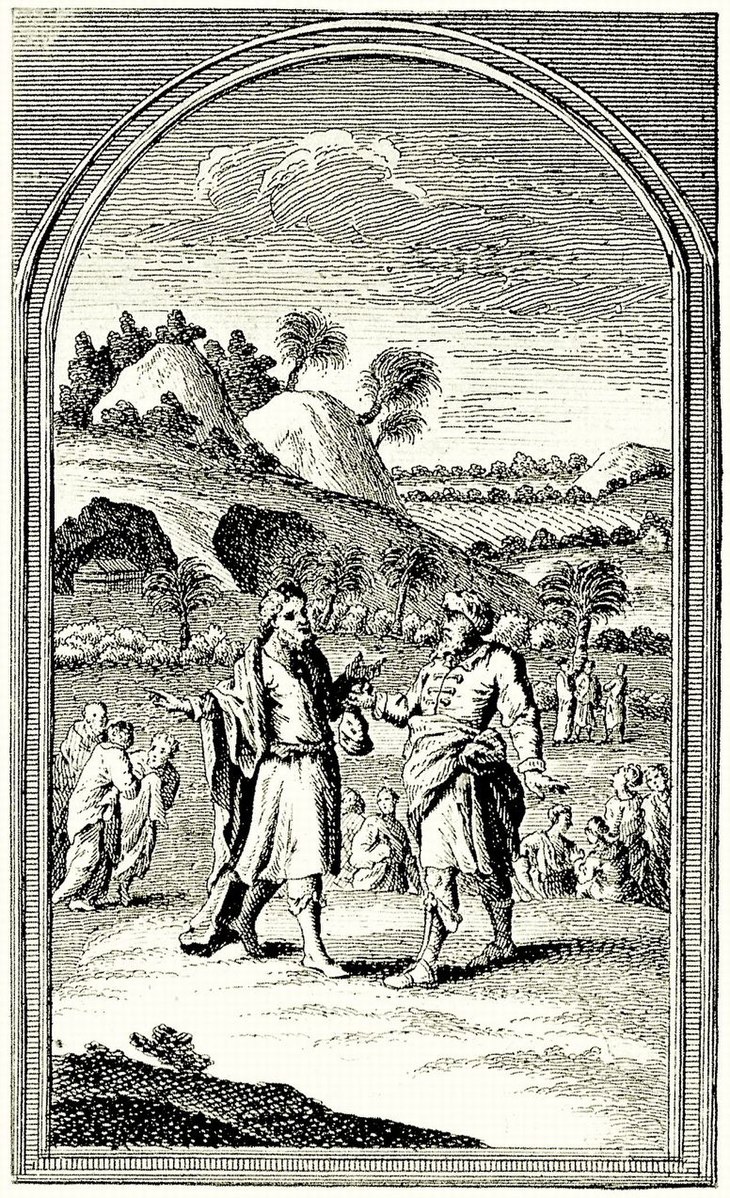
Jacob on his Deathbed, 1539 woodcut

This week’s Torah portion, Vayechi (Genesis 47:28-50:26), begins:

And Jacob lived in the land of Egypt seventeen years; and the years of Jacob, the years of his life, were 147 years. The time for Israel to die approached, and he called for his son, for Joseph …  (Genesis/Bereishit 47:28-29)

Jacob acquired a second name, Israel, in an earlier portion of the book of Genesis, Vayishlach, when he wrestled with a mysterious “man” all night before his reunion with Esau, the brother whom Jacob had cheated twenty years before.

Becoming Israel

In Vayishlach, Esau was approaching with 400 men, and Jacob was terrified that his brother would attack his camp for revenge. He prayed, he sent generous gifts ahead on the road, and he moved his whole household and all his possessions across the Yabok River. Then Jacob spent the night on the other side.

And Jacob was left alone. And a man wrestled with him until dawn rose. And he saw that he had not prevailed against [Jacob], so he touched the socket of his yareikh, and the socket of Jacob’s yareikh was dislocated when he wrestled with him. (Genesis 32:25-26)

yareikh (יָרֵךְ) = loin, i.e. hip, buttocks, upper thigh, or genitals (depending on the context).

One cannot actually touch the socket inside a human hip—unless, perhaps, one is a supernatural creature. Even with the pain of a dislocated hip, Jacob hangs onto his opponent. The mysterious wrestler is the first to speak.

Jacob Wrestles, by Ephraim Moses LIlien, 1923

Then he said: “Let me go, because dawn is rising.”

But [Jacob] said: “I will not let you go unless you bless me!”

And he said to [Jacob]: “What is your name?”

And he said: “Jacob.”

Then he said: “It will no longer be said that Jacob is your name, but Yisrael. Because sarita with God and with men, and you have prevailed.”

And Jacob inquired and said: “Please tell your name.”

And he said: “What is this, that you ask for my name!” (Genesis 32:27-29)

Yisrael (יִשְׂרָאֵל) = “Israel” in English. Possibly he strives with God, he contends with God. (Yisar,יִשַׂר  = he strives with, he contends with + Eil, אֵל  = God, a god.) On the other hand, the subject usually follows the verb in Biblical Hebrew, so Yisrael could mean “God contends”.)

sarita (שָׂרִיתָ) = you have striven with, you have contended. (From the same root as yisar.)

Gradually the “man” who wrestles with Jacob is revealed as a divine messenger. “Jacob was left alone”—away from any other human beings. “A man wrestled with him”—messengers from God often look like men at first, and can do physical things in our world.1 “You have striven with God and with men”—striving with God’s messenger is the equivalent of striving with God. And protesting that “you ask for my name!”—God’s messengers do not reveal their names in the Torah.2

The two wrestlers in this passage also serve as a metaphor for a narrow human frame of reference wrestling with a broad divine frame of reference—both within Jacob’s psyche. The divine perspective touches an intimate spot, and Jacob emerges from the experience with a new name, and a limp to remind him of what happened.

And the sun rose for him as he passed Penueil, and he, he was limping on his yareikh. (Genesis 32:32)

After this story, the Torah continues to use the name Jacob, but sometimes switches to Jacob’s new name, Israel. Why does it switch from “Jacob” to “Israel” at the beginning of this week’s portion, Vayechi?

Requesting an oath

The time for Israel to die approached, and he called for his son, for Joseph, and he said to him: “If, please, I have found grace in your eyes, then place, please, your hand under my yareikh; and if you would do lasting kindness, you will not, please, bury me in Egypt.  When I lie down with my fathers, and you carry me up from Egypt, my burial place should be in their burial place.” (Genesis 47:29-30)

This is Jacob/Israel’s first deathbed speech. As the self-centered Jacob, he might want to be buried in Bethlehem beside Rachel, the wife who died in childbirth, the wife he loved and mourned for the rest of his life. Or he might even want his sons to bury him in Egypt, where his entire surviving family has emigrated. His beloved son Joseph is a viceroy, so he could buy a deluxe burial site there.

But Jacob does not mention either possibility. As Israel, he knows it will be best for his future descendants if he is buried in the cave of Machpelah, which his grandfather Abraham purchased for a family burial site. This is where Abraham and Sarah, Isaac and Rebecca, and (we learn later in this Torah portion) Jacob’s first wife, Leah, are buried. Reinforcing the importance of that site, the only land in Canaan that his family inherits through the generations, will help Israel’s descendants in Egypt remember that someday they must return to Canaan to fulfill God’s prophecies.

Israel begins his speech to Joseph with extreme formality and politeness, addressing him in his role as the viceroy. The consensus among commentators is that the pharaoh does not want his invaluable viceroy to leave Egypt for even a short visit to Canaan, his homeland.  What if Joseph did not return?  So Israel decides to give Pharaoh an extra reason to let Joseph go to Machpelah. If Joseph has sworn the most solemn oath possible, how could Pharoah make his viceroy dishonor himself by violating it?

Precedent for the oath

So Israel requests the kind of oath that Abraham made his steward swear regarding a bride for his son Isaac. Jacob/Israel knows he will be powerless over his own burial; Abraham, at age 137, was afraid he would not live long enough to make sure his son married one of his relatives from Aram instead of a Canaanite. In both cases, the aged father relies on the most serious oath possible. Abraham told his steward:

“Please place your hand under my yareikh, and I will make you swear by God, god of the heavens and god of the earth, that you do not take a wife for my son from the daughters of the Canaanites amidst whom I am dwelling. Because you must go to my [former] land and to my relatives, and [there] you must take a wife for my son, for Isaac. (Genesis 24:2-4)

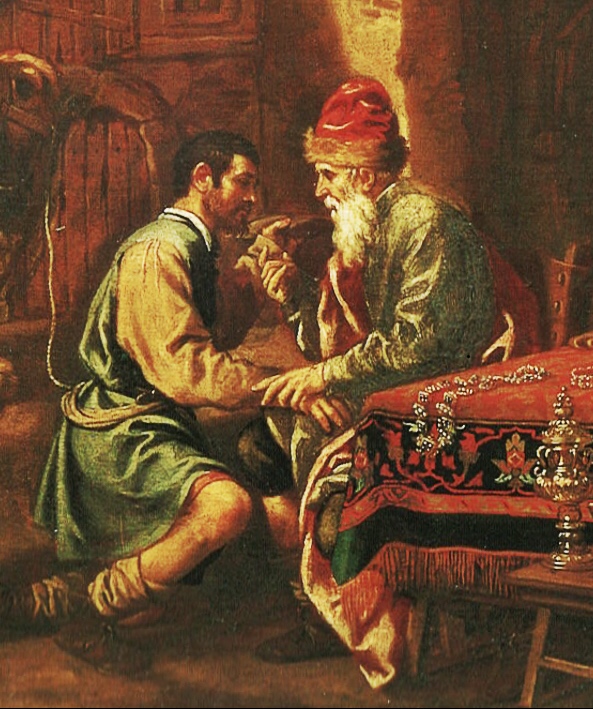
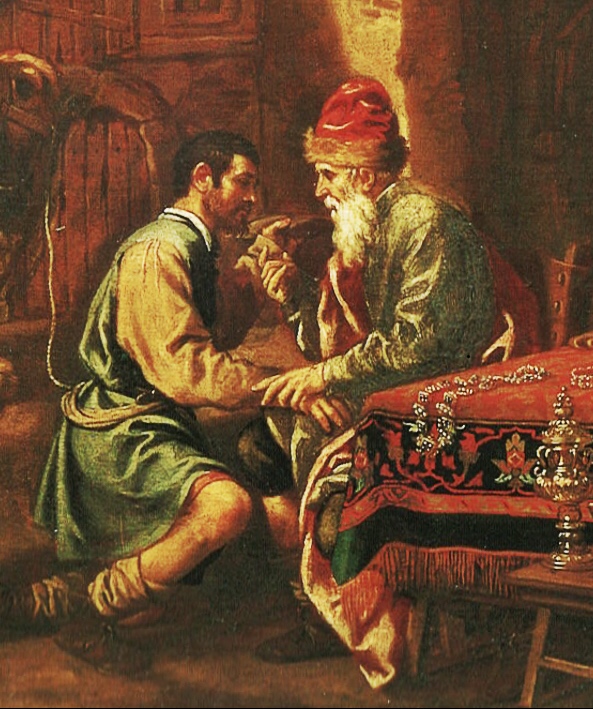
Abraham’s Solemn Charge, by Pedro Orrente, 17th century, detail

Abraham’s steward asked a clarifying question to make sure he understood his mission. Then he complied at once with his master’s request:

And the servant placed his hand under the yareikh of Abraham, his master, and he swore to him on this matter. (Genesis 24:9)

Since the word yareikh could mean any of several locations on the lower body, we can only guess where Abraham’s steward placed his hand. But commentators have noted that the Latin root “testis” appears in words whose English versions are testify, testimony, and testicles, and claim that this may reflect a Roman practice of taking an oath on the genitals. And for at least two millennia, oaths administered by a court have required the person swearing the oath to hold a sacred item in the hand. Before the holy objects were made for the sanctuary, before the Torah was written down, a circumcised penis was the only sacred object available.3

The actual oath

In the portion Vayechi, Joseph listens to his father’s request, then tells him:

“I will do as you have spoken.” (Genesis 47:30)

Instead of immediately placing his hand under his father’s yareikh, Joseph makes a simple verbal promise. Is placing his hand under his father’s whatever-it-is beneath the dignity of a viceroy of Egypt?

Or does Joseph remember Jacob’s famous limp, and feel reluctant to touch the spot that the unnamed being touched?

Jacob does not accept Joseph’s unsupported promise as a bona fide oath.

He said: “Swear to me!” And he swore to him. Vayishtachu, Israel, at the head of the bed. (Genesis 47:31)

vayishtachu (וַיִּשְׁתַּחוּ) = and he prostrated himself, and he bowed as deeply as possible. (This verb is used for bowing to a king or to God.)

It sounds as though Joseph brings himself to place his hand under the spot and swear. His father, Israel, accepts Joseph’s response as a duly sworn oath, one that even the Pharaoh could not quibble about. And he bows as deeply as possible for an invalid in bed.

When Jacob limped toward Esau the morning after the wrestling match, he prostrated himself seven times—honoring his brother’s power over his life. Now Jacob prostrates himself as best he can, at age 147, to his Joseph—honoring his son the viceroy’s power.

Pharaoh’s permission

After that Israel rearranges his inheritance by adopting Joseph’s two sons as his own4 and makes two deathbed prophecies, one short5 and one lengthy.6 Then he repeats the instructions for his burial in the cave of Machpelah, and dies.7

Joseph has his father embalmed like an Egyptian nobleman, and then informs Pharaoh:

“My father made me swear, saying: ‘Here, I am dying. In my burial side that I dug for myself in the land of Canaan there you must bury me.’ And now please let me go up, and I will bury my father, and I will return.” And Pharaoh said: “Go up and bury your father as he made you swear.” (Genesis 50:5-6) So Israel’s plan works.

A speculation

Yet Pharaoh gives Joseph permission to go even though Joseph does not mention the hand position he used for his oath to his father. Why is the placement of Joseph’s hand so important to his father?

I wonder if Israel wants Joseph to touch the same place the divine being touched. He might recognize himself in his favorite son. The first two times Joseph’s brothers came to Egypt, Joseph disguised himself and lied to them in order to get the information he wanted. When Jacob was a young man, he disguised himself and lied to his father in order to steal his brother’s blessing.

How can Israel get Joseph to recognize the manipulative side of his personality, and wrestle with it? Maybe if Joseph touches the spot that the divine being touched, it will shock him into the awareness that he is not as grand and impartial as he thinks. Joseph is the supreme judge of Egypt’s agricultural system, but he is not divine.

Would Jacob/Israel think in those terms? He is not a psychologist, but he is a clever thinker. And humans have always used symbolic acts to make connections between the known and the unknown. There is always more going on inside us than we know. Some people tend to act intuitively, and need to practice thinking and planning. Others are like Jacob, Joseph, and myself: thinking and planning are default behavior for us. We need to step back, take a breath, and take the long view. We need a touch of the divine.


  1. For example, divine messengers wash their feet and eat in front of Abraham in Genesis 18:1-8.
  2. See my posts Toledot & Vayishlach: Wrestlers, and Haftarat Naso—Judges: Spot the Angel.
  3. Talmud Bavli, Shevuot 38b; Rashi (11th-century Rabbi Shlomoh Yitzchaki); Rabbi Elie Munk, The Call of the Torah: Bereishis, Mesorah Publications, 1994, p. 626. See my post Chayei Sarah: A Peculiar Oath.
  4. Genesis 48:3-11, 48:22.
  5. The prophecy about Efrayim and Menasheh is in Genesis 48:12-20.
  6. The prophecy about the twelve tribes of Israel is in Genesis 49:1-28.
  7. Genesis 49:29-33.

Chayei Sarah & 1 Kings: Old Age for Scoundrels, Part 2

Both Abraham and King David have motley careers in the bible: brave and magnanimous in one scene, heartless and unscrupulous in the next. But in old age (about age 140-175 for Abraham, 60-70 for David) the two characters take different paths.

And Abraham expired and died at a good old age, old and satisfied, and he was gathered to his people. (Genesis 25:8)

Abraham, who is healthy and virile in extreme old age, takes a new concubine and raises a new family in last week’s Torah portion, Chayei Sarah (Genesis 23:1-25:18). But this time, instead of endangering his women and his sons, he acts responsibly. Abraham makes explicit arrangements for his eight sons so that each will carry on an independent life without internecine struggles. (See last week’s post: Chayei Sarah & 1 Kings: Old Age for Scoundrels, Part 1)

King David, however, is feeble and bitter during his last years. The haftarah reading for Chayei Sarah (1 Kings 1:1-1:31) sets the tone with its opening:

King David’s Deathbed, 1435

And the king, David, was old, coming on in years. And they covered him with bedclothes, but he never felt warm. (1 Kings 1:1)

This is the man who personally killed 200 Philistines in a single battle,1 who took at least eight wives and ten concubines,2 and who danced and leaped in front of the ark all the way into Jerusalem.3

David’s prime

As a young man, David is such a charismatic and popular military commander that King Saul is afraid David will steal his kingdom. Saul makes four attempts to kill him.4 David flees and becomes the leader of an outlaw band. At one point he seems to be running a protection racket.5

Later David defects to the Philistines, Israel’s longtime enemies, with his 600 men. The Philistine king of Gat welcomes the mercenaries and gives David the town of Ziklag. For over a year David and his men raid villages, kill the residents, and bring back booty (presumably sharing it with the king of Gat). This kind of raiding was common in the Ancient Near East, and the Hebrew Bible does not censure David; the text merely indicates that David lied to the king of Gat in order to avoid raiding Israelite villages.6

After King Saul and his son and heir Jonathan die in a battle with Philistines, David and his men relocate to Hebron, where David is proclaimed king of Judah, his own tribe. Meanwhile, Saul’s general Abner makes one of Saul’s sons7 the king of the northern Israelite territory.8 Right after David and Abner have made a truce, Joab, David’s army commander and nephew, assassinates Abner.9 Two other supporters of David assassinate Saul’s son in the north, and David becomes the king of all Israel—when he is only 30.

He captures the part of Jerusalem and turns it into his capitol, the City of David. One spring King David stays home while Joab leads a fight against the kingdom of Ammon. Walking on his rooftop in the evening, David sees a beautiful woman bathing on her rooftop. He finds out that she is Bathsheba (Batsheva), the wife of one of his own soldiers, Uriyah.

King David Sees Bathsheba, by Jean-Leon Gerome, 1889

Adultery is a sin in the Torah, a crime punishable by death.10 Nevertheless, David has Bathsheba brought to him. When she tells David she has become pregnant, he calls Uriyah home from the front so it will look as if she is pregnant by her husband. Uriyah, however, refuses to spend even one night in his own house at a time of war.

So David compounds his crime.

And it was in the morning when David wrote a letter to Joab, and he sent it by the hand of Uriyah. And the letter he wrote said: “Put Uriyah in the front of the hardest battle, then draw back from him, so he will be struck down and die.” (2 Samuel 11:15)

Joab obeys. The innocent Uriyah dies. As soon as Bathsheba finishes the mourning rituals for her husband, David marries her.

And the thing that David had done was evil in the eyes of God. (2 Samuel 11:27)

The prophet Natan transmits the words of God’s curse to the king:

“And now the sword will never swerve away from your house again, because you have despised me and have taken the wife of Uriyah the Hittite to be your wife. Thus says God: Here I am, raising up against you evil  from within your own house…” (2 Samuel 12:10-11)

The death of Bathsheba’s infant conceived in adultery is only the beginning. Amnon, who is David’s firstborn son by his wife Achinoam, rapes Tamar, David’s daughter by his wife Ma-akhah. David is responsible for justice, in both his household and his kingdom, but he does nothing about the rape. So Tamar’s full brother, Absalom (Avshalom), kills Amnon and goes into exile.

King David grieves over Amnon’s death for three years, then lets Absalom return to Jerusalem. Absalom usurps David’s throne after a long misinformation campaign, and King David leaves Jerusalem with his supporters. They camp at Machanayim on the other side of the Jordan River. On the way, a fellow named Shimi throws stones, dirt, and insults at David, but David is feeling either defeated or philosophical, and he tells his men to leave Shimi alone, since this, too, is God’s doing.11

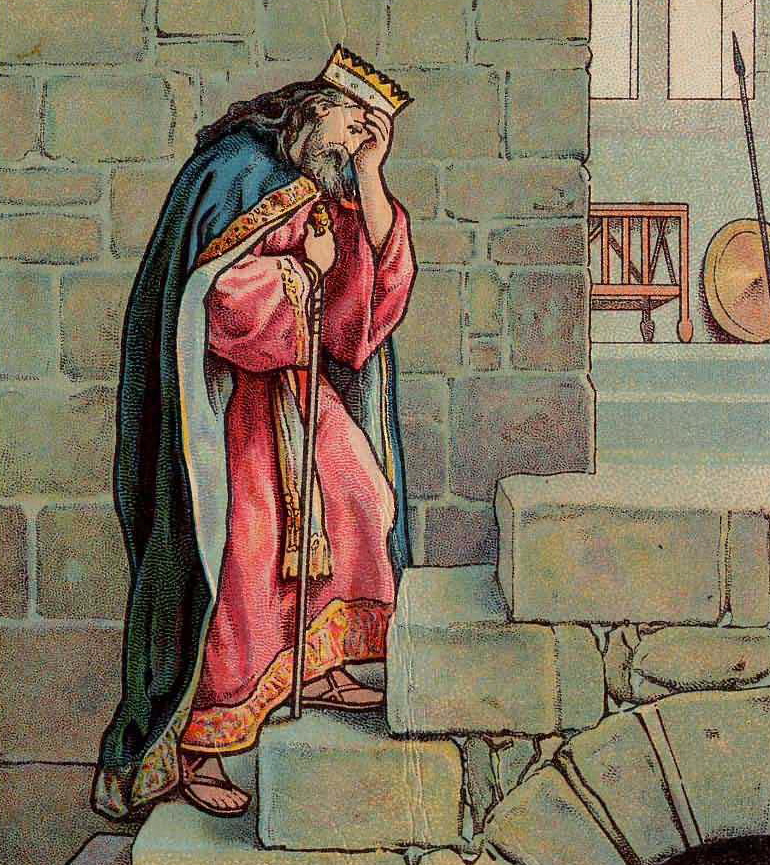
David’s Grief over Absalom, Bible card, Providence Lithograph Co., 19th century

When Absalom’s army clashes with David’s army, David orders Joab and his other two commanders to go easy on Absalom. David’s troops win the battle, and Absalom is left dangling from a tree branch by his own long hair. Joab disregards David’s order and kills Absalom. David is heartbroken. His grief demoralizes his troops, until Joab persuades David to come down from his bedroom and act like a king.12 Shortly after that, David replaces Joab with Amasa, who was Absalom’s general.13

When David and his followers cross the Jordan back into Jerusalem, Shimi prostrates himself and apologizes for insulting the king and throwing rocks at him. Joab’s brother Avishai says:

“Shouldn’t Shimi be put to death instead, since he cursed God’s anointed?” (2 Samuel 19:22)

But David scolds Avishai and says no man of Israel should be killed on a day of national reconciliation.

And the king said to Shimi: “You will not be put to death.” And the king swore to him. (2 Samuel 19:24)

With David back on the throne, life continues as usual for ancient Israel, full of battles against neighboring countries. During one of them, Joab kills General Amasa, hides his bloody corpse with a cloak, and takes charge of the king’s troops. He defeats the enemy and returns to Jerusalem as the king’s general once more. King David takes no action.

 Unlike Abraham, David is punished during his lifetime for his worst sin (committing adultery and then having the woman’s husband killed). But his woes only make him more passive, not more ethical.

David’s old age

The first book of Kings begins:

And the king, David, was old, coming on in years. And they covered him with bedclothes, but he never felt warm. Then his courtiers said to him: “Let them seek for my lord the king a virgin young woman, and she will wait on the king, and she will be an administrator for him, and she will lie in your bosom and my lord the king will be warm.”  (1 Kings 1:1)

David and Abishag, Bible Illustration Cycle, 1432-35

They bring King David a beautiful young woman named Avishag.

And she became an attendant to the king and waited on him, but the king lo yeda-ah. (1 Kings 1:4)

lo yeda-ah (לֺא יְדָעָהּ) =he was not intimately acquainted with her. (lo, לֺא = not + yeda-ah, יְדָעָהּ = he was intimately acquainted with her. From the verb yada, יָדָע = he found out by experience,was acquainted with, had sexual relations with, understood, knew.)

Poor David! Even though Avishag is young and beautiful and lies down right next to him, he is too feeble to take advantage of the situation. And he used to be a man who loved spreading his seed around.

Unlike Abraham, David has not named his heir or distributed his property. His three oldest sons were Amnon (murdered by Absalom), Khiliav (Avigail’s son, who has disappeared from the story), and Absalom (killed in battle). Next in birth order is Adoniyah.

And Adoniyah, son of Chagit, was exalting himself, thinking: I myself will be king! … And his father had not found fault with him, or said “Why did you do that?” And also he was very good-looking … (1 Kings 1:5-6)

Adoniyah, the son whom David spoiled, gets support from General Joab and one of the top priests. He holds a coronation feast at on the southeast side of the City of David, and he invites everyone except his half-brother Solomon (a later son of David and Bathsheba) and Solomon’s supporters (the prophet Natan, the priest Tzadok, and King David’s personal guard, headed by Beneyahu).

Then Natan said to Solomon’s mother, Bathsheba: “Haven’t you heard that Adoniyah son of Chagit rules, and our lord David lo yada? And now, please take my advice, and save your life and the life of your son Solomon!” (1 Kings 1:11-12)

lo yada (לֺא יָדָע) = he does not know, does not understand.

King David, once an active and decisive leader, seems to have slipped into a state of passive ignorance. Perhaps he has become senile.

Following Natan’s script, Bathsheba comes to David’s bedchamber and bows.

And she said to him: “My lord, you yourself swore by God, your God, to your servant about Solomon, your son, ‘He will rule after me and he will sit on my throne.’ Yet now, hey! Adoniyah is king, and now, my lord the king, lo yadata! And he has slaughtered oxen and fatlings and many sheep, and he has invited all the king’s sons and Avyatar the priest and Joab commander of the army, but he has not sent for your servant Solomon. And you, my lord the king, the eyes of all Israel are upon you, to tell them who will sit on the throne of my lord the king after him. And it will happen when my lord the king lies down with his fathers, that I and my son Solomon will be considered guilty!” (1 Kings 1:18-21)

lo yadata (לֺא יָדָעתָּ) = you do not know; you do not understand. (Also from the verb yada.)

Natan comes in and corroborates. Then King David pulls himself together and issues orders for Solomon’s anointment as king.

The Solomon faction immediately holds a ceremony just east of Jerusalem, with shofar-blowing and music so loud that Adoniyah’s people hear it on the other side of the city. Solomon sits on the king’s throne before Adoniyah can get there.

Thus David, who had forgotten to take care of his most important business, makes Solomon his heir at the last minute. Adoniyah submits to his younger brother, and Solomon spares his life.

David’s last words to Solomon come right after last week’s haftarah reading, in the second chapter of 1 Kings. David opens with a formulaic directive to be strong and walk in God’s ways, but then he orders Solomon to take care of some unfinished business. Apparently David was too weak—politically, physically, or psychologically—to mete out rewards and punishments before he took to his bed. After his introduction, David tells Solomon:

“And also yadata yourself what Joab son of Tzeruyah did to me, what he did to the two commanders of the army of Israel, to Abner son of Neir and to Amasa son of Yeter. He killed them, and he put the bloodshed of war into a time of peace … So you must act in your wisdom, and his gray head will not go down in peace to Sheol. (1 Kings 2:5)

David reminds Solomon of what Joab did to Abner and Amasa, but does not say what Joab did to David. The obvious answer is that Joab killed David’s son Absalom, but David chooses not to go into that on his deathbed. He just wants Solomon to execute Joab, something David himself could not manage to do.

“But to the sons of Barzilai the Gileadite you must do loyal-kindness, and let them eat at your table, since [Barzilai] came close to me with blessings when I fled from the face of Absalom, your brother.” (1 Kings 2:7)

Here David is merely asking Solomon to continue the reward he set up for one of Barzilai’s sons after Barzilai had provided provisions for David and all his men during their exile from Jerusalem after Absalom usurped the kingship. But then David remembers someone who did not treat him well when he left Jerusalem.

“And hey! With you is Shimi son of Geira … and he, he insulted me with scathing insults on the day I went to Machanayim. Then he went down to meet me at the Jordan, and I swore to him by God, saying ‘I will not put you to death by the sword”. But now, do not hold him guiltless, because you are a wise man, veyadata what you should do to him. And you must bring his gray head down in blood to Sheol!” (1 Kings 2:8-9)

veyadata (וְיָדַעְתָּ) = and you will know. (Also from the verb yada.)

After David has laid these orders on Solomon, reminding him that he knows what to do, David dies—cold, ineffective, unforgiving, and bitter.


Abraham has a good and satisfied old age; David has the opposite. Abraham starts taking care of his family, instead of using them for his own selfish desires. David becomes so passive it takes both Natan and Bathsheba to get him to give orders to prevent a civil war, and on his deathbed he orders his son and heir to take revenge for him.

Why are the two characters so different?

Now, when I remember my mother’s suffering, senile incomprehension, and verbal sniping during her long journey toward death, I think that what matters most in the last part of life is autonomy and agency. During Abraham’s last years he is sound of mind; he gives thoughtful orders, and he continues to be obeyed. David retreats from thinking during the last half of his life. Instead of seeking more knowledge and understanding, he continues to make impulsive decisions that disregard both other people’s point of view and the good of his own kingdom. First Joab, and then Natan, manipulate him for the good of the kingdom. At the end, David takes no responsibility for anything, and asks his son Solomon to avenge him after he dies.

May each of us take responsibility while we still have autonomy and agency, and may we act in order to improve the situation for those who survive us. Even if we have a past record of misdeeds, may we be more like Abraham in old age, and less like King David.


  1. David killed 200 Philistines and harvested their foreskins (1 Samuel 18:25-27).
  2. The foreskins were the bride-price for marrying King Saul’s daughter Mikhal. David was leading an outlaw band when he married Avigail (1 Samuel 25:39-42) and Achinoam (1 Samuel 25:43). As king of Judah, he married Ma-akhah, Chagit, Avital, and Eglah (2 Samuel 3: 3-6); and as king of all Israel he took “more concubines and wives” (2 Samuel 5:13). He married Batsheva in 2 Samuel 11:27. We learn he had ten concubines in 2 Samuel 15:16.
  3. David danced in front of the ark, whirling and leaping, in 2 Samuel 6:13-16.
  4. King Saul tries to thrust a spear through David himself in 1 Samuel 18:8-2 and 19:10. He sends David into a difficult battle in the hope that Philistines will kill him in 1 Samuel 18:25-26. And Saul sends assassins to David’s house in 1 Samuel 19:11.
  5. 1 Samuel 25:2-44.
  6. 1 Samuel 27:10-13.
  7. The Hebrew Bible calls this son of Saul Ish-Boshet, meaning “Man of Shame”; we never learn his actual name.
  8. 2 Samuel 2:1-10.
  9. 2 Samuel 2:12-3:39.
  10. Leviticus 20:20.
  11. 2 Samuel 16:5-14.
  12. 2 Samuel 18:1-19:15.
  13. 2 Samuel 19:12-15. Amasa is another nephew of David’s, and a cousin of Absalom’s.

Chayei Sarah & 1 Kings: Old Age for Scoundrels, Part 1

And Abraham expired and died at a good old age, old and saveia, and he was gathered to his people. (Genesis 25:8)

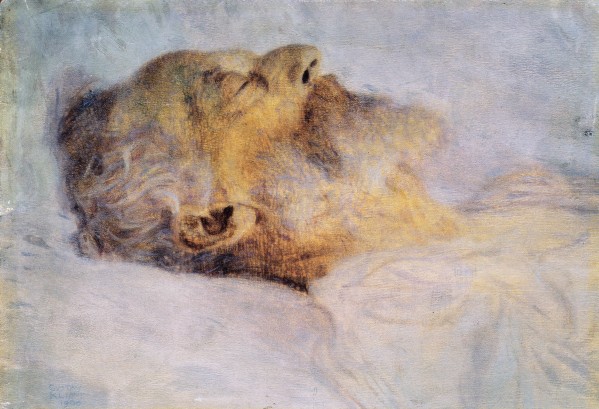
Old Man on his Deathbed, by Gustav Klimt

saveia (שָׂבֵעַ) = (adjective) satisfied, full, sated. (From the root verb sava, שָׂבַע = be sated, have enough, be filled up—usually with food.)

The full and satisfying end of Abraham’s life in this week’s Torah portion, Chayei Sarah (“The Life of Sarah”, Genesis 23:1-25:18) contrasts with the thin and bitter end of King David’s life in the accompanying haftarah reading (1 Kings 1:1-1:31). The haftarah sets the tone for King David’s final years when it opens:

And the king, David, was old, coming on in years, and they covered him with bedclothes, but he never felt warm. (1 Kings 1:1)

In their prime, both men have motley careers: brave and magnanimous in one scene, heartless and unscrupulous in the next. But in old age (about age 140-175 for Abraham, 60-70 for David) their paths diverge.

Abraham’s prime

Abraham commits several major unethical deeds after he moves his family to Canaan when he is 75. Although his behavior toward his nephew Lot is faultless, his behavior toward his wife Sarah and his first two sons, Ishmael and Isaac, is sometimes cruel, selfish, and immoral.

Abram’s Counsel to Sarai, by James Tissot, ca. 1900, detail

Twice when he travels to a new kingdom, Abraham asks Sarah to pretend to be his sister. He claims that she was unusually beautiful1 and that the king has peculiar morals, considering adultery taboo, but murder perfectly all right. The king will take Sarah regardless, but only if everyone lies and says Abraham is her brother will the king let him live. In fact, both kings pay Abraham a bride-price for his “sister”. Both kings are horrified when they discovered the truth. Both times, Abraham gets to take back his wife and leave richer than when he arrived.2

Sarah also uses Abraham, by giving him her slave Hagar as a concubine for the purpose of producing an heir. (She is 75 and childless at the time.) After Sarah give birth to her own son at age 90, she sees that Hagar’s son Ishmael is not treating her son Isaac with respect. So she orders Abraham to cast out Hagar and Ishmael, in order to make Isaac the only heir. Abraham is rich, and could easily give his own son and his former concubine a couple of donkeys laden with water, food, and silver to ensure their safe relocation. Instead, Abraham sends them off into the desert with only bread and a skin of water. When they get lost and use up the water, Ishmael nearly dies.3 God arranges a rescue, but Abraham never sees his oldest son again.

Isaac has grown up, but has not yet married or had children, when Abraham hears God tell him:

“Please take your son, your only one, whom you love, Isaac. And get yourself going to the land I will show you, and offer him up there as a burnt offering on one of the hills, which I will say to you.” (Genesis 22:2)

Sacrifice of Isaac, by Caravaggio, 1603

Abraham knows he could argue with God. When he was 99, he argued with God about destroying Sodom, and God listened and agreed it would be unjust to annihilate the city if it contained even ten innocent people.4 Yet now, in his 130’s, Abraham does not argue with God. he does not even ask God a question. He gets up early and leaves with Isaac, two servants, and a donkey carrying firewood, without telling Sarah where they are going. When Isaac lies bound on the altar and Abraham lifts the knife, God has to call his name twice to get him to stop. After Abraham sacrifices a ram instead, he walks back down the hill alone.5 The breach between father and son is irreparable. Abraham never sees Isaac again.

Abraham’s old age

Is Abraham consumed by guilt and loss during the final stage of his life, from his late 130’s to his death at 175? No. But he has changed. This week’s Torah portion, Chayei Sarah, portrays a man at peace with himself who meets all his responsibilities and also enjoys life.

The Torah portion begins with Sarah’s death in Hebron. Yet the last we knew, Abraham was living in Beersheba.6 Perhaps the two locations reflect a glitch in a redactor’s effort to combine two stories. Or perhaps Sarah left her husband after he returned without Isaac and tried to explain what happened. In an already difficult marriage, that would be the last straw. Yet the estrangement does not stop Abraham from traveling to Hebron and doing his duty as Sarah’s husband.

Abraham Buys the Field of Ephron the Hittite, by William Hogarth, ca. 1725

And Abraham came to beat the breast for Sarah and to observe mourning rites. Then Abraham got up from the presence of his dead, and he spoke to the Hittites, saying: “I am a resident alien among you. Give me a burial site among you, and I will bury my dead away from my presence.” (Genesis 23:2)

After some negotiations, Abraham buys a plot of land with a suitable burial cave, and buries Sarah there. In this way he also prepares for his own burial, and future burials in his family.

Isaac is not mentioned during the first scene in Chayei Sarah. But in the next scene, Abraham makes arrangements for Isaac’s marriage.

And Abraham said to his elder servant of his household, the one who governed all that was his: “Please place your hand under my yareikh, and I will make you swear by God, god of the heavens and god of the earth, that you do not take a wife for my son from the daughters of the Canaanites amidst whom I am dwelling.  For you must go to the land I came from and to my relatives, and you must take a wife for my son, for Isaac.”  (Genesis 24:2-4)

Abraham’s Solemn Charge, by Pedro Orrente, 17th century, detail

yareikh (יָרֵךְ) = upper thigh, buttocks, genitals.

This is a serious oath. Isaac is in his late thirties at this point, and his father has obviously been keeping track of him from a distance. Now Abraham wants to make sure, before he dies, that Isaac marries and starts producing the descendants God promised. But he does not try to confront his estranged and traumatized son in person. He instructs his steward, and trusts him to deliver the right bride to his son.

Arranged marriage was the norm in the Ancient Near East, so Isaac is not shocked when his father’s steward arrives with a young woman for him. In fact, he falls in love with her.7

Once Isaac is married, Abraham takes a concubine again, and has six sons with Keturah.

And Abraham gave all that was his to Isaac. But to the sons of the concubines that were Abraham’s, Abraham gave gifts, and he sent them away from his son Isaac while he was still alive, eastward, to the land of the east. And these are the days of the years of Abraham, that he lived: 175 years. And Abraham expired and died in good seivah (Genesis 25:6-8)

Abraham is virile and enjoys life his old age. He is also in charge of his own life, and takes care to meet all his responsibilities well before he dies. He divides his wealth among his sons and makes sure Isaac will not be harassed by his stepbrothers. After his death, Ishmael and Isaac bury their father in the cave he bought for Sarah’s burial. Whatever mistakes he made before the age of 140, Abraham leads an enviable life for his last 35 years. He is fortunate to be in good health, with both virility and a sound mind. He knows what he is doing, and he does it more thoughtfully than he used to. Abraham was always good at generating plans. But during the last part of his life, his plans are more reasonable, and take the other people in his life into consideration.


No human being is perfect. We may not commit such extravagant misdeeds as Abraham, but we have all hurt other humans. Occasionally we get the blessing of a frank conversation with someone we hurt, and an opportunity to apologize and make amends. But often the chance for a frank conversation never comes. Then the best we can do is to acknowledge our misdeeds to ourselves, and plan how we will behave more ethically in the future. Sometimes we can notice our own improvement, and find peace in our old age.

Perhaps this is what Abraham does in the book of Genesis. He never apologizes to Sarah, or Ishmael, or Isaac. But after age 140, he is careful to meet his responsibilities to everyone, even the people estranged from him. Abraham still pursues his own interests and arranges a pleasant life for himself, but he does it without any deceit and without endangering anyone’s safety. He dies old and satisfied.

Next week, in Part 2, we will look at the unfortunate counterexample of King David’s old age.


  1. Sarah is 65 when Abraham pulls this scam on the king of Egypt in Genesis 12:10-20. She is 89 when he repeats it with the king of Gerar in Genesis 20:1-18, but during that year God is presumably making Sarah’s body younger so she can bear a son to Abraham.
  2. See my posts The Wife-Sister Trick: Part 1 and Part 2.
  3. Genesis 21:8-19. See my post Vayeira: Failure of Empathy.
  4. Genesis 18:16-32.
  5. Genesis 22:1-19. See my post Vayeira: Stopped by an Angel.
  6. In Genesis 22:19 Abraham comes back to Beersheba without Isaac.
  7. Genesis 25:67.

Chayei Sarah: Seizing the Moment, Part 2

A beautiful young woman named Rebecca goes to extraordinary lengths to marry a man in Canaan whom she has never met.

Abraham decides to arrange a marriage for Isaac, his son and heir, in last week’s Torah portion, Chayei Sarah. He sends his senior servant, or steward, to find a bride in Charan, his old hometown in northern Mesopotamia. And he makes the steward (possibly Eliezer of Damascus, who was Abraham’s steward before Isaac was born)1 swear that he will not let Isaac leave Canaan; the bride must consent to moving where Isaac lives.

The steward arrives at the well outside the city, and asks God for a specific sign so he will know who is destined to be Isaac’s wife.

Rebecca and Eliezer, by Alexandre Cabanel, 1883

I explained in my post Chayei Sarah: Seizing the Moment, Part 1 why Rebecca must have overheard his prayer: he spoke out loud; she came out with her water jar before he finished; and she did everything he prayed for, saying the right words and even hauling water for ten camels. Yes, she was kind and had extraordinary strength and endurance, but she was also determined to be the bride the stranger was praying for.

And it was as the camels finished drinking, that the man took a gold nose-ring gold weighing half a shekel, and two bracelets for her wrists, ten gold shekels. (Genesis/Bereishit Genesis 24:22)

The only reason for a stranger to hand over such largesse would be as a down-payment on a bride-price. The steward asks Rebecca who her father is and whether there is room for him his men, and his camels to spend the night. She gives her lineage, so he knows she is a granddaughter of Abraham’s brother Nachor, and says they have plenty of room. Then she runs into the city to tell her family. Soon her brother Lavan runs out to well with an invitation.

The steward and Lavan negotiate a marriage contract that evening.

In the Ancient Near East, marriage arrangements were made between families, with contracts specifying the bride-price provided by the groom’s family and the dowry provided by the bride’s family. Usually the negotiations were conducted by the fathers of the future couple. Abraham delegates this job to his steward.

But who negotiates for Rebecca? Her father, Betueil, speaks only once during the story:

And Lavan answered, and Betueil, and they said: “This thing went out from God; we cannot speak to you ‘bad’ or ‘good’. Here is Rebecca in front of you. Take her and go, and she will be a wife to the son of your master, as God has spoken.” (Genesis 24:50-51)

In Biblical Hebrew, “Lavan answered, and Betueil” means that Lavan spoke first, and his father, Betueil, chimed in. Apparently Lavan was acting as the man of the house.2 This is supported by two other details: that Lavan is the one who comes out to meet the steward and serves as the host, and that the next morning only Lavan and his mother speak.

Why does Rebecca want to marry Isaac?

She overhears that the stranger at the well is looking for a wife for someone named Isaac. She might suspect it is her cousin Isaac, whom she has never met. We know caravans brought news between Beir-sheva in Canaan and Charan in northern Mesopotamia; the Torah reports that after Abraham almost slaughtered Isaac as an offering to God, he received the news that his brother Nachor had eight children with his wife Milkah, and that the youngest one, Betueil, had a daughter named Rebecca.3

Similarly, travelers would have told Nachor’s family that Abraham and Sarah lived in Beir-sheva in Canaan, and had a son named Isaac. The news of Sarah’s death might not yet have reached Charan, but Rebecca would at least know she had a cousin Isaac who lived in Canaan.

However, the stranger at the well might be referring to a different Isaac. Then all Rebecca could deduce was that the prospective groom came from a wealthy family—so wealthy that it even owned camels—and that he lived far away, since the camels were thirsty.

Rebecca seems eager to marry someone who lives far away from her own home.

As a beautiful (and physically strong) adolescent from a wealthy family, she would have attracted many marriage proposals already. Yet she has not married anyone in the vicinity. Probably some of the prospective husbands were not wealthy enough to satisfy Lavan, who actually runs to the well to meet the stranger as soon as Rebecca reports back to her family wearing gold jewelry and talking about camels.

And Lavan ran outside to the man, to the spring.  And it was because he was seeing the nose-ring and the bracelets on his sister’s wrists, and because he heard the words of his sister Rebecca, saying: “Thus the man said to me.”  And he came up to the man, and hey! He was standing beside the camels at the spring. (Genesis 24:28-30)

Perhaps Lavan had previously tried to arrange marriages for Rebecca with a few especially wealthy neighbors, but she had found the prospective husbands so undesirable that she had refused to consent. (For example, the book of Ruth illustrates that most young women did not want to marry old men; Ruth was an exception.)4

By the time Rebecca overhears the steward at the well, she is eager to get out from under her brother’s thumb. And like many adolescents today who are fed up with their families, she longs to escape, and feels sure that a new life in a distant place would be an improvement.

The match between Rebecca and Isaac suits everyone. Abraham wants his son to marry someone from his old home town.5 His steward wants Isaac to marry someone who is kind, hospitable, and physically strong. Rebecca wants to marry someone who lives far away. And Lavan wants Rebecca to marry someone who is rich.

Abraham’s steward and Rebecca’s brother complete the marriage agreement that night. Rebecca’s dowry includes “girls” (female slaves) and her old wet-nurse (retained as a companion).6 And Abraham’s steward adds to his down-payment on the bride-price.

Then the servant brought out silver ornaments and gold ornaments and garments, and he gave them to Rebecca. And he gave precious gifts to her brother and her mother. (Genesis 24:53)

In the morning the steward politely asks permission to leave with Rebecca. Lavan and his mother demur.

And her brother said, and her mother [chimed in]: “Let the girl stay with us yamim or ten; afterward you may go.” (Genesis 24:55)

yamim (יָמִים) = days (literally); a long time, a year or more (idiomatically). (Plural of yom, יוֹם = day.)

According to the Talmud, Lavan and his mother requested a long engagement because it was the custom to give a bride who was going to leave home a year to prepare.7 However, the vagueness of their request implies a hidden motive. Alshich wrote that they were disappointed in their share of the bride-price, and suggested a long delay in order to irritate the steward. Perhaps they hoped he would either cancel the marriage contract, or give them more valuables.7

But the steward only insists that he and the young woman must leave immediately.

And they summoned Rebecca and they said to her: “Will you go with this man?” And she said: “I will.” (Genesis 24:58)

They depart that day. The story in Chayei Sarah ends:

And Isaac brought her into the tent of Sarah, his mother, and he took Rebecca and she became his wife, and he loved her. And Isaac found consolation after [the death of] his mother. (Genesis 24:67)

Rebecca’s determination paid off. She has a new life in a new place, with a man who loves her.


I admire the young Rebecca. I remember noticing several unexpected opportunities when I was young, and toying with the idea of seizing the moment and changing my life. But I was always too cautious to do it.

I wonder what would have happened if I has been as bold as Rebecca.


  1. Genesis 15:2.
  2. Rashi (11th-century rabbi Shlomoh Yitzchaki), following Genesis Rabbah 60:12, wrote that Betueil wanted to prevent the marriage, so an angel from God killed him. 12th-century rabbi Abraham ibn Ezra suggested that Lavan was respected for his wisdom, so Betueil remained silent and let his son speak. Some modern commentators suggest that Betueil was ill or feeble. Others attribute the possible inconsistency to redaction from two different sources, one in which Betueil is still alive, and another in which he is already dead.
  3. Genesis 22:20-23.
  4. Ruth 3:10.
  5. Abraham might want Isaac to marry someone who worships the same God; see my post:
    Chayei Sarah: Arranged Marriage.
  6. Genesis 24:61 and 24:59.
  7. Talmud Bavli, Ketubot 57b.
  8. 16th-century rabbi Moshe Alshich, quoted in www.sefaria.org.

Chayei Sarah: Seizing the Moment, Part 1

How far would you go to make a good marriage? Rebecca goes a long way in terms of physical exertion as well as geography in this week’s Torah portion, Chayei Sarah.

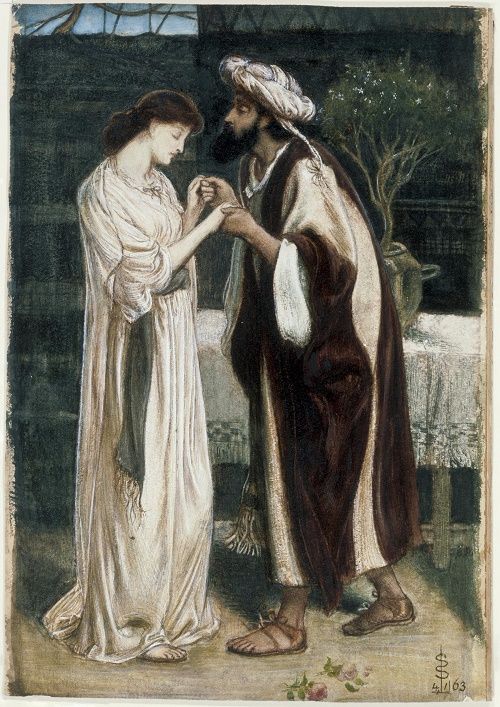
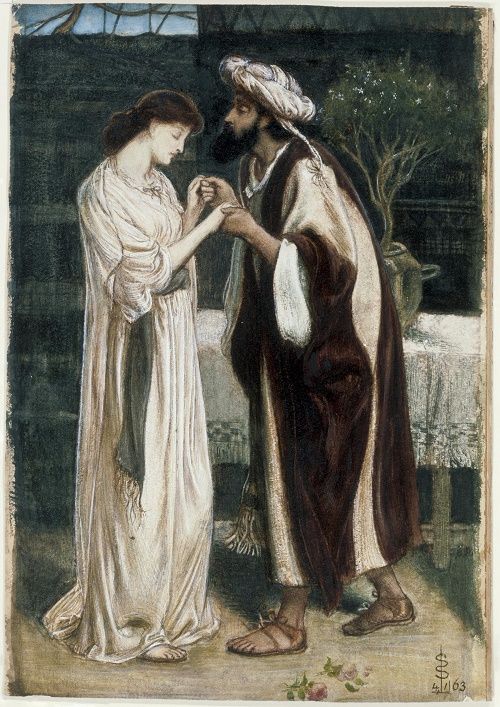
Isaac and Rebecca, by Simeon Solomon, 1863

When the story of the arranged marriage between Isaac and Rebecca begins, Isaac is 40 years old, has never married, and lives with his flocks in the Negev desert near a spring called Beir Lachai Roi.1 His mother, Sarah, is dead, and his father, Abraham, lives at an oasis farther north in the Negev called Beir-sheva.2 Father and son parted ways on a hilltop a three-day journey from Beir-sheva, after Abraham held a knife to Isaac’s throat and nearly slaughtered him as a sacrificial offering.3 The Torah reports no communication between father and son since that time (nor any further communication between Abraham and God). Isaac does not even come to his mother’s funeral at the beginning of this week’s Torah portion,4 so presumably he received no message about it.

Sometime after Sarah’s death, Abraham decides to arrange a marriage for Isaac. After all, God had promised him descendants through Isaac who would one day rule the land of Canaan. Abraham does not consult with his estranged son. He puts the arrangements in the hands of his “senior servant” or steward—after making him swear an oath that he will fetch a wife for Isaac from his old home, the Aramaean city where Abraham left his brother Nachor when God called him 65 years before. Abraham also makes his steward swear that he will not let Isaac leave Canaan to join his new wife in Aram.

Rebecca’s age is between puberty and 20 years old. She is a “beautiful virgin”5 living with her parents and her brother in the northern Mesopotamian city of Charan, called the “city of Nachor” in this week’s Torah portion6. She is the granddaughter of Abraham’s brother Nachor.

“And if the woman will not come to follow you, then you will be cleared from this oath to me. Only do not bring my son back there!” (Genesis/Bereishit 24:8)

Domesticated camel in an Egyptian petroglyph circa 2200 BCE

The steward leaves with ten camels and some expensive gifts. The sight of ten camels would be impressive; this story is set in the period between 2000 and 1500 B.C.E., when camels were domesticated in Egypt, but were rare in Canaan and Mesopotamia.

After the steward has selected the prospective bride, we learn that he also brought along a few men under his command, men who would be necessary to handle the camels, serve as guards on the road, and support the general impression of a delegation from a wealthy and important chieftain.

When they arrive at Charan, the city of Nachor, the steward heads for the well outside the city wall.

And he made the camels kneel outside the city at the well of water, at evening time, the time when the women are drawing water. Vayomar: “God, God of my master Abraham, please make it happen for me today. Hey, I have stationed myself at the spring of water, and the daughters of the men of the city are going out to draw water. Let it be the young woman to whom I say, “Please lower your jar and I will drink,” and she says, “Drink, and also I will water your camels”—let her be the one you have marked for your servant Isaac. And by that means I will know that you have done loyal-kindness to my master.” (Genesis 24:11-14)

vayomar (וַיֺּאמַר) or vayomer (וַיֺּאמֶר) = and he said, then he said. (Other forms of the verb amar (אָמַר) = “say” also appear in the above passage, since the sign that the steward asks God for is a specific conversation.)

A well outside a city’s walls was customarily used by both residents and travelers in the Ancient Near East. Women and older girls fetched water for their households. Shepherds filled adjacent water troughs for their flocks. And travelers stopped to fill their waterskins and water their riding and pack animals.

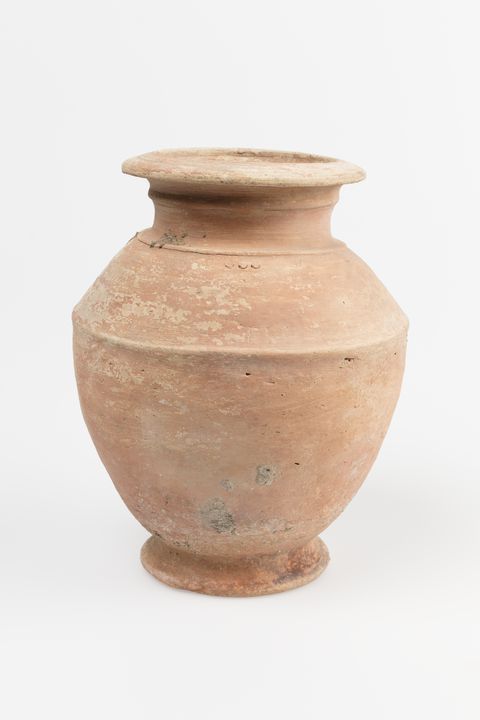
Mesopotamian Water Jar, circa 2200 BCE

And it happened he had not yet finished speaking, and hey! Rebecca went out … and her jar was on her shoulder. (Genesis 24:15)

A water jar was a large pottery vessel with stopper at the top.

And the servant ran to meet her, vayomer: “Let me sip, please, a little water from your jar.” Vatomer: “Drink, my lord,” and she quickly lowered her jar on her hand and let him drink. When she had finished letting him drink, vatomer: “Also for your camels I will draw water, until they finish drinking.” And she hurried and she emptied the jar into the trough, and she ran again to the well to draw water. And she drew water for all his camels. (Genesis 24:1ְ-20)

vatomer (וַתֹּאמֶר) = and she said, then she said. (Also a form of the verb amar.)

A camel drinks at least 25 gallons of water after a long journey, and Abraham’s steward has ten of them. Rebecca runs down the steps of the well and back up with a heavy jug of water at least a hundred times—a  heroic feat requiring great fortitude and determination. And she does it as fast as she can.

First by her speech, and then by her action, Rebecca does everything the steward had prayed for. He gives her a gold nose-ring and two heavy gold bracelets—her share of the bride price he will offer in marriage negotiations. He is confident that the young woman is indeed the bride God wants for Isaac. But he still asks her about her family, since Isaac should only marry someone who is his social equal.

Vayomer: “Whose daughter are you? Tell me, please, is there a place in your father’s house for us to spend the night?” Vatomer to him: “I am the daughter of Betueil son of Milkah, that she bore to Nachor,” vatomer to him: “Also, we have plenty of straw and fodder. Also a place to spend the night.” (Genesis 24:23-25)

Now the steward knows that Rebecca comes from the same illustrious family as Abraham, and that her branch of the family lives in a compound large enough to comfortably accommodate ten camels and several men as guests. She is fully qualified to become Isaac’s bride.

Why does Rebecca water the camels?

Rebecca could simply invite the steward’s men to fill the watering trough for the camels. Why does she undergo the arduous labor of doing it herself?

The story has not yet mentioned that the steward brought men with him. Conceivably, they might be around the other side of the well, satisfying their own thirst before they get to the camels, so Rebecca sees only the camels and the elderly steward in front of her. If she were kind and generous, and acted without thinking, she would rush to help the old man.

But in next week’s Torah portion, Toledot, Rebecca is an independent thinker who takes initiative to find out what is going on7, and who figures out schemes with multiple steps to achieve her goals8. Her behavior in middle age indicates she is a planner. As an adolescent, she would have acted impulsively only if she were overwhelmed by lust—which an elderly man would not be likely to provoke.

My theory is that Rebecca the planner does not let the steward’s men water their own camels because she has overheard most of the steward’s prayer, and she wants to be the bride marked for Isaac.

A close reading shows that Rebecca could have overheard the steward as she approached the well. Before he begins his prayer, the text says vayomar, indicating that he speaks out loud. Later, when he tells Rebecca’s brother Lavan what has happened to him so far, he says:

“I had not yet finished ledabeir el libi, and hey! Rebecca went out and a jar was on her shoulder …” (Genesis 24:45)

ledabeir el libi (לְדַבֵּר אֶל־לִבִּי) = speakingto my heart. Speaking or saying something to one’s heart is a biblical Hebrew idiom for thinking silently. (libi, לִבִּי = my heart; the seat of my consciousness, including thoughts and emotions.) 

Here the steward claims that he was praying silently. However, in that same speech to Lavan he alters a few other details about what happened. For one thing, he reports that his rich master, Abraham, said he would be released from his oath only if the prospective bride’s family refused to give her; but actually Abraham said he would be cleared if the woman herself did not consent to follow him back to Canaan.7 For another, he reports that after Rebecca watered the camels, he asked her whose daughter she was, and then gave her the gold nose ring and bracelets; but actually he gave her the gold jewelry before he asked her who her family was.8

Thus it is quite plausible that the steward delivered his request to God out loud, and Rebecca, who was already on her way to the well, overheard him. Then she seized the moment, and did whatever it took to get the marriage that the stranger had come to arrange.

But why is Rebecca so eager to marry a man named Isaac whom she has never met? Next week’s post will explore her motivation.


  1. Genesis 24:62. In Genesis 16:7-14, Beir Lachai Roi is located on the desert road between Beir-sheva and Shur, a town just east of Egypt.
  2. Genesis 22:19.
  3. Genesis 22:1-19. At the end of the story, “Abraham returned to his servants” at the foot of the hill. The Torah uses a singular verb for “returned”, which leaves Isaac alone on the hilltop in the land of Moriyah.
  4. Genesis 23:1-4.
  5. Genesis 24:16.
  6. Genesis 24:10.
  7. Compare Genesis 24:37-41 and Genesis 24:5-8.
  8. Compare Genesis 24:46-48 and Genesis 24:22-27.

Book of Genesis: Inbreeding

Why is there so much inbreeding in the book of Genesis/Bereishit? After the first two Torah portions, most of the major characters are descended from Abraham’s father, Terach, through multiple lines. The branches of their family tree keep growing together again.

Noach

The Torah does not say how many wives Terach has, but it does name four of his children at the end of the Torah portion Noach. He has three sons: Avram (whom God renames Abraham), Nachor, and Haran.1 He also has a daughter named Sarai (whom God renames Sarah).2 While they are all living in the southern Mesopotamian city of Ur, Avram and Nachor marry their own relatives.

Avram and Nachor took wives for themselves. The name of Avram’s wife was Sarai, and the name of Nachor’s wife was Milkah, the daughter of Haran … (Genesis 11:29)

In other words, Avram marries his half-sister, Terach’s daughter, and Nachor marries his niece, Terach’s granddaughter.

Terach leaves Ur and heads toward Canaan with some of his family members. Halfway there they stop and settle in the town of Charan, where Terach dies.3

Thanks to archeology, we know that Charan was an actual city where the main road north from Ur met the main road that went southwest to Canaan. Both Charan and Ur were dedicated to the moon-god Nannar. The residents of those two cities worshiped many other gods as well, in temples stocked with idols. They also kept terafim, figurines of lesser gods, to protect their households.

Terach would probably acknowledge Nannar, but his primary god might be a different deity. In last week’s Torah portion, Chayei Sarah, both Betueil (son of Nachor and Milkah) and Betueil’s son Lavan use the same four-letter name of God that Avram uses (commonly represented in Roman letters as Y-H-W-H).4 Later in Genesis, Lavan says “Y-H-W-H” has blessed him, and he makes a vow in the name of “the god of Nachor”.5 But he is not a monotheist; he also owns terafim.6

Lekh-Lekha and Vayeira

Does Terach hear the voice of God, Y-H-W-H? The Torah is silent.7 But it is conceivable that he starts traveling toward Canaan because he hears the same voice in Ur that his son Avram hears  in Charan:

“Go for yourself, away from your land and from your relatives and from your father’s house, to the land that I will show you.” (Genesis 12:1)

For Avram, that land turns out to be Canaan.

Avram hears God’s voice many more times in the portions Lekh-Lekha and Vayeira. On five occasions God promises him that his descendants will inherit the land of Canaan.8 God informs him that first those descendants will be enslaved in another land for 400 years.9 God demands circumcision for every male in his household and all of his future descendants, alters the names of Avram and Sarai, and promises that Sarai (now Sarah) will have a son at age 90.10 Avram (now Abraham) talks God into agreeing not to wipe out Sodom and Gomorrah if there are even ten innocent people living there.11 When Sarah demands that Abraham cast out his first son, Ishmael, along with Ishmael’s mother, God tells him to do what Sarah says.12

Sarah Hears and Laughs, by James J.J. Tissot

Terach’s daughter Sarah also hears God’s voice. When three men who turn out to be angels visit in the Torah portion Vayeira, she overhears one of them say that she will have a child the following year. Sarah, who is 89, laughs silently. Then she hears God asking Abraham: “Why did Sarah laugh?”

And Sarah lied, saying: “I did not laugh,” because she was afraid. But [God] said: “No, for you did laugh.” (Genesis 18:15)

Abraham and Sarah do have a son. Isaac is probably 26 when his father hears God order him to sacrifice that son on an altar.  God calls him off at the last minute, and Abraham goes home alone.13 Then he gets news from Charan: Nachor and Milkah (Abraham’s brother and niece) had a son named Betueil, and Betueil now has a daughter named Rebecca.14

Chayei Sarah

Abraham arranges a marriage for Isaac fourteen years later, in the Torah portion Chayei Sarah. He insists that Isaac must marry one of his relatives back in the Aramaean town of Charan. He adds the condition that the bride must be willing to move to Canaan, because he wants Isaac to stay in Canaan.

Why does he reject the idea of simply getting Isaac a Canaanite wife?

In last week’s post I proposed that Abraham worries Isaac might stray in his religion, after the trauma of being bound as a sacrifice to his father’s god. (See Chayei Sarah: Arranged Marriage.) Since his extended family in Charan worships Y-H-W-H (among others)15, a wife from that branch of the family would not tempt Isaac away from serving the God of Abraham.

But there is another possible reason for marrying Isaac to one of his relatives. Perhaps Abraham believes his covenant with God can be best continued through the generations if as many of his descendants as possible can hear God’s voice. For that, more inbreeding might help.

Rebecca may be exactly the young woman Abraham has in mind as a bride for Isaac. After all, she is descended from Terach through both Nachor and Milkah. She agrees to go to Canaan, and marries Isaac.

Toledot

In Toledot, this week’s Torah portion, Rebecca is alarmed by her pregnancy; it feels as though a wrestling match is taking place in her womb.

And she went to inquire of God. And God said to her: “Two nations are in your womb, and two peoples will branch off from your belly. One people will be mightier than the other, and the older will serve the younger.” (Genesis 25:22-23)

The text does not say where Rebecca goes to inquire of God; some commentary suggests that she consults an oracle.  But the text does say that God speaks directly to her, and it uses the name Y-H-V-H. The voice of God is correct; Rebecca has twins, Esau and Jacob, who eventually found two peoples in the Torah: the Edomites and the Israelites.

Rebecca’s husband Isaac, who is descended from Terach through both Abraham and Sarah, also hears God’s voice.

And God appeared to him that night and said: “I am the god of Abraham, your father. Don’t be afraid, because I am with you, and I will bless you and increase your descendants for the sake of my servant Abraham.” (Genesis 26:24)

Jacob proves more intelligent and more patient than his twin brother Esau.17 The Torah does not say whether his parents realize that Jacob is the better candidate to carry on the covenant with God. Isaac fumbles his delivery of the blessing of Abraham, Esau is enraged at the result, and Rebecca tells Jacob to flee to her brother Lavan’s house in Charan. Then she tells Isaac that she is disgusted with the Hittite women Esau married, and she could not bear it if Jacob also married one of the local women.

Isaac calls in Jacob. Rebecca has not told him where to send Jacob for a bride, but Isaac decides to continue Abraham’s family breeding program.

And he said to him: “Do not take a wife from the daughters of Canaan! Rise, go to Padan Aram, to the house of Betueil, your mother’s father, and take yourself a wife from there, from the daughters of Lavan, your mother’s brother.” (Genesis 28:1-2)

Thus he orders Jacob to marry one of his first cousins, who also carries more than the usual share of Terach’s blood (or genes).

Vayeitzei

Jacob’s ladder, German 14th century

As soon as Jacob leaves home he, too, hears the voice of God. In next week’s Torah portion, Vayeitzei, he dreams of God’s angelic messengers ascending and descending between heaven and earth, and then sees God standing over him. God confirms that the blessing of descendants who will inherit Canaan has gone from Abraham to Isaac to Jacob.

And [God] said: “I am God [Y-H-V-H], the God of your father Abraham and the God of Isaac. The land which you are lying on I will give to you and to your descendants.” (Genesis 28:13).

Jacob marries both of Lavan’s daughters, and their eight sons (plus Jacob’s four sons with Lavan’s daughters’ servants) become the ancestors of the twelve tribes of Israel.

Being able to hear God is not a unique trait of Terach’s descendants. Before the Flood, God converses with Adam and Eve, Cain, and Noah. After the flood, God speaks twice to Hagar the Egyptian and once to Avimelekh of Gerar.18 But most of God’s words in the Genesis are addressed to Abraham, Sarah, Isaac, Rebecca, and Jacob, all inbred descendants of Terach.19

There is no record in the Torah of God speaking to any of Jacob’s children. Perhaps a few of them would be able to hear God’s voice, but God chooses to be “with” them without words. It may be enough for God that all the inbreeding among Terach’s descendants results in the genesis of the Israelite people. The next time God speaks in the Torah is in the book of Exodus when God needs a prophet to bring the Israelites from Egypt to Canaan, and chooses Moses.20


In the Torah, God is one of the characters, and converses with some of the human characters. Is this only a literary device to make the stories juicier? Or does it also reflect some deeper truth?

When individuals today claim to have heard God’s voice, how can we tell whether they have heard an external power of the universe, or a hidden part of their own minds?

Is there a difference?


  1. Genesis 11:26-27.
  2. Genesis 20:12 (unless Abraham is lying).
  3. Genesis 11:31.
  4. Genesis 24:50-51.
  5. Genesis 30:27 and 31:51-53.
  6. Genesis 31:19.
  7. In a 5th century C.E. story attributed to Rabbi Chiya, Terach made idols for a living, and Abraham mocks them (Bereishit Rabbah, 38:13). This fable enhanced Abraham’s reputation with a Jewish audience, but the Hebrew Bible itself never mentions idols in connection with Terach.
  8. Genesis 12:7, 13:14-17, 15:1-7, 15:17-21, 17:1-8.
  9. Genesis 15:13-16.
  10. Genesis 17:9-22.
  11. Genesis 18:20-33.
  12. Genesis 21:9-13.
  13. Genesis 22:1-2, 22:11-19.
  14. Genesis 22:20-23.
  15. Joshua 24:2.
  16. Genesis 25:27-28.
  17. See Genesis 25:29-34, in which Esau can only think about eating, but Jacob cooks stew ahead of time and is prepared to bargain for Esau’s birthright.
  18. Hagar hears God in Genesis 16:7-13 and 21:17-18. Avimelekh hears God in a dream in Genesis 20:3-7.
  19. Lavan, Rebecca’s brother, also hears God in a dream (Genesis 31:24).
  20. Exodus 3:1-4:23.


Chayei Sarah: Arranged Marriage

This week’s Torah portion, Chayei Sarah (“Life of Sarah”), opens with Sarah’s burial, then tells the story of the arranged marriage of Sarah and Abraham’s son, Isaac.  The following essay comes from the first version of my book on moral psychology in Genesis, which I am now rewriting.

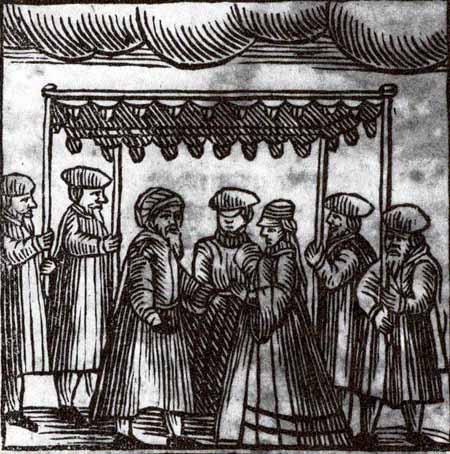
Wedding, Minhagim, 1707 Amsterdam

When is an arranged marriage ethical?  The story in Chayei Sarah offers some clues.

Ignorant groom

When Isaac turns 40 years old he is still unmarried.  So his father, Abraham, commissions his steward1 to get Isaac a wife.  Abraham asks him to swear a formal oath:

“… that you will not take a wife for my son from the daughters of the Canaanites among whom I am living.  Instead, you must go to my land and my homeland, and [there] you will take a wife for my son, for Isaac.”  (Genesis/Bereishit 24:3-4)

Abraham’s homeland is the town of Charan in northern Mesopotamia,2 where the family of Abraham’s nephew Betueil still lives.

Isaac is not present when Abraham gives these orders to his steward.  He has lived apart from his father for the past fourteen years, ever since Abraham put a knife to his throat to sacrifice him to God. 3  During that time Abraham has stayed at Beir-sheva, and Isaac has settled at Beir-Lachai-Roi.4  There is no indication in the book of Genesis of any communication between father and son after the near-sacrifice.

But since God promised that Isaac’s descendants would inherit the land of Canaan and his father’s covenant with God,5 Abraham decides it is high time for his son to marry.

And the servant said to him: “What if she does not consent to follow me to this land?  Shall I bring your son back to the land that you left?”  (Genesis 24:5)

Abraham rejects this option.

“And if the woman will not follow you, then you are free from this oath of mine.  Only you must not take my son there!”  (Genesis 24:8)

Abraham’s requirements are 1) that Isaac’s wife must come from Charan, and 2) that she must be willing to move to Canaan.

1) Why must the bride come from Charan?

I suspect that Abraham does not trust Isaac to continue worshiping his father’s god.  Since Isaac rejected his father after the attempted sacrifice, he might also reject God.  A Canaanite wife would probably persuade him to worship her own gods.  But Abraham’s extended family in Charan recognizes the God of Abraham as at least one of their gods.

When Abraham’s steward arrives at the well in Charan he prays to Abraham’s God for a particular sign.6

Rebekah Meets Abraham’s Servant, New World Encyclopedia

“May it be the young woman to whom I say: “Please lower your water jar so I may drink,” and she says: “Drink, and also I will water your camels”—may she be the one you assigned for your servant, for Isaac.”  (Genesis 24: 14)

At once Rebecca, the daughter of Abraham’s nephew Betueil, comes and does so.  After she has watered all ten camels, he asks for lodging for the night, follows her home, and tells his story to her brother and parents, including the four-letter name of Abraham’s God.  Their initial response defers to the same god.

And Lavan and Betueil answered, and they said: “From God [Y-H-V-H] the matter went out; we are not able to speak to you bad or good.  Here is Rebecca in front of you. Take [her] and go, and she will be a wife to the son of your master, as God [Y-H-V-H] has spoken.”  (Genesis 24:50-51)

2) Why must the bride be willing to move to Canaan?

One possible marriage arrangement in the Ancient Near East was for the husband to leave his parents and live with his wife’s family.7

But Abraham does not want to give Isaac any pretext to move out of Canaan, because God promised to give the land of Canaan to his descendants through Isaac.

Abraham’s steward journeys to Charan and arranges the marriage without the knowledge of the groom.  We can deduce that no one informs Isaac that a marriage is being arranged for him, because  Isaac is walking home from the well of Beir-Lachai-Roi one evening when he is surprised to see a string of camels.

… and he raised his eyes and he saw—hey!—camels coming!  (Genesis 24:63)

Recent archaeological evidence shows that domesticated camels were not introduced to Canaan until 930-900 B.C.E., when the pharaoh called Shishak conquered the kingdoms of Judah and Israel and used camels to transport copper.  The Abraham stories are set perhaps a thousand years earlier, when domesticated camels were only seen in Egypt and Arabia. But  Isaac would know that his father kept camels descended from the camels Pharaoh gives him in Genesis 12:16.

After fourteen years, the sight of Abraham’s camels surprises him.

Consenting bride

Before Abraham’s steward asks Rebecca if he can stay in her father’s house for the night, he gives her a gold nose-ring and two gold bracelets.  Rebecca would know that these gifts are preliminaries for a marriage arrangement.  The steward is kindly giving her an opportunity to speak up privately before he approaches her family.

She merely invites him, his camel drivers, and the camels home for the night.  Rebecca’s family agrees to the match, and the steward distributes gifts (the bride-price) to them.  Now all the needs to determine is whether she is willing to move to Canaan.  He asks Rebecca’s brother and mother to let him leave without delay.

And they called Rebecca and they said to her: “Will you go with this man?”  And she said: “I will”.  So they sent off Rebecca, their kinswoman, and her nursemaid and the servant of Abraham and his men.  (Genesis 24:58-59)

Rebecca is at least fourteen years old,8 so she is a legal adult, qualified to make vows—and ethically qualified to make her own decisions.  Rebecca’s brother Lavan is not morally upright in his dealings with Jacob later in the book of Genesis, but here he and his mother do the right thing by asking for the bride’s consent.  She willingly commits herself to a man she has never met and a land she has never seen.

Consenting groom

And Rebecca raised her eyes, and she saw Isaac and she fell down from on top of the camel.  And she said to the servant: “Who is that man, the one walking through the field to meet us?”  And the servant said: “He is my master.”  Then she took the tza-if and she covered herself.   (Genesis 24:64-65)

tza-if (צָעִיף) = shawl, veil.  (The story of Jacob’s first wedding in Genesis 29:21-25 depends on the assumption that brides cover their faces.)

A train of ten camels would be surprising enough.  Isaac must have been even more surprised to see a young woman suddenly put on a wedding veil.

Isaac and Rebekah, by Simeon Solomon, 1863

And the servant related to Isaac all the things that he had done.  Then Isaac brought her into the tent of Sarah, his mother.  And he took Rebecca and she became his wife, and he loved her.  And Isaac felt a change of heart after [the death of] his mother.  (Genesis 24:66-67)

Isaac falls in love with Rebecca when he consummates the marriage with her. But why does he accept the marriage arrangement and bring her into his tent, which was once his mother’s tent?

One answer is that Isaac makes the ethical choice of considering Rebecca on her own merits, rather than rejecting her because his father arranged the marriage without his consent.

Another answer is that Isaac makes the ethical choice of refraining from doing harm to the young woman.  After Rebecca leaves her home and travels with the steward for about 650 miles (1046 km) to consummate her already-contracted marriage, she can hardly go back to her family in Charan and ask them to return the bride-price; her family would be shamed, and her chance of marrying someone else would be small.

Fortunately Isaac does not face a choice between ruining her life or his own, since he finds Rebecca more than acceptable.  But Abraham was morally wrong to impose a marriage that his son could not ethically refuse.

The arranged marriage could have been ethical, if Abraham had told his son what he was arranging, and Isaac had not objected.  But when he arranges the marriage without the groom’s consent he is treating Isaac as his property, like a prize ram whom he can unilaterally choose to slaughter or breed.

Abraham makes an unethical choice because he believes that Isaac is weak and easily influenced.  He does not trust his son to pick out the right wife, and he thinks that if Isaac visited the family in Charan before the wedding they might persuade him to stay there.  No wonder he sends his steward to arrange the marriage and bring back the bride!  But even if his assessment of Isaac’s character were true, an adult should have the right of consent to his own marriage.

An arranged marriage can be as ethical as one initiated by the couple themselves, but only if there are exit strategies for both balking brides and grudging grooms.

  1. The Torah calls him “the senior servant in his household who ruled in all that was his” (Genesis 24:2). He is not named in the Torah portion Chayei Sarah, but many commentators have identified him as Eliezer of Damascus from Genesis 15:2-3.
  2. Genesis 12:1-4.
  3. Sifrei Devarim 357:33 and Bereishit Rabbah 81:5 make a convincing argument that Isaac is 26 at the Akeidah, when Abraham almost slaughters him (Genesis 22:1-13). (See my post Lekh-Lekha & Vayeira: Going with the Voice.)  Isaac is 40 when he marries Rebecca (Genesis 25:20).
  4. Abraham is in Beir-sheva in Genesis 22:19. Isaac lives near Beir-Lachai-Roi in Genesis 24:62 and 25:11.
  5. Genesis 17:7-8, 17:19-21, 22:15-18.
  6. In other words, the steward specifies a young woman who is hospitable, generous, and strong. She must be strong to water ten camels; after a long journey, one camel can drink 25 gallons (95 liters) of water.
  7. The stories about Abraham’s family are probably set sometime between 1800 and 1500 BCE, when Aram was a region of Assyria in northern Mesopotamia, and would have followed the Babylonian customs during the reign of Hammurabi. The Code of Hammurabi includes three laws about when a married couple lives with the wife’s parents (Laws 159-161 listed in https://avalon.law.yale.edu/ancient/hamframe.asp).  Genesis 31:41 confirms that Jacob and his two wives live with their father for 20 years.
  8. In Genesis 22:20-23 Abraham receives news that his brother Nachor has a son called Betueil and a granddaughter called Rebecca (Rivkah) “after these things”, i.e. his near-sacrifice of Isaac. That makes Rebecca at least fourteen years old when Abraham’s steward comes to Charan.  A girl attains her majority six months after the first sign of puberty according to Talmud Bavli, Yevamot 6:4.

Emor, Chayei Sarah, & Toledot: Intermarriage

The geir who resides among you shall be like the native-born among you, and you must love him like yourself, since you were geirim in the land of Egypt.  (Leviticus/Vayikra 19:34)

geir (גֵר) = immigrant, resident alien.  (Plural = geirim, גֵרִים.)

Boaz and Ruth (a geir), by E.C.F. Holbein, 1830

We must love our neighbors like ourselves not only when they are from our own people, but also when they are immigrants, strangers from another land; God says so in last week’s Torah portion, Kedoshim.1

Native-born citizens are sometimes prejudiced against immigrants, in the Torah as well as in the world today.  This week’s Torah portion, Emor (“Say”), ends with the case of a blasphemer.  The writer of this section mentions that the blasphemer is an outsider, the child of an intermarriage.

The son of an Israelite woman and an Egyptian man went out among the Israelites, and the son of the Israelite woman and an Israelite man quarreled in the camp. (Leviticus 24:10)2

For the rest of the story multiethnic man is called “the son of the Israelite woman”, reminding the reader that his father is not an Israelite and implying that he therefore has a lower status.  The other man is called simply “the Israelite”.

And the son of the Israelite woman blasphemed, and he treated the name of God with contempt.  And they brought him to Moses …  (Leviticus 24:11)

Moses waits for God to tell him the penalty, and God says the blasphemer should be stoned:

The Blasphemer Stoned, from Figures de la Bible, 1728

“And speak to the Israelites, saying: Anyone who treats his God with contempt must carry his guilt.  And whoever blasphemes against the name of God must certainly be put to death.  The whole assembly must definitely stone him, whether geir or native-born; for his blaspheming the name, he must be put to death.  (Leviticus 24:15-16)

Despite the writer’s bias against the blasphemer’s mixed parentage, God clarifies that the death penalty applies to anyone who desecrates God’s name, immigrant or native.  God generalizes:

“One law must be for all of you, whether geir or native-born, because I, God, am your God.”  (Leviticus 24:22)

*

As I draft the conclusion of my book on moral psychology in Genesis, I am noticing how the book of Genesis addresses intermarriage.  Abraham makes his steward swear:

“… that you will not take a wife for my son from the daughters of the Canaanites among whom I am living.  Instead, you must go to my land and my homeland, and [there] you will take a wife for my son, for Isaac.”  (Genesis 24:3-4)

He is probably discriminating against the Canaanites because of their religion.  The Arameans in Abraham’s hometown of Charan may well worship more than one god, but at least they recognize a god with the same four-letter personal name as Abraham’s God.3

Isaac and Rebekah, by Simeon Solomon, 1863

Abraham’s steward brings a bride back from Charan: Rebecca, Abraham’s grandniece; and Abraham’s son Isaac marries her.

Isaac and Rebecca want brides from Charan for their sons, too, but their firstborn son, Esau, disappoints them.

And Esau was forty years old, and he took as a wife Yehudit, daughter of Beiri the Hittite, and Basmat, daughter of Eylon the Hittite.  And they made the spirits of Isaac and Rebecca bitter.  (Genesis 26:34)

After the tension between Esau and his brother Jacob has escalated until Esau is contemplating fratricide, Rebecca tells Isaac:

“I am disgusted with my life because of the Hittite women.  If Jacob takes a wife from the Hittite women like these, why should I go on living?”  (Genesis 27.46)

Isaac gets the hint.  He summons Jacob and says:

“You must not take a wife from the daughters of Canaan.  Get up, go to Padan of Aram4 to the house of Betu-eil, your mother’s father, and take yourself a wife from there, from the daughters of Lavan, your mother’s brother.”  (Genesis 28:1-2)

Jacob leaves at once for Charan, fleeing from his angry brother Esau.  He marries both of Lavan’s daughters, and he takes their maidservants (who presumably share the family’s religion) as concubines.  Yet he shows no concern over the religious affiliations of the women that his own twelve sons marry.

Jacob Blessing the Sons of Joseph, by Rembrandt

On his deathbed Jacob adopts two of his many grandsons so they will inherit equal shares with his sons.  These two are Menasheh and Efrayim, the children of Jacob’s son Joseph and Joseph’s Egyptian wife, Asnat.  Menasheh and Efrayim, like the blasphemer in the Torah portion Emor, are half Israelite and half Egyptian.  But like God, Jacob does not discriminate against them.  He is not even concerned that their mother will alienate them from his and Joseph’s religion, though Asnat is the daughter of an Egyptian priest of On! 5

In fact, Jacob concludes the adoption ritual by declaring:

“Through you Israel will give blessings, saying: My God place you like Efrayim and Menasheh.”  (Genesis 48:20)

This sentence is commonly interpreted as referring to the amity between the two brothers, and later their eponymous tribes, despite the placement of Efrayim (the younger brother) as the dominant one—both in Jacob’s adoption ritual and in the politics of the tribes of the Kingdom of Israel.  But it could also mean that both sons and both tribes were a blessing for the Israelites, despite their mixed Israelite and Egyptian heritage.

May we all judge people by their deeds rather than their origins.  And may we all recognize the blessings that come to us from immigrants and from the children of multiethnic couples.

  1. You must not take vengeance nor bear a grudge against the children of your people; you must love your neighbor like yourself. (Leviticus 19:18)
  2. For more on the possible cause of the quarrel, see my post Emor: Blasphemy.
  3. Genesis 24:50-51.
  4. “Paddan of Aram” is a name for the region of Mesopotamia that includes Charan.
  5. Genesis 41:45.

What Do You Seek?

And [Joseph] came to Shekhem.  And a man found him, and hey!  He was going astray in the field.  And the man asked him: “What do you seek?” (Genesis/Bereishit 37:14-15)

That is the opening of the first post I ever wrote on this week’s Torah portion, Vayeishev.  I dusted if off and polished it up today, and you can find it at this link: Vayeishev: The Question.

I plan to expand on  two of the points in that post when I write Chapter 9 of my book on moral psychology in Genesis.  This week I’ve been writing Chapter 5, on the Torah portion Chayyei Sarah, which includes the story of how Abraham and his steward acquire a wife for Abraham’s son Isaac.  “What do you seek?” is a good question for that story as well.

Abraham’s Solemn Charge, by Pedro Orrente, 17th cent., detail

When Abraham gives instructions to his steward for picking out the bride, he is seeking a woman who will keep Isaac on the path to provide descendants who will someday rule Canaan under God’s law.  Since Abraham believes his son is  weak and easily influenced, he wants Isaac to have a wife who is not a Canaanite but who will move to Canaan for the marriage.

Abraham’s steward has another agenda besides fulfilling his oath to his master.  He seeks a bride who is generous and strong–perhaps because Isaac is withdrawn and passive, and the steward hopes a wife like that will draw him out.

Isaac himself seeks solace after his mother’s death, but it does not occur to him to look for it in a wife.  He is surprised when his father’s steward arrives with a bride for him.

And the bride herself?  Rebecca, Isaac’s first cousin once removed, is the one all three men have been seeking.  But what does she seek, and does she find it in her marriage to Isaac?  The Torah is silent on that subject, so I am making it the theme of my Torah monologue for Chapter 5.

*

I like the word “seeking” because it means actively searching, not passively hoping that what you want will happen.  I have been seeking a life of writing books for most of my 66 years, but real life is complicated, and I have only achieved my goal a few times, during years that were never long enough.  This time, even though I am retired, I still have to keep saying no to all kinds of things in order to guard my writing time.  That’s the hard part.  The easy, delightful part is spending so many hours a day writing, and going to bed every night looking forward to writing again in the morning.

I have found what I was seeking.  What do you seek?