Bo: Eyes and Swarms

Ten “plagues”, or devastating miracles, destroy the land of Egypt bit by bit in the book of Exodus, until the pharaoh finally acknowledges the God character’s superior power and gives the Israelites unconditional permission to leave. Last week’s Torah portion, Va-eira (Exodus 6:2-9:35), ends with the seventh plague: hail. (See my post: Va-eira: Hail That Failed.)

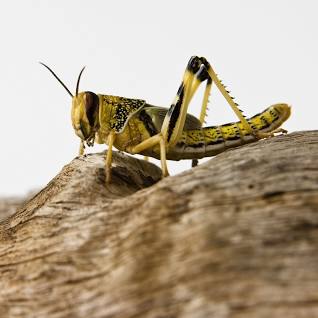
Desert locust: Schistocera gregaria

The eighth plague, locusts,1 opens this week’s Torah portion, Bo (Exodus 10:1-13:16). First Moses and Aaron tell Pharaoh:

“Thus says Y-H-V-H, the god of the Hebrews: How long do you refuse to humble yourself before me? Release my people so they will serve me! Because if you refuse to release my people, here I am, bringing arbeh in your territory tomorrow!” (Exodus/Shemot 10:3-4)

arbeh (אַרְבֶּה) = locust swarm(s); the desert locust Schistocera gregaria.

Then they deliver a practical threat and two frightening images. The practical threat is that the plague of locusts will devour every green thing in Egypt left after the hail, leaving the human population without food.2

Before and after the practical threat, Moses and Aaron transmit God’s frightening images.

Eyes, up and down

The first image conjures blindness, like the plague of darkness that will follow the locust plague.

“And it [the locust  swarm] will conceal the ayin of the land, and nobody will be able to see the land …” (Exodus 10:5)

ayin (עַיִן) = eye; view; spring or fountain.

After Pharaoh refuses to let the Israelites leave, the locust plague does exactly that.

And it concealed the ayin of the whole land, and it darkened the land and ate up all the green plants of the land and all the produce of the trees that the hail had left. Then nothing remained, nothing green remained on the trees or in the plants of the field, in the whole land of Egypt. (Exodus 10:15)

What does the word ayin mean in this story? The Hebrew Bible frequently uses ayin (most often in its duplex form, eynayim, עֵינַיִם = pair of eyes) to mean “view” or “sight”. Therefore many classic commentators assumed the Torah meant that the view of the land was blocked by the hordes of locusts. After all, the first reference to “the ayin of the land” is immediately followed by “nobody will be able to see the land”. If the locust swarms blanket every surface when they land, it would be as impossible to see through them as it is to see through the total darkness the Egyptians experience in the ninth plague.

On the other hand, the phrase “the ayin of the land” occurs only three times in the Hebrew Bible: twice in this week’s Torah portion (see above), and once in Numbers 22:5 (see below). According to contemporary commentator Gary Rendsburg, the rarity of this phrase means it is probably an adaptation of a common Egyptian phrase, “the eye of Ra”, which referred to either the sun (since Ra was the sun god) or the land of Egypt (which belonged to Ra). He wrote that Onkelos, who translated the Hebrew Bible into Aramaic in the second century C.E., inserted the word for “sun” in both phrases: “… ‘the eye of the sun of the land’ in 10:5 and … ‘the eye of the sun of the whole land’ in 10:15.”  Rendsburg suggested that Israelite readers would understand that the plague of locusts caused “the worst possible chain of events for the Egyptian nation, the disappearance of their omnipresent sun-god Ra”.3

Then what about the phrase “it darkened the land” in the second reference to “the ayin of the land”? When a locust swarm is in the air, it would not only block anyone underneath it from seeing the sun above, but also cast a broad shadow. According to Chizkuni,4 the shade cast by the swarm darkens the earth below.

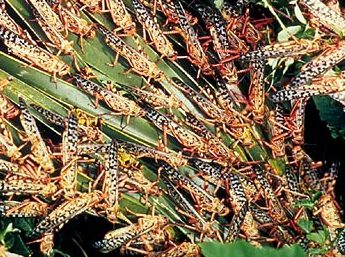
Locust swarm, photo by James Wainscoat

However, the context of the only other biblical appearance of the phrase “the ayin of the land” refers to a swarm or horde on the ground. In the book of Numbers/Bemidbar. Balak, the king of Moab, is alarmed because Moses has led a horde of Israelites north from Egypt, and they are encamped on the border of his country. This king says to his advisors:

“Now the throng will lick bare everything around us like an ox licks bare the grass of the field!” (Numbers 22:4)

This is the behavior of locusts on the ground eating up the vegetation, not of locusts on the wing blocking the sun. King Balak then sends a message to the prophet-sorcerer Bilam, saying:

“Here are people [who] left Egypt, and hey! They conceal the ayin of the land, and they are living next to me! So now please come and put a curse on this people, because they are too strong for me …” (Numbers 22:5-6)

In other words, Balak sees the Israelites covering the ground like a giant swarm of locusts; and like locusts they are powerful because of sheer numbers.

Swarms: inside and out

Plague of Locusts, Nuremberg Chronicle, 1493

After the practical warning that the coming locust swarms will consume Egypt’s entire food supply, Moses and Aaron transmit a second frightening image to Pharaoh—one that conjures an gruesomely intimate invasion.

“And they will fill your houses, and the houses of all your courtiers, and the houses of all Egyptians …” (Exodus 10:6) 

It is not the first such invasion in the contest between the God character and Pharaoh. Before the second plague, frogs, God orders Moses to tell Pharaoh:

“And the Nile will swarm with frogs, and they will go up and come into your palace and your bedroom and climb into your bed, and go up into your courtiers’ houses and your people’s, and into your ovens and your kneading bowls.” (Exodus 7:28)

The fourth plague is arov, עָרֹב = swarms of insects (traditional translation), mixed vermin (translation based on the fact that the root ערב means “mixture”). Again God says:

“… and the arov will fill the houses of the Egyptians, and even the ground they stand on.” (Exodus 8:17)

Swarms of unpleasant animals are bad enough outside. Being unable to escape them even inside your own personal space is a horrifying invasion.


The plague of locusts both signals the coming plague of darkness, and echoes the earlier plagues of frogs and swarms of vermin. It also completes the destruction of Egypt, by eliminating the last sources of food. After Moses and Aaron warn Pharaoh about the locust plague,

Pharaoh’s courtiers said to him: “How long will this one be a snare for us? Release the men so they will serve Y-H-V-H, their god! Don’t you know yet that Egypt is lost?” (Exodus 10:7)

Locusts feeding, photo by Compton Tucker, NASA

Pharaoh is so invested in his power struggle with God and Moses that he is past the point of caring whether his country is lost. But his courtiers have a different motivation. The first seven plagues have already ensured the economic downfall of Egypt; the loss of more crops will only mean that landowners lose more wealth as they feed their people during the coming famine. They have nothing to prove about who has more power. Some of Pharaoh’s courtiers have already acknowledged God’s power by bringing in their field slaves and livestock before the seventh plague, hail.5

So why do Pharaoh’s courtiers beg him to let the Israelites go? Probably because they cannot bear the thought of one more plague, especially a plague that will blot out their sight of the sun and the ground, and will once again invade even their bedrooms.


Over the past twenty years I have had problems I could deal with, and two persistent troubles that drove me crazy because I felt constantly under attack from well-meaning people who could not understand me and would not leave me alone. I was plagued by their incessant arguments and their refusals to accommodate me. These plagues darkened my life so I despaired of seeing sunlight. They invaded my home because I had to keep returning their phone calls. All I wanted was to be free of them.

I cut myself loose from one plague by resigning from my position. At the time, it seemed as hard for me to give up on that part of my life as it was for Pharaoh to give up and let the Israelites go. I waited out the other plague until my unwitting tormenter died. In that case, I was more like Pharaoh’s courtiers, whose power was limited.

Now that I am free, I hope that if I see another plague coming, I will be able to cut my losses right away. But I also pray that I will have empathy for others who suffer from unrelenting troubles. It is painfully hard to make a major change to improve your life, especially when you can see no illumination, and you have no safe place of refuge.


  1. When a wind brings multiple swarms of desert locusts into the same large region, it is still called a “plague” of locusts. (World Meteorological Organization, “Weather and Desert Locusts”, https://library.wmo.int/doc_num.php?explnum_id=3213#:~:text)
  2. Exodus 10:5.
  3. Gary Rendsburg, “YHWH’s War Against the Egyptian Sun-God Ra”, https://www.thetorah.com/article/yhwhs-war-against-the-egyptian-sun-god-ra.
  4. Chizkuni is a compilation of Torah commentary and insights written by 13th-century Rabbi Hezekiah ben Manoah.
  5. Exodus 9:13-26. See my post: Va-eira: Hail That Failed.

Va-eira: Hail That Failed

Is it ethical to harm or even kill innocent people? The liberal answer is no. Someone with more traditional morality might answer: no … unless you need to do it for the sake of your own people, whose welfare comes first.

In terms of either answer, the God of Israel and the pharaoh of Egypt are unethical in this week’s Torah portion, Va-eira (Exodus 6:2-9:35).

The God character wants the Israelites to walk out of Egypt and serve God as the new rulers of the land of Canaan. The pharaoh character wants the Israelites to stay in Egypt as forced labor making bricks and building cities for him. The God character also wants to be acknowledged as the most powerful force in the world, while the pharaoh wants to keep every iota of power he already has.1

Following God’s instructions, Moses repeatedly offers Pharaoh what sounds like a compromise: that Pharaoh give the Israelites a three-day vacation to hold a festival for their God in the wilderness.2 (Meanwhile Moses informs the Israelites that the real goal is a new life in a different country.) Pharaoh refuses, and the God character responds by devastating Egypt with a series of “plagues”: miraculous disasters. The plagues devastate the country and harm or kill human beings, including both the Israelite immigrants God has adopted, and Pharaoh’s native Egyptians.

The Ten Plagues, Erlangen Haggadah, by Judah Pinchas, 1747

Before the seventh plague, hail, God tells Moses to pass on this information to Pharaoh:

“For by now shalachti my hand, and you, you and your people, would be wiped off the earth by bubonic plague. However, on account of this I have let you stand: to show you my power, so that my name will be made known over all the earth.” (Exodus 9:15-16)

shalachti (שָׁלַחְתִּי) = I could have sent forth, I could have released. (A kal form of the verb shalach, שָׁלַח = sent, let go. Throughout this week’s Torah portion, forms of the verb shalach are used both when God releases a plague, and when Moses and Pharaoh talk about releasing, or not releasing, the Israelites.)

In other words, God is refraining from simply killing every native Egyptian. The purpose of sending one plague after another is to spread the word about God’s awesome power, and to eventually make Pharaoh so terrified that he gives in and lets the Israelites go out into the wilderness.

Pharaoh’s strategy is to keep refusing to give the Israelites permission to go. He assumes they would never leave Egypt without his permission, probably because then his army would kill them.3

Plague of Death of the Firstborn, Erlangen Haggadah, by Judah Pinchas, 1747

So much is at stake that neither of the God character nor the pharaoh is willing to stop them. Only after the tenth plague, the death of the firstborn, does Pharaoh concede defeat.

Yet these entrenched enemies soften their positions briefly in this week’s Torah portion, in the story of the seventh plague: hail.

Ethics of a god

The first three plagues in the book of Exodus/Shemot afflict everyone in Egypt indiscriminately. When God turns the Nile into blood, the Israelites as well as the native Egyptians are affected by the shortage of both drinking water and fish.4 The second plague, frogs, and the third, lice, also affect everyone in Egypt without exception.

Then the God-character seems to notice that his demonstrations of power are causing suffering to the people he plans to rescue. Before the fourth plague, swarms of mixed vermin, God declares that all the Egyptians will be affected, but the region occupied by Israelites, Goshen, will be vermin-free.5

The Israelites also get a divine exemption from the fifth plague, cattle disease; the ninth plague, darkness; and the tenth, death of the firstborn. (Through the oversight of either the narrator or the God character, no exception is mentioned for the sixth plague, boils, nor for the eighth plague, locusts.)

The seventh plague, hail, is a unique case. No hail falls on Goshen, where the Israelites live. But this time God gives some of the Egyptians a chance to reduce their losses ahead of time. God tells Moses to tell Pharaoh and his court:

“Here I will be, about this time tomorrow, raining down a very heavy hail, the like of which has never been in Egypt from the day it was founded until now. So now, shelach your livestock and everything in the field that is yours! Every human and beast that is found in the field and has not been gathered into [its] house, the hail will descend upon them and they will die.” (Exodus 9:18-19)

shelach (שְׁלַח) = Send! Send in! (Another kal form of shalach.)

Perhaps God is testing Pharaoh to see whether he rejects everything God says, not just the demand to give the Israelites a three-day leave of absence. Pharaoh is stubborn and does not issue any orders about his own livestock or field slaves.

Plague of Hail, Erlangen Haggadah, by Judah Pinchas, 1747

But everyone in the audience hall hears God’s advice regarding the coming hailstorm, and some of Pharaoh’s courtiers act on it.

Whoever feared the word of God among the servants of Pharaoh had his slaves and his beasts flee into the houses. But whoever did not pay attention to the word of God left his slaves and his beasts in the field. (Exodus 9:20-21)

The hail still destroys the barley and flax crops and shatters trees throughout all of Egypt—except Goshen, where the Israelites live.6 This means a loss for even the God-fearing landowners, since all Egyptians now face a future shortage of food (barley and fruit) and clothing (linen from flax). The hail also kills or injures the slaves of the Egyptian landowners who ignored God’s warning and left them out in their fields along with the livestock.

The God character must notice that some of Pharaoh’s courtiers now believe in the power of the God of Israel. This is progress on God’s agenda of becoming known as the supreme deity. An ethical and intelligent deity would now devise a way to exempt every Egyptian who fears the God of Israel from the suffering and death that will be caused by the last three plagues.

But God’s lenience preceding the seventh plague does not last. The three plagues in next week’s Torah portion, Bo, affect all Egyptians without exception. The tenth and final plague kills the firstborn son of everyone in Egypt who does not paint blood on the doorframe of their house—and God does not tell anyone but the Israelites about this sign.

And it was the middle of the night, and God struck down all the first-born in the land of Egypt, from the first-born of Pharaoh who sits on his throne to the first-born of the captive who was in the dungeon, to all the first-born of the livestock. (Exodus 12:29)

For the plague of hail, God experimented with mitigating the damage to Egyptians who feared God. But the final and most horrible plague punishes all Egyptians, even those who are eager to let the Israelites leave.

Ethics of a king

During the first six plagues, Pharaoh makes two false promises to let the Israelites go, but breaks them as soon as the plagues are removed.7 He does not express any guilt over the devastation to his country and its people.

But he appears to have a change of heart during the seventh plague, hail.

Then Pharaoh summoned Moses and Aaron and said to them: “I am guilty this time. God is the righteous one and I and my people are the wicked ones. Plead to God that there will be no more of God’s thunder and hail, va-ashalchah you, and you will not continue to stay.” (Exodus 9:27-28)

va-ashalchah (וַאֲשַׁלְּחָה) = and I will send away, let go, set free. (A piel form of the verb shalach.)

Plague of Hail, Golden Haggadah, Spanish, ca. 1320

Only here and during the eighth plague, locusts, does Pharaoh say he is guilty. When the hail is pummeling the land, he qualifies his confession in two telling ways. He classifies his people as well as himself as “wicked” even though so far, only Pharaoh and his taskmasters have harmed the Israelites. And he says he is guilty “this time”, ignoring the previous six times he refused to release the Israelites.

Does Pharaoh really believe he acted unethically? Or is he just saying so in the hope that a little groveling will help to get the plague of hail removed?

After all, Moses has not been frank with Pharaoh. So far he has kept repeating God’s request that the pharaoh give the Israelites three days off to worship their God in the wilderness. Pharaoh, by adding “and you will not continue to stay”, hints for the first time that he suspects the truth: if the Israelites got a three-day head start, they would not return to Egypt. Both Moses and Pharaoh hide their true agendas.

This week’s Torah portion ends:

And Pharaoh saw that the rain and the hail and the thunder had ended. Then he added to his guilt, and his heart was unmoved,8 his and his courtiers’. And Pharaoh’s heart hardened, and he did not shilach the Israelites, as Hashem had spoken through Moses. (Exodus 9:34-35)

shilach (שִׁלַּח) = let loose, let go, sent away. (Another piel form of the verb shalach.)

It is the narrator who says Pharaoh “added to his guilt” by being hard-hearted and refusing to let the Israelites go. Pharaoh himself is no longer talking about guilt. He has returned to his stubborn refusal to recognize that he cannot win against God. And Pharaoh’s courtiers stand with him this time.

By now Pharaoh knows that every time he refuses to release the Israelites another plague strikes Egypt. Perhaps during the hail he realizes that he, too, bears some responsibility and guilt for the damage the plagues have done. But then he returns to making  his own status as Egypt’s absolute ruler his top priority. He does not free the Israelites until the plague of the firstborn kills his own son and heir.


Both God and Pharaoh soften briefly during the story of the plague of hail. The God character enables the Egyptian landowners who take God seriously to protect some of their property. Pharaoh entertains the idea that he is wrong to prioritize his pride and his free labor over the health and safety of his own Egyptian citizens. Yet this softening quickly vanishes without leading to a moral improvement in either character.

It is easy to keep on angling to get what you want, regardless of the consequences for anyone else. I have acted that way myself, until I realized the damage I was doing and repented.

But some individuals are too narcissistic to feel compassion and repent. Occasionally a narcissist says or does something that appears to be kind and compassionate but, as I know from personal experience, this temporary kindness may be only a ploy to win favor. When push comes to shove, narcissists will harden again, because nothing is more important than their own agendas.

The book of Exodus paints the characters of both God and Pharaoh as narcissistic. Nevertheless, people still enjoy a story about a battle between two superpowers, regardless of the collateral damage in human lives.

But in our own lives, may we remember to look and see whether we are harming others as we pursue our own agendas. And may we protect ourselves, and others, from narcissists who cannot see the harm they do.

And may we not confuse God with the narcissistic God character in the book of Exodus.


  1. See my post Bo: Pride and Ethics.
  2. Exodus 5:1-3, 7:16, 8:21-24, 10:9-11, 10:24-26.
  3. Pharaoh and his charioteers do pursue the Israelites in Exodus 14:6-10 after Pharaoh changes his mind about letting them go.
  4. Exodus 7:20-24.
  5. Exodus 8:17-8:18.
  6. Exodus 9:16, 9:25, 9:31.
  7. Pharaoh promises to let the Israelites go during the plague of frogs in Exodus 8:4 and backs out in Exodus 8:11. He promises during the plague of vermin in Exodus 8:21 and 8:24 and backs out in Exodus 8:28.
  8. The Hebrew reads: vayakhebeid libo (וַיַּכְבֵּד לִבּוֹ) = and his heart was heavy. In English, the idiom “heavy heart” means sadness. But in Biblical Hebrew, a “heavy heart” is unmoved or immovable.

Shemot: Demagogue

Demagogue (noun): a leader who makes use of popular prejudices and false claims and promises in order to gain power. (Merriam-Webster Dictionary)

Egypt has too many immigrants! says the pharaoh says at the beginning of the book of Exodus, in the Torah portion Shemot (Exodus 1:1-6:1). If the immigrant population increases any more, we’re in trouble!

“Hey, the Israelite people are countless, more numerous than we are! Come, let us use our wits, or else they will increase. Then it will happen that war will be proclaimed against us, and [these people] will actually join our enemies and make war against us, then go up from the land!” (Exodus/Shemot 1:9-10)

Semites visiting Egypt, Tomb of Knumhotep II, c. 1900 BCE

A few centuries before, in the book of Genesis, a pharaoh appreciated Joseph’s service so much he invited Jacob’s clan of 70 people to migrate from Canaan to Egypt. Now they have so many descendants that some of the native Egyptians are nervous. The pharaoh escalates their fears by predicting both that the Israelites will rise against the Egyptians, and that they will leave Egypt and, presumably, stop contributing to its economy.

Today demagogues in many western nations spread the notion that immigrants and their descendants will take away jobs, use up public resources, and change the culture of the country. Why did the pharaoh at the beginning of the book of Exodus raise the specter of civil war instead?

The scenario the pharaoh describes in this week’s Torah portion may have actually happened when a Semitic people called the Hyksos conquered northern Egypt and ruled it from 1638 to 1530 B.C.E.. A recent analysis of teeth found in skeletons in the remains of Aravis, their capital in the Nile delta, indicates that the Hyksos came from an established immigrant community within Egypt.1

Ramesses II capturing enemies, c. 1250 BCE

None of the pharaohs in the book of Exodus are named, but the first one to speak is sometimes identified with Ramesses II, who ruled in 1279–1213 B.C.E. and built a new capital city, Pi-Ramesses, near the old site of Avaris. During his reign Canaan was a colony of the Egyptian Empire, populated by Semites but controlled by Egyptian administrators and soldiers. Nevertheless, historical memory of the Hyksos might have haunted Egyptians.

After fomenting fear and loathing of the Semitic Israelites living in Egypt, the first pharaoh in Exodus takes two actions. First he takes advantage of the anti-Semitism he has revived to get free labor for his own projects.

Then they set over them [the Israelite men] overseers for corvée labor in order to oppress them with their forced labor, and they built cities of warehouses for Pharaoh: Pitom and Rameseis. (Exodus 1:11)

Native Egyptians are probably glad their pharaoh is conscripting resident aliens instead of them. However, this corvée labordoes not address the pharaoh’s original claim that the Israelites are dangerous because they might fight on the enemy’s side in a war. Even though the Israelite men are supervised by Egyptian overseers, they might revolt if an army from another country promised them liberation.

(The first book of Kings provides an example of rebellion due to forced labor. King Solomon imposes corvée labor on his own people, sending Israelite men in shifts to quarry stone in Lebanon for building Jerusalem’s new temple. Unlike the Israelites in Egypt, Solomon’s laborers work in the quarries one month, then get two months off at home.2 The levy continues for further building projects in the northern part of Solomon’s kingdom.3 When Solomon’s son and successor, Rechavam, announces he will work the northern Israelites harder, they revolt and set up their own kingdom.4)  

The first pharaoh in Exodus, besides taking advantage of the anti-Semitism he has revived in order to levy forced labor, attempts to commit gradual genocide. He orders the midwives for the Israelites to kill the male infants of Israelite women, but let the females live.5 Perhaps his rationale is that the boys would grow up to become soldiers fighting against the native Egyptians. A more efficient way to commit genocide would be to kill the girls as well, since they will give birth to future generations. But the cultural assumption was that girls could be trained as servants and concubines and safely absorbed into the Egyptian population. Why deprive the native Egyptians of a class of docile domestic servants?

But the midwives disobey the pharaoh.

Then the king of Egypt summoned the midwives and said to them: “Why have you done this thing and let the boys live?” And the midwives said to Pharaoh: “Because the Ivriot are not like the women of Egypt, because [they are] chayot. Hey! Before you come to them to serve as a midwife, they have given birth.” (Exodus 1:18-19) 

Ivriot (עִבְרִיֺּת) = female Hebrews.  (Plural female of Ivri, עִבְרִי. The term Ivri may be related to the term habiru in letters sent from Canaan to Egypt in the 14th century B.C.E.. The habiru were a marginal social class of outsiders, often outlaws or mercenaries. In Hebrew, Ivri is related to the verb avar, עָוַר = pass through, cross over; an ivri is a boundary-crosser or a nomad. Today the Hebrew language is called Ivrit, עִבְרִית.)

chayot (חָיוֹת) = wild animals.

The midwives probably refer to the Israelite women as Ivriot and chayot in order to sound as if they are as anti-Semitic as the pharaoh.6 They get away with their excuse; the pharaoh refrains from punishing them.

Although classic commentary says the two spokeswomen for the midwives, Shifrah and Puah, and actually Moses’ mother and sister, Pharaoh would hardly respond positively to their excuse if they were Semites! But why would the Israelite women use Egyptian midwives? The Torah offers no explanation. Why complicate a juicy story?

Even though the pharaoh lets the midwives off the hook, he still needs to pander to the masses he has inflamed. So he incites the native Egyptians to take violent action.

Then Pharaoh commanded his entire people, saying: “Every son that is born, you shall throw him into the Nile. But every daughter you shall keep alive.” (Exodus 1:22)

Vigilante groups of Egyptian men must have responded by searching Israelite houses, seizing infant boys, and drowning them. The next two sentences in the Torah portion are:

And a man from the house of Levi went and married a daughter of Levi. And the woman conceived, and she gave birth to a son. And she saw him, that he was good, and she hid him for three months. (Exodus 2:1-2:2)

This baby boy is Moses, who is later adopted by a daughter of the pharaoh who does not share her father’s anti-Semitism.


I believe the pharaoh in this story acts unethically by inciting murder, by imposing corvée labor on residents of his country in a time of peace, and by encouraging prejudicial acts against native-born children of an immigrant population. But not everyone today would agree with me. Demagogues have risen in more than one modern Western nation in the 21st century, and a few have even been elected as heads of state.

Since the pharaoh in this week’s Torah portion is an absolute ruler, he can issue inflammatory orders without fear of reprise. I pray that all demagogues who incite violence in our time will be brought to justice.


  1. https://www.smithsonianmag.com/smart-news/first-foreign-takeover-ancient-egypt-was-uprising-not-invasion-180975354/
  2. 1 Kings 5:27-31.
  3. 1 Kings 11:26-28.
  4. 1 Kings 12:1-20.
  5. Exodus 1:16.
  6. Exodus 1:17-19. See my post Shemot: Disobedient Midwives.

Shelach-Lekha: Deceptions and Sore Spots

How do you persuade someone to do what you want—even when you can’t make a reasonable case for it?

Two of the stories people tell in this week’s Torah portion, Shelach-Lekha, are implausible when you examine them. But nevertheless the speakers succeed in getting the reaction they desire.

1) Fabrication by the Ten Scouts

The Two Reports of the Spies, 1907 bible card by Providence Lithograph Co.

Moses sends twelve men north from the wilderness of Paran to scout out the land of Canaan—the land God has promised to give to the Israelites—and report back. He also tells them to bring back some fruit from the land. They return forty days later with pomegranates, figs, and a single cluster of grapes so heavy that two of them have to bear it on a carrying frame.

All twelve scouts agree that the land is fertile and good, and “flows with milk and honey”1. Ten of them, however, are alarmed by the “strong people” and “large fortified cities” they saw—phrases that make the assembled Israelites nervous.

Caleb, one of the other two scouts, urges:

“Let us definitely go up! And we will take possession of [the land], since yakhol nukhal it!” (Numbers 13:30)

yakhol (יָכוֹל) = being capable of, having power to. (Infinitive absolute form of yakhol, יָכֺל = was capable of, had power to; held onto, won.)

nukhal (נוּכַל) = we are capable of, we have the power to do. (Imperfect form of yakhol.)

yakhol nukhal (יָכוֹל נוּכַל) = Literally: being capable we are capable of. Idiomatically: we are certainly capable of. (In Biblical Hebrew, an infinitive absolute preceding another verb from the same root indicates emphasis, such as “certainly”, “definitely”, or in older English “surely”.)

The ten scouts who are afraid to march on Canaan do not want the Israelites to believe Caleb’s assurance. So they add some new details to their story.

But the men who had gone up with him said: “Lo nukhal to go up to the people, because they are stronger than we are!” And they put forth to the Israelites a slanderous report of the land that they had scouted, saying: “The land that we traversed to scout out is a land devouring its inhabitants! And all the people who we saw in it were people of [great] size. And there we saw the Nefilim2, Anakites from the Nefilim! And in our eyes we were like grasshoppers, and so we were in their eyes.”

Lo nukhal (לֺא נוּכַל) = we are not capable, we do not have the power. (Lo, לֺא ֹ= not.)

The ten scouts simply do not believe that their people could succeed in conquering the land, with or without God’s help. Since the presence of large fortified cities is not enough to persuade the Israelites to stay put in Paran, the ten scouts invent a “slanderous report” that is clearly false—if you examine it rationally.

How could a land that produces such abundant food be “devouring its inhabitants”? Could wild animals be killing off the people? No, the land is full of large cities, and these cities are still populated. We know this because in their first account, the scouts said that there were Anakites; Amalekites living in the Negev; Hittites, Jebusites, and Amorites living in the hill country; and Canaanites living along the seacoast to the west and the Jordan River to the east.3

Furthermore, in the first report Anakites were only one of the groups living in Canaan. In their new story, they ten scouts say that all the people are giants—giants so big that they felt like grasshoppers in comparison.

Despite the holes in their story, the ten scouts succeed in panicking the Israelites, who weep all night and tell each other: “Give us a leader and we will return to Egypt!” (Numbers 14:4)

In the morning the twelfth scout, Joshua, stands with Caleb and both men argue that the Israelites can conquer Canaan because God is with them. But their argument comes too late. The people have already been persuaded by the tale the other ten scouts fabricated.

The Israelites do not see through the deception because their habit, whenever they encounter a problem, is to doubt God and beg to go back to Egypt, where they were enslaved but (they now believe) safe.

In the book of Exodus the Israelite slaves believe Moses the first time he tells them that God will rescue them.4 Then Pharaoh doubles their labor, and when Moses tells them that God will not only free them, but also give them the land of Canaan, they do not listen.5 Five of the ten plagues affect the Israelites as much as the Egyptians, which is not a promising sign. After they march out of Egypt, Pharaoh pursues the Israelites with an army of charioteers, and they are so frightened they do not believe God will rescue them.6

Escape over the Red Sea, Golden Haggadah, c. 1320, Spain

Their faith in God returns after the Egyptian army drowns in the Reed Sea.7 But in the wilderness the Isaelites think they are going to die when they run out of food or water, and they long for Egypt instead of trusting God to provide for them.8

The majority of Israelites are easily deceived in this week’s Torah portion because the fabrication of the ten scouts triggers their ongoing anxiety about God.

2) Fabrication by Moses

In the morning the Israelites threaten to stone Caleb and Joshua for telling them what they do not want to hear. Then the glory of God (probably the divine cloud that has led them from Egypt to the southern edge of Canaan) appears on the Tent of Meeting.9 God threatens to disown the Israelites, kill them, and make a nation out of Moses instead.

Moses does not try to reason with God. Instead he reminds God that if God kills all the Israelites, the Egyptians will hear about it and spread the news. Since God chose the Israelites to rescue and accompany, Moses says,

“… then the nations that heard of your reputation would say: Except God was not yekholet to bring this people to the land that [God] promised them, so [God] slaughtered them in the wilderness!” (Numbers 14:15)

yekholet (יְכֺלֶת) = capable enough, powerful enough. (Also from the root verb yakhol.)

Moses then asks God to pardon the people instead. God grants a limited pardon, requiring the Israelites to stay in the wilderness for forty years before they get another chance to enter Canaan.

Would the natives of Egypt and other nations really conclude that God killed the Israelites because God was not powerful enough to give them the land?  In an actual war between the Israelites and the natives of Canaan, people might assume that the conqueror’s god was stronger. But would people think that the reason God killed the Israelites before they even entered Canaan would was because God was weak?

Throughout the Ancient Near East, gods were considered mercurial and easily angered. The gods in polytheistic religions quarreled with each other, with disastrous consequences to human beings. They also lashed out at humans if they felt they were insufficiently propitiated.

If news spread that the Israelites had all died at the border, the people of other nations probably would conclude that the God of Israel was responsible. But they would attribute God’s deed to annoyance, revenge, or a change of mind, not to a lack of power.

Apparently God does not think of this. After hearing Moses’ deceptive claim, God commutes the Israelites’ sentence. Why is the God-character in Shelach-Lekha so easily persuaded?

Israelites Leave Egypt, the Golden Haggadah

Four times in the book of Exodus God says that the purpose of creating ten plagues in a row (and hardening Pharaoh’s heart whenever it wavers) is so that all the Egyptians, as well as the Israelites, will realize how powerful God is.10 Finally God lets Pharaoh beg the Israelites to leave Egypt, and they march out into the wilderness. Then God tells Moses:

“And I will strengthen Pharaoh’s heart and he will chase after you. Then I will be honored through Pharaoh and through all his army, and Egypt will know that I am God.” (Exodus 14:4)

The honor11 that God has in mind is drowning the Egyptian army in the Reed Sea. For the God-character portrayed in Exodus and Numbers, it is not enough to be the most powerful god in the world.12 All human beings must know that the God of Israel is the most powerful god. The God-character in Exodus and Numbers frets over “his” reputation.

Moses is able to mislead this God-character because he knows what the deity is touchy about.


Few people today believe in an anthropomorphic God that is hypersensitive and does not see through human misdirection. But all of we humans can be tricked into knee-jerk reactions by those who know our weak spots.

In these times I am angry when immoral politicians use slogans that push people’s buttons and thereby get popular support for agendas that will result in the opposite of what their voter base really wants. I am also angry when activists whose agendas I favor unskillfully use slogans that set off negative knee-jerk reactions among people who would otherwise be able to listen to a reasonable argument.

Alas, the portion Sehlach-Lekha illustrates that when a speaker fabricates a story that triggers an ingrained fear or sore spot, the listeners are highly unlikely to stop and think.

May all human beings be blessed with longer fuses, and the strength to put our feelings on hold long enough to question what we read or hear.


  1. Numbers 13:27. See my post Ki Tavo: Milk and Honey.
  2. Nefilim (נְפִילִים) = a race of demi-gods and heroes before the Flood. (Genesis 6:4)
  3. Numbers 13:29.
  4. Exodus 4:30-31.
  5. Exodus 6:6-9.
  6. Exodus (Beshallach)14:10-12.
  7. Exodus (Beshallach) 14:31.
  8. Exodus (Beshallach) 16:2-3, 17:1-4.
  9. Numbers 14:10.
  10. Exodus 7:3-5, 9:15-16, 10:1-2, 11:9.
  11. Honor or importance. The Hebrew word in Exodus (Beshallach) 14:4 is ikavdah (אִכָּבְדָה) = I will be honored, I will show my glory, I will be respected, I will be recognized as important. God repeats this sentiment in Exodus 14:17 and 14:18.
  12. Monotheism appears in the Hebrew Bible only in the first chapter of Genesis and the books of Deuteronomy and Isaiah.

Bemidbar & Naso: Dangerous Duty

Two dangers face the Israelites as they leave Mount Sinai in the book of Numbers/Bemidbar: the risk of attack by an enemy in the wilderness, and the risk of annihilation by God.

They have already experienced both dangers. On their way from Egypt to Sinai the Amalekites attacked them, and the Israelites beat them off with the help of God.1 When they stood at the foot of Mount Sinai to hear God speak, the earth quaked—and so did the Israelites.

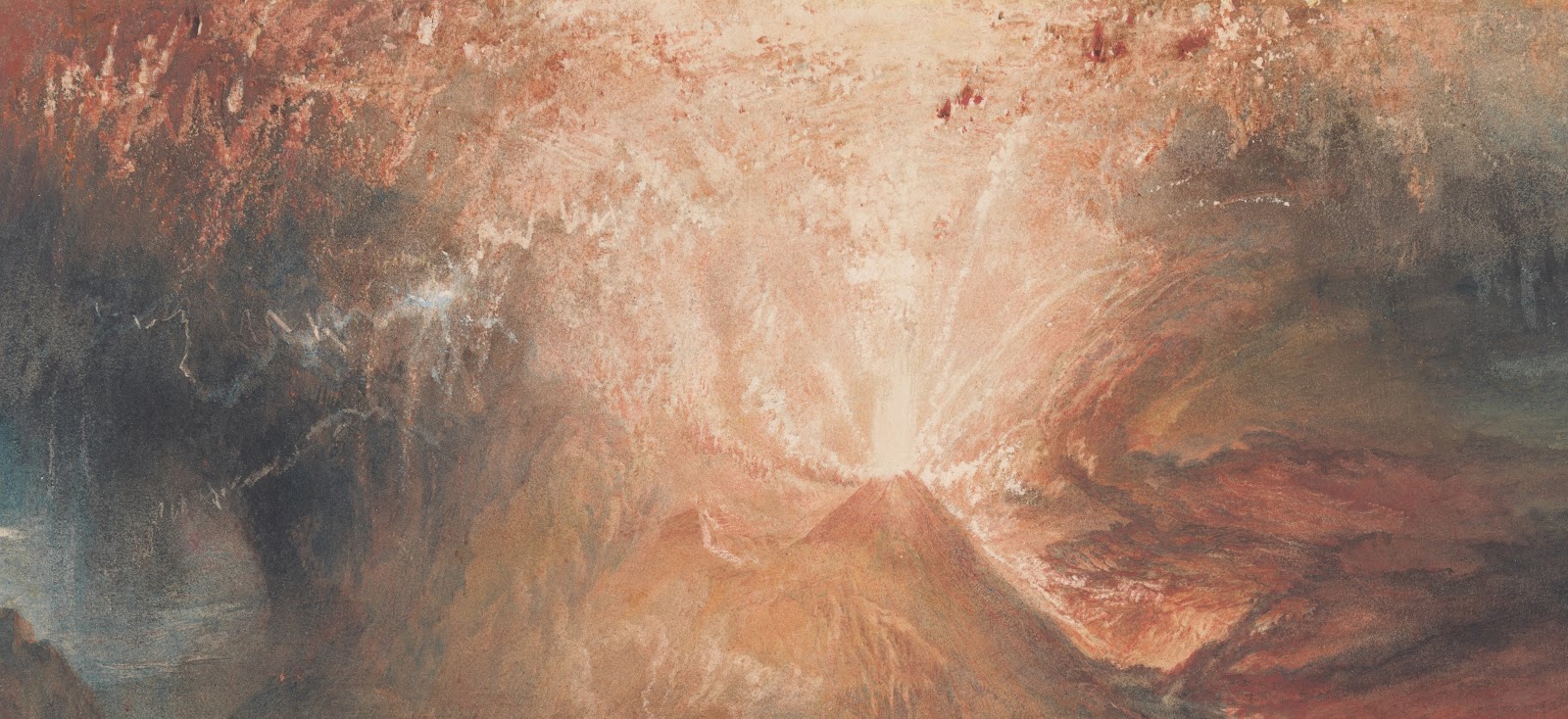
Mount Vesuvius in Eruption, by Jacob More, 18th cent., detail

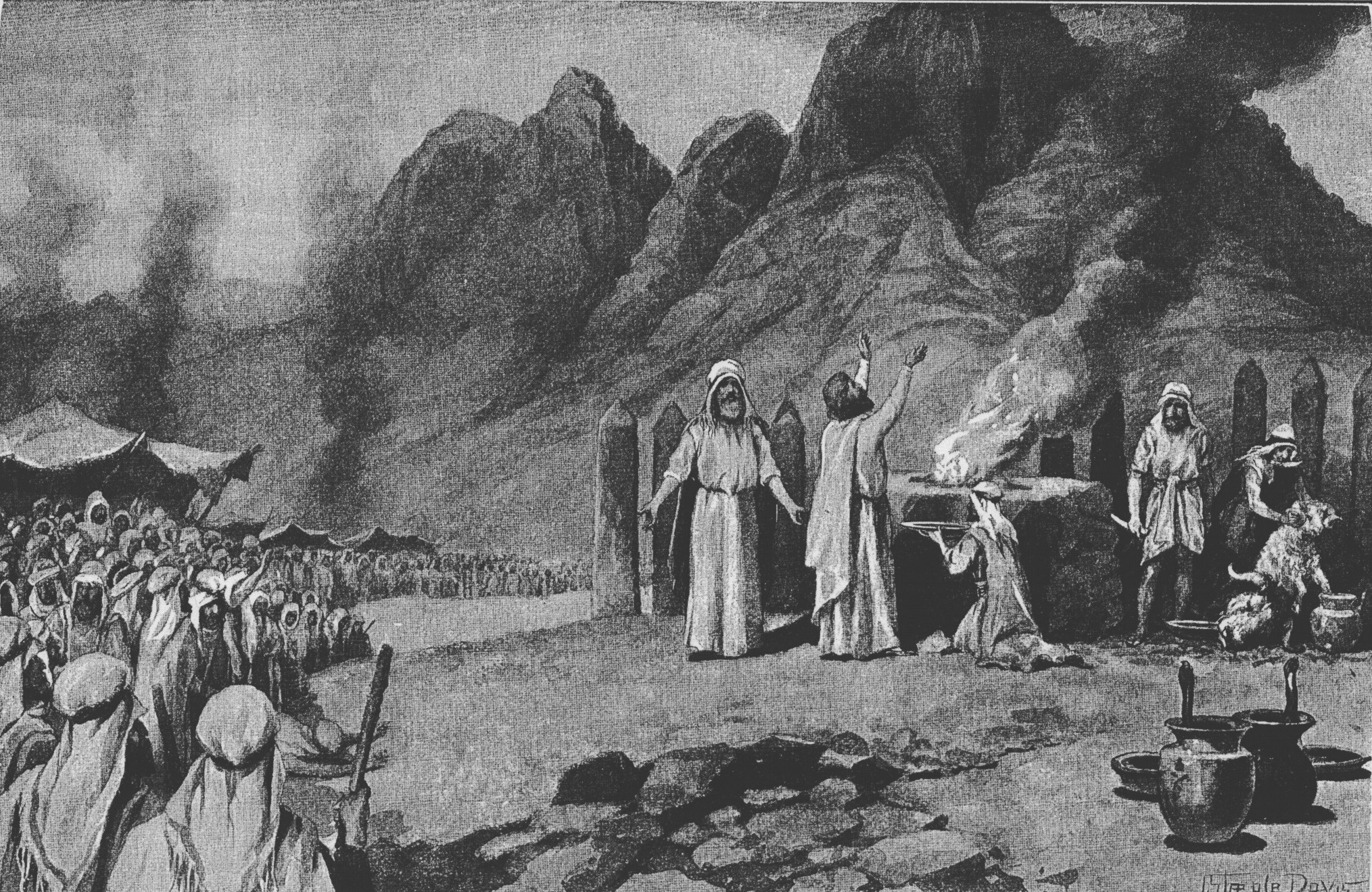
And all the people were seeing the thunder and the flashes and the sound of the ram’s horn, and the mountain was smoking; and the people saw and they quaked and drew back and stood at a distance. And they said to Moses: “You speak to us and we will listen; but don’t let God speak to us, or else we will die!” (Exodus 20:15-16)

The Jewish day of Shavuot commemorates the revelation at Sinai, when the Israelites were terrified and God uttered the “ten commandments”. This holiday always falls the same week as the Torah reading Bemidbar, the first portion in the book of Bemidbar.

This Torah portion begins with God telling Moses to take a census of the men in all the tribes except Levi.2 The purpose of this census is to learn how many troops can be mustered in the event of a battle after the Israelites leave Mount Sinai and resume their journey to Canaan.

Israelite service

Numbering of the Israelites, by Henri F.E. Philippoteaux, 19th cent.

And all the [male] Israelites were mustered from the houses of their forefathers, from the age of twenty years and up, all who were going out in the tzava in Israel. (Numbers 1:45)

tzava (צָבָא) = army, unit of warriors, army service.

The qualifying phrase “all who were going out in the tzava” implies that the census counted only men aged 20 and over who were able to march and wield weapons.

Then God spoke to Moses saying: “However, the tribe of Levi you shall not muster, and you must not make a head count of them among the Israelites.” (Numbers 1:48-49)

In the second Torah portion of Numbers, Naso, there is a census of the three Levite clans.

And Moses and Aaron and the chieftains of the community enrolled the sons of the Kehatites by their families and by the house of their father, from the age of thirty years and over, up to the age of fifty years, all who were entering the tzava for the service of the Tent of Meeting. (Numbers 4:34-35)

The censuses of the Geirshonite and Merarite clans also count men aged 30 to 50, and also add “all who were entering the tzava for the service of the Tent of Meeting”.3

Why does the Torah call the Levites an army?

Levite service

Before telling Moses to take a separate census for the tribe of Levi, God says:

“Assign the Levites over the Sanctuary of the Testimony and over all its equipment and over everything that belongs to it. They themselves shall carry the sanctuary and all its equipment, and they shall attend it, and they shall camp around the sanctuary. And when [it is time for] the sanctuary to pull out, the Levites shall take it down; and when [it is time for] the sanctuary to be pitched, the Levites shall erect it. And any unauthorized person who comes close must be put to death.” (Numbers 1:50-51)

Thus one of the duties of the Levites is to guard the tent-sanctuary and kill any unauthorized person who persists in coming too close to the tent, or even entering it.4 That is the military aspect of their service, but it is not the most dangerous.

“And the Israelites shall encamp, each man in his camp and each man at the banner for his troop. But the Levites shall encamp around the Sanctuary of the Testimony, and then there will be no fury against the community of Israelites; and the Levites shall guard the guardianship of the Sanctuary of the Testimony.” (Numbers 1:52-53)

Whose fury? When the Torah portions Bemidbar and Naso describe the duties of the Levites whenever the people break camp, it becomes clear that the fury would come from God.

First the priests (Aaron and his two surviving sons) must go inside the tent and wrap up the most holy items before anyone else can see them, and place them on carrying frames with poles. The holiest items are the ark, lampstand (menorah), the bread table, and the gold incense altar. The priests also wrap up the gold tools used for the rituals inside the tent.5

And Aaron and his sons shall finish covering the holy items and all the holy equipment when breaking camp, and after that the Kehatites shall come in to pick them up, so they do not touch the holy objects and die. These things in the Tent of Meeting are the burdens the Kehatites. (Numbers 4:15)

Each of the three clans in the tribe of Levi is responsible for carrying some part of the tent-sanctuary. The Kehatites must carry the most holy items, while the Geirshonites and Merarites carry the outside altar and the disassembled parts of the tent and the wall around it—cloth hangings, posts, planks, bars, pegs, sockets, and cords.

No touching

Certainly Betzaleil touched the holiest items when he hammered them out of gold in the book of Exodus.6 But later in the book of Numbers, God tells Aaron that the priests must not touch them, or they will be killed.7 Somehow the priests must light the menorah, lay bread on the table, and place coals and incense into the incense altar without touching their gold surfaces. And they must wrap these items in cloths without directly touching them.

Model of ark, Jerusalem

In the first book of Samuel the ark sits for twenty years in the house of Avinadav at Kiryat Ye-arim. His son Elazar is consecrated as an ad-hoc priest to look after it.8 Then King David decides to move it to his new capital in Jerusalem. The ark is lifted up onto a new cart, and two other sons of Avinadav, Uzah and Achyo (presumably younger replacements for Elazar) walk beside it. Partway to Jerusalem,  the oxen pulling cart stumble, and Uzah puts his hand on the ark to steady it.

And God’s anger flared up against Uzah, and God struck him down there … and he died there beside the ark of God. (2 Samuel 6:7)

Uzah’s impulse is good, but nevertheless a divine power zaps him the instant he touches the ark.

No looking

No one in the bible is harmed from carrying the ark by its two poles, but touching the ark itself is deadly. The ark takes a circuitous route to Kiryat Ye-arim in the first book of Samuel. After the Philistines capture the ark in battle they bring it to their town of Ashdod, but everyone there is stricken with a plague. They send it on to Gath, then to Ekron, each time with the same result. So they load the ark onto a cart pulled by two cows and send it back into Israelite territory. The cows stop in a field near the town of Beit Shemesh, where seventy curious Israelites look inside. God strikes down every one of them.9

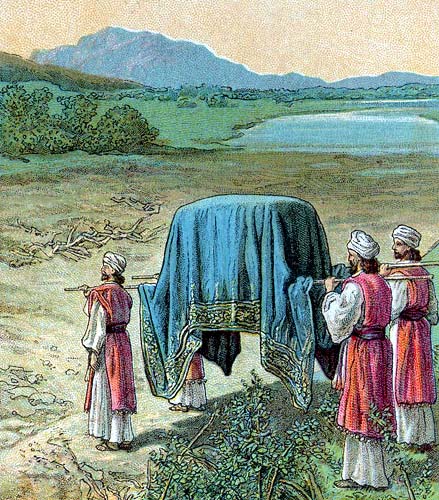
Kehataties carrying ark on a bible card by Providence Lithograph Co., 1907

In the portion Bemidbar: Don’t Look, the priests cover all the holiest items not only to prevent the Kehatites from touching them, but also to prevent these Levites from seeing them, even from the outside.

And God spoke to Moses and to Aaron, saying: “Do not cause the staff of the families of the Kehatites to be cut down from among the Levites!  Do this for them, so they will live and not die: when they approach the Holy of Holies, Aaron and his sons shall come in and assign each individual man his service and his burden.  And they must not come inside [the tent] to look as the holy things are swallowed [by the wrappings], or they will die.”  (Numbers 4:17-20) 

I speculated that the Levites are not allowed a glimpse of the holiest items either because it might make them feel as powerful as the priests, or because it might make them treat the holy items (and therefore God) with insufficient reverence.

Transporting the wrapped-up holy things might be nerve-wracking for the Kehatites. They carry them by hand, not on carts. What if they stumble and drop something? What if one of the coverings slips off?

For the “armies” traveling north from Mount Sinai, guard duty is more dangerous than combat duty.


  1. Exodus 17:8-13.
  2. In the book of Genesis Jacob has twelve sons; Levi is his third son, and Joseph is his eleventh. In other books of the Torah eleven tribes are named after Jacob’s sons, but there is no tribe of Joseph; instead two tribes are named after Joseph’s two sons, Efrayim and Menashe. That makes thirteen tribes—but even in the Torah, the tradition is that there were twelve tribes of Israel. The solution in the first three portions of Numbers is that there are twelve tribes of Israel plus one tribe of Levi.
  3. Numbers 4:39, 4:43.
  4. See Numbers 25:6-8.
  5. Numbers 4:5-14. See my post Bemidbar: Covering the Sacred.
  6. Exodus 37:1-29.
  7. Numbers 18:3.
  8. 1 Samuel 6:21-7:2.
  9. 1 Samuel 6:10-20.

Pesach, Metzora, & Chukat: Blood and Oregano

Jews will gather around tables all over the world this Friday evening for the Passover seder, a ritual and story about God liberating the Israelites from Egypt. One highlight is when we chant the names of the ten plagues God inflicted on Egypt. After the name of each plague, we use one finger to remove a drop from the second of our four ceremonial cups of wine.1

Death of the Firstborn, Spanish Haggadah c. 1490

The tenth and final plague is makat bechorot, death of the firstborn; God takes the life of every firstborn in every family in Egypt—except for the Israelites who mark their doors so that God skips, or passes over, them.

Before the final plague, God tells Moses that each Israelite family must slaughter a lamb or goat kid on the fourteenth day of the month.

“Then they shall take some of the blood and put it on the two doorposts and on the lintel, on the houses in which they will eat it. And they shall eat the meat that night, roasted in fire, and unleavened flatbread; on bitter herbs they shall eat it.” (Exodus/Shemot 12:7-8)

After describing how the Israelites should eat standing up with their loins girded, ready to leave, God says: “… It is a Pesach for God.” (Exodus 12:11)

Pesach (פֶּסַח) = the sacrifice mandated in Exodus 12; the annual spring pilgrimage festival in the Torah; the annual observance of Passover. (From the root verb pasach, פָּסַח = limp, skip.)

“And the blood will be a sign on the houses where you are, and I will see the blood ufasachti over you, and you will not be afflicted with destruction when I strike in the land of Egypt.” (Exodus 12:13)

ufasachti (וּפָסַחְתִּי) = and I will skip over you. (A form of the verb pasach.)

The animal blood both signals an escape from death and brings the recipient close to God—in these instructions and in two other rituals in the Torah in which the blood of  slaughtered animal is applied with branches of oregano.

1) Bo in Exodus (Pesach)

Moses adds oregano when he transmits God’s instructions to the Israelites.

Preparing for the Plague of the Firstborn, History Bible, Paris, c. 1390

“Then you shall take a bundle of eizov and you shall dip it into the blood that is in the basin, and touch some of the blood that is in the basin to the lintel and to the two doorposts. And you must not let anyone go out from the door of his house until morning. Ufasach, God, to strike dead the Egyptians, and [God] will see the blood on the lintel and on the two doorposts, ufasach, God, the door and not let the destruction enter your houses to strike dead [your firstborn].  (Exodus 12:21-23)

eizov (אֵזֺב) = Syrian oregano, an aromatic perennial herb. (Traditionally translated as “hyssop”, although true hyssop does not grow in the Middle East.) Eizov grows in stony ground to a height of 3-4 feet; its stems are the longest in the oregano branch of the mint family.

ufasach(וּפָסַח) = and he will skip over, and he will hop over. (Another form of the verb pasach.)

In the above passage, the first ufasach means that God will pass over Egypt, and the second ufasach means that God will skip over the houses whose doorframes are painted with blood.

An omniscient god would already know which houses to skip. Either the God-character in this story is not omniscient, or God includes the blood painting for its emotional or symbolic impact.

Up to this point in the book of Exodus, the Israelite slaves find it hard to believe that God is on their side. But when they discover that God has killed every firstborn in every house except theirs, they are (temporarily) reassured that God is indeed rescuing them, and they march out of Egypt into freedom “with a high hand”.2

Why does Moses specify that the Israelites should use a bunch of eizov to paint the blood? The only herbs God mentioned to him were generic bitter herbs, to be eaten with the roast lamb or goat. Oregano is savory, but not bitter. Perhaps Moses is afraid that the Israelites will find it eerie to paint with blood, and he hopes to comfort them with the good smell of oregano.

2) Metzora in Leviticus

Last week’s Torah portion, Metzora, describes four steps of purification for someone who has recovered from the skin disease tzara-at. Although this disease does not seem to be contagious, the white and scaly patches of skin are a reminder of death. If the tzara-at clears up, ritual purification is necessary so that the healed person can return to the community and to God’s sanctuary. (See my post Metzora: Time to Learn, Part 2.)

Two Birds, by Simon Fokke, 18th century

The first step is a ritual requiring two wild birds.

And the priest shall slaughter one bird in an earthenware vessel [held] over living water. The live bird he shall take, along with the cedar wood and the crimson dye and the eizov, and he shall dip them and the live bird into the blood of the bird [that was] slaughtered over living water. Then he shall sprinkle it on the one being purified from tzara-at seven times and purify him. And he shall send the live bird out over the open field. (Leviticus 14:5-6)

The ancient Israelites identified blood with the life-force (nefesh, נֶפֶשׁ) in a person or animal.3 Here the priest kills one bird and catches its lifeblood in a bowl held over fresh water, which is called “living water” in the bible. The priest dips the other bird into the blood of life and sets it free. The healed person who is watching knows deep down that God has rescued them and given them new life.

The cedar and crimson dye (made from shield-louse eggs) have no apparent purpose except to emphasize the red color of the blood.

The eizov is used to sprinkle blood on the person being purified. A bunch of branches covered with soft leaves can be used to paint blood on something, but it can also be shaken to sprinkle blood on someone. And shaking a bunch of eizov branches would release the good smell of oregano, a reminder that life will be savory again.

3) Chukat in Numbers

A purification ritual in the book of Numbers/Bemidbar uses blood and eizov to make a transition for someone who has been exposed to a human death, so that the person can return to the right state for worshiping God with the community.

First a perfect, unblemished red cow that has never carried a yoke is slaughtered outside the camp as a chatat (חַטָּאת), an offering to compensate for an inadvertent sin or lapse. Usually someone offers a chatat after realizing they have made an error in observance that separates them from God. The chatat in this Torah portion is unique because the offering is slaughtered and burned ahead of time, so that future people who find they have become separated from the divine through exposure to human death can make a virtual chatat.

Then Elazar the high priest shall take some of her [the cow’s] blood with his finger, and he shall flick some of the blood seven times in the direction of the front of the Tent of Meeting. (Numbers/Bemidbar 19:4)

This connects the cow’s life with God’s holy place. Next, Elazar watches while someone burns the entire cow, even its blood and dung.

And the priest shall take cedar wood and eizov and crimson dye, and throw them into the middle of the burning cow. (Numbers 19:6)

The ashes of the red cow in Chukat are gathered and stored in a ritually pure place, to be used to purify the following:

1) Anyone who is inside a tent where a human dies, and anyone who enters the tent for the next seven days (Numbers 19:14).

2) Anyone who touches a human corpse (even on a battlefield), or who touches a human bone, or who touches a grave (Numbers 19:16).

Eizov (Syrian oregano)

Then some of the ashes of the burning of the chatat will be taken and mixed with living water in a vessel. Then a ritually pure man shall take eizov and dip it in the water, and he shall sprinkle it over the tent and on all the vessels and on the souls who were there; or on the one who touched the bones, or the killed person, or the person who died [of natural causes], or the grave. And the ritually pure one shall sprinkle it on the third day and on the seventh day. Vechito on the seventh day. And he shall clean his clothes and he shall wash in water, and he will be ritually pure in the evening. (Numbers 19:17-19)

vechito (וְחִטּאוֹ) = and he will become free of his lapse. (From the same root as chatat.)

Anyone exposed to death who does not go through this process is excluded or “cut off” from the community. If they were not excluded, “the holy place of God would become impure”. (Numbers 19: 20)


Today we have no ritual to free us from the feeling of alienation that accompanies contact with death; there has been no ash from a pure red cow for two thousand years. Neither do we have a ritual to reintegrate with the community when we recover from a disfiguring condition that isolates us as tzara-at once did.

And today very few Jews in the world observe Passover by slaughtering a lamb and painting its blood on their doorframes with bunches of giant oregano—even during the current plague of Covid. The long ritual seder that developed over the past millennium and a half focuses on freedom from slavery, not on fear that God will kill us.

Nevertheless, this Passover I am going to put a sprig of oregano on my seder plate, next to the bitter herbs. Even during times when we are crushed by the bitterness of physical or psychological slavery, life has savory moments.


  1. The custom of removing drops of wine is first mentioned in a Pesach sermon written by Rabbi Eleazer of Worms (1176–1238). The idea that we do it in sympathy for the Egyptians is based on Proverbs 24:17 and first appeared in commentary by Rabbi Yirmiyahu Löw (1812-1874).
  2. Numbers 33:3.
  3. Leviticus 17:14, Deuteronomy 12:23.

Vayikra & Kedoshim: Guilty Speech

I thought that when the Jewish cycle of readings reached the book of Leviticus, I would be too busy moving my 92-year-old mother to write a post. I also thought there was nothing about the Ten Commandments in the book’s first Torah portion, Vayikra.

I was wrong on both counts. But next week the packing and moving begin!

The Third Commandment

The “Ten Commandments” appear both in Exodus (in the Torah portion Yitro) and Deuteronomy (in the portion Va-etchanan). The first commandment prohibits other gods, and the second prohibits idols. The third commandment reads:

You must not raise the name of Y-H-V-H, your God, for a worthless reason,1 since Y-H-V-H will not acquit anyone who raises [God’s] name for a worthless reason. (Exodus 20:7; Deuteronomy 5:11)

“Raising” the name of God means using God’s name in an oath, vow, or promise, according to the Talmud tractate Shevuot (“Oaths”). This tractate distinguishes two kinds of worthless oaths:

  • empty oaths that use God’s name to declare something true when it is either false or impossible;2 and
  • false oaths that use God’s name to make a promise that the speaker does not carry out.3

One Talmudic example of an empty oath is attaching God’s name to the declaration: “If I did not see a camel flying through the air!”4

Kedoshim: Any Name

Does the third commandment prohibit swearing by any of God’s names for a worthless reason, or only swearing by God’s four-letter personal name? The text is ambiguous. A command from God in the “holiness code” which appears later in the book of Leviticus in the portion Kedoshim elaborates:

Velo tishavu in my name for a falsehood; then you would profane the name of your God. (Leviticus 19:12)

velo tishavu (וְלֺא־תִשָּׁבְעוּ) = and you must not swear, vow, or pledge. (From the root verb shava.)

The author of Sifra, a commentary on Leviticus from early in the Talmudic period, wrote that the third commandment could be interpreted as forbidding a worthless use only of God’s personal name Y-H-V-H. Therefore the command in Kedoshim says “in my name” — any name that I have.5

According to this reasoning, the Torah tells us not to profane any name of God by misusing it. Yet people who are in the habit of swearing might argue that they are not demeaning God when they say something harmless.

A deceitful vow is unethical whether the speaker swears by God or not. But is it really so bad to use one of God’s names in an empty way?

Yes, according to both this week’s Torah portion, Vayikra, and the later portion Kedoshim.

Vayikra and Kedoshim: An Empty Oath

This week’s Torah portion lists the correct offerings to bring to the altar for various purposes, including two types of atonement for inadvertently disobeying God’s rules: a reparation-offering (chattat, חַטָּאת), and a guilt-offering (asham, אָשָׁם).6 The section on reparation-offerings specifically addresses a harmless or empty violation of the third commandment:

… Or a person tishava with the lips, to do evil or to do good—whatever a human [says] bishevuah—and it was hidden from him; and then he realizes that he is carrying guilt because of one of these [oaths]; then it shall be that he shall accept guilt for one of these, and he shall confess what he did wrong concerning it. (Leviticus 5:4-5)

tishava (תִשָׁבַע) = swears, vows, or pledges in God’s name. (A form of the verb shava, שׁבע = swore an oath, vowed, or pledged using God’s name.)

bishevuah (בִּשְׁבֻעָה) = in a oath or vow using God’s name. (Also from the root verb shava.)

In this case the person is guilty merely of misusing God’s name, even if the outcome is good. The text goes on to prescribe that after the person realizes what they said and confesses to using God’s name for a worthless reason, they must bring a female sheep or goat to the altar as a reparation-offering.

What needs to be repaired? Swearing a pointless or empty oath is like swearing a false oath in the portion Kedoshim; it “would profane the name of your God.” 12th-century commentator Ibn Ezra wrote:

“Now the one who is constantly swearing, although there is no need for him to do so publicly, desecrates the name of God without deriving any benefit from his act.7

This forbidden act is different from the ninth commandment, which prohibits a witness in court from affirming a falsehood. Violating the ninth commandment can harm another person. Violating the third commandment cannot harm God, but it does demean God.

Vayikra: A Compounding Oath

The section on guilt-offerings in this week’s Torah portion considers a case in which one person inadvertently takes or keeps the property of another, and then the perpetrator swears they did nothing wrong.

And it shall be when he does a misdeed and realizes his guilt, then he will restore the robbed item that he robbed, or the deposit that was deposited with him, or the lost item that he found, or anything that yishava about falsely. And he will make amends for it by its principal and a fifth of it in addition; he will give it at that time to the one whose it is, as compensation for guilt. (Leviticus 5:23-24)

yishava (יִשָּׁבַע) = he swears in God’s name. (Another form of the verb shava.)

This time the perpetrator must compensate the victim, and also bring a ram as a guilt-offering to God.

Vayikra: Forgiveness

And the priest will make atonement for him in front of God, and he will be pardoned for everything that he did to incur guilt. (Leviticus 5:26)

The third commandment says God will not acquit anyone who swears an empty or false vow in God’s name. Yet God’s instructions in Vayikra say that after making recompense and offering the appropriate animal to God, the perpetrator will be pardoned. In other words, although the person who swears falsely will not be declared innocent, that person may still be forgiven.

This week’s Torah portion sets out the requirements for forgiveness: perpetrators must realize what they did wrong, confess it, compensate their victims, and make a public offering to God.

This model for forgiveness from God can also work to get forgiveness from a human. Although some crimes seem unforgivable to us, we are generally willing to forgive people for committing lesser crimes or doing personal harm if they recognize what they did, apologize, provide whatever recompense is possible, and—if they violated a civil law—serve their sentence.

*

Although confession, apology, and forgiveness can be done all year round, Jews set aside the month of Elul (in the late summer or early fall) for searching our consciences, apologizing to our fellow humans, and accepting the apologies of others. After Elul ends, we confess our sins against God and beseech God for forgiveness on Yom Kippur.

I find that in real life, only some of the people who have harmed me apologize. I figure the others do not realize that they said anything wrong—but although I can pardon them for their ignorance, I do not fully forgive them in my heart.

This week’s Torah portion does not say what to do if someone transgresses inadvertently and does not realize it. But the portion Kedoshim, later in Leviticus, says:

You must not hate your brother in your heart; you must definitely reprove your comrade, and then  you will not carry guilt because of him. (Leviticus 19:17)

One standard interpretation of this directive is that you must alert your fellow human beings to the consequences of their bad behaviors, so they become motivated to change their ways. But perhaps it is also good to let people know what they did that hurt you, so they receive an opportunity to realize it and apologize to you.

I wonder if I will ever be both brave and thoughtful enough to provide this kind of information, gently, to someone I wish I could forgive?

  1. lashaveh (לַשָּׁוְא) = for a worthless reason; in emptiness or in falsehood. (The traditional English translation is “in vain”.)
  2. Talmud Bavli, Shevuot
  3. Talmud Bavli, Shevuot
  4. Talmud Bavli, Shevuot 29a, Mishna.
  5. Sifra is a commentary on Leviticus written in 250-350 C.E. that influenced the Talmud. This quote is from Sifra, Kedoshim, Section 2:6, translated in sefaria.org.
  6. See my post Vayikra & Tzav: Fire Offerings Without Slaughter, Part 2.
  7. Abraham ben Meir Ibn Ezra, translated in sefaria.org.

Pekudei, Yitro, & Ki Tisa: Not Like Other Gods

The Ten Commandments are delivered in thunder at Mount Sinai partway through the book of Exodus. As I wait to move my mother into assisted living (an example of obeying  the fifth commandment), I have been writing about how these famous directives play out in the rest of the book.

This week’s reading is the last Torah portion in Exodus, Pekudei, which confirms that the Israelites are finally on the right track about the first two commandments.  

*

The first two of the Ten Commandments in the Torah portion Yitro both warn the Israelites not to treat their God like other gods. By the end of the book of Exodus, they have succeeded—at least temporarily.

First Commandment

Edomite goddess, 7th-6th century BCE, Israel Museum (photo by M.C.)

I am Y-H-V-H, your God who brought you out of the land of Egypt, out of the house of slavery. You must have no other gods al panai. (Exodus 20:2-3)

al panai (עַל פָּּנָי) = over my face, above me, in front of me, in addition to me. (Panai is the first person singular possessive of panim, פָּּנִים = face, surface, self, presence.)

First God identifies “himself” in two ways:

  • as the god of the four-letter name that riffs on the verb for being and becoming,1 and
  • as the god who brought the Israelites out of slavery in Egypt with ten miraculous disasters.

Then God utters one of the following commands, depending on translation:

  • You must have no other gods above me.
  • You must have no other gods in addition to me.

It is not clear whether God wants to be considered the supreme god, or the only god.2 But the existence or non-existence of other gods is not the issue; the important point is that the God called Y-H-V-H is incomparable to any other god.3

Second Commandment

Idol of Hazor storm-god, 15th-13th century BCE, Israel Museum (photo by M.C.)

One way that the God of the Israelites is not like any other god is Y-H-V-H’s objection to being worshiped through an idol.

You must not make yourself a carved idol or any likeness of what is in the heavens above or what is on the earth below or what is in the waters below the earth. You must not bow down to them, and you must not serve them. Because I, Y-H-V-H, your God, am a jealous god … (Exodus 20:4-5)

Is God jealous of other gods? I think a better reading is that God is jealous of the privilege of manifesting only in sounds, earthquakes, and amorphous sights such as cloud and fire. Only other gods are willing to inhabit man-made idols.

A divine pillar of cloud by day and fire by night leads the Israelites from Egypt to Mount Sinai. Then in the Torah portion Ki Tisa the people panic about forty days after Moses has disappeared into the cloud or fire on top of the mountain. They tell Moses’ brother, Aaron:

“Get up! Make us a god that will go before us! Because this Moses, the man who brought us up from the land of Egypt, we do not know what has happened to him!” (Exodus 32:1)

So Aaron makes them an idol out of gold.4 The Israelites call the golden calf the god who brought them out of Egypt, and Aaron identifies it by God’s four-letter personal name, Y-H-V-H. They are not disobeying the first commandment and worshiping another god. Yet their God is furious.5

If the God of the Israelites were like other gods, Aaron’s only mistake would be making a golden calf instead of a golden bull. After all, a bull is more powerful than its juvenile offspring.

Gold calf from temple of Baalat in Byblos

Bulls represented Egyptian, Mesopotamian, and Canaanite gods. And 1 Kings 12:28-29 reports that golden “calves” were placed in the sanctuaries of Beit-El and Dan in the northern Kingdom of Israel. (They were probably bulls, which the southern kingdom of Judah belittled by calling them calves.)6

Most idols in the Ancient Near East were shaped like humans, animals, or fanciful hybrids. Archaeologists have found many small enough to hold in one hand. Neither Egyptians nor Mesopotamians nor Canaanites appear to have believed that the statues or figurines were gods. What they did believe was that gods could be enticed into temporarily inhabiting their idols. A god inhabiting a statue was easier to address with promises and bribes so it would act for your benefit.

The God of the Israelites, however, refuses to inhabit an idol. God cannot be represented by the shape of any physical object in the world because God has an entirely different, transcendent, kind of being.

In the first four portions of Exodus, God manifests as a voice coming from a burning bush, and as a moving pillar of cloud by day and fire by night.7 During the revelation at Mount Sinai, God manifests as thunder and shofar blasts, earthquake tremors, and lightning, fire, cloud, and smoke.8 The visible—but intangible and unbounded—manifestation of God as cloud and fire reappears in the portion Pekudei at the end of Exodus.

*

This gives the book of Exodus a happy ending. In the portion Ki Tisa, thousands of are punished with death for worshiping the golden calf. Then Moses tells the Israelites that God wants them to make a portable tent-sanctuary so God can dwell among them.9 The people eagerly donate materials and labor.

In this week’s portion, Pekudei, Moses assembles the tent and places the ark inside. Rising from the lid of the ark are two gold winged creatures called keruvim,10 but they are not considered idols, since God will speak from the empty space between the wings of the keruvim.

And Moses completed the work. Then the cloud covered the Tent of Meeting, and the kavod of God filled the dwelling-place. And Moses was not able to come into the Tent of Meeting because the cloud dwelled in it, and the kavod of God filled the dwelling-place. (Exodus 40:33-35)

kavod (כָּבוֹד, כָּבֺד) = weight, impressiveness, magnificence, glory, honor.

The cloud covering the tent looks like the pillar of cloud by day and fire by night that led the Israelites from Egypt to Mount Sinai.10  The kavod of God inside is not described.11 Nevertheless, the people can see that God is with them again.

The book of Exodus concludes with a summary the movements of the divine manifestation for the next 38 years:

Pillar of cloud over the sanctuary, Collectie Nederland

And when the cloud lifted from the dwelling-place, the Israelites pulled out on all their journeys. And if the cloud did not lift, then they did not pull out until the day it did lift. Because the cloud of God was above the dwelling-place by day, and it became fire by night, in the eyes of the whole house of Israel on all their journeys. (Exodus 40:36-38)

In other words, God’s pillar of cloud and fire returns to lead the Israelites from Mount Sinai to the land of Canaan. The people get what they need, a God who provides a visible sign to follow—without violating the second commandment.

May we all find ways to invite the divine spirit to be with us, without trying to contain and idolize that spirit through magical thinking.

  1. Also called the “tetragrammaton”. See my post Beshallach & Shemot: Knowing the Name.
  2. Jerome Segal, in his analysis of God’s psychology as presented in the Torah, wrote: “… it may be that God is happy to have the Israelites believe in multiple gods, as that makes it all the more significant that they worship only Yahweh.” (Jerome M. Segal, Joseph’s Bones, Riverhead Books/Penguin Group, New York, 2007, p. 223)
  3. 16th-century commentator Ovadiah Sforno imagined God explaining: “I cannot tolerate that someone who worships me worships also someone beside me. The reason is that there is absolutely no comparison between Me and any other phenomenon in the universe. I am therefore entitled to stand on My dignity by refusing to be compared.” (translation by http://www.sefaria.org)
  4. See my post Ki Tisa: Golden Calf, Stone Commandments.
  5. Exodus 32:4-5, 32:7-10.
  6. See Rami Arav, “The Golden Calf: Bull-El Worship”, https://www.thetorah.com/article/the-golden-calf-bull-el-worship.
  7. Exodus 32:4-5.
  8. Exodus 3:1-17, Exodus 13:20-22.
  9. Exodus 19:16-20. A shofar is a trumpet-like instrument made from the horn of a ram or goat.
  10. Exodus 35:4-38:20 (most of the Torah portion Vayakheil).
  11. See my post Terumah: Cherubs Are Not for Valentine’s Day.
  12. See my post Pekudei: Cloud of Glory.

Vayakheil+4: Not on Shabbat

“Hurry up and wait” describes a lot of life. Two weeks ago I was frantically getting ready to move my mother into assisted living. Now my effort to fulfill the Fifth Commandment and honor my mother is on hold until I get a moving date from the center—and wouldn’t you know it, she had another fall while she was alone in her house …

Talmud Readers, by Adolf Behrman, 1876-1943. What could be more absorbing?

I wish this period of waiting instead of doing labor were like the day of shabbat, the sabbath day of rest, but these days my soul is too heavy to rise to either refreshment or holiness. So this week I took my mind off my troubles by researching the commandment about shabbat. Here is a new post for this week’s Torah portion, Vayakheil—and four other portions in the book of Exodus, Beshallach, Yitro, Mishpatim, and Ki Tisa, that include variations on the command to desist from labor on the seventh day.

*

The first three of the Ten Commandments order us not to underestimate God.1 The last six are ethical precepts for human relations with other humans.2 In between, the fourth commandment combines holiness and ethics. It opens:

Remember the day of the shabbat, to treat it as holy. (Exodus 20:8) 3

shabbat (שַׁבַּת) = sabbath, day of rest. (From the same root as shavat, שָׁבַת = cease, stop, desist; stop working.)

This command is followed by explanatory notes in the Torah portion Yitro. More details are added every time the observance of shabbat is commanded in the book of Exodus—from the first time, in the portion Beshallach, when the Israelites are collecting manna, to the sixth time, in this week’s portion, Vayakheil, after God has given Moses a second set of tablets with the Ten Commandments carved in stone.

1) Don’t move

Manna Raining from Heaven, Maciejowski Bible, c. 1250 C.E.

Moses first mentions shabbat in the Torah portion Beshallach, when God provides manna for the hungry Israelites to gather up from the ground six, and only six, days a week. Moses says:

“See that God has given you the shabbat. Therefore on the sixth day [God] is giving you food for two days. Everyone in his place! No one go out from his spot on the seventh day!” (Exodus 16:29—Beshallach)

This introduces shabbat as a day of rest, at least in terms of going out and gathering food.

2) Holy break

The next order regarding shabbat is the one in the Ten Commandments in Yitro. The full fourth commandment states:

The Creation, by Lucas Cranach, 1534, Luther Bible

Remember the day of the shabbat, to make it holy. Six days you may work and you may do all your labor. But the seventh day is a shabbat for God, your God; you must not do any labor, you or your son or your daughter, your male slave or your female slave or your livestock or your immigrant within your gates. Because in six days God made the heavens and the earth and the sea and everything that is in them, and [God] took a break on the seventh day. Therefore God blessed the day of the shabbat and made it holy. (Exodus 20:8-11)

The emphasis in this commandment is on the holiness of shabbat. Since the day itself is holy, it must be set aside from mundane labor by all humans and animals in an Israelite’s household, and even by God.

3) Ethical refreshment

The third injunction about shabbat is in the portion Mishpatim:

Six days you may do your doings, but on the seventh day tishbot so that your ox and your donkey can take a break, veyinafeish, your slave and the immigrant. (Exodus 23:12)

tishbot (תּשְׁבֺּת) = you must cease, stop, stop working. (A form of the verb shavat.)

veyinafeish (וְיִנָּפֵשׁ) = and he can refresh himself, reanimate himself, catch his breath. (From the same root as nefesh, נֶפֶשׁ = throat, breath, appetite, mood, animating soul.)

This time Moses, speaking for God, gives a reason why even slaves, immigrants, and beasts must be given a day off from work on shabbat: so that draft animals can rest their muscles, and human laborers can rest their souls, becoming refreshed and revitalized.

Providing a day of rest is an ethical mandate; the moral principle of kindness calls for helping others to have a better life, and the moral principle of fairness supports giving everyone a day off when the landowner has a day off. Shabbat is the opposite of Pharaoh’s unethical subjection of the Israelite slaves to unremitting labor.4

4) Be holy or die

The fourth command about shabbat appears in the Torah portion Ki Tisa, after God finishes telling Moses what the Israelites must make to set up the sanctuary and the priests of their new religion. God warns that all of this construction must pause on the day of shabbat.

Nevertheless, you must observe shabtotai, because it is a sign between me and you for your generations, for knowledge that I, God, have made you holy. And you must observe the shabbat because it is holy for you. Whoever profanes it must definitely be put to death, because whoever does labor on it, his life will be cut off from among his people. (Exodus 31:12-14)

shabtotai (שַׁבְּתֺתַי) = my shabbats.

This order not only reiterates that shabbat is holy, but adds that observing it is a reminder that the Israelite people themselves are holy, i.e. set aside for God.

In addition, profaning shabbat by doing labor on that day is such a serious transgression that God assigns it the death penalty.

This rule about observing shabbat is the source text for the Talmud’s list of 39 categories of labor forbidden on the seventh day. The rabbis assume that since God warns that the work of building the sanctuary and fabricating the priests’ clothing must cease on shabbat, the labors involved in doing those tasks are the labors forbidden on shabbat from then on.5

This injunction in Ki Tisa continues:

The Israelites must observe the shabbat, doing the shabbat throughout their generations as a covenant forever. Between me and the Israelites it will be a sign forever, because for six days God make the heavens and the earth, and on the seventh day [God] shavat vayinafash. (Exodus 31:16-17)

vayinafash (וַיִּנָּפַשׁ) = and he refreshed himself, reanimated himself, caught his breath.   (A variant of veyinafeish.)

Since the divine life of the universe pauses every seven “days” for refreshment and redirection, so must our own souls. (See my earlier post,  Mishpatim, Ki Tisa, & 2 Samuel: Soul Recovery.)

5) No farming

Shabbat comes up again later in the portion Ki Tisa when God gives Moses additional instructions for the Israelites.

Six days you may work, but on the seventh day tishbot; at plowing and at grain-cutting tishbot. (Exodus 34:21)

The book of Exodus gives no reason why agricultural labor in particular is prohibited on shabbat. One possibility is that this sentence refers to the ethical law about shabbat in Mishpatim, since landowners used draft animals (oxen and donkeys) to plow, and teams of underlings including slaves and immigrants to scythe down ripe grain.

Sheaves of grain

On the other hand, the list in the Talmud of activities prohibited on shabbat includes farming chores that eventually lead to the bread that must be displayed on the gold-plated table in the sanctuary.6 The first eleven of the 39 prohibited labors in the Talmud are sowing grain, plowing, reaping, gathering sheaves, threshing, winnowing, selecting the edible kernels, grinding them into flour, sifting the flour, kneading dough, and baking bread. By this interpretation, the ban on plowing and reaping on shabbat might mean the holiness of the day surpasses the holiness of the sanctuary.

6) Light no fires

The sixth and final shabbat instruction in the book of Exodus occurs in this week’s Torah portion, Vayakheil. Again the seventh day is called holy, and doing labor on that day is punishable by death.

Six days you may do labor, but the seventh day must be holy for you, a shabbat shabbaton for God. Anyone who does labor on it must be put to death. You must not kindle a fire in any of your settlements on the day of shabbat. (Exodus 35:2-3)

shabbaton (שַׁבָּתוֹן) = most solemn shabbat, feast day of shabbat, day of absolute stopping.

Here Moses repeats God’s commands that the day of shabbat must be treated as holy and that anyone who does not desist from labor on that day must be executed.

The new information in Vayakheil is that lighting a fire is prohibited on shabbat. Before this, the only specific examples of labor forbidden on shabbat are agricultural: gathering manna, using draft animals, sowing and reaping . Now, in Vayakheil, Moses gives another example of labor: lighting a fire.

The purpose of this prohibition cannot be ethical, since lighting a fire is not in itself a heavy labor, and it benefits other humans by giving them heat, light, and a way to cook food.

Since the previous verse reminds us that the seventh day must be holy, refraining from kindling a fire must be another religious rule associated with holiness.

Kindling a fire is number 37 in the Talmud’s list of 39 labors banned on shabbat, right after extinguishing a fire. It may allude to the fire on the altar. Although burnt offerings continue during shabbat according to the Torah, the fire is not rekindled. In fact, it must never go out.7 The altar fire is holy because it is dedicated to God, and because God kindled it.8

*

Thus the book of Exodus presents the law against working on shabbat as a religious rule (guarding what is holy) three to five times.9 It presents the law as an ethical rule (promoting kindness and fairness) only twice.10

Yet when we observe the day of shabbat we can remember that it is not solely a religious requirement reminding us of holiness. We will not be put to death for doing forbidden work on shabbat, since that part of the order in this week’s Torah portion is no longer followed. But when we try to set aside mundane concerns in order to elevate our souls on the seventh day, we can also remember the ethical values in the last six commandments, which address kindness, fairness, and respect for other human beings.

And I can pray that soon I will be able to obey the fifth commandment, and treat my mother with kindness and respect by moving her into a safe place.

  1. See my upcoming post, Pekudei, Yitro, & Ki Tisa: Not Like Other Gods.
  2. See my posts Yitro, Mishpatin, & Va-etchanan: Relative or Relevant? Part 1, Part 2, and Part 3 on the last six commandments.
  3. This is the opening in Exodus. When Moses repeats the Ten Commandments in Deuteronomy, the fourth commandment opens: Observe the day of the shabbat and treat it as holy. (Deuteronomy 5:12)
  4. Exodus 5:1-9, 6:9.
  5. Talmud Bavli, Shabbat 73a, Mishna.
  6. Exodus 25:23-30.
  7. Leviticus 6:5-6.
  8. Leviticus 9:24 for the portable sanctuary in the wilderness.
  9. Exodus 16:29, 20:8 and 11, 31:12-13 at a minimum. According to the Talmud Exodus 34:21 and 35:2-3 are also rules for religious purposes.
  10. Exodus 20:9-10, 23:12.

Ki Tisa: Golden Calf, Stone Commandments

Mount Sinai, by Elijah Walton, 19th century

The Torah gives the Ten Commandments1 top priority out of all the rules and orders God gives to the Israelites through Moses. God utters them in the Torah portion Yitro after manifesting in smoke, fire, and thunder, and Moses tells the people what God said.

At the beginning of this week’s Torah portion, Ki Tisa, God engraves the Ten Commandments in stone.

Then [God] gave to Moses, as [God] finished speaking with him on Mount Sinai, the two tablets of the Testimony, stone tablets engraved by the finger of God. (Exodus/Shemot 31:18)

Aaron and the second commandment

While God is giving Moses the first pair of stone tablets, the Israelites at the foot of the mountain are losing hope that Moses will ever come back down. After they have waited for almost forty days, they tell Moses’ brother Aaron:

“Get up! Make us a god that will go before us! Because this Moses, the man who brought us up from the land of Egypt, we do not know what has happened to him!” (Exodus 32:1)

The people desperately want an intermediary between themselves and the invisible, remote, and terrifying God that Moses says has adopted them. Moses was a visible human being, and he could tell them what God wanted, so he was a satisfactory intermediary—until   he vanished into the cloud on top of Mount Sinai.2

Now the people demand a new intermediary. They know the “god” they ask Aaron to make could not speak, like Moses, but at least it would be visible and familiar, like the idols in Egypt.

Aaron is not only Moses’ older brother, but his second-in-command. Yet God has not yet spoken directly to him, and does not do so until Leviticus 10:8-11. The Israelites turn to Aaron as their default leader, but do not expect him to replace Moses as God’s prophet.

Aaron could ask the people to wait another day for Moses to return before taking any rash action. He could remind them of God’s second commandment, which Moses told them during the revelation at Sinai:

You must not make for yourself a statue or any likeness of what is in the heavens above or what is on the earth below or what is in the waters below the earth. You must not bow down to them, and you must not serve them … (Exodus 20:4-5)

He could frighten the people by predicting that their God would surely smite them all if they violated this commandment. But he does not.

The Adoration of the Golden Calf, by Marc Chagall, 1966

Instead, Aaron asks the people to bring him their gold earrings, and casts the gold in the shape of a calf.

And they said: “This is your God, Israel, who brought you up from the land of Egypt!” And Aaron saw, and he built an altar in front of it. And Aaron made an announcement, and said: “Tomorrow is a festival for Y-H-V-H!” (Exodus 32:4-5)

Aaron uses the four-letter proper name of the God of Israel, so he is not violating the first commandment, “You must have no other gods before me.” But he is violating the second commandment, which prohibits making or worshiping an idol.

He has not had a chance to read the commandments on the stone tablets Moses is about to bring down from Mount Sinai. But he has heard Moses declare them. He cannot claim ignorance as an excuse.

Moses and the sixth commandment

The next day the Israelites make burnt offerings in front of the golden calf. By the time Moses reached the bottom of Mount Sinai, they are eating, drinking, and enjoying themselves.

Moses Breaking the Tablets of the Law, by Gustave Dore, 19th cent.

Moses smashes God’s stone tablets.3 Then he melts down the calf, grinds the gold into powder, mixes it with water, and makes the Israelites drink it. He questions his brother Aaron, who gives a feeble excuse, and Moses lets it pass.

Then Moses saw that the people were parua, because Aaron peraoh for a non-entity … (Exodus 32:25)

parua (פָּרֻעַ) = wild, out of control.

peraoh (פְּרָעֺה) = he let [them] get out of control.

Apparently after they have watched Moses melt the calf and grind its gold into dust, some of the Israelites feel wild agitation over losing their idol.

Then Moses stood in the gate of the camp and said: “Who is for Y-H-V-H? To me!” And all the Levite men gathered around him. And he said to them: “Thus says Y-H-V-H, the God of Israel: Every man, put his sword on his hip! Cross and return from gate to gate of the camp, and every man kill his brother and his fellow and his close relatives!” And the Levite men did as Moses spoke, and about 3,000 men of the people fell on that day. (Exodus 32:26-28)

Do the Levites violate the sixth commandment?

Lo tirtzach. (Exodus 20:13)

lo tirtzach (לֺא תִרְצָח) = you must not kill without a legal sanction. (From the verb ratzach, רָצַח.)

Other uses of the verb ratzach in the Torah indicate that this commandment only covers deliberate murder of a fellow Israelite. (See my post Yitro, Mishpatim, & Va-etchanan: Relative or Relevant? Part 1.) God does not prohibit causing accidental death, executing someone who was given the death penalty, or killing the enemy in war. But the Levites deliberately kill fellow Israelites who have not been tried in court with witnesses and sentenced to death.

If each Levite man were individually choosing a fellow Israelite to kill (presumably one who is still parua after the golden calf fiasco), then he would be violating the sixth commandment. But the Levites have to sweep through the camp and back with lightning speed before the other Israelites either escape or fight back. They do not have time to pause and identify who they are killing.

Individual Levite men make one conscious choice: Moses calls out “Who is for God? To me!” and they gather around him. After that they simply obey his orders in the name of God. If Moses had not announced that God wanted them to run through the camp killing people, the Levites would not have taken up their swords.

Bronze Age Short Sword

Moses bears the primary responsibility for the massacre. Does he merely pass on God’s orders word-for-word? Not according to Rashi,4 who wrote that Moses’ order to the Levites was based on an earlier order from God:

“Whoever offers a slaughter-sacrifice to any god except Y-H-V-H alone will be dedicated to destruction.” (Exodus 22:19).

This law in the Torah portion Mishpatim is an elaboration of the second commandment.

Moses might be applying God’s ruling in Mishpatim when he says God wants the Levite men to run through the camp killing people. Or he might be speaking impulsively in a potentially dangerous moment, based on God’s outrage over the golden calf worship, and perhaps a sense that God continues to feel outrage.

What he does not do is pronounce death penalties on about 3,000 men and ask the Levites to execute them. Moses is the chief judge for all the Israelites,5 so he certainly has the legal authority to pronounce death penalties. However, in the Torah a judge rules on individual cases, and only after hearing the testimony of witnesses concerning the accused. Moses asks only Aaron for information about his role in the golden calf fiasco. He calls no witnesses, and pronounces no individual sentences.

Moses violates the sixth commandment by ordering the men of his tribe, the Levites, to murder Israelites without the proper legal sanction. Does he at least achieve what God wants?

The primary effect of the Levites’ lightning-strike massacre would be shock and fear—which might be just what Moses intends. Fear may not be the best motivator for long-term obedience, but it does work in the short run, and Moses and God use it repeatedly in the Torah. The shattering of the stone tablets and the destruction and consumption of the golden calf are not enough to frighten all the Israelites into obedience, but the massacre by the Levites does the trick.

The next day, Moses asks God to forgive the Israelites for the sin of the golden calf. But apparently God is not fully satisfied with the results of the massacre.

And Y-H-V-H said to Moses: “Whoever has offended against me, I will wipe out from my record … and on the day of my accounting, I will bring them to account for their offenses.” And God struck a blow against the people over what they did with the calf that Aaron made. (Exodus 32:33-35)

Classic commentators6 interpreted God’s blow as a plague of disease that killed a particular group of golden calf worshippers who were still alive after the massacre by the Levites.


Neither Aaron nor Moses is punished for his violation of one of the Ten Commandments. Moses says in Deuteronomy 9:20 that he prayed for his brother Aaron, and God forgave him. Moses’ good relationship with God continues; in the remainder of the portion Ki Tisa, Moses asks God to resume leading the people in person (presumably as the pillar of cloud and fire) and God agrees. Then God tells Moses:

“Carve yourself two stone tablets like the first ones, and I will engrave upon the tablets the words that were on the first tablets, which you shattered.” (Exodus 34:1)

Moses climbs Mount Sinai again, carrying blank tablets, and God engraves them with the same ten commandments. Perhaps this shows that God both forgave Moses and reaffirmed that the Ten Commandments as fundamental precepts.

Or perhaps this shows that God plays favorites, approving of the death of thousands of Israelites because they worshiped an idol, but preserving the lives of his two darlings, Moses and Aaron.


  1. What we call “the Ten Commandments” in English are ten “statements” in the bible. Exodus introduces the ten with “And God spoke all these ” (Exodus 20:1) Devarim, דְּבָרִים = words, statements, things. Moses repeats them in Deuteronomy 5:6-18, then concludes: “These devarim God spoke to your whole congregation at the mountain, in a great voice from the midst of the fire and the cloud and the gloom, and … engraved them on two stone tablets.” (Deuteronomy 5:19)
  2. Exodus 24:15-18.
  3. Exodus 32:15-19.
  4. Rashi is the acronym of 11th-century Rabbi Shlomo Yitzchaki.
  5. Exodus 18:13-26.
  6. Including Rashi, Ibn Ezra (12th-century commentator Abraham ben Meir Ibn Ezra), and Ramban (13th-century Rabbi Moses ben Nachman).
  7. In Leviticus 10:1-3.