Haftarat Tetzaveh—Ezekiel: The Meaning of Humiliation

Every week of the year has its own Torah portion (a reading from the first five books of the Bible) and its own haftarah (an accompanying reading from the books of the prophets). This week the Torah portion is Tetzaveh (Exodus 27:20-30:10), and the haftarah is Ezekiel 43:10-27.

This week’s haftarah begins when God tells the prophet Ezekiel:

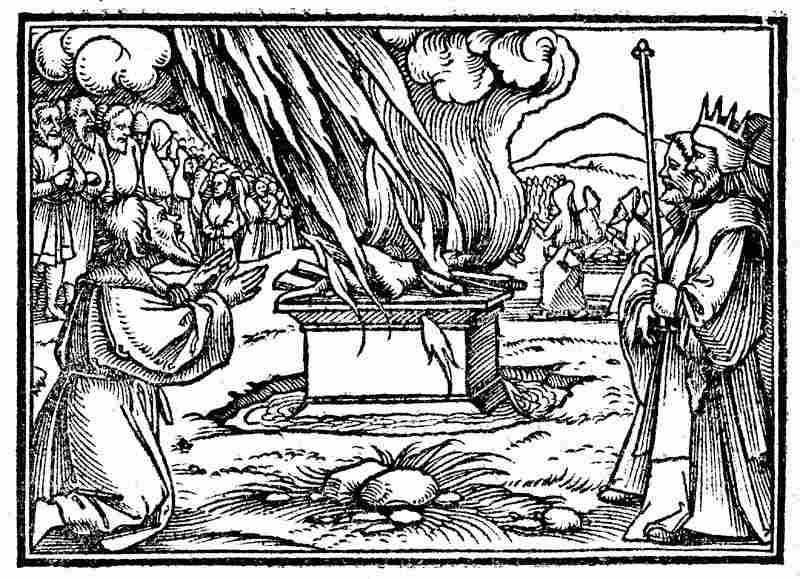
You, son of humankind, describe the House to the household of Israel, veyikalmu because of their sins, and they will measure off its plan. And if nikhlemu because of everything that they have done, make known to them the design of the House and its plan …(Ezekiel 43:10-11)

veyikalmu (וְיִכָּלְמוּ) = and they will be humiliated, embarrassed, publicly disgraced. (From the root k-l-m, כּלם, sometimes translated as “ashamed” but actually referring to public humiliation regardless of actual guilt or innocence.)

nikhlemu (נִכְלְמוּ) = they are humiliated, etc. (Also from the root k-l-m.)

“The House” refers to a building for the God of Israel: Ezekiel’s vision of a new temple to replace the one that King Solomon erected and King Nebuchadnezzar of Babylon razed when he destroyed Jerusalem in 587 B.C.E.

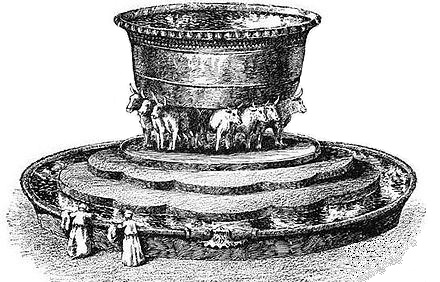
Temple sizes
Temple sizes

The two clauses about being humiliated are difficult to interpret, since in the first one God predicts the Israelites will be humiliated, and in the second one God says “if they are humiliated”. According to the standards of the sixth century B.C.E., there is no question that the Israelites of Judah have been publicly humiliated by the time of this prophecy, dated to the fourteenth year after the fall of Jerusalem.

The kingdom of Judah had been a vassal state of the Neo-Babylonian Empire, paying annual tribute to King Nebuchadnezzar but managing its internal affairs as an independent country. Then King Yehoyachim of Judah rebelled, and the Babylonian army besieged his capital, Jerusalem. His son Yehoyachin (a.k.a. Jeconiah) surrendered in 597 B.C.E. and saved the city. Nebuchadnezzar deported him and about 3,000 of Jerusalem’s leading citizens—including Ezekiel—to Babylon. Nebuchadnezzar installed Yehoyachin’s uncle Zedekiah as Judah’s king, and Judah resumed its status as a Babylonian vassal state.

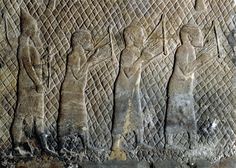
The Flight of the Prisoners, by James J.J. Tissot, 1886 (capture of Jerusalem in 587)

The Israelites remaining in Judah still had their own king, and a temple for their own god. But eight years later Zedekiah rebelled (after making a secret treaty with Egypt), and the Babylonian army surrounded Jerusalem again. This time the siege ended in the capture of Jerusalem, the execution of Judah’s last king, and the destruction of the capital and its temple—in other words, the complete humiliation of Judah.

What caused this humiliation? One might blame Nebuchadnezzar for his determination to expand his empire, or King Zedekiah for foolishly rebelling, or even Egypt for marching toward Judah at Zedekiah’s instigation, then succumbing to the Babylonian army before they reached Jerusalem.

But in the passage above, God says twice that the humiliation of the Israelites happened because of their own sins—and God is not referring to their kings’ rebellions against Babylon.

This week’s haftarah comes in the middle of Ezekiel’s fifth and final vision. This vision begins when a divine guide wafts Ezekiel to Jerusalem and shows him around a new and larger temple, measuring everything as he goes. Then the glory of God appears, and God tells Ezekiel:

Son of humankind, [this is] the place of My throne and the place of the soles of My feet, where I will dwell in the midst of the children of Israel forever. But the house of Israel must not again defile My holy name, neither they nor their kings, by their prostitution [with other gods] and with their kings’ lifeless idols in their shrines. (Ezekiel 43:7)

The sin of the Israelites is building shrines for idols and other gods—and in the worst possible place.

When they placed their thresholds next to My threshold and their doorposts beside My doorposts, [with only] the wall between Me and them, and they defiled My holy name with their taboo actions, then I consumed them in My anger. (Ezekiel 43:8)

God decided to destroy Jerusalem and its temple because of the people’s apostasy, and used the Babylonian army to do it.

Jeremiah, who was still prophesying in Jerusalem when Ezekiel prophesied in Babylon, also said that God arranged the destruction of Jerusalem, using Nebuchadnezzar as a tool. According to both prophets, God decides which army wins in every battle involving Israelites. (See my post Jeremiah: The Ruler of All Armies.) Nebuchadnezzar, naturally, did not know that the God of Israel was using him to punish the Israelites.

Today this prophetic point of view seems parochial and narrow-minded. Even if God did micro-manage every battle and siege, why should all of God’s plans be about rewarding or punishing the Israelites? What about all the other peoples in the world?

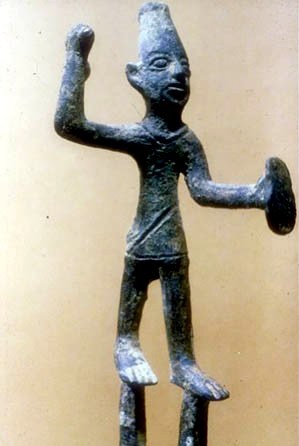
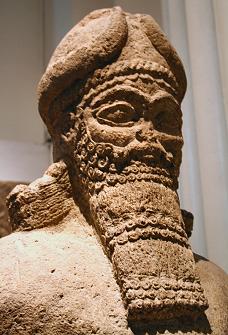
Nabu, from temple at Kalah

Other peoples had their own, albeit inferior, gods. For example, the chief gods of the Neo-Babylonian Empire were Nabu and Marduk. The Bible maintains that the God of Israel was more powerful than all other gods, and that God chose the Israelites to be “His” people and commanded them not to worship any other gods. The Torah often compares this exclusive relationship between the God of Israel and the Israelites to a marriage in which the Israelites let down God by failing to be monogamous.

Monotheism, the idea that there is only one god in the universe, only creeps into the Bible in a few of the many books written during the Babylonian exile in the sixth century B.C.E. The book of Ezekiel, however, sticks to the older point of view that the God of Israel is the most powerful god, not the only god.  Therefore the book of Ezekiel is Judeo-centric; God interferes in the world primarily to reward or (more often) punish the Israelites.

And if nikhlemu because of everything that they have done, make known to them the design of the House and its plan——its exits and its entrances, and its entire plan, and all its decrees and all its plans and all its teachings; And write it down before their eyes so they will observe its entire plan and all its decrees, and do them. (Ezekiel 43:11)

*

For those of us who have a more monotheistic or universal idea of God, I propose a radical rereading of Ezekiel 43:11:

And if nikhlamta because of everything that you have done, discover for yourself the design of the House and its plan—

If you feel your life is unsatisfactory, even humiliating, and suspect it is because you have done something wrong, then think of your life as a temple for God’s presence.

—its exits and its entrances, and its entire plan,

Where in your life do you exit from the presence of God? Where do you enter it? What is your overall plan for living with God?

and all its decrees and all its plans and all its teachings;

What principles do you follow as if they are divine decrees? What teachings help you to approach God?

And write it down before your own eyes so you will observe its entire plan and all its decrees, and do them. (Ezekiel 43:11)

And undertake a practice, such as prayer or study, that will keep reminding you of your plan for living in God’s presence and the principles you are following. Then make it your life.

Haftarat Terumah—1 Kings: Solomon versus Shalom

Every week of the year has its own Torah portion (a reading from the first five books of the Bible) and its own haftarah (an accompanying reading from the books of the prophets). This week the Torah portion is Terumah (Exodus 25:1-27:19), and the haftarah is 1 Kings 5:26-6:13.

To rule as a king, one needs administrators, a standing army, and a capital city. And in the Ancient Near East, the capital had to have a temple for the chief god of the kingdom.

When David conquers Jerusalem (in the first book of Samuel) to be the capital of his new kingdom, he brings in the two objects that are the most sacred to the Israelites: the Tent of Meeting and the Ark of the Covenant. But he leaves building the temple to his son and heir, Solomon.

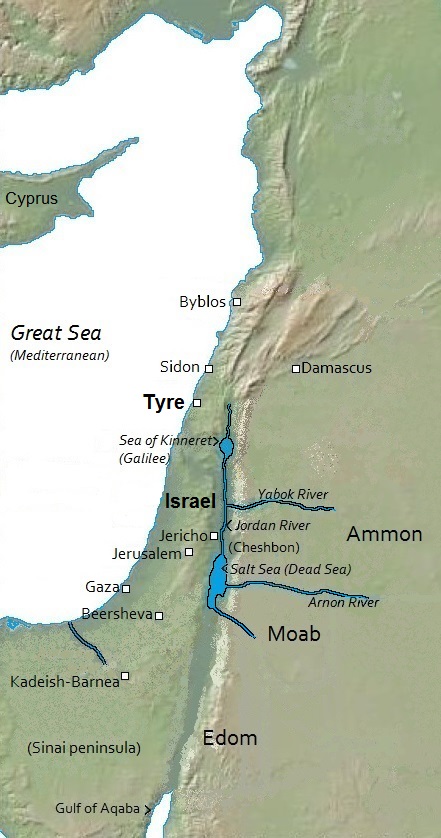
map 950 BCE

King Solomon has stone quarries and can command his citizens to do forced labor. But Israel has neither tall timber nor craftsmen skilled with wood. So he makes a pact with Chiram, king of the Phoenician city-state of Tyre.

And it happened: Chiram gave to Shlomoh cedar and cypress wood, all he wanted. And Shlomoh gave to Chiram 20,000 kor of wheat for his household and 20 kor of beaten oil. This Shlomoh gave to Chiram year after year. And God had given wisdom to Shlomoh, as [God] had spoken to him. [There was] shalom between Chiram and Shlomoh, and the two of them cut a covenant. (1 Kings 5:24-26)

Shlomoh (שְׁלֹֹמֹה) = Solomon in English, Suleyman in Arabic. (From the root verb shilam (שִׁלָם) = complete; make amends, repay, fulfill; restore to wholeness.)

Shalom (שָׁלֹם) = peace, wholeness, intactness, well-being. (Also from the root shilam.)

In the tenth century B.C.E., the time of Shlomoh and Chiram, there were two kinds of treaties between kingdoms in the Near East. In one model, the weaker kingdom was a vassal of the stronger one, and paid tribute to it (see my post Jeremiah: The Ruler of All Armies). In the other, two equal kingdoms made a treaty or covenant for trade and mutual defense.

The treaty between King Shlomoh of Israel and King Chiram of Tyre specified that Tyre would provide wood for all of Shlomoh’s building projects in Jerusalem, and Israel would provide annual large shipments of wheat and olive oil to Tyre. Although the Bible does not mention a clause about mutual defense, it does state that there was shalom between the two kings, which implies that they had at least agreed to mutual non-aggression.

And the king, Shlomoh, imposed a mas upon all of Israel, and the mas was 30,000 men. And he sent 10,000 a month to Lebanon; following a month in Lebanon they were two months at home, in turns … And Shlomoh had 70,000 burden-carriers and 80,000 quarriers in the hills … The king commanded, and they pulled out great stones, valuable stones, to lay the foundation-wall of the House: hewn stones. (1 Kings 5:27-31)

mas (מַס) = conscription for forced labor.

The first mas described in the Bible is the forced labor of the Israelites in Egypt. Although it was an accepted practice for a king to impose a temporary mas on his own citizens, in this case Shlomoh made 180,000 Israelites neglect their own land to do heavy labor for a full year. Then after two years at home, they had to go back to cut and haul materials for the temple, for King Shlomoh’s palace, and for several other large new buildings in Jerusalem.

Limestone quarry under Jerusalem: four stones partly cut out

The text also emphasizes that the stones for the foundation wall of the temple are hewn: huge blocks of stone cut out and smoothed.

And when the House was built, it was built of shleimah stone, quarry stone; but hammers or the axe, any tool of iron, was not heard in the House when it was built. (1 Kings 6:7)

shleimah (שְׁלֵמָה) = complete, whole, uninjured, undivided, peaceable. (Plural: shleimot.)

The king wants to avoid the sound of an iron tool on the site of the new temple because of an old law about altars:

If you make an altar of stones for Me, you must not build it of hewn stones; if you have wielded your sword upon it, you have profaned it. (Exodus 20:22)

And you shall build there an altar for God, your god, an altar of stones; you must not wield iron upon them. You must build the altar for God, your god, of shleimot stones. (Deuteronomy 27:5-6)

King Shlomoh’s laborers are building the foundation-wall of the temple, not an altar. However, the temple will enclose a space even more sacred than the altar. So the king orders the stones to be cut at the quarry, and merely set in place at the temple site. Shlomoh’s attempt to follow the law may actually subvert it, since the stones are hewn.

Similarly, Shlomoh’s treaty with Chiram of Tyre has two purposes: to promote shalom, peace, between the two kingdoms, and also to build a temple that will unite the Israelites under a single god at a single holy place so they will be shaleim, intact, one people.

Instead the annual wheat and oil shipments to Tyre become a burden on the farming population.  And the mas imposed on so many Israelite men results in complaints and rebellion. Shortly after King Shlomoh’s death, northern Israel secedes from southern Judah. (See my post Terumah & 1 Kings: Tent versus Temple.)

Are the stones of the temple wall really shleimot, whole and undivided, when they are cut out of the quarry with hammers and shaped with axes?

Does Shlomoh’s kingdom really live in shalom, peace and wholeness, when building a temple in Jerusalem leads to oppression, revolt, and secession?

Haftarat Mishpatim—Jeremiah: False Freedom

Every week of the year has its own Torah portion (a reading from the first five books of the Bible) and its own haftarah (an accompanying reading from the books of the prophets). This week the Torah portion is Mishpatim (Exodus 21:1-24:18), and the haftarah is Jeremiah 34:8-22.

Town by town, city by city, the armies of King Nebuchadnezzar took over the land of Judah. The country could have remained a semi-independent vassal of Babylon, keeping its own temple and running its own internal affairs. But the last three kings of the Israelites had rebelled against their overlord. And each time Nebuchadnezzar’s retaliation had been more severe.

King Nebuchadnezzar
King Nebuchadnezzar

The prophet Jeremiah kept warning the kings of Judah to keep paying tribute to Babylon, but they never listened to him. Instead they flirted with Egypt. Only Jeremiah realized what was obvious to the Babylonians: that when Pharaoh Nekho lost the big battle with Nebuchadnezzar at Carchemish in 605 B.C.E., and lost all his vassal states to the new Babylonian Empire, Egypt was finished as a world power.

When King Yehoyakhim of Judah stopped paying tribute to Babylon in 597 B.C.E., Nebuchadnezzar besieged Jerusalem until it surrendered. When King Zedekiah stopped paying tribute eight years later, after secret negotiations with Egypt, the Babylonian army surrounded Jerusalem again.

This time Nebuchadnezzar also conquered the rest of Judah, town by town and city by city.

Trapped in Jerusalem, unable the send their slaves out to the fields to plant and harvest, the leaders of Judah were getting desperate. Soon their city would fall, and they would all be killed or, at best, deported to Babylon. Only a miracle could save them.

The god of Israel had made miracles for the Israelites before. The priests were still serving God in the temple. What more was needed? How could they win God’s favor again?

In this week’s hafatarah, it occurs to King Zedekiah that the people of Judah have been ignoring one of God’s commands:

If your brother or sister Hebrew sells himself to you, then he shall serve six years, and in the seventh year you shall let him go chafshi from you. And when you let him go chafshi from you, you shall not let him go empty-handed… (Deuteronomy/Devarim 15:12-13)

chafshi (חָפְשִׁי) = emancipated, freed. (Plural: chafshim.)

In ancient kingdoms of Israel and Judah, men who could not pay their taxes or other debts sold themselves or their children as temporary slaves. After six years of service, their owners were required to set them free, and give the men a food supply and the means to make a living.

But the slave-owners of Judah had let the years pass without emancipation.

… the king, Zedekiah, cut a covenant with all the people who were in Jerusalem, to proclaim for them a dror: for each man to let go of his male slave and his female slave, the Hebrew male and the Hebrew female, chafshim, so that no one would be enslaved by his fellow Yehudi. And they heeded [the proclamation], all the officers and all the people who had entered in the covenant … they heeded and they let them go. (Jeremiah 34:8-10)

dror (דְּרוֹר) = emancipation of slaves every seventh year and every  fiftieth year.

Yehudi (יְהוּדִי) = citizen of Judah; Jew. (From Yehudah (יְהוּדָה) = the kingdom of Judah, the tribe of Judah, or the individual Judah in the book of Genesis.)

The slave-owners in Jerusalem had more than one reason to free their slaves. Besides wooing God’s favor, the general emancipation also meant that the owners no longer had to feed their slaves. And since no one could work in the fields anyway, the government could recruit the emancipated men as soldiers to help defend the city.

The siege lifted briefly when an Egyptian army marched north, perhaps intending to honor its new alliance with the king of Judah.  Most of the Babylonian army departed to take care of the Egyptian annoyance, and for a few months life in Jerusalem could return to normal.

Unfortunately, it did.

And later they turned back, and they took back the male slaves and the female slaves whom they had let go chafshim, and they subjected them to slavery [again]. Then the word of God happened to Jeremiah… (Jeremiah 34:11-12)

Jeremiah the Prophet and King Zedekiah, 1897 illustration
Jeremiah the Prophet and King Zedekiah,
1897 illustration

Through his prophet, God reminds the people in Jerusalem that Hebrews enslaved because of debt must be freed in the seventh year. God continues:

“One day you yourselves turned around and became upright in My eyes, proclaiming a dror for each man from his fellow, and you cut a covenant before Me in the house that is called by My name. But now you have profaned My name; each of you has brought back his male slave and his female slave that he had let go chafshim to follow their desire, and subordinated them to be male slaves and female slaves for you [again].

“Therefore, thus says God: [Since] you did not listen to Me proclaiming a dror, each one for his brother and each one for his fellow, here I am, proclaiming to you a dror—declares God—to the sword, to disease, and to starvation! (Jeremiah 34:15-17)

Jeremiah’s prophecy points out the hypocrisy of the ruling class. They free their slaves only when feeding them is a burden—and when they hope to wangle an extra favor out of God. But the newly-emancipated slaves have no means to feed themselves. What kind of liberty is that?

Then as soon as it looks as though the ex-slaves can once more engage in agriculture, their former owners re-enslave them, making them responsible for feeding everyone.

So God threatens to emancipate the Yehudi the same way they emancipated their slaves—by abandoning them to death. After all, no human beings can live exclusively by their own power, without the world God provides.

Nebuchadnezzar takes Jerusalem James_Tissot_Flight_of_The_PrisonersIn fact, the Babylonians returned before the slaves of Jerusalem could bring in a harvest. In 586 B.C.E. the wall around the city was breached. Nebuchadnezzar blinded King Zedekiah, killed his sons, razed the capital, and burned down the temple. Judah became merely a district of Babylonia. The remaining ruling families were deported, and Jeremiah lingered in the ruins of Jerusalem.

(See my post Haftarah for Bo—Jeremiah: The Ruler of All Armies.)

In some parts of the world today, impoverished people are still kidnapped to become slaves (often for sex or war). Those of us who read blogs on the Internet, distant from the villages of Syria or Nigeria, might congratulate ourselves on never owning a slave or oppressing a debtor. But is that true?

Do we vote for political candidates who claim that everyone can succeed by their own efforts, even those who are not given the tools?  Do we find it acceptable that one accident, disease, or misinformed purchase can doom a person to poverty for life, with no second chance—not even after six years of suffering?

Do we treat our own children as slaves? Do we send them off, after the right number of years, with all the tools they need to make it on their own? Do we try to recapture and control them later?

Do we take advantage of someone over and over again, neglecting them when we do not need them?


Haftarat Yitro—Isaiah: Burning Angels

Every week of the year has its own Torah portion (a reading from the first five books of the Bible) and its own haftarah (an accompanying reading from the books of the prophets). This week the Torah portion is Yitro (Exodus 18:1-20:23), and the haftarah is Isaiah 6:1-7:6 & 9:5-6.

You cannot see My face, because humankind may not see Me and live. (Exodus/Shemot 33:20)

Although God cannot be seen directly, people in the Bible do experience visions of God. The Israelites see a manifestation of God in this week’s Torah portion, and Isaiah sees a manifestation of God in this week’s haftarah.

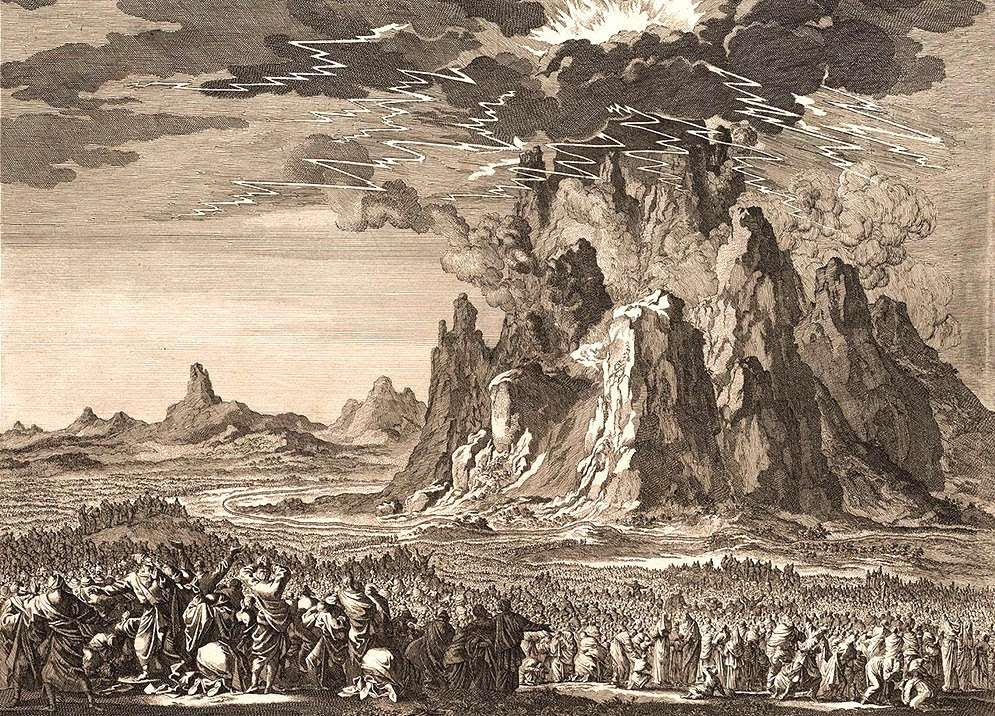
Vision at Mount Sinai

The Law on Mount Sinai, by Jan Luyken, 1708

In the vision shared by everyone at Mount Sinai, God appears only as fire.

And Moses brought out the people from the camp to meet God, and they stationed themselves at the bottom of the mountain. And all of Mount Sinai smoked, because God went down upon it in fire, and its smoke went up like the smoke of the furnace, and all the mountain shuddered very much. (Exodus 19:17-18)

A shuddering, smoking mountain could be a volcano—except that in this vision, God’s fire comes down from the sky, not up from a crater. God also manifests in the book of Exodus as the fire Moses sees in the burning bush on Sinai, as the pillar of cloud and fire that leads the Israelites to Mount Sinai, and as fire and cloud on the mountain when Moses ascends to receive each pair of stone tablets.

No angels or other semi-divine creatures appear in the revelation at Mount Sinai; only fire, smoke, and various sounds.

Other parts of Exodus speak of God’s hand, arm, or finger (when God takes action in the world), and God’s feet (in a separate vision; see my post Mishpatim: After the Vision, Eat Something). But these references may not indicate an anthropomorphic god; the Hebrew Bible often uses these body parts in idioms.

Vision at the temple

Isaiah’s moment of revelation also includes fire, but God does not appear as fire.

In the year King Uzziyahu died, I saw my Master sitting elevated on a lofty throne, and His skirts filling the heykhal. (Isaiah 6:1)

heykhal (הֵיכָל) = palace, temple; main room of the temple in Jerusalem; heavenly palace.

Isaiah beholds God wearing a robe and sitting on a throne, like a king—except that the skirts of the robe mysteriously flow out to fill the room. As the vision continues God speaks, but does not move. Angelic attendants surrounding God do move; and they burn with fire.

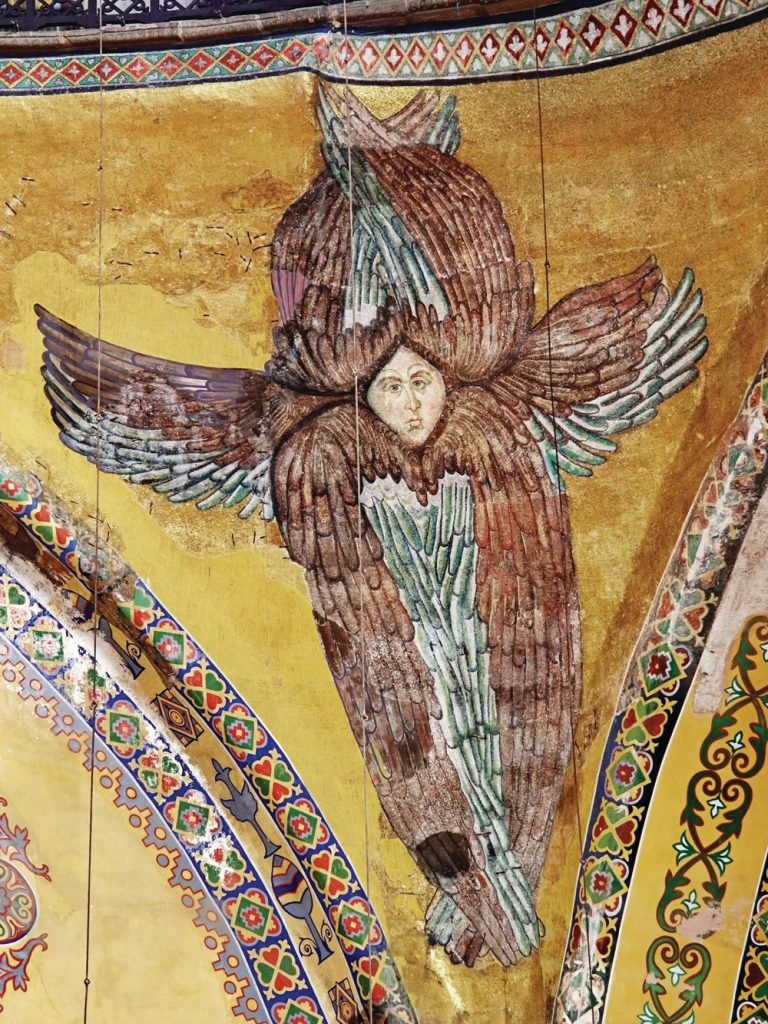
Seraf, Haggia Sophia mosaic

Serafim are stationed above Him, each with six wings; with one pair he covers his face, and with a pair he covers his raglayim, and with a pair he flies. And one calls to another, and he says: Holy, holy holy! God of Tzevaot, Who fills all the earth with His glory! And the supports of the threshold shiver from the sound of the calling, and the house fills with smoke. (Isaiah 6:1-4)

serafim (שְׂרָפִים) = burners, burning creatures. (From the verb saraf, שָׂרַף = burn. Used in Numbers and Deuteronomy for “burning serpents”—probably poisonous snakes.)

tzevaot  (צְבָאוֹת) = armies (on earth); the stars (in the heavens).

raglayim (רַגְלָיִם) = (pair of) feet, legs; a euphemism for the penis. Singular: regel (רֶגֶל) = foot, leg; walking pace; time set for a pilgrimage-festival.

The serafim must both cover and uncover their faces and their raglayim; if these body parts were permanently covered, they would not need wings for that purpose. When and why do they conceal these parts of their anatomy?

In Leviticus Rabbah, a collection of commentary from 400-600 C.E., Rabbi Jacob ben Zadbi says the serafim cover their faces to avoid looking at God’s presence, and cover their feet so God would not have to look at such unsightly appendages. (The writer assumed that the feet of the serafim were like the feet of Ezekiel’s angelic keruvim, which resembled calves’ feet.)

Twelfth-century C.E. rabbi Moses Maimonides wrote in The Guide for the Perplexed that the description of serafim covering their body parts is symbolic. The faces of the serafim are covered to indicate that “the cause of their existence is hidden and concealed”, while their feet are covered to indicate that their actions in the universe are also hidden. The wings for flying, Maimonides adds, merely represent the speed with which the serafim move when they act.

I propose a simpler explanation. Maybe the serafim cover their faces whenever they turn toward Isaiah, so he is not exposed to the blinding light radiating from these burning creatures. If seeing God’s face means death, seeing the faces of the serafim might be almost as bad.

As for covering their raglayim, I doubt the serafim are concealing their feet.  After all, humans must have bare feet when they are in God’s presence; Moses must remove his sandals in front of the burning bush, and the priests must go barefoot inside the sanctuary. Since Isaiah’s vision is set inside a heykhal, the serafim in God’s presence probably expose their bare feet.

Although the word raglayim most often refers to feet or legs, sometimes it implies the pubic area between the legs, and there are three places in the Bible where raglayim is definitely a euphemism for the male genital organs. In Judges 3:24 and 1 Samuel 24:4 the word raglayim is combined with a verb to indicate a man urinating.  And in the part of chapter 7 of Isaiah that is left out of this week’s haftarah, the prophet says that God will use the king of Assyria as a razor to shave off the head of hair and the hair of the raglayim (JPS: public hair) and also snatch away the beard. (Isaiah 7:20)

A man’s hair, especially his beard and pubic hair, stood for virility in ancient Israelite culture. Isaiah employs a shaving metaphor to prophesy that God will use Assyria to symbolically castrate Israel’s other enemies.

Why would the serafim in Isaiah’s vision use their extra wings to cover their genitals?

The penis is a symbol of rule, dominance, and control throughout the Bible, from the oath Abraham’s servant swears on his master’s yareich (which can also mean genitals; see my post Chayyei Sarah: A Peculiar Oath) to the Persian king who approves Esther’s interruption by lifting his sharvit (scepter). But God is the ultimate ruler. It would be subversive for a male to uncover his genitals in God’s presence.

That is why this week’s Torah portion specifies that all altars for God must be built without stairs or steps.

You must not ascend on stairs to My altar; that way you would expose your nakedness upon it. (Exodus 20:23)

The Torah also requires that priests must wear linen undergarments, so their genitals will be concealed in all areas of God’s sanctuary.

So each seraf uses one pair of wings to conceal his fiery face from Isaiah, for his own protection; and one pair of wings to conceal his genitals, so Isaiah will know that God rules, not the serafim.

Nevertheless, these angels are endowed with the potential to generate independent decisions and actions. One example occurs after Isaiah expresses his anxiety about having a vision of God.

The Prophet Isaiah, by Marc Chagall

And I said: Woe to me! I am as good as dead, because I am a man of impure lips, and I am living in the midst of a people of impure lips, yet my eyes behold the King, God of Tzevaot! Then one of the serafim flew toward me, and in his hand was a live coal he had taken from the altar with a pair of tongs. And he touched it to my mouth and he said: Hey! Now that this has touched your lips, your bad deeds have gone away, and your offense is atoned for. Then I heard the voice of my Master saying: Whom shall I send, and who will go for us? And I said: Here I am, send me! (Isaiah 6:5-8)

We have come a long way from the vision at Mount Sinai of God as undifferentiated fire, unaccompanied by any furniture or subsidiary creatures.

Isaiah sees God in terms of a throne and skirts, not in terms of fire. The fire exists in God’s serafim, “burning ones”, who occupy a station somewhere between humankind and God. They praise God (Holy, holy holy!) and they are privy to some of God’s plans (and who will go for us?) They protect Isaiah from the blinding brightness of their faces, and they cover their genitals to indicate that although they have some power, God is the ultimate ruler. And one seraf, hearing Isaiah’s anxiety about his unworthiness, takes action to remove his guilt. In his relief, Isaiah volunteers to be God’s prophet. Thus the seraf both furthers God’s plan and helps Isaiah rise to his calling.


The image of God as a king with a throne and a long robe has continued to be popular, from some of the writings after the fall of the first temple to some of the explanations given to children today. For me, God as fire is a better metaphor. An individual human cannot become a god.

But maybe we can aspire to be brighter, more aware of God’s presence, and more able to listen to people and address their concerns.

May all of us humans learn to act as thoughtfully as the serafim in Isaiah’s vision.

Haftarat Beshalach—Judges: Overlooking the Underdog

Every week of the year has its own Torah portion (a reading from the first five books of the Bible) and its own haftarah (an accompanying reading from the books of the prophets). This week the Torah portion is Beshallach (Exodus 13:17-17:16), and the haftarah is Judges 4:4-5:31.

The underdog triumphs in many biblical stories. Jacob, the beardless weakling, outsmarts his strong, hairy brother Esau. Joseph rules over the older brothers who once enslaved him. The boy David kills the giant Goliath.

In this week’s Torah portion, Beshalach (“when he sent out”), the Israelite slaves leave Egypt as free people while Pharaoh’s army drowns behind them. In the haftarah from the book of Judges, two Israelite women triumph over the Canaanite general Sisera and his army.

How do you defeat an enemy stronger than you?  In the Hebrew Bible, two effective ways are by receiving and using inside information from God, like Moses; and by taking action on your own initiative with intelligence, courage, and guile, like Jacob and Joseph.

The haftarah from Judges tells the story of two women, the ultimate underdogs in the patriarchal society of the ancient Israelites, triumphing over Israel’s enemies through both methods. Devorah the prophet gets her people to act on God’s promise to help them defeat the army of their Canaanite overlord, and Jael/Yael the Kenite acts on her own initiative and kills the enemy’s general.

War chariots, ivory plaque from Megiddo

When this week’s haftarah begins, the Israelites are scattered tribes who have been ruled by the chief king of Canaan, Yavin, for twenty years. They are oppressed by King Yavin’s general, Sisera, who commands a force that includes 900 chariots, the most fearsome war technology of the time.

Still, instead of relying on the Canaanite king’s dubious justice, the Israelites go to their own judges, including one outstanding judge.

Devorah was a woman, a prophet, a woman of lapidot; she was a shoftah of Israel at that time. (Judges/Shoftim 4:4)

Devorah (דְבוֹרָה) = “Deborah” in English; honey bee. (From the same root as doveir  = speaker, and divrah  = legal case.)

lapidot (לַפִּידוֹת) = a feminine plural form of the masculine noun lapid = torchlight, torch, flash of light. (Some translations consider lapidot a place-name or the name of Devorah’s husband.)

shoftah (שֹׁפְטָה) = the feminine form of shofet = judge; a man who decides legal cases and resolves disputes.

The bible emphasizes that Devorah is a woman; all the other judges in the bible were men. Moreover, she is a prophet, a woman of flashes of light. Even her name is significant: she is a speaker, both for justice and for God.

Date palm tree
Date palm tree

And she was the one who sat under the Date-Palm of Devorah, between Ramah and Bethel in the hills of Efrayim. And the children of Israel went up to her for the law. (Judges 4:5)

Unlike the judges of villages, Devorah serves as the authority for a wider area, and holds her own law court in a sacred place. In ancient Israel, many holy places were indicated by trees or groves with names, such as the Oak of Weeping (Genesis 35:8), the Grove of Teaching (Genesis 12:6), or the Grove of Mamre (Genesis 13:18). Devorah’s own presence is what makes this particular palm tree the marker of a holy site.

And she sent and summoned Barak, son of Avinoam, from Kedesh in Naftali. And she said to him: Did not God, the god of Israel, command: “Go!—and draw up your position on Mount Tabor, and you shall take with you ten thousand men from Naftali and Zevulun. Then I will draw up to you, to the wadi of Kishon, the commander of the army of Yavin, Sisera, and his charioteers, and his infantry; and I will give them into your hand.” (Judges 4:6-7)

If Barak musters troops from the two Israelite tribes of Naftali and Zevulun and marches them up Mount Tabor, God will arrange for the defeat of the enemy’s army. But Barak is afraid.

And Barak said to her: If you go with me, then I will go; but if you will not go with me, I will not go. (Judges 4:8)

Devorah agrees to go with him, but prophesies that Barak will get no glory from the battle, because

into the hand  of a woman God will deliver Sisera. (Judges 4:9)

Deborah, by Gustave Dore

Devorah walks with Barak both to Kedesh to inspire the men to volunteer for the ad hoc army, and to the top of Mount Tabor to announce when the men should charge down. God panics Sisera’s army (through a flash flood in the wadi, according to the accompanying poem) and the Israelite foot soldiers kill every enemy soldier except General Sisera.

Devorah is supremely successful as the instigator of the battle because she is God’s prophet. Receiving divine communication and cooperating with God both inspires people to trust her and results in a successful campaign—even though she is a woman, who would normally be powerless.

Sisera gets down from his chariot in the middle of the battle and flees on foot. Where can he find refuge? He heads for the nearby camp of Chever the Kenite, a vassal of King Yavin.

Sisera fled on foot to the tent of Yael, wife of Chever the Kenite … (Judges 4:17)

Study of Jael, by Carlo Maratta

Yael (יָעֵל) = a variant of ya-al (יָעַל) = he will ascend, he will climb, he will mount for mating.

Normally, a fugitive would go to the tent of the man who heads the household or encampment, the only person who can take the role of host and decide to shelter the unexpected guest.  In that culture, a woman’s tent was her private domain that no man outside her immediate family would dare to enter. Why does Sisera enter Yael’s tent instead of heading straight for her husband’s tent?

One line of commentary claims that Sisera’s motivation was to rape Yael, and then claim Chever’s household as his own. By taking ownership of a chieftain’s women, a man signaled that he was the new chieftain. Later in the Bible, King David’s son Absalom shows Israel that he is the new king by having sexual intercourse with the concubines King David leaves behind in Jerusalem. Sisera might plausibly decide he would rather be the head of a camp of Kenites than a disgraced ex-general.

But I think Sisera is on his way to Chever’s tent when Yael appears and suggests a different plan.

And Yael went out to meet Sisera, and she said to him: Surah, my lord, surah eilai, do not fear. Vayasar to her, to her tent, and she concealed him with the curtain. (Judges 4:18)

surah (סוּרָה) = turn aside, go away, desert, avoid.

eilai (אֵלַי) = to me.

vayasar (וַיָּסַר) = and he turned aside, went away, deserted, avoided.

Normally a woman would warn an intruder who slipped past the sentries around her husband’s camp to get away from her. But since Yael says surah eilai, she must be saying either “turn aside to me” or “desert to me” (knowing that Sisera has already deserted his own army).

Yael is a quick thinker with a cool head. She may view Sisera as an enemy; the Kenites are usually allies with the Israelites in the Bible, and Chever might have sworn vassalage to King Yavin because he had no alternative. But now Yavin’s army no longer exists, and the time is ripe for change.  Sizing up the situation, Yael steps out of her tent and tempts Sisera with an ambiguous sentence.

And he falls for it. Suddenly he imagines he can take Chever’s wife, and then take over his whole household. He steps inside her tent, and she lets the curtain fall behind him. He asks for water, and she brings him a yogurt drink and puts covers over him. He orders her to stand at the entrance of the tent and tell anyone who comes that there is no one inside. Then, secure in his belief that she is his and they will eventually seal the deal with sex, Sisera falls asleep.

Jael and Sisera, by Jan de Bray

Then Yael, wife of Chever, took a tent peg and took the hammer in her hand, and she came to him quietly, and she drove the peg into his temple, and she hammered it into the ground. And he was fast asleep, exhausted, and he died. (Judges 4:21)

Deborah’s prophesy is fulfilled; Sisera dies by the hand of a woman.

Yael acts on her own initiative, taking advantage of the situation and employing her sharp wits and her ability to deceive without actually lying. The text does not say whether Sisera carries a weapon on his body, but he is a career soldier, and under ordinary circumstances could overpower (and rape) any woman in his path.  Yael courageously uses guile, the weapon of the underdog, to overpower and “rape” him with her tent peg.


Never assume you can take advantage of an underdog who has always held a rank beneath your own. People who have been slaves for hundreds of years might turn out to have God on their side, and defeat you, as in this week’s Torah portion from Exodus. And women who have been ordered around by men for hundreds of years might turn out to be prophets and judges, like Devorah, or extraordinary executioners, like Yael.

Never overlook the underdog.

Haftarat Bo—Jeremiah: The Ruler of All Armies

Every week of the year has its own Torah portion (a reading from the first five books of the Bible) and its own haftarah (an accompanying reading from the books of the prophets). This week the Torah portion is Bo (Exodus 10:1-13:16), and the haftarah is Jeremiah 46:13-28.

In the book of Exodus, God inflicts ten miraculous plagues on Egypt to punish the pharaoh for refusing to let the Israelite slaves go. Pharaoh finally sets the Israelites free in this week’s Torah portion, Bo—but only after the final miracle: the death of the firstborn.

In this week’s haftarah, Jeremiah predicts that God will once again punish the pharaoh of Egypt for mistreating the Israelites.  This time God will not create miracles, but instead will use another empire’s army to achieve the goal.

The political history

There were three kinds of nations in the Near East during the era of 800-500 B.C.E.: superpowers that ran empires (the Egyptian, Neo-Assyrian, and Neo-Babylonian empires); countries that were directly controlled by a superpower; and semi-independent vassal states that paid tribute to a superpower in exchange for protection against outside attacks. Being a vassal state was the best hope for a small country like Judah, the only remaining Israelite kingdom after the northern kingdom of Israel was swallowed by the Neo-Assyrian Empire in 732 B.C.E.

Judah sent tribute to Assyria for about a century, except for a brief and doomed rebellion in 705-701 B.C.E. The Neo-Assyrian Empire expanded southwest to include northern Egypt, and southeast to the Persian Gulf.

Pharaoh Psamtik I
Pharaoh Psamtik I unites Egypt

But no empire lasts forever. Psamtik, the son of one of Assyria’s puppet governors in northern Egypt, hired Greek mercenaries to drive out the Assyrian occupiers. By 654 B.C.E. he was pharaoh over a united Egypt. He went on to conquer the western half of the Neo-Assyrian Empire, and by 630 B.C.E. King Josiah of Judah had become a vassal of Pharaoh Psamtik.

Next Assyria was assailed from the southeast. In 626 B.C.E. Babylon revolted under its new king, Narbopolassar. A shrunken Assyria allied itself with Egypt, and Psamtik’s son, Pharaoh Nekho II, sent his armies north to fight Narbopolassar’s son, Nebuchadnezzar II.

It was a slow march, interrupted by rebellions of vassal states along the way. King Josiah of Judah took his own army to Megiddo to challenge the Egyptians in 609 B.C.E., but the Egyptians trounced the Israelites, and Pharaoh Nekho killed Josiah.

The armies of Egypt and Babylon met in 605 B.C.E. at Carchemish, about 2,000 miles north of Jerusalem (on the present border between Turkey and Syria). The Egyptian army was crushed, and its surviving soldiers fled south.

According to Jeremiah, Egypt did not lose the battle because of any deficiency of its own; Egypt lost because the God of Israel made it happen.

Why have your strong ones been cut down?
They did not stand
Because God shoved them down. (Jeremiah 46:15)
map Neo-Babylonian Empire B

After the battle at Carchemish, all of Egypt’s vassal states became vassals of Babylonia, and Assyria disappeared. The prophet Jeremiah repeatedly warned the new king of Judah, Yehoyakhim, to stay out of trouble and keep sending tribute to the Babylonian king, Nebuchadnezzar.

But Yehoyakhim revolted against Babylonia in 599 B.C.E. and sent Judah’s tribute to Pharaoh Nekho II (the same pharaoh who had killed his father, Josiah).

Nebuchadnezzar retaliated by besieging Jerusalem. After a year and a half the city fell and Judah came under direct control of the Neo-Babylonian Empire. Both Jeremiah and Ezekiel criticized Egypt for failing to send troops to defend its new vassal Judah.

Judah’s king, the prophet Ezekiel, and other leading citizens were deported to Babylon. Jeremiah stayed behind in the ruins of Jerusalem until some of his fellow countrymen took him into exile in Egypt.

The prophecy

Both Jeremiah and Ezekiel prophesied that because Egypt had failed keep its promise to help Judah, God would send an army from the north to destroy Egypt.  Both prophets said it would be King Nebuchadnezzar’s army, but in actual history, Nebuchadnezzar failed in his 568 B.C.E. attempt to conquer Egypt. The country remained independent until the Persians took it—from the north—in 526 B.C.E.

The Chaldees [Babylonians] Destroy Jerusalem,
by James Tissot, circa 1900

In Ezekiel’s prophecy, God would arrange for Nebuchadnezzar to devastate Egypt not just to punish it, but so that the pharaoh would know who God is. (See last week’s post, Va-eira—Ezekiel: How to Know God.)

Jeremiah’s prophecy also includes more than punishment. He uses a name for God that never appears in Ezekiel:

As I live, declares the kingY-H-V-H of Tzevaot is his name
As Tabor is among the mountains,
And Carmel is by the sea,
It will come!
Prepare for yourself the gear of exile ...
For Nof will become a horror,
A desolation without inhabitants.
Egypt is a heifer with a beautiful mouth,
But a stinging fly from the north is coming, coming! (Jeremiah 46:18-20)

Y-H-V-H = the four-letter personal name of God, possibly related to the Hebrew verb “to be”.

Tzevaot (צְבָאוֹת) = armies; companies of soldiers. (Singular tzava, צָבָא. The Bible also uses the word metaphorically for armies of stars.  See my post Bemidbar: Two Kinds of Troops.)

The first biblical book that calls the God of Israel HVH of Tzevaot is Samuel I, which modern scholars date to 630–540 BCE—the same period as the book of Jeremiah. Jeremiah uses this term 70 times!

Why does Jeremiah emphasize that YHWH, the god of existence itself, is the god of armies?

Jeremiah lived through at least 60 years of wars and reversals of fortune in the Near East, 60 years in which Judah was always a pawn, unable to take charge of its own destiny.

The common belief in the ancient Near East was that each country had its own god. When that god was happy with the people of his country, he made their army succeed. When the god was unhappy with them, their army failed.

The Bible also attributes many failures of Israelite armies to Israelite rejections of God. But why were God’s people suffering so many defeats, if their god was the most powerful?

Jeremiah was inspired to preach that the God of Israel is unlike the gods of other nations. Israel’s god, the supreme God of all existence, controls all the armies in the world. God decides which armies will win and which will lose, even when Israelites are not involved in the battle.

For Jeremiah, the prophetic insight that God rules all armies made the wars of his own lifetime meaningful. God had a master plan. Egypt would be humbled. Eventually the Babylonians would also be defeated. And in the long run, the Israelites would outlast all other peoples.

You must not fear, my servant Jacob,
—declares Y-H-V-H—
For I am with you.
For I will make an end of all the nations
Among which I have banished you.
But with you, I will not make an end. (Jeremiah 46:28)

Personally, I shrink inside when I sing a prayer that includes the term Y-H-V-H Tzevaot. If God is the ruler of all armies, then God is responsible for the carnage and suffering of all wars—which are apparently necessary for God’s master plan.

Yet if God were the Master Planner, controlling all the actions of mutable human beings, surely God could come up with a better plan than war after war. And if human beings hold ultimate responsibility for wars, then God is not the Master Planner, and not the God of Armies.

Sorry, Jeremiah.

Hafarat Va-eira—Ezekiel: How to Know God

Every week of the year has its own Torah portion (a reading from the first five books of the Bible) and its own haftarah (an accompanying reading from the books of the prophets). This week the Torah portion is Va-eira (Exodus 6:2-9:35), and the haftarah is Ezekiel 28:25-29:21.

Apparently God really wants Egypt to know who God is. The god of Israel asks the prophet Moses to tell Pharaoh “and you will know that I am God” three times in this week’s Torah portion, Va-eira. And God tells the prophet Ezekiel how God will bring down the Egyptians “and they will know that I am God” four times in this week’s haftarah.

Plague of Blood, as depicted in 14th century CE

Before God inflicts the first of ten terrible miracles on Egypt, God instructs Moses to meet Pharaoh on the shore of the Nile and warn him that the water will turn into blood.

And you shall say to him: YHVH, the god of the Hebrews, sent me to you to say, ‘Let My people go and they shall serve Me in the wilderness’, but hey—you did not listen before now. Thus says YHVH: ‘By this teida that ani YHVH’. (Exodus 7:16-17)

YHVH = the Tetragrammaton or four-letter personal name of God that Jews consider most sacred. The name appears to be a form of havah  or hayah (הוה or היה) the root of the verb “to be”, “to happen”, or “to become”, but it is a form that does not fit any Hebrew verb conjugations.

teida (תֵּדַע) = you will know, experience, be acquainted with, recognize, realize, have intercourse with.

ani (אֲנִי) = I [am].

Pharaoh hardens his heart during the seven days of bloody water, claiming it is not a divine miracle, so he does not experience or recognize the god of Israel.

God’s goal of being known by Pharaoh reappears when Moses talks about the second miracle, the plague of frogs:

… so that teida that there is none like YHVH our god. (Exodus 8:6)

—and again when God tells Moses the fourth plague will be more miraculous, because the swarm will be excluded from the place where the Israelites live,

…so that teida that ani YHVH in the midst of the land. (Exodus 8:18)

It takes ten miracles or plagues before Pharaoh finally knows YHVH, and can no longer harden his heart in denial. The knowledge comes from experiencing what God can do in the world.

The haftarah for this week’s Torah portion is a passage from the book of Ezekiel, set many centuries later during the Babylonian exile after King Nebuchadnezzar conquered the Israelite nation of Judah in 597 BCE. Judah had asked Egypt to help it fight the Babylonians, and Egypt had not come to the rescue. So Ezekiel prophesies that God will restore the land to the Israelites and punish Egypt, and both peoples will “know” God.

build houses and plant vineyards…then they will dwell on their soil that I gave to My servant, to Jacob. And they will dwell on it in safety, and they will build houses and plant vineyards, and they will dwell on it in safety when I have passed judgments on all those who despise them from all around; veyad-u that ani YHVH their god. (Ezekiel 28:25-26)

veyad-u (וְיָדְעוּ) = and they will know, realize, experience, etc. (A form of the same verb as teida.)

The Israelites will once again know YHVH is their god when they have first-hand experience of this amazing reversal in fortune.

The hafatarah continues with a poem describing the future downfall of Egypt. Then Ezekiel says:

Thus said my master, YHVH: Here I am over you, Pharaoh, king of Egypt …To the beasts of the earth and to the birds of the sky I have given you for food. Veyade-u, all the inhabitants of Egypt, that ani YHVH; because you were a walking-stick of reed to the House of Israel; when their hand grasped you, you would break…(Ezekiel 29:3-6)

The implication is that because Egypt failed to support the Israelites, God will make sure all Egyptians know from experience who YHVH is.

And the land of Egypt will become a deserted place and a ruin; veyade-u that ani YHVH, because he [Pharaoh] said: The Nile is mine and I made it. (Ezekiel 29:9)

Egyptians must also realize that although their pharaoh claimed he created the Nile, really YHVH created everything. In order to accomplish this, God will reduce Egypt to the lowest of nations.

And never again will they inspire trust in the House of Israel … veyade-u that ani the lord YHVH. (Ezekiel 29:16)

Therefore, thus says my master YHVH: Here I am, giving the land of Egypt to Nebuchadnezzar, king of Babylon. And he will carry off her wealth and loot her loot and plunder her plunder, and she will be a reward for his army. …On that day… veyade-u that ani YHVH. (Ezekiel 29:19, 29:21)

In all of these cases in Exodus and Ezekiel, people are expected to realize who God is after they have experienced an unexpected disaster or triumph, a miraculous change in fortune. The experience is supposed to be so powerful that both Israelites and Egyptians will realize that only the most powerful god in the world could create such a miracle, and that this supreme god is the god of Israel.

Furthermore, both peoples will know God by the name YHVH, the four-letter name based on the verb “to be”.  Is this detail repeatedly included simply because it is the name the Israelites use for their god? Or does it carry another meaning?

In last year’s post on this Torah portion (Va-eira: The Right Name) I suggested that the idea of God as “being” or “becoming” is intellectually appealing, but too abstract for an emotional relationship with God. Now I notice that the phrase “know that I am YHVH” always occurs in the Torah and haftarah portions in the context of knowing God’s power to change fate and to create. What is most important is for the Egyptians and for the defeated and deported Israelites to realize that the god of Israel is the god of existence itself. Nothing can have power over YHVH.

I have experienced no inexplicable miracles or reversals of fortune in my own life. I do not know God in that way. I acknowledge the reality of being, that there is something rather than nothing, and I could call that God, even if it is irrelevant to the anthropomorphic god of the Bible.

But I will not. My unmiraculous life is full of meaning and my soul is full of awe, so “I know”—yadati (יָדַעְתִּי)—that there is something I might as well call God that goes beyond the fact of existence.

Teida that ani YHVH = You will know that I am Being.

Then what, or who, is the “I”?

Beha-alotkha and Shemot: Moses as Wet Nurse

by Melissa Carpenter, maggidah

Moses never wanted the job.

When God spoke out of the burning bush and assigned him to lead the Israelites out of Egypt, Moses tried to get out of it.  He objected:

Moses at the Burning Bush by Rembrandt van Rijn
Moses at the Burning Bush
by Rembrandt van Rijn

Hey! Lo ya-aminu me, and they will not listen to my voice, for they will say: Your god, God, did not appear. (Exodus 4:1)

Lo ya-aminu = They will not believe, they will not trust.  Lo (לֹא) = not.  Ya-aminu (יַאֲמִינוּ) = They will believe, be convinced by, put trust in, have faith in.  (From the root aman, אמן, which is also the root of amen (אָמֵן) = a solemn statement of confirmation or acceptance.  See last week’s post, Naso: Ordeal of Trust for the first use of “Amen” in the Torah.)

God gave Moses three miraculous signs to convince the Israelites that he really did speak for God.  But Moses still tried to turn down the job. Finally God compromised by giving Moses a partner: his older brother Aaron, who had stayed in Egypt when Moses fled to Midian many decades before.

The arrangement was that God would speak to Moses, Moses would speak to Aaron, and Aaron would deal directly with the people.  Moses accepted this arrangement—maybe because he had run out of excuses.

Moses and Aaron are still together in this week’s Torah portion, Beha-alotkha (“when you bring up”), in the book of Numbers/Bemidbar.  But their roles have changed.  The big change came while the Israelites were camped at Mount Sinai, halfway between Egypt and the “promised land’ of Canaan.  When they first arrived at Mount Sinai, the people trusted God.  Sure, they had panicked a few times when there was a shortage of water or food, but each time Moses talked to God and God fixed the problem. So when they reached Mount Sinai, the people said:

Everything that God speaks we will do!  And God said to Moses: Hey! I myself will come to you in the thickness of the cloud, in order that the people will listen when I speak with you, and also ya-aminu in you forever. (Exodus 19:9)

Alas, while Moses is secluded inside God’s cloud on top of Mount Sinai for 40 days, the people feel abandoned and lose faith that Moses will return to them.  They ask Aaron to make a god to lead them, now that Moses has disappeared.

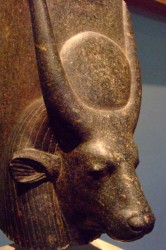
Gold calf, Temple of Baalat in Byblos

If Aaron were trustworthy as Moses’ co-leader, he would have reminded them that God explicitly forbade them to make gold or silver idols.  He might have redirected them toward making an acceptable offering to God.  Instead, Aaron made the Golden Calf, and the Israelites had a wild party.

When Moses returned and questioned him about it, Aaron lied about his own role—

So I said to them: Who has gold? They took it off themselves and they gave it to me, and I threw it away into the fire, and out came this calf (Exodus 32:24)

—and slandered the Israelites—

You yourself know the people, that they are bad. (Exodus 32:22)

The Midrash Rabbah on the Song of Songs, a collection of commentary from the 8th century C.E., said that the two breasts of the woman in the song symbolize Moses and Aaron, who were full of the milk of Torah. But Aaron fails as a wet-nurse when he fails to set appropriate limits for the “children” of Israel, and instead gives them their golden calf—and then denies his own responsibility for their downfall.

God and Moses between them kill thousands of the guilty, but they let Aaron live. Later they make him the high priest: the chief technician in charge of conducting rituals, looking impressive, handling holy objects, and diagnosing skin diseases.  But Moses is left as the people’s sole boss and spiritual leader.

He does his best to keep them encouraged and in line, but in this week’s Torah portion Moses finally cracks.

The people appear to be in good shape at the beginning of the book of Numbers.  They are marching from Mount Sinai to the border of Canaan in battle formation, with their portable sanctuary and all its holy objects in the middle, so they know God is with them. They have water to drink and manna to eat.

Then suddenly they are overcome with craving.

They weep and say:

Who will feed us basar? We remember the fish that we ate in Egypt for free, the cucumbers and the melons and the leeks and the onions and the garlic. But now nafsheinu are drying up; there is nothing except the manna before our eyes. (Numbers/Bemidbar 11:4-6)

basar (בָּשָׂר) = human flesh (skin and/or muscle); animal meat.

nafsheinu (נַפְשֵׁנוּ) = our souls, our lives, our throats, our appetites.

They are not actually hungry.  They are disgusted with God’s manna and, according to many commentators who point out the double meaning of basar, with God’s laws restricting sex partners. Perhaps they are fed up with the whole religion.  Or perhaps they have had their fill of spiritual experiences, long lists of rules, and the goal of taking over Canaan.  They get cranky. They want a break for immediate physical pleasure.

Moses heard the people weeping in their family groups, each one at the entrance of its tent, and God’s anger flared very hot; and in the eyes of Moses it was bad. And Moses said to God: Why do You do bad to your servant, and why have I not found favor in your eyes, that you put the burden of all this people on me?  Did I myself become pregnant with all this people, or did I myself give birth to them, that you say to me: Carry them in your bosom, like the omein carries the one who suckles, to the land that You swore to their forefathers? (Numbers 11:10-12)

omein (אֹמֵן) = guardian, substitute parent. (Literally, the reliable one, the dependable one; from the same root as ya-aminu and amen.)

Elsewhere in the Bible, an omein is a man in charge of bringing up a child; each of King Ahab’s underage children has an omein in the second book of Kings, and Mordecai is Esther’s omein in the book of Esther. The female form of this word, omenet, means wet-nurse or nanny.  Moses imagines himself not just as a parent to the Israelites, but as their wet-nurse, too.

Moses continues:

I am not able to carry all this people by myself alone, because they are too heavy for me! If thus You must do to me, please kill me altogether, if I have found favor in Your eyes, and don’t let me see my badness! (Numbers 11:14-15)

Moses has a hard enough time serving as the people’s sole spiritual leader and teaching them God’s directives. Being a nanny for thousands of ex-slaves is too much for him. If only they acted like mature adults, restraining their impulses and deferring immediate pleasure for the sake of higher goals!  Instead, the people are like small children—as immature as if they are still nursing. (Children in ancient Israel nursed until they were about four years old.)

Moses cannot bear to be a single mother.  He tells God he would rather die than continue to be their omein.

God tries to solve the problem by giving 70 elders some of Moses’ spirit of prophecy, so they can all help him. But in the rest of the book of Numbers, the elders prove insufficient to control the childish impulses of the Israelites. Either the elders are not mentioned, or in the case of Korach’s rebellion, they are part of the group that revolts and complains to Moses.


Child in a Tantrum, by Rembrandt van Rijn

Have you ever been responsible for a small child who loses control and throws a tantrum?  Rational explanations go right over their heads; all they can think about is the physical gratification they want right now, the comfort that their parent or babysitting is denying them. Back when that child was my son, I had to fight hard to stay calm until I could calm him down.

Small children are totally dependent on their caregivers.  If they are to grow up into independent adults, rather than slaves, their omein or omenet must be totally dependable—emunah.

Yet all humans are imperfect, unable to rise successfully to every single challenge. I was not a perfect mother, but I did not give up, and now I am proud of my adult son.

Moses does not give up either, even though he did not give birth to the Israelites, nor ask for the job of being their nanny. When God lashes out at the people, Moses talks God out of God’s temper tantrum, and keeps everyone on the road to the future.

May everyone who is given responsibility for others find the fortitude to carry on.  May we all be more like Moses than Aaron.


In next week’s Torah portion, the Israelite spies return from Canaan and ten out of twelve report that the land is full of fearsome giants. Look for my next blog post about how the people weep and refuse to go—because this time they do not ya-aminu God.

Pesach:  Being Unleavened, Part 2

by Melissa Carpenter, maggidah

In the Hebrew Bible, Passover appears to be a conflation of three holidays:

* chag ha-aviv (“festival of the new ears of grain”), a one-day celebration of spring on the 15th of the month that was called Aviv until the Babylonian exile in the sixth century B.C.E, then renamed Nissan. (See Leviticus 2:14.)

lamb 2

* chag ha-matzot (“festival of the unleavened bread”), a seven-day period of refraining from eating, or owning, any leavened food.  This period fell at the beginning of the barley harvest in the spring. (See Exodus 23:15, 34:18.)

* pesach (“skipping over”), a one-day observance in Aviv, in which a lamb or goat kid was sacrificed, and the meat was roasted and eaten in one night.

Some modern scholars speculate that the Torah combines an ancient festival of matzot (when farmers cleared out their old grain products in preparation for the new grain) with an ancient festival of pesach (when shepherds celebrated the spring lambing by sacrificing a lamb and performing a skipping dance)—and then incorporates both spring holidays in the story of the exodus from Egypt.

Thus the special Torah reading for the first day of Passover, Exodus 12:21-51 (in the Torah portion Bo), begins with Moses’ instructions to the Israelites for the night of the tenth and final plague in Egypt: the death of the firstborn.  Each family must slaughter a lamb as a pesach offering, paint the blood on the lintel and doorposts of its home, and stay indoors all night, eating the roasted meat, while God “skips over” the marked houses and kills only the firstborn children of the Egyptians. The Torah adds that the Israelites shall continue to re-enact this ritual every spring.

Then, after describing the final plague and Pharaoh’s command that the Israelites leave at once, the Torah says:

The people picked up their dough before it could become chameitz, their kneading-troughs wrapped up in their cloaks upon their shoulders. …And the Children of Israel journeyed from Ramses to Sukkot… And they baked the dough that they had taken from Mitzrayim in rounds of matzot, because it was not chameitz, because they were banished from Mitzrayim and they could not delay, and they had not even prepared provisions for themselves. (Exodus 12:34, 37, 39)

chameitz (חָמֵץ) = leavened bread, leavened food.

Mitzrayim (מִצְרַיִם) = Egypt.  The dual form —ayim (ַיִם) probably refers to the combined kingdoms of Upper and Lower Egypt. The first three letters, מצר, might be related to the word meitzar (מֵצַר) = narrow strait, constriction, confinement, bondage.

Egyptian kneading trough

I have always found the above explanation of the festival of matzot unconvincing.  If the Israelites normally made leavened bread in Egypt, then they would always have a jar of sourdough starter bubbling in the house.  Why not bring that jar along with a kneading-trough and flour?  The story in the book of Exodus smacks of a post-hoc, invented rationale.

Nevertheless, one of the special Torah readings for intermediate days of the week of Passover, Exodus 13:1-16 (also in the Torah portion Bo), makes the festival of matzot an essential part of the observance of Passover:

Moses said to the people: Remember this day on which you went out from Egypt, from the house of slavery.  For with a strong hand God brought you out from this, and you shall not eat chameitz.  Today you are leaving, in the month of Aviv… and it will happen when God brings you into the land…then you shall serve this service in this month.  Seven days you shall eat matzot, and on the seventh day [will be] a festival for God. Matzot shall be eaten these seven days, and chameitz must not be seen with you, and se-or must not be seen with you in all your borders. And you shall tell your child on that day, saying:  Because of this, God acted for me when I went out from Egypt. (Exodus 13:3-8)

se-or (שְׂאֹר) = sourdough starter; any leavening agent.

Throughout history, religions have connected their new holidays to pre-existing holidays.  Sometimes the only real connection between the new and old holiday seems to be the time of year.  Spring is certainly a good time of year to celebrate both the promise of new grain and the concept of liberation.

But the connection between the festival of matzot and the story of liberation from Egypt may be deeper than that.

In last week’s post, Tzav & Pesach: Being Unleavened, Part 1, I wrote about the symbolic meanings of matzot and chameitz proposed by Philo of Alexandria in the first century C.E. and by Rabbi Raphael Samson Hirsch in the 19th century.

Philo considered how leaven makes bread rise and puff up, like an arrogant person.  He wrote that eating matzot is a reminder of our humility before God.

Hirsch wrote that chameitz is the bread of independence, and matzot the bread of dependence.  Among other arguments, he cited a verse from the special Torah reading for the eighth day of Passover, Deuteronomy 15:19-16:17 (in the Torah portion Re-eih):

Seven days you shall eat matzot, the bread of oni, because in hurried flight you went out from the land of Egypt—so that you shall remember the day of your exodus from the land of Egypt all the days of your life. (Deuteronomy/Devarim 16:3)

oni (עֹנִי) = misery, wretchedness; a state of dependence due to poverty.

By eating matzot in remembrance of our deliverance from slavery, Hirsch argued, we acknowledge that we did not escape from poverty and oppression by our own actions, but only because of God’s actions: the ten plagues or miracles, and the warnings God communicated through Moses.  We rose to the independence represented by chameitz only because God lifted us out of Egypt.

That is as far as Hirsch went.  But I wonder:  Does leaven itself represent one aspect the divine?  What if God is the fermentation in our souls, and in the world, which leads to liberation and expansion?

During Passover we might acknowledge that without the divine spark, we would be as flat as matzah.  We could not escape from Egypt, Mitzrayim, or the constrictions in our own souls. We would be slaves to our genetic predispositions and to all the psychological complexes we have acquired during our lives.

But if the divine spark in our souls bubbles up like the se-or that bubbles up and makes bread rise, and we are inspired with an insight, then we can make different decisions. With a holy insight, we can push open some of the narrow places in our psyches, and expand into a new life of more freedom and independence.

But we cannot change from matzot into chameitz through sheer willpower. It takes a touch of leavening, and that is a gift from God.

matzah001

The festival called Chag ha-Matzot, Pesach, or in English, Passover, lasts for seven days in Israel.  By Jewish tradition, Passover lasts for eight days outside of Israel (to make sure that those who live far away will be observing Passover during all of Israel’s seven days). This year in the diaspora, Passover begins on a Friday evening and ends on a Saturday evening the following week.  That means we will study the special Torah portions for Passover—including the ones in this blog post—for two weeks.

So it will be two weeks before I return to the annual cycle of Torah portions, and post my new thoughts on Shemini, the next Torah portion in the book of Leviticus.

May all my Jewish readers have a happy Passover! And may some divine insight bubble up in everyone during this change of seasons.

Vayakheil: Holy Time

by Melissa Carpenter, maggidah

Holy time is more important than holy space. Jewish commentary through the millennia has drawn this conclusion from several key passages in the Torah, including the opening of this week’s Torah portion, Vayakheil (“And he assembled”):

matchAnd Moses assembled the whole community of the Children of Israel, and he said to them: Six days you shall do melakhah, and the seventh day there shall be holiness for you: a shabbat shabbaton for God. Anyone who does melakhah on it shall be put to death. You shall not kindle a fire in any of your settlements on the day of the shabbat. (Exodus/Shemot 35:1-3)

melakhah (מְלָאכָה) = tasks, labors; crafts; creative work, productive work; a project, an enterprise.

Shabbat (שַׁבָּת) = day of rest, day of stopping. (From the root verb shavat, שָׁבַת = stop, cease, desist.)

shabbat shabbaton (שַׁבַּת שַׁבָּתוֹן) = day of absolute stopping.

Immediately after this, Moses hands down God’s directions for making the portable sanctuary—the most holy type of melakhah humans can do. According to most of commentary, Moses first makes it clear that the work of making the sanctuary must be confined to six days a week, then tells the people what to make.  The holy day of Shabbat trumps the holy sanctuary.

As confirming evidence, the commentary points to the first mention of any form of the root shavat in the Torah—after God spends six “days” creating the heavens and the earth and everything in them.

God finished on the seventh day Its melakhah that It had done, vayishbot on the seventh day from all Its work that It had done. God blessed the seventh day and made it holy… (Genesis/Bereishit 2:2-3)

vayishbot (וַיִּשְׁבֹּת) = and he/it stopped, ceased, desisted.

God made the seventh day holy long before making the sanctuary (or any other place) holy.

In between the beginning of Genesis and the ending of Exodus, the Torah gives us more information about Shabbat and melakhah in the fourth of the Ten Commandments.

Remember the day of the Shabbat to make it holy. Six days you shall serve and you shall do all your melakhah. And the seventh day is Shabbat for God, your god; you shall not do any melakhah—you or your son or your daughter, your male slave or your female slave or your livestock or your resident alien who is within your gates.  Because [for] six days God made the heavens and the earth, the sea and everything that is in them, vayanach on the seventh day; therefore God blessed the seventh day and made it holy. (Exodus 20:8-11)

vayanach  (וַיָּנָח) = and he/it rested.

Here the Torah introduces the idea of stopping as resting. People, animals, and even God must periodically stop and rest. We know that our physical bodies need rest to rebuild energy. Do our souls also need rest to re-energize? During Moses’ first 40 days on Mount Sinai, God says:

The Children of Israel shall guard the Shabbat, to make the Shabbat for their generations, a covenant forever. Between Me and the Children of Israel it is a sign forever, because for six days God made the heavens and the earth, and on the seventh day shavat, vayinafash. (Exodus 31:16-17)

shavat (שָׁבַת) = he/it stopped, ceased, desisted.

vayinafash (וַיִּנָּפַשׁ) = and refreshed his/its soul, and recovered himself/itself, and re-animated himself/itself. (From the same root as nefesh = soul, the soul that animates the body, inclination, appetite.)

Since the divine life of the universe pauses periodically for refreshment and redirection, so must our own souls. (See my earlier post, Shabbat in Yitro, Mishpatim and Ki Tissa: Soul Recovery.)

One divine inspiration can trigger human beings to engage in a lifetime of holy work; but if we do not stop regularly to rest and listen with our souls, our work will never be animated by new inspirations.

When Shabbat comes up again in this week’s Torah portion, the Torah adds a new detail:

You shall not kindle a fire in any of your settlements on the day of the shabbat. (Exodus 35:3)

Kindling a fire is the archetype of a human activity that is creative and useful, and enables further creative and useful work. Many ancient cultures considered kindling fire the beginning of civilization.

fireI would add that God manifests in the Torah as a sound, a cloud, or a fire. So fire can stand for our own holy work, as well as for God’s presence. And fire represents change and activity; flames are always moving, never stopping, until the fire has burned down to an ember.

I learned a hard lesson from preparing this blog post: as I suspected, I have been cheating myself.

It is a pleasure to refrain from doing drudgery on Shabbat. And during the years I worked at a job that was not my calling, I was always glad to take Saturday off.

But now I love my melakhah, my creative work of learning, pondering, and teaching Torah through my adult education classes, my Torah monologues, the services I lead, and this weekly blog. I love the work so much that it is hard to make myself take a vacation. I know I should rest on Shabbat, but after all, studying Torah is an approved Shabbat activity.  So what if I put sticky tags next to passages I want to copy onto my computer the next day? So what if I take notes on Shabbat afternoon, even though the Talmud (in Shabbat 73a) includes writing in its list of melakhah forbidden on Shabbat?  I decided long ago that I never wanted to be so strict in my observance that Shabbat became a punishment.  Why not write down any ideas about the Torah that come to me?  After all, studying Torah is holy work.

So was making the items for the sanctuary.

Rereading the portion Vayakheil this year, I can understand the value of stopping even holy work, once a week. My work makes me feel happy, but also driven. Every day that I have the blessing of time to work on Torah, I quickly kindle my inner fire. So far I have not run out of insights and observations—perhaps because I have 60 years of life to reflect upon. But I do run out of energy. I am starting to worry that my fuel supply is dwindling, and if I go on this way, I will burn out.

I need to rest more. I need to re-animate my soul. I need a regular day of shabbat shabbaton, absolute stopping. The Torah is right.

So I am going to start obeying the fourth commandment. I will still lead a Shabbat service now and then, having prepared the week before. But I will rest every Shabbat, and refrain from working on my next holy project. It will not be easy for me.