
First kiss: a test
The first kiss in the Torah happened in last week’s Torah portion, Toledot, when Yitzchak (“Isaac” in English) was old and blind and could no longer stand up. He summoned Eisav (“Esau” in English), his favorite son, and told him to hunt and cook some game and bring it to him. Then, Yitzchak said, he would give Eisav his blessing.1 His wife, Rivkah (“Rebecca” in English), overheard and thought that her old husband planned to pass on God’s blessing to the wrong son. So she got her favorite son, Yaakov (“Jacob” in English) to bring Yitzchak a similar meal and impersonate his twin brother Eisav (“Esau” in English).2

Yitzchak is not sure which of his twin sons is standing in front of him. He questions the young man, who answers with Yaakov’s voice. He touches his son’s hand, but Rivkah has covered Yaakov’s hand with hairy goat skin, so it feels like the hand of Eisav, the hairy hunter. Puzzled, Yitzchak eats and drinks.
Then his father Yitzchak said to him: “Please come close ushekah me, my son!” And he came close vayishak to him. And [Yitzchak] smelled the smell of his garments, and blessed him, and said:
“See, the smell of my son is like the smell of a field that God has blessed”. (Genesis 27:26-27)
ushekah (וּשְׁקָה) = (imperative) and kiss! (From the root verb nashak, נָשַׁק = kiss.)
vayishak (וַיִּשַּׁק) = and he gave a kiss. (Also from nashak.)
Since Yitzchak believes he will soon die, it would be reasonable to ask his son for a farewell kiss. But really the request for a kiss is another test. Yaakov smells like the fields where Eisav hunts because he put on his brother’s clothes. So Yitzchak gives him the blessing.
Eisav is angry enough to kill him for stealing the blessing, so Rivkah sends Yaakov away to his uncle Lavan’s house in Charan. And Yitzchak sends him to Charan to find a bride.
The next two occasions when people kiss in the Torah occur in this week’s Torah portion, Vayeitzei (Genesis 28:10-32:3). When Yaakov arrives in Charan, he kisses his first cousin Racheil (“Rachel” in English), and then his uncle Lavan kisses him. When Yaakov leaves Aram, Lavan chases after him and insists on kissing his daughters and grandsons goodbye. All of these kisses occur between relatives—like the kiss Yaakov gives his father in last week’s Torah portion.
First hello kiss
When Yaakov arrives at the well outside Charan, he asks the shepherds waiting there if they know Lavan. They say yes, and point out Lavan’s daughter Racheil, who is approaching with the flock that she tends. They also tell him that they always wait until all of the town’s shepherds have brought in their flocks before they roll the heavy stone off the mouth of the well.
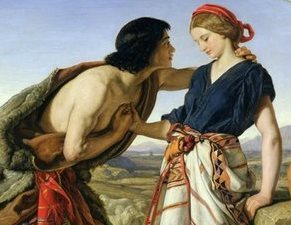
And it happened when Yaakov saw Racheil, daughter of Lavan, his mother’s brother, and the sheep of Lavan, his mother’s brother, then Yaakov came closer. And he rolled the stone from the mouth of the well, and he watered the flock of Lavan, his mother’s brother. Vayishak, Yaakov, to Racheil, and he raised his voice and wept. Then Yaakov told Racheil that he was her father’s kinsman, and that he was Rivkah’s son. And she ran and told her father. (Genesis 29:10-12)
Racheil would be surprised to receive a kiss from a stranger. But she does not scream, even though Yaakov does not tell her he is her first cousin until after he has kissed her and wept. Perhaps she admires his feat of strength in rolling the heavy stone off the well all by himself, and his generosity in watering her flock. Radak suggested that “since she had realized that Yaakov had done all this on her account, she accepted his kiss.”3
She might have a sudden crush on him.
On the other hand, she might be shocked by the kiss, and then flummoxed by Yaakov breaking into tears. By the time she pulls herself together, Yaakov is explaining that he is her first cousin.
Some medieval commentators could not accept that Yaakov, one of their heroes, would kiss a young woman whom he has just met. So Bachya ben Asher invented a detail that is not in the Torah: “We should also note that Yaakov did not kiss Rachel on the mouth but on the head or the shoulder, suggesting that there was no sexual element in that kiss.”4
Even in the 19th century, Hirsch had to find an excuse for Yaakov’s behavior. He wrote: “Who knows how long Yaakov had been wandering, away from home, without seeing one familiar face. Then suddenly he sees Rachel, the daughter of his mother’s brother, and the image of his mother is called up in his memory, bringing him to tears. The tears show that the kiss was entirely innocent, and that even when he attended to the sheep he was only honoring his mother. Rachel must have thought him quite mad when he fell round her neck and kissed her, and then broke into tears. He therefore stepped back and explained to her the cause of his emotion.”5
Perhaps Yaakov, unlike his brother Eisav, has never pursued a woman before. But Racheil is young and beautiful—and Yaakov’s father told him to go to his uncle’s house to find a wife. Yaakov might decide on the spot that Racheil is the wife he wants. And if he is falling in love for the first time, he impulsively kisses her—and only then remembers to explain that he is her first cousin.
But then why does he break into tears immediately after kissing her? According to Hirsch, Yaakov weeps because Racheil reminds him of his mother. Some earlier commentators followed the lead of Bereishit Rabbah, which offered three possible reasons for Yaakov’s tears: because he arrives without any valuables to offer as a bride-price (see my post Vayeitzei: Father Figures), or because he foresees that he will not be buried with Racheil, or because the other shepherds are whispering that his behavior is lewd.6
Another possible reason for Yaakov’s tears is that he is overcome by emotion at finally reaching his destination. Radak wrote that “he wept for joy”.7 And Steinsaltz wrote: “Jacob kissed Rachel chastely, as one would a young family relation. And he raised his voice, and wept out of emotion. After a journey of hundreds of miles, which certainly took him several months, spending each night in a different place, he had finally met a member of his family.”8
Second hello kiss
After Yaakov has kissed Racheil, wept, and identified himself, she runs and tells her father, Lavan.
And it happened when Lavan heard the news of Yaakov, his sister’s son, that he ran to meet him, and he embraced him, vayenashek him, and he brought him into his house. Then he [Yaakov] recounted all these things to Lavan. (Genesis 29:13)
vayenashek (וַיְנַשֶּׁק) = and he kissed. (Also from nashak.)
Lavan kisses his nephew in greeting, a normal courtesy between male relatives who have not seen one another for a long time—or ever.
Considering that Lavan cheats and takes advantage of Yaakov for the next fourteen years, he may have a second motivation for kissing and embracing his nephew from Canaan. The last time someone connected with Lavan’s family in Canaan came to Charan, it was Avraham’s steward, accompanied by ten camels, servants, and a wealth of bride-gifts. The steward quickly arranged a marriage between Lavan’s younger sister Rivkah and Avraham’s son Yitzchak.
Yaakov, Yitzchak’s son, does not arrive with any camels or servants, but nevertheless, Lavan knows he comes from a wealthy branch of the family. So Rashi suggested: “When he saw that he had nothing with him, he thought, ‘Perhaps he has brought gold coins and they are hidden away in his bosom!’”9 According to Rashi, Lavan kisses and embraces Yaakov to see if he can feel any hidden objects.
Chayim ibn Attar added: “When the Torah reports that Laban brought Jacob into his house, this was also because he thought that maybe Jacob’s wealth was following some distance behind him. He wanted to keep Jacob around pending arrival of his possessions.”10
The Torah says that Yaakov recounted all these things to Lavan without specifying what things Yaakov tells him about. Chizkuni suggests that Yaakov told him “… how he had acquired the birthright and subsequently the blessing, in order that Lavan would agree to give him Rachel in marriage. He also told him that he had been forced to flee from his brother Esau, in order to explain why he had arrived emptyhanded.”11
Since Yaakov has no gifts for his uncle, Lavan puts him to work as a shepherd.
Goodbye kisses
Family members in the Torah also kiss goodbye, especially when they do not expect to see each other again.
Twenty years after Yaakov arrives at Lavan’s house, he leaves with his two wives (Racheil and her older sister Leah), his two concubines (his wives’ maidservants), and his eleven sons, as well as the servants and animals he has acquired during the last six years under his own name. They leave in a hurry, while Lavan and his sons are out of town, because Yaakov is afraid that Lavan would refuse to let them go.
When Lavan and his sons get home, they discover that the rest of their family has absconded, and immediately chase after them. After seven days, they catch up with Yaakov in the highlands of Gilead, on the road to Canaan. Lavan and his sons camp overnight a short distance from Yaakov’s camp. That night, God comes to Lavan in a dream and warns him not to say anything to Yaakov about returning to Charan.12
When Lavan confronts Yaakov in the morning, he demands:
“Why did you secretly flee and steal away on me? You told me nothing! And I would have sent you off with rejoicing and with song, with drum and with lyre! But you did not allow me lenasheik my [grand]sons and my daughters! Now you have acted foolishly!” (Genesis 31:27-28)
lenasheik (לְנַשֵּׁק) = to kiss. (Also from nashak.)
What Lavan is implying, according to Hirsch, is: “Had you left openly, I would have sent you off as would a father (I might even have finally given you a dowry!). But now that you crept away like a thief, I have the power, and the right, to take everything away from you—only that God has intervened.”13
Yaakov and Lavan argue about theft and rights. (See my post Vayeitzei: Stealing Away.) Finally Lavan declares:
“The daughters are my daughters, and the children are my children, and the flocks are my flocks! Everything that you see, it is mine! But as for my daughters, what can I do about these today? Or about their children whom they have borne? So now let’s cut a covenant, I and you, and let there be a witness between us.” (Genesis 31:43-44)
Now that Lavan has given up his claim, the two men make a treaty and set up stones to “witness” the border between them. After the formal ceremony is finished, both parties spend another night on the hilltop.
And Lavan got up early in the morning, vayenasheik his [grand]sons and his daughters, and he blessed them. Then Lavan left and returned to his own place. (Genesis 32:1)
vayenasheik (וַיְנַשֵּׁק) = and he kissed. (Also from nashak.)
The previous day, when Lavan protested that Yaakov did not give him a chance to kiss his daughters and grandsons, he was inventing a reason for pursuing Yaakov’s family for seven days. But now that he and Yaakov have made peace and are going their separate ways, Lavan takes the opportunity to kiss his daughters and grandsons goodbye.
He does not kiss his nephew and son-in-law Yaakov.
It is normal, in the Hebrew Bible, for someone to kiss a family member to say hello or goodbye. We do not know where the kiss customarily landed, but it was probably somewhere on the face, since the bible often refers to embracing and kissing, and to hanging on someone’s neck while kissing and weeping.
The custom in many countries today is that if one person gives another a kiss, the second person kisses back. But in the Hebrew Bible, this happens only twice.14
I have observed extended families in which everyone kisses everyone hello and goodbye. Other families restrict themselves to hugs, and still others stand together awkwardly while the older men shake hands. I came from a reserved family, so I was relieved when my in-laws hugged when they were greeting and parting, but did not kiss.
How much physical or emotional intimacy is implied by a biblical kiss? It is not always easy to tell from the context. (See my post Vayishlach: He Kissed Him.) How much intimacy is implied when relatives kiss in your family?
- Genesis 27:3-4.
- Genesis 27:3-17.
- Radak (Rabbi David Kimchi, 1160–1235), translation in www.sefaria.org.
- 14th-century rabbi Bachya ben Asher, translation in www.sefaria.org.
- 19th-century rabbi Samson Raphael Hirsch, The Hirsch Chumash: Sefer Bereshis, translated by Daniel Haberman, Feldheim Publishers, Jerusalem, 2002, p. 614.
- Bereishit Rabbah 70:12, 300-500 CE.
- Radak, ibid.
- 21st-century rabbi Adin Even-Israel Steinsaltz, The Steinsaltz Tanakh, reprinted in www.sefaria.org.
- Rashi (11th-century rabbi Shlomoh Yitzchaki), translation in www.sefaria.org.
- 18th-century rabbi Chayim ibn Attar, Or Hachayim, translation in www.sefaria.org.
- Chizkuni, 13th century collection of commentary, translation in www.sefaria.org.
- Genesis 31:24.
- Hirsch, ibid, p. 643.
- David and Jonathan kiss each other and weep when they are parting (1 Samuel 20:41). Naomi kisses both her daughters-in-law goodbye, and Orpah kisses her back, but Ruth does not, since she refuses to leave her mother-in-law (Ruth 1:9, 1:14).


