
Now Avraham was old, advanced in days, and Y-H-V-H had blessed Avraham in everything. (Genesis 24:1)
Blessings in the Torah are health, long life, prosperity, and fertility. When that verse appears in this week’s Torah portion, Chayei Sarah (Genesis/Bereishit 23:1-25:18), Avraham is over 137 years old, and still healthy. He is a prosperous livestock owner, and he has two sons. So technically, he has been blessed in everything. But he is estranged from both of his sons.
Obeying God
Avraham first heard from God when he lived in the northern Mesopotamian town of Charan, at the beginning of the Torah portion Lekh Lekha. His name was Avram then, and he was 75 years old. He already had the blessings of health and prosperity, but not fertility. His wife, Sarai, was 65 and childless.
And Y-H-V-H said to Avram: “Go for yourself from your land, and from your kin, and from your father’s house, to the land that I will show you! And I will make a great nation of you, and I will bless you, and I will make your name great. Be a blessing!” (Genesis 12:1-2)
Avram obeys God and emigrates to the land of Canaan.1 He takes along his wife (Sarai, later renamed Sarah), his nephew (Lot), and a number of servants. But Avram’s brother Nachor stays in Charan.
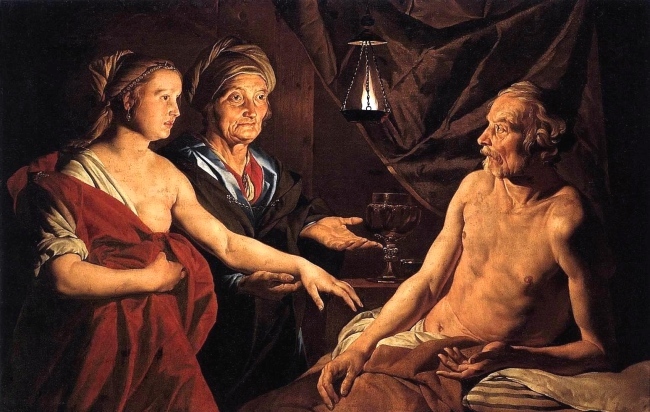
On three more occasions in the portion Lekh Lekha God says that Avram will have a nation of descendants who will posses the land of Canaan.2 Finally his wife arranges for him to impregnate her Egyptian slave, Hagar. Their son, Yishmael (“Ishmael” in English, is born when Avram is 86. But there is friction between Sarai and Hagar.
When Avram is 99, God makes a new covenant with him, changing his name to Avraham and Sarai’s name to Sarah, requiring male circumcision, and promising to give Avraham numerous descendants through Sarah. Yishmael, who is 13 at the time, will eventually father children too, but God’s covenant (and the possession of Canaan) will go to the descendants of Avraham and Sarah’s son, Yitzchak (“Isaac” in English).3
Shortly after that, in the Torah portion Vayeira, Avraham questions God for the first and only time. He urges God to spare the people of Sodom and Gomorrah if even ten of them are innocent. And God agrees—but does not find even ten.4
Sarah gives birth at age 90, by a divine miracle. At the feast celebrating Yitzchak’s weaning, Yishmael laughs at his little half-brother, and that is the last straw for Sarah. She demands that Avraham cast out Yishmael and his mother Hagar, so that only Yitzchak will inherit Avraham’s estate—and his covenant with God.
The matter was very bad in Avraham’s eyes, on account of his son. But God said to Avraham: “Don’t let it be bad in your eyes about the lad and about your servant. In everything that Sarah says to you, listen to her voice, since your offspring will be called through Yitzchak.” (Genesis 21:11-12)
Avraham obeys God. Yishmael nearly dies of thirst in the desert because Avraham has sent him and his mother away with insufficient provisions, but a divine messenger points out a well, and they survive and settle far to the south, outside Canaan.5
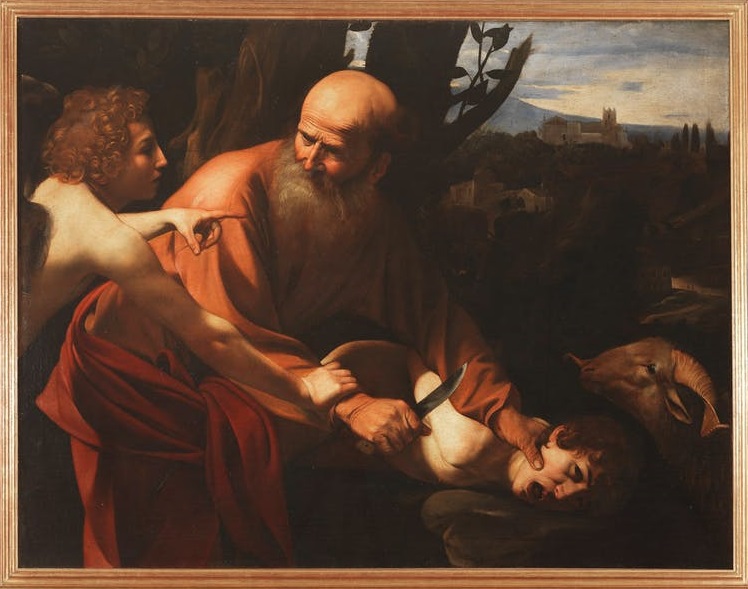
After his second son has grown up, Avraham hears God orders him to slaughter Yitzchak and burn him as an offering to God. Instead of questioning God again, Avraham simply obeys. He leaves early in the morning with his son and two servants, without telling Sarah. Once he has bound Yitzchak on an altar and raised a knife over his son’s throat, a voice from God stops him. Avraham returns to his camp at Beersheba without his son.6 Yitzchak goes his own way, ending up at Beir-Lachai-Roi, the place where Hagar had encountered God.7
Sarah dies at age 127, at the beginning of this week’s Torah portion, Chayei Sarah, and Avraham buries her. But Yitzchak is absent. He might not even hear about his mother’s death until after her burial.
Avraham is consistent. Whenever he must choose between obeying God or being a decent father, he always chooses to obey God.
Assisting God
Now Avraham was old, advanced in days, and Y-H-V-H had blessed Avraham in everything. (Genesis 24:1)
Yes, God had blessed Avraham with health, long life, prosperity, and fertility. And God also promised him that his descendants through Yitzchak would inherit the land of Canaan.
But Yitzchak has never married, never had a child. So Avraham takes the initiative to make God’s promise come true.
He does not send a message asking Yitzchak to come to him to discuss the problem. I suspect he figures that since his son has avoided him this long, he would refuse to come. Instead, Avraham sends his steward to find Yitzchak a wife.
Avraham said to his servant, the elder of his household, who ruled over all that was his: “… I want you to swear by Y-H-V-H, the God of the heavens and the earth, that you will not take a wife for my son from the women of the Canaanites, among whom I dwell. Instead, you must go to my land and to my kin and take a wife for my son, for Yitzchak.” (Genesis 24:2-4)
After living for more than 60 years in Canaan, Avraham still thinks of Mesopotamia as his land. And he knows that he still has kin in Charan; he received news that his brother Nachor and his wife had eight sons and at least one granddaughter.8 But why does he want Yitzchak’s wife to be one of his relatives from Charan, instead of a local girl?
In the 13th century, Radak wrote: “The entire Canaanite tribe is cursed since the days of Noach, and Avraham’s seed is not to be merged with that of a cursed tribe.”9
Other commentators proposed that if Yitzchak married a relative, the pair would have a natural affinity and equal status, and therefore a more harmonious marriage.10
A third approach was to point out that since Avraham was a devout follower of Y-H-V-H, he did not want Yitzchak to be influenced by “idolaters”. That ruled out a Canaanite bride, since Canaanites worshipped other gods. So did most Mesopotamians, though Avraham’s own kin worshipped Y-H-V-H.11
Since Avraham prizes his relationship with Y-H-V-H more than any of his relationships with humans, his goal in getting Yitzchak a wife must be to ensure that there will be descendants who worship Y-H-V-H, and therefore qualify for his God’s gift of Canaan. A Canaanite wife and her family might teach Yitzchak’s children to worship other gods.
Furthermore, according to the 13th century commentary Chizkuni, “Avraham did not want that in the future anyone could claim that his claim on the Holy Land was based on intermarriage with the previous owners of that land.”12
Avraham knows that Yitzchak’s descendants will not take possession of Canaan through intermarriage, because God has already told Avraham, back in the portion Lekh Lekha, that his descendants would be enslaved in another land for four hundred years, and only then return and take the land of Canaan.13
But the servant said to him: “Perhaps the woman will not be willing to go after me to this land. May I then take your son back there, to the land from which you once went out?” (Genesis 24:5)
It is a reasonable question. Is Avraham’s main goal the marriage of Yitzchak to one of his relatives, or is there an additional agenda?
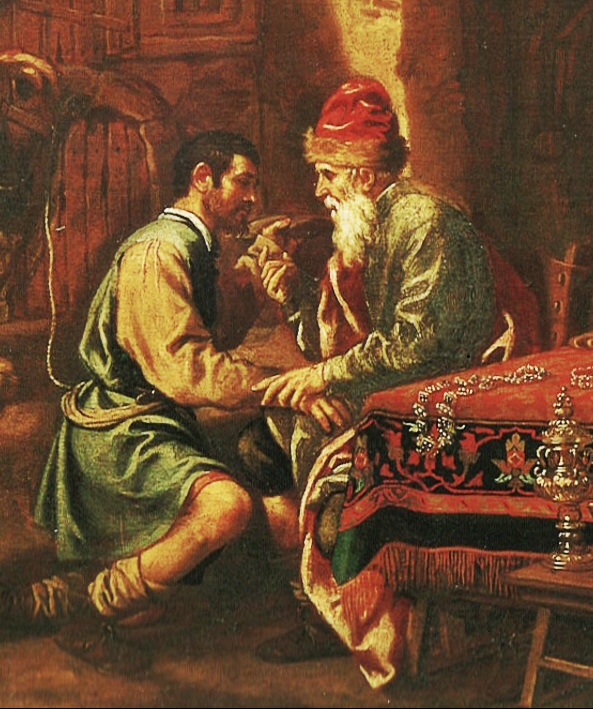
And Avraham said to him: “Guard yourself against taking my son back there! Y-H-V-H, the God of the heavens, who took me from my father’s house and from the land of my kin, and who spoke to me and swore to me, saying: I give this land to your descendants—[God] will send [God’s] messenger ahead of you, and you will take a wife for my son from there. But if the woman is not willing to follow you, then you will be clear from this oath of mine. Only you must not take my son back there!” (Genesis 24:6-8)
Why does Avraham insist that Yitzchak must not go to Charan? Some classic commentary says that when he dedicated his son as a sacrifice to God, Yitzchak’s new status as sacred became permanent (even though God then intervened to prevent Avraham from cutting his son’s throat). Being sacred, Yitzchak was not allowed to leave “the Holy Land”.14
But Radak wrote: “Avraham did not want the claim on the land of Israel which God had promised him and which had been established through his physical presence in that land, to become subject to doubt through an even temporary migration of Yitzchak.”15
My opinion is that if Yitzchak settled down and had children in Charan, he would have no motivation to return to Canaan. His mother was dead, and ever since Avraham nearly sacrificed him, he has been avoiding his father. If Yitzchak spent the rest of his life in Charan, his descendants would have no motivation to go to Canaan.
Even God tells Yitzchak not to leave the land of Canaan in next week’s portion, Toledot.
And Y-H-V-H appeared to him and said: “Do not go down to Egypt! Dwell in the land that I tell you!” (Genesis 26:2)
Then is it a problem when Yitzchak dispatches one of his own sons, Yaakov (“Jacob” in English), to Charan to find a bride? Hirsch explained that the situation is different for Yaakov because his parents (Yitzchak and his wife Rivkah, “Rebecca” in English) stayed behind in Canaan. “… his family was still living in isolation in Canaan, and that is what drew him back to the family, immediately after his children were born.”16
Avraham does not know, at this point in the story, that he will live on in Canaan until he dies at age 175. But he probably does know that if Yitzchak moved to Charan, he would not return to Canaan in order to see his father.
So he does what he can to fulfill God’s plan, by ordering his steward to get a bride from his kin in Charan and bring her to Yitzchak in Canaan. He can only hope that his son will accept the woman and give her a child; but perhaps he believes that since Yitzchak once obediently lay down on top of the firewood on an altar, he will obediently marry the woman his father arranges for him.
Avraham dedicates his life to obeying God and furthering God’s plans. The price of this dedication is the loss his two sons. Both Yishmael and Yitzchak remain alive thanks to God, not to their father. And the Torah does not report that either of them sees Avraham again until after his death, when both Yishmael and Yitzchak bury him.17
What kind of God would command a father to throw out his older son and kill his younger son? What kind of person would obey a God like that, and work to further that God’s plans?
What kind of God would you trust? What kind of person do you want to be?
- See my post Lekh Lekha & Noach: Why Leave?
- Genesis 12:7, 13:14-15, and 15:5-18.
- Genesis 17:1-27.
- Genesis 18:20-32.
- Genesis 21:14-21. See my post Vayeira: Failure of Empathy.
- Genesis 22:1-19. See my post Vayeira: Return to Silence.
- See my post Lekh Lekha: First Encounter.
- Genesis 22:20-24.
- Radak (acronym of 13th century Rabbi David Kimchi), translation in www.sefaria.org referring to Genesis 9:25-27.
- E.g. Bachya ben Asher (14th century), Tze-enah Ure-enah (17th century).
- E.g. Kli Yakar (17th century), S.R. Hirsch (19th century).
- Chizkuni, 13th century, translation in www.sefaria.org.
- Genesis 15:13-21—an allusion to the book of Exodus.
- E.g. 14th century Rabbi Bachya ben Asher.
- Radak (acronym of Rabbi David Kimchi), 13th century, translation in www.sefaria.org.
- 19th-century Rabbi Raphael Samson Hirsch, The Hirsch Chumash: Sefer Bereishis, translated by Daniel Heberman, Feldheim Publishers, Jerusalem, 2002, p. 518.
- Genesis 25:9.


