
In last week’s Torah portion, Lekh Lekha (Genesis/Bereishit 12:1-17:27), God keeps promising Avraham numerous descendants,1 but he remains childless until his wife arranges for him to impregnate her Egyptian slave Hagar.2 At the end of the portion, God makes a new covenant with Avraham, and a new promise: descendants through his wife.
First annunciation
Then God said to Avraham: “Sarai, your wife—she will no longer be called by her name, Sarai. Because [now] Sarah is her name! I will bless her. Indeed, I will give you a son from her, and I will bless her so that she will become nations! Kings of peoples will come from her.” (Genesis 17:15-16)
sarah (שָׂרָה) = (noun) noblewoman, female official.
The change from an ordinary name to one that indicates high status may reflect Sarah’s new role as the progenitor of kings. But how can Sarah, who is 89 years old and has never given birth, fill this role?
Then Avraham fell on his face and laughed, and he said to himself: “Will a son be born to a hundred-year-old, and will Sarah bear a child at ninety?” And Avraham said to God: “If only Yishmael will live in your presence!” (Genesis 17:18)
When Avraham hears God’s promise, he has two thoughts: that both he and Sarah are too old to have a baby; and that if they do have a son, the boy will replace Hagar’s son, Yishmael (“Ishmael” in English) as Avraham’s heir. Yishmael is now thirteen years old, and Avraham loves him.
Men in the Torah “fall” on their faces, prostrating themselves, when they are petitioning God or a king. According to 18th-century rabbi Chayim ibn Attar, “Abraham prayed that Ishmael should enjoy divine assistance to live as a righteous person.”3
After God tells Avraham to name Sarah’s son Yitzchak (“Isaac” in English; yitzchak (יִצְחָק) = he laughs), God reassures Avraham that Yishmael will live and father his own nation of descendants.
“But my covenant I will establish with Yitzchak, whom Sarah will bear to you at this appointed time, in another year.” (Genesis 17:21) Then God makes a new covenant with Avraham: God will give Avraham’s descendants the whole land of Canaan; and Avraham, all his male descendants, and all their male slaves, will be circumcised.4 So Avraham has himself and all the other males in his household circumcised, including his 13-year-old son Yishmael, thus fulfilling his part of the new covenant with God.
Second annunciation
This week’s Torah portion, Vayeira (Genesis 18:1-22:24), opens:
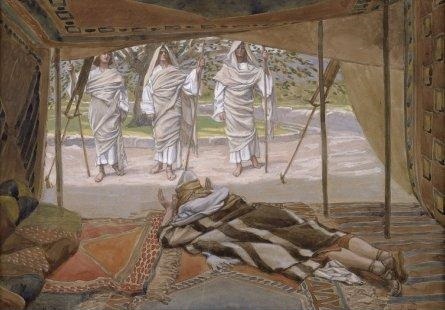
And God appeared to him at the great trees of Mamrei, and he was sitting in the entrance of the tent at the heat of the day. He raised his eyes and looked, and hey! Three men standing over him! And he saw, and he ran from the entrance of the tent to meet them, and he bowed down to the ground. (Genesis 18:1-2)
It takes some time for Avraham to figure out that these three men are really divine messengers (angels). He lavishes hospitality on them, inviting them to recline under a tree, wash their feet, and eat something. He tells Sarah to make flatbread with fine flour for them, tells his boy (Yishmael? A servant?) to slaughter and roast a calf, and fetches butter and curds.
And he was standing over them, under the tree, and they ate. And they said to him: “Where is Sarah, your wife?” And he said: “Here in the tent.” (Genesis 18:8-9)
It was considered polite for visitors to inquire about the welfare of their host’s family. But why would these men, whom Avraham has never seen before, know his wife’s name? Furthermore, even if they had somehow heard of her, they would have called her by her old name, Sarai, not by the name God had recently given her.
According to Chayim ibn Attar, “The angels wanted that Abraham should realize that the message they had to deliver was primarily for Sarah; this is why they enquired about her whereabouts. Abraham indicated that she was within the tent ready to listen to what they had to say to her.”5
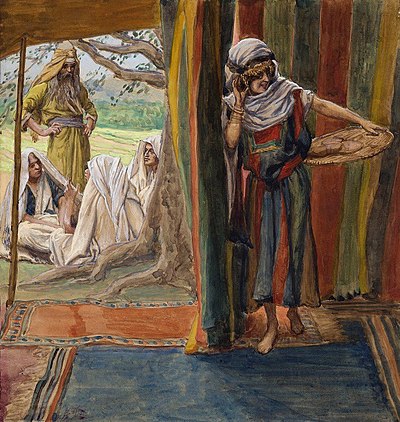
The phrase “And they said to him” may imply that Avraham is not paying attention to which of the three “men” is speaking. But in the next verse, “they” becomes “he”.
Then he said: “I will definitely return to you when [this] time [of year] revives, and hey! A son for Sarah, your wife!” And Sarah was listening at the entrance of the tent, which was behind him. (Genesis 18:10)
This speaker is either God or a divine messenger acting as God’s mouthpiece, telling Avraham the same thing that God said before the circumcisions: that one year later, Sarah would have a son.7
Before the second annunciation, the leader of the three “men” makes sure that Sarah is close enough to hear. Like Avraham, Sarah reacts to the news with laughter.
And Avraham and Sarah were old, coming on in days. The path of women [menstrual periods] had ceased for Sarah. And Sarah laughed inside herself, thinking: “After I am worn out, will there be ednah for me? And my lord is old!” (Genesis 18:12)
ednah (עֶדְנָה) = sexual pleasure, sensual pleasure. (From the same root as the verb ע־ד־ן = luxuriate, enjoy sensually, and the proper noun Eden, עֵדֶן = the location of the primeval garden where the first two humans eat from the Tree of Knowledge and have sexual intercourse.)
Sarah’s laughter indicates that she is surprised; evidently her husband has not told her everything that God said to him earlier. According to Hirsch, “Apparently, God’s Will was that Sarah should hear the news only incidentally. In this way, she, too, would hear it firsthand; the astounding abnormality of it all would strike her abruptly; and, to her too, the news would at first appear absurd.”8 As Sarah laughs, her first thought is that she is old and worn out. Next she wonders whether she will have sexual pleasure again. Then she notes that Avraham is old.
1. “I am worn out”
What does Sarah mean by “worn out”? Some classic commentary focuses on her beauty and her skin. In the Talmud, “Rav Ḥisda says: After the skin had worn out [nitballa] and become full of wrinkles, the skin once again became soft [nitadden] and her wrinkles smoothed out, and Sarah’s beauty returned to its place.”9
In the 12th century, Rashbam even defined ednah as “a form of the skin becoming elastic and the wrinkles straightening out.”10
Midrash Tanchuma is more practical, and imagines Sarah thinking: “These innards are to carry a fetus, these shriveled breasts are to draw milk?”11
2. “Will there be ednah for me?”
Sarah’s second thought is of ednah, sexual pleasure. It is likely that Sarah, at age 89, has vaginal dryness that would make intercourse painful rather than pleasurable. Yet as soon as she hears the “man” prophesy that she will have a son, she wonders whether it means that she will have ednah.
This passage is not like the Christian story of a virgin becoming pregnant and bearing a child. Instead, it presents an old woman who misses the sexual relations she had in the past, and wonders if the prophecy would mean she will have at least one more night of pleasure.
How long has it been since Avraham and Sarah were physically intimate? The Torah does not say. But we can deduce that they sleep in the same tent.
When Avraham first sees the three “men”, he is sitting “in the entrance of the tent”—not his tent, but the tent. When the visitors ask him where Sarah is, he replies“Here in the tent.”
Since Avraham is a rich nomad, the tent is probably large and sprawling, divided by curtains into several rooms inside, like a Bedouin tent today. We are not told whether Sarah’s slave Hagar has her own room in the tent, nor where Yishmael sleeps. (Avraham also has employees and male slaves to care for his herds and flocks; they would have their own tents, and pitch them sometimes at Avraham’s campsite, sometimes at other locations where the animals are pastured.)
But even though Avraham and Sarah sleep in the same tent, they may not be physically affectionate. Theirs is a long but difficult marriage. When they moved to Egypt during a drought, Avraham asked Sarah to lie and say she was his sister, so he could sell her to the pharaoh as a concubine; God arranged for her to return unscathed, and Avraham got to keep the riches, but I find it hard to imagine that she was sanguine about the whole episode.12 Later, Sarah arranged for Avraham to impregnate her Egyptian slave, so she could adopt the child. But when her pregnant slave belittled her, Sarah blamed Avraham, and Avraham merely told his wife to do whatever she liked about the problem.13 Friction arises between Sarah and Avraham again later in this week’s Torah portion, after Sarah’s son is born.
3. “My lord is old”
Sarah’s third thought after the annunciation is “My lord is old”. In the Hebrew Bible a wife might refer to her husband as adoni (אָדֺנִי) = my lord, or as ba-ali (בַּעְלִי) = my owner, or as ishi (אִישִׁי) = my man. Ishi is the most affectionate term, but Sarah thinks of Avraham as her lord and master. According to Midrash Tanchuma, this is a sign of her esteem: “However, Abraham’s wife honored him and called him my lord …”15 But another possibility is that Sarah thinks of her husband with some bitterness over his lack of empathy for her in the past.
Sarah believes that even if she had periods again, Avraham is too old to make her pregnant. One midrash comments:
“Rav Yehuda said: He grinds but does not discharge. Rabbi Yehuda ben Rabbi Simon said: The Holy One blessed be He said: ‘Each of you considers yourself young, and your counterpart old, but am I too old to perform miracles?’”16
At age 99, Avraham might well experience some sexual dysfunction. Yet after Sarah dies 38 years later, he remarries and has six more sons.17 Perhaps Sarah is blaming his lack of interest in bed on his advanced age, when actually he has lost interest in her.
Why laugh?
Then Y-H-V-H said to Avraham: “Why does Sarah laugh, thinking: ‘And will I truly give birth, when I myself am old?’ Is anything too wondrous for Y-H-V-H? At the appointed time I will return to you, when [this] time [of year] revives, and Sarah will have a son!” (Genesis 18:13-14)
Although the text now uses God’s personal name, Y-H-V-H, God is still speaking through a divine messenger who looks—and sounds—like a man, because Sarah hears from inside the tent.
Although God did not question Avraham’s laughter at the first annunciation, God now questions Sarah’s laughter.
And Sarah lied, saying: “No, I did not laugh,” because she was afraid. But he said: “No, indeed you did laugh.” (Genesis 18:15)
Sarah’ fear indicates that she believes the “man” outside the tent is either a true prophet or a divine messenger, and therefore God now knows that she laughed. What if God considers her laughter a sign that she does not believe God can make the miracle happen? In her fear, she lies instinctively.
But what is the real reason why she laughed?
As I read the story, Sarah laughs in joy and amazement over the news that even though she is 89 and has little to show for her life, a new life is about to begin. Sarah has probably resigned herself to a marriage with a man who gives her little empathy or affection, and no sensual pleasure; to having no child of her own (since her bold attempt at adoption did not work out); and to living out her remaining years with few good memories. Now, suddenly, Avraham’s mysterious visitors arrive knowing her new name, and promising that next year she will have a baby. A miracle! A new life, with love and affection and meaning, for however long she has before she dies!
- Genesis 12:2, 12:7, 13:16,15:2-5, 15:13, 15:18.
- Genesis 16:1-16. See my post Lekh Lekha: Belittlement.
- 18th-century rabbi Chayim ibn Attar, Or HaChayim, translation in www.sefaria.org.
- Genesis 17:3-14.
- Chayim ibn Attar, ibid.
- 19th-century rabbi Samson Raphael Hirsch, The Hirsch Chumash: Sefer Bereshis, translation by Daniel Haberman, Feldheim Publishers, Jerusalem, 2002, p. 408.
- Although the “man” says “I will definitely return to you”, no such visit is reported. But the Torah does consider God the opener of wombs, who decides whether a woman will get pregnant. (See Genesis 29:31 and 30:22.) Later in the Torah portion Vayeira, “Y-H-V-H did to Sara as he had spoken.” (Genesis 21:1))
- Hirsch, ibid.
- Talmud Bavli, Bava Metzia 87a, (5th century CE), translation by Adin Steinsaltz in www.sefaria.org.
- Rashbam, acronym of 12th-century rabbi Shmuel Ben Meir, translation in www.sefaria.org.
- Midrash Tanchuma, 500-800 CE, translation in www.sefaria.org.
- See my post Lekh Lekha, Vayeira, & Toledot: The Wife-Sister Trick, Part 2.
- Genesis 16:3-6; see my post Lekh Lekha: Belittlement.
- See my post Vayeira: Failure of Empathy.
- Midrash Tanchuma, ibid.
- 4th-5th century midrash Bereishit Rabbah 48:17, translation in www.sefaria.org.
- Genesis 25:1-2.


