
The Israelites who follow Moshe (“Moses” in English) out of Egypt in the book of Exodus have a good reason to emigrate. The pharaoh has subjected the Israelite men to forced labor under harsh conditions, with no end in sight and no days off. No wonder they are willing to leave their homes, their plots of land, and their neighborhoods and head off for the unknown country of Canaan—especially since their God is on their side, and has afflicted Egypt with plagues so that they can take their families and their livestock with them.
A generation earlier, Moshe himself left Egypt and became a resident alien in Midian—until God ordered him to return to Egypt and rescue his people. Moshe also had a good reason to emigrate; he had killed an Egyptian overseer who was beating an Israelite man, and in Egypt he was wanted for murder.1
Five centuries before that, in the book of Genesis, the ancestors of the Israelites—later known as Abraham and Sarah—leave Mesopotamia and head for the unknown country of Canaan. Their reason for emigrating is not as obvious. The Torah does not report that anyone oppressed them in Mesopotamia, or that they committed any rash deeds. So why do they leave?
Terach’s family emigrates from Ur to Charan
Avram, whom God later renamed Avraham (“Abraham” in English), is first introduced near the end of last week’s Torah portion, Noach (Genesis/Bereishit 6:9-11:32).
And these are the genealogies of Terach: Terach begot Avram, Nachor, and Haran,
and Haran begot Lot. And Haran died in the presence of his father Terach, in the land of his moledet, in Ur of the Casdim. And Avram and Nachor took wives for themselves. The name of Avram’s wife was Sarai … And Sarai was barren, she had no child. (Genesis 11:27-30)
moledet (מוֹלֶדֶת) = descendants, offspring; kin in general; birthplace. (From the root verb yalad, יָלַד = gave birth, procreated.)
Then Terach and his whole family leave Ur and head toward Canaan.
… and they set out together from Ur of the Casdim, to go to the land of Canaan. And they came as far as Charan, and they settled there. (Genesis 11:31)
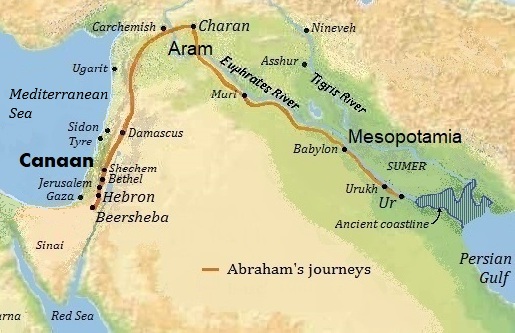
A straight line from Ur to Canaan would cross a vast desert with no water sources. So the only realistic route to Canaan was U-shaped: north into the foothills of Anatolia, in the vicinity of Charan, and then southwest past Damascus to Canaan.
The distances between Ur, Charan, and Canaan are significant. From the lower Mesopotamian city of Ur, where Avram was born, to the upper Mesopotamian city of Charan is about 770 miles (1240 km). From Charan to Canaan is about 500 miles (800 km).
Terach dies in Charan, at age 205. Nachor and his wife stay there2 when Avram, Sarai, and Lot pack up again and travel to Canaan. The Torah reports no war, famine, or oppression in either Ur or Charan. So why do Terach and his family emigrate?
Why does Terach leave Ur?
Perhaps Terach leaves for the sake of his eldest son. Avram turns out to be exceptional in his ability to converse with God. Perhaps Terach notices that Avram has an unusual talent, and is willing to uproot his whole family to foster it.
The Netziv wrote that Avram experienced “a heavenly illumination” in Ur, “and he saw the sanctity of the land [of Canaan] from afar”. This 19th-century rabbi imagined Avram as so “immersed in Godly ideas” that his doting father had to manage the practical details of the journey.3
Chayim ibn Attar suggested that Terach was concerned that his beloved oldest son had no children, and emigrated in the hope that Avram would be blessed with a son in Canaan. “The Torah shows us that Abraham was so important in the eyes of the other members of his father’s household that they all joined in the migration in order to stay close to him.”4
Modern commentator Frymer-Kensky suggested: “The worship of YHWH may be the reason that Terah first left Mesopotamia to head for Canaan.”5 Although a famous midrash claims (with no evidence) that Terach sold idols,6 the Torah indicates that Terach’s whole family worshipped Y-H-V-H as their primary god. Not only does Avram hear from Y-H-V-H in Charan, but decades later, when he sends his head servant back to Charan, Nachor’s son Betueil and grandson Lavan both refer to their god as Y-H-V-H.7
Would adherence to Y-H-V-H be a problem in Ur, but not in Charan or Canaan? It seems unlikely. The primary god of Ur was the moon goddess Nanna, and the god of Charan was the moon god Sin. But people throughout Mesopotamia acknowledged multiple gods, as did people in Canaan. I suspect a family that worshipped an obscure god they called Y-H-V-H would not be discriminated against as long as they made no negative comments in public about their city’s chief god.
Avram’s family emigrates from Charan to Canaan
An instruction from God opens this week’s Torah portion, Lekh Lekha (Genesis 12:1-17:27).
And Y-H-V-H [God] said to Avram: “Go for yourself from your land, and from your moledet, and from your father’s house, to the land that I will show you!” (Genesis 12:1)
At this point Avram is still childless, so moledet means either “kin” or “birthplace”. Either the writer is confusing Charan and Ur, or Avram has settled down in Charan with his kin, and now considers it the area around Charan in northern Mesopotamia his homeland.
Next God promises Avram ample rewards if he obeys.
“And I will make a great nation of you, and I will bless you, and I will make your name great. Be a blessing! And I will bless those who wish blessing on you, and curse those who demean you. And all the clans of the earth will be blessed through you!” (Genesis 12:2-3)
The usual blessings in the Torah are health, long life, fertility, and prosperity.
And Avram went as Y-H-V-H had spoken to him, and Lot went with him. And Avram was seventy-five years old when he left from Charan. (Genesis 12:4) Presumably after Terach dies in Charan, Nachor and Milkah decide not to continue the journey to Canaan. But when Avram chooses to obey God’s instruction and go to the land God shows him (which may or may not be Canaan), his wife Sarai and his nephew Lot go with him.
Why do Avram, Sarai, and Lot leave Charan?
The Torah portion Lekh Lekha continues:
And Avram took Sarai his wife and Lot his brother’s son, all their property that they had accumulated, and the persons whom they had acquired in Charan, and they went out to go to the land of Canaan. (Genesis 12:5)
Obviously Avram, Sarai, and Lot had prospered in Charan. They now own a lot of moveable property (livestock and household goods), and a number of servants. They are wealthy and comfortable. Yet instead of staying in Charan, these three decide to emigrate again. The only reason the Torah provides is God’s speech to Avram.
Since God promises Avram blessings and descendants if he goes, Avram and Sarai may decide to leave in the hope of having a son (although Avram is 75 and Sarah is 65).
Lot, however, may decide to go with them in the hope of inheriting his childless uncle Avram’s estate.
On the other hand, maybe Avram, Sarai, and/or Lot simply want to follow the guidance of Y-H-V-H, their god.
Then why does God want Avram to emigrate from Charan to another land? The easy answer is that God is laying the groundwork for what the writers of the book of Genesis already knew—that for centuries one branch of Avram’s descendants, the Israelites, ruled the land formerly known as Canaan.
But within the story in Genesis, other answers are possible. 21st-century commentator Judy Klitsner posited that God wants to isolate Avram. “With the words lekh lekha, which can literally be translated as ‘go to yourself,’ God commands Abraham to leave behind everything that is familiar and to embark on a path that is uniquely his (Gen. 12:1). And in fact, throughout his trials, Abraham maintains his solitary stance, earning the title ‘Abraham the Ivri, Hebrew’ (14:13), a term that throughout the Bible suggests singularity and otherness.”8
Ivri (עִבְרִי) = member of the Hebrew ethnic group; one from the other side. (From the root verb avar, עָבַר = cross over, pass through.)
Other commentators have focused on God’s directive to go not to Canaan, but “to the land that I will show you”. Steinsaltz wrote: “That is how one follows God: without a destination and without an aim. … God says, ‘go forth,’ and one must get up and go, without knowing where one will arrive, without knowing one’s objective, and without knowing one’s aim.”9
And Buchdahl wrote: “We Jews were strangers at the birth of Judaism. … God did not permit Abraham and Sarah to begin Judaism within the comfort of their hometown. They had to become immigrants. They had to be the Other in order to create a religion of the Other. … As Jews, we know what it is to feel vulnerable and powerless. God chose the Jewish people to be archetypal strangers. … We are mandated by our tradition to remember, protect, and yes, love the stranger, because that’s who we are.”10
Some people, like the Israelites who leave Egypt, emigrate for the sake of their lives. They need to escape oppression, persecution, war, natural disasters, poverty. Other people, like Avram, emigrate for the sake of their souls. They might seek more education, a different culture, uncommon opportunities. Or they might even hear a divine call urging them to go for a reason they do not yet know.
But all emigrants have to leave their homes, and leave behind familiar people and things. And they risk arriving at the land they long for and learning that immigrants are not welcome. I continue to pray that someday all borders will be open, and all people will be kind to strangers.
- Exodus 2:11-15.
- See Genesis 22:20-24, 24:4.
- 19th-century rabbi Naftali Zvi Yehudah Berlin (a.k.a. the Netziv), Ha-amek Davar, translation in www.sefaria.org.
- 18th-century rabbi Chayim ibn Attar, Or Hachayim, translation in www.sefaria.org.
- Tikva Frymer-Kensky, Reading the Women of the Bible, Schocken Books, New York, 2002, p. 12.
- Bereishit Rabbah, chapter 38.
- Genesis 24:31, 24:50-51.
- Judy Klitsner, Subversive Sequels in the Bible, Jewish Publication Society, Philadelphia, 2009, pp. 41-42.
- Rabbi Adin Even-Israel Steinsaltz, Talks on the Parasha, Koren Publishers, New Milford, CT, 2015, p. 27.
- Rabbi Angela Buchdahl, Heart of a Stranger, Viking, Penguin Random House, 2025, p. 310-311.


