
A great flood drowns all humans and animals on earth except for those on the ark built by Noach (“Noah” in English). After the flood, Noach’s three sons and their wives are fruitful and multiply. In this week’s Torah portion, Noach (Genesis/Bereishit 6:9-11:32), their descendants eventually spread out and form nations all over the known world. But first they journey together, away from the mountain where the ark touched down after the flood, and settle on a plain in Shinar—another name for Babylonia.
And all the earth was of one language and one set of words. (Genesis 11:1)
Traditional commentators assumed that the language was Hebrew, and that “one set of words” means that the people were of one opinion, one mind.
After arriving at the fertile river plain,
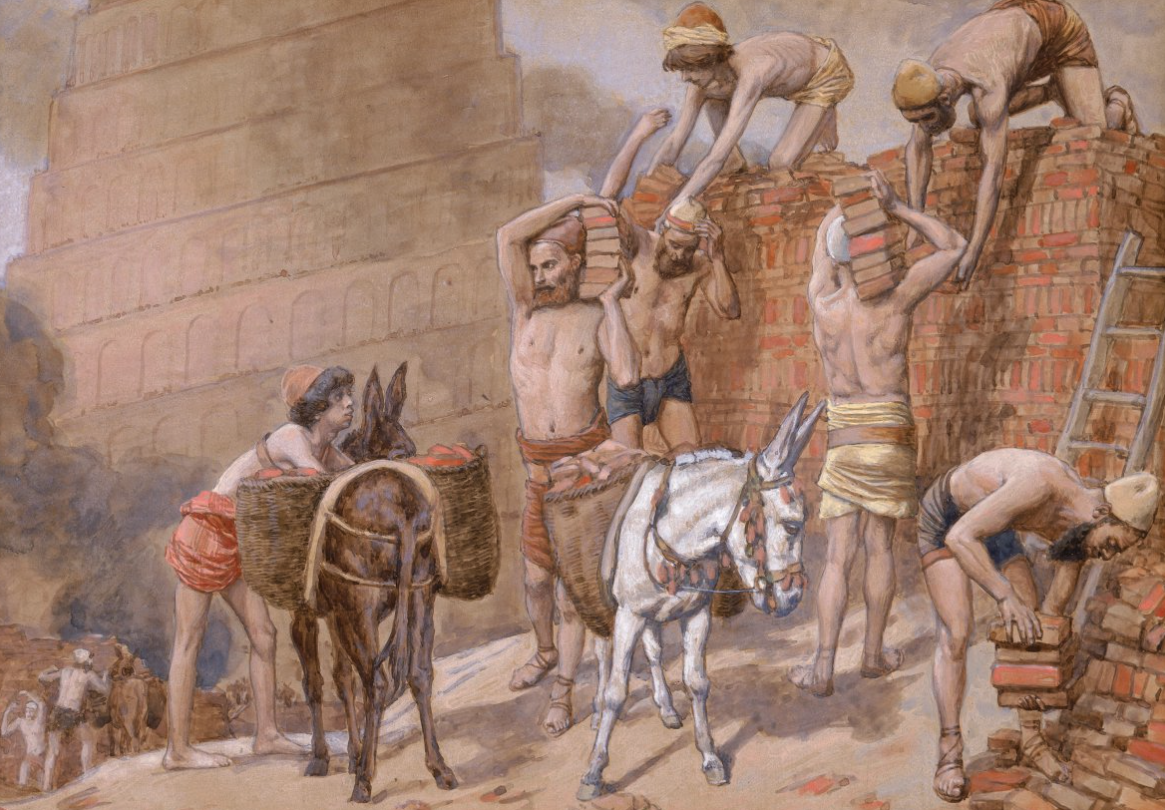
circa 1900
Then they said to one another: “Come on! Let’s make bricks, and let us burn them well [bake them hard]!” Bricks were to them like stone, and bitumen was to them like mortar. And they said: “Come on! Let’s build a city and a tower, its top in the heavens! And let us make ourselves a sheim, lest we be scattered over the face of all the earth!” (Genesis 11:3-4)
sheim (שֵׁם) = name, reputation, fame.
The first problem with this plan is that the people decide (presumably by consensus) to live together in a single city, instead of following God’s command to Noach and his family:
“And you: Be fruitful and multiply, and fill the earth!” (Genesis 9:1)
Geography alone would prevent a single city from filling the earth; oceans, deserts, and mountain ranges would separate people. But these like-minded people do not want to spread out and scatter.
A 19th-century rabbi known as the Netziv wrote that the people noticed that their opinions are not identical, but decided that as long as they stayed together they could enforce a single program—by punishing, or even executing, nonconformists. “Therefore they sought to ensure that no one would leave their society.”1
But I figure that the people would ensure consensus through conversation and persuasion rather than by any violent means. After all, they would have passed down stories of the violence among humans that led to God’s decision to flood the earth.
According to Kli Yakar, a commentary from 1602, “there was concern lest we necessarily scatter from one another and brotherhood cease between us” and then “they would come to wars, as war is always common between inhabitants of one country and another.”2
So they build a big city—out of bricks, since the alluvial plain in Mesopotamia has few stones or trees. But why do they build a tower?
The purpose of the tower
One theory is that the tower is simply a landmark so shepherds and anyone else who wanders too far can find the way home.3 Saying that they want a tower with “its top in the heavens” is merely “an exaggeration describing that the Tower would be very tall. We find a similar exaggeration when Moses described the walls of Canaanite cities in Deuteronomy 1:28 as ‘reaching into heaven.’”4
But other commentators have taken the phrase literally, and concluded that the people had so much hubris they wanted the top of the tower to reach into God’s domain.5 Then if God tried to scatter them, through a flood or some other disaster, they would climb to the top of the tower and wage war against God.6
Alternatively, “Their goal was: we will go up and chop large windows and holes in heaven, so that the water will run out, in the hope that the Holy One will no longer bring the Flood upon us.”7 (In the first story in Genesis, God creates the earth and sky in between “the waters above” and “the waters below”. Near the beginning of this week’s Torah portion, Noach, God triggers the great flood when all the springs of the great subterranean waters burst open, and the windows of the heavens/skies opened (Genesis 7:11) so rain fell for 40 days and 40 nights.)
Modern scholars point out that since the people are building the tower in Shinar, a.k.a. Babylon, the author is poking fun at the brick ziggurats built in Babylonian cities and considered “the meeting point of heaven and earth”.8
Name or fame
But how can the tower make a sheim (name, reputation or fame) for the people of the city, when there are no other humans in the world who might wander by and discover it?
The 18th-century commentary Or HaChayim explains: “The ‘name’ the Torah speaks of is the ‘name’ of the tower, i.e. its visibility from afar, its significance.”9 So God does not object to the tower, but to the city—because God had ordered the people to spread out.
But an earlier commentary, Kli Yakar, proposes that the people wanted fame as individuals, not as one community. “… each one will want to be a ruler and minister in this great city so that his name will spread throughout the world, and through this, disputes will multiply between them as mentioned.”10 So the desire for individual fame destroys the people’s peaceful unanimity.
And in the 19th century, Hirsch came up with another solution: “They decided to create a structure that would be an everlasting monument to the power of the community and its preeminence over the individual.”11 In his view, the community “may easily come to regard itself as the highest goal—as though the individual has value only through the community … the individual is expected to sacrifice his life, and the community is expected to renounce its allegiance to morality. Individuals, of course, weep at the loss of a loved one, but when the community builds its edifice of glory the toll in human life is deemed to be of no importance. … A nation’s ambition to make a name for itself and to magnify its national glory spells disaster for its moral mission.”12
What does God do?
And God came down to look at the city and the tower that the humans were building. (Genesis 11:5)
The God character in the book of Genesis is neither omnipresent nor omniscient. Sometimes there even seems to be more than one god.13
And God said: “Hey! One people, and one language for them all, and this is the start of their doings! And now they will not hold themselves back from anything that they consider doing. Come on! Let’s go down there, and navlah their language, so that no one will understand the language of his fellow!” (Genesis 11:6-7)
navlah (נָבְלָה) = let’s scramble, let’s mix, let’s mix up, let’s confuse. (A form of the verb balal, בָּלַל = scrambled, mixed, muddled, confused.
Does this mean that although the God character in this story is not omnipresent, omniscient, or singular, nevertheless this God (and perhaps a crew of subordinate gods) has the power to alter the language in human minds?
The next verse appears to explain how God, acting alone, scrambled their language without interfering with their minds:
Then Y-H-V-H scattered them from there over the face of all the earth, and they stopped building the city. (Genesis 11:8)
In the 12th century, Ibn Ezra lists three possible interpretations of this verse: “Some say that the people building the tower started hating each other and each one invented a new language. Others say that the One who grants knowledge to man caused them to forget their language. In my opinion, they were first scattered.”14
Which is the cause and which is the effect?
The 13th-century rabbi known as Radak maintained: “God did not scatter the people by physically depositing them in different parts of the earth. By mixing up their languages, the people themselves started moving away from one another, in accordance with their ability to understand one another, Seeing that they were unable to communicate with one another coherently, their building project had to be aborted at any rate.”15
Therefore its [the city’s] sheim was called Bavel, because there Y-H-V-H balal the language of all the earth, and from there, Y-H-V-H scattered them over the face of all the earth. (Genesis 11:9)
Bavel (בָּבֶל) = the Hebrew name for Babylon.
balal (בָּלַל) = scrambled, mixed, muddled, confused.
The story ends with a slur against Babylon; what a confused place!
Why does God do it?
A literal way to read the story of the Tower of Babel is that God orders Noach’s descendants to scatter and fill the earth; they refuse to do so because they want to stay together; and God punishes them by scattering them so far apart that their languages change and they can no longer communicate well enough to live in peace. Apparently God is more interested in population increase than in peace.
Another interpretation is that if everyone holds the same beliefs, including the same beliefs about God, then no one will seek deeper understanding. We will all follow tradition blindly, without questioning whether, for example, God is more interested in population increase than in peace. So God scattered the people in order to induce their descendants to question one another and develop better beliefs.
A third way to read the story is as a parable about permanence. After the flood, Noach’s descendants know about the death of their entire world. Despite God’s promise not to do it again, they are understandably afraid it might happen again. So the thousands of people in the extended family do not want to separate and scatter over the earth. They try to put down roots by building a city out of a permanent material, brick. And they build a tall tower to establish a name for themselves—either to create a monument that will outlast them, or to prevent the sky from flooding again, or to touch the eternal heavens above the ever-changing earth. But God will not let anything on earth endure forever, so they are scattered, and they give up on the project.
Today the earth is so full of human beings that our polluting activities have unbalanced the climate. And although we try to improve our communications, we do not share the same values, and there is always war in some part of the world.
Overall, human ethical beliefs have improved, but we still have a long way to go. Human beings are still afraid of dying without achieving anything permanent. And we are still confused.
We are still Noach’s descendants, the same species that tried to build the Tower of Babel. But instead of a tower, perhaps we can build a world that is a little better than the one we inherited.
- 19th-century Rabbi Naftali Zvi Yehuda Berlin (a.k.a. the Netziv), Ha-amek Davar, translation in www.sefaria.org.
- Rabbi Shlomo Ephraim ben Aaron Luntschitz, Kli Yakar, 1602, translation in www.sefaria.org.
- E.g. 13th-century rabbi David Kimchi (a.k.a. Radak); 18th century rabbi Chayim ibn Attar, Or HaChayim. Translations in www.sefaria.org.
- Radak, ibid.
- E.g. Midrash Tanchuma, circa 500 – circa 800 CE.
- Siftei HaChamim, 17th century.
- Tze-enah Ure-enah, a 17th-century Yiddish commentary, translation in www.sefaria.org.
- Dr. Tamara Cohn Eskenazi, The Torah: A Women’s Commentary, URJ Press, 2008, reprinted in www.sefaria.org.
- Or HaChayim, ibid.
- Kli Yakar, ibid.
- Rabbi Samson Raphael Hirsch, The Hirsch Chumash: Sefer Bereshis, Feldheim Publishers, Jerusalem, 2002, p. 266.
- Hirsch, ibid., pp. 267-268.
- See my post Bereishit: How Many Gods?
- Rabbi Abraham ibn Ezra, 12th century, translation in www.sefaria.org.
- Radak, ibid.


