
At the beginning of the book of Genesis (Bereishit, בְּרֵאשִׁית = in a/the beginning, at first, when beginning), God’s first creation is light. Then God adds other elements of the universe we know, concluding with the creation of humankind.
And God created the adam in his tzelem, in the tzelem of God he created it, male and female he created them. (Genesis 1:27)
adam (אָדָם) = humankind; a human being.
tzelem (צֶלֶם) = image, model, statue or drawing.
(See footnote below on why my translation refers to God as “he”, an exception to my usual approach to God pronouns.)1
The human being is the only creature in the Torah made in the image of God. But what does that mean? In what way are human beings modeled after God?
In physical appearance?
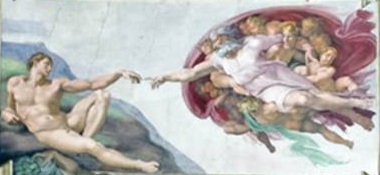
Some people still picture God as an old man with a long white beard. But there is only one place in the Hebrew Bible in which God appears in human form: when Avraham sees three men approaching his tent, and hurries to offer them hospitality.2 When the strangers depart, two of them head down to Sodom;3 they turn out to be divine messengers (angels); elsewhere in the bible, angels sometimes appear in human form.4 The third stranger remains at the overlook with Avraham, and is now identified by God’s personal name, Y-H-V-H.5 After God and Avraham have a conversation about Sodom,
Then Y-H-V-H went, as soon as he had finished speaking to Avraham, and Avraham returned to his place. (Genesis 18:33)
Does God look like a man throughout their conversation, or is God a voice in Avraham’s head once more? Does God walk away, or vanish? The text does not say.
The only description of God in this passage is that God is one of “three men”. Everywhere else in the Torah, God manifests as a fire, a cloud, or a voice, not as anything shaped like a human being.
Nevertheless, visions of God sometimes use anthropomorphic terms. Several prophets report seeing a vision of a robed figure on a throne.6 When the seventy elders climb partway up Mount Sinai in the book of Exodus, they behold a vision of God,
—and beneath [God’s] feet, like a pavement of sapphire, like the substance of the skies in purity. (Exodus 24:10)
This verse mentions only God’s feet, and there is no description of them. The Hebrew Bible often refers to God’s power to act in terms of God’s “hand” or “arm”, and to God’s anger in terms of a burning nose—but the same metaphors are used for human power and human anger. There are also references to God’s “ear”, meaning God’s ability to listen, and to God’s “eye”, meaning what God perceives.
Ibn Ezra explained in the 12th century: “Now a human being cannot speak of things above or below him without employing human terminology. Hence Scripture uses such terms as the mouth of the earth (Num. 16:30) … Far be it from us to believe that God has an image!”7
No doubt some unsophisticated readers have interpreted these anthropomorphic references literally, but there is no reason to believe that the scribes who first recorded them did.
In incorporeality?
One Jewish belief since Talmudic times (4th-5th centuries C.E.) is a human being has two parts: an incorporeal divine soul, and a physical body animated by a lower form of soul. All other animals lack the higher kind of soul.
Ibn Ezra wrote in the 12th century: “It is because man’s upper soul is eternal and is compared in its existence to God—and because man’s soul is incorporeal and fills the body, which is a microcosm, in the same way that God fills the universe—that Scripture states: in our image, after our likeness.”8
Ramban explained that the lower soul, which all animals and humans have, is located in the blood that circulates through the body. The prohibition in the book of Leviticus against eating the blood of animals says:
Because the nefesh of the flesh, it is in its blood! (Leviticus 17:11)
nefesh (נֶפֶשׁ) = the soul that animates the body; throat, appetite; personality, state of mind.
Leviticus repeats this explanation a few verses later, adding that it applies to all flesh.9
After locating the souls of all beasts, and the lower soul of humans, in the blood, Ramban wrote: “… and afterwards, He breathed into him a higher soul.”10
By around 400 C.E., rabbis inclined toward kabbalah had identified five levels of soul in human beings, based on five Biblical Hebrew words that can be translated as “soul”.11 The two most common words for “soul” are nefesh, the lower, animal soul; and neshamah (נְשָׁמָה), the higher, divine soul, associated with the intellect.
While the nefesh cannot exist without a body to animate, the neshamah is considered incorporeal. After all, our thoughts exist even though we cannot see, hear, smell, taste, or touch them. Opinions differ on whether the neshamah is eternal or dies with the body.
But either way, the neshamah, like God, is mysterious and invisible except for its effects. Perhaps the human neshamah is in the image of God.
In dominion over the earth
There are other ways that humankind might be in the image of God. One obvious candidate is in our ability to subjugate the earth. In the first creation story, God’s creation of humankind is immediately followed by this verse:
And God blessed them, and God said to them: “Be fruitful and multiply and fill the earth and subjugate it! Dominate the fish of the sea, the birds of the heavens, and all living things that crawl about on the earth!” (Genesis 1:28)
The Torah depicts God as the ultimate ruler, the king of kings, who has power not only over the earth and all its animals, but everything else in the universe. And God encourages humankind to subjugate the earth and dominate the other animals.
The 13th-century commentary Chizkuni says: “Just as God is our ruler, so we rule over the other creatures in the universe.”12
In the same century, Ramban wrote that the verse means that humans “are to rule over the earth itself, to uproot and to pull down, to dig and to hew out copper and iron.”13
In our own time, humankind has subjugated the earth by polluting it enough to trigger world-wide climate changes—changes that are already dramatically increasing forest fires, drought, and floods, and raising sea levels. And we have dominated other animals to the point of making many species extinct. But then, God destroys the world with a great flood in the next Torah portion, Noach. Does that explain how we were created in the image of God?
In freedom
For several centuries, Torah commentators have asserted that humankind is able to subjugate and dominate the earth and everything on it because our species does not always operate from instinct; our extra intelligence gives us more freedom of choice. According to this line of commentary, God has complete freedom, and human beings are in the image of God because we have a measure of free will.14
Chayim ibn Attar added that humans, like God, could choose to act with either mercy or judgment. “Given that the creation resembles the Creator with respect to the attributes of mercy and judgment, it follows logically that [man] should rule [over] the creations, since he has the attribute of mercy for … those that require it, and the [capability] to kill those that are guilty in judgment.”15 But we know that humans do not always make the right choice between mercy or judgment, between pardon or punishment. Does God?
In language?
Perhaps language is the ability that humans share with God. In the first creation story, God creates the universe with words.
And God said: “Light will be!” And light was. (Genesis 1:3)
The creation continues as God speaks each element of the world into being. After speaking the animals of the water and the sky into being, God uses more language to bless them.
And God blessed them, saying: “Be fruitful and multiply and fill the waters in the sea, and let the flying creatures multiply over the earth.” (Genesis 1:22)
On the sixth “day”, God speaks the land animals into being. After creating humankind, God speaks a second blessing, telling humans to multiply, too—but also to subjugate the earth and dominate the other animals.
But a human does not speak until the second creation story, which immediately follows the first one. It begins:
These are the histories of the heavens and the earth, in their being created, at the time Y-H-V-H, God, was making earth and heavens. Before any bush of the field was on earth, and before any green plant of the field had sprouted … (Genesis 2:4-5)
In this story, clearly written by a different scribe, God creates a single human being from the dirt, apparently without speaking.
And Y-H-V-H, God, formed the adam of dust from the ground. And [God] blew into its nostrils
the breath of life, and the adam became a living being. And Y-H-V-H, God, planted a garden in Eden in primeval times, and there he placed the human whom he had formed. (Genesis 2:7-8)
After making trees grow in Eden, God finally speaks, saying to the human:
“From every tree of the garden you may certainly eat. But from the Tree of the Knowledge of Good and Evil, you should not eat from it; because on the day you eat from it, you will certainly die.” (Genesis 2:17)
Nothing happens. Then God decides the human being needs a helping counterpart. So God forms all the land and sky animals from the dirt of Eden, and brings them to the adam to name. Thus the human starts speaking words.
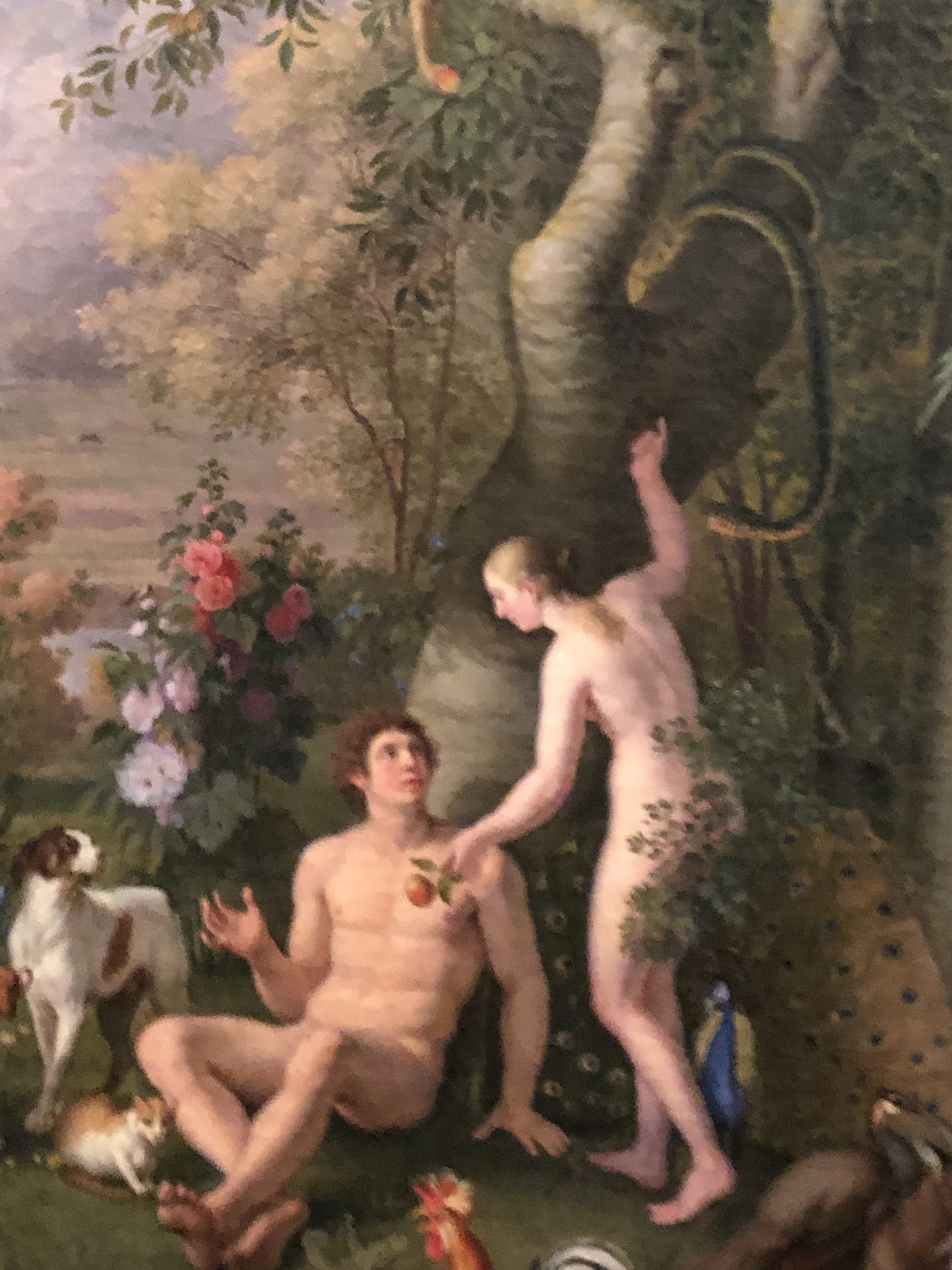
The human called out names for all the herd-animals and for the birds of the heavens and for all the living beings of the field. But for the human, there could not be found a helper as his counterpart. (Genesis 2:20)
After God has split the human into two humans, male and female, a snake speaks to the female human. (A talking snake can only exist in the Garden of Eden, not in the real world.) The female human answers the snake in complete sentences, demonstrating that she, too, can use language.
Whenever the Torah wants to report the thoughts of either God or a human being, it uses the verb amar (אָמַר), which means both “say” and “think”. After all, once human have learned language as babies, we do a lot of our thinking in silent words.
Without words, a human would be more like any other animal. Without words, God would not have created the world. Perhaps language is the way in which humankind is created in God’s image.
In moral knowledge?
In the second creation story, the snake tells the female human that if she and her male counterpart ate from the Tree of the Knowledge of Good and Evil, they would not definitely die. (As the story continues, God casts them out of the garden of Eden, and they live for centuries in the real world, but they are mortal and they do eventually die.) The snake says:
“Rather, God knows that on the day you eat from it, your eyes will be opened and you will become like God, knowing good and evil.” And the woman saw that the tree was good for eating, and that it was a delight to the eyes, and the tree was desirable for insight. And she took some of its fruit and she ate, and gave also to her man with her, and he ate. And the eyes of the two of them were opened … (Genesis 2:5-7)
In other words, God understands the concepts of good and evil. Once the humans have gained insight from eating the fruit, they, too, know the concepts of good and evil. And in that way, they are made in God’s image.
Of course, knowing the difference between good and evil does not mean that everything one chooses to do is good.
So what does it mean to be created in the image of God? Do humans have bodies that look similar to God’s? Are our souls incorporeal, like God? Do we subjugate the earth, as God does? Do we exercise free choice, as God does? Do we use a language of words, as God does? Do we grasp the idea of morality, as God does? Is there another similarity between God and humankind?
Or do we just think humans are created in God’s image because, as Sigmund Freud argued, humans portray God in their own image?16
- In Hebrew all nouns are gendered, but in English “he” means a male person. Therefore translations that apply the pronouns “he”, “him” and “his” to God give the impression that God is a male person. Since I believe that God does not have a gender, and is not a person (a human being or individual), my translations from Hebrew to English either replace pronominal suffixes referring to God with the noun “God”, or omit those pronouns. Genesis 1:27, however, is too difficult to translate into English without using the pronouns “he” and “his”. I could not even replace “he” with the modern substitute “they”, because that would imply that humankind was created jointly by God and the other gods or beings referred to in verse 1:26.
- Genesis 18:2-8.
- Genesis 18:22.
- See my post Haftarat Naso—Judges: Spot the Angel.
- Genesis 18:17-33.
- In 1 Kings 22:19, Isaiah 6:1, and Ezekiel 1:26-28.
- 12th-century rabbi Abraham Ibn Ezra, translated in www.sefaria.org.
- Ibid.
- Leviticus 17:14.
- Ramban, (13th-century Rabbi Moshe ben Nachman), translated in www.sefaria.org.
- Bereishit Rabbah 14:9, circa 400 C.E., The Sefaria Midrash Rabbah, 2022, www.sefaria.org.
- Chizkuni, a 13th-century compilation of commentary by Rabbi Hezekiah ben Manoah, translated in www.sefaria.org.
- Ramban, ibid.
- E.g. Ovadiah Sforno, 16th century; Chayim ibn Attar, 18th century; Adin Even-Israel Steinsaltz, 21st century.
- 18th-century Rabbi Chayim ibn Attar, Or Hachayim, translated in www.sefaria.org.
- Sigmund Freud, The Psychopathology of Everyday Life (Zur Psychopathologie des Alltagslebens), 1901; The Future Of An Illusion (Die Zukunft einer Illusion), 1927.


