
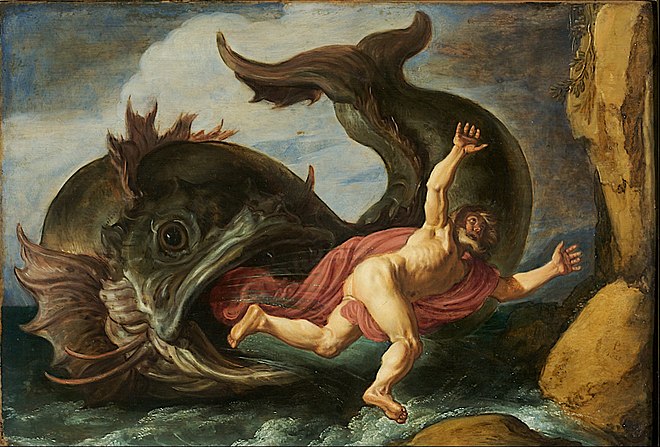
The prophet Yonah (“Jonah” in English) rebels against God’s order to deliver a prophecy in Nineveh, and flees from God by taking a ship all the way to the distant land of Tarshish. He tries to travel from Israel to the ends of the earth in order to avoid the presence of God.
The prophet who wrote the second half of Isaiah, however, prophecies that ships from Tarshish will bring riches to Jerusalem. This prophet exults in the idea that foreigners will travel from the ends of the earth in order to come close to the presence of God. (For both stories, see last week’s post, Hafarat Ki Tavo—2 Isaiah: Tarshish.)
The ends of the earth come up again, even more poetically, in the Torah portion Nitzavim (Deuteronomy/Devarim, 29:9-30:20), the first of this week’s double portion. Moses says that when the Israelites are unfaithful to their God, then God will cause them to be conquered and deported to other lands. But when their minds and hearts return to God—
Then God, your God, will return your captives and take you back in love, and collect you from all the peoples where God, your God, has scattered you. If you are banished to the ends of the heavens, from there God, your God, will collect you, and from there will take you. And God, your God, will bring you to the land that your forefathers possessed, and you will possess it; and [God] will do you good and multiply you more than your forefathers. (Deuteronomy 30:3-5)
Here “the ends of the heavens” is a poetic way of saying “farther than the ends of the earth”—even farther than Tarshish.
Yet God’s dwelling-place is the portable sanctuary the Israelites build in the book of Exodus, then the temple in Jerusalem.1 How can God find us at the ends of the earth? Psalm 139 teaches that escaping God’s guidance—or God’s demands—is impossible because God knows every mind and is present everywhere.
Omniscient: Psalm 139:1-4
The God character in the book of Genesis hears about events on earth, but sometimes needs a closer look to find out what humans are actually doing and thinking. In the story of the Tower of Babel,
God came down to look at the city and the tower that the humans had built. (Genesis 11:5)
When God is considering destroying Sodom and Gomorrah, God says:
“I will go down and I will see; if they have done according to the outcry that has come to me, annihilation! And if not, I will know.” (Genesis 18: 21)
But in the later psalms, God is less anthropomorphic. The first four verses of Psalm 139 express the concept that God is omniscient, at least when it comes to human minds.
God, you have examined me, and you know me.
You know my sitting down and my standing up.
          You discern my purpose from afar.
You sift through my way of life and my lying down,
          And you are familiar with all my paths.
For there is no word on my tongue—
          Hey, God you know it completely.  (Psalm 139:1-4)
Unlike God, another human being can observe you sitting, standing, lying down, and talking, but cannot discern your thoughts. Someone who knows you well can guess at your thoughts by considering your words, your body language, and your past deeds, but it is only a guess.
For God, it is not guesswork. According to Hirsch, God can reliably predict what we will think: “Even before the thought has actually taken form within me, You [God] can already see it by inference from Your previous knowledge of all my personality and the interaction of all my character traits.”2
Or maybe God is a mind-reader, and knows our thoughts and intentions directly, even before we become conscious of them.3
Continuous: Psalm 139:5-6
Next, the psalm says that only God exists at all times. Humans keep going only as long as God is pushing them through time.
You confine me between achor and kedem,
          And you set your palm upon me.  (Psalm 139:5)
achor (אָחוֹר) = back, behind (in time or space); west; future. (In Hebrew the future is what we cannot see because it is behind our backs.)
kedem (קֶדֶם) = in front (in time or space); east; past. (In Hebrew the past is what we can see right in front of us, because it has already happened.)
A human can remember the past and anticipate the future, but can only live in the present. Hirsch wrote: “Mine is only that infinitely brief span of the ‘present’ which is hardly long enough for me to be able to declare that I ‘am’. … it is only through You that I ‘am’.”4
Without God’s palm, a human being could not make it into the next moment.
Incomprehensible knowledge for me!
          Too high! I am not capable of it.  (Psalm 139:6)
After declaring that God knows our innermost thoughts even before we do, and that we continue living only through God’s support, the psalmist brings in the concept of omnipresence.
Omnipresent: Psalm 139:7-12
Where could I go away from ruchekha?
          And where could I flee from paneykha?  (Psalm 139:7)
ruchekha (רוּחֶךָ) ֹ= your wind, your air, your spirit, your disposition.
paneykha (פָּנֶיךָ) = your face, your front, your surface, your presence.
On one hand, God surrounds us like air. On the other hand, as Hirsch wrote, the spirit of God keeps on nudging us and moving us around.5
The word paneykha also has a double meaning: God’s presence is everywhere, and God’s “face” sees us everywhere.6
If I ascend to the heavens, you are there;
          If I make my bed in Sheol, there too.  (Psalm 139:8)
The Hebrew Bible often speaks of God as living in the sky (the heavens) and manipulating the weather. This verse of Psalm 139 introduces the idea that God is also present in the underworld, where people “sleep” when they die.
I take wing at dawn;
          I come to rest at the end of the sea.
Even there your hand guides me
          And your right hand holds onto me.  (Psalm 139:9-10)
Alter explained: “The speaker imagines taking wind with the dawn as it appears in the east, then soaring with the sun on its westward path to the limits of the imagined world …”7
The “end of the sea” describes Tarshish even better than “the end of the earth”. No matter how far we travel, the psalmist says, God either guides us or grabs us.
It is also useless to try to hide in the dark from God.
If I say: “Surely darkness will screen me,
          And night will be light for me,”
Even darkness is not dark for you,
          And night is as light as day;
Darkness and light are the same.  (Psalm 139:11-12)
Inside: Psalm 139:13
The next verse hints at why God is always present for every person.
Because you created khilyotai;
          You wove me together in my mother’s womb. (Psalm 139:13)
khilyoitai (כִלְיֺתָי) = my kidneys; my conscience.8
Hiding from God is like hiding from yourself. You can only hide from your own conscience temporarily.
When Psalm 139 ends, the psalmist has decided to embrace God’s intimate knowledge, constant presence, and guidance.
Search me, God, and know my mind;
          Examine me and know my thoughts.
And see if I have a hurtful path;
          And guide me on a path for all time.  (Psalm 139:23-24)
Some religious people and some atheists believe that God is either the irrational and punitive being that we see sometimes in the Hebrew Bible, and/or the author of the policy that “sinners” will burn forever in hell that we see sometimes in Christianity. That version of God strikes me as an immoral villain whom I would not want to be omniscient, omnipresent, or guided by.
Other people believe that God is benevolent, either the fair and merciful being we also see in the Hebrew and Christian bibles, and/or an omnipotent being who makes everything work out for the best in the (not too long) long run. This is a more reassuring version of an omniscient, omnipresent God who guides us (although we run into theological problems if we also claim God is omnipotent).
There are other versions of what God is. Some that say God is not “a being” at all, but rather the ground of being, or the source of creation. Others say that “God” is not even a noun, but rather a verb, an adjective, or an adverb. In Kabbalah, God is ein sof (אֵין סוֹף), “without end”. The Tanya explains: “No thought grasps you [God] at all.”9
The impossibility of defining God also appears in Psalm 139:6: “Incomprehensible knowledge for me! Too high! I am not capable of it.”
But even if we can have no general concept of God, we can think about a single aspect of God. What if we experience God as an inner guide who is omniscient and omnipresent? Then “God” is another way of referring to our own consciences. We cannot flee from this God because we cannot flee from our inner selves. But if we only listen, our conscience guides us.
In the Jewish calendar, we are approaching the High Holy Days, Rosh Hashanah and Yom Kippur, days dedicated to asking God’s pardon for our individual and collective misdeeds of the past year. Jews are called upon to apologize to other people and make amends for any ways that we have hurt them before Rosh Hashanah. Then during the High Holy Days, we apologize to God, and rededicate ourselves to following God’s guidance—which might be the same as the guidance of our consciences. This year, may we all return to God, or to our inner guide—not just on holy days, but in each present moment.
- See my post Haftarat Ki Tavo—Isaiah: A Place for Feet.
- 19th-century Rabbi Samson Rasphael Hirsch, The Hirsch Tehillim, translation by Gertrude Hirschler, Feldheim Publishers, Jerusalem, 2014, p. 1104.
- This idea appears in Tehillim: The Book of Psalms with an Interlinear Translation, ed. by Rabbi Menachem Davis, Artscroll Series, Schottenstein Edition, 2001, p. 388; and also in Rabbi Adin Even-Israel Steinsaltz, The Steinsaltz Ketuvim, Koren Publishers, 2019, in www.sefaria.org.
- Hirsch, p. 1106.
- Ibid., p. 1107.
- Ibid.
- Robert Alter, The Book of Psalms, W.W. Norton & Co., New York, 2007, p. 480.
- See my post Vayikra & Jeremiah: Kidneys
- Rabbi Schneur Zalman of Liadi (1745–1812), The Tanya, Chapter 4.


