
Babylonians destroyed the temple in Jerusalem in 586 B.C.E., and Romans destroyed the second temple in 70 C.E. Both times, the temple was razed on the ninth or tenth day of the month of Av, in late summer. Tisha Be-Av, the ninth of Av, is a traditional day of mourning for Jews.
For seven weeks after that date, the Torah portions march uninterrupted through the book of Deuteronomy, but the accompanying haftarah readings from the Prophets feature prophecies that the temple will be rebuilt and Jerusalem will become the beacon of the world. All seven are from second Isaiah.1 This week’s haftarah is the sixth “haftarah of consolation”, Isaiah 60:1-22.2 The theme of this reading is that soon God will fill Jerusalem with light, glory, wealth, and fame. (See my post Ki Tavo & 2 Isaiah: Enlightenment.) The haftarah opens:
Arise! Brighten! For your light has come!
          And the glory of God shines upon you!  (Isaiah 60:1)3
The prophet then declares that soon all the Israelites will return from their exile in other countries.
Raise your eyes and look around!
          All of them gather [and] come to you.
Your sons will come from afar,
          And your daughters will be nursed at your side.  (Isaiah 60:4)
Furthermore, people from other nations will bring gifts of homage to the rebuilt temple, and riches will pour into Jerusalem.
That is when you will look and you will beam,
          And your heart will tremble and expand;
For the abundance of the seacoast will be turned over to you,
          The wealth of nations will come to you.  (Isaiah 60:5)
The next two verses say that camel trains from Sheba will bring gold and frankincense, and people from the Arabian Peninsula and what is now southern Jordan will bring flocks. Then the prophet returns to the subject of coastlands:
The coastlands yearn for me,
          Ships of Tarshish in the lead,
To bring your children from afar,
          And their silver and their gold with them ... (Isaiah 60:9)
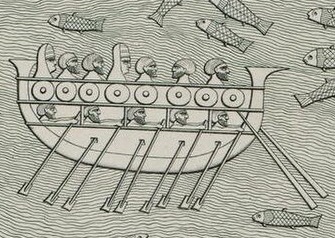
Tarshish (תַּרְשִׁישׁ) = an island or coastal country distant from Judah; a type of large galley trade ship suitable for a long sea voyage. A precious stone, either beryl or jasper. What are these ships of Tarshish?
Tarshish in Phoenician and Akkadian texts
A Phoenician inscription discovered on the island of Sardinia mentions a place called Tarshish.4 So does an Akkadian cuneiform text in the Neo-Assyrian city of Assur on the Tigris River. The Assyrian inscription lauding King Esarhaddon’s conquests in the 670’s B.C.E. includes: “All the kingdoms from [the islands] amidst the sea—from the country of Iadanan and Jaman as far as Tarshishi—bowed to my feet and I received heavy tribute.”5
Since Iadanan is Cyprus, and Iaman (Jaman) is Ionia (the coast and islands where Anatolia abuts the Aegean Sea), “Tarshishi” must be farther west. The Hebrew Bible mentions Tarshish 25 times, but the only clues it offers about the land’s location are that it is an island or coastline, it is far to the west of Israel, and it is a source of relatively rare metals. Scholars have speculated that Tarshish was a name for Crete, Carthage, Sardinia, or the Mediterranean coast of Iberia.
Tarshish as a source of luxuries
A prophecy in the book of Ezekiel predicting doom for the cosmopolitan Phoenician city of Tyre mentions Tarshish twice. The first reference is to Tarshish as a country.
Tarshish trades with you because of your abundance of wealth. They give silver and iron and tin and lead for your wares. (Ezekiel 27:12)
The prophecy lists the goods that other countries bring to Tyre, including the kingdom of Judah, which trades wheat, fruit syrup, oil, and salve in exchange for other goods. Probably Judah obtains some of the metals from Tarshish in Tyre.6
The second reference to Tarshish is to a type of ship: very large ships for long voyages. As a major Mediterranean port, Tyre keeps a fleet of Tarshish ships.
The Tarshish ships journey with your merchandise, and you are filled and very heavy on the high seas. Your rowers bring you out into the great waters; the east wind shatters you on the high seas. Your wealth and your wares, your merchandise, your seamen and your navigators, those who repair your leaks, and the merchants of your merchandise, and all the warriors who are inside you, and all the company in your midst—they will fall down into the heart of the sea on the day of your downfall. (Ezekiel 27:25-27)
The moral of this prophecy, according to Steinsaltz, is that “Tyre’s insatiable desire to become richer will cause it to drown.”7
Earlier in the bible, the first book of Kings brags about the wealth of King Shlomoh (“Solomon” in English) by saying:
And all of King Shlomoh’s drinking cups were gold, and all the utensils of the Lebanon Forest House were of pure gold; silver was not thought of as anything in Shlomoh’s days. For the king had a Tarshish fleet on the sea, along with Hiram’s fleet. Once every three years, the Tarshish fleet came in, carrying gold and silver, ivory and apes and parrots. (1 Kings 10:21-22)
If a round-trip to Tarshish takes three years, it is a distant country, such as Spain, and requires many intermediate stops. But if King Shlomoh has a fleet of Tarshish ships, they might spend three years stopping at many ports, and bringing home choice goods from each.
Later in 1 Kings, King Yehoshafat (“Jehoshaphat” in English) of Judah—
—made Tarshish ships to go to Ofir for gold. But he did not go, because the ships were broken up at Etzyon Gaver. (1 Kings 22:49)
Here Tarshish refers to a type of ship rather than a country. Steinsaltz explained: “Tarshish was distant from Israel, and only large, strong ships with teams of rowers could sail there.”8 The location of Ofir is still unknown. But King Yehoshafat’s ships were wrecked at the Kingdom of Judah’s port on the Red Sea, now called Eilat. So the land of Ofir must have been on the Arabian Sea, not the Mediterranean.
Tarshish as a distant land
Perhaps the most famous biblical reference to Tarshish is in the book of Jonah. Yonah (“Jonah” in English) does not want to obey God and utter a prophecy in the city of Nineveh. So instead of heading inland to the northeast, toward Nineveh, Yonah heads west across the Mediterranean.
And Yonah got up to flee from God’s presence to Tarshish. And he went down to Yafo and found a ship going to Tarshish. And he paid the fare, and he went down into it, to go with them to Tarshish, away from God’s presence. (Jonah 1:3)
He tries to go so far away—all the way to Tarshish!—that God will not find him. But flight is futile; God creates a storm that threatens to sink the ship, and after an undersea adventure, Yonah ends up in Nineveh after all.
Tarshish in Second Isaiah
What role do the ships of Tarshish play in this week’s haftarah reading from second Isaiah?
The coastlands yearn for me,
          Ships of Tarshish in the lead,
To bring your children from afar,
          And their silver and gold with them;
For the sheim of Y-H-V-H, your God,
          For the Holy One of Israel, who gives you glory. (Isaiah 60:9)
sheim (שֵׁם) = name; reputation, fame.
Either the country of Tarshish, or coastal countries visited by Tarshish-style ships, will bring luxuries to the temple and the people in Jerusalem. But will the ships bring exiled Israelites as well?
According to Steinsaltz, when the people of the coastlands are yearning for the God of Israel, “The children [of Israelites] will not arrive as captives that have been redeemed in exchange for gold and silver, as their silver and their gold will be with them, like dignitaries bearing expensive goods.”9
But would any exiled Israelites use a coastal port?
When the Assyrian Empire defeated the Kingdom of Israel, its citizens were deported to Assyrian lands in northern Mesopotamia from 734-715 B.C.E.. When the Babylonian Empire defeated the Kingdom of Judah, its citizens were deported to Babylonia in central Mesopotamia from 597-582 B.C.E.. The kingdoms of Israel and Judah were never conquered by, or deported to, any country on the Mediterranean or Arabian seas.
According to Alter, “This is an exercise of poetic license to convey the idea of the exiles being brought form afar because in fact they would be coming overland from Mesopotamia, not from the west by sea.”10
However, “The coastlands yearn for me” implies that the people of the seacoasts and islands will want to come to Jerusalem to honor the God of Israel, since the “name” or reputation God will spread all over the known world, all the way to Tarshish. And “Ships of Tarshish in the lead” might mean that long-distance ships will arrive at the nearest port (either Yafo on the Mediterranean or Etzyon Gaver on the Gulf of Aqaba) bearing gold, silver, and would-be worshipers, who would then travel overland to the inland city of Jerusalem. In that case, the only poetic license in the verse is used to call foreigners who want to honor the God of Israel the “children” of the Israelites.
And the name Tarshish indicates not only the size of the ships, and the luxuries they will bring, but also the distances that people will travel in order to reach Jerusalem and its temple.
Yonah (“Jonah”) wanted to travel to the ends of the earth in order to avoid the presence of God. But second Isaiah predicts that someday people will travel from the ends of the earth in order to come close to the presence of God.
(Next week I will examine Psalm 139 in terms of fleeing to, or arriving from, the land of Tarshish.)
- Isaiah 1:1-39:8 consists of the prophecies of Yeshayahu (“Isaiah” in English) son of Amotz during the reigns of four kings of Judah, ending with King Yechizkiyahu (“Hezekiah” in English), who died in 687 B.C.E. Isaiah 40:1 begins sometime after the Babylonian destruction of Jerusalem in 586 B.C.E Since this work by an unknown author was appended to the book of Isaiah, scholars call it “second Isaiah” or “Deutero-Isaiah”.
- Some scholars date Isaiah 40:1-55:13 to the Babylonian exile, 587-538 B.C.E., and Isaiah 56:1-66:24 to the period after the Persians conquered Babylon and the Jews in Babylonia were allowed to return and rebuild Jerusalem and its temple.
- The King James translation used in Handel’s Messiah is “Arise! Shine! For thy light has come! And the glory of God is risen upon thee!”
- The Nora Stone, carved circa 800 B.C.E.
- J. Pritchard, Ancient Near Eastern Texts Relating to the Old Testament (Princeton, 1955), p. 260, quoted in http://www.varchive.org/nldag/tarshish.htm.
- Ezekiel 27:17.
- Rabbi Adin Even-Israel Steinsaltz, The Steinsaltz Nevi’im, Koren Publishers, 2019.
- Ibid.
- Ibid.
- Robert Alter, The Hebrew Bible, Volume 2: Prophets, W.W. Norton & Co., New York, 2019, p. 824.


One thought on “Haftarat Ki Tavo—2 Isaiah: Tarshish”