Tetzaveh: Meeting Room

Who will meet in the “Tent of Meeting”?

Moses receives instructions for making a portable tent-sanctuary for God in last week’s portion, Terumah.  This week’s portion, Tetzaveh (“you shall command”), is the first one to call the sanctuary the ohel mo-eid, the “Tent of Meeting”—an expression that appears 137 times in the books of Exodus through Deuteronomy.

This week’s portion is also the first to reveal who will meet at or inside the tent.  But in its first appearance, the phrase “Tent of Meeting” is merely a location.  God tells Moses:

And you, you shall command the children of Israel, so they will take for you pure oil of beaten olives for the light, to make the lamp go up regularly.  In the ohel mo-eid, outside the dividing curtain that is in front of the testimony [in the ark], Aaron and his sons shall set it up from evening until morning before God.  [This is] a decree forever for the generations from the children of Israel. (Exodus/Shemot 27:20-21)

ohel (אֹהֶל) = tent.

mo-eid (מוֹעֵד) = appointed place for meeting with God; appointed time (usually for a religious festival).  (From the root ya-ad, יָעַד = appoint a time or place.)

ohel mo-eid (אֹהֶל מוֹעֵד) = Tent of Meeting (i.e. the tent appointed for meeting with God).

The ohel mo-eid is the portable tent-sanctuary God described to Moses in last week’s Torah portion, a two-chamber tent with a dividing curtain screening off the Holy of Holies from the larger front chamber.1  The menorah whose lamps the priests must fill is inside the tent’s front chamber.

The portion Tetzaveh then describes the vestments to be made for the new priests, followed by the ritual for ordaining them.  First Moses must assemble Aaron and his four sons, a bull and two rams, three kinds of bread, and the new priestly garments.

Then you shall bring Aaron and his sons to the entrance of the ohel mo-eid and you shall wash them in water.  (Exodus 29:4)

Both the basin for the priests’ ritual washing and the altar for burnt offerings are located outside the Tent of Meeting, in front of the entrance.

And you shall bring the bull to the front of the ohel mo-eid, and Aaron and his sons shall lean their hands on the head of the bull.  And you shall slaughter the bull before God, at the entrance of the ohel mo-eid.  (Exodus 29:10-11)

After washing and dressing Aaron and his sons, Moses must make the first offerings on the new altar, and sprinkle some of the blood on both the altar and the five men.After Moses has made all the offerings, the remaining bread and the remaining meat from the second ram go to the men being ordained.

And Aaron and his sons shall eat the flesh of the ram, and the bread that is in the basket, at the entrance of the ohel mo-eid.  (Exodus 29:32)

The whole process, from washing to eating, must be carried out in front of the Tent of Meeting, and must be repeated every day for a total of seven days in order to sanctify both the priests and the altar.  After that, the priests will make daily offerings, which are briefly listed.  With the last one, an evening offering of a lamb, God finally mentions why the portable sanctuary is called the “Tent of Meeting”.

[It is] a perpetual rising-offering3 for your generations at the entrance of the ohel mo-eid, in front of God, where iva-eid with you, to speak to you there.  (Exodus 29:42)

iva-eid (אִוָּעֵד) = I shall meet, I shall arrange meeting(s).  (Also from the root ya-ad.)

The “you” in this sentence is plural.  The next sentence declares that the ohel mo-eid will be the locus or focus where all the Israelites can meet God.

Veno-adeti there for the Children of Israel, and it will be sanctified by my glory.  (Exodus 29:43)

veno-adeti (וְנֹעַדְתִּי) = And I will arrange meeting(s).  (Also from the root ya-ad.)

The Torah does not explain what kind of meeting or meetings will occur between God and the Israelites.  But God does say:

And I will dwell in the midst of the Children of Israel and I will be their god.  (Exodus 29:45)

Pillar of cloud, from Collectie Nederland

Maybe the Israelites have a meeting with God whenever they see the pillar of cloud and fire that rests over the Tent of Meeting when they are encamped.4  Or when they brings offerings to the courtyard in front of the tent and watch while the priests perform the ritual actions to send them up to God.  Or maybe living so close to the Tent of Meeting is enough for the Israelites to meet God.

The Torah portion then describes the incense altar, and God adds:

And you shall place it in front of the dividing curtain that is in front of the Ark of the Testimony, in front of the atonement-cover that is over the testimony, where iva-eid with you.  (Exodus 30:6)

This time “you” is singular.  Only Moses, to whom God is speaking, will meet with God inside the back chamber of the tent, the Holy of Holies, in front of the atonement-cover on the ark.

Thus the innermost chamber the Tent of Meeting is the appointed place where Moses and God meet, while the tent as a whole is the focus for meetings between rest of the people and the God who dwells in their midst.

*

Before there is a Tent of Meeting, people in the Torah never know where God might speak to them.  God’s voice might come in a dream, or from a stranger who turns out to be not human after all, or from a burning bush.  But in this week’s Torah portion Moses learns that God has designated the Tent of Meeting as the appointed place.  God still speaks to Moses at odd moments, but a formal meeting takes place inside or in front of the tent.

When the Israelites have finished making all the items for the Tent of Meeting and Moses assembles it for the first time, God fills the tent with the divine manifestations of cloud and glory (or impressiveness).

And Moses was not able to enter the ohel mo-eid because the cloud rested upon it and the glory of God filled the sanctuary.  (Exodus 40:35)

The presence of God is too strong for the meeting to take place!  So the book of Leviticus/Vayikra begins with God summoning Moses and speaking to him from the Tent of Meeting, as if God has changed the divine frequency in order to meet the appointment with Moses.

*

Many people today believe they have an appointed place to meet with God: their synagogue or church or mosque or temple.  Some religions still claim that God gives direct instructions to their leaders.  And all too many people believe that the “real” God can only be found in their religion’s sacred places.

I pray that someday people will notice the glory of God outside their own exclusive Tent of Meeting, and the divine will dwell in the midst of everyone on earth.

  1. Exodus 26:31-33.
  2. See my posts Tzav: Oil and Blood and Tzav: Horns, Ears, Thumbs, and Toes.
  3. olah (עֹלָה) = rising-offering.  (From the root alah (עלה) = go up.) In an olah the entire slaughtered animal is burned up into smoke, which rises to the heavens.
  4. Exodus 40:36-38, Numbers 9:15-17.

Terumah & 1 Kings: Tent versus Temple

A 2,000-year-old tradition pairs every weekly Torah portion with a haftarah, a reading from the Prophets/Neviim. In this week’s Torah reading, Terumah (“Donations”), God gives Moses instructions for building a sanctuary. This week’s haftarah is a passage from the first book of Kings about how King Solomon begins building the temple in Jerusalem.

The sanctuary and the temple both contain the ark, menorah, bread table, and incense altar. Both are places where priests perform the rituals prescribed in the Torah. But there are dramatic differences between the two structures.

For one thing, the building materials dictate whether each holy structure is portable or stationary. The Torah portion Terumah specifies that the walls of the mishkan will be made out of woven pieces of cloth hung on a framework of gilded acacia planks and beams.

The Tabernacle that the Israelites
Built, Charles Foster Bible, 1897

And you shall make the mishkan of ten panels of fabric, made of fine twisted linen, and sky-blue dye and red-violet dye and scarlet dye …(Exodus/Shemot 26:1)

mishkan (מִשְׁכָּן) = sanctuary, dwelling-place for God. (The word is used for the portable tent-like sanctuary created in the book of Exodus and used until the second book of Samuel.)

Next God tells Moses to make the roof out of woven goat-hair, and cover it with tanned hides. The mishkan would look like a huge tent of vividly-colored cloth, its framework resting directly on the earth. After it has been built, the Torah often calls this sanctuary the “Tent of Appointed Meeting”.

The courtyard in front of it, containing the altar for burning animal offerings, is to be enclosed by another wall of linen cloth, this one roofless. I can imagine the cloth walls of both the courtyard and the tent glowing in the sunlight, and the gold, silver, and bronze fittings gleaming. The structure would be beautiful, but also obviously portable, easy to disassemble and move to the next location.

While the mishkan is temporary, Solomon’s temple is built to last.

The king commanded, and they quarried huge stones, valuable stones, to lay the foundation of the house with hewn stones. (1 Kings 5:31)
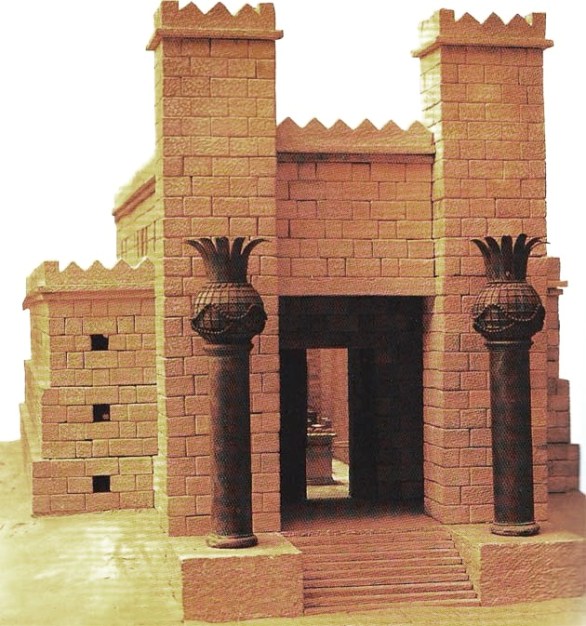
First Temple reconstruction,
Bible Museum, Amsterdam

On this foundation, the “house” is built out of more large squared stones, then paneled inside with cedar wood, and roofed with cedar planks. Additional rooms are built against the outside walls, all the way around. The temple is three stories high, with stairs and narrow latticed windows. This sanctuary could never be disassembled and moved. It is supposed to be permanent. According to the Hebrew bible, it lasted for four centuries, until the Babylonian invaders destroyed it. During that time, the central place of worship for the southern kingdom remained fixed in its capital, Jerusalem.

Another important difference between the tent and the temple is how the materials and labor to build them were obtained. The materials for the tenttextiles, hides, wood, and metals—are all gifts volunteered by the Israelites. This week’s Torah portion opens with God asking for only voluntary donations.

God spoke to Moses, saying: Speak to the children of Israel, and they shall take for me a donation from every man whose heart urges him; [from him] you shall take My donation. And this is the donation that you shall take from them: gold or silver or bronze, or sky-blue or red-violet or scarlet dyes, or linen or goat hair, or hides… (Exodus/Shemot 25:1-5)

But the stone and cedar for Solomon’s temple are purchased from a foreign king, Chiram of Lebanon. This week’s haftarah opens:

God had given wisdom to Solomon, as [God] promised him; and there was peace between Chiram and Solomon, and the two of them cut a treaty. (1 Kings/Malchim 5:26)

Just before this verse, the first book of Kings describes the deal between Chiram and Solomon: Hiram will provide timber and stone for Jerusalem, and in exchange Solomon will pay Hiram in annual shipments of wheat and olive oil—shipments that would require a heavy tax on Israel’s farmers.

In the book of Exodus, both women and men enthusiastically volunteer to do the weaving, carpentry, and metal-working for the tent sanctuary. In the first book of Kings, Solomon imposes forced labor on the Israelite men to do the logging and quarrying.

And King Solomon raised a mas from all of Israel, and the mas was 30,000 men. He sent them to Lebanon, 10,000 a month in turns; they were in Lebanon for a month, two months at home. And Solomon loaned 70,000 burden-carriers and 80,000 stone-cutters on the mountain. (1 Kings 5:28-29)

mas (מַס) = compulsory labor, corvée labor, levy

Compulsory labor, mas, is what the pharaoh imposed on the Israelites in Egypt—the slavery that God and Moses freed them from. King Solomon gets away with his temporary mas, but later in Kings, his son Rechavam imposes an even heavier “yoke” on his people, and they revolt against him.

So while the mishkan is constructed with voluntary gifts and voluntary labor, the temple is built through agricultural taxes and forced labor.

In the Torah portion, Moses gets instructions for making a sanctuary from God Itself. In the haftarah, Solomon remembers his father David’s desire to build a temple, and after he has built a palace for himself, he starts the temple on his own initiative.

In both cases, God makes a conditional promise to dwell among the Israelites. In the Torah portion, God will stay with them if they make a place for God:

And they shall make for me a holy place, and I will dwell in their midst. (Exodus 25:8)

But in the haftarah, God will stay with the Israelites if King Solomon follows the rules:

And the word of God came to Solomon, saying: This house that you are building—if you follow my decrees and you do my laws and you observe all my commandments, to go by them, then I will establish my word with you that I spoke to David, your father: then I will dwell in the midst of the children of Israel, and I will not desert my people Israel. (1 Kings 6:12-13)

The differences between the mishkan and the temple imply two different approaches to religion. The sanctuary God describes to Moses belongs to the people; they make it voluntarily, they move it with them wherever they go, and God dwells among them because they make a holy place for God.

The temple of Solomon belongs to the king; he oppresses his own people in order to procure the materials and labor, he fixes it permanently in Jerusalem, and God dwells among his people because King Solomon obeys God’s rules.

I believe the tent-sanctuary described in the Torah portion represents the ideal approach to communal religion, in which everyone in the community contributes enthusiasm, support, or creativity; in which textual interpretations and rituals are flexible enough to move and change along with the people; and in which everyone makes a holy place for God.

Yet this ideal cannot always be realized. There are times everyone, including me, is too exhausted or too stuck to manage creative communal worship. Sometimes we just need a place to go where the rituals will be fixed and familiar, and where a trusted authority figure is taking care of everything and telling us what to do.

We need both tents and temples.
Mishpatim: Seeing the Cloud

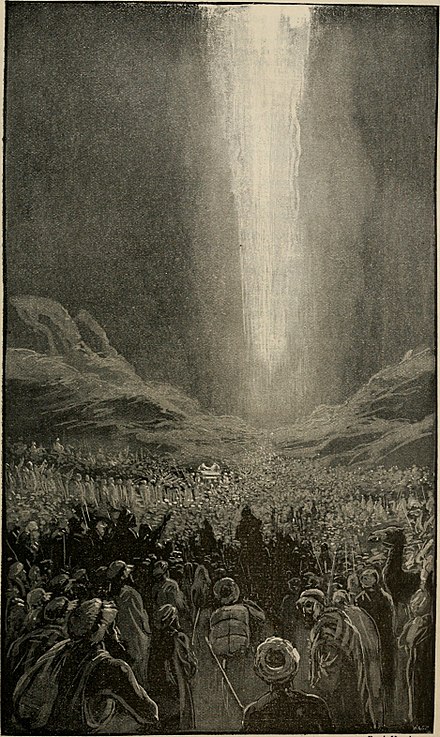
When God manifests in this world, what does God look like? In the book of Exodus/Shemot, God looks like either cloud or fire. Moses first encounters God as a voice in a burning bush. As soon as the Israelites leave Egypt, God sends a guide to lead the way: a pillar of cloud by day and fire by night. When God comes down on Mount Sinai to speak to all the people, … there was thunder and lightning and a heavy cloud on the mountain (Exodus/Shemot 19:16) … and all of Mount Sinai smoked with the presence of God that came down upon it in fire…(Exodus 19:18)

At the end of this week’s Torah portion, Mishpatim (“Laws”), God summons Moses back up the mountain to receive the stone tablets, the torah (“teaching”) and the mitzvah (“commandment”). As Moses climbs, the Torah describes more cloud and fire. But this time the Israelites below see Moses walking into fire, while Moses sees himself walking into cloud.

Then Moses went up the mountain, and the cloud covered the mountain. And the kavod of God rested on Mount Sinai; and the cloud covered it/him for six days. Then [God] called to Moses on the seventh day, from the midst of the cloud. But in the eyes of the children of Israel, the mareih of the kavod of God was like a consuming fire on the top of the mountain. (Exodus 24:15-17)

kavod (כָּבוֹד) = weight, impressiveness, magnificence, glory. (The kavod of God = a visible manifestation of God’s splendor.)

mareih (מַרְאֵה) = appearance, vision, apparition, mirror.

Moses is accustomed by now to living in close communication with a highly dangerous and powerful god. God has spoken to him at least 41 times already, and Moses often asks God questions and makes suggestions.

Yet he has not seen God directly. When God manifests in our world, Moses still sees only fire or  cloud. The nature of God is always hidden.

This time, Moses sees the cloud. But the people at the foot of the mountain do not see God’s kavod in cloud form. They see only a mareih of God’s kavod, an apparition or mirror image of it—God’s presence as reflected in their own minds. Having lived through the ten miraculous plagues in Egypt, not to mention the parting of the Reed Sea, no wonder they view God as so powerful, dangerous, and threatening that they are afraid God’s glory will eat them up. Their own feelings make the cloud look like a “consuming fire”.

They watch their leader Moses walk right into the fire, a fire nobody could survive. And they despair.

No wonder, after they have waited for 40 long days, they demand a safer manifestation of God—in the form of a golden calf rather than a fire.

Meanwhile, Moses waits inside the cloud on the mountain for six days. He can see nothing in the fog; he does not know what God is, what reality is, or what will happen. But at least he does not see fire; he is not afraid. He waits patiently for what God will give him. And on the seventh day, God calls to him.

And Moses entered into the middle of the cloud and went up the mountain. And Moses was on the mountain forty days and forty nights. (Exodus 24:18)

The Torah has already said that Moses was in the cloud, on top of the mountain. Is this verse a repetition of that information? I think not; I think it means that after Moses hears God call him, he goes even farther into the fog of unknowing, and climbs even higher and farther away from the ordinary world.

Could you leave your “real” life so far behind, for so long? Could you face an unknown and unknowable god of terrible power and remain calm, waiting for instructions?

I doubt I could. I have always been amazed by people who seek out ecstatic mystical experiences, through drugs or through other means. I never know whether to view such people as foolhardy idiots, or advanced wisdom masters.

My own mystical experiences, all mild and momentary, have all come by accident without any mountain-climbing or cloud-entering on my part. And a mild and momentary experience is enough for me. Perhaps where others see fog, I see fire. I do not want to enter the fire, because I am afraid of getting burned. I am content to watch from a distance when seriously religious people walk into the kavod of fire—or cloud.

But unlike the people at the foot of Mount Sinai, I refuse to demand an easier god to worship. In the modern Western world, the most common versions of an easier god to worship are: a) a loving parental god who looks after you personally, or b) a theological paradox (omnipotent, omniscient, omnibenevolent, personal, and yet responsible for evil in the world).  Version A is easy to worship because it is safe and feels good—rather like the golden calf to the Israelites at Sinai. Version B is easy to worship because it is an abstraction which does not require emotional engagement.

But what if we know God only as cloud or fire?

I think if the word “God” has any meaning, it must have something to do with that nagging blur at the edge of our vision, that cloud—or fire—we encounter when we move away from the outside world and deep into ourselves.

Va-eira & Shemot: Request for Wilderness

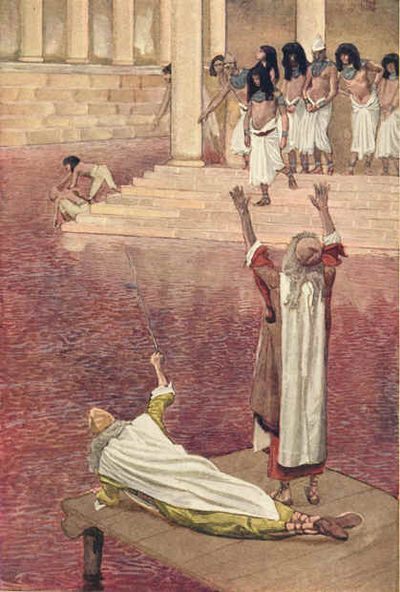
Water is Changed into Blood, by James J.J. Tissot

The preliminaries end and the ten “plagues”1 begin in in this week’s Torah portion, Va-eira (“and I appeared”).  God asks Moses to meet Pharaoh at the river and tell him the reason for the first plague, when water will turn into blood.

And you shall say to him: “Y-H-V-H, the god of the Hebrews, sent me to you, saying: Send out my people, and they will serve me in the midbar!  And hey, you have not paid attention before now.”  (Exodus/Shemot 6:16)2

midbar (מִּדְבָּר) = wilderness, uninhabited land, uncultivated land (pasturage or desert).

Moses had asked for a leave of absence for the Israelites when he first came before the pharaoh, just as God had ordered him at the burning bush on Mount Sinai:

“And you shall say to him: God, the god of the Hebrews, appeared to us; and now, let us go, please, a journey of three days into the midbar, and we will bring animal-offerings for Y-H-V-H, our god.”  (Exodus/Shemot 3:18)

It seems like a small request.  The pharaoh has been forcing the Israelite men to do corvée labor building brick storehouses.  He could afford to grant them all one week off—three days to travel into the wilderness, perhaps one day for ritual offerings, and three days to come back.  Then as soon as they returned he could put them back to work.

Why does God order Moses to make this small request, when the long-term plan is to take the  Israelites out of Egypt altogether and relocate them in Canaan?  Why should Moses ask for a short leave of absence, instead of for permanent emancipation?

A trick?

I used to wonder if Moses’ repeated request for a leave of absence to serve God in the wilderness is a ploy to give the Israelites a head start on their journey to Canaan before the Egyptians realize they were not coming back, and decide to pursue them. After all, when they do finally leave Egypt, it takes them only three days to get to the Reed Sea, part of the boundary of Egypt proper.3

However, God already knows that the pharaoh will repeatedly refuse to grant the Israelites a leave of absence.4  God is already planning to harden the Pharaoh’s heart and inflict the miraculous plagues on Egypt.

Therefore Moses’ request is both an excuse for Pharaoh to say no, and an expression of two things the Israelites ought to desire, according to God: serving their own god, and going into the wilderness to do it.

When Moses and his brother Aaron first come before the pharaoh they phrase the request this way:

“Thus says Y-H-V-H, the god of Israel: Send out my people and let them make a festival-offering for me in the midbar.”  (Exodus 5:1)

The pharaoh refuses, giving two reasons:

“Who is Y-H-V-H that I should listen to his voice to send out Israel?  I do not know Y-H-W-H, and neither will I send out Israel.”  (Exodus 5:2)

Why, Moses and Aaron, would you disturb the people from their work?  Go to your [own] burdens!”  (Exodus 5:4)

The pharaoh then gives the Israelites additional hours of work; they must gather the straw stubble for brickmaking while still meeting their quota for making bricks (and presumably for building the brick storehouses).  His move is effective; the Israelites tell Moses and Aaron that this additional hardship is all their fault.5  But the two brothers continue to cooperate with God’s plan for eventually liberating the Israelites from Egypt.

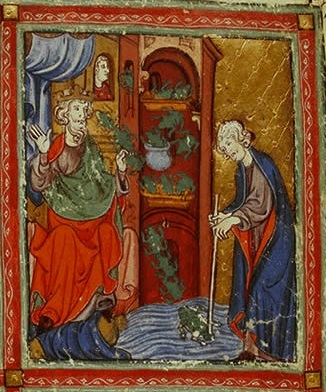
Plague of Frogs, Golden Haggadah, Barcelona, 14th century

The pharaoh ignores the first plague in this week’s Torah portion, Va-eira, in which all the water in Egypt turns into blood.  The second plague, an infestation of frogs, bothers the pharaoh enough so he summons Moses and Aaron.

…and he said: “Plead for me to God, so He will clear away the frogs from me and from my people; then I will send out the people, and they may slaughter an offering to Y-H-V-H.” (Exodus 8:4)

At this point the pharaoh mentions only the offering to God, not the request to make it in the wilderness. And Moses does not bring it up.

After Egypt is relieved of frogs, the pharaoh hardens his own heart and refuses to carry out his side of the bargain anyway; he still stands firm in his two original objections to Moses’ request: that he does not recognize the god of the Israelites, and that he will not give them any time off work.

Going into the wilderness

Only after the fourth plague (arov = mixed vermin) does the pharaoh make a more genuine offer—perhaps because this time God inflicts the plague only on native Egyptian houses, leaving the houses of the Israelites vermin-free.

And Pharaoh summoned Moses and Aaron, and he said: “Go!  Slaughter offerings to your god, in the land.”  (Exodus 8:21)

Moses refuses.  He says they will only make offerings to God in the wilderness, not in the populated part of Egypt.  His excuse is that the animal offerings God wants from the Israelites are taboo to native Egyptians.

“Sure, we slaughter the taboo of Egyptians in front of their eyes, and they do not stone us?  Let us go for a journey of three days into the midbar, and we will slaughter animals for Y-H-V-H, our god, as [God] says to us.”  (Exodus 8:22-23)

Then Pharaoh said: “I, I will send you, and you may slaughter offerings for Y-H-V-H, your god, in the midbar—only you definitely must not go far away.  Plead for me!”  (Exodus 8:24)

After Moses has pleaded with God to remove the plague of arov, the pharaoh hardens his heart again, and refuses to give the Israelites any leave of absence.

During the rest of the plagues, God, Moses, and the pharaoh speak only of sending out the people; the wilderness is now assumed to be their destination.

What is the deeper reason why the Israelites must serve their god in the wilderness, not in the settled land of Egypt?

Routine sacrifices to God are conducted at altars in long-term campsites in the books of Genesis through Joshua, and at temples in towns populated by Israelites in the rest of the Torah.  But in situations that make it harder to reach God, the wilderness is often where the connection happens.

In Genesis, God speaks to Hagar twice, both times when she has walked far into the midbar south of Beersheva.6  Abraham must travel away from Beersheva to a remote hilltop in order to commit the difficult sacrifice of his son Isaac.7  Jacob wrestles with a divine being in an uninhabited area on the Yabbok River.8  Moses does not encounter God until he is 80, when he sees the burning bush on Mount Sinai, so deep in the wilderness that last week’s Torah portion says:

And he led the flock behind the midbar, and he came to the mountain… (Exodus 3:1)

*

In my own experience, there are two kinds of divine connection.  I find that when I am praying with my friends and fellow travelers on the Jewish path, the connection among all of us brings in the divine, and we rise toward the universal divine together—rather like the Israelites in the Torah who gather at at their communal altars.  I miss prayer services when I go too long without them.

Yet if I want a deeper connection with the divine spirit inside myself, I can only reach it in a wilderness: a place where there are no other people to distract me, not even praying people or inspiring speakers; and no buildings or vehicles in sight to remind me of what else I might be doing.  If I see only what we call nature, and hear only wind or water or bird songs as well as my own breathing, then I can do a different and deeper kind of prayer.

In a midbar, I am separated from my usual labors.  I am neither a pharaoh who demands achievement, nor an Israelite who works harder than she really can in order to achieve.  You might say that “serving God” in this way gives me freedom.  And a little freedom returns with me when I return to the world of people.

May we all find a wilderness when we need it.

  1. What we call the ten “plagues” are ten miracles that cause widespread devastation in Egypt.
  2. Although I usually translate the four-letter personal name of God as simply “God”, in this essay I spell it out in Roman letters because Pharaoh does not know there is a god by that name, and one of the reasons God sends Moses to Egypt and inflicts the plagues is so that all Egypt will know the name Y-H-W-H.  God brings this up at least ten times.  For more on the tetragrammaton, the four-letter name, see my post Beshallach & Shemot: Knowing the Name.
  3. The Reed Sea is the third place where the Israelites encamp for the night after they leave the capitol city of Ramses.  The first is Sukkot, the second is Eitam (Exodus 13:20), and the third is Pi Hachirot by the Reed Sea (Exodus 14:2 and 14:9).  (See also Numbers 33:3-8.)  God chooses not to part the sea until after the Egyptian army arrives and is available to be drowned.
  4. And God said to Moses: “When you come and return to Egypt, see all the wonders that I have put in your hand and do them before Pharoah.  But I, I will strengthen his heart and he will not send out the people.”  (Exodus 4:21.)
  5. Exodus 5:6-21.
  6. Genesis 16:7-13, 21:14-19.
  7. Genesis 22:2.
  8. Genesis 32:23-29.

Shemot: Hebrews vs. Children of Israel

Both the book of Exodus and its first Torah portion are called Shemot (“Names”) after a key word in the first sentence.  But that sentence also includes the two names of Jacob and all his descendants:

Jacob and his Family Go to Egypt, by Jean Bondol, 14th century CE

And these are the names of the Children of Yisra-eil who came to Egypt with Ya-akov, each man and his household. (Exodus/Shemot 1:1)

shemot (שְׁמוֹת) = names.

Yisra-eil (יִשְׂרָאֵל) = Israel (in English).  Yisra (ישׂר) is derived from either yisar (יִּשַׂר) = he strives, contends, struggles; or yasor (יָשֹׂר) = he rules, directs.  Eil (אֵל) = god, God.

(Jacob earned the name Yisra-eil after wrestling with a mysterious being.1  The possible meanings of Yisra-eil have spurred a lot of commentary.  Likely translations are “He struggles with God”, “God strives”, or “God rules”. Calling Jacob’s descendants the children of Israel, instead of the children of Jacob, focuses on their active and sometimes insecure relationship with their god.)

Ya-akov (יַעֲקֹב) = Jacob (in English); he grabs the heel (from the verb akav, (עָקַב) = came from behind, grabbed by the heel, supplanted, circumvented, held back).

(Jacob’s father, Isaac son of Abraham, named him Ya-akov when he was born, because he emerged holding the heel of his twin brother Esau.2)

The second sentence in Exodus lists the names of eleven of Jacob’s twelve sons.  Joseph is already a viceroy of Egypt when his extended family moves down.  He invited them to resettle in the Goshen area so he could guarantee they would have food during the seven-year famine.

Over the next few centuries or generations the descendants of Jacob multiply, and a new dynasty takes over Egypt.3

And a new king rose over Egypt who did not know [about] Joseph.  And he said to his people: “Hey! The people of the children of Yisra-eil are more numerous and more mighty than we are!  … What if a war happens, and they even join our enemies and wage war against us, or they go up out of the land?” (Exodus/Shemot 1:8-10)

Here the pharaoh is superficially respectful, referring to the children of Israel by their own name for themselves.  Perhaps at this point most Egyptians had nothing against their Israelite neighbors.

Having identified a potential problem, Pharaoh assigns the Israelites to corvée labor (forced and unpaid labor on a state project).  They must build storage cities in the eastern delta of the Nile, near the Goshen region where they live.  This move establishes their lower-class status, and puts them under close supervision so they cannot defend themselves against any future injustice.

Pharaoh and Midwives, The Golden Haggadah, 14th century CE

The pharaoh’s next move is to order the midwives to kill all the Israelites’ newborn sons.  At this point, Pharaoh calls the Israelite women “Hebrews”.

And he said: When you deliver the ivriyot, and you look at the pair of stones [the birthing seat], if it is a son, then you shall kill him.  But if it is a daughter, then she shall live. (Exodus 2:16)

ivriyot (עִבְרִיּוֹת) = Hebrew women; the feminine plural of ivri (עִבְרִי) = a Hebrew person.  (From the root verb avar, עבר = passed through, passed by, crossed over.  Ivri is an imperative form of this verb.)

The word ivri is etymologically related to the Egyptian word ‘apiru and the Mesopotamian word habiru (as well as the English word “Hebrew”).  Several thousand years ago, the countries surrounding Canaan used the term to mean any Semitic immigrants on the fringes of society.  Surviving ancient texts refer to Hebrews as nomadic herders, temporary laborers, mercenaries, or outlaws.  They are not permanent residents.

Yet when the book of Exodus opens, the children of Israel have been living in Egypt for somewhere between two generations and 350 years.Although they belong to a distinct ethnic group, they have a long-established place in Egyptian society.

Nevertheless, the pharaoh switches from calling them “children of Israel” to calling them “Hebrews”.  This change in language signals that they are aliens who do not really belong in Egypt.  Given the usual meaning of the Egyptian word ‘apiru, the pharaoh also implies that the Israelites are low-class migrant workers and potential outlaws.  His racial slur probably makes the idea of killing the newborn males more palatable to ordinary Egyptians.

Yet the midwives do not carry out the pharaoh’s hate crime; they come up with an excuse for letting the baby boys live.  Although the pharaoh does not punish them, he remains determined to eliminate the “Hebrews” by attrition, letting the old ones work until they die without a new generation to replace them.  His next move is to incite the whole native Egyptian population to commit a form of genocide.

Pharaoh gave orders to all his people, saying: “Every son that is born, you shall throw away into the Great River; but every daughter, you shall let live.” (Exodus/Shemot 1:22)

Why does the pharaoh want to kill only the newborn boys, and not the girls?  In the ancient world of the Torah, men carry the identity of a tribe or nation; women become members of their husbands’ tribes when they marry.  If the only young Israelites were female, they would merely become wives, prostitutes, or servants to native Egyptians.

I would add that adolescent boys and young men are always seen as the most dangerous members of an out-group.

The children of Israel are already subject to corvée labor with no fixed endpoint—in practice, a kind of slavery.  Now they are also helpless against any Egyptians who decide to drown their male children.

Moses from the River, detail from Dura Europos, 244 CE

Only a hero and some miracles can reverse the situation.  The miracles will come from God; the hero is born among the Israelites in Egypt.  His mother hides him for three months before putting him inside a waterproof papyrus box and floating it among the reeds on the bank of the Nile.  When the pharaoh’s daughter finds the  box and sees a baby boy inside, she says:

This is one of the children of the ivrim!”  (Exodus 2:6)

ivrim (עִבְרִים) = Hebrews; the male or all-purpose plural of ivri.

Thus the infant whom she adopts and names Moses begins life identified as an ivri, a nomad, immigrant, outsider.  Eighty years later, Moses leads the ivrim out of Egypt and toward Canaan, the land where ivrim originally came from, the land where they can live as children of Yisra-eil.

Once the Israelites leave Egypt, the Torah rarely calls them ivrim.  References to “Hebrew” people appear only in rules regarding Israelites who have sold themselves as slaves, and in conversations with non-Israelites.

The Israelite occupation of Canaan was not permanent.  The Babylonians conquered Jerusalem in 586 B.C.E., and it took 2,534 years before the land became an independent nation of Israel again, rather than a province of a larger country.  During much of that time Jews in Palestine and in the diaspora were treated like ivrim, unsavory migrants.

*

No group of people is permanent.  Identifying some residents of a country as natives, and others as migrants, outsiders, ivrim, is only a way for demagogues to stir up enough fear and hatred to get what they want.

None of us are natives, if you look back far enough in history.  None of us have an exclusive claim to a patch of land.  All of us are temporary residents—in our countries, and on this earth.  We are all ivrim.

Our challenge is to recognize that everything is temporary, and dedicate our short lives to becoming true children of yisra-el by wrestling with God and changing the fate of the earth.

  1. Genesis 32:25-29.
  2. Genesis 25:26.
  3. Neither the Torah nor the classic commentary are consistent about how much time passed between the immigration to Egypt of Jacob and family, and the imposition of corvée labor by the first pharaoh alarmed by the strength and numbers of his descendants.  According to Exodus 12:14, the Israelites were in Egypt a total of 430 years, making the time between their arrival and their initial enslavement no more than 340 years.  In Genesis 15:13-14 God says the Israelites will be in Egypt for 400 years, bringing that time down to no more than 310 years, which  Genesis 15:16 considers four generations.  Yet according to Exodus 6:16-20, Moses’ grandfather Kehat came down with Jacob, so there were only two generations.