Pekudei & 1 Kings: A Throne for the Divine

Canaanite temples were built according to a basic three-part plan: a courtyard in front, a main hall behind it, and a small temple 2sacred chamber at the back containing a statue of the temple’s god. There were often additional rooms at the sides of the main hall for practical use by the temple’s priests and functionaries, but religious rituals happened in the courtyard, main hall, and back chamber.

The Hebrew Bible describes the construction of three sanctuaries: the portable tent-sanctuary in the book of Exodus, the first Israelite temple in Jerusalem in the first book of Kings, and the second temple in the books of Ezra and Nehemiah.

The portable Tent of Meeting that Moses assembles at the end of the book of Exodus travels with the people from Mount Sinai all the way across the Jordan River. It is erected in several locations while the Israelites are gradually conquering Canaan: Gilgal, Shiloh, Nob, Givon, and then Jerusalem. King Solomon builds the first temple in Jerusalem in the first book of Kings, and the construction of the second temple in Jerusalem begins in the book of Ezra.

All three of these sanctuaries follow the basic three-part Canaanite plan. But since the Israelites are forbidden to make an image of God, the innermost chamber at the back cannot contain a statue of their deity. So what is inside the “holy of holies”?

This week’s Torah portion, Pekudei (“Inventories”), says what Moses put into the holy of holies in the Tent of Meeting.

He took and placed the eidut in the aron, and he put the poles on the aron, and he placed the cover on top of the aron. Then he brought the aron into the dwelling-place, and he placed the curtain of screening-off, and screened off the aron of the eidut, as God had commanded Moses.  (Exodus/Shemot 40:20-21)

eidut (עֵדֻת) = testimony—of a witness or of God. (The Torah often uses this word to refer to the second pair of stone tablets Moses brings down from Mount Sinai.)

aron (אֲרוֹן)  = chest, coffer, coffin; ark of the covenant

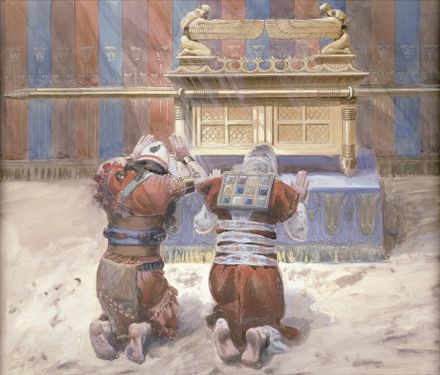
What does the aron look like? In the book of Exodus, it is a gold-plated wooden box about four feet long, with carrying-poles attached to the bottom. Last week’s Torah portion, Vayakheil, describes how the master artist Betzaleil makes the lid of the aron:

Then he made a cover of pure gold, two and a half cubits long and a cubit and a half wide. And he made two keruvim of gold; he made them hammered out from the two ends of the cover. One keruv from this end and one keruv from that end; from the cover he made the keruvim, from its two ends. And the keruvim were spreading wings upward, screening off with their wings over the kaporet; and their faces were toward each other, toward the cover were the faces of the keruvim. (Exodus 37:6-9)

keruv (כֱרוּב), (plural keruvim)  = a hybrid beast with wings and a face. (See my earlier post: Terumah: Cherubs Are Not for Valentine’s Day.)

What are the wings of the keruvim on the cover screening off? The space above the golden lid is empty—or, at least, nothing is visible there. But the Torah treats the aron as a throne for an invisible, although not inaudible, god.

Moses came into the Tent of Meeting to speak with [God]. Then he heard the voice speaking to him from above the cover that was on the aron of the eidut, from between the two keruvim; thus [God] spoke to him. (Numbers/Bemidbar 7:89)

The keruvim and the lid of the aron are a single piece of gold in the Tent of Meeting. But in the first temple, they are separate items. While the aron stays in the tent where King David put it, King Solomon’s craftsmen make two keruvim out of olive-wood overlaid with gold. Each keruv is ten cubits (about 15 feet) tall, with a ten-cubit span from wingtip to wingtip.

Then he placed the keruvim inside the House, in the innermost [chamber]. And the wings of the keruvim spread out so the wing of one keruv touched the wall, and the wing of the second keruv was touching the second wall, and in the middle of the chamber their wings touched. (1 Kings 6:27)

The haftarah reading corresponding to the Torah portion Pekudei is from the first book of Kings. It describes the ceremony after the first temple in Jerusalem is completed, starting with a procession as King Solomon and elders from all over Israel accompany the aron on its short journey from the tent in the old city to the new House of God.

The priests brought in the aron of the covenant of God to its place, to the back room of the House, to the holy of holies, to underneath the wings of the keruvim. For the keruvim were spreading wings toward the place of the aron, so the keruvim screened off the aron and its poles from above. (1 Kings 8:6-7)

In both the Tent of Meeting and the first temple, there is an empty space between the lid of the aron below and the wings of the keruvim above. God’s voice or presence is never located inside the aron, only in the space above it.

Yet inside the aron is the eidut, God’s testimony. Commentary on the Tent of Meeting agrees that the eidut means the second, unbroken, pair of stone tablets inscribed by God on Mount Sinai (also called Choreiv). Commentators disagree on whether the aron also contained the shattered tablets, and/or a scroll that Moses wrote.

The first book of Kings clarifies the contents of the aron in the time of the first temple:

There was nothing in the aron but the two tablets of stone that Moses placed there at Choreiv, when God cut a covenant with the children of Israel after they left the land of Egypt. (1 Kings 8:9)

The first temple was sacked several times, and when the Babylonian army captured Jerusalem in 586 B.C.E. they razed it altogether. The keruvim and the aron were never recovered. So in the second temple, which was begun in 538 B.C.E., the holy of holies was an empty room. But priests still treated it as the locus of God’s presence.

After the Romans destroyed the second temple in 70 C.E., Jews had to find God’s presence in other places. Today, many of us search for God by going inside ourselves: pondering what we have learned, questioning our feelings, meditating, sinking into ritual, praying with intention, and so on. This inner journey in search of God also has stages.

If the first stage of your search is like the courtyard of the Tent or temple, does your courtyard have an altar for animal sacrifices and a basin for washing? If you push on into the main hall, does it have any of the furnishings of the Israelite sanctuaries: a lampstand for light, or a table for bread, or an altar for incense? And if you keep searching even deeper, what do you find in your holy of holies?

Do you enshrine fundamental written principles in a gold coffer? Or do you encounter fantastical creatures? If you find both in your holy of holies, are the fantastical creatures bigger or smaller than the coffer? Or is your holy of holies an empty room?

Is God present there?
Vayakheil and Ki Tissa: How to Be a Holy Artist

What does it take to create something that will help people feel the presence of God?

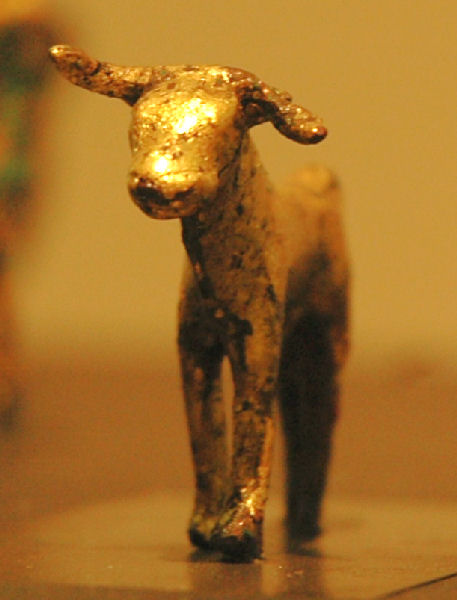
Aaron tries to do this when he makes the Golden Calf in last week’s Torah portion, Ki Tissa. At first, the people are ecstatic over the idol, bowing down to it and singing and dancing. But this simple and undisciplined religious outlet does not last. When Moses returns and grinds the calf into gold dust, nobody protests. Moses stirs the gold dust into water, and they all meekly swallow it. Aaron’s creation turns out to be a failure.

In this week’s Torah portion, Vayakheil (“And he assembled”), the master craftsman Betzaleil begins making the holy objects for the new sanctuary. The completed creation is so successful that it sustains the religion of the Israelites for several centuries, until King Solomon replaces it with the temple in Jerusalem.

The key difference between Aaron and Betzaleil as creators of religious objects appears in the Torah twice, repeated word for word. In the portion Ki Tissa, God says it to Moses. In this week’s portion, Moses says it to the Israelites:

See? God has called by name Betzaleil, son of Uri, son of Chur, of the tribe of Yehudah. And [God] has filled him with ruach of God, with chokhmah, with tevunah, and with da-at, and with every craft. (Exodus/Shemot 35:30-31)

ruach (רוּחַ) = wind; spirit, motivation, overwhelming state of mind.

(Usually when the ruach of God comes over someone in the Hebrew Bible, that person speaks as a prophet or leads people into battle. Exceptions are Samson, who is gripped by a murderous rage and supernatural strength; and Betzaleil the artist, who is filled with a divine motivation to create.)

chokhmah (חָכְמָה) = wisdom; inspiration.

tevunah (תְבוּנָה) = insight, rational understanding, analytic ability.

da-at (דַעַת) = knowledge.

In later Kabbalistic writings, chokhmah and binah (another form of the word tevunah) are two of the sefirot or divine powers.  Chokhmah is the sefirah associated with the left side of the head, i.e. the left brain that popular science now associates with non-rational, intuitive, holistic consciousness. Binah (tevunah) is the sefirah associated with the right side of the head, i.e. the right brain that we now associate with rational, logical, analytic thinking. In the Kabbalist system, da-at is the product of chokhmah combined with binah.

Aaron, although he will serve as the high priest, lacks the four qualities with which God fills Betzaleil. When the Israelites are waiting at the foot of Mount Sinai in Ki Tissa, Aaron feels no ruach of God, no divine urge to create a holy object. The people decide Moses will never return and order Aaron: Get up, make for us gods that will go before us! (Exodus 32:1). Then Aaron acts, but only to satisfy the crowd.

He has no chokhmah, no inspiration nor wisdom about what to make; he merely calls for gold earrings to melt down, since the finest idols are made of gold.

He took it from their hands and he shaped it with the engraving tool, and he made it into an image of a calf. (Exodus 32:4)

Afterward, when Aaron explains to Moses what happened, he says: I said to them, “Who has gold? Pull it off yourselves.” And they gave it to me and I threw it into the fire and out came this calf.” (Exodus 32:24)

Aaron admits that he acted without any of the insight or discrimination of tevunah, and also without any da-at, any knowledge of what would emerge from the fire.

Betzaleil, on the other hand, is born betzalmeinu—in God’s shadow or image—when it comes to creativity. (See my earlier post, Vayakheil: Shadow Power.) **** He creates under the protection of God’s shadow. God “fills” him with the qualities he already has the potential and experience to develop.

Even as Moses comes down with God’s basic design for a portable sanctuary, Betzaleil is filled with a divine desire to create it. He has the chokhmah to visualize the whole thing, and to imagine beautiful and inspiring objects—from the gold keruvim (hybrid winged beasts) on top of the ark to the design embroidered in brilliant colors on the curtain at the entrance to the Tent of Meeting. He has the tevunah to analyze and understand how each part can be made well and assembled into the whole. And he has da-at, knowledge, of every craft: metal-working, jewelry, wood-working, weaving, and embroidery.

Betzaleil is so filled with chokhmah, tevunah, and da-at that he and his assistant can teach other craftsmen and craftswomen among the people.

And [God] put teaching into his heart, him and Ahaliyav son of Achisamakh of the tribe of Dan. (Exodus 35:34)

And Betzaleil and Ahaliyav and everyone wise of heart to whom God gave chokhmah and tevunah for da-at and for doing all the work for the service of the Holy, they shall do everything that God commanded. (Exodus 36:1)

The sanctuary that is completed in next week’s Torah portion, Pekudei, is the product of the grand design Moses heard from God; the divine spirit, inspiration, understanding, and know-how of the master artist, Betaleil; and the enthusiasm and wisdom of the contributors in the community. No wonder it becomes a place where people feel God’s presence.

I think that the qualities God gives Betzaleil are necessary for anyone to produce truly moving art, whether its explicit goal is religious or not. I know that when I do “creative writing”, especially of Torah monologues and fiction, both my motivation (ruach) and my inspiration (chokhmah) seem to come from a mysterious place outside myself, or perhaps from some inner place so deep my conscious mind can never penetrate it. I might as well say they come from God, the great mystery.

But the most burning motivation and inspiration leads nowhere without the application of rational insight and analysis (tevunah). My own ability in this area is a talent I was born with, a gift of God, that I have developed over many years of practice. And as in Kabbalah, I have found that the combination of left-brained inspiration (chokhmah) and right-brained analysis (binah or tevunah) does indeed result in knowledge (da-at).

The final requirement for creating art is to actually do all the labor. I am grateful that the ruach that blows through me from the unknown source I call God is strong enough to motivate me to keep on working, with enthusiasm—like the Israelites in this week’s Torah portion.

May the divine spirit be strong in all artists.

Tetzaveh: Meeting Room

Who will meet in the “Tent of Meeting”?

Moses receives instructions for making a portable tent-sanctuary for God in last week’s portion, Terumah.  This week’s portion, Tetzaveh (“you shall command”), is the first one to call the sanctuary the ohel mo-eid, the “Tent of Meeting”—an expression that appears 137 times in the books of Exodus through Deuteronomy.

This week’s portion is also the first to reveal who will meet at or inside the tent.  But in its first appearance, the phrase “Tent of Meeting” is merely a location.  God tells Moses:

And you, you shall command the children of Israel, so they will take for you pure oil of beaten olives for the light, to make the lamp go up regularly.  In the ohel mo-eid, outside the dividing curtain that is in front of the testimony [in the ark], Aaron and his sons shall set it up from evening until morning before God.  [This is] a decree forever for the generations from the children of Israel. (Exodus/Shemot 27:20-21)

ohel (אֹהֶל) = tent.

mo-eid (מוֹעֵד) = appointed place for meeting with God; appointed time (usually for a religious festival).  (From the root ya-ad, יָעַד = appoint a time or place.)

ohel mo-eid (אֹהֶל מוֹעֵד) = Tent of Meeting (i.e. the tent appointed for meeting with God).

The ohel mo-eid is the portable tent-sanctuary God described to Moses in last week’s Torah portion, a two-chamber tent with a dividing curtain screening off the Holy of Holies from the larger front chamber.1  The menorah whose lamps the priests must fill is inside the tent’s front chamber.

The portion Tetzaveh then describes the vestments to be made for the new priests, followed by the ritual for ordaining them.  First Moses must assemble Aaron and his four sons, a bull and two rams, three kinds of bread, and the new priestly garments.

Then you shall bring Aaron and his sons to the entrance of the ohel mo-eid and you shall wash them in water.  (Exodus 29:4)

Both the basin for the priests’ ritual washing and the altar for burnt offerings are located outside the Tent of Meeting, in front of the entrance.

And you shall bring the bull to the front of the ohel mo-eid, and Aaron and his sons shall lean their hands on the head of the bull.  And you shall slaughter the bull before God, at the entrance of the ohel mo-eid.  (Exodus 29:10-11)

After washing and dressing Aaron and his sons, Moses must make the first offerings on the new altar, and sprinkle some of the blood on both the altar and the five men.After Moses has made all the offerings, the remaining bread and the remaining meat from the second ram go to the men being ordained.

And Aaron and his sons shall eat the flesh of the ram, and the bread that is in the basket, at the entrance of the ohel mo-eid.  (Exodus 29:32)

The whole process, from washing to eating, must be carried out in front of the Tent of Meeting, and must be repeated every day for a total of seven days in order to sanctify both the priests and the altar.  After that, the priests will make daily offerings, which are briefly listed.  With the last one, an evening offering of a lamb, God finally mentions why the portable sanctuary is called the “Tent of Meeting”.

[It is] a perpetual rising-offering3 for your generations at the entrance of the ohel mo-eid, in front of God, where iva-eid with you, to speak to you there.  (Exodus 29:42)

iva-eid (אִוָּעֵד) = I shall meet, I shall arrange meeting(s).  (Also from the root ya-ad.)

The “you” in this sentence is plural.  The next sentence declares that the ohel mo-eid will be the locus or focus where all the Israelites can meet God.

Veno-adeti there for the Children of Israel, and it will be sanctified by my glory.  (Exodus 29:43)

veno-adeti (וְנֹעַדְתִּי) = And I will arrange meeting(s).  (Also from the root ya-ad.)

The Torah does not explain what kind of meeting or meetings will occur between God and the Israelites.  But God does say:

And I will dwell in the midst of the Children of Israel and I will be their god.  (Exodus 29:45)

Pillar of cloud, from Collectie Nederland

Maybe the Israelites have a meeting with God whenever they see the pillar of cloud and fire that rests over the Tent of Meeting when they are encamped.4  Or when they brings offerings to the courtyard in front of the tent and watch while the priests perform the ritual actions to send them up to God.  Or maybe living so close to the Tent of Meeting is enough for the Israelites to meet God.

The Torah portion then describes the incense altar, and God adds:

And you shall place it in front of the dividing curtain that is in front of the Ark of the Testimony, in front of the atonement-cover that is over the testimony, where iva-eid with you.  (Exodus 30:6)

This time “you” is singular.  Only Moses, to whom God is speaking, will meet with God inside the back chamber of the tent, the Holy of Holies, in front of the atonement-cover on the ark.

Thus the innermost chamber the Tent of Meeting is the appointed place where Moses and God meet, while the tent as a whole is the focus for meetings between rest of the people and the God who dwells in their midst.

*

Before there is a Tent of Meeting, people in the Torah never know where God might speak to them.  God’s voice might come in a dream, or from a stranger who turns out to be not human after all, or from a burning bush.  But in this week’s Torah portion Moses learns that God has designated the Tent of Meeting as the appointed place.  God still speaks to Moses at odd moments, but a formal meeting takes place inside or in front of the tent.

When the Israelites have finished making all the items for the Tent of Meeting and Moses assembles it for the first time, God fills the tent with the divine manifestations of cloud and glory (or impressiveness).

And Moses was not able to enter the ohel mo-eid because the cloud rested upon it and the glory of God filled the sanctuary.  (Exodus 40:35)

The presence of God is too strong for the meeting to take place!  So the book of Leviticus/Vayikra begins with God summoning Moses and speaking to him from the Tent of Meeting, as if God has changed the divine frequency in order to meet the appointment with Moses.

*

Many people today believe they have an appointed place to meet with God: their synagogue or church or mosque or temple.  Some religions still claim that God gives direct instructions to their leaders.  And all too many people believe that the “real” God can only be found in their religion’s sacred places.

I pray that someday people will notice the glory of God outside their own exclusive Tent of Meeting, and the divine will dwell in the midst of everyone on earth.

  1. Exodus 26:31-33.
  2. See my posts Tzav: Oil and Blood and Tzav: Horns, Ears, Thumbs, and Toes.
  3. olah (עֹלָה) = rising-offering.  (From the root alah (עלה) = go up.) In an olah the entire slaughtered animal is burned up into smoke, which rises to the heavens.
  4. Exodus 40:36-38, Numbers 9:15-17.

Chayei Sarah & Lekh-Lekha: A Holy Place

What makes a place holy?

The word for “holy”, kadosh, means separated from mundane use, dedicated to God, or simply inspiring religious awe.  Kadosh appears only once in the book of Genesis/Bereishit, in verb form, when God blesses the seventh day of creation and makes it holy.  The word does not show up again until the book of Exodus/Shemot, when Moses stops to look at the burning bush, and God tells him to take off his shoes, because the place where you are standing is holy ground (Exodus 3:5).  Later in Exodus, Mount Sinai becomes holy ground for a whole people.  Eventually the Bible names Jerusalem as a holy city.

Even though there are no places called kadosh, “holy”, in the book of Genesis, there many sites where God makes first contact with a human being.  At two of the locations where God speaks to a human, the human dedicates the spot, and later someone returns to the same place to connect with God.  These places, Be-eir Lachai Ro-i and Beit-El, must surely count as holy!

Isaac and his bride Rebecca meet in a field next to Be-eir Lachai Ro-i (“Well for the Living One Who Sees Me”) in this week’s Torah portion, Chayei Sarah (“the life of Sarah”).  But it is Hagar, an Egyptian, who first encounters God there.

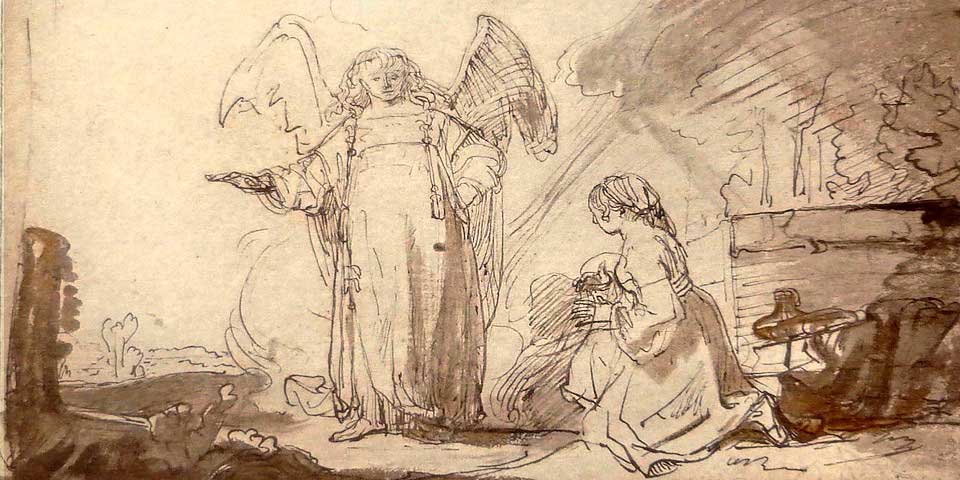
Hagar and the Angel, by Rembrandt

When Abraham and his wife Sarah leave Egypt in the Torah portion Lekh-Lekha (“Go for Yourself”), Hagar goes with them as Sarah’s servant.  Sarah gives Hagar to her husband for the purpose of producing a child Sarah can adopt.  But once Hagar is pregnant, Sarah abuses her, and Hagar runs away across the Negev Desert, back toward Egypt.  A messenger of God  finds her at a spring, a watering-place by the road.  God speaks to Hagar through the messenger and convinces her to return to Abraham and Sarah.

And she called the name of God, the one speaking to her: You are the God of Ro-i; for she said: Even as far as here, I saw after ro-i! Therefore the be-eir is called Be-eir Lachai Ro-i. (Genesis 16:13-14)

ro-i = seeing me, one who sees me.

be-eir = well, watering-place.

lachai = for the living one.

For Hagar, accustomed to being a pawn in Sarah’s schemes, the most amazing thing is that God actually notices her—and she survives.  Hagar does return, and gives birth to Ishmael.  Sarah adopts Ishmael, but later bears her own son, Isaac, and sends Hagar and Ishmael into exile.

Isaac is 40 years old before the Torah once again mentions Be-eir Lachai Ro-i, the Well of the Living One Who Sees Me.  At this point, Isaac is estranged from his father.  In last week’s Torah portion, Vayeira (“And He Saw”), Abraham bound Isaac as a sacrificial offering, and raised the knife to his son’s throat before a voice from God called him off.  After that, Isaac did not go home with his father.  In this week’s Torah portion, Abraham buries Sarah, Isaac’s mother, without Isaac’s presence.  Then he arranges for Isaac to marry an Aramean without even informing his son.  Apparently they are not on speaking terms.

Abraham lives in Beersheba (Be-eir Sheva), and Isaac lives farther south, in the Negev Desert.

And Isaac, he came from coming to Be-eir Lachai Ro-i, and he himself lived in the land of the Negev.  And Isaac went out lasuach in the field, in the face of the sunset; and he raised his eyes and he saw—hey!  Camels were coming. (Genesis 24:62-63)

lasuach = to ?? (This is the only occurrence of the word in the Bible, and though it is in the form of an infinitive verb, scholars do not agree on its meaning.  Lasuach has been translated as to stroll, to pray, to supplicate, and to meditate.  It might be a variant spelling of the verb siyach = meditate, go over a matter, contemplate something.)

I like the literal translation he came from coming to; it emphasizes that a holy well is a place you come to.  Isaac is avoiding his father, but he comes to the well where God noticed and spoke to Hagar.  Since he has no intention of traveling to Egypt on the road that runs past the well, he must come there because he knows about Hagar’s experience.

Like Hagar, Isaac is used to being overlooked as a person, accustomed to being a pawn in his father’s schemes.  Maybe he hopes that God will notice him at Hagar’s well, or maybe he hopes he will be able to see himself.

Coming from the Well of the Living One Who Sees Me, Isaac heads out into the field at sunset to lasuach.  Maybe Isaac senses the holy presence of God at the well, and he walks back through the field slowly to absorb the experience.

Lost in thought, he raises his eyes and is surprised to see camels approaching.  He is not far from the road between Beersheba and Egypt, but these camels have left the road and are heading across the field toward him.  The first rider to dismount is Rebecca, the bride that Abraham’s servant is bringing to Isaac.  They meet in the field, he loves her, and he begins his new life.

Near the end of the Torah portion, Isaac and his half-brother, Hagar’s son Ishmael, bury Abraham in the family cave to the north.  Then Isaac returns to Hagar’s well.

And it was after the death of Abraham when God blessed Isaac, his son; and he settled next to Be-eir Lachai Ro-i. (Genesis 25:11)

The only other place in the book of Genesis that remains holy years later, under the same name, is Beit-El (sometimes called Bethel in English).  In the upcoming Torah portion Vayeitzei (“And he went”), Jacob stops for the night on his way to Charan and dreams of a stairway between heaven and earth. God speaks to him for the first time.  When Jacob wakes, he says:

Truly God yesh in this place and I, I did not know! And he was awestricken, and he said: How awesome is this place! This is nowhere but Beit El, and this is the gate of the heavens! (Genesis 28:16-17)

yesh = it exists, it is present, there is.

Beit El = the house of God.

For Jacob, the most amazing thing is not that God notices him, but that God exists at all in this world.

Jacob dedicates the spot by setting up a stone pillar and pouring oil over it, and naming it Beit-El.  More than 20 years later, God tells him to return to Beit-El.  Jacob first buries all the idols belonging to his household.  Then he leads them to the spot and builds an altar. God blesses him again, and Jacob pours a libation as well as oil on the stone pillar before moving on.  By returning to the place where God first spoke to him, Jacob rededicates himself to God.

*

Few of us today hear God speaking to us in Biblical Hebrew.  But once in a while, we notice God, or God notices us, and we are amazed.  Suddenly our usual mundane perspective changes, and the world is suffused with new meaning.

Sometimes this happens because a place strikes us as holy, awe-inspiring, connected with God.  It might be a liminal place in nature—the edge of the ocean, deep in a forest, a remote spot with a brilliant night sky.  I have also felt that mysterious awe inside medieval cathedrals, though as a Jew I do not go looking for God there.

Sometimes we go back later, and find God again.  Sometimes we go back and discover that the place seems ordinary now; the holiness was in our own heart.  Either way, it is a blessing to be able to stand on holy ground.