Mishpatim: After the Vision, Eat Something

In this week’s Torah portion, Mishpatim, God tells Moses:

“Come up to God, you and Aaron, Nadav, and Avihu, and seventy elders of Israel, and bow down from a distance.” (Exodus/Shemot 24:1)

Aaron is Moses’ brother, and Nadav and Avihu are Aaron’s two oldest sons, who will later be initiated as priests. The seventy elders are judges and the de facto representatives of the Israelites.

And Moses went up, and Aaron, Nadav, Avihu, and seventy of the elders of Israel.  And they saw the God of Israel, and under [God’s] feet something like brick-work of sapphire, and it was exactly like the heavens latohar.  And [God] did not stretch out {God’s] hand against those singled out from the children of Israel. And they beheld God, and they ate and they drank.  (Exodus/Shemot 24:9-11)

latohar (לָטֺהַר) = for the ritual purity, for being acceptable for sacred purposes.

Brickwork in Ishtar Gate of Babylonia (Staatliche Museum, Berlin)

Seventy-five men see God in a transcendent vision. Then, overwhelmed by this spiritual

experience—they take out their lunches and have a bite to eat?  What’s that supposed to mean?

The commentary on the portion called Mishpatim (“Laws”)  is divided.  

latohar = for the purity; for being acceptable for sacred purposes

First God tells Moses to climb at least partway up Mount Sinai with his brother Aaron, his nephews Nadav and Avihu, and 70 elders.  When they do so, they see God in a transcendent vision, and then, overwhelmed by this spiritual experience—they take out their lunches and have a bite to eat?  What’s that supposed to mean?

The commentary on the portion called Mishpatim (“Laws”)  is divided.  Some modern commentators explain that since the Israelites have just received the Torah, or at least the Ten Commandments and a number of laws, the elders are now engaged in the sort of feast that marks a covenant or treaty.They probably shlepped some meat from sacrificed animals up with them for the concluding feast.2

I find this approach disappointing, because it downgrades the vision of God’s feet to merely part of cutting a covenant, the ancient Israelite version of a signing ceremony.

Other commentary claimed that it was not actual, physical food; the elders were feasting upon their contemplation of the divine glory.  In the Talmud, Rav even said that in the “World to Come” humans will be nourished only by their appreciation of God’s glory.3  In other words, none of that nasty physical chewing will be necessary.

According to other commentary, the Torah refers to real food and drink, but the elders on Mount Sinai raise their food to a more spiritual level.  The kabbalist Isaac of Luria wrote that we raise the sparks of holiness in plants and animals by eating them with the proper devotion.  19th-century rabbi Samson R. Hirsch wrote that the sapphire brick in the elders’ vision is a metaphor showing that even a lowly brick acquires a heavenly purity when it serves the divine.4

But what if the elders are not thinking about raising sparks?  What if they really do go from seeing a mystical vision of God to enjoying a nice snack?  One way to explain their flexible outlook is to look at the previous clause, “And He did not stretch out his hand toward them”.  Ovadiah Sforno interpreted that as meaning they are already seeing like prophets; God does not need to put them into an altered state of consciousness, the way God does with Saul, or Ezekiel, or the 70 elders themselves in Numbers 11:25-26.5

Maybe the consciousness of the elders is so integrated, at that moment, that they can find God in everything—in the taste of food as much as in a numinous vision.

I know some people who shun any hint of spirituality or mysticism.  They would explain a vision of God’s feet on sapphire bricks as a mere hallucination due to some bodily malfunction.  I also know people who love mysticism and cultivate spiritual ecstasy.  They seem to view the practical details of life as inferior, and prefer not to pay much attention to what their bodies are doing (except, perhaps, when they’re engaged in ecstatic dance).

I like the middle way.  I think an ideal world is one in which we are all like the 70 elders on Mount Sinai: we calmly accept whatever mysterious vision of God arrives, and we also savor the food, drink, and other physical gifts that God’s world provides.  When we unite body and soul, we become whole.

(This post was first published on February 7, 2010.)

  1. E.g. Etz Hayim: Torah and Commentary, The Jewish Publication Society, 2001, p. 479.
  2. Cf. 12th-century rabbi Shmuel ben Meir, a.k.a. Rashbam, on Exodus 24:11, http://www.sefaria.org.
  3. Talmud Bavli, Berakhot 17a.
  4. Samson Raphael Hirsch, The Hirsch Chumah: Sefer Shemos, Feldheim Publishers, Jerusalem, 2005, p. 533.
  5. 16th-century rabbi Ovadiah Sforno on Exodus 24:11, http://www.sefaria.org.

Terumah: Cherubs Are Not for Valentine’s Day

“And they shall make me a holy place, and I shall dwell among them.”  (Exodus/Shemot 25:8)

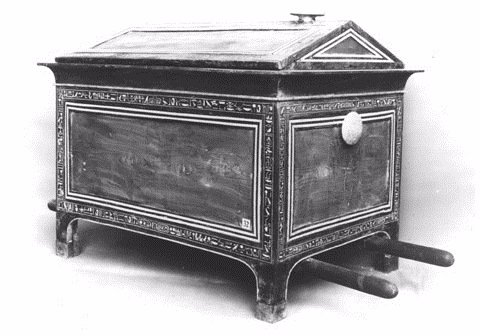
Ark from Tutankhamun’s tomb with poles, but a different lid

With this promise, God begins telling Moses how to make the portable tent-sanctuary.  In this week’s Torah portion, Terumah (“Donation”), God begins by describing the ark to be placed inside the Holy of Holies, the innermost room of the sanctuary.  The ark will be a box or coffer made of gold-plated wood, with gold rings for permanent carrying-poles.  Inside the ark will be the testimony, e.g. the stone tablets with the commandments.  The lid of the ark will be made out of pure gold.  The Torah calls this lid the kaporet (כַּפֹּרֱת) = atonement-cover; reconciliation, atonement.

And you will make two keruvim of gold; you will make them hammered out of the two ends of the atonement-cover.  You will make one keruv at one end, and one keruv at the other end; from the atonement-cover you will make the keruvim, on both of its ends.  And the keruvim will be spreading their wings upward, sheltering the atonement-cover with their wings; and their faces will be turned one another; the faces of the keruvim will be turned toward the atonement-cover.  (Exodus/Shemot 25:18-20)

keruv (כְרוּב), plural keruvim (כְרוּבִים) = a winged hybrid beast, usually with a human head and an animal body.  (Cherub in English.)


Two stone lions crouch on either side of the main entrance to a library, a civic building, or a mansion.  Usually they face the person who approaches, looking stern and regal, but sometimes they face one another.  Architects have used flanking statues for centuries, the world over, to make entrances more impressive.

Door guardians from palace of Ashurnasirpal II, Metropolitan Museum of Art, NY (photo by MC)

In ancient Mesopotamia, the colossal statues on either side of an entrance  were hybrid winged beasts with human heads, called lamassu in Sumerian and shedu or kuribu in Akkadian.  Scholars say the word kuribu is related both to the Akkadian word karabu, “to pronounce formulas of blessing”, and to the Hebrew word keruv.

Now imagine two winged beasts facing one another, guarding neither a city gate nor a door into a building, but a portal into another world, another reality.  Science fiction?  No, Torah.

The Torah portion Terumah explains that when the sanctuary is finished, God will speak to Moses from the empty space between the two keruvim.

“And I will speak to you from above the atonement-cover, from between the two keruvim that are upon the Ark of the Testimony, everything that I am commanding you and the Israelites.”  (Exodus 22)

This is neither the first nor the last place where the Torah mentions winged figures called keruvim.  The first reference is when the first two human beings are banished from the Garden of Eden.

And [God] drove out the human, and stationed at the east of the garden of Eden the keruvim and the flame of the sword of the continually-transforming, to guard the way to the Tree of Life.(Genesis/Bereishit 3:24)

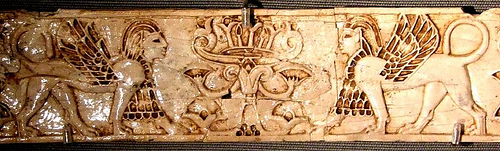
An image of keruvim flanking a tree of life is not unusual in the Ancient Near East.  But in the Torah, the keruvim are also guarding the entrance to a world called the garden of Eden.

Phoenician sphinxes and the tree of life

When the ark is carried into battle against the Philistines, it is referred to as: “the ark of the covenant of the God of Armies Sitting on the Keruvim.”  (I Samuel 4:4)  Here the keruvim are not guarding an entrance, but are flanking an invisible God.  The army hopes, in vain, that the ark with its keruvim will guard the soldiers from their enemies.

When King Solomon builds a permanent temple, he places two colossal gilded keruvim in the innermost chamber.  Their anatomy is not described, but their wings touch in the center of the room.  (I Kings 6:23-27)  Keruvim are also used as a decorative motif in the temple walls, as they are in the woven curtains around the inner chamber of the portable sanctuary.

The four mysterious hybrid creatures in vision of the prophet Ezekiel are also called keruvim.  Ezekiel’s keruvim have four wings each, human hands, calves’ hoofs, and four faces each (human, lion, ox, and eagle).  The throne where God’s glory appears hovers above them.  (Ezekiel 1:4-12 and 10:1-21)

Psalm 18 paints a metaphorical picture of God descending from the heavens to rescue King David from his enemies, and borrows a Canaanite image of the sky god riding on a winged steed.

          And [God] rode on a keruv and flew,

          And swooped on the wings of the wind.  (Psalm 18:11).

What do these references to keruvim mean?  If we look behind the descriptive details borrowed from neighboring cultures, keruvim seem to define a location for the appearance of God’s glory or presence.  The location might be between the keruvim, as in this week’s Torah portion, or above them, as in Ezekiel and Psalm 18, or behind them, as in Genesis.

Keruvim combine the traits of many animals, including humans.  Yet they are supernatural, existing somewhere between our reality and the transcendence of God.  Therefore they mark the dividing line between our world and a divine world we can neither enter nor understand.

Yet in Torah this dividing line is not a wall, but a gateway.  As long as we live in this world we cannot pass through the gate.  But we can imagine the entrance to the Garden of Eden.  And we can imagine God speaking to Moshe through the empty space between the keruvim above the ark, even if we can never enter the Holy of Holies ourselves.


One effect of this invisible portal to another reality, this gap in our universe, is that human beings feel a yearning that can never be satisfied by the things of this world.  The yearning keeps us searching—for love, for beauty, for the good, for the divine.  That is what it means to be human.

Maybe Adam and his counterpart Eve are not really human until they are expelled from the Garden of Eden.  Only then can they feel yearning.

Today we human beings still yearn for the ineffable.  And we are still responsible for using the passion of our yearning to fix the world we live in and make it more like the world we yearn for.

(This blog was first posted on February 7, 2010.)

Vayikra: Fat Belongs to God

(This blog was first posted on March 14, 2010.)

And the priest will make them go up in smoke, a food offering by fire, for a soothing fragrance.  All fat belongs to God.  A law for all time for your generations: You will not eat any fat, nor any blood, in any of your settlements.  (Leviticus 3:16-17–Vayikra)

chalev = fat, especially abdominal fat

dam = blood

The blood and the abdominal fat of livestock are reserved for God in chapter 3 of the book of Leviticus/Vayikra, which provides instructions for making zevach shelamim, the animal sacrifices that are offered by an individual for the sake of shaleim,  “wholeness”.  This type of offering is made to express gratitude to God, or to confirm peace with the people invited to share the feast afterward.

In brief, a man brings an unblemished cow, sheep, or goat to the altar, leans his hand against the animal’s head, and then slaughters it.  The priests splash the animal’s blood against all four sides of the altar.  The priests burn the fat covering the entrails, liver, and kidneys.  The fragrance of the smoke from the burning fat is the donor’s gift to God.  Then the donor and his guests eat the meat in celebration (and according to Leviticus 7:31-35, the priests are given the breast and the right thigh to eat).

Splashing blood is certainly a dramatic ritual, and fat burns well.  But fat and blood are not merely reserved for the ritual at the altar.  The Torah prohibits the people from eating any abdominal fat, or any blood, anywhere.  Even far away from the altar, even in a time when there is no temple, abdominal fat and blood are reserved for God.  Why?

A reason for not consuming blood is given in Leviticus 17:14: “You may not consume the blood of any flesh, because the nefesh (soul, animating force) of all flesh is its blood.” Genesis 9:5-6 also links blood with the nefesh of a human or animal, and forbids humans to eat flesh with the blood still in it.  Ramban (13th-century rabbi  Moshe ben Nachman) wrote that someone who eats an animal’s blood dilutes his own nefesh and becomes less spiritual, more animal.

So blood is equated with the nefesh, the animating force that makes a creature alive.  What does abdominal fat stand for?

Rabbi R.S. Hirsch wrote in the 19th century that the blood of an animal is its essence, while the fat is what it produces for its own needs.  The essence of an animal must never become a human being’s essence, and the needs of an animal must never become a human being’s needs.  Human nature must not be equated with animal nature.

I would add that abdominal fat is stored up as a reserve calorie supply against a hungrier time.  It’s like a pot of silver buried against hard times; in modern terms, it’s like a stock portfolio.  Stockpiling resources can be a good strategy.  But we must not become so attached to our stock portfolios that we despair when the market plunges.  We cannot really control our savings, so in a way they do not really belong to us.  The fat belongs to God.

Similarly, it’s good to tend to our health, to enjoy each day of life, to “choose life” for ourselves and others.  But my life, my nefesh, ultimately belongs to God.

Metzora & Acharey Mot: Doubles

(This blog was first posted on April 13, 2010.)

Gird your loins! This is a double blog, covering two weeks, two double Torah portions, two birds, and two goats!

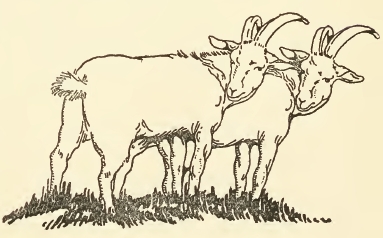
Goats, by Dugald Stewart Walker

The double Torah reading for the week culminating on Shabbat April 17 (Leviticus 12:1-15:33: Tazria and Metzora) deals mostly with tzara-at, a discoloring skin disease.  The double Torah reading for the week ending on Shabbat April 24 (Leviticus 16:1-20-27: Acharey Mot and Kedoshim) covers the rituals for atonement on Yom Kippur, forbidden sexual unions, and a series of ethical and religious laws.

This year I noticed a connection between the two double Torah portions. The first week’s reading includes a mysterious ritual using two birds, while the second week’s reading includes a remarkably similar ritual using two goats.  What does this parallelism mean?

Birds vs. goats

The reading for the week ending April 17 includes this passage about the ritual for making someone with the skin disease tzara-at ritually pure:

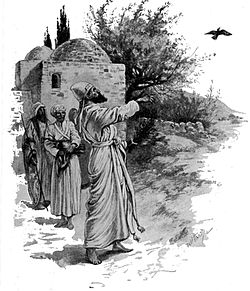
Let Go the Living Bird, by Paul Hardy ca. 1900

And the priest will give an order, and he will take for the one who is being ritually purified two living, ritually pure birds, and a stick of cedar, and crimson stuff, and [a branch of] oregano.  And the priest will give an order, and he will slaughter the first bird in a pottery vessel, over living water (water flowing from a natural source).  He will take the living bird, the stick of cedar, the crimson stuff, and the oregano, and he will dip them into the blood of the slaughtered bird, over the living water.  And he will sprinkle upon the one who is being ritually purified from tzara-at seven times; thus he will purify him, and then he will send out the living bird over the face of the open field.  (Leviticus/Vayikra 14:4-7, Metzora)

tzara-at (צָרַעַת) = a technical term for several specific skin conditions, one of which seems to be vitiligo.

And the reading for the week ending on April 24 includes this passage, part of the annual Yom Kippur ritual for purifying the whole community:

And from the assembly of the children of Israel, he (the high priest) will take two hairy male goats for a guilt offering and one ram for an elevation offering.  He will take the two goats and stand them up before God at the opening of the Tent of Meeting.  And Aaron will place lots on the two goats, one lot for God, and one lot for Azazel.  Then Aaron will bring the goat that received the lot for God, and he will make it a guilt offering.  But the goat that received the lot for Azazel, it will be stood alive before God, for making atonement over, by sending it out to Azazel to the wilderness.  (Leviticus 16:5-10, Acharei Mot)

Both rituals use two animals, which must be the same species and equal in value.  In both rituals, one animal is chosen randomly to be sacrificed to God, and the other is set free at the end of the ritual, sent out away from human habitations.  In both rituals, the blood of the sacrificed animal is sprinkled seven times on the person or place to be purified.  Other rituals described in the Torah employ sacrifices of birds and goats, and sprinkling of animal blood, but only in these two passages does the Torah require that one of a pair of animals is slaughtered and the other pair is set free.

Individual vs. community

Why are these two unique purification rituals so similar, when they seem to be performed for such different purposes?

Let’s look at who or what is being purified.  In the first reading, the metzora (the person who had the disease of tzara-at) is ritually purified after a priest has declared that the affliction is over.  Since someone with tzara-at must live in isolation, in a tent away from the community, the purification ritual is necessary for the ex-metzora to move back and rejoin society.

In Torah and Talmud, a metzora is not someone who just happened to develop a disease.  The appearance of an unnaturally white patch of skin is considered a physical manifestation of a flaw in the metzora’s moral condition.   Commentators have written that since the “treatment” for tzara-at is segregation from the community, and the ritual restores the metzora to society, the moral flaw of the metzora must be some anti-social behavior, such as slander.  A skin disease is an appropriate sign of immoral behavior toward society because the skin is the boundary between one person and another. (See my post Tazria & 2 Kings: A Sign of Arrogance ).

Isolation protects the rest of the community from being infected by the metzora’s bad behavior.  It also gives the metzora time to reflect and repent.  If the skin discoloration shrinks or disappears, the priest knows that the metzora has repented and can rejoin the community safely.  But first he must perform a public ritual establishing that the ex-metzora is now acceptable and accepted back into society.

In the second reading, from Acharei Mot, the blood of the sacrificed goat is sprinkled on the curtains around the innermost chamber of the sanctuary, and on the lid of the ark in the center.  The high priest performs this ritual once a year, on Yom Kippur (the Day of Atonement), to purify the Israelites’ focus of worship from their own cumulative ritual impurity.  This purification also atones for their misdeeds, particularly their pesha-im, their rebellions against the social order.

The implication, I think, is that while only some people are so egotistical that they pay no attention at all to the good of the community (and therefore get the mark of tzara-at on their skin), nobody is perfect.  We all rebel occasionally against the need for good social behavior.  These small misdeeds accumulate, tarnishing the purity of our focus on the holy.  So once a year, according to the Torah, two goats are brought to the high priest.  He slaughters one, and sprinkles its blood on the atonement-lid of the ark in the Holy of Holies.  He confesses the sins and misdeeds of the Israelites over the head of the other goat, and a designated man sets it free in the wilderness.   This public ritual establishes clearly that the whole community is acceptable to God once again.

Killing vs. setting free

The details of the two rituals are parallel, and both are performed to address immoral behavior against the community.  But why, in each case, is only one animal sacrificed, while its double is set free?

Maybe the two birds, and the two goats, represent two courses of action for human beings.  We can sacrifice our egos (while retaining the “blood”, the juiciest part, in the pottery bowl over living water) in order to be kind and cooperative; then we will be full members of society.  Or we can refuse to make any sacrifice; then we will be free—but we will also be sent away from the community, like the bird and the goat.  Even today, individuals who are not willing to sacrifice their own egotism, at least enough to avoid doing harm to other people, will be driven out of society.  If they are not kicked out of a group explicitly, they will still find themselves isolated and friendless … out in the wilderness.

And what if the freed bird or goat comes back?  Well, that’s one of the questions “the designated man” asks in my Torah monologue!

Ki Tavo: Cursing Yourself

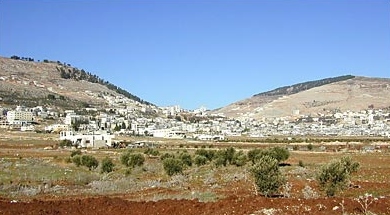
Today Mount Gezerim and Mount Eyval stand over the city of Nablus.  In the Hebrew Bible, the same two hills frame the ancient Canaanite city of Shekhem.  Although Moses has never been to Canaan, in the book of Deuteronomy/Devarim he knows about Gezerim and Eyval.

Mt. Gezerim (left), Nablus, Mt. Eyval (right)

Moses knows how the slopes that face one another curve to form a natural amphitheater, so anyone who stood in the middle of the valley and shouted could be heard by people standing on both slopes.  He gives the following order in this week’s Torah portion, Ki Tavo (“When you enter”):

These shall stand for blessing the people upon Mount Gerizim, when you have crossed the Jordan: Simon and Levi and Judah and Issachar and Joseph and Benjamin.  And these shall stand for the cursing on Mount Eyval: Reuben, Gad, and Asher, and Zebulun, Dan, and Naphtali.  And the Levites shall testify, and they shall say to every man of Israel in a loud voice: “Arur is the craftsman who makes a carved idol or a cast idol, an abomination to God, or the one who sets it up in a hiding-place.”  And all the people shall answer and say: “Amen.” (27:12-15)

arur (אָרוּר) = accursed; isolated and ruined.

amen (אָמֵן) = Supported!  Confirmed!  (A formula indicating acceptance of a curse, oath, message, deal, or religious tenet.)

The ritual continues with eleven more curses:

  • demeaning one’s father or mother
  • moving another’s boundary marker
  • making a blind person go astray
  • skewing justice concerning a stranger, orphan, or widow
  • having sex with one’s father’s wife
  • having sex with any animal
  • having sex with one’s sister or half-sister
  • having sex with one’s mother-in-law
  • hitting a person in private
  • taking payment to murder someone
  • not upholding the words of the Torah.

Commentators have pointed out that these curses deal with acts done secretly or privately, acts that society is not likely to discover and punish.  Ten of these acts concern treating other human beings badly, even when no one else knows.  The other two are about cheating on one’s religion.

Of course, more secret vices could be added to the list, but since the Israelites had twelve tribes, these twelve secret sins serve as examples.

By saying amen to the curses, the Israelites are internalizing an aversion to, or fear of, transgressing God’s ethical and religious rules.

The ritual Moses prescribes would have a major psychological impact on people just entering their new homeland.  Instead of proudly celebrating their military victories, they must dedicate themselves to being considerate with other humans and honest with God.

Why two mountains?

Mount Gerizim, which represents blessings, was thickly wooded in the biblical era.  Mount Eyval, which represents curses, was bare and stony.  Doing the right thing, therefore, would mean choosing the blessing of abundant life.  Doing the wrong thing would mean choosing an accursed life, a life of emptiness and spiritual death.

By saying “Amen” after the Levites recite each curse, the people affirm that this is the choice they must make.


Twelve Blessings

The twelve blessings are not listed in this week’s Torah portion, but according to the Talmud they are simple inverses of the curses, e.g. not making and secretly setting up an idol, etc.

However, it is easy to extrapolate active behaviors that lead to being blessed: worshiping only God; honoring one’s parents; respecting others’ property; guiding the blind; being just to people who are at a disadvantage in society; having sex only with appropriate partners; refraining from violence even when you could get away with it; putting life ahead of profit; and promoting the  rules in the Torah.

*

The blessings and curses still apply to us today.  Every time an individual faces a decision between doing something they know is wrong, and doing the right thing instead, that individual stands  between Mount Eyval and Mount Gerizim.

Thanks to our inner Levites, we know that if we do something wrong in secret,  we will still be accursed: we will suffer from guilt, we will feel degraded, and we will isolate ourselves.  If we do something good in secret, we will still be blessed: we will feel full of life, right with the world and right with our souls.

(This blog was first posted on August 23, 2010.)

Noach: Babble and Meaning

(This blog was first posted on October 5, 2010.)

And all the earth was of one language and one set of words …   And they said: Come let us build a city for ourselves, and a tower with its head in the heavens, and let us make a name for ourselves, lest we be scattered all over the face of the earth.   And God went down to see the city and the tower …

And God said: Hey!  One people and one language for all, and this is what they begin to do? …  Come let Us go down there and scramble their language, so that they will not understand each other’s language.  Then God scattered them from there over the surface of all the earth, and they stopped building the city.  Therefore He called its name Babel, because there God scrambled the language of all the earth, and from there God scattered them over all the surface of the earth. (Genesis/Deuteronomy 11:1-9)

Babel = Babylon, from the Sumerian Babilim, “Gate of the God” (both city and region)

balal = scramble, confuse; thoroughly mix oil into grain for a meal offering

Obviously the people of Babel are doing something wrong—something that isn’t horrible enough for God to destroy them with a flood, but is  serious enough for God to investigate and correct their mistake.

What is their mistake?  Three theories are: that they don’t follow God’s order to scatter; that they enforce conformity and suppress individuality; and that they try for permanence in a world God created for change.

1) They refuse to scatter.

After the Flood, God tells Noah’s descendants to be fruitful and multiply and fill the land.  But the traumatized people are afraid of being scattered.  There is comfort in numbers—and in being able to see that nobody is engaged the kind of outrageous sins that led to the Flood.  I can imagine the anthropomorphic God in this story heaving a celestial sigh, wondering what it will take for humans to get with the program.  Then God scrambles their minds so they have different languages and different sets of words—i.e., different concepts.  This time, when God scatters the humans, they have so much trouble communicating that they stay scattered.

2) They suppress the individual.

The people of Babel speak only in the plural, and appear to be in perfect agreement.  No individuals are named in the story.  Whether this counts as cooperation, or conformity, it’s not what God has in mind.  Sforno (Rabbi Obadiah Sforno, 16th century) wrote that if everyone held the same beliefs, including the same beliefs about God, then no one would seek the true God.  Only when people find out about religious differences do they develop a desire for deeper understanding.   Martin Buber (1878-1965) wrote that only a person with a well-developed sense of self is able to connect with God.

In the allegory of Babel, after God scatters the people and gives them different languages and concepts and cultures, individuality and variety return to humankind.  Then we are again able to learn and change.

3) They crave permanence.

Permanence is a continuing issue in Genesis/Bereishit.  Although subsequent chapters focus on the desire for a sense of permanence through one’s descendants, the book has already addressed the issue of death.  The result of eating from the Tree of Knowledge in Eden is personal mortality; God removes Adam and Eve from the garden of Eden and places them in our own world, where they will eventually die.  Noah and his family witness the death of their entire world, and must start all over again when the Flood waters recede.

What is the meaning of life when, sooner or later, you will die?  One possible response is to create something that will outlast you, that will be a monument down through the ages.  This is difficult to do alone.  So the people act collectively to make a name for themselves, by building a city and a tower so high that its head is in the heavens.  (In this part of the Torah, the heavens are eternal, while the earth is always changing.)

Of course their plan fails.  God, or the nature of the universe God created, will not let anything on earth endure forever.

The answer is to give up on permanence, and find a different meaning of life.

Each human must find his or her own individual meaning.  But the book of Genesis offers some suggestions.  We can “walk with God”, which I interpret as behaving morally for its own sake.  We can raise and teach children.  We can love another person, as Isaac loves Rebecca and Jacob loves Rachel.  We can wrestle with ourselves and develop our own hidden potential, like Jacob wrestling and finding new courage at the ford of Yabbok.

What other ways can we find meaning in a life without permanence?  I welcome your comments.

Chayyei Sarah: A Peculiar Oath

(I first posted this essay on October 24, 2010, then added footnotes and illustrations in 2019.)

Which body part does Abraham’s steward place his hand under when he swears an oath to his master?

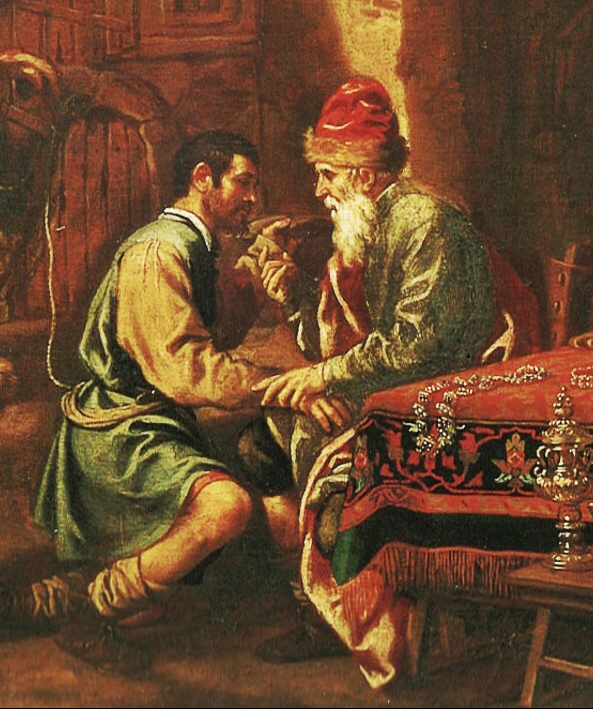
Abraham and steward, Abraham’s Solemn Charge,, by Pedro Orrente, 17th century, detail

Now Abraham was an elder, coming on in days, and God had blessed Abraham in everything.  And Abraham said to his servant, an elder of his household, the one who governed all that was his: Please place your hand under my yareikh, and I will make you swear by God, god of the heavens and god of the earth, that you do not take a wife for my son from the daughters of the Canaanites amidst whom I am dwelling.  Because you must go to my [former] land and to my relatives, and [there] you must take a wife for my son, for Isaac.  (Genesis/Bereishit 24:1-4)

yareikh (יָרֵךְ) = hip, upper thigh, buttocks, genitals.

Only two times in the Torah does someone ask another person to place his hand under the yareikh and swear an oath: in this week’s Torah portion, Chayyei Sarah (“Life of Sarah”), and in Genesis 47:29, when Jacob makes his son Joseph swear not to bury him in Egypt.

In both cases, the person requesting the oath believes he will soon die.  He will not be there to make sure his wishes are carried out, so he deputizes a man he trusts and asks him to swear a serious oath.

Abraham is 137 years old when he requests this oath.  Neither he nor his steward Eliezer1 expect him to live long enough to give further instructions if Eliezer cannot find a wife for Isaac in Abraham’s old home, the city of Charan in Aram.  (Ironically, it turns out that Abraham lives another 38 years.)

He asks his steward, who will be in charge after he dies, to swear an oath while his hand is placed—where, exactly?

19th-century rabbi Samson Raphael Hirsch argued that it was the patriarch’s thigh or buttock: the first place to touch the ground when one rests.  Therefore, he wrote, the man about to swear the oath shows the dying man that he can rest in peace, trusting to the power of the swearer’s hand.2

George Washington Swearing on a Bible

Yet in other parts of the Torah, the word yareikh is a euphemism for the genitals.   A rabbi in the Talmud declared that Abraham’s servant grasped his circumcised penis, since oaths administered by a court require one to hold a sacred item in the hand while swearing.3  Rashi4 confirmed this opinion, and his commentary is not known for flights of fancy.  Rabbi Elie Munk pointed out that the book of Genesis is set in a time before the giving of the Torah, so a circumcised penis was the only sacred object available.5

Other commentators have noted that the English words testify, testimony, and testicles all come from Latin words based on the root “testis”, and claim that this may reflect a Roman practice of taking an oath on the genitals.

If the male genitals are a symbol of creative power, they refer to God the Creator.  If they represent the covenant with God, they refer to holiness.  Either way, the oath-taker is asked to place his hand in a position underneath a symbol of the sacred.

Throughout the Torah, the hand is a metaphor for the power to act, to do things in the world.  So in this ancient ritual, the one swearing the oath places his own power to act underneath, below, subservient to, the sacred object of the other man.  In other words, he is promising he will do everything in his power to carry out the other man’s will as if it were the will of God.  A potent oath!

A vow made to a dying person is one-sided, obligating only the person swearing the oath.  If unforeseen circumstances arise after someone is dead, is the other party still obliged to carry out a mission that now looks like a bad idea?  Or should the survivor be free to change course to address the new circumstances?

In the book of Genesis, Abraham’s steward Eliezer has little trouble bringing back a bride for Isaac from Aram.  (In the other example of this oath, Joseph easily gets Pharaoh’s permission to bury his father in Hebron instead of Egypt.)  My impression is that Eliezer enjoys carrying out his oath by matchmaking.

*

Not all deathbed requests are that easy, or that benign.  Yet human nature tends to put a high value on a deathbed promise; for example, people go to great lengths to carry out a deceased person’s wishes regarding burial.  There is also psychological pressure to reassure a dying person.  In that situation, is a promise really freely given?

Suppose you “knew” that a certain thing had to happen, and you doubted you would live long enough to make sure it did happen.  Is it right to ask someone else to swear to make it happen?  What if the person you are asking agrees to carry our your mission even though they do not share your belief in its necessity?  What if the circumstances change after your death?

Is it right for a living person to be bound by the desire of someone who is dead?

  1. See Genesis 15:2.
  2. Rav Samson Raphael Hirsch, The Hirsch Chumash: Sefer Bereshit, translated by Daniel Haberman, Feldheim Publishers, Jerusalem, 2000, p. 514.
  3. Talmud Bavli, Shevuot 38b.
  4. Rashi is the acronym of 11th-century Rabbi Shlomoh Yitzchaki.
  5. Rabbi Elie Munk, The Call of the Torah: Bereishis, Mesorah Publications, 1994, p. 626.

Toledot: Why?

(This blog was first posted on November 1, 2010.)

Isaac prayed to God, in front of his wife, because she was barren; and God was moved by the prayer to him; and his wife, Rebecca, conceived.  But the sons pushed and crushed one another inside her.  And she said: “If thus why this I?”  And she went to question God.  (Genesis/Bereishit 25:21-22)

im kein lamah zeh anochi = literally:  “If thus why this I?”

“If it’s like this, why me?”

“Why am I this way?”

“If so, why do I exist?”

In last week’s Torah portion, Rebecca is portrayed as remarkably strong-willed and hospitable to strangers (hauling water for the camels of Abraham’s steward until they’ve drunk their fill); decisive and courageous (deciding she will leave at once to marry a stranger in a strange land); and impressed by a man who prays (falling off her camel when she sees him, and then, upon discovering the man is her fiancé Isaac, instantly donning her wedding veil).

This week’s Torah portion, Toledot (Histories) opens when Isaac and Rebecca have been married almost twenty years, and are still childless.  Isaac prays, and Rebecca gets pregnant, but the violent movements in her belly alarm her.  She says something cryptic, then becomes the first person in the Torah to seek out and question God.

Even Abraham waits for God to speak to him before venturing to ask God any questions.  But although Rebecca lets her husband do the praying for conception, she does not ask Isaac to find out about the battle in her belly.  She goes straight to God.

At least that’s what the text says.  Some medieval commentary says she went to the school of Noah’s sons Shem and Ever, who were somehow still alive and running the world’s first yeshiva (Jewish seminary).  Some modern commentary speculates that she actually went to a professional oracle.  But the remaining commentary credits her with going directly to God.  I suspect Rebecca goes to the nearest holy spot—perhaps the well where Hagar heard God—and stands there alone, asking her question from her heart until she gets an answer.

What is her motivation for this unprecedented act?  It depends on the interpretation of her cry, Im kein lamah zeh anochi.  If she means “If it’s like this, why me?”, Rebecca questions God because she wishes some other woman were carrying the painful burden and risking miscarriage or her own death.  Why can’t Isaac have his sons by a concubine instead?  (c.f. Abraham Ibn Ezra, 12th century; Obadiah Sforno, 16th century).  Is God punishing her because there’s something wrong with her?  (c.f. Talmud, tractate Sotah 12a).

If Rebecca means, “Why am I this way?”, she just wants to understand why her pregnancy is so unusual (c.f. Radak–Rabbi David Kimhe, circa 1200; 19th-century rabbi S.R. Hirsch).  What can she expect when it’s time for the birth?  What will happen after that?

But if Rebecca means, “If so, why do I exist?”, she seems to be close to despair, wondering if her painful pregnancy is worth living through (c.f. 13th-century rabbi Moses ben Nachman).  Going to God is a last-ditch effort to find a reason to carry on.

I don’t think the “Why me?” attitude fits Rebecca’s character.  Would someone that hospitable to a stranger want to inflict pain or death on a concubine?  Would someone that self-confident wonder if she had some horrible hidden flaw?

“Why am I this way?” makes more sense.  Rebecca might well have a practical motivation for questioning God.  She is fundamentally a woman of action, and now that something strange and alarming is happening, she can no longer stay in her tent and leave things up to her adored husband.  She has to find out what will happen next, so she can be prepared to respond to any emergency.  Later in the Torah portion, when she overhears that Isaac is about to give the blessing to the wrong twin, she reacts with a decisive emergency response, as if certain that her desire matches God’s will.

Yet is also possible that even a strong woman like Rebecca might come close to despair after 20 years of watching her husband pray for a child right in front of her, followed by a pregnancy that tortures her and seems likely to end in death.  She would be desperate to find some meaning in life, some reason for it all—desperate enough to seek out God.

Many of us reach a moment when we wonder: “Why am I this?”  Is there some reason for everything I’ve gone through?  What is my purpose in life?  What is the meaning of it?

I believe the worst thing to do, when that moment comes, is to accept the answer of an authority figure:  someone in a pulpit, on a book jacket, on television, on a calendar page or refrigerator magnet.  Someone else’s idea of the meaning of life might bring me temporary comfort, but how can it answer a cry from the depths of my soul?  No, I have to seek God on my own, like Rebecca.  I have to keep questioning God, even though I don’t know what God is, until my answer comes.

I think I am beginning to feel my purpose in life, but it’s too amorphous to put into words.  And I believe, without any rational reason, that there is meaning in life, but I don’t know what the meaning is.  Since I’m a modern woman, I get my incomplete and mysterious answers in the form of vague intuitions, instead of in the form of riddling prophecies like the one Rebecca received.

Maybe a complete answer will never come to me.  That’s okay.  I’ll keep on seeking God, I’ll keep on questioning.  For me, the search is what’s important.

Beshalach: Pillar of Cloud and Fire

Humans often hear God’s voice in the Torah, but there are only two verses where humans might be seeing part of God: when the elders climb Mount Sinai and behold God’s feet in Exodus 24:10, and when God lets Moses see his back in Exodus 33:23.  The rest of the time, God becomes manifest through two kinds of supernatural messengers (called angels in many English translations). One kind looks like a human being, and the other kind looks like an annatural fire.

One of these supernatural fires is the pillar of cloud and fire that leads the Israelites from the border of Egypt all the way to the Jordan River. This pillar first appears in this week’s Torah portion, Beshalach (“when he was sending out”).

After the tenth plague, Pharaoh finally sends the Israelites out of Egypt.  When they cross the border of Egypt and head into the wilderness, the Torah says that God “went before them”. Then it describes the messenger that actually went before them:

And God went before them; by day, in an amud of cloud to lead them down the road, and by night, in an amud of fire to give light for them, for walking by day and night.  The amud of cloud by day and the pillar of fire by night never withdrew from before the people.  (Exodus/Shemot 13:21-22)

amud (עַמּוּד) = pillar, column, upright support. (From the verb amad. עָמַד = stand, take a stand.)

Pillar of Cloud, by Johann Jakob Scheuchzer, 1731

The commentary is divided on whether there is one pillar or two.  But if the pillar of cloud is replaced by a separate pillar of fire for the night, what does the changing of the guard look like?  The Torah never describes it.

Pharaoh changes his mind about releasing the Israelites, and sends an army unit of charioteers after them. The Egyptians catch up with the Israelites just as they have pitched camp on the shore of the Sea of Reeds. 

Then the messenger of God pulled out, the one going before the camp of Israel, and it went behind them; thus the amud of the cloud pulled out from before them, vaya-amod behind them.  Thus it came between the camp of Egypt and the camp of Israel, and it was the cloud and the darkness, and it lit up the night, so that this one did not come near this one, all the night.  (Exodus 14:19-20)

vaya-amod (וַיַּעֲמֺד) = and it stood, and it stationed itself. (A form of the verb amad.)

Moses follows God’s instructions and raises his hand over the sea, and God uses a strong east wind to dry up a swath of the sea. The Israelites walk across, between the two walls of water. But the Egyptian charioteers are stuck behind the pillar of fire until dawn.

Rabbi Ovadiah Sforno, a 16th-century Italian commentator, wrote that the angel, the pillar of cloud, and the pillar of fire were three separate things, and the messenger or angel came down to direct the two pillars, which both circled around to stand behind the Israelites, between their camp and the camp of the Egyptian army. But the text itself contradicts his interpretation:

And it was in the morning watch when God looked down on the camp of Egypt from an amud of fire and cloud, and it put the camp of Egypt into an uproar.  (Exodus 14:24)

Here the Torah says that God is in “a pillar of fire and cloud”, which sounds like one pillar containing both elements. I picture a pillar that looks like a column of fog in the daylight. As it gets dark, people see sparks of fire in the cloud, and at night only the column of sparks is visible. When dawn comes during the “morning watch” of the night, the cloud can again be seen through the sparks. Since the pillar itself is God’s messenger, God looks down from the amud.

This pillar can only be divine.  A whirlwind can form a temporary pillar of cloud, a bonfire can make a pillar of sparks, and an erupting volcano can do both. But a continuously moving pillar of cloud and fire is a miracle.

And this pillar not only controls the movements of the Egyptians, but also communicates a message to both camps: that God stands up for the Israelites, protecting them from the Egyptians. Looking down from the pillar of cloud and fire, God puts the Egyptian army in an uproar by making their chariot wheels get stuck or fall off.  Only then, when it is too late, do the Egyptians recognize that God is waging war on them, and decide to flee.

The amud continues to serve more than one purpose in the books of Exodus and Numbers. When the Israelites are traveling, rather than camping, the pillar is a guide showing them which way to go.  It is also a reminder that God is with them—that God is “taking a stand” for them, and they must “take a stand” for their god.

Furthermore, fire naturally inspires awe and fear.  A cloud, on the other hand, is usually made of fog.  In the desert, moisture is a welcome caress on the skin, a gentle gift, a reminder of God’s kindness.  God’s kindness is confirmed later in the story by the fact that even after the Israelites do things that enrage both Moses and God, even after they make the Golden Calf, the pillar of cloud and fire returns to lead them.

No matter how visible the reminder of God’s presence in our world, people will ignore it if they are fixated on having their own way.  It’s a replay of Pharaoh’s refusal to take the miraculous plagues seriously.  When we are determined to solve a problem by eliminating it, we override any inner qualms, whether they appear as cloud, the heart-softening temptation of kindness, or as fire, the nagging fear that we are playing god or doing something wrong.

But if we try to be holy people, metaphorically taking a stand with God, we can recognize both kindness and awe as manifestations of the divine, inspiring us to take the right path.  We have a better chance of noticing when we are fixated on killing a problem.  We can look around for other solutions, other ways of dealing with the problem, even other ways of working with problematic people.

Instead of getting stuck in the muck and drowning, we can continue on our journey, guided by the pillar of cloud and fire within.

(This blog was first posted on January 9, 2011, and revised in January 2023.)

Yitro: Not in My Face

Moses, frieze on U.S. Supreme Court building, by Adolph Weinman

Terrified by a direct experience of God, the people ask Moses to be their intermediary and tell them God’s orders.  So God gives Moses the “Ten Commandments” in this week’s Torah portion, Yitro.  Both “Ten” and “Commandments” are designations invented by commentators; the Torah merely introduces the set of fundamental obligations with:

And God spoke all these words, saying—  (Exodus/Shemot 20:1)

The next sentence is:

I am God, your God who brought you from the land of Egypt, from the house of slaves.  (Exodus 20:2)

Some commentators count this as the first commandment, and Exodus 20:3-6 as the second commandment, prohibiting other gods and idols.  But the reminder that the God of Israel delivered the people from slavery in Egypt does not sound like a commandment to me.  I agree with commentators who count Exodus 20:3, prohibiting other gods, as the first commandment, and Exodus 20:4-6, prohibiting physical objects as idols, as the second commandment.

The verse prohibiting other gods reads:

You must have no elohim acheirim al panai.  (Exodus/Shemot 20:3)

elohim acheirim (אֱלֺהִים אֲחֵרִים) = other gods; gods of others.

al (עַל) = on, upon, over, above; besides, in addition to; over against; concerning; because of.  (The most common meaning of al is “on: or ”over”, but verse 5 explains that you must not worship anything else but God—so verse 3 cannot mean that it’s okay to serve other gods as long as they are below God. )

panai (פָּנָי) = my face, my presence, my surface, my visible side, my identity.

Here are five literal translations of this ambiguous commandment:

      You must not have other gods besides My presence.

      You must not have gods of others in addition to My presence.

      You must not have gods of others in addition to My visible side.

      You must not have other gods over against Me.

      You must not have other gods in My face.

First let’s look at the difference between “other gods” and “gods of others”, two phrases that are identical in Biblical Hebrew.  If the Israelites can’t have “other gods”, they are forbidden to worship not only the gods of others, but also any gods they happen to think of or notice on their own.  Therefore they must not worship any manifestations of God, such as angels or the stars or nature.  Modern commentary sometimes adds that we must not make a god out of wealth, or having a perfect body, or any other value exalted by our culture.  We may only have one God.

On the other hand, if the Israelites can’t have “gods of others”, the focus turns to the kind of gods worshiped by Egyptians, Mesopotamians, and Canaanites.  These peoples made idols in an effort to entice gods to come down out of the heavens or up from under the earth and inhabit their statues, the way humans inhabit their bodies.  A god living in a statue is easier to communicate with, and easier to appease and honor and butter up so it will act for your benefit.

Throughout the Torah, God may appear as a humanoid angel or as fire or a cloud, but what we see is God’s choice of manifestation, not the work of our own hands.  The vision may disappear at any moment; it is not solid; it cannot be set on a table or paraded through town.  Therefore God is not like the gods of others.

Reading elohim acheirim as “gods of others” leads right into the next three verses in this week’s Torah portion:

Do not make yourself a carved idol or any likeness of what is in the heavens above, or of what is in the land below, or of what is in the water beneath the land.  Do not prostrate to them and do not serve them.  Because I am God, your god, a jealous god, calling to account the wrongdoing of fathers upon children over the third and fourth (generations), for my enemies; but doing kindness to the thousandth (generation) for those who love me and who observe my commandments.  (Exodus 20:4-6)

This continuity supports the theory that Exodus 20:3 and Exodus 20:4-6 are one “commandment”, but it makes the list of what the people must do and not do add up to nine instead of ten.

The ambiguity is not over.  What about the last two words of Exodus 20:3, al panai?

If the phrase means “over against Me”, or even “in My face”, it is a warning that God would be offended if you worshiped any other gods.  After all, God is the one who rescued you from slavery (Exodus 20:2).  And God is a “jealous” god, i.e. passionately exclusive (Exodus 20:5).

However, if al-panai is translated as “in addition to My presence” or “besides My presence”, it means simply that the Israelites must worship and serve only the one god.  Some commentators who have translated the word panai as “My presence” have interpreted it as meaning that God is present everywhere and at all times, so don’t think you can get away with having another god without the One God noticing.

But since the next verse in Exodus begins “Do not make yourself a carved idol”, I think panai means both “My presence” and “My visible surface”.  The Torah contrasts the carved idols that are supposedly inhabited by the gods of others with the presence of the God of the Israelites, which is sometimes visible as a vision of an angel or a fire, and sometimes invisible, as when God speaks from the empty space above the cherubim in the Holy of Holies.

Similarly, sometimes the God of the Torah is audible to everyone, as a sound like thunder or the blowing of rams’ horns.  And sometimes God is audible only to one person, who “hears” the words that God speaks inside him or her.

*

The commandment in Exodus 20:3 not only orders us to refrain from serving other gods, but also asks us to serve our God.  How do we do that?

How can we honor the face of God, when God cannot be contained in a statue, a synagogue, a church, a mosque, or even the Holy of Holies?  What can we do when God makes its presence known unpredictably, when you never know where, when, or who will become aware of God for a moment?

And how can we serve our elusive God when even the Ten Commandments give us only a general idea of what we are supposed to do?  And when half of the more specific laws in the Torah were dropped as inapplicable more than 1,500 years ago in the Talmud?

Does anyone today have the authority to tell us how to serve God?  What actions and attitudes can we take that count as service?

I’m working on some answers to those questions.  It will take me the rest of my life.

(An earlier version of this blog was posted on January 16, 2011.)