Toledot: Why?

(This blog was first posted on November 1, 2010.)

Isaac prayed to God, in front of his wife, because she was barren; and God was moved by the prayer to him; and his wife, Rebecca, conceived.  But the sons pushed and crushed one another inside her.  And she said: “If thus why this I?”  And she went to question God.  (Genesis/Bereishit 25:21-22)

im kein lamah zeh anochi = literally:  “If thus why this I?”

“If it’s like this, why me?”

“Why am I this way?”

“If so, why do I exist?”

In last week’s Torah portion, Rebecca is portrayed as remarkably strong-willed and hospitable to strangers (hauling water for the camels of Abraham’s steward until they’ve drunk their fill); decisive and courageous (deciding she will leave at once to marry a stranger in a strange land); and impressed by a man who prays (falling off her camel when she sees him, and then, upon discovering the man is her fiancé Isaac, instantly donning her wedding veil).

This week’s Torah portion, Toledot (Histories) opens when Isaac and Rebecca have been married almost twenty years, and are still childless.  Isaac prays, and Rebecca gets pregnant, but the violent movements in her belly alarm her.  She says something cryptic, then becomes the first person in the Torah to seek out and question God.

Even Abraham waits for God to speak to him before venturing to ask God any questions.  But although Rebecca lets her husband do the praying for conception, she does not ask Isaac to find out about the battle in her belly.  She goes straight to God.

At least that’s what the text says.  Some medieval commentary says she went to the school of Noah’s sons Shem and Ever, who were somehow still alive and running the world’s first yeshiva (Jewish seminary).  Some modern commentary speculates that she actually went to a professional oracle.  But the remaining commentary credits her with going directly to God.  I suspect Rebecca goes to the nearest holy spot—perhaps the well where Hagar heard God—and stands there alone, asking her question from her heart until she gets an answer.

What is her motivation for this unprecedented act?  It depends on the interpretation of her cry, Im kein lamah zeh anochi.  If she means “If it’s like this, why me?”, Rebecca questions God because she wishes some other woman were carrying the painful burden and risking miscarriage or her own death.  Why can’t Isaac have his sons by a concubine instead?  (c.f. Abraham Ibn Ezra, 12th century; Obadiah Sforno, 16th century).  Is God punishing her because there’s something wrong with her?  (c.f. Talmud, tractate Sotah 12a).

If Rebecca means, “Why am I this way?”, she just wants to understand why her pregnancy is so unusual (c.f. Radak–Rabbi David Kimhe, circa 1200; 19th-century rabbi S.R. Hirsch).  What can she expect when it’s time for the birth?  What will happen after that?

But if Rebecca means, “If so, why do I exist?”, she seems to be close to despair, wondering if her painful pregnancy is worth living through (c.f. 13th-century rabbi Moses ben Nachman).  Going to God is a last-ditch effort to find a reason to carry on.

I don’t think the “Why me?” attitude fits Rebecca’s character.  Would someone that hospitable to a stranger want to inflict pain or death on a concubine?  Would someone that self-confident wonder if she had some horrible hidden flaw?

“Why am I this way?” makes more sense.  Rebecca might well have a practical motivation for questioning God.  She is fundamentally a woman of action, and now that something strange and alarming is happening, she can no longer stay in her tent and leave things up to her adored husband.  She has to find out what will happen next, so she can be prepared to respond to any emergency.  Later in the Torah portion, when she overhears that Isaac is about to give the blessing to the wrong twin, she reacts with a decisive emergency response, as if certain that her desire matches God’s will.

Yet is also possible that even a strong woman like Rebecca might come close to despair after 20 years of watching her husband pray for a child right in front of her, followed by a pregnancy that tortures her and seems likely to end in death.  She would be desperate to find some meaning in life, some reason for it all—desperate enough to seek out God.

Many of us reach a moment when we wonder: “Why am I this?”  Is there some reason for everything I’ve gone through?  What is my purpose in life?  What is the meaning of it?

I believe the worst thing to do, when that moment comes, is to accept the answer of an authority figure:  someone in a pulpit, on a book jacket, on television, on a calendar page or refrigerator magnet.  Someone else’s idea of the meaning of life might bring me temporary comfort, but how can it answer a cry from the depths of my soul?  No, I have to seek God on my own, like Rebecca.  I have to keep questioning God, even though I don’t know what God is, until my answer comes.

I think I am beginning to feel my purpose in life, but it’s too amorphous to put into words.  And I believe, without any rational reason, that there is meaning in life, but I don’t know what the meaning is.  Since I’m a modern woman, I get my incomplete and mysterious answers in the form of vague intuitions, instead of in the form of riddling prophecies like the one Rebecca received.

Maybe a complete answer will never come to me.  That’s okay.  I’ll keep on seeking God, I’ll keep on questioning.  For me, the search is what’s important.

Beshalach: Pillar of Cloud and Fire

Humans often hear God’s voice in the Torah, but there are only two verses where humans might be seeing part of God: when the elders climb Mount Sinai and behold God’s feet in Exodus 24:10, and when God lets Moses see his back in Exodus 33:23.  The rest of the time, God becomes manifest through two kinds of supernatural messengers (called angels in many English translations). One kind looks like a human being, and the other kind looks like an annatural fire.

One of these supernatural fires is the pillar of cloud and fire that leads the Israelites from the border of Egypt all the way to the Jordan River. This pillar first appears in this week’s Torah portion, Beshalach (“when he was sending out”).

After the tenth plague, Pharaoh finally sends the Israelites out of Egypt.  When they cross the border of Egypt and head into the wilderness, the Torah says that God “went before them”. Then it describes the messenger that actually went before them:

And God went before them; by day, in an amud of cloud to lead them down the road, and by night, in an amud of fire to give light for them, for walking by day and night.  The amud of cloud by day and the pillar of fire by night never withdrew from before the people.  (Exodus/Shemot 13:21-22)

amud (עַמּוּד) = pillar, column, upright support. (From the verb amad. עָמַד = stand, take a stand.)

Pillar of Cloud, by Johann Jakob Scheuchzer, 1731

The commentary is divided on whether there is one pillar or two.  But if the pillar of cloud is replaced by a separate pillar of fire for the night, what does the changing of the guard look like?  The Torah never describes it.

Pharaoh changes his mind about releasing the Israelites, and sends an army unit of charioteers after them. The Egyptians catch up with the Israelites just as they have pitched camp on the shore of the Sea of Reeds. 

Then the messenger of God pulled out, the one going before the camp of Israel, and it went behind them; thus the amud of the cloud pulled out from before them, vaya-amod behind them.  Thus it came between the camp of Egypt and the camp of Israel, and it was the cloud and the darkness, and it lit up the night, so that this one did not come near this one, all the night.  (Exodus 14:19-20)

vaya-amod (וַיַּעֲמֺד) = and it stood, and it stationed itself. (A form of the verb amad.)

Moses follows God’s instructions and raises his hand over the sea, and God uses a strong east wind to dry up a swath of the sea. The Israelites walk across, between the two walls of water. But the Egyptian charioteers are stuck behind the pillar of fire until dawn.

Rabbi Ovadiah Sforno, a 16th-century Italian commentator, wrote that the angel, the pillar of cloud, and the pillar of fire were three separate things, and the messenger or angel came down to direct the two pillars, which both circled around to stand behind the Israelites, between their camp and the camp of the Egyptian army. But the text itself contradicts his interpretation:

And it was in the morning watch when God looked down on the camp of Egypt from an amud of fire and cloud, and it put the camp of Egypt into an uproar.  (Exodus 14:24)

Here the Torah says that God is in “a pillar of fire and cloud”, which sounds like one pillar containing both elements. I picture a pillar that looks like a column of fog in the daylight. As it gets dark, people see sparks of fire in the cloud, and at night only the column of sparks is visible. When dawn comes during the “morning watch” of the night, the cloud can again be seen through the sparks. Since the pillar itself is God’s messenger, God looks down from the amud.

This pillar can only be divine.  A whirlwind can form a temporary pillar of cloud, a bonfire can make a pillar of sparks, and an erupting volcano can do both. But a continuously moving pillar of cloud and fire is a miracle.

And this pillar not only controls the movements of the Egyptians, but also communicates a message to both camps: that God stands up for the Israelites, protecting them from the Egyptians. Looking down from the pillar of cloud and fire, God puts the Egyptian army in an uproar by making their chariot wheels get stuck or fall off.  Only then, when it is too late, do the Egyptians recognize that God is waging war on them, and decide to flee.

The amud continues to serve more than one purpose in the books of Exodus and Numbers. When the Israelites are traveling, rather than camping, the pillar is a guide showing them which way to go.  It is also a reminder that God is with them—that God is “taking a stand” for them, and they must “take a stand” for their god.

Furthermore, fire naturally inspires awe and fear.  A cloud, on the other hand, is usually made of fog.  In the desert, moisture is a welcome caress on the skin, a gentle gift, a reminder of God’s kindness.  God’s kindness is confirmed later in the story by the fact that even after the Israelites do things that enrage both Moses and God, even after they make the Golden Calf, the pillar of cloud and fire returns to lead them.

No matter how visible the reminder of God’s presence in our world, people will ignore it if they are fixated on having their own way.  It’s a replay of Pharaoh’s refusal to take the miraculous plagues seriously.  When we are determined to solve a problem by eliminating it, we override any inner qualms, whether they appear as cloud, the heart-softening temptation of kindness, or as fire, the nagging fear that we are playing god or doing something wrong.

But if we try to be holy people, metaphorically taking a stand with God, we can recognize both kindness and awe as manifestations of the divine, inspiring us to take the right path.  We have a better chance of noticing when we are fixated on killing a problem.  We can look around for other solutions, other ways of dealing with the problem, even other ways of working with problematic people.

Instead of getting stuck in the muck and drowning, we can continue on our journey, guided by the pillar of cloud and fire within.

(This blog was first posted on January 9, 2011, and revised in January 2023.)

Yitro: Not in My Face

Moses, frieze on U.S. Supreme Court building, by Adolph Weinman

Terrified by a direct experience of God, the people ask Moses to be their intermediary and tell them God’s orders.  So God gives Moses the “Ten Commandments” in this week’s Torah portion, Yitro.  Both “Ten” and “Commandments” are designations invented by commentators; the Torah merely introduces the set of fundamental obligations with:

And God spoke all these words, saying—  (Exodus/Shemot 20:1)

The next sentence is:

I am God, your God who brought you from the land of Egypt, from the house of slaves.  (Exodus 20:2)

Some commentators count this as the first commandment, and Exodus 20:3-6 as the second commandment, prohibiting other gods and idols.  But the reminder that the God of Israel delivered the people from slavery in Egypt does not sound like a commandment to me.  I agree with commentators who count Exodus 20:3, prohibiting other gods, as the first commandment, and Exodus 20:4-6, prohibiting physical objects as idols, as the second commandment.

The verse prohibiting other gods reads:

You must have no elohim acheirim al panai.  (Exodus/Shemot 20:3)

elohim acheirim (אֱלֺהִים אֲחֵרִים) = other gods; gods of others.

al (עַל) = on, upon, over, above; besides, in addition to; over against; concerning; because of.  (The most common meaning of al is “on: or ”over”, but verse 5 explains that you must not worship anything else but God—so verse 3 cannot mean that it’s okay to serve other gods as long as they are below God. )

panai (פָּנָי) = my face, my presence, my surface, my visible side, my identity.

Here are five literal translations of this ambiguous commandment:

      You must not have other gods besides My presence.

      You must not have gods of others in addition to My presence.

      You must not have gods of others in addition to My visible side.

      You must not have other gods over against Me.

      You must not have other gods in My face.

First let’s look at the difference between “other gods” and “gods of others”, two phrases that are identical in Biblical Hebrew.  If the Israelites can’t have “other gods”, they are forbidden to worship not only the gods of others, but also any gods they happen to think of or notice on their own.  Therefore they must not worship any manifestations of God, such as angels or the stars or nature.  Modern commentary sometimes adds that we must not make a god out of wealth, or having a perfect body, or any other value exalted by our culture.  We may only have one God.

On the other hand, if the Israelites can’t have “gods of others”, the focus turns to the kind of gods worshiped by Egyptians, Mesopotamians, and Canaanites.  These peoples made idols in an effort to entice gods to come down out of the heavens or up from under the earth and inhabit their statues, the way humans inhabit their bodies.  A god living in a statue is easier to communicate with, and easier to appease and honor and butter up so it will act for your benefit.

Throughout the Torah, God may appear as a humanoid angel or as fire or a cloud, but what we see is God’s choice of manifestation, not the work of our own hands.  The vision may disappear at any moment; it is not solid; it cannot be set on a table or paraded through town.  Therefore God is not like the gods of others.

Reading elohim acheirim as “gods of others” leads right into the next three verses in this week’s Torah portion:

Do not make yourself a carved idol or any likeness of what is in the heavens above, or of what is in the land below, or of what is in the water beneath the land.  Do not prostrate to them and do not serve them.  Because I am God, your god, a jealous god, calling to account the wrongdoing of fathers upon children over the third and fourth (generations), for my enemies; but doing kindness to the thousandth (generation) for those who love me and who observe my commandments.  (Exodus 20:4-6)

This continuity supports the theory that Exodus 20:3 and Exodus 20:4-6 are one “commandment”, but it makes the list of what the people must do and not do add up to nine instead of ten.

The ambiguity is not over.  What about the last two words of Exodus 20:3, al panai?

If the phrase means “over against Me”, or even “in My face”, it is a warning that God would be offended if you worshiped any other gods.  After all, God is the one who rescued you from slavery (Exodus 20:2).  And God is a “jealous” god, i.e. passionately exclusive (Exodus 20:5).

However, if al-panai is translated as “in addition to My presence” or “besides My presence”, it means simply that the Israelites must worship and serve only the one god.  Some commentators who have translated the word panai as “My presence” have interpreted it as meaning that God is present everywhere and at all times, so don’t think you can get away with having another god without the One God noticing.

But since the next verse in Exodus begins “Do not make yourself a carved idol”, I think panai means both “My presence” and “My visible surface”.  The Torah contrasts the carved idols that are supposedly inhabited by the gods of others with the presence of the God of the Israelites, which is sometimes visible as a vision of an angel or a fire, and sometimes invisible, as when God speaks from the empty space above the cherubim in the Holy of Holies.

Similarly, sometimes the God of the Torah is audible to everyone, as a sound like thunder or the blowing of rams’ horns.  And sometimes God is audible only to one person, who “hears” the words that God speaks inside him or her.

*

The commandment in Exodus 20:3 not only orders us to refrain from serving other gods, but also asks us to serve our God.  How do we do that?

How can we honor the face of God, when God cannot be contained in a statue, a synagogue, a church, a mosque, or even the Holy of Holies?  What can we do when God makes its presence known unpredictably, when you never know where, when, or who will become aware of God for a moment?

And how can we serve our elusive God when even the Ten Commandments give us only a general idea of what we are supposed to do?  And when half of the more specific laws in the Torah were dropped as inapplicable more than 1,500 years ago in the Talmud?

Does anyone today have the authority to tell us how to serve God?  What actions and attitudes can we take that count as service?

I’m working on some answers to those questions.  It will take me the rest of my life.

(An earlier version of this blog was posted on January 16, 2011.)


Ki Tissa: Out Came This Calf!

(This blog was first posted on February 16, 2011.)

While Moses is having a 40-day conversation with God on top of Mount Sinai, the people down below are wondering if they’ll ever see their leader again.

Thanks to his special relationship with God, Moses got them out of Egypt and as far as Mount Sinai.  He climbed up the mountain several times to communicate with God, and finally God and the people made a formal covenant.  At the end of that ritual, the 70 elders climbed halfway up Mount Sinai, met God,  and sat down to eat.  (See my post Mishpatim: After the Vision, Eat Something.)  Then Moses climbed the rest of the way up Mount Sinai.

The 70 elders came down and reported that everyone should stay at the foot of the mountain, and whoever had matters to speak about should approach Aaron or Chur (the two lieutenants who supported Moses’ arms for the victory over Amelek).  Seven days after that, the people see the glory of God like a fire on top of Mount Sinai. (See my  post Mishpatim: Seeing the Cloud.)  But Moses does not come back down.

In this week’s Torah portion, Ki Tissa (“when you lift up”), the people despair of ever seeing their leader again.

The people saw that Moses was taking too long to come down from the mountain, and the people gathered against Aaron, and they said to him: “Get up!   Make for us gods that will go before us, because this man Moses who brought us up from the land of Egypt, we don’t know what happened to him.”  (Exodus 32:1)

They are asking for a replacement for Moses, not a replacement for God.  They need an intermediary to “go before” them, to show them both where to walk and how to behave.  The pillar of cloud and fire that led them across the Reed Sea is gone (transmuted, perhaps, into the cloud and fire that appears at the top of Mount Sinai).  Now Moses is also gone.  So they want a new guide: “gods”, elohim, idols.

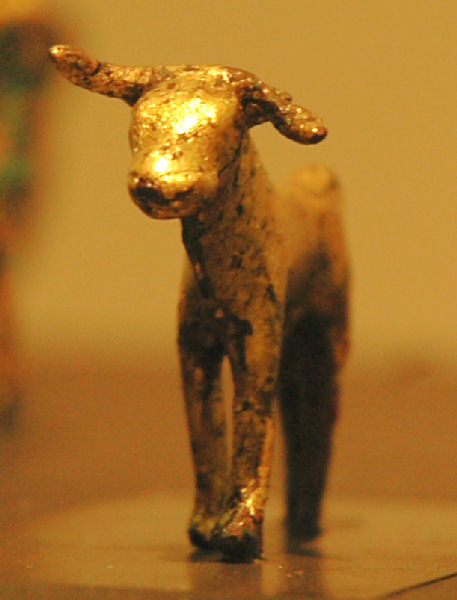
Gold calf from Temple of Baalat, Byblos

And Aaron said to them: Strip off the gold rings that are in the ears of your women, your sons, and your daughters, and bring them to me. …  And he took from their hand, and he shaped it with the chisel, and he made a bull-calf of metal-work; then they said: These are your gods, Israel, that brought you up from the land of Egypt   (Exodus 32:2, 4)

cheret = chisel, stylus, engraving tool; an item used by an Egyptian seer or magician

Alas, when Moses descends after 40 days with the stone tablets from God, the people are having an orgy in front of a golden idol.  He flings down the tablets and shatters them.  He grinds up the calf, dumps the gold dust in water, and makes the Israelites drink it.  Then he asks Aaron: “What did these people do to you, that you brought such great guilt upon them?”  Aaron’s answer is revealing.

They said to me: Make for us gods that will go before us, because this man Moses who brought us up from the land of Egypt, we don’t know what happened to him.  And I said to them: Who has gold?  They stripped it off themselves and they gave it to me.  So I flung it into the fire, and out came this bull-calf.  (Exodus 32:23-24)

Aaron’s first sentence repeats the Torah’s earlier account word for word.  But then, instead of admitting that he personally shaped the gold into a calf, Aaron gives what sounds like a child’s lame excuse.  Why doesn’t he confess?

Classic commentary, including Vayikra Rabbah and Rashi, points out that Moses put Aaron and Chur in charge while he was up in the clouds listening to God—and Chur is never mentioned again.  Therefore, the subset of the people who wanted idols must have come to Chur first, and killed him when he refused to cooperate.  Next the gang approached Aaron.  Aaron was afraid they would kill him, too, and the Israelites would incur guilt before God for a second murder.  So he cooperated, but proceeded as slowly as possible, hoping at each step that Moses would return and stop the people before they did anything worse. When Moses did return, Aaron gave him a brief, vague answer so as not to implicate anyone else in the crime.

I have an alternate explanation:     The 40 days that Moses is on top of Mount Sinai are a surreal time for Aaron.  He is still exalted by the vision of God on a sapphire pavement that he and the elders were granted halfway up Mount Sinai.  But many people lose hope and demand idols.  Chur refuses, and Aaron is shocked by his murder.  How can the glory of God and the murder of a respected elder coexist in the same world?  And how can God use Moses as his right hand, and then (apparently) let him die on Mount Sinai with the job of transforming history unfinished?

With despair, Aaron concludes that this religion of Moses’ doesn’t work.  You can’t count on God, and you can’t control anything God does.  Magic works better.  If you do magic right, you can count on the right result.  No wonder the priests of Egypt coaxed their gods into inhabiting idols!

Numbly, Aaron offers to melt gold for the rebels and see what happens. Maybe the God of Moses will manifest again.  Or maybe there will be a sign.

When the fire cools, the amorphous mass of gold looks vaguely like a calf.  If he squints, Aaron sees the four legs, the head, the body.  The second commandment forbids him from making a metal image from scratch, but this crude calf seems to have coalesced by magic.  Someone hands Aaron a stylus, a tool taken from an Egyptian magician the night before the exodus.  Aaron discovers he can easily make the mass of gold look even more like a calf.

And Aaron’s golden calf works like magic.  The people take heart again.  When Aaron uses the four-letter name of the God of Israel to call for animal sacrifices and feasting, the people rejoice; they are confident that the golden idol will replace Moses as their intermediary with God.

Later, when Moses questions Aaron, he tells the truth:  “I flung it into the fire, and out came this bull-calf.”  It was magic.

Magical thinking is still easier for us than religion.  Maybe only a small child believes that on Passover, an invisible prophet Elijah actually drinks the wine in Elijah’s cup.  But how many adults, in a desperate moment, pray to God by promising they’ll “be good”, they’ll do anything, if only God will give them what they’re asking for? And how many of us interpret mysterious events and coincidences as “signs” that something we’re reaching for is “meant to be”, intended by God?

We just fling our gold into the fire, and out comes a calf.

Pekudei & Vayakheil: Basin of Mirrors

(This blog was first posted on February 27, 2011.)

He (Moses) put the basin between the Tent of Meeting and the altar, and he placed water there for washing.  Moses and Aaron and his sons washed from it, their hands and their feet.  When they came into the Tent of Meeting, or when they came up to the altar, they washed as God had commanded Moses.  (Exodus/Shemot 40:30-32)

The last Torah portion in the book of Exodus/Shemot, Pekudei (“Inventories” or “Commissions” or even “Searches”) lists once again all the items made for the sanctuary and the priests’ garments, this time including the weight of the donated gold, silver, and bronze.  Moses assembles all the parts, and then God’s cloud appears and fills the new Tent of Meeting.  The portable dwelling-place for God is complete.

Its front half is a roofless courtyard surrounded by curtains, and contains the altar where slaughtered animals and grain are burned.  The back half is the new Tent of Meeting,  which is both curtained and roofed, and contains the holiest objects: the gold incense altar, the gold-covered bread table, the solid gold lamp-stand, and the gold-covered ark inside its own curtained alcove.  Only priests, and Moses, can enter the Tent of Meeting.

The wash-basin in front of the entrance to the Tent is critical for the transition between the public courtyard and the inner sanctum.  Washing in water symbolizes inner purification, the mental preparation necessary to enter a space where there will be closer communion with God.  In the Torah, hands stand for action and power.  By washing their hands, Moses and the priests dedicate their power and actions to divine service.  Feet are related to one’s path in life, the direction one is going psychologically as well as physically; the greatest men in the Torah are described as “walking with God”.  By washing their feet, Moses and the priests rededicate themselves to walking with God.

The wash-basin where this ritual takes place is made of bronze—but it’s not the same as the bronze donated by all the people with willing hearts and melted down to make the altar and its utensils.  Last week’s Torah portion says the basin is made out of bronze mirrors:

He (Betzaleil) made the basin of bronze, and its stand of bronze, with the mirrors of the army (of women) who mobilized at the entrance of the Tent of Meeting.  (Exodus/Shemot 38:8)

nechoshet = bronze, copper.  From the same root as nachash= snake; and nicheish = practice divination, seek omens.

marot = mirrors; apparitions.  (Mirrors in the ancient Middle East were made of highly polished bronze, and were luxuries for the rich.)

tzav-u = mobilized, went to war, served in the cult, joined in public service

The unusual donation of mirrors led to a story in Midrash Tanchuma, a 5th-century commentary, that when the Israelites were slaves in Egypt, the women used mirrors to entice their husbands into lying with them and producing more children.  Moses hesitated to make a holy object out of mirrors, which are instruments of vanity.  But God overruled him on the grounds that the women had used their mirrors for the good deed of multiplying the children of Israel.  And the master-craftsman Betzaleil used the mirrors to make the wash-basin.

This fanciful story was accepted by many subsequent commentators.  But I think it is inconsistent with the descriptions in Exodus/Shemot of the Israelite slaves as poor and oppressed.  Surely they could not afford anything as expensive as bronze mirrors!  The only time in the book of Exodus when the Israelite women could acquire mirrors is the day before they leave Egypt, when Moses tells them to take gold and silver jewelry from the Egyptians.

So why does the Torah say the wash-basin at the entrance of the Tent of Meeting is made out of bronze mirrors?

It’s always possible that an odd detail in the Torah refers to some ancient practice that occurred outside the story, perhaps in the cult of another group of people.  But what I notice is that a priest washing his hands and feet at the entrance of the Tent of Meeting would see a double reflection: a reflection on the surface of the water, and a reflection from the polished bronze basin.

Samson Raphael Hirsch, a 19th-century rabbi, wrote that the language in this verse might mean the mirrors were not even melted down, but only welded together in a form where they could still be recognized.  Perhaps the basin would even show a different reflection in the surface of each mirror.

Furthermore, the basin was made by Betzaleil, whose name means “In the Shadow of God”.  A shadow provides protection from the harsh sun of the Middle East, so some commentary notes that Betzaleil is under God’s protection.  But a shadow is also a type of reflection; the original thing casts a shadow on the ground, just as the original thing casts a reflection in a mirror.  The Hebrew word for shadow, tzeil, is the root of the word tzelem, which means “image”.

So when a priest steps up to the bronze basin, he sees multiple reflections of the sky and of his own body, and perhaps multiple reflections of the heavens, his own soul, and other aspects of God.  After all, the basin was made by “In the Shadow of God”, and the word for “bronze” comes from the same root as “divination”.  All of these reflections from the basin, besides reminding him that he is preparing to come closer to God, provide food for the priest’s inner reflections.  Has he been using his body the right way?  Has he been mired in harmful thoughts and emotions?  Or has he been acting like someone made betzelem elohim, in the image of God?

After he has reflected, the water from the basin purifies him as he washes and rededicates himself to the path of holy service.

We could all benefit from washing at a basin of mirrors before we pray, or meditate, or take a moment to reflect on our lives.

Bereishit: Fairness & Free Will

(This blog was first posted on September 26, 2010.)

And God said to Cain:  Why did you heat up, and why did your face fall?  Isn’t it true that if you do good, there is uplifting?  And if you do not do good, sin is lying like a beast at the door, and its hunger is for you.  But you, you can rule over it.  (Genesis/Bereishit 4:6-7)

chatat = sin, moral violation, missing the mark, going off track, fault, guilt

Yes, God gives Cain a warning, and he kills his brother anyway.

The first time I read the story of Cain and Abel in Hebrew, I saw it in a new light.  Cain’s name in Hebrew is kayin, which means “spear”, and may or may not be related to the word kanah, “acquire”.  But Abel’s name in Hebrew is hevel—the same word that is translated as “vanity” in the King James version of Ecclesiastes/Kohelet.  A hevel is a puff of air, a vapor, something transitory and insignificant; it can also be translated as “emptiness” or “futility”.

Somebody named Abel might well be a virtuous shepherd who brings a superior sacrifice to God.  But somebody named Futility?  Or Puff?  I don’t think so.

Puff’s insubstantiality is underscored by the description of the births of Adam and Eve’s first two sons.  First the Torah says: She conceived and she gave birth to Cain, and she said: I have created a man with God.  Then it says:  And she added to the birthing his brother, Puff.  Clearly Cain is the important character.  Puff is merely a foil for Cain’s drama.

Cain is the one who gets the idea of bringing an offering to God, and since he works the soil like his father Adam, he brings a sacrifice from the fruit of the ground.  Puff then imitates Cain, and brings a sacrifice from the firstborns of his flock and from their fat.

God pays attention to Puff’s offering, and ignores Cain’s.  (The Torah does not say how God demonstrated this attention, but somehow Cain could tell.  Medieval commentary said that fire from heaven devoured Puff’s animals, but left Cain’s fruits and vegetables untouched.)

Then Cain gets upset; in the metaphor of the Torah, he becomes hot, and his face falls.  I remember how upset my own son used to get when he was small and something unfair happened.

Is God’s action unfair?  Traditional commentary argues that Puff’s sacrifice is superior to Cain’s, so he deserves God’s favor.  But I don’t buy it.  It’s true that later in the Torah, firstborn animals and fat are especially appropriate for sacrifices, so Puff gave God the best he had.  But the text says nothing about the quality of Cain’s gifts; he might have offered the best he had, too.  And given that at this point God still expects humans to be vegetarians, it seems odd that God would prefer the sacrifice of animals.

I think God’s action is deliberately unfair, and its purpose is to give Cain a test or  challenge.  God then gives Cain a strong hint with the warning translated above.  Never mind whether life is fair, God implies.  The important thing is to do good yourself, regardless.  If you do, you’ll be uplifted.  But if you succumb to the animal impulse to do evil, you’ll be eaten up by it.  Believe me, you have the ability to overrule that impulse.  So here’s your chance to prove yourself.

Alas, Cain fails the test and kills his brother.

Traditional commentary claims this is the second time a human fails one of God’s tests, the first time being in the garden of Eden.  But I think that when God creates the adam (which means “human” or “humankind”) out of dirt and the divine breath, this new creature is incomplete, not entirely human yet.  God transfers the proto-human into an otherworldly place in which all the animals subsist on fruit.  Judging by God’s “curses” on man, woman, and serpent, the garden of Eden has no weeds, thorns, pain, birth, or death; it’s not part of the real world we know.

The whole point of Eden seems to be to expose the adam to the Tree of Knowledge.  God points out the tree to the creature by saying: From all the trees of the garden you may certainly eat; but from the Tree of Knowledge of Good and Bad, you may not eat, because once you eat from it you will certainly die.

When the adam doesn’t do anything about this prohibition, God divides it into two beings, male and female counterparts.  This does the trick; the female human accepts the challenge, and both of them eat from the Tree of Knowledge.  Now they are truly human: they exercise free will, they have a moral sense that other animals lack, and they are mortal.  Now God can take them out of Eden and return them to the real world to get the history of humanity going.

But apparently humanity needs another nudge from God.  The knowledge of good and bad that Adam and Eve acquired in Eden is still nascent and primitive.  A real test is needed to show humanity what free will and good and evil really mean.  So God sets it up, with Puff as the foil for Cain.  Cain has a good impulse, wanting to show his gratitude for the produce of the earth, and gives some to God.  God responds with unfairness, injustice.  Cain has a primitive intuition of good and evil, and gets upset when life isn’t fair.  And God tells Cain to get over it, and use his free will, his ability to override his impulses and make deliberate choices, his ability to act according to a higher morality.  This is the first real test of a human being.

Cain flunks the test.  And to this day, human beings keep on flunking the test.  We lash out at unfairness, we take revenge, and we murder our brothers, our fellow human beings.

But some of us grow up.  Some of us hear an echo of God’s message to Cain, and override our angry impulses, and choose to behave with more virtue.  It’s not easy at first, but gradually we can develop a habit of choosing good over evil, of keeping the hungry beast at the door at bay.  We can make the beast lie outside, instead of letting it come in and take over.

Is humanity making any progress on this hard path?  Examples of atrocities are still all too easy to find.  But I believe that more and more people are recognizing them as atrocious.  The world is still full of Cains.  But maybe, in some future century, if humanity lasts long enough, we will all finally be able to hear God’s warning to Cain, and rule over our emotional reactions to unfairness, and dedicate ourselves to choosing good, no matter what.

May it happen soon.