Va-eira: Shortness of Ruach

(This blog was first posted on January 10, 2010.)

And Moses spoke thus to the children of Israel, but they did not listen to Moses, from kotzer of ruach and from avodah kashah.  (Exodus/Shemot 6:9)

Moses asks Pharaoh to give the Israelite slaves a leave of absence to spend three days in the wilderness worshiping their god.  Pharaoh responds by accusing the Israelites of laziness and giving them extra work: they must collect their own straw to mix with clay, and still make the same quota of bricks.  The slaves complain to Moses, who then complains to God that now the people are even worse off than before.  This week’s Torah portion,Va-eira (“And I appeared”), opens with God reaffirming the divine plan to rescue the children of Israel from Egypt.

Moses passes on this communication to the Israelite slaves, but they do not listen to him.  Why not?  The brief explanation ending the sentence in Exodus 6:9,  “from kotzer of ruach and from avodah kashah“, can be translated in many ways.  Below are some possibilities; pick one from each list to make your own translation.

kotzer = shortness.  being stunted.  despondency.  impatience.

ruach = wind.  spirit.  breath.  motivation.

avodah = labor.  service.  ritual.  worship.

kashah = difficult.  heavy.  stubborn.  severe.

Some translators choose a physical interpretation, writing that the Israelites did not listen to Moses out of shortness of breath and hard bondage (Robert Alter, following Rashi).  How can you listen to someone promising an unimaginable future when you’re working so hard that you’re panting?  Ramban says physical exhaustion made the people impatient and sapped them of the strength to hope.

Other translators take a psychological approach, writing that the Israelites did not listen to Moses because of a constriction of the spirit (the Zohar) and because of the heathen service which weighed heavily upon them (the Targumim, according to Elie Munk).  Their suffering was so continuous that they were reduced to animals who could only think about their daily physical needs; they did not have enough human spirit to imagine anything else.  Lacking imagination and believing themselves powerless, they paid homage to the Egyptian gods of their slave-masters.  This idol worship also prevented them from listening to any communication from their own god.

Avivah Gottlieb Zornberg, in The Particulars of Rapture, wrote:  “To hear is to open oneself up to vulnerability, change, contingency.”  Pharoah the hard-hearted cannot consider even the idea of change, so he refuses to hear out Moses.  Pharoah afflicts his Israelite slaves with the same deafness, by making their lives so hard that they cannot stop and listen to any revolutionary ideas.  Thus Egypt, which in Hebrew is called Mitzrayim, “Narrow Places”, is the place of constriction for both master and slave.  It is the place where people are stunted, cut short—“kotzer”—from the freedom of thought that make us human.

In Kabbalistic terms, the children of Israel are stunted in the ruach level of soul.  Like animals, they exist from day to day with only the nefesh, the level of soul that animates the body.  They have neither time nor energy to access their ruach and neshamah levels of soul.  (The neshamah is the soul level where one can hear one’s calling and receive inspiration.  The ruach is the level where one is seized by the drive and motivation to seek that calling, to do something new.)

In the story of creation at the beginning of Genesis, the ruach—wind or spirit—of God hovers over the face of the waters.  Throughout the Torah, certain humans are seized by the irresistible power of the ruach of God, which turns them into prophets or madmen, or perhaps both.  A human being’s own ruach may not be as enormous as God’s ruach, but it is still a motivating force that can be ignored only by rigorous denial.

Pharaoh is the king of denial.  He does not listen to the word of God because his ruach is stunted; he refuses to believe that change is unavoidable.  The children of Israel do not listen to the word of God because their ruach is imprisoned by continuous suffering; they refuse to believe that change can happen to them.

I’ve been in that constricted place, too.  I’ve cried over more than one unbearable situation in my life, unable to believe that I could do anything about it or that it would ever change.  But each situation did change.  Sometimes I heard a different inner voice, and I found a way out.  Other times the change happened without an action on my part, by the grace of God, and all I had to do was to respond, to gird my loins and go with it.

But what about when you’re still trapped in the suffering?  How do you find the voice you haven’t been hearing?  Does it take a temporary break—a deep breath, a real Shabbat, three days in the wilderness—to hear the voice of freedom?  Or do you need someone, or something, to lead you out of your Egypt whether you’re ready or not?

Vayiggash: Reuben the Jerk

(This blog was first posted on December 20, 2009.)

These are the names of the sons of Israel, the one coming to Egypt, Jacob and his children: Jacob’s bechor, Reuben.  (Genesi/Bereishit 46:8)

bechor (בְּכֺר) = firstborn.

Throughout the book of Genesis, the firstborn son, who is supposed to be the future leader of the clan, is portrayed in a bad light.  Avraham’s firstborn son, Ishmael, is exiled for inappropriate “playing with his younger brother Isaac.  Esau, Isaac’s firstborn son, is portrayed and easily duped, stupid, and impulsive compared to his brother Jacob.  Jacob’s firstborn, Reuben, comes across as a shmendrick,  an ineffectual jerk.

Right after his father Jacob’s second and favorite wife, Rachel, dies in childbirth, Reuben lies with Bilhah, who is Rachel’s servant and Jacob’s concubine.  (Genesis 35:22)  Jacob is not at all happy about this, and brings it up years later on his deathbed.  (Genesis 49:4).  Is Reuben overcome with passion, and unable to see the obvious consequences?  Or is he making a foolish attempt to become the family’s leader through the ancient custom by which the new ruler assumed his office by having sex with the old ruler’s concubines?

The next time we see Reuben, he is arguing with his brothers about what to do with Joseph, Rachel’s firstborn and their father’s favorite son.  Joseph’s older brothers hate him, and now that he is approaching them in a place far from home, far from Jacob’s protection, the brothers conspire to kill him and throw him into a pit.

But Reuben says, “Let’s not strike down his life.  Don’t shed blood!  Throw him into this pit in the wilderness, but don’t lay a hand on him.”  (Genesis 37:21-22)  The Torah adds that Reuben says this “in order to rescue him from their hand, to return him to his father”.

If we take Reuben’s words at face value, he does not mind if Joseph dies in the pit—which Rashi (11th-century rabbi Shlomo Yitzchaki) said was filled with scorpions.  He just does not want to be responsible for breaking the taboo against shedding a brother’s blood.

On the other hand, if we believe the explanation the Torah adds, Reuben does want to save Joseph’s life; he just doesn’t have the guts to directly contradict his brothers.  He is the bechor, and therefore the eldest, but he is afraid to stand up to the brothers he should be leading.

It gets worse.  Reuben goes away for some unspecified reason.  In his absence, the brothers, led by Judah, sell Joseph to a passing caravan as a slave.  The early rabbis invented reasons for Reuben’s absence; Rashi said either it was his day to go home and wait on his father, or he was fasting in penitence for lying with Bilhah.  But neither explanation exonerates him from a charge of criminal neglect.

Reuben returns to the pit, sees that his Joseph is gone, and asks his brothers, “And I, where will I go?”  (Genesis 37:30)  Reuben does not ask what happened to Joseph; he is only concerned about what will happen to himself, once his father finds out Joseph is missing.

The brothers trick their father Jacob into believing that Joseph was killed by a wild animal.  While Jacob mourns, Reuben does not say a thing to alleviate his father’s pain or expose the truth.

The next time Reuben shows up in the story, the ten oldest of Jacob’s twelve sons have gone to Egypt to buy grain during a famine.  The governor of Egypt (whom the brothers do not recognize as their long-lost little brother Joseph) accuses the ten men of being spies.  He imprisons Simon, then orders the rest of the men to go home and bring back their youngest brother, Benjamin.  The brothers decide this must be divine punishment for selling Joseph into slavery.  And Reuben says, “Didn’t I speak to you, saying— Don’t sin against the boy— but you didn’t listen.”  (Genesis 42:22)  As if Reuben were innocent!  As if it did any good now to say “I told you so”!

It gets worse.  When the brothers go home and explain the situation to Jacob, he refuses to part with Benjamin, his favorite son since Joseph disappeared.  Reuben tries to persuade Jacob by saying, “You can kill my two sons if I don’t bring him (Benjamin) back to you.  Put him in my hands, and I myself will return him to you.”  (Genesis 42:37)

In this one sentence, Reuben shows that he is both callous about his own sons, and stupid about human relationships.  He is callous because he cannot be sure of Benjamin’s safe return, no matter how carefully he guards him, yet he is willing to risk the lives of his own sons anyway.  And he is stupid because he assumes Jacob would consider killing two of his own grandsons a satisfactory revenge!

That is the last time Reuben speaks in the Torah.  But his name comes up again in this week’s Torah portion, Vayiggash (And he stepped forward), in a genealogy.  (Genesis 46:8).  Like the genealogy right after Reuben lies with Bilhah in 35:23, the Torah specifically refers to Reuben as the firstborn, though none of the oldest sons in subsequent generations are listed that way.  In fact, many other genealogies in the Torah don’t use the word bechor, firstborn, at all.

This may be a clue to the reason why Reuben is a jerk.  He is Jacob’s firstborn; he is supposed to inherit the mantle of authority, to be the leader of his generation, to serve as the family’s religious leader after Jacob is gone.  But he just does not have the personality traits of a leader.  When Prince Shechem offers to marry Dinah (see my blog on Vayishlach), Simon and Levi speak for their brothers and lead the action.  When Benjamin is in danger, Judah speaks for the brothers and becomes their leader.  Reuben knows he should act like the firstborn son, but he cannot; he is either too afraid of his younger brothers, or too self-centered to care about the lives of others, or too stupid to see the big picture and the consequences of his actions.

What happens today, when someone is given a leadership role but does not have what it takes to succeed?  Some people can rise to the occasion and grow into leaders.  But some cannot, no matter how good their intentions are.  I know people who are too self-centered to be fair parents or bosses, perhaps because they suffered childhood trauma beyond their control.  I know people who simply were not born with the mental ability to make complicated long-term decisions.  I know that in the past I myself have failed other people because I was too afraid to stand up for them.

The world is full of Reubens.  Once again, the Torah shows us that no human being is perfectly good, and no human being is completely evil.  We are all shmendricks sometimes.

Bo: Serving God with Possessions

(This blog was first posted on January 17, 2010.)

And also mikanu will go with us—not a hoof will remain—because we will take from them to serve Y*h, our god; and we ourselves will not know with what we will serve Y*h  until we come there.  (Exodus/Shemot 10:26)

miknanu=our possessions, our property—usually livestock

Moses does not ask Pharaoh to let the children of Israel go free.  He only asks Pharaoh to let them go out into the wilderness for a three-day holiday to serve their god.  The implication is that then the slaves will all return to their jobs in Egypt.

Yet God has told Moshe that in the end, after the tenth and final plague, Pharaoh will drive the Israelites out of Egypt altogether.  Then God will lead them to the promised land.

In this week’s Torah portion, Bo (Come), Pharoah reacts to plague number nine, darkness, by telling Moshe that all the Israelites can go to serve God in the wilderness, even the children—but they must leave their livestock behind.  Moshe refuses with the explanation—or rationalization—that “from them we will take to serve Y*h, our god, and we ourselves will not know with what we will serve Y*h  until we come there”.

The Israelite slaves do not possess much except for the descendants of the cows, sheep, and goats their ancestors brought down from Canaan.  But Moshe insists they must take all their possessions with them for the three-day holiday.  Pharaoh rightly suspects his slaves are planning to escape, instead of return.  He also seems to suspect that worshiping their god with sacrifices is merely a pretext for leaving.

In that, I believe, he is mistaken.  Moshe makes sure that the exodus focuses on religious service, not for three days but for forty years.  And the Israelites do worship God with sacrifices.  As well as sacrificing livestock, they sacrifice their security.  Even a bad situation seems secure if it goes unchanged long enough.  Now the Israelites exchange their familiar Egyptian masters for a new and unpredictable master, a god who can create terrifying plagues, a god who might ask anything of them.

Today, many of us serve God by following ethical rules, praying at the right times, and observing other rituals.  This kind of service can be a conscious effort, even a sacrifice.  Or it can be lip service, not service of the heart.  What do we do when our inner world changes and we need to hear and follow the call of the divine, but we don’t know how anymore?

We can look over our possessions, and ask God what needs to be sacrificed.  Are we too attached to our “livestock”, our material goods?  Are we clinging to our present status—high or low?  To the security of our present life?  To something else that keeps us enslaved in a narrow place?

What do we need to sacrifice in order to free ourselves to leave our Egypts and enter a new world?

Mishpatim: After the Vision, Eat Something

In this week’s Torah portion, Mishpatim, God tells Moses:

“Come up to God, you and Aaron, Nadav, and Avihu, and seventy elders of Israel, and bow down from a distance.” (Exodus/Shemot 24:1)

Aaron is Moses’ brother, and Nadav and Avihu are Aaron’s two oldest sons, who will later be initiated as priests. The seventy elders are judges and the de facto representatives of the Israelites.

And Moses went up, and Aaron, Nadav, Avihu, and seventy of the elders of Israel.  And they saw the God of Israel, and under [God’s] feet something like brick-work of sapphire, and it was exactly like the heavens latohar.  And [God] did not stretch out {God’s] hand against those singled out from the children of Israel. And they beheld God, and they ate and they drank.  (Exodus/Shemot 24:9-11)

latohar (לָטֺהַר) = for the ritual purity, for being acceptable for sacred purposes.

Brickwork in Ishtar Gate of Babylonia (Staatliche Museum, Berlin)

Seventy-five men see God in a transcendent vision. Then, overwhelmed by this spiritual

experience—they take out their lunches and have a bite to eat?  What’s that supposed to mean?

The commentary on the portion called Mishpatim (“Laws”)  is divided.  

latohar = for the purity; for being acceptable for sacred purposes

First God tells Moses to climb at least partway up Mount Sinai with his brother Aaron, his nephews Nadav and Avihu, and 70 elders.  When they do so, they see God in a transcendent vision, and then, overwhelmed by this spiritual experience—they take out their lunches and have a bite to eat?  What’s that supposed to mean?

The commentary on the portion called Mishpatim (“Laws”)  is divided.  Some modern commentators explain that since the Israelites have just received the Torah, or at least the Ten Commandments and a number of laws, the elders are now engaged in the sort of feast that marks a covenant or treaty.They probably shlepped some meat from sacrificed animals up with them for the concluding feast.2

I find this approach disappointing, because it downgrades the vision of God’s feet to merely part of cutting a covenant, the ancient Israelite version of a signing ceremony.

Other commentary claimed that it was not actual, physical food; the elders were feasting upon their contemplation of the divine glory.  In the Talmud, Rav even said that in the “World to Come” humans will be nourished only by their appreciation of God’s glory.3  In other words, none of that nasty physical chewing will be necessary.

According to other commentary, the Torah refers to real food and drink, but the elders on Mount Sinai raise their food to a more spiritual level.  The kabbalist Isaac of Luria wrote that we raise the sparks of holiness in plants and animals by eating them with the proper devotion.  19th-century rabbi Samson R. Hirsch wrote that the sapphire brick in the elders’ vision is a metaphor showing that even a lowly brick acquires a heavenly purity when it serves the divine.4

But what if the elders are not thinking about raising sparks?  What if they really do go from seeing a mystical vision of God to enjoying a nice snack?  One way to explain their flexible outlook is to look at the previous clause, “And He did not stretch out his hand toward them”.  Ovadiah Sforno interpreted that as meaning they are already seeing like prophets; God does not need to put them into an altered state of consciousness, the way God does with Saul, or Ezekiel, or the 70 elders themselves in Numbers 11:25-26.5

Maybe the consciousness of the elders is so integrated, at that moment, that they can find God in everything—in the taste of food as much as in a numinous vision.

I know some people who shun any hint of spirituality or mysticism.  They would explain a vision of God’s feet on sapphire bricks as a mere hallucination due to some bodily malfunction.  I also know people who love mysticism and cultivate spiritual ecstasy.  They seem to view the practical details of life as inferior, and prefer not to pay much attention to what their bodies are doing (except, perhaps, when they’re engaged in ecstatic dance).

I like the middle way.  I think an ideal world is one in which we are all like the 70 elders on Mount Sinai: we calmly accept whatever mysterious vision of God arrives, and we also savor the food, drink, and other physical gifts that God’s world provides.  When we unite body and soul, we become whole.

(This post was first published on February 7, 2010.)

  1. E.g. Etz Hayim: Torah and Commentary, The Jewish Publication Society, 2001, p. 479.
  2. Cf. 12th-century rabbi Shmuel ben Meir, a.k.a. Rashbam, on Exodus 24:11, http://www.sefaria.org.
  3. Talmud Bavli, Berakhot 17a.
  4. Samson Raphael Hirsch, The Hirsch Chumah: Sefer Shemos, Feldheim Publishers, Jerusalem, 2005, p. 533.
  5. 16th-century rabbi Ovadiah Sforno on Exodus 24:11, http://www.sefaria.org.

Terumah: Cherubs Are Not for Valentine’s Day

“And they shall make me a holy place, and I shall dwell among them.”  (Exodus/Shemot 25:8)

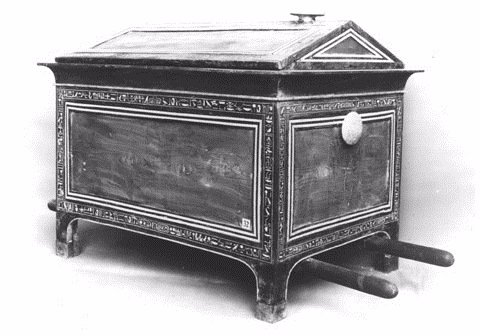
Ark from Tutankhamun’s tomb with poles, but a different lid

With this promise, God begins telling Moses how to make the portable tent-sanctuary.  In this week’s Torah portion, Terumah (“Donation”), God begins by describing the ark to be placed inside the Holy of Holies, the innermost room of the sanctuary.  The ark will be a box or coffer made of gold-plated wood, with gold rings for permanent carrying-poles.  Inside the ark will be the testimony, e.g. the stone tablets with the commandments.  The lid of the ark will be made out of pure gold.  The Torah calls this lid the kaporet (כַּפֹּרֱת) = atonement-cover; reconciliation, atonement.

And you will make two keruvim of gold; you will make them hammered out of the two ends of the atonement-cover.  You will make one keruv at one end, and one keruv at the other end; from the atonement-cover you will make the keruvim, on both of its ends.  And the keruvim will be spreading their wings upward, sheltering the atonement-cover with their wings; and their faces will be turned one another; the faces of the keruvim will be turned toward the atonement-cover.  (Exodus/Shemot 25:18-20)

keruv (כְרוּב), plural keruvim (כְרוּבִים) = a winged hybrid beast, usually with a human head and an animal body.  (Cherub in English.)


Two stone lions crouch on either side of the main entrance to a library, a civic building, or a mansion.  Usually they face the person who approaches, looking stern and regal, but sometimes they face one another.  Architects have used flanking statues for centuries, the world over, to make entrances more impressive.

Door guardians from palace of Ashurnasirpal II, Metropolitan Museum of Art, NY (photo by MC)

In ancient Mesopotamia, the colossal statues on either side of an entrance  were hybrid winged beasts with human heads, called lamassu in Sumerian and shedu or kuribu in Akkadian.  Scholars say the word kuribu is related both to the Akkadian word karabu, “to pronounce formulas of blessing”, and to the Hebrew word keruv.

Now imagine two winged beasts facing one another, guarding neither a city gate nor a door into a building, but a portal into another world, another reality.  Science fiction?  No, Torah.

The Torah portion Terumah explains that when the sanctuary is finished, God will speak to Moses from the empty space between the two keruvim.

“And I will speak to you from above the atonement-cover, from between the two keruvim that are upon the Ark of the Testimony, everything that I am commanding you and the Israelites.”  (Exodus 22)

This is neither the first nor the last place where the Torah mentions winged figures called keruvim.  The first reference is when the first two human beings are banished from the Garden of Eden.

And [God] drove out the human, and stationed at the east of the garden of Eden the keruvim and the flame of the sword of the continually-transforming, to guard the way to the Tree of Life.(Genesis/Bereishit 3:24)

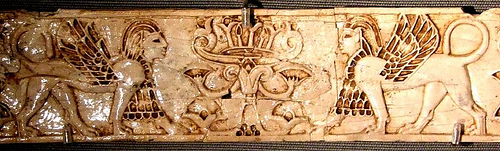
An image of keruvim flanking a tree of life is not unusual in the Ancient Near East.  But in the Torah, the keruvim are also guarding the entrance to a world called the garden of Eden.

Phoenician sphinxes and the tree of life

When the ark is carried into battle against the Philistines, it is referred to as: “the ark of the covenant of the God of Armies Sitting on the Keruvim.”  (I Samuel 4:4)  Here the keruvim are not guarding an entrance, but are flanking an invisible God.  The army hopes, in vain, that the ark with its keruvim will guard the soldiers from their enemies.

When King Solomon builds a permanent temple, he places two colossal gilded keruvim in the innermost chamber.  Their anatomy is not described, but their wings touch in the center of the room.  (I Kings 6:23-27)  Keruvim are also used as a decorative motif in the temple walls, as they are in the woven curtains around the inner chamber of the portable sanctuary.

The four mysterious hybrid creatures in vision of the prophet Ezekiel are also called keruvim.  Ezekiel’s keruvim have four wings each, human hands, calves’ hoofs, and four faces each (human, lion, ox, and eagle).  The throne where God’s glory appears hovers above them.  (Ezekiel 1:4-12 and 10:1-21)

Psalm 18 paints a metaphorical picture of God descending from the heavens to rescue King David from his enemies, and borrows a Canaanite image of the sky god riding on a winged steed.

          And [God] rode on a keruv and flew,

          And swooped on the wings of the wind.  (Psalm 18:11).

What do these references to keruvim mean?  If we look behind the descriptive details borrowed from neighboring cultures, keruvim seem to define a location for the appearance of God’s glory or presence.  The location might be between the keruvim, as in this week’s Torah portion, or above them, as in Ezekiel and Psalm 18, or behind them, as in Genesis.

Keruvim combine the traits of many animals, including humans.  Yet they are supernatural, existing somewhere between our reality and the transcendence of God.  Therefore they mark the dividing line between our world and a divine world we can neither enter nor understand.

Yet in Torah this dividing line is not a wall, but a gateway.  As long as we live in this world we cannot pass through the gate.  But we can imagine the entrance to the Garden of Eden.  And we can imagine God speaking to Moshe through the empty space between the keruvim above the ark, even if we can never enter the Holy of Holies ourselves.


One effect of this invisible portal to another reality, this gap in our universe, is that human beings feel a yearning that can never be satisfied by the things of this world.  The yearning keeps us searching—for love, for beauty, for the good, for the divine.  That is what it means to be human.

Maybe Adam and his counterpart Eve are not really human until they are expelled from the Garden of Eden.  Only then can they feel yearning.

Today we human beings still yearn for the ineffable.  And we are still responsible for using the passion of our yearning to fix the world we live in and make it more like the world we yearn for.

(This blog was first posted on February 7, 2010.)

Vayikra: Fat Belongs to God

(This blog was first posted on March 14, 2010.)

And the priest will make them go up in smoke, a food offering by fire, for a soothing fragrance.  All fat belongs to God.  A law for all time for your generations: You will not eat any fat, nor any blood, in any of your settlements.  (Leviticus 3:16-17–Vayikra)

chalev = fat, especially abdominal fat

dam = blood

The blood and the abdominal fat of livestock are reserved for God in chapter 3 of the book of Leviticus/Vayikra, which provides instructions for making zevach shelamim, the animal sacrifices that are offered by an individual for the sake of shaleim,  “wholeness”.  This type of offering is made to express gratitude to God, or to confirm peace with the people invited to share the feast afterward.

In brief, a man brings an unblemished cow, sheep, or goat to the altar, leans his hand against the animal’s head, and then slaughters it.  The priests splash the animal’s blood against all four sides of the altar.  The priests burn the fat covering the entrails, liver, and kidneys.  The fragrance of the smoke from the burning fat is the donor’s gift to God.  Then the donor and his guests eat the meat in celebration (and according to Leviticus 7:31-35, the priests are given the breast and the right thigh to eat).

Splashing blood is certainly a dramatic ritual, and fat burns well.  But fat and blood are not merely reserved for the ritual at the altar.  The Torah prohibits the people from eating any abdominal fat, or any blood, anywhere.  Even far away from the altar, even in a time when there is no temple, abdominal fat and blood are reserved for God.  Why?

A reason for not consuming blood is given in Leviticus 17:14: “You may not consume the blood of any flesh, because the nefesh (soul, animating force) of all flesh is its blood.” Genesis 9:5-6 also links blood with the nefesh of a human or animal, and forbids humans to eat flesh with the blood still in it.  Ramban (13th-century rabbi  Moshe ben Nachman) wrote that someone who eats an animal’s blood dilutes his own nefesh and becomes less spiritual, more animal.

So blood is equated with the nefesh, the animating force that makes a creature alive.  What does abdominal fat stand for?

Rabbi R.S. Hirsch wrote in the 19th century that the blood of an animal is its essence, while the fat is what it produces for its own needs.  The essence of an animal must never become a human being’s essence, and the needs of an animal must never become a human being’s needs.  Human nature must not be equated with animal nature.

I would add that abdominal fat is stored up as a reserve calorie supply against a hungrier time.  It’s like a pot of silver buried against hard times; in modern terms, it’s like a stock portfolio.  Stockpiling resources can be a good strategy.  But we must not become so attached to our stock portfolios that we despair when the market plunges.  We cannot really control our savings, so in a way they do not really belong to us.  The fat belongs to God.

Similarly, it’s good to tend to our health, to enjoy each day of life, to “choose life” for ourselves and others.  But my life, my nefesh, ultimately belongs to God.

Metzora & Acharey Mot: Doubles

(This blog was first posted on April 13, 2010.)

Gird your loins! This is a double blog, covering two weeks, two double Torah portions, two birds, and two goats!

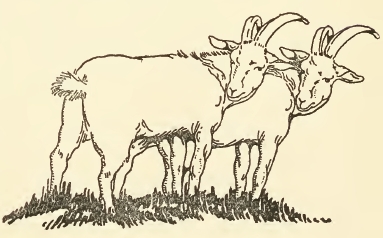
Goats, by Dugald Stewart Walker

The double Torah reading for the week culminating on Shabbat April 17 (Leviticus 12:1-15:33: Tazria and Metzora) deals mostly with tzara-at, a discoloring skin disease.  The double Torah reading for the week ending on Shabbat April 24 (Leviticus 16:1-20-27: Acharey Mot and Kedoshim) covers the rituals for atonement on Yom Kippur, forbidden sexual unions, and a series of ethical and religious laws.

This year I noticed a connection between the two double Torah portions. The first week’s reading includes a mysterious ritual using two birds, while the second week’s reading includes a remarkably similar ritual using two goats.  What does this parallelism mean?

Birds vs. goats

The reading for the week ending April 17 includes this passage about the ritual for making someone with the skin disease tzara-at ritually pure:

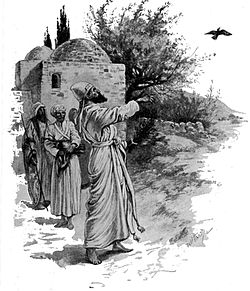
Let Go the Living Bird, by Paul Hardy ca. 1900

And the priest will give an order, and he will take for the one who is being ritually purified two living, ritually pure birds, and a stick of cedar, and crimson stuff, and [a branch of] oregano.  And the priest will give an order, and he will slaughter the first bird in a pottery vessel, over living water (water flowing from a natural source).  He will take the living bird, the stick of cedar, the crimson stuff, and the oregano, and he will dip them into the blood of the slaughtered bird, over the living water.  And he will sprinkle upon the one who is being ritually purified from tzara-at seven times; thus he will purify him, and then he will send out the living bird over the face of the open field.  (Leviticus/Vayikra 14:4-7, Metzora)

tzara-at (צָרַעַת) = a technical term for several specific skin conditions, one of which seems to be vitiligo.

And the reading for the week ending on April 24 includes this passage, part of the annual Yom Kippur ritual for purifying the whole community:

And from the assembly of the children of Israel, he (the high priest) will take two hairy male goats for a guilt offering and one ram for an elevation offering.  He will take the two goats and stand them up before God at the opening of the Tent of Meeting.  And Aaron will place lots on the two goats, one lot for God, and one lot for Azazel.  Then Aaron will bring the goat that received the lot for God, and he will make it a guilt offering.  But the goat that received the lot for Azazel, it will be stood alive before God, for making atonement over, by sending it out to Azazel to the wilderness.  (Leviticus 16:5-10, Acharei Mot)

Both rituals use two animals, which must be the same species and equal in value.  In both rituals, one animal is chosen randomly to be sacrificed to God, and the other is set free at the end of the ritual, sent out away from human habitations.  In both rituals, the blood of the sacrificed animal is sprinkled seven times on the person or place to be purified.  Other rituals described in the Torah employ sacrifices of birds and goats, and sprinkling of animal blood, but only in these two passages does the Torah require that one of a pair of animals is slaughtered and the other pair is set free.

Individual vs. community

Why are these two unique purification rituals so similar, when they seem to be performed for such different purposes?

Let’s look at who or what is being purified.  In the first reading, the metzora (the person who had the disease of tzara-at) is ritually purified after a priest has declared that the affliction is over.  Since someone with tzara-at must live in isolation, in a tent away from the community, the purification ritual is necessary for the ex-metzora to move back and rejoin society.

In Torah and Talmud, a metzora is not someone who just happened to develop a disease.  The appearance of an unnaturally white patch of skin is considered a physical manifestation of a flaw in the metzora’s moral condition.   Commentators have written that since the “treatment” for tzara-at is segregation from the community, and the ritual restores the metzora to society, the moral flaw of the metzora must be some anti-social behavior, such as slander.  A skin disease is an appropriate sign of immoral behavior toward society because the skin is the boundary between one person and another. (See my post Tazria & 2 Kings: A Sign of Arrogance ).

Isolation protects the rest of the community from being infected by the metzora’s bad behavior.  It also gives the metzora time to reflect and repent.  If the skin discoloration shrinks or disappears, the priest knows that the metzora has repented and can rejoin the community safely.  But first he must perform a public ritual establishing that the ex-metzora is now acceptable and accepted back into society.

In the second reading, from Acharei Mot, the blood of the sacrificed goat is sprinkled on the curtains around the innermost chamber of the sanctuary, and on the lid of the ark in the center.  The high priest performs this ritual once a year, on Yom Kippur (the Day of Atonement), to purify the Israelites’ focus of worship from their own cumulative ritual impurity.  This purification also atones for their misdeeds, particularly their pesha-im, their rebellions against the social order.

The implication, I think, is that while only some people are so egotistical that they pay no attention at all to the good of the community (and therefore get the mark of tzara-at on their skin), nobody is perfect.  We all rebel occasionally against the need for good social behavior.  These small misdeeds accumulate, tarnishing the purity of our focus on the holy.  So once a year, according to the Torah, two goats are brought to the high priest.  He slaughters one, and sprinkles its blood on the atonement-lid of the ark in the Holy of Holies.  He confesses the sins and misdeeds of the Israelites over the head of the other goat, and a designated man sets it free in the wilderness.   This public ritual establishes clearly that the whole community is acceptable to God once again.

Killing vs. setting free

The details of the two rituals are parallel, and both are performed to address immoral behavior against the community.  But why, in each case, is only one animal sacrificed, while its double is set free?

Maybe the two birds, and the two goats, represent two courses of action for human beings.  We can sacrifice our egos (while retaining the “blood”, the juiciest part, in the pottery bowl over living water) in order to be kind and cooperative; then we will be full members of society.  Or we can refuse to make any sacrifice; then we will be free—but we will also be sent away from the community, like the bird and the goat.  Even today, individuals who are not willing to sacrifice their own egotism, at least enough to avoid doing harm to other people, will be driven out of society.  If they are not kicked out of a group explicitly, they will still find themselves isolated and friendless … out in the wilderness.

And what if the freed bird or goat comes back?  Well, that’s one of the questions “the designated man” asks in my Torah monologue!

Ki Tavo: Cursing Yourself

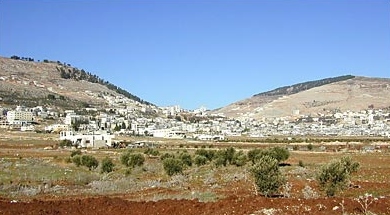
Today Mount Gezerim and Mount Eyval stand over the city of Nablus.  In the Hebrew Bible, the same two hills frame the ancient Canaanite city of Shekhem.  Although Moses has never been to Canaan, in the book of Deuteronomy/Devarim he knows about Gezerim and Eyval.

Mt. Gezerim (left), Nablus, Mt. Eyval (right)

Moses knows how the slopes that face one another curve to form a natural amphitheater, so anyone who stood in the middle of the valley and shouted could be heard by people standing on both slopes.  He gives the following order in this week’s Torah portion, Ki Tavo (“When you enter”):

These shall stand for blessing the people upon Mount Gerizim, when you have crossed the Jordan: Simon and Levi and Judah and Issachar and Joseph and Benjamin.  And these shall stand for the cursing on Mount Eyval: Reuben, Gad, and Asher, and Zebulun, Dan, and Naphtali.  And the Levites shall testify, and they shall say to every man of Israel in a loud voice: “Arur is the craftsman who makes a carved idol or a cast idol, an abomination to God, or the one who sets it up in a hiding-place.”  And all the people shall answer and say: “Amen.” (27:12-15)

arur (אָרוּר) = accursed; isolated and ruined.

amen (אָמֵן) = Supported!  Confirmed!  (A formula indicating acceptance of a curse, oath, message, deal, or religious tenet.)

The ritual continues with eleven more curses:

  • demeaning one’s father or mother
  • moving another’s boundary marker
  • making a blind person go astray
  • skewing justice concerning a stranger, orphan, or widow
  • having sex with one’s father’s wife
  • having sex with any animal
  • having sex with one’s sister or half-sister
  • having sex with one’s mother-in-law
  • hitting a person in private
  • taking payment to murder someone
  • not upholding the words of the Torah.

Commentators have pointed out that these curses deal with acts done secretly or privately, acts that society is not likely to discover and punish.  Ten of these acts concern treating other human beings badly, even when no one else knows.  The other two are about cheating on one’s religion.

Of course, more secret vices could be added to the list, but since the Israelites had twelve tribes, these twelve secret sins serve as examples.

By saying amen to the curses, the Israelites are internalizing an aversion to, or fear of, transgressing God’s ethical and religious rules.

The ritual Moses prescribes would have a major psychological impact on people just entering their new homeland.  Instead of proudly celebrating their military victories, they must dedicate themselves to being considerate with other humans and honest with God.

Why two mountains?

Mount Gerizim, which represents blessings, was thickly wooded in the biblical era.  Mount Eyval, which represents curses, was bare and stony.  Doing the right thing, therefore, would mean choosing the blessing of abundant life.  Doing the wrong thing would mean choosing an accursed life, a life of emptiness and spiritual death.

By saying “Amen” after the Levites recite each curse, the people affirm that this is the choice they must make.


Twelve Blessings

The twelve blessings are not listed in this week’s Torah portion, but according to the Talmud they are simple inverses of the curses, e.g. not making and secretly setting up an idol, etc.

However, it is easy to extrapolate active behaviors that lead to being blessed: worshiping only God; honoring one’s parents; respecting others’ property; guiding the blind; being just to people who are at a disadvantage in society; having sex only with appropriate partners; refraining from violence even when you could get away with it; putting life ahead of profit; and promoting the  rules in the Torah.

*

The blessings and curses still apply to us today.  Every time an individual faces a decision between doing something they know is wrong, and doing the right thing instead, that individual stands  between Mount Eyval and Mount Gerizim.

Thanks to our inner Levites, we know that if we do something wrong in secret,  we will still be accursed: we will suffer from guilt, we will feel degraded, and we will isolate ourselves.  If we do something good in secret, we will still be blessed: we will feel full of life, right with the world and right with our souls.

(This blog was first posted on August 23, 2010.)

Noach: Babble and Meaning

(This blog was first posted on October 5, 2010.)

And all the earth was of one language and one set of words …   And they said: Come let us build a city for ourselves, and a tower with its head in the heavens, and let us make a name for ourselves, lest we be scattered all over the face of the earth.   And God went down to see the city and the tower …

And God said: Hey!  One people and one language for all, and this is what they begin to do? …  Come let Us go down there and scramble their language, so that they will not understand each other’s language.  Then God scattered them from there over the surface of all the earth, and they stopped building the city.  Therefore He called its name Babel, because there God scrambled the language of all the earth, and from there God scattered them over all the surface of the earth. (Genesis/Deuteronomy 11:1-9)

Babel = Babylon, from the Sumerian Babilim, “Gate of the God” (both city and region)

balal = scramble, confuse; thoroughly mix oil into grain for a meal offering

Obviously the people of Babel are doing something wrong—something that isn’t horrible enough for God to destroy them with a flood, but is  serious enough for God to investigate and correct their mistake.

What is their mistake?  Three theories are: that they don’t follow God’s order to scatter; that they enforce conformity and suppress individuality; and that they try for permanence in a world God created for change.

1) They refuse to scatter.

After the Flood, God tells Noah’s descendants to be fruitful and multiply and fill the land.  But the traumatized people are afraid of being scattered.  There is comfort in numbers—and in being able to see that nobody is engaged the kind of outrageous sins that led to the Flood.  I can imagine the anthropomorphic God in this story heaving a celestial sigh, wondering what it will take for humans to get with the program.  Then God scrambles their minds so they have different languages and different sets of words—i.e., different concepts.  This time, when God scatters the humans, they have so much trouble communicating that they stay scattered.

2) They suppress the individual.

The people of Babel speak only in the plural, and appear to be in perfect agreement.  No individuals are named in the story.  Whether this counts as cooperation, or conformity, it’s not what God has in mind.  Sforno (Rabbi Obadiah Sforno, 16th century) wrote that if everyone held the same beliefs, including the same beliefs about God, then no one would seek the true God.  Only when people find out about religious differences do they develop a desire for deeper understanding.   Martin Buber (1878-1965) wrote that only a person with a well-developed sense of self is able to connect with God.

In the allegory of Babel, after God scatters the people and gives them different languages and concepts and cultures, individuality and variety return to humankind.  Then we are again able to learn and change.

3) They crave permanence.

Permanence is a continuing issue in Genesis/Bereishit.  Although subsequent chapters focus on the desire for a sense of permanence through one’s descendants, the book has already addressed the issue of death.  The result of eating from the Tree of Knowledge in Eden is personal mortality; God removes Adam and Eve from the garden of Eden and places them in our own world, where they will eventually die.  Noah and his family witness the death of their entire world, and must start all over again when the Flood waters recede.

What is the meaning of life when, sooner or later, you will die?  One possible response is to create something that will outlast you, that will be a monument down through the ages.  This is difficult to do alone.  So the people act collectively to make a name for themselves, by building a city and a tower so high that its head is in the heavens.  (In this part of the Torah, the heavens are eternal, while the earth is always changing.)

Of course their plan fails.  God, or the nature of the universe God created, will not let anything on earth endure forever.

The answer is to give up on permanence, and find a different meaning of life.

Each human must find his or her own individual meaning.  But the book of Genesis offers some suggestions.  We can “walk with God”, which I interpret as behaving morally for its own sake.  We can raise and teach children.  We can love another person, as Isaac loves Rebecca and Jacob loves Rachel.  We can wrestle with ourselves and develop our own hidden potential, like Jacob wrestling and finding new courage at the ford of Yabbok.

What other ways can we find meaning in a life without permanence?  I welcome your comments.

Chayyei Sarah: A Peculiar Oath

(I first posted this essay on October 24, 2010, then added footnotes and illustrations in 2019.)

Which body part does Abraham’s steward place his hand under when he swears an oath to his master?

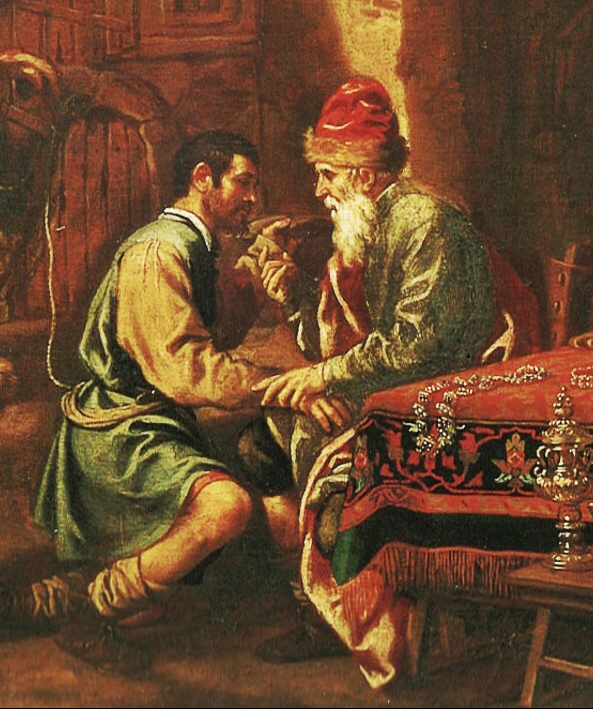
Abraham and steward, Abraham’s Solemn Charge,, by Pedro Orrente, 17th century, detail

Now Abraham was an elder, coming on in days, and God had blessed Abraham in everything.  And Abraham said to his servant, an elder of his household, the one who governed all that was his: Please place your hand under my yareikh, and I will make you swear by God, god of the heavens and god of the earth, that you do not take a wife for my son from the daughters of the Canaanites amidst whom I am dwelling.  Because you must go to my [former] land and to my relatives, and [there] you must take a wife for my son, for Isaac.  (Genesis/Bereishit 24:1-4)

yareikh (יָרֵךְ) = hip, upper thigh, buttocks, genitals.

Only two times in the Torah does someone ask another person to place his hand under the yareikh and swear an oath: in this week’s Torah portion, Chayyei Sarah (“Life of Sarah”), and in Genesis 47:29, when Jacob makes his son Joseph swear not to bury him in Egypt.

In both cases, the person requesting the oath believes he will soon die.  He will not be there to make sure his wishes are carried out, so he deputizes a man he trusts and asks him to swear a serious oath.

Abraham is 137 years old when he requests this oath.  Neither he nor his steward Eliezer1 expect him to live long enough to give further instructions if Eliezer cannot find a wife for Isaac in Abraham’s old home, the city of Charan in Aram.  (Ironically, it turns out that Abraham lives another 38 years.)

He asks his steward, who will be in charge after he dies, to swear an oath while his hand is placed—where, exactly?

19th-century rabbi Samson Raphael Hirsch argued that it was the patriarch’s thigh or buttock: the first place to touch the ground when one rests.  Therefore, he wrote, the man about to swear the oath shows the dying man that he can rest in peace, trusting to the power of the swearer’s hand.2

George Washington Swearing on a Bible

Yet in other parts of the Torah, the word yareikh is a euphemism for the genitals.   A rabbi in the Talmud declared that Abraham’s servant grasped his circumcised penis, since oaths administered by a court require one to hold a sacred item in the hand while swearing.3  Rashi4 confirmed this opinion, and his commentary is not known for flights of fancy.  Rabbi Elie Munk pointed out that the book of Genesis is set in a time before the giving of the Torah, so a circumcised penis was the only sacred object available.5

Other commentators have noted that the English words testify, testimony, and testicles all come from Latin words based on the root “testis”, and claim that this may reflect a Roman practice of taking an oath on the genitals.

If the male genitals are a symbol of creative power, they refer to God the Creator.  If they represent the covenant with God, they refer to holiness.  Either way, the oath-taker is asked to place his hand in a position underneath a symbol of the sacred.

Throughout the Torah, the hand is a metaphor for the power to act, to do things in the world.  So in this ancient ritual, the one swearing the oath places his own power to act underneath, below, subservient to, the sacred object of the other man.  In other words, he is promising he will do everything in his power to carry out the other man’s will as if it were the will of God.  A potent oath!

A vow made to a dying person is one-sided, obligating only the person swearing the oath.  If unforeseen circumstances arise after someone is dead, is the other party still obliged to carry out a mission that now looks like a bad idea?  Or should the survivor be free to change course to address the new circumstances?

In the book of Genesis, Abraham’s steward Eliezer has little trouble bringing back a bride for Isaac from Aram.  (In the other example of this oath, Joseph easily gets Pharaoh’s permission to bury his father in Hebron instead of Egypt.)  My impression is that Eliezer enjoys carrying out his oath by matchmaking.

*

Not all deathbed requests are that easy, or that benign.  Yet human nature tends to put a high value on a deathbed promise; for example, people go to great lengths to carry out a deceased person’s wishes regarding burial.  There is also psychological pressure to reassure a dying person.  In that situation, is a promise really freely given?

Suppose you “knew” that a certain thing had to happen, and you doubted you would live long enough to make sure it did happen.  Is it right to ask someone else to swear to make it happen?  What if the person you are asking agrees to carry our your mission even though they do not share your belief in its necessity?  What if the circumstances change after your death?

Is it right for a living person to be bound by the desire of someone who is dead?

  1. See Genesis 15:2.
  2. Rav Samson Raphael Hirsch, The Hirsch Chumash: Sefer Bereshit, translated by Daniel Haberman, Feldheim Publishers, Jerusalem, 2000, p. 514.
  3. Talmud Bavli, Shevuot 38b.
  4. Rashi is the acronym of 11th-century Rabbi Shlomoh Yitzchaki.
  5. Rabbi Elie Munk, The Call of the Torah: Bereishis, Mesorah Publications, 1994, p. 626.