Omer: Working on a Holy Place

(This is the second post in a series about counting the omer. If you are looking for inspiration about this week’s double Torah portion, you can check out my previous blog posts on Acharei Mot and Kedoshim.)

עמר

omer

Last week I wrote about the Jewish tradition of counting the omer—counting each of the 49 days between Passover/Pesach and the festival of Shavuot. (See my post “Omer: Counting 49”.) Most non-orthodox Jews who count the omer today simply read or recite two sentences (labeled as #2 and #3 below): a blessing for counting the omer, and the evening’s count—the number of days and weeks since the first day of Passover. But that way they miss all the juicy parts of the ritual.

In fact, the prayer service for counting the omer is full of Kabbalistic practices and symbolic meanings. I’ll repeat the orthodox order of the omer-counting service from last week’s post:

#1.  Opening prayer: a) the intention of the omer prayer service, b) Leviticus 23:15-16, and c) a blessing from Psalm 90.

#2.  Blessing for counting the omer.

#3.  Statement of which day it is in the count.

#4.  A one-sentence prayer about restoring the service of hamikdash = the holy place (usually translated as “the Temple”).

#5.  Psalm 67, which has 49 words.

#6.  Ana Bekhoach, a 7-line poem of supplication written by Rabbi Nechunya ben HaKanah, a Kabbalist who lived in the first century C.E.

#7.  Closing prayer framing the count in terms of Kabbalah, including the 7 lower sefirot. (Sefirot is the plural of sefirah, a word from the same root as sofeir = counting. Sefirot are categories of creative power, or forces ruling the universe and the human soul.) In the middle of this closing prayer, you fill in the blank with the  the sefirah of the day and the sefirah of the week. Over the course of seven days a week for seven weeks, you get 49 different pairings.

Last week, I wrote about the first sentence, a breathtaking declaration from Kabbalah that this omer prayer service is for the sake of changing reality and uniting God. I also wrote about the quote from Leviticus in the middle of the first prayer, which tells us to bring the priests an omer-measure of barley on the second day of Pesach/Passover (day one of the omer count), count 49 days, then bring a new grain offering (wheat bread) on day 50.

The first prayer of the omer service concludes with a three-line sentence from Psalm 90:

May the no-am of the lord our God be upon us,

And the work of our hands konenah upon us,

And the work of our hands, konenah it. (Psalm 90:17)

no-am = pleasantness, delight, sweetness

konenah = establish, firmly found, build to endure

This is a good blessing to recite before any serious undertaking—and medieval Kabbalists considered counting the omer a serious undertaking. The blessing carries additional meaning within the context of Psalm 90. The theme of that psalm is that although God is permanent, humans are ephemeral. What can we hope for, when our lives are so fleeting? The answer lies the psalm’s conclusion, translated above. We pray that we will enjoy whatever gifts we receive from God, and that the works we create will endure for generations after us.

The “work of our hands” includes everything we make, in every field of endeavor. (For example, this blog is one of the works of my hands.) The word konenah is commonly used in the Torah for solid buildings, edifices that will stand for a long time. Malbim (the 19th-century rabbi Meir Leibush ben Yehiel Michael Wisser) wrote that doing  mitzvot (ethical and religious behaviors required in the Torah) also counts as the work of our hands. The habit of doing mitzvot adds depth to a human’s personality, he said, so establishing that practice counts as establishing a solid edifice.

Other traditional commentators have written that Psalm 90 is speaking about the “work of our hands” in making the portable sanctuary in the Torah, and building the temple in Jerusalem.  We pray at the end of Psalm 90 for God to confirm the holiness of the Temple we built, and strengthen it so it will last.

Both the first and the second temples in Jerusalem lasted for centuries. But when the second temple fell to the Romans in 70 C.E., Jews were left with only the temple mount and the remains of the western wall. Since then, we have built synagogues and study houses all over the world, and have turned our own homes into places of prayer. I believe these are all holy places, and the “work of our hands”, our intentional creative actions, make them holy. But does a house of prayer or study count as a “house of the mikdash” ?

That phrase appears in step #4 of the omer service. Step #1 is the opening prayer, which ends with the blessing for the work of our hands from Psalm 90. Step #2 is the blessing for counting the omer: Blessed are you, God, our god, king of the universe, who has made us holy with Its commandments, and commanded us regarding the counting of the omer. Step #3 is the actual count of the day. Then comes step #4:

May the Compassionate One return for us the service of the house of the mikdash to its place, in a hurry, in our days. Amen, Selah.

mikdash = holy place, abode of holiness, sanctuary, holy precinct

In this prayer after the omer count, “the house of the mikdash” is usually translated as “the Temple”. Even during the first century C.E., the century after the fall of the second temple, praying for a third temple and the restoration of the service of priests was a political statement. Some sects thought the priests had wielded too much power, and these Jews did not want a return to the old status quo.

Today, I am one of many Jews who feels an aversion to praying for God to restore the service of the Temple. I certainly do not want the mosque that currently crowns the temple mount to be torn down and replaced with a Jewish building. I do not want a return to a hereditary priesthood running things. And I do not want a return to worship through slaughtering animals as offerings; I believe it is far better to serve God through prayers and good deeds, as we have been doing for the last two thousand years.

So some evenings when I am counting the omer, I skip this prayer. Other evenings, I recite it in Hebrew, but my inner English translation is different:

May the One of compassion return us to service in the places where holiness dwells, now, every day. Amen, Selah.

God may be everywhere, but we only notice the divine at certain times and in certain places. The Hebrew Bible asks people to pay attention to the divine on Shabbat and festival days, and at the Temple where God dwelled. Now, I believe, the divine dwells wherever humans recognize holiness. Sometimes the holiness of a place strikes us suddenly. More often, we make an effort to create a holy space, by arranging what we see and hear there, and then going there to pray and to engage in rituals. Thus holy places are the work of our hands—in Moses’ time, in Temple times, and to the present day.

May the delight of our God be upon us,

And make the work of our hands an enduring foundation for us,

And the work of our hands, may it endure.

.

Omer: Counting 49

I have been counting the omer every evening for two weeks now, and we have five more weeks to go. The omer count begins on the second day of Passover and goes on for 49 days. On the 50th day, we celebrate the holy day of Shavuot (“Weeks”).

Barley sheaf

In the Torah, the priest waves a sheaf of barley each day for 49 days. But after the fall of the second temple in Jerusalem in 70 C.E., the omer-counting became a prayer service, and acquired new  meanings. This is the first of several posts I am writing about the fascinating prayers from Kabbalah that come  before and after the daily count in orthodox Jewish prayers.

But first, what does “counting the omer” mean?

The Hebrew word omer first appears in the book of Exodus/Shemot (in the Torah portion  Beshallach), as a measure for manna; one omer of manna feeds one person for one day.

The word omer does not show up again until Leviticus/Vayikra, in the Torah portion Emor. The Torah sets the time for the Festival of Matzah, i.e. Passover, then gives instructions for the next day:

…then you shall bring an omer of the first of your harvest to the priest. And he will wave the omer before God so you will be acceptable; [starting] from the day after the rest-day the priest will wave them. (Leviticus/Vayikra 23:10-11)

And you shall count for yourselves, from the day after the rest-day, from the day you bring an omer of the waving, seven tamim weeks. Until the day after the rest-day of the seventh [week] you shall count [to] the 50th day; then you shall bring close a new grain-offering to God. (Leviticus 23:15-16)

omer (עֺמֶר) = a measure for barley.  

tamim (תָּמִים) = whole, entire, intact, unblemished, blameless, sincere.

When the word tamim refers to a sacrificial animal, it means blemish-free. When it describes a human being, it can mean either that the person’s body is unblemished, or that the person is innocent, blameless, honest. So I think the text in the Torah itself invites us not merely to count the days for seven weeks, but to make the days count—by checking for blemishes in our souls.

The culmination of the 49 days of counting is Shavuot, the 50th day. Until the fall of the second temple, Shavuot was a harvest festival. People brought their “new grain-offering” of two loaves of wheat bread to the temple, along with the first fruits from seven kinds of plants (wheat, barley, grapes, figs, pomegranates, olives, and dates).

After the fall of the temple, the rabbis soon found a new meaning for Shavuot, deciding that it marked the anniversary of receiving the Torah at Mount Sinai. So for the last 2,000 years, the 49-day count has been linked with preparing, day by day, to be worthy of receiving the divine revelation of Sinai.

Naturally, rabbis over the millennia have enriched counting the omer with other prayers that have a count of  7 or 49. The orthodox omer-counting procedure as it stands today follows this order:

#1.  Opening prayer: a) a sentence declaring the intention of the omer prayer service, b) Leviticus 23:15-16 (translated above), and c) a blessing from Psalm 90.

#2.  Blessing for counting the omer.

#3.  Statement of which day it is in the count.

#4.  A one-sentence prayer about restoring the service of hamikdash = the holy place (usually translated as “the Temple”).

#5.  Psalm 67, which has 49 words.

#6.  Ana Bekhoach, a 7-line poem of supplication written by Rabbi Nechunya ben HaKanah, a Kabbalist who lived in the first century C.E.

#7.  Closing prayer framing the count in terms of Kabbalah, including the 7 lower sefirot. (Sefirot is the plural of sefirah, a word from the same root as sofeir = counting. Sefirot area categories of creative power, or forces ruling the universe and the human soul.) In the middle of this closing prayer, you fill in the blank with the  the sefirah of the day and the sefirah of the week. Over the course of seven weeks, you get 49 different pairings.

Most non-orthodox Jews who count the omer today simply read or recite two sentences, labeled as #2 and #3 above. That way they get it done quickly—and miss all the juicy parts. Some people, especially in Jewish Renewal, go on to consider the essence of #7, and try to find a personal meaning in the pair of sefirot for the day. There are many books and blogs about what each of the 49 sefirot pairs might mean.

My posts will look instead at the often overlooked prayers in the omer-counting procedure: numbers 1, 4, 5, 6, and 7 in the list above.  This week, let’s zoom in on just the first prayer in number 1:

For the sake of the unification of the Holy One, blessed is He, and His shekhinah, in fear and love to unify the name Yud Heh with Vav Heh, in complete unity, in the name of all Israel.

shekhinah (שְׁכִננָה) = the indwelling presence of God in our universe (literally, the feminine form of “dweller”)

This opening prayer sets the intention of the rest of the omer-counting prayer service. We are not just counting the days; we are doing spiritual work that helps to change the nature of reality.

This introduction was written (in Aramaic) by the disciples of Rabbi Isaac Luria. Luria taught from 1569 to 1572 in Sfat, a town full of Kabbalists about 80 miles north of Jerusalem. In those three years before his death, he founded a major branch of Kabbalah. One of the core Lurianic ideas is that in order to create our universe, God first withdrew a measure of divine “light” to make space, then created ten sefirot, ten forces of creative power, which Luria saw as vessels for the divine light. The first three vessels, the three upper sefirot, could contain the light  poured into them. But the next six vessels shattered. The tenth and the lowest sefirah, Malkhut, cracked.

After the “shattering of the vessels”, the rest of the creation of the universe proceeded differently from God’s original plan, and included evil as well as good. Yet everything in our universe contains a spark of divine light. And human beings have the ability, through good deeds and prayers, to “raise the sparks” and repair the universe. Therefore the Lurianic Kabbalists preceded many prayers with the sentence above, to remind the person praying that the purpose of the prayer service is to unify God Itself with the shekhinah, the divine presence in our world. According to Kabbalah, the shekhinah is in the sefirah of Malkhut, the lowest one, the one closest to our daily physical life on earth. So uniting the Holy One with the shekhinah is also uniting the upper three sefirot with the lower seven  sefirot, and it also uniting the first two letters of God’s most holy Name, yud and heh, with the last two letters of the Name, vav and heh.

Every evening, during the 49 days of counting the omer, when I recite that intention to unify God with my prayers, I feel hollow with awe inside. What nerve! How could anything I do affect God, reality, the nature of being? And anyway, I’m not much of a mystic compared with most of my Jewish Renewal friends. I find the images of Kabbalah powerful, and they feel significant; but my rational mind does not believe any of this stuff.

And yet … if I pray for the sake of the unification of the Creating and the creation…if I pray for the sake of making whole the holiness I glimpse in the world…then maybe this little ritual of counting the omer  has a deeper meaning than I think. Maybe everything I do, everything each of us does, has a deeper meaning than we think.

Shemini: Mourning in Silence

The death of someone close to you, even after a long illness, is hard to accept.  A sudden death is like an earthquake.  But what if the sudden death came neither from an accident nor from a gun, but from a blast of divine fire?

That is how Aaron’s two older sons die in this week’s Torah portion, Shemini (“Eighth”).  Aaron and his four sons undergo an eight-day sanctification and ordination, along with the altar of the newly-assembled mikdash (“holy place”).  At the conclusion of the ritual, a miraculous fire rushes out from the Holy of Holies and consumes everything on the altar.  All the Israelites shout with joy and prostrate themselves. The five newly-ordained priests no doubt rejoice as well in this manifestation of God’s glory.

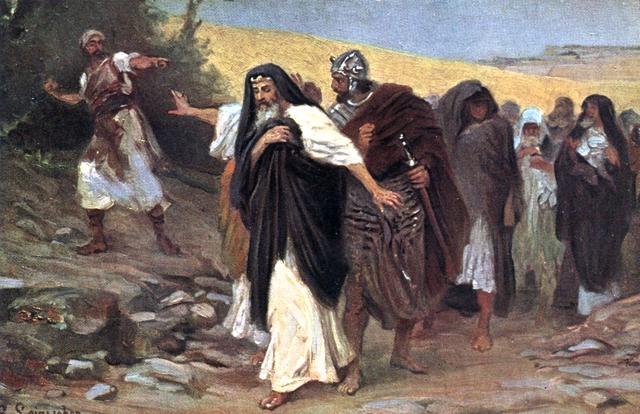
The Dead Bodies Carried Away, by James Tissot, ca. 1900

Then Aaron’s older sons, Nadav and Avihu, grab their incense-burners and bring “alien fire” to God.  (See my post Shemini: Prayer and Glory.) Another miraculous fire rushes out from the Holy of Holies and consumes them. But their bodies remain sufficiently intact for their cousins to drag them out of the sanctuary by their tunics.

Then Moses said to Aaron:  It is what God spoke, saying:  “Bikrovai, I will be proven holy; and in the presence of all the people I will be glorified. And Aaron, vayidom. (Leviticus/Vayikra 10:3)

bikrovai (בִּקְרֺבַי) = through those near me.

vayidom (וַיִּדֺּם) = he was silent; he was motionless; he waited. (Another verb from the same root, דּמם , means “was silenced”.)

Moses seems to be quoting God, but when did God say that?

According to Rashi1 Moses elaborated: “Aaron, my brother, I knew that this House would be sanctified by those who are cherished by God, and I thought it would be either through me or through you. Now I see that these [Nadav and Avihu] are greater than I and you.”

In this reading, Moses is assuring his brother Aaron that God did not kill his sons because they were unworthy; God killed his sons because they were so wonderful. This reminds me of when I was in first grade, and a Catholic friend of mine solemnly told me that the happiest day of her life would be when her husband died—because she knew he would go straight to heaven, and she knew she would be unselfish enough to rejoice.  (I thought my friend was crazy.)

But the religion in the Torah has no concept of an afterlife, except for vague references to an underworld called Sheol where nothing happens.  Whatever Moses intends, he is not saying that God has suddenly rewarded Nadav and Avihu for their virtue by transporting their souls to heaven.

Most Jewish commentators agree that God is punishing rather than rewarding Nadav and Avihu. After all, the two men brought “alien fire” into the new Tent of Meeting without authorization, so they were guilty of at least careless over-enthusiasm, and at worst egotism and disdain for their elders.  But did they deserve death for their mistake?

Naphtali Herz Weisel2 wrote that while humans tend to be lenient with the people they love the most, God does the opposite.  God overlooks a minor infraction committed by an ordinary person, but severely punishes even a tiny error by a leader who was divinely chosen.

The implication is that God’s killing of Nadav and Avihu for making a small mistake proves that the two new priests were extraordinarily holy and close to God. This is how Moses tries to console Aaron.  And Aaron responds to this attempt with silence.

Some commentary says that Aaron was silent because he accepted Moses’ explanation.  Indeed, I can imagine that if you were afraid your children had died committing a crime, it might be some comfort to know that they had only made a minor error in judgment.

Other commentary brings in other possible meanings of vayidom.  Isaac Abravanel3 wrote that Aaron was not consoled; he wailed at first, then became silent and motionless as his heart turned to stone.  Modern commentators add that Aaron was in shock; we might say his soul was silenced.

And Aaron’s silence continues.  In the Torah, the acceptable response to the death of a family member is to wail, tear your clothing, and untie your hair.  You are supposed to show your grief in public.  But before Aaron, or his two younger sons, Elazar and Itamar, can begin to dishevel themselves, Moses stops them.

Moses said to Aaron, and to his sons Elazar and Itamar:  Don’t let the hair hang loose on your heads, and don’t tear your clothes; then you will not die, nor will God become furious at the whole community.  But your brothers, all the house of Israel, will bewail the burning that God burned.  And do not go out of the opening of the Tent of Meeting, lest you die, for the oil of anointing of God is upon you.  And they did as Moses spoke.  (Leviticus 10:5-7)

Everyone in the whole camp of Israel is expected to mourn for Nadav and Avihu—except for the three surviving priests, the three men closest to them. Later in the book of Leviticus, in chapter 21, a high priest is forbidden to grow his hair long, tear his garments, or come near any dead body.  The other priests may engage in mourning practices, but only for their closest family members (including sons and brothers), and only when they are not on duty. This exception does not apply, however, to the newly anointed Elazar and Itamar.  Since they are not allowed to leave the opening of the Tent of Meeting, they are like high priests, unable to go off-duty.

Other ancient religions in the region had priests who specialized in serving and summoning the dead.  But for the priests of the Israelites, any contact with the dead was a contamination, making them unable to do their jobs until they had been purified.  True, their jobs included a great deal of contact with dead animals, not to mention diagnoses of skin diseases.  Nevertheless, it was important for priests to inspire the people to become “holy”, to worship God with joy as well as devotion.  In order to do this, priests were expected to look joyful and devout as they served God, no matter what they felt inside.

20th-century rabbi Elie Munk went further, and wrote that the priests had to maintain a joyful state of mind in order to give blessings to the people.  They could not let themselves mourn on either the outside or the inside.4

Today we would call that going into denial.  Yet it remains true that there are times when we must all rise to the occasion, pretending to be more serene than we feel inside, in order to do some important job—maybe to take care of someone else in need.  The danger lies in always being “on”—never leaving the opening of the tent of meeting.

May we all be blessed with both the strength to rise above our feelings at times, in order to serve others, and the strength to remove ourselves from service at times, in order to do the mourning we need for our own souls.


  1. 11th-century Rabbi Shlomo Yitchaki.
  2. 18th-century rabbi Naphtali Herz Weisel, translated in Nehama Leibowitz, New Studies in Vayikra, Vol. 1, World Zionist Organization, Jerusalem,1993, p. 131.
  3. 15th century philosopher Isaac ben Judah Abravanel.
  4. Elie Munk, The Call of the Torah: Vayikra, Mesorah Publications, Brooklyn, N.Y.,1992, p. 89-90.

Tzav: Keep the Altar Fire Burning

The last Jewish temple was razed in the year 70 C.E., almost two thousand years ago, when the Romans destroyed Jerusalem. So what use do we have, today, for an instruction manual for priests officiating at the altar?

This week’s Torah portion, Tzav (“Command”) tells priests what to do with the grain offering and four types of animal offerings (or sacrifices) brought to the altar at the front of the sanctuary.  These instructions ares certainly of historic interest. But do they matter to our own psycho-spiritual lives?

For the past two thousand years, Torah commentary has answered yes—by finding deeper meanings embedded in the practical instructions for the priests. One example is the Torah’s insistence that the fire on the altar must burn through the night and never go out.

Command Aaron and his sons, saying: This is the Teaching of the olah: It is the olah that [stays] on the hearth, on the altar all night until the morning, and the fire in the altar must be kept burning. (Leviticus/Vayikra 6:2)

olah = ascending, going up; that which ascends; an animal offering completely burned on the altar and thus turned entirely into smoke that ascends to God

And  you shall keep the fire on the altar burning, you shall not let it go out; and the priest shall kindle wood on it each morning, and he shall arrange the olah on it and cause the fat of the shelamim to ascend on it.  A continual fire must be kept burning on the altar; you may not let it go out. (Leviticus 6:5-6)

shelamim = offerings of peace and wholeness; animals offered to express thanks or to fulfill a vow, and divided into portions to be burned into smoke for God, portions for priests to eat, and portions for the donors and their guests to eat

The olah was offered twice a day, morning and evening. Other offerings were burned on the altar during the day, but at night the sanctuary was closed to everyone but the priests, and no new offerings were added to the fire. For the other kinds of animal offerings, including shelamim, the priests cut up the animal and reserved some pieces for eating, but burned the choice fatty parts on the altar. The fatty pieces burned up quickly, but the olah was the whole skinned animal, so it burned slowly.

One interpretation of the commandment to keep the altar fire going all night is simply that the burning of the olah must be completed, no matter how long it takes. And who would want to deprive God of even a whiff of the smoke?  (See my blog post Pinchas: Aromatherapy.)

But the ancient Israelites must have appreciated the symbolic value of a fire that must never go out as much as we do today. In next week’s Torah portion, Shemini, Aaron and his sons inaugurate the sanctuary’s altar with various offerings, lighting the wood themselves. But then a fire comes straight out from God and consumes every animal and animal part smoldering on the altar in one glorious rush. From then on, the fire that burns on the altar has a direct line of transmission—or ignition—from that divine fire. As Rabbi Elie Munk pointed out in the early 20th century, “Fire is an allusion to the Divine Word, the Torah.”  The word of the Torah must never be extinguished.

The fire on the altar is both divine and man-made, rekindled daily by the priests. Thus it also represents our passionate desire for God, which we must never extinguish.

Rabbis in the Talmud tractate Yoma deduce that all the fire used for holy purposes in the sanctuary is taken from the continual fire on the altar, including the fire used to kindle the incense altar, to burn coals in the censer on Yom Kippur, and to light the seven lamps of the golden menorah. Naturally a fire started by God would be the most holy fire to use. But Rabbi Munk compares the fire on the outer altar, used for animal offerings (i.e. sacrifices) to “the altar of duty” on which we should sacrifice our egotism. Only if we tend the fire of that altar will we be able to kindle the fire of passion for God that brings us exaltation.

Other commentary points out that although the fire on the altar must never go out altogether, it burns low during the night, and in the morning a priest kindles fresh wood from it. The late 19th-century Hassidic rabbi Yehudah Leib Alter of Ger wrote that the rekindling in the morning means that every day a new light comes to those who serve God.  Our spirits burn low at night, that is, when our soul are distracted by darkness and evil. But when we remove the ashes from the previous day’s sacrifices, we are removing the waste in our lives, and that uplifts us so that we receive new light from God.

About 100 years later, in 1998, Rabbi David Wolfe-Blank zt”l wrote the following double translation of Leviticus 6:6. (The first sentence is a literal translation; the second interprets it at a psycho-spiritual level.)

This is the law of the elevation offering, the elevation offering on the flames on the altar all night until the morning, and the fire of the altar shall be kept aflame on it.

This is the teaching which enables you to transcend. Transcend the ‘small’ by moving toward whatever enflames the passion in your heart even during times of illusion and conventional life-issues, leading towards the time of enlightenment. Let the parts of the Torah which seem brightly lit to your heart blaze and shine and fire up those parts of your soul that are ignitable.

Both Rabbi Yehudah Leib Alter of Ger and Rabbi David Wolfe-Blank of Seattle compared the nights in this Torah verse to the times when we are distracted and deluded. I believe these times of darkness  are frequent for everyone; it is so easy to get caught up in the obsessions of our society, so hard to keep out minds on a higher purpose in life. But if we stick to a practice of offering ourselves to the divine at regular intervals—perhaps every morning and evening, like the olah—then we keep the fire from going out altogether. Another way to keep the fire from going out during the dark times, according to Wolfe-Blank, is to keep paying attention to the parts of the Torah that light up our hearts.

Then after every dark night comes a morning, and by the grace of God we see beauty and light again. We recall our own souls, and the fire is rekindled—the fire of desire and enlightenment and glory, the fire that is both a gift from God, and our gift to God.

Vayikra: Sour, Sweet, and Salt

Humans tend to bring gifts to their gods. They have done it all over the world, from the beginning of history. In the Torah, the first human to offer a gift to God is Cain, the oldest son of Adam and Eve … and God rejects his offering. Religions help people to avoid the fear of being rejected by their gods by spelling out what gifts are and are not acceptable.

The first part of the book of Leviticus/Vayikra (And It Called) is devoted to instructions about offerings for the altar. What kinds of animal and grain offerings will be acceptable to God? The first Torah portion begins by considering animals for burned offerings.

If one brings an olah from the herd, he shall bring an unblemished male; he shall bring it to the opening of the Tent of  Meeting, liretzono before God. And he shall lean his hand upon the head of the olah, and it will be nirtzah for him, to atone for him. (Leviticus/Vayikra 1:3-4)

olah = an offering that is completely burned, so its smoke will rise to the heavens

liretzono = to be accepted for him

nirtzah = favorably received, acceptable, counted as good (from the same root as liretzono, רצה)

After an initial review of animal offerings, the Torah gives particulars about the minchah offering: a gift of homage to God, made from grain. (See my blog post “Vayikra: Gifts to the Giver”.) Embedded in the minchah instructions is a ban on any leavening or sweetener in a burned offering:

Every homage that you bring to God you shall make without chameitz; for you shall not bring any sourdough or any devash into an offering by fire to God. (Leviticus 2:11)

chameitz = leavened bread, fermented food

devash = syrup, bee honey, fruit nectar

Leavened loaves of bread can only be brought to the sanctuary for the priests and their families to eat; they must not be burned on the altar. Fruit syrup or jam can only be brought at the annual festival of first fruits, Shavuot, and the fruit preserves were also eaten by the priests.

Why are leavened bread and syrup are banned from burned offerings?  Philo of Alexandria, who lived 2,000 years ago, began a long line of Jewish commentatary comparing bread rising to a human puffing up with self-importance—the opposite of the humility needed to pay homage to God. Another view stresses the instruction in the book of Exodus/Shemot to eat unleavened matzah on Passover/Pesach in order to remember that the Israelites did not have time to let their dough leaven before escaping Egypt. Since matzah is “the bread of our affliction”, the Israelites presumably did not have time to watch bread rise during their years of slavery, either. According to 19th-century rabbi Samson Raphel Hirsch, leavened bread therefore represents political independence, which the Israelites achieved not by their own efforts, but only by following God’s Torah. Fruit syrup represents ownership of land where dates and other fruit trees grow naturally—another gift from God. Hirsch argued that an acceptable offering to God could only be something that the Israelites had acquired by their own efforts. (Presumably the Israelites put a lot of their own labor into making flour and tending their animals.)

I am not persuaded by either Philo or Hirsch. I suspect that the key lies in the way the ancient Israelites viewed leavening. For modern Americans, leavened bread is sweet and yeasty, and sourdough bread is an interesting variation. But the ancient Israelites had only sourdough leavening, and their word for leavened bread, chameitz, comes from the same root as the word for vinegar, chometz. In Biblical Hebrew, when something leavens or ferments itself, yitchameitz, it turns sour and sharp, whether it is flour becoming sourdough bread or grape juice becoming vinegar.

An offering that is going to straight up to God in smoke should not be sour. If we give ourselves to God in a sour mood, our offering will not be accepted.

Nor should an offering sent straight to God be sweetened, as if the donor wanted to make it more palatable to God. If we try to sweet-talk our way into God’s favor, or to adopt a sweetness that we do not feel inside, our offering will not be accepted.

After banning leaven and syrup in burned offerings, the Torah says that all offerings to God must be salted:

Every offering of your homage you shall salt with salt; you may not omit the melach of the brit of your God from your homage. You shall put melach on every offering of yours. (Leviticus/Vayikra 2:13)

melach = salt

brit = covenant, pact, alliance

Why is salt required for acceptance? Salt was not a rare commodity in Canaan; the Israelites used to quarry rock salt near the Dead Sea, which the Hebrew Bible calls the Sea of Salt. The salt quarries between that sea and the city of Sodom may be the “Valley of Salt”, the site of at least two battles in the Hebrew Bible. When God annahilates Sodom and Gomorrah in the book of Genesis/Bereishit, Lot’s wife looks back at Sodom and becomes a pillar of salt (one of many strange salt formations left by the evaporation of the Dead Sea). In Deuteronomy/Devarim Moses warns that when the Israelites worship idols in the future, God will destroy their land, and visitors will compare its barrenness to burning with sulfur and salt.

Yet the proper care of a newborn infant included bathing it in water and rubbing it with salt, according to the book of Ezekiel/Yechezkeil; and the prophet Elisha “heals” a contaminated spring with a dish of salt in 2 Kings/Melakhim. Salt is both a preservative and a condiment for food. Thus the Hebrew Bible associates salt with both death and life.

This week’s Torah portion refers to salt as a form of covenant. A covenant of salt also shows up in the book of Numbers/Bemidbar. After disposing of Korach’s threat to the rights of priests, God tells the high priest Aaron:

All holy upraised offerings that the children of Israel raise up to God, I give to you and to your sons and to your daughters with you, as a decree forever; it will be a brit melach forever; it is before God for you and your offspring with you. (Numbers/Bemidbar 18:19)

And in the second book of Chronicles, Aviyah, king of Judah, says:

Listen to me, Yaravam and all Israel! Don’t you know that God, the god of Israel, gave kingship to David over Israel forever, to him and to his sons, a brit melach? (2 Chronicles/2 Divrei Hayamim 13:4-5)

Salt apparently makes a covenant especially unbreakable and long-lasting. Many commentators attribute this to the fact that salt was the main preservative used by the Israelites. But salt was also their universal seasoning, set on the table for every meal. Eating a man’s salt was an idiom for being either his friend or his dependent. So a covenant of salt might imply not only durability, but also dependence or even friendship.

Now that we reach out to God by praying instead of by burning animals and matzah, we can apply the ideas in Leviticus about leaven, syrup, and salt in a more subtle way. All too often, when we stand before other people, we have to paste on a sweet smile. But when we stand before God, we need to abandon any false sweetness, as well as the pride and the sourness implied by leavening. And we need to be serious about life and death, offering our whole selves, and acknowledging that we all eat our salt at God’s table.

Stories from Eve’s Tree

A story as old as the Talmud says that when Abraham and Sarah went to Egypt, and Abraham suddenly noticed his wife was beautiful, he hid her in a casket and tried to smuggle her across the border.

What happened next? Five women who were certified last year as maggidot (“tellers” of Jewish stories and Torah) have put our own spin on the ancient tale. We’ll present it this Saturday, March 16, in a show called “Stories from Eve’s Tree”. In between scenes about the dubious border crossing, we’ll tell other tales about how the lives of women are hidden and revealed—-traditional stories, personal stories, and stories about characters in the Torah as we imagine them. For this show, I wrote a story about about Lot and his wife when they imitate Abraham and Sarah, with hilarious results.

If you can be in Portland, Oregon, this Saturday night, come to “Stories from Eve’s Tree” at 7:30 p.m. Here’s the poster: SFET flyer

And here’s the link to our website: www.storiesfromevestree.com

If you can’t be in Portland on March 16, stay tuned! We are forming a troupe and taking this show on the road.

Ki Tissa: Interrupted Wedding

The covenant between the people of Israel and the God of the Torah has often been compared to a wedding, perhaps ever since the prophecy of the 6th century BCE:  As the bridegroom rejoices over the bride, so shall your God rejoice over you. (Isaiah 62:5) According to the Torah, God and the Israelites make their covenant (a contract like a marriage) at Mount Sinai.  The Talmud tractate Kiddushin states that the three elements of a wedding are money (the dowry), a written contract (the ketubah), and intercourse. So far in the book of Exodus/Shemot, God has given the Israelites a dowry: their freedom from Egypt, plus the gold and silver that the Egyptians handed over to the Israelites in response to God’s miraculous plagues. In this week’s Torah portion, Ki Tissa (“When you lift”), when Moses comes down from a 40-day meeting with God on Mount Sinai, he brings the other two elements of the wedding: a  marriage contract engraved on two stone tablets (presumably the Ten Commandments), and instructions for building a sanctuary so God will “dwell among them”.

Alas, while Moses was away, the bride was unfaithful. The Israelites, terrified that Moses would never return, got Aaron to make a golden calf to lead them. Moses returns to find the people cavorting in front of  an idol. Clearly, the Israelites do not yet have enough faith and fortitude for this marriage. So Moses quickly smashes the two stone tablets of the contract, and postpones the building of the sanctuary for cohabitation.

Before the wedding can resume, the bride must have a change of heart. So God and Moses arrange for the Israelites to see their separation from God’s presence.

And Moses, he shall take the tent and pitch it for himself outside the camp, far away from the camp, and he shall call it the Tent of  Meeting. Then it will be that anyone seeking God must go to the Tent of Meeting, which will be outside the camp. (Exodus/Shemot 33:7)

In the next two books of the Torah, we learn that anyone who contracts the skin disease tzara-at is ritually impure, and must live outside the camp until he or she is cured. Here in the portion Ki Tissa, the whole camp is ritually impure after the golden calf worship, unfit for worshiping God. Therefore the place where God can be encountered must be far away from the camp—until the whole camp is cured. Only then does the Tent of Meeting move from outside the camp to inside the new sanctuary in the heart of the camp.

During the period when God does not dwell in the camp, any individual who wants to communicate with God must go to the Tent of Meeting, which will be outside the camp. The Torah does not say whether Moses acts as an intermediary, or God answers the seekers who walk out to the Tent of Meeting directly. But the Torah does describe the experience of the people who wait in the camp while Moses goes to meet God.

Then it was, that when Moses was going out to the Tent, all the people stood up, and each one stationed himself at the petach of his tent, and they gazed after Moses until he came to the Tent. And it was, that when Moses came to the Tent, the pillar of the cloud descended, and it stood at the  petach of the Tent, and It spoke with Moses. And all the people saw the pillar of the cloud standing at the petach of the Tent, and all the people stood, and each one prostrated himself at the petach of his [own] tent. (Exodus 33:8-10)

petach  = opening, entrance, doorway

How do the people feel when they gaze after Moses, and see him speaking with the pillar of cloud ? How do they feel, knowing that they have jilted God?

The Talmud offers two different theories. In one, the people resent Moses so much, they accuse him of profiting at their expense. In the other, they admire Moses for his confidence that God will speak to him. Either way, they are painfully aware that Moses’ relationship with God is unbroken, while they are suffering through a separation. I think that their jealousy of Moses contains more longing than resentment, since they stand up respectfully when he leaves for the Tent of Meeting, and they prostrate themselves, bowing to God, when they see the pillar of cloud. These are the Israelites who survived the killings Moses and God carried out after the Golden Calf worship, presumably the ones who did not incite idol worship, but did look the other way. Now, after the death of their neighbors and the separation of God’s presence from the camp, the survivors  are humble.

The repetition of the Hebrew word petach indicates to me that this period between the destruction of the golden calf and the building of the sanctuary is is a time of openings and doorways. When Moses speaks with God at the entrance of the tent outside the camp, each Israelite stands alone in the entrance of his (and perhaps her) own tent. Each one longs for God from a distance. I can imagine an Israelite bowing down toward the distant God that he or she betrayed. A person’s tent is his dwelling-place, like his body, or his mind. Bowing to God leaves the doorway open; it makes an opening for change.

I have been feeling distant from God lately. I try to pray, since my prayers of gratitude used to make an opening for joy to enter my own “tent”. But these days, the prayers feel formulaic. I am not aware of doing anything to jilt God, but nevertheless I feel a separation. I wish I could see a Moses going out to the Tent of Meeting. Maybe the sight would inspire me. Or maybe then I’d know where to seek God.

The book of Exodus ends when the people have made everything to build a mishkan, a dwelling-place, for God, and Moses puts all the pieces together. Then God comes into the camp and dwells in their midst. In other words, the wedding resumes, and the covenant is cut or signed between the Israelites and God. Will something similar happen to each of us today, when we yearn for God? Will our longing make an opening? If we work hard to make God’s dwelling-place, will God become manifest to us?

And can we do it individually? Or do we need a whole community, a whole camp, to bring God into our midst?


Terumah: Bread of Faces

Why does God need a dinner table?

In this week’s Torah portion, Terumah (Donations), God orders a Moses to make a table, and tells him how to set it. The table is just one piece of furniture God requests during Moses’s first 40-day stay at the top of Mount Sinai. God also wants the children of Israel to make a lamp, an incense burner, and an ark, and a tent to put them in.

They shall make a mikdash for me, and I will dwell among them. Like everything that I show you, the pattern of the mishkan and the pattern of all its furnishings, that is how you shall make it.  (Exodus/Shemot 25:8-9)

mikdash (מִקְדָּשׁ) = sanctuary, holy-place

mishkan (מִשְׁכָּן) = sanctuary, dwelling-place

God calls for the sanctuary to be divided into three zones of holiness. All Israelite men can enter the outer courtyard, which will be  unroofed but enclosed by curtains. This is where animal sacrifices will be burned at the altar. Inside this courtyard Moses will erect a tent divided into two rooms. The main room, called the Holy, is reserved for the priests. The innermost room, screened off by a curtain, is the Holy of Holies, a small enclosure for the ark (see my post Terumah: Cherubs Are Not for Valentine’s Day). Only Moses, and the high priest once a year, can enter the Holy of Holies.

But priests will be walking into the room of intermediate holiness every day. God requests three pieces of furniture for this room: a gold incense altar, a  gold lampstand or menorah, and a small gold-plated table.

You shall make a table of acacia wood, its length a pair of cubits, its width a cubit, and its height a cubit and a half. And you shall overlay it with pure gold, and you shall make a molding of gold for it, all around. (Exodus/Shemot 25:23-28)

The flames of the lamps and the smoke of the incense are intangible, so they make natural reminders of intangibles such as enlightenment, the soul, God.  But the table does not produce anything intangible. After giving more specifications for the design of the table, God orders Moses to lay out a place setting and some bread—as if God were going to sit down and eat.

And you shall make its bowls and its scoops and its jars and its chalices for pouring out [libations]; of pure gold you shall make them. And you shall place upon the table bread of panim, lefanai continually. (Exodus 25:30)

panim (פָּנִים) = faces, face, expression of feelings, surface, front, presence

lefanai (לְפָנַי) = facing me, in front of me, before my presence

Although some translations still call this bread “shewbread”, following the King James Bible, a more accurate translation would be “Bread of Faces”. We learn in the next book of the Torah, Vayikra/Leviticus, that twelve loaves of bread (actually flat rounds of bread, like pita or naan) are stacked on this table at all times. The priests replace them once a week on Shabbat with newly baked loaves.

The Israelites knew that other religious cults in the region set food in front of an idol so that the essence of the god inhabiting the idol could eat the essence of the food in front of it. But the Torah clearly states that when the old loaves are removed once a week in the God of Israel’s sanctuary, the priests eat them (Leviticus 24:9). So why does God need a dinner table?

I believe the point of the table appears in the sentence I would translate as “And you shall place upon the table Bread of Faces, facing Me continually”. In the Torah, bread represents all food, which is a gift from God. Yet since humans need to actively intervene to change grain into bread, I  think bread can also symbolize the creative effort humanity puts into the material world. Twelve loaves of bread represent everyone in the twelve tribes of Israel. Symbolically, the Israelites are faces of bread, facing God continually.

No wonder God orders a table set with bread.  It is not enough to approach God through the mysterious dazzlement of flames and smoke, the overwhelming feeling of mystical experience. We must also approach God through our everyday, solid, material lives, setting ourselves out on the table and facing God continually.

This is a difficult goal to achieve. How can we face a god we cannot see?

In ancient times the mishkan, and later the temples, provided holy rooms to serve as God’s “dwelling place”, and the place for human priests to enact rituals to orient the people toward God. Today, we build sanctuaries where everyone can come and pray and enact rituals in order to orient themselves toward the divine.

The ritual space, with its furniture, helps. Nevertheless, I am sometimes so distracted during a service in a sanctuary that I forget to try to face God.  It is even harder to keep trying to face God during the week, as I deal with all the material things in my life. It is a tall order, but a good one, when the Torah says:

You shall place upon the table bread of faces, facing Me continually.

Mishpatim, Ki Tisa, & 2 Samuel: Soul Recovery

The curious verb nafash shows up only three times in the whole Hebrew Bible. The first occurrence comes in this week’s Torah portion, Mishpatim (Laws):

Six days you shall make your makings, and on the seventh day you shall shavat, in order that your ox and your donkey will rest in tranquility, veyinafeish, the son of your slave-woman and the resident foreigner. (Exodus 23:12)

shavat (שָׁבַת) = desist, cease, stop an activity. (From the same root as shabbat = day of stopping, not-doing.)

veyinafeish (וְיִּנָּפֵשׁ) = and he can refresh his soul, recovered himself, and reanimate himself. (From the same root as nefesh = soul, the soul that animates the body, inclination, appetite.)

Hebrew has several words for “soul”; nefesh means the soul at the level that animates the body.  It also means an individual person, or an inclination or appetite. The corresponding verb nafash implies resting to recover one’s personal energy and self-direction.

Shimi throws stones at David (artist unknown)

This definition certainly applies to the only use of the verb nafash in the Hebrew Bible excluding the book of Exodus. In the second book of Samuel/Shmuel, King David and his men have endured a long march while Shimi, a member of Saul’s clan, walked beside them hurling insults, dirt clods, and stones. Finally they leave Shimi behind, and camp at the Jordan.

The king, and all the people who were with him, arrived exhausted; and he veyinafeish there. (2 Samuel 16:14)

King David and his men are used to marching; they are not exhausted physically, but their souls are exhausted by enduring the abuse. They rest to recover their animation and their inner selves.

The drudgery and daily misfortunes of life can wear down anyone’s soul at the nefesh level. So Mishpatim orders us to share our shabbat with  humans less fortunate than we are—including those who work for us, or who are alienated in our society—get one day a week to refresh their energy and recover their individual selves.

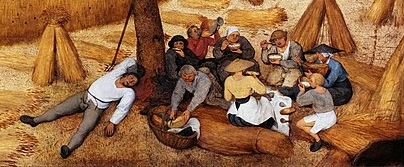
detail from The Harvesters, by Pieter Bruegel the Elder, 1565

The two elements in this shabbat process are desisting from productive work, and refreshing the spirit. The Hebrew Bible specifically prohibits lighting a fire (Exodus 35:3), gathering food or wood (Exodus 16:23-30, Numbers 16:32-36), carrying burdens outside (Jeremiah 17:21), treading in a winepress (Nehemiah 13:15), and selling or buying food (Nehemiah 13:15-18). Apparently the Israelites needed extra reminders not to do any work related to getting food to the table.

Other activities prohibited on shabbat can be inferred, but are not actually stated in the bible. Later, the Talmud multiplied rules about what a Jew cannot do on shabbat. The 312-page Talmud tractate Shabbat discusses every finicky prohibition the rabbis of the first few centuries C.E. could imagine. Although many orthodox Jews today observe  shabbat according to strict and complex rules that evolved from the Talmud, I know that if I tried to imitate them, I would spend the whole day worrying. My anxiety and resentment would make  shabbat a day to dread, and I would look forward to the six weekdays when I could relax and refresh my soul!

Fortunately, the Torah itself offers a more attractive and interesting view of Shabbat for unorthodox people like me. Desisting from creative work is connected with recovering the soul in a passage from the upcoming portion of Exodus called Ki Tisa. (It is also part of the Shabbat liturgy.)

The children of Israel shall observe the shabbat, to make the shabbat for their generations a covenant for all time. Between Me and the children of Israel it will be a sign forever, because for six days God made the heavens and the earth, and on the seventh day (God) shavat vayinafash. (Exodus 31:16-17)

vayinafash וַיִּנָּפַשׁ)) = and he refreshed his soul, recovered himself, reanimated himself. (Also from the same root as nefesh.)

I am awed by this portrayal of a god that changes through time, breathing life into the universe and then stopping to catch its breath and recover the divine soul. That is how I experience life, the universe, and everything—not as a static abstraction, but as the changing rhythmic flow of heartbeats, breaths, lifespans, seasons.

The Torah says that in order to be holy to God, we humans must add another rhythm to our lives: a seven-day cycle of work and rest, creative production and cessation. For six days we may pour out our energy and creativity into productive work, but on the seventh day we desist from creative work to re-center and re-animate our inner selves. 

But wait a minute! I used to need a day off from my bookkeeping job to recover my self. But a lot of the creative work I do now—including writing this blog—re-energizes me. When I finish writing an essay or a story, I feel joy, and a sense of purpose, and the re-centering that comes from returning to my own soul. Why should I deprive myself of creative work once a week?

One answer is that I cannot keep creating endlessly without pause. Even God, in the story of creation that opens the book of Genesis/Bereishit, divides the job into six separate days, completes each day of creation before starting the next, and then takes a break at the end. I need to finish a piece of work and then stop to pay attention to where I am and where God is. I can believe that I need not only those moments of stopping every day, but also a whole day of stoppage every week. a whole day to reconnect with myself and the holy.

Alas, I still have not developed a steady practice for spending the day of shabbat in tranquility, restoring my soul. Merely refraining from certain activities doesn’t do it for me. Joining my congregation in prayer is uplifting,  and following or leading Shabbat services does remind me of what to focus on. Yet all too often, the long drive and the personal interactions disturb my ability to focus on anything.

Nevertheless, I have not given up on establishing a shabbat practice. Any suggestions, readers?

Beshalach: High-Handed

As a child I was a natural victim, the target of any bully who needed to humiliate someone.  So I can imagine how the Israelites might feel in the book of Exodus/Shemot when they finally leave Egypt on the morning after God’s tenth and final plague:

Our god beat the pharaoh!  We asked our Egyptian neighbors for silver and gold, and they just handed it over to us!  Yesterday we were slaves, and today we are free!  We can do what we please, and we never need to be afraid of Egypt again!

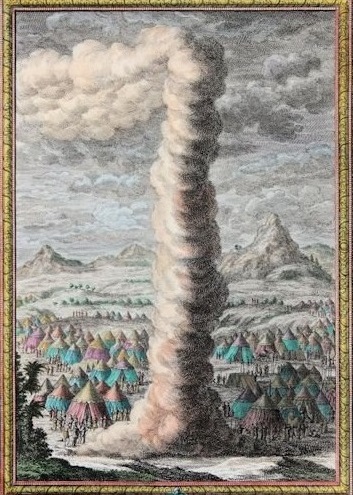
Pillar of Cloud, by Johann Jakob Scheuchzer, 1731

The Israelites leave the city of Ramses unchallenged at the beginning of this week’s Torah portion, Beshalach (“When sending out”).  They march for three days in military formation, following God’s spectacular pillar of cloud by day and fire by night.  For three days, they feel on top of the world.

God leads them to the Reed Sea, rather than by the main road to Canaan, which passes through the land of the Philistines.1  When the Israelites reach the shore of the Reed Sea, God stages one last showdown with the pharaoh.

God strengthened the heart of the pharaoh, the king of Egypt, and he chased after the children of Israel, while the children of Israel were going out beyad ramah. (Exodus 14:8)

beyad ramah (בְּיָד רָמָה) = with a high hand.  Yad (יָד) = hand; power to do something.  Ramah (רָמָה) = high, exalted.

What does it mean to march “with a high hand”?  When I first read this passage, I pictured the Israelites raising their hands as if they were trying to get the teacher’s attention.  But this image is the opposite of the spirit of beyad ramah.

In both Biblical Hebrew and English, the word yad or “hand” is used in many idioms.  After all, we accomplish things primarily with our hands.  Twice in the Torah portion Beshallach Moses raises his hands in order to channel divine energy.  At the Reed Sea, God tells Moses:

And you shall be hareim your staff and stretching out your yad over the sea and splitting it, and the Children of Israel shall come into the middle of the sea on dry land.  (Exodus 14:16)

hareim (הָרֵם) = raising, lifting up.  (From the same root as the adjective ramah.)

Battle with the Amalekites, by Julius Schnorr von Carolsfeld, 1860

Later in this week’s Torah portion the people of Amaleik attack the Israelites, and Moses influences the course of the battle by stationing himself on a hill and raising his hands.

And it happened that Moses yarim his yad, then Israel was mightier, but when he rested his yad, then Amaleik was mightier.  (Exodus 17:11)

yarim (יָרִים) = he would raise.  (From the same root as ramah.)

The Israelites win the battle because Aaron and Hur help Moses hold up his hands when he gets tired.  This confirms that holding up his hands is how Moses channels God’s power; he does not have power of his own.

But the idiom yad ramah refers to acting as if you have power to accomplish things by yourself.  It appears only four  times in the Torah, and two of these appearances refer to the way the Israelites leave Egypt (in Exodus 14:8 above, and in Numbers/Bamidbar 33:3).  The other two appearances help to clarify the idiom’s meaning.

But a person who does it beyad ramah, whether citizen or foreign resident, is reviling God; so that person will be cut off from among the people. (Numbers 15:30) 

In this passage, the Torah has just ruled that if someone inadvertently fails to obey one of God’s laws, he can atone by offering a goat as a sacrifice.  But if he does it on purpose, acting “with a high hand”, the consequence is more severe: he is banished or dies.  When someone transgresses deliberately, beyad ramah, he is acting as if he has more authority than the religious law.

The fourth occurrence of yad ramah in the Torah comes in Moses’ parting poem to the Israelites.  In his long final warning, Moses quotes God’s response to their ingratitude and idolatry:

I said: I would have cut them to pieces,

I would have made the memory of them disappear from men,

If I had not feared for the provocation of enemies—

lest their foes would misinterpret,

lest they would say: “Our yad was ramah, and it was not God Who accomplished all this!”

(Deuteronomy/Devarim 32:26-27)

Here, the “high hand” is the arrogance of Israel’s enemies, who will falsely assume that they have the power to destroy Israel on their own, without God’s collaboration.

Similarly, in English “high-handed” persons assume they have all the power, and arrogantly do something without considering the concerns of others.

So why do the newly freed slaves in the portion Beshalach leave Egypt beyad ramah?  Dazzled by their new higher status, they may well imitate the arrogance of their former masters.  If they had a chance, they might even try to bully or enslave someone less fortunate.  But God does not give them a chance.

In this week’s Torah portion, after “the children of Israel were going out beyad ramah“, the pharaoh sends a troop of charioteers after them.

And Pharaoh came closer, and the children of Israel raised their eyes, and hey!  Egyptians!  Pulling out after them!  And they were very frightened, and the Children of Israel cried out to God.  And they said to Moses: “Are there no graves in Egypt, that you take us to die in the wilderness?  What is this you have done to us, to take us out from Egypt?” (Exodus 14:10-11)

At once the Israelites are struck with fear of their old owners, the bullies who tortured and subjugated them.  They cry out to God, but there is no immediate response.  Their belief in God’s protection is too new and fragile to withstand their reflexive fear.  They cringe and despair.  They are caught between the sea and the chariots.  At that moment, they think they will always be victims.

Yet when they complain to Moses, they make a sarcastic joke: “Are there no graves in Egypt, that you take us to die in the wilderness?”  Thus Jewish humor is born.

*

Would you rather be an arrogant bully, like the pharaoh in the book of Exodus, treating people with high-handed disregard, too habitually hard-hearted to learn compassion?

Or would you rather be like an Israelite in Egypt, never certain of your status and power—but resilient enough to keep your sense of humor?  If so, then be careful about when you act with “a high hand”.

—

  1. Exodus 13:17-18.