Toldedot: To Bless Someone

For most of my life, the closest I came to giving or receiving a blessing was “Good luck!” When I converted to Judaism, I learned how to bless God as a way to express my appreciation for food and other good things in life. But the idea blessing another person never occurred to me.

Yes, I had read about Isaac blessing his sons in this week’s Torah portion, Toledot (“Lineages”). I gathered that giving a blessing means both stating the good outcomes you want for another person, and calling on (or praying to) God to make your words come true. But I did not believe that the actual words mattered, or that a formal blessing would be any more effective than “Good luck!” I felt sorry for Isaac and his family for taking the blessing business so seriously. I was 48 before I discovered Jewish Renewal and the potential power of blessing.

What makes a blessing a living force instead of a formality?

The blessings in the book of Genesis/Bereishit use formal poetic language. Even when they are personal blessings, they focus material prosperity, fertility, and/or victory over enemies, and use customary phrases. For example, Rebecca’s mother and brother bless her as she leaves home to get married, saying: “Our sister, may you become a thousand multitudes, and may your descendants take possession of their enemies’ gate.” (Genesis/Bereishit 25:60)

Another kind of blessing in Genesis is “the blessing of Abraham”, a phrase the Torah uses to refer both to God’s promise that Abraham’s descendants will possess the land of Canaan, and to the first blessing God gives Abraham:

I will make you a great nation, and I will bless you and I will make your name great, and you will become a blessing. And I will bless those who bless you, and those who curse you I will curse. And all the clans of the earth will find blessing through you. (Genesis 12:2-3)

In this week’s Torah portion, Isaac decides to give a blessing to Esau, the firstborn of his twin sons. The Torah does not say whether Isaac is planning to give Esau his personal blessing, or the blessing of Abraham, but it does say what part of himself Isaac hopes will deliver the blessing.
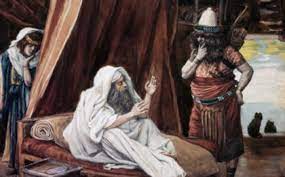
Isaac Sends Esau to Hunt, by James Tissot, ca. 1900

He said: “I have grown old, and I do not know the day of my death. So now, please pick up your gear, your quiver and your bow, and go out to the field and hunt game for me. Then make me tasty tidbits, the kind that I love, and bring them to me, and I will eat, so that my nefesh may bless you before I die.” (Genesis/Bereishit 27:2-4)

nefesh (נֶפֶשׁ) = animating soul; seat of appetite, desire, yearning, instinct; person

Isaac wants the blessing to come from his nefesh, his instinctual self, without any interference from his conscious mind. Isaac loves Esau and could invent a formula of blessing. But he wants his blessing to express the will of God as it moves through him, not his own conscious will.

When Isaac’s wife, Rebecca, overhears him, she assumes he intends to give Esau the blessing of Abraham. She panics, not only because she loves Jacob more, but also because she knows that Jacob is the one who will carry on the worship of the God of Abraham.

Apparently Rebecca and Isaac are having communication problems, because she does not march into Isaac’s tent and straighten him out. Instead, she says to Jacob:

“Hey, I heard your father speaking to your brother Esau, saying: Bring game to me and make me tasty tidbits, and I will eat them, and I will bless you lifnei God, before my death.” (Genesis 27:6-7)

lifnei (לִפְנֵי) = in the presence of, before

Rebecca interprets Isaac’s reference to blessing with his nefesh as blessing “in the presence of God”, and she associates this with God’s blessing of Abraham.

She quickly cooks some tasty tidbits from goat meat, and orders Jacob to bring them to his father. Jacob protests that he is not a hairy man, like his brother, so his blind father will know he is not Esau as soon as he touches him. So Rebecca disguises Jacob by dressing him in Esau’s spare clothes and fastening the skins of goat kids around his hands and neck.

Of course as soon as Jacob comes in and says, “My father“, Isaac recognizes Jacob’s voice, and asks:

“Who are you, my son?” Then Jacob said to his father: “I am Esau, your firstborn. I have done as you spoke to me. Get up, please, sit, and eat some of my game, so that your nefesh may bless me.” (Genesis 27:18)

Jacob thinks like his father. He hears Rebecca’s “in the presence of God”, and interprets it in terms of Isaac’s nefesh!

Isaac tests his son several times, unable to believe that this man with Jacob’s voice is really Esau, no matter how hairy his hands feel. Then he decides to bless the son in front of him anyway. Now it is even more important that the blessing come from God, so he repeats:

“I will eat some of the game of my son, so that my nefesh may bless you.” (Genesis 27:25)

After Isaac has eaten and received a kiss from his son, he delivers the blessing:

“May God give to you from the dew of the heavens, and from the fat of the land, and abundant grain and wine. May peoples serve you, and may nations bow down to you. Be a leader to your kinsmen, and may the descendants of your mother bow down to you. Cursed be those who curse you, and may those who bless you be blessed.” (Genesis 27:28-29)

The blessing begins with the standard themes of material abundance and victory over other nations. Then Isaac adds part of God’s blessing of Abraham:  Cursed be those who curse you, and blessed be those who bless you. He does not say the other part of the blessing of Abraham—that he will have many descendants, and they will possess the whole land of Canaan—until later in the Torah portion, when he gives a blessing to Jacob as Jacob.

I think that Isaac gives Jacob-in-disguise part of the blessing of Abraham because he is indeed speaking from his instinctual self, channeling divine inspiration without thinking it through. His words naturally mirror the words of the blessing of Abraham.

When his other son shows up a moment later with his own tasty tidbits, Isaac recognizes Esau’s voice, and comes out of his trance and back to earth. He trembles, partly because he knows he cannot repeat the same blessing to Esau, and partly because he realizes that the blessing he just gave Jacob is indeed an expression of God’s will.

Then Isaac trembled, full of fear, and said: “Who is it, then, who hunted game and brought it to me and I ate everything before you came and I blessed him? He must be truly blessed!” (Genesis 27:33)


Is it possible to channel a blessing from God, as Isaac apparently channels his first blessing? I do not know. But when I was 48 and I wandered into a Jewish Renewal service, I saw the rabbi of P’nai Or of Portland, Aryeh Hirschfield zt”l, blessing people. I could tell he was connecting with some inner source of energy, and the people he blessed were taking in that energy.

Is that kind of blessing from the instinctual self, the nefesh, confirmed by God and therefore bound to come true? Again, I do not know. What I do know is that a blessing given with what seems to be divine energy makes a big impression on both giver and receiver. No doubt the words of the blessing are absorbed deep into the subconscious mind of the one blessed, where they affect one’s outlook and behavior for years to come. That alone might make a blessing come true.

May everyone who needs a blessing be truly blessed. And may everyone who sees the need for a blessing be inspired to give a true blessing.
Chayei Sarah & Lekh-Lekha: A Holy Place

What makes a place holy?

The word for “holy”, kadosh, means separated from mundane use, dedicated to God, or simply inspiring religious awe.  Kadosh appears only once in the book of Genesis/Bereishit, in verb form, when God blesses the seventh day of creation and makes it holy.  The word does not show up again until the book of Exodus/Shemot, when Moses stops to look at the burning bush, and God tells him to take off his shoes, because the place where you are standing is holy ground (Exodus 3:5).  Later in Exodus, Mount Sinai becomes holy ground for a whole people.  Eventually the Bible names Jerusalem as a holy city.

Even though there are no places called kadosh, “holy”, in the book of Genesis, there many sites where God makes first contact with a human being.  At two of the locations where God speaks to a human, the human dedicates the spot, and later someone returns to the same place to connect with God.  These places, Be-eir Lachai Ro-i and Beit-El, must surely count as holy!

Isaac and his bride Rebecca meet in a field next to Be-eir Lachai Ro-i (“Well for the Living One Who Sees Me”) in this week’s Torah portion, Chayei Sarah (“the life of Sarah”).  But it is Hagar, an Egyptian, who first encounters God there.

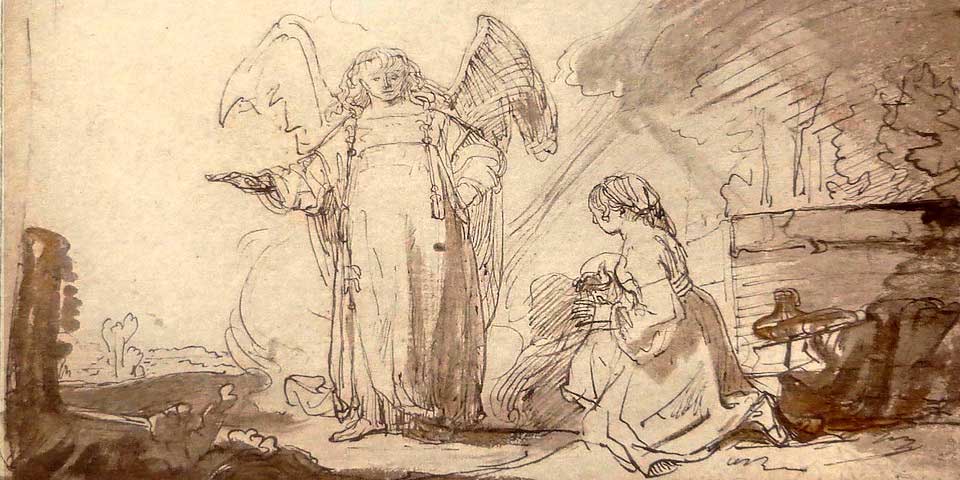
Hagar and the Angel, by Rembrandt

When Abraham and his wife Sarah leave Egypt in the Torah portion Lekh-Lekha (“Go for Yourself”), Hagar goes with them as Sarah’s servant.  Sarah gives Hagar to her husband for the purpose of producing a child Sarah can adopt.  But once Hagar is pregnant, Sarah abuses her, and Hagar runs away across the Negev Desert, back toward Egypt.  A messenger of God  finds her at a spring, a watering-place by the road.  God speaks to Hagar through the messenger and convinces her to return to Abraham and Sarah.

And she called the name of God, the one speaking to her: You are the God of Ro-i; for she said: Even as far as here, I saw after ro-i! Therefore the be-eir is called Be-eir Lachai Ro-i. (Genesis 16:13-14)

ro-i = seeing me, one who sees me.

be-eir = well, watering-place.

lachai = for the living one.

For Hagar, accustomed to being a pawn in Sarah’s schemes, the most amazing thing is that God actually notices her—and she survives.  Hagar does return, and gives birth to Ishmael.  Sarah adopts Ishmael, but later bears her own son, Isaac, and sends Hagar and Ishmael into exile.

Isaac is 40 years old before the Torah once again mentions Be-eir Lachai Ro-i, the Well of the Living One Who Sees Me.  At this point, Isaac is estranged from his father.  In last week’s Torah portion, Vayeira (“And He Saw”), Abraham bound Isaac as a sacrificial offering, and raised the knife to his son’s throat before a voice from God called him off.  After that, Isaac did not go home with his father.  In this week’s Torah portion, Abraham buries Sarah, Isaac’s mother, without Isaac’s presence.  Then he arranges for Isaac to marry an Aramean without even informing his son.  Apparently they are not on speaking terms.

Abraham lives in Beersheba (Be-eir Sheva), and Isaac lives farther south, in the Negev Desert.

And Isaac, he came from coming to Be-eir Lachai Ro-i, and he himself lived in the land of the Negev.  And Isaac went out lasuach in the field, in the face of the sunset; and he raised his eyes and he saw—hey!  Camels were coming. (Genesis 24:62-63)

lasuach = to ?? (This is the only occurrence of the word in the Bible, and though it is in the form of an infinitive verb, scholars do not agree on its meaning.  Lasuach has been translated as to stroll, to pray, to supplicate, and to meditate.  It might be a variant spelling of the verb siyach = meditate, go over a matter, contemplate something.)

I like the literal translation he came from coming to; it emphasizes that a holy well is a place you come to.  Isaac is avoiding his father, but he comes to the well where God noticed and spoke to Hagar.  Since he has no intention of traveling to Egypt on the road that runs past the well, he must come there because he knows about Hagar’s experience.

Like Hagar, Isaac is used to being overlooked as a person, accustomed to being a pawn in his father’s schemes.  Maybe he hopes that God will notice him at Hagar’s well, or maybe he hopes he will be able to see himself.

Coming from the Well of the Living One Who Sees Me, Isaac heads out into the field at sunset to lasuach.  Maybe Isaac senses the holy presence of God at the well, and he walks back through the field slowly to absorb the experience.

Lost in thought, he raises his eyes and is surprised to see camels approaching.  He is not far from the road between Beersheba and Egypt, but these camels have left the road and are heading across the field toward him.  The first rider to dismount is Rebecca, the bride that Abraham’s servant is bringing to Isaac.  They meet in the field, he loves her, and he begins his new life.

Near the end of the Torah portion, Isaac and his half-brother, Hagar’s son Ishmael, bury Abraham in the family cave to the north.  Then Isaac returns to Hagar’s well.

And it was after the death of Abraham when God blessed Isaac, his son; and he settled next to Be-eir Lachai Ro-i. (Genesis 25:11)

The only other place in the book of Genesis that remains holy years later, under the same name, is Beit-El (sometimes called Bethel in English).  In the upcoming Torah portion Vayeitzei (“And he went”), Jacob stops for the night on his way to Charan and dreams of a stairway between heaven and earth. God speaks to him for the first time.  When Jacob wakes, he says:

Truly God yesh in this place and I, I did not know! And he was awestricken, and he said: How awesome is this place! This is nowhere but Beit El, and this is the gate of the heavens! (Genesis 28:16-17)

yesh = it exists, it is present, there is.

Beit El = the house of God.

For Jacob, the most amazing thing is not that God notices him, but that God exists at all in this world.

Jacob dedicates the spot by setting up a stone pillar and pouring oil over it, and naming it Beit-El.  More than 20 years later, God tells him to return to Beit-El.  Jacob first buries all the idols belonging to his household.  Then he leads them to the spot and builds an altar. God blesses him again, and Jacob pours a libation as well as oil on the stone pillar before moving on.  By returning to the place where God first spoke to him, Jacob rededicates himself to God.

*

Few of us today hear God speaking to us in Biblical Hebrew.  But once in a while, we notice God, or God notices us, and we are amazed.  Suddenly our usual mundane perspective changes, and the world is suffused with new meaning.

Sometimes this happens because a place strikes us as holy, awe-inspiring, connected with God.  It might be a liminal place in nature—the edge of the ocean, deep in a forest, a remote spot with a brilliant night sky.  I have also felt that mysterious awe inside medieval cathedrals, though as a Jew I do not go looking for God there.

Sometimes we go back later, and find God again.  Sometimes we go back and discover that the place seems ordinary now; the holiness was in our own heart.  Either way, it is a blessing to be able to stand on holy ground.

Vayeira & Noach: Drunk and Disorderly

As I read the book of Genesis/Bereishit again this year, I feel sorry for the characters who try to rise to the challenge of walking with God, but are just too limited to keep up. Two of those who fall by the wayside are Noah and Lot, who both attempt to do the right thing, then collapse into drink and incest after they see their worlds destroyed.

Noah begins by following all of God’s directions; he sees God destroy all life on land with the over-the-mountaintop flood. Abraham’s nephew Lot begins by offering hospitality to strangers in this week’s Torah portion, Vayeira (“And he saw”). He sees the strangers, who are actually messengers from God, destroy the city of Sodom and the land around it.

After their respective catastrophes are over, and it is time to build a new life, both men think only about getting drunk.

Noah

Drunkenness of Noah, mosaic, Basilica di San Marco, Venice, 1215

And Noah began to be a man of the soil, and he planted a vineyard. And he drank some of the wine, and he became drunk, and vayitgal in the middle of his tent. And Cham, the father of Canaan, saw the erat of his father and he told his two brothers outside. (Genesis/Bereishit 9:20-22)

vayitgal = he uncovered himself, exposed himself

erat = nakedness

Noah plans his drunkenness with the foresight of an alcoholic who hides stashes of liquor in strategic places. He has to wait a long time, through planting and harvesting and fermentation, before he gets his first drink after the flood. Although the Torah does not report Noah’s feelings, I imagine he is haunted by the deaths of everyone he knew outside his own immediate family of eight. Perhaps he dreams of children drowning. Perhaps he wishes he had said something to change God’s mind, or found some way to rescue more people.

I suspect that Noah cannot find a way to live with this knowledge and move forward. So he opts to escape into an altered state of consciousness, or unconsciousness.

After becoming drunk, Noah uncovers his nakedness in the middle of his tent. A modern reader might wonder what is so bad about lying down naked in the privacy of your tent—even if one of your sons barges in and accidentally sees you.

But in the Torah, to “uncover the nakedness” of someone is a euphemism for a sexual act. The book of Leviticus/Vayikra devotes thirteen verses to listing close relatives whose nakedness you must not uncover, using the same words for “uncovering” and “nakedness” as the passage above.

The implication is that Noah and his son Cham (whose name means “heat”) are guilty of some illicit sexual act. Furthermore, Noah begins it, by “uncovering himself”. Yet Noah shifts all the blame to his son.

And Noah woke up from his wine, and he knew what his youngest son had done to him. (Genesis 9:24)

Noah expresses his anger at Cham by cursing Cham’s son Canaan. Alas, it is a common human reaction to reject your own guilt by lashing out at someone else.

Lot

In this week’s Torah portion, Lot and his daughters act out a different version of the drunken incest theme.

Lot, like Noah, means well. His story begins with a good deed; when two messengers from God, disguised as ordinary men, come to the city of Sodom, Lot goes out of his way to give them hospitality and treat them with respect and kindness—just as his uncle Abraham did in the previous scene in this week’s Torah portion. After Lot has brought the strangers home and fed them, the men of Sodom converge on Lot’s house and demand that he bring out his guests, so that they can “know” them.

Just as it never occurs to Noah to question God’s plan to wipe out the earth, it never occurs to Lot that there might be an alternative to sacrificing two people to the mob. Since his two guests are out of the question, Lot steps outside and offers the would-be rapists his two virgin daughters instead.

Maybe Lot is so terrified of his neighbors that he cannot think straight. But we can still question his impulse to sacrifice his daughters—and perhaps after the crisis is over, Lot is tormented by remembering his own behavior.

The mob outside ignores Lot’s proposed substitution of rape objects, and crowd forward to break down the door. The messengers from God save the day (or night) by pulling Lot inside and blinding the men outside. Then they tell Lot that God has sent them to destroy the whole city, and they order Lot to flee with his family.

Lot panics, and at dawn he is still dithering in his house. The messengers grab him, his wife, and their two daughters by the hand and lead them outside the city. They tell Lot to save himself by escaping to the mountain, without stopping or looking back.

When God rains sulfur and fire down from the heavens, Lot’s wife looks back and turns into a pillar of salt, but Lot hurries on. He settles into a cave on the mountain with his two daughters.

And the elder said to the younger: Our father is old, and there is no man on the earth to marry us as the way of all the earth. Come, we will give our father a drink of wine, and we will lie down with him, and we will keep alive seed from our father. So they gave their father wine to drink that night, and the elder came, and she lay down with her father, and he did not know when she was lying down or when she was getting up. (Genesis 19:31-33)

They repeat the procedure the next night, with the younger daughter as the seed collector. And once again the Torah claims Lot did not know when she was lying down or when she was getting up. Both women become pregnant, as they planned.

Many commentators have pointed out that preserving a man’s lineage is a high value in the Torah, and concluded that Lot’s daughters were doing the right thing. But if incest were truly the right behavior in their situation, they would simply ask their father to cooperate, without resorting to wine. Lot may not have read the Torah’s prohibition against “uncovering the nakedness of your father”, but he obviously knows that incest, like mistreating a stranger, is wrong.

The Torah appears to view Lot as innocent of incest by reason of unconsciousness. Yet it is Lot’s decision to keep drinking the wine until he passes out; even two strong young women could not force it down his throat.

And where did the wine come from? The Midrash Rabbah, a collection of commentary from Talmudic times, speculates that either the Sodomites stored wine in distant mountain caves, or the wine appeared miraculously. However, I agree with modern commentator Jonathan Kirsch that Lot probably grabs some wine when they pass through the village of Zoar on the way to the mountain. Like Noah, Lot would anticipate a need for escape from sanity after the catastrophe. And as in Noah’s story, the Torah blames Lot’s subsequent sexual misdeed on his children.

It is easy for me to judge both Noah and Lot harshly. But if God gave me orders, would I have the imagination or the courage to talk back? If I were faced with a mob of evil men, would I have the imagination or the courage to divert them safely? I have lots of imagination—except when it comes to my own problems. I’m learning courage, but I still prefer avoidance.

If all my friends, most of my family, and every familiar thing in my life were suddenly wiped out, would I have the imagination and courage to build a new life from nothing? I think I would, but how do I know?

When life becomes unbearable, do I stick with reality and avoid any drugs of escape? Cookies don’t count, do they?

When something bad happens between two people, do I duck responsibility by blaming it on the other guy? Never—except for when I am fixated on escaping the situation.

As I read the book of Genesis again this year, I feel sorry for the characters who try to rise to the challenge of walking with God, but are just too limited to keep up. I might be one of them.

Lekh-Lekha and Bereishit: Giving Directions

For me, every story in the book of Genesis/Bereishit is another fruit from the Tree of Knowledge of Good and Evil. And the God who speaks to individual people, from Adam to Jacob, is like a human teacher trying to prod people into making conscious choices and moral judgments.

Like other animals, we humans make most of our decisions automatically, out of instinct and habit. Sometimes we stop to solve a practical problem or an intellectual puzzle. But only rarely do we stop to solve a moral problem. When we do become aware of a moral issue, and of our ability to choose between good and evil actions, I think we are tasting another fruit from the Tree of Knowledge.

The anthropomorphic God in Genesis often talks to Himself, debating what to do next. He also talks to human characters, asking them questions, telling them His plans, blessing and cursing them, making covenants with them, and giving them directions.

“God” tries out several methods for giving directions. In the second creation story, “God” makes a single human out of dirt and breathes life into it. After placing the human (ha-adam) in the garden of Eden, the God character gives it an instruction.

figGod tzivah the human, saying: From every tree of the garden, certainly tokheil. But from the tree of the knowledge of good and bad, not tokhal; for on the day you eat from it, you will certainly die. (Genesis 2:16-17)

tzivah = commanded, ordered, directed.

tokheil, tokhal = you will eat, you shall eat, you should eat, you could eat, you may eat, you can eat, you are going to eat, you must eat.

It is impossible to translate this passage literally, because biblical Hebrew has only one verb form for action that has not yet happened. Is “God” telling the human “you must not eat” from the tree of knowledge, and if you do, you will be punished with death? Or is “God” saying “you could not eat” from it without becoming mortal?  Either translation is correct.

The God character’s motivation in giving this order is also open to interpretation. Classical commentary assumes “God” wants the human to stay in the garden, in a state of moral ignorance, and therefore after the female and male humans eat the fruit, they are punished for disobeying orders. I think “God” points out the Tree of Knowledge in order to show the adam, the solo and sexless human, that it can act of its own free will, and gain knowledge. But the adam passively follows orders, and nothing changes. I can imagine the God character wondering what it will take to get the humans to make a choice and acquire a sense of good and evil, so He can remove them from Eden and place them in the real world! “God” solves the problem by splitting the human it into male and female persons, and inventing the snake to make the female human think.

The next person in the Torah to get moral training is Cain, who gets upset when God shows a preference for Abel’s offering over his. Perhaps because reverse psychology did not work well with Adam, “God” avoids anything that sounds like an order when He first addresses Cain.

Cain, by Henri Vidal, detail


And God said to Cain: Why are you making yourself angry, and why has your face fallen? Is it not so: if you do good, [there is] uplifting; but if you do not do good, wrongdoing waits at the door, and its desire is for you. Yet you can rule over it. (Genesis 4:6-7)

Cain does not get the hint, and in a fit of rage kills his brother Abel.

In the story of Noah, the God character tries a different approach.

God said to Noah: The end of all flesh is coming before Me, because the earth is filled with violence on account of them, and here I am, the one Who destroys the earth.  Make for yourself a floating-container of gofer wood; you shall make the floating-container compartmented, and you shall cover it inside and outside with caulking. (Genesis 6:13-14)

If what “God” wants is for Noah to obey orders, His new style works. Noah simply follows orders, and makes no independent decisions until after the flood. But commentators have wondered for millennia whether Noah’s mechanical obedience is actually what “God” wants. (See my post last week, Noach: Righteous Choices.) What if “God” is hoping that Noah will propose an alternative, the way Abraham does later when “God” announces He will destroy Sodom and Gommorah?

abraham-looks-at-starsThis week’s Torah portion, Lekh-lekha, begins with the God character’s first direction to Abraham.

God said to Abraham: Lekh-lekha, away from your land, and away from your home, and away from the house of your father, to the land that I will show you. And I will make you into a great people, and I will bless you, and I will make your name great, so it will become a blessing. (Genesis 12:1-2)

Lekh = Go!

-lekha = yourself, for yourself, to yourself.

Here the God character’s order specifies what Abraham should leave behind, but gives no details about the future he is walking into. What “God” does communicate is that this move is important for Abraham, not just for God. Rashi (11th-century Rabbi Shlomo Yitzchaki) interpreted Lekh-lekha as “Go for yourself”, i.e. for your own sake. The Zohar (a 13th-century kabbalistic text) interpreted it as “Go to yourself”, i.e. recreate yourself as a new individual, separate from your past.

All the promises of blessing, while non-specific, also serve to let Abraham know that going to the new land will be for his own benefit. This is the first time in the Torah that “God” promises a reward for obeying His directions.

Abraham responds to the divine direction by leaving home for good, as instructed. But he takes some initiative and prepares for his own future by bringing along his wife, nephew, servants, and livestock.

Since the voice of God does not even tell him which way to head when he leaves his father’s house in Charan, Abraham chooses to travel west into Canaan. Only after he has reached Shechem, well inside Canaan, does “God” appear to him and say: To your offspring I will give this land. (Genesis 12:7)

The God character’s method of giving partial directions, promising an eventual reward, and leaving the rest up to the human being seems to be the most successful approach so far. Abraham responds by leaving his old familiar habits behind, and making new choices.

Today, few people hear God giving them direct instructions in Biblical Hebrew. But I can imagine the God character in these stories as an inner voice from the human subconscious, struggling to be heard properly.

There are many ways for a human being to get stuck and wait passively for change, instead of looking for a good action and bravely doing it. At times in my life I have been like the adam, obeying orders without raising questions, avoiding any potential conflict. I had to reach a certain level of misery before an inner voice from God’s snake reminded me that it would not kill me to pick the fruit and liberate myself, to choose my own course and act.

At times in my life I have been like Cain, feeling as though I am at the mercy of a bad desire. Yet eventually I hear the divine hint that I can master the desire, and choose to do good.

Other times, I feel overwhelmed, drowned, by the demands of other people and by the way the world works. I want to make my own little floating container and hide in it. But my conscience nags at me, reminding me that I cannot hide in an ark without bringing my family and hordes of hungry animals with me. God wants engagement with the world.

And yes, periodically I have heard an inner call to leave my familiar but not-so-good life, and set out for an unknown destination and destiny, like Abraham. So far, responding to that voice has led to blessings.

May we all be blessed to listen to our inner “God” voice, and never lose the taste of the fruit from the Tree of Knowledge of Good and Evil.

Noach: Righteous Choices

This is the story of Noah: Noah was a man of tzadik; he was blameless in his generations; Noah walked with God. (Genesis/Bereishit 6:9)

tzadik (צַדִּיק) = right conduct, lawfulness, innocence; a righteous person.

In the Talmud, a man is called a tzadik if he devotes his life to Torah study and prayer. For the Chassidim in Eastern Europe, a tzadik was a holy man so esteemed by God that he could work miracles. Some commentary reads these meanings of the word tzadik back into Noah’s story, but the Torah never shows Noah studying, praying, or acting like a holy miracle-worker. So I think Noah is merely innocent and lawful, avoiding violence even though everyone around him is doing it.

At the end of last week’s Torah portion, God regrets creating humankind, because of

… the abundant badness of the human on earth, that the shape of every idea of his heart was only bad all the time. (Genesis 6:5)

(See my post last week, Bereishit: Inner Voices.) Since Noah is the best human being available, God speaks to him at the beginning of this week’s Torah portion, Noach (“Noah” or “resting”).

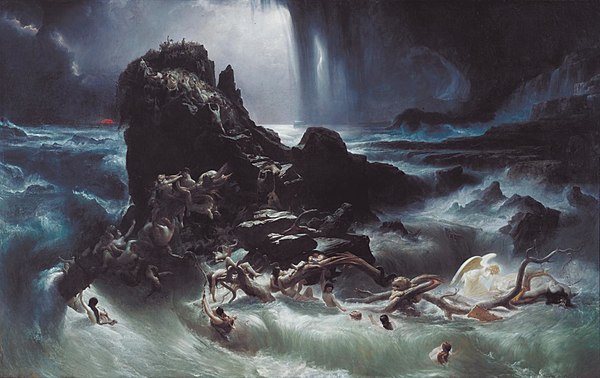
The Deluge, by Francis Danby, 1840

And God said to Noah: “The end of all flesh is coming before me, because violence has filled the earth on account of them, and here I am, their destroyer of the earth. Make for yourself an ark …” (Genesis 6:13-14)

God gives Noah explicit instructions on how to build the ark, and explains that the problem of human violence will be solved when God wipes out everything else on earth with a vast flood. Then God tells Noah to collect what will go inside the ark: a pair of every kind of animal; Noah and his wife, sons, and daughters-in-law; and food for everybody.

And Noah did so; everything that God commanded him, thus he did. Then God said to Noah: Enter, you and all your household, into the tevah, because in you I have seen tzadik before Me in this generation. (Genesis 6:22-7:1)

It sounds as if God approves of Noah’s passive obedience. Yet commentators through the ages have wondered why Noah does not try to talk God out of the Flood, the way Abraham tries to talk God out of destroying Sodom and Gomorrah by saying perhaps there are some innocent people among the wicked.

Most of the commentary I have read falls into two camps. One camp considers Noah either a failed prophet (because he did not warn anyone to repent) or a failed tzadik in the Chassidic sense (because he did not ask God to decree a different fate for the world). The other camp argues that God must have asked Noah to prophesy in an unrecorded conversation, and Noah must have done his best, while building the ark, to warn people about the flood and urge them to repent before it was too late.

But the commentary that alarms me the most comes from the 19th-century Rabbi Samson Raphael Hirsch. Hirsch wrote that performing God’s will is what matters; acting on the basis of your own judgment is of secondary and uncertain importance. So although Noah could have done other things, he was correct in doing exactly what God commanded, and no more.

I would say that if God only wants humans to do as they are told, God had no reason to plant the Tree of Knowledge in the Garden of Eden in the first place. Yet God not only places the Tree, but points it out to Adam by warning him not to eat from it. Then when Adam obediently avoids it, God creates Eve and the talking snake, so the humans finally eat. The taste of knowledge of good and bad gives humans have the ability to form opinions, and choose between them. Though we usually act out of habit and instinct, we have the ability to make new and creative choices.

Some rabbis have argued that the most desirable outcome is when a human deliberately chooses to do exactly what God wants. But sometimes there is a difference in the Torah between what God says and what God wants. On several occasions God “tests” (nasah) people to see what they will choose to do. For example, God tests Abraham by telling him to sacrifice his son Isaac as a burnt offering—but when Abraham binds his son on an altar and raises his knife, God intervenes to save Isaac’s life. It was only a test, and in a real test you do not tell the subject everything you want.

So when God tells Noah to build and supply the ark before the flood wipes out the earth, is that really all God wants Noah to do? Or is God testing him, to see whether Noah will warn people to repent, or even propose a different solution to God?

Suppose Hirsch is right, and God only wants us to choose to follow explicit directions. That not only makes the relationship between humans and God uninteresting, it also leaves us stranded when we have to make independent decisions that are not explicitly covered by the 613 rules in the Torah. The tradition of Jewish oral law tries to fill the gap, but it still cannot cover everything. Human beings often find themselves in situations where they need to figure out the best course of action for themselves.

Thank God!  I believe we humans shine when we discover, or invent, good ideas that nobody considered before. Choosing to follow God’s orders is a virtue of sorts. But we are blessed with the ability to rise above Noah’s level of virtue, and improve the world in ways the Torah never envisioned. Depending on how you define “God”, this might be what God really wants.

In my own lifetime, I have seen great progress in granting status, rights, and respect to people in groups that were subjugated for millennia, including women, people outside the traditional heterosexual model, and outsiders from different ethnic groups and countries. We still have farther to go, and some parts of the world lag far behind, but we have created a good path. The Torah merely assumes these groups will always be inferior, and offers a few paltry laws to protect the members of some groups within their inferior status. Thanks to our God-given abilities, humans are now working on a better vision.

The Torah also promotes war, while alluding to a distant future when war will disappear because everyone will worship the same god. But we can do better than that, thanks to our taste for knowing good from bad, our ability to transcend our habits and instincts and make choices, our creative minds, and our power to rise above ourselves to speak as prophets or tzaddikim. Someday humans may achieve an era of peace better than the one imagined in the Bible!

May it be God’s will … but most of all, may it become our will.

Bereishit: Divine Inner Voices

The first Torah portion in the first book of the Torah (both called Bereishit, “In a beginning”) opens with God’s creation of the world. It closes with God’s decision to destroy the world and start over again.

Just before God makes this decision, the Torah gives us a curious story fragment:

And beney ha-elohim saw the daughters of the human, how tov they were, and they took themselves wives from whomever they chose. (Genesis 6:2)

The Nefilim were on the earth in those days, and also afterward, for beney ha-elohim came into the daughters of the human, and they bore children to them. They were the mighty ones from long ago, men of renown. (Genesis 6:4)

beney ha-elohim = the sons of God.

tov = good, attractive.

What does “the sons of God” mean? Some traditional commentary claims the phrase refers to superior human men, who make the mistake of marrying an inferior class of women. Other commentators say the “sons of God” are angels, angels of a lower grade than the malachim (“messengers”) that appear in the Torah in human form in order to speak as mouthpieces for God.

What strikes me is that the phrase beney ha-elohim appears only four times in the whole Hebrew Bible: twice in the passage above, and twice in the book of Job. The book of Job begins by describing how upright, good, and God-fearing Job is. Then the scene shifts to the court of God:

One day beney ha-elohim came to present themselves in front of God, and ha-satan came too, in the middle of them. And God said to ha-satan: Where do you come from? And ha-satan answered God, and said: From roving about on the earth and from going back and forth on it. (Job 1:6-7)

ha-satan = the adversary, the obstacle

God pays attention to ha-satan, and does not question any of the other “sons of God”. The Adversary doubts whether Job is genuinely good and God-fearing, and persuades God to test Job’s faithfulness. God assigns the Adversary to strike all Job’s possessions. Ha-satan eliminates Job’s wealth and all his children—for no good reason—but Job still blesses God.

Then one day beney ha-elohim came to present themselves in front of God, and ha-satan came too, in the middle of them, to present itself in front of God. And God said to ha-satan: Where do you come from this? And ha-satan answered God, and said: From roving about on the earth and from going back and forth on it. (Job 2:1-2)

Once again God only converses with ha-satan. The Adversary persuades God to test Job again, this time by afflicting his body, and God authorizes another injustice in order to find out what Job will do.

The book of Job is a theological conversation in the guise of a story about a man who lived long ago and far away. In order to set up the question of whether God is just, the story uses an allegory of God in His court, receiving His sons, the lesser gods (a scene obviously borrowed from one of the pantheistic religions in the region).

But on another level, I see both stories about beney ha-elohim as allegories for the human mind.

In the book of Job, I think God’s court represents the human mind. The decision-making ego is visited by various sub-personalities, including one that takes an adversarial role and obstructs the ego by planting doubt, then tempting the ego to abandon morality in order to find out for sure.

In the book of Genesis, the interaction between “the sons of God” and the “daughters of the human” can also represent the human mind. Like ha-satan in Job, beney ha-elohim in Genesis  visit the earth. The purpose of the visit in Job is to observe the human beings from a different perspective than God’s, and bring that perspective into the heavenly court that I think represents the human mind.

The purpose of the visit in Genesis is to marry and “come into” human women. When the book of Genesis says “for beney ha-elohim came into the daughters of the human, and they bore children to them”, we can read it as simply a description of the sons of God having sex with their wives, who then give birth to mighty and famous men. But we can also read it as a representation of subconscious aspects of the mind coming into the consciousness of human women, and inspiring them to give birth to new ideas and notions.

In the Bible divine inspiration, ruach elohim, can be good or bad; good when a prophet is moved to speak out and warn people they are doing wrong, but bad when King Saul is seized by divinely-induced madness. What if divine inspiration comes from different aspects of God, different “sons”? One aspect might give us an impulse to speak out against injustice. Another aspect (such as ha-satan in Job) might give us an impulse to commit any injustice in order to prove a point.

The “sons of God” in Genesis are apparently bad impulses, leading to bad thoughts and actions.

And God saw the abundant badness of the human on the earth, that the shape of every idea of his heart was only bad all the time. And God nicham that It had made the human on the earth, and It was heartbroken. (Genesis/Bereishit 6:5-6)

nicham = had a change of heart, reconsidered. (This verb covers at least two kinds of change of heart: regret, and consolation.)

Before the beney ha-elohim show up, the humans on earth seem like a mixed lot, more good than bad. Cain is a murderer, and his great-great-great grandson Lemekh boasts to his wives about vengeance, but the other people the Torah mentions seem innocent enough. When Enosh is born, people start invoking the four-letter name of God. One of Enosh’s descendants, Enoch (Chanokh), “walked with God”.

Only after the beney ha-elohim influence the human race does God consider the ideas of the human heart “only bad all the time”. Perhaps these “sons of God” are like ha-satan in Job. The Adversary in Job corrupts the ruling god with feelings of doubt. The sons of God in Genesis apparently introduce urges that corrupt the conscious mind of the human “daughter”, and become obstacles to good behavior.

And God said: I will wipe away the human that I created from the face of the earth, from human to beast to creeper to flyer in the sky, because I have nicham that I made them. But Noah found grace in the eyes of God. (Genesis/Bereishit 6:7-8)

In next week’s Torah portion, God decides to start the world over again with Noah and his family (as well as pairs of all the animals). This is like deciding to eliminate all those awkward feelings of beney ha-elohim, and reduce the mind to a single virtuous ego. Yet when the flood ends, God reaches the more mature conclusion that the human mind is always subject to evil, and decides to put up with it.

Today, we all hear the mental voices of divine inspiration inside our own minds. Sometimes they are Adversaries, trying to push us off the right path and make us act out of doubt or resentment or another negative urge. Sometimes they enter with enlightenment, and impregnate us with ideas that lead to good actions.

May we all learn to put up with the many shapes of our ideas, as the god in Genesis did. And may we all become more discriminating about our inner promptings than the god in Job.

Sukkot: Temporary and Permeable

Everything in life is temporary, including life itself.

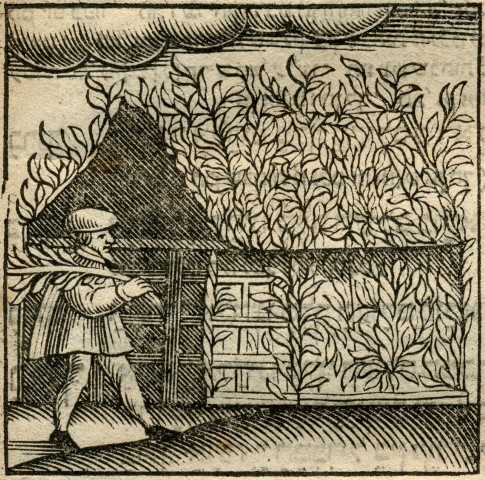
“Sukkot Customs”, 1662

The annual festival of Sukkot was once a pilgrimage to the temple to celebrate the harvest.  Since the second temple in Jerusalem was destroyed in 70 C.E., Sukkot has centered around this instruction in the Torah:

In the sukkot you shall live seven days; all the citizens of Israel shall live in the sukkot, so that your generations will know that I made the children of Israel live in the sukkot when I brought them out from the land of Egypt.  (Leviticus/Vayikra 23:42-43)

sukkot  (סֻּכֹּֽת) = huts, temporary shelters constructed in fields during harvest (often translated as “booths”).  Singular: sukkah (סֻּכַּה).

The Sukkah

This week many Jews are eating meals and spending time in their sukkot.  A ritual sukkah must be a temporary structure.  While it can be attached to a wall of one’s house, it must also have temporary walls and a temporary roof.  The roof must also be permeable, made of plant materials such as branches or reeds—materials that leave gaps big enough to let in both rain and starlight.  One cannot seal oneself off from the world in a sukkah; the outside world is always coming in.

The Mishkan

The sukkah reminds me of another temporary dwelling-place in the Torah:

And let them make for me a holy place, and I will dwell in their midst.  Like everything that I am showing you, the pattern of the mishkan and the pattern of its furnishings, thus you shall make it.  (Exodus/Shemot 25:8-9)

mishkan (מִּשְׁכָּן) = dwelling-place, home.  (From the root verb shakan = stay, dwell, inhabit.)

Every time the Israelites camp in the Torah, the priests and Levites assemble all the pieces of the mishkan to rebuild the sanctuary.  Then when the Israelites move on, the Levites disassemble all the pieces and carry them on the journey through the wilderness.  The mishkan, the holy place where the presence of God dwells, is both temporary and portable.

Divine cloud rising from mishkan (artist unknown)

It is also permeable, but in the opposite direction from a sukkah.  Rain and light from outside a sukkah penetrate its roof and come inside. The mishkan has cloud by day and fire by night inside it, from the divine presence in its inner chamber. The cloud and fire inside penetrate the roof and appear outside, above the mishkan where people outside the sanctuary can see the divine manifestation.

Inside and Out

When we assemble a sukkah, it’s not only a dwelling-place for us, but also a mishkan for God.  In kabbalah, the aspect of God that dwells here in this world is the Shechinah, a feminine form of the noun for “dweller, inhabitant” (from the same root as mishkan).  As we sit in the sukkah, we invite God in, along with the rain and starlight.  And God dwells “in our midst”, inside us.  It is a mitzvah, a good deed, to invite other people to join you in your sukkah.  I can imagine this fellowship in a fragile structure radiating goodwill out to the world.

Like the mishkan, a sukkah is temporary.  Sitting in a temporary shelter can remind us that we are temporary visitors in our world.  Humans get attached to things; we crave permanence.  Yet in the Torah, the Israelites escape the slavery of Egypt and live in the wilderness for 40 years in tents, moving on whenever God’s pillar of cloud and fire lifts from the mishkan.

A sukkah is a reminder that we have the power to become free from attachments to material things, even from attachments to our homes and our familiar lives.  We can find shelter wherever we go.  Sometimes it’s hard to step out from under our solid roofs, but we can do it.

Sukkot is also called “The Season of our Rejoicing”.  May we all rejoice, knowing that everything in our lives is temporary and permeable—and knowing that accepting this fact of life brings us inner freedom.

Ha-azinu & Vezot Habrakhah: Upright, Devious, and Struggling

Would you like to belong to a group called the God-Strugglers? What about the Heel-Grabbers? Or the Upright-Ones?

Yisra-el (“Israel” in English) is the most common name in the Hebrew Bible for the people that God and Moses lead out of Egypt, instruct on God’s laws, and bring to the land of Canaan. Occasionally the bible also refers to the people as Ya-akov (“Jacob” in English), and a few times as Yeshurun (“Jeshurun” in English).

Yisra-el (יִשְׂרָאֵל) = He struggles with God. (Yisar, יִשַׂר = he struggles, he contends + eil, אֵל = god.)

Ya-akov (יַעַקֺב) = He grabs a heel; he supplants; he takes advantage. (From the root verb akav, עָקַב = grasp by the heel; cheat)

Yeshurun (יְשֻׁרוּן) = Upright ones; those on the level, straight, honest, law-abiding. (From the root verb yashar, יָשַׁר= be upright, be straight, be level.)

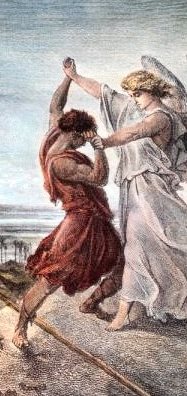
Jacob Wrestling with an Angel, by James Tissot, ca. 1900

Yisrael and Ya-akov are the two names of the patriarch in the book of Genesis who fathers the twelve sons whose names become the names of the twelve tribes. His first name, Ya-akov, refers to his devious efforts to pull down his brother Esau and replace him as the “firstborn” who will inherit not only twice as much wealth, but also God’s blessing and covenant. Ya-akov wins a second name, Yisrael, after wrestling all night with an angel of God, refusing to let go until the angel blesses him.

I find it significant that the Hebrew Bible does not call the twelve tribes after Abraham, or Isaac, but after the patriarch who began his career as a deceitful heel, and had to struggle with God to become the legitimate conduit for the divine covenant. At the end of the book of Genesis, Jacob-Israel is more straightforward and law-abiding than at the beginning of his story, but still far from perfect.

The name Yeshurun appears in the Torah for the first time in the long poem of Ha-azinu (“Use your ears”), the portion we read this Saturday, between Rosh Hashanah and Yom Kippur. Purportedly a prophecy written by Moses, the poem describes how after Moses has died and the Israelites have conquered and settled Canaan, God made them prosperous, but then they forgot the source of their wealth.

…[God] suckled them with honey from a rock,

And oil from a flinty boulder,

Sour cream from cattle and cream from sheep,

With the fat of lambs, and rams from Bashan, and he-goats,

With the fat of kernels of wheat,

And the blood of the grape you drink fermented.

And Yeshurun fattened, and it kicked;

You fattened, you became thick, you became gorged,

And abandoned the god who made him,

Dismissed as foolish the Rock who rescued him. (Deuteronomy/Devarim 32:13-15)

The ingrates in this poem are anything but upright.  16th-century rabbi Obadiah Sforno explained that the Israelites kicked like an animal that kicks the person feeding it. Their love of material pleasures, indicated by the rich foods, made them too “thick” to understand subtle truths.

19th-century rabbi Samson Raphael Hirsch added that God made the Israelites prosperous in order to show the world that it is possible to enjoy material pleasures and still lead a spiritual and moral life. When you are well-fed, Hirsch wrote, the correct behavior is to be more active and accomplish more. But the people who were supposed to be the Upright-Ones got lazy and fat instead.

In the last Torah portion of Deuteronomy, Vezot Habrakhah (“This is the blessing”), Moses calls the Israelites Yeshurun two more times, just before and just after his poetic prophecies for individual tribes. Here Moses uses the name Yeshurun without irony.

First he recalls the Israelites’ peak moment, when all the tribes gathered at Mount Sinai and pledged themselves to God.

He became king among Yeshurun,

When the heads of the people gathered themselves,

All together, the tribes of Yisra-el. (Deuteronomy 33:4)

Commentators disagree on who “he” is in this verse, Moses or God. According to Rambam (12th-century rabbi Moses Maimonides), the Israelites honored Moses like a king. This would make Moses the head of the Upright Ones. But according to the Talmud, the Israelites accepted God as their king. This would make them the Upright Ones who unite to obey God’s laws (even though it is a struggle, yisra, to serve the divine king).

After giving prophecies for individual tribes, Moses makes another positive statement about the Israelites as a whole.

There is none like the god of Yeshurun,

Riding through heavens as your rescuer,

…And Yisra-el will dwell in safety,

The well of Ya-akov left alone. (Deuteronomy 33:26, 33:28)

Ultimately, God will help the people, even though sometimes they are upright, sometimes struggling for God’s blessing, and sometimes they are devious supplanters.

After these three uses of Yeshurun at the end of Deuteronomy, the name occurs only once again in the whole Hebrew Bible:

Thus says God, your maker and your shaper,

Who helps you from the womb on:

Do not fear, My servant Ya-akov,

And Yeshurun whom I have chosen. (Isaiah 44:2)

I think Isaiah means that the descendants of Ya-akov, who grabbed his brother’s heel and used devious means to supplant him, need not fear as long as they serve God. If Ya-akov had pursued only the firstborn’s double portion of wealth, God would not have helped him. But since Ya-akov also pursued the firstborn’s blessing of the covenant with God, God gave him more chances to make good.

And Yeshurun, the upright ones, need not fear as long as they live up to the role God chose for them: to be the model of a nation that obeys God’s laws.


Do you identify with the God-Struggler (Yisra-el), the Heel-Grabber (Ya-akov), or the Upright One (Yeshurun)? Or perhaps a fourth name?

Personally, my default is to be law-abiding, probably because I grew up feeling the safest when I went unnoticed. That kind of uprightness is hardly a great model. Fortunately I also have a stubborn moral sense, so when I discover I have accidentally done something that might be devious, I rush to make amends. I do not want to be a heel-grabber, even when that seems to be the only means to a good end.

I think my highest self is a god-struggler, wrestling with the question of what God is, and how I can have at least a relationship, if not a covenant, with this mystery called God.

And I pray that all humans may find the names that they need to grow into.

Haftarah for Ki Tavo–Isaiah: Rise and Shine

I was an alto before I was a Jew. I first sang Handel’s “Messiah” in my high school choir. Now, 27 years after my conversion, I still enjoy Handel’s music, and I still do not take the words seriously. But when you sing words, you remember them.

This week I read the Torah portion, Ki Tavo, and then turned to the haftarah, the passage from the Prophets/Neviyim that is traditionally chanted after the Torah portion at the morning Shabbat service. I glanced at the first line in Hebrew, and I immediately sang:

handel-1

Arise, shine, for thy light has come! (Isaiah 60:1)

This King James Bible translation accurately captures one possible meaning of the Hebrew. But the “Messiah” uses the line for an entirely different purpose than the book of Isaiah. Handel’s friend Charles Jennens, who provided the libretto for the oratorio, was a devout Anglican who wanted to tell a story of Jesus’ life in terms of direct divine intervention in human affairs. So he cut and pasted verses from all over the King James Bible and the Common Book of Prayer to make his point.

Jennens took many lines out of context from the book of Isaiah. At the beginning of the “Messiah”, after setting the scene, he put in a line from the King James version of Isaiah: Behold, a virgin shall conceive and bear a son, and shall call His name Emmanuel: God with us.

This line is now notorious as a bad Hebrew translation. A more accurate translation would be: Behold (or Hey!), the young woman is pregnant and is giving birth to a son; may she call his name Immanu-El (with us God). (Isaiah 7:14)

There is no virgin birth in the original Hebrew, and the young woman is already pregnant. There is no indication here or in the rest of Isaiah that this line has anything to do with the birth of someone called Jesus about 700 years later.

But by using this quote from the King James Bible, Jennens established that the “Messiah” was going to be about Jesus. He proceeded with another out-of-context quote from Isaiah: O thou that tellest good tidings to Zion …say unto the cities of Judah, behold your god! (Isaiah 40:9)

Then Jennens goes directly to the verse at the beginning of this week’s haftarah. The King James translation is: Arise, shine, for thy light is come, and the glory of the Lord is risen upon thee.

Here is my own translation:

Arise! Shine! For your light ba,

And the kavod of God dawns over you. (Isaiah 60:1)

ba = come, has come, is coming

kavod = glory, honor, dazzling splendor, awesome presence

In the “Messiah”, Jennens uncharacteristically chose to follow up Isaiah 60:1 with the next two verses, Isaiah 60:2-3. A solo bass sings the King James version: For behold, darkness shall cover the earth, and gross darkness the people; but the Lord shall arise upon thee, and His glory shall be seen upon thee. And the Gentiles shall come to thy light, and kings to the brightness of thy rising.

Here is my translation from the Hebrew:

For hey! the darkness will cover the earth

And the gloom the peoples;

But God will dawn upon you

And Its kavod will appear over you.

And the nations will walk to your light

And kings to a gleam of your dawn. (Isaiah 60:2-3)

What is the light that either came or is coming? And who is “you”?

These three verses connect “light” with God’s glory. In the previous two chapters of Isaiah, the Israelites who live in exile in Babylonia have been groping in the darkness of ignorance, wondering how to find their god. So “light” may mean both enlightenment and God’s close approach.

The “you” (and all the verbs) in the verses above are in the feminine singular, but no female human is mentioned. “The people” and “God” (and “Jesus”!) would all take the masculine form. However, most place-names in the Torah are feminine. The subject whose light will attract the tribute of many nations is finally named in 60:14: And they will call you City of God, Zion of the Holy One of Israel.

Zion (pronounced Tziyon in Hebrew) is a synonym for Jerusalem. Scholars date the second half of the book of Isaiah (chapters 40-66) to about 550-515 B.C.E., around the time when the Persian king Cyrus  gave the Jews in exile permission to return to Jerusalem and rebuild their temple. The poet in Isaiah chapter 60 apparently rejoiced that Zion’s people and religion were rising again, and hoped that the religion would spread as more and more nations “saw the light”.

So in the 6th century B.C.E., the book of Isaiah saw the rebuilding of Jerusalem as the dawn of an era in which belief in the god of Israel would become universal. In the 18th century C.E., the librettist of Handel’s “Messiah” connected the dawning of God’s light with the birth of Jesus, heralding the new religion of Christianity. Meanwhile, for the last 2,000 years or so, Isaiah 60:1-22 has been the “sixth haftarah of consolation” of Jews; we read it during the sixth week after Tisha B’Av, the day of mourning for the fall of the first and second temples in Jerusalem.

Can this haftarah from Isaiah, which is so hopeful about the rebuilding of the temple, still console us for the fall of both temples in Jerusalem? Personally, I am glad that for the last 2,000 years we have been seeking God through prayer instead of through animal offerings at a temple.  But I am still waiting for enlightenment to dawn over Zion.

Meanwhile, I can use a message of hope during this introspective month of Elul, when Jews are asked to prepare for Yom Kippur by reviewing the past year and acknowledging their misdeeds. As Rabbi Shoshana Dworsky pointed out, it is easy for a woman to take the first few verses of this haftarah personally, since all the language is in the feminine singular! What if the poem is addressing me, as I wonder how I will ever outgrow the shortcomings in my character that I am pondering this month?

Maybe my light is coming, and soon I will arise and shine.

Ki Teitzei: Captive Soul

detail of Rachel weeping in “Massacre of the Innocents”, by Francois-Joseph Navez, 1824

When you go out to battle against your enemies, and God, your god, gives [one of them] into your hand, and you capture captives from him; and you see among the captives a woman who is yefat to-ar, and you desire her, then you may take her for a wife. (Deuteronomy 21:10-11)

yefat to-ar = beautiful of form, shapely, attractive.

yefat (יְפַת) = beautiful of.

to-ar (תֺּא) = form, shape.

This week’s Torah portion, Ki Teitzei (“When you go out”), opens with a standard situation in war: the men on the winning side of a battle take all the losers’ possessions, including their women.  In other Torah portions, the enemy’s women are merely listed as part of the booty; their fate is not addressed until the portion Ki Teitzei.

The implication in the passage above is that the Israelite soldiers will restrain themselves from raping most captive women, but a woman who has a beautiful shape is a special case.

The Hebrew bible describes three people besides the captive woman as yefat to-ar (feminine) or yefeh to-ar (masculine): Rachel, Jacob, and Esther.  Rachel’s beauty in the book of Genesis/Bereishit makes Jacob fall in love at first sight and labor for 14 years in order to marry her.  When her son Joseph is serving as Potifar’s steward in Egypt, his beauty makes his master’s wife lust after him so much that she grabs his clothing to pull him down.  Esther’s beauty in the book of Esther makes the king of Persia fall for her and crown her as his queen.

Clearly if you are yefat to-ar, your body is bound to inspire someone with extreme desire. Perhaps that is why this week’s Torah portion does not ask Israelite soldiers to refrain altogether from sex with the enemy’s women. But it does raise the bar for a man who desires a shapely captive. Instead of (or according to some commentators, in addition to) raping her in the field, he must bring her home.

You shall bring her into the midst of your household, and she shall shave her head, and she shall do her nails. And she shall remove the cloak of her captivity from herself, and she shall sit in your house, and she shall weep for her father and her mother for a month of days. After this, you may come into her and become her husband, and she will be your wife. But it happens that you do not want her [any more], then you shall send her out as her own nefesh. You shall certainly not sell her for silver, nor shall you take advantage of her, inasmuch as you violated her. (Deuteronomy 21:12-14)

nefesh = soul, person, individual; appetite. (In post-Biblical Jewish writings, the nefesh is the level of soul that animates the body.)

By bringing the captive woman into his household, and exchanging her captive’s cloak for ordinary clothes, the man publicly changes her status from war booty to prospective wife.  Next, she gets a full month to mourn for her old home and family, by shaving her head (a common mourning practice in the Hebrew bible), trimming her nails, and weeping.  During this month, the man is forbidden to molest her.  The month of mourning grants the woman a measure of human dignity.

At the end of the month, the man chooses whether to espouse her or to send her away free.  Being a woman, the former captive does not have the right to negotiate her own marriage.  Nevertheless, she now has as much status as an Israelite woman with no father; she is either married or free, not a slave.

On a literal level, the law of the captive woman teaches men to restrain their sexual desires and reserve sex for responsible and committed relationships.  It also teaches men to choose their partners after a period of consideration, rather than in the first heat of physical passion.

But the Chassidic rabbis of the 17th-19th centuries found other levels of meaning in the passage about the captive woman. The one that speaks to me this year comes from 18th-century Rabbi Schnuer Zalman of Liadi (with some interpretation by Rabbi Zalman Schacter-Sholomi).  Schnuer Zalman saw the Israelite soldier as the conscious ego, and the captive woman as the nefesh, the level of soul that animates our bodies.  He called this the “animal soul” because it is the seat of physical desires.

The nefesh is held captive not by the body itself, but by the limited perspective of our physical desires and aversions, and by the compulsions of our bad habits.  The nefesh is a “woman of beautiful form” because, despite its captivity, it expresses some of the beauty of the neshamah, the divine level of soul that transcends the physical world.

When your conscious self longs to connect with the beauty of the divine, you have to free your nefesh from its captivity, so it can become a clear vessel for your divine neshamah.  According to Schnuer Zalman, the way to do this is to shave its head and cut its nails—that is, to renounce physical desires for the sake of spiritual desires.

This year, my rational mind knows my body would benefit from a weight-loss diet.  Another part of me craves comfort food. Now I wonder if my craving for comfort food is a bad habit that grew because of the limited perspective of my “animal soul”.  My nefesh is short-sighted enough to prefer feeling better right now over restraining myself for the sake of a distant future benefit.  Now the bad habit holds my nefesh captive.  According to Rabbi Schneur Zalman, I should renounce my physical desires in order to elevate my nefesh.

But I do not want to renounce ALL of my physical desires.  After all, some of them are good for my body, nefesh, and neshamah.  For example, sometimes I feel the urge to stretch, take a walk, kiss my husband, or eat green beans and mint from my garden.  These are good desires, since acting on them results in joy and gratitude for the gifts of the universe.

Can I renounce only one physical desire: the craving for comfort food?

I have never been able to stick to a diet I undertake for the sake of my body.  But what if I dieted for the sake of my soul?

My heartfelt impulse is to give the captive woman in this week’s Torah portion a safe home and a position of dignity, respect, and freedom.  Maybe I can see my own nefesh as a captive who is being enslaved by my bad habit.  If I intervene, will God give me the strength to rescue my soul and give it a good home?