Nitzavim: Concealed and Revealed

Hanistarot is for God, our god; and haniglot is for us and for our children forever to do all the words of this Torah. (Deuteronomy/Devarim 29:18)

hanistarot (הַנִּסְתָּרֹת) = what is hidden, concealed, secret.

haniglot (הַנִּגְלֹת) = what is revealed, uncovered, exposed.

In this week’s Torah portion, Nitzavim (“taking a stand”), the sentence above is wedged in between two predictions. The first is that the Israelites will worship other gods and then God will destroy their land and exile them. The second is that eventually the Israelites will return to God and God will return them to the land.

Does the sentence about what is concealed and revealed have anything to do with Moses’ two predictions?  Since the sentence follows Moses’ prediction that the Israelites will commit the “sin” of worshiping other gods, some commentary assumes the hanistarot/haniglot statement is about sins. According to Rashi (11th-century rabbi Shlomo Yitzchaki), it means that if a sin is committed so secretly that nobody could discover it, then God is responsible for punishing the individual offender. But if a sin is committed openly, it is up to the community to punish the offender; “and if we do not execute judgment upon these, then the whole community will be punished” by God.

Other commentators relate the hanistarot/haniglot statement to the sentence that follows it, where Moses predicts that the exiled Israelites will return to God, and then God will gather them back into the land of Canaan. In this case, what is concealed is the length of the exile. The future is always hidden from human beings. What is revealed is what we should do in the meantime: all the words of this Torah.  In other words, we and our descendants must strive to obey the 613 rules in the Torah as much as we can. (See last week’s post, Ki Tavo: Writing in Stone.)

A third strand of commentary, starting in the Talmud, interprets “what is secret (hanistarot) is for God” as a warning to individuals against pursuing arcane mystical knowledge.  “What is revealed (haniglot)” is the Torah, which is good for us to study.
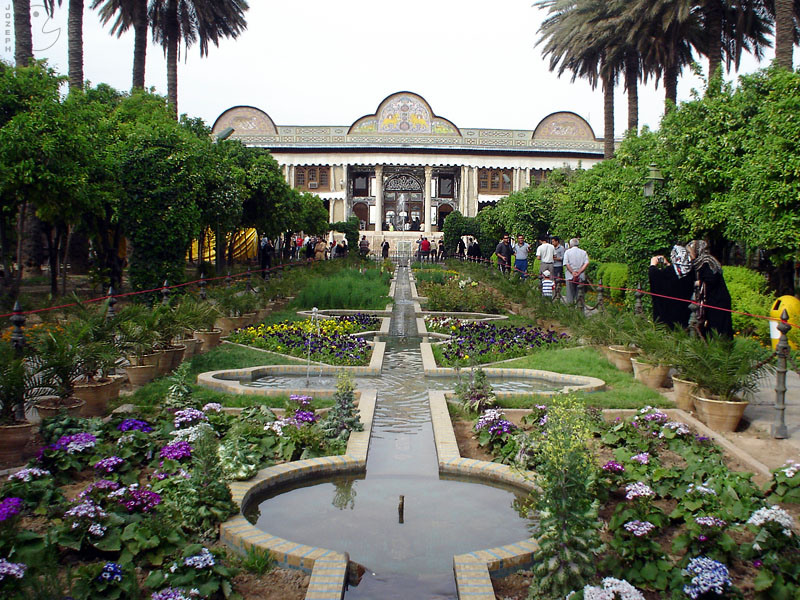
A pardeis at Shiraz (modeled after a garden of King Cyrus of Persia)

In the Babylonian Talmud (written by rabbis living under Persian rule in the first few centuries C.E.) the tractate Chaggigah mentions rabbis who taught about Ezekiel’s mystical vision of the chariot. Then it points out the dangers of pursuing arcane knowledge by offering a story about four great Torah scholars who entered a pardeis.

Pardeis (פַּרְדֵּס), often translated as “paradise”, is a Persian word for an orchard or an enclosed garden. Chaggigah 14b uses a pardeis as an image of the “upper worlds” of heaven, a realm of spiritual truth divorced from the physical world.

The four famous scholars who enter the pardeis in this story are Ben Azzai, Ben Zoma, the “other” (Elisha ben Avuya), and Rabbi Akiva, their senior. Ben Azzai glimpses the divine presence, abandons his body, and dies. Ben Zoma glimpses the divine presence, suffers from a consuming a surfeit of “honey”, and loses his mind. Elisha ben Avuya, the “other”, glimpses the divine presence, but sees a duality: God versus an angel (Metatron) who is sitting and recording the merits of Israel. The Talmud says Elisha “chopped down the shoots” of saplings, i.e. became a heretic who separated God (the root) from the angel (the shoot). Only Rabbi Akiva comes out of the pardeis safely.

When the scholars are entering the pardeis, Akiva warns them that they will see pure marble stones that appear to be water, but they must not say “water, water”. Perhaps Ben Azzai, Ben Zoma, and Elisha ben Avuya were unable to distinguish between polished marble and water—that is, between two key points in mystical understanding of the divine—and the result was death, madness, or heresy.  Hanistarot, what is secret, belongs to God, and very few can perceive one of God’s secrets and remain whole.

In the 12th century B.C.E., Rambam (Moses Maimonides) wrote that the hidden secret (hanistarot) in the sentence from this week’s Torah portion is Kabbalah, and the revealed wisdom (haniglot) is the Torah.  Those who learn Kabbalah must still take care to observe the rules of the Torah in the world of physical action.

*

Today I encounter people who are so fascinated by mysticism that they ignore the Rambam’s advice, and spend all their energy pursuing an “oh, wow!” state of mind. Sometimes I get the impression that anything arcane and mysterious attracts these people, as long as it is non-logical and only tenuously related to the world we live in. These ungrounded mystics seem to assume they can transcend the rules in the Torah and rise above their own psychological (soul) issues.  They appear to be more concerned with feeling love, than with figuring out what actions might be loving.

I also encounter people who want to “do all the words of this Torah”, but prefer specific rules about physical actions over admonitions to change their heart and soul.  If they are Jews, they may be strict about keeping kosher, but not so thorough about loving their fellows as themselves. Examining their own psyches in order to love other people is too much for them.

In between these two types are the people who cautiously mine mystical claims for insight without trying to enter pardeis.  They are enthusiastic about how religion can be applied to ethics and personal insight. Figuring out how to love one’s fellow as oneself, for example, is more important to them than either feeling ecstatic or following all the rules.

I want to belong to that third group. I want to investigate my own soul and stay grounded in my life here on earth. I want to borrow an occasional idea from Kabbalah without getting lost in it, and I want to use the Torah’s concrete rules as guidelines for behavior, to be reinterpreted if following the letter of the law gets in the way of following its spirit.

So I can subscribe to first part of the sentence from this week’s Torah portion:

Hanistarot [what is hidden] is for God, our god, and haniglot [what is revealed] is for us and for our children …

But I would like to end the sentence this way:

to study all the words of this Torah, and apply them thoughtfully to our lives.
 

Ki Tavo: Carved in Stone

Carve something on a stone, and set it upright as a memorial or a boundary marker.  People have been doing this all over the world for millennia.  Americans today still erect gravestones and mark historic sites with upright stones bearing text.

Anyone can read the inscribed stone or stele and learn something—about the battle that took place at that spot, or the boundary it marks, or the person who is buried there.

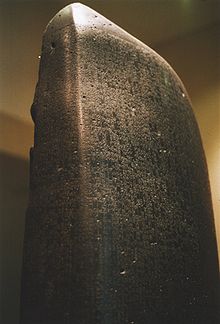
Code of Hammurabi, 1750 B.C.E.

In the ancient Middle East, most steles recorded victories in battle. But the oldest stele discovered so far from that region is a stone seven and a half feet high, with the Code of Hammurabi carved into it during the 18th century B.C.E.  The 282 laws of the reigning Babylonian king are written in Akkadian.

Standing stones without any words carved into them are even older. Only oral tradition can tell subsequent generations what the stones commemorated. A stranger from another place or a later time who sees a blank monument, or a circle of tall stones, knows only that they are significant, not what they signify.

The first standing stones in the Torah are uncarved.  In the book of Genesis/Bereishit, Jacob erects four different matzeivot or standing stones, marking the sites of his dream of angels, the boundary  between his area of influence and his father-in-law Lavan’s, and his wife Rachel’s grave.

Moses erects twelve standing stones at the foot of Mount Sinai in the book of Exodus/Shemot, to represent the twelve tribes of Israel in their covenant with God.  But the only engraved stones in Exodus are the two small tablets bearing the ten commandments, and they are so sacred that they are carried inside the ark, which must never be touched or opened.

At Mount Sinai and in the wilderness, the blank stones that depend on mutable oral tradition are out in public.  But the immutable, fixed written words are hidden in a sacred place.

Moses does not call for standing stones with writing on them until this week’s Torah portion, Ki Tavo (“When you enter”), in the book of Deuteromy/Devarim.

Moses and the elders of Israel commanded the people, saying:  Observe the entire commandment that I command you this day.  And it shall be, on the day that you cross over the Jordan into the land that God, your god, is giving to you, you shall erect for yourself great stones, vesadeta them with the siyd. And you shall write on them all the words of this torah when you cross over, so that you may come into the land that God, your god, is giving to you, a land flowing with milk and honey, as God, the god of your forefathers, has spoken to you. (Deuteronomy 27:1-3)

vesadeta (וְשַׂדְתָּ) = and you shall limewash (coat them with a paint-like mixture of lime and water).

siyd (שִׂיד) = lime, quicklime, limewash.

torah (תוֹרָה) = teaching. (The word torah also refers to the first five books of the Bible, to the whole Hebrew Bible, and to any teaching of Jewish law or religion.)

The people of the ancient Middle East made quicklime (calcium oxide powder) by burning bones. Adding enough water to slake the lime turns it into calcium hydroxide, which can be mixed with additional water to make limewash.  Limewash is still used to coat surfaces in order to make them smooth and white; the coating hardens into a thin shell of limestone, which may last for millennia in dry conditions. Remnants survive of a text painted in ink on a white limewashed wall in the 8th century B.C.E.

Fragments of 8th-century B.C.E. Balaam story on limewash at Deir Alla, Jordan

Thus the text on Moses’ limewashed stones could have been readable for many centuries. The Hebrew Bible does not specify which torah Moses wants on the stones, but it must include some or all of the laws from the written Torah we have today—the first five books of the Bible, as copied and recopied on parchment and paper. According to 12th-century rabbi Abraham Ibn Ezra, Moses means the 613 commandments that the Talmud (Makkot 23b) says are in the five books. Other commentary speculates that Moses is calling for the code of laws in the book of Deuteronomy (chapters 13-26), or for the whole book of Deuteronomy (which would fit on two stones the size of the one used for the Code of Hammurabi).

Until this point in the Torah, Moses passes down God’s laws by announcing them verbally to the assembly of Israelites. Only in this week’s Torah portion does Moses call for laws to be “carved in stone”—or at least painted on limestone—and set out in a public place: the top of Mount Eyval, next to the ancient town of Shekhem.

And it shall be when you cross over the Jordan, you shall erect these stones, as I command you this day, on Mount Eyval; vesadeta them with the siyd. And you shall build there an altar for God, your god … (Deuteronomy 27:4-5)

Moses continues with orders for offerings at the altar, followed by a ritual of blessings and curses to indicate acceptance of God’s law.  (See my earlier post, Ki Tavo: Cursing Yourself.)

On the bare summit of Mount Eyval, the stones would be visible from a distance, as shining white pillars against the sky.

Perhaps the author of this section of Deuteronomy imagined that the steles on Mount Eyval would be like the Code of Hammurabi, which many scribes over the centuries copied onto clay tablets. In the Talmud (Sotah 35b), Rabbi Yehudah imagines scribes from different Canaanite tribes visiting the stones on Mount Eyval and bringing home copies of their text.

Yet ancient scribes, including those who copied the Hebrew Bible, not only made copying errors, but also felt free to insert additional material. The steles on Mount Eyval would stand as a permanent record of the original laws of Moses, whatever amendments people made later.

From the viewpoint of the storyline within the book of Deuteronomy, Moses’ desire for a permanent, immutable, and public record of the laws is understandable. He is about to die, and he believes the Israelites, with their history of backsliding, will eventually abandon God’s laws and convert to Canaanite religions. Moses’ last hope of preserving his religion is to write it down.

He writes multiple copies of “this torah” in Deuteronomy 31:9, and a book of “this torah” to be placed inside the ark in Deuteronomy 31:24-26. All of these writings appear to be on parchment scrolls. But he also wants a more permanent record, so he orders the limewashed standing stones.

From the viewpoint of modern scholarship, Deuteronomy was written much later than Numbers, probably after the fall of the Northern Kingdom of Israel.  King Josiah of Judah, the southern kingdom, wanted public support for conquering the old northern territory and reinstating the old religion the two kingdoms shared. The description of a permanent monument bearing the laws of Moses might make King Josiah’s people feel that the religion of the God of Israel should persist.

From the viewpoint of a practicing Jew today, I would say the religion could not have survived this long without additions and reinterpretations. Of the 613 mitzvot or commandments in the five books of the Torah, as compiled by Rambam (12th-century rabbi Moses Maimonides), only 271 can be observed at all today. (Many of the old laws were about sacrifices at the temple, a method of worship that ended about 2,000 years ago with the fall of the second temple in Jerusalem.)

And some of the commandments are clearly inferior to ethical customs that Jews adopted later in their history. For example, although the Torah includes highly ethical commandments (such as not to insult, embarrass, or slander people), it also contains commandments such as the requirement that a rapist must marry his victim if she is single (Deuteronomy 22:29). There was a reason for that law in Judah 2,700 years ago, but 21st-century American society has better ways of handling the situation.

If archaeologists ever discover limewashed stones with some laws of Moses written on them, I pray that we may view the laws as artifacts, not immutable rules to follow forever. Reinterpretations of both oral traditions and traditional writings are what keep a religion alive, and let it walk farther on the path of virtue.

Ki Teitzei: Forgetting to Be Selfish

Last week’s Torah portion, Shoftim, told us not to cut down fruit trees when we are besieging a city. By Talmudic times, this injunction had been expanded into the principle of bal taschchit, do not destroy anything useful. (See my post Shoftim: Saving Trees.)

Some of the rules in this week’s Torah portion, Ki Teitzei (“When you go out”), have been similarly expanded. Here is one, nicknamed “The Forgotten Sheaf”:

If you harvest your harvest in your field, and you forget an omer in the field, you shall not turn back to take it. It shall be for the stranger, for the orphan, and for the widow, so that God, your god, will bless you in everything your hands do. (Deuteronomy/Devarium 24:19)

omer (עֹמֶר) = a dry measure, roughly 2 quarts or 2 liters, used in the Torah for both manna and cut ears of grain.

The word omer is sometimes translated as “sheaf”, but the omer of manna discussed in the book of Exodus/Shemot consists of tiny white spheres the size of coriander seed.  Manna could hardly be gathered into a sheaf! Elsewhere in the Hebrew Bible, the word omer refers to grain, and can easily be translated as a quantity of grain heads. (The sheaves in Joseph’s dream in Genesis/Bereishit are called alumim (אֲלֻמִּים), an entirely different word.)

Commentators over the centuries have agreed that the purpose of the rule about the so-called “Forgotten Sheaf” could not be to provide for the poor (epitomized by three types of people unlikely to own land or to be supported by wealthy men: resident aliens, orphans, and widows). One omer of grain might feed one person for one day. Landowners and their employees would have to be extraordinarily forgetful to accidentally leave enough grain to feed all the poor in their area.

detail from R.F. Babcock, "Ruth Gleaning"
detail from R.F. Babcock, “Ruth Gleaning”

Moreover, the Torah already requires landowners to deliberately leave behind grain, grapes, and other produce for the poor to glean.

When you harvest the harvest of your land, you shall not finish harvesting to the edge of your field, nor gather up the gleanings of your harvest.  And you shall not glean your vines nor gather up your fallen grapes in your vineyard; to the poor and to the stranger you shall leave them. (Leviticus/Vayikra 19:9-10)

The Torah portion for this week in Deuteronomy adds orchards to the fields and vineyards.

When you beat out your olive tree, you shall not strip the branches behind you; they shall be for the stranger, for the orphan, and for the widow. (Deuteronomy 24:20)

If landowners are already required to leave food in their fields, vineyards, and orchards for the poor to glean, why does the Torah tell them not to go back and gather an omer they forgot about?

The 13th-century book Sefer Ha-Chinukh answers that the purpose of this commandment is to help people develop the habit of generosity. Even if you are giving to the poor as required by gleaning laws, tithes, or taxes, as you work to increase your own wealth you must still cultivate the belief that sharing wealth is more important than maximizing your own profit.

Philo of Alexandria’s commentary, written in the first century C.E., criticizes people who devote themselves exclusively to increasing their own wealth, and never notice that their gains would be impossible without the natural world God gives us.  (I would add that the gains of the money-hungry also require the labor of other people.) And in the 19th century, Rabbi Samson Raphael Hirsch wrote that the commandment not to go back for the forgotten omer is intended to clear possessiveness and greed from your thoughts.

Besides breaking the habits of possessiveness and greed, leaving the forgotten omer behind might also help someone to overcome the habits of worrying about being cheated, or thinking of everything in terms of private property.

What if a farmer left grain in the field, and nobody came by to pick it up?  Would this violate the principle of bal tashchit, “do not waste”?

This was not an issue in ancient Israel, where there were always people without land of their own  who gleaned to feed themselves.

Gleaning projects are being revived today in the United States, collecting food that would otherwise be wasted.  But we can also update the principle of the forgotten omer.  What if you are fumbling with your purse or billfold, and you accidentally drop money on the sidewalk?  If you leave it behind, the money will not go to waste; someone will pick it up. What if you forget to collect your change at the counter, or discover you left too large a tip?  Going back for your money would shrink your soul.  Leaving it for someone else gives you practice in keeping your priorities straight.

When you have forgotten to do a good deed, go back.  But when you have forgotten to be selfish, go on, and be grateful for your forgetfulness.

Shoftim: Saving Trees

When you besiege a town for many days, to make war against it, to capture it, lo tashchit its trees by swinging an axe against them; for you will eat from them, so you shall not cut them down; for is a tree of the field ha-adam, to come in front of you in the siege? (Deuteronomy/Devarim 20:19)Peaches_clip_art_hight

lo tashchit (לֹא־תַשְׁחִית) =  you shall not destroy, ruin, corrupt.

ha-adam (הָאָדָם) = human (as an adjective); the human, humankind (as a noun).

The above verse from this week’s Torah portion, Shoftim (“judges”), assumes that it is acceptable to make war in order to capture a town belonging to a different tribe or nation. If humans from the town get in your way, you may kill them. Everyone does it.

However, the verse does challenge the idea that it is acceptable to cut down your enemy’s orchards and groves. This practice ensured that even if the siege failed, the town would still suffer in the long term, deprived of both fruit and a means of livelihood. (For example, olive oil was a major export in the part of Canaan that the Israelites conquered.  Cutting down olive trees would mean the town had no more olive oil for themselves or for trade.)

The Talmud generalizes the prohibition against cutting down fruit trees in a siege to prohibit any wasteful destruction, including tearing fabric when you are not in mourning (Kiddushin 32a), or scattering your money in anger (Shabbat 105b).

Rambam (the 12th-century commentator Moses Maimonides) wrote that the verse in this week’s Torah portion applies to any injury to a fruit tree. However, he said, the tree may be removed if it is damaging other trees, or even if its wood can be sold at a high price. The important thing is to avoid any needless destruction. He extended this idea to cover ruining edible food or demolishing a usable building.

The prohibition against waste and useless destruction came to be called bal tashchit. (Bal, like lo, means “not”.)

Many societies have rules against destroying a fellow citizen’s property. What stands out about the Jewish principle of bal taschchit is that it prohibits useless destruction of both enemy property, and your own personal property.

According to the 13th-century book Sefer Ha-Chinukh, the purpose of bal taschchit is to train us to avoid acting on evil impulses. Wicked people revel in destruction and corruption. By following the rule to eschew waste and preserve everything useful, we gradually reduce our impulses to destroy something, and develop a better attitude.

Imagine if everyone followed the rule of bal taschchit today!

Who knows, maybe the modern ethic of “reduce, re-use, recycle” is training us to disapprove of wasting the earth’s resources. Maybe the people of the world are almost ready to rally to a new call to save the world from the pollution that leads to “global climate change”—which really means ruin and hardship all over the world.

May it be so!

Re-eih: Recipe for Joy

Sometimes joy comes unexpectedly. But sometimes we plan to rejoice on a particular occasion, acting with joy and thus inducing a feeling of joy. This week’s Torah portion, Re-eih (“See!”), says that three times a year, everyone should rejoice.

Universal joy is required during the three annual pilgrimage festivals, Pesach, Shavuot, and Sukkot.  Although the Torah gives instructions for these three festivals in the earlier books of the Torah, this portion in the book of Deuteronomy/Devarim is the first one that mandates a pilgrimage to the central sanctuary even for Pesach.

Three times in the year all your males shall appear in the presence of God, your god, in the place that [God] will choose: on the festival of the matzot and on the festival of the shavuot and on the festival of the sukkot (Deuteronomy/Devarim 16:16) 

matzot (מַצּוֹת) = unleavened bread. (This spring festival is part of Pesach or Passover.)

shavuot (שָׁבֻעוֹת) = weeks. (This summer festival occurs after counting seven weeks of the barley harvest, and includes bringing the first fruits and loaves of leavened bread to the priests at the sanctuary.)

Barley
Barley

sukkot (סֻכּוֹת) = huts, temporary shelters. (In Exodus this autumn festival is called the festival of the asif, “ingathering”, and pilgrims donate products from their threshing-floors and wine-presses. Leviticus adds the rituals of dwelling in temporary huts for seven days.)

…and they shall not appear in front of God empty-handed; each man [shall give] according to the giving-capacity of his hand, according to the blessing that God, your god, has given to you. (Deuteronomy/Devarim 16:16-17)

Only Israelite men are required to make the three pilgrimages to the central sanctuary (which was in Shiloh for about 370 years, and Jerusalem for about 1,000 years).  But this week’s portion also encourages women, children, and slaves to go, while recognizing that the journey may not be possible for pregnant or nursing women. Each head of a household must bring the second tithe (a donation for the priests and the temple administration), and a sacrificial animal for God. But the donations must be in proportion to the family’s wealth, so nobody’s joy is dampened by having to give more than they can afford.

Pilgrimage for Sukkot

In the Torah’s previous instructions regarding the three festivals, rejoicing is mentioned only once, when Leviticus 23:40 says to take branches from four species of trees and rejoice for the seven days of Sukkot.

But in this week’s Torah portion, rejoicing is called for three times, once in the instructions for Shavuot and twice in the instructions for Sukkot.

(Although this Torah portion does not specifically mention rejoicing during Pesach, later passages in Ezra and Chronicles 2 mention rejoicing in Jerusalem during this festival.)

The requirement for rejoicing in the portion Re-eih includes the Levite, stranger, orphan, and widow, who were not mentioned in any of the earlier instructions on the three festivals. During Shavuot, the Torah portion says:

Rejoice in the presence of God, your god—you and your son and your daughter and your man-servant and your woman-servant, and the Levite who is within your gates, and the foreigner and the orphan and the widow … (Deuteronomy 16:11)

And during Sukkot:

Rejoice in your festival, you and your son and your daughter and your man-servant and your woman-servant, and the Levite and the foreigner and the orphan and the widow who are within your gates. Seven days you shall celebrate a festival for God, your god, in the place that [God] will choose, because God, your god, will have blessed you in all that comes to you and in all the doings of your hands, and there will be for you only joy. (16:14-15)

Feeling joy might be easy for the landowner who brings his offerings to the sanctuary, since he gives in proportion to his means, and he is celebrating that God blessed his agricultural endeavors with success.

But when the Torah addresses this landowner, it informs him that his family and his servants or slaves must also feel joy during the festivals. Furthermore, the Torah gives examples of four classes of people who are unlikely to own land or other independent means in a society built around inheritance through the male line: the Levites, whose pasture land is restricted and depend on donations; foreigners, who can lease but not inherit estates; orphans who have no fathers to provide for them; and widows, who are dependent on the mercy of relatives unless they have wealthy sons.  The Torah says that all of the disadvantaged people who live in the landowner’s town or village must also rejoice during the three festivals. Their joy becomes the landowner’s responsibility.

What can he do for them? According to the commentary of 19th-century rabbi Samson Raphael Hirsch, he must arrange for those who cannot travel to rejoice at home.  Everyone who can travel must come with him to the central sanctuary, to experience the joy of celebrating in the national community, whose people are dedicated to one god, and to one another.

Hirsch added that these festivals are also times that God appointed to meet the people at God’s sanctuary. The awareness of God’s presence, he wrote, brings the purest joy.

In the 11th century, Rashi (Rabbi Shlomo Yitzchaki) wrote that the phrase I translate above as “there will be for you only joy” means that if you bring everyone to God’s chosen place for a festival, God promises you will be happy.

I have observed this effect in my own life. Occasionally happiness lifts me when I am alone; more often it comes when I am with my beloved. But when I am singing with my congregation at services, my heart almost always rises. The only times this communal singing does not bring me joy are when someone in the group looks angry or miserable.

The unhappy people are like the poor foreigners in the Torah, alienated from the community where they live. Sometimes these “foreigners” cannot come to the place where God is; they are unable to travel spiritually. Then those of us who have greater means, like the landowners in the Torah, must make arrangements to help them rejoice in the spiritual state where they are.

Other times, the unhappy “foreigners” are able to travel, if we carry them with us. The Torah tells us not to neglect them, but to bring them to God’s place to celebrate with us.

Then “there will be only joy”. Complete joy happens only when everybody contributes, and nobody gets left out.

Eikev: Reward and Punishment

The oldest section of Jewish prayer services consists of the Shema and the three excerpts from the Torah that follow it. This “Shema section” became a regular part of morning and evening services about 2,000 years ago.  The Shema itself is a single sentence: Listen, Israel: God is our god, God is one. (Deuteronomy/Devarim 6:4)

The prayer service continues with Deuteronomy 6:5-9, in a paragraph sometimes called “the ve-ahavta” because it begins with the word ve-ahavta (וְאָהַבְתָּ) = And you shall love. (See my post: Va-etchannan: Extreme Love.) This first paragraph after the Shema urges individuals to remember to love God at all times.

The second paragraph, Deuteronomy 11:13-21, which comes from this week’s Torah portion, Eikev (“On the heels of”), offers reasons why the whole community must follow God’s rules. The third paragraph, Numbers/Bemidbar 14:37-41, calls for tassels (tzitzit) as a reminder to keep our attention on God. (See my post Shelach-Lekha: Glimpses of Blue.)

The second paragraph after the Shema is the most problematic of the three, because its reasons for obeying God’s rules consist of two if-then statements that are obviously untrue. It begins:

And it will be, if you [plural] truly heed My commandments that I am commanding to you today, to love God, your god, and to serve [God] with your whole levav and your whole being— (Deuteronomy/Devarim 11:13)

levav (לֵבָב) = mind, (literally “heart”), the seat of conscious thoughts and feelings.

Are the commandments in the “if” clause the whole body of law in the Torah, or just to love God and serve God with your whole mind and body? For classic commentators, it does not matter, because the way to love and serve God is to follow all of God’s commandments in the Torah. 

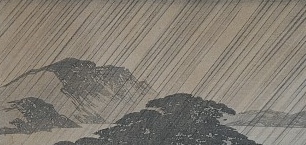
Hiroshige, detail
Rain by Hiroshige, detail

The next two verses promise a reward:

—then I will give rain to your land at the right time, autumn-rain and spring-rain, and you will gather your grain and your wine and your olive oil. And I will put grasses in your field for your livestock, and you will eat and you will be sated. (Deuteronomy 11:14-15)

It is a nice promise, but we all know that obeying God’s commandments does not, in actual practice, result in beneficial weather–even in Israel. For Jews outside Israel, obeying God’s commandments does not guarantee the results of beneficial weather: a full stomach and being able to live where you are.

One explanation is that we humans are so fallible, we never manage to obey all of the pertinent commandments properly; and God will not reward us if we miss the mark on even one of them. But even the God-character in the Torah, who wipes out the innocent with the guilty, is not that unreasonable.

The if-then promise is followed by an if-then threat:

Be on guard against yourselves, because if your mind yifteh, and you turn away and serve other gods and bow down to them—then the heat of God’s anger will be against you, and it will shut up the heavens, and rain will not happen, and the land will not give its produce, and you will quickly perish from the good land that God is giving to you. (Deuteronomy 11:16-11:17)

yifteh (יִפְתֶּה) = will fool itself, will be tempted, will be naïve.

However, we know that when someone succumbs to the temptation to serve other gods—either literal or figurative—drought, death, or exile do not necessarily follow.

Some commentary points out that although the ve-ahavta paragraph of the Shema addresses “you” in the singular, this second paragraph uses “you” in the plural.  God’s covenant is with all the Israelites, collectively. The more conscientious members of the community are charged elsewhere in in the Torah with preventing idolatry and improving the behavior of the slackers.

Yet bad things still happen to whole groups of good people.

And whole groups of people who fool themselves into idolatry (such as the belief that getting rich is more important than loving your fellow as yourself) still have plenty to eat.

Jews who want to believe the promise and threat in the passage from this week’s Torah portion continue to find rationalizations. Sixty years ago some religious Jews blamed their own people’s lack of perfection for the Holocaust.

Environmentalists, extending the if-then statements in this week’s Torah portion to the whole human race, have pointed out that our wanton degradation of the world’s air, water, soil, flora, and fauna result in poisoned food, sickness, and  rising sea levels, all of which can result in starvation, death, and exile. We can certainly argue that if society as a whole does not put the welfare of our planet first, then disasters will follow. And perhaps taking care of the earth is one way to love and serve God.

But it is not the only way. What about all the commandments in the Torah? What about all the other acts of kindness and right behavior we should be doing?

I believe that the two if-then statements in this excerpt from the Torah portion Eikev do not reflect literal reality, and can only be considered poetic exaggerations. Yet I also believe that loving and serving the divine does have good consequences, and letting ourselves be fooled into worshiping harmful ideologies does have bad consequences.

So I am struck by the last sentence in the excerpt from Eikev that is used as the second paragraph of the Shema. After repeating the reminders in the first paragraph to always keep “these words” in mind, the second paragraph ends:

So that your days yirbu, and the days of your children, upon the land that God vowed to your forefathers, to give to them as the days of the heavens over the earth. (Deuteronomy 11:21)

yirbu (יִרְבּוּ) = will be many, will become numerous, will increase.

“Your” and “you” in this sentence are plural.  So on a simple level, the sentence might mean “So that your people will live a long time in the land (Canaan) God promised to give your ancestors—as long as the sky is above the earth”. In other words, every individual must die, but as long as you all obey God, your people can live in Israel forever.

Maybe this promise was motivating when Deuteronomy was written (probably in the 7th century B.C.E.). But today, many Jews who choose not to emigrate to Israel need a different kind of promise.

In the 19th century, Rabbi Samson Raphael Hirsch wrote that “as the days of the heavens” means that days on earth would be like days of heaven. Following his lead, I would retranslate the sentence at the end of the excerpt this way:

“So that your days will increase in fullness and value, and so will the days of your children; and the potentials of your ancestors will be realized in you and your children; and every day on earth will be full of the divine.”

Not only is this a good reward for good behavior, but it actually works. If you keep your attention on loving and serving God—the inner divine voice, or the spirit of life, or all humanity—then your days really do improve. They may even become heavenly.

Devarim & Shelach-Lekha: A Giant Detour

The first time the Israelites reach the border of Canaan, they refuse to cross because they are afraid of giants. The second time, they delay crossing the border because of a giant.

The first time, the Israelites come from Mount Sinai directly to the southern border of the land God promised to give them. In the Torah portion Shelach-Lekha in Numbers/Bemidbar, Moses sends scouts into Canaan. The scouts return saying the land is full of giants.

And all the people that we saw in it were men of unusual size. There we saw the Nefilim—children of Anak from the Nefilim—and we were like grasshoppers in our own eyes, and so we were in their eyes! (Numbers/Bemidbar 13:32-33)

Nefilim (נְפִילִים) = “fallen ones”, giants; offspring of “the gods” and human women before the Flood.

Anak = founder of the Anakim (עֲנָקִים) = “necklace people”, giants.

There are three groups of people in the Torah who are tall enough to be considered giants: the Nefilim, the Anakim, and the Refa-im. The passage above confirms that the Nefilim and Anakim are giants.

At the southern border of Canaan, the Israelites refuse to go into a promised land that is full of giants. God declares they must wait until 40 years have passed since the exodus from Egypt, and all the men of that generation have died (except for Joshua, and Caleb, the two scouts in favor of  going).

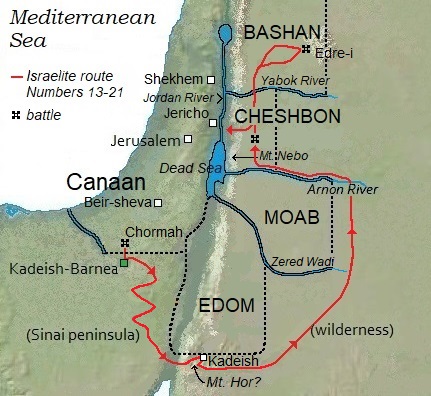
In the 39th year, in the Torah portion Chukkat in Numbers, Moses leads the Israelites around the kingdoms of Edom and Moab, and they camp on the Arnon River.  Now all that lies between them and the Jordan River, the eastern border of Canaan, is the kingdom of Cheshbon.

Moses asks Sichon, king of Cheshbon, for permission to pass through his land on the king’s highway. Sichon not only refuses, but calls up his army and goes to battle. The Israelites win, and take over Cheshbon.

Then, instead of heading straight for the Jordan River, they take a long detour to the north, all the way to Edre-ii.

Then they turned their faces and they went up the Bashan road; and Og, king of the Bashan, went out to come against them to do battle, he and all his people, at Edre-ii. And God said to Moses: Do not be afraid of him, because into your hand I have given him, and all his people, and all his land; and you shall do to him as you did to Sichon, king of the Emori, who was living in Cheshbon. So they struck him down, and his sons and all his people, until there were no survivors left, and they took possession of his land. Then the Children of Israel pulled out, and they pitched camp on the plains of Moab, across the Jordan from Jericho. (Numbers/Bemidbar 21:33- 22:1)

Og (עוֹג) = a proper name. (In Biblical Hebrew, the closest word is oog (עוּג) = bake a cake. In Phoenician, og = a supernatural being who attacks grave-desecrators.)

Why do the Israelites make this gratuitous detour to conquer an extra country—a country that is not even part of the “promised land” of Canaan?

According to most traditional commentary, King Og would have come south and attacked the Israelites anyway, as soon as they conquered Cheshbon. Some commentators have claimed that Og and Sichon were allies, others that they were both hired by the Canaanites to guard the Jordan River against invaders from the east. In the Talmud, Niddah 61a says Og and Sichon were brother giants who escaped the Flood in Noah’s day. (According to one old story, baby Sichon was a stowaway in the ark, and Og rode on the roof.)

Yet when the Israelites head up the Bashan road, they do not meet Og and his army until they get all the way to the fortress of Edre-ii, King Og’s second capital. Therefore, according to the Torah itself, Og is not on his way to attack the Israelites in Cheshbon. The Israelites’ detour to the Bashan is unnecessary.

So why do they do it—with Moses’ cooperation, and God’s consent and reassurance?

When Moses retells the story in this week’s Torah portion, Devarim (“Words”), his account begins the same way as in Numbers. But then he gives us new information about King Og.

For only Og, king of the Bashan, remained from the rest of the Refa-im. Hey! His bedstead was a bedstead of iron! Is it not in Rabbah of the Ammonim? Nine cubits is its length, and four cubits its width, according to the cubit of a man. (Deuteronomy 3:11)

Refa-im  (רְפָאִים) = an ancient people of huge size; the dead.

A bed that size indicates that Og is about ten to twelve feet tall (about 300 to 370 cm)—twice as tall as an ordinary man. No wonder God tells Moses not to be afraid!

After the Nefilim and the Anakim, the third group of extra-large people in the Torah is the Refa-im. We know the Refa-im are giants not only because Og is a Refa-i, but also because of another aside in this week’s Torah portion. Moses remembers that God told him not to provoke the Ammonites on the way to the Jordan, since God reserved their land for the descendants of Lot’s son Ammon. Then Moses adds that Ammon

…is also considered the land of Refa-im; Refa-im used to live there previously … a great people, and numerous and tall as the Anakim. God exterminated them before [the Ammonim], and displaced them, so they live in their place instead. (2:10-11)

This explanation ties together the two meanings of refa-im. The refa-im are giants; and they are also extinct, by the time of Moses’ speech in Deuteronomy; the Israelites kill the last Refa-ii, King Og. The refa-im are the dead.

When the scouts reported that Canaan was full of gigantic Anakim, the Israelite men of the older generation are afraid to cross the southern border of Canaan. Now a new generation is preparing to enter Canaan across a different border, the Jordan River at the eastern edge of Canaan. These young men need to prove to themselves that unlike their fathers, they are not afraid of giants.

Fortunately, from their point of view, there is a giant ruling the country just north of Cheshbon. The chance to attack King Og is irresistible.

Many of us today are haunted by giants from the past. When Jews say “Never again”, we are thinking of Nazi giants. Individuals also remember feeling like grasshoppers in the face of those who used to have power over them: an abusive parent, a menacing teacher, the draft board, “the system”. It takes many years for us to grow and develop our own power.

Eventually, we may believe we are strong enough and brave enough to prevent anyone from seizing power over us. But our memories still haunt us. How can we be sure we are now safe from giants?

I have even caught myself wishing a giant would attack me, just so I could prove to myself that I can stand up to it!

Some of us might be tempted to attack potential giants who are minding their own business—just  to prove we have to courage to do it. It takes even greater strength to refrain, and not turn onto the Bashan road.

I pray that everyone may find not only the strength to stand up to giants, but also the greater strength to refrain from provoking them. May we wait for an actual threat before acting. And may we use our newfound power and courage with wisdom and compassion, so we do not turn anyone into a grasshopper.


Masey: Magic of an Egyptian Province

The Torah does not name the pharaoh in its story about the exodus from Egypt. But some scholars guess the story is set in the 13th century B.C.E., during the reign of Rameses II. At that time the land of Canaan was a remote province of the Egyptian empire. Canaanite vassals ruled individual villages and their surrounding regions, but they reported to the Egyptian government in the provincial capital, Gaza. Egyptian garrisons were scattered around the province.

The two biggest powers then were the Egyptians and the Hittites. The capital of Egypt was in the Nile delta; the capital of Hatti was in present-day Turkey. Naturally the two empires fought over the land in between, until their kings, Rameses II and Hattusili III, made a peace treaty circa 1260 B.C.E. that froze the border. A long period of peace followed—as far as the Egyptians and Hittites were concerned. If one Canaanite vassal overthrew another, that was not their business.

In this week’s Torah portion, Masey (“Journeys”), the Israelites are preparing to cross the Jordan River and overthrow every ruler in the province of Canaan.

God spoke to Moses, saying: Command the Children of Israel, and you shall say to them: When you enter the land of Canaan, this is the land that will fall to you as a hereditary possession: the land of Canaan by its boundaries. Your southern limit shall be from the wilderness of Tzin next to Edom … (Numbers/Bemidbar 34:1-3) 

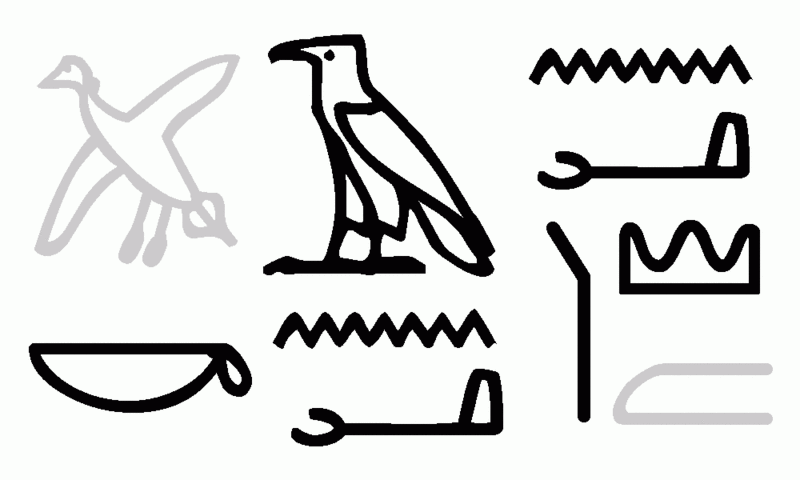
"Canaan" in Egyptian heiroglyphs, Merneptah Stele
“Canaan” in Egyptian heiroglyphs, Merneptah Stele

Canaan (כְּנָעַן) = a territory roughly including present-day Israel, Lebanon, and part of Syria—but not Jordan. (Probably from the Egyptian name Kanana, though it may also be related to the Hebrew verb root kana (כּנע) = humble, subdue, subjugate. Much later, in the Second Temple period, a kinani (כְּנַעֲנִי) was a merchant or tradesman rather than a Canaanite.)

God promises to give the land of Canaan to Abraham’s descendants in the book of Genesis,and to the descendants of Abraham’s grandson Jacob in the book of Exodus.

When God delineates the boundaries of the promised land in this week’s Torah portion, Masey (“Journeys”), the northern boundary is about the same as the boundary between the Egyptian and Hittite empires, as set by their treaty. Like the province of Canaan, Israel is to include the coastline from Wadi el-Arish all the way to a Mount Hor north of Byblos (now the Lebanese city of Jubayl). (This is different from the Mount Hor east of Edom where Aaron dies.)

Canaan in Numbers 34

The northern boundary goes from the Mediterranean to a point deep in present-day Syra. The eastern boundary swings around to the Sea of Kinneret and follows the Jordan River to the Dead Sea, like the eastern boundary of Canaan in the 13th century B.C.E.

The Israelites never rule the entire province. But they are so attached to Canaan as their promised land, that Moses gets upset in last week’s Torah portion (Mattot) when two and a half tribes want to settle on the east side of the Jordan River, in the land the Israelites recently captured from a pair of Amorite kings.

In this week’s Torah portion, Moses makes the distinction between Canaan and the land east of the Jordan again.

And Moses commanded the Children of Israel, saying: This is the land that you will divide for hereditary property by lot, that God commanded to give to the nine tribes and the half tribe. For the tribe of the Reubenites…the tribe of the Gadites… and the half-tribe of Menashe, they have taken their hereditary possession. The two tribes and the half-tribe took their hereditary possession from across the Jordan at Jericho, eastward toward the sunrise. (Numbers 34:13-15)

Why must the land promised to the Israelites be no more nor less than the Egyptian province of Canaan?

One answer is that the Israelites are Canaanites. Some archaeologists suspect the exodus was a literary invention, and that although a small band of slaves may have run away from Egypt, the majority of ethnic Israelites lived in the hills of eastern Canaan all along. When the kingdom of Judah conquered more of Canaan during the reign of King Josiah (Yoshiyahu), 600 years later, they rewrote some of the Torah to justify their expansionism.

The Torah, on the other hand, implies that Israelites are Canaanites because an extended family of 70 (plus wives and servants) go down from Canaan to Egypt, and 430 years later in the exodus 600,000 men (plus wives and children and a multitude of like-minded Egyptians) come back up. During their four centuries in Egypt, the Israelites retain their identity and language. Returning to Canaan, therefore, is returning home.

But they do not return to rejoin their fellow Canaanites. The god of Israel orders them to conquer the current population and drive them out of their towns, so that the people and religion of Israel will rule the land. The Torah gives two kinds of justifications for taking over Canaan. One is that Canaanite religious practices are evil in God’s eyes, and therefore must be eliminated. The other is that the Israelites, as descendants of Abraham, are supposed to be a blessing to the rest of the world. Presumably part of this blessing is setting an example of a country run according to God’s laws.

Some mystical commentary claims that the promised land had to include Jerusalem. According to these mystics, the Temple Mount is also Mount Moriyah, where Abraham nearly sacrifices his son Isaac. This is the holiest spot in the world. (Mount Sinai, which lies outside Canaan, is somehow less important!)

I think all of these explanations ignore the power of myth and legend. As an American child, I grew up reading English stories full of menhirs, dolmens, fairy circles, and henges, where magical things happened to previously ordinary people. When I visited England as an adult, it moves me to tears to see these legendary structures cropping up in the woods and in the middle of farms. This was the world of the stories I grew up with, the world my imagination lived in. Every day I spent in the English and Welsh countryside filled me with awe. I can only imagine the awe I will feel when I finally get to Israel and see the places I keep reading about in the Torah as an adult.

The ancient Israelites, whether they stayed in Canaan or migrated to Egypt and back, grew up with the legends that found their way into the book of Genesis. Imagine what it would mean to them to see Mount Moriah, the grove of Mamre, the cave of Makhpelah, Beeir-sheva, or Beeir-lachai-roi.

Never underestimate the power of story. It can turn a rural Egyptian province into the Promised Land.

Matot: Killing the Innocent

In the Torah portion Balak, Israelite men worship a god named Baal Peor by engaging in ritual sex with the local Midianite and Moabite women. God becomes enraged against Israel, punishes the Israelites with a plague, and tells Moses to impale the ringleaders among the Israelite men. (See my earlier post, Balak: Carnal Appetites.) The focus is on the men’s shameful betrayal of the God of Israel.

In the next Torah portion, Pinchas, God tells Moses to punish the Midianites even more:

“Be hostile to the Midianites and strike them! Because they were hostile to you through their cunning, acting cunningly toward you over the matter of Peor…” (Numbers 25:17-18)

Notice how the blame for the blasphemy is shifted from the Israelites to the Midianites. In this week’s Torah portion, Matot (“Tribes”), God reminds Moses:

“Take vengeance, the vengeance of the Children of Israel from the Midianites!” (Numbers 31:2)

In the Torah, making God angry often results in death. A death penalty for the Midianite women who engaged in Baal Peor worship with Israelite men would be consistent with other examples of justice in the Torah. But what happens is far worse.

Women of Midian Led Captive by the Hebrews, by James Tissot, ca. 1900

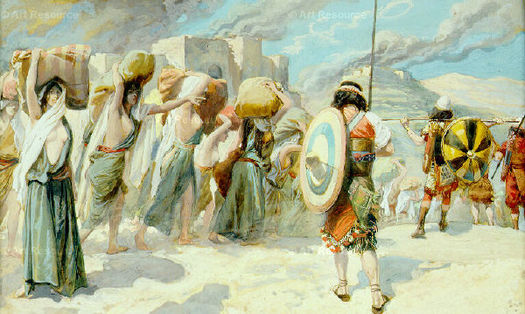
Moses sends an army of 12,000 Israelites to attack the local Midianites. The army kills all the Midianite men, burns their settlements, and brings back the women and children as captives, along with livestock and other booty. And Moses is furious.

Moses said to them: You let every nekeivah live! Hey, they were [why] the Children of Israel, through the word of Bilam, betrayed God in the matter of Pe-or, so that a plague was among the community of God! So now, kill every male among the small children. And every woman who has known a man by lying with a male, kill her! But all the small children among the women who have not known lying with a male, keep them alive for yourselves. (Numbers 31:15-18)

nekeivah (נְקֵבָה) = female (human or any other animal); hole.

Three things about this passage raise my hackles. One is how Moses and God shift the blame from the Israelites to the Midianites. The second is his use of the dehumanizing term nekeivah for the women, some of whom are surely innocent. The third is the command for genocide.

This year, thanks to a question from my friend Steve Ulrich, I can no longer distance myself from the genocide the way I did in my 2011 post, Matot: From Genocide to Gentleness.

Commentary from the Talmud through the nineteenth century justified Moses’ order to kill all the young boys by claiming that the Midianites living north of Moab would be unable to stop subverting Israel’s morals and religion. Even if all the adult Midianites were killed, their infant sons would still grow up dedicated to bringing down the Israelites. (There is some truth to this claim; if the boys knew that the Israelites had killed their fathers, they might well want revenge.)

Classic commentary strained to justify why Moses exempted the virgin girls among the Midianites from the death penalty. The Zohar (written in the 13th century) claimed that once a woman has lost her virginity to a man, she is under his influence. This assertion supposedly justifies both the killing of the Midianite men (who must have urged their wives to seduce Israelites), and Moses’ order to spare the virgin girls “for yourselves”.

Some twentieth-century commentary pointed out that genocide was common at the dawn of the Iron Age in the Middle East, along with taking girls captive to be personal slaves. The implication is that we cannot expect a higher standard in the Torah.

None of this commentary justifies Moses’ order of genocide as far as I am concerned. In my 2011 post, I tried a different approach to the genocide in this week’s Torah portion, and interpreted it symbolically. That was an interesting exercise for me, and it let me avoid dwelling on the atrocities the Israelite army committed at Moses’ command.

But this year I want to point out two assumptions underlying Moses’ orders:

1) Proselytizing for the “wrong” religion is a crime deserving death.

2) Every member of the same tribe or race or ethnic group as the criminal deserves the same punishment, because “they” are all alike.

This second assumption is Hitler’s way of thinking.

It is also an extreme example of a common human error. Many people who feel ashamed or at a disadvantage look for someone to blame. All too often, they generalize and blame their situation on all the members of a group—such as all Jews, all Muslims, all Democrats, all Republicans, all blacks, all whites, all unemployed single mothers, all CEO’s of corporations, all men, or all women.

Few Americans today progress from blaming all members of a group to trying to massacre them. We tend to stop at the level of hatred, bitterness, slander, and voting habits. But in other parts of the world, genocide still happens.

Apparently genocide was acceptable to whoever wrote down or redacted this part of the Torah portion Matot—as long as the victims were not Israelites. Then classic commentators had to find excuses for Moses, because they assumed a priori that the heroes in the Torah always have good reasons for doing apparently bad things.

But we are not bound by their assumption. We must do better, and denounce genocide even when the so-called good guys do it in the Torah.

And we must never stop noticing and pointing out when someone is blaming a whole group for the misdeeds of some of its members. Even if that blamer is yourself.

Haftarat Pinchas—1 Kings: The Sound of God

When people in the Hebrew Bible see a manifestation of God, they nearly always see either fire (from the flames in the burning bush to the sparks of fire in the pillar or cloud), or something human (from Abraham’s guest to the feet on the sapphire pavement).

When they hear a manifestation of God, they usually hear words. I have found only two exceptions in the Hebrew Bible. One is in the book of Exodus, when God descends upon Mount Sinai, and all the Israelites hear (and see, perhaps through synesthesia) thunder and the sound of a shofar (a loud wind instrument made from an animal’s horn). The cracks of thunder and the increasing volume of the shofar blasts would make the sound of God unbearably loud.

Ram's Horn Shofar
Ram’s Horn Shofar

The other exception is in this week’s haftarah, when the prophet Elijah hears God as what the King James translation calls “a still, small voice”.

A haftarah is the reading from the prophets that accompanies the week’s Torah portion. This week’s haftarah, from the first book of Kings, opens with the prophet Elijah running before the chariot of King Ahab.

In the scene just before, Elijah had staged a dramatic contest on Mount Carmel, where there were altars to both Baal and the God of Israel. King Ahab (who was away from his wife Jezebel at the time) summoned all the people to the mountaintop as witnesses. Elijah invited 450 prophets of Baal and 400 prophets of Asherah to call on their gods, while he alone would call on the God of Israel. (The prophets of Asherah did not show up, but the contest proceeded anyway.) A bull was killed and laid over wood at each altar, but nobody was allowed to bring fire to burn the offerings. Elijah said:

You will call your gods by name, and I, I will call God by name. And it will be the god that answers with fire, that one is the god.” And all the people answered, and they said: “It is good!” (1 Kings 18:14)

Elijah increased the drama by giving the prophets of Baal all day to work themselves into an ecstatic frenzy, and by pouring water all over the God of Israel’s altar. No fire ever appeared on Baal’s altar. In the evening, when water was dripping into the trench around God’s altar, Elijah called on God by name.

And the fire of God fell, and it consumed the rising-offering and the wood and the stones and the dirt, and it licked up the water that was in the trench. And all the people saw, and they fell on their faces, and they said: “That god is the god! That god is the god!” (1 Kings 18:38-39)

The Israelites helped Elijah kill all 450 prophets of Baal. A three-year drought ended. And Elijah ran as an honor guard before King Ahab’s chariot as they returned to the king’s nearest palace, in the fortress of Jezreel.

Haftarat Pinchas begins with this triumphal run. Then Ahab’s wife Jezebel, the real ruler of the kingdom, nixes the mass conversion and threatens to kill Elijah.

The prophet flees, lies down in the wilderness to die, then gets up again at the request of an angel and walks all the way to Mount Chorev (another name for Mount Sinai). There God speaks to him—first in words, as usual.

Then the word of God came to him, and it said to him: “Why are you here, Elijah?” And he said: “I was very zealous for God, the God of Armies, because the Children of Israel had abandoned your covenant, and pulled down your altars, and killed your prophets by the sword. And only I was left, and they tried to take my life.” (1 Kings 19:9-10)

Elijah is in despair because Queen Jezebel won. He forgets that the Israelites fell on their faces, shouted that the God of Israel is the only god, and killed Baal’s prophets. He either does not believe, or does not care, that the people’s feelings about God have changed. All that matters to him is that he lost the contest with Queen Jezebel for political power. Her gods, and the rest of her prophets, will remain in the kingdom of Israel whether the people support them or not.

God tells Elijah to stand up, and then gives him a wordless demonstration.

And hey! God was passing by, and a big and strong wind was tearing off mountains of rocks in front of God; but God was not in the wind. And after the wind, an earthquake; but God was not in the earthquake. And after the earthquake, fire; but God was not in the fire. And after the fire, kol demamah dakkah. And when Elijah heard, he wrapped his face with his robe, and he went out and stood at the entrance of the cave; and hey!—a  voice [came] to him, and it said: “Why are you here, Elijah?” (1 Kings 19:11-13)

kol (קוֹל) = voice; sound.

demamah (דְּמָמָה) = quiet (without much movement or sound); stillness; silence.

dakkah (דַקָּה) = very thin; finely ground, powdery.

kol demamah dakkah = “a still, small voice” (King James translation); “a soft murmuring sound” (Jewish Publication Society translation); a “sound of thin silence” (Avivah Gottlieb Zornberg translation); a faint sound of quietness (my translation).

Elijah hears the sound of quietness, steps out to the mouth of the cave, and covers his face. That means he knows God is in the quietness, since God told Moses no one may see God from the front.

Then God asks him the same question: Why are you here, Elijah? And Elijah gives the same reply, word for word—as if he had learned nothing. So God tells him he must anoint a young man named Elisha to be a prophet in his place.

I agree with the many commentators who concluded that Elijah is too impatient in his zeal; he wants the spectacle of fire (or, presumably, windstorm or earthquake) to turn Israel back to God all at once. He is not interested in a quiet, gradual approach. And that is why God decides to retire Elijah and try a new prophet.

But I also wonder about the three ways of hearing God: as ear-splitting blasts and booms, as spoken words, and as a faint sound of quietness.

We are only human. When we want to plan, or communicate, or understand something complicated, we turn to language. Even musicians and visual artists who are working alone must think in words when they address other aspects of their lives. Our brains automatically translate much of our experience into words and language.

Maybe one difference between a prophet and an ordinary person is that a prophet can easily translate experiences of God into words. So for them, God manifests as spoken words.

For the rest of us, our occasional numinous experiences are hard to understand, hard to put into words. A shaft of sunlight or a haunting bird call might trigger an awareness of something greater—but we struggle just to describe it. Our brains do not translate these evanescent and ineffable experiences into direct speech from God.

In the book of Exodus, God manifests to all the non-prophets at Mount Sinai as unbearably loud noise. The people are terrified, and beg for God to speak only to Moses; their prophet can then translate what God says into words spoken at a reasonable decibel level.

But in the book of Elijah, when the prophet hears God ask him a question in words—Why are you here, Elijah?—he answers defensively, stuck in a repetitive loop of his own words, his own story about himself. Any further insight from God cannot get through. So God resorts to non-verbal communication.

Elijah hears the windstorm, the earthquake, and the fire. Then he hears God in the “still, small voice,” the faint sound of quietness. But he does not understand.

Does God manifest to us, sometimes, as quietness?

Can we understand?