Ki Tavo & Ki Teitzei: You Are What You Wear, Part 2

A person’s inner state and outer garment should match, according to the Torah.

And God said to Moses: Go to the people and consecrate them, today and tomorrow, and they shall wash their semalot. Then they shall be ready for the third day, for on the third day God is coming down before the eyes of all the people on Mount Sinai. (Exodus/Shemot 19:10-11)

semalot (שְׂמָלוֹת) = plural of simlah (שִׂמְלַה) = a long, loose outer garment resembling a caftan or cloak. (A variant spelling is salmah (שַׂלְמָה), plural salmot (שַׂלְמֹת).)

If you are consecrated, made holy enough to behold God, then your simlah must also be purified. Although men remove their semalot to do physical labor, stripping down to a less bulky garment underneath, the Israelites in the Bible wear their semalot for public appearances, as well as for protection from wind, sun, and rain. At night one’s simlah serves as a blanket.

Three of the laws in last week’s Torah portion, Ki Teitzei, assume every individual has the right to a simlah. Even an impoverished debtor and a captive of war must be allowed to sleep in their semalot. Depriving someone of a simlah would not only expose them to the elements, but deprive them of human dignity. (See my post Ki Teitzei: You Are What You Wear, Part 1.)

Two other laws in the portion Ki Teitzei (4 and 5 below) show how a simlah can reveal something about the essential nature of the person who wears it. And this week’s Torah portion, Ki Tavo (“When you enter”), ends with miraculous semalot that reveal the nature of humankind.

  1. Abominable or godly?

One of the laws about the simlah in Ki Teitzei has become notorious:

The equipment of a man shall not be on a woman, and a man shall not put on the simlah of a woman, because anyone doing this is to-eivah to God, your God. (Deuteronomy/Devarim 22:5)

Head of a prince or princess from Ugarit, 13th century B.C.E.

to-eivah (תוֹעֲבַה) = abhorrent, abominable, anathema.

The first clause in this verse may be a reaction against a Canaanite myth (discovered in the ruins of Ugarit) about Paghat, a young woman who wears weapons under her female clothing and sets out to avenge her brother’s murder.1 The Bible frequently denounces Canaanite religions, and the Talmud (Nazir 59a) agrees that the “equipment of a man” consists of weapons of war.

The second clause in the verse may be a reaction against a Canaanite practice in which male temple functionaries cross-dressed and offered themselves as surrogates for gods in homosexual religious acts. According to the Bible, this happened even at the Temple in Jerusalem until King Josiah put an end to it.2

A man wearing a woman’s simlah may be to-eivah because the only men who appeared that way in public were those paid for sexual rituals from another religion—a practice God clearly abhors according to a later law in Ki Teitzei:

No daughter of Israel shall be a female religious prostitute, and no son of Israel shall be a male religious prostitute. You shall not bring into the house of God, your God, the fee of a harlot [female prostitute] or the price of a dog [male prostitute] for any vowed offering, because both of them are to-eivah to God, your God. (Deuteronomy 23:18-19)

Nevertheless, for more than two millennia people have used the law in Ki Teitzei about cross-dressing to promote the traditional gender roles in their own societies. (See my post Ki Teitzei: Crossing Gender Lines.)

Today many people reject the idea that every individual must squeeze into one of two gender roles defined by a particular society. Some individuals in the 21st century C.E. choose apparel that blurs gender lines in order to reveal their own nuanced identities.

In the 7th century B.C.E. kingdom of Judah, a man who wore the simlah of a woman also revealed an essential part of his identity: he was dedicated to gods other than the God of Israel, and he served these gods by providing ritual sex for worshipers.

  1. Fraud or honesty?

The remaining law in Ki Teitzei that mentions a simlah is about the virginity of a bride. It begins:

If a man takes a wife and he comes into her, and then he hates her, and he brings charges against her and gives her a bad name, and he says: “I took this woman, and I approached her, but I did not find evidence of virginity in her!”— (Deuteronomy 22:13-14)

Detail of “Hymen” by Marc Chagall

This was a serious charge in ancient Judah. A marriage was a contracted alliance between two households. The legal contract included the dowry paid to the groom’s household, and the bride-price paid to the bride’s household. When the bride and groom had intercourse, the marriage was completed. The bride (but not the groom) was expected to be a virgin (unless the contract stipulated otherwise).

So if a man claimed, after the wedding, that his bride was not a virgin, he was not only defaming her and her parents, but also suing her family for contract fraud. If the village elders ruled in his favor, he got a divorce, the bride (if she was permitted to live4) became unmarriageable, and the bride’s father had to return the bride-price to the groom. The grooms’ household, on the other hand, got to keep the dowry, the bride price, and the family’s good name.3

What if a groom tells a lie in order to get a divorce with a lucrative financial settlement? Then, according to Ki Teitzei, the bride’s parents should bring “evidence of the girl’s virginity” to the elders sitting as judges, and the bride’s father should say:

“But this is evidence of the virginity of my daughter!” And they shall spread the simlah before the elders of the town. (Deuteronomy 22:17)

The evidence is the simlah the bride wore on her wedding night. When the couple goes to bed, she lies on top of her own simlah—and leaves a bloodstain if her hymen breaks.

In much of the ancient Near East, a bride’s parents collected her wedding simlah the morning after—just in case they would need to display it.

The law in Ki Teitzei affirms that a bloodstained simlah is evidence of virginity, and punishes the lying husband. He is flogged; he pays 100 shekels of silver to the bride’s father (to compensate for impugning his honor); and he may never divorce the bride.

The good name of the bride’s family is restored. The bride herself at least has the consolation of a salvaged reputation and a guaranteed home (even if she might prefer to be the property of a different man).

Thus the condition of the bride’s simlah proves something about her character: she was honest when she affirmed she was a virgin.

  1. Natural or miraculous?

At the end of this week’s Torah portion, Ki Tavo, Moses quotes God:

“And I led you forty years through the wilderness. Your salmot did not wear out upon you, and your sandal did not wear out upon your foot. Bread you did not eat, and wine or alcohol you did not drink, so that you would know that I, God, am your God.” (Deuteronomy 29:4-5)

During their 40 years in the wilderness, the Israelites did not need to grow grain and grind it into flour; manna miraculously appeared every morning. They did not need to cultivate grapes and make wine; God provided fresh drinking water in the desert. They did not need to make leather for sandals, or weave cloth for semalot; God continuously renewed their clothing.5

Instead, the Israelite women wove cloth to make God’s sanctuary. All the weavers were generous volunteers.6  And God generously volunteered the small miracles that kept the people clothed and fed. All God wanted was acknowledgement “he” was their god.

The Israelites in the books of Exodus and Numbers did praise God for saving them at the Reed Sea and for giving them victories in battles. But in ordinary daily life, they complained about the food, were impatient when they ran out of water, and did not even notice the condition of their semalot.

Moses introduces God’s words at the end of Ki Tavo by saying:

But God did not give you a mind to know, or eyes to see, or ears to hear, until this day. (Deuteronomy 29:3)

Only at the end of 40 years in the wilderness to the people notice God’s daily generosity.

The portrayal of God’s character must be taken with a grain of salt. The Torah sometimes portrays God as a patient parent, sometimes as an angry mass murderer. This is the result of trying to explain everything in terms of an anthropomorphic god.

Yet the passage at the end of Ki Tavo does offer insight into the character of human beings. Human nature takes good situations for granted—until we are deprived of them, or until we grow wise enough to see how fragile our lives are. To find that wisdom—a mind to know, eyes to see, ears to hear—might take 40 years. And we cannot force ourselves to become wise.  It comes as a gift.

  1. She emerges, dons a youth’s raiment, puts a k[nife] in her sheath. A sword she puts in her scabbard, and over all dons woman’s garb. (“The Tale of Aqhat”, The Ancient Near East, Vol. 1, by James B. Pritchard, Princeton Univ. Press, 1958, p. 132)
  2. And he smashed the houses of the male religious prostitutes that were inside the house of God, where the women wove fabrics for Asherah. (2 Kings 23:7).  The book of Deuteronomy was probably written during the reign of King Josiah (640-609 B.C.E.), and encouraged his campaign to wipe out the practice of other religions in Judah.
  3. Victor H. Matthews & Don C. Benjamin, Social world of Ancient Israel 1250-587 BCE, Hendrickson Publishers, Peabody, Mass., 1993, p. 127-128.
  4. But if this charge is true, evidence of the girl’s virginity was not found, then they shall bring the girl out to the entrance of her father’s house, and the men of the town shall stone her with stones. And she will die because she did a serious offense in Israel, fornicating in the house of her father. (Deuteronomy 22:20-21)
  5. Deuteronomy 8:2-6 and Nehemiah 9:20-21 report similar miracles. (See my post Eikev: Not by Bread Alone.)
  6. Exodus 35:20-29.

Ki Teitzei: You Are What You Wear, Part 1

If he is a man overwhelmed by poverty, you must not lie down with his pledge. You must definitely return the pledge to him when the sun sets, and he shall lie down in his salmah, and he will bless you, and you will be righteous before God, your God. (Deuteronomy/Devarim 24:12-13)

Semites, tomb of Knumhotep II, painted circa 1900 BCE

simlah (שִׂמְלַה) or salmah (שַׂלְמָה) = a long, loose outer garment resembling a caftan or cloak (two variant spellings).

The Torah assumes everyone has at least one simlah or salmah. At night one sleeps in a simlah instead of a sheet or blanket. By day one might wear it over other clothes to provide protection from cold, sun, rain, or blowing sand—or to dress formally in public. But a man takes off his simlah to do physical labor.

What does a simlah look like? Around 1900 B.C.E. a simlah was a single rectangular cloth wrapped around the body, leaving one shoulder bare.

Three men from Israel wearing simlahs over tunics; Assyrian relief, 850 BCE

By 640-610 BCE, when most scholars believe the book of Deuteronomy was written, a man’s simlah was an ample cloak or caftan. One common pattern was to sew two long rectangles of cloth together up the back, but leave the front open, and belt the whole thing with a sash.

Assyrian woman, 700 BCE

All we know about a woman’s simlah is that it looked different from a man’s, and that she wore a tunic under it. So far, archaeologists have found neither art nor text describing the clothing of women in Judah. But clothing styles might have imitated those in Assyria, the empire to which Judah paid tribute.

The simlah or salmah appears in five of the laws given in this week’s Torah portion, Ki Teitzei (“If you go out”). In the three laws under discussion in Part 1, the difference between justice and injustice hinges on whether a person gets to be home with his or her personal simlah.

  1. Uncompromising or compassionate?

You must definitely return the pledge to him when the sun sets, and he shall lie down in his salmah(Deuteronomy 24:13)

salmah appears in this excerpt from the passage opening this post as a typical item used by an impoverished man as security for a loan.

The poor had to repay loans with labor. One repayment method was to give a wife or child to the creditor as a temporary slave. Then that family member also served as security for the loan. Another method was for a man to work as a day-laborer for the lender. In this case, he generally gave the lender his simlah as a pledge; he not have any other item of value.

But the lender is obliged to return the cloak every night, so the borrower has something to sleep in.1 He may be impoverished, but he is still a human being with a right to protection from the elements. A minimum level of compassion is a legal part of the justice system.

The verse immediately before the rule about returning a poor man’s salmah at night declares:

If you make a loan to a poor person who gives you something as security, do not enter his house to seize it. Stay outside and let the debtor bring the pledge to you. (Deuteronomy 24:11-12)

And later in the Torah portion, a creditor is forbidden to take any garment belonging to a widow as a pledge.2

Considered together, these laws about pledges for loans assume that all citizens (including temporary slaves) are entitled not only to food, clothing, and shelter, but also to human dignity.

  1. Loot or person?

The requirement for granting human dignity to an impoverished citizen also applies to a woman forcibly brought into the country as a potential wife. The Torah portion Ki Teitzei opens with the instruction:

Women of Midian Led Captive by the Hebrews, by James Tissot

If you go out to battle against your enemies, and God, your God, gives [them] into your hand … and you see among the captives a shapely woman, and you desire her and you would take her as a wife, then you shall bring her inside your house, and she shall shave her head and do her nails and remove the simlah of her captivity. And she shall stay in your house and cry for her father and mother for a month, and afterward you may justly come into her [have intercourse] and you may marry her as a wife. And if you do not like her, then you shall let her go free; you definitely may not sell her for silver, since you have violated her. (Deuteronomy/Devarim 21:10-14)

Female war captives are often raped, enslaved, and/or killed in the Torah. (For example, see my post Mattot: Killing the Innocent.) However, this week’s portion prescribes a more humane treatment. The soldier who wants a captive as his concubine must treat her as a mourner; after all, she has lost her parents (either when they were killed or when she was forced to move to another country). He must give her food and shelter in his house as she goes through the rituals of head-shaving, fingernail-trimming, and weeping for a full month. Moreover, he must replace her simlah of captivity.

We can only guess the meaning of “simlah of captivity”. Maybe it is a torn and bloodied garment, the simlah she was wearing when the Israelite soldiers captured her town and dragged off the women. Or maybe she was stripped of her own clothing and given a cheap cloth to wrap herself in.

Either way, the change of clothing is important because when someone wears a captive’s garment, she is seen as a captive, a foreign slave. If she wears other clothing, she can be seen as a person, an individual who will either become a full-fledged wife or be set free.

  1. Finder or keeper?

The Torah portion Ki Teitzei also mentions a simlah as a lost and found item.

You shall not watch an ox or a lamb belonging to your brother [fellow man] going astray, and hide yourself from it; you must definitely return it to your brother.  And if your brother is not in your vicinity, and you do not know him, then you shall hold it inside your house, and it shall be with you until your brother inquires about it. Then you shall return it to him.  And thus you shall do for his donkey, and thus you shall do for his simlah, and thus you shall do for any lost item of your brother’s that goes astray and that you find.  You shall not dare to hide yourself!  (Deuteronomy 22:1-3)

This law defends the right to personal property. If you find a stray farm animal or a simlah, you may neither keep it for yourself nor leave it abandoned. You must guard it until you can return it to the owner, even if you have to wait a long time.

Keeping a stray animal safe includes feeding it, though the Talmud notes that one can also use its labor until the owner shows up.3 I would argue that keeping a simlah safe includes not wearing it yourself. The practical reason would be to avoid tearing it or wearing it out. The psychological reason would be to avoid the appearance of theft or of impersonating the owner of the simlah. Garments are expensive in the Torah. Only kings and their chief advisors could afford large wardrobes. Anyone else might be recognized from a distance by their simlah. Just as you must respect the owner’s personal property, you must respect the owner’s identity and reputation.

These three examples of laws involving a simlah or salmah recognize the rights of people who are otherwise powerless: the impoverished, the war captive, the person who has lost something valuable. The other two examples in the portion Ki Teitzei, about cross-dressing and about a bride’s virginity, are more problematic. I will discuss them in next week’s post, along with the salmah in next week’s Torah portion, Ki Tavo.

Meanwhile, may we all be inspired to extend the ethical principle of these three laws in Deuteronomy, and grant every human being the right to respect and dignity, as well as health and safety. May we view all people as if they are wearing their own inviolable simlah.

  1. An earlier version of this law is given in Exodus 22:24-26.
  2. Deuteronomy 24:17. Perhaps it would shame a woman to be seen outside wearing only a tunic, without a simlah.
  3. Talmud Bavli, Bava Metzia 28b, which also says that the finder of an animal that does no productive work can be sold, and the money set aside to return to the owner whenever the owner is discovered.


Shoftim: No Goddesses Allowed

In beginning, elohim created the heavens and the earth. (Genesis/Bereishit 1:1)

elohim (אֱלֺהִים) = gods (plural); one of the names of the God of Israel. (Other common names include the tetragrammaton, El, El Elyon, and El Shaddai.)

How many gods does it take to create the universe? For most of ancient Canaan and Mesopotamia, in the beginning there were two: a father god and a mother goddess, who proceeded to beget additional gods. The universe was dualistic from the start.

But the book of Genesis clarifies that only one God created the universe, without any sexual partner.  God makes all the separations and distinctions, including gender, during the course of this creation. And unlike the gods of other peoples in the Ancient Near East, the God of the Torah demands exclusive loyalty. Anyone who worships God is forbidden to worship any additional gods or goddesses.

God first reveals this at Mount Sinai, with the commandment:

You shall not make for yourself an idol or any image of what is in the heavens above or what is in the earth below on what is in the water below the earth. You shall not bow down to them and you shall not serve them. Because I, God, your elohim, am a jealous eil. (Exodus/Shemot 20:4-5)

eil, El (אֵל) = a god; the father god of Canaanite religion; the God of Israel.

Matzeivah at Gezer

Worshiping an idol is equated in the Bible with worshiping the god that the idol represents. In this week’s Torah portion, Shoftim (“Judges”), Moses orders the Israelites:

You must not plant for yourself an asherah of any wood next to the altar of God, your elohim, that you shall make for yourself. And you must not erect for yourself a matzeivah which God, your elohim, hates. (Deuteronomy/Devarim 16:21-22)

asherah (אֲשֵׁרָה) = the mother goddess of Canaanite and Phoenician religions (called Ishtar in Akkadian and Inanna in Sumerian); a carved wooden post representing this goddess. (Plural: asherim, אֲשֵׁרִים.)

matzeivah (מַצֵבָה) = a standing stone used as a marker, or as an image representing a god. (Plural: matzeivot, מַצֵּבֺת.)

Clay figurines from Judah

Although very few wooden artifacts have survived the millennia in Israel, archaeologists have unearthed numerous small clay figurines in ancient Judah that may have been modeled after large wood asherim.1

All asherim are forbidden in the Bible, but not every matzeivah is. Standing stones that mark graves, boundaries, covenants, or great events are acceptable.2 So are the standing stones Jacob erects for God and anoints with oil.3 The matzeivot that God hates are the standing stones that people bowed to and anointed in order to worship a different god.

Asherim and matzeivot are mentioned together in eleven biblical passages.4 These wood and stone vertical idols were erected at the shrines of other gods—and even, at times, inside the temple of the God of Israel in Jerusalem.5 Thus when people came to a shrine or, during the reigns of more permissive kings, to a temple of God, they also acknowledged the divine power of the gods represented by the asherah and the matzeivah.

Who were the gods behind these two ubiquitous types of idols?

Asherah from Ugarit

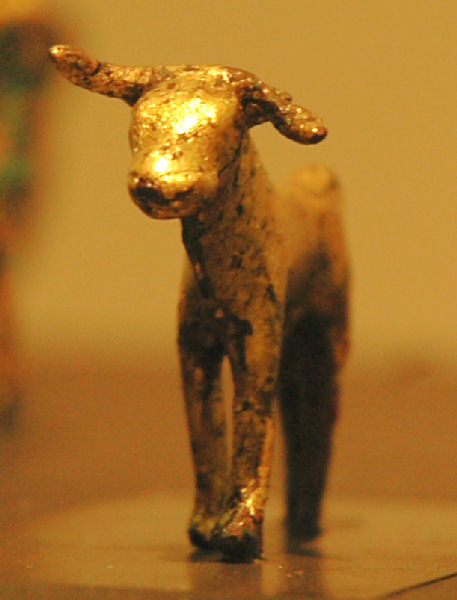
The religion of Canaan (later known as Phoenicia) had a founding pair of gods who mated and produced 70 more gods. The father god was named El. In a long poem from Ugarit in northern Canaan6, El is associated with the bull, and holds court in a field at the source of two rivers. The mother goddess was named Asherah or Atirat, and was associated with the seashore, stars, fertility, and trees.

El and Asherah’s most important son was Baal, the weather god. In the Ugaritic poem, Baal asks Asherah to ask El for permission to build a palace on Mount Tzafon and hold court there. Both parents give permission, thus making Baal the ruler over all his sibling gods and goddesses. In other Canaanite stories, Asherah and her son Baal are a sexual pair.

Baal from Ugarit

An asherah represented the mother goddess Asherah. A matzeivah probably represented her son and lover Baal, since Canaanite rituals focused on the pairing of Asherah and Baal, not Asherah and El.7 Most biblical references to matzeivot do not specify the god; the only exceptions are Jacob’s matzeivot for God in the book of Genesis, and two matzeivot of Baal in the second book of Kings.8

The first time the Israelites are told to destroy asherim and matzeivot is in the book of Exodus:

For their altars you shall tear down and their matzeivot you shall shatter and their asherim you shall cut down (34:13); because you must not bow down to another eil, because God is jealous of “his” name; a jealous eil is “he”. (Exodus 34:14)

The Torah consistently uses masculine pronouns and conjugations to refer to its asexual God. Hebrew is a gendered language, in which even inanimate objects and abstract concepts are assigned genders, so the masculine gender is often arbitrary. But it may not be so arbitrary in the case of God.

In the Torah the head of a household is a man, who is entitled to complete obedience from his wife and adult children as well as his slaves. God is often described in the first five books of the Bible as a demanding father, and in the books of the Prophets as the husband of the Israelites, who collectively take the role of God’s unfaithful wife.

Canaanite and Mesopotamian religions had both priestesses and priests; the Israelites had only priests. In other Canaanite and Mesopotamian cultures, women could also own land, make contracts, and initiate divorce. The Israelites reserved these privileges for men.

Is the biblical condemnation of goddesses, including both Asherah and the later goddess Ashtoret, “Queen of the Heavens”9, a result of this discrimination against women?

Or is it merely part of the condemnation of all gods other than the one God, a condemnation that includes the worship of matzeivot as well as asherim?

Complete dedication to a single god does have an advantage. If you begin with two gods, male and female, you can certainly understand our universe of separations and distinctions. But it might be hard to grasp that everything is part of a whole.  Beginning with a single god who creates all the separations and distinctions makes it easier to transcend dualism and get an inkling of the underlying unity of everything.

For me, as for many human beings, it is hard to keep remembering that we are interconnected parts of the whole, and that the whole means more than the sum of its parts.  It is hard to keep returning to any sort of God-consciousness.

So I agree with the Torah portion Shoftim that we should not plant any goddess-posts or god-stones. What we need is a new pronoun and some new metaphors for God.

  1. See Aaron Greener’s essay What Are Clay Female Figurines Doing in Judah during the Biblical Period?, published on thetorah.com.
  2. Jacob marks Rachel’s grave (Genesis 35:20) and his boundary pact with Lavan (Genesis 31:45-52) with matzeivot. Moses erects twelve matzeivot for the twelve tribes around an altar for a ceremonial covenant between the Israelites and God (Exodus 24:4). Joshua erects twelve standing stones in a circle at Gilgal to commemorate the crossing of the Jordan River (Joshua 4:1-9, 4:19-24).
  3. Genesis 8:18, 28:22, 31:13, and 35:14.
  4. Exodus 34:13; Deuteronomy 7:5, 12:13, and 16:21-22; 1 Kings 4:23; 2 Kings 17:10, 18:4, and 23:13-14; Micah 5:12; 2 Chronicles 14:2 and 31:1.
  5. King Hezekiah shatters matzeivot in the Jerusalem Temple in 2 Kings 18:4. King Menashe erects an asherah in the Temple in 2 Kings 21:7. King Josiah removes all the objects made for Asherah and Baal from the Temple and burns them in 2 Kings 23:4-6.
  6. Translated by H.L. Ginsberg in The Ancient Near East, Vol. 1, edited by James B. Pritchard, Princeton University Press, 1958.
  7. Similarly, in the annual fertility rituals of Mesopotamia to the east, a high priestess embodying Asherah (called Inana or Ishtar in that region) has sexual intercourse with the city’s king, who embodies Asherah’s son Baal (called Tammuz or Dumuzi there).
  8. 2 Kings 3:2 and 10:26-27.
  9. Ashtoret, originally one of the daughters of Asherah and El, replaced Asherah as the primary goddess in the region of Canaan during the 6th century B.C.E. The worship of Ashtoret is denounced in Judges 2:13 and 10:6, 1 Samuel 7:4 and 12:10, 1 Kings 11:5, and 2 Kings 23:13. Israelite women worship the “Queen of the Heavens”, one of the titles of Ashtoret, in Jeremiah 7:18 and 44:15-18.
  10. 1 Samuel 28:3-20.


Re-eih & Acharey Mot: The Soul in the Blood

Only the blood you must not eat! (Deuteronomy/Devarim 12:16)

Eight times the Torah commands people not to eat an animal’s blood: once in the book of Genesis/Bereishit when God tells Noah that humans may now eat meat; five times in Leviticus/Vayikra; and twice in Deuteronomy/Devarim.1

We learn in this week’s Torah portion, Re-eih (“See”), that the temptation to eat blood is hard for the Israelites to resist.

Only be strong, do not eat the blood! Because the blood is the nefesh, and you must not eat the nefesh with the basar. (Deuteronomy 12:23)

nefesh (נֶפֶשׁ) = animating soul, vital force; mood, appetite, desire; individual; throat. (This word applies to both humans and other animals.)2

basar (בָּשָׂר) = flesh, meat, soft tissue.  (This word, too, applies to both humans and other animals.)

Of course there is some blood in all soft tissue. Talmudic law on slaughtering explains that the forbidden blood is the arterial blood that spurts out when the animal is killed, because the animal dies when it loses this life-blood.3 In the Torah, eating an animal’s life-blood would mean eating its soul.

We can deduce that eating an animal’s soul be a powerful act of magic. One clue appears in the portion Acharey Mot in Leviticus, when God declares that the Israelites may no longer slaughter livestock in the open field, but must now do it on the altar at the entrance of the Tent of Meeting, God’s portable sanctuary.

And the priest shall sprinkle the blood on the altar of God at the entrance of the Tent of Meeting, and he shall make the fat go up in smoke as a soothing fragrance for God. And they must no longer slaughter their slaughter-offerings for the goat demons they go whoring after. (Leviticus/Vayikra 17:6-7)

There must have been a ritual in a Canaanite religion involving animal slaughter, blood, and goat-demons.4 Later in Leviticus, You must not eat over the blood (Leviticus 19:26) heads a list of Canaanite ritual practices to avoid. Maimonides explained that some people ate a meal sitting around a basin of blood, on the assumption that invisible spirits would join them to eat the blood.5 Summoning spirits is prohibited in the next item on the list: You must not do sorcery.

Permitted Uses of Animal Blood

Although eating blood and eating over an animal’s blood are both forbidden, animal blood is featured in two magical rituals in the Bible. In the book of Exodus/Shemot, Moses instructs the Israelites in Egypt to slaughter a lamb or kid on the evening of Passover, and splash some of the blood on their doorposts and lintels as a signal to God to skip over their houses during the plague of the death of the firstborn (Exodus 12:7 and 12:21-23).

In Leviticus, someone who recovers from the skin disease tzara-at cannot enter the precincts of the sanctuary until a priest has performed a ritual that includes dipping a live bird into the blood of a slaughtered bird (Leviticus 14:1-7).

Blood for God

The blood of an animal slaughtered as an offering to God is sacred in the Torah. New priests are ordained when this blood is daubed on their right ears, thumbs, and big toes and sprinkled on their vestments (Exodus 29:19-21). The Torah portion Acharey Mot decrees that once a year, on Yom Kippur, the high priest must enter the Holy of Holies and sprinkle the blood of a sacrificed bull and a goat on the ark itself in order to purge any spiritual impurity from human transgressions over the past year (Leviticus 16:11-15).

Every time an animal is slaughtered on the altar in front of the sanctuary, some of it must always be daubed on the horns of the altar and/or splashed on its sides. This sanctifies the blood, i.e. the nefesh, of the animal to God. But before the animal is slaughtered, the donor lays his hands on the animal’s head, symbolically transferring some of his identity to the animal. Thus when the priest splashes its blood on the altar, he is dedicating the donor’s own nefesh to God.

Because the nefesh of the basar is in the blood, and I myself give it to you on the altar to atone for your nefesh … (Leviticus 17:11)

The Torah portion Acharey Mot insists that every time people slaughter their livestock, they must bring the animals to the altar in front of the sanctuary, so the priests can dedicate each animal’s nefesh to God.

Anyone from the House of Israel who slaughters a bull or a sheep or a goat in the camp, or who slaughters it outside the camp, and does not bring it to the entrance of the Tent of Meeting to offer it as an offering to God in front of God’s resting-place, it will be considered blood that man has shed, and that man will be cut off from his people. (Leviticus 17:3-4)

In other words, failing to offer the animal at the altar is equated with manslaughter. After all, both a human and a sheep or cow have a nefesh.  The only difference in the Torah between humans and other red-blooded animals is the human mind. And an animal you have raised is identified with you, whether or not you lay your hands on it at the altar.

Blood to Cover Up

In Leviticus, the only animals one may slaughter without bringing them to the altar are kosher wild animals.

Anyone … who hunts a wild animal or a bird that will feed someone, he shall pour out its blood and cover it with dirt. Because the nefesh of all basar, its blood is its nefesh; and I say to the Children of Israel: The blood of all basar you must not eat … (Leviticus 17:13:14)

Although the animal’s blood cannot be dedicated to God, it must be covered—both to forestall any “eating over the blood”5 and to show respect for the animal’s nefesh.6

The Ark Enters the Land of Promise, Providence Lithograph Co., ca. 1907

The decree restricting livestock slaughtering to God’s altar is reasonable as long as all Israelites live near the sanctuary. This is no problem in the books of Leviticus and Numbers, in which everyone travels through the wilderness with the portable Tent of Meeting. But once the Israelites have spread out and settled around Canaan, there are only two ways they could meet the requirements in Leviticus:

* They could build multiple altars for God. Israelites in the books of Judges, first and second Samuel, and first and second Kings do, in fact, make animal offerings on makeshift altars in various locations, as well as at the temples at Dan and Samaria in the northern kingdom of Israel.

* Or they could kill and eat their livestock only on the three pilgrimage festivals, when everyone who is able travels to the central place of worship.7 The rest of the time they could only eat meat from kosher wild animals, which can be slaughtered anywhere.

This week’s Torah portion in Deuteronomy eliminates the option of multiple altars. The portion Re-eih insists that there must be only one holy place for God, and only one legitimate altar.

Re-eih also assumes that the Israelites are not psychologically able to restrict themselves to eating meat from cattle, sheep, or goats only three times a year. So having eliminated both ways to meet the requirements in Leviticus, the Torah portion decrees a new law:

Only wherever your nefesh is craving [meat], you shall slaughter and you shall eat basar according to the blessing that God, your God, gave to you, in all your gates; the ritually pure and the impure shall eat it the way [they eat] the gazelle and the deer. Only the blood you must not eat! On the ground you must pour it out like water. (Deuteronomy 12:15-16)

Pouring blood on the ground and covering it is more respectful that eating it, but it does not treat the animal’s nefesh as sacred the way an offering at the altar does. This is the price of the conviction in Re-eih that a) there must be only one altar for God, and b) people cannot resist eating meat.

Today the price is higher. Treating an animal’s life-blood as sacred would remind us that all life is sacred. But how many people today butcher animals following the rules of Jewish kashrut or Mulsim halal? It is hard to treat an animal’s life as sacred when you receive its meat already cut and wrapped in plastic, or already cooked on a plate.

How can we remember that every animal’s nefesh is as holy as our own?

  1. Genesis 9:4; Leviticus 3:17, 7:26, 17:12, 17:14, and 19:26; and Deuteronomy 12:16 and 12:23.
  2. For more on the concept of nefesh, see my posts
    1. Balak: Prophet and Donkey (The nefesh versus the mind)
    2. Korach: Buried Alive (The nefesh after death)
    3. Beha-alatokha & Beshallach: Stomach versus Soul (The nefesh as craving.)
    4. Toledot: To Bless Someone (The nefesh versus the conscious mind.)
    5. Bechukkotai: Sore Throat or Lively Soul (The nefesh as a throat metaphor.)
    6. Omer: Kabbalah of the Defective (The nefesh versus other kinds of souls in kabbalah)
  3. Babylonian Talmud, Pesachim 16b, 22b, and Keritot 22a.
  4. The word seirim (שְׂעִירִים) usually means “hairy goats”, but it can also mean “goat demons”. Many scholars have suggested that the Yom Kippur ritual in the same Torah portion, in which one goat is sacrificed to God and the second goat is sent off to Azazel, is a concession to the worship of a goat demon. The second book of Chronicles reports disapprovingly that when the northern kingdom of Israel seceded from Judah, their first king, Jereboam, appointed for himself priests for the high shrines and for the goat demons and for the calves that he had made. (2 Chronicles 11:15) Rambam (12th century Rabbi Moses ben Maimon or Maimonides) wrote that some sects of Sabeans worshiped demons who took the form of goats (Maimonides, The Guide for the Perplexed, 3:46).
  5. Maimonides, The Guide for the Perplexed, 3:46, covers both eating over the blood and covering the blood with dirt instead.
  6. “The blood of wild animals and fowl is to be covered with earth out of respect for the soul, just as we are commanded to bury a human corpse out of respect for the dead person.” (Rabbi Elie Munk, The Call of the Torah: Vayikra, translated by E.S. Mazer, Mesorah Publications, New York, 1992, p. 191.)
  7. During the centuries covered by the books of Joshua through 2 Samuel, the sanctuary containing the ark was set up in Gilgal, then in Shiloh, then in Beit-El, then back to Shiloh, and finally in Jerusalem, where it remained until the Babylonians destroyed the city in 587 B.C.E. The part of Deuteronomy including the Torah portion Re-eih was probably written in the 7th century B.C.E., when King Josiah was centralizing religious worship in Jerusalem.


Eikev: No Satisfaction

If you all really heed My commandments that I am commanding you all this day, to love God, your God, and to serve [God] with all your minds and with all your bodies, then I will grant rain … and you will gather in your grain and your grapes and your olive oil, and you will eat, vesavata.  (Deuteronomy/Devarim 11:13-15)

vesavata (וְשָׂבָעְתָּ) = and you will be satisfied.  (From the same root as saveia (שָׂבֵעַ) = satisfied, full, sated, surfeited.)

A literal reading of the conditional promise from this week’s Torah portion, Eikev (“On the heels of”) would be frightening.  The promise begins with “you” in the plural, implying that all the Israelites must thoroughly love and serve God, in both thought and action.   I can imagine a subsistence farmer wondering: What if I am not completely devoted to God all the time?  What if I am pious, but my neighbor is not?  Will God let us all starve in a drought?

The next verse lowers the bar somewhat by explaining that the important thing is to avoid devotion to other gods.

Guard yourselves, lest your mind deceive itself, and you turn away and you serve other gods and bow down to them. Then the anger of God will blaze against you, and [God] will shut up the heavens and it will never rain and the ground will not grant its produce, and you will quickly be lost from upon the good land that God is giving to you.  (Deuteronomy 11:16-17)

If we all serve our own God, it will rain and we will have plenty of food.  If we serve other gods, the rain will stop and we will starve.

The promise and threat from this week’s Torah portion is part of both morning and evening Jewish prayer services to this day.  (See my post Eikev: Reward and Punishment.)

The word vesavata appears two more times in this week’s Torah portion. Moses tells the Israelites that God is bringing them to a well-watered land full of wheat, barley, figs, pomegranates, olives, honey, iron, and copper—all the raw materials they could want.

And you will eat vesavata, and you shall bless God, your God, concerning the good land that [God] has given to you. (Deuteronomy 8:10)

The Talmud cites this verse as the foundation for the Jewish tradition of saying blessings both before and after meals.1  Our blessings express gratitude to God for blessing us with abundance.

But blessing God is only one requirement.  Earlier in the Torah portion Eikev Moses warns the Israelites that they must also observe all of God’s rules:

Watch out, lest you forget God, so that you do not observe [God’s] commandments and laws and decrees that I command you today; lest you eat vesavata, and you build good houses and you live in them, and your herds and your flocks increase, and your silver and gold increase, and everything you have increases—but your mind becomes haughty and you forget God, your God, who brought you out from the land of Egypt, from the house of slavery.  (Deuteronomy 8:11-14)

Here Moses warns the Israelites to remember that God is the source of their new wealth, and to respond with gratitude (blessing God) and service (following God’s rules).

*

The words vesavata and saveia in the Hebrew Bible usually refer to eating enough or too much.  But people can also be dissatisfied, satisfied, or surfeited with shame and honor,2 with bitterness and joy,3 with long life,4 and with wealth.5

All humans need enough to eat.  All humans enjoy the luxuries of wealth.  The “American dream”, like one of the dreams in ancient Israelite society, is to get richer and richer.  But the Bible points out that riches are not ultimately satisfying.

When Deuteronomy was written, perhaps around 2,650 years ago6, the Israelites were in danger of attributing their material blessings to Canaanite or Mesopotamian fertility gods.  Today, we might mistakenly attribute an abundance of food and other material goods to our technology, or to capitalism, or to some other recent human invention that we now treat as sacred.

While we serve these “gods” we may continue to eat, but we are no longer satisfied.  Our bodies become obese from a surfeit of calories, and our houses become full of luxuries, but our minds sense that something is missing.  Our souls are empty when we lack gratitude, love, and service to our own God—whether our idea of “God” means a harmonious way of life, a beauty and purpose in the universe, or the highest ethical ideal.

Have you fallen into worshiping the god of increasing wealth?  You can still save yourself.  Practice gratitude, and look for occasions to give thanks.  Instead of waiting for love to arise, act loving, and practice feeling love for those around you.  Remember to ask yourself throughout the day: Am I about to buy something I do not need?  To take advantage of someone lower in the pecking order?  Or to do something that helps people?

What kind of satisfaction do I want?

          Whoever is in awe of God has life;

          And he will stay savea;

          He will not be called up for misfortune. (Proverbs 19:23)

  1. Berachot 48b.
  2. e.g. Habakkuk 2:16.
  3. e.g. Lamentations 3:15, Psalm 16:11.
  4. e.g. Genesis 25:8.
  5. e.g. Ecclesiastes 5:9.
  6. One theory is that most of the book of Deuteronomy was written during the reign of King Josiah of Judah, 640-609 B.C.E.  One piece of evidence for this date is found in 2 Kings 22:3-13, when the high priest Chilkiyahu gives King Josiah (Yoshiyahu) a “book of law” he has “discovered” while renovating the temple in Jerusalem.  The language of Deuteronomy supports this theory.  (Two scholars who agree on the dating of Deuteronomy, though they disagree on the dating of other strands in the Torah, are Richard Elliott Friedman, The Bible with Sources Revealed, HarperCollins, San Francisco, 2003, p. 24-26; and Israel Knohl, The Divine Symphony, The Jewish Publication Society, Philadelphia, 2003, p. 155.)

1 Samuel: How to Stop a Plague, Part 4

One mageifah is upon all [of you]and your princes! (1 Samuel 6:4)

mageifah (מַגֵפָה) = plague, epidemic, pestilence. (Plural = mageifot.)

Angry gods cause epidemics. This was the obvious to writers in Egypt, Mesopotamia, and Canaan several thousand years ago, long before the germ theory of disease. The best way to stop a plague or epidemic was to determine which god was responsible, and then appease that god.

Pinchas Impales Zimri & Cozbi, by J.C. Weigel

My last three posts on “How to Stop a Plague”1 concern an epidemic caused by the jealous rage of the God of Israel when “His” people are unfaithful to “Him” and worship a god named Baal Peor. The plague kills 24,000 Israelites before Pinchas halts it with an act that shocks the God-character out of “His” uncontrolled anger.2 This plague begins in the Torah portion Balak, but the repercussions continue through this week’s portion, Va-etchannan.

The God-character also kills thousands of Israelites with plagues after they worship the Golden Calf3, after they complain about the food God provided4, after they complain that God killed the 250 rebels led by Korach5, and after God becomes angry with the Israelites for some unreported reason and tells King David to order a census.6  In all of these cases, the plague is a direct result of God’s rage.

However, when the God of Israel afflicts other peoples with epidemics, God is offended, but calm. The God-character uses plagues to make the foreigners acknowledge the superior power of God and do the Israelites a favor. Once those objectives have been met, God simply stops the plague.

Pharoah Merneptah

In the book of Exodus/Shemot, God creates ten miraculous disasters in Egypt, two of which are infectious plagues.7 Yet the Pharaoh keeps refusing to do what the God of Israel wants. After the second epidemic, God orders Moses to tell the Pharaoh:

…Thus says God, God of the Hebrews: Let My people go so they may serve Me. Because this time I am sending all My mageifot to you and to your courtiers and to your people, so that you shall know that there is none like Me in all the world. (Exodus/Shemot 9:13-14)

Only after the tenth miracle, the overnight death of the firstborn, does the Pharaoh admit God’s superior power and free the Israelite slaves.


The Philistines are more rational when the God of Israel afflicts them with a plague.

The problem begins when the Philistines take God’s most sacred object, the ark of the covenant. Israelite soldiers in the first book of Samuel unwisely bring the ark with them from the sanctuary at Shiloh onto the battleground at Even Ha-eizer, hoping that the magic of its presence will give them victory. It does not; God wants “His” ark in a sanctuary, not on a battlefield.

Dagon

And the Philistines took the ark of God, and they brought it from Even Ha-eizer to Ashdod. And the Philistines took the ark of God and they brought it into the House of Dagon, and they placed it beside Dagon. (1 Samuel 5:1-2)

The next morning, the priests of Ashdod discover that the statue of their own chief god, Dagon, has fallen face-down in front of the ark. The second morning, the statue of Dagon has fallen again, and its head and hands are cut off. Naturally, the shocked Philistines move the ark out of the sanctuary and into a field.

Then the hand of God was heavy on the Ashdodites, and He devastated them, and He struck down Ashdod and her territory with ofalim. (1 Samuel 5:6)

ofalim (עֳפָלִים) = probably buboes—lymph nodes swollen to the size of chicken eggs due to the bubonic plague—in the groin area. (According to the Masoretic text, when this chapter is read out loud, the word ofalim is replaced with techorim (טְחֺררִים) = hemorrhoids or anal abscesses. Techorim was considered a more polite word to say in public.)

The people of Ashdod send the ark off to another Philistine city, Geit.

The ark journeys from Shiloh to Beit Shemesh in six stages

…and the hand of God was on the city, a very great panic, and the people of the town from young to old had ofalim in their secret parts. So they sent the ark of God to Ekron… (1 Samuel 5:9-10)

The people of Ekron protest even before they start dying of the bubonic plague, and the princes of all five Philistine city-states meet there to decide what to do. Philistine priests and diviners urge them to send the ark back to Israelite territory, along with a guilt-offering, in the hope that then the God of Israel will stop the plague and heal the survivors.

And they [the princes and the Ekronites] said: “What is the guilt-offering that we should send back to Him?” And they [the priests] said: “The number of princes of Philistine is five. Five golden ofalim and five golden rats—for one mageifah is upon all [of you]and your princes! So you must make images of your ofalim and images of your rats that are destroying the land, and you must give honor to the God of Israel. Perhaps them He will lighten His hand from upon you and from upon your gods and from upon your land.” (1 Samuel 6:4-5.)

The Philistines probably noticed a plethora of dying rats in same areas where humans were afflicted. Today we know that bubonic plague is carried by fleas that bite both rats and humans.

Perhaps the Philistine rulers hesitated to send the golden ark and ten gold statuettes to their enemies the Israelites, because the Philistine priests add:

Why should you harden your heart as Egypt and Pharaoh hardened their heart? Did He not make a fool of them, so they let [the Israelites] go, and off they went? (1 Samuel 6:6)

The five Philistine princes, unlike the Pharaoh, are willing to do whatever will end the plague. Their priests then give instructions that will prove whether the God of Israel is responsible for it. The Philistines must load a cart with the ark and also a box containing the ten gold images. Then they must take two milk cows that have never pulled a plow and separate them from their nursing calves. They must shut up the calves inside, and harness the cows to the cart.

Then you will see: If it [the ark] goes up on the road to its own territory, toward Beit Shemesh, He made this great evil for us. But if not, then we will know that His hand has not touched us; by happenstance it happened to us. (1 Samuel 6:9)

Normally, the two cows would refuse to pull the cart, since they have never been harnessed before. Furthermore, they would try to get back to their calves as soon as their udders were full. Only a divine miracle would make the cows pull the cart to the nearest town in Israelite territory.

And the cows went straight on the road, on the road to Beit Shemesh. On a single highway they kept walking, lowing as they walked, and they veered neither right nor left. And the Philistine princes were walking behind them as far as the border of Beit Shemesh. (1 Samuel 6:12)

The action then switches to the arrival of the cart in Beit Shemesh, but we can assume that God responds by halting the bubonic plague in Philistine. The Bible does not mention it again.

*

Today the prompt administration of antibiotics can cure people of even the bubonic plague. But humans still experience a psychological kind of plague when panic spreads because our neighbors seem like enemies. In the United States today, people have become deeply divided by their anger and fear over the perceived political and moral differences between the left and the right. On each side, we are afraid that our own compatriots will force us to change our way of life, or even let us die.

And on each side, we want to take away things that are sacred to the other side. Unlike the Philistines appropriating the ark, we may not even realize what our “enemies” on the left or right consider sacred.

The people of Ekron get upset when the people of Geit send the ark to their city, yet they neither pick a fight nor pass the ark on to the next city. They call a meeting, get expert advice, and save all the surviving Philistine people by sending off the cart, even though it means giving up some wealth and honor. The five Philistine city-states not only cooperate with each other, but also honor the sacred object of the Israelites, and make a peace offering to the God of their enemies.

May we all become realistic and flexible like the Philistines, rather than hard-hearted like the Pharaoh. May we determine the causes of our own country’s plague, and may we all find the strength to do what we must in order to bring health and peace to all people.

__

1.  Balak & Pinchas: How to Stop a Plague, Part 1; Mattot, Judges, & Joshua: How to Stop a Plague, Part 2; and Mattot, Va-etchannan, & Isaiah: How to Stop a Plague, Part 3.

2.  Numbers 25:6-8.

3.  Exodus 32:35.

4.  Numbers 11:31-35.

5.  Numbers 17:6-15.

6.  This story is included in the second book of Samuel, although its language and themes do not fit the rest of the book. After King David has followed God’s instructions to order a census of all Israelite men of fighting age, God makes him choose one out of three punishments for doing so. David chooses the plague, which kills 70,000 Israelites before David stops it with an animal offering (2 Samuel chapter 24).

7.  Ten according to Exodus; see my post Va-eira & Bo; Psalm 78 & Psalm 105: Responding to Miracles. The two plagues are livestock pestilence (dever) and an inflammation with boils (shechin).

Matot, Va-etchannan, & Isaiah: How to Stop a Plague, Part 3

from Domenichino,
“The Rebuke of Adam and Eve”, 1626

“Don’t blame me!” We say that when we feel guilty.  Even the first human beings in the Bible blame someone else when they disobey God’s instruction not to eat from the Tree of Knowledge of Good and Bad. The male human blames the female, and the female blames the snake.1

In the Book of Numbers/Bemidbar, the Israelites flagrantly disobey the First Commandment, “You shall have no other gods before Me”, after accepting an invitation from the local women (first called Moabites, then Midianites) in the land the Israelites have conquered east of the Jordan River.

And they invited the people to the slaughter-sacrifices for their god.  And the people ate, and they bowed down to their god. (Numbers 25:2)

The story told in the Torah portion Balak gives no indication that the women deceive the Israelites, no hint of a lie or a trick. (See my post Balak: False Friends.) It is the Israelites who decide to worship that god, Baal Peor.

from Sacra Parallela,
Byzantine, 9th century

And the God of Israel, enraged at the Israelites’ apostasy, starts an epidemic among the Israelites, a divine plague that even the God-character cannot control. The plague stops only when Pinchas spears an Israelite man and a Midianite woman (who is probably a priestess of Baal Peor) in the act of doing something unholy. (See my post Balak & Pinchas: How to Stop a Plague, Part 1.)

The God-character rewards Pinchas for calming “His” rage in the next Torah portion, Pinchas. (See my post Mattot, Judges, & Joshua: How to Stop a Plague, Part 2.)

At least the God-character’s uncontrollable anger targets the Israelites, the people guilty of disobeying God’s commandment. Yet when the God-character has calmed down, “He” targets the Midianites, accusing them of actively tricking the Israelites.

Attack the Midianites and strike them down! –beecause they attacked you through nikheleyhem when niklu you over the matter of Peor … (Numbers 25:17-18)

nikheleyhem (נִכְלֵיהֶם) = their deceit, their trickery, their cunning.

niklu (נִכְּלוּ) =they deceived, they tricked.

But Moses turns his attention to other issues. So eventually, in the Torah portion Matot, God reminds Moses:

Nekom nikmah of the Israelites on the Midianites! Afterward you shall be gathered to your people. (Numbers 31:1)

nekom (נְקֺם) = Avenge! Take revenge! Get even!

nikmah (נִקְמַה) = [the] vengeance, revenge, payback.

And Moses finally assembles an army.

The God-character is calling for revenge, not for removing temptation. At most, the extermination of the local population prevents the Israelites from sliding back into worshiping Baal Peor. It does not stop them from straying after other Gods once they settle in Canaan.

Women of Midian Led Captive by the Hebrews,
by James Tissot, ca. 1900

The Israelite soldiers kill all the Midianite men and burn all their settlements. But instead of killing the Midianite women and children, the army returns with them as booty.

And Moses said to them: “You let every female live? Hey, they caused the Children of Israel, through the word of Bilam, to elevate themselves over God in the matter of Peor, so that the plague came to the community of God!” (Numbers 31:14-16)

Moses blames the Midianite women for seducing the Israelites into Baal-worship, instead of blaming the Israelites for their own actions. He also casts blame on Bilam, the prophet who uttered God’s blessings for the Israelites, then returned to his distant home on the Euphrates.2  Any foreigner is easier to blame than your own people.

Moses then orders his officers to kill all the Midianite women and the boys, exempting only the virgin girls from the genocide. (See my post Mattot: Killing the Innocent.) The Torah portion Mattot illustrates how guilt over your own behavior can lead to blaming others, and even destroying them.

Yet there are other ways humans can deal with guilt and shame. In next week’s Torah portion, Va-etchannan, Moses says:

Your eyes saw what God did about Baal Peor; for God, your God, exterminated from among you every man who went after Baal Peor. But you who cling to God, your God, are alive, all of you, today. (Deuteronomy 4:3-4)

Here Moses returns to the originally story, placing the blame on the Israelite men and declaring that God punished the guilty Israelites by killing them with the plague. Everyone who remained faithful to the God of Israel, he says, was not punished.

This is certainly more just than accusing the Midianites or Bilam for the deeds of the unfaithful Israelites. But two moral problems remain.

Genocide

The Israelites who followed the orders to massacre all the Midianites in the valley of Peor, even infants, are never considered guilty. Genocide is not a crime in the Torah. If the Israelite men felt uneasy about it, they probably excused themselves by thinking: “Don’t blame me; God made me to do it.”

Repentance

None of the Israelites who worship Baal Peor get a chance to admit their own guilt, repent, and reform. The God-character’s angry plague wipes them out without even a trial.

Judah sets a stellar example of repentance and reform in the book of Genesis/Bereishit.3 But God neither punishes nor rewards Judah directly, though God does provide a prophecy that Judah’s descendants will someday be the rulers of Israel.4

The book of Leviticus/Vayikra provides ritual animal-offerings for those who inadvertently disobey one of God’s rules,5 but the only atonement it offers for deliberate misdeeds is the high priest’s annual ritual on Yom Kippur, which purifies the entire people of Israel.6

The first time the Bible declares that guilty individuals can repent and receive forgiveness and a second chance from God is near the beginning of the book of Isaiah.

Wash yourselves clean;

            Remove evil from upon yourselves,

            From in front of My eyes.

And stop doing evil;

            Learn to do good.

            Seek justice. (Isaiah 1:16-17)

The first prophet Isaiah then tells the Israelites to “do good and listen”7 and to “turn around”, i.e. repent8.


I suspect the world today is teeming with people haunted by shame and guilt. What can we do about our recurrent memories of betraying ourselves, betraying our God, and doing the wrong thing?

I have led a relatively blameless life, yet shame has haunted me, too. It took me years to forgive myself for insulting my best friend in first grade. I did not repeat that particular shameful act, but I betrayed my own principles in other ways during the years when I clung to my first husband, accepting his abuse and ignoring my inner ethical voice. After I finally left him, it took many more years before I could trust myself again.

May all of us learn to accept responsibility for our own transgressions, instead of blaming others. When we are ashamed of our own behavior, may we admit it and strive to do the right thing next time. And may we stop and think when anyone tells us that God wants something we know in our hearts is wrong.

(A portion of this material is from Va-etchannan: Haunted by Shame”, an essay I published in August 2014.)


1  Genesis 3:12-13.

2  The king of Moab hires Bilam to curse the Israelites, but Bilam utters God’s blessings, and goes home without pay (Numbers 24:10-11, 24:25). The Torah gives no reason why Bilam would ever return to the land north of Moab. Yet the description of the Israelite war on Midian mentions that they kill the five kings of Midian—and Bilam (Numbers 31:8).

3 Judah is guilty of selling his brother Joseph as a slave (Genesis 37:26-28) and condemning his daughter-in-law Tamar to death (Genesis 38:24). He publicly admits his guilt about Tamar (Genesis 38:25-26) and rescues his brother Benjamin from slavery (Genesis 44:16-34).

4  Genesis 49:10.

5  Leviticus chapter 4.

6  Leviticus chapter 16.

7  Isaiah 1: 19

8  Isaiah 1:27.

Matot, Judges, & Joshua: How to Stop a Plague, Part 2

Pinchas first appears in the Torah grabbing a spear and skewering two worshipers of a local Midianite god, Baal Peor. God (that is, the God-character in the book of Numbers/Bemidbar) is relieved, because “He” could not stop “His” own anger at the apostasy and the resulting plague. (See my post Balak & Pinchas: How to Stop a Plague, Part 1.) Pinchas’s zealous impulse does the trick.

God tells Moses:

Therefore say: Here I am, giving to him My covenant of shalom. And it shall be for him, and for his descendants after him, a covenant of priesthood for all time, founded because he was zealous for his God, so he atoned for the children of Israel.” (Numbers 25:12-13)

shalom (שָׁלוֹם) = peace, wholeness, well-being.

The covenant of shalom makes Pinchas a priest, binding him to commit no further violence against humans (though like all priests, he must slaughter animal offerings at the altar).

However, there is no covenant of peace binding God. In this week’s Torah portion, Mattot (“Tribes”), God orders Moses:

Avenge the vengeance of the Israelites on the Midianites! Afterward you shall be gathered to your people. (Numbers 31:1)

After Moses dies, the rest of the Israelites live with the knowledge of both their unfaithfuless to God and their vengeance on the Midianites. Next week’s post, Mattot, Va-etchannan, & Isaiah: How to Stop a Plague, Part 3, will consider the lasting effects of the Baal Peor incident on the Israelites. This week’s post explores what happens to Pinchas after his well-timed murder.

Pinchas in Matot

Moses sent a thousand from each tribe for the army, and Pinchas, son of Elazar the Priest, for the army; and holy utensils and trumpets for blasting were in his hands. And they made war against Midian, as God had commanded Moses … (Numbers 31:6-7)

A priest accompanies an army in the Torah not to engage in battle, but to address the troops before battle1 and take charge of holy objects2. Sometimes a general consults a priest before battle, and the priest uses an oracular device to relay simple questions to God and report God’s brief replies.3

The Torah portion Matot does not identify the holy utensils Pinchas brought to the battle against the Midianites in the valley of Baal Peor. Trumpets were used to sound an alarm, to signal troops to advance, and to signal troops to retreat.4

Pinchas in the Book of Judges

Dead Concubine at Gibeah

Pinchas does use an oracular device to answer the questions of generals many years later, when he is the high priest of the Israelites. After the tribes have conquered and settled various parts of Canaan, some men in the territory of Benjamin rape and kill a Levite’s concubine. The Levite rallies all the other tribes to go to war against the Benjaminites.5

Pinchas stays in the town of Beit-El, where the ark is in residence, about 8 miles (13 km) north of Gibeah, the main town of Benjamin. Before each day of battle, men from the Israelite army go to Beit-El with a question for God.

First they ask which tribe should advance first against the Benjaminites, and God’s answer is “Judah”. The Israelites lose the battle. They return to Beit-El and ask if they should attack again, and God answers yes. But they lose the second battle as well.

Then they went up … and they came to Beit-El and they wept, and they sat there before God, and they fasted that day until the evening, and they sent up rising-offerings and shelamim before God. (Judges 20:26)

shelamim (שְׁלָמִים) = animal-offerings either to express gratitude to God for well-being, or to attempt a state of peace and unity with God. (From the same root as shalom.)

And the Israelites inquired of God—and the ark of the covenant of God was there in those days, and Pinchas son of Elazar son of Aaron was standing in attendance before [God] in those days—saying: “Should we gather again to go out to war with the Benjaminites, our brothers, or should we give up?” And God said: “Go up, because tomorrow I will give them into your hand.” (Judges 20:27-28)

The Israelites defeat the Benjaminites the next day, wiping out most of the men of that tribe and all of the women. But the only role Pinchas plays is to report God’s answers; he takes no action on his own.

Pinchas in the Book of Joshua

Pinchas takes a more active role in the book of Joshua when nine and a half tribes are considering making war on the other two and a half.

At the end of Matot, this week’s portion, the tribes of Reuben and Gad ask Moses for permission to settle east of the Jordan in Gilead and Bashan, the lands that the Israelites have already conquered. Moses grants them and the half-tribe of Menasheh these lands, but only after they have promised that their fighting men will cross the Jordan with the rest of the Israelites and help conquer Canaan.6

After the death of Moses, Joshua leads these men and all the other Israelites across the Jordan River. His army conquers a large part of Canaan, the men of Reuben, Gad, and Menasheh return to their new homes, and the land west of the Jordan is allotted among the other nine and a half tribes. Joshua erects the portable Tent of Meeting containing God’s ark at Gilgal first, then at Shiloh, both on the west side of the Jordan.

And the Israelites heard [a report] saying: Hey! The Reubenites and the Gadites and the half-tribe of Menasheh built an altar opposite the land of Canaan, in the district across from the Israelites. (Joshua 22:11)

This is the same region where the Israelites were camping when they joined the Midianites in their worship of Baal Peor.

And the Israelites heard, and they assembled, the whole community of the sons of Israel, at Shiloh to go up to make war upon them. And the Israelites sent Pinchas, son of Elazar the [high] priest … to the land of Gilead, along with ten chieftains … (Joshua 22:12-14)

If anything could trigger Pinchas’s jealousy and zealotry for the God of Israel again, it would be news that some Israelites had built an altar for a foreign god. When his delegation arrives, Pinchas protests:

Is it a small matter for us, the crime of Peor from which we have not purified ourselves to this day? It is a scourge in the community of God! And you, you would turn away from God? If you rebel today against God, tomorrow the whole community of Israel will become angry!” (Joshua 22:17-18)

The east-bank tribesmen quickly explain that they have no intention of worshiping another god. They claim they were afraid of being excluded from the community of the God of Israel, and they only built a symbolic replica of God’s altar in Shiloh.

because it is a witness between our eyes and your eyes. Far be it from us to rebel against God!” (Joshua 22:28-29)

And Pinchas the priest heard, and the chieftains of the community and the heads of the companies of Israel who were with him, the words that they spoke … and it was good in their eyes. (Joshua 22:30)

Pinchas and his delegation return to Shiloh with their new understanding, and war is averted. Pinchas has indeed become a man of shalom, of peace, wholeness, and well-being.

Did God’s covenant of shalom transform Pinchas because it gave him the responsibilities of a priest?7 Or did it transform him because God’s response shocked him into recognizing his own excessive zeal?

Imitating God’s forgiveness might be a fine strategy, but imitating the murderous zeal of the God-character in the Torah is bad for a human being. Naftali Tzvi Yehuda Berlin, the 19th-century author of Ha’amek Davar, wrote: “Since it was only natural that such a deed as Pinhas’ should leave in his heart an intense emotional unrest afterward, the Divine blessing was designed to cope with this situation and promised peace and tranquility of soul.”8

May all human beings who are overwhelmed by jealousy or anger be transformed like Pinchas —whether by a new responsibility, a new realization, or an inner blessing—into people of shalom.


1  See Deuteronomy 20:2.

2  See 1 Samuel 4:4-5.

3  This oracular device is called urim and/or tummim in Numbers 27:21, 1 Samuel 14:41, and 1 Samuel 28:6; and an eifod in 1 Samuel 23:9-12 and 1 Samuel 30:7-8.  An eifod in the Bible is usually a tabard worn by priests and other attendants on God’s sanctuary: a garment made of two rectangular panels of cloth fastened together at the shoulders and belted around the waist. Exodus 28:6-30 describes the elaborate eifod of the high priest and the choshen tied to its front panel. The choshen is a square pouch with twelve precious stones on the front side. Inside the pouch are the urim and tummim, items that scholars have not yet identified.

4  2 Samuel 17:6, 20:22; Jeremiah 4:19, 6:1, 51:27; Ezekiel 33:6; Amos 3:6.

5  Judges 20:1-48.

6  Numbers 32:1-33.

7  The priesthood was hereditary, so Pinchas, son of the high priest Elazar, son of the high priest Aaron, could expect to be consecrated as a priest eventually. But the Zohar notes that someone who has killed a person is normally disqualified from the priesthood. (Arthur Green in Sefat Emet, The Language of Truth, by Rabbi Yehudah Leib Alter of Ger, translation and commentary by Arthur Green, The Jewish Publication Society, Philadelphia, 1998, p. 264)

8  Translation from Ha’amek Davar in Nehama Leibowitz, Studies in Bamidbar (Numbers), translated from Hebrew by Aryeh Newman, The World Zionist Organization, Jerusalem, 1980.

Balak & Pinchas: How to Stop a Plague, Part 1

And Israel strayed at the acacias, and the people began to be unfaithful [to God] with the daughters of Moab. They invited the people to the sacrificial slaughters of their god, and the people ate and bowed down to their god. And Israel attached itself to Baal Peor, and God’s nose burned against Israel. (Numbers/Bemidbar 25:1-3)

The Israelites camp for a while under the shade of acacia trees on the east bluff of the Jordan River, with a view of their “promised land” of Canaan across the water. In last week’s Torah portion, Balak, some local women invite the Israelite people—men and women—to feasts in honor of their god, Baal Peor, and the Israelites accept. (See my post Balak: False Friends.) They bow down to Baal Peor along with their hostesses, perhaps at first out of politeness. But their prostrations become sincere; they end up worshiping Baal Peor. The God of Israel is enraged at their unfaithfulness; in the Biblical Hebrew idiom, God’s nose burns.

This is the second time a large number of Israelites flout one of the Ten Commandments. The first time, at Mount Sinai, they make and worship the golden calf (as an image of the God of Israel), violating the commandment against idols in Exodus/Shemot 20:4. Even after Moses has the Levites kill about 3,000 idol-worshipers, God sends a plague that kills more of them.

The Ten Commandments also include “You shall have no other gods before Me” (Exodus 20:3). Right after forbidding other gods and idols, God says:

You shall not bow down to them and you shall not serve them; because I, God, your god, am a kana god, taking retribution for the crimes of parents upon their children, upon the third and the fourth [generations] of those who hate Me. (Exodus 20:5)

kana (קַנָּא) = jealous, zealous.

In last week’s Torah portion, Balak, many Israelites flagrantly disobey God by worshiping Baal Peor. This time God’s plague kills 24,000 Israelites.

Everyone wants to stop the epidemic—even God. Apparently pestilence is a direct expression of God’s anger (along with the idiomatic burning nose), and God (as portrayed in the book of Numbers/Bemidbar) cannot simply switch off divine anger.

So what can stop the plague? God has the first idea, and tells Moses:

Take all the chiefs of the people and hang them for God in full sunlight. Then the heat of God’s nose will turn away from Israel. (Numbers 25:4)

But Moses, who prefers justice over mass extermination, does not follow God’s suggestion. He  orders a different action to stop God’s anger:

Moses said to the judges of Israel: Each man, execute his men who are attached to Baal Peor. (Numbers 25:5)

The Torah does not say whether Moses’ order is carried out. But in the next verse, a chief from the tribe of Shimon tries another idea for halting the plague.

from Sacra Parallela, Byzantine, 9th century

And hey! An Israelite man came and brought the Midianite close to his brothers, before the eyes of Moses and the eyes of the whole community of the Israelites who were weeping at the entrance of the Tent of Meeting. And Pinchas, son of Elazar son of Aaron the Priest, saw it, and he stood up in the midst of the community and he took a spear in his hand. And he entered the kubah after the man of Israel, and he pierced the two of them, the man of Israel and the woman, to kavatah. And the pestilence was held back from the Israelites. (Numbers 25:6-8)

kubah (קֻבָּה) = alcove, small tent. (This word may be related to the Akkadian kabu, a verb for calling upon a god, and/or the Arabic kubatu, a small tent-shrine.)

kavatah (קֳבָתָהּ) = her belly. (The word is probably used here as a pun on kubah.)

The word kubah is not used in any descriptions of the God of Israel’s Tent of Meeting; in fact, it appears only once in the Hebrew Bible. So why is there suddenly a kubah near the entrance of the Tent of Meeting?

The Israelite man, we learn in this week’s Torah portion, Pinchas, is Zimri son of Salu, a chief of the tribe of Shimon. The Midianite is Kozbi daughter of Tzur, a chief of a tribe of Midian. According to commentator Tikva Fryemer-Kensky, a high-ranking Midianite woman might well be a priestess who sets up her own kubah in the hope that she can stop the plague.1 The religious ritual she uses to invoke her god apparently includes sexual intercourse with Zimri, given the pun about her kubah. Thus Zimri and Kozbi are probably transgressing three of God’s rules at once: worshiping another god, letting a foreigner enter the holy courtyard around the Tent of Meeting, and having intercourse there.2

Although some commentary justifies Pinchas’s violent deed by pointing out that the first two of these rules carry a death penalty, there is no legal trial.3  Pinchas is not an executioner, but someone who murders in the grip of emotion—like God.

Is Pinchas’s action necessary? In other parts of the Torah, God kills individuals instantly when they flout one of God’s rules or decisions.4 But in the Torah portion Balak, God seems to be overpowered by rage, unable to either calm down or attend to anything else.

In the Torah portion Pinchas, God thanks Pinchas.

And God spoke to Moses, saying: “Pinchas, son of Elazar, son of Aaron the high priest, turned back my rage from the children of Israel through his kina, kina for me in their midst, so I did not finish off the children of Israel in my kina.  Therefore say: Here I am, giving him my covenant of peace.  And it shall be for him, and for his descendants after him, a covenant of priesthood for all time, founded because kinei for his God, so he atoned for the children of Israel.” (Numbers 25:10-13)

kina (קִנְאָ)=  zeal, jealousy, fervor, passion for a cause. (From the same root as kana above.)

kinei (קִנֵּא) = he was zealous, he was jealous.

God recognizes a kindred spirit. Both God and Pinchas act out of kina when someone is unfaithful to God.

Pinchas’s double murder for God’s sake does prevent the deaths of any more Israelites from God’s plague. And murder may be justified if it is the only way to prevent other people from being killed. Does God grant Pinchas a covenant of peace and priesthood as a reward for halting the plague that God is unable to halt?

Or does the covenant modify Pinchas’s kina, giving him an ability to make peace? (See next week’s post, Mattot, Judges, & Joshua: How to Stop a Plague, Part 2.)

It takes longer for the God character in the bible to master “His” own kina over how “He” is treated by the Israelites. For example, after the Israelites are settled in Canaan, God strikes 70 Israelite villagers dead when they look into the ark, even though they are rejoicing over its return to Israelite territory and worshiping God through animal offerings.5

Eventually God calms down somewhat. When God becomes angry with the Israelites of Judah for worshiping other gods at the temple in Jerusalem, He lets the Babylonian army do the killing. God merely informs the Israelites, through the prophets Jeremiah and Ezekiel, that they deserve it.

And in Second Isaiah God finally gives up His kina over the unfaithful Israelites. God promises to take them back with love and never lash out in anger again, despite their infidelity.6

In the western world today we understand jealousy as a natural human emotion, but we caution people not to act out of jealousy, since that often leads to unfortunate or immoral results. On the other hand, we still praise zeal, passionate attachment to a cause.

Yet over the centuries millions of people have been murdered, often in battle, because of zeal for a religion. I pray that more people will question their own beliefs, and stop confusing God with the God-character in the Bible, who kills thousands in uncontrollable fits of rage and kina.

And I pray that all people who are filled with passionate attachment to a cause, even a good cause, will pause and think before taking any action that might harm someone.

May we all become humans of peace.

1  Tikva Frymer-Kensky, Reading the Women of the Bible, Schocken Books, New York, 2002, pp. 220-222.

2  The Torah prescribes the death penalty for an Israelite sacrificing to any gods other than the God of Israel (Exodus 22: 19 combined with Leviticus 27:29), and for a foreigner approaching the Tent of Meeting (Numbers 3:10). The Israelite religion also forbids semen even in the courtyard around the Tent of Meeting; anyone who has sex must bathe and wait until evening before entering the area (Leviticus 15:16-18).

3  A legal punishment can only be carried out after a trial including the testimony of two witnesses (Deuteronomy 19:15). When Moses orders the judges to execute the men who are attached to Baal Peor (Numbers 25:5), he is in effect asking for such trials. Some commentators say Pinchas assumes responsibility for impaling Zimri because God’s plague is raging and the judges of Israel are too slow to act.

4  For example, God employs fire to kill Nadav and Avihu when they bring unauthorized incense into the Tent of Meeting (Leviticus 10:1-2). God makes the earth swallow up  Korach, Datan, and Aviram when they challenge the leadership of Moses and Aaron (Numbers 16:27-33—see my post Korach: Buried Alive). And God inflicts an invisible death (perhaps a stroke or heart attack) on Uzza with when he touches the ark to prevent it from tipping over (2 Samuel 6:6-7—see my post Haftarat Shemini—2 Samuel: A Dangerous Spirit) and on King Achazeyahu after he consults with a foreign god (2 Kings 1:16-17).

5  1 Samuel 6:15, 6:19.

6  Isaiah 54:7-10. See my post Haftarat Re-eih—Isaiah: Song of the Abuser.


Balak: Prophet and Donkey

Bilam appears to be a sorcerer who can bless and curse people, but he is actually a prophet who transmits God’s blessings and curses. Bilam’s donkey1 appears to be an ordinary domestic animal, but she actually knows more than Bilam.

At the beginning of this week’s Torah portion, Balak, King Balak of Moab is alarmed by the large Israelite camp on his border. He sends messengers to Bilam, whom he thinks is a professional sorcerer, with this request:

“Now come, please, curse for me this people, because they are too mighty for me. Then perhaps I will be able to strike them and drive them out from the land; for I know whoever you bless is blessed, and whoever you curse is cursed.” (Numbers/Bemidbar 22:6)

God has used Bilam as a prophet so often that Bilam believes he can count on God to speak to him during the night (presumably in a dream). So he tells Balak’s messengers:

“Remain here overnight, and I will bring back to you whatever God speaks to me.”  (Numbers 22:8)

That night, God tells Bilam:

“You shall not go with them.  You shall not curse the people, because it is blessed.” And Bilam got up in the morning and said to the officials of Balak: “Go back to your own country, because God refused to permit me to go with you.” (Numbers 22:12-13)

Bilam fails to mention that God has already blessed the Israelites. When the messengers report to their king, they fail to mention God at all; they simply say:

“Bilam refused to go with us.” (Numbers 22:14)

King Balak assumes Bilam refused only because he did not expect to get paid enough, so he sends a larger and higher-ranking group of officials. His second message promises Bilam:

I will honor you very impressively, and anything that you say to me I will do; just come, please, curse for me this people. (Numbers 22:17)

This time Bilam suggests the payment he would like: the king’s house full of silver and gold. In other words, he wants as much wealth and/or as much honor as a king. But he is at least honest enough to add that he cannot do anything that contradicts God’s command. Then he asks the messengers to stay overnight while he checks with God.

And God came to Bilam at night, and said to him: “If the men came to invite you, get up, go with them. But only the word that I speak to you, shall you do.” And Bilam got up in the morning and saddled his she-donkey and went with the officials of Moab. (Numbers 22:20-21)

Bilam’s silence in the morning is dishonest, since it gives Balak’s messengers the impression that the cursing will take place as requested.

And God vayichar af because he [Bilam] was going, and a messenger of God manifested itself on the road as an accuser for him. (Numbers 22:22)

vayichar (וַיִּחַר) = and he/it became glowing hot.

af (אַף) = nose, nostril.

vayichar af (וַיִּחַר אַף) = and his nose burned: an idiom meaning “and he became angry”.

God gives Bilam permission to go to Moab, but God is angry when he goes. Perhaps God disapproves of Bilam’s lying by omission, or of his greed for a payment he is unlikely to receive.2

Three times a messenger of God (i.e. an angel), manifests on the road to Moab. Who sees the divine apparition? Not Bilam, the prophet and would-be sorcerer; but his donkey. Bilam has only heard God’s voice at night, but his donkey sees God’s angel in broad daylight.

Each time Bilam’s donkey sees an angel with a drawn sword in the middle of the road, she refuses to go forward. The first time she runs off into a field, the second time the road lies between walls and she presses Bilam’s foot against the stones, and the third time the way is so narrow she lies down in the middle of the road. Each time Bilam beats his donkey, unable to see the reason for her behavior. The third time, the Torah describes the beating:

…and she lay down underneath Bilam, and Bilam vayichar af and he beat the she-donkey with the stick. (Numbers 22:27)

Then God opened the mouth of the she-donkey, and she said to Bilam: “What have I done to you that you beat me these three times?” And Bilam said to his she-donkey: “Because you made a fool of me!  If only there were a sword in my hand, I would kill you now!” (Numbers 20:28-29)

Bilam has been beating his donkey out of pride. With his servants and possibly King Balak’s officials watching him, he wants to look as if he is in control of his animal. In fact, his donkey is in control of where Bilam goes, and the donkey sees God’s messenger—with a sword in its hand, ready to kill Bilam!

by Rembrandt, 1626

And the she-donkey said to Bilam: “Am I not your she-donkey, upon whom you have ridden all your life until this day?  Have I really been in the habit of doing thus to you?” And he said: “No.” (Numbers 22:30)

The donkey says “all your life”, not “all my life”, even though the average life-span of a working donkey is 15 years in developing countries (a category that applies to all countries in biblical times). While Bilam’s age is not given in the story, he is a man who has developed a reputation, so he is too old to have been riding the same donkey his whole life.  The donkey’s words are a clue that the donkey is not just a talking animal; she also represents a part of Bilam.

Though he enjoys hearing God speak in the dark, Bilam is only a human being, and he cannot do anything without his animal: his body. Perhaps it is no coincidence that Bilam rides a she-donkey; in Biblical Hebrew, the word nefesh, which means both an individual body and the soul that animates the body, is feminine.

When Bilam answers his donkey with the word “No”, he both recognizes the truth and humbles himself before the animal he rides.

Then God uncovered the eyes of Bilam, and he saw the messenger of God standing in the road, and its drawn sword was in its hand.  Then he knelt down, and he bowed down le-apav.  (Numbers 22:31)

le-apav (לְאַפָּיו) = to his nostrils, to his nose. (A form of af.)

Bowing down to his nose is an idiom for making a full prostration, indicating his humility and submission before God’s messenger. But it also implies Bilam is surrendering his own “hot nose”, his own anger.

Then God speaks through the divine messenger and explains that the donkey saved Bilam’s life three times. If the donkey had not shied away from the angel, God would have killed Bilam—but spared the donkey.

After that humbling experience, Bilam becomes a better prophet. He is more direct and honest; as soon as he meets King Balak, he warns his employer that he can speak only the word God puts into his mouth. And now God speaks to Bilam in the daylight, and even gives him prophetic visions.

Of course all three times Bilam attempts to curse the Israelites, God makes praise and blessings come out of his mouth. And his employer, King Balak, is enraged.

Balak, vayichar af at Bilam …and Balak said to Bilam: “To curse my enemies I called you, and hey! You kept on blessing them, these three times!  So now run away to your own place! I said I would honor you impressively, but hey! God held you back from honor.”

King Balak dismisses Bilam rudely and without payment. But Bilam no longer seeks honor from other people. Now he knows that seeking wealth or fame blinds him to God’s message, and he is a prophet.  He responds to Balak only by pronouncing another prophecy—one that includes Israel defeating Moab. Then, unrewarded by either wealth or status,

Bilam got up and went and returned to his own place. (Numbers 24:25)


Personally, I resent being humbled by my donkey.  All too often I set off on what looks to me like a rewarding path, assuming I can do what I want—only to find that my body refuses to carry me. My chronic pain increases and my energy flags. If I try to whip my body into doing my will by drinking too much coffee, for example, my body starts lying down underneath me.

These days I find myself getting a “hot nose” less and less often, thank God. I am trying to pay attention to my own donkey. I am slowly giving up my desire for recognition and honor, knowing that I am still blessed with the ability to do my calling, as long as I listen to both my God and my donkey.

Who knows, if I learn enough humility, maybe someday my eyes will be uncovered and I’ll see a messenger of God in the road! But I’m not planning on it.  It’s enough to learn how to get along with this faithful donkey whom I’ve been riding all my life.


1  “Donkey” and “ass” are two words for the same species of equine animal. In Hebrew, a she-donkey, or jenny, is an aton (אָתוֹן).

2  According to Ramban (3th-century Rabbi Moses ben Nachman or Nachmanides), God was angry at Bilam for leaving without telling Balak’s messengers everything God had said, and for hoping that he might be able to curse Israel after all.

(An earlier version of this essay was published in June 2010.)