Mikeitz: An Unlikely Ascent

From prison to palace, from slave to ruler, in one day.

At Pharaoh’s command, Joseph leaves the dungeon and becomes the vice-regent of all Egypt in this week’s Torah portion, Mikeitz (Genesis 41:1-44:17). Joseph has intelligence and God’s favor; Pharaoh has power. Yet Joseph’s elevation would not have occurred without the honesty of Pharaoh’s chief butler, the Egyptian “magicians”, and Joseph himself.

Joseph Sold into Slavery, by Own Jones, 1865

Joseph is a Hebrew youth who grew up as the favorite son of a rich man, Jacob. His descent was precipitous in last week’s portion, Vayeishev. His older brothers stripped off his fancy clothing, told a caravan bound for Egypt that he was a slave, and sold him. The Egyptian who bought him recognized Joseph’s intelligence and ability, and made him the head slave of his household. But his Egyptian master’s wife falsely accused him of attempted rape, and Joseph was thrown into the dungeon.

Thanks to the dishonesty and cruelty of his own brothers and his master’s wife, Joseph became the lowest of the low. At least he is not sentenced to death. Joseph lives in the dungeon, and once again his attitude and abilities lead to a small increase in status: the chief jailer makes Joseph his assistant, and lets him run everything inside the dungeon. But he is not allowed to leave.

The chief butler forgets

The portion Vayeishev ends with Joseph interpreting the dreams of two of his fellow prisoners. Joseph predicts that the former chief baker will be executed, but the former chief butler will be pardoned and restored to his post.
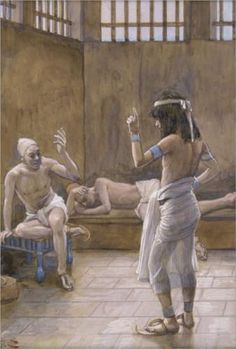
Joseph in Prison, by James Tissot, c. 1900

This man is the only person Joseph knows who will soon be in Pharaoh’s presence. He tells the chief butler he is innocent, and begs him to mention his case to Pharaoh.

The chief butler does not actually promise Joseph he will tell Pharaoh, but he does not demur. Yet the portion Vayeishev ends with the sentence:

But the chief butler did not zakhar Joseph, and he forgot him. (Genesis 40:23)

zakhar (זַכַר) = remember.

This week’s portion, Mikeitz, begins:

It was at the end of two years, and Pharaoh had a dream … (Genesis 41:1)

For two years nothing happened. The chief butler did not mention Joseph to Pharaoh. Joseph continued to live in the dungeon.

Why does the chief butler “forget” to bring up Joseph’s case?

An 18th-century commentary explained that the Torah says he “did not remember Joseph and he forgot him” to refer to two stages of forgetting:

“At the beginning he simply did not recall Joseph’s name, something that Joseph had asked him to remember. … This verse also informs us that the chief butler subsequently forgot Joseph completely, he erased the incident from his heart. … a deliberate act of forgetting.” (Or HaChayim)1

When I put myself in the chief butler’s place, I imagine that when he is first pardoned and restored to his position, he would want to keep his head down and not ask Pharaoh for any favors. I’ll bring it up later, he would think, after I’m sure Pharaoh trusts me again.

A few months later, when everything is going well, the man remembers Joseph. But now he does not want to remind Pharaoh about whatever he did that caused Pharoah to throw him into the dungeon in the first place. I imagine the chief butler rationalizing that he did not actually make a promise to Joseph. And it is not as if the young Hebrew man is under a death sentence. So gradually the butler forgets all about Joseph’s request—until Pharaoh asks for a dream interpretation.

A 12th-century commentator, Rashbam, wrote that God “performed a miracle for the sake of Joseph” by sending Pharoah two dreams that his own interpreters could not understand. That way, the chief butler “was forced to remember him.” 2

The chartumim do not cheat

Pharaoh has two dreams in a single night. In the first dream, seven healthy cows are eaten by seven gaunt cows. In the second, seven healthy ears of grain are swallowed up by seven thin, scorched ears.

Then it was morning, and his spirit was disturbed. And he sent out and summoned all the chartumim of Egypt, and all of its wise. But there was no dream-interpreter among them for Pharaoh. (Genesis 41:8)

Chartumim (חַרְטֻמִּים) = literate priests with occult knowledge. (Probably from the Hebrew word charut, חָרוּת = engraved, written. These high-level priests wrote down and read incantations out loud.)
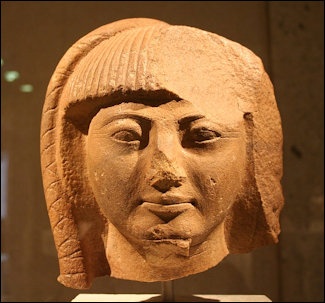
Khamwese, Egyptian Priest and Heka manipulator, 13th century BCE

The word chartumim is often translated in English as “magicians”. But they were not magicians in the modern sense: people who create illusions and trick their audience. The ancient Egyptians believed that the gods created and maintained the universe with “heka”, a cosmic power that some individuals could also tap into and use to manipulate reality. Priests who were chartumim accomplished this through incantations and ritual actions.3

The Torah assumes that are that significant dreams are predictions about the future. In last week’s portion, when seventeen-year-old Joseph related his two dreams, his brothers and his father assumed they were predictions that someday they would bow down to Joseph (although they did not want to believe it).4

The other assumption in the portion Mikeitz is that chartumim were usually able to interpret significant dreams. Perhaps they failed with Pharaoh’s two dreams because their occult knowledge was about Egyptian gods. This time, although Pharaoh does not know it, his dreams came from the God of Abraham, the God of Joseph. So the rituals of the chartumim do not yield any results.

And they are honest enough to say so.

Thechief butler remembers

Then the chief butler spoke to Pharaoh, saying: “My offenses I am mazkir today. Pharaoh became angry with his servant, and he placed me in custody of the house of the chief of the guards, me and the chief baker.” (Genesis 41:9-10)

mazkir (מַזְכִּיר) = mentioning, recounting. (A form of the verb zakhar = remember.)

When the chief butler mentions his “offenses”, he probably is not including his failure to mention Joseph to Pharaoh. His “offenses” are whatever he did two years ago that offended Pharaoh. He chooses not to remind Pharaoh of exactly what he had done, but he does take the risk of Pharaoh remembering it—in order to help his boss now, and perhaps even in order to help the young Hebrew in the dungeon.

The chief butler continues:

“And one night we [both] dreamed a dream, I and he, each dream according to its own meaning. And there was with us a young Hebrew man, a slave of the chief of the guards, and we told him, and he interpreted our dreams for us … And it happened as he had interpreted for us: I was restored to my position, and he was hanged.”
 (Genesis 41:11-13)

This true account is all it takes to move the story along; the chief butler does not even need to add Joseph’s claim that he is innocent. Pharaoh is so eager to have his two disturbing dreams interpreted that he sends for Joseph immediately.

Joseph does not take credit

Then Pharaoh sent and summoned Joseph, and he was rushed out of the dungeon, and he shaved and he changed his clothes and he came to Pharaoh. And Pharaoh said to Joseph: “A dream I dreamed, and there is no interpreter for it. But I have heard it said about you: you [need only] hear a dream to interpret it.” (Genesis 41:14-15)

Pharaoh’s chief butler did indeed describe Joseph interpreting his dream and the chief baker’s dream right after he heard them, without engaging in any of the occult rituals the chartumim would use.

Joseph knows his dream interpretations in the dungeon were inspired by God; he would never have made such accurate guesses on his own. He had even told the chief butler and chief baker:

“Isn’t interpretation of them for God?” (Genesis 40:8)

Now that he stands in front of Pharaoh, Joseph once more refuses to pretend he has magic power of his own.  

And Joseph answered Pharaoh, saying: “Not I! Elohim will answer for the welfare of Pharaoh.” (Genesis 41:16)

Elohim (אֱלֺהִים) = plural of eloha, אֱלוֹהַּ = god. Elohim  = gods, god, God.
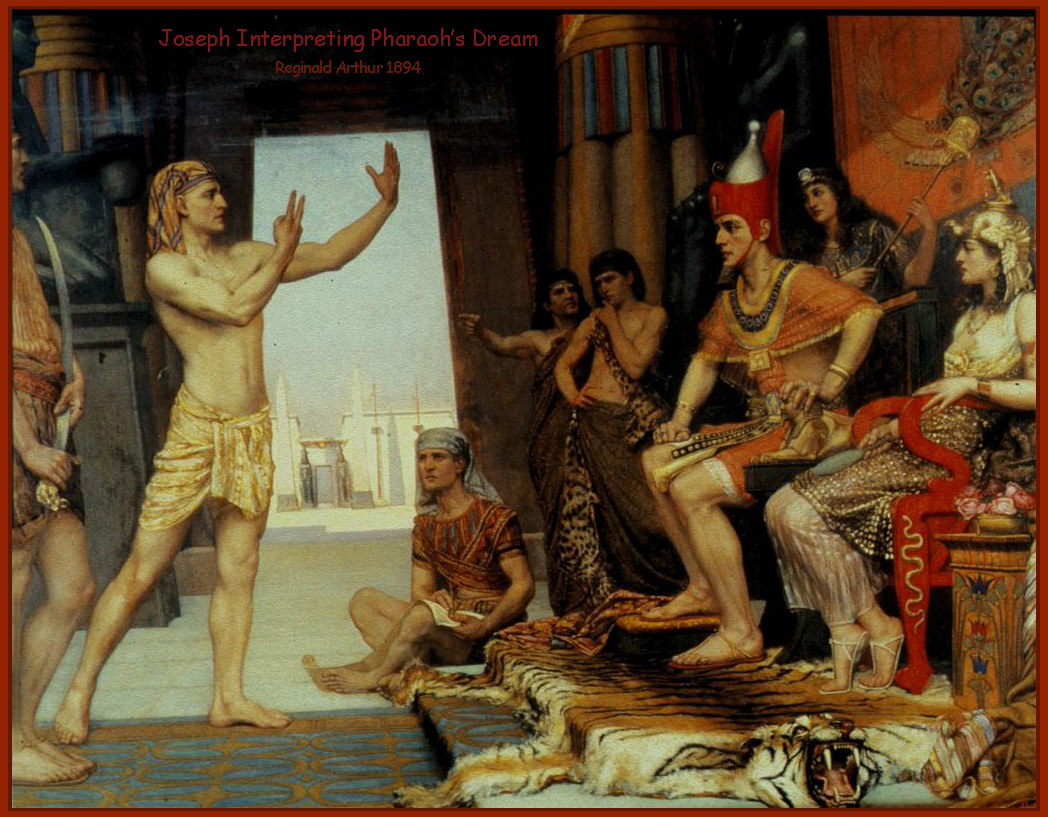
Joseph Interprets Pharaoh’s Dreams, by Reginal Arthur, 1894

Instead of using God’s personal name, Y-H-V-H, Joseph uses an ambiguous word that could as easily refer to the gods of Egypt as to Joseph’s God, the God of his great-grandfather Abraham. He is both honest about his own abilities, and intelligent about using a neutral word for God that will not trigger any negative reaction from Pharaoh.

With no further ado, Pharaoh tells Joseph his two dreams, concluding:

“And the scanty ears of grain swallowed up the seven good ears of grain. And I told the chartumim, but none [of them] was an explainer for me.” (Genesis 41:24)

Joseph might have decided to make the number seven mean seven years if he wanted to invent an explanation for the dreams of seven scrawny cows consuming seven fat cows and seven scanty ears of grain swallowing up seven good ears. But how could anyone invent explanations for the other elements in Pharaoh’s dreams that would turn out to be true predictions? There is too much at stake for anyone to prophesize without the help of a guidebook or a god.

The chartumim had no guidebook for the dreams sent by Joseph’s God. But Joseph has God, who instantly puts the meaning of the dreams into his mind. He explains the dreams to Pharaoh, ending with this summary:

“What the Elohim is doing, he made Pharaoh see. Behold, seven years of great plenty are coming throughout the land of Egypt. And seven years of famine will arise after them, and all the plenty in the land of Egypt will be forgotten, and the famine will completely use up the land. … And the dream came to Pharaoh two times because the matter was determined by the Elohim, and the Elohim is hastening to do it.” (Genesis 41:28-32)

Next Joseph gives Pharaoh some good advice. The text does not indicate whether God is transmitting these words to Joseph as well, or whether Joseph now had an idea of his own.

“And now, let Pharaoh select a man of discernment and wisdom, and set him over the land of Egypt. … And let them collect all the food of the seven good years … in cities under guard. And let the food be a reserve for the land for the seven years of the famine that will be in the land of Egypt. Then the land will not be cut down by the famine.” (Genesis 41:33-36)

And the thing was good in the eyes of Pharaoh and all his courtiers. And Pharaoh said to his courtiers: “Could we find another man like this, who has the spirit of Elohim in him?” (Genesis 41:37-38)

Pharaoh makes Joseph his viceroy on the spot—because the spirit of Elohim is in him.


Pharaoh needs a dream interpreter. He does not know that he also needs a viceroy in charge of agriculture and food rationing. Joseph wants to be released from both prison and slavery. He does not know what he wants to do once he is free.

Pharoah and Joseph need each other. But they would never meet, if it were not for the honesty of the Egyptian chartumim, and a belated good deed by Pharaoh’s chief butler. And their meeting would not have led to Joseph’s elevation if Joseph had not been honest about the true source of his dream interpretations. Pharaoh gives him the job title and the signet ring because he respects Elohim—whether that means Joseph’s God or many gods—and sees that Joseph has Elohim’s favor.

Does everything come together by chance? Are Joseph and Pharaoh just lucky?

Or does God arrange everything as part of a master plan? (Later in the Joseph story, Joseph tells the brothers who sold him into slavery “you did not send me here, but God!” and “you planned evil for me, but God planned it for good, in order to bring about this time of keeping many people alive.”)5

Or is it a combination of luck and the honest, ethical behavior of everyone involved at the time?

The same questions apply to our life stories today. When the right people do the right things and everything “clicks” for a good outcome, what do you attribute it to? Luck? A master plan of God’s? Or a combination of luck and a few individuals acting honestly for the good of everyone?


  1. Or HaChayim is a collection of 18th-century Moroccan Jewish commentary. Translation from www.sefaria.org.
  2. Rashbam is the acronym of 12th-century Rabbi Shmuel ben Meir. Translation from www.sefaria.org.
  3. Scott B. Noegel, “The Egyptian Magicians”, www.thetorah.com/article/the-egyptian-magicians; Flora Brooke Anthony, “Heka: Understanding Egyptian Magic on Its Own Terms”, https://www.thetorah.com/article/heka-understanding-egyptian-magic-on-its-own-terms.
  4. Genesis 37:5-11.
  5. Genesis 45:8 and 50:18-20. See my post: Vayigash & Vayechi: Forgiving?
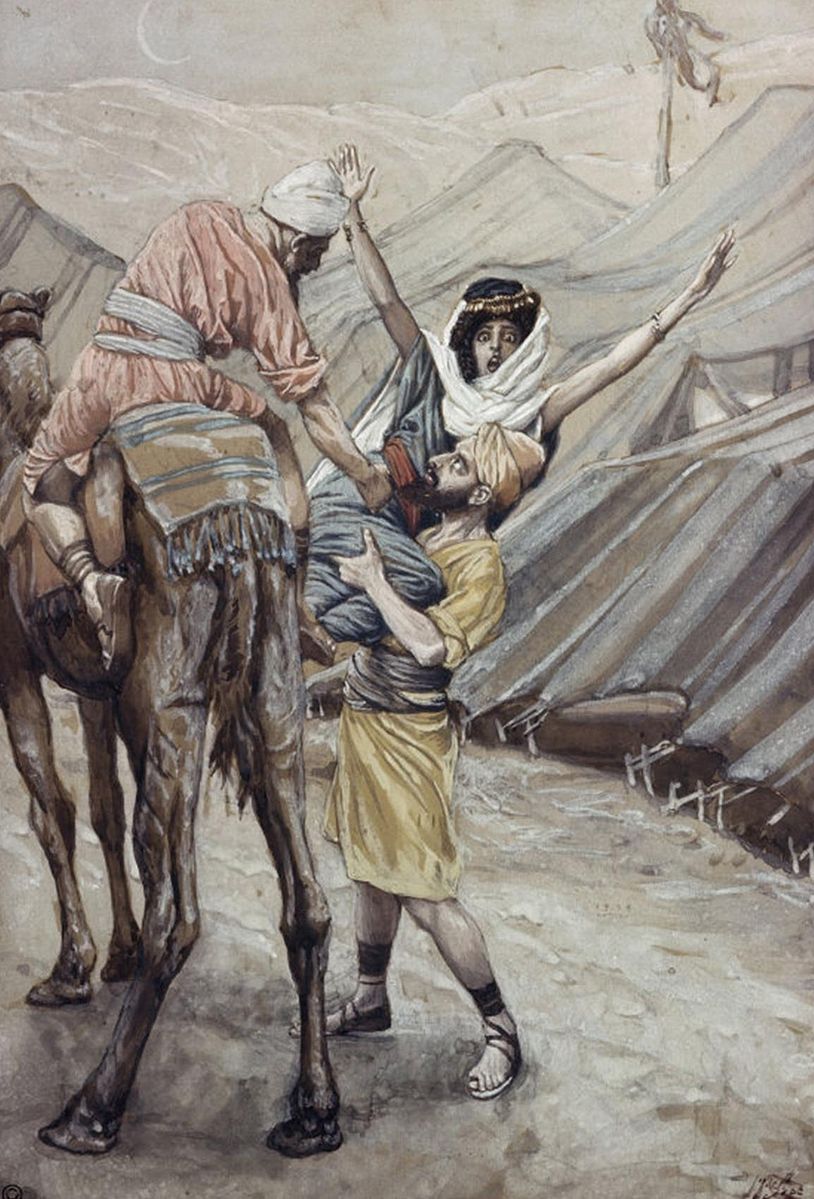
Vayeishev: Question at Shekhem

His brothers went to pasture their father’s flocks at Shekhem. And Israel said to Joseph: “Aren’t your brothers pasturing at Shekhem? Go, and I will send you to them.” And [Joseph] said to him: “Here I am.” And he said to him: “Go, please, see the welfare of your brothers and the welfare of the flock, and bring back word to me.” (Genesis 37:12-14)

This passage in the Torah portion Vayeishev (Genesis 37:1-40:23) sounds pleasant—as if there were nothing ominous about Shekhem, or dangerous about sending Joseph to report on his brothers. But someone who reads the book of Genesis up to this point knows that something dire is about to happen.

At Shekhem: Rape and murder

The Seduction of Dinah, by James Tissot, ca. 1900

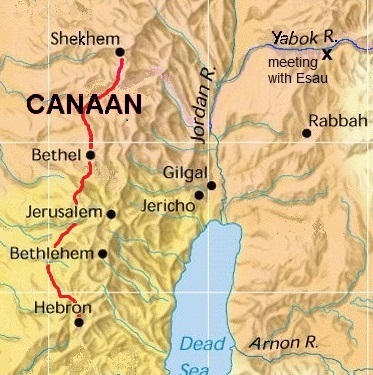
When Joseph and his half-sister Dinah were about twelve or thirteen years old, their father Jacob (a.k.a. Israel) brought his whole family to Shekhem1 and pitched camp next to the town. Jacob even purchased the land they were camping on, as if he intended to stay. Then one day Dinah walked into town alone “to see the daughters of the land”.2 Instead of making some female friends, she is abducted and raped by the son of the town’s ruler.

Jacob delayed taking action until his older sons came home from pasturing the flocks. By that time the ruler’s son, also named Shekhem, had fallen in love with Dinah and talked her into changing her mind about him.3 Shekhem and his father came to Jacob’s camp to arrange a marriage. The son offered to pay Jacob any bride-price he asked for. The father upped the ante, proposing that his people and Jacob’s people would intermarry and become one people.4

Jacob said nothing. His sons pretended to agree to intermarriage if all the men of the town  circumcised themselves first.  After the men of Shekhem had done so, and were disabled by pain, two of Jacob’s sons, Simon and Levi, came into town and killed every male. They took their sister and left.  Then “the sons of Jacob” (which sons are not specified) plundered the town, seizing its women and girls as slaves, and its goods and livestock as booty.5

Then Jacob said to Simon and Levi: “You have stirred up trouble, making me stink among the inhabitants of the land, among the Canaanites and Perizites! And I am few in number, and they will gather together against me, and they will strike me and I will be destroyed, I and my household!” (Genesis 34:30)

To escape vengeance from neighboring towns, Jacob makes his whole household pack up and move south to Hebron.

Joseph was probably too young to participate in the massacre or the looting of Shekhem. His mother, Rachel, was protective of her only son; and when Jacob introduced his family to Esau and his soldiers, he placed Rachel and Joseph in back, the safest position.6

But Joseph saw his half-brothers Simon and Levi arm themselves with swords, go into Shekhem, and return covered with other men’s blood. Later that day Joseph saw his older brothers herding their new female slaves. And when the whole household packed up and took down the tents, Joseph knew that they were moving again to escape a possible counter-attack.

Now, only four or five years later, Joseph’s ten older brothers have taken the family flocks to
Shekhem, of all places. And his father wants him to go there and check up on them.

At Hebron: Joseph’s negative reports

Joseph is seventeen when Jacob sends him from their home in Hebron back to Shekhem. By this time Joseph’s ten older brothers hate him—partly because their father demonstrated blatant favoritism by giving only Joseph a garment fit for royalty; partly because Joseph told them two of his dreams, in which his brothers were bowing down to him; and partly because he maligns them when he reports to their father.7

Joseph, at age seventeen, was tending the flock with his brothers, and he was an assistant to the sons of Bilhah and Zilpah, his father’s women.8 And Joseph brought bad slander about them to their father.9 (Genesis 37:2)

Jacob may believe everything his favorite son says, and trust him to bring an honest report back from Shekhem. He may also be concerned that his ten older sons decided to take the flocks to Shekhem. (I assume that Jacob’s older sons are still making independent decisions without consulting their father, as they did several years before at Shekhem.)  What if someone from a neighboring town recognized them from the time before the massacre?

On the other hand, what if someone in the vicinity of Shekhem recognizes Joseph? This possibility does not seem to occur to Jacob.

Perhaps he does not think logically where his favorite son is concerned, especially now that Joseph’s mother, Rachel, has died. It also does not occur to Jacob that his older sons might hate Joseph so much that they are a greater danger to him than any neighbors of the former Shekhemites.

At Shekhem: The question

Joseph answers his father, “Here I am!” With the blitheness of a spoiled adolescent, he heads off alone for Shekhem.

And [Jacob] sent [Joseph] away from the valley of Hebron. And he came to Shekhem.  And a man found him, and hey! He was wandering in the fields. And the man asked him: “What tevakeish?” (Genesis 37:14-15)

tevakeish (תְּבַקֵּשׁ) = do you seek, will you seek, are you looking for. (A conjugation of the piel verb bikeish, בִּקֵּשׁ  = seek, look for, try to get.)

Joseph probably wandered off the road and through the fields looking for his brothers and the flocks. The Torah never identifies the “man” who questions Joseph. It might be an ordinary man, or it might be a “man” like the “man” who wrestled with Jacob in Genesis 32:25 and turned out to be a divine being. Most classic commentators said it was an angel, i.e. a divine messenger who looked like a man,10 though Ibn Ezra wrote that the man was simply someone passing by.11 

At Shekhem: Joseph’s answer

And he said: “My brothers I am mevakeish.  Tell me, please, where they are pasturing.” (Genesis 37:16)

mevakeish (מְבַקֵּשׁ) = seeking. (Another piel form of bikeish.)

Why does Joseph assume that a man who happens to be crossing a field near the former town of Shekhem would know who his brothers are, or where they went?

Perhaps Joseph’s polite request implies “if you happen to know”.12 Perhaps Joseph intuitively senses that the “man” is actually a divine messenger from God.13 Or perhaps he simply figures he might as well ask, just in case the man has seen them.

Growing up with his family’s religion and stories, Joseph would know that God’s divine messengers sometimes look like men—until they disappear. So the question “What do you seek?” might be an inquiry from God.  In that case, Joseph could take the opportunity to give a different answer, and receive a different response.

1) He could say: “I am seeking to find out what my brothers are doing wrong this time, so I can report back our father.”

He knows his father loves him more than any of his brothers, but he is old enough to wonder if it will last. Perhaps Joseph thinks that slandering his brothers helps to keep him in first place.

2) He could say: “I am seeking to find out what really happened when my family lived here in Shekhem.”

If Joseph had asked his mother and other adults in the household about Shekhem, their reactions combined with his own vivid but incomplete memories would give him a morbid fascination with the subject.

3) He could say: “I am seeking an interpretation of those two dreams I had in which my brothers were bowing down to me.”

His father and his brothers thought that Joseph was fantasizing that he would become a king and rule over them all.14 But what if the dreams were true prophecies from God? Was there something else he should know?

4) But he would not say: “I am seeking to know why my father sent me all the way to an abandoned city to check up on my brothers who hate me enough to kill me.”

If he had been more aware of his family’s psychology, Joseph would have been afraid of finding his brothers. Readers today might suspect Jacob of the psychological blindness of narcissism. (See my post: Mikeitz: Forgetting a Father.) We might also wonder about the Joseph’s older brothers, who were brought up in a family where two of their mothers were openly jealous of one another,15 where their father and grandfather were cheating one another,16 and where they literally got away with murder at Shekhem. Would these young men feel any ethical qualms about harming the little brother they hated?

Joseph has an excuse for giving up and going home, since he could not find his brothers near Shekhem. But he is determined to complete the mission his father sent him on. So instead of giving a more response, he merely tells the stranger that he is looking for his brothers.

Does Joseph feel some inner calling in the presence of God’s angel? Or does he simply believe, with the naivety of a spoiled seventeen-year-old, that he will return safely to his father in Hebron?

And the man said: “They pulled out from here, for I heard them saying: Let’s go to Dotan.”  So Joseph went after his brothers and he found them at Dotan.  (Genesis 37:17)

When the brothers at Dotan see Joseph approaching, some of them want to kill him right away and throw him into a nearby dry cistern. Reuben, the oldest, says they should throw him into the pit alive. So the brothers seize Joseph, strip off his royal clothing, and throw him in. Then a caravan headed for Egypt passes by, and the brothers sell him to the traders as a slave.17

They think they will never see him again. But the rest of the book of Genesis is a story about the complicated reconciliation between Joseph and his brothers, and how all the children of Israel ended up living in Egypt.


History haunts the story of Joseph and his brothers. They leave Shekhem with their father to make a fresh start; but then they return, and Shekhem becomes the place where Joseph makes the fateful decision to follow his brothers instead of going home. Jacob gives Joseph a royal tunic and Joseph blabs about his dreams and his brothers’ faults; and these relatively small errors in judgment lead to attempted murder, slavery, redemption, and four hundred years of exile in Egypt.

Everything is connected in the Joseph story. Everything he does matters.

I suspect this is true in our own lives as well. Before we act, before we speak, we might ask ourselves: What are we looking for?


  1. Shekhem was about 30 miles (50 km) north of Jerusalem, between two round hills, Mt. Gezerim and Mt. Eyval. (The common noun shekhem, שְׁכֶם, means “shoulders”.) The site is now part of the city of Nablus.
  2. Genesis 34:1.
  3. Genesis 34:2-4. See my post Vayishlach: Change of Heart, Part 1.
  4. Genesis 34:4-12
  5. Genesis 34:13-29.
  6. Genesis 33:1-2.
  7. Genesis 37:3-4. See my post Vayeishev: Favoritism.
  8. Jacob’s two wives, Rachel and Leah, gave him their slaves Bilhah and Zilpah as concubines in Genesis 30:3-9.
  9. The Hebrew word is dibatam (דִּבָּתָם), which could mean slander or negative gossip about them, reports of their own slander, or their bad reputation. See my post Vayeishev: What Drove Them Crazy.
  10. C.f. Aggadat Bereshit 73:3, Bereshit Rabbah 84:14, Midrash Tanchuma Buber, Rashi, Kli Yakar, Siftei Chakhamim.
  11. 12th-century rabbi Abraham Ibn Ezra.
  12. C.f. Ibn Ezra, Radak.
  13. C.f. Haamek Davar by 19th-century Naftali Zvi Yehuda Berlin.
  14. Genesis 37:5-11.
  15. Leah and Rachel in Genesis 29:31-30:24. Leah’s son Reuben, at least, knows about their competition for Jacob’s love when he gives his mother mandrake roots in Genesis 30:14.
  16. Lavan cheats his son-in-law Jacob in Genesis 29:18-27. Lavan and Jacob both try to cheat one another regarding Jacob’s wages in Genesis 30:31-30:2.
  17. Genesis 37:18-28.

Vayeitzei: Awe versus Terror

Jacob introduces a new name for God in this week’s Torah portion, Vayeitzei (Genesis 28:10-32:3):

“If it were not that the elohim of my father—the Elohim of Abraham and the Pachad of Isaac—is with me, you would have sent me off empty-handed!” (Genesis 31:42)

elohim (אֱלֹהִים) = gods, god, God.

pachad (פַּחַד) = trembling; terror, dread. (From the verb pachad, פָּחַד = tremble uncontrollably, shudder, be terrified; dread.)

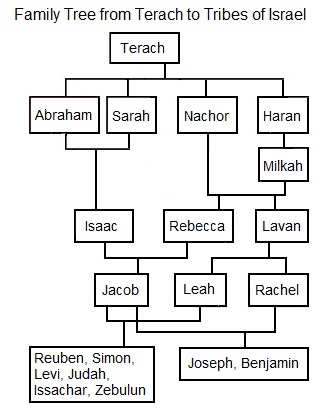
Everyone in the book of Genesis uses the common noun elohim to refer to gods in general. Descendants of Terach, both Abraham’s line in Canaan and Nachor’s line in Aram, also use the proper name Y-H-V-H for the god who becomes known later as the God of Israel.1 Y-H-V-H has other names and titles, but only Jacob calls God the Pachad of his father.

Jacob’s awe

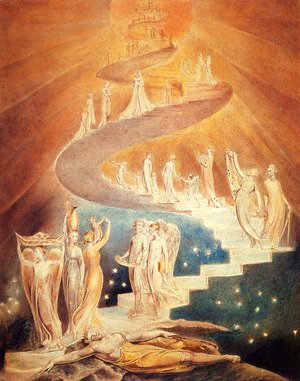
Jacob’s Dream, by William Blake, 1800

In last week’s Torah portion, Toledot, Jacob cheats his older brother Esau twice, and Esau vows to kill him. He flees to his uncle Lavan’s house in Aram, a northern Mesopotamian territory far from Canaan. On the way, Jacob has his first direct experience of God: a dream featuring a stairway between the earth and the heavens, and God standing over him.

Then Jacob woke up from his sleep, and he said: “Surely there is Y-H-V-H in this place, and I, I did not know!” Vayiyra, and he said: “How awesome is this place!” (Genesis 28:16)

vayiyra (וַיִּירָא) = and he was afraid, and he was awed. (A form of the verb yarei, יָרֵא = fear, be afraid, be awed, revere.

Jacob feels awed and frightened by his numinous experience. Maybe he has goosebumps. But he is not overcome by the uncontrollable trembling associated with pachad, terror. When he gets up, he erects a stone, pours oil on it, and vows that if God protects him until he returns to his father’s house, he will worship God and give God a tenth of his possessions.

Isaac’s terror

Jacob’s practical bargaining is a far cry from his father Isaac’s relationship to God. As a young adult, Isaac voluntarily let his father tie him up on an altar as a burnt offering to God. Abraham almost cut his throat before God intervened.2 According to some classic Jewish commentators, Isaac experienced pachad then, and carried the trauma for the rest of his life.3 When Isaac is old and blind, Jacob impersonates his brother Esau in order to steal Isaac’s blessing in the name of God. When Esau arrives and confirms what Jacob did, Isaac is seized by another kind of fearful trembling, charad.4

Perhaps Jacob thinks of Isaac’s overwhelming relationship to God in terms of trembling.

Jacob’s wages

Jacob arrives safely at his uncle’s house in this week’s Torah portion, and promptly falls in love with Lavan’s younger daughter, Rachel. Having arrived without any gifts to use as a bride-price,5 Jacob works as a shepherd for Lavan for seven years. But on the wedding day, Lavan substitutes his older daughter, Leah. Jacob still wants Rachel, and Lavan tells Jacob he has to work another seven years for her.6

After Jacob completes fourteen years of service for his two wives, he continues to work for his uncle and father-in-law, this time in exchange for the black sheep and the spotted and brindled goats in Lavan’s flocks. Lavan promptly sends them all to a distant pasture before they can be counted.7 But over the next six years Jacob uses breeding techniques to build up his own flocks of black sheep and brindled goats.

… so the feeble ones were Lavan’s and the [sturdy] striped ones were Jacob’s. And the man spread out very much, and he owned large flocks, female slaves and male slaves, and camels and donkeys. (Genesis 30:42-43)

After Jacob has accumulated this wealth, he notices that Lavan and Lavan’s sons act as if they have a grudge against him.

Then Y-H-V-H said to Jacob: “Return to the land of your fathers and your clan, and I will be with you.” (Genesis 31:3)

Jacob talks it over with his wives, who agree it is time to leave their father in order to ensure their own children’s inheritance. While Lavan and his sons are away at a sheep-shearing, Jacob leaves town with his whole household (his two wives, two concubines, twelve children, and many slaves) and all his flocks and other possessions. He does not know that his wife Rachel secretly brings along the small idols from her father’s house.8 They cross the Euphrates River and continue west, heading for Canaan.

Final confrontation

Lavan and his sons are not amused. They pursue Jacob’s party for seven days, and catch up with them in the hill country.

And Lavan said to Jacob: “What have you done when you deceived me and you carried off my daughters like captives of the sword? … There is power in my hand to do harm to you all! But last night the elohim of your father spoke to me, saying: Guard yourself, lest you speak with Jacob for good or bad. And now, you are surely going because you surely longed for your father’s house. [But] why did you steal my elohim?” (Genesis 31:29-30)

Elohim is an elastic word in the Hebrew Bible. When Lavan remembers his dream, he refers to the elohim of Jacob’s father (and also of Lavan’s father), whose name is Y-H-V-H. But also when he remembers that his household idols are missing, he accuses Jacob of stealing his elohim. Lavan does not limit himself to a single god.

Jacob chooses not to respond to Lavan’s allegation that he carried off Leah and Rachel like captives. Instead he makes his own accusation.

And Jacob answered, and said to Lavan: “Because yareiti, because I thought: Lest you take your daughters from me by force!” (Genesis 31:31)

yareiti (יָרֵאתִי) = I was afraid. (Another form of the verb yarei.)

Jacob’s use of the verb yarei does not imply that he was pusillanimous, only that he recognized a danger. He was afraid, not terrified.

Then Jacob challenges Lavan to look through the camp and see if he can find his household idols. Lavan searches the tents belonging to Jacob, his two wives, and his two concubines without finding them. (Rachel has hidden them in a camel cushion and is sitting on them. She tells her father she cannot get up because it is her menstrual period.)8

After that, Jacob feels entitled to castigate Lavan. He points out that he did hard, honest work for for twenty years, while Lavan tricked him more than once regarding his wages. He claims that he had to leave while Lavan was away, because:

“If it were not that the elohim of my father—the Elohim of Abraham and the Pachad of Isaac—was with me, you would have sent me off empty-handed! But Elohim saw my plight and the labor of my hands, and gave judgement last night.” (Genesis 31:42)

The judgement, according to Jacob, is God’s warning to Lavan the previous night that he must not say (or do) anything bad to his nephew and son-in-law. If God had not intervened in Lavan’s dream, Lavan would have taken everything Jacob had earned.

The two men agree that the Elohim in Lavan’s dream is the god they both acknowledge, Y-H-V-H. But Jacob includes another name for God: the Pachad of Isaac.

Jacob is not the kind of person who says the first thing that pops into his mind. I suggest that Jacob thought of “the pachad of Isaac”, then decided to say the words out loud in order to warn Lavan that his father’s God is a god of terror. The aspect of Y-H-V-H that causes terror and dread is on Jacob’s side.

Lavan cannot resist one last protest:

“The daughters are my daughters, and the children are my children, and the flocks are my flocks, and everything that you see, it is mine!” (Genesis 31:43)

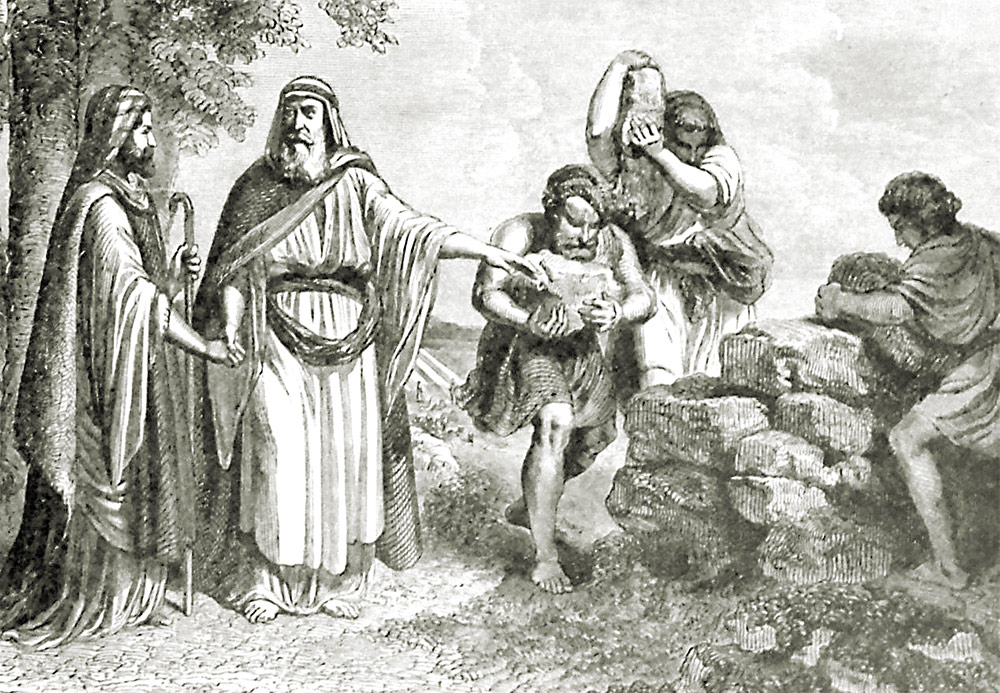
But then he gives up and proposes that he and Jacob make a formal peace treaty. Jacob raises a memorial stone and builds a cairn (a heap of stones) to mark the boundary between them. Lavan says:

The Heap of Witness, Holman Bible, 1890

“A witness is this cairn, and a witness is the standing-stone, that I will not cross over past this cairn to you, and that you will not cross over past this cairn or this standing-stone to me, [to do anything] bad. The elohim of Abraham and the elohim of Nachor, may he judge between us—the elohim of their father.” (Genesis 31:52-53)

When Lavan swears by the elohim of Abraham (Jacob’s grandfather) and Nachor (his own grandfather) and their mutual great-grandfather, Terach, he knows he is swearing by Y-H-V-H, the god that Jacob also recognizes. Lavan phrases his oath to emphasize his kinship with Jacob. It is a reassurance: We have the same god.

And Jacob swore by the pachad of his father, Isaac. (Genesis 31:53)

Perhaps, as Robert Alter wrote, “he himself does not presume to go back as far as Abraham, but in the God of his father Isaac he senses something numinous, awesome, frightening.”9

Or perhaps Jacob is fed up with his uncle and father-in-law, and wants a clean break—as long as he gets to keep all of his own family and property. He does not care about his kinship with Lavan. Swearing by the pachad of Isaac emphasizes the dreadful power of the god who helped him and judged in his favor. It is a warning: My god is more dangerous!

Divine terror

The next time the word pachad appears is in the book of Exodus, in an ancient poem about how Egyptians were defeated at sea by the power of Y-H-V-H. The poem declares that all the nations in the region are aghast and tremble with fear of the God of Israel.

Horror and pachad fall upon them! (Exodus 15:16)

Pachad next appears in the book of Deuteronomy, when God promises the Israelites:

“This day I begin putting pachad of you and yirah of you over the faces of all the peoples under the heavens, so that they will pay attention to a rumor of you, and they will shake and they will weaken before you.” (Deuteronomy 2:25)

Later in Deuteronomy, Moses warns the Israelites that if they fail to obey God’s rules, God will inflict horrors upon them.

“And your life will hang in the balance, and you will be pachad night and day, and you will not [be able to] rely upon living. In the morning you will say ‘Who will make it evening?’ and in the evening you will say ‘Who will make it morning?’ because of the pachad of your heart that you will be pachad, and the vision of your eyes that you will see.” (Deuteronomy 28:66-67)

So God is the pachad of Isaac, who obeyed and nearly died; the pachad that Jacob uses to threaten Lavan; the pachad of the enemies and rivals of the Israelites; and the pachad of anyone who dares to disobey God.


I have felt a touch of yirah of the divine, though not quite at the goosebump level. I have never experienced pachad, the shuddering terror. I hope I never do. When I pray, I try to cultivate awe, but not dread.

Yet I know what is going to happen to Jacob in next week’s Torah portion. He will wrestle with a mysterious being, and walk away limping on his hip. He ran away from Esau and he ran away from Lavan, but he cannot run away from God.

I pray that everyone who is overwhelmed by terror is able to walk away—perhaps traumatized, like Isaac, or limping, like Jacob—but able to go on living.


  1. In Genesius 24:50-51, Nachor’s son Betuel and grandson Lavan spontaneously use the name Y-H-V-H.
  2. Genesis 22:1-14.
  3. Cf. Ibn Ezra, Ramban, Rabbeinu Bachya.
  4. Genesis 27:33. Charad (חָרַד) = tremble with fear.
  5. Even though Isaac is rich, Jacob runs off without any silver, animals, or trade goods to use as a bride-price. See my post Vayeitzei: Guilty Conscience.
  6. Genesis 29:9-20.
  7. Genesis 30:33-36.
  8. See my posts Vayeitzei: Idol Thief and Vayeitzei: Stealing Away.
  9. Robert Alter, The Five Books of Moses, W.W. Norton & Co., NY, 2004, p. 175.

Chayei Sarah & 1 Kings: Old Age for Scoundrels, Part 2

Both Abraham and King David have motley careers in the bible: brave and magnanimous in one scene, heartless and unscrupulous in the next. But in old age (about age 140-175 for Abraham, 60-70 for David) the two characters take different paths.

And Abraham expired and died at a good old age, old and satisfied, and he was gathered to his people. (Genesis 25:8)

Abraham, who is healthy and virile in extreme old age, takes a new concubine and raises a new family in last week’s Torah portion, Chayei Sarah (Genesis 23:1-25:18). But this time, instead of endangering his women and his sons, he acts responsibly. Abraham makes explicit arrangements for his eight sons so that each will carry on an independent life without internecine struggles. (See last week’s post: Chayei Sarah & 1 Kings: Old Age for Scoundrels, Part 1)

King David, however, is feeble and bitter during his last years. The haftarah reading for Chayei Sarah (1 Kings 1:1-1:31) sets the tone with its opening:

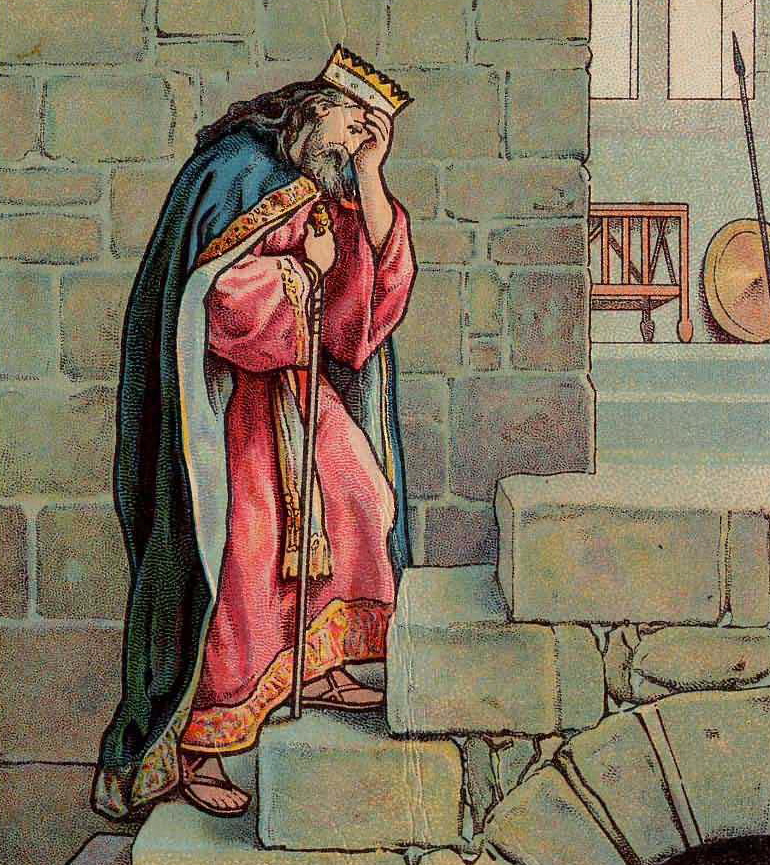
King David’s Deathbed, 1435

And the king, David, was old, coming on in years. And they covered him with bedclothes, but he never felt warm. (1 Kings 1:1)

This is the man who personally killed 200 Philistines in a single battle,1 who took at least eight wives and ten concubines,2 and who danced and leaped in front of the ark all the way into Jerusalem.3

David’s prime

As a young man, David is such a charismatic and popular military commander that King Saul is afraid David will steal his kingdom. Saul makes four attempts to kill him.4 David flees and becomes the leader of an outlaw band. At one point he seems to be running a protection racket.5

Later David defects to the Philistines, Israel’s longtime enemies, with his 600 men. The Philistine king of Gat welcomes the mercenaries and gives David the town of Ziklag. For over a year David and his men raid villages, kill the residents, and bring back booty (presumably sharing it with the king of Gat). This kind of raiding was common in the Ancient Near East, and the Hebrew Bible does not censure David; the text merely indicates that David lied to the king of Gat in order to avoid raiding Israelite villages.6

After King Saul and his son and heir Jonathan die in a battle with Philistines, David and his men relocate to Hebron, where David is proclaimed king of Judah, his own tribe. Meanwhile, Saul’s general Abner makes one of Saul’s sons7 the king of the northern Israelite territory.8 Right after David and Abner have made a truce, Joab, David’s army commander and nephew, assassinates Abner.9 Two other supporters of David assassinate Saul’s son in the north, and David becomes the king of all Israel—when he is only 30.

He captures the part of Jerusalem and turns it into his capitol, the City of David. One spring King David stays home while Joab leads a fight against the kingdom of Ammon. Walking on his rooftop in the evening, David sees a beautiful woman bathing on her rooftop. He finds out that she is Bathsheba (Batsheva), the wife of one of his own soldiers, Uriyah.

King David Sees Bathsheba, by Jean-Leon Gerome, 1889

Adultery is a sin in the Torah, a crime punishable by death.10 Nevertheless, David has Bathsheba brought to him. When she tells David she has become pregnant, he calls Uriyah home from the front so it will look as if she is pregnant by her husband. Uriyah, however, refuses to spend even one night in his own house at a time of war.

So David compounds his crime.

And it was in the morning when David wrote a letter to Joab, and he sent it by the hand of Uriyah. And the letter he wrote said: “Put Uriyah in the front of the hardest battle, then draw back from him, so he will be struck down and die.” (2 Samuel 11:15)

Joab obeys. The innocent Uriyah dies. As soon as Bathsheba finishes the mourning rituals for her husband, David marries her.

And the thing that David had done was evil in the eyes of God. (2 Samuel 11:27)

The prophet Natan transmits the words of God’s curse to the king:

“And now the sword will never swerve away from your house again, because you have despised me and have taken the wife of Uriyah the Hittite to be your wife. Thus says God: Here I am, raising up against you evil  from within your own house…” (2 Samuel 12:10-11)

The death of Bathsheba’s infant conceived in adultery is only the beginning. Amnon, who is David’s firstborn son by his wife Achinoam, rapes Tamar, David’s daughter by his wife Ma-akhah. David is responsible for justice, in both his household and his kingdom, but he does nothing about the rape. So Tamar’s full brother, Absalom (Avshalom), kills Amnon and goes into exile.

King David grieves over Amnon’s death for three years, then lets Absalom return to Jerusalem. Absalom usurps David’s throne after a long misinformation campaign, and King David leaves Jerusalem with his supporters. They camp at Machanayim on the other side of the Jordan River. On the way, a fellow named Shimi throws stones, dirt, and insults at David, but David is feeling either defeated or philosophical, and he tells his men to leave Shimi alone, since this, too, is God’s doing.11

David’s Grief over Absalom, Bible card, Providence Lithograph Co., 19th century

When Absalom’s army clashes with David’s army, David orders Joab and his other two commanders to go easy on Absalom. David’s troops win the battle, and Absalom is left dangling from a tree branch by his own long hair. Joab disregards David’s order and kills Absalom. David is heartbroken. His grief demoralizes his troops, until Joab persuades David to come down from his bedroom and act like a king.12 Shortly after that, David replaces Joab with Amasa, who was Absalom’s general.13

When David and his followers cross the Jordan back into Jerusalem, Shimi prostrates himself and apologizes for insulting the king and throwing rocks at him. Joab’s brother Avishai says:

“Shouldn’t Shimi be put to death instead, since he cursed God’s anointed?” (2 Samuel 19:22)

But David scolds Avishai and says no man of Israel should be killed on a day of national reconciliation.

And the king said to Shimi: “You will not be put to death.” And the king swore to him. (2 Samuel 19:24)

With David back on the throne, life continues as usual for ancient Israel, full of battles against neighboring countries. During one of them, Joab kills General Amasa, hides his bloody corpse with a cloak, and takes charge of the king’s troops. He defeats the enemy and returns to Jerusalem as the king’s general once more. King David takes no action.

 Unlike Abraham, David is punished during his lifetime for his worst sin (committing adultery and then having the woman’s husband killed). But his woes only make him more passive, not more ethical.

David’s old age

The first book of Kings begins:

And the king, David, was old, coming on in years. And they covered him with bedclothes, but he never felt warm. Then his courtiers said to him: “Let them seek for my lord the king a virgin young woman, and she will wait on the king, and she will be an administrator for him, and she will lie in your bosom and my lord the king will be warm.”  (1 Kings 1:1)

David and Abishag, Bible Illustration Cycle, 1432-35

They bring King David a beautiful young woman named Avishag.

And she became an attendant to the king and waited on him, but the king lo yeda-ah. (1 Kings 1:4)

lo yeda-ah (לֺא יְדָעָהּ) =he was not intimately acquainted with her. (lo, לֺא = not + yeda-ah, יְדָעָהּ = he was intimately acquainted with her. From the verb yada, יָדָע = he found out by experience,was acquainted with, had sexual relations with, understood, knew.)

Poor David! Even though Avishag is young and beautiful and lies down right next to him, he is too feeble to take advantage of the situation. And he used to be a man who loved spreading his seed around.

Unlike Abraham, David has not named his heir or distributed his property. His three oldest sons were Amnon (murdered by Absalom), Khiliav (Avigail’s son, who has disappeared from the story), and Absalom (killed in battle). Next in birth order is Adoniyah.

And Adoniyah, son of Chagit, was exalting himself, thinking: I myself will be king! … And his father had not found fault with him, or said “Why did you do that?” And also he was very good-looking … (1 Kings 1:5-6)

Adoniyah, the son whom David spoiled, gets support from General Joab and one of the top priests. He holds a coronation feast at on the southeast side of the City of David, and he invites everyone except his half-brother Solomon (a later son of David and Bathsheba) and Solomon’s supporters (the prophet Natan, the priest Tzadok, and King David’s personal guard, headed by Beneyahu).

Then Natan said to Solomon’s mother, Bathsheba: “Haven’t you heard that Adoniyah son of Chagit rules, and our lord David lo yada? And now, please take my advice, and save your life and the life of your son Solomon!” (1 Kings 1:11-12)

lo yada (לֺא יָדָע) = he does not know, does not understand.

King David, once an active and decisive leader, seems to have slipped into a state of passive ignorance. Perhaps he has become senile.

Following Natan’s script, Bathsheba comes to David’s bedchamber and bows.

And she said to him: “My lord, you yourself swore by God, your God, to your servant about Solomon, your son, ‘He will rule after me and he will sit on my throne.’ Yet now, hey! Adoniyah is king, and now, my lord the king, lo yadata! And he has slaughtered oxen and fatlings and many sheep, and he has invited all the king’s sons and Avyatar the priest and Joab commander of the army, but he has not sent for your servant Solomon. And you, my lord the king, the eyes of all Israel are upon you, to tell them who will sit on the throne of my lord the king after him. And it will happen when my lord the king lies down with his fathers, that I and my son Solomon will be considered guilty!” (1 Kings 1:18-21)

lo yadata (לֺא יָדָעתָּ) = you do not know; you do not understand. (Also from the verb yada.)

Natan comes in and corroborates. Then King David pulls himself together and issues orders for Solomon’s anointment as king.

The Solomon faction immediately holds a ceremony just east of Jerusalem, with shofar-blowing and music so loud that Adoniyah’s people hear it on the other side of the city. Solomon sits on the king’s throne before Adoniyah can get there.

Thus David, who had forgotten to take care of his most important business, makes Solomon his heir at the last minute. Adoniyah submits to his younger brother, and Solomon spares his life.

David’s last words to Solomon come right after last week’s haftarah reading, in the second chapter of 1 Kings. David opens with a formulaic directive to be strong and walk in God’s ways, but then he orders Solomon to take care of some unfinished business. Apparently David was too weak—politically, physically, or psychologically—to mete out rewards and punishments before he took to his bed. After his introduction, David tells Solomon:

“And also yadata yourself what Joab son of Tzeruyah did to me, what he did to the two commanders of the army of Israel, to Abner son of Neir and to Amasa son of Yeter. He killed them, and he put the bloodshed of war into a time of peace … So you must act in your wisdom, and his gray head will not go down in peace to Sheol. (1 Kings 2:5)

David reminds Solomon of what Joab did to Abner and Amasa, but does not say what Joab did to David. The obvious answer is that Joab killed David’s son Absalom, but David chooses not to go into that on his deathbed. He just wants Solomon to execute Joab, something David himself could not manage to do.

“But to the sons of Barzilai the Gileadite you must do loyal-kindness, and let them eat at your table, since [Barzilai] came close to me with blessings when I fled from the face of Absalom, your brother.” (1 Kings 2:7)

Here David is merely asking Solomon to continue the reward he set up for one of Barzilai’s sons after Barzilai had provided provisions for David and all his men during their exile from Jerusalem after Absalom usurped the kingship. But then David remembers someone who did not treat him well when he left Jerusalem.

“And hey! With you is Shimi son of Geira … and he, he insulted me with scathing insults on the day I went to Machanayim. Then he went down to meet me at the Jordan, and I swore to him by God, saying ‘I will not put you to death by the sword”. But now, do not hold him guiltless, because you are a wise man, veyadata what you should do to him. And you must bring his gray head down in blood to Sheol!” (1 Kings 2:8-9)

veyadata (וְיָדַעְתָּ) = and you will know. (Also from the verb yada.)

After David has laid these orders on Solomon, reminding him that he knows what to do, David dies—cold, ineffective, unforgiving, and bitter.


Abraham has a good and satisfied old age; David has the opposite. Abraham starts taking care of his family, instead of using them for his own selfish desires. David becomes so passive it takes both Natan and Bathsheba to get him to give orders to prevent a civil war, and on his deathbed he orders his son and heir to take revenge for him.

Why are the two characters so different?

Now, when I remember my mother’s suffering, senile incomprehension, and verbal sniping during her long journey toward death, I think that what matters most in the last part of life is autonomy and agency. During Abraham’s last years he is sound of mind; he gives thoughtful orders, and he continues to be obeyed. David retreats from thinking during the last half of his life. Instead of seeking more knowledge and understanding, he continues to make impulsive decisions that disregard both other people’s point of view and the good of his own kingdom. First Joab, and then Natan, manipulate him for the good of the kingdom. At the end, David takes no responsibility for anything, and asks his son Solomon to avenge him after he dies.

May each of us take responsibility while we still have autonomy and agency, and may we act in order to improve the situation for those who survive us. Even if we have a past record of misdeeds, may we be more like Abraham in old age, and less like King David.


  1. David killed 200 Philistines and harvested their foreskins (1 Samuel 18:25-27).
  2. The foreskins were the bride-price for marrying King Saul’s daughter Mikhal. David was leading an outlaw band when he married Avigail (1 Samuel 25:39-42) and Achinoam (1 Samuel 25:43). As king of Judah, he married Ma-akhah, Chagit, Avital, and Eglah (2 Samuel 3: 3-6); and as king of all Israel he took “more concubines and wives” (2 Samuel 5:13). He married Batsheva in 2 Samuel 11:27. We learn he had ten concubines in 2 Samuel 15:16.
  3. David danced in front of the ark, whirling and leaping, in 2 Samuel 6:13-16.
  4. King Saul tries to thrust a spear through David himself in 1 Samuel 18:8-2 and 19:10. He sends David into a difficult battle in the hope that Philistines will kill him in 1 Samuel 18:25-26. And Saul sends assassins to David’s house in 1 Samuel 19:11.
  5. 1 Samuel 25:2-44.
  6. 1 Samuel 27:10-13.
  7. The Hebrew Bible calls this son of Saul Ish-Boshet, meaning “Man of Shame”; we never learn his actual name.
  8. 2 Samuel 2:1-10.
  9. 2 Samuel 2:12-3:39.
  10. Leviticus 20:20.
  11. 2 Samuel 16:5-14.
  12. 2 Samuel 18:1-19:15.
  13. 2 Samuel 19:12-15. Amasa is another nephew of David’s, and a cousin of Absalom’s.

Chayei Sarah & 1 Kings: Old Age for Scoundrels, Part 1

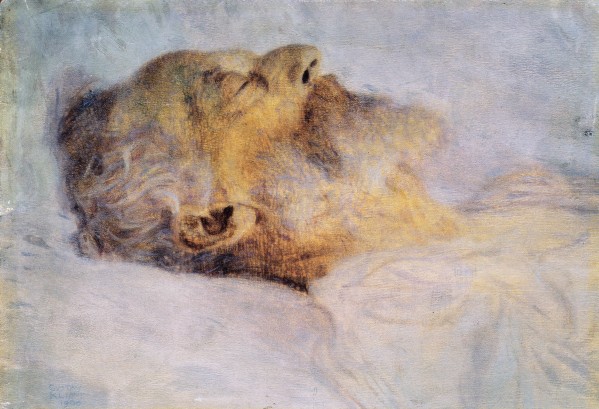
And Abraham expired and died at a good old age, old and saveia, and he was gathered to his people. (Genesis 25:8)

Old Man on his Deathbed, by Gustav Klimt

saveia (שָׂבֵעַ) = (adjective) satisfied, full, sated. (From the root verb sava, שָׂבַע = be sated, have enough, be filled up—usually with food.)

The full and satisfying end of Abraham’s life in this week’s Torah portion, Chayei Sarah (“The Life of Sarah”, Genesis 23:1-25:18) contrasts with the thin and bitter end of King David’s life in the accompanying haftarah reading (1 Kings 1:1-1:31). The haftarah sets the tone for King David’s final years when it opens:

And the king, David, was old, coming on in years, and they covered him with bedclothes, but he never felt warm. (1 Kings 1:1)

In their prime, both men have motley careers: brave and magnanimous in one scene, heartless and unscrupulous in the next. But in old age (about age 140-175 for Abraham, 60-70 for David) their paths diverge.

Abraham’s prime

Abraham commits several major unethical deeds after he moves his family to Canaan when he is 75. Although his behavior toward his nephew Lot is faultless, his behavior toward his wife Sarah and his first two sons, Ishmael and Isaac, is sometimes cruel, selfish, and immoral.

Abram’s Counsel to Sarai, by James Tissot, ca. 1900, detail

Twice when he travels to a new kingdom, Abraham asks Sarah to pretend to be his sister. He claims that she was unusually beautiful1 and that the king has peculiar morals, considering adultery taboo, but murder perfectly all right. The king will take Sarah regardless, but only if everyone lies and says Abraham is her brother will the king let him live. In fact, both kings pay Abraham a bride-price for his “sister”. Both kings are horrified when they discovered the truth. Both times, Abraham gets to take back his wife and leave richer than when he arrived.2

Sarah also uses Abraham, by giving him her slave Hagar as a concubine for the purpose of producing an heir. (She is 75 and childless at the time.) After Sarah give birth to her own son at age 90, she sees that Hagar’s son Ishmael is not treating her son Isaac with respect. So she orders Abraham to cast out Hagar and Ishmael, in order to make Isaac the only heir. Abraham is rich, and could easily give his own son and his former concubine a couple of donkeys laden with water, food, and silver to ensure their safe relocation. Instead, Abraham sends them off into the desert with only bread and a skin of water. When they get lost and use up the water, Ishmael nearly dies.3 God arranges a rescue, but Abraham never sees his oldest son again.

Isaac has grown up, but has not yet married or had children, when Abraham hears God tell him:

“Please take your son, your only one, whom you love, Isaac. And get yourself going to the land I will show you, and offer him up there as a burnt offering on one of the hills, which I will say to you.” (Genesis 22:2)

Sacrifice of Isaac, by Caravaggio, 1603

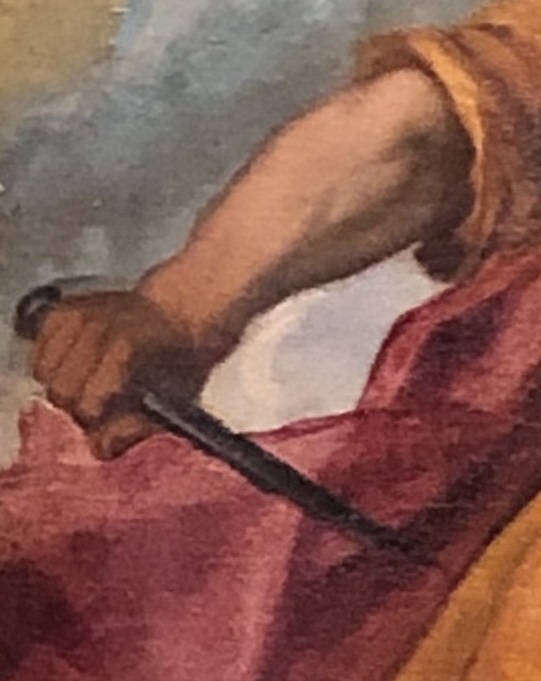
Abraham knows he could argue with God. When he was 99, he argued with God about destroying Sodom, and God listened and agreed it would be unjust to annihilate the city if it contained even ten innocent people.4 Yet now, in his 130’s, Abraham does not argue with God. he does not even ask God a question. He gets up early and leaves with Isaac, two servants, and a donkey carrying firewood, without telling Sarah where they are going. When Isaac lies bound on the altar and Abraham lifts the knife, God has to call his name twice to get him to stop. After Abraham sacrifices a ram instead, he walks back down the hill alone.5 The breach between father and son is irreparable. Abraham never sees Isaac again.

Abraham’s old age

Is Abraham consumed by guilt and loss during the final stage of his life, from his late 130’s to his death at 175? No. But he has changed. This week’s Torah portion, Chayei Sarah, portrays a man at peace with himself who meets all his responsibilities and also enjoys life.

The Torah portion begins with Sarah’s death in Hebron. Yet the last we knew, Abraham was living in Beersheba.6 Perhaps the two locations reflect a glitch in a redactor’s effort to combine two stories. Or perhaps Sarah left her husband after he returned without Isaac and tried to explain what happened. In an already difficult marriage, that would be the last straw. Yet the estrangement does not stop Abraham from traveling to Hebron and doing his duty as Sarah’s husband.

Abraham Buys the Field of Ephron the Hittite, by William Hogarth, ca. 1725

And Abraham came to beat the breast for Sarah and to observe mourning rites. Then Abraham got up from the presence of his dead, and he spoke to the Hittites, saying: “I am a resident alien among you. Give me a burial site among you, and I will bury my dead away from my presence.” (Genesis 23:2)

After some negotiations, Abraham buys a plot of land with a suitable burial cave, and buries Sarah there. In this way he also prepares for his own burial, and future burials in his family.

Isaac is not mentioned during the first scene in Chayei Sarah. But in the next scene, Abraham makes arrangements for Isaac’s marriage.

And Abraham said to his elder servant of his household, the one who governed all that was his: “Please place your hand under my yareikh, and I will make you swear by God, god of the heavens and god of the earth, that you do not take a wife for my son from the daughters of the Canaanites amidst whom I am dwelling.  For you must go to the land I came from and to my relatives, and you must take a wife for my son, for Isaac.”  (Genesis 24:2-4)

Abraham’s Solemn Charge, by Pedro Orrente, 17th century, detail

yareikh (יָרֵךְ) = upper thigh, buttocks, genitals.

This is a serious oath. Isaac is in his late thirties at this point, and his father has obviously been keeping track of him from a distance. Now Abraham wants to make sure, before he dies, that Isaac marries and starts producing the descendants God promised. But he does not try to confront his estranged and traumatized son in person. He instructs his steward, and trusts him to deliver the right bride to his son.

Arranged marriage was the norm in the Ancient Near East, so Isaac is not shocked when his father’s steward arrives with a young woman for him. In fact, he falls in love with her.7

Once Isaac is married, Abraham takes a concubine again, and has six sons with Keturah.

And Abraham gave all that was his to Isaac. But to the sons of the concubines that were Abraham’s, Abraham gave gifts, and he sent them away from his son Isaac while he was still alive, eastward, to the land of the east. And these are the days of the years of Abraham, that he lived: 175 years. And Abraham expired and died in good seivah (Genesis 25:6-8)

Abraham is virile and enjoys life his old age. He is also in charge of his own life, and takes care to meet all his responsibilities well before he dies. He divides his wealth among his sons and makes sure Isaac will not be harassed by his stepbrothers. After his death, Ishmael and Isaac bury their father in the cave he bought for Sarah’s burial. Whatever mistakes he made before the age of 140, Abraham leads an enviable life for his last 35 years. He is fortunate to be in good health, with both virility and a sound mind. He knows what he is doing, and he does it more thoughtfully than he used to. Abraham was always good at generating plans. But during the last part of his life, his plans are more reasonable, and take the other people in his life into consideration.


No human being is perfect. We may not commit such extravagant misdeeds as Abraham, but we have all hurt other humans. Occasionally we get the blessing of a frank conversation with someone we hurt, and an opportunity to apologize and make amends. But often the chance for a frank conversation never comes. Then the best we can do is to acknowledge our misdeeds to ourselves, and plan how we will behave more ethically in the future. Sometimes we can notice our own improvement, and find peace in our old age.

Perhaps this is what Abraham does in the book of Genesis. He never apologizes to Sarah, or Ishmael, or Isaac. But after age 140, he is careful to meet his responsibilities to everyone, even the people estranged from him. Abraham still pursues his own interests and arranges a pleasant life for himself, but he does it without any deceit and without endangering anyone’s safety. He dies old and satisfied.

Next week, in Part 2, we will look at the unfortunate counterexample of King David’s old age.


  1. Sarah is 65 when Abraham pulls this scam on the king of Egypt in Genesis 12:10-20. She is 89 when he repeats it with the king of Gerar in Genesis 20:1-18, but during that year God is presumably making Sarah’s body younger so she can bear a son to Abraham.
  2. See my posts The Wife-Sister Trick: Part 1 and Part 2.
  3. Genesis 21:8-19. See my post Vayeira: Failure of Empathy.
  4. Genesis 18:16-32.
  5. Genesis 22:1-19. See my post Vayeira: Stopped by an Angel.
  6. In Genesis 22:19 Abraham comes back to Beersheba without Isaac.
  7. Genesis 25:67.

Vayeira: On Speaking Terms

Direct speech, or visions, or dreams, or divine messengers—the Hebrew Bible portrays God as communicating with human beings through all these methods. In this week’s Torah portion, Vayeira (“And he appeared”, Genesis 18:1-22:24), God speaks to Abraham both directly and through divine messengers, called malakhim; to Sarah directly; to King Avimelekh in a dream; and to Lot and Hagar through malakhim.

malakh (מַלְאָךְ) = messenger, emissary. (Plural: malakhim, מַלְאָכִים. While human characters in the Torah send fellow humans as malakhim, the God character sends divine malakhim. “A malakh of God” is often translated into English as “an angel”.)

One way or another, God speaks to more people in Vayeira than in any other Torah portion or haftarah reading. And Vayeira is the only place in the Hebrew Bible where God sends three malakhim at once. What does the God-character achieve?

Three “men”

Abraham is 99 when this week’s Torah portion begins. God spoke directly with him five times in last week’s portion, Lekh Lekha, both with and without accompanying visions.1 The portion Vayeira begins:

Three Visitors, by James Tissot, ca. 1900

And God appeared to him by the great trees of Mamrei, while he was sitting at the entrance of the tent as the day grew hot. And he raised his eyes, and he saw—hey! Three men were standing near him. And he saw, and he ran from the entrance of the tent to greet them, and he bowed down to the ground. (Genesis/Bereishit 18:1-3)

When God appears in Mamrei, what Abraham sees is three men.2 At first Abraham assumes the three men are ordinary human beings, travelers passing through. He rushes to offer them hospitality: water for washing their feet, shade to rest in, and food to eat. He waits on them under the trees. Then one of the strangers speaks like a prophet, saying:

“I will definitely return to you when this season revives, and hey! A son for Sarah, your wife!” (18:10)

Sarah, who is 89 years old, overhears from inside the tent, and immediately thinks of the sexual act necessary to produce a son.

And Sarah laughed inside herself, saying: After I am all used up, will there be pleasure for me? And my lord is old. (Genesis 18:12)

Then God said to Abraham: “Why is it that Sarah laughed, saying: ‘Can I truly even give birth, when I am old?’ Is it too extraordinary a thing, from God?” (Genesis 18:13-14)

Abraham expresses no surprise that now God is talking to him, though the three “men” are still present. Perhaps he knows that God sometimes speaks through malakhim who look human, at least at first.

And Sarah lied, saying: “I did not laugh,” because she was afraid. But [God] said: “No, because you did laugh.” (Genesis 18:15)

Sarah’s fear shows that she, too, knows that God is speaking.

Does God make three malakhim manifest in the grove of Mamrei only in order to test Abraham’s hospitality and/or to announce Sarah’s future child? I doubt it. A single malakh could have achieved both these objectives.3

Then the men got up from there, and they looked down at Sodom. And Abraham was walking with them to send them off.  And God said: Will I hide from Abraham what I am doing? … For I pay attention to him, so that he can instruct his sons and his descendants after him, so they will observe God’s path to do righteousness and justice … (Genesis 18:16-19)

After this thought, God addresses Abraham, saying:

“The outcry of Sodom and Gomorrah is great, because their abundant guilt is very heavy. Indeed I will go down, and I will see: Are they doing like the outcry coming to me? [If so,] Annihilation! And if not, I will know.” The men turned their faces away from there and they went to Sodom, while Abraham was still standing before God. (Genesis 18:20-22)

In other words, God sends two of the malakhim down to check out Sodom. The God in the Torah is not omniscient; in the story about the Tower of Babble, God  comes down from the heavens to look at the city and tower before taking action.4 The God of Torah is not omnipresent either, but always has a specific location in our world or in the heavens.

After God’s opening statement about the outcry about Sodom and Gomorrah (presumably coming from victims),

Abraham approached and said: “Would you sweep away the tzadik with the wicked? What if there are fifty tzadikim inside the city? Would you sweep away and not pardon the place for the sake of the fifty tzadikim who are in it? Far be it from you to do this thing, to bring death to the tzadik with the wicked! Then the tzadik would be like the wicked. Far be it from you! The judge of all the earth should do justice!” (Genesis 18:23-25)

tzadik (צַדִּיק) = righteous, innocent. tzadikim (צַדִּיקִם) = people who are righteous or innocent.

And God agrees to pardon the whole city if fifty of its residents are innocent. Abraham continues until God agrees to spare Sodom even if it has only ten innocent people.

As we will see, this encounter between God and Abraham could have changed Abraham’s life about 30 years later—if only he had remembered that he could argue with God. As it is, Abraham does succeed in establishing that God is supposed to be a god of justice.

Two malakhim

And the two malakhim came to Sodom in the evening, and Lot was sitting in the gate of Sodom. And Lot saw them, and he rose to greet them, and he bowed down with his nose to the ground. (Genesis 19:1)

Abraham’s nephew Lot emigrated with him from Aram to Canaan 24 years before. They parted when the pastureland around Bethel was no longer sufficient to feed the increasing flocks and herds of both men. Abraham stayed in the hill country, and Lot went down to the fertile valley and settled in the city of Sodom.5

Now, when he sees two strangers enter the city, Lot is as hospitable as his uncle Abraham. He, too, bows to the ground. He begs the men to come home with him for the night, and he prepares a feast for them. That night, all the men of Sodom surround Lot’s house.

And they called to Lot and they said to him: “Where are the men who came to you tonight? Bring them out to us, and we will ‘know’ them!” (Genesis 19:5)

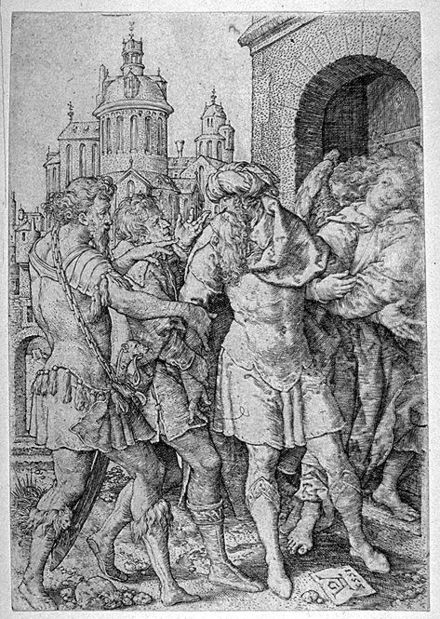
Lot Prevents the Sodomites from Raping the Angels, by Heinrich Aldegrever, 1555

The men of Sodom believe that the two strangers in Lot’s house are ordinary men who can be degraded through rape. They do not care about other people; they only want to prove how powerful they are. Lot steps out, closing the door behind himself, and begs the men of Sodom not to do an evil deed. He volunteers to send out his own two virgin daughters for them to rape instead. (This offer indicates that he is not a tzadik, but his hospitality to strangers indicates that he is not wicked like the native Sodomites.)

The men of Sodom reject Lot’s offer.

And they moved forward to break the door. But the “men” [inside] stretched out their hands and brought Lot inside the house with them, and they shut the door. And the men who were at the entrance of the house, from small to big, they struck with a blinding light; and they were powerless to find the door.

The two malakhim urge Lot to collect his married daughters and their families, so they can all flee together before Sodom is annihilated. Although Lot believes the malakhim, he cannot persuade his sons-in-law to take the warning seriously. When he returns to his own house at dawn, the two malakhim urge Lot to leave at once with his wife and his two unmarried daughters. Lot hesitates, and the malakhim grasp the hands of all four humans and drag them out of the city.

Then God rained down on Sodom, and on Gomorrah, sulfur and fire from God,  from the heavens. (Genesis 19:24) 

We can deduce that God sends two malakhim to Sodom in order to confirm that all the men there (except Lot) really are evil, and to rescue Lot and his wife and virgin daughters. The rescue requires a magical power (blinding the Sodomites) and four hands with a firm grip.

The encounter with the two malakhim from God does save four human lives, but it does not redeem them. Lot’s wife ignores the warning of the malakhim not to look back, and turns into a pillar of salt. Lot gets drunk and has incestuous intercourse with his two remaining daughters, providing an excuse for the author to insult the kingdoms of their descendants, Moab and Ammon. (See my post Vayeira & Noach: Drunk and Disorderly.)

A dream

Abraham travels on to Gerar, where the Torah gives us a second version of the wife-sister story.6

And Abraham said about Sarah, his wife: “She is my sister.” And Avimelekh, the king of Gerar, sent for and took Sarah. Then God came to Avimelekh in the dream at night, and said to him: “Hey, you will die on account of the woman that you took, for she is the wife of a husband.” (Genesis 20:2-3)

In his dream, the king defends himself, protesting that Abraham and Sarah lied to him, and anyway he has not yet touched Sarah, so he is innocent. Avimelekh’s argument is successful.

And God said to him in the dream: “I also know that you did this with an innocent heart, and I  also held you back from doing wrong to her. That is why I did not let you touch her.” Genesis 20:6)

After claiming credit for the disease that caused King Avimelekh’s delay, God orders him to restore Sarah to her husband. He does so, throwing in some portable wealth to be on the safe side, and God heals him.

In this case, God participates in Abraham’s scam, but then sends Avimelekh a dream that gives him a chance to defend himself. When he does, God remits his punishment. As in the first wife-sister story, Abraham goes unpunished.

About Ishmael

After Abraham and Sarah return from Gerar, Sarah does indeed have a son at age 90. Several years later, at her son Isaac’s weaning feast, she is disturbed by the behavior of Abraham’s first son, Ishmael. Sarah orders her husband to cast out Ishmael and his mother, the slave-woman Hagar, in order to prevent Ishmael from sharing Isaac’s inheritance. (See my post Vayeira: Failure of Empathy.) Abraham is not happy about this order from his wife.

But God said to Abraham: “Don’t let it be bad in your eyes about the boy and about the slave-woman. Everything that Sarah says to you, listen to her voice! … And also I will set the son of the slave-woman as [the founder of] a nation, because he is your seed.” (Genesis 21:12)

Perhaps this promise makes Abraham feel absolved of responsibility for the adolescent boy. He sends off Ishmael and Hagar with only some bread and one skin of water, and nothing to give them a start on a new life. The mother and son run out of water in the desert.

Hagar in the Desert, by Gheorghe Tattarescu, 1870, detail

And God listened to the sound of the boy [crying], and a malakh of God called to Hagar from the heavens and said to her: “What is it, Hagar? Don’t be afraid. Because God has listened to the sound of the boy where he is. Get up, lift up the boy, and hold your hand firmly in his. Because I will make him a great nation.” Then God opened her eyes, and she saw a well of water. (Genesis 21:17-19)

The words of the malakh might make Hagar feel more optimistic, but the important change is that Hagar now sees the water.

Abraham obeys again

Abraham hears from God for the last time in his life near the end of the portion Vayeira.

And it was after these things, and God tested Abraham. And [God] said to him: “Abraham!” And he answered: “Here I am.” And [God] said: “Take, please, your son, your only one,7 whom you love, Isaac. And go for yourself to the land of the Moriyah, and offer him there as a burned offering on one of the hills that I say to you.” And Abraham got up early in the morning and he saddled his donkey and he took two [slave] boys with him, and his son Isaac. And he split wood for the burnt offering and he got up and went to the place that God had said to him. (Genesis 22:1-3)

Abraham simply obeys. He does not argue with God. Apparently he does not remember the time when he debated with God about justice and the city of Sodom; he does not even mention that Isaac is innocent.

The Sacrifice of Isaac, by Tintoretto, 1550-55, detail

On the summit of the hill in Moriyah,

Abraham stretched out his hand and he took the knife to slaughter his son. Then a malakh of God called to him from the heavens, and said: “Abraham! Abraham!” And he said: “Here I am.” (Genesis 22:10-11)

In the Torah, when the speaker repeats the name of the person addressed, it means there was no answer the first time. Abraham is not even listening for God’s voice.

Once he has Abraham’s attention, the malakh from God says:

“You must not stretch out your hand against the boy, and you must not do anything to him. Because now I know that you fear God, and you have not withheld your son, your only one, from me.” (Genesis 22:12)

Abraham looks up, sees a ram caught in the bushes, and sacrifices it instead of Isaac.8 But as a result of his unquestioning obedience, he is estranged from his only remaining son for the rest of his life. And although Abraham appears in several more scenes in the book of Genesis, God does not speak to him again.


What does God achieve in the portion Vayeira through all these conversations, speaking with Sarah, Lot, Avimelekh, and Hagar as well as Abraham?

Abraham argues in favor of sparing Sodom if it contains ten innocent people, but then he fails to argue for the life of his own innocent son. Sarah is unaffected by the annunciation of Isaac, though she defends him after he is born. God spares Lot’s life, but Lot does not appreciate it, and falls into immoral behavior. Avimelekh protests to God in his dream, and God heals him—of the affliction God caused in the first place. And God does not tell Abraham anything that motivates him to behave decently to Hagar and Ishmael.

We can see God’s involvement in the lives of all five people: Abraham Sarah, Lot, Avimelekh, and Hagar. But if God had remained silent and distant in the portion Vayeira, the five humans might have been better off. And although the generations after Abraham have benefited from his argument that God is supposed to do justice, this benefit has been undermined by the story of his unquestioning obedience to an unjust command.

But without God’s conversations, the stories would have been less entertaining.


  1. God manifests to Abraham as a voice only in Genesis 12:1-3, and 13:14-17; and as voice with an accompanying visuals in Genesis 12:7, 15:1-21, and 17:1-22.
  2. God might be invisible, or manifest in a fire, or use a malakh; but nobody can see what God actually looks like. As God tells Moses in the book of Exodus, “No man can see me and live” (Exodus 33:20). Moses, Aaron, two of Aaron’s sons, and 70 elders do see God’s feet on a sapphire pavement in Exodus 24:10, but this does not count.
  3. Cf. the single malakh who announces the coming birth of Samson in Judges 13:2-24.
  4. Genesis 11:5 in the portion Noach.
  5. Abraham and Lot separate in Genesis 13:1-13.
  6. The first wife-sister story is in Lekh-Lekha, in Genesis 12:11-20. See my posts Lekh Lekha, Vayeira, and Toledot: The Wife-Sister Trick, Part 1, Part 2, and Part 3.
  7. We know Abraham has two living sons, so why does God call Isaac “the only one” (yechidekha, יְחִידֶךָ)? I believe here the word means “the only one remaining to you”, since Ishmael has been banished.
  8. See my post Vayeira: Stopped by an Angel.

Lekh Lekha: Abraham’s Heir

When you die, what do you leave behind in the world of the living?

Someone inherits your wealth: land, money, or—for nomads in the Ancient Near East—the  livestock and slaves you own. Someone may take your place at work or in your community. And some people will remember you and tell stories about you, for good or bad.

What do you want to leave behind, and who do you want to your heirs to be?


The question of inheritance is a major concern in this week’s Torah portion, Lekh Lekha (Genesis 12:1-17:27), and for the next six portions. For three generations, from Abraham to his grandson Jacob, the men and women in his family tree try to manipulate events in order to control who will inherit.

Abraham appears (under his original name, Avram) at the end of a long genealogy in last week’s portion, Noach. Nine generations after Noah, Terach was living in the city-state of Ur in southern Mesopotamia when he begot three sons: Avram, Nachor, and Haran. All three sons grew up and got married in Ur. Haran died there. Terach set out for Canaan with Avram and his wife Sarai, and Haran’s son Lot. Before they reached Canaan, they stopped and settled in the Aramaean town of Charan in northern Mesopotamia.1 Later we learn that Nachor and his wife also settled in Aram.2

Possible heir #1: Lot

When Avram is 75, God tells him:

“Get yourself going away from your land and your clan and your father’s house, to the land that I will show you! And I will make you a great people, and I will bless you. I will make your name great, and it will become a blessing. And I will bless those who bless you, and I will curse those who belittle you.” (Genesis 12:1-2)

In the Torah, someone becomes “a people” by having numerous descendants who become an ongoing society or even country. A great name means fame or a great reputation. Already God has promised Avram two roles that his heirs might inherit: the leadership of a whole people, and a name that can trigger divine blessing or curse.

And Avram went, as his god, Y-H-V-H, had spoken. And Lot went with him. And Avram was 75 years old when he went out from Charan. And Avram took his wife Sarai, and his brother’s son Lot, and all their acquisitions that they had acquired, and the persons that they had made [their own] in Charan; and they left to go to the land of Canaan. (Genesis 12:4-5)

Without an explicit direction from God, Avram heads toward Canaan, his father’s intended destination. Besides his wife and his nephew, Avram takes all his possessions with him—mostly livestock and slaves. He stops at the site of Shekhem in Canaan, where God appears to him and says: “I will give this land to your offspring.” (Genesis 12:7)

This confirms that Canaan was the right place to go. Avram does not question God’s promise to give Canaan to his offspring, even though he has no children and Sarai is already 65. The household migrates south through Canaan, from Bethel to the Negev. When a famine comes, they go to Egypt, where Avram uses Sarai to pull a scam on the pharaoh. (See my posts Lekh-Lekha, Vayeira, & Toledot: The Wife-Sister Trick, Part 1 and Part 2.)

It went well on account of her, and he acquired flocks and cattle and male donkeys and male slaves and female slaves and female donkeys and camels. (Genesis 12:16)

When Avram, Sarai, and Lot return to Canaan with and all their possessions,

Avram was very heavy in livestock and in silver and in gold. (Genesis 13:2)

At this point, Avram has great wealth to pass on to his heir. The right heir might also inherit his connection with divine blessing, and his ability to hear God. Avram’s presumed heir at the beginning of Lekh Lekha is his nephew Lot. But when they return to Bethel, Avram and Lot decide to go their separate ways.

Lot, who went with Avram, also had flocks and cattle and tents. And the land could not support them [if they were] staying together … And there was quarreling between the herdsmen of Avram’s cattle and the herdsmen of Lot’s cattle. (Genesis 13:5-7)

Avram gives his nephew first choice of pastureland, and Lot claims “the whole plain of the Jordan”—the river valley and the land near the Dead Sea—because it has lots of water.

And they separated, each man from his kinsman. Avram stayed in the land of Canaan, and Lot settled in the cities of the plain, and he pitched his tent near Sodom. (Genesis 13:11-12)

The Torah never specifies the borders of Canaan, only the borders of the future kingdom of Israel.3 It does locate some towns as being in Canaan, but Sodom is not one of them. The passage above indicates that Lot rejects Canaan in favor of Sodom. This may be the point when Avram realizes Lot will not be his heir.4

As soon as Lot has left, Avram hears God repeat the promise that Avram’s offspring will someday own the land of Canaan.

And God said to Avram, after Lot had separated from him: “Raise your eyes, please, and look around from the place where you are, to the north and to the south and to the east and to the west. For all the land that you see, I give it to you and to your offspring forever. And I will make your offspring like the dust of the earth, so that if anyone is able to count the dust of the earth, he can count your offspring.”  (Genesis 13:14-16)

Possible heir #2: Eliezer

The next time God appears to Avram in a vision, God says:

“Don’t be afraid, Avram. I am a shield to you. Your wages will be very great.” (Genesis 15:1)

Avram does not ask what God is paying him for. But he does ask who will inherit God’s reward:

“What could you give me, when I am going childless, and the one maintaining my household is Eliezer of Damascus?” (Genesis 15:2)

When God does not answer, Avram explains:

“Since you have not given me offspring, then hey! The one over my household yoreish from me.” (Genesis 15:3)

yoreish (יוֹרֵשׁ) = will inherit

Perhaps Avram nudging God to provide him with his own son, so he can have the descendants God promised. There is nothing wrong with his steward Eliezer, especially if he is the same unnamed senior servant who, years later, goes out of his way to procure the right wife for Avram’s son Yitzchak (Isaac in English).5 But like most men in the Hebrew Bible, Avram wants an heir who is his own flesh and blood.

Then, hey! The word of God came to him, saying: “This one lo yiyrashekha, because one who goes out from your own loins, he yiyrashekha.” (Genesis 15:3-4)

lo yiyrashekha (לֹא יִירָשְׁךָ) = will not inherit land or property from you, will not get your possessions. (Lo, לֹא = not + yiyrashekha,יִירָשְׁךָ = will inherit land or property from you, will get your possessions.)

Then God again promises Avram an uncountable number of descendants.

Possible heir #3: Yishmael (Ishmael)

When Avram is 85 and his wife Sarai is 75, long past menopause, Sarai decides to give her husband an heir without waiting for a miracle.

And Sarai, Avram’s wife, had not borne children to him. And she had an Egyptian slave-woman, and her name was Hagar. And Sarai said to Avram: “Hey, please, God has kept me from bearing children. Please come into my slave-woman. Perhaps I will have a son through her.” And Avram paid attention on Sarai’s voice. (Genesis 16:1-2)

This was not an unusual strategy in the Ancient Near East. Childless women assign surrogates to their husbands and then adopt the resulting progeny both in the Mesopotamian laws of Hammurabi and in another story in Genesis, when Rachel and Leah ask their husband Jacob to produce more children for them by using their slave-women as surrogate mothers.5

And Hagar bore a son to Avram, and Avram called the name of his son that Hagar had borne Yishmael. And Avram was 86 years old when Hagar bore Ishmael to Avram. (Genesis 16:15-16)

The arrangement does not go well for Sarai or Hagar, but Avram acknowledges and grows fond of his son Yishmael (Ishmael in English).6

Possible heir #4: Yitzchak (Isaac)

When Avram is 99, and Sarai is 89, and Ishmael is 13, God appears to Avram again and says:

“Walk constantly in my presence, and be blameless. Then I will establish my covenant between me and you, and I will make you very, very numerous.”

At first the deal appears to be that Avram will behave perfectly, and in return God will give him those long-promised descendants. But then God continues:

“Behold my covenant with you: You will be a father for a hamon of nations. And you will no longer be called the name Avram, but your name will be Avraham; because I will give you a hamon of nations. And I will make you very, very fruitful, and give you nations, and kings will go out from you. And I will establish my covenant between me and you and your descendants after you for generations as a covenant forever: to be a god for you and your descendants after you. And I give you and your descendants after you the land of your sojourning, all the land of Canaan, as a possession forever, and I will be their god.” (Genesis 17:4-8)

hamon (הָמוֹן) = crowd, noisy procession, uproar. (From the root verb  hamah,הָמה  = roar, make an uproar. Avram’s new name, Avraham, incorporates the root hamah.)

Now God’s side of the covenant is to give Avraham crowds of descendants who will possess the land of Canaan; and to act as their god, presumably by paying special attention to their welfare.

Then God tells Avraham what he must do for his side of the covenant:

“This is my covenant that you must keep, between me and you and your descendants after you: Be circumcised, every male among you. And they must be circumcised, the flesh of your foreskins, and it will be a sign of the covenant between me and you.” (Genesis 17:10-11)  

In future generations, God adds, the circumcision should happen when a male infant is eight days old; and every man should also circumcise his male slaves.

And God said to Avraham: “Sarai, your wife—her name will not be called Sarai, because Sarah will be her name. And I will bless her, and even give you a son from her. I will bless her and she will become nations; kings of nations will come from her!” And Avraham threw himself on his face and he laughed, and he thought in his heart: Can a son be born to a hundred-year-old? Or can Sarah bring forth a child at ninety? And Avraham said to God: “May Ishmael live before your presence!” (Genesis 17:15-18)

Avraham seems content with Ishmael as his son and heir. Why does he need another? God reassures him that Ishmael will have twelve children and found a nation of his own. But the heir to Abraham’s property and relationship with God will not be Hagar’s son, but Sarah’s son, whom he must name Yitzchak.

“And my covenant I will establish with Yitzchak, whom Sarah will bear to you at this time next year.” (Genesis 17:21)

So Avraham’s own wife will miraculously give birth to Yitzchak, who will inherit God’s covenant with Avraham: God’s attention, the obligation of circumcision, and the equivalent of a deed to the land of Canaan. And that is not all Yitzchak inherits. God also blesses him7 and makes him a blessing to others.8 When Avraham himself dies at age 175, in the Torah portion Chayei Sarah, he leaves his wealth and livestock business to Yitzchak.

And Avraham gave everything that was his to Yitzchak. But to the sons of Avraham’s concubines, Avraham gave gifts, and he sent them away from his son Yitzchak while he was still alive, eastward to the land of the east. (Genesis 25:6)

Thus Yitzchak, the fourth person under consideration as Avraham’s heir, inherits his father’s wealth, livestock business, position as a blessing to others, deed to the land of Canaan, covenant with God, and ability to speak with God. Avraham left a lot to inherit, and he was happy with his heir.

And Avraham died at a good ripe age, old and satisfied. (Genesis 25:8)


When you die, what will you leave behind in the world of the living?

Someone will inherit your wealth. Someone may take your place at work or in your community. Some people will remember you and tell stories about you, for good or bad. And some may inherit your personality, or your attitude toward God.

Will you be satisfied with what you leave behind? Will you be satisfied with your heirs?


  1. Genesis 11:27-31.
  2. Genesis 22:20-22 and 24:10.
  3. Numbers 34:1-12.
  4. In chapter 14 of Genesis, invaders from the north raid Sodom and its neighbors, capture Lot and other residents of Sodom, and carry them off along with the loot. Abraham and his 318 men rescue all the captives, either because Sodom is one of Abraham’s allies at the time, or because he feels affection and/or responsibility for his nephew. But Lot returns to his home in Sodom, not to Avram’s camp in Canaan.
  5. Genesis 24.
  6. See my post Lekh Lekha: Belittlement.
  7. Genesis 30:1-13.
  8. Genesis 25:11.
  9. Genesis 26:2-4.

Bereishit & Noach: What Ruined the World?

Creation, by Lucas Cranach, 1434

On the sixth “day” of creation God creates land animals, including humans.

And God saw everything [God] had made, and hey! It was very good. And it was evening and it was morning, the sixth day. (Genesis 1:31)

But by the end of this first Torah portion in Genesis, Bereishit, something has gone wrong.

Then God saw that the evil of humankind was abundant on the earth, and all the shapes of the plans of its mind were only evil all the time. And God had second thoughts about making the human being on the earth, and [God’s] heart was distressed. And God thought: “I will wipe out the human that I created from upon the face of the earth—from humankind to beasts to creeping animals to flying animals in the sky—because I have had second thoughts about making them.” But Noach found favor in the eyes of God. (Genesis 6:5-8)

Noach (נֺחַ) = rest, resting-place; the personal name “Noah” in English.

Humans are generating so much evil that God wants to roll back creation to somewhere on the fifth “day” and start over again.

What kind of evil? The beginning of this week’s Torah portion, Noach (Genesis 6:9-11:32), narrows it down a bit.

The earth had become ruined in front of God; the earth was filled with chamas. And God looked at the earth, and hey! It was ruined, because all basar had ruined its ways on the earth. And God said to Noach: “The end of all basar is coming before me! For the earth is filled with chamas because of them. So here I am, ruinging them along with the earth! Make for yourself an ark of gofer wood …” (Genesis 6:11-14)

chamas (חָמָס) = violence.

basar (בָּשָׂר) = soft tissue of a human or other animal, including skin, muscle, meat; animals in general. (See my post Bereishit & Noach: All Flesh.)

After giving instructions for building the ark, God tells Noach:“As for me, here I am bringing the flood waters over the earth, to ruin all basar with a breath of life in it under the skies.” (Genesis 6:17)

All flesh

In the Noach story, the phrase “all flesh” (kol basar) means all non-human land animals four times in order to emphasize that Noach and his family are saving a pair of every type of animal.  “All flesh” means all land animals, including humans, eight times in the Noach story.1 For example:

And all basar expired: the crawlers on the earth, birds and beasts, and all swarming creatures that swarm on the earth, and all the human beings. Everything that breathed the air of life in its nostrils, out of all that were on dry land, died.  (Genesis 7:21-22)

The portion Noach states at the beginning that all basar had “ruined its ways on the earth” (Genesis 6:12), and then God tells Noach: “the earth is filled with chamas because of them” (Genesis 6:13). It is reasonable to conclude that God floods the earth because all land animals, including humans, are ruining God’s creation through violence.

What kind of violence?

What kind of chamas has ruined the earth? Classic commentators suggested four answers2:

Robbery. For example, “There is a discussion between the sages as to the difference in meaning between the word: חמס (violence) and the word גזל (robbery) when used in the Holy Scriptures. According to Rabbi Chaninah, the difference is merely in the amount misappropriated by violent means.” (Chizkuni, in response to earlier commentary including Rashi).

I reject robbery as a candidate because although I can imagine one animal biting another in order to steal its stash of food, this kind of behavior is never mentioned in the Torah.

Idolatry. For example, “Ḥamas refers to idolatry, as it is stated [in Ezekiel 8:17—Is it so little for the house of Judah, doing the abominations that they do here, that] they filled the earth with ḥamas?” (Bereishit Rabbah 31:6).

I reject idolatry as a candidate for two reasons: 1)  Ezekiel might have meant that the Judahites were violent in addition to committing abominations, and 2) Non-human animals exhibit no god-worshiping behavior, violent or otherwise.

Sexual misconduct. For example, “The dog would consort with the wolf, and the chicken would consort with the peacock.” (Bereishit Rabbah 28:8). “All flesh engaged in unnatural and perverted sexual acts.” (Ibn Ezra). “They raped women against their will.” (Chizkuni).

I reject this theory because no sexual violence or other sexual misconduct is mentioned in the Torah until after the flood.

Shedding innocent blood. For example, “Ḥamas refers to bloodshed, as it is stated: “[in Joel 4:19—Egypt shall be a desolation and Edom a desolate waste] due to the ḥamas against the children of Judah, that they shed innocent blood.” (Bereishit Rabbah 31:6).

Shedding innocent blood certainly counts as chamas, and too much of it might well make the God character conclude that the world is ruined. The quote from the book of Joel in Bereishit Rabbah refers to humans shedding the blood of other humans, but it is also possible that the word chamas applies to other kinds of bloodshed.

When God has second thoughts about the world, what innocent blood is being shed, and by whom? The Torah portions Bereishit and Noach support two different answers. In one, humans and some of the other animals are shedding the blood of innocent animals in order to eat them. In the other, evil humans are murdering innocent humans.

Carnivores versus herbivores

On the sixth “day” of creation, God tells the first humans:

“Hey! I give you all seed-bearing plants that are on the face of the whole earth, and all the trees with seed-bearing fruits; they shall be your food. And to all animals on the land, and all birds in the skies, and all crawlers on the ground that have the animating soul of life in them: all green plants for food.” (Genesis 1:29-30)

Thus God’s original plan is for all animals, including humans, to follow a vegan diet. No animals are created to be carnivores.

The next episode in the book of Genesis is an older creation story, in which the first living thing God creates is the human being. Then God plants the garden of Eden and transfers the androgynous human there. God gives it permission to eat fruit:

“From every tree of the garden you may certainly eat. But from the Tree of the Knowledge of Good and Evil, you should not eat from it …” (Genesis 2:16-17)

Then God makes animals and brings them to the human to name. The approved diet for these animals is not mentioned. Later, when God is about to banish the first two humans from Eden, along with the snake, God says that in the real world the snake will eat dust.

“On your belly you will go, and dust you will eat, all the days of your life.” (Genesis 3:14).

Eating dust might be an idiom, as in English, leaving the snake’s actual source of nutrition unspecified. But God does say what the man will eat after he is expelled from the garden of Eden:

“And your food will be the plants of the field. By the sweat of your face you will eat bread.” (Genesis 3:18-19)

Perhaps, over time, all flesh—humans and other predatory animals—ruin the world that God created by becoming carnivores. After all, eating meat, basar, requires the death of an animal—a violent act of bloodshed, since any animal struggles against its killer.

If this is the widespread chamas that is ruining the world, the flood makes sense as God’s solution. If all flesh were wiped out, God could repopulate the earth with creatures designed so they would stay vegetarian.

Yet after the flood is over, God decides to put up with the evil inclinations of humans. God specifically accepts the practice of eating meat, telling Noach and his sons:

“Fear and dread of you will be upon every beast of the earth, and upon every bird of the skies, in everything that crawls on the ground, and in every fish in the sea; into your hand I give them. Every crawler that is alive will be yours for eating; as with green plants, I give them all to you.” (Genesis 9:2-3)

The only caveats God makes are that humans must not drink an animal’s blood; and that neither a human nor a beast can shed human blood and get away with it.

Whoever sheds the blood of humankind, by humankind his blood must be shed.” (Genesis 9: 6)

Killing and eating animals is now an acceptable form of violence; but human murder is not.

Human versus human

After the expulsion from Eden and before God decides to flood the earth, there is another story about chamas—one in which the evil behavior is murder, not eating meat.

Adam and Eve’s first son, Cain, farms the soil, and their second son, Abel, tends a flock. This division of labor bothered some classic commentators, who tried to reconcile being a shepherd with following God’s instructions to eat only plants.

“The one who became the shepherd was interested in eating the dairy products obtainable from the sheep and goats. He was also in need of the wool of the sheep to make clothing. They restricted themselves to these vocations, seeing that God had not permitted the eating of meat but only grass, fruit of the trees, and bread …” (Radak)3

The Torah does not report that any of the first four humans eats a sheep or goat. But Abel does become the first human to kill an animal.

And Cain brought from the fruit of the ground an offering to God. And Abel, also he, brought from the firstborn of his flock and from their fattest. And God paid regard to Abel and to his offering. But to Cain and to his offering, [God] paid no regard. And Cain was very angry and his face fell. (Genesis 4:3-5)

In the Torah, every animal offering is butchered, and at least part of it is burned up into smoke, which God enjoys smelling. (See my post Pinchas: Aromatherapy.) Since God indicates approval of Abel’s offering in some way, we can conclude that God is not distressed when Abel kills an animal in his flock. Perhaps animal-killing is acceptable as an act of worship, even though eating its flesh is still unacceptable.4

Cain is so upset about God’s preference for Abel that he becomes the first human to commit murder. We can assume that the murder involves violent bloodshed, since God tells Cain:

“And now you will be more cursed than the ground, which opened its mouth to take in the blood of your brother from your hand!” (Genesis 4:11)

Cain and Abel, 1624 print by Francesco Villamena, after Raphael

The next biblical reference to killing a fellow creature, human or beast, is when six generation later a man named Lemekh brags:

“I have killed a man for crushing me, and a boy for bruising me!” (Genesis 4:23)

Then (after a quick, unconnected story about lesser gods mating with human women to produce heroes) God sees that humankind has become evil, and all basar has filled the world with chamas.

One more indication that God does not object to humans killing beasts is that after the flood, Noah builds an altar, kills some extra animals, and burns them as offering to God. As in the story of Cain and Abel, God appreciates the animal offering.

And God smelled the soothing smell, and God said in [God’s] heart: Never again [will I] curse the ground on account of humankind, because the impulse of the human heart is evil from its youth. And never again [will I] strike down all life, as I have done.” (Genesis 8:20-21).

According to classic commentary, God decides that it is only natural for children to act on their bad impulses, but adults can learn to control these impulses and be good. Throughout the Torah, sacrificing animals to worship God is considered good behavior. God must think so, too, even before the flood. (See my post Noach: The Soother.)

“He ascribes merit to men because by their very creation they have an evil nature in their youthful days but not in their mature years.” (Ramban)5

After that, God explicitly gives Noah and his sons permission to eat meat—although presumably they will have to wait until the animals they saved on the ark have reproduced.

Why does God wipe out not only humankind, but all animals?

If the chamas that distresses God is carnivorous behavior, then why does God drown all the land animals, including herbivores? Is it too much work to create a plague that kills only the carnivorous species?

Similarly, if the kind of chamas that distresses God is human murder, then why does God make a flood that wipes out not only humankind, but also every land animal that is not on Noah’s ark?

The Talmud imagines God answering:

“Did I create domesticated animals and non-domesticated animals for any reason other than for man? Now that man sins and is sentenced to destruction, why do I need domesticated animals and non-domesticated animals?” (Talmud Bavli, Sanhedrin 108a)5

In other words, God drowns the other animals because they have no value apart from their usefulness to humans. After all, in the first creation story God tells the newly created humans:

“Be fruitful and multiply, and fill the earth and subjugate it, and rule over the fish of the sea and over the birds of the skies and over everything alive crawling on the land.” (Genesis 1:28)

In Genesis, non-human animals are clearly inferior to humans, and do not deserve the same respect. Therefore if a flood is the easiest way to wipe out the whole human population, the fact that it wipes out other animals as well is irrelevant to God—as long as enough are preserved on the ark to repopulate the world, and to be burned as offerings to God.


What is the chamas that makes God have second thoughts about creating the world? The book of Genesis provides evidence for both the theory that the world is ruined by carnivorous behavior, and the theory that the world is ruined by human murder. But God and humankind are made in the same “image”, and the death by violence of a fellow human usually causes the most despair in humans themselves.

Today, chamas (חָמָס) is the Hebrew spelling of the Arabic acronym Charakat al-Muqawama al-Islamiya (“Islamic Resistance Movement”)—spelled “Hamas” in English. This group, founded in 1987, has been the de facto government of the Gaza strip since 2007. As I write this post, Hamas is engaged in a terrorist invasion of Israel marked by personal violence.

Since “the impulse of the human heart is evil from its youth”, what will it take for all of humanity to learn to reject violence?


  1. Kol basar refers to all non-human animals in Genesis 6:19, 7:15, 7:16, and 8:17. Kol basar refers to all animals including humans in 6:12, 6:13, 6:17, 7:21, 9:11, 9:15 (twice), and 9:17. The phrase does not refer to all human flesh until Deuteronomy 5:23.
  2. Translations of Chizkuni (13th century) and Bereishit Rabbah (4th-5th century C.E.), are from www.sefaria.org.
  3. Radak (Rabbi David Kimchi),13th century; translation from www.sefaria.org. Also see Siftei Chakhamim, 17th century, on Genesis 4:2.
  4. Of course, it is also possible that the author of the story of Cain and Abel was unaware of the vegetarian diet commanded in the two creation stories. Scholars date the story of the six days of creation to the 6th century B.C.E., and the subsequent stories in the Torah portion Bereishit to an earlier date.
  5. Talmud Bavli, Sanhedrin 108a:20, William Davidson translation, www.sefaria.org.

Bereishit: Before the Beginning

This week we roll the Torah scroll back to the beginning, and read:

First Day of Creation, Nuremberg Chronicle, 1493

Bereishit, God created the heavens and the earth and the earth had been tohu vavohu, and darkness over the face of tehom, and a ruach of Elohim was hovering over the face of the waters — then God said: “Light, be!” and light was. (Genesis/Bereishit 1:1-3)

Beginning

bereishit (בְּרֵאשִׁית) = in a beginning, at first, when first. (The prepositional prefix be- (בְּ) =in, at, among, through, by, when. Reishit (רֵאשִׁית) = (noun) a beginning, a first step, a starting point; (adjective) first-rate, choicest, best.)

Two possible accurate translations of Genesis 1:1 are “In a beginning, God created” or “When God first created”.

Although the old King James translation of the first word as “In the beginning” is no longer popular, it is also a reasonable possibility. Normally a prefix meaning “in the” would be ba (בַּ), not be- (בְּ). But reishit is an unusual word, in that it does not take a definite article even in contexts where the English translation would be “the beginning” or “the first step”. In 50 of the 51 times that reishit appears in the Hebrew Bible, there is no prefix indicating a definite article (“the”).1 And the word bereishit appears four times in the book of Jeremiah in the phrase “at the beginning of the reign of”.2

Therefore, the translation “In the beginning, God created” is also accurate—and it has a different implication. “In the beginning” indicates that there was only one beginning. “In a beginning” indicates that this creation story describes only one beginning, and there might have been—or will be—others.3

What does God create in this verse of the bible?

… the  shamayim and the eretz … (Genesis 1:1)

shamayim (שָׁמַיִם) = heavens, skies.

eretz (אֶרֶץ) = land, earth.

Shamayim, always plural, refers to the visible dome above the horizon containing the sun, moon, stars, and clouds. Birds fly in the shamayim. The heavens are not called the abode of God until Deuteronomy 26:15.4

Eretz can refer to a specific land (such as “Eretz Israel”), or to all the land in the world. Eretz can also mean “Earth”—our world—but not dirt, which is adamah. In Genesis 1:1-2 God has not yet created land, so eretz can only mean Earth or the world.5

Yet what God creates on the first “day” is not the heavens and the earth, but light:

Then God said: “Light, be!” and light was. And God saw the light, that it was good, and God separated the light from the darkness. And God called the light day, and called the darkness night. And it was evening and it was morning, one day. (Genesis 1:3-5)

What does God create first: the heavens and the earth, or light? 20th-century translator Everett Fox explained that “the shamayim and the eretzis “probably a merism—an inclusive idiom meaning ‘everything’ or ‘everywhere’—such as Hamlet’s ‘There are more things in heaven and earth …’”

So Genesis 1:1 actually means one of the following:

  1. In the beginning, God created the world—
  2. In a beginning, God created the world—
  3. When God first created the world—

Translation 1 implies that God created only one world, and this is it. There was a single moment when creation began; the moment when God created light.

Translations 2 and 3 leave the possibility open that our world is one of many that God has or will create. Other worlds may exist in a different time and/or space.

“There was a God before He created the world, who was perhaps involved in other things prior to choosing to turn His Divine attention to our homeland. … Genesis 1:1 is the biblical account of the commencement of our narrative journey, but not necessarily God’s.” (Dennis Shulman,)6

Translation 3 also opens the possibility that God’s creation of the world did not stop on the seventh “day”, but is ongoing.

“The Lord created the world in a state of beginning. The universe is always in an uncompleted state, in the form of its beginning. It is not like a vessel at which the master works to finish it; it requires continuous labor and renewal by creative forces. Should these cease for only a second, the universe would return to primeval chaos.” (Simcha Bunim Bonhardt)7

Tohu

You might have noticed that so far I have not referred to Genesis 1:2. This parenthetical but important verse is inserted between “When God first created the world” and “God said: Light, be! And light was.”

— and the eretz [Earth] had been tohu vavohu, and darkness over the face of tehom, and a ruach of Elohim was hovering over the face of the waters — (Genesis 1:2)

tohu (תֺהוּ)= emptiness, unreality; worthlessness, worthless people or things; chaos, shapelessness, undifferentiation.

vavohu (וָבֺהוּ) = “and the vohu”. The word vohu appears only three times in the bible,8 always as part of tohu vavohu. Therefore vavohu is probably an intensifier for tohu, and is often translated with an alliterative synonym, as in “void and vacant”, “chaos and confusion”, “a worthless waste”, “a hodge-podge”, or “a mish-mash”. Tohu vavohu could also mean “an insubstantial unreality”.

The word tohu appears in the Hebrew 20 times. Eleven of these occurrences use the word either as a synonym for “nothing”, or as a descriptor of an empty, depopulated desert.9 In six other places, tohu is a synonym for either “worthlessness” or “worthless people or things”.10 This leaves two occurrences of the word tohu that are harder to translate. One is the tohu vavohu in Genesis 1:2; the other is in second Isaiah.

The creator of the heavens, he is God,
          who formed the earth and made it.
          He established it.
He did not create tohu;
          For dwelling he shaped it. (Isaiah 45:18)

In other words, God created the world as an orderly place to live in; God did not create undifferentiated chaos.

One opinion in the commentary is that tohu is indeterminate matter that has the potential to become something definite.

“The first raw material was something entirely new. It is described as tohu to indicate that at that point it was merely something which had potential, the potential not yet having been converted to something actual.” (Sforno)11

It seems that when God began to create the world in the book of Genesis, tohu already existed. That means God did not create the world ex nihilo, out of nothing, as many Jewish and Christian commentators have claimed from the first century C.E. onward. God had tohu, at least, as a raw material—though God may have previously created tohu vavohu, darkness, and tehom.

On the other hand, some commentators claim that these words describe what the universe was like before God created anything.

“At the beginning of creation, God encounters primordial material (Genesis 1:2) … The universe in its pristine state betrayed a disorganization and utter lack of order which God found intolerable and on which He felt compelled to impose order. … His dissatisfaction with the chaotic state of existence leads to the reordering, classifying, and distinguishing described in the primordial week of creation.”12

“This description raises two questions potentially troubling to monotheism. First, if God did not create the primeval entity, who did? And second, doesn’t the claim that there are elements of the universe that predated Creation diminish God’s omnipotence and sovereignty? … I believe that scripture would like us to understand that these materials were always there, coexistent with God.”13

Darkness and water

Tohu vavohu is not the only thing that already exists when God begins to create.

— and the earth was tohu vavohu, and darkness was over the face of tehom,and a ruach of God was hovering over the face of the waters— (Genesis 1:2)

tehom (תְהוֹם) = a place of deep water, i.e. a sea bed or an underground spring. The word is often translated as “deeps” or “abyss”.14

ruach (רוּחַ) = wind; spirit; mood or disposition. (Ruach is also one of several words that mean “breath”.)

In Genesis 1:2, either a divine wind is preparing to expose the land that lies underneath the water (as the east wind exposes the land under the Reed Sea in Exodus); or God’s spirit (or metaphorical breath) is hovering over the water while God decides what to do.

Are darkness and deep waters part of tohu vavohu? Or are they separate materials that were also present before God began to create the world? Classic commentators considered the original tohu as both dark and watery.

“Darkness and silence were before the world was made, and silence spoke and the darkness became visible.” (Pseudo-Philo)15

“This tohu vavohu is alternately referred to by the Torah as “water” … at this point God wanted to imbue this tohu vavohu with some quality, [some] useful meaning, hence God’s spirit moved above it in order to inspire such a change. When something assumes definitive, solid dimensions, it has become qualitatively superior to water, which slips through one’s fingers, cannot be held in one’s hand. This mass which has thickened out of a primordial murky liquid something is—the earth.” (Radak)16

Speech and separation

Yet the text in Genesis does not say that God turned tohu, darkness, or water into the items God creates over the course of six “days”.

When God first created the heavens and the earth—and the Earth was tohu vavohu, and darkness was over the face of deep water, and a ruach of God was hovering over the face of the waters—then God said: “Light, be!” and light was. And God saw the light, that it was good, and God separated the light from the darkness. And God called the light “day” and called the darkness “night”, and it was evening and it was morning: one day. (Genesis 1:1-5)

Tohu, darkness, and deep waters existed before God created light. But God creates light by speaking. And simply commanding light to exist makes it so—ex nihilo.

So on the first “day” of creation, the world includes both the darkness that pre-existed the beginning of creation, and the light that God creates ex nihilo. God separates light from the existing darkness—a separation in time, distinguishing day from night.

On the second day God speaks again, and creates a dome or vault that separates the waters into two areas, one below the dome and one above it. This is the first separation in space.

Second Day of Creation, Nuremberg Chronicle, 1493

And God called the dome shamayim [heavens, skies]; and it was evening and it was morning, a second day.  (Genesis 1: 8)

When God speaks on the third day, the waters below the skies collect into one place and dry land appears.

And God called the dry land eretz [earth], and called the gathering of the waters: seas. And God saw that it was good. (Genesis 1:10)

Thus God’s first creations in Genesis are light, sky, and land—as well as time and space.

Apparently God is dissatisfied with what already exists (tohu, darkness, and tehom), so God creates light using speech alone, then makes separations and sets boundaries in both time and space to change the pre-existing raw materials into the sky, the land, and the seas.


Today someone writing about the creation of the world might start with the mysterious Big Bang about 13 billion years ago, when a single point of something suddenly existed. Billions of years later, a floating cloud of interstellar gas (mostly hydrogen) and dust (microscopic particles made of other elements) collapsed into a solar nebula – a spinning, swirling disk of raw material. Gravity made this nebulous tohu vavohu—excuse me, gas and dust—coalesce in the center to form our sun—and light was. Clumps of gas and dust farther out in the solar nebula compressed into planets. One of them was our Earth. Both creation stories are amazing.


  1. The exception is the word lareishit (לָרֵאשִׁית) = “for the first [fruits]” (Nehemiah 12:44).
  2. Jeremiah 26:1, 27:1, 28:1, and 49:34.
  3. See my post Bereishit: A First-Rate Beginning.
  4. The etymology of shamayim is uncertain. It may be related to an Akkadian word shamu, meaning “lofty”. If there was once an equivalent Hebrew root word shamah, the plural would be shamayim, i.e. “lofty places”. On the other hand, shamayim may be the Hebrew noun mayim (מַיִם), which means “waters”, with a prefix sh- (שְׁ) meaning “that is”. God makes the shamayim in Genesis 1:6-8 by separating the waters above from the waters below.
  5. According to modern scholars, Genesis 1:1-2:4 was written in the 6th century B.C.E. The first recorded proposal that our world is a sphere was made in the 5th century B.C.E. by Pythagorean astronomers. So the author(s) of Genesis chapter 1 would not imagine Earth as a sphere. They might use eretz to refer to our world, but not to a planet Earth.
  6. Dennis Shulman, The Genius of Genesis, iUniverse Inc., 2003, p. 25.
  7. Simcha Bunim Bonhardt, 1765-1827, translated in www.sefaria.org.
  8. Genesis 1:2, Isaiah 24:10, 34:11; Jeremiah 4:23.
  9. Deuteronomy 32:10; Isaiah 29:21, 40:17, 40:23, 41:29; Jeremiah 4:23; Psalm 107:40, Job 6:18, 12:24, 26:7.
  10. 1 Sam 12:21 (twice); Isaiah 44:9, 45:19, 49:4, 59:4.
  11. Ovadiah Sforno, 16th century, translation in www.sefaria.org.
  12. James A. Diamond, “Creating Order from Tohu and Bohu”, www.thetorah.com.
  13. Israel Knohl, The Divine Symphony: The Bible’s Many Voices, The Jewish Publication Society, Philadelphia, 2003, p. 12.
  14. The word tehom occurs 35 times in the Hebrew Bible. The only time tehom contains fire instead of water is in Amos 7:4.
  15. Pseudo-Philo, circa 70-150 C.E., translation in www.sefaria.org.
  16. Radak (an acronym for Rabbi David Kimchi, 1160–1235), translation in www.sefaria.org.

Shemini Atzeret: Returning to Normal

Take a week or two off work and out of your home. Spend it doing things you never do the rest of the year. When you come back from your vacation, it may be hard to resume your usual life. How do you return to normal?

This is the question Jews have faced for millennia in the month of Tishrei, the lunar month that falls in September or October in the Gregorian calendar.

  • 1 & 2 Tishrei: Rosh Hashanah, a new year observance with two days of services.
  • 10 Tishrei: Yom Kippur, a full day of fasting and praying for our misdeeds of the past year to be forgiven, and for God to enroll us for a good life in the new year..
  • 15-21 Tishrei: Sukkot.
  • 21 Tishrei: Hoshana Rabbah, the last day of Sukkot. (Friday, October 6 in 2023.)
  • 22 Shemini Atzeret.
  • 23 Simchat Torah.

And then, suddenly, life as usual resumes.

Sukkot Elaborations

Examining the Lulav, by Leopold Pilichowski, 1890’s

The Torah describes Sukkot both as a week for making animal, grain, and wine offerings at the altar in Jerusalem,1 and as a week for living in a sukkah (a temporary hut with a porous roof of branches or straw) and doing something unspecified with an etrog (a yellow citrus fruit) and branches from palm, myrtle, and willow trees (later bound together and called a lulav).2 (See last week’s post, Sukkot: Rootless.)

The Talmud reports that during the time of the second temple in Jerusalem, many people brought their lulav and etrog to an additional festivity at the temple: the pouring of a water libation every evening.

One who did not see the Celebration of the Place of the Drawing of the Water never saw celebration in his days. (Talmud Bavli, Sukkah 51a)3

An elaborate procession brought a large golden jug of water from the Siloam Pool at the southern end of Jerusalem to the top of the temple mount and up the ramp to the altar, while Levites played flutes and priests blew the shofar. There were so many oil lamps on poles in the temple courtyards that the whole city was lit up.

And the Levites would play on lyres, harps, cymbals, and trumpets, and countless other musical instruments. The musicians would stand on the fifteen stairs that descend from the Israelite [Men’s] Courtyard to the Women’s Courtyard. (Talmud Bavli, Sukkah 51a)

The high priest poured the water into a basin as a libation for God. Men danced and juggled flaming torches.

One time a Sadducee priest intentionally poured the water on his feet, as the Sadducees did not accept the oral tradition requiring water libation, and in their rage all the people pelted him with their etrogim.4 (Talmud Bavli, Sukkah 48b)

The water-pouring celebration, as well as the offerings at the altar, ceased when the Romans razed the second temple in 70 C.E. But to this day, many Jews continue to spend the week of Sukkot eating and even sleeping in a festively decorated sukkah, and ritually shaking a lulav and etrog in six directions, an ancient ritual to encourage the rainy season to begin.

Hoshana Rabbah

In the Torah there is nothing special about the seventh day of Sukkot except a change in the number of animals to offer at the temple altar.5 But the Talmud relates an additional change in observance. The Talmudic rabbis recall that at the start of Sukkot, cut willow branches were placed upright on the platform of the altar, so they leaned over the edge at the top. On each of the first six days of Sukkot, priests blew  signal on the shofar, and people walked in a circle around the altar, chanting two lines from Psalm 118:

I beg you, God, hoshiyah, na!

I beg you, God, make us prosper, na! (Psalm 118:25)

hoshiyah (הוֹשִׁיעָה) = Rescue! Save! (An imperative hifil form of the verb yasha, ישׁע = help, save, liberate.)

na (נָא) = please!

On the seventh day of Sukkot, people circled the altar not once, but seven times.6 This practice became incorporated into an additional morning prayer on Sukkot that begins with and repeats the words hosha na (הוֹשַׁע נָא), an Aramaic version of hoshiyah na. While chanting this prayer, congregants holding a lulav make a circuit around the sanctuary (at least in congregations that hold daily morning services during Sukkot).

The last day of Sukkot is called Hoshana Rabbah, when people circle seven times, and then strike the floor with willow branches until the leaves fall off—perhaps evoking either the change of season, or the final discarding of the old year’s misdeeds.

Shemini Atzeret

The last day of Sukkot is Hoshana Rabbah. Yet both Leviticus7 and Numbers mandate an eighth holy day. The Torah gives no explanation for this day, but merely lists the required offerings at the temple.

On the day of Shemini Atzeret, you must not you must not work at your occupations. And you must present a fire-offering, a soothing smell for God: one bull, one ram, seven yearling lambs, unblemished; your grain-offerings and your libations for the bull, the ram, and the lambs, by the legal count; and one hairy goat [for a] guilt-offering, aside from the perpetual rising-offering and its grain offering and libation. (Numbers 29:35-38) 

shemini (שְׁמִינִי) = eighth.

atzeret (עֲצֶֶרֶת) = holding back; festive gathering while refraining from work. (From the verb atzar, עָצַר = hold back, detain, retain, be at a standstill.)

The Talmud paints Shemini Atzeret as a quieter day than any day of Sukkot, since there was no water-pouring, and people were not even required to sit in a sukkah or hold a lulav and etrog.8 All they did was remain in Jerusalem for one more round of offerings at the temple.

Then what could Jews do to observe Shemini Atzeret after the second temple was razed in 70 C.E?

19th-century rabbi Samson Raphael Hirsch considered Shemini Atzeret a day of reflection. “Its purpose is to keep us before God … in order to strengthen our grasp of perceptions we have already gained, so that they remain with us for a long time. … on this day we gather up and hold fast to all the spiritual treasures that we have collected during the festival. Thus they will truly enrich us; thus we can integrate them into everyday life, which recommences at the end of the seventh day.” 9  

But for the last millennium, Shemini Atzeret has also been a day to pray for rain. Israel is a land with parched summers and few year-round rivers, so life depends on winter rains. The famines in the Hebrew Bible are the result of winter droughts. Winter is when fields are green, when barley and wheat grow so they can be harvested in the spring.

Nobody wants the winter rains to begin until we have moved out of the sukkah and back into our watertight homes. Nevertheless, we shake the lulav during Sukkot to evoke the sound of rain. On Shemini Atzeret, our liturgy includes two direct prayers for rain.

1) The second Amidah (standing) prayer begins:

You are powerful forever, God; bringing life to the dead, you are abundant in hoshiya—

hoshiya (הוֹשִׁיעַ) = helping, saving, rescuing. (An infinitive hifil form of the verb yasha.)

From Shemini Atzeret in the autumn to Pesach/Passover in the spring, we add the phrase:

bringing back the wind and bringing down the rain.

2) On Shemini Atzeret only, this praise of a God who brings rainstorms is preceded in some congregations by a prayer addressing “Af-bri”, and followed by a poem begging God to send us water. The prayer spoken on this day only begins:

Af-Bri is the name of the angel of rain, who thickens and shapes clouds to empty them and to make rain, water to crown the valley with green. May rain not be withheld from us because of our unpaid debts. May the merit of the faithful patriarchs protect those who pray for rain.

Sukkot is a celebration of the final harvest of the year, with gestures that anticipate rain for a new growing season. Shemini Atzeret is a plea for normal winter rain.

Simchat Torah

But that is not the end of our vacation from our usual lives. In the diaspora, a one-day holiday often lasts for two days.10 The second day of Shemini Atzeret has become Simchat Torah (“Rejoicing in the Torah”), an observance not of the agricultural cycle, but of the cycle of Torah readings. Rabbis from the 6th to the 11th century C.E. established the Torah portions for every week of the year, completing the book of Deuteronomy this week. For the last thousand years or so, Jews read the final passage about Moses’ death on the evening of Simchat Torah, then start reading about the creation of the world in the book of Genesis.11

Simchat Torah flag, 1900

Before we begin reading, we circle the sanctuary seven times, as on Hoshana Rabbah, but without the lulav; the leader holds a Torah scroll. At the start of each circuit, the congregation begins chanting the same verse people chanted on Hoshana Rabbah when they circled the altar of the second temple. When the circuit is complete, everyone sings and dances with the Torah scrolls. The holiday is as joyful as the water-pouring during Sukkot at the temple.

Then unrolling the Torah and reading about the end of Moses’ life in Deuteronomy is only a prelude to the birth of the whole world in Genesis.


How do you return to normal after a vacation? Especially if your vacation is a holy celebration?

I suggest that after the life-and-death solemnity of Yom Kippur, people need the seven (or eight) days of intense festivity called Sukkot. But after Hoshana Rabbah, the Israelites were not emotionally ready to simply go home and go back to work the next day. So they took an extra day, Shemini Atzeret, to hold back from normal life and let the holiness of their proximity to God sink in. Many centuries later, Jews found that this eighth day was not enough; they needed a final celebration to mark the end of an old life and the beginning of a new one. And Simchat Torah fit the bill.

Simchat Torah begins at sunset on October 7, 2023—the 23rd day of the holiday-packed month of Tishrei. Whether we are dancing with the Torah or sitting in our own homes thinking about going back to work, may we step lightly into a new year and a new season, and savor the small joys that ordinary life brings when we are in touch with our inner selves, the natural world, and the people around us.


  1. Numbers 29:12-34.
  2. Leviticus 23:39-43.
  3. A shofar is a natural trumpet made from the horn of a ram or goat. It is blown in the Hebrew Bible to announce certain holy days, or the start of a battle. Talmudic descriptions of the water pouring during Sukkot can be found in Talmud Bavli, Sukkah 48a, 50a, 51a, and 53a. Quotes from tractate Sukkah follow the William Davidson translation in www.sefaria.org.
  4. Etrogim is the plural of etrog.
  5. In the Torah reading for Hoshana Rabbah, the seventh day of Sukkot: Numbers 29:29-34.
  6. Talmud Bavli, Sukkah 45a.
  7. Leviticus 23:37.
  8. Talmud Bavli, Sukkah 47a.
  9. The Hirsch Chumash, Sefer Vayikra Part 2, translated by Daniel Haberman, Feldheim Publishers, Jerusalem, 2000, pp. 820-821.
  10. “The diaspora” refers to all Jews living outside Israel. When a holiday that lasts one day in Israel is observed for two days in the diaspora, Jews can start the holiday at sunset in their own location even when it is morning in Jerusalem.
  11. The entire first Torah portion is not read until the following week.