Haftarat Pinchas—1 Kings: The Sound of God

When people in the Hebrew Bible see a manifestation of God, they nearly always see either fire (from the flames in the burning bush to the sparks of fire in the pillar or cloud), or something human (from Abraham’s guest to the feet on the sapphire pavement).

When they hear a manifestation of God, they usually hear words. I have found only two exceptions in the Hebrew Bible. One is in the book of Exodus, when God descends upon Mount Sinai, and all the Israelites hear (and see, perhaps through synesthesia) thunder and the sound of a shofar (a loud wind instrument made from an animal’s horn). The cracks of thunder and the increasing volume of the shofar blasts would make the sound of God unbearably loud.

Ram's Horn Shofar
Ram’s Horn Shofar

The other exception is in this week’s haftarah, when the prophet Elijah hears God as what the King James translation calls “a still, small voice”.

A haftarah is the reading from the prophets that accompanies the week’s Torah portion. This week’s haftarah, from the first book of Kings, opens with the prophet Elijah running before the chariot of King Ahab.

In the scene just before, Elijah had staged a dramatic contest on Mount Carmel, where there were altars to both Baal and the God of Israel. King Ahab (who was away from his wife Jezebel at the time) summoned all the people to the mountaintop as witnesses. Elijah invited 450 prophets of Baal and 400 prophets of Asherah to call on their gods, while he alone would call on the God of Israel. (The prophets of Asherah did not show up, but the contest proceeded anyway.) A bull was killed and laid over wood at each altar, but nobody was allowed to bring fire to burn the offerings. Elijah said:

You will call your gods by name, and I, I will call God by name. And it will be the god that answers with fire, that one is the god.” And all the people answered, and they said: “It is good!” (1 Kings 18:14)

Elijah increased the drama by giving the prophets of Baal all day to work themselves into an ecstatic frenzy, and by pouring water all over the God of Israel’s altar. No fire ever appeared on Baal’s altar. In the evening, when water was dripping into the trench around God’s altar, Elijah called on God by name.

And the fire of God fell, and it consumed the rising-offering and the wood and the stones and the dirt, and it licked up the water that was in the trench. And all the people saw, and they fell on their faces, and they said: “That god is the god! That god is the god!” (1 Kings 18:38-39)

The Israelites helped Elijah kill all 450 prophets of Baal. A three-year drought ended. And Elijah ran as an honor guard before King Ahab’s chariot as they returned to the king’s nearest palace, in the fortress of Jezreel.

Haftarat Pinchas begins with this triumphal run. Then Ahab’s wife Jezebel, the real ruler of the kingdom, nixes the mass conversion and threatens to kill Elijah.

The prophet flees, lies down in the wilderness to die, then gets up again at the request of an angel and walks all the way to Mount Chorev (another name for Mount Sinai). There God speaks to him—first in words, as usual.

Then the word of God came to him, and it said to him: “Why are you here, Elijah?” And he said: “I was very zealous for God, the God of Armies, because the Children of Israel had abandoned your covenant, and pulled down your altars, and killed your prophets by the sword. And only I was left, and they tried to take my life.” (1 Kings 19:9-10)

Elijah is in despair because Queen Jezebel won. He forgets that the Israelites fell on their faces, shouted that the God of Israel is the only god, and killed Baal’s prophets. He either does not believe, or does not care, that the people’s feelings about God have changed. All that matters to him is that he lost the contest with Queen Jezebel for political power. Her gods, and the rest of her prophets, will remain in the kingdom of Israel whether the people support them or not.

God tells Elijah to stand up, and then gives him a wordless demonstration.

And hey! God was passing by, and a big and strong wind was tearing off mountains of rocks in front of God; but God was not in the wind. And after the wind, an earthquake; but God was not in the earthquake. And after the earthquake, fire; but God was not in the fire. And after the fire, kol demamah dakkah. And when Elijah heard, he wrapped his face with his robe, and he went out and stood at the entrance of the cave; and hey!—a  voice [came] to him, and it said: “Why are you here, Elijah?” (1 Kings 19:11-13)

kol (קוֹל) = voice; sound.

demamah (דְּמָמָה) = quiet (without much movement or sound); stillness; silence.

dakkah (דַקָּה) = very thin; finely ground, powdery.

kol demamah dakkah = “a still, small voice” (King James translation); “a soft murmuring sound” (Jewish Publication Society translation); a “sound of thin silence” (Avivah Gottlieb Zornberg translation); a faint sound of quietness (my translation).

Elijah hears the sound of quietness, steps out to the mouth of the cave, and covers his face. That means he knows God is in the quietness, since God told Moses no one may see God from the front.

Then God asks him the same question: Why are you here, Elijah? And Elijah gives the same reply, word for word—as if he had learned nothing. So God tells him he must anoint a young man named Elisha to be a prophet in his place.

I agree with the many commentators who concluded that Elijah is too impatient in his zeal; he wants the spectacle of fire (or, presumably, windstorm or earthquake) to turn Israel back to God all at once. He is not interested in a quiet, gradual approach. And that is why God decides to retire Elijah and try a new prophet.

But I also wonder about the three ways of hearing God: as ear-splitting blasts and booms, as spoken words, and as a faint sound of quietness.

We are only human. When we want to plan, or communicate, or understand something complicated, we turn to language. Even musicians and visual artists who are working alone must think in words when they address other aspects of their lives. Our brains automatically translate much of our experience into words and language.

Maybe one difference between a prophet and an ordinary person is that a prophet can easily translate experiences of God into words. So for them, God manifests as spoken words.

For the rest of us, our occasional numinous experiences are hard to understand, hard to put into words. A shaft of sunlight or a haunting bird call might trigger an awareness of something greater—but we struggle just to describe it. Our brains do not translate these evanescent and ineffable experiences into direct speech from God.

In the book of Exodus, God manifests to all the non-prophets at Mount Sinai as unbearably loud noise. The people are terrified, and beg for God to speak only to Moses; their prophet can then translate what God says into words spoken at a reasonable decibel level.

But in the book of Elijah, when the prophet hears God ask him a question in words—Why are you here, Elijah?—he answers defensively, stuck in a repetitive loop of his own words, his own story about himself. Any further insight from God cannot get through. So God resorts to non-verbal communication.

Elijah hears the windstorm, the earthquake, and the fire. Then he hears God in the “still, small voice,” the faint sound of quietness. But he does not understand.

Does God manifest to us, sometimes, as quietness?

Can we understand?

Pekudei & 1 Kings: A Throne for the Divine

Canaanite temples were built according to a basic three-part plan: a courtyard in front, a main hall behind it, and a small temple 2sacred chamber at the back containing a statue of the temple’s god. There were often additional rooms at the sides of the main hall for practical use by the temple’s priests and functionaries, but religious rituals happened in the courtyard, main hall, and back chamber.

The Hebrew Bible describes the construction of three sanctuaries: the portable tent-sanctuary in the book of Exodus, the first Israelite temple in Jerusalem in the first book of Kings, and the second temple in the books of Ezra and Nehemiah.

The portable Tent of Meeting that Moses assembles at the end of the book of Exodus travels with the people from Mount Sinai all the way across the Jordan River. It is erected in several locations while the Israelites are gradually conquering Canaan: Gilgal, Shiloh, Nob, Givon, and then Jerusalem. King Solomon builds the first temple in Jerusalem in the first book of Kings, and the construction of the second temple in Jerusalem begins in the book of Ezra.

All three of these sanctuaries follow the basic three-part Canaanite plan. But since the Israelites are forbidden to make an image of God, the innermost chamber at the back cannot contain a statue of their deity. So what is inside the “holy of holies”?

This week’s Torah portion, Pekudei (“Inventories”), says what Moses put into the holy of holies in the Tent of Meeting.

He took and placed the eidut in the aron, and he put the poles on the aron, and he placed the cover on top of the aron. Then he brought the aron into the dwelling-place, and he placed the curtain of screening-off, and screened off the aron of the eidut, as God had commanded Moses.  (Exodus/Shemot 40:20-21)

eidut (עֵדֻת) = testimony—of a witness or of God. (The Torah often uses this word to refer to the second pair of stone tablets Moses brings down from Mount Sinai.)

aron (אֲרוֹן)  = chest, coffer, coffin; ark of the covenant

What does the aron look like? In the book of Exodus, it is a gold-plated wooden box about four feet long, with carrying-poles attached to the bottom. Last week’s Torah portion, Vayakheil, describes how the master artist Betzaleil makes the lid of the aron:

Then he made a cover of pure gold, two and a half cubits long and a cubit and a half wide. And he made two keruvim of gold; he made them hammered out from the two ends of the cover. One keruv from this end and one keruv from that end; from the cover he made the keruvim, from its two ends. And the keruvim were spreading wings upward, screening off with their wings over the kaporet; and their faces were toward each other, toward the cover were the faces of the keruvim. (Exodus 37:6-9)

keruv (כֱרוּב), (plural keruvim)  = a hybrid beast with wings and a face. (See my earlier post: Terumah: Cherubs Are Not for Valentine’s Day.)

What are the wings of the keruvim on the cover screening off? The space above the golden lid is empty—or, at least, nothing is visible there. But the Torah treats the aron as a throne for an invisible, although not inaudible, god.

Moses came into the Tent of Meeting to speak with [God]. Then he heard the voice speaking to him from above the cover that was on the aron of the eidut, from between the two keruvim; thus [God] spoke to him. (Numbers/Bemidbar 7:89)

The keruvim and the lid of the aron are a single piece of gold in the Tent of Meeting. But in the first temple, they are separate items. While the aron stays in the tent where King David put it, King Solomon’s craftsmen make two keruvim out of olive-wood overlaid with gold. Each keruv is ten cubits (about 15 feet) tall, with a ten-cubit span from wingtip to wingtip.

Then he placed the keruvim inside the House, in the innermost [chamber]. And the wings of the keruvim spread out so the wing of one keruv touched the wall, and the wing of the second keruv was touching the second wall, and in the middle of the chamber their wings touched. (1 Kings 6:27)

The haftarah reading corresponding to the Torah portion Pekudei is from the first book of Kings. It describes the ceremony after the first temple in Jerusalem is completed, starting with a procession as King Solomon and elders from all over Israel accompany the aron on its short journey from the tent in the old city to the new House of God.

The priests brought in the aron of the covenant of God to its place, to the back room of the House, to the holy of holies, to underneath the wings of the keruvim. For the keruvim were spreading wings toward the place of the aron, so the keruvim screened off the aron and its poles from above. (1 Kings 8:6-7)

In both the Tent of Meeting and the first temple, there is an empty space between the lid of the aron below and the wings of the keruvim above. God’s voice or presence is never located inside the aron, only in the space above it.

Yet inside the aron is the eidut, God’s testimony. Commentary on the Tent of Meeting agrees that the eidut means the second, unbroken, pair of stone tablets inscribed by God on Mount Sinai (also called Choreiv). Commentators disagree on whether the aron also contained the shattered tablets, and/or a scroll that Moses wrote.

The first book of Kings clarifies the contents of the aron in the time of the first temple:

There was nothing in the aron but the two tablets of stone that Moses placed there at Choreiv, when God cut a covenant with the children of Israel after they left the land of Egypt. (1 Kings 8:9)

The first temple was sacked several times, and when the Babylonian army captured Jerusalem in 586 B.C.E. they razed it altogether. The keruvim and the aron were never recovered. So in the second temple, which was begun in 538 B.C.E., the holy of holies was an empty room. But priests still treated it as the locus of God’s presence.

After the Romans destroyed the second temple in 70 C.E., Jews had to find God’s presence in other places. Today, many of us search for God by going inside ourselves: pondering what we have learned, questioning our feelings, meditating, sinking into ritual, praying with intention, and so on. This inner journey in search of God also has stages.

If the first stage of your search is like the courtyard of the Tent or temple, does your courtyard have an altar for animal sacrifices and a basin for washing? If you push on into the main hall, does it have any of the furnishings of the Israelite sanctuaries: a lampstand for light, or a table for bread, or an altar for incense? And if you keep searching even deeper, what do you find in your holy of holies?

Do you enshrine fundamental written principles in a gold coffer? Or do you encounter fantastical creatures? If you find both in your holy of holies, are the fantastical creatures bigger or smaller than the coffer? Or is your holy of holies an empty room?

Is God present there?

Terumah & 1 Kings: Tent versus Temple

A 2,000-year-old tradition pairs every weekly Torah portion with a haftarah, a reading from the Prophets/Neviim. In this week’s Torah reading, Terumah (“Donations”), God gives Moses instructions for building a sanctuary. This week’s haftarah is a passage from the first book of Kings about how King Solomon begins building the temple in Jerusalem.

The sanctuary and the temple both contain the ark, menorah, bread table, and incense altar. Both are places where priests perform the rituals prescribed in the Torah. But there are dramatic differences between the two structures.

For one thing, the building materials dictate whether each holy structure is portable or stationary. The Torah portion Terumah specifies that the walls of the mishkan will be made out of woven pieces of cloth hung on a framework of gilded acacia planks and beams.

The Tabernacle that the Israelites
Built, Charles Foster Bible, 1897

And you shall make the mishkan of ten panels of fabric, made of fine twisted linen, and sky-blue dye and red-violet dye and scarlet dye …(Exodus/Shemot 26:1)

mishkan (מִשְׁכָּן) = sanctuary, dwelling-place for God. (The word is used for the portable tent-like sanctuary created in the book of Exodus and used until the second book of Samuel.)

Next God tells Moses to make the roof out of woven goat-hair, and cover it with tanned hides. The mishkan would look like a huge tent of vividly-colored cloth, its framework resting directly on the earth. After it has been built, the Torah often calls this sanctuary the “Tent of Appointed Meeting”.

The courtyard in front of it, containing the altar for burning animal offerings, is to be enclosed by another wall of linen cloth, this one roofless. I can imagine the cloth walls of both the courtyard and the tent glowing in the sunlight, and the gold, silver, and bronze fittings gleaming. The structure would be beautiful, but also obviously portable, easy to disassemble and move to the next location.

While the mishkan is temporary, Solomon’s temple is built to last.

The king commanded, and they quarried huge stones, valuable stones, to lay the foundation of the house with hewn stones. (1 Kings 5:31)

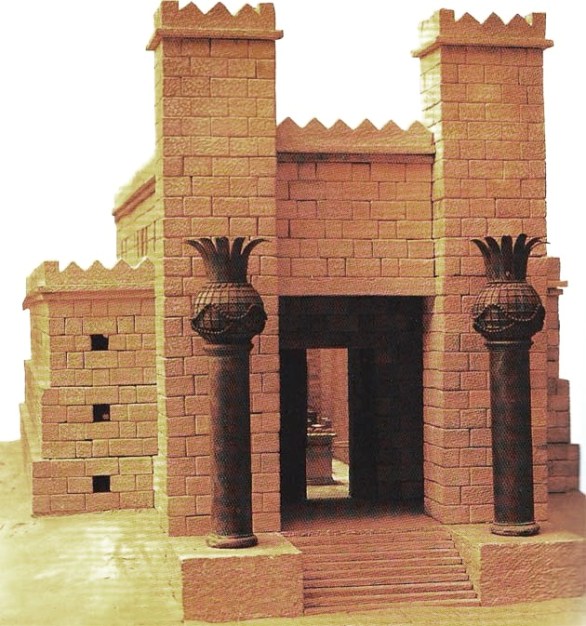
First Temple reconstruction,
Bible Museum, Amsterdam

On this foundation, the “house” is built out of more large squared stones, then paneled inside with cedar wood, and roofed with cedar planks. Additional rooms are built against the outside walls, all the way around. The temple is three stories high, with stairs and narrow latticed windows. This sanctuary could never be disassembled and moved. It is supposed to be permanent. According to the Hebrew bible, it lasted for four centuries, until the Babylonian invaders destroyed it. During that time, the central place of worship for the southern kingdom remained fixed in its capital, Jerusalem.

Another important difference between the tent and the temple is how the materials and labor to build them were obtained. The materials for the tenttextiles, hides, wood, and metals—are all gifts volunteered by the Israelites. This week’s Torah portion opens with God asking for only voluntary donations.

God spoke to Moses, saying: Speak to the children of Israel, and they shall take for me a donation from every man whose heart urges him; [from him] you shall take My donation. And this is the donation that you shall take from them: gold or silver or bronze, or sky-blue or red-violet or scarlet dyes, or linen or goat hair, or hides… (Exodus/Shemot 25:1-5)

But the stone and cedar for Solomon’s temple are purchased from a foreign king, Chiram of Lebanon. This week’s haftarah opens:

God had given wisdom to Solomon, as [God] promised him; and there was peace between Chiram and Solomon, and the two of them cut a treaty. (1 Kings/Malchim 5:26)

Just before this verse, the first book of Kings describes the deal between Chiram and Solomon: Hiram will provide timber and stone for Jerusalem, and in exchange Solomon will pay Hiram in annual shipments of wheat and olive oil—shipments that would require a heavy tax on Israel’s farmers.

In the book of Exodus, both women and men enthusiastically volunteer to do the weaving, carpentry, and metal-working for the tent sanctuary. In the first book of Kings, Solomon imposes forced labor on the Israelite men to do the logging and quarrying.

And King Solomon raised a mas from all of Israel, and the mas was 30,000 men. He sent them to Lebanon, 10,000 a month in turns; they were in Lebanon for a month, two months at home. And Solomon loaned 70,000 burden-carriers and 80,000 stone-cutters on the mountain. (1 Kings 5:28-29)

mas (מַס) = compulsory labor, corvée labor, levy

Compulsory labor, mas, is what the pharaoh imposed on the Israelites in Egypt—the slavery that God and Moses freed them from. King Solomon gets away with his temporary mas, but later in Kings, his son Rechavam imposes an even heavier “yoke” on his people, and they revolt against him.

So while the mishkan is constructed with voluntary gifts and voluntary labor, the temple is built through agricultural taxes and forced labor.

In the Torah portion, Moses gets instructions for making a sanctuary from God Itself. In the haftarah, Solomon remembers his father David’s desire to build a temple, and after he has built a palace for himself, he starts the temple on his own initiative.

In both cases, God makes a conditional promise to dwell among the Israelites. In the Torah portion, God will stay with them if they make a place for God:

And they shall make for me a holy place, and I will dwell in their midst. (Exodus 25:8)

But in the haftarah, God will stay with the Israelites if King Solomon follows the rules:

And the word of God came to Solomon, saying: This house that you are building—if you follow my decrees and you do my laws and you observe all my commandments, to go by them, then I will establish my word with you that I spoke to David, your father: then I will dwell in the midst of the children of Israel, and I will not desert my people Israel. (1 Kings 6:12-13)

The differences between the mishkan and the temple imply two different approaches to religion. The sanctuary God describes to Moses belongs to the people; they make it voluntarily, they move it with them wherever they go, and God dwells among them because they make a holy place for God.

The temple of Solomon belongs to the king; he oppresses his own people in order to procure the materials and labor, he fixes it permanently in Jerusalem, and God dwells among his people because King Solomon obeys God’s rules.

I believe the tent-sanctuary described in the Torah portion represents the ideal approach to communal religion, in which everyone in the community contributes enthusiasm, support, or creativity; in which textual interpretations and rituals are flexible enough to move and change along with the people; and in which everyone makes a holy place for God.

Yet this ideal cannot always be realized. There are times everyone, including me, is too exhausted or too stuck to manage creative communal worship. Sometimes we just need a place to go where the rituals will be fixed and familiar, and where a trusted authority figure is taking care of everything and telling us what to do.

We need both tents and temples.