Haftarat Va-etchannan—Isaiah: Who Is Calling?

Every week of the year has its own Torah portion (a reading from the first five books of the Bible) and its own haftarah (an accompanying reading from the books of the prophets). This week the Torah portion is Va-Etchannan (Deuteronomy 3:23-7:11) and the haftarah is Isaiah 40:1-26.
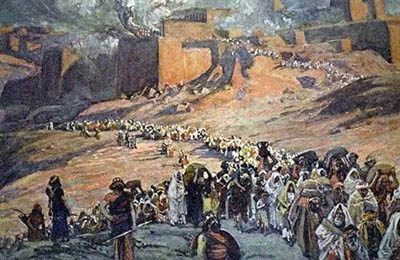
Deportation from Jerusalem

Nebuchadnezzar conquered Judah, destroyed Jerusalem, razed its temple, and deported all its leading citizens to Babylonia in 597-596 B.C.E. Then each family in exile faced a decision.

Should they give up on their own religion, their own identity, and assimilate? Or should they have faith that their god had the power and the desire to eventually return them to their own land?

           Nachamu, nachamu My people!

            Says your god. (Isaiah 40:1)

nachamu (נַחַמוּ) = Comfort! Reassure! (This imperative verb has the plural suffix u (וּ), meaning the speaker—God—is urging more than one person—or divine being—to reassure God’s people.)

This call for reassurance (and enlightenment) opens this week’s haftarah and what is really the second book of Isaiah.

(Isaiah 1-39, considered the first book of Isaiah, is set in the 8th century B.C.E., and warns that God will send an army against the people of Jerusalem if they do not reform. (See my post last week, Haftarah for Devarim—Isaiah: False Worship.) The rest of Isaiah, chapters 40-66, is set in the 6th century B.C.E., near the end of the Babylonian exile and shortly before the Persian emperor Cyrus II took Babylon in 539 B.C.E. , This second book of Isaiah shares a new vision of God: that God is both the protector of the Israelites and the only god in the universe, powerful beyond imagining.)

The haftarah at the beginning of the second book of Isaiah promises that God has forgiven the exiles in Babylonia and will soon gather them home.

God continues:

            Speak (dabru) to the heart of Jerusalem

            And call out (kire-u) to her

            That she has worked off her debt,

            That her wrongdoing has been accepted,

            That she has received from the hand of God

            Double the amount of all her sins. (Isaiah 40:2)

The Hebrew words for both “Speak!” and “Call out!” above also have the plural suffix u (וּ). But who is God addressing? As the poem continues, it seems that God is giving orders to two disembodied voices.

Isaiah 40 3

           A kol is calling out:

           Clear (panu) in the wilderness

           A path for God!

           Level (yasheru) in the desert

           A highway for our god! (Isaiah 40:3)

kol (קוֹל) = voice; sound; speech.

            And the glory of God shall be revealed

            And all flesh shall see (ra-u) it together… (Isaiah 40:5)

Again, the verbs are in the plural, with the suffix u (וּ). The kol is not addressing a work crew; it seems to be urging multiple persons to open the minds of the Jerusalemites in Babylon, so they can experience God.

           …A[nother] kol says: Call out! (kera!)

           And he says: What shall I call out? (Isaiah 40:6)

The second kol uses the singular form, commanding one unidentified male person to call out. But “he” seems to be depressed about the transience of human life, and eight lines later, the kol recruits a second person:

            Climb up (aliy) on a high mountain,

            Mevaseret of Zion!

            Lift up (harimiy) your voice with strength,

            Mevaseret of Jerusalem!

            Lift up (harimiy), do not be afraid (tiyra-iy)!

            Say (imriy) to the cities of Judah:

            Here is your god! (Isaiah 40:9)

mevaseret (מְבַשֶֹּרֶת) = herald, bringer of news. (Mevaseret is the feminine form of mevaseir (מְבַשֵֹּר) = a (male) herald.)

The voice addresses the mevaseret using imperative verbs with a singular feminine suffix, iy (יִ), telling her to speak so as to lift the spirits and hopes of the Jewish exiles.

As Sheryl Noson-Blank points out in The Women’s Haftarah Commentary, early commentators could not imagine the mevaseret as a woman; Targum Yonatan (~50 B.C.E.) translated mevaseret into Aramaic as plural male prophets, while David Kimchi (1160-1235 C.E.) decided the mevaseret was the land of Zion herself.

The second book of Isaiah never tells us the identity of the man or the woman recruited by the kol. Maybe they are the prophet-poets who wrote the book. Or maybe they represent all inspired men and women among the exiles in Babylon.

Nor does the book clarify what the two voices are. The first statement, that the people of Jerusalem have been sufficiently punished and should now be reassured that God will redeem them, is definitely attributed to God.

But how will God’s order be achieved? The first kol says all impediments to beholding God must be cleared away. The second kol says the news must be called out by heralds, man and woman.

What are these voices that interpret God’s original thought?

*

Some commentators view the voices as members of a divine council. In other religions of the ancient Near East, the gods assembled under the chairmanship of the chief god to discuss earthly affairs. The Hebrew Bible also mentions a divine council or assembly, whose members are variously described as:

           elohim (אֱלֺֹהִים) = gods; a god with various aspects; God.

           beney ha-elohim (בְּנֵי־הָאֱלֹהִים) = offspring of the gods; offspring of God.

           kedoshim (ֹקְדֹשִׁים) = holy ones, holy places.

           ruchot (רוּחוֹת) = spirits, winds, motivating forces.

In Psalm 82 the members of God’s assembly are called simply elohim, gods.

           God takes a stand in the assembly of El,

           Among elohim he pronounces judgment. (Psalm 82:1)

El is the high god in Canaanite mythology, equated with the God of Israel in this psalm.  God/El criticizes the elohim in God’s assembly for ignorantly favoring the wicked rather than the poor in their judgments, and decrees that henceforth these lesser gods will die like human beings.

Psalm 89 calls the members of the divine assembly beney elohim (“offspring of gods” or “offspring of God”) and kedoshim (“holy ones”), but they still appear to be lesser gods:

           Because who in the sky can measure up to God,

           Can compare to God, among beney elohim?

           El is greatly dreaded in the council of kedoshim

           And held in awe above everyone around Him. (Psalm 89:7-8)

In the book of Genesis, beney ha-elohim (offspring of “the gods” or God) resemble the gods in Greek myths.

The beney ha-elohim saw that the daughters of humankind were good, and they took wives for themselves from all that they chose. …when the beney ha-elohim came into the daughters of humankind, they bore children to them, heroes that were famous forever. (Genesis 6:2, 6:4)

Many scholars consider this fragment a piece of an ancient Canaanite text that was included in Genesis as a result of clumsy editing. However, the book of Job also refers to beney ha-elohim in its first two chapters.

One day the beney ha-elohim came to stand before God, and even the satan came among them. (Job 1:6)

satan (שָׂטָן) = accuser, adversary, one who feels animosity.

The satan persuades God to test Job to find out if he serves God only because he is fortunate, and God commissions this particular “offspring of the gods” to kill Job’s children and destroy his wealth. The heavenly council meets again, and the satan persuades God to commission him to afflict Job with diseases. Then most of the book is a long discussion of the problem of how God can be omnipotent and good, yet permit evil in the world.

Is the divine council of beney ha-elohim, including God’s satan, merely an engaging way of setting up the problem by using a Canaanite mythological theme? Or do the beney ha-elohim represent different aspects of the mind of God, like the different and sometimes conflicting inclinations in each human mind?

In the first book of Kings, the prophet Mikhayehu describes his vision of a divine council whose members appear to include stars, which are often called “the army of the heavens” in the Bible.

I saw God sitting on His throne, and all the army of the heavens was standing in attendance on Him to His right and to His left. And God said: “Who will fool Ahab so he will go up and fall at Ramot of Gilad?” And this one said thus, and this one said thus. Then the ruach went and stood before God and said: “I, I will fool him.” And God said to him: “How?”  And he said: “I will go and be a ruach of falsehood in the mouth of all his prophets.” (1 Kings 22:19-22)

ruach (רוּחַ) = spirit, wind, or motivating psychological force (singular of ruchot).

One or more ruchot are also at the council meeting, advising God. Just as God commissions the satan to carry out his suggestion about testing Job, in the first book of Kings God commissions the ruach to carry out his suggestion for bringing down Ahab. Elsewhere in the Bible, God sends a ruach elohim (a spirit of God) or a ruach hakodesh (a holy spirit) to individuals to overwhelm them with a mood or inspire them to become prophets. Here, the ruach that volunteers to makes Ahab’s prophets speak falsehoods is an aspect of God.

*

Back to this week’s haftarah in second Isaiah. I think the “voices” that respond to God’s initial order to nachamu, nachamu the people of Israel are like a divine council—but it is a council consisting of different aspects of one God. As God considers how to reassure the exiled Israelites, ideas arise, each with its own kol or voice.

The unnamed man and the mevaseret hear these divine voices inside their own heads, and they must respond.

Perhaps their response is the second book of Isaiah.
Haftarot for Vayikra & Tzav—Isaiah & Jeremiah: Useless Gods

Every week of the year has its own Torah portion (a reading from the first five books of the Bible) and its own haftarah (an accompanying reading from the books of the prophets). Last week the Torah portion was Vayikra (Leviticus 1.1-5:26) and the haftarah was Isaiah 43:21-44:23. This week the Torah portion is Tzav (Leviticus 6:1-8:36) and the haftarah is Jeremiah 7:21-8:3 and 9:22-23.

The first two Torah portions in the book of Leviticus/Vayikra consist entirely of instructions for making offerings on the altar: what each type of offering is for, what kind of animal or grain should be brought, and how the priests should process them. In Leviticus, this is the primary way to worship God, so the instruction manual is important.

The two accompanying haftarah readings both declare that offerings on God’s altar are meaningless when people are also making and worshiping idols.

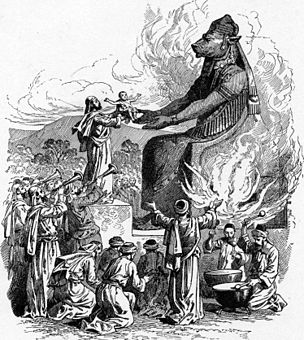
Tofet in "Bible Pictures", 1897
Tofet in “Bible Pictures”, 1897

The children of Judah have done what is bad in My eyes, declares God. They have set their abominable idols in the House with My name on it, defiling it. And they have built shrines of the Tofet in the valley of Ben-Hinnom, for burning their sons and their daughters in the fire, which I did not command and which did not arise in my mind. (Jeremiah 7:30-31)

Jeremiah decries the placement of statues of other gods right in God’s temple (“house”) in Jerusalem, as well as the practice of Tofet-worship in the valley below.  The haftarah from Isaiah points out that a craftsman might burn part of a log to burn for heat and cooking, and carve another part of the log into a statue to which he bows down and prays.

Yotzeir of an idol—

All of them are emptiness;

And what they crave

Cannot be useful.  (Isaiah 44:9)

yotzeir (יֹצֵר) = shaping, forming, fashioning.

Other gods and the statues that represent them are empty, useless. God does the yotzeir of real humans; but a human does the yotzeir of false gods.

Jeremiah agrees that worshiping other gods is useless. In a prophecy that follows this week’s haftarah, Jeremiah says:

And the towns of Judah and inhabitants of Jerusalem will go to the gods for whom they sent up offerings in smoke, and call for help. But they [these gods] will certainly not rescue them at the time of their adversity. (Jeremiah 11:12)

The haftarah in Isaiah goes a step further, and declares other gods simply do not exist.

Thus said God, king of Israel

And its redeemer, God of Armies:

I am first and I am last

And except for Me there are no gods. (Isaiah 44:6)

The haftarot in Jeremiah and Isaiah agree that God punished the people of Judah for making and worshipping other so-called gods by sending in the Babylonian army to conquer the land and destroy Jerusalem and its temple. (See my post Haftarah for Bo—Jeremiah: The Ruler of All Armies.)

Does that leave any hope for the future? Jeremiah, who witnessed the siege of Jerusalem in 589-587 B.C.E., predicts only more disaster.

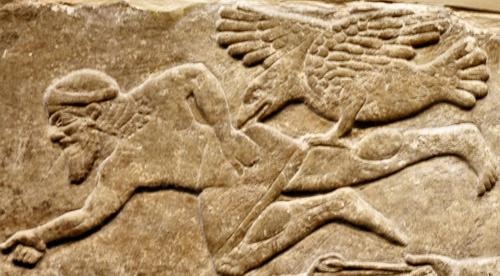
Vulture on Assyrian relief carving in Kalhu

And the carcasses of these people will be food for the birds of the sky and for beasts of the earth, and there will be no tomorrow. (Jeremiah 7:33)

And death will be preferable over life for all the remainder of those remaining from this wicked family, in all the places where I will push them… (Jeremiah 8:3)

But chapters 40-66 of the book of Isaiah were written at least 50 years later, after the Babylonian empire had been replaced by the Persians. Although the Jews did not get an independent kingdom again, the new Persian emperors granted them religious freedom and let those who wished go back to Jerusalem and build a second temple for their god.

The haftarah from Isaiah interprets this Persian policy as God’s intervention. After criticizing the Israelites for their idolatry, the haftarah says:

I have wiped away like a mist your rebellion

And like a cloud your transgressions.

Return to Me, for I have reclaimed You. (Isaiah 44:22)

How can they return? What should they do that is more important than making offerings at a rebuilt altar? This week’s haftarah from Jeremiah says they should follow God’s directions for the right way to behave in the world.

Heed My voice, and I will be your god and you will be My people; but you must walk on the entire path that I command you, so that it will go well for you. (Jeremiah 7:23)

Last week’s haftarah from Isaiah says they should praise God to the rest of the world.

This people yatzarti for Myself:

My praise they should report! (Isaiah 43:21)

yatzarti (יָזַרְתִּי) = I formed, I shaped, I fashioned. (From the same verb as yotzeir above.)

Instead of forming statues of empty, useless gods, the people should report what the real God is.

But the Israelites of Judah turned deaf (according to Jeremiah) and mute (according to Isaiah) where God was concerned.


We still make idols for ourselves, 2,600 years later, and we still worship “gods” that are ultimately useless. Some people pursue power as if it were the source of life—until their careers or families crash and they discover they live in a spiritual exile. Others dedicate themselves to accumulating or spending money—until a disaster reveals how they devoted so much time and energy to something so transient. We do not need an anthropomorphic god to send an army against us; serving the false gods we create carries its own intrinsic punishment, preventing us from leading full and meaningful lives.

A Jeremiah can point out that the wrong path leads to a bitter death. Sometimes this is the slap in the face we need to wake up.

But an Isaiah can give us hope for a second chance, however late in life. If we return to God—if we return of a life of appreciating reality (one form of praising God), appreciating one another, remembering we are only human, and rejoicing when we come home to our better selves—then the divine spirit will wipe away our former false worship like a mist, like a cloud. We can change, and true meaning can return to our lives.

Haftarah for Ki Tavo–Isaiah: Rise and Shine

I was an alto before I was a Jew. I first sang Handel’s “Messiah” in my high school choir. Now, 27 years after my conversion, I still enjoy Handel’s music, and I still do not take the words seriously. But when you sing words, you remember them.

This week I read the Torah portion, Ki Tavo, and then turned to the haftarah, the passage from the Prophets/Neviyim that is traditionally chanted after the Torah portion at the morning Shabbat service. I glanced at the first line in Hebrew, and I immediately sang:

handel-1

Arise, shine, for thy light has come! (Isaiah 60:1)

This King James Bible translation accurately captures one possible meaning of the Hebrew. But the “Messiah” uses the line for an entirely different purpose than the book of Isaiah. Handel’s friend Charles Jennens, who provided the libretto for the oratorio, was a devout Anglican who wanted to tell a story of Jesus’ life in terms of direct divine intervention in human affairs. So he cut and pasted verses from all over the King James Bible and the Common Book of Prayer to make his point.

Jennens took many lines out of context from the book of Isaiah. At the beginning of the “Messiah”, after setting the scene, he put in a line from the King James version of Isaiah: Behold, a virgin shall conceive and bear a son, and shall call His name Emmanuel: God with us.

This line is now notorious as a bad Hebrew translation. A more accurate translation would be: Behold (or Hey!), the young woman is pregnant and is giving birth to a son; may she call his name Immanu-El (with us God). (Isaiah 7:14)

There is no virgin birth in the original Hebrew, and the young woman is already pregnant. There is no indication here or in the rest of Isaiah that this line has anything to do with the birth of someone called Jesus about 700 years later.

But by using this quote from the King James Bible, Jennens established that the “Messiah” was going to be about Jesus. He proceeded with another out-of-context quote from Isaiah: O thou that tellest good tidings to Zion …say unto the cities of Judah, behold your god! (Isaiah 40:9)

Then Jennens goes directly to the verse at the beginning of this week’s haftarah. The King James translation is: Arise, shine, for thy light is come, and the glory of the Lord is risen upon thee.

Here is my own translation:

Arise! Shine! For your light ba,

And the kavod of God dawns over you. (Isaiah 60:1)

ba = come, has come, is coming

kavod = glory, honor, dazzling splendor, awesome presence

In the “Messiah”, Jennens uncharacteristically chose to follow up Isaiah 60:1 with the next two verses, Isaiah 60:2-3. A solo bass sings the King James version: For behold, darkness shall cover the earth, and gross darkness the people; but the Lord shall arise upon thee, and His glory shall be seen upon thee. And the Gentiles shall come to thy light, and kings to the brightness of thy rising.

Here is my translation from the Hebrew:

For hey! the darkness will cover the earth

And the gloom the peoples;

But God will dawn upon you

And Its kavod will appear over you.

And the nations will walk to your light

And kings to a gleam of your dawn. (Isaiah 60:2-3)

What is the light that either came or is coming? And who is “you”?

These three verses connect “light” with God’s glory. In the previous two chapters of Isaiah, the Israelites who live in exile in Babylonia have been groping in the darkness of ignorance, wondering how to find their god. So “light” may mean both enlightenment and God’s close approach.

The “you” (and all the verbs) in the verses above are in the feminine singular, but no female human is mentioned. “The people” and “God” (and “Jesus”!) would all take the masculine form. However, most place-names in the Torah are feminine. The subject whose light will attract the tribute of many nations is finally named in 60:14: And they will call you City of God, Zion of the Holy One of Israel.

Zion (pronounced Tziyon in Hebrew) is a synonym for Jerusalem. Scholars date the second half of the book of Isaiah (chapters 40-66) to about 550-515 B.C.E., around the time when the Persian king Cyrus  gave the Jews in exile permission to return to Jerusalem and rebuild their temple. The poet in Isaiah chapter 60 apparently rejoiced that Zion’s people and religion were rising again, and hoped that the religion would spread as more and more nations “saw the light”.

So in the 6th century B.C.E., the book of Isaiah saw the rebuilding of Jerusalem as the dawn of an era in which belief in the god of Israel would become universal. In the 18th century C.E., the librettist of Handel’s “Messiah” connected the dawning of God’s light with the birth of Jesus, heralding the new religion of Christianity. Meanwhile, for the last 2,000 years or so, Isaiah 60:1-22 has been the “sixth haftarah of consolation” of Jews; we read it during the sixth week after Tisha B’Av, the day of mourning for the fall of the first and second temples in Jerusalem.

Can this haftarah from Isaiah, which is so hopeful about the rebuilding of the temple, still console us for the fall of both temples in Jerusalem? Personally, I am glad that for the last 2,000 years we have been seeking God through prayer instead of through animal offerings at a temple.  But I am still waiting for enlightenment to dawn over Zion.

Meanwhile, I can use a message of hope during this introspective month of Elul, when Jews are asked to prepare for Yom Kippur by reviewing the past year and acknowledging their misdeeds. As Rabbi Shoshana Dworsky pointed out, it is easy for a woman to take the first few verses of this haftarah personally, since all the language is in the feminine singular! What if the poem is addressing me, as I wonder how I will ever outgrow the shortcomings in my character that I am pondering this month?

Maybe my light is coming, and soon I will arise and shine.