The covenant between the Israelites and their God is like a marriage, according to four prophets in the Hebrew Bible: Hosea, Jeremiah, Ezekiel, and second Isaiah. They refer to God as the husband, and “Israel” as the bride. Israel loves her husband at first, in this analogy, but then abandons him by committing adultery with other men (worshiping other gods).
Hosea: The harlot
This analogy first appears in the book of Hosea, written in the 8th century B.C.E. as the Neo-Assyrian Empire was attacking the northern kingdom of Israel. Hosea calls the northern kingdom the “mother” of the Israelites, and declares that she has cheated on her legitimate “husband”, God. As God’s mouthpiece, Hosea urges the people of Israel:
"Bring a case against your mother, a case!
          For she is not my wife,
          And I am not her husband.
She must clear away the whoredom from her face,
          And the sign of adultery from between her breasts.
If not, I will strip her down to her nakedness
          And display her as on the day she was born.
And I will turn her into a wilderness,
          And make her like a waterless land,
          And let her die of thirst." (Hosea 2:4-5)

In other words, the Israelites must cease all worship of other gods, or else their kingdom will be destroyed. (See my post: Haftarat Bemidbar—Hosea: An Unequal Marriage.)
After the Assyrians wiped out the kingdom of Israel, the Hebrew Bible used the term “Israel” to refer to the people of the southern kingdom of Judah. The next prophet to employ the marriage analogy was Jeremiah. Like Hosea, Jeremiah explained that God let enemies attack because the Israelites persistently disobeyed God’s rules—both by cheating and oppressing the poor, and by worshiping other gods.
Jeremiah: The devoted bride
This week’s haftarah reading is Jeremiah 2:4-28, which Jews read on the same Shabbat as the final Torah portion in the book of Numbers, Masey. This is the second of three “haftarot of admonition” before Tisha Be-Av, the day of mourning for the Babylonian destruction of the temple in Jerusalem in 587 B.C.E. and subsequent tragic events.
Jeremiah introduces the marriage analogy just before this week’s haftarah begins.
And the word of God happened to me, saying: “Go and proclaim in the ears of Jerusalem, saying: Thus said God:
I recalled for you the devotion of your youth,
          The love of your betrothals,
Your following after me in the wilderness,
          In a land not sown.
Israel was holy to God …” (Jeremiah 2:1-3)
Leaving home to follow a new husband to a new land is not easy, even if the bride’s home is a place of servitude, like Egypt. Yet Israel, the prophet says, was a devoted bride and followed God into an uninhabited wilderness—“without provisions for the way, since you believed in me,” Rashi adds.1
Jeremiah does not mention how short this honeymoon period is in the book of Exodus. The Israelites rejoiced when they followed God’s pillar of cloud and fire out of Egypt, and again after they crossed the Reed Sea. But every time they ran short of food or water they panicked, not trusting God to provide for them. And when Moses left them at the foot of Mount Sinai for forty days, they made and worshiped a golden calf, violating God’s commands requiring exclusive worship.
Jeremiah: The wandering wife
The golden calf is only the first of many episodes in the Hebrew Bible in which Israel is unfaithful to God. In this week’s haftarah Jeremiah transmits God’s complaint that Israel, who once “followed after” God, has been “following after” other gods.
Thus said God:
“What wrong did your fathers find in me
         That they wandered away from me?
And they followed after the hevel,
          And they trusted in hevel!” (Jeremiah 2:5)
hevel (הֶבֶל) = (literally) a puff of air; (figuratively) emptiness, a mere nothing, something transitory that quickly vanishes.2 Why did the Israelites abandon their own God, who is a real, for hevel? The book of Jeremiah brings up the exodus again to underline this folly.
“And they did not say: Where is God,
          Who brought us up from the land of Egypt,
Who led us through the wilderness,
          Through a land of desert and pit,
Through a land of parched earth and death’s shadow,
          Through a land no man had crossed,
          And no human had dwelled in?
And I brought you to a land of vineyards,
          To eat its fruit and its goodness!
But you came and made my land tamei,
          And my inheritance anathema. (Jeremiah 2:6-7)
tamei (טָָמֵא) = unfit for serving God; contaminated, defiled. (“Unclean” in older translations.)
This passage reminds the people of Judah that in the foundational myth of the exodus, God rescued them from Egypt and “gave” them (let them conquer) a fruitful land. But instead of being grateful, the Israelites are contaminating the land. Serving other gods in addition to the God of Israel contaminates the land God gave them because, unlike other gods in the Ancient Near East, their God is a jealous God.3 Their covenant with God is as exclusive as a woman’s marriage to a man. (A man in the Hebrew Bible could take more than one wife or concubine or female slave; but a woman was only allowed to have sex with her husband or owner.)
Jeremiah: The persistent harlot
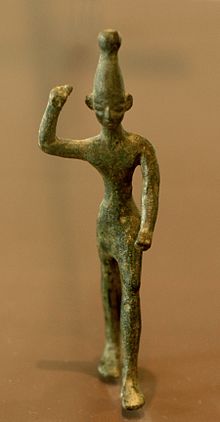
Even after King Josiah has eliminated the worship of other gods in Jerusalem’s temple and some scattered shrines,4 the people still go to the traditional hilltops and big trees where the Canaanite god Baal and goddess Asherah were always worshiped.
“… For on every high hill and under every luxuriant tree
          You recline as a harlot.
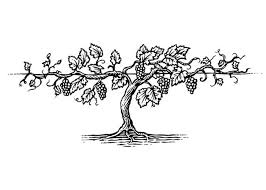
I planted you as a choice vine,
	  A wholly true seed.
Then how could you turn against me,
	  Disloyally turning into a foreign vine?” (Jeremiah 2:20-21)


The Israelites of Judah pretend they are obedient to God, but they cannot scrub off the stain of their crime (Jeremiah 2:22). So God exclaims:
“How can you say: “I am not tamei,
          I did not follow after the Baalim”?
Look at your path in the ga!
          Realize what you have done! (Jeremiah 2:23)

ga (גַּיא) or gey (גֶּיא) = valley.
Jeremiah is referring to Gey Ben Hinnom, the valley just south of Jerusalem where people sacrificed children to the god Molekh. He mentions this crime again in Jeremiah 7:31–32 and 32:35,5 which indicates that Josiah’s destruction of the shrine for Molekh had no lasting effect, and Molekh worship resumed under the next few kings of Judah.
After comparing Israel to a wayward female camel and a wild ass in heat, Jeremiah passes on these divine words to the Israelites:
“Then you say: It’s hopeless!
          No, because I love zarim,
          And I must follow after them.” (Jeremiah 2:25)
zarim (זָרִים) = strangers, foreigners, unlawful or forbidden things (in this case, foreign and forbidden gods).
Perhaps the Israelites find foreign gods irresistible because they can be worshiped in the form of idols—sculptures made of stone, wood, or metal (like the golden calf). An invisible god is harder to relate to. The haftarah concludes:
“They said to wood: You are my father!
	And to stone: You gave birth to me!
For they turned the back of their necks to me
	And not their faces.
But in their time of disaster, they say:
	Arise and save us!
And where are those gods that you made for yourself?
        Let them arise with your salvation in your time of disaster!
For the number of your towns
	Has become the number of your gods, Judah!” (Jeremiah 2:27-28)
The disaster is coming. In the east the new Babylonian empire is expanding, conquering any small kingdoms that do not pay tribute. When King Zedekiah of Judah revolts instead, the Babylonian army conquers Judah, besieges Jerusalem, and destroys the city and its temple in 587 B.C.E.. Jeremiah goes into exile, still prophesying.
Jeremiah could have put all the blame for the destruction of Jerusalem on the king’s foreign policy. Instead he argues that God let an enemy empire destroy God’s own temple because the Israelites were flagrantly unfaithful to God. Israel’s unfaithfulness amounted to a divorce.
When you believe in an omnipotent God, and God fails to protect your people from disaster, the easiest explanation is that your people did the wrong thing and alienated God. Even some Jews who survived the Holocaust assumed that God let it happen because the Jews were insufficiently religious.
This solution to the “problem of evil” is unsatisfying, because it makes God seem unjust and spiteful. Hosea, Jeremiah, and Ezekiel all portray God as a jealous husband who, in effect, murders his wife. Only in second Isaiah is God willing to forgive Israel and take her back.
- Rashi (11th-century rabbi Shlomoh Yitzchaki), translation in www.sefaria.org.
- Hevel is also the name of Cain’s brother in Genesis 4:2-11, and the refrain in Ecclesiastes.
- E.g. Exodus 20:5. See last week’s post: Pinchas & Balak: Calming Zeal.
- 2 Kings 22:3-23:20.
- See my post: Acharey Mot & Kedoshim: Fire of the Molekh.










 Questioning Torah