Balak, Pinchas, & Matot: Midianites Revisited

Ten years ago I wrote a post called Balak, Pinchas, & Matot: How Moabites Became Midianites. I received some positive comments, but also some hate mail. I am leaving that post up to remind myself that my writing is not always interpreted the way I intended it.

This week Matot (Numbers 30:2-32:42) arrives again in the annual cycle of Jewish Torah portions, and I want to add another interpretation of the Israelites’ massacre of Midianite women. I also want to re-examine my conclusion in 2015, in which I compared my own unreflective discrimination against Republicans to Moses’ discrimination against Midianites.

Midianites in Moab

Moses first encounters Midianites in the area where archaeologists have confirmed that they actually lived: east of the Gulf of Aqaba (in present-day Saudi Arabia), and north up to and including Timna. In the book of Exodus, Moses is fleeing from a murder charge in Egypt, and a priest of Midian invites Moses to live with him and marry one of his daughters.1

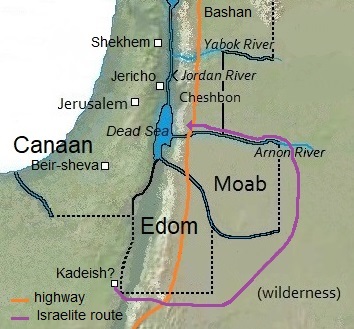
Years later in the book of Numbers, Moses leads the Israelites all the way to the east bank of the Jordan River. When King Sichon will not let them pass through Cheshbon, they conquer his whole kingdom, and the kingdom of Bashan to the north. Then they go back and camp in the acacias on the “Plains of Moab”, so-called because the land of Cheshbon was once part of kingdom of Moab.

In the Torah portion Balak, King Balak of Moab is afraid of the horde of Israelites camped just north of his border.

And Moab said to the elders of Midian: “Now this assembly will lick up everything around us like the ox licks up the green plants of the field!” (Numbers 22:4, in the portion Balak)

Apparently there is no king of Midian, so King Balak sends his message to the elders of each town. And apparently the Midianites respond to his call for an ally, because when Balak sends a delegation to Bilam, a Mesopotamian “sorcerer”, the Torah says:

The elders of Moab and the elders of Midian went, and tools of divination were in their hand, and they came to Bilam and they spoke Balak’s words to him. (Numbers 22:7).

Balak’s message asks Bilam to come to Moab and curse the Israelites. Eventually the two men meet on a ridge at Moab’s northern border, overlooking the Israelite camp. But King Balak’s plan fails, because Bilam is actually a prophet, and God will not let him curse the Israelites.2

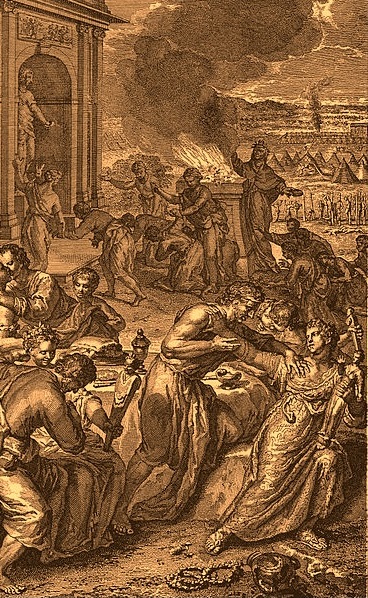
Then Bilam got up and went, and he returned to his place. And also Balak went on his way. And Israel stayed in the acacias, and the people began to whore with the women of Moab. They [the women] called the people for animal sacrifices of their gods, and the people ate, and they bowed down to their gods. And Israel yoked itself to the Ba-al of Peor, so God’s nose heated up against Israel. (Numbers 24:25-25:3)

As usual, the God character responds to “whoring” after other gods with a plague. Next, an Israelite man brings a foreign woman into the Tent of Meeting itself for sex. Aaron’s grandson Pinchas quickly thrusts a spear through both of them, and the plague halts.

One would expect the impaled woman to be a Moabite, since the Israelite men were seduced into worshiping Ba-al Peor by Moabite women. But the next Torah portion, Pinchas, identifies the foreign woman as the daughter of a Midianite elder.

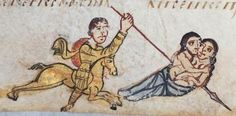
Pinchas impales them, in Sacra Parallela, 9th century Byzantine manuscript

And the name of the Midianite woman who was struck down was Kozbi, daughter of Tzur, the head of the people of a paternal household from Midian. And God spoke to Moses, saying: “Be hostile toward the Midianites, and strike them down. Because they were hostile to you through their deceit, when they deceived you about the matter of Peor …” (Numbers 25:15-18)

Suddenly Moabite women have become Midianite women.

In this week’s Torah portion, Matot, God reminds Moses to attack the Midianites.

And God spoke to Moses, saying: “Take vengeance, the vengeance of the Israelites, from the Midianites; afterward you will be gathered to your people.” (Numbers 31:1-2)

Moses obediently musters an army.

And they arrayed against Midian, as God had commanded Moses, and they killed every male. And the kings of Midian they killed … five kings of Midian, and Bilam son of Beor, they killed by the sword. But the children of Israel took captive the women of Midian and their little ones… (Numbers 31:7-9)

In this passage, the Midianites are not ruled merely by elders, but by five kings. And Bilam, who goes home at the end of the portion Balak, mysteriously appears among the kings of Midian.
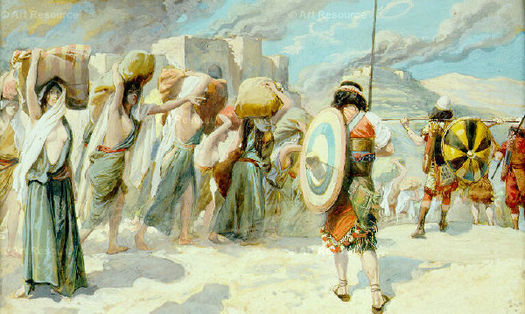
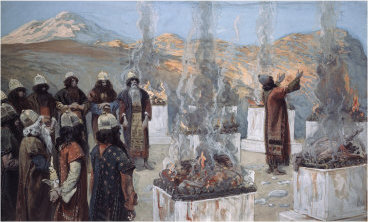
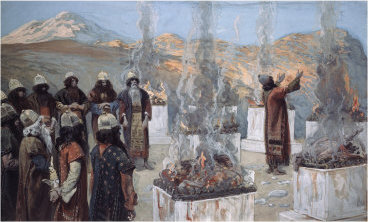
The Women of Midian Led Captive by the Hebrews, by James Tissot, ca. 1900

The story ends with the slaughter of the captive Midianite women. (See my post Matot: Killing the Innocent.)

And Moses said to them: “You left every female alive! Hey, they were the ones who, by the word of Bilam, led the Israelites to treachery against God in the matter of Peor, so there was a plague in God’s assembly. So now, kill every male among the little ones; and every woman who has known a man by lying with a male, kill!” (Numbers 31:15-17)

Has Moses forgotten that the Israelite men were seduced into worshiping Ba-al Peor by Moabite women? Or does he assume that God must be right, so the women whom he thought were Moabites must secretly be Midianites?

Another Explanation for Midianites in Moab

In my 2015 post, I review three kinds of attempts by commentators to reconcile the apparent conflation of Moabites and Midianites in this storyline: the “apologists”, who invented bizarre explanations for the inconsistencies; the “scientists”, modern scholars who assigned the scenes to two different sources and noted that the redactor left both Moab (the enemy in the J/E source) and Midian (the enemy in the P source) in the story; and the “psychologists”, who imagined that Moses, whose own wife is a Midianite, is flummoxed when God tells him that the Midianite women are all guilty.

Now I would add a fourth explanation. Angela Roskop Erisman3 dates the storyline about Midianites in Moab to the reign of Hezekiah, the king of Judah from circa 716 to 687 B.C.E. Before King Hezekiah rebelled against being a vassal of the Assyrian Empire, he lined up support from Egypt, but Egypt (ruled by Kushites at the time) was not much help. So, according to Erisman, he probably arranged an alliance with Midian instead. These two political alliances are reflected in the Torah, where Moses has a Midianite wife in the book of Exodus, but a Kushite wife in Numbers 12:1.

Jerusalem survived the Assyrian siege in 701 B.C.E. not because of any allies, but because King Hezekiah had built a new city wall and dug a tunnel between the city and the nearest water source, the Siloam Pool. No assistance from Midianites was recorded either in the Hebrew Bible or on the Assyrian stelae that have been excavated.

If the Midianites failed to come to the aid of Jerusalem, that would be reason enough to vilify them in one of the stories about Moses.

Floored by comments

Ten years ago, I wrote this conclusion to my post on Midianites in Moab:

“Just as Moses judges all Midianites in the five northern tribes as evil because of the actions of a few of their members, human beings throughout history have made judgements about undifferentiated groups.  It is so much easier than discriminating among individuals. From Biblical times to the present day, some people have judged all Jews as bad.

“Today, I catch myself ranting against Republicans, as if every person who voted Republican in the last election were responsible for the particular propaganda efforts and political actions that I deplore. A psychological look at the story of Moses and the Midianites near Moab reminds me that I need to be careful not to slander the innocent with the guilty.”

My intention was to sound a warning against treating all members of a group as if they were the same. It is obvious that “All Midianites are bad” is a false statement in the context of the whole Torah, since Moses’ father-in-law and wife are Midianites and do nothing but good deeds.

My next example was my own bad tendency to talk about “Republicans” as if all Republicans were bad. I thought I was being clear that there were people who voted for Republican candidates in the 2014 election for reasons that had nothing to do with the claims and policies that I, personally, objected to.

But I got a lot of comments that were vicious put-downs. I deleted them, since I did not want hate language in this blog. Now I wish I had saved them, so I would have examples of knee-jerk emotional reactions.

This year I received a milder negative comment on my 2015 post:

“You had me until you started the Republican rant…. Too bad TDS once again ruins scripture talk unnecessarily.”

I had to look up TDS. I found it that it stands for “Trump Derangement Syndrome”, and is a term that some supporters of Donald Trump use to criticize people whom they perceive as having knee-jerk emotional reactions against Trump that make them incapable of perceiving reality.

Who is making a rational analysis, and who is having a knee-jerk emotional reaction? It turns out to be a complicated question.

Should I have avoided any mention of politics in my 2015 blog post, and found a different example of my own tendency to discriminate against whole groups (instead of being discriminating about the differences among individual members of those groups)?

Maybe. But I find American politics more frightening now than I did ten years ago. When I wrote my 2015 post, I thought it was obvious that “All Jews are bad” is a false statement, like “All Midianites are bad”. But now anti-Semitism is increasing in the United States, and it comes from both ends of the political spectrum. I suspect that the increase on the right is part of today’s greater tolerance for hate speech, while the increase on the left is due to a false assumption that all Jews support the current government of Israel’s war on Gaza.

Will human beings ever overcome the black-and-white thinking that leads us to slander whole groups of people?


  1. Exodus 2:15-22.
  2. See my post Balak: Prophet and Donkey.
  3. Angela Roskop Erisman, “Moses is Modeled on Horus and Sargon, but His Story Is About King Hezekiah” and “Miriam Complains of Moses’ Cushite Wife: Hezekiah Married the Wrong Empire!” in www.thetorah.com, 2025.

Balak: High Anxiety

Poor King Balak of Moab. His name, Balak (בָּלָק), means “he devastated”. But he never devastates any person or any land in the Torah; instead, Balak himself feels devastated.

The situation

Balak already rules a diminished country. During the reign of the previous king, the Amorites conquered the northern half of Moab.

… Sichon, king of the Amorites, himself had waged war against the former [king] of Moab, and had taken all his land from his hand, as far as the Arnon. (Numbers 21:26)

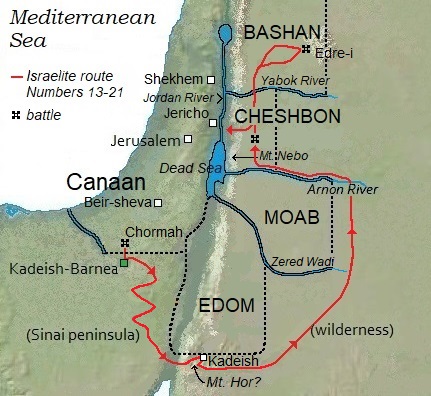
Next, a horde of Israelites march through the wilderness east of Moab at the end of last week’s Torah portion, Chukat, avoiding settled lands until they have crossed the Arnon River. Then they turn west, heading for the land of Canaan. Since they must pass through King Sichon’s city-state of Cheshbon to reach the Jordan River, they ask Sichon for permission to travel on the king’s highway, promising they will not use any well water or go off the road into fields or vineyards. But the king refuses and attacks the Israelites east of his border. They conquer his entire country. (See my post Chukat: Respect versus Belligerence.)

Encouraged by their victory, the Israelites begin conquering more Amorite land to the north, until the army of King Og of Bashan confronts them at Edre-ii.

(Route of the Israelites in red)

And they [the Israelites] struck him and his sons and all his people, until there was no survivor left to him, and they took possession of his land. Then the Israelites journeyed on, and camped on the Plains of Moab, across the Jordan from Jericho. (Numbers 21:35-22:1)

The Torah still calls the area where they camp, near Mount Nebo, “the Plains of Moab”, even though Moab has not owned the land since King Sichon captured it.

When this week’s Torah portion (Balak, Numbers 22:2-25:9) begins, the conquering Israelites have come south again, and are camping right across the Arnon River from the remaining kingdom of Moab. King Balak does not know that the Israelites’ next target for conquest is the land of Canaan. It would be just as easy for them to continue south and ford the Arnon River as it would be for them to turn east and cross the Jordan.

This week’s portion begins:

Balak son of Tzipor saw everything that Israel had done to the Amorites. And Moab1 felt very intimidated on account of the people, because there were so many; and Moab felt dread on account of the Israelites. (Numbers 22:2-3)

I think that King Balak, who never does devastate any person or place, feels devasted at the sight of the Israelites across the Arnon. (If their campsite is within view of Jericho, it would actually be almost 60 miles, or 100 km, from the Arnon, but the Torah is more interested in a good story than in geographic precision.)

A confident and thoughtful king might feel relieved that the Israelites had skirted his own country and conquered his enemy to the north instead.  He might make inquiries, and learn that the Israelites had asked permission to cross through the land of Cheshbon peacefully, since their real destination was Canaan.  He might realize that the Israelites are, in fact, no threat to the present kingdom of Moab.

But Balak is consumed by anxiety.  The Israelites are so numerous, and so successful in battle, how could they not be a threat?  Balak knows his own army could never defeat them unaided.

The search for help

A king of Moab looking for allies might consider the kingdom of Ammon to the northeast, or the kingdom of Edom on Moab’s southern border. Instead Balak calls on Midianites, who live mostly south of Edom, near the Gulf of Aqaba and the Sinai Peninsula. I will discuss this oddity in my post two weeks from now, about the Torah portion Matot.

And Moab said to the elders of Midian: “Now the assembly [of Israelites] will lick up everything around us, like an ox licks up the green plants of the field!” (Numbers 22:4)

Balak then decides that help from the Midianites will not be enough; what he really needs is magic.

“Israel’s mere presence and the wondrous victories they had already achieved had worked such a spell on his people that they had lost all confidence in the ordinary powers of nations … the spell had to be broken. It had to be countered with an equally mysterious power, one that acts secretly in the dark, before Balak could dare to lead his people into battle against Israel, or before he could even hope to succeed in doing so.” (Hirsch)2

So Balak sends dignitaries to Bilam (often spelled Balaam in English), a famous sorcerer who lives even farther away than the Midianites: by the Euphrates in Mesopotamia.  The dignitaries deliver their king’s message:

“Hey! A people went out from Egypt; hey! It covers the sight of the land!  And it is dwelling in front of me! And now go, please, and curse this people for me, because it is too numerous for me! Perhaps we will be able to strike them and drive them from the land. Because I know that whomever you bless is blessed, and whomever you curse is cursed.” (Numbers 22:5-6)

I think that Balak feels so powerless, he cannot believe that his army could drive back the Israelites even if Bilam blessed every Moabite. What he needs is a curse that will cripple the Israelites so they cannot fight in the first place.

The king’s dignitaries spend the night at Bilam’s house, while Bilam waits for God to speak to him. In the morning Bilam says:

“Go back to your land, because Y-H-V-H refuses to let me go with you.” (Numbers 22:13)

Bilam knows that he is a prophet, not a sorcerer, and his blessings and curses come true only because God puts the words in his mouth. His use of the same personal name for God as the Israelites indicates to readers that he is a real prophet.

When the dignitaries return to King Balak, they say:

“Bilam refused to go with us.” (Numbers 22:14)

“They suspected him of being a liar, accusing him of desiring more honor than what Balak had shown him thus far.” (Or HaChayim)3

Balak refuses to take no for an answer; he cannot bear to give up the idea of being rescued by magic.  So he sends a larger and more impressive delegation, with a pleading message that offers Bilam great honor—i.e., ample remuneration:

“Please don’t hold back from going to me! Because I really will honor you very much. And anything that you say to me, I will do. So please go and curse this people for me!” (Numbers 22:16-17)

The failure of magic

Bilam goes, hoping against hope that God will let him curse the Israelites and collect the reward. When he arrives in Moab, the king’s first words to him are not royal commands, but subservient whining:

“Didn’t I actually send for you, to invite you?  Why didn’t you go to me? Am I actually not able to honor you?” (Numbers 22:37)

Balak’s insecurity is showing.  Meanwhile, Bilam has had a harrowing experience involving an angel and a talking donkey (see my post Balak: Prophet and Donkey).  He answers with the truth:

“Hey! I’ve come to you now. Am I actually able to speak anything? I must speak the word that God puts in my mouth.”  (Numbers 22:38)

Bilam Prepares for Prophecy, by James Tissot, circa 1900

King Balak takes Bilam to three different spots overlooking the Israelite camp, and at each place, he builds altars and sacrifices animals according to Bilam’s instructions.  At each place, Bilam goes off by himself, then returns to King Balak and recites a poem extolling the Israelites. Bilam’s second poem includes the lines:  

“For there is no magic in Jacob,

and no divination in Israel.” (Numbers 23:23)

Unlike Balak, the people of Israel do not need magic, because they know God is blessing them.

After the third time Balak and Bilam go through their routine, the king of Moab finally gives up on magic.

Then Balak’s nose burned in anger toward Bilam, and he slapped his hands together. Balak said to Bilam: “I invited you to pronounce a curse on my enemies, and hey! You repeatedly blessed them these three times!  So now, run away back to your own place.  I said I would certainly honor you, but hey! God held you back from honor!” (Numbers 24:10-11)


Poor King Balak. Since he is ruled by fear, he never does find out that the Israelites have no intention of attacking Moab.

It is easy for us to see that Balak should have sent his dignitaries to the Israelites first, and learned their intentions. But things look different when anxiety unhinges you.

How can we face threats, real or apparent, with equanimity? How can we avoid being devastated? The clue in the Torah is that there is no magic in Israel; people who know they have God’s blessing do not seek magic. Our task is to focus on our blessings instead of our fears.

Balak could have thought about how the conquering Israelites had already passed up opportunities to attack his kingdom, and investigated why. I could think about all the ways my life is good right now, while preparing as best I can for a future in a world that seems more uncertain than ever. I know that magic is of no avail, but it helps to remember that I have led a worthwhile life.


  1. Elsewhere in the Hebrew Bible the name of a kingdom is also used as the name of its king; for example, in Numbers 20:18, the king of Edom is called “Edom”.
  2. Samson Raphael Hirsch, The Hirsch Chumash: Sefer Bemidbar, English translation by Daniel Haberman, Feldheim Publishers, Jerusalem, 2007.
  3. Chayim ibn Attar, Or Hachayim, 18th century, translation in www.sefaria.org.

Pinchas & Balak: Calming Zeal

One of God’s primary rules is that the Israelites must shun all other gods.  In the “Ten Commandments” God declares:

You must not have other gods … For I, Y-H-V-H, your God, am a kanna god.” (Exodus 20:3-5)

kanna (קַנָּא) = jealous; zealous. (Adjective from the root kana.)

“That is, the gods of other peoples generally have no problem with sharing their people’s devotions with other deities—polytheism is the ‘default setting’ of the ancient Near East. But that is not the case with Me, God says—I am unusually touchy in this matter, I am a jealous God.” (James Kugel)1

A jealous God

The anthropomorphic God character in the Torah not only demands exclusive worship, but becomes enraged when Israelites even nod at another god in passing. At the end of last week’s portion, Balak, many Israelite men do more than that.

And Israel strayed at the acacias, and the people began to be unfaithful [to God] with the women of Moab. They invited the people to the sacrificial slaughters of their god, and the people ate and bowed down to their god. And Israel attached itself to Baal Peor, and Y-H-V-H’s nose burned against Israel. (Numbers 25:1-3)

A hot nose is an idiom for anger in the Torah. Whenever God’s nose burns hot enough, people are afflicted with a contagious plague.

This time, the God character’s jealous rage causes a plague even God cannot stop without human intervention. Only a human act of appeasement will halt God’s zeal for destruction and restore “him” to self-control. (See my post: Balak & Pinchas: How to Stop a Plague, Part 1.) At least God retains enough sanity to recognize this, and therefore tells Moses:

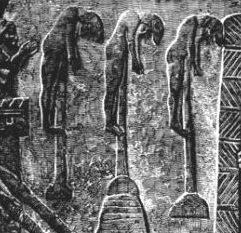
Impalements, Assyrian relief,
Tiglath Pileser II

“Take all the chiefs of the people and impale them for Y-H-V-H in full sunlight. Then the heat of Y-H-V-H’s nose will turn away from Israel.” (Numbers 25:4)

The God character in the Torah prefers collective punishment. But Moses prefers selective punishment restricted to the actual perpetrators.2 So he orders every judge to execute the men under his supervision who worshipped Baal Peor.3

Before the sentence can be carried out, an even more flagrant act of forbidden worship occurs. The son of an Israelite chieftain brings a Moabite woman (in fact the daughter of a Midianite chieftain) into the courtyard of God’s sacred sanctuary and right up to the entrance of the Tent of Meeting, in front of Moses and Israelites who have gathered there to weep over the plague. The couple enter an enclosed chamber—either in an enclosure inside the Tent of Meeting itself, or in a small tent at its entrance—and engage in sexual intercourse. Since they choose this sacred space for their deed, it is not merely a  physical coupling, but a religious ritual—in the religion of the Midianite woman. (See my post: Balak: Wide Open.)

A zealous Levite

The high priest’s grandson catches them in the act.

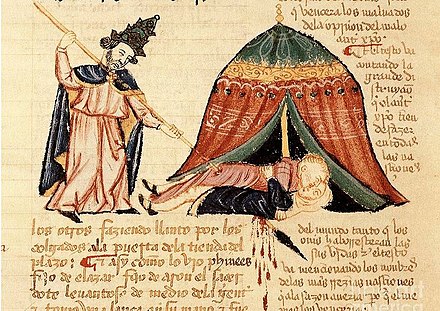
The Zeal of Pinchas, Alba Bible, 1430

And Pinchas, son of Elazar, son of Aaron the High Priest, saw; and he rose from among the gathering and he took a spear in his hand. And he came after the Israelite man into the enclosure and he pierced both of them, the Israelite man and the woman in her enclosure. Then the plague against the Israelites halted. And the dead from the plague were twenty-four thousand. (Numbers 25:7-9)

As a Levite, it is Pinchas’s job to prevent any unauthorized persons from approaching, touching, or entering God’s Tent of Meeting.4 None of the other Levites seem to be doing their job, so Pinchas jumps up. As a devout servant of God, Pinchas is determined to eliminate anyone who blatantly insults God or flouts God’s law. Being a zealot, he stops at nothing, and finds a double murder perfectly justified under the circumstances.

Peace for a zealot

This week’s Torah portion, Pinchas (Numbers/Bemidbar 25:10-30:1), begins right after the plague stops.

And Y-H-V-H spoke to Moses, saying: “Pinchas, son of Elazar, son of Aaron the High Priest, made my rage over the Israelites abate through kano for kinati in their midst. Then I did not exterminate them in kinati. (Numbers 25:10-11)

kano (קַנְאוֹ) = his zeal, his jealousy. (From the root verb kana, קָנָא = be zealous, be jealous.)

kinati (קִנַּתִי) = my zeal, my jealousy. (Also from the root kana. )

This remark tells us that God was inflamed with jealousy, and started wiping out Israelites with zeal. When Pinchas acted out of his own zeal, God calmed down and did not kill all the Israelites.

Next God tells Moses:

“Therefore say: Here I am, giving him my covenant of peace.” (Numbers 25:12)

A “covenant of peace” sounds like a peace treaty, but God and Pinchas were not enemies. Some commentators have interpreted this phrase as God’s guarantee to protect Pinchas from vengeance by the dead man’s relatives. Rashi wrote that God acted “just like a man who shows gratitude and friendliness to one who has done him a kindness.”5

But in the next verse, God equates the “covenant of peace” with a “covenant of everlasting priesthood”.

“And it will be for him, and for his descendants after him, a covenant of everlasting priesthood, inasmuch as kinei for his God and he atoned for the Israelites.” (Numbers 25:13)

kinei (קִנֵּא) = he is/was zealous, he is/was jealous. (Perfect tense of the verb kana.)

Many Jewish commentators have explained that since a priest is not permitted contact with a corpse, Pinchas could not have killed the fornicating couple if he were already a priest. Now God grants him priesthood—and now he must be a man of peace, never killing again.

But Chayim ben Moshe ibn Attar6 wrote that “and he atoned for the Israelites” means Pinchas’s action made peace between them and God. And Sforno wrote: “Seeing that he did what he did in full view of his peers so that they would obtain expiation … he proved himself fit to become a priest, whose primary function it is to secure expiation for the sins of their Jewish brethren. As a priest he could continue in the role he had first adopted on this occasion.”7

Clearly God approves of Pinchas’s quick killing of the copulating couple. But now that God is in control again and the plague has been halted, God no longer needs Pinchas to be the kind of zealot who kills people for God’s sake. So God makes him a priest.


Zeal is an extreme enthusaism that not only feels good, but provides the energy to get a hard job done. Sometimes zeal is necessary to make change happen. But unchecked zeal can cause collateral damage.

In the Torah portions Balak and Pinchas, God’s plague seems necessary to get the Israelite men to stop worshiping an alien god. But then God is like a zealot who has gone out of control and cannot stop. Only Pinchas’s quick double killing halts the divine plague.

Pinchas’s zeal is different from God’s. He feels no personal jealousy, or even anger. Nevertheless, if Pinchas continued a career as a zealot, he would present a new danger to the Israelites. So God quashes his excess zeal by making him a priest.

When two zealots are on the same side of an issue, they can egg each another on until they have both gone too far. But it is also possible that one zealot will be more rational and restrain the other. While God is out of control in this week’s Torah portion, Pinchas is merely sitting at his post, guarding the Tent of Meeting from intruders. When the Israelite man and Midianite woman invade God’s sacred spot with a sexual ritual, Pinchas’s decisive action makes the God character blink and regain rational control.

Pinchas’s zeal makes him a violent killer for a moment, but if he had not acted zealously, God’s plague would have killed thousands more. Sometimes zeal is beneficial; other times it does more harm than good.

May we all find zeal when we need it, and may we notice if our righteous anger has burned too long. And may we find ways to help our zealous friends pause for time to find perspective.


  1. James Kugel, The God of Old, The Free Press, New York, 2003, p. 73.
  2. See Numbers 16:20-22.
  3. Numbers 25:5.
  4. Numbers 1:51-53, 3:38.
  5. Rashi is the acronym for 11th-century Rabbi Shlomoh Yitzchaki. Translation in www.sefaria.org.
  6. The 18th-century rabbi who wrote the commentary Or HaChayim.
  7. 16th-century Rabbi Ovadiah Sforno, translation in www.sefaria.org.

Balak, Isaiah, & Micah: The Blessing of Water

After the humorous story of the greedy Mesopotamian prophet Bilam and his talking donkey,1 Bilam delivers a series of poetic prophecies to King Balak of Moab in this week’s Torah portion, Balak (Numbers 22:2-25:9).  Balak has promised to pay Bilam to curse the Israelites camped at his border, so he can defeat them if there is a battle. But Bilam is a true prophet, and can only utter a curse if God approves.

When Bilam arrives in Moab, he warns King Balak:

“Am I really able to speak anything at all? The speech that God puts in my mouth, only that can I speak.” (Numbers 22:38)

Bilam Prepares to Prophesy, by James Tissot, circa 1900

Then God proceeds to use Bilam as a mouthpiece for four prophecies. And every prophecy that mentions the Israelites blesses them instead of cursing them. Some of the blessings predict that the Israelites will destroy their enemies. (See my post: Balak & Micah: Divine Favor.) Others predict continued fertility and future abundance of resources.

The blessing of fertility

The dry climate of the Ancient Near East meant there was no natural surplus of food, and in the millennia before modern agricultural technology, it took intensive labor to till land, transport water, and bring in harvests. Fertile soil helped, and so did fecund livestock. But large families were also important, producing more people to do all the labor. In the book of Genesis, God commands humans three times to “Be fruitful and multiply”2.  In Deuteronomy, the blessings humans can expect if they obey God include “the fruit of your womb, and the fruit of your soil, and the fruit of your livestock”3.

Bilam’s first prophecy in this week’s Torah portion says that God has already blessed the Israelites; the evidence is that they have multiplied until they cannot be counted.

How could I curse
Where God has not cursed?
How could I denounce
Where God has not denounced?
For from the top of cliffs I can see them,
And from hills I can observe them.
Here a people dwells alone
And it does not count itself among the nations.
Who can number the dust of Jacob,
Or reckon a quarter of Israel? (Numbers 23:8-10)

The blessing of water in Balak

Water was the most critical requirement for fruitful land in the Ancient Near East, since rain was not abundant and fell mostly during winter. (Egypt was so dry that crops depended exclusively on water from the Nile.) In Deuteronomy, Moses reminds the Israelites that “God, your God, is bringing you to a good land, a land with streams of water, pools, and springs going out from valley and hill”.4 Canaan did indeed have more natural sources of water, as well as some winter rain. But water was still a limiting factor for agriculture.

In one of Bilam’s prophecies (the third out of four), he praises the Israelites with a couplet still used in today’s Jewish liturgy, then compares the Israelites’ homes to well-watered land.

Mah tovu, your tents, Jacob
Your dwellings, Israel!
Like palm-groves they stretch out
Like gardens beside a river,
Like aloes planted by God,
Like cedars beside the water.
Water drips from their branches
And their seeds have abundant water. (Numbers 24:5-7)

Mah tovu (נַה־טֺּווּ) = How good they are. (Mah = what, how + tovu = they are good. A form of the adjective tov, טוֹב = good, i.e. desirable, useful, beautiful, or virtuous.)

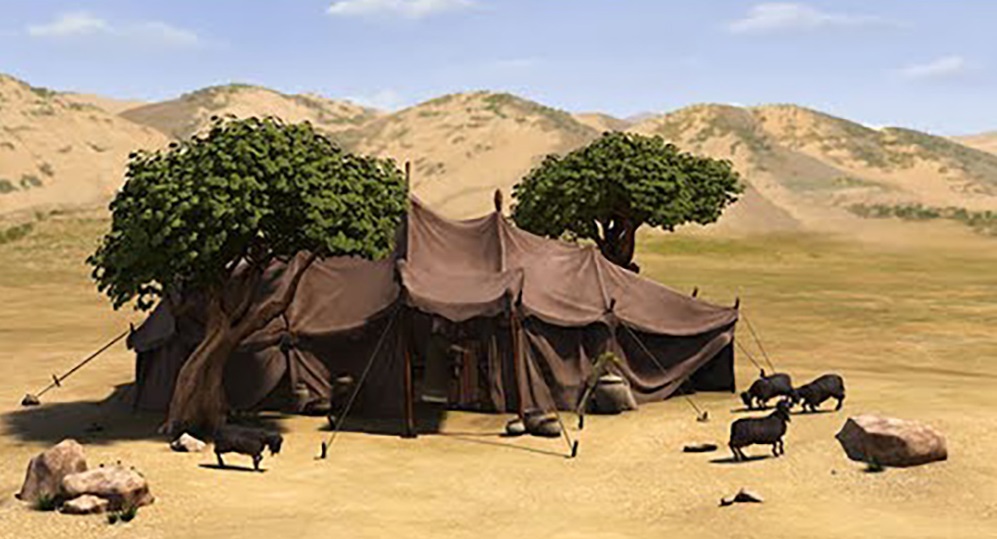
Bedouins in the desert, by Eugene Alexis Girardet, 19th century

The dwellings of the Israelites are good because they are desirable, like water. They are also good, according to 20th-century commentator Nehama Leibowitz, because the people living in them are virtuous.

Leibowitz cited four passages in the Hebrew Bible which use images of abundant water to indicate God’s reward for good behavior.5 Her best example is from second (or third) Isaiah:

If you remove the yoke from your midst,
Send away the pointing finger and the evil word,
And you extend yourself toward the hungry
And you satisfy the impoverished,
Then your light will shine in darkness
And your gloom will become like noon.
And God will give you rest always,
And satisfy your body in parched places,
And your bones will be strong,
And you will be like a well-watered garden,
And like a spring of water that does not disappoint,
Whose water never fails. (Isaiah 58:9-11)

The blessing of water in Micah

The haftarah reading that accompanies the Torah portion Balak is from the book of Micah. This reading begins with Micah’s prophecy for the Israelites (a.k.a. descendants of Jacob) who remain in what was once the northern kingdom of Israel before the Assyrian empire conquered it in 732-721 B.C.E. The Assyrians followed their usual strategy of deporting much of the native population to distant places, while moving other people into the newly conquered land.

Micah predicts what will happen to the small population of Israelites who are allowed to stay.

And it will be, the remnant of Jacob
In the midst of many peoples
Like dew from God,
Like gentle rain on grass,
That does not expect anything from a man,
And does not wait for human beings. (Micah 5:6)

Dew condenses regardless of what humans do, and the gentle rains of winter make grasses and grains grow without being watered by people. Micah’s implication, according to Rashi6 is that the remaining Israelites should not expect any help from other people, but God will help them. Micah goes on to predict that God will give “the remnant of Jacob” the strength of lions, the top predator in nature.7


Both fertility and water are powerful blessings in the Hebrew Bible. But human fertility is no longer a blessing today. Through overpopulation and pollution, we humans have created global climate change, making water even scarcer in dry regions while increasing flooding in the wetter parts of the world. The increase in dryness sets off larger forest fires, and the increase in extreme heat means humans, other animals, and plants need more water than before just to stay alive.

For all our advanced technology today, we cannot reverse the damage we have done; we can only hope to keep it from getting worse.

How can we keep it from getting worse? Yes, technology can help—but only if the powerful people of the world act not for their own selfish short-term profit, but for the welfare of all humankind, or indeed all life on earth. I wish the prophet in the book of Isaiah could enter the minds of all the decision-makers in corporations and governments, and persistently whisper: “extend yourself toward the hungry, and satisfy the impoverished”.

Only if the powerful decide in favor of life, rather than money or status, will we keep some remnant of “cedars beside the water”—as a metaphor, or in reality.


  1. See my post: Balak: Prophet and Donkey.
  2. Genesis 1:28, 9:1, 9:7, 35:11.
  3. Deuteronomy 28:4. 28:11, 30:9.
  4. Deuteronomy 8:7.
  5. Nehama Leibowitz, Studies in Bamidbar, trans. by Aryeh Newman, The World Zionist Organization, Jerusalem, 1980, p. 293. She cites Psalm 1:3, Jeremiah 17:8, Isaiah 58:11, and Jeremiah 31:12.
  6. Rashi is the acronym for 11th-century Rabbi Shlomoh Yitzchaki, the most cited classic Jewish commentator.
  7. See my post: Balak & Micah: Divine Favor.

Vayeilekh: Long-Term Prophecy

(I am flying cross-country to see my sister for the first time since 2019, so I will not be able to write new blog posts for the next three weeks. You can read some of my favorite earlier posts for this time of year at the following links: Ha-Azinu: Raining Wisdom; Rosh Hashanah & Yom Kippur: Our Father, Our King; Haftarot for Rosh Hashanah & Shabbat Shuvah—1 Samuel & Hosea: From Smoke to Words; Yom Kippur & Isaiah: Ending Slavery; and Jonah: Turning Around. You can also look under “Categories” on my home page to find all my previous posts.)


Most prophecies in the Hebrew Bible are short-term; they predict events during the lifetime of the prophet’s audience. They are also conditional; the prophet announces what will happen if the people, or their rulers, do not change their course of action. If they do change, like the Assyrians of Nineveh in the book of Jonah, God changes the decree.

But a prophecy containing the idiom be-acharit hayamim is about events in the distant future, not a warning to anyone alive at the time of the prophecy. Moses makes one of these long-term prophecies near the end of this week’s double Torah portion, Nitzavim and Vayeilekh (Deuteronomy 29:9-31:22), after God has told him what will happen many generations later, after the Israelites have conquered Canaan.

And God said to Moses: “Hey, you will be lying with your fathers, and this people will rise up and go whoring after the foreign gods of the land where they are coming into their midst. And they will abandon me and violate my covenant that I cut with them. And on that day my nose will heat up against them, and I will abandon them! And I will hide my face from them. And they will be [ripe] for devouring, and many bad things and troubles will find them. And on that day they will say: Isn’t it because our God is not in our midst that these evils found us?” (Deuteronomy 31:16-17)

Not only God, but also the writer of these verses knows that the Israelites will backslide again and be punished. According to some 21st-century biblical scholarship, much of the book of Deuteronomy was written in the 7th century, but it was rewritten and expanded in the 6th century during the Babylonian exile.1 The rewriter made two major changes: the book was recast as a series of speeches by Moses; and “predictions” were added that Judah and its capital would be destroyed someday because the Israelites would disobey God’s primary command: do not worship any other gods.

The Babylonian army razed Jerusalem in 586 BCE, and the rewriter of Deuteronomy lived through it. According to biblical reasoning, Judah could only be conquered if God stopped protecting it; and God would only stop protecting Judah if its people persistently disobeyed God. Therefore the conquest and destruction of Judah was the people’s own fault.

Moses duly transmits God’s message to the people, saying:

For I know that after my death, you will indeed act ruinously, and you will swerve away from the path that I commanded to you, and bad things will happen to you, be-acharit hayamim. For you will do what is bad in the eyes of God, offending [God] through your handiwork. (Deuteronomy 31:29)

be-acharit (בְּאַחֲרִית) = in an end, when afterward, as an aftermath, in the future. Be (בְּ) = in, at, when, through. Acharit (אַחֲרִית) = an end, outcome, future. (From achar (אַחַר)= behind, after, afterward, following.)

hayamim (הַיָּמִים) = (literally) the days; (as an idiom) a long period of time.

be-acharit hayamim (בְּאַחֲרִית הַיָּמִים) = (literally) “at the end of days”; (as an idiom) a long time afterward, in the distant future, as a long-term outcome.

A long time from now

The phrase be-acharit hayamim appears 15 times in the Hebrew Bible, and even though it could be translated as “at the end of days”, none of these verses refer to the end of the world as we know it. They usually predict the future of the people of Israel, and describe events that had actually happened by the time the second temple was built in Jerusalem in the 5th century BCE. (Prophecies about two neighboring kingdoms foretell events in the same time period.2)

The first appearance of be-acharit hayamim is in Jacob’s deathbed prophecies, supposedly about his twelve sons, but actually about what happens to the twelve tribes of Israel after the land of Canaan is settled.3

The second appearance is in Bilam’s introduction to the fourth prophecy he delivers to King Balak of Moab about the Israelites camped on the king’s border:

Bilam Prophesies, by James Tissot, ca. 1900

And now, here I am going [back] to my people. I will advise you what this people will do to your people be-acharit hayamim. (Numbers 24:16)

Bilam says Israel will conquer Moab and Edom; 2 Samuel 8:11-12 reports King David’s conquest of those two kingdoms. Bilam says Amalek will perish forever; 1 Samuel 7-33 reports that King Saul killed all the Amalekites (although a few of them show up later in the bible).4 Bilam says the Kenites (allies of the Israelites who are nomads in their territory) will be captured by Asshur (the Neo-Assyrian Empire); the Assyrians did take over the northern kingdom of Israel in the 8th century BCE, a conquest reported in 2 Kings 17:5-6, and they attacked Judah, the southern kingdom, so they may well have captured the Kenites. Bilam’s final prediction is that enemies on ships will destroy Asshur forever; the Medes and the Babylonians did conquer the Assyrians in 614-612 BCE, but the Tigris River was too shallow for ships to reach the capital.

Some modern scholars attribute this prophetic poem to a refugee from the Assyrian conquest of the northern kingdom of Israel.5 The only event in the prophecy that had not happened by the time the refugee recorded it was the conquest of the Assyrian Empire.

The phrase be-acharit hayamim occurs twice in the book of Deuteronomy. In this week’s portion Vayeilekh, Moses tells the Israelites:

… bad things will happen to you, be-acharit hayamim. For you will do what is bad in the eyes of God, offending [God] through your handiwork. (Deuteronomy 31:29)

Sure enough, although the Israelites toe the line in the book of Joshua, they repeatedly worship foreign gods in the book of Judges and the first and second books of Kings, as well as in most of the books of the prophets. Meanwhile, the Assyrians wipe out the northern kingdom of Israel in the 8th century BCE, and the Babylonians destroy Jerusalem in the 6th century BCE. Thus when Deuteronomy was revised and Moses’ prophecy was recorded, it had already come true.

Earlier in Deuteronomy, Moses predicts that after the Israelites have been living in Canaan for generations, they will make and worship idols, and God will get angry and drive them out of their land into other nations. In fact, the Assyrians deported many leading citizens of Israel, and the Babylonians deported many leading citizens of Judah. Moses continues:

But if you seek there, then you will find God, your God, if you inquire with all your heart and with all your soul. When you are in distress and all these things have found you, be-acharit hayamim, then you will return to God, your god, and you will listen to [God’s] voice. (Deuteronomy 4:29-30)

It may be no accident that here Moses sounds like second Isaiah, who wrote after the Persians conquered Babylon. Second Isaiah repeatedly urges the exiles in Babylon to seek God and return to their religion and to Jerusalem.

The phrase be-acharit hayamim also appears in first Isaiah, Hosea, Micah, and Jeremiah, in predictions that are so vague, they merely express optimism that someday the Israelites will return to their God. Ezekiel uses be-acharit hayamim in two expressions of pessimism over the long-term future of the Israelites, when he invents a foreign king called Gog who will overrun the land. Although none of these predictions from the Prophets refer to specific events in the future, they do all refer to a distant future in historical time, in this world.6

Not the end of the world

The phrase be-acharit hayamim appears twice in the book of Daniel, but neither time does it refer to the End of Days.  First Daniel uses the Aramaic version be-acharit hayamim when he interprets King Nebuchadnezzar’s dream about a statue made of different materials, from a gold head down to feet of iron and clay.7  It is not an apocalyptic image, but merely foretells a succession of kingdoms ruling Mesopotamia. The second time the phrase appears in Daniel, an angel proceeds to tell him the future of the Persian Empire.8 In both cases, a better translation of be-acharit hayamim would be “in the distant future”.

The verse that does mean “the End of Days” comes at the end of the book of Daniel, when an angel tells him:

“But you go to the keitz. And you will rest [in the grave]; then you will stand up for your destiny at keitz hayamim.” (Daniel 12:13)

keitz (קֵץ) = end (of someone’s existence), limit, boundary, extremity.

keitz hayamim (קֵץ הַיָּמִים) = the end of days; the limit of time.

Acharit means an outcome sometime in the future, after which history will continue. But keitz is an absolute end. The verse at the end of Daniel is is the only occurrence in the Hebrew bible of the phrase keitz hayamim—and the book of Daniel is the only book that seriously proposes the resurrection of the dead at the end of the world as we know it. Although the Daniel story begins during the 6th-century CE Babylonian Exile, the book was written in the 2nd century CE, well after all the other books of the Hebrew Bible. The starting point for Jewish and Christian eschatology9 is the final chapter of Daniel, which includes not only the phrase “the end of days”, but also the concept of resurrection of the dead—the righteous to “everlasting life” and others to “everlasting shame”.


Some people hope for a life after death; others believe this world is the only one we get, and humans only live once. Some people believe the ethical level of humanity will continue to improve, rapidly enough so we will save ourselves and our polluted earth; others believe we will not get our act together in time.

Will we win the human race, or self-destruct? Will humankind learn how to manage without war? How bad will the damage be from our degradation of the planet, and when will it stabilize? And what about my own nation, my own religion, my own people? Will we ever get it right?

We might want to know the short-term future for selfish reasons: so that we can make choices that will improve our own lot, or our family’s. But we want to know long-term future because we care about the fate of human beings who come after us, even those we will never meet.

I pray that enough people find enlightenment, dedicate their lives to doing no harm, and repair what they are able to repair. I am not interested in an End of Days, but I pray for a better future for this world, be-acharit hayamim.


  1. See Eckart Otto, www.thetorah.com/article/deuteronomy-rewritten-to-reflect-on-the-exile-and-future-redemption.
  2. Jeremiah 48:47 and 49:39.
  3. See my post Vayechi & 1 Kings: Deathbed Prophecies.
  4. Amalekites appear in 1 Samuel 30:1-2 and 2 Samuel 1:5-10.
  5. The “E” or Elohist source.
  6. Isaiah 2:2; Jeremiah 23:20, 30:24, 48:47, 49:39; Hosea 3:5; Micah 4:1; Ezekiel 38:8, 38:16.
  7. Daniel 2:28.
  8. Daniel 10:14.
  9. The orthodox Christian tradition is that the “The End of Days” or “The End Times” will be a world-wide apocalypse, as described in the Book of Revelation, followed by the Second Coming of Jesus and the Last Judgment, when life on earth will become obsolete. Jewish eschatology is moderate by comparison. The orthodox Jewish tradition, established as a subject for argument in the Talmud before 500 CE, is that in some distant future there will be a happy olam haba (world-to-come) here on earth. There will be a new king (moshiach, מַשִׁיַח = “anointed one”) who is a descendant of King David; the Jews in the diaspora will return to the land that was once David’s kingdom; and righteous people who have died over the centuries will be resurrected bodily.

Bo: Eyes and Swarms

Ten “plagues”, or devastating miracles, destroy the land of Egypt bit by bit in the book of Exodus, until the pharaoh finally acknowledges the God character’s superior power and gives the Israelites unconditional permission to leave. Last week’s Torah portion, Va-eira (Exodus 6:2-9:35), ends with the seventh plague: hail. (See my post: Va-eira: Hail That Failed.)

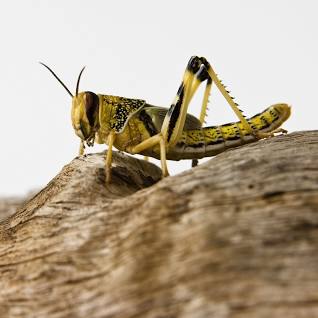
Desert locust: Schistocera gregaria

The eighth plague, locusts,1 opens this week’s Torah portion, Bo (Exodus 10:1-13:16). First Moses and Aaron tell Pharaoh:

“Thus says Y-H-V-H, the god of the Hebrews: How long do you refuse to humble yourself before me? Release my people so they will serve me! Because if you refuse to release my people, here I am, bringing arbeh in your territory tomorrow!” (Exodus/Shemot 10:3-4)

arbeh (אַרְבֶּה) = locust swarm(s); the desert locust Schistocera gregaria.

Then they deliver a practical threat and two frightening images. The practical threat is that the plague of locusts will devour every green thing in Egypt left after the hail, leaving the human population without food.2

Before and after the practical threat, Moses and Aaron transmit God’s frightening images.

Eyes, up and down

The first image conjures blindness, like the plague of darkness that will follow the locust plague.

“And it [the locust  swarm] will conceal the ayin of the land, and nobody will be able to see the land …” (Exodus 10:5)

ayin (עַיִן) = eye; view; spring or fountain.

After Pharaoh refuses to let the Israelites leave, the locust plague does exactly that.

And it concealed the ayin of the whole land, and it darkened the land and ate up all the green plants of the land and all the produce of the trees that the hail had left. Then nothing remained, nothing green remained on the trees or in the plants of the field, in the whole land of Egypt. (Exodus 10:15)

What does the word ayin mean in this story? The Hebrew Bible frequently uses ayin (most often in its duplex form, eynayim, עֵינַיִם = pair of eyes) to mean “view” or “sight”. Therefore many classic commentators assumed the Torah meant that the view of the land was blocked by the hordes of locusts. After all, the first reference to “the ayin of the land” is immediately followed by “nobody will be able to see the land”. If the locust swarms blanket every surface when they land, it would be as impossible to see through them as it is to see through the total darkness the Egyptians experience in the ninth plague.

On the other hand, the phrase “the ayin of the land” occurs only three times in the Hebrew Bible: twice in this week’s Torah portion (see above), and once in Numbers 22:5 (see below). According to contemporary commentator Gary Rendsburg, the rarity of this phrase means it is probably an adaptation of a common Egyptian phrase, “the eye of Ra”, which referred to either the sun (since Ra was the sun god) or the land of Egypt (which belonged to Ra). He wrote that Onkelos, who translated the Hebrew Bible into Aramaic in the second century C.E., inserted the word for “sun” in both phrases: “… ‘the eye of the sun of the land’ in 10:5 and … ‘the eye of the sun of the whole land’ in 10:15.”  Rendsburg suggested that Israelite readers would understand that the plague of locusts caused “the worst possible chain of events for the Egyptian nation, the disappearance of their omnipresent sun-god Ra”.3

Then what about the phrase “it darkened the land” in the second reference to “the ayin of the land”? When a locust swarm is in the air, it would not only block anyone underneath it from seeing the sun above, but also cast a broad shadow. According to Chizkuni,4 the shade cast by the swarm darkens the earth below.

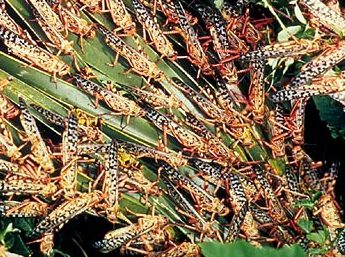
Locust swarm, photo by James Wainscoat

However, the context of the only other biblical appearance of the phrase “the ayin of the land” refers to a swarm or horde on the ground. In the book of Numbers/Bemidbar. Balak, the king of Moab, is alarmed because Moses has led a horde of Israelites north from Egypt, and they are encamped on the border of his country. This king says to his advisors:

“Now the throng will lick bare everything around us like an ox licks bare the grass of the field!” (Numbers 22:4)

This is the behavior of locusts on the ground eating up the vegetation, not of locusts on the wing blocking the sun. King Balak then sends a message to the prophet-sorcerer Bilam, saying:

“Here are people [who] left Egypt, and hey! They conceal the ayin of the land, and they are living next to me! So now please come and put a curse on this people, because they are too strong for me …” (Numbers 22:5-6)

In other words, Balak sees the Israelites covering the ground like a giant swarm of locusts; and like locusts they are powerful because of sheer numbers.

Swarms: inside and out

Plague of Locusts, Nuremberg Chronicle, 1493

After the practical warning that the coming locust swarms will consume Egypt’s entire food supply, Moses and Aaron transmit a second frightening image to Pharaoh—one that conjures an gruesomely intimate invasion.

“And they will fill your houses, and the houses of all your courtiers, and the houses of all Egyptians …” (Exodus 10:6) 

It is not the first such invasion in the contest between the God character and Pharaoh. Before the second plague, frogs, God orders Moses to tell Pharaoh:

“And the Nile will swarm with frogs, and they will go up and come into your palace and your bedroom and climb into your bed, and go up into your courtiers’ houses and your people’s, and into your ovens and your kneading bowls.” (Exodus 7:28)

The fourth plague is arov, עָרֹב = swarms of insects (traditional translation), mixed vermin (translation based on the fact that the root ערב means “mixture”). Again God says:

“… and the arov will fill the houses of the Egyptians, and even the ground they stand on.” (Exodus 8:17)

Swarms of unpleasant animals are bad enough outside. Being unable to escape them even inside your own personal space is a horrifying invasion.


The plague of locusts both signals the coming plague of darkness, and echoes the earlier plagues of frogs and swarms of vermin. It also completes the destruction of Egypt, by eliminating the last sources of food. After Moses and Aaron warn Pharaoh about the locust plague,

Pharaoh’s courtiers said to him: “How long will this one be a snare for us? Release the men so they will serve Y-H-V-H, their god! Don’t you know yet that Egypt is lost?” (Exodus 10:7)

Locusts feeding, photo by Compton Tucker, NASA

Pharaoh is so invested in his power struggle with God and Moses that he is past the point of caring whether his country is lost. But his courtiers have a different motivation. The first seven plagues have already ensured the economic downfall of Egypt; the loss of more crops will only mean that landowners lose more wealth as they feed their people during the coming famine. They have nothing to prove about who has more power. Some of Pharaoh’s courtiers have already acknowledged God’s power by bringing in their field slaves and livestock before the seventh plague, hail.5

So why do Pharaoh’s courtiers beg him to let the Israelites go? Probably because they cannot bear the thought of one more plague, especially a plague that will blot out their sight of the sun and the ground, and will once again invade even their bedrooms.


Over the past twenty years I have had problems I could deal with, and two persistent troubles that drove me crazy because I felt constantly under attack from well-meaning people who could not understand me and would not leave me alone. I was plagued by their incessant arguments and their refusals to accommodate me. These plagues darkened my life so I despaired of seeing sunlight. They invaded my home because I had to keep returning their phone calls. All I wanted was to be free of them.

I cut myself loose from one plague by resigning from my position. At the time, it seemed as hard for me to give up on that part of my life as it was for Pharaoh to give up and let the Israelites go. I waited out the other plague until my unwitting tormenter died. In that case, I was more like Pharaoh’s courtiers, whose power was limited.

Now that I am free, I hope that if I see another plague coming, I will be able to cut my losses right away. But I also pray that I will have empathy for others who suffer from unrelenting troubles. It is painfully hard to make a major change to improve your life, especially when you can see no illumination, and you have no safe place of refuge.


  1. When a wind brings multiple swarms of desert locusts into the same large region, it is still called a “plague” of locusts. (World Meteorological Organization, “Weather and Desert Locusts”, https://library.wmo.int/doc_num.php?explnum_id=3213#:~:text)
  2. Exodus 10:5.
  3. Gary Rendsburg, “YHWH’s War Against the Egyptian Sun-God Ra”, https://www.thetorah.com/article/yhwhs-war-against-the-egyptian-sun-god-ra.
  4. Chizkuni is a compilation of Torah commentary and insights written by 13th-century Rabbi Hezekiah ben Manoah.
  5. Exodus 9:13-26. See my post: Va-eira: Hail That Failed.

Balak & Micah: Divine Favor

How does a community know that God is on their side?

In the Hebrew Bible, God rewards people with food, fertility, long life, and success in war. God determines the winner of a battle. If an enemy attacks a group of Israelites and wins, God is punishing the Israelites. If the Israelites attack and win, God is giving them the victory because they have found favor in God’s eyes.

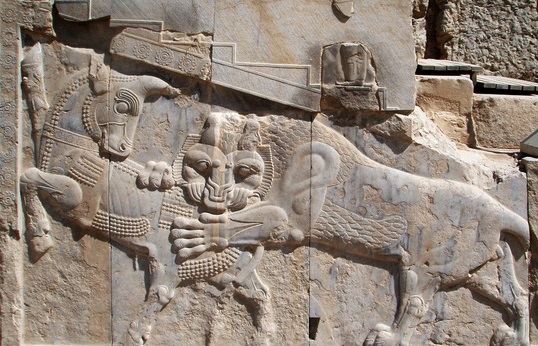
Lion attacking, Persepolis, circa 5th c. BCE

Both this week’s Torah portion, Balak, and the accompanying haftarah reading, Micah 5:6-6:8, predict that when the Israelites please God, they will conquer other countries like a lion devouring its prey.

What can people do to get God on their side?

In Balak, the blessings that the prophet Bilam pronounces for the Israelites include two hints about why God is on their side. But in the haftarah, the prophet Micah directly states what God wants.

A sign of divine favor

The Israelites traveling from the Reed Sea to Mount Sinai defeat an attack of Amalekite nomads in the desert, with God’s help.1 Their next military engagement is on the southern border of Canaan, where the Israelites alienate God and are condemned to forty years in the wilderness. They march north anyway, even though Moses warns them that God is no longer on their side, and this time the Amalekites defeat them.2

After that the Israelites avoid combat until their forty-year sentence is almost completed. Then, instead of approaching Canaan from the south, they circle east and north around the kingdoms of Edom and Moab.

When they finally head toward the Jordan River and Canaan (in last week’s Torah portion, Chukat) they ask the Amorite king Sichon for permission to pass through his territory. He attacks them instead. The Israelites win and conquer all of his land, from Arnon River to the Yabok River.3

… he was Sichon, king of the Amorites, and he had made war against the first king of Moab and taken all his land from his hand, as far as the Arnon. (Numbers/Bemidbar 21:26)

Bilam

The next Torah portion, Balak, opens by showing the current king of Moab’s fear of the hordes of Israelite invaders camping across the Arnon in what used to be Moabite land. King Balak hires a Mesopotamian prophet to come and curse the Israelites, so he can defeat them. But each time the prophet Bilam prepares to do so, God makes him speak a blessing instead.4

Two of Bilam’s blessings compare the Israelites to lions. The lion was the top predator among non-human animals in the Ancient Near East, an apt metaphor for a human nation that is the top predator among the nations in the region—the nation that wins wars and cannot be conquered.

In the first of his two blessings mentioning lions, Bilam says:

Hey, a people like a lioness rises,

           And like the lion it rears up.

It does not lie down until it devours prey

            And drinks the blood of the slain. (Numbers 23:24)

Later in the portion Balak some Midianites living in Sichon’s former territory seduce many of the Israelite men into disobeying God and worshiping Baal Pe-or.5 After the apostasy has been squelched, God orders the Israelites to attack the Midianites.6 Like ravenous lions, the Israelite men kill every Midianite male and burn down all their villages.7

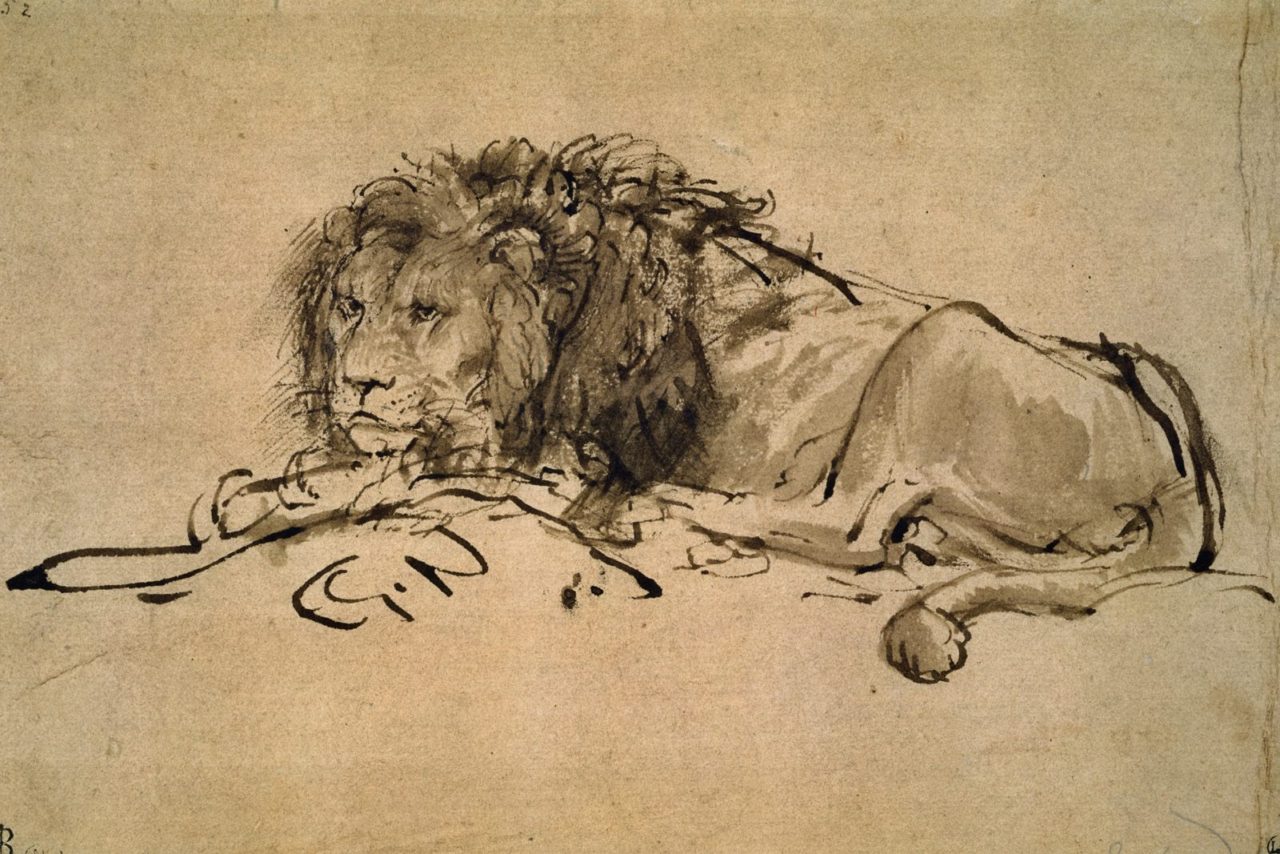
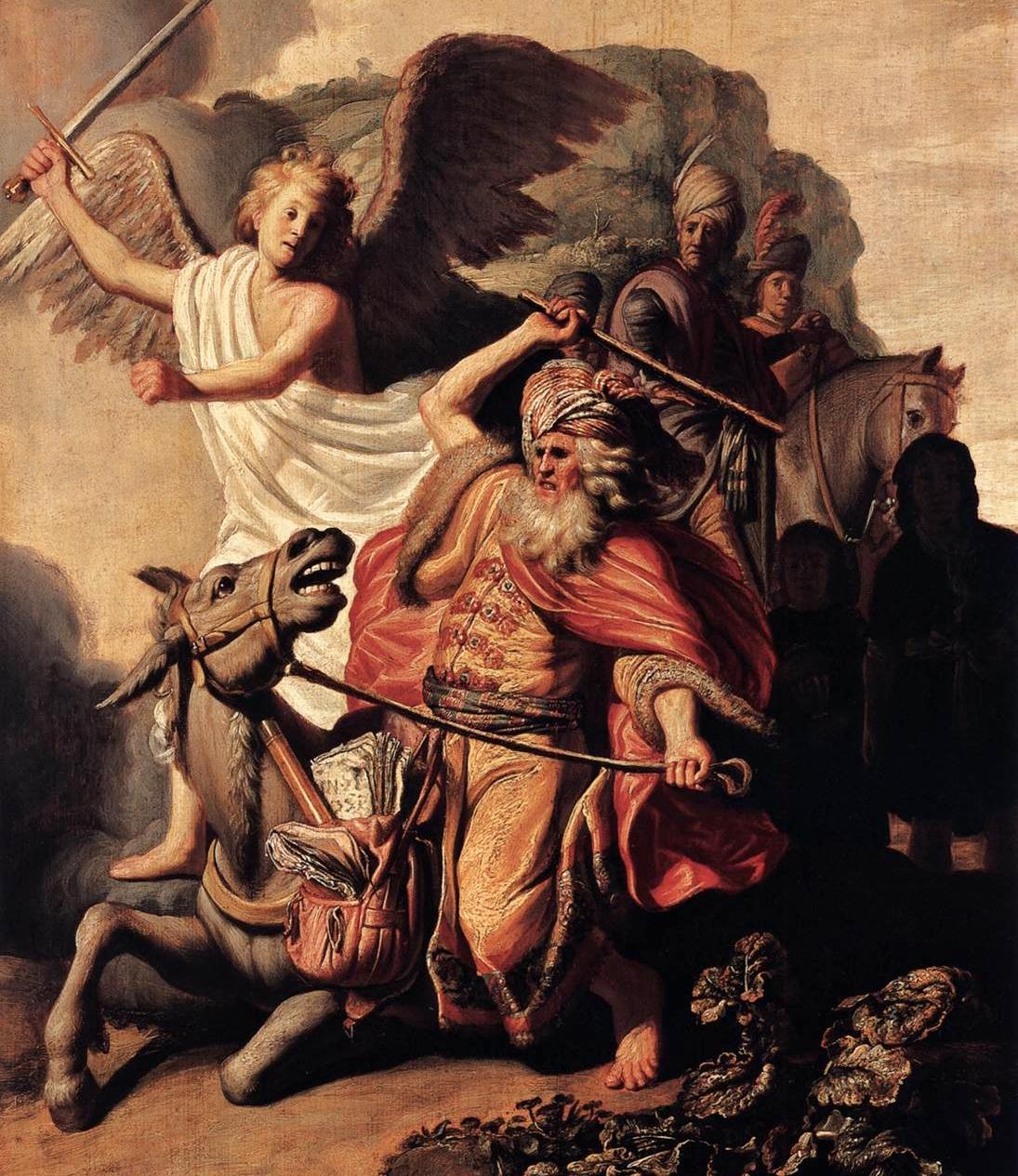
by Rembrandt van Rijn, 17th c.

Bilam refers to lions in another blessing when he says of the Israelite people:

It kneels, lies down like a lion

            And like a lioness, who [dares to] impose on it? (Numbers 24:9)

When the Israelites cross the Jordan River they have a reputation for conquering two Amorite kingdoms, both Sichon’s kingdom of Cheshbon and the Og’s kingdom of Bashan. In the book of Joshua, they conquer large parts of Canaan. Bilam’s blessing indicates that in the future (perhaps in the time of King Solomon) their new nation “relies on its reputation and does not fear attack even when lying down.”8

Micah

Micah makes a similar prediction in this week’s haftarah. The book of Micah begins with a denunciation of the northern Israelite kingdom, Samaria, which the Assyrian Empire had recently conquered. Micah’s prophecies for the southern kingdom of Judah alternate between catastrophe if the Judahites offend God and good fortune if they retain God’s favor. In the haftarah for Balak, Micah prophecies:

And the remainder of Jacob9 will be among the nations,

            In the midst of many peoples,

Like a lion among beasts of the forest,

            Like a young lion among flocks of sheep

That passes through and tramples

            And tears apart, and there is none to rescue them.

Your hand will be high over your adversary

            And all your enemies will be cut down. (Micah 5:7-8)        

How to earn divine favor

Bilam passes on God’s blessings for the people who already have favor in God’s eyes. In his very first blessing, he says:

Who has counted the dust of Jacob,

           Or numbered [even] a fourth of Israel?

May my soul die the death of the upright,

           And may my end be like theirs! (Numbers 23:10)

Here dust is a metaphor for fertility, as in Genesis when God promises to make Abraham’s descendants “like the dust of the earth, so that if a man is able to count the dust of the earth, he can also count your descendants”10.

This verse in Balak implies that the Israelites have been rewarded with fertility (another sign of divine favor) because they are upright. But we do not learn God thinks of them that way.

In his third blessing, Bilam says:

Mah tovu your tents, Jacob,

            And your dwellings, Israel! (Numbers 24:5)

mah tovu (נַה־טֺּווּ) = How good they are. (Mah = what, how + tovu = they are good, from the same root as tov, טוֹב = good: desirable, useful, beautiful, kind, or virtuous.)

Parshas Balak, The Jewish Voice

How are they good? All shelters are desirable and useful. Are the tents or future dwellings of the Israelites beautiful?  Probably not; the rest of the Torah waxes lyrical about nature and about the sanctuaries the Israelites build for God, but not about their personal habitations. So does Bilam mean that Israelite houses, i.e. families, are good in the ethical sense?

According to the Talmud, Bilam sees that the entrances of the tents are not aligned so that they face each other, thereby giving each family more privacy—and this makes them worthy of God’s presence.11 Subsequent commentators, including Rashi, interpreted this privacy as a form of sexual morality.

But the haftarah goes much farther than the Talmudic speculation that Bilam was referring to a narrow area of morality.

Micah, after comparing the Israelites to a lion, delivers a different prophecy in which God will destroy Judah, presumably through a foreign army, as a punishment for worshiping idols.

Then he quotes God as bringing as case against the Israelites for turning toward idols despite all the help God gave them in the past: bringing them up from Egypt; giving them Moses, Aaron, and Miriam as leaders; and making Bilam answer Balak with blessings.12

Next Micah imagines the Israelites asking what they can give God to get back into favor—thousands  of rams as burnt offerings? Streams of oil? Their own firstborn sons?13 He replies:

It was told to you, human, mah tov

            And what God is demanding from you:

Only to do justice

           And to love kindness

            And to live carefully, walking with your God. (Micah 6:8)

mah tov (מַה־טּוֹב) = what is good.

Here tov clearly means “good” in the ethical sense, and it is not limited to sexual morality. God wants us to treat other human beings with both justice and kindness. God also wants religious observance that is not ostentatious or immoral, like the sacrifices the Israelites suggest, but part of a careful, mindful life.


Even when we are not looking for divine favor to vanquish our enemies or give us happy lives, Micah’s statement of what God wants is a valuable guide to being morally upright. May we all learn to pay attention to where we walk, and correct our course as needed so that we treat our fellow humans with both justice and kindness.


  1. Exodus 17:8-13.
  2. Numbers 14:39-45.
  3. Numbers 21:21-25.
  4. Numbers 23:11-12, 23:25-26, 24:1, 24:10. In the Hebrew Bible a prophecy is usually a conditional prediction; it forecasts what will happen if a person or nation makes a certain choice. A blessing, such as Isaac’s blessings of his sons in Genesis 27, is an unconditional prediction.
  5. Numbers 25:1-9. See my post Balak: Being Open.
  6. Numbers 25:16-18, 31:2.
  7. Numbers 31:3-18.
  8. 18th-century Moroccan rabbi Chayim ben Mosheh ibn Attar, Or HaChayim, translated in sefaria.com.
  9. The “remainder of Jacob” probably refers to the kingdom of Judah, since the Assyrians had deported thousands of Israelites from the other Israelite kingdom, Samaria.
  10. Genesis 13:16.
  11. Talmud Bavli, Bava Batra.
  12. Micah 5:9-6:5.
  13. Micah 6:6-7.

Balak, Pinchas & Matot: They Made Us Do It

(Overall, the books of Exodus through Deuteronomy present Moses as a complex character. Yet at times he obeys God without thinking. In the conversation below I address this simplistic Moses character.) 

Moses: We killed them because they made us do the wrong thing.

M. Carpenter: They made the Israelite men do it? Aren’t they adults, responsible for their own actions?

Moses: But they tricked us.

Carpenter: Or maybe you let them trick you. Here’s what the Torah says:

Torah portion Balak:

And Israel was dwelling at Shittim, and the people began liznot the Moabite women.  And they invited the people to make slaughter-offerings to their god.  So the people ate and prostrated themselves to their god.  And Israel yoked itself to Baal-Peor, and God became inflamed against Israel.  (Numbers/Bemidbar 25:1-3)

liznot (לִזְנוֹת) = to have intercourse with a religious sex worker (when zonah, זֺמָה  = cult prostitute); to have illicit intercourse (when zonah = any woman who sells herself for sex); to be unfaithful.

Any of the three meanings of liznot might apply in the passage above.  The Israelite men might have served the god of Peor from the beginning, through its sex workers. Or they might have used Moabite prostitutes, who then invited them to religious feasts.  Or the word liznot might introduce the idea that they became unfaithful to God when they bowed down to another god.

Pinchas, Sacra Parallela, Byzantine 9th century

God’s rage was expressed as a plague, which killed 24,000 Israelites before Aaron’s grandson Pinchas stopped it with a single violent act.  One of the Israelite men brought one of the Moabite women right into God’s Tent of Meeting to have sex.  Pinchas speared both of them through their private parts in one blow.1

Torah portion Pinchas: Then God made Pinchas a priest on the spot.2  When the Torah gave the names of the speared offenders, it changed the Moabite woman into a Midianite woman, an example of incomplete redaction when two versions of a story have been melded.  From that point on, the female offenders are called Midianites.

Then God spoke to Moses, saying: “Attack the Midianites and strike them down! –because they attacked you through nikheleyhem when niklu you over the matter of Peor … (Numbers 25:17-18)

nikheleyhem (נִכְלֵיהֶם) = their deceit, their trickery, their cunning.

niklu (נִכְּלוּ) =they deceived, they tricked.

Moses:  So you see, God Himself said that the Moabites, er, Midianites, tricked us.

M. Carpenter: Well, the God-character you heard in the Torah said that. I think those Israelite men should have realized that having liaisons with women attached to the god of Peor would lead to invitations to feasts, during which it would only be polite to bow down to their god like everyone else. The men could have thought it through, but they didn’t—and they could not use the excuse that they were starving.  They already had sex and food in their own camp with Israelite women.

Moses: Anyway, those Peor worshipers will never trick us again.

M. Carpenter: True. Because the next Torah portion says:

Torah portion Mattot: After a while God reminded him:

Take revenge with the vengeance of the Israelites on the Midianites! Afterward you shall be gathered to your people.” (Numbers 31:1)

So, knowing it might be his final deed before he died, Moses assembled an army.  The Israelites defeated the Midianites, burned down their towns, and killed every Midianite man.  When they returned with the booty, including the Midianite women and children, Moses ordered them to kill all the women who were not virgins.  He explained that it was Midianite women who caused the Israelites to choose Peor over God, which resulted in God’s plague.3

M. Carpenter: Exterminating the local population did eliminate that particular temptation. But it won’t stop the Israelites from straying after other Gods once they settle in Canaan, as I pointed out in an earlier post: Mattot, Va-etchannan, & Isaiah: How to Stop a Plague, Part 3.

Moses: But God wanted revenge.

M. Carpenter: In this story, the God-character wants revenge. But elsewhere in the Torah, the God-character wants justice. There’s a difference.  Let me quote something God said to you at Mount Sinai:

“A fracture for a fracture, an eye for an eye, a tooth for a tooth: as someone gives a physical injury to a human, thus it shall be given to him.  And for striking down a beast, he shall pay compensation, but for striking down a human, he shall be killed.”  (Leviticus/Vayikra 24:19-21)

Moses: So you think we should have seduced the Moabites into worshiping our God?

M. Carpenter: You could have tried. Of course, they might have had the fortitude to resist and stick to their own god. But trying to seduce them would have been more ethical than killing them.

Moses: I was afraid that if we didn’t obey God’s order to kill the Moabites, God would kill more Israelites. You know what a temper he has.

M. Carpenter: You must have noticed that God has more than one voice in the Torah. There’s the angry jealous God, the God of justice, and the God of mercy. Remember back in the book of Exodus when you talked the jealous God-character into giving up his plans for revenge against the Israelites, and extending mercy instead?3

Moses: I asked for mercy for the Israelites.  Mercy for the Moabites is different.

M. Carpenter: Is it?


  1. Numbers 25:6-9.
  2. Numbers 25:10-13.
  3. Numbers 31:16.
  4. Exodus 32:7-14.


Balak: Motivations

Why do King Balak and the prophet Bilam behave badly in this week’s Torah portion, Balak?

In the book I am writing on moral psychology in Genesis, I examine the text for emotional impulses and character flaws that result in immoral behavior.  Three of the character flaws I found in Genesis also explain the poor ethical choices of Balak and Bilam.

Balak

Balak, the king of Moab, is alarmed after the Israelites have conquered the Amorite city-state of Cheshbon on the northern border of his kingdom.  He sends dignitaries to Bilam, who lives by the Euphrates River, with the following message:

“And now please go curse these people for me!  Because they are more numerous than we are.  Maybe I will be able to nakeh them and drive them out from the land.  For I know that whoever you bless is blessed, and whoever you curse is cursed.”  (Numbers/Bemidbar 22:6)

nakeh (נַכֶּה) = strike down, break, beat down.  (A form of the root verb nakah, נָכָּה = strike, hit, beat, destroy.)

Balak’s emotional reaction to finding a horde of strangers camped across his border is fear, naturally enough.  But when he tries to address his fear he makes two mistakes.  One is that he assumes the Israelites will attack Moab next.  The truth is that the Israelites are on their way to Canaan, and conquered Cheshbon because the king of Cheshbon refused to let them pass through his land.  They are not interested in attacking Moab, which lies to the south, before they continue their journey northward.  But it never occurs to Balak to see if he can find out why the Israelites attacked Cheshbon.

His other mistake is that he tries to hire Bilam to curse the Israelites, instead of to bless the Moabites.  King Balak could just as well ask Bilam to make Moab look invulnerable to the Israelites, or to make the Israelites seek peace.

But Balak only thinks in terms of war, in terms of kill or be killed.  He tries to arrange the mass destruction of the people camping across the Arnon River from Moab even though they have made no hostile move against him because he lacks imagination.

He is not the only one in the Torah with this character flaw.  In the book of Genesis, Noah fails to talk God into saving innocent animals and children from the flood because he cannot imagine talking back when God speaks to him.1  Jacob masquerades as his brother Esau and lies to Isaac, their father, because it does not occur to him that Isaac might intend to give two blessings, one to Esau and a different one to Jacob.2  Shimon and Levi lie to the men of Shekhem and then massacre them because nobody in their family thinks of a polite way to refuse an invitation by the ruler of Shekhem.3

An inability to imagine better alternatives leads many human beings to follow their worst impulses: callous resignation for Noah, greed for Jacob, and violence for Shimon and Levi.  The same lack of imagination makes Balak respond to his fear of strangers by trying to make it easier to kill them.

On the other hand, people who often exercise imagination can become unable to think outside the box when they are gripped by an overwhelming emotional reaction.   A psychological complex can overwhelm one’s more rational self; perhaps Balak, Shimon, and Levi had complexes that made them react to trouble by lashing out violently.  We cannot tell from the text of the Torah.

Bilam and the Moabites

When King Balak’s delegation arrives at Bilam’s house, God visits Bilam in a dream and tells him not to go to Moab, because the Israelites are blessed.  In the morning Bilam tells the Moabites that God will not let him go with them.

Then Balak sends back a more impressive group of dignitaries, and the promise of a rich reward.  Bilam already knows that God will not let him curse the Israelites, but this time he prevaricates:

“If Balak gave me what fills his house, [all the] silver and gold, I would not be able to cross the word of God, my God, to do [anything] small or large.  But now please stay here overnight again, and I will find out again what God will speak to me.”  (Numbers 22:18-19)

That night God tells the prophet he may go to Moab, but when he arrives he must do whatever God tells him to do.  Bilam accompanies the Moabites without telling them God’s caveat, giving them the false impression that he will curse the Israelites and earn his pay.

Why does Bilam string along the Moabites?  The clue in the text is that he has named a high price for his services: all the silver and gold in Balak’s house.  His motivation for going to Moab, and his character flaw, is greed.

Greed was also Abraham’s motivation in Genesis when he passed off his wife Sarah as his sister, hoping to cheat the king of Gerar out of a high bride-price.4  If the Torah told us about what Bilam and Abraham learned from their parents or from earlier experiences, we could guess why they are greedy enough to brush aside ethical considerations.  But the Torah only presents the two men as they are.

Bilam and the donkey

Next God tests Bilam by placing a divine messenger in his path, an angel that only Bilam’s donkey can see.  Twice the donkey swerves twice to avoid the angel.  The third time, when the way is too narrow, she lies down underneath Bilam and refuses to move.  All three times Bilam angrily beats his donkey.

Then God opened the mouth of the donkey, and she said to Bilam: “What have I done to you that hikitani these three times?”  And Bilam said to the donkey: “Because you made a fool of me!  If only there were a sword in my hand so that now I could kill you!” (Numbers 22:28-29)

hikitani (הִכִּיתַנִי) = you struck me, you hit me, you beat me.  (Another form of the root verb nakah.)

Why does Bilam beat his donkey?  It would have been more ethical for him to investigate her unusual behavior (not to mention her sudden gift of speech).  But Bilam is overwhelmed by his angry impulse because of another character flaw: pride.  King Balak’s men were probably watching the first two times the donkey swerved.  He believed his donkey’s behavior made him look like a fool who could not control his own mount.

In the book of Genesis, Cain also becomes infuriated when his pride is hurt.  He is the first person to make an offering to God.  After he has laid out the fruits of the soil he has labored over, his brother Abel offers an animal from his flock.  God accepts Abel’s offering but ignores Cain’s.  Cain is humiliated, and God cautions him:

“Why did you become hot-with-anger,

and why did your face fall?

“Isn’t it true that if you do good,

[there is] uplifting?

“And if you do not do good,

wickedness is crouching like a beast at the door,

and its craving is for you.

“But you, you can rule over it.” (Genesis 4:6-7)

Cain loses his temper and kills Abel.  He is unable to rule over his pride and stop himself from succumbing to wickedness.

When Bilam is infuriated by pride, God does not caution him directly, but instead lets the donkey speak.

Then God opened the mouth of the donkey, and she said to Bilam: “Aren’t I your donkey, that you have ridden on from long ago until this day?  Am I really accustomed to doing this to you?”  And he said: “No.”  (Numbers 22:30)

Bilam and His Ass, by Rembrandt, 1626

At least Bilam is honest at this point, recognizing that his donkey does not deserve to be beaten.  Once he has answered “No”, God lets him see the divine messenger, who scolds him for beating the donkey and adds: “Hey, I went out as a accuser.” (Numbers 22:32)

Bilam concludes that God sent the angel to oppose his journey to Moab in the hope of being able to curse the Israelites.

And Bilam said to God’s messenger: “I did wrong because I did not know that you were stationed to meet me on the way.  And now, if it is wrong in your eyes I will turn back.”  (Genesis 22:34)

Turning around at this point would make Bilam look even more foolish to the Moabite dignitaries, but now Bilam is willing to swallow his pride.  The divine messenger tells him to go to Moab anyway, but say nothing except what God tells him.  He does, and finds himself blessing (giving good prophecies about) the Israelites three times.  King Balak pays Bilam nothing, and the reformed prophet heads home.5

In this week’s Torah portion, Bilam makes two ethical errors: he deceives someone because of greed, like Abraham, and he strikes an innocent party because of pride, like Cain.  But his bad deeds are not as bad as theirs.  Bilam only deceives the king of Moab, whereas Abraham both deceives the king of Gerar and puts Sarah in a dangerous and compromising position.  Bilam only beats his donkey, whereas Cain murders his brother.  And Bilam admits he was wrong and repents.


We all have negative emotional impulses sometimes.  Whether these impulses lead to unethical behavior often depends on our individual character flaws, which may be the result of psychological complexes.  But early in the book of Genesis, God promises Cain that even though it is difficult, we can learn what our complexes are and rise above them.

May we exercise more imagination than Balak, so we can think of better alternatives than lashing out at others.  And if we become overwhelmed by greed or pride, may we recognize it, temper it, and admit when we did wrong, like Bilam.


  1. Abraham persuades God to refrain from burning up Sodom if there are even ten innocent people in the city. Moses persuades God to give the Israelites a second chance after they worship the Golden Calf. But Noach is silent. After God has spoken to him, all the Torah says is: And Noach did everything that God commanded him; thus he did. (Genesis 6:22)
  2. Genesis 27:1-28:4.
  3. Genesis 34:8-29.
  4. Genesis 20:1-18.
  5. In a later Torah portion, Mattot, Moses orders a war of vengeance against the Midianites of Moab, who had invited the Israelites to make offerings to their own god. The Israelites kill every Midianite male including the five kings of Midian, “and Bilam son of Beor they killed by the sword” (Numbers 31:8).  The Torah does not say why Bilam was there, but Moses says that the Midianite females seduced the Israelite men “according to the word of Bilam” (Numbers 31:16).

Balak: Wide Open

At last, after 40 years in the wilderness, a large company of ex-slaves from Egypt camp on the east bank of the Jordan River, right across from their “promised land” of Canaan.  They have just conquered two small kingdoms of Amorites,1 which proves that God is on their side.  And when the Mesopotamian prophet Bilam tries to curse them in this week’s Torah portion, Balak, God keeps putting words of blessing in his mouth instead.2  The Israelites expect to cross into Canaan with the help of their God.

Then they get invitations from their neighbors, the Midianite Moabites3 living near their campsite.  These tribes are inhabitants of the area that used to belong to the Amorite king of Cheshbon until the Israelites defeated him and took over.

Moab Leads Israel into Sin, by Gerard Hoet, 1728

Israel settled at The Acacias, and the people began to commit forbidden intercourse with the young women of Moab.  They invited the people to slaughter offerings to their gods, and the people ate and bowed down to their gods.  Israel yoked itself to the local god of Peor, and God became hot with anger against Israel.  (Numbers/Bemidbar 25:1-3)

Peor (פְּעוֹר) = a place name meaning Wide Opening.  (From the root verb pa-ar, פָּעַר = open wide.)

The verb pa-ar occurs only four times in the Hebrew Bible, all in reference to mouths opening wide.  Sheol (death) opens its mouth wide and the living fall down into it,4 a psalmist opens his mouth wide as he pants for God’s commandments,5 Job’s tormentors open their mouths wide against him,6 and Job remembers when men came to him for wise advice and their mouths opened wide to receive it like rainfall.7

One traditional interpretation of the name Peor is that the Midianite Moabites living near the Israelite campsite were afraid of the horde of conquerors, so they came up with a scheme for integrating the two communities on a friendly basis.  The Moabites would display their daughters to the Israelite men.  These young women would then invite the men to a banquet that included meat from animal sacrifices to Baal Peor, the local god of Peor.  The Israelites would eat, drink, and have intercourse with the Moabite women.8

This outcome would not be ideal from the Moabite point of view; fathers in the Ancient Near East preferred to sell their daughters as brides.  But at least if their scheme works, the Moabites might escape being killed or enslaved.

The Israelite men are already familiar with eating meat from animal sacrifices; in their own wholeness-offerings (shelamim) some animal parts are burned up into smoke for God, and some of the meat was reserved for the priests and the donors and their guests to eat.9  It is not surprising that Midianites across the river from Canaan worship their gods in a similar way—or that Moses’ own father-in-law was a Midianite priest in another place, southwest of Edom.

Opening their mouths to eat and drink, the Israelite men become open not just to friendship and sex with Moabites, but to their religion as well.  They forget that the God of Israel is a jealous god, who becomes “hot with anger” when they do anything that could be interpreted as worshiping an additional god.  As usual, the God-character expresses anger by starting an epidemic.  Then God tells Moses how to stop it:

Assyrian impalements

“Take all the leaders of the people and impale them before God, across from the sun; then the anger of God will turn away from Israel.”  (Numbers 25:4)

Impaling a man kills him by making an unnatural opening in his body.  “Across from the sun” is an idiom for doing something in the open, in public.

But Moses said to the judges of Israel: “Each man, kill the men yoked to Baal-Peor.”  (Numbers 25:5)

Instead of following God’s directions, Moses orders the execution of the men who actually participated in the sacrificial feasts for the god of Peor.  Before any of the judges can take action, something else happens.

The Zeal of Pinchas, Alba Bible, 1430

But hey!  An Israelite man came up, and he brought to his kinsmen a Midianite woman, in plain sight of Moses and all the community of the children of Israel!  And they were weeping at the petach of the Tent of Meeting.  And Pinchas, son of Elazar, son of Aaron the priest, saw; and he rose from the middle of the community and took a spear in his hand.  And he came in after the man of Israel to the kubah, and he pierced the two of them, the man of Israel and the woman, into her kubah, and the epidemic was halted.  (Numbers 25:6-8)

petach (פֶּתַח) = opening, entrance, doorway.

kubah (קֻבָּה) = enclosure, alcove, private chamber–inside a tent or a woman.

The Israelite man and the Midianite woman (identified later as Zimri, a chief of the tribe of Shimon, and Kozbi, a daughter of a Midianite chief)10 may be engaging in ritual sex for the purpose of ending the epidemic.11

The impalement of only two people, by spear, proves sufficient to calm God’s anger—perhaps because they are skewered right at the enclosed spot where an illicit entry is happening.  The epidemic comes to a halt.


This story is full of openings: the name of the local god, Peor/Wide Opening; the social opening of the invitation from the Midianite Moabites; the daughters of the Midianites opening their private enclosures to foreign men; the Israelite men opening their mouths to eat the sacrificial meat; the threat of impalement opening holes in bodies; the petach/opening to God’s Tent of Meeting; and the deadly opening Pinchas’s spear makes in the coupling couple.

The invitation from the Moabites seems to me like a peace offering, an ethical alternative to war.  Knowing the nature of the God of Israel, the Israelites who respond to this social opening are foolish to accept the meat (and sex) without checking its religious significance.  They succumb to their animal desires without thinking, but they could have thought it through and offered a counter-proposal to the Moabites for peaceful social relations without religious transgression.

The petach of the Tent of Meeting is an essential part of the portable sanctuary for the God of Israel.  The fact that the Israelites assemble in front of the petach of the tent in times of distress indicates the spiritual solidarity of the community.

The tent-sanctuary is not open for entry by anyone who has not been initiated into the service of God, so the Levites, including Pinchas, are charged with guarding its petach so no unauthorized persons enter.    Both Zimri, an Israelite from another tribe, and Kozbi, a non-Israelite, are forbidden to enter.

The God-character in this week’s Torah portion reacts as if any opening between the Israelites and the Moabites is bad, and the only solution is extermination.  First the God-character demands the execution of the Israelite bosses (or at least one ringleader).  Then in next week’s Torah portion, Pinchas, “he” orders the Israelites to go to war against the Midianites.12  When they do, they kill every Midianite man in the area, and take the women and children captive.  But Moses reminds them to kill all the Midianite women, too: every woman who “has known a man”.13  The whole project of friendly relations between the Midianites and the Israelites must be destroyed.


The Israelites in the Torah, like all peoples in the Ancient Near East, and like the governments of most nations today, resort to the wholesale killing of war when they cannot think of another way to resolve a difference between peoples or deal with the fear of foreigners.  Many stories in the bible portray the God-character as no better than human beings at peaceful co-existence.

Today I hear calls for eliminating people designated as foreigners, through by war, deportation, or building a wall on the border.  I also hear calls for being open to other people and celebrating our differences.

I believe there is a time to open and a time to close, but never a good time to kill.  Opening to friendships between people belonging to different groups is good.  Adopting another group’s religion, ethics, or way of life may be good only if one thinks it through and does it consciously, with one’s true self.  Being open to the possibility of God is good—but only if your idea of “God” is morally good.

Being open in a good way takes a lot of thinking.


  1. Cheshbon and Bashan. See last week’s post, Chukkat & Ecclesiastes: Accounting for Cheshbon.
  2. The Mesopotamian prophet Bilam. See my post Balak: A Question of Anxiety.
  3. See my post Balak, Pinchas, and Mattot: How Moabites Became Midianites on why the Torah refers to the local inhabitants as both Moabites and Midianites.
  4. Isaiah 5:14.
  5. Psalm 119:131.
  6. Job 16:10.
  7. Job 29:23.
  8. See Talmud Bavli, Sanhedrin 106a; Numbers Rabbah 20:23; and Sefer HaYashar, Numbers 7.  A different line of commentary is that people worshipped Baal Peor, the god of Peor, by baring their buttocks and opening their anuses to relieve themselves.  (Sifrei Bamidbar 131; Rashi, the acronym for the 11th-century rabbi Shlomoh Yitzchaki.)
  9. See my posts Vayikra & Tzav: Fire-Offerings Without Slaughter, Part 1 and Part 2.
  10. Numbers 25:14-15.
  11. Tikva Frymer-Kensky, Reading the Women of the Bible, Schocken Books, New York, 2002, p. 221.
  12. Numbers 25:16-18.
  13. Numbers 31:2-18. See my post Mattot, Va-etchannan, & Isaiah: How to Stop a Plague, Part 3.