Balak, Pinchas & Matot:  How Moabites Became Midianites

by Melissa Carpenter, Maggidah

Moabites and Midianites are two distinct peoples in most of the Bible.  Yet they appear to be interchangeable in a story about sex and revenge that runs through three Torah portions in the book of Numbers/Bemidbar: the portions Balak (last week), Pinchas (this week), and  Mattot (next week).

The conflation between Moabites and Midianites begins after the Israelites have marched through the wilderness east of Moab and then conquered two Amorite kingdoms to its north. The Israelites camp on the east bank of the Jordan River, in their first newly captured territory–which is now described as a former part of Moab.

And the Israelites journeyed [back], then encamped on the plains of Moab, across the Jordan from Jericho. (Numbers/Bemidbar 22:1)

Balak, the king of Moab, is afraid they will go south and attack his country next.

And [the king of] Mo-av said to the elders of Midyan: Now the congregation will nibble away all our surroundings, as an ox nibbles away the grass of the field. (Numbers 22:4)

1. Midian in Genesis, Exodus, and 1 Kings.
2. Midian in Numbers and Judges.

Mo-av (מוֹאָב), Moab in English = a kingdom east of the Dead Sea; the people of this kingdom. (The actual etymology is unknown. Genesis/Bereishit  19:36-37 claims the Moabites are descended from incest between Lot and one of his daughters, and implies that the daughter named her son Mo-av to mean “from father”.  The actual Hebrew for “from father” would be mei-av מֵאָב.) The Moabite language was a Hebrew dialect, and appears on a circa 840 B.C.E. stele about a war between Israel and a Moabite king named Mesha.

Midyan (מִדְיָן), Midian in English = a territory occupied by the people of Midian, whose geographic location differs in various parts of the Bible. (Possibly from the Hebrew dayan (דַּיָּן) = judge. Midyan might mean “from a judge”, “from judgement”, or “from a legal case”.) References to a people called Madyan or Madiam appear in later Greek and Arabic writings, and Ptolemy wrote of a region of Arabia called Modiana (see #1 on map), but archeology has not yet proven the existence of a country of Midian.  The Midianites may have been a nomadic people without a fixed territory.

When King Balak sends a delegation to the prophet Bilam to ask him to curse the Israelites, it consists of “the elders of Moab and the elders of Midian“. (Numbers 22:7).

When Bilam arrives at the mountaintop overlooking the Israelite camp, King Balak is there with “all the nobles of Moab (Numbers 23:6, 23:17) but apparently no Midianites.

After Bilam fails to curse the Israelites and goes home, a brief story in the portion Balak describes how some young women invite the Israelites to participate in ritual feasts to their gods, and many Israelites end up bowing down to the local god, Baal Peor. (See my post  Balak: False Friends?) At first, these women are identified as Moabites.

And Israel settled among the acacias, and the people began to be unfaithful with the daughters of Moab. (Numbers 25:1)

Pinchas Impales Zimri and Kozbi,
by J.C. Weigel

Next, an Israelite man brings a foreign woman into the Tent of Meeting itself for sex. Aaron’s grandson Pinchas saves the day by quickly spearing the two of them. The woman is identified as a Midianite, and in the next Torah portion, Pinchas, we find out she is a woman of rank.

And the name of the  Midianite woman who was struck down was Kozbi, daughter of Tzur, the head of the people of a paternal household from Midian. And God spoke to Moses, saying: “Be hostile toward the Midianites, and strike them down. Because they were hostile to you through their deceit, when they deceived you about the matter of Peor…” (Numbers 25:15-18)

Suddenly the Moabite women who invited the Israelites to feasts for their gods are being called Midianites!

In the next Torah portion, Matot (“Tribes”), God reminds Moses to attack the Midianites, but does not mention the Moabites.

And they arrayed against Midian, as God had commanded Moses, and they killed every male. And the kings of Midian they killed …five kings of Midian, and Bilam son of Beor, they killed by the sword. But the children of Israel took captive the women of Midian and their little ones… (Numbers 31:7-9)

This story ends with the slaughter of the captive Midianite women. (See my post Mattot: Killing the Innocent.)

And Moses said to them: “You let every female live! Hey, they were the ones who, by the word of Bilam, led the Israelites to apostasy against God in the matter of Peor, so there was a plague in the assembly of God. So now, kill every male among the little ones and every woman who has known a man by lying with a male, kill!” (Numbers 31:15-17)

Here Moses declares that it was Midianite women who seduced Israelites into worshiping Baal Peor. The Moabite women are no longer mentioned.

When we look at the storyline over three Torah portions, the enemies of the Israelites seem to change from a coalition of Moabite and Midianite leaders, to Moabite men, to Moabite women, to Midianite women, to Midianites in general.  How can we explain the shift from Moabites to Midianites?

books

As usual when it comes to inconsistencies in the scripture, the commentary falls into three camps: the apologists, the scientists, and the psychologists. (A fourth camp of commentary is the mystics, who focus on individual phrases and words, and ignore inconsistencies in storylines.)

The Apologists

The apologists take the Torah as literal history, and find clever ways to explain apparent inconsistencies.

The Talmud considers Midian and Moab two separate nations that became allies against the Israelites. Thus men from both nations hire Bilam to curse the Israelites, and make their daughters seduce the Israelite men (in order to cause the God of Israel to abandon the Israelites and leave them vulnerable).

In one Talmud story, God tells Moses to spare Moab and attack only Midian because God wants to preserve the land of Moab for the birth of Ruth, the virtuous ancestor of King David. (Talmud Bavli, Bava Kama 38a-b.) Another tractate of the Talmud (Sotah 43a) says that the attack on Midian is actually vengeance for the episode in the book of Genesis when a band of Midianites buys Joseph from his brothers and sells him into slavery in Egypt.

Rashi (11th century rabbi Shlomo Yitzchaki) wrote that the king of Moab consults the Midianites because he knows Moses spent a period of his life in Midian, and he wants to learn more about the leader of the Israelites. The elders of Midian choose to not only advise the king of Moab, but join forces with him in the campaign to seduce the Israelite men. According to Rashi, God orders Moses to attack only the Midianites because the Moab acted solely out of fear for their own nation, “but the Midianites became enraged over a quarrel which was not their own”.

Some 20th century commentary explains the conflation between Moabites and Midianites by concluding that Midian was not a separate kingdom, but a confederation of nomadic tribes. (This explains why the first Midianites Moses meets lived near Mount Sinai, while the Midianites in the book of Numbers live in or near Moab, several hundred miles away.)  According to this theory, King Balak recruits local Midianite elders in order to involve all the people living in Moab, and the two ethnic groups work together to weaken the Israelites.

books

This theory explains God’s order to kill the Midianites, but does not explain why God fails to order the death of Moabites who are not Midiainites.

The Scientists

The commentators I call “the scientists” use linguistic and archeological evidence to assign various parts of the biblical text to authors from different periods and with different agendas. Inconsistencies in a Torah story occur when two different sources are awkwardly combined by a redactor.

The “documentary hypothesis” about when various pieces of the Bible were written has been revised a number of times since it first became popular in the 19th century, but linguistic scholars have agreed that passages in the first five books of the Bible come from at least four original documents (and probably additional fragments), and were stitched together and edited by at least one redactor.

Richard Elliott Friedman’s The Bible with Sources Revealed (2003) proposes that the stories in the Torah portions Balak, Pinchas, and Mattot came from three different sources which were compiled and edited by a final redactor (perhaps the priest called Ezra the Scribe).

The two references to Midian (…to the elders of Midianin Numbers 22:4; … and the elders of Midian … in Numbers 22:7) were inserted into the Bilam story by the final redactor who compiled and edited the five books of the Torah in the 5th century B.C.E. This redactor (possibly Ezra) inserted the elders of Midian into the Bilam story in order to harmonize it with the later story of seduction by Midianite women.

According to Friedman, the bulk of the Torah portion Balak was written by the “E” source in the northern kingdom of Israel. The northern kingdom was often in conflict with Moab across the Jordan River, and at one point conquered the whole country, only to be defeated by a new king of Moab named Mesha. The “E” source considered Moab an enemy.

Friedman credits the redactor of J/E with writing the story of the Moabite women seducing the Israelites into worshiping Baal Peor. The J/E redactor combined the “E” scripture from the northern kingdom of Israel with the “J” scripture from the southern kingdom of Judah, and added a few other stories—including the story of the Moabite women, according to Friedman.

The “P” source, which Friedman assigns to the Aaronide priests at the time of King Hezekiah of Judah, wrote the next story, in which a man from the tribe of Shimon and the daughter of a Midianite king go into the Tent of Meeting to copulate, and are speared in the act by Aaron’s grandson Pinchas. God then makes a covenant with Pinchas, and tells Moses to attack the Midianites.

Friedman notes that the “P” source was responding to a conflict at the time between priests who claimed descent from Aaron, and a clan of Levites called “Mushi” who may have been descendants of the two sons of Moses and his Midianite wife, Tzipporah. The first book of Chronicles, written between 500 and 350 B.C.E., says their descendants were the Levites in charge of the treasury. This story by “P” praises Aaron’s grandson, while denigrating Midianites.

In the next Torah portion, Mattot, the “P” source records the story of the Israelite’s war on the five kings of Midian, and has Moses blame the Midianite women for causing Israelite men to worship Baal Peor.

books

The approach used by Friedman and other scientific commentators certainly explains why this part of the book of Numbers keeps adding or replacing Moabites with Midianites. But it does not address the psychological insights of the stories when they are read as if they are episodes in a novel or mythic epic.

The Psychologists

The commentators I call “the psychologists” read the Bible as it stands, viewing it as a collection of mythic tales rolled into one grand epic, and mine it for insights about human nature.

One of the first psychological commentaries appears in a 5th century C.E. story in the Midrash Rabbah for Numbers. Referring to the Torah story about an Israelite man bringing a Midianite princess into the Tent of Meeting for sex, the Midrash says: “He seized her by her plait and brought her to Moses. He said to him: ‘O son of Amram! Is this woman permitted or forbidden?’ He answered him: ‘She is forbidden to you.’ Said Zimri to him: ‘Yet the woman whom you married was a Midianitess!’ Thereupon Moses felt powerless and the law slipped from his mind. All Israel wailed aloud; for it says, they were weeping (25:6). What were they weeping for? Because they became powerless at that moment.”
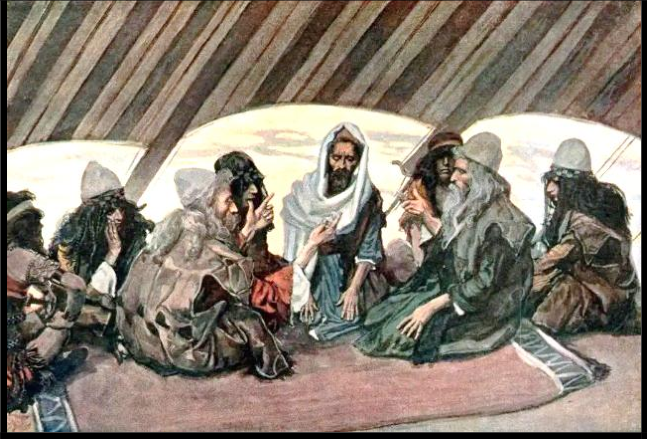
Jethro (Yitro) and Moses, by James Tissot, ca. 1900

As a psychological commentator myself, I would point out that until the Israelites reach the Jordan north of Moab, all their contacts with Midianites have been positive.  Moses himself is sheltered by a Midianite priest, Yitro, when he is fleeing a murder charge in Egypt.  Yitro becomes his beloved mentor and father-in-law.  The Torah does not say Moses loves his wife, Yitro’s daughter Tzipporah, but she is the mother of his two sons, and she does rescue him from death on the way back to Egypt.

When Moses is leading the Israelites from Egypt toward Mount Sinai, his Midianite family arrives at the camp, and Moses greets his father-in-law with joy and honor. Yitro calls the god of Israel the greatest of all gods, makes an animal offering to God, and gives Moses good advice about the administration of the camp. (Exodus 18:5-27)

Moses and the Israelites do not encounter Midianites again until 40 years later, about 500 miles to the northeast, and in the book of Numbers. These Midianites are hostile instead of benevolent, determined to ruin the Israelites by alienating them from their god.

Does Moses feel betrayed by the people he married into?  Does he feel powerless, as the Midrash Rabbah claims, when his own affiliation with Midian seems to contradict his orders to destroy Midian?

Does it break his heart to see Midianite women, kin to his own wife, seducing Israelite men away from God?  Does it break his heart to transmit God’s orders to kill all the Midianites near Moab, including the captive women?

Does he turn against his own Midianite wife and sons then?

Or does he reassure himself, and perhaps others, that the Midianite tribes in Moab are different from the Midianite tribes near Mount Sinai; that there are good Midianites and bad Midianites, and it is right to marry the good ones, and kill the bad ones?

If Moses distinguishes between good Midianite tribes and bad Midianite tribes, does it occur to him that within a tribe there might be good and bad individuals?  That wholesale slaughter, although the usual procedure in war, is actually unjust because a number of innocent people die with the guilty?

Judging by Moses’ long speech to the Israelites in the book of Deuteronomy (which scientific commentators attribute to sources written after 640 B.C.E.), Moses and the Torah continue to condemn tribes and nations wholesale, without regard for individual members.


Just as Moses judges all Midianites in the five northern tribes as evil because of the actions of a few of their members, human beings throughout history have made judgements about undifferentiated groups.  It is so much easier than discriminating among individuals. From Biblical times to the present day, some people have judged all Jews as bad.

Today, I catch myself ranting against Republicans, as if every person who voted Republican in the last election were responsible for the particular propaganda efforts and political actions that I deplore. A psychological look at the story of Moses and the Midianites near Moab reminds me that I need to be careful not to slander the innocent with the guilty.

Note: This blog completes the book of Numbers  for this year (2015 in the modern calendar, 5775 in the Hebrew calendar). My next blog post will be in two weeks, when we open the book of Deuteronomy.

Haftarat Pinchas—1 Kings: The Sound of God

When people in the Hebrew Bible see a manifestation of God, they nearly always see either fire (from the flames in the burning bush to the sparks of fire in the pillar or cloud), or something human (from Abraham’s guest to the feet on the sapphire pavement).

When they hear a manifestation of God, they usually hear words. I have found only two exceptions in the Hebrew Bible. One is in the book of Exodus, when God descends upon Mount Sinai, and all the Israelites hear (and see, perhaps through synesthesia) thunder and the sound of a shofar (a loud wind instrument made from an animal’s horn). The cracks of thunder and the increasing volume of the shofar blasts would make the sound of God unbearably loud.

Ram's Horn Shofar
Ram’s Horn Shofar

The other exception is in this week’s haftarah, when the prophet Elijah hears God as what the King James translation calls “a still, small voice”.

A haftarah is the reading from the prophets that accompanies the week’s Torah portion. This week’s haftarah, from the first book of Kings, opens with the prophet Elijah running before the chariot of King Ahab.

In the scene just before, Elijah had staged a dramatic contest on Mount Carmel, where there were altars to both Baal and the God of Israel. King Ahab (who was away from his wife Jezebel at the time) summoned all the people to the mountaintop as witnesses. Elijah invited 450 prophets of Baal and 400 prophets of Asherah to call on their gods, while he alone would call on the God of Israel. (The prophets of Asherah did not show up, but the contest proceeded anyway.) A bull was killed and laid over wood at each altar, but nobody was allowed to bring fire to burn the offerings. Elijah said:

You will call your gods by name, and I, I will call God by name. And it will be the god that answers with fire, that one is the god.” And all the people answered, and they said: “It is good!” (1 Kings 18:14)

Elijah increased the drama by giving the prophets of Baal all day to work themselves into an ecstatic frenzy, and by pouring water all over the God of Israel’s altar. No fire ever appeared on Baal’s altar. In the evening, when water was dripping into the trench around God’s altar, Elijah called on God by name.

And the fire of God fell, and it consumed the rising-offering and the wood and the stones and the dirt, and it licked up the water that was in the trench. And all the people saw, and they fell on their faces, and they said: “That god is the god! That god is the god!” (1 Kings 18:38-39)

The Israelites helped Elijah kill all 450 prophets of Baal. A three-year drought ended. And Elijah ran as an honor guard before King Ahab’s chariot as they returned to the king’s nearest palace, in the fortress of Jezreel.

Haftarat Pinchas begins with this triumphal run. Then Ahab’s wife Jezebel, the real ruler of the kingdom, nixes the mass conversion and threatens to kill Elijah.

The prophet flees, lies down in the wilderness to die, then gets up again at the request of an angel and walks all the way to Mount Chorev (another name for Mount Sinai). There God speaks to him—first in words, as usual.

Then the word of God came to him, and it said to him: “Why are you here, Elijah?” And he said: “I was very zealous for God, the God of Armies, because the Children of Israel had abandoned your covenant, and pulled down your altars, and killed your prophets by the sword. And only I was left, and they tried to take my life.” (1 Kings 19:9-10)

Elijah is in despair because Queen Jezebel won. He forgets that the Israelites fell on their faces, shouted that the God of Israel is the only god, and killed Baal’s prophets. He either does not believe, or does not care, that the people’s feelings about God have changed. All that matters to him is that he lost the contest with Queen Jezebel for political power. Her gods, and the rest of her prophets, will remain in the kingdom of Israel whether the people support them or not.

God tells Elijah to stand up, and then gives him a wordless demonstration.

And hey! God was passing by, and a big and strong wind was tearing off mountains of rocks in front of God; but God was not in the wind. And after the wind, an earthquake; but God was not in the earthquake. And after the earthquake, fire; but God was not in the fire. And after the fire, kol demamah dakkah. And when Elijah heard, he wrapped his face with his robe, and he went out and stood at the entrance of the cave; and hey!—a  voice [came] to him, and it said: “Why are you here, Elijah?” (1 Kings 19:11-13)

kol (קוֹל) = voice; sound.

demamah (דְּמָמָה) = quiet (without much movement or sound); stillness; silence.

dakkah (דַקָּה) = very thin; finely ground, powdery.

kol demamah dakkah = “a still, small voice” (King James translation); “a soft murmuring sound” (Jewish Publication Society translation); a “sound of thin silence” (Avivah Gottlieb Zornberg translation); a faint sound of quietness (my translation).

Elijah hears the sound of quietness, steps out to the mouth of the cave, and covers his face. That means he knows God is in the quietness, since God told Moses no one may see God from the front.

Then God asks him the same question: Why are you here, Elijah? And Elijah gives the same reply, word for word—as if he had learned nothing. So God tells him he must anoint a young man named Elisha to be a prophet in his place.

I agree with the many commentators who concluded that Elijah is too impatient in his zeal; he wants the spectacle of fire (or, presumably, windstorm or earthquake) to turn Israel back to God all at once. He is not interested in a quiet, gradual approach. And that is why God decides to retire Elijah and try a new prophet.

But I also wonder about the three ways of hearing God: as ear-splitting blasts and booms, as spoken words, and as a faint sound of quietness.

We are only human. When we want to plan, or communicate, or understand something complicated, we turn to language. Even musicians and visual artists who are working alone must think in words when they address other aspects of their lives. Our brains automatically translate much of our experience into words and language.

Maybe one difference between a prophet and an ordinary person is that a prophet can easily translate experiences of God into words. So for them, God manifests as spoken words.

For the rest of us, our occasional numinous experiences are hard to understand, hard to put into words. A shaft of sunlight or a haunting bird call might trigger an awareness of something greater—but we struggle just to describe it. Our brains do not translate these evanescent and ineffable experiences into direct speech from God.

In the book of Exodus, God manifests to all the non-prophets at Mount Sinai as unbearably loud noise. The people are terrified, and beg for God to speak only to Moses; their prophet can then translate what God says into words spoken at a reasonable decibel level.

But in the book of Elijah, when the prophet hears God ask him a question in words—Why are you here, Elijah?—he answers defensively, stuck in a repetitive loop of his own words, his own story about himself. Any further insight from God cannot get through. So God resorts to non-verbal communication.

Elijah hears the windstorm, the earthquake, and the fire. Then he hears God in the “still, small voice,” the faint sound of quietness. But he does not understand.

Does God manifest to us, sometimes, as quietness?

Can we understand?

Masey & Pinchas: Daughters and Loyalty

As the book of Numbers/Bemidbar comes to an end, the Israelites are camped on the east bank of the Jordan, ready to begin their conquest of Canaan. Moses knows he will die before they cross the river, so he is handing down rules that will only apply after the people settle the new land and switch to a different economy. Instead of being nomads, most of the Israelites will become farmers or ranchers in Canaan. Wealth will be measured in land rather than herds.

Last week I wrote about God’s directions in the Torah portion Pinchas on how to divide up Canaan into hereditary properties—after the Canaanites have been driven off their land. (See Pinchas: Fairness). First Moses takes a census of men aged 20 and older. Every man counted in that census will get a tract of land in Canaan for his household. His land will be in the district of his clan, and his clan’s district will be in the territory allocated to his tribe.

Women, of course, do not count. Ancient Israelite society was patriarchal, and women were dependents. Apart from their personal effects, women’s possessions were nominal. In a marriage contract, any property that a woman’s father assigned to her was passed directly to her husband. If her husband died or divorced her, “her” possessions became the property of her sons. Women did not inherit, and if they were given land, they did not control it. They belonged to the clan and tribe of whichever man supported them, and only men could be leaders in a clan.

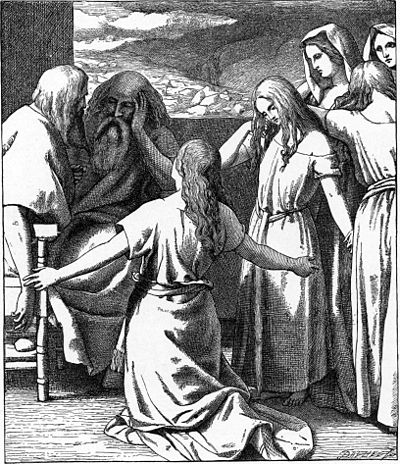
Daughters of Tzelofchad, print after Frederick R. Pickersgill, by Dalziel Brothers, Charles Foster Bible 1897

Yet in the Torah portion Pinchas, five women take a bold and independent action. The daughters of Tzelofchad come to Moses and the assembly of all-male leaders at the entrance of the Tent of Meeting. They ask for the property that would have gone to their father, if he had lived long enough to be counted in Moses’ census.

Why should the name of our father be removed from his family because he had no son? Give us property amidst the brothers of our father.” (Numbers/Bemidbar 27:4)

The women are careful to ask for property not for their own sake, but in order to perpetuate their father’s name. Moses checks with God, who replies:

“Rightly the daughters of Tzelofchad speak; you shall certainly give them possession of a hereditary property amidst the brothers of their father, and you shall make the property of their father pass over to them. And you shall speak to the children of Israel, saying: If a man dies and has no son, then you shall make his property pass over to his daughters.” (Numbers 27:7-8)

God’s answer promotes women from chattels to second-class citizens who can inherit land—but only if their father dies without sons. This solution rescues women who would otherwise be dependent on the goodwill of distant male relatives. The Torah never praises independence, but it does praise compassion for the unfortunate, and a woman without a father, husband, brother, or son to support her is considered unfortunate. A side-effect of the new law was that a daughter who inherited and remained unmarried would have a financial independence no other women possessed. But the Torah assumes all women marry and try to have sons.

This assumption raises an issue about the daughters of Tzelofchad in this week’s double Torah portion, at the end of Masey (“Journeys”). The heads of other clans in the Gilad branch of the tribe of Menasheh come to Moses and say:

“God commanded my lord to give the land, by lot, as hereditary property for the children of Israel; and my lord was commanded by God to give the property of Tzelofchad, our brother, to his daughters. But if they become wives to any of the sons of the [other] tribes of the children of Israel, then their property will be removed from the property of our fathers, and it will be added onto the property of the tribe that they will belong to; so it will be removed from our allotted property.” (Numbers 36:2-3)

In other words, if a daughter who inherited land married a man from another tribe, then she and her land would automatically become her husband’s property—and therefore the property of her husband’s tribe. These men identify strongly with their own tribe, Menasheh, and with the Gilad branch of the tribe. Any reduction in the amount of land under the control of the Gilad clans of Menasheh seems like a personal loss to them.

Moses approves of their sentiment. He does not stop to check with God this time, but he answers the men in God’s name.

“This is the word that God commanded for the daughters of Tzelofchad, saying: They may become wives to whoever is good in their eyes; yet only within the clan of the tribe of their father they shall become wives. And landed property shall not go around for the children of Israel from tribe to tribe, for each man shall daveik to the landed property of the tribe of his fathers. And every daughter coming into possession of landed property from the tribes of the children of Israel, she shall become a wife to someone from the clan of the tribe of her father, so that each of the children of Israel shall possess the landed property of his fathers.” (Numbers 36:6-7)

daveik  = cling to, stick to, be attached to; catch up with

The idea of clinging to your ancestral land is so important that Moses repeats it.

“The property will not go around from one tribe to another tribe, because each man shall daveik to his hereditary property in the tribes of the children of Israel.” (Numbers 36:9)

The Hebrew Bible uses the verb daveik when physical things stick to each other, and when one person pursues and overtakes another. But daveik is also used when one person is devoted to another, and when it sets out the ideal that the Israelites should cling to God with loyal devotion. The only time the Bible uses a form of daveik to indicate a person’s attachment to land is in Numbers 36:7 and 36:9, translated above. But land here is not just real estate; it is the expression of family lineage and tribal loyalty.

Conquering Canaan could, theoretically, be an opportunity for the tribes of Israel to unite and become truly one people (as the thirteen colonies became the United States of America). However, the Torah tells men to cling to the property they inherit from their fathers, and to the territory of their tribe. Why?

My theory is that instead of viewing tribal loyalty as a threat to national loyalty, the way many nations do today, the Torah views tribal loyalty as good practice for for national loyalty. The more you cling to one thing, the more you become able to cling to something else.

Most of all, Moses repeats that everyone must love God. But does practicing  passionate attachment to another person, to a tribe, or to a country, make it easier to love God?

I grew up in an atheist household in 20th-century America. I have always valued independence more than loyalty. I love my husband and my son, and give them my passionate allegiance. But I have never been interested in loyalty to my ancestry, or hometown, or school, or state, or country. I grew fond of several of the houses and yards where I have lived, but I still moved and sold the property to strangers. Maybe I have not practiced attachment enough, and that is why I find it hard to become attached to God.

In the Torah, many of the Israelites wandering in the wilderness also find it hard to cling devoutly to God. The first generation of the exodus from Egypt frequently complains about the food and expresses a desire to abandon God and return to Egypt. When Moabites invite the second generation to worship Baal-Peor, most of the men quickly abandon any loyalty to their own god. (See my earlier post, Balak: Carnal Appetites.)  No wonder Moses encourages them to practice passionate loyalty, if only to their families and tribes!

If you have not practiced a lot of clinging, is there any other way to develop a love for God? In Chassidic Judaism of the last two centuries, a key aspiration is deveikut, attachment or clinging to God. The Chassidic masters recommended developing deveikut through personal prayer, meditation, and intention (though it also helps to learn from a wise rabbi).

But first a modern, independent person without a religious upbringing must decide whether deveikut is even desirable. And that includes figuring out what it is that we are calling “God”.

I wonder if my life would be easier if I had inherited my religion and my god. On the other hand, a good life is not necessarily easy.

Pinchas: Fairness

Children passionately want life to be fair. For the sake of fairness, they can even be persuaded to share their possessions. But if a young child is the victim of unfairness, prepare for a tantrum.

Adults know that life is not fair. People in power are biased, and bad luck happens. Nevertheless, most of us feel bitter when we do all the right things, and still get the short end of the stick.

When is the distribution of benefits “fair”?  Merriam-Webster’s dictionary gives two possible answers: when the distributor is impartial, i.e. free from self-interest, prejudice, or favoritism; or when everyone is given their due according to established rules.

Unfairness to Canaanites

This week’s Torah portion, Pinchas, looks ahead to how the land of Canaan will be distributed after the Israelites have conquered it by killing or subjugating the Canaanites. The question of fairness to the indigenous Canaanites never comes up in the Torah. Over and over again, from the book of Genesis/Bereishit through the conquest of the land in the book of Joshua, we read that God is giving the land of Canaan to the children of Israel. And what God wants trumps any human notion of fairness. Although later Jewish writings paint the Canaanites as evil perverts, the only objection to Canaanites in the Torah itself is that they worship different gods.

Fairness among Israelites

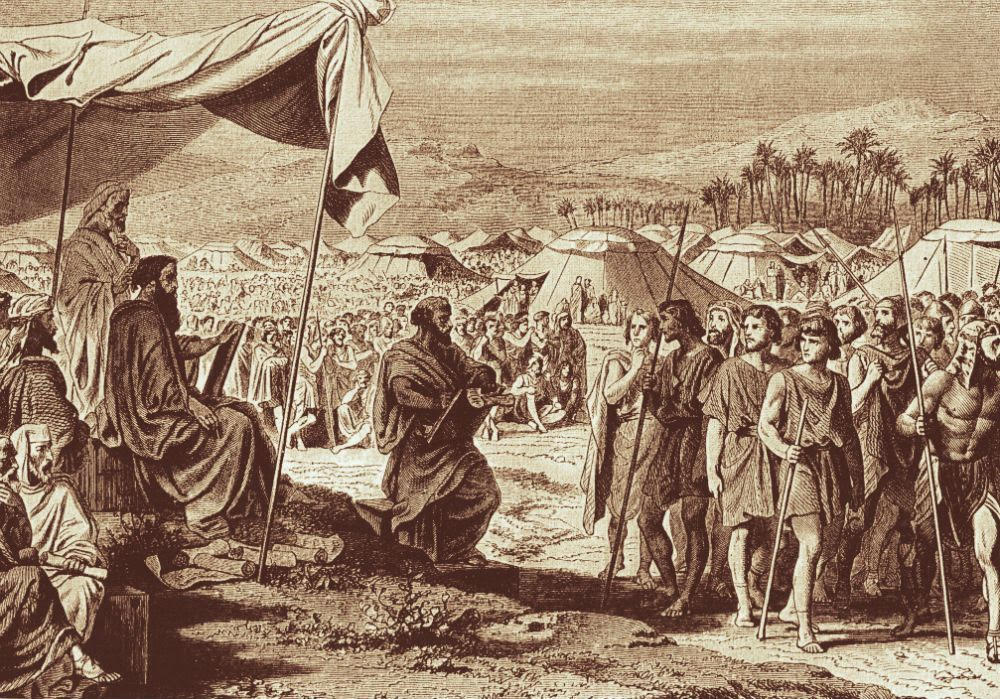
Numbering of the Israelites, by H.F.E. Philippoteaux,
19th century

In this week’s Torah portion, God prescribes how the land the Israelites are about to conquer should be divided among themselves. The first step is to take a census of men aged 20 and older. The census serves both as a mustering of eligible fighters for the upcoming conquest, and as a count of the households that will own plots of land once Canaan has been conquered.

The census of adult men raises two questions: What about women? And why should the land be divided according to the current population on the banks of the Jordan, rather than the previous generation, or the next generation? The Torah addresses these issues in the story of the daughters of Tzelofchad, which begins in the portion Pinchas and resumes in the portion Masey. I plan to examine that two-part story in next week’s blog post.

Right or wrong, the census clearly defines the in-group for the distribution of land: male heads of households. The next step is to divide the land fairly among the tribes of the in-group.

This is the census of the sons of  Israel: 601,730. Then God spoke to Moses, saying: “For these the land shall be divided as a nachal, by the account of names. The abundant [tribe] will have an abundant nachal, and the scanty [tribe] will have a scanty nachal; each one shall be given its nachal according to the bidding of the census. Yet the land shall be divided according to the bidding of a lottery; nachal [will be assigned] to the names of the tribes of their fathers.  According to the bidding of the lottery you shall divide [land] among the abundant [tribes] and the scanty [tribes], giving each its nachal.” (Numbers/Bemidbar 25:51-55)

nachal (נָחַל)=a permanent possession to pass on as an inheritance; a hereditary land-holding.

In other words, each tribe will get a territory proportionate to the number of adult men in the tribe, and tribes will be matched with territories through a lottery. This procedure goes out of its way to achieve fairness. The land will be distributed according to population, and an impartial lottery will match each tribe with its territory. (After that, the leaders of each tribe are to use a similar process to allocate land to individual clans and households.)

According to the Talmud Bavli, tractate Bava Batra 121b-122a, every man in the census will end up with his own plot of land, and all the plots will be equal—not in size, but in value. Where the land is more fertile, the plots will be smaller. This seems fair because each male Israelite head of household, i.e. each member of the in-group, will get his due.

The purpose of the lottery is to make sure this distribution is carried out without favoritism. Later in the Hebrew Bible, lotteries express the will of God, but here a lottery might be merely a randomizing mechanism, as it is today. The choice is left up to blind chance rather than a human decision. A lottery seems to meet the dictionary definition of fairness as impartial distribution, free from self-interest, prejudice, or favoritism.

But there is a catch. Each tribe must get a territory whose total value matches its total count of adult males. And the tribes are different sizes. The tribe with the largest head-count is Yehudah (Judah in English), with a total of 76,500 men. The smallest is Shimon (Simeon in English) with a total of 22,200. In a truly random lottery, the high priest might draw the name Yehudah the same time as the description of a territory that could only support Shimon. Thus the leaders cannot conduct a random lottery and still give each tribe land according to its head-count. Either the land will not be not distributed equally, or the lottery will be rigged.

Fairness versus foreknowledge

The Talmud explained that when the lottery took place, the high priest Elazar already knew which tribe would be matched with which territory, because he was supported by the ruach hakodesh, the holy spirit of God. First he would predict the tribe and its territory. Then he would shake the urn of tribe names and pick one, and shake the urn of land boundaries and pick one. Every time, the two lots matched his prediction (Talmud Bavli, Bava Batra 122a). In other words, the whole lottery was predetermined by God.

Thus God’s orders for land distribution are fair only for the group counted in the census, and only if God is impartial and does not play favorites. The obvious question is: Is God fair?

God wears a human face in the Torah; “He” is an anthropomorphic character who feels emotions such as regret (for creating this world) and rage (every time the Israelites disobey him). Nevertheless, God is the creator of the universe, far greater than any other gods, if they even exist. Sometimes this God character is benevolent. When God tells Moses “His” 13 attributes in Exodus/Shemot 34:6, the list begins with compassion, grace, patience, abundant kindness, and truth. Fairness is not mentioned.

And it is hard to attribute fairness to the god who saves Noah’s family but drowns the rest of the world, including innocent children; or to the god who routinely wipes out thousands of Israelites with plagues that make no distinction between the innocent and the guilty.


Some people still assume that the God character in the Torah is the same being as the theologian’s omnipotent all-benevolent God, and that both are the same as God the Unknowable. After all, the three versions of God all have the same name. It is hard for these people to believe that life is unfair. If God is human enough to care about fairness, and God runs everything in the universe, then why does bad luck strike some people and not others? Surely the unlucky must deserve a worse deal than their luckier neighbors. Otherwise, God would be unfair.

This confusion about God led some Jews to believe that they must have deserved the Holocaust; if only they had been more observant, God would have intervened to prevent it. During the current long recession, some Americans who lose their houses and jobs blame themselves for not working hard enough, or for making the wrong decisions.  It is easier for them to believe they are undeserving than to believe that either God or the American system is unfair.

Other people embrace the reality that life is not fair, and campaign to change the system to make it more fair. Still others view the desire for fairness as childish, and focus on moral values they find less simplistic.

Life is not fair.  What do you want to do about it?

Tetzaveh: Divining

What should I do?

Usually human beings carry on with their habitual behavior, but sometimes we have to make a deliberate decision.  And we do not know whether a particular choice will lead to good or evil, or to happiness or disaster.  If only we knew ahead of time!

The longing for foreknowledge has been with us for millennia.  Most cultures have had their own methods of divination, of gaining knowledge that is normally outside the human realm.

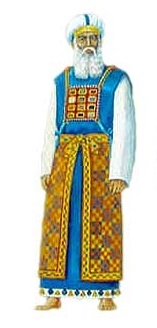
High priest’s vestments, artist unknown

In the Hebrew Bible, leaders and kings ask the high priest to consult the urim and tumim tucked into his breast-pouch. These mysterious items are introduced in this week’s Torah portion, Tetzaveh (“You shall command”), but we do not learn their purpose until the book of Numbers/Bemidbar, when God tells Moses what Joshua must do after Moses has died. Since Joshua, unlike Moses, cannot hear God directly, he must ask the high priest for divination when he needs to decide whether to go out to battle:

He shall stand before Eleazar the priest, and ask him for the ruling of the urim before God. (Numbers 27:21)

urim (אוּרִים) = firelight? illumination?

But the book of Joshua never refers to the urim. The only time the Torah says someone actually consults them is in the first book of Samuel:

And Saul inquired of God, but God did not answer him, either with dreams or with urim or with prophets.  (1 Samuel 28:6)

Several other times in that book both Saul and David “inquire of God” in the presence of a priest, and when David receive yes/no answers, we can assume the answers are indicated by the urim.  But no description is given.

This week’s Torah portion describes everything else the high priest wears, from his headband to his underpants. Over his sky-blue robe, the priest must wear an eifod, a kind of tabard with shoulder-straps and sewn-in ties at the waist.  A chosen, a square pouch, will hang from the shoulder-straps of the eifod, secured on the high priest’s breast.  This breast-pouch will be folded at the bottom, and twelve gems will be set into the front.  Each gem will be engraved with the name of one of the tribes of Israel.

And into the breast-pouch of the law you will place the urim and the tumim; and they will be over the heart of Aaron when he comes before God, and Aaron will carry the law of  the children of Israel over his heart before God constantly.  (Exodus/Shemot 28:30)

tumim (תֻּמִּים) = ? (a noun probably based on the adjective tamim, תָּמִים = whole, flawless, blameless.)

Obviously a high priest could not carry firelight and wholeness in a pouch on his chest; the names of the actual items are symbolic.  But what do they mean?  In Ezekiel, ur is a destroying fire. Throughout the book of Isaiah, urim means “fires” or “firelight”, not an object worn by a high priest.  Everywhere else in the Hebrew Bible, the word urim refers to the item worn by the high priest.

Traditional commentary says the word urim means light, illumination, clarity, because it has the same root letters as the word or = light. Some modern language scholars speculate that urim is derived from nei-arim (נֵאָרִים) = cursed, inflicted with a curse. In that case, urim and tumim would mean “cursed” and “blameless”. In other words, one object indicates a bad outcome and the other indicates a good one.

Rashi (11th-century rabbi Shlomo Yitzchaki) suggested that the two words urim and tumim were written on a single piece of parchment, and the high priest would look down through the open top of his breast-pouch to see which word was facing up.

In the Talmud tractate Yoma 73b, the rabbis seem to use the phrase “urim and tumim” interchangeably with the phrase “breast-pouch of the law”.   Some speculated that the names of the twelve tribes were inscribed on the urim and tumim, and the letters lit up or moved around to create an oracular message.  Others said that the urim and tumim caused the stones on the front of the breast-pouch to light up, and the message could be deciphered from the pattern of flashing lights.  The important thing was that both the person with the question and the high priest had to direct their minds toward God.


Some passages in the Torah appear to forbid using any kind of divination, along with any other kind of magic.  For example:

No one must be found among you who sacrifices his son or his daughter in the fire, or who reads omens, a cloud-conjurer or a diviner, or a sorcerer; or a charm-binder, or a medium who consults ghosts or a medium who possesses a familiar spirit, or who questions the dead.  For anyone who does these is an abomination of God, and on account of these abominations, God, your god, is dispossessing them before you.  You shall be whole with God, your god.   (Deuteronomy/Devarim 18:10-13)

Here Moses is banning all the divination practices of the people surrounding the Israelites.  In other places, the Torah approves of a few practices for getting a bit of divine knowledge.

The two most common ways that God shares foreknowledge with humans is through dreams, and through communication with prophets.  In the absence of dreams or prophetic utterances, a person can take the initiative by casting lots, or by consulting the high priest’s urim and tumim.


When this week’s Torah portion introduces the urim and tumim, it says “they will be over the heart of Aaron when he comes before God”—like the gems representing twelve tribes of Israel.  Maybe the primary purpose of the urim and tumim is not to enable divination, but to keep light and wholeness in the high priest’s awareness whenever he approaches God.

Even today, people who want to make the right decision resort to dubious divination methods.  Instead of reading omens in entrails or conjuring clouds, they flip a coin, or buy something from a New Age shop, or consult a medium who channels the spirit of a dead person.  It is hard to accept that we cannot have foreknowledge, only good guesses.

Yet we can answer the question “What should I do?” without knowing the outcome of our choice.  And when our intuitions are not clear, we can use approaches similar to the kind of “divination” the Torah approves of.  Dreams still help by connecting us with hidden parts of ourselves that are connected with the divine.  And we can improve our conscious thought by keeping certain ideas in our awareness, carrying them upon our hearts like high priests.   We can consciously stay in touch with urim, the light shed by the fire of our passions; tumim, the continual effort to complete ourselves and become whole; and on the outside, the gemstones of our own tribes, our own families, friends, and communities.