Haftarat Shemot or Matot—Jeremiah: A Congenital Prophet

(In this post I refer to people by their Hebrew names first, but to books and places by their English names.)

The English word “prophet” means “1. one who utters divinely inspired revelations. … 2. one gifted with more than ordinary spiritual and moral insight. … 3. one who foretells future events: predictor.”1

The Biblical Hebrew word navi (נָבִיא), routinely translated as “prophet”, means: 1. one who goes into a temporary altered state and experiences God.2 2. one who receives messages from God and communicates at least some of them to other people.3

Even the second kind of navi does not predict the future, but rather warns people about what God will do to them if they do not change their ways.4 Everyone in the Hebrew Bible who hears or reads one of these prophecies has a choice: to continue their behavior and eventually suffer the prescribed doom from God, or to stop doing the wrong things and avoid the doom.

Ironically, although the recipients of prophecies have free will (the ability to choose their own actions), the prophets themselves may not.
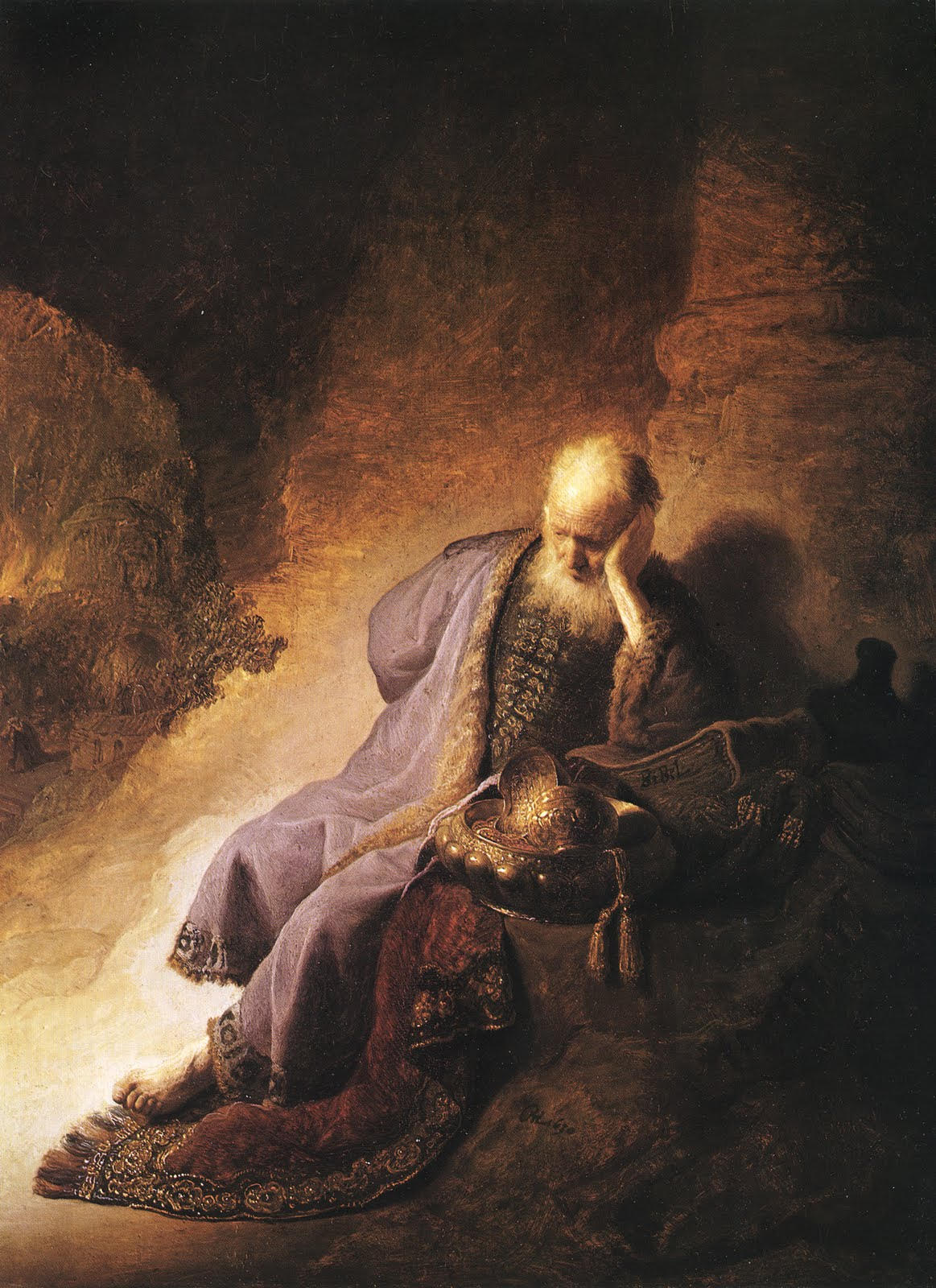
Jeremiah Lamenting the Destruction of Jerusalem, by Rembrandt, ca. 1630

A time for prophecy

Yirmeyahu (“Jeremiah” in English) seems to have no choice but to prophesy, whether he wants to or not. His dilemma is introduced in the haftarah reading Jeremiah 1:1-2:3, which goes with this week’s Torah portion, Shemot, according to the Sefardi tradition.5 The book of Jeremiah opens:

The words of Yirmeyahu, son of Chilkiyahu, one of the priests who were at Anatot in the territory of Benjamin. (Jeremiah 1:1)

Already we know that the father of Yirmeyahu (Jeremiah) is a priest, perhaps even the high priest named Chilkiyahu during the reign of King Yoshiyahu (“Josiah” in English).6 Priesthood is hereditary in Ancient Israel, so Yermiyahu (Jeremiah) is born a priest. He is also born in the territory of Benjamin, close to Jerusalem, the capital city of the kingdom of Judah.

Before he reaches adulthood, he finds out that he is also a prophet.

The word of God happened to him in the days of Yoshiyahu son of Amon, king of Judah, in the thirtieth year of his reign. (Jeremiah 1:2)

King Yoshiyahu (“Josiah” in English) ruled the kingdom of Judah from 640 to 608 B.C.E.—after the Assyrian Empire to the north had become weak and ceded some of northern kingdom of Israel to Judah, and before the new Babylonian empire had grown strong. According to 2 Kings 22 and 23, King Yoshiyahu crusaded to get rid of all the shrines and priests serving other gods.7

There is not much work for Yirmeyahu (Jeremiah) until after King Yoshiyahu dies, since the main roles of a prophet during the time of the Israelite kingdoms are to challenge government policies and to shame or frighten rich citizens into reforming. But then Babylon’s power grows, and the kings of Judah make no changes in policy to address the threat. The word of God happens to Yirmeyahu (Jeremiah) more often, and many of his prophesies warn that unless people return to the exclusive worship of God, and embrace God’s ethical rules, the Babylonians will conquer Judah and Jerusalem.

And it happened through the days of Yehoyakim son of Yoshiyahu, king of Judah, until the end of the eleventh year of Tzidekiyahu son of Yoshiyahu, until Jerusalem went into exile in the fifth month. (Jeremiah 1:3)

The reign of King Tzidekiyahu (“Zedekiah” in English) ended in 586 B.C.E. when the Babylonian army completed its conquest of Judah by destroying Jerusalem and exiling almost all of its remaining citizens to Babylon.

A congenital prophet

The narrative in this week’s haftarah then switches to the first person, and Yirmeyahu (Jeremiah) speaks.

And the word of God happened to me, saying: “Before I formed you in the belly, I knew you; and before you went out of the womb, I set you apart as holy. A prophet to the nations I appointed you.” (Jeremiah 1:4-5)

What is God communicating here?

“Before I formed you in the belly, I knew you.” Psalm 139 is the only other biblical passage that says God gives human fetuses their physical form and some aspect of their personality:

For you yourself provided my conscience;

            You wove me together in my mother’s womb. (Psalm 139:13)

Furthermore, in Psalm 139 God knows all human thoughts:

God, you have examined me and you know me.

You know [when] I sit down and stand up,

            You discern my intention from afar. (Psalm 139:1-2)

The new claim in the book of Jeremiah is that God knows Yirmeyahu even before weaving him together in the womb. This might mean that God knows what certain individuals will be like in the future. Or it might mean that God creates someone’s personality even before creating that person’s body.

“And before you went out of the womb, I set you apart as holy.” This statement could mean merely that Yirmeyahu (Jeremiah) was born into the priesthood, since priests are holy in the sense of being set apart for temple service and restricted regarding marriage and mourning.8 But it might also mean that God made him, in utero, even holier than a priest, even more set apart from normal life.

“A prophet to the nations I appointed you.” In the rest of the book of Jeremiah, the prophet addresses most of his prophecies to the citizens of Judah, although he does utter some prophecies about other nations.9 But the point in this verse is that before Yirmeyahu (Jeremiah) was born, God determined how he would spend his entire adult life.

A right of refusal?

That raises the question of whether it is even possible for Yirmeyahu (Jeremiah) to refuse to speak as a prophet. (Presumably he cannot help hearing, or otherwise experiencing, God.) Some modern commentators assert that he does have the power to refuse. For example, Plaut wrote:

“The call to Jeremiah may thus be seen to express both predetermination and freedom: the child was born with particular gifts and a high degree of religious sensitivity. But giving his life to a pursuit of the divine call—with all its rewards, difficulties and dangers—was a decision that Jeremiah had to make for himself.”10

After God’s opening salvo, Yirmeyahu (Jeremiah) protests that he does not have the eloquence to be a prophet.

“Ah-ah, my lord God! Hey, I do not know how to speak, since I am a na-ar.” (Jeremiah 1:6)

na-ar(נַעַר) = boy or young man.

He says this, according to Malbim, because he lacks confidence, because he does not know how to speak well in front of a congregation, and because he is afraid people will kill him on account of his prophecies.11

And God said to me: “Don’t you say ‘I am a na-ar’. For you will go wherever I send you, and you will speak whatever I command you.” (Jeremiah 1:7)

Midrash Tanchuma explains, ominously: That is, against your will you will go, and against your will you will speak.”12

Indeed, later in the book Yirmeyahu (Jeremiah) complains:

“… the word of God happens to me, for scorn and derision all day. So I thought: I will not mention him, and I will not speak any more in his name. But it [God’s word] happened in my mind like a burning fire shut up in my bones, and it exhausted me to hold it in, and I could not endure.” (Jeremiah 20:8-9)

By the prophet’s own testimony, he has no freedom of choice when it comes to prophecy.

A promise of rescue

After God tells Yirmeyahu (Jeremiah) that he must go and speak at God’s command, God attempts to reassure him by saying:

“Don’t be afraid in front of them! For I am with you to rescue you.” (Jeremiah 1:8)

“To rescue you” could mean merely to rescue him if his speech stumbles. But God makes the real meaning clear before the interview is over:

“And hey, I appoint you this day as a fortified city, and as an iron pillar, and as bronze walls, against the whole land—against the kings of Judah, against its officers, against its priests, and against the people of the land. And they will battle against you, but they will not prevail over you, because I am with you,” declares God, “to rescue you!” (Jeremiah 1:18)

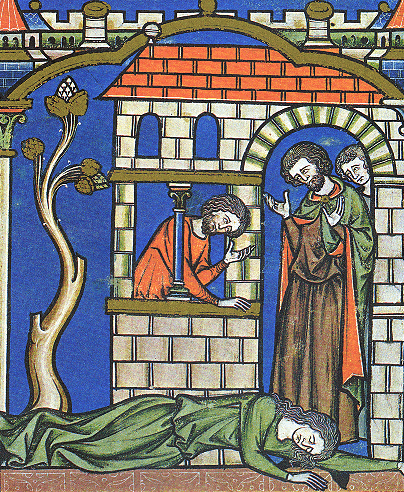
Later in the book, the prophecies of Yermiyahy (Jeremiah) are so unpopular that he needs to be rescued from various death threats.13 The worst is when he tries to leave Jerusalem on a business trip, and a guard at the gate accuses him of defecting to the Babylonians. City officials beat him, imprison him, and eventually convince King Tzediyahu to put him to death. Yirmeyahu (Jeremiah) is lowered into a pit with no water, only mud. But before he dies of thirst and hunger, the king changes his mind and has him pulled up and returned to the regular prison. He remains there until the Babylonians capture Jerusalem.14 Then, while the city is burned down and its nobles are killed, the Babylonians remove him, give him food, and set him free.15


The characters in the Hebrew Bible have fewer choices than we do in today’s world, but almost all of them have free will, the ability to choose to do something different. We know this because the prophets who utter prophecies issue warnings about how people will suffer if they do not change their ways.

But do the prophets themselves have free will? It is hard to know, since even reluctant prophets like Moses come to accept their role in the world—except for Yirmeyahu (Jeremiah), who hates being a prophet so much that he wishes he had never been born. He declares:

“Accursed is the day that I was born! … Why did I ever go out from the womb to see trouble and grief, and to use up my days in shame!” (Jeremiah 20:14-20)

Today we have more choices than anyone in ancient Jerusalem, yet our range of choices is still limited by our starting point. A person is born into a family; events can change one’s upbringing as time goes on, but one’s first environment makes its mark. A person is born with predetermined genes; they can be turned on or off by events, but not replaced by different genes.16 Some infants have congenital defects. Some, for all we know, might be congenital prophets.

Do we have more control over our own lives than Yirmeyahu? Or are we just less aware that someone or something is pulling the strings?


  1. www.merriam-webster.com, 2025.
  2. E.g. 1 Samuel 10:5-6 and 10-13.
  3. E.g. Deutereonomy 34:10, 1 Samuel 3:20, etc. There are also false prophets, as in Deuteronomy 13:1-4.
  4. Deuteronomy 18:22 is an exception to this rule; the book of Jonah is a prime example.
  5. The haftarah reading Jeremiah 1:1-2:3 goes with the portion Matot in Numbers according to the Ashkenazi tradition.
  6. 2 Kings 22:4ff.
  7. 2 Kings 22:1-23:25.
  8. Leviticus 21:1-15.
  9. Jeremiah 9:25, 25:9–29, 27:3–11, and chapters 46–51.
  10. W. Gunther Plaut, The Haftarah Commentary, UAHC Press, New York, 1996, p. 413.
  11. Malbim is the acronym of Meir Leibush ben Yehiel Michel Weisser (1809–1879).
  12. Midrash Tanchuma, c.500–c.800 C.E., translation in www.sefaria.org.
  13. Jeremiah 11:21-23, 26:8-11, 26:24, 36:26.
  14. Jeremiah chapters 37-38.
  15. Jeremiah 40:1-4.
  16. At least not yet; gene splicing is still in its infancy.

Balak, Pinchas, & Matot: Midianites Revisited

Ten years ago I wrote a post called Balak, Pinchas, & Matot: How Moabites Became Midianites. I received some positive comments, but also some hate mail. I am leaving that post up to remind myself that my writing is not always interpreted the way I intended it.

This week Matot (Numbers 30:2-32:42) arrives again in the annual cycle of Jewish Torah portions, and I want to add another interpretation of the Israelites’ massacre of Midianite women. I also want to re-examine my conclusion in 2015, in which I compared my own unreflective discrimination against Republicans to Moses’ discrimination against Midianites.

Midianites in Moab

Moses first encounters Midianites in the area where archaeologists have confirmed that they actually lived: east of the Gulf of Aqaba (in present-day Saudi Arabia), and north up to and including Timna. In the book of Exodus, Moses is fleeing from a murder charge in Egypt, and a priest of Midian invites Moses to live with him and marry one of his daughters.1

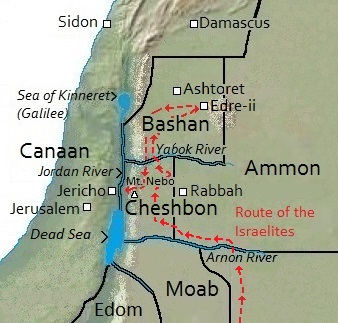
Years later in the book of Numbers, Moses leads the Israelites all the way to the east bank of the Jordan River. When King Sichon will not let them pass through Cheshbon, they conquer his whole kingdom, and the kingdom of Bashan to the north. Then they go back and camp in the acacias on the “Plains of Moab”, so-called because the land of Cheshbon was once part of kingdom of Moab.

In the Torah portion Balak, King Balak of Moab is afraid of the horde of Israelites camped just north of his border.

And Moab said to the elders of Midian: “Now this assembly will lick up everything around us like the ox licks up the green plants of the field!” (Numbers 22:4, in the portion Balak)

Apparently there is no king of Midian, so King Balak sends his message to the elders of each town. And apparently the Midianites respond to his call for an ally, because when Balak sends a delegation to Bilam, a Mesopotamian “sorcerer”, the Torah says:

The elders of Moab and the elders of Midian went, and tools of divination were in their hand, and they came to Bilam and they spoke Balak’s words to him. (Numbers 22:7).

Balak’s message asks Bilam to come to Moab and curse the Israelites. Eventually the two men meet on a ridge at Moab’s northern border, overlooking the Israelite camp. But King Balak’s plan fails, because Bilam is actually a prophet, and God will not let him curse the Israelites.2

Then Bilam got up and went, and he returned to his place. And also Balak went on his way. And Israel stayed in the acacias, and the people began to whore with the women of Moab. They [the women] called the people for animal sacrifices of their gods, and the people ate, and they bowed down to their gods. And Israel yoked itself to the Ba-al of Peor, so God’s nose heated up against Israel. (Numbers 24:25-25:3)

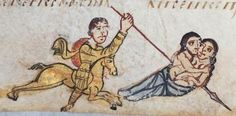
As usual, the God character responds to “whoring” after other gods with a plague. Next, an Israelite man brings a foreign woman into the Tent of Meeting itself for sex. Aaron’s grandson Pinchas quickly thrusts a spear through both of them, and the plague halts.

One would expect the impaled woman to be a Moabite, since the Israelite men were seduced into worshiping Ba-al Peor by Moabite women. But the next Torah portion, Pinchas, identifies the foreign woman as the daughter of a Midianite elder.

Pinchas impales them, in Sacra Parallela, 9th century Byzantine manuscript

And the name of the Midianite woman who was struck down was Kozbi, daughter of Tzur, the head of the people of a paternal household from Midian. And God spoke to Moses, saying: “Be hostile toward the Midianites, and strike them down. Because they were hostile to you through their deceit, when they deceived you about the matter of Peor …” (Numbers 25:15-18)

Suddenly Moabite women have become Midianite women.

In this week’s Torah portion, Matot, God reminds Moses to attack the Midianites.

And God spoke to Moses, saying: “Take vengeance, the vengeance of the Israelites, from the Midianites; afterward you will be gathered to your people.” (Numbers 31:1-2)

Moses obediently musters an army.

And they arrayed against Midian, as God had commanded Moses, and they killed every male. And the kings of Midian they killed … five kings of Midian, and Bilam son of Beor, they killed by the sword. But the children of Israel took captive the women of Midian and their little ones… (Numbers 31:7-9)

In this passage, the Midianites are not ruled merely by elders, but by five kings. And Bilam, who goes home at the end of the portion Balak, mysteriously appears among the kings of Midian.

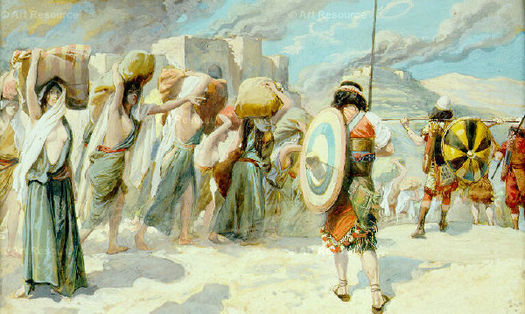
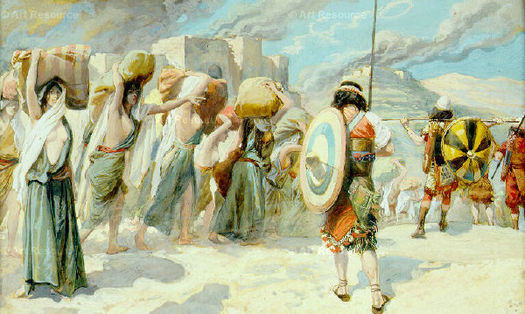
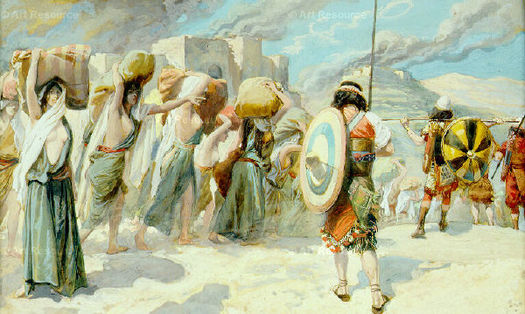
The Women of Midian Led Captive by the Hebrews, by James Tissot, ca. 1900

The story ends with the slaughter of the captive Midianite women. (See my post Matot: Killing the Innocent.)

And Moses said to them: “You left every female alive! Hey, they were the ones who, by the word of Bilam, led the Israelites to treachery against God in the matter of Peor, so there was a plague in God’s assembly. So now, kill every male among the little ones; and every woman who has known a man by lying with a male, kill!” (Numbers 31:15-17)

Has Moses forgotten that the Israelite men were seduced into worshiping Ba-al Peor by Moabite women? Or does he assume that God must be right, so the women whom he thought were Moabites must secretly be Midianites?

Another Explanation for Midianites in Moab

In my 2015 post, I review three kinds of attempts by commentators to reconcile the apparent conflation of Moabites and Midianites in this storyline: the “apologists”, who invented bizarre explanations for the inconsistencies; the “scientists”, modern scholars who assigned the scenes to two different sources and noted that the redactor left both Moab (the enemy in the J/E source) and Midian (the enemy in the P source) in the story; and the “psychologists”, who imagined that Moses, whose own wife is a Midianite, is flummoxed when God tells him that the Midianite women are all guilty.

Now I would add a fourth explanation. Angela Roskop Erisman3 dates the storyline about Midianites in Moab to the reign of Hezekiah, the king of Judah from circa 716 to 687 B.C.E. Before King Hezekiah rebelled against being a vassal of the Assyrian Empire, he lined up support from Egypt, but Egypt (ruled by Kushites at the time) was not much help. So, according to Erisman, he probably arranged an alliance with Midian instead. These two political alliances are reflected in the Torah, where Moses has a Midianite wife in the book of Exodus, but a Kushite wife in Numbers 12:1.

Jerusalem survived the Assyrian siege in 701 B.C.E. not because of any allies, but because King Hezekiah had built a new city wall and dug a tunnel between the city and the nearest water source, the Siloam Pool. No assistance from Midianites was recorded either in the Hebrew Bible or on the Assyrian stelae that have been excavated.

If the Midianites failed to come to the aid of Jerusalem, that would be reason enough to vilify them in one of the stories about Moses.

Floored by comments

Ten years ago, I wrote this conclusion to my post on Midianites in Moab:

“Just as Moses judges all Midianites in the five northern tribes as evil because of the actions of a few of their members, human beings throughout history have made judgements about undifferentiated groups.  It is so much easier than discriminating among individuals. From Biblical times to the present day, some people have judged all Jews as bad.

“Today, I catch myself ranting against Republicans, as if every person who voted Republican in the last election were responsible for the particular propaganda efforts and political actions that I deplore. A psychological look at the story of Moses and the Midianites near Moab reminds me that I need to be careful not to slander the innocent with the guilty.”

My intention was to sound a warning against treating all members of a group as if they were the same. It is obvious that “All Midianites are bad” is a false statement in the context of the whole Torah, since Moses’ father-in-law and wife are Midianites and do nothing but good deeds.

My next example was my own bad tendency to talk about “Republicans” as if all Republicans were bad. I thought I was being clear that there were people who voted for Republican candidates in the 2014 election for reasons that had nothing to do with the claims and policies that I, personally, objected to.

But I got a lot of comments that were vicious put-downs. I deleted them, since I did not want hate language in this blog. Now I wish I had saved them, so I would have examples of knee-jerk emotional reactions.

This year I received a milder negative comment on my 2015 post:

“You had me until you started the Republican rant…. Too bad TDS once again ruins scripture talk unnecessarily.”

I had to look up TDS. I found it that it stands for “Trump Derangement Syndrome”, and is a term that some supporters of Donald Trump use to criticize people whom they perceive as having knee-jerk emotional reactions against Trump that make them incapable of perceiving reality.

Who is making a rational analysis, and who is having a knee-jerk emotional reaction? It turns out to be a complicated question.

Should I have avoided any mention of politics in my 2015 blog post, and found a different example of my own tendency to discriminate against whole groups (instead of being discriminating about the differences among individual members of those groups)?

Maybe. But I find American politics more frightening now than I did ten years ago. When I wrote my 2015 post, I thought it was obvious that “All Jews are bad” is a false statement, like “All Midianites are bad”. But now anti-Semitism is increasing in the United States, and it comes from both ends of the political spectrum. I suspect that the increase on the right is part of today’s greater tolerance for hate speech, while the increase on the left is due to a false assumption that all Jews support the current government of Israel’s war on Gaza.

Will human beings ever overcome the black-and-white thinking that leads us to slander whole groups of people?


  1. Exodus 2:15-22.
  2. See my post Balak: Prophet and Donkey.
  3. Angela Roskop Erisman, “Moses is Modeled on Horus and Sargon, but His Story Is About King Hezekiah” and “Miriam Complains of Moses’ Cushite Wife: Hezekiah Married the Wrong Empire!” in www.thetorah.com, 2025.

Matot: Protection from Commitment

Seal to sign contracts, Jerusalem, ca. 7th c. BCE

Most human beings want to make some commitments—although what we are willing to commit to depends on both our cultures and our individual psychologies. Modern Western societies tend to focus on marriages, legal contracts, and oaths of office. The Israelite culture portrayed in the Hebrew Bible also focuses on religious commitments.

According to the Torah, every family was required to tithe to support the clergy, and to make the necessary sacrificial offerings. But some Israelites committed themselves to making extra donations to both the sanctuary staff and God.1 And some abstained from certain behaviors in order to achieve greater sanctity. The most common abstentions were fasting, and living as a nazirite.

Not for nazarites

Nazirites dedicated themselves to God by adopting a more ascetic way of life for a specific period of time. They could not serve in the sanctuary, since clergy were restricted to hereditary priests and Levites. So instead, nazirites let their hair go wild and abstained from alcohol, grapes, and contact with the dead. (For more details, see my posts Naso: Distanced by Hair and Haftarat Naso: Restraining the Abstainer.)

What a person vows to abstain from for the sake of God depends on the religion. During the past millennium, monks and nuns have taken vows of abstinence from sexual intercourse and lived in separate communities as a spiritual dedication.

All men, but not all women, were free to determine their own voluntary religious commitments.

This week’s Torah portion, Matot, opens:

A man who vows a vow to God, or swears a sworn-oath le-esor isar upon his soul, he must not break2 his word; he must act according to everything that goes out from his mouth. (Numbers/Bemidbar 30:3)

le-esor (לֶאְסֺר) = to bind. (From the same root as isar.)

isar (אִסָּר) = a vow or oath binding oneself to abstain from a certain actions.

A vow of abstention

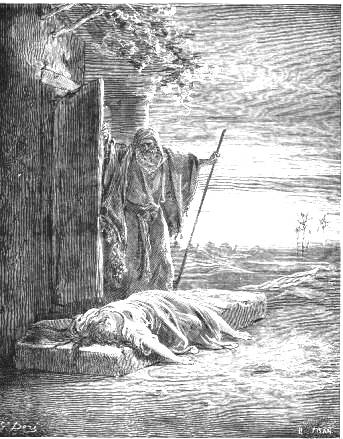
He Finds her Dead, by Gustave Dore, ca. 1880

An example of an oath that binds a man to abstain from a particular action occurs in the book of Judges. The men of Giveah, a village in the territory of Benjamin, rape a Levite’s woman to death.

Leaders and soldiers from all the other Israelite tribes meet at Mitzpah, then march against the Benjaminites. The Israelites kill them all—men, women, and children—except for 600 men of Benjamin who escape.

And the men of Israel, nishbei at Mitzpah, saying: “No man among us will give his daughter to a Benjaminite as a wife!” (Judges 21:1)

nishbei (נִשְׁבֵּע) = they had sworn an oath.

When the war is over, the victors realize that thanks to their oath, the tribe of Benjamin will disappear; the 600 survivors will die without issue. None of the men had thought that far ahead—nor asked for a wife’s opinion. Now they regret that they effectively eliminated one of the tribes of Israel. But breaking their oath is out of the question.

So they kill almost all the residents of the one village that did not send anyone to Mitzpah—everyone except the virgin maidens, who they give to the men of Benjamin. Then they tell the remaining Benjaminites to kidnap some of the unmarried women who dance in the vineyards at the festival in Shiloh. These young women are the daughters of the Israelites conquerors, but if they are kidnapped their fathers will not be forsworn.

Anything is better than breaking an oath.

Women who vow

Slaves could not make vows or oaths upon their souls, according to the Talmud,3 because their souls were not their own; they were not allowed to disobey their owners. The vows of minor children did not count either. But free women could bind themselves with vows—within limits.

An Israelite woman could not make a commitment about something she did not have authority over in the first place, such as her daughter’s marriage. But she could vow to donate any of her personal property to God, and she could bind herself to certain abstentions—including fasting4 and living as a nazirite.

A woman’s vow or oath to God is just as impossible to break as a man’s—unless her father or husband steps in promptly to cancel it.

And a woman, if she vows a vow to God and asrah isar in the household of her father, when she is young and single5, and her father hears her vow or her isar that asrah upon her soul, and her father is silent, then every vow and isar that asrah upon her soul will stand. (Numbers 30:4-5)

asrah (אָסְרָה) = she bound herself to. (From the same root as isar.)

An unmarried woman’s vow stands as long as her father does not contradict it.

But if her father restrains her on the day he hears of any of her vows or esareyha that asrah upon her soul, it will not stand, and God will pardon her, since he father restrained her. (Numbers 30:6)

esareyha (אֱסָרֶיהָ) = her vows or oaths binding herself to abstain from a certain behavior. (Also from the same root as isar.)

The father of an unmarried woman has only one day to annul his unmarried daughter’s vow—the day he finds out about it. If he does not do it that day, the vows stands.

After a woman marries, her husband has the right to annul any vow she made before the wedding, and any vow she makes during their marriage. But he can only do it on the day he finds out about the vow.6

The only female whose vows cannot be canceled is a free woman who was once married and now lives independently.

But a vow of a widow or a divorced woman, anything that asrah upon her soul, it will stand. (Numbers 30:10)

Protection from Foolish Vows

Given the seriousness of a vow or oath, it would be reasonable to let a close family member invalidate anyone’s impulsive commitment. Yet a mother cannot nullify a vow or oath that her unmarried son makes, however foolish it might be. And a wife cannot nullify anything that her husband vows.

The ancient Israelites assigned strict roles to men versus women, with men wielding far more independence and authority. In the 19th century C.E., European society was similarly sexist, and its assumptions underlie the commentary of Rabbi Samson Raphael Hirsch:

For a man creates his position in life independently, and if he binds himself with a vow that cannot be absolved, he introduces into his life a new element … and, since he is independent, he is able to take this individuality into account when he shapes the conditions of his life.

Not so for a woman. The moral greatness of the woman’s calling requires that she enter a position in life created by another. The woman does not build for herself her own home. She enters the home provided by the man, and she manages it, bringing happiness to the home and nurturing everything inside the home in a spirit of sanctity and orientation toward God. The woman—even more than the man—must avoid the constraint of extraordinary guidelines in her life, for they are likely to be an impediment to her in the fulfillment of her calling.7


If all women are fated to a life of repeated pregnancies and decades of child care, without the options of celibacy, birth control, or abortion, then it makes sense to nullify any vows they make that would interfere with these inescapable duties. For example, extended periods of fasting would be detrimental during pregnancy and nursing.

On the other hand, if all men are fated to a life of providing for large families, then they should be prevented from making vows that would interfere with their duties. For example, living as a nazirite would interfere with their ability to conduct business.

Fortunately, in much of the world today both men and women are free to decide whether to constrain themselves with the duties of raising a family, and how large the family will be (although in the United States a recent supreme court decision makes this more difficult).

Both genders now have the flexibility to determine their own commitments—to spouses (if any), to children (if any), and to religion (if any)—at least in the modern world. Nevertheless, each new vow limits our ability to take on another commitment.

May we all enjoy independence. And may we also give any new vows careful consideration, and talk them over with someone close to us before we commit!


  1. See Leviticus 27:1-8.
  2. The Hebrew word yacheil (יַחֵל) = he will desecrate, profane. I translate it as “break” to conform with standard English usage, at the risk of losing the Israelite idea that vows and oaths are literally, nut just metaphorically, sacred.
  3. Talmud Bavli, Nazir 61a.
  4. Numbers 30:14 specifically mentions mortifying the soul, which meant fasting.
  5. The Hebrew word I translate as “young and single” is ne-ureiyha (נְעֻרֶיהָ) = the time when a young woman or adolescent girl is not engaged or married.
  6. Numbers 30:7-9, 30:11-16.
  7. Samson Raphael Hirsch, The Hirsch Chumash: Sefer Bemidbar, trans. by Daniel Haberman, Feldheim Publishers, Jerusalem, p. 620-621.


Balak, Pinchas & Matot: They Made Us Do It

(Overall, the books of Exodus through Deuteronomy present Moses as a complex character. Yet at times he obeys God without thinking. In the conversation below I address this simplistic Moses character.) 

Moses: We killed them because they made us do the wrong thing.

M. Carpenter: They made the Israelite men do it? Aren’t they adults, responsible for their own actions?

Moses: But they tricked us.

Carpenter: Or maybe you let them trick you. Here’s what the Torah says:

Torah portion Balak:

And Israel was dwelling at Shittim, and the people began liznot the Moabite women.  And they invited the people to make slaughter-offerings to their god.  So the people ate and prostrated themselves to their god.  And Israel yoked itself to Baal-Peor, and God became inflamed against Israel.  (Numbers/Bemidbar 25:1-3)

liznot (לִזְנוֹת) = to have intercourse with a religious sex worker (when zonah, זֺמָה  = cult prostitute); to have illicit intercourse (when zonah = any woman who sells herself for sex); to be unfaithful.

Any of the three meanings of liznot might apply in the passage above.  The Israelite men might have served the god of Peor from the beginning, through its sex workers. Or they might have used Moabite prostitutes, who then invited them to religious feasts.  Or the word liznot might introduce the idea that they became unfaithful to God when they bowed down to another god.

Pinchas, Sacra Parallela, Byzantine 9th century

God’s rage was expressed as a plague, which killed 24,000 Israelites before Aaron’s grandson Pinchas stopped it with a single violent act.  One of the Israelite men brought one of the Moabite women right into God’s Tent of Meeting to have sex.  Pinchas speared both of them through their private parts in one blow.1

Torah portion Pinchas: Then God made Pinchas a priest on the spot.2  When the Torah gave the names of the speared offenders, it changed the Moabite woman into a Midianite woman, an example of incomplete redaction when two versions of a story have been melded.  From that point on, the female offenders are called Midianites.

Then God spoke to Moses, saying: “Attack the Midianites and strike them down! –because they attacked you through nikheleyhem when niklu you over the matter of Peor … (Numbers 25:17-18)

nikheleyhem (נִכְלֵיהֶם) = their deceit, their trickery, their cunning.

niklu (נִכְּלוּ) =they deceived, they tricked.

Moses:  So you see, God Himself said that the Moabites, er, Midianites, tricked us.

M. Carpenter: Well, the God-character you heard in the Torah said that. I think those Israelite men should have realized that having liaisons with women attached to the god of Peor would lead to invitations to feasts, during which it would only be polite to bow down to their god like everyone else. The men could have thought it through, but they didn’t—and they could not use the excuse that they were starving.  They already had sex and food in their own camp with Israelite women.

Moses: Anyway, those Peor worshipers will never trick us again.

M. Carpenter: True. Because the next Torah portion says:

Torah portion Mattot: After a while God reminded him:

Take revenge with the vengeance of the Israelites on the Midianites! Afterward you shall be gathered to your people.” (Numbers 31:1)

So, knowing it might be his final deed before he died, Moses assembled an army.  The Israelites defeated the Midianites, burned down their towns, and killed every Midianite man.  When they returned with the booty, including the Midianite women and children, Moses ordered them to kill all the women who were not virgins.  He explained that it was Midianite women who caused the Israelites to choose Peor over God, which resulted in God’s plague.3

M. Carpenter: Exterminating the local population did eliminate that particular temptation. But it won’t stop the Israelites from straying after other Gods once they settle in Canaan, as I pointed out in an earlier post: Mattot, Va-etchannan, & Isaiah: How to Stop a Plague, Part 3.

Moses: But God wanted revenge.

M. Carpenter: In this story, the God-character wants revenge. But elsewhere in the Torah, the God-character wants justice. There’s a difference.  Let me quote something God said to you at Mount Sinai:

“A fracture for a fracture, an eye for an eye, a tooth for a tooth: as someone gives a physical injury to a human, thus it shall be given to him.  And for striking down a beast, he shall pay compensation, but for striking down a human, he shall be killed.”  (Leviticus/Vayikra 24:19-21)

Moses: So you think we should have seduced the Moabites into worshiping our God?

M. Carpenter: You could have tried. Of course, they might have had the fortitude to resist and stick to their own god. But trying to seduce them would have been more ethical than killing them.

Moses: I was afraid that if we didn’t obey God’s order to kill the Moabites, God would kill more Israelites. You know what a temper he has.

M. Carpenter: You must have noticed that God has more than one voice in the Torah. There’s the angry jealous God, the God of justice, and the God of mercy. Remember back in the book of Exodus when you talked the jealous God-character into giving up his plans for revenge against the Israelites, and extending mercy instead?3

Moses: I asked for mercy for the Israelites.  Mercy for the Moabites is different.

M. Carpenter: Is it?


  1. Numbers 25:6-9.
  2. Numbers 25:10-13.
  3. Numbers 31:16.
  4. Exodus 32:7-14.


Matot: From Confrontation to Understanding

The Israelites conquer land east of the Jordan River before they even entered Canaan.  They ask permission to use the king’s road through the land of Cheshbon, and when King Sichon refuses and sends his troops, the Israelites win the battle and take all his land.  After that, for no reason given in the Torah, the Israelites march north and conquer Bashan, ruled by King Og.  Only then do they finally turned around and camp on the east bank of the Jordan, across from the land of Canaan.1

After exterminating the local population there (see my post Matot: Killing the Innocent) most of the Israelites are ready to cross the river and take over Canaan.  But the men of the tribes of Gad and Reuven have a different idea.

Stage One: Confrontation and ignorance

They come to the authorities—Moses, the new high priest Elazar, and the chieftains of the other tribes—and declare:

“The land that God struck down before the community of Israel is livestock land, and your servants have livestock.”  And they said: “If we find favor in your eyes, give this land to your servants as property; don’t ta-avireinu the Jordan!”  (Numbers/Bemidbar 32:4-5)

ta-avireinu (תַּעֲוִרֵנוּ) = you make us cross, you let us cross.  (A form of the verb avar, עָבַר = cross, pass through, go past.)

At this stage, the men of Gad and Reuven are saying “Don’t make us cross the Jordan!”  They are only thinking about their livestock, their livelihood.  They have come up with only one supporting argument for their request:  that God gave the Israelites the land east of the Jordan River by letting the Israelites win battles.  The implication, they hope, is that the lands formerly ruled by Sichon and Og might also count as God’s “promised land”.  After all, God once promised “I will set your borders from the Sea of Reeds to the Sea of the Philistines, and from the wilderness to the Euphrates River” (Exodus 23:31).2  That would include and extend beyond the territories the livestock men want.3

But in the book of Numbers, Moses consistently treats the Jordan River as the northeastern border of God’s promised land of milk and honey.  So he assumes that the Gaddites and Reuvenites are starting yet another rebellion against God’s plan.

And Moses said to the Gaddites and to the Reuvenites: “Will your brothers go to war while you stay here?  And why will you inhibit the hearts of the Israelites from avor into the land that God gives you?  That is what your fathers did when I sent them from Kadeish-Barnea to look at the land.”  (Numbers 32:6-8)

avor (עֲבֺר) = crossing.  (Also a form of avar.)

Moses then brings up the catastrophe in the portion Shelach-Lekha, when the ten out of twelve spies returning to Kadeish-Barnea from their tour of Canaan reported that the land was too well-fortified, and its inhabitants were as gigantic as its fruit.  Frightened,  the people refused to cross the southern border of Canaan, and God declared they must wait 40 years in the wilderness, while the old generation died off, before they got another chance.4  Now the 40 years are complete.

What if the tribes of Gad and Reuven do stay behind when it is time to cross the river?  The rest of the Israelites might assume that conquering Canaan would be harder than they thought. 5   If the Israelites became too afraid to cross, Moses figures, God would become enraged and punish them again.  This idea disturbs Moses so much that he accuses the men of Gad and Reuven:

“And hey!—you rose up, replacing your fathers, you brood of sinful men—to sweep God’s anger again toward Israel!”  (Numbers 32:14)

Moses calls the men of Gad and Reuven sinful because they are obstructing God’s grand plan.6

At this stage, Moses and the men of Gad and Reuben appear to be on opposite sides.  Will the two tribes rebel against Moses?  Or will they submit and go live in Canaan with the rest of the Israelites?

Stage Two: Discovering the reasons

Reuben and Gad ask for Land, by Arthur Boyd Houghton

What Moses overlooks is that the Gadites and Reubenites are politely asking to settle on the east bank, using the phrases “if we find favor in your eyes” and “your servants”.  The men of the two tribes could have secretly plotted to make their move right after Moses’ death and before his successor, Joshua, began the river crossing.  Instead, they ask Moses’ permission ahead of time, in front of the high priest and the chiefs of all the tribes.

I believe this shows that they want to stay in good standing with the whole community of Israel, even though they do put their own livelihoods first.  It may even indicate that they respect God, and therefore respect the leadership God has established.  They simply did not realize that the other tribes would react badly if they stayed behind instead of crossing the Jordan.

Instead of stalking off or hardening their position, the men of Gad and Reuven respond to Moses’ accusation by reformulating their request to include the new information they gleaned from Moses’ first response.

Then they stepped up to him and they said: “We will build stone pens for our livestock and towns for our dependents.  Then we ourselves will go armed, hurrying in front of the Israelites until we bring them to their place.  And our dependents7 will stay in the towns fortified against the dwellers of the land.  We will not return to our houses until each Israelite has taken possession of his permanent possession.”  (Numbers 32:16-18)

At this point Moses could respond that their offer is not good enough.  The Gaddites and Reuvenites already seem to care more about their livestock than about God.  Moses suspects that choosing to live on the other side of the river from Canaan is further evidence of their disinterest in God.

However, he decides to accept their revised offer—as long as two key elements are added: God and the community.8  First Moses emphasizes that God will witness the battles to come.

And Moses said to them: “If you do this thing, if you bear arms in front of God to go to war; and everyone who is armed avar the Jordan in front of God, until [God] has dispossessed [God’s] enemies from in front of [God]; and the land has been subjugated in front of God; and afterward you return.  Then you will be cleared with God and with Israel, and this land will be your property in front of God.”  (Numbers 32:20-22)

avar (עָבַר) = he crosses.

Next Moses reminds the men of Gad and Reuven that if they do not carry out their promise in full, God will punish them.

“But if you do not do this, hey!—you sin against God.  Know that your sin will catch up with you!  So build for yourselves cities for your dependents, and stone pens for your livestock. And then what has gone out from your mouth, you must do.”  (Numbers 32:23-24)

Having noticed that the Gaddites and Reuvenites thought of their livestock first, Moses is careful to put the cities for their dependents first, and the pens for their livestock second.9

Stage Three: Acknowledgement

Crossing the Jordan,
by Gustave Dore

And the Gaddites and the Reuvenites said to Moses: “Your servants will do as my lord commands.  Our dependents, our women, our livestock, and all our animals will be there in the towns of Gilead.  And your servants, everyone who is armed for war, ya-avru to go to war in front of God, as my lord has spoken.”  (Numbers 3:25-27)

ya-avru (יַעַבְרוּ) = they will cross.  (Another form of the verb avar.)

The men of Gad and Reuven are still polite—and still interested in their livestock.  But they have listened carefully to Moses, and they correct their proposal accordingly.  They put the people before the animals when they mention securing settlements in Gilead.

They also include Moses’ phrase “in front of God” when they mention crossing the Jordan and fighting in the vanguard of the Israelites.  Thus they acknowledge Moses’ concern that they might not be placing enough value on human relations or on God’s presence.

Moses accepts their reformulation, and gives them provisional permission.  Since God has decreed that Moses will die on the east side of the Jordan, Moses gives instructions to his successor Joshua, to the high priest Elazar, and to the chieftains of the other tribes.

Moses said to them: “If all the armed Gaddites and Reuvenites ya-avru the Jordan with you to make war lifnei God, and the land is subjugated lifnei you, then you shall give them the land of Gilead as [their] property.  But if the armed men do not ya-avru with you, then they shall take property in the land of Canaan.”  (Numbers 32:29-30)

Given Moses’ mistrust of the motivations of the Gaddites and Reuvenites, he naturally makes the assignment of the land east of the Jordan conditional on their promise to send their armed men across the Jordan and fight in the vanguard until they have conquered enough territory so all the Israelites have their property.

But Moses’ instructions end with a surprise.  If the Gaddites and Reuvenites break their promise, their punishment shall be—that they take property in Canaan instead of Gilead!  Settling on conquered land outside Canaan is optional, a favor to be allowed or denied.  But Moses views settling on conquered land inside Canaan is the right of every Israelite, regardless of their character.  By stating this the contingency plan, Moses is acknowledging that the men of Gad and Reuven are still part of the community of Israel.

The Gaddites and Reuvenites humbly reply:

“Whatever God has spoken concerning your servants, thus we will do.”  (Numbers 32:31)


Did the men of Gad and Reuven agree to all of Moses’ terms, using his language, simply so they could acquire the lands they wanted for their livestock?

Or did they realize during the negotiations that they had been acting as if livelihood and land were the only vital things, when other things were actually more important?  Did they learn to appreciate their own families, the larger Israelite community, and even the Holy One?

May we all listen carefully, when we speak with people who seem to be on the other side of an issue.  And whether we reach an agreement or not, may we all learn about the other concerns in the hearts of our “opponents”, and acknowledge them.


  1. Numbers 21:31-22:1, in the Torah portion Chukkat. See my post Devarim & Shelach-Lekha: A Giant Detour.
  2. The land in God’s promise to Abraham also has the Euphrates River as its eastern border: On that day God cut a covenant with Avram, saying: To your descendants I give this land, from the river of Egypt to the great river, the river Euphrates.  (Genesis 15:18)
  3. The two Amorite kingdoms of Cheshbon and Bashan become the area called Gilead in the bible, and are part of the kingdom of Jordan today.
  4. Numbers 13:21-14:35.
  5. Rashi (11-th century Rabbi Shlomoh Yitzchaki) explains that Moses believes the other Israelites will be inhibited from crossing the Jordan because they think the men of Gad and Reuven are afraid to cross.
  6. Chatta (חַטָּא) = fallible, likely to sin (by disobeying God), sinful, guilty. (From the root verb chata, חָטָא = miss the mark, offend, be guilty.)
  7. The word I translate in this post as “dependents” is taf (טָף), which usually means either small children, or all non-marchers (i.e. all members of a tribe who cannot walk far). Sometimes the Torah uses the word taf to mean children and the elderly; other times taf includes women as well.
  8. Isaac ben Moses Arama, a 15th-century rabbi, wrote in Sefer Akedat Yitschak that Moses noticed the men of Gad and Reuven were only considering economics, not the spiritual value of living in the “promised land”, so he angrily reminded them four times of God’s share in the land by saying “in front of God”.
  9. Rashi wrote that the men of Gad and Reuven cared more about their property than about their children, since they put their livestock first, and Moses corrected the order.

Matot, Va-etchannan, & Isaiah: How to Stop a Plague, Part 3

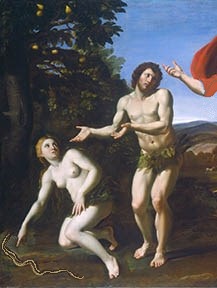
from Domenichino,
“The Rebuke of Adam and Eve”, 1626

“Don’t blame me!” We say that when we feel guilty.  Even the first human beings in the Bible blame someone else when they disobey God’s instruction not to eat from the Tree of Knowledge of Good and Bad. The male human blames the female, and the female blames the snake.1

In the Book of Numbers/Bemidbar, the Israelites flagrantly disobey the First Commandment, “You shall have no other gods before Me”, after accepting an invitation from the local women (first called Moabites, then Midianites) in the land the Israelites have conquered east of the Jordan River.

And they invited the people to the slaughter-sacrifices for their god.  And the people ate, and they bowed down to their god. (Numbers 25:2)

The story told in the Torah portion Balak gives no indication that the women deceive the Israelites, no hint of a lie or a trick. (See my post Balak: False Friends.) It is the Israelites who decide to worship that god, Baal Peor.

from Sacra Parallela,
Byzantine, 9th century

And the God of Israel, enraged at the Israelites’ apostasy, starts an epidemic among the Israelites, a divine plague that even the God-character cannot control. The plague stops only when Pinchas spears an Israelite man and a Midianite woman (who is probably a priestess of Baal Peor) in the act of doing something unholy. (See my post Balak & Pinchas: How to Stop a Plague, Part 1.)

The God-character rewards Pinchas for calming “His” rage in the next Torah portion, Pinchas. (See my post Mattot, Judges, & Joshua: How to Stop a Plague, Part 2.)

At least the God-character’s uncontrollable anger targets the Israelites, the people guilty of disobeying God’s commandment. Yet when the God-character has calmed down, “He” targets the Midianites, accusing them of actively tricking the Israelites.

Attack the Midianites and strike them down! –beecause they attacked you through nikheleyhem when niklu you over the matter of Peor … (Numbers 25:17-18)

nikheleyhem (נִכְלֵיהֶם) = their deceit, their trickery, their cunning.

niklu (נִכְּלוּ) =they deceived, they tricked.

But Moses turns his attention to other issues. So eventually, in the Torah portion Matot, God reminds Moses:

Nekom nikmah of the Israelites on the Midianites! Afterward you shall be gathered to your people. (Numbers 31:1)

nekom (נְקֺם) = Avenge! Take revenge! Get even!

nikmah (נִקְמַה) = [the] vengeance, revenge, payback.

And Moses finally assembles an army.

The God-character is calling for revenge, not for removing temptation. At most, the extermination of the local population prevents the Israelites from sliding back into worshiping Baal Peor. It does not stop them from straying after other Gods once they settle in Canaan.

Women of Midian Led Captive by the Hebrews,
by James Tissot, ca. 1900

The Israelite soldiers kill all the Midianite men and burn all their settlements. But instead of killing the Midianite women and children, the army returns with them as booty.

And Moses said to them: “You let every female live? Hey, they caused the Children of Israel, through the word of Bilam, to elevate themselves over God in the matter of Peor, so that the plague came to the community of God!” (Numbers 31:14-16)

Moses blames the Midianite women for seducing the Israelites into Baal-worship, instead of blaming the Israelites for their own actions. He also casts blame on Bilam, the prophet who uttered God’s blessings for the Israelites, then returned to his distant home on the Euphrates.2  Any foreigner is easier to blame than your own people.

Moses then orders his officers to kill all the Midianite women and the boys, exempting only the virgin girls from the genocide. (See my post Mattot: Killing the Innocent.) The Torah portion Mattot illustrates how guilt over your own behavior can lead to blaming others, and even destroying them.

Yet there are other ways humans can deal with guilt and shame. In next week’s Torah portion, Va-etchannan, Moses says:

Your eyes saw what God did about Baal Peor; for God, your God, exterminated from among you every man who went after Baal Peor. But you who cling to God, your God, are alive, all of you, today. (Deuteronomy 4:3-4)

Here Moses returns to the originally story, placing the blame on the Israelite men and declaring that God punished the guilty Israelites by killing them with the plague. Everyone who remained faithful to the God of Israel, he says, was not punished.

This is certainly more just than accusing the Midianites or Bilam for the deeds of the unfaithful Israelites. But two moral problems remain.

Genocide

The Israelites who followed the orders to massacre all the Midianites in the valley of Peor, even infants, are never considered guilty. Genocide is not a crime in the Torah. If the Israelite men felt uneasy about it, they probably excused themselves by thinking: “Don’t blame me; God made me to do it.”

Repentance

None of the Israelites who worship Baal Peor get a chance to admit their own guilt, repent, and reform. The God-character’s angry plague wipes them out without even a trial.

Judah sets a stellar example of repentance and reform in the book of Genesis/Bereishit.3 But God neither punishes nor rewards Judah directly, though God does provide a prophecy that Judah’s descendants will someday be the rulers of Israel.4

The book of Leviticus/Vayikra provides ritual animal-offerings for those who inadvertently disobey one of God’s rules,5 but the only atonement it offers for deliberate misdeeds is the high priest’s annual ritual on Yom Kippur, which purifies the entire people of Israel.6

The first time the Bible declares that guilty individuals can repent and receive forgiveness and a second chance from God is near the beginning of the book of Isaiah.

Wash yourselves clean;

            Remove evil from upon yourselves,

            From in front of My eyes.

And stop doing evil;

            Learn to do good.

            Seek justice. (Isaiah 1:16-17)

The first prophet Isaiah then tells the Israelites to “do good and listen”7 and to “turn around”, i.e. repent8.


I suspect the world today is teeming with people haunted by shame and guilt. What can we do about our recurrent memories of betraying ourselves, betraying our God, and doing the wrong thing?

I have led a relatively blameless life, yet shame has haunted me, too. It took me years to forgive myself for insulting my best friend in first grade. I did not repeat that particular shameful act, but I betrayed my own principles in other ways during the years when I clung to my first husband, accepting his abuse and ignoring my inner ethical voice. After I finally left him, it took many more years before I could trust myself again.

May all of us learn to accept responsibility for our own transgressions, instead of blaming others. When we are ashamed of our own behavior, may we admit it and strive to do the right thing next time. And may we stop and think when anyone tells us that God wants something we know in our hearts is wrong.

(A portion of this material is from Va-etchannan: Haunted by Shame”, an essay I published in August 2014.)


1  Genesis 3:12-13.

2  The king of Moab hires Bilam to curse the Israelites, but Bilam utters God’s blessings, and goes home without pay (Numbers 24:10-11, 24:25). The Torah gives no reason why Bilam would ever return to the land north of Moab. Yet the description of the Israelite war on Midian mentions that they kill the five kings of Midian—and Bilam (Numbers 31:8).

3 Judah is guilty of selling his brother Joseph as a slave (Genesis 37:26-28) and condemning his daughter-in-law Tamar to death (Genesis 38:24). He publicly admits his guilt about Tamar (Genesis 38:25-26) and rescues his brother Benjamin from slavery (Genesis 44:16-34).

4  Genesis 49:10.

5  Leviticus chapter 4.

6  Leviticus chapter 16.

7  Isaiah 1: 19

8  Isaiah 1:27.

Matot, Judges, & Joshua: How to Stop a Plague, Part 2

Pinchas first appears in the Torah grabbing a spear and skewering two worshipers of a local Midianite god, Baal Peor. God (that is, the God-character in the book of Numbers/Bemidbar) is relieved, because “He” could not stop “His” own anger at the apostasy and the resulting plague. (See my post Balak & Pinchas: How to Stop a Plague, Part 1.) Pinchas’s zealous impulse does the trick.

God tells Moses:

Therefore say: Here I am, giving to him My covenant of shalom. And it shall be for him, and for his descendants after him, a covenant of priesthood for all time, founded because he was zealous for his God, so he atoned for the children of Israel.” (Numbers 25:12-13)

shalom (שָׁלוֹם) = peace, wholeness, well-being.

The covenant of shalom makes Pinchas a priest, binding him to commit no further violence against humans (though like all priests, he must slaughter animal offerings at the altar).

However, there is no covenant of peace binding God. In this week’s Torah portion, Mattot (“Tribes”), God orders Moses:

Avenge the vengeance of the Israelites on the Midianites! Afterward you shall be gathered to your people. (Numbers 31:1)

After Moses dies, the rest of the Israelites live with the knowledge of both their unfaithfuless to God and their vengeance on the Midianites. Next week’s post, Mattot, Va-etchannan, & Isaiah: How to Stop a Plague, Part 3, will consider the lasting effects of the Baal Peor incident on the Israelites. This week’s post explores what happens to Pinchas after his well-timed murder.

Pinchas in Matot

Moses sent a thousand from each tribe for the army, and Pinchas, son of Elazar the Priest, for the army; and holy utensils and trumpets for blasting were in his hands. And they made war against Midian, as God had commanded Moses … (Numbers 31:6-7)

A priest accompanies an army in the Torah not to engage in battle, but to address the troops before battle1 and take charge of holy objects2. Sometimes a general consults a priest before battle, and the priest uses an oracular device to relay simple questions to God and report God’s brief replies.3

The Torah portion Matot does not identify the holy utensils Pinchas brought to the battle against the Midianites in the valley of Baal Peor. Trumpets were used to sound an alarm, to signal troops to advance, and to signal troops to retreat.4

Pinchas in the Book of Judges

Dead Concubine at Gibeah

Pinchas does use an oracular device to answer the questions of generals many years later, when he is the high priest of the Israelites. After the tribes have conquered and settled various parts of Canaan, some men in the territory of Benjamin rape and kill a Levite’s concubine. The Levite rallies all the other tribes to go to war against the Benjaminites.5

Pinchas stays in the town of Beit-El, where the ark is in residence, about 8 miles (13 km) north of Gibeah, the main town of Benjamin. Before each day of battle, men from the Israelite army go to Beit-El with a question for God.

First they ask which tribe should advance first against the Benjaminites, and God’s answer is “Judah”. The Israelites lose the battle. They return to Beit-El and ask if they should attack again, and God answers yes. But they lose the second battle as well.

Then they went up … and they came to Beit-El and they wept, and they sat there before God, and they fasted that day until the evening, and they sent up rising-offerings and shelamim before God. (Judges 20:26)

shelamim (שְׁלָמִים) = animal-offerings either to express gratitude to God for well-being, or to attempt a state of peace and unity with God. (From the same root as shalom.)

And the Israelites inquired of God—and the ark of the covenant of God was there in those days, and Pinchas son of Elazar son of Aaron was standing in attendance before [God] in those days—saying: “Should we gather again to go out to war with the Benjaminites, our brothers, or should we give up?” And God said: “Go up, because tomorrow I will give them into your hand.” (Judges 20:27-28)

The Israelites defeat the Benjaminites the next day, wiping out most of the men of that tribe and all of the women. But the only role Pinchas plays is to report God’s answers; he takes no action on his own.

Pinchas in the Book of Joshua

Pinchas takes a more active role in the book of Joshua when nine and a half tribes are considering making war on the other two and a half.

At the end of Matot, this week’s portion, the tribes of Reuben and Gad ask Moses for permission to settle east of the Jordan in Gilead and Bashan, the lands that the Israelites have already conquered. Moses grants them and the half-tribe of Menasheh these lands, but only after they have promised that their fighting men will cross the Jordan with the rest of the Israelites and help conquer Canaan.6

After the death of Moses, Joshua leads these men and all the other Israelites across the Jordan River. His army conquers a large part of Canaan, the men of Reuben, Gad, and Menasheh return to their new homes, and the land west of the Jordan is allotted among the other nine and a half tribes. Joshua erects the portable Tent of Meeting containing God’s ark at Gilgal first, then at Shiloh, both on the west side of the Jordan.

And the Israelites heard [a report] saying: Hey! The Reubenites and the Gadites and the half-tribe of Menasheh built an altar opposite the land of Canaan, in the district across from the Israelites. (Joshua 22:11)

This is the same region where the Israelites were camping when they joined the Midianites in their worship of Baal Peor.

And the Israelites heard, and they assembled, the whole community of the sons of Israel, at Shiloh to go up to make war upon them. And the Israelites sent Pinchas, son of Elazar the [high] priest … to the land of Gilead, along with ten chieftains … (Joshua 22:12-14)

If anything could trigger Pinchas’s jealousy and zealotry for the God of Israel again, it would be news that some Israelites had built an altar for a foreign god. When his delegation arrives, Pinchas protests:

Is it a small matter for us, the crime of Peor from which we have not purified ourselves to this day? It is a scourge in the community of God! And you, you would turn away from God? If you rebel today against God, tomorrow the whole community of Israel will become angry!” (Joshua 22:17-18)

The east-bank tribesmen quickly explain that they have no intention of worshiping another god. They claim they were afraid of being excluded from the community of the God of Israel, and they only built a symbolic replica of God’s altar in Shiloh.

because it is a witness between our eyes and your eyes. Far be it from us to rebel against God!” (Joshua 22:28-29)

And Pinchas the priest heard, and the chieftains of the community and the heads of the companies of Israel who were with him, the words that they spoke … and it was good in their eyes. (Joshua 22:30)

Pinchas and his delegation return to Shiloh with their new understanding, and war is averted. Pinchas has indeed become a man of shalom, of peace, wholeness, and well-being.

Did God’s covenant of shalom transform Pinchas because it gave him the responsibilities of a priest?7 Or did it transform him because God’s response shocked him into recognizing his own excessive zeal?

Imitating God’s forgiveness might be a fine strategy, but imitating the murderous zeal of the God-character in the Torah is bad for a human being. Naftali Tzvi Yehuda Berlin, the 19th-century author of Ha’amek Davar, wrote: “Since it was only natural that such a deed as Pinhas’ should leave in his heart an intense emotional unrest afterward, the Divine blessing was designed to cope with this situation and promised peace and tranquility of soul.”8

May all human beings who are overwhelmed by jealousy or anger be transformed like Pinchas —whether by a new responsibility, a new realization, or an inner blessing—into people of shalom.


1  See Deuteronomy 20:2.

2  See 1 Samuel 4:4-5.

3  This oracular device is called urim and/or tummim in Numbers 27:21, 1 Samuel 14:41, and 1 Samuel 28:6; and an eifod in 1 Samuel 23:9-12 and 1 Samuel 30:7-8.  An eifod in the Bible is usually a tabard worn by priests and other attendants on God’s sanctuary: a garment made of two rectangular panels of cloth fastened together at the shoulders and belted around the waist. Exodus 28:6-30 describes the elaborate eifod of the high priest and the choshen tied to its front panel. The choshen is a square pouch with twelve precious stones on the front side. Inside the pouch are the urim and tummim, items that scholars have not yet identified.

4  2 Samuel 17:6, 20:22; Jeremiah 4:19, 6:1, 51:27; Ezekiel 33:6; Amos 3:6.

5  Judges 20:1-48.

6  Numbers 32:1-33.

7  The priesthood was hereditary, so Pinchas, son of the high priest Elazar, son of the high priest Aaron, could expect to be consecrated as a priest eventually. But the Zohar notes that someone who has killed a person is normally disqualified from the priesthood. (Arthur Green in Sefat Emet, The Language of Truth, by Rabbi Yehudah Leib Alter of Ger, translation and commentary by Arthur Green, The Jewish Publication Society, Philadelphia, 1998, p. 264)

8  Translation from Ha’amek Davar in Nehama Leibowitz, Studies in Bamidbar (Numbers), translated from Hebrew by Aryeh Newman, The World Zionist Organization, Jerusalem, 1980.

Haftarat Matot—Jeremiah: Doomed to a Calling

Every week of the year has its own Torah portion (a reading from the first five books of the Bible) and its own haftarah (an accompanying reading from the books of the prophets). This week the Torah portion is Mattot (Numbers 30:2-32:42) and the haftarah is Jeremiah 1:1-2:3.

Jeremiah discovers his calling in this week’s haftarah:

The word of God happened to me, saying:

     Before I enclosed you in the womb, I knew you.

     And before you went out from the womb, I consecrated you;

     A navi to the nations I appointed you. (Jeremiah 1:4-5)

navi (נָבְיא) = prophet. (Plural = neviyim (נְבִיאִים).)

There are two kinds of neviyim in the Bible: those who have ecstatic experiences of the divine but do not speak for God; and those who serve as mouthpieces or translators for God, giving God’s messages to other people. Jeremiah is the second kind of navi, like thirteen prophets who came before him: Moses, Bilam, Samuel, Natan, Elijah, Elisha, Jonah, Joel, Amos, Hosea, the first Isaiah, Micah, and Nahum.

Jeremiah is an adolescent when he hears God tell him he is a navi.

And I said:

     Ahahh! My master, God!

     Hey! I do not know how to speak,

     Because I am a youth. (Jeremiah 1:6)

Ahahh (אֲהָהּ) = a cry of alarm, like “oh no!” or “alas!”

Jeremiah does not want the job

Moses tried to get out of being God’s prophet by claiming his speech and his tongue were heavy. Jeremiah protests that he would be a poor speaker because he is too young.

Perhaps he is wise for his age and knows that speaking out effectively against what others are doing requires the kind of insight one gains from life experience. Of course, knowing that at a young age would actually make him more qualified!

More importantly, God consecrated Jeremiah as a navi before he was born. The language in these poetic verses reflects an observation that we explain today through genetics: human beings are born with genes for certain talents and dispositions, which change from potential to actual in the right environment. Skills can be developed through education and practice, but you can become a stellar dancer only if you were born with certain physical traits, a stellar mathematician only if you were born with certain mental traits, a stellar prophet only if you were born with—what?

My guess is that a competent navi must be born with both the kind of intelligence needed by translators and eloquent speakers, and an unusual spiritual sensitivity.  Jeremiah must have had a way with words as a child, and he must have experienced glimpses or echoes of a reality behind our mundane reality.

Horrified

People enjoy using their talents. So why is Jeremiah horrified at the news that he must serve as a navi?

The haftarah opens by stating that Jeremiah began prophesying in the 13th year of the reign of Josiah, king of Judah, which scholars date to the 620’s B.C.E. Two neviyim are already active in Jerusalem at that time: Zephaniah (who has his own book) and Huldah (who is mentioned only when she utters a prophecy for King Josiah five years after Jeremiah’s call, in 2 Kings 22).

King Josiah began his reign at the age of eight. While he was growing up, Zephaniah was predicting a day of reckoning when God would wipe out Jerusalem, Judah, and most of the world for injustice and idol worship, while giving refuge to a small number of survivors.

When Jeremiah is called to prophesy, Josiah is 21 and has not yet begun his campaign of wiping out the images, shrines, and priests of other gods. The kingdom of Judah is still full of polytheists worshipping Baal, Ashtoret, Molekh, Khemosh, Milkom, and various astral deities. Furthermore, the political situation in the region is shifting. The Assyrian Empire, which had earlier swallowed up the northern kingdom of Israel and made Judah its vassal state, is weakening. Wars are brewing between powers bigger than the little state of Judah. It would be all too easy for a sensitive person to imagine God using foreign armies to punish and destroy the Israelites.

Jeremiah probably expects that the speeches he must make as a navi will be at least as grim and unwelcome as Zephaniah’s. If Jeremiah hopes that at least his private life will continue as before, that hope probably dies when he hears God’s response to his attempt to excuse himself on the grounds of youth.

prophet 1

And God said to me:

     Do not say “I am a youth”

     Because anywhere I send you, you will go,

     And anything I command you, you will speak.

     Do not be afraid in front of them,

     Because I will be with you to rescue you—declares God. (Jeremiah 1:7-8)

Theoretically Jeremiah could refuse the call, but God already knows Jeremiah will obey—and that he will need rescuing from “them”, some people who have not yet been named.

In case Jeremiah did not get the hint, later in this haftarah God says:

     And they will attack you

     But they will not vanquish you

     Because I will be with you—declares God—to rescue you. (Jeremiah 1:19)

How reassuring!

prophet 2

Jeremiah rants against dishonesty, injustice, and the worship of other gods until King Josiah is killed in 609 B.C.E. During the reigns of the next four kings of Judah, Nebuchadnezzar of Babylon vanquishes the old Assyrian empire and his army conquers Judah, putting Jerusalem under siege in 589 B.C.E.

Jeremiah blames idol-worship for the Babylonian attack, and advises each successive king of Judah (Yeho-achaz, Yehoyakim, Yehoyakin, and Tzidkiyahu) to surrender and make Judah a vassal of the new Babylonian empire. He knows it is the only way to save lives and preserve Jerusalem and its temple.

Despite all of Jeremiah’s prophesies, the people do not repent, and none of the kings submit to Babylon.  The Jerusalem faction that opposes surrender flogs, imprisons, and attempts to murder Jeremiah, so he will stop interfering with their power over the king.

prophet 3

When the Babylonians finally do raze Jerusalem and its temple, and kill or take captive most of its leading citizens, all Jeremiah can do is save the lives of a few people who helped him. He spends the rest of his own life in exile in Egypt, prophesying about other countries whose kings do not listen to him.

Maybe Jeremiah glimpses his own future when God first calls him to serve as a navi. That future would make anyone cry Ahahh!


When I was young, I was one of many Americans who believed that if you discovered your true calling and did it, you would be successful and happy. The 1970’s and 80’s were the era of “Do your own thing” and “Follow your bliss”.

Gradually I realized that even when you pursue work you have a talent for and are passionate about, the world does not always rearrange itself to give you a clear path.

Some individuals are lucky; I believe my father was born to be an engineer, and he had a profitable and satisfying career in that field. Some are unlucky, and pursue what speaks to their innermost heart only to end up broke and miserable. In some countries, those who pursue the work of a prophet speaking out against the government end up imprisoned (like Jeremiah) or killed (a fate he narrowly escaped).

And some people never try to pursue their calling, either because what they were born to do is something society expects from them anyway, or because they run away from the first intimation that they might have a calling.

What if you realized, with deep inner clarity, that you were called to devote your life to work that would lead to frustration and failure like Jeremiah’s?

Balak, Pinchas & Matot:  How Moabites Became Midianites

by Melissa Carpenter, Maggidah

Moabites and Midianites are two distinct peoples in most of the Bible.  Yet they appear to be interchangeable in a story about sex and revenge that runs through three Torah portions in the book of Numbers/Bemidbar: the portions Balak (last week), Pinchas (this week), and  Mattot (next week).

The conflation between Moabites and Midianites begins after the Israelites have marched through the wilderness east of Moab and then conquered two Amorite kingdoms to its north. The Israelites camp on the east bank of the Jordan River, in their first newly captured territory–which is now described as a former part of Moab.

And the Israelites journeyed [back], then encamped on the plains of Moab, across the Jordan from Jericho. (Numbers/Bemidbar 22:1)

Balak, the king of Moab, is afraid they will go south and attack his country next.

And [the king of] Mo-av said to the elders of Midyan: Now the congregation will nibble away all our surroundings, as an ox nibbles away the grass of the field. (Numbers 22:4)

1. Midian in Genesis, Exodus, and 1 Kings.
2. Midian in Numbers and Judges.

Mo-av (מוֹאָב), Moab in English = a kingdom east of the Dead Sea; the people of this kingdom. (The actual etymology is unknown. Genesis/Bereishit  19:36-37 claims the Moabites are descended from incest between Lot and one of his daughters, and implies that the daughter named her son Mo-av to mean “from father”.  The actual Hebrew for “from father” would be mei-av מֵאָב.) The Moabite language was a Hebrew dialect, and appears on a circa 840 B.C.E. stele about a war between Israel and a Moabite king named Mesha.

Midyan (מִדְיָן), Midian in English = a territory occupied by the people of Midian, whose geographic location differs in various parts of the Bible. (Possibly from the Hebrew dayan (דַּיָּן) = judge. Midyan might mean “from a judge”, “from judgement”, or “from a legal case”.) References to a people called Madyan or Madiam appear in later Greek and Arabic writings, and Ptolemy wrote of a region of Arabia called Modiana (see #1 on map), but archeology has not yet proven the existence of a country of Midian.  The Midianites may have been a nomadic people without a fixed territory.

When King Balak sends a delegation to the prophet Bilam to ask him to curse the Israelites, it consists of “the elders of Moab and the elders of Midian“. (Numbers 22:7).

When Bilam arrives at the mountaintop overlooking the Israelite camp, King Balak is there with “all the nobles of Moab (Numbers 23:6, 23:17) but apparently no Midianites.

After Bilam fails to curse the Israelites and goes home, a brief story in the portion Balak describes how some young women invite the Israelites to participate in ritual feasts to their gods, and many Israelites end up bowing down to the local god, Baal Peor. (See my post  Balak: False Friends?) At first, these women are identified as Moabites.

And Israel settled among the acacias, and the people began to be unfaithful with the daughters of Moab. (Numbers 25:1)

Pinchas Impales Zimri and Kozbi,
by J.C. Weigel

Next, an Israelite man brings a foreign woman into the Tent of Meeting itself for sex. Aaron’s grandson Pinchas saves the day by quickly spearing the two of them. The woman is identified as a Midianite, and in the next Torah portion, Pinchas, we find out she is a woman of rank.

And the name of the  Midianite woman who was struck down was Kozbi, daughter of Tzur, the head of the people of a paternal household from Midian. And God spoke to Moses, saying: “Be hostile toward the Midianites, and strike them down. Because they were hostile to you through their deceit, when they deceived you about the matter of Peor…” (Numbers 25:15-18)

Suddenly the Moabite women who invited the Israelites to feasts for their gods are being called Midianites!

In the next Torah portion, Matot (“Tribes”), God reminds Moses to attack the Midianites, but does not mention the Moabites.

And they arrayed against Midian, as God had commanded Moses, and they killed every male. And the kings of Midian they killed …five kings of Midian, and Bilam son of Beor, they killed by the sword. But the children of Israel took captive the women of Midian and their little ones… (Numbers 31:7-9)

This story ends with the slaughter of the captive Midianite women. (See my post Mattot: Killing the Innocent.)

And Moses said to them: “You let every female live! Hey, they were the ones who, by the word of Bilam, led the Israelites to apostasy against God in the matter of Peor, so there was a plague in the assembly of God. So now, kill every male among the little ones and every woman who has known a man by lying with a male, kill!” (Numbers 31:15-17)

Here Moses declares that it was Midianite women who seduced Israelites into worshiping Baal Peor. The Moabite women are no longer mentioned.

When we look at the storyline over three Torah portions, the enemies of the Israelites seem to change from a coalition of Moabite and Midianite leaders, to Moabite men, to Moabite women, to Midianite women, to Midianites in general.  How can we explain the shift from Moabites to Midianites?

books

As usual when it comes to inconsistencies in the scripture, the commentary falls into three camps: the apologists, the scientists, and the psychologists. (A fourth camp of commentary is the mystics, who focus on individual phrases and words, and ignore inconsistencies in storylines.)

The Apologists

The apologists take the Torah as literal history, and find clever ways to explain apparent inconsistencies.

The Talmud considers Midian and Moab two separate nations that became allies against the Israelites. Thus men from both nations hire Bilam to curse the Israelites, and make their daughters seduce the Israelite men (in order to cause the God of Israel to abandon the Israelites and leave them vulnerable).

In one Talmud story, God tells Moses to spare Moab and attack only Midian because God wants to preserve the land of Moab for the birth of Ruth, the virtuous ancestor of King David. (Talmud Bavli, Bava Kama 38a-b.) Another tractate of the Talmud (Sotah 43a) says that the attack on Midian is actually vengeance for the episode in the book of Genesis when a band of Midianites buys Joseph from his brothers and sells him into slavery in Egypt.

Rashi (11th century rabbi Shlomo Yitzchaki) wrote that the king of Moab consults the Midianites because he knows Moses spent a period of his life in Midian, and he wants to learn more about the leader of the Israelites. The elders of Midian choose to not only advise the king of Moab, but join forces with him in the campaign to seduce the Israelite men. According to Rashi, God orders Moses to attack only the Midianites because the Moab acted solely out of fear for their own nation, “but the Midianites became enraged over a quarrel which was not their own”.

Some 20th century commentary explains the conflation between Moabites and Midianites by concluding that Midian was not a separate kingdom, but a confederation of nomadic tribes. (This explains why the first Midianites Moses meets lived near Mount Sinai, while the Midianites in the book of Numbers live in or near Moab, several hundred miles away.)  According to this theory, King Balak recruits local Midianite elders in order to involve all the people living in Moab, and the two ethnic groups work together to weaken the Israelites.

books

This theory explains God’s order to kill the Midianites, but does not explain why God fails to order the death of Moabites who are not Midiainites.

The Scientists

The commentators I call “the scientists” use linguistic and archeological evidence to assign various parts of the biblical text to authors from different periods and with different agendas. Inconsistencies in a Torah story occur when two different sources are awkwardly combined by a redactor.

The “documentary hypothesis” about when various pieces of the Bible were written has been revised a number of times since it first became popular in the 19th century, but linguistic scholars have agreed that passages in the first five books of the Bible come from at least four original documents (and probably additional fragments), and were stitched together and edited by at least one redactor.

Richard Elliott Friedman’s The Bible with Sources Revealed (2003) proposes that the stories in the Torah portions Balak, Pinchas, and Mattot came from three different sources which were compiled and edited by a final redactor (perhaps the priest called Ezra the Scribe).

The two references to Midian (…to the elders of Midianin Numbers 22:4; … and the elders of Midian … in Numbers 22:7) were inserted into the Bilam story by the final redactor who compiled and edited the five books of the Torah in the 5th century B.C.E. This redactor (possibly Ezra) inserted the elders of Midian into the Bilam story in order to harmonize it with the later story of seduction by Midianite women.

According to Friedman, the bulk of the Torah portion Balak was written by the “E” source in the northern kingdom of Israel. The northern kingdom was often in conflict with Moab across the Jordan River, and at one point conquered the whole country, only to be defeated by a new king of Moab named Mesha. The “E” source considered Moab an enemy.

Friedman credits the redactor of J/E with writing the story of the Moabite women seducing the Israelites into worshiping Baal Peor. The J/E redactor combined the “E” scripture from the northern kingdom of Israel with the “J” scripture from the southern kingdom of Judah, and added a few other stories—including the story of the Moabite women, according to Friedman.

The “P” source, which Friedman assigns to the Aaronide priests at the time of King Hezekiah of Judah, wrote the next story, in which a man from the tribe of Shimon and the daughter of a Midianite king go into the Tent of Meeting to copulate, and are speared in the act by Aaron’s grandson Pinchas. God then makes a covenant with Pinchas, and tells Moses to attack the Midianites.

Friedman notes that the “P” source was responding to a conflict at the time between priests who claimed descent from Aaron, and a clan of Levites called “Mushi” who may have been descendants of the two sons of Moses and his Midianite wife, Tzipporah. The first book of Chronicles, written between 500 and 350 B.C.E., says their descendants were the Levites in charge of the treasury. This story by “P” praises Aaron’s grandson, while denigrating Midianites.

In the next Torah portion, Mattot, the “P” source records the story of the Israelite’s war on the five kings of Midian, and has Moses blame the Midianite women for causing Israelite men to worship Baal Peor.

books

The approach used by Friedman and other scientific commentators certainly explains why this part of the book of Numbers keeps adding or replacing Moabites with Midianites. But it does not address the psychological insights of the stories when they are read as if they are episodes in a novel or mythic epic.

The Psychologists

The commentators I call “the psychologists” read the Bible as it stands, viewing it as a collection of mythic tales rolled into one grand epic, and mine it for insights about human nature.

One of the first psychological commentaries appears in a 5th century C.E. story in the Midrash Rabbah for Numbers. Referring to the Torah story about an Israelite man bringing a Midianite princess into the Tent of Meeting for sex, the Midrash says: “He seized her by her plait and brought her to Moses. He said to him: ‘O son of Amram! Is this woman permitted or forbidden?’ He answered him: ‘She is forbidden to you.’ Said Zimri to him: ‘Yet the woman whom you married was a Midianitess!’ Thereupon Moses felt powerless and the law slipped from his mind. All Israel wailed aloud; for it says, they were weeping (25:6). What were they weeping for? Because they became powerless at that moment.”

Jethro (Yitro) and Moses, by James Tissot, ca. 1900

As a psychological commentator myself, I would point out that until the Israelites reach the Jordan north of Moab, all their contacts with Midianites have been positive.  Moses himself is sheltered by a Midianite priest, Yitro, when he is fleeing a murder charge in Egypt.  Yitro becomes his beloved mentor and father-in-law.  The Torah does not say Moses loves his wife, Yitro’s daughter Tzipporah, but she is the mother of his two sons, and she does rescue him from death on the way back to Egypt.

When Moses is leading the Israelites from Egypt toward Mount Sinai, his Midianite family arrives at the camp, and Moses greets his father-in-law with joy and honor. Yitro calls the god of Israel the greatest of all gods, makes an animal offering to God, and gives Moses good advice about the administration of the camp. (Exodus 18:5-27)

Moses and the Israelites do not encounter Midianites again until 40 years later, about 500 miles to the northeast, and in the book of Numbers. These Midianites are hostile instead of benevolent, determined to ruin the Israelites by alienating them from their god.

Does Moses feel betrayed by the people he married into?  Does he feel powerless, as the Midrash Rabbah claims, when his own affiliation with Midian seems to contradict his orders to destroy Midian?

Does it break his heart to see Midianite women, kin to his own wife, seducing Israelite men away from God?  Does it break his heart to transmit God’s orders to kill all the Midianites near Moab, including the captive women?

Does he turn against his own Midianite wife and sons then?

Or does he reassure himself, and perhaps others, that the Midianite tribes in Moab are different from the Midianite tribes near Mount Sinai; that there are good Midianites and bad Midianites, and it is right to marry the good ones, and kill the bad ones?

If Moses distinguishes between good Midianite tribes and bad Midianite tribes, does it occur to him that within a tribe there might be good and bad individuals?  That wholesale slaughter, although the usual procedure in war, is actually unjust because a number of innocent people die with the guilty?

Judging by Moses’ long speech to the Israelites in the book of Deuteronomy (which scientific commentators attribute to sources written after 640 B.C.E.), Moses and the Torah continue to condemn tribes and nations wholesale, without regard for individual members.


Just as Moses judges all Midianites in the five northern tribes as evil because of the actions of a few of their members, human beings throughout history have made judgements about undifferentiated groups.  It is so much easier than discriminating among individuals. From Biblical times to the present day, some people have judged all Jews as bad.

Today, I catch myself ranting against Republicans, as if every person who voted Republican in the last election were responsible for the particular propaganda efforts and political actions that I deplore. A psychological look at the story of Moses and the Midianites near Moab reminds me that I need to be careful not to slander the innocent with the guilty.

Note: This blog completes the book of Numbers  for this year (2015 in the modern calendar, 5775 in the Hebrew calendar). My next blog post will be in two weeks, when we open the book of Deuteronomy.

Matot: Killing the Innocent

In the Torah portion Balak, Israelite men worship a god named Baal Peor by engaging in ritual sex with the local Midianite and Moabite women. God becomes enraged against Israel, punishes the Israelites with a plague, and tells Moses to impale the ringleaders among the Israelite men. (See my earlier post, Balak: Carnal Appetites.) The focus is on the men’s shameful betrayal of the God of Israel.

In the next Torah portion, Pinchas, God tells Moses to punish the Midianites even more:

“Be hostile to the Midianites and strike them! Because they were hostile to you through their cunning, acting cunningly toward you over the matter of Peor…” (Numbers 25:17-18)

Notice how the blame for the blasphemy is shifted from the Israelites to the Midianites. In this week’s Torah portion, Matot (“Tribes”), God reminds Moses:

“Take vengeance, the vengeance of the Children of Israel from the Midianites!” (Numbers 31:2)

In the Torah, making God angry often results in death. A death penalty for the Midianite women who engaged in Baal Peor worship with Israelite men would be consistent with other examples of justice in the Torah. But what happens is far worse.

Women of Midian Led Captive by the Hebrews, by James Tissot, ca. 1900

Moses sends an army of 12,000 Israelites to attack the local Midianites. The army kills all the Midianite men, burns their settlements, and brings back the women and children as captives, along with livestock and other booty. And Moses is furious.

Moses said to them: You let every nekeivah live! Hey, they were [why] the Children of Israel, through the word of Bilam, betrayed God in the matter of Pe-or, so that a plague was among the community of God! So now, kill every male among the small children. And every woman who has known a man by lying with a male, kill her! But all the small children among the women who have not known lying with a male, keep them alive for yourselves. (Numbers 31:15-18)

nekeivah (נְקֵבָה) = female (human or any other animal); hole.

Three things about this passage raise my hackles. One is how Moses and God shift the blame from the Israelites to the Midianites. The second is his use of the dehumanizing term nekeivah for the women, some of whom are surely innocent. The third is the command for genocide.

This year, thanks to a question from my friend Steve Ulrich, I can no longer distance myself from the genocide the way I did in my 2011 post, Matot: From Genocide to Gentleness.

Commentary from the Talmud through the nineteenth century justified Moses’ order to kill all the young boys by claiming that the Midianites living north of Moab would be unable to stop subverting Israel’s morals and religion. Even if all the adult Midianites were killed, their infant sons would still grow up dedicated to bringing down the Israelites. (There is some truth to this claim; if the boys knew that the Israelites had killed their fathers, they might well want revenge.)

Classic commentary strained to justify why Moses exempted the virgin girls among the Midianites from the death penalty. The Zohar (written in the 13th century) claimed that once a woman has lost her virginity to a man, she is under his influence. This assertion supposedly justifies both the killing of the Midianite men (who must have urged their wives to seduce Israelites), and Moses’ order to spare the virgin girls “for yourselves”.

Some twentieth-century commentary pointed out that genocide was common at the dawn of the Iron Age in the Middle East, along with taking girls captive to be personal slaves. The implication is that we cannot expect a higher standard in the Torah.

None of this commentary justifies Moses’ order of genocide as far as I am concerned. In my 2011 post, I tried a different approach to the genocide in this week’s Torah portion, and interpreted it symbolically. That was an interesting exercise for me, and it let me avoid dwelling on the atrocities the Israelite army committed at Moses’ command.

But this year I want to point out two assumptions underlying Moses’ orders:

1) Proselytizing for the “wrong” religion is a crime deserving death.

2) Every member of the same tribe or race or ethnic group as the criminal deserves the same punishment, because “they” are all alike.

This second assumption is Hitler’s way of thinking.

It is also an extreme example of a common human error. Many people who feel ashamed or at a disadvantage look for someone to blame. All too often, they generalize and blame their situation on all the members of a group—such as all Jews, all Muslims, all Democrats, all Republicans, all blacks, all whites, all unemployed single mothers, all CEO’s of corporations, all men, or all women.

Few Americans today progress from blaming all members of a group to trying to massacre them. We tend to stop at the level of hatred, bitterness, slander, and voting habits. But in other parts of the world, genocide still happens.

Apparently genocide was acceptable to whoever wrote down or redacted this part of the Torah portion Matot—as long as the victims were not Israelites. Then classic commentators had to find excuses for Moses, because they assumed a priori that the heroes in the Torah always have good reasons for doing apparently bad things.

But we are not bound by their assumption. We must do better, and denounce genocide even when the so-called good guys do it in the Torah.

And we must never stop noticing and pointing out when someone is blaming a whole group for the misdeeds of some of its members. Even if that blamer is yourself.