Haftarat Tzav—Jeremiah: The Worst That Can Happen

It was a bad time to be God’s prophet.

Jeremiah first prophesied under King Josiah of Judah, who shared Jeremiah’s opposition to idolatry. Josiah cleared the idols out of the temple and tried to wipe out the worship of other gods in Judah.1 But when the Egyptian army marched toward Assyria, Pharaoh Nekho II led his troops through the western edge of Judah. King Josiah attacked them at Megiddo, and was killed in battle.

The pharaoh  appointed Josiah’s son Jehoiakim as the next king of Judah, and Jehoiakim began his 11-year reign as an obedient vassal of Egypt, sending regular tributes of silver and gold. Then in 605 BCE the new Babylonian empire won a major battle against the Egyptians at Carchemish, in the heart of the former Assyrian empire. King Jehoiakim switched his allegiance.

In his days, Nebuchadnezar, king of Babylon, came up, and Jehoiakim was his vassal for three years. Then he turned and rebelled against him. (2 Kings 24:1)

Rebelling against King Nebuchadnezar II was a big mistake. The Babylonian army conquered all of Judah except its capital, then laid siege to the walled city of Jerusalem in 599 BCE.  

Jeremiah prophesied that God was not on Judah’s side any more, thanks to the bad behavior of its people, and therefore the king should surrender and send tribute to Babylon once more. King Jehoiakim was not amused. While Jerusalem was under siege, the king imprisoned Jeremiah and tried to assassinate him.

Two passages from Jeremiah compose the haftarah (the reading from the Prophets) accompanying this week’s Torah portion (Tzav in the book of Leviticus). In the first passage, Jeremiah 7:21-8:3, God warns the prophet about the worst that can happen if people do not obey God. The second passage, Jeremiah 9:22-23, ends this week’s reading on a happier note.

The worst

The haftarah begins with God complaining that the Israelites are still making the standard offerings (the ones required in the Torah portion Tzav), as if that were all they needed to do to please God.

Thus said the God of Armies, God of Israel: “Add your olot to your[other] slaughter-offerings and eat the meat! For I did not speak to your fathers and I did not command them at the time I brought them out from the land of Egypt about matters of olah and slaughter. For with this word I commanded them, saying: Heed my voice, and I will be your God and you will be my people. Walk on every path that I command you, so that it will go well for you.” (Jeremiah 7:21-23)

olah (עוֹלָה) = rising offering; an offering in which a slaughtered animal is completely burned up into smoke that rises up to the heavens. (Plural olot, עֺלוֹת.)

Ever since the exodus from Egypt, God continues, the people have refused to listen and obey—even though God keeps sending prophets who repeat the message. Then God tells Jeremiah:

“And you will speak all these words to them, but they will not listen to you. And you will call to them, but they will not respond.” (Jeremiah 7:27)
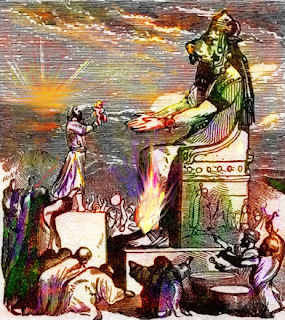
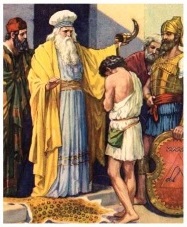
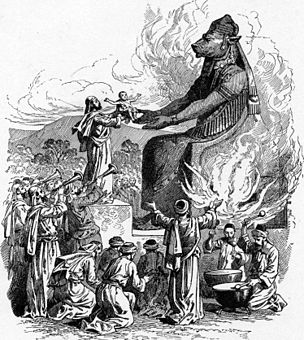
Burning a child for Molekh at Tofet,
Charles Foster Bible Pictures, 1897

Instead, God predicts, they will continue to set up idols in God’s temple, and they will continue to burn their own children at the shrine of Tofet in the Valley of Ben-hinom, just south of the temple mount in Jerusalem.

“Therefore, hey! The days are coming,” declares God, “when no one will say ‘the Tofet’ or ‘the Valley of Hinom’ any more, but rather ‘the Valley of the Mass Killing’. And they will bury at Tofet until there is no space left.” (Jeremiah 7:32)

Then, God says, it will get even worse. Since there will be too many corpses to bury, the bodies will be desecrated by wild animals. Furthermore, the people’s beloved land, already trampled by the Babylonian army, will become a wasteland.

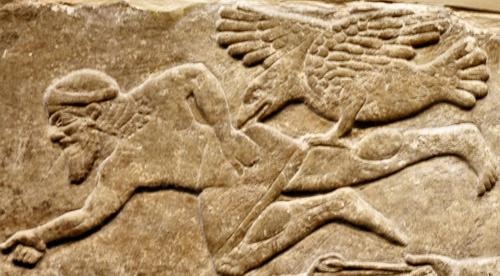
“And the corpses of these people will be food for the birds of the sky and the beasts of the land, and there will be no one frightening them off. And I will make the sound of  gladness and of rejoicing cease in the towns of Judah and the streets of Jerusalem, the voice of the bridegroom and the voice of the bride. For the land will become a desolation.” (Jeremiah 7:33-34)

Yet even this is not enough. God is so fed up with the people of Judah that the dead will not be allowed to rest in peace.

“At that time,” declares God, “they will bring from out of their graves the bones of the kings of Judah, the bones of its officers, the bones of it priests, the bones of its prophets, and the bones of the inhabitants of Jerusalem. And they will be spread out under the sun and the moon … They will not be gathered and not reburied; they will become manure on the face of the earth.” (Jeremiah 8:1-2)

The earlier graves would be located outside the city, like the Valley of Hinom. Who would bother to ransack them? The 11th-century commentator Rashi suggested the Babylonian invaders, called “Chaldeans” at the time.

“And the Chaldeans shall dwell, when they besiege the city, in the graves of the princes, that were as beautiful as palaces.” (Rashi)2 

Or perhaps the invading army would desecrate graveyards in order to humiliate the Jerusalemites and move them to despair.

“Exposure of the dead was considered a great dishonor and desecration throughout the ancient world.” (Etz Chayim)3

The horrifying prophecy concludes:

“And death will be more desirable than life for all the remaining remainders of this wicked clan, in all the remaining places where I will drive them,” declares the God of Armies. (Jeremiah 8:3)

Vindictive or kind?

This passage and many others in the book of Jeremiah make God sound like a vindictive ruler with an anger management problem. The message could be summarized: If any of you disobey me, you’ll all wish you’d never been born!

On the other hand, the God of Jeremiah asks the Judahites not only to refrain from worshiping other gods, but also to behave decently to one another. Before the haftarah reading, Jeremiah reports that what God wants the most is for people to eschew injustice; oppression of strangers, orphans, and widows; and shedding the blood of the innocent.4

After the first passage in this week’s reading, God continues to rant about how wicked the people are and how devastating their punishment will be. But the rabbis who chose the haftarot over the centuries tried to end on a hopeful note. In the case of Haftarat Tzav, they appended a two-verse poem, the next positive passage in Jeremiah:

Thus said God:
Let not the wise one boast about his wisdom,
And let not the strong one boast about his strength.
Let not the rich one boast about his riches.
For only of this may a boaster boast:
Of insight and acquaintance with me.
For I am God, doing kindness,
Justice, and righteousness on earth.
For in these I delight,
Declares God. (Jeremiah 9:22-23)

Communal versus individual justice

If God is kind and just, why does God let the Babylonian army kill so many people, including orphans, widows, and the innocent?

Throughout the Hebrew Bible, God treats people collectively. If enough of the population is at fault, God punishes everyone.

In the book of Jeremiah, the punishment is not the worst-case scenario of the first passage in this week’s haftarah. Later the book describes how the Babylonian army breaches the walls of Jerusalem and burns down the city and its temple. The people who have surrendered are put in fetters and marched off to exile in Babylon. A Babylonian official who knows about Jeremiah’s prophecies lets the prophet himself go free, and Jeremiah spends his final years with a group of Judahite refugees in Egypt.

Even if the outcome is not the worst that can happen, it is still personally devastating for a lot of innocent people. Why does God punish everyone in the community for the crimes of only some of its population?


Collective punishment is not perfect justice. If we think of God as a person who controls our fates, then we must protest, like Abraham:

“Far be it from you to do this thing, to bring death to the innocent along with the wicked, so the innocent and the wicked will fare alike!  Far be it from you, the judge of all the earth, to not do justice!” (Genesis 18:25)

But collective punishment is a reality. When enough humans pollute the air, we all suffer from global climate change. When enough humans are inflamed by a demagogue, we all live in fear of terrorism and the seizure of the government. And when humans in power decide to make war, innocent people die.


  1. 2 Kings 22:3-23:16.
  2. Rashi (Rabbi Shlomoh Yitzchaki), translated in www.sefaria.org.
  3. Commentary edited by Chaim Potok, Etz Hayim, Rabbinical Assembly of the United Synagogue of Conservative Judaism, 2001, p. 628.
  4. Jeremiah 7:5-6.

Beha-alotkha: Waving Levites

Moses, Aaron, and Miriam, the leaders of the Exodus from Egypt, were born into the tribe of Levi.1 When the Israelites are wildly worshiping the Golden Calf, Moses calls out:

“Whoever is for God, to me!” And all the sons of Levi gathered to him. (Exodus 32:26)

Numbering of the Israelites, by Henri P.E. Philippoteaux, 19th century

The male descendants of Levi obey Moses’ order to go through the camp killing the calf-worshippers. But the Levites are not specifically mentioned again until the book of Numbers, which begins with a census of all the men of Israel who are twenty years old and above and are able to bear arms. The three priests (Aaron and his two surviving sons, Elazar and Itamar) and the tribe of Levi are excluded.

And God spoke to Moses, saying: “Indeed, you must not muster the tribe of Levi; you must not lift their heads [i.e. count them in a census] among the sons of Israel. You must assign the Levites over the Sanctuary of the Testimony, and over all its gear, and over all that belongs to it. They will carry the sanctuary and all its gear, and they themselves will guard it, and they will camp all around the sanctuary.” (Numbers/Bemidbar 1:48-50)

The “Sanctuary of the Testimony” is the portable tent-sanctuary the Israelites made for God in Exodus, with the “Ark of the Testimony” in its rear chamber, the Holy of Holies. This sanctuary is also called the Tent of Meeting, since Moses and God converse there.

Later in the first Torah portion of Numbers, Bemidbar, God adds:

“Bring forward the tribe of Levi and station them in front of Aaron hakohein, and they will wait on him. And they … serve the service of the sanctuary.” (Numbers 3:6)

hakohein (הַכֹּהֵן) = the priest (usually the high priest). Kohein (כֺּהֵן) = priest, and kohanim (כֺּהֲנִים) = priests.

The book of Numbers establishes three categories of people: priests (Kohanim), Levites (Leviyim), and Israelites (Yisrael). Even today, when Jews give their Hebrew names at services, those descended from the Kohanim add “hakohein” and those descended from the Leviyim add “halevi”.2 All other Jews are in the Yisrael category.

The priests (kohanim) and the Levites (Leviyim) get their ordination in two different books of the Torah. This week’s Torah portion, Beha-alotkha (Numbers 8:1-12:16) ordains the Levites in a ceremony that treats them like an animal offering.

But the first priests are ordained in the book of Leviticus, when the altar is inaugurated.3 Their ordination ceremony treats them like the altar.

Ordination of priests

This ordination of priests begins when Moses washes Aaron and his sons with water, dresses them in their new vestments, and anoints both the men and the altar and sanctuary-tent with oil. Then Moses, acting as a priest for the last time, slaughters a bull and two rams. The second ram is the ordination offering. After Aaron and his sons have laid their hands on its head, Moses slaughters it, then applies its blood, mixed with oil, to the corners of altar as well as to the right ears, right thumbs, and right big toes of Aaron and his sons. (See my post Tzav: Oil and Blood.) In other words, the priests are consecrated the same way as the altar, with anointing oil and blood.

After the blood-dabbing, the new priests hold out their hands, and Moses gives them the fat parts of the ram, its right thigh, a loaf of bread, and two cakes.

And he placed everything on the palms of Aaron and his sons, vayanef them as a tenufah before God.” (Leviticus/Vayikra 8:27)

vayanef (וַיָּנֶף) = and he waved, moved back and forth. (A form of the verb nuf, נוּף = move back and forth, wave, lift.)

tenufah (תְּנוּפָה) = wave-offering. (A noun derived from the root verb nuf, but often translated as  “elevation offering” because the offering is usually lifted in the priest’s hands before being waved.)

This is the first tenufah in the Torah, but a tenufah is prescribed for many types of offerings in the book of Leviticus. The object lifted and waved before being given to God is often, but not always, the portion of an offering reserved for the priests to eat. In this instance, Moses appears to be guiding the hands of the new priests in the correct waving movements.

Ordination of Levites

Serving as  priest is a full-time job in the Torah. Someone else has to cover the remaining work to keep the religion going: the Levites.

In the first two Torah portions of the book of Numbers, the Levites are given responsibility for  disassembling the Tent of Meeting, transporting the pieces (as well as the sacred objects, which the priests have wrapped), and re-erecting the tent and courtyard—every time the people travel to a new campsite. They must also guard the tent from intruders, and assist the priests as requested.4

The [Levite] Choristers, by James J.J. Tissot, circa 1900

When the second temple in Jerusalem is erected in the books of Ezra and Nehemiah, the Levites are divided into singers and musicians, gatekeepers, and temple servants.5 Levites are also assigned the duty of collecting tithes (under the supervision of priests).6

The Levites are ordained in this week’s Torah portion in Numbers, Beha-alotkha. While the priests’ ordination treats them like the altar, the Levites’ ordination treats them like pieces of an offering at the altar.

Both ceremonies begin with washing for ritual purification, but the Levites do it a different way from the priests.

And God spoke to Moses, saying: “Take the Levites from among the Israelites and purify them. And this is what you will do to purify them: Sprinkle water of exoneration over them, and make them pass a razor over all their flesh; and they should wash their clothes and purify themselves.” (Numbers 8:5-7)

Animal offerings are already pure, since the animals must be not only kosher, but also without any physical blemishes.7

“And you must bring forward the Levites in front of the Tent of Meeting, and assemble the whole community of Israelites. And you will offer the Levites in front of God, and the Israelites will lay their hands on the Levites.” (Numbers 8:9-10)

Anyone who offers an animal at the altar first lays a hand on its head. But here, all the Israelites lay hands on the Levites—making the men of Levi their offering to God.

“Then the Levites will lay their hands on the heads of the bulls, and make one of them an exoneration-offering and the other a rising-offering for God, to make atonement for the Levites. Then you shall station the Levites in front of Aaron and in front of his sons, veheinafta them tenufah for God.” (Numbers 8:12-13)

veheinafta (וְהֵנַפתָּ) = and you will wave; and you have waved. (Another form of the verb nuf.)

At their own ordination ceremony, the priests wave choice parts of their animal and grain offering. But at their subordinates’ ordination ceremony, the priests wave the Levites themselves—after the Israelites have laid hands on them. The living men in the tribe of Levi are a tenufah from the Israelites to God.

We can only speculate about how these men were waved back and forth by the three priests. According to Kohelet Rabbah, “Rabbi Abba bar Kahana said: Aaron [picked up and] waved twenty-two thousand Levites on one day.”8

“And you will segregate the Levites from among the Israelites, and the Levites will be mine. And after this, the Levites will come to serve the Tent of Meeting, when have purified them veheinafta them as a tenufah. Because they were definitively given to me from among the Israelites to replace the openers of all wombs, the firstborn if all the Israelites, for me to take them.” (Numbers 8:14-16)

This quote from God reaffirms that the firstborn sons of various clans in every tribe will no longer run the family’s religious practice. From the portion Beha-alotkha on, religious positions in Israelite society are the sole prerogatives of hereditary priests and Levites.


Rabbis, rather than priests, have been the Jewish religious authorities since 70 C.E., when the second temple in Jerusalem was destroyed. Today any Jew can study and be certified as a rabbi, regardless of ancestry. The ordination ceremony includes smichah, in which established rabbis lay hands on the heads of the new rabbis.

There are also a number of supporting roles to keep Jewish communities going, from cantors and other service leaders to kosher butchers; these, too, depend on training rather than ancestry. When there is a ceremony to recognize people taking on these roles, it might also include smichah, but I have never heard of anyone waving the initiates back and forth.

Religious practices in the Torah are full of blood and slaughter. I thank God that Jews no longer have a temple with an altar, that we have moved on to addressing God through words rather than through burning dismembered animals. But I would like to see Levites being waved.


  1. Exodus 6:16-20.
  2. Genetic research has shown that most men called kohanim today do share a genetic marker. The leviyim do not, but the designation is still handed down through the generations by tradition.
  3. The ritual is prescribed in Exodus 29:4-29 and performed in Leviticus 8:1-9:24.
  4. Numbers 1:50-51. See my post Bemidbar & Naso: Dangerous Duty.
  5. Ezra 2:40-55, 3:10-11, 7:7, 7:24 and Nehemiah 7:1-46. (1 Chronicles 6:16-18 claims that King David appointed Levites to sing in front of the tent-sanctuary in Jerusalem before Solomon built the first temple, but Chronicles was written after the books of Ezra and Nehemiah, at least five centuries after the time of David. Rabbis in the Talmud claimed that some Levites were singers even in the book of Numbers, but there is no actual textual evidence. 1 Chron. 9:21-27 makes a similar specious claim regarding gatekeepers.)
  6. Nehemiah 10:38-40.
  7. See my post Emor: Flawed Worship.
  8. Kohelet Rabbah 12:7:1, written 700-950 C.E./, translated in www.sefaria.org.

Tzav & Jeremiah: Smoke vs. Altruism

(Last week’s Torah portion was actually Vayikra, the first portion in the book of Leviticus/Vayikra. This week I am back on sync with the calendar of Torah readings.)


What gives God pleasure?

This week’s Torah portion, Tzav (Leviticus 6:1-8:36) and its haftarah, the accompanying reading from the Prophets (Jeremiah 7:21-8:3 and 9:22-23) give two different answers. In Leviticus, God is infuriated when any Israelites violates one of God’s many rules, even inadvertently; but smoke from a burning sacrifice improves God’s mood. In Jeremiah, God is bitter and destructive because the Israelites abandoned God and worshipped other gods; and smoke does nothing to improve God’s mood. 

Pleasure in smoke

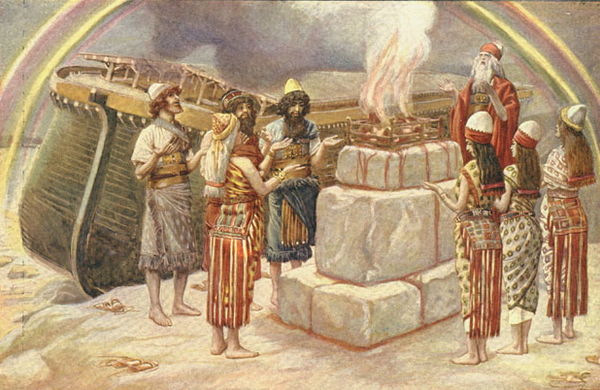
The first five books of the bible are full of people making animal sacrifices to God. The first humans in the Torah to worship God with burned offerings are Cain and Abel.1 Noah loads some extra animals on the ark, and when he burns them after the flood has receded, God’s attitude toward humankind improves.2

Noah’s Sacrifice, by James Tissot, circa 1900

Throughout Genesis and Exodus, individual men continue to thank and worship God by building altars and burning animals. The first two portions in the book of Leviticus, Vayikra and Tzav, give God’s instructions for making animal and grain offerings as part of the new cult that relies on priests.

For any type of offering, Leviticus explains, the donor who brings the animal to the altar leans a hand on its head before slaughtering it,3 thus identifying the animal as his gift to God and making sure God gives him the credit. For example, in the Torah portion Tzav, a ram is burned during the ceremony in which Moses consecrates the first priests, Aaron and his four sons.

Then [Moses] brought close the ram of the olah, and Aaron and his sons leaned their hands on the head of the ram. And he slaughtered it, and Moses sprinkled the blood on the altar all around. (Leviticus 8:18-19)

olah (עֺלָה) = offering in which the animal is completely burned. (From the root verb alah, עָלָה = rise up.)

After the altar is splashed with blood, Moses butchers the animal, and all the pieces are roasted on the fire of the altar.

When an offering is made to atone for transgressing one of God’s laws, even unintentionally, a priest removes all the fatty parts of the animal and burns them up into smoke; then he and other male priests may eat the remaining meat. The smell of the smoke soothes God’s temper and inclines God toward forgiveness. (See my post Pinchas: Aromatherapy.) When an offering is made to thank God for well-being, the donor and his guests also get to eat some of the meat, but the fatty parts are still reserved to be burned up into smoke for God.

Humans get two benefits from an offering that is not an olah: they eat high-protein food, and God is pleased or appeased. But other offerings require that the entire animal is burned up into smoke for God. During the consecration of priests in Tzav,

… Moses turned the whole ram into smoke at the altar; it was an olah, for a soothing scent; it was a fire-offering for God, as God had commanded Moses. (Leviticus 8:21)

An olah must be offered not only on special occasions such as a consecration or a holiday, but also every day, so there is always something smoldering on the altar.

The smoke from the burning animal rises up to the sky, where God normally lives. (Hebrew uses the same word, shamayim, שָׁמַיִם, for both “sky” and “heavens”.) Then God enjoys the “soothing scent” of the smoke, and relaxes. The God-character in the Torah is hot-tempered, and needs a lot of soothing. Even part of the daily grain-offering is mixed with oil and frankincense and burned, so that its smoke will please God.4

Against burning animals

Yet the haftarah reading from the book of Jeremiah declares that the directions for animal offerings are useless.

Thus said God of Armies, God of Israel: “Add your olot onto your slaughter-sacrifice and eat the meat! Because I did not speak with your forefathers, nor command them at the time I brought them out of the land of Egypt concerning matters of olah and slaughter. Rather, with this word if commanded them, saying: Heed my voice, and I will be your god, and you—you will be my people. And you must walk the entire path that I command you, so that it will be good for you.” (Jeremiah 7:21-23)

olot (עֺלוֹת) = plural of olah; offerings in which the animal is completely burned up into smoke.

Some commentators have explained Jeremiah’s outburst as sarcasm. Others have written that Jeremiah meant the wicked were assuming they could get away with their transgressions by making the appropriate guilt-offerings.5

I think Jeremiah is challenging the whole idea that the way to keep God happy is to keep making sacrifices and providing smoke for God to smell. In the chapter before this week’s haftarah, Jeremiah quotes God as saying:

“Your olot are not acceptable, and your slaughter-sacrifices do not please me.” (Jeremiah 6:20)

Pleasure in altruism

Then what does give God pleasure in the book of Jeremiah?

Shortly before this week’s haftarah begins, God says:

“For if you really make your way and your acts good; if you really do justice between a man and his fellow, if you do not oppress an immigrant, orphan, or widow, and you do not shed the blood of the innocent in this place, and you do not go after other gods—to your own harm; then I will let you dwell in this place, in the land that I gave to your forefathers forever until forever.” (Jeremiah 7:5-7)

In other words, the only way to please God is to be fair, to help the needy, and to avoid other gods.

The end of this week’s haftarah is the following poem:

Thus said God:

            “May the wise not boast of their wisdom,

            And may the powerful not boast of their power.

            May the wealthy not boast of their wealth.

            Rather, in this may the boasting boast:

            Understanding and knowing me.

            Because I, God, do kindness,

            Justice, and altruism in the land.

            Because in these I take pleasure,”

Declared God. (Jeremiah 9:22)


Every year I approach the portions Vayikra and Tzav with dread; they are particularly unpleasant reading for someone like me who does not eat mammals and does not want to see or imagine their cut-up corpses. Nor do I like the idea of a God who normally has a hair-trigger temper, but calms right down under the influence of smoke from sacrifices.

As I write this I am sipping a cup of cocoa, because the taste of chocolate calms me down. But I disdain a concept of God that assigns the deity that much human frailty.

The God in Jeremiah is not as temperamental as the one in Leviticus. Yet this God is fixated on destroying Judah and Jerusalem in order to punish the Israelites for both serving other gods, and persisting in doing evil to other human beings. Only a thorough change in the people’s behavior will satisfy God. Only then will God let them return in peace to their ancestral land.

What would it take to please God—or to occupy our world in peace—today?


  1. Genesis 4:3-4.
  2. Genesis 8:20-21.
  3. The Hebrew in Vayikra and Tzav is veshachat (וְשָׁחַט) = and he will slaughter, with “he” referring to the one who leans a hand on the animal’s head.
  4. Leviticus 6:8.
  5. For example, Rabbi Bachya ben Asher wrote circa 1300 C.E.: “When the prophet spoke about G’d not commanding us to bring animal sacrifices he meant that the animal sacrifices were not meant to be in lieu of penitence and proper conduct on our part. This is what Samuel had already said many hundreds of years previously to King Saul (Samuel I 15,22) “heeding My commands is much preferable than to offer Me good meat-offerings.” (Translation of Rabbeinu Bachya on Leviticus 7:38 by www.sefaria.org.)

Vayikra & Tzav: Fire Offerings Without Slaughter, Part 2

The first two Torah portions in the book of Leviticus/ Vayikra mention repeatedly that God enjoys the smell of smoke, especially the smell of burning animal fat.1

Six types of offerings at the altar appear in the portions Vayikra (“and [God] called”) and Tzav (“Command”).  For five out of six, the donor must bring an animal, lean a hand on its head, and slaughter it.  Then the donor watches a priest butcher the animal, splash its blood around the altar, and burn all or part of it to generate smoke.  (The other offering is made out of grain, and is sprinkled with oil and frankincense before it goes on the fire, so the smoke will smell good to God.)

Killing and burning animals was the usual technology for worship in the Ancient Near East, and the ancient Israelites probably found fire-offerings spiritually moving.  Today some people view the slaughter of animals as an unfortunate necessity, and others find it unethical to kill animals for human food.  Can we apply the Torah’s six categories of offerings to a more ethically refined set of procedures?

Last week I suggested a new way of interpreting fire-offerings in general.  This week I propose six kinds of practices to replace the six kinds of fire offerings.

*

In the order of their appearance in the Torah portions Vayikra and Tzav, the six types of fire-offerings are:

1) olah (עֹלָה) = rising-offering.

(From the root verb alah (עלה) = go up.)

Altar, “Treasures of the Bible”, Northrup 1894

Then

This is the instruction of the olah: It is the olah which burns on the altar all night until the morning …  (Leviticus/Vayikra 6:2)

In an olah the entire slaughtered animal is burned up, so olah is often translated as “burnt offering” or even “holocaust offering”.  The olah is the only offering which stays on the altar fire all night, until it is completely burned up into smoke.  An olah is required twice a day as a matter of routine, perhaps to keep a sustaining level of smoke rising to the heavens.

And the fire on the altar shall burn on it; it shall not go out.  The priest shall kindle wood on it every morning and arrange the olah upon it …  A continual fire shall burn on the altar; it must not go out.  (Leviticus 6:5-6)

A holy day calls for an extra olah.  This type of offering is also prescribed for individuals who have been isolated and need to return to a normal relationship with God and their community.2  Perhaps a normal relationship includes continuous, unflagging dedication to serving God, day and night.

Now

For a physical, animal body, fat serves as a reserve source of energy in lean times.  But accumulating too much fat is physically unhealthy, just as accumulating too much wealth is spiritually unhealthy.  How can we burn up the excess fat in our lives?  How can we avoid selfish hoarding? How can we keep our souls directed toward making our own best contributions in a world full of other individuals?

The Jewish practice of mussar calls for a daily review of our actions before bedtime.  We record every time we succumbed to an undesirable character trait (such as hoarding) and every time we practiced a good trait we want to acquire (such as generosity).  It takes continual self-examination to change a habit.

During our isolation due to the coronavirus pandemic, we could start a journal noting when we acted selfishly, and when we acted generously.  We can think about what we will do differently next time.  Then when we come out of social isolation, may we offer the olah of a pledge to pay extra attention to our own behavior to make sure we do not lapse back into selfishness.

2) minchah (מִנחָה) = allegiance-offering; a gift to a king as a sign of homage or respect; tribute.

Frankincense (Boswellia sacra tree resin)

Then

The Torah prescribes an offering of grain, loose or baked, as a minchah to God.

A person who offers a minchah to God, he shall offer fine flour, and he shall pour oil over it and place frankincense upon it … and the priest shall make a memorial portion go up in smoke on the altar, a fire-offering of soothing fragrance for God.  (Leviticus 2:1-2)

Now

When I burn my toast, it only sets off the smoke alarm.  But before I eat my toast, or any other food, I say a blessing to give thanks for it.  My blessing is my gift of allegiance to the source of all life.

During the pandemic, may we express gratitude and allegiance not only to God, but to all human beings who are keeping the world fed.

3) shelamim (שְׁלָמִים) = wholeness-offering.

(From the same root as shaleim (שָׁלֵם) = complete, safe and sound, at peace; and shalom (שָׁלוֹם) = peace.)

Then

And if his offering is a shelamim, if he offers it from the herd, whether male or female, he shall offer it unblemished in front of God.  And he shall lean his hand on the head of the offering …  (Leviticus 3:1-2)

The Torah gives three reasons for offering a shelamim:

(Electronic handshakes only during the pandemic please.)

todah (תוֹדָה) =  thanks,

neder (נֶדֶר) = fulfilling a pledge to make that offering if all goes well, or

nedavah (נְדָבָה) = donating out of generosity.

And this is the instruction for the shelamim offering that he shall offer to God.  If he brings an offering of todah, then he shall offer, along with the todah slaughter-offering, unleavened loaves mixed with oil and unleavened crackers anointed with oil and fine flour loaves mixed with oil.  Along with loaves of leavened bread, he shall offering his offering along with his shelamim slaughter-offering.  (Leviticus 7:11-13) 

The same assortment of grain products accompany neder and nedavah animal offerings.  The slaughtered animal and the unleavened loaves are divided into three portions: one to be turned into smoke for God, one for the officiating priest to eat, and one for the donor and his guests to eat in God’s presence (i.e. in the courtyard in front of the altar).  None of the leavened bread is burned for God; it is all eaten by the priest and the donor’s party.

The difference between a shelamim for a todah and and a shelamim for a neder or nedavah is the time limit for eating the meat and bread.  The donor and his family and guests have one day to eat the meat and bread from a todah.  They have two days to eat the meat and bread from a neder or nedavah.3  One theory is that these time limits ensure that the donor invites more guests to share the feast.  This increases his generosity.

Now

Today we can say blessings to thank God for our lives and for everything else in the world.  (Even though the world includes things we consider bad, I am grateful that there is a world with people in it, and so much beauty and wonder.)

But it is also important to show our appreciation to the human groups and individuals that improve life on earth.  We can give individuals thank-you gifts, and give groups our pledges and donations.  The more often we do so, the more we add to the world’s supply of generosity—and that brings more wholeness (shaleim), and holiness into the world.

During the pandemic, consider leaving a gift on someone’s doorstep.  Pledge or donate to a good cause to help our battered world recover.

4) chattat (חַטָּאת) = lapse-offering.

(From the root verb chata (חָטָא) = miss the mark, commit an offense against God; make amends for doing wrong.)

Then

If one soul from among the people of the land should chata unintentionally, by doing one of the [negative] commandments of God, [doing something] that should not be done, and he incurs guilt—  If the offense that he committed becomes known to him, then he shall bring his offering: an unblemished female goat for his chatat that he chata …  (Leviticus 4:27-28)

A different animal must be offered according to the person or group who unintentionally violated one of God’s rules: priests, leaders, the whole community, and individuals.  All the animals are offered in the usual way for fire-offerings, from leaning a hand on the living animal’s head to burning up the fatty parts on the altar to give soothing smoke to God.

And the priest shall make atonement for him and he shall be forgiven.  (Leviticus 4:31) 

Now

What can we do today when we realize after the fact that we violated a moral or religious rule we want to live by?

If I bite into what I thought was a vegetarian omelet and taste bacon in my mouth, I push the plate aside and say a short prayer for discernment in the future.  Both actions help me to accept that I made a mistake, and forgive myself.

But if I realize I did something that hurt another person, I need to find reconciliation not only with my conscience, but also with the person I wronged.  I find what I hope is a calm time to talk with the person, then say what I think I did wrong and apologize.  (Finding the right time may call for extra sensitivity during a period of social isolation during a pandemic.)

Next I give the other person a chance to say how the offense looked to them.  If I need to explain anything, I try to do it humbly, without defending my ego.  Then I ask what I can do to make up for the wrong I did.  If there is something concrete and reasonable, I do it.  Only then can I be forgiven by both the other person and myself.

5) asham (אָשָׁם) = guilt-offering.

(From the root asham (אָשַׁם) = incur guilt.)

Then

If a soul who does wrong commits treachery against God and lies to his fellow about a pledge, or a loan, or a theft, or fraud; or he finds a lost item and lies about it, and he swears falsely … he shall return the stolen item that he stole or the fraud that he committed or the pledge that was left with him or the lost item he found … and he shall pay back the principal and add a fifth …  And he shall bring his asham to God: an unblemished ram …  And the priest shall make reconciliation for him before God, and he shall be forgiven for everything that he did to become guilty.  (Leviticus 5:21-26)

Pinocchio, by Enrico Mazzanti, 1883

In a case of theft or fraud, the Torah requires both reparations to the person who was wronged, and an offering to God for atonement.  Someone who has stolen or cheated and then lied about it bears extra guilt, so that person must give the victim extra compensation and offer an asham to God.

Now

When we have made reparations for our original misdeed, but we still feel guilty about the way we did it, what can we do to clear ourselves?  For some people, the answer is to give a large donation to charity, in money or labor.  For others, the answer might be a period of saying prayers from the Yom Kippur repentance liturgy.  Words make a difference, even when we speak them only to ourselves and our God.

6) milu-im (מִלֻּאִים) = ordination-offering.

(From the root mala (מָלַא) = fill, fulfill.  Filling someone’s hands is the Biblical Hebrew idiom for ordaining that person as a priest.)4

Then

And God spoke to Moses, saying:  Take Aaron and his sons with him, and the garments, and the anointing oil, and the chataat bull, and the two rams, and the basket of unleavened bread, and assemble the whole community at the entrance of the Tent of Meeting.  (Leviticus 8:1-3)

Leaning hands on a bull in an ordination ritual

Moses washes the five men who are being ordained as priests, dresses them in their official vestments, and anoints them and the sanctuary and its altar.  Then come the fire-offerings: first a chataat with a bull, to atone for anything the new priests might have done wrong inadvertently; then an olah with a ram.

Then [Moses] offered the second ram, the ram of milu-im, and Aaron and his sons leaned their hands on the head of the ram.  And Moses slaughtered it, and took some of its blood and placed it on the edge of Aaron’s right ear and on the thumb of his right hand and on the big toe of his right foot. (Leviticus 8:22-23)

The ritual continues with both the altar and the five new priests being anointed with blood as well as oil, the fatty parts of the ram burned into smoke to please God, and the meat of the ram roasted for Aaron and his sons to eat in the holy place at the entrance of the Tent of Meeting.

Now

If our goal is to become “a kingdom of priests and a holy nation” (Exodus 19:6), then we need to give milu-im, ordination-offerings, whenever our hands are filled—i.e. whenever we receive authority to act in the public sphere.

What can we give today in return for the grant of authority?  Humble service, regular prayers or meditations on becoming worthy, and the sacrifice of stepping down again at the right time.

When we have opportunities to elect people to positions of authority, may we choose leaders who will serve with humility, act for the good of everyone, and give a higher priority to the well-being of their people than to re-election.

*

Ancient Israelites who wanted to give God fire-offerings, offerings of the heart, could come to the altar and follow the established rituals.  They knew what to do; and the death, blood, and smoke made the rituals more impressive.

Today we have to think harder about our practices.  Yet we can still give six kinds of offerings to the divine, with the fire of our hearts.  We can practice rising above selfishness (olah), give allegiance (minchah), cultivate wholeness through thanks and generosity (shelamim), repair mistakes (chataat), undo guilt (asham), and turn our positions of authority into holy ordinations (milu-im).

Let’s keep on giving our own offerings!  And may the whole world someday become a holy nation.

  1. See my posts Vayikra & Tzav: Fire Offerings Without Slaughter, Part 1 and Pinchas: Aromatherapy.
  2. An individual must bring an olah at the end of a period of social isolation because of seclusion following childbirth (Leviticus 12:1-8), because of the skin disease tza-arat (Leviticus 14:1-11 and 9-20), because of genital discharges that require staying away from the sanctuary (Leviticus 15:13-15 and 28-30), and because of a nazirite vow (Numbers 6:9-14).  A new priest brings an olah for his ordination (Leviticus 8:18-21).
  3. Leviticus 7:15-17.
  4. For more details about the ordination of the first priests, see my posts Tzav: Oil and Blood and  Tzav: Seven Days of Filling Up.

Repost: Vayikra

And [God] called to Moses, and God spoke to him from the Tent of Meeting.  (Leviticus/Vayikra 1:1)

The opening of the book of Leviticus/Vayikra leads us to expect an important announcement.  Instead, God explains how to make six kinds of offerings at the altar of the brand-new Tent of Meeting.  The only technology on offer for pleasing or appeasing God involves slaughtering animals at the altar, splashing their blood around, butchering them, and burning them.

My 2014 posts on the first two Torah portions in the book, Vayikra and Tzav, reinterpret the six types of animal sacrifices from a vegetarian viewpoint.  You can read a revised version of the first one here:  Vayikra & Tzav: Fire-Offerings Without Slaughter, Part 1.  (I will rewrite Part 2 for next week.)

This year I feel sadness and disgust once again at the gratuitous slaughter of innocent animals.  I feel gratitude once again that Jews now serve God with prayer and good deeds instead.  I stand by my earlier interpretations of fire-offerings as ways of dealing with anger, and of rising-offerings as ways of continuously directing our desires toward doing good.

But the let-down of learning that God’s first words from the new tent-sanctuary are instructions for animal offerings hit me harder this year.  It reminds of the let-down I went through when I reached the climax of our journey, Jerusalem itself.

Men’s side of the western wall (kotel) on March 13, 2020, after most tourists left

My first disappointment was that although I prayed at the Western Wall (Herod’s retaining wall for the Temple Mount) three times, and stuck my own heartfelt written prayer into a crevice, I was unable to feel holiness emanating from the stones.  I was sad, but not surprised.  I have always been a practical person, capable of flights of imagination but untouched by the world that mystics sense so vividly.

My second disappointment was the abrupt end of my time in Israel.  I wanted to attend a third teaching by Avivah Zornberg, one of my favorite biblical commentators.  I wanted to go to several more archaeological sites and museums.  I wanted to see some places outside Jerusalem that I had read about in the Torah and in later Jewish writings—the  Dead Sea, the Negev, the Galilee, the kabbalistic town of Sfaat, the northern cities on the Mediterranean.

But like the United States, Israel shut down all public places in order to fight the spread of the coronavirus.  Museums closed, tours ceased.  There was no point sitting in our apartment day after day, watching teachings online that we could watch from anywhere in the world.  And what if we could not return to the U.S., where we have health insurance, when we need medical care for our pre-existing conditions?

We canceled our flight to Athens, the next stop on our itinterary, and booked an earlier flight to the United States.  Now we are repatriated in our home state of Oregon, looking for a new place to live.   I remind myself that while the whole world is shut down, I will have time to work on both of the books I was writing when we left last September: my book on the ethics of free will in Genesis, and my fantasy novel.  Staying home to write will not be so bad.

But I was expecting something bigger when I reached Jerusalem.  I suppose I wanted a divine voice to call to me from a holy place and tell me something important.  All I got was instructions on making sacrifices.

Now I will have to make my own meaning out of life during the pandemic.


Vayikra & Tzav vs. Isaiah & Psalm 40: Smoke vs. Words & Deeds

The book of Leviticus/Vayikra gets right down to business.  The first Torah portion opens with God calling to Moses, then telling him more instructions for the Israelites—this time about conducting the rituals at the altar.

from Treasures of the Bible, Northrop, 1894

Speak to the Israelites, and you shall say to them:  Any human among you who offers an offering to God, from the livestock—from the herd or from the flock—you shall offer your offering.  If it is an olah he will offer from his herd…  (Leviticus/Vayikra 1:2)

olah (עֹלָה) = rising-offering; an offering that is completely burned into smoke.  (Plural: olot (עֺלוֹת).)

A person who offers an offering of minchah to God, fine flour will be his offering …  (Leviticus 2:1)

minchah (מִנחָה) = gift of allegiance or homage; a grain-offering.

And if he offers a zevach as a thankgiving-offering …  (Leviticus 3:1)

zevach (זֶבַח) = animal slaughter as an offering on the altar.  (Plural: zivechim (זִבְחִעם).)

The text continues through this week’s Torah portion (Vayikra) and next week’s (Tzav) with instructions for a total of six kinds of offerings.  (See my post Vayikra & Tzav: Fire Offerings Without Slaughter, Part 2.)  The last four all involve slaughtering animals, burning parts of them so God can enjoy the smell of the smoke, and eating the remaining edible parts after they have been roasted on the altar.

The primary method of serving God throughout the Hebrew Bible is turning animals into smoke, “… a fire-offering of a soothing smell for God” (Leviticus 3:5).  In the first twelve books of the bible (Genesis through 2 Kings) this method goes unquestioned.

Where does this idea come from?  The Torah does not say, but I believe the ancient Israelites assumed God wanted animal sacrifices because the other gods in the Ancient Near East were worshiped that way.1

Only when foreign empires began swallowing up the kingdoms of Israel did prophets and psalmists begin to question this approach.  The first prophet in the book of Isaiah reports:

“Why your many zivechim for me?” God says.

“I am sated with olot of rams.

And suet from fattened animals

And blood of bulls and lambs and he-goats

I do not want!”  (Isaiah 1:11)

“… And when you spread your palms

I am averting my eyes from you.

Even though you multiply [your] prayers

I am not listening.

Your hands are full of blood!

Wash, become pure;

Remove your evil acts from in front of my eyes;

Cease doing evil!

Learn to do good!

Seek justice,

Make the oppressed happy,

Defend the orphan,

Argue the widow’s case!”  (Isaiah 1:15-17)

Here God does not totally reject animal sacrifices, but God does consider good deeds and justice a higher form of service.

Psalm 40 declares:

[God] gave my mouth a new song,

A song of praise for our God.

May the many see, and may they be awed

And may they trust in God.    (Psalm 40:4)

Zevach and minchah you do not want.

You dug open a pair of ears for me!

Olah and guilt-offering you do not request.  (Psalm 40:7)

That is when I said:

Hey, I will bring a scroll of the book written for me.

I want to do what you want, my God,

And your teaching is inside my guts.

I delivered the news of right behavior to a large assembly.

Hey! I will not eat my lips.  (Psalm 40:7-10)

The speaker in Psalm 40 maintains that God does not want smoke, only words of praise. Nothing can make this poet recant; he will not “eat his lips”.  (See my post Tetzavveh: Smoke and Pray.)

*

What does God want?  Most, but not all, of the Hebrew Bible assumes God wants offerings on the altar.  Today we assume God wants words of prayer and blessing, as well as deeds of kindness and justice.

But why should we give God what we think God wants?

Suppose you want to thank a person for saving your life.  You might speak to them, send them a card, send them flowers or a bigger gift.

Suppose you want to manipulate or appease a person who has power over you.  You might speak to them, send them a card, send them flowers or a bigger gift.

The same human impulses apply to thanking or manipulating a semi-anthropomorphic God.  In the bible, the Israelites slaughter their animals in order to give them to God, either in gratitude or in an attempt at appeasement.2

Today, do we pray and do good deeds to express gratitude?  Or to appease God?  Or to manipulate God into giving us what we want?

  1. For example, the odor of Utnapishtim’s burnt sacrifice gives the gods of Mesopotamia pleasure in Gilgamesh tablet 11, part 4. In the book of Numbers, Moabite women invited Israelites to worship Baal Pe-or with them through zivechey their god” (Numbers 25:2).  (Zivechey (זִבְחֵי) = slaughter offerings of.)  In the book of Ezekiel, God complains that Israelites are flocking to foreign altars and burning sacrifices to give idols soothing smells (Ezekiel 6:13, 16:19, and 20:28).
  2. Offerings of wholeness or thanksgiving (shelamim, שְׁלָמִים) are described in the portion Vayikra in Leviticus 3:1-16 and in the portion Tzav in Leviticus 7:11-21. Offerings to appease God after violating one of God’s rules (chataat, חַטָּאת, and asham, אָשָׁם) are described in Vayikra in Leviticus 4:1-5:22.

Metzora: Ear, Thumb, Toe

Ew, icky, gross, disgusting!  These words express is our unfiltered, untrained reactions to such things as slimy substances, corpses, and some visible diseases.

Tamei! says the book of Leviticus/Vayikra.

And the tzarua who has a mark, his clothes shall be torn and his hair shall be neglected and he shall wrap something over his lip, and he shall call out: Tamei!

tzarua (צָרוּעַ) = one stricken with the skin disease tzara-at (צָרָעַת). Also called a metzora (מְצֺרָע), from the same root.

tamei (טָמֵא) = ritually impure.

Anyone who is ritually impure, tamei, because of contact with genital discharges, dead bodies, or the skin disease tzara-at is forbidden to enter the courtyard around the sanctuary until the proper ritual purifies them.  Perhaps the writers of these passages1 imagined God was so anthropomorphic “he” would feel disgusted by these things, too.  Or perhaps the proper frame of mind for standing in front of God was to be free of any feelings of disgust—which would also explain why physically blemished priests could not serve at the altar.2

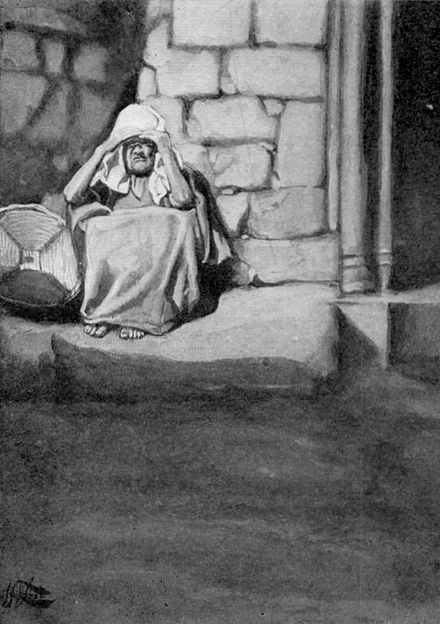
Metzora outside the city wall, by James Tissot

Tzara-at is not contagious,3 yet those afflicted with it are quarantined, forbidden even to live within their own community’s tent circle or town wall.4

This week’s Torah portion, Metzora (“someone with tzara-at”), prescribes how to make people who have healed from tzara-at ritually pure again, so they can rejoin the community for both worship and daily life.

First a priest must go outside the camp to inspect the metzora and confirm that their skin has really healed.  The writers of the Hebrew Bible assumed that any serious disease is a divine punishment for doing something wrong, and healing means that God had ended the punishment.  Many plagues are attributed to disobeying one of God’s commands.  Tzara-at, however, appears to be a divine punishment for demeaning other people through slander, denigration, or deception.5

If the skin disease is gone, the priest conducts a ritual with two wild birds.  (See my post Metzora & Acharey Mot: Doubles.)  Then, after washing and shaving their entire body, the metzora comes into the sanctuary courtyard with offerings to God.  The first offering is for their own purification and atonement.

The priest shall take one of the young rams and bring it near for an ashamThen the priest shall take some of the blood of the asham, and the priest shall put it on the rim of the right ear of the one being purified, and on the thumb of his right hand, and on the thumb of his right foot.  (Leviticus 14:12, 14:14) 

asham (אָשָׁם) = guilt-offering, to atone for an intentional misdeed.  (This is another indication that the Torah views bad behavior as the cause of tzara-at.)

In the whole Hebrew Bible, blood is daubed on the ear, thumb, and big toe for only two reasons: to purify an ex-metzora, or to ordain a priest.  Earlier in Leviticus we read:

Then [Moses] brought near the second ram, the ram of the ordination, and Aaron and his sons laid their hands on the head of the ram.  And Moses slaughtered it, and he took some of its blood and put it on the rim of Aaron’s right ear, the thumb of his right hand, and the thumb of his right foot.  Then he brought near the sons of Aaron, and Moses put some of the blood on the rim of their right ears, on the thumb of their right hands, and on the thumb of their right feet.  (Leviticus 8:22-24)

Both a new priest and a newly healed metzora are daubed with ram’s blood from head to toe, on the right side, the active side.

Oil is involved in both rituals as well, though the order of application is different.  When Moses ordains the first priests, he sprinkles anointing oil (which contains aromatic spices) on the altar before the blood-daubing.6  A priest sprinkles some of the ex-metzora’s offering of plain olive oil on the altar after the blood daubing.7

In both cases, after sprinkling oil on the altar, the officiant pours oil on someone’s head.  Moses pours anointing oil on Aaron’s head.8  The procedure for an ex-metzora is more elaborate:

And some of the rest of the oil that is on his palm the priest shall put on the rim of the right ear of the one being purified and on the thumb of his right hand and on the thumb of his right foot, over the blood of the asham.  Then the remainder of the oil that is on the palm of the priest he shall put on the head of the one being purified.  Thus the priest shall make atonement for him before God.  (Leviticus 14:17-18) 

Why are the procedures for purification after a skin disease and ordination of a priest so similar?  One answer is that both the metzora and the priest take a step up in their ability to serve God.  The metzora becomes able to enter the space in front of the sanctuary where the altar is.  The priest becomes able to enter the inner sanctuary.

Community members who are temporarily barred from the sanctuary courtyard because of other ritual impurities do not go through the same blood-daubing and oil-pouring ritual—perhaps because they have done nothing wrong.  They might become ritually impure because of sex, or childbirth, or the death of a family member.  The passage of time and a less elaborate cleansing ritual are sufficient.

Perhaps someone who has recovered from tzara-at gets the full priestly treatment because the disease was thought to be the result of denigrating another person.  If one is accustomed to malicious gossip, or deception, or arrogant speech, it takes care and attention not to fall back into one’s old habits.  A powerful ritual can help motivate reformed persons to watch themselves continuously.

Priests in the Torah are also required to pay constant attention to their behavior.  Any slip on their part leads to improper worship by the whole community.  So they begin their tenure with a powerful ritual to remind them of their awesome responsibility.

Purity in any area requires careful attention.  Today, those with medical conditions requiring the complete elimination of certain foods, as well as Jews who are strict about keeping kosher, must read labels and ask embarrassing questions about meals served away from home.

And in our world of divisiveness and suffering, we all need to aim at purity in our own ethical behavior.  Like the metzora, we must guard ourselves against harmful speech.  Like the priest, we must be careful and thoughtful about what we teach, what we do, and the examples we set.

May the spirit of the divine help us all to pay attention.

  1. Modern scholars agree that all the instructions on protocol regarding the altar and sanctuary in Leviticus were written by the “P” source, i.e. one or more priests experienced in the rituals.
  2. See my post Emor: Flawed Worship.
  3. The detailed description of tzara-at in the Torah portion Metzora does not match any known contagious disease. The bible does not consider it contagious, either; while Naaman had tzara-at, he led an army, and the king of Aram often leaned on his arm for support (2 Kings 5:18).
  4. Those with tzara-at are excluded from the tent camp in Leviticus 13:46 and Numbers 12:14-16. They must stay outside the town wall in 2 Kings 7:3-10.
  5. Tzara-at is a punishment for harmful speech according to Numbers 12:-15; Talmud Bavli, Arachin 16a; Maimonides (Rambam) in “Mishnah” Nega’im 12:5; and Shlomoh ben Yitzchak (Rashi) in his commentary on Leviticus. The Torah implies that God strikes Naaman the Aramean with tzara-at because of his pride (2 Kings 5:9-14), which might have led to denigrating others.  And King Azariah gets lifelong tzara-at because of his failure to remove other gods’ shrines, which leads to Israelite apostasy (2 Kings 15:5).
  6. Leviticus 8:11.
  7. Leviticus 14:16 and 14:27.
  8. Exodus 29:7 and Leviticus 8:12.

Tzav: Oil and Blood

What does it mean to be a priest in the Hebrew Bible?  One clue is the ordination ritual.

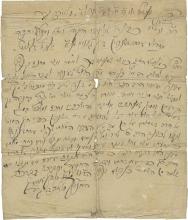
Smikhah letter, 1877

My own ordination as a maggid (a Jewish preacher and storyteller) included telling a story.  Ordination as a rabbi often includes giving a divrei Torah (“words of Torah”, corresponding to a sermon in the Christian tradition).  In both cases written documents are signed, and the final step is the laying on of hands (smikhah) transmitting authority from the teacher to the student.1

The first priests of the Israelites undergo an entirely different initiation experience in this week’s Torah portion, Tzav (“Command”).  The primary job of biblical priests is to process various animal and grain offerings according to all the rules in the book of Leviticus/Vayikra.  Priests also enforce the rules on ritual purity;2 diagnose the skin disease of tzara-at;3 recite a blessing formula over the community;4; tend the menorah (lampstand) and other holy items inside the sanctuary;5 and look impressive while on duty.6  No wonder the ordination of the first priests focuses on purification, blood, and clothing.

First, in front of all the Israelites, Moses bathes Aaron and his four sons in water.7  Water and the blood of animal offerings are purifying agents in the Torah.  Next Moses dresses Aaron in all the garments of the high priest, ending with the gold forehead ornament engraved “Holy to God”.8

Next Moses picks up the anointing oil.  In the Hebrew Bible, only priests and kings are anointed before they take up their duties.

Then Moses took the anointing oil, and he anointed the sanctuary and everything that was in it, vayekadeish them.  And he sprinkled some of it seven times on the altar, and all its tools, and the basin and its stand, lekadesham.  And he poured out some of the anointing oil on the head of Aaron, and he anointed him lekadeshu.  (Leviticus/Vayikra 8:10-12)

vayekadeish (וְַיקַדֵּשׁ) = and he made holy, and he sanctified.  (In the Hebrew Bible, kadosh (קָדוֹשׁ = holy) means set apart for God rather than for ordinary use.  See my post Kedoshim: Reciprocal Holiness.)

lekadesham (לְקַדְּשָׁם) = to made them holy.

lekadeshu (לְקַדְּשׁוּ) = to make him holy.

Moses uses the same oil to make Aaron and all the objects related to the sanctuary holy.9  While the temple stood in Jerusalem, priesthood was hereditary and new priests, when they came of age, were anointed to consecrate them for serving God.

After the anointing, Moses finally dresses Aaron’s four sons in their assistant priest garments.  (Some commentary assumes that they put on their own linen breeches after the bathing, so they did not spend the entire time nude.)

Then Moses slaughters three animal offerings: a bull as a chataat (חַטָּאת) = reparation-offering, a ram as an olah (עֹלָה) = rising-offering, and a second ram as a milu-im (מִלֻּאִים) = ordination-offering.  (See my posts Vayikra & Tzav: Fire Offerings without Slaughter, Part 1 and Part 2 on these three types of offerings.)

Smikhah for Aaron and sons

And he presented the bull of the reparation-offering, and Aaron and his sons laid their hands on the head of the bull of the reparation-offering.  And Moshe slaughtered it. and he took the blood and put it on the horns of the altar all around with his finger, and he made reparation for the altar.  And he poured out the blood onto the foundation of the altar, and vayekadeish it for atonement.  (Leviticus 8:14-15)

The five men who are being ordained transfer some of their spirit or identity to the bull by laying their hands on its head.  (See last week’s post, Vayikra & Jeremiah: Kidneys.)  Then Moses cuts its throat and puts blood on the four corners of the altar, which are shaped like animal horns, as well as on its foundation.  According to Rashi, this blood not only makes the altar ritually pure, but also changes its status from ordinary to holy, so it can be used from then on to make reparations for people’s errors and atone for their crimes against God.10

Horned altar at Beersheva

Moses slaughters the first ram as an olah and burns up the whole animal into smoke; the God-character in the sky appreciates the fragrance.11  Then he slaughters the second ram as a milu-im, an ordination offering.  Just as he daubed bull’s blood on the horns of the altar, Moses daubs ram’s blood on the right ears, right thumbs, and right big toes of the five men being ordained, before he splashes the rest on the altar.12

Then Moses took some of the anointing oil and some of the blood that was on the altar, and he sprinkled on Aaron, on his clothes, on his sons, and on the clothes of his sons with him.  Vayekadeish Aaron and his clothes and his sons and the clothes of his sons with him.  (Leviticus 8:30)

The anointing oil is for consecration; the blood is for ritual purification.  Having completed both, Moses tells Aaron and his sons to spend seven days and nights at the entrance of the sanctuary.  On the eighth day, the new priests will officially inaugurate the altar, and their own service, with seven animal offerings and a grain offering.  (See my post Tzav: Filling Up a Priest.)

Why does Moses apply oil and blood not only to the five men he is ordaining, but also to their clothing and the altar?

Sacrificing an animal is the primary means of worshiping God in the most of the Hebrew Bible.  Once the priests are ordained, the Israelites bring their animals to the altar to be slaughtered.  The priests collect and splash the blood, butcher the animals, lift up animal parts, burn, roast, and remove waste.  Both the priests and the altar are intermediaries between the people and God.


When I reread this week’s Torah portion I felt sorry for the priests in the bible.  Their honor is merely hereditary, and their contribution to the welfare of the Israelites consists in following the rules.  They do not volunteer creative work, like Betzaleil and the artisans who craft all the items for the tent-sanctuary.  They do not make plans and decisions, like the kings and their generals and aides.  They do not have visions and hear God’s voice, like the prophets.

The priests also do not get to tell stories, like a maggid.  They do not get to explain words of Torah, like a rabbi.  They learn the Torah only in order to follow and teach the rules about offerings, impurity, diseases, and temple protocol.  No wonder the ordination of the first priests includes multiple applications of blood from animal offerings in order to effect ritual purity.

Nevertheless, the Israelites depend on the labor of the priests so they can worship God in the only way they know.  Today, may we all honor those who follow the rules and keep things running just as much as we honor inspired artists, leaders, and prophets.


  1. For more on smikhah see last week’s post, Vayikra & Jeremiah: Kidneys.
  2. The many examples include Leviticus 12 and 15, and Numbers 5 and 6:9-20.
  3. Leviticus 13:1-14:57.
  4. Numbers 6:22-27.
  5. Exodus 27:20-21, Numbers 8:1-3.
  6. Priests are not allowed to serve at the altar or inside the sanctuary unless they have unblemished bodies (Leviticus 21:16-23 and 21:18-20). They must also be wearing their garments made of white linen and expensive dyes, and when the high priest officiates he wears a gold tabard with gems and a gold plate on his forehead (Exodus 28).  The high priest may not dishevel his hair or rip his garments—the usual signs of mourning—even when his closest family members die (Leviticus 21:10-12).
  7. Leviticus 8:6.
  8. Leviticus 8:7-9. For more information, see my post Tetzavveh: Holy Flower.
  9. But God’s instructions to Moses in Exodus 29:7 only mention pouring oil on Aaron’s head, not on the sanctuary or the altar.
  10. Rashi (11th-century Rabbi Shlomoh Yitzchaki) explained that Moses chata, made reparation, not because anyone had missed the mark, but simply to purify the altar so as to convert it from an ordinary state to a holy state.
  11. Leviticus 8:18-21.
  12. Leviticus 8:22-24.

Tzav: Filling Up a Priest

The Israelites complete the tent that will serve as a portable temple at the end of the book of Exodus/Shemot. Moses consecrates the altar and the priests who will perform all the required rituals in this week’s Torah portion, Tzav, the second portion in the book of Leviticus/Vayikra.

High Priest’s garments

Moses assembles the whole community outside the entrance of the new Tent of Meeting. In front of everyone he washes his brother Aaron and Aaron’s four sons, then dresses them in the white, gold, red, purple, and blue ritual garments described in the book of Exodus/Shemot.1

The ceremony continues with the ritual slaughter of a bull and three rams, offerings of animal parts and three kinds of flat cakes, and the application of anointing oil and blood from the slaughtered animals in various locations and combinations. (See my post Tzav: Oil and Blood.) After the gorgeous new ceremonial garments are spotted all over with oil and blood they are holy—dedicated to God.  So are Aaron and his sons, but they are not yet priests.

Moses leaves them with a supply of boiled meat (from the second ram) and leftover grain products (from the grain offering), and gives them strict instructions:

You must not leave the entrance of the Tent of Meeting for seven days, until the day of melot the days of your milu-im; because in seven days yemallei your yad. (Leviticus/Vayikra 8:33)

melot (מְלֺאת) = filling up, being full, fulfilling, completing.  (A form of the verb mala, מָלַא = filled, was full.)

milu-im (מִילֻּאִים) = ordination; setting for a jewel to fill.  (From the root mala.)

yemallei (יְמַלֵּא) = it will fill up.  (Another form of the verb mala.)

yad (יַד) = hand; power, ability.

mala yad (מָלַא יַד) = Literally: filled the hand.  Idiomatically: ordained.2

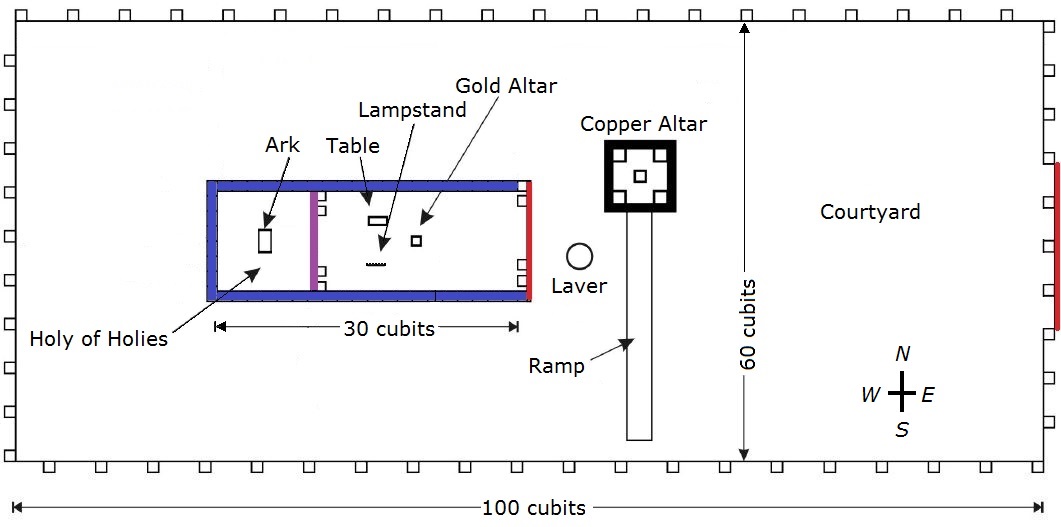
Tent of Meeting and its courtyard
(entrances in red)

According to God’s instructions to Moses in the book of Exodus, one part of the ritual will be repeated each day during this seven-day period: the slaughter of a bull and consecration of the altar with its blood.3 But Aaron and his sons will simply sit in the tent entrance in their spattered garments, gradually eating their portions of the meat and grain offerings that they had shared with God.

God commanded to do what was done today, to atone for you. And you must sit at the entrance of the Tent of Meeting day and night for seven days, and you must watch over the watch of God, so you will not die; for so I was commanded.  (Leviticus 8:34-35)

The Torah does not say whether the long ritual served as a general atonement and spiritual purification, or whether it atones for Aaron’s sin of making the golden calf back in the book of Exodus.4

Nor does it say what Aaron and his sons must watch over or guard for seven days. Many commentators have written that they spend the seven days meditating on the rules of holiness and ritual purity for serving God.5

Another viewpoint is that they are mourning, because they have a premonition that at least one of them will die on the eighth day, when they first serve God as official priests.6 But when Aaron’s two oldest sons, Nadav and Avihu, do die on the eighth day, in next week’s Torah portion, it comes as a shock to everyone.

The Torah also quotes Moses as telling Aaron and his sons that they must not leave the entrance of the Tent of Meeting for seven days because “it will fill up (yemallei) your ability (yad)”.  Maybe it takes seven days in the entrance to God’s dwelling-place to fill up with sufficient holy awe to be able to conduct the business of holiness.

What strikes me is that Aaron and his sons are neither born nor trained to be priests.  They get their new positions without any previous job experience.

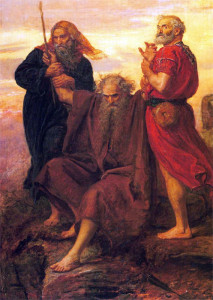
Chur and Aaron support Moses, by J.E. Millais, 1871

Up to this point, Aaron has not been the sort of man who wears a gold medallion on his forehead saying “Holy to God”.   It’s clear in the book of Exodus that God only calls Aaron in because Moses makes so many objections to the job God gives him at the burning bush.7  To his credit, Aaron greets his long-lost brother without jealousy, and willingly serves as Moses’ sidekick.  When the Israelites are attacked by Amalek on the way to Mount Sinai, Aaron literally supports Moses’ arm and helps him save the day.8  But when Moses climbs Mount Sinai and does not return for 40 days, and the people panic and ask for idols, Aaron makes the golden calf.

Now Aaron is promoted from Moses’ unreliable assistant to High Priest.  Aaron will officiate over the ritual offerings in the sanctuary.  Aaron will light the menorah.  Aaron will be in charge of God’s dwelling place.

Aaron’s four sons are also getting major promotions.  They have not done anything of distinction, though they would be treated with the respect simply because they are Aaron’s sons.9  Now they are being ordained as priests.  They will be the only people besides Moses and Aaron and Moses who are allowed to enter the Tent of Meeting, the only people allowed to handle the holiest objects inside it.  Only they will turn the offerings of their people into smoke that ascends to God.

For seven days Aaron and his sons sit inside the sanctuary, in the entrance of the Tent of Meeting. Perhaps they face out, gazing at the bronze altar and the wash-basin in the sunlit courtyard. Perhaps they face in, gazing at the golden menorah, incense altar, and bread table under the tent roof, not to mention the curtain screening off the ark itself.  For seven days they sit there, without distractions, realizing they will spend the rest of their lives dedicated to holy service.

I doubt they are doing anticipatory mourning for the coming deaths of Nadav and Avihu. But they may be mourning for their old way of life, which has ended forever.  At the end of seven days, they will be the servants of God’s dwelling-place, who must act as God’s representatives every waking minute.

Their new lives as priests are imposed on them.  They do not apply for the job. They do not even hear God call them, the way prophets in the Hebrew Bible are called into service. Moses simply tells them what God told him do. It might seem like a great honor to them, or it might seem as arbitrary as an accident.

At least they are granted seven days to sit at the entrance of their new lives, experiencing the grief, fear, awe, and whatever else comes along, letting the transformation sink in.

We don’t have a Moses to set aside seven days for us when we face a sudden major change in life.  But we have the example in this week’s Torah portion.  May everyone who can take time on the threshold between an old life and a new one receive the inspiration to sit and reflect.  And whenever our lives change, may God fill up our ability to meet the new challenge.

(An earlier version of this essay was posted in March 2010.)

1  Exodus 28:1-43, 39:1-31. See my post Tetzavveh: The Clothes Make the Man.

2  The source of this idiom is not known, but it may be related to the elevation offering, the tenufah (תְּנוּפָה), in which priests lay the meat or grain cakes to be offered on their palms and either hold them out, raise them, or wave them toward God before burning them. A tenufah was part of the ordination ceremony for Aaron and his sons (Leviticus 8:26-28).

3  Exodus 29:35-38.

4  Exodus 32:1-8, 21-25. See my post Ki Tissa: Out Came this Calf!

5  e.g. 13th-century rabbi Moses ben Nachman (a.k.a. Ramban, Nachmanides), paraphrased in Elie Munk, The Call of the Torah: Vayikra, trans. by E.S. Mazer, Mesorah Publications, 1992, p. 71; 19th-century rabbi Sampson Raphael Hirsch, The Hirsch Chumash: Sefer Vayikra, Part 1, trans. by Daniel Haberman, Feldheim Publishers, Jerusalem, 2002, p. 277.

6  Midrash Tanchuma, a collection of commentary from the 5th through 8th centuries C.E., paraphrased in Munk, p. 72.  Aaron’s two older sons, Nadav and Avihu, do die on the eighth day, consumed by a fire from God (Leviticus 10:1-2); and Moses forbids Aaron and his two surviving sons to engage in mourning for them (Leviticus 10:6-7). The seven days sitting at the tent entrance are compared to the initial seven-day mourning period of shivah, but “sitting shivah” is a later Jewish custom.

7  Exodus 4:10-17.

8  Exodus 17:8-13.  See my post Beshallach: Hands Up.

9  Aaron’s two older sons, Nadav and Avihu, are treated as if they are elders when they walk partway up Mount Sinai with the 70 regular elders, Moses, and Aaron to behold a vision of God’s feet (Exodus 24:1, 9-11).

Haftarot for Vayikra & Tzav—Isaiah & Jeremiah: Useless Gods

Every week of the year has its own Torah portion (a reading from the first five books of the Bible) and its own haftarah (an accompanying reading from the books of the prophets). Last week the Torah portion was Vayikra (Leviticus 1.1-5:26) and the haftarah was Isaiah 43:21-44:23. This week the Torah portion is Tzav (Leviticus 6:1-8:36) and the haftarah is Jeremiah 7:21-8:3 and 9:22-23.

The first two Torah portions in the book of Leviticus/Vayikra consist entirely of instructions for making offerings on the altar: what each type of offering is for, what kind of animal or grain should be brought, and how the priests should process them. In Leviticus, this is the primary way to worship God, so the instruction manual is important.

The two accompanying haftarah readings both declare that offerings on God’s altar are meaningless when people are also making and worshiping idols.

The children of Judah have done what is bad in My eyes, declares God. They have set their abominable idols in the House with My name on it, defiling it. And they have built shrines of the Tofet in the valley of Ben-Hinnom, for burning their sons and their daughters in the fire, which I did not command and which did not arise in my mind. (Jeremiah 7:30-31)

Tofet in "Bible Pictures", 1897
Tofet in “Bible Pictures”, 1897

Jeremiah decries the placement of statues of other gods right in God’s temple (“house”) in Jerusalem, as well as the practice of Tofet-worship in the valley below.  The haftarah from Isaiah points out that a craftsman might burn part of a log to burn for heat and cooking, and carve another part of the log into a statue to which he bows down and prays.

Yotzeir of an idol—

All of them are emptiness;

And what they crave

Cannot be useful.  (Isaiah 44:9)

yotzeir (יֹצֵר) = shaping, forming, fashioning.

Other gods and the statues that represent them are empty, useless. God is the yotzeir of real humans; but a human is a yotzeir of false gods.

Jeremiah agrees that worshiping other gods is useless. In a prophecy that follows this week’s haftarah, Jeremiah says:

And the towns of Judah and inhabitants of Jerusalem will go to the gods for whom they sent up offerings in smoke, and call for help. But they [these gods] will certainly not rescue them at the time of their adversity. (Jeremiah 11:12)

The haftarah in Isaiah goes a step further, and declares other gods simply do not exist.

Thus said God, king of Israel

And its redeemer, God of Armies:

I am first and I am last

And except for Me there are no gods. (Isaiah 44:6)

The haftarot in Jeremiah and Isaiah agree that God punished the people of Judah for making and worshipping other so-called gods by sending in the Babylonian army to conquer the land and destroy Jerusalem and its temple. (See my post Haftarah for Bo—Jeremiah: The Ruler of All Armies.)

Does that leave any hope for the future? Jeremiah, who witnessed the siege of Jerusalem in 589-587 B.C.E., predicts only more disaster.

Vulture on Assyrian relief carving in Kalhu

And the carcasses of these people will be food for the birds of the sky and for beasts of the earth, and there will be no tomorrow. (Jeremiah 7:33)

And death will be preferable over life for all the remainder of those remaining from this wicked family, in all the places where I will push them… (Jeremiah 8:3)

But chapters 40-66 of the book of Isaiah were written at least 50 years later, after the Babylonian empire had been replaced by the Persians. Although the Jews did not get an independent kingdom again, the new Persian emperors granted them religious freedom and let those who wished go back to Jerusalem and build a second temple for their god.

The haftarah from Isaiah interprets this Persian policy as God’s intervention. After criticizing the Israelites for their idolatry, the haftarah says:

I have wiped away like a mist your rebellion

And like a cloud your transgressions.

Return to Me, for I have reclaimed You. (Isaiah 44:22)

How can they return? What should they do that is more important than making offerings at a rebuilt altar?

This week’s haftarah from Jeremiah says they should follow God’s directions for the right way to behave in the world.

Heed My voice, and I will be your god and you will be My people; but you must walk on the entire path that I command you, so that it will go well for you. (Jeremiah 7:23)

Last week’s haftarah from Isaiah says they should praise God to the rest of the world.

This people yatzarti for Myself:

My praise they should report! (Isaiah 43:21)

yatzarti (יָזַרְתִּי) = I formed, I shaped, I fashioned. (From the same verb as yotzeir above.)

Instead of forming statues of empty, useless gods, the people should report what the real God is.

But the Israelites of Judah turned deaf (according to Jeremiah) and mute (according to Isaiah) where God was concerned.

*

We still make idols for ourselves, 2,600 years later, and we still worship “gods” that are ultimately useless. Some people pursue power as if it were the source of life—until their careers or families crash and they discover they live in a spiritual exile. Others dedicate themselves to accumulating or spending money—until a disaster reveals how they devoted so much time and energy to something so transient. We do not need an anthropomorphic god to send an army against us; serving the false gods we create carries its own intrinsic punishment, preventing us from leading full and meaningful lives.

A Jeremiah can point out that the wrong path leads to a bitter death. Sometimes this is the slap in the face we need to wake up.

But an Isaiah can give us hope for a second chance, however late in life. If we return to God—if we return of a life of appreciating reality (one form of praising God), appreciating one another, remembering we are only human, and rejoicing when we come home to our better selves—then the divine spirit will wipe away our former false worship like a mist, like a cloud. We can change, and true meaning can return to our lives.